EP0447940B1 - Sintered product for making sheath used for continuous thin plate molding apparatus and sheath using the same - Google Patents
Sintered product for making sheath used for continuous thin plate molding apparatus and sheath using the same Download PDFInfo
- Publication number
- EP0447940B1 EP0447940B1 EP91103855A EP91103855A EP0447940B1 EP 0447940 B1 EP0447940 B1 EP 0447940B1 EP 91103855 A EP91103855 A EP 91103855A EP 91103855 A EP91103855 A EP 91103855A EP 0447940 B1 EP0447940 B1 EP 0447940B1
- Authority
- EP
- European Patent Office
- Prior art keywords
- sheath
- sintered article
- weight
- less
- powder
- Prior art date
- Legal status (The legal status is an assumption and is not a legal conclusion. Google has not performed a legal analysis and makes no representation as to the accuracy of the status listed.)
- Expired - Lifetime
Links
- 238000000465 moulding Methods 0.000 title 1
- PZNSFCLAULLKQX-UHFFFAOYSA-N Boron nitride Chemical compound N#B PZNSFCLAULLKQX-UHFFFAOYSA-N 0.000 claims description 29
- 229910052582 BN Inorganic materials 0.000 claims description 28
- 238000009749 continuous casting Methods 0.000 claims description 24
- RVTZCBVAJQQJTK-UHFFFAOYSA-N oxygen(2-);zirconium(4+) Chemical compound [O-2].[O-2].[Zr+4] RVTZCBVAJQQJTK-UHFFFAOYSA-N 0.000 claims description 19
- 229910001928 zirconium oxide Inorganic materials 0.000 claims description 19
- PMHQVHHXPFUNSP-UHFFFAOYSA-M copper(1+);methylsulfanylmethane;bromide Chemical compound Br[Cu].CSC PMHQVHHXPFUNSP-UHFFFAOYSA-M 0.000 claims description 10
- 239000011230 binding agent Substances 0.000 claims description 7
- 238000005245 sintering Methods 0.000 claims description 5
- OJMOMXZKOWKUTA-UHFFFAOYSA-N aluminum;borate Chemical compound [Al+3].[O-]B([O-])[O-] OJMOMXZKOWKUTA-UHFFFAOYSA-N 0.000 claims description 4
- PNEYBMLMFCGWSK-UHFFFAOYSA-N aluminium oxide Inorganic materials [O-2].[O-2].[O-2].[Al+3].[Al+3] PNEYBMLMFCGWSK-UHFFFAOYSA-N 0.000 claims description 2
- 229910002076 stabilized zirconia Inorganic materials 0.000 claims description 2
- 229910052593 corundum Inorganic materials 0.000 claims 1
- 229910001845 yogo sapphire Inorganic materials 0.000 claims 1
- 239000000843 powder Substances 0.000 description 30
- 238000005299 abrasion Methods 0.000 description 16
- 230000007797 corrosion Effects 0.000 description 15
- 238000005260 corrosion Methods 0.000 description 15
- 239000000523 sample Substances 0.000 description 15
- 150000001875 compounds Chemical class 0.000 description 14
- 230000035939 shock Effects 0.000 description 14
- 229910052751 metal Inorganic materials 0.000 description 10
- 239000002184 metal Substances 0.000 description 10
- 239000000203 mixture Substances 0.000 description 8
- 239000002994 raw material Substances 0.000 description 8
- 229910000831 Steel Inorganic materials 0.000 description 7
- 239000000463 material Substances 0.000 description 7
- 239000010959 steel Substances 0.000 description 7
- 230000002950 deficient Effects 0.000 description 6
- 239000000155 melt Substances 0.000 description 6
- 230000000052 comparative effect Effects 0.000 description 4
- 238000010586 diagram Methods 0.000 description 4
- 238000002474 experimental method Methods 0.000 description 4
- 238000000034 method Methods 0.000 description 4
- 230000000694 effects Effects 0.000 description 3
- 239000011812 mixed powder Substances 0.000 description 3
- OKTJSMMVPCPJKN-UHFFFAOYSA-N Carbon Chemical compound [C] OKTJSMMVPCPJKN-UHFFFAOYSA-N 0.000 description 2
- MCMNRKCIXSYSNV-UHFFFAOYSA-N Zirconium dioxide Chemical compound O=[Zr]=O MCMNRKCIXSYSNV-UHFFFAOYSA-N 0.000 description 2
- 229910002804 graphite Inorganic materials 0.000 description 2
- 239000010439 graphite Substances 0.000 description 2
- 238000004519 manufacturing process Methods 0.000 description 2
- 239000002245 particle Substances 0.000 description 2
- 230000002459 sustained effect Effects 0.000 description 2
- PIGFYZPCRLYGLF-UHFFFAOYSA-N Aluminum nitride Chemical compound [Al]#N PIGFYZPCRLYGLF-UHFFFAOYSA-N 0.000 description 1
- QGZKDVFQNNGYKY-UHFFFAOYSA-N Ammonia Chemical compound N QGZKDVFQNNGYKY-UHFFFAOYSA-N 0.000 description 1
- RYGMFSIKBFXOCR-UHFFFAOYSA-N Copper Chemical compound [Cu] RYGMFSIKBFXOCR-UHFFFAOYSA-N 0.000 description 1
- GVGLGOZIDCSQPN-PVHGPHFFSA-N Heroin Chemical compound O([C@H]1[C@H](C=C[C@H]23)OC(C)=O)C4=C5[C@@]12CCN(C)[C@@H]3CC5=CC=C4OC(C)=O GVGLGOZIDCSQPN-PVHGPHFFSA-N 0.000 description 1
- 229920000877 Melamine resin Polymers 0.000 description 1
- 229910052581 Si3N4 Inorganic materials 0.000 description 1
- 238000002441 X-ray diffraction Methods 0.000 description 1
- -1 Y2O3 and MgO Chemical class 0.000 description 1
- 230000002411 adverse Effects 0.000 description 1
- KGBXLFKZBHKPEV-UHFFFAOYSA-N boric acid Chemical compound OB(O)O KGBXLFKZBHKPEV-UHFFFAOYSA-N 0.000 description 1
- 239000004327 boric acid Substances 0.000 description 1
- 238000010276 construction Methods 0.000 description 1
- 238000001816 cooling Methods 0.000 description 1
- 229910052802 copper Inorganic materials 0.000 description 1
- 239000010949 copper Substances 0.000 description 1
- 239000013078 crystal Substances 0.000 description 1
- 230000007812 deficiency Effects 0.000 description 1
- 229960002069 diamorphine Drugs 0.000 description 1
- 230000002708 enhancing effect Effects 0.000 description 1
- 238000011156 evaluation Methods 0.000 description 1
- 230000001747 exhibiting effect Effects 0.000 description 1
- 238000003754 machining Methods 0.000 description 1
- JDSHMPZPIAZGSV-UHFFFAOYSA-N melamine Chemical compound NC1=NC(N)=NC(N)=N1 JDSHMPZPIAZGSV-UHFFFAOYSA-N 0.000 description 1
- 238000009877 rendering Methods 0.000 description 1
- 239000011369 resultant mixture Substances 0.000 description 1
- 229910001220 stainless steel Inorganic materials 0.000 description 1
- 239000010935 stainless steel Substances 0.000 description 1
- 239000000126 substance Substances 0.000 description 1
- 238000005303 weighing Methods 0.000 description 1
Images

Classifications
-
- C—CHEMISTRY; METALLURGY
- C04—CEMENTS; CONCRETE; ARTIFICIAL STONE; CERAMICS; REFRACTORIES
- C04B—LIME, MAGNESIA; SLAG; CEMENTS; COMPOSITIONS THEREOF, e.g. MORTARS, CONCRETE OR LIKE BUILDING MATERIALS; ARTIFICIAL STONE; CERAMICS; REFRACTORIES; TREATMENT OF NATURAL STONE
- C04B35/00—Shaped ceramic products characterised by their composition; Ceramics compositions; Processing powders of inorganic compounds preparatory to the manufacturing of ceramic products
- C04B35/515—Shaped ceramic products characterised by their composition; Ceramics compositions; Processing powders of inorganic compounds preparatory to the manufacturing of ceramic products based on non-oxide ceramics
- C04B35/58—Shaped ceramic products characterised by their composition; Ceramics compositions; Processing powders of inorganic compounds preparatory to the manufacturing of ceramic products based on non-oxide ceramics based on borides, nitrides, i.e. nitrides, oxynitrides, carbonitrides or oxycarbonitrides or silicides
- C04B35/583—Shaped ceramic products characterised by their composition; Ceramics compositions; Processing powders of inorganic compounds preparatory to the manufacturing of ceramic products based on non-oxide ceramics based on borides, nitrides, i.e. nitrides, oxynitrides, carbonitrides or oxycarbonitrides or silicides based on boron nitride
-
- B—PERFORMING OPERATIONS; TRANSPORTING
- B22—CASTING; POWDER METALLURGY
- B22D—CASTING OF METALS; CASTING OF OTHER SUBSTANCES BY THE SAME PROCESSES OR DEVICES
- B22D11/00—Continuous casting of metals, i.e. casting in indefinite lengths
- B22D11/06—Continuous casting of metals, i.e. casting in indefinite lengths into moulds with travelling walls, e.g. with rolls, plates, belts, caterpillars
- B22D11/0637—Accessories therefor
- B22D11/0648—Casting surfaces
- B22D11/066—Side dams
Definitions
- This invention relates to a sintered article for a sheath to be used in an apparatus for continuous casting of a thin sheet and to a sheath using the sintered article. More particularly, it relates to a sintered article for a sheath to be used in an apparatus for continuous casting of a thin sheet, which apparatus is provided on the melt pouring side thereof with cylindrical surfaces as in a twin roll type or twin belt type apparatus which comprises two water-cooled rolls or two endless belts parallelly opposed to each other across a gap with the rotary shafts thereof laid horizontally and two sheath plates applied one each fast to the opposite lateral ends of the parallelly disposed water-cooled rolls or endless belts so as to give rise to an enclosure like a container on the parallelly disposed water-cooled rolls or endless belts and which effects continuous casting of a thin sheet by pouring a melt into the enclosure and rotating the two water-cooled rolls or endless belts inwardly toward each other, and a sheath using the sintered article.
- sintered articles of boron nitride (BN) and sintered articles of zirconium oxide (ZrO2) and alumina (Al2O3) have been known as materials for the parts which, like a sheath used in an apparatus provided on the inlet side thereof with cylindrical surfaces and operated for continuous casting of a thin sheet, are required to possess stability to resist thermal shock, corrosion, and abrasion.
- the sintered articles of BN show prominence in resistance to thermal shock and in lubricity on the one hand and betray low strength and deficiency in resistance to corrosion in the melt of steel such as stainless steel on the other hand.
- the sintered articles of ZrO2 and Al2O3 possess high strength and nevertheless suffer from the disadvantage that the sheaths using these sintered articles inflict scratches on the water-cooled rolls or endless belts which slide on the sheaths.
- the conventional sheath of the aforementioned type which combines portions different in material as described above, however, it has the disadvantage that the sheath is complicated in construction and troublesome to produce because it possibly induces leakage of the melt unless the different materials being used are adapted to possess an equal thermal expansion coefficient and the portions different in material are fitted to each other exactly.
- the desirability of providing a sintered article for an sheath which produces the sheath consisting solely of the sintered article instead of a combination of different materials and excelling in resistance to corrosion, resistance to thermal shock, and resistance to abrasion and consequently providing a sheath using the sintered article has been finding enthusiastic recognition.
- This invention perceived in the light of the true state of the prior art mentioned above, has as an object thereof the provision of a sintered article for a sheath consisting solely of the sintered article and excelling in resistance to corrosion, resistance to thermal shock, and resistance to abrasion and a sheath using such sintered article thereby alleviating the burden imposed on the apparatus used for continuous casting of a thin sheet.
- BN excels in resistance to thermal shock and in lubricity
- aluminum nitride (AlN) and aluminum borate (compound of Al2O3 and B2O3) excel in resistance to corrosion in fused steel
- ZrO2 excels in resistance to abrasion at elevated temperatures and consequently have found that a sintered article for a sheath possessing a prominent well-balanced quality manifested in resistance to thermal shock, resistance to corrosion, and resistance to abrasion and a sheath using the sintered article and consequently enjoying the same prominent quality as the sintered article are obtained by combining BN, AlN and/or the compound of Al2O3 and B2O3, and ZrO2 in a suitable ratio.
- the present invention has been perfected as the result.
- the object described above is accomplished by a sintered article composed of the following components, i) to iii), and used for a sheath in an apparatus for continuous casting of a thin sheet and also by a sheath formed of the sintered article and used in the apparatus for continuous casting of a thin sheet:
- Fig. 1 is an explanatory diagram of a twin roll type apparatus for continuous casting of a thin sheet.
- Fig. 2 is an explanatory diagram of another twin roll type apparatus for continuous casting of a thin sheet.
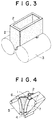
- Fig. 3 is an explanatory diagram of a sheath to be used in a twin roll type apparatus for continuous casting of a thin sheet.
- Fig. 4 is an explanatory diagram of a twin belt type apparatus for continuous casting of a thin sheet.
- the sintered article of this invention is required to have a BN content of not less than 65% by weight and particulary not less than 65% by weight and less than 86% by weight. If the BN content is less than 65% by weight, the sintered article is deficient in resistance to thermal shock due to fused steel and is liable to sustain cracks when it is immersed in fused steel or passed under fused steel. If the BN content exceeds 86% by weight, the sintered article tends to be deficient in strength.
- the BN powder as raw material before sintering has no particular restriction.
- the BN powder to be used is desired to be of the type which is converted in a sintered article into a hexagonal BN of high crystallinity because this type imparts enhanced lubricity to the sintered article.
- the BN in the sintered article is desired to be hexagonal BN for the purpose of enabling the sintered article to acquire lubricity. For this reason, it is desirable to use a hexagonal BN powder as the raw material before sintering.
- the sintered article is required to have a ZrO2 content of not less than 9% by weight, desirably not less than 15% by weight, and particularly not less than 9% by weight and less than 35% by weight. If the ZrO2 content is less than 9% by weight, the sintered article is deficient in resistance to abrasion at elevated temperatures and the sheath using this sintered article undergoes heavy wear per unit time and tends to induce leakage of a fused material to the extent of rendering it difficult for the operation of the sheath to be continued for a long time. If the ZrO2 content exceeds 35% by weight, the sintered article is deficient in resistance to thermal shock and liable to sustain cracks.
- the zirconia stabilized partially or completely by the addition of about 4 to 12 mol% of CaO or about 2 to 12 mol% of Y2O3, for example, may be used as the raw material of ZrO2 powder before sintering. It is, however, desirable to use completely stabilized zirconia because it removes the susceptibility of the sintered article to the occurrence of cracks.
- This sintered article of this invention further incorporates therein both or either of AlN and the compound of Al2O3 and B2O3.
- the content of this additional component is required to be not less than 5% by weight, desirably not less than 10% by weight, and particularly not less than 5% by weight and less than 45% by weight. If this content is less than 5% by weight, the sheath using the sintered article encounters difficulty in exhibiting sufficient resistance to corrosion in the fused steel. If the content exceeds 45% by weight, the sintered article is deficient in resistance to thermal shock and therefore liable to sustain cracks.
- the synthetic powder produced in advance by combining an Al2O3 powder and a B2O3 powder in a prescribed molar ratio may be used and the mixed powder obtained simply by mixing an Al2O3 powder with a B2O3 powder may be used otherwise as the raw material for the compound of Al2O3 and B2O3.
- the compounds of Al2O3 and B2O3 which are usable effectively herein include 9 Al2O3 ⁇ 2B2O3, 2Al2O3 ⁇ B2O3, and Al2O3.B2O3, etc.
- a mixture of the raw materials and a binder is preferably used for the production of the sintered article.
- the mixture is desired to contain the binder in an amount of not more than 5% by weight of the mixture, for the purpose of improving the sintering property of the mixture without a sacrifice of the sintered article's resistance to thermal shock or to abrasion.
- the sintered article which is produced of the mixture also contains the binder in an amount of not more than 5% by weight of the sintered article.
- the binders which are effectively usable herein include compounds of CaO and B2O3, compound of MgO and B2O3, compound of SrO and B2O3, and compound of BaO and B2O3, for example for BN and compounds such as Y2O3 and MgO, for example, for AlN.
- the total amount of the binders to be added exceeds 5% by weight, the disadvantage arises that the sintered article to be consequently produced is deficient in resistance to thermal shock and resistance to abrasion.
- the compounds of CaO and B2O3 which are effectively usable heroin include 2CaO ⁇ 3B2O3, CaO ⁇ B2O3, CaO ⁇ 2B2O3, 3CaO ⁇ B2O3, and 2CaO ⁇ B2O3, for example.
- the raw materials for the sintered article are invariably in a powdery form.
- the particles of the raw materials are desired to be small. Specifically, the particles are desired to have diameters not exceeding 10 ⁇ m.
- the sintered article of this invention is produced by the use of a hot press, for example. This production can be effected as follows.
- the BN powder, the ZrO2 powder, and both or either of the AlN powder and the compound powder of Al2O3 and B2O3 are uniformly mixed in a mixing ratio calculated to produce a sintered article of a prescribed composition.
- the resultant mixed powder is hot pressed under the conditions of a temperature of 1,900° to 2,100°C and a pressure of 1000 to 2000 N (100 to 200 kg/cm2), such that the resultant sintered article acquires a density of not less than 70% of the theoretical density.
- the sheath of the present invention can be produced, for example, by machining the resultant sintered article in a prescribed shape.
- Fig. 1 to Fig. 4 illustrate examples of a sheath 2
- Fig. 1 to Fig. 3 illustrate examples of a sheath 2 in a twin roll type apparatus for continuous casting of a thin sheet using two water-cooled rolls 3
- Fig. 4 illustrate an example of a sheath 2 in a twin belt type apparatus for continuous casting of a thin sheet using two endless belts 5.
- 1 stands for fused metal
- 2 for a sheath
- 3 for a water-cooled roll
- 4 for a thin sheet.
- the sheath 2 shown in Fig. 1 consists of two pieces applied one each fast to the opposite end faces of the water-cooled rools 3
- the sheath 2 shown in Fig. 2 consists of two pieces applied one each fast to the inner upper surfaces of the water-cooled rolls 3 in the opposite sides thereof.
- the sheath 2 shown in Fig. 3 has a box-shaped structure with the lower side of which, similarly to the sheath 2 of Fig. 2, contacts the inner upper surfaces of the water-cooled rolls 3 on the opposite ends thereof. It is, therefore, allowed to reserve the fused metal 1 (Fig. 1) in a larger amount.
- 1 stands for fused metal
- 2 for a sheath
- 4 for a thin sheet
- 5 for an endless belt
- 6 for a guide roll
- 7 for a water-cooling device.
- this sheath 2 is so disposed as to be nipped between two endless belts 5.
- the density of a sample sintered article was determined by measuring the dimensions of the sample and finding the volume thereof and, at the same time, weighing the sample, and calculating the following formula, using the volume and the weight.
- Density (g/cm3) Weight (g)/volume (cm3)
- the properties of the following items (2) to (4) were evaluated by the use of a twin roll type apparatus for continuous casting of a thin sheet, constructed as illustrated in Fig. 1 and operated under the following conditions.
- a sample sheath was visually examined to find whether or not it sustained a crack.
- the sample containing no crack was indicated by tile mark "o" and the sample containing a crack by the mark "x.”
- a sample sheath operated for continuous casting was visually examined as to the sign of corrosion.
- the sample showing virtually no sign of corrosion was indicated by the mark "O,” the sample showing a recognizable sign of slight corrosion but showing no sign of leakage of fused metal by the mark “ ⁇ ,” and the sample showing a sign of heavy corrosion and suffered from leakage of fused metal during the continuous casting by the mark "x.”
- a sample sheath after continuous casting was visually examined to determine whether or not it sustained abrasion.
- the sample showing virtually no sign of visible abrasion was indicated by the mark "o,” the sample showing a sign of slightly recognizable abrasion but showing no sign of leakage of fused metal by the mark " ⁇ ,” and the sample showing a sign of heavy abrasion and suffering from leakage of fused metal during the continuous casting by the mark "x.”
- a BN powder (Grade GP hexagonal BN crystals of purity of 99.0%, produced by Denki Kagaku Kogyo Kabushiki Kaisha), a stabilized ZrO2 powder (Grade 6Y ZrO2 of a purity of 89.8%, containing 10.1% by weight of Y2O3, produced by Tosoh Corporation), an AlN powder (Grade AP-10 of a purity of 99.0%, produced by Denki Kagaku Kogyo Kabushiki Kaisha), and a 2CaO ⁇ 3B2O3 powder as a binder were mixed in a varying ratio indicated in Table 1 for two hours.
- the resultant mixed powder was hot pressed under the conditions of 2,100°C and 1400 N 140 kg/cm2, to obtain a sintered article.
- the sintered article was fabricated into a sheath.
- the sheath was tested for chemical composition, density, resistance to thermal shock, resistance to corrosion, and resistance to abrasion.
- Boric acid and melamine were mixed in a weight ratio of 1 : 1.
- the resultant mixture was heat-treated in a current of ammonia gas at 1,200°C for four hours, to obtain a BN powder having a BN purity of 90% and a specific surface area of 50 m2/g.
- the produced powder was identified to be an amorphous BN powder.
- Sheaths were produced by faithfully following the procedure of Example 1, except that the BN powder just mentioned was used in place of the hexagonal BN powder used in Example 1. The sheaths were evaluated in the same manner as described above.
- a sheath was produced by following the procedure of Example 1, excepting 9Al2O3 ⁇ 2B2O3 whiskers (produced by Shikoku Kasei Kogyo K.K. and marketed under trademark designation of "Alborex G ”) was used in a proportion of 10% by weight in the place of the AlN powder and the proportion of the ZrO2 powder was changed to 20% by weight.
- the sheath was evaluated in the same manner as in Example 1.
- a sheath was produced by following the procedure of Example 1, excepting 68% by weight of the same BN powder, 5% by weight of the same ZrO2 powder, and 2% by weight of the same 2CaO ⁇ 3B2O3 powder as used in Example 1 and 25% by weight of 9Al2O3 ⁇ 2B2O3 whiskers were combined instead.
- the resultant sheath was evaluated in the same manner as in Example 1.
- This invention is constructed as described above and manifests the following effects.
- the sheath is produced easily and the burden imposed on the apparatus for continuous casting of a thin sheet is alleviated because the sheath excelling in resistance to thermal shock, resistance to corrosion, and resistance to abrasion is produced from one single material.
- the continuous casting of a thin sheet is stably attained because the possibility of the sintered article entailing such troubles as fracture is nil and the possiblity of the ingate being corrosion or abrasion and consequently mingling as an extraneous matter into the fused metal and exerting an adverse effect on the cast thin sheet is nil.
- the sintered article provided by this invention and the sheath using this sintered article therefore, contribute to improving the quality of the thin sheet to be continuously casted by the apparatus provided on the melt pouring side thereof with cylindrical surfaces such as, for example, a twin roll type, a twin belt type, or a belt drum type apparatus for continuous casting and also to enhancing the productivity of the continuous casting using the apparatus.
Landscapes
- Engineering & Computer Science (AREA)
- Chemical & Material Sciences (AREA)
- Ceramic Engineering (AREA)
- Mechanical Engineering (AREA)
- Manufacturing & Machinery (AREA)
- Materials Engineering (AREA)
- Structural Engineering (AREA)
- Organic Chemistry (AREA)
- Ceramic Products (AREA)
- Continuous Casting (AREA)
Description
- This invention relates to a sintered article for a sheath to be used in an apparatus for continuous casting of a thin sheet and to a sheath using the sintered article. More particularly, it relates to a sintered article for a sheath to be used in an apparatus for continuous casting of a thin sheet, which apparatus is provided on the melt pouring side thereof with cylindrical surfaces as in a twin roll type or twin belt type apparatus which comprises two water-cooled rolls or two endless belts parallelly opposed to each other across a gap with the rotary shafts thereof laid horizontally and two sheath plates applied one each fast to the opposite lateral ends of the parallelly disposed water-cooled rolls or endless belts so as to give rise to an enclosure like a container on the parallelly disposed water-cooled rolls or endless belts and which effects continuous casting of a thin sheet by pouring a melt into the enclosure and rotating the two water-cooled rolls or endless belts inwardly toward each other, and a sheath using the sintered article.
- Heretofore, sintered articles of boron nitride (BN) and sintered articles of zirconium oxide (ZrO₂) and alumina (Al₂O₃) have been known as materials for the parts which, like a sheath used in an apparatus provided on the inlet side thereof with cylindrical surfaces and operated for continuous casting of a thin sheet, are required to possess stability to resist thermal shock, corrosion, and abrasion.
- Incidentally, the sintered articles of BN show prominence in resistance to thermal shock and in lubricity on the one hand and betray low strength and deficiency in resistance to corrosion in the melt of steel such as stainless steel on the other hand. In contrast, the sintered articles of ZrO₂ and Al₂O₃ possess high strength and nevertheless suffer from the disadvantage that the sheaths using these sintered articles inflict scratches on the water-cooled rolls or endless belts which slide on the sheaths.
- For this reason, it has been proposed to divide a sheath between the portion destined to contact the melt and the part destined to slide against the water-cooled rolls or endless belts and use the sintered article of BN or Si₃N₄ and the like for the former portion and the sintered article of ZrO₂ or Al₂O₃ and the like for the latter portion (Japanese Patent Application Disclosure SHO 62(1987)-166,054 and Japanese Patent Application Disclosure SHO 60(1985)-162,557).
- The conventional sheath of the aforementioned type which combines portions different in material as described above, however, it has the disadvantage that the sheath is complicated in construction and troublesome to produce because it possibly induces leakage of the melt unless the different materials being used are adapted to possess an equal thermal expansion coefficient and the portions different in material are fitted to each other exactly. Thus, the desirability of providing a sintered article for an sheath which produces the sheath consisting solely of the sintered article instead of a combination of different materials and excelling in resistance to corrosion, resistance to thermal shock, and resistance to abrasion and consequently providing a sheath using the sintered article has been finding enthusiastic recognition.
- This invention, perceived in the light of the true state of the prior art mentioned above, has as an object thereof the provision of a sintered article for a sheath consisting solely of the sintered article and excelling in resistance to corrosion, resistance to thermal shock, and resistance to abrasion and a sheath using such sintered article thereby alleviating the burden imposed on the apparatus used for continuous casting of a thin sheet.
- After a diligent study, the present inventors have taken notice of the fact that BN excels in resistance to thermal shock and in lubricity, aluminum nitride (AlN) and aluminum borate (compound of Al₂O₃ and B₂O₃) excel in resistance to corrosion in fused steel, and ZrO₂ excels in resistance to abrasion at elevated temperatures and consequently have found that a sintered article for a sheath possessing a prominent well-balanced quality manifested in resistance to thermal shock, resistance to corrosion, and resistance to abrasion and a sheath using the sintered article and consequently enjoying the same prominent quality as the sintered article are obtained by combining BN, AlN and/or the compound of Al₂O₃ and B₂O₃, and ZrO₂ in a suitable ratio. The present invention has been perfected as the result.
- The object described above is accomplished by a sintered article composed of the following components, i) to iii), and used for a sheath in an apparatus for continuous casting of a thin sheet and also by a sheath formed of the sintered article and used in the apparatus for continuous casting of a thin sheet:
- i)
- Not less than 65% by weight of BN,
- ii)
- Not less than 9% by weight of ZrO₂, and
- iii)
- Not less than 5% by weight of at least one member selected from the group consisting of AlN and a compound of Al₂O₃ and B₂O₃,
the sum of these components being 100% by weight. - Fig. 1 is an explanatory diagram of a twin roll type apparatus for continuous casting of a thin sheet. Fig. 2 is an explanatory diagram of another twin roll type apparatus for continuous casting of a thin sheet. Fig. 3 is an explanatory diagram of a sheath to be used in a twin roll type apparatus for continuous casting of a thin sheet. Fig. 4 is an explanatory diagram of a twin belt type apparatus for continuous casting of a thin sheet.
- Now, the present invention will be described in detail below.
- The sintered article of this invention is required to have a BN content of not less than 65% by weight and particulary not less than 65% by weight and
less than 86% by weight. If the BN content is less than 65% by weight, the sintered article is deficient in resistance to thermal shock due to fused steel and is liable to sustain cracks when it is immersed in fused steel or passed under fused steel. If the BN content exceeds 86% by weight, the sintered article tends to be deficient in strength. - The BN powder as raw material before sintering has no particular restriction. The BN powder to be used is desired to be of the type which is converted in a sintered article into a hexagonal BN of high crystallinity because this type imparts enhanced lubricity to the sintered article. To be specific, the BN in the sintered article is desired to be hexagonal BN for the purpose of enabling the sintered article to acquire lubricity. For this reason, it is desirable to use a hexagonal BN powder as the raw material before sintering.
- The sintered article is required to have a ZrO₂ content of not less than 9% by weight, desirably not less than 15% by weight, and particularly not less than 9% by weight and less than 35% by weight. If the ZrO₂ content is less than 9% by weight, the sintered article is deficient in resistance to abrasion at elevated temperatures and the sheath using this sintered article undergoes heavy wear per unit time and tends to induce leakage of a fused material to the extent of rendering it difficult for the operation of the sheath to be continued for a long time. If the ZrO₂ content exceeds 35% by weight, the sintered article is deficient in resistance to thermal shock and liable to sustain cracks.
- The zirconia stabilized partially or completely by the addition of about 4 to 12 mol% of CaO or about 2 to 12 mol% of Y₂O₃, for example, may be used as the raw material of ZrO₂ powder before sintering. It is, however, desirable to use completely stabilized zirconia because it removes the susceptibility of the sintered article to the occurrence of cracks.
- This sintered article of this invention further incorporates therein both or either of AlN and the compound of Al₂O₃ and B₂O₃. The content of this additional component is required to be not less than 5% by weight, desirably not less than 10% by weight, and particularly not less than 5% by weight and less than 45% by weight. If this content is less than 5% by weight, the sheath using the sintered article encounters difficulty in exhibiting sufficient resistance to corrosion in the fused steel. If the content exceeds 45% by weight, the sintered article is deficient in resistance to thermal shock and therefore liable to sustain cracks.
- In the aforementioned group consisting of AlN and the compound of Al₂O₃ and B₂O₃, the synthetic powder produced in advance by combining an Al₂O₃ powder and a B₂O₃ powder in a prescribed molar ratio may be used and the mixed powder obtained simply by mixing an Al₂O₃ powder with a B₂O₃ powder may be used otherwise as the raw material for the compound of Al₂O₃ and B₂O₃. For the sintered article to be produced with prominent properties, it is desirable to use the synthetic powder which is obtained by combining Al₂O₃ and B₂O₃ in advance in a molar ratio of 9 : 2.
- The compounds of Al₂O₃ and B₂O₃ which are usable effectively herein include 9 Al₂O₃·2B₂O₃, 2Al₂O₃·B₂O₃, and Al₂O₃.B₂O₃, etc.
- A mixture of the raw materials and a binder is preferably used for the production of the sintered article. The mixture is desired to contain the binder in an amount of not more than 5% by weight of the mixture, for the purpose of improving the sintering property of the mixture without a sacrifice of the sintered article's resistance to thermal shock or to abrasion. The sintered article which is produced of the mixture also contains the binder in an amount of not more than 5% by weight of the sintered article. The binders which are effectively usable herein include compounds of CaO and B₂O₃, compound of MgO and B₂O₃, compound of SrO and B₂O₃, and compound of BaO and B₂O₃, for example for BN and compounds such as Y₂O₃ and MgO, for example, for AlN.
- If the total amount of the binders to be added exceeds 5% by weight, the disadvantage arises that the sintered article to be consequently produced is deficient in resistance to thermal shock and resistance to abrasion.
- The compounds of CaO and B₂O₃ which are effectively usable heroin include 2CaO·3B₂O₃, CaO·B₂O₃, CaO·2B₂O₃, 3CaO·B₂O₃, and 2CaO·B₂O₃, for example.
- The raw materials for the sintered article are invariably in a powdery form. For the raw materials to produce a highly desirable sintered article, the particles of the raw materials are desired to be small. Specifically, the particles are desired to have diameters not exceeding 10 µm.
- The sintered article of this invention is produced by the use of a hot press, for example. This production can be effected as follows.
- First, the BN powder, the ZrO₂ powder, and both or either of the AlN powder and the compound powder of Al₂O₃ and B₂O₃ (which may be a mixture of Al₂O₃ powder and B₂O₃ powder) are uniformly mixed in a mixing ratio calculated to produce a sintered article of a prescribed composition. In a graphite mold, the resultant mixed powder is hot pressed under the conditions of a temperature of 1,900° to 2,100°C and a pressure of 1000 to 2000 N (100 to 200 kg/cm²), such that the resultant sintered article acquires a density of not less than 70% of the theoretical density. The sheath of the present invention can be produced, for example, by machining the resultant sintered article in a prescribed shape.
- Fig. 1 to Fig. 4 illustrate examples of a
sheath 2 and Fig. 1 to Fig. 3 illustrate examples of asheath 2 in a twin roll type apparatus for continuous casting of a thin sheet using two water-cooledrolls 3 and Fig. 4 illustrate an example of asheath 2 in a twin belt type apparatus for continuous casting of a thin sheet using twoendless belts 5. - In Fig. 1 and Fig. 2, 1 stands for fused metal, 2 for a sheath, 3 for a water-cooled roll, and 4 for a thin sheet. Particularly, the
sheath 2 shown in Fig. 1 consists of two pieces applied one each fast to the opposite end faces of the water-cooledrools 3 and thesheath 2 shown in Fig. 2 consists of two pieces applied one each fast to the inner upper surfaces of the water-cooledrolls 3 in the opposite sides thereof. - The
sheath 2 shown in Fig. 3 has a box-shaped structure with the lower side of which, similarly to thesheath 2 of Fig. 2, contacts the inner upper surfaces of the water-cooledrolls 3 on the opposite ends thereof. It is, therefore, allowed to reserve the fused metal 1 (Fig. 1) in a larger amount. - In Fig. 4, 1 stands for fused metal, 2 for a sheath, 4 for a thin sheet, 5 for an endless belt, 6 for a guide roll, and 7 for a water-cooling device. Particularly, this
sheath 2 is so disposed as to be nipped between twoendless belts 5. - Now, this invention will be described more specifically below with reference to working examples, which are intended to be merely illustrative of and not in any sense limitative of the invention.
- First, the methods used in the working examples and the comparative experiments to be cited hereinbelow for evaluation of samples will be described below.
- The density of a sample sintered article was determined by measuring the dimensions of the sample and finding the volume thereof and, at the same time, weighing the sample, and calculating the following formula, using the volume and the weight.

The properties of the following items (2) to (4) were evaluated by the use of a twin roll type apparatus for continuous casting of a thin sheet, constructed as illustrated in Fig. 1 and operated under the following conditions. - ① Water-cooled rolls
These were internally water-cooled cast rolls of copper measuring 1,000 mm in diameter and 1,000 mm in length. The thin sheet to be cast measured 3 mm in thickness and 1,000 mm in width. The water-cooled rolls were rotated at a rate of 32 m/min. - ② Sheath
This was made of a varying sintered article obtained in the working examples and the comparative experiments and used in the apparatus. - ③ Fused metal
This was the fused mass of SUS304 steel. The temperature of the fused metal held in a turn dish was 1,530°C. - A sample sheath was visually examined to find whether or not it sustained a crack. The sample containing no crack was indicated by tile mark "o" and the sample containing a crack by the mark "x."
- A sample sheath operated for continuous casting was visually examined as to the sign of corrosion. The sample showing virtually no sign of corrosion was indicated by the mark "O," the sample showing a recognizable sign of slight corrosion but showing no sign of leakage of fused metal by the mark "△," and the sample showing a sign of heavy corrosion and suffered from leakage of fused metal during the continuous casting by the mark "x."
- A sample sheath after continuous casting was visually examined to determine whether or not it sustained abrasion. The sample showing virtually no sign of visible abrasion was indicated by the mark "o," the sample showing a sign of slightly recognizable abrasion but showing no sign of leakage of fused metal by the mark "△," and the sample showing a sign of heavy abrasion and suffering from leakage of fused metal during the continuous casting by the mark "x."
- In a shaking mill, a BN powder (Grade GP hexagonal BN crystals of purity of 99.0%, produced by Denki Kagaku Kogyo Kabushiki Kaisha), a stabilized ZrO₂ powder (Grade 6Y ZrO₂ of a purity of 89.8%, containing 10.1% by weight of Y₂O₃, produced by Tosoh Corporation), an AlN powder (Grade AP-10 of a purity of 99.0%, produced by Denki Kagaku Kogyo Kabushiki Kaisha), and a 2CaO·3B₂O₃ powder as a binder were mixed in a varying ratio indicated in Table 1 for two hours.
- In a graphite die, the resultant mixed powder was hot pressed under the conditions of 2,100°C and 1400 N 140 kg/cm², to obtain a sintered article.
- The sintered article was fabricated into a sheath. The sheath was tested for chemical composition, density, resistance to thermal shock, resistance to corrosion, and resistance to abrasion.
- The results are shown in Table 1.
- Boric acid and melamine were mixed in a weight ratio of 1 : 1. The resultant mixture was heat-treated in a current of ammonia gas at 1,200°C for four hours, to obtain a BN powder having a BN purity of 90% and a specific surface area of 50 m²/g.
- By the X-ray diffraction analysis, the produced powder was identified to be an amorphous BN powder.
- Sheaths were produced by faithfully following the procedure of Example 1, except that the BN powder just mentioned was used in place of the hexagonal BN powder used in Example 1. The sheaths were evaluated in the same manner as described above.
- The results are shown in Table 1.
- A sheath was produced by following the procedure of Example 1, excepting 9Al₂O₃·2B₂O₃ whiskers (produced by Shikoku Kasei Kogyo K.K. and marketed under trademark designation of "Alborex G ") was used in a proportion of 10% by weight in the place of the AlN powder and the proportion of the ZrO₂ powder was changed to 20% by weight. The sheath was evaluated in the same manner as in Example 1.
- A sheath was produced by following the procedure of Example 1, excepting 68% by weight of the same BN powder, 5% by weight of the same ZrO₂ powder, and 2% by weight of the same 2CaO·3B₂O₃ powder as used in Example 1 and 25% by weight of 9Al₂O₃·2B₂O₃ whiskers were combined instead. The resultant sheath was evaluated in the same manner as in Example 1.
- The results are shown in Table 1.

- This invention is constructed as described above and manifests the following effects.
- (1) In accordance with the present invention, the sheath is produced easily and the burden imposed on the apparatus for continuous casting of a thin sheet is alleviated because the sheath excelling in resistance to thermal shock, resistance to corrosion, and resistance to abrasion is produced from one single material.
- (2) The continuous casting of a thin sheet is stably attained because the possibility of the sintered article entailing such troubles as fracture is nil and the possiblity of the ingate being corrosion or abrasion and consequently mingling as an extraneous matter into the fused metal and exerting an adverse effect on the cast thin sheet is nil. The sintered article provided by this invention and the sheath using this sintered article, therefore, contribute to improving the quality of the thin sheet to be continuously casted by the apparatus provided on the melt pouring side thereof with cylindrical surfaces such as, for example, a twin roll type, a twin belt type, or a belt drum type apparatus for continuous casting and also to enhancing the productivity of the continuous casting using the apparatus.
Claims (9)
- A sintered article for a sheath in an apparatus for continuous casting of a thin sheet, which sintered article is characterized by comprising not less than 65% by weight of boron nitride, not less than 9% by weight of zirconium oxide, and not less than 5% by weight of at least one member selected from the group consisting of aluminum nitride and aluminum borate.
- A sintered article according to claim 1, wherein the proportion of boron nitride is not less than 65% by weight and less than 86% by weight.
- A sintered article according to claim 1 or 2, wherein said boron nitride is hexagonal boron nitride.
- A sintered article according to any of the claims 1 to 3, wherein the proportion of zirconium oxide is not less than 15% by weight and less than 35% by weight.
- A sintered article according to any of the claims 1 to 4, wherein the zirconium oxide before sintering is stabilized zirconia.
- A sintered article according to any of the claims 1 to 5, wherein the proportion of at least either of aluminum nitride and aluminum borate is not less than 10% by weight and less than 45% by weight.
- A sintered article according to any of the claims 1 to 6, wherein said aluminum borate is at least one member selected from the group consisting of 9Al₂O₃·2B₂O₃ , 2Al₂O₃·B₂O₃, and Al₂O₃·B₂O₃.
- A sintered article according to any of the claims 1 to 7, which further contains not more than 5% by weight of a binder.
- A sheath for use in an apparatus for continuous casting of a thin sheet, characterized by being formed of a sintered article according to any of the claims 1 to 8.
Applications Claiming Priority (2)
| Application Number | Priority Date | Filing Date | Title |
|---|---|---|---|
| JP61168/90 | 1990-03-14 | ||
| JP2061168A JP2884427B2 (en) | 1990-03-14 | 1990-03-14 | Sinter for dam material used in thin sheet continuous casting apparatus and dam material using the same |
Publications (2)
| Publication Number | Publication Date |
|---|---|
| EP0447940A1 EP0447940A1 (en) | 1991-09-25 |
| EP0447940B1 true EP0447940B1 (en) | 1994-09-07 |
Family
ID=13163347
Family Applications (1)
| Application Number | Title | Priority Date | Filing Date |
|---|---|---|---|
| EP91103855A Expired - Lifetime EP0447940B1 (en) | 1990-03-14 | 1991-03-13 | Sintered product for making sheath used for continuous thin plate molding apparatus and sheath using the same |
Country Status (5)
| Country | Link |
|---|---|
| US (1) | US5227347A (en) |
| EP (1) | EP0447940B1 (en) |
| JP (1) | JP2884427B2 (en) |
| AU (1) | AU637206B2 (en) |
| DE (1) | DE69103791T2 (en) |
Families Citing this family (12)
| Publication number | Priority date | Publication date | Assignee | Title |
|---|---|---|---|---|
| DE4143344A1 (en) * | 1991-12-23 | 1993-06-24 | Sintec Keramik Gmbh | Sintered mixt. based on hexagonal boron nitride - used for casting nozzle for precious metal, includes oxide(s) and further nitride to improve properties |
| DE4238036A1 (en) * | 1992-11-11 | 1994-05-19 | Didier Werke Ag | Device for casting close to final dimensions |
| JP3175483B2 (en) * | 1994-06-30 | 2001-06-11 | 日本鋼管株式会社 | Boron nitride-containing material and method for producing the same |
| US6037299A (en) | 1998-04-30 | 2000-03-14 | Phillips Petroleum Company | Catalyst composition and processes therefor and therewith |
| EP1002776A1 (en) * | 1998-11-19 | 2000-05-24 | Vesuvius Crucible Company | Composite material |
| DE69939223D1 (en) * | 1998-11-19 | 2008-09-11 | Vesuvius Crucible Co | composite |
| DE10015850A1 (en) * | 2000-03-30 | 2001-10-18 | Kempten Elektroschmelz Gmbh | Material for age-resistant ceramic evaporators |
| DE10015849A1 (en) * | 2000-03-30 | 2001-10-18 | Kempten Elektroschmelz Gmbh | Ceramic material used in the production of sintered bodies contains boron nitride, an additive selected from oxides, carbides and nitrides of silicon, aluminum, titanium and zirconium |
| DE10055442A1 (en) | 2000-11-09 | 2002-05-29 | Wacker Chemie Gmbh | Process for recycling hexagonal boron nitride ceramic components used in metallurgical installations comprises cleaning the surface of the components, and converting into a boron nitride-containing powder by breaking and grinding |
| DE10055410A1 (en) * | 2000-11-09 | 2002-05-23 | Sms Demag Ag | Device, for continuously casting steel strip, comprises coolable radially interspersed rollers defining casting gap and having adjustable sealing elements with front and rear walls parallel to each other |
| US7098159B2 (en) | 2002-01-23 | 2006-08-29 | General Electric Company | Articles for casting applications comprising ceramic composite and methods for making articles thereof |
| US20050280192A1 (en) * | 2004-06-16 | 2005-12-22 | Graham Carson | Zirconia refractories for making steel |
Family Cites Families (5)
| Publication number | Priority date | Publication date | Assignee | Title |
|---|---|---|---|---|
| JPS5917181B2 (en) * | 1978-11-06 | 1984-04-19 | 三菱マテリアル株式会社 | Sintered material with toughness and wear resistance |
| JPS5567576A (en) * | 1978-11-14 | 1980-05-21 | Mitsubishi Metal Corp | Ultrahigh pressure sintered tool material |
| JPS5920937B2 (en) * | 1980-03-17 | 1984-05-16 | 三洋電機株式会社 | hot water heating equipment |
| US4647546A (en) * | 1984-10-30 | 1987-03-03 | Megadiamond Industries, Inc. | Polycrystalline cubic boron nitride compact |
| DE3824849A1 (en) * | 1988-07-21 | 1990-01-25 | Kempten Elektroschmelz Gmbh | PRESSURIZED POLYCRYSTALLINE MIXING MATERIALS BASED ON HEXAGONAL BORNITRIDE, OXIDES AND CARBIDES |
-
1990
- 1990-03-14 JP JP2061168A patent/JP2884427B2/en not_active Expired - Fee Related
-
1991
- 1991-03-11 US US07/667,919 patent/US5227347A/en not_active Expired - Lifetime
- 1991-03-13 EP EP91103855A patent/EP0447940B1/en not_active Expired - Lifetime
- 1991-03-13 DE DE69103791T patent/DE69103791T2/en not_active Expired - Fee Related
- 1991-03-13 AU AU72866/91A patent/AU637206B2/en not_active Ceased
Non-Patent Citations (3)
| Title |
|---|
| DERWENT ACCESSION NO. 80-45 823C (26), Questel Telesystems WPI DERWENT PUBLICATIONS LTD., London & J-55-065 347 ((MITV) MITSUBISHI METAL KK) * |
| DERWENT ACCESSION NO. 80-47 270C (27), Questel Telesystems WPI DERWENT PUBLICATIONS LTD., London & J-55-067 576 ((MITV) MITSUBISHI METAL KK) * |
| DERWENT ACCESSION NO. 81-86 441D (47), Questel Telesystems WPI DERWENT PUBLICATIONS LTD., London & J-56-130 451 ((DIEJ-) DIE JET KOGYO KK) * |
Also Published As
| Publication number | Publication date |
|---|---|
| US5227347A (en) | 1993-07-13 |
| EP0447940A1 (en) | 1991-09-25 |
| AU7286691A (en) | 1991-09-19 |
| JPH03264145A (en) | 1991-11-25 |
| DE69103791T2 (en) | 1995-05-11 |
| JP2884427B2 (en) | 1999-04-19 |
| DE69103791D1 (en) | 1994-10-13 |
| AU637206B2 (en) | 1993-05-20 |
Similar Documents
| Publication | Publication Date | Title |
|---|---|---|
| EP0447940A1 (en) | Sintered product for making sheath used for continuous thin plate molding apparatus and sheath using the same | |
| EP0406770B1 (en) | Amorphous alloys superior in mechanical strength, corrosion resistance and formability | |
| EP0433670B1 (en) | Amorphous alloys having superior processability | |
| Aksel et al. | Thermal shock parameters [R, R‴ and R‴′] of magnesia–spinel composites | |
| KR960001430B1 (en) | A self-reinforced silicon nitride ceramic with high fracture | |
| EP1140730B1 (en) | Composite material | |
| EP0381360B1 (en) | Zirconia mullite/boron nitride composites | |
| Dutta et al. | The load dependence of hardness in alumina–silver composites | |
| JPS5827229B2 (en) | high alumina refractory brick | |
| EP0262687B1 (en) | Refractory composites of alumina and boron nitride | |
| EP0255023A1 (en) | Zirconia toughening of glass-ceramic materials | |
| DE69205882T2 (en) | Composites of mullite / yttrium oxide stabilized zirconium oxide / boron nitride. | |
| Li et al. | New amorphous alloys with high strength and good bend ductility in the Mg Ni Nd system | |
| FR2354304A1 (en) | THERMAL INSULATION ELEMENT FOR PROCESSING MELT STEEL | |
| MATSUNO et al. | Disintegration of synthesized iron oxides by reduction at 550 C in 30% CO-N2 gas stream | |
| US5134098A (en) | Method of producing mullite/yttria stabilized zirconia/boron nitride composites | |
| JP2933943B2 (en) | Break ring for horizontal continuous casting | |
| SU565902A1 (en) | Charge composition for making a refractory material | |
| EP1002776A1 (en) | Composite material | |
| McGEE | Constitution of Fireclays at High Temperatures: III, Deformation Characteristics | |
| Omar | Alternative Binders for Silicon Nitride Based on Alumina-Baria Alloys | |
| JPH03265567A (en) | Sintered body for brake ring | |
| Hagiwara et al. | RECYCLING USED-SLIDING PLATE FOR Al 2 O 3-SiC BRICK | |
| Bolarinwa et al. | Structural Characterization of Ijero–Ekiti, Ekiti State, Nigeria Kaolin for Use as Refractory Material | |
| JPH03264156A (en) | Sintered body for molten metal casting nozzle |
Legal Events
| Date | Code | Title | Description |
|---|---|---|---|
| PUAI | Public reference made under article 153(3) epc to a published international application that has entered the european phase |
Free format text: ORIGINAL CODE: 0009012 |
|
| AK | Designated contracting states |
Kind code of ref document: A1 Designated state(s): DE FR GB |
|
| 17P | Request for examination filed |
Effective date: 19920319 |
|
| 17Q | First examination report despatched |
Effective date: 19930819 |
|
| GRAA | (expected) grant |
Free format text: ORIGINAL CODE: 0009210 |
|
| AK | Designated contracting states |
Kind code of ref document: B1 Designated state(s): DE FR GB |
|
| REF | Corresponds to: |
Ref document number: 69103791 Country of ref document: DE Date of ref document: 19941013 |
|
| ET | Fr: translation filed | ||
| PLBE | No opposition filed within time limit |
Free format text: ORIGINAL CODE: 0009261 |
|
| STAA | Information on the status of an ep patent application or granted ep patent |
Free format text: STATUS: NO OPPOSITION FILED WITHIN TIME LIMIT |
|
| 26N | No opposition filed | ||
| REG | Reference to a national code |
Ref country code: GB Ref legal event code: IF02 |
|
| PGFP | Annual fee paid to national office [announced via postgrant information from national office to epo] |
Ref country code: DE Payment date: 20090519 Year of fee payment: 19 |
|
| PGFP | Annual fee paid to national office [announced via postgrant information from national office to epo] |
Ref country code: FR Payment date: 20090219 Year of fee payment: 19 |
|
| PGFP | Annual fee paid to national office [announced via postgrant information from national office to epo] |
Ref country code: GB Payment date: 20090403 Year of fee payment: 19 |
|
| GBPC | Gb: european patent ceased through non-payment of renewal fee |
Effective date: 20100313 |
|
| REG | Reference to a national code |
Ref country code: FR Ref legal event code: ST Effective date: 20101130 |
|
| PG25 | Lapsed in a contracting state [announced via postgrant information from national office to epo] |
Ref country code: FR Free format text: LAPSE BECAUSE OF NON-PAYMENT OF DUE FEES Effective date: 20100331 |
|
| PG25 | Lapsed in a contracting state [announced via postgrant information from national office to epo] |
Ref country code: DE Free format text: LAPSE BECAUSE OF NON-PAYMENT OF DUE FEES Effective date: 20101001 |
|
| PG25 | Lapsed in a contracting state [announced via postgrant information from national office to epo] |
Ref country code: GB Free format text: LAPSE BECAUSE OF NON-PAYMENT OF DUE FEES Effective date: 20100313 |