EP0447756B1 - Mittel oder Konzentrat zum Schutz von Schnittholz gegen holzverfärbende Pilze - Google Patents
Mittel oder Konzentrat zum Schutz von Schnittholz gegen holzverfärbende Pilze Download PDFInfo
- Publication number
- EP0447756B1 EP0447756B1 EP91100791A EP91100791A EP0447756B1 EP 0447756 B1 EP0447756 B1 EP 0447756B1 EP 91100791 A EP91100791 A EP 91100791A EP 91100791 A EP91100791 A EP 91100791A EP 0447756 B1 EP0447756 B1 EP 0447756B1
- Authority
- EP
- European Patent Office
- Prior art keywords
- solvent
- mixture
- weight
- polar organic
- polar
- Prior art date
- Legal status (The legal status is an assumption and is not a legal conclusion. Google has not performed a legal analysis and makes no representation as to the accuracy of the status listed.)
- Expired - Lifetime
Links
- 239000012141 concentrate Substances 0.000 title claims abstract description 16
- 239000002023 wood Substances 0.000 title claims abstract description 8
- 239000000203 mixture Substances 0.000 title claims description 21
- 241000233866 Fungi Species 0.000 title claims description 11
- 238000010186 staining Methods 0.000 title description 6
- 239000000126 substance Substances 0.000 claims abstract description 37
- XLYOFNOQVPJJNP-UHFFFAOYSA-N water Substances O XLYOFNOQVPJJNP-UHFFFAOYSA-N 0.000 claims abstract description 13
- 229910052782 aluminium Inorganic materials 0.000 claims abstract description 12
- 239000004411 aluminium Substances 0.000 claims abstract description 7
- 239000002904 solvent Substances 0.000 claims description 44
- 239000011877 solvent mixture Substances 0.000 claims description 25
- 239000003795 chemical substances by application Substances 0.000 claims description 13
- 239000003995 emulsifying agent Substances 0.000 claims description 9
- 239000000080 wetting agent Substances 0.000 claims description 6
- 239000002480 mineral oil Substances 0.000 claims description 5
- 150000002170 ethers Chemical class 0.000 claims description 4
- 229920000151 polyglycol Polymers 0.000 claims description 4
- 239000010695 polyglycol Substances 0.000 claims description 4
- QCAHUFWKIQLBNB-UHFFFAOYSA-N 3-(3-methoxypropoxy)propan-1-ol Chemical compound COCCCOCCCO QCAHUFWKIQLBNB-UHFFFAOYSA-N 0.000 claims description 2
- 125000002877 alkyl aryl group Chemical group 0.000 claims description 2
- 125000000217 alkyl group Chemical group 0.000 claims description 2
- 125000003118 aryl group Chemical group 0.000 claims description 2
- 125000000468 ketone group Chemical group 0.000 claims description 2
- 235000010446 mineral oil Nutrition 0.000 claims description 2
- 229920000847 nonoxynol Polymers 0.000 claims description 2
- SNQQPOLDUKLAAF-UHFFFAOYSA-N nonylphenol Chemical class CCCCCCCCCC1=CC=CC=C1O SNQQPOLDUKLAAF-UHFFFAOYSA-N 0.000 claims description 2
- 150000002148 esters Chemical class 0.000 claims 1
- 238000000034 method Methods 0.000 claims 1
- JSPLKZUTYZBBKA-UHFFFAOYSA-N trioxidane Chemical compound OOO JSPLKZUTYZBBKA-UHFFFAOYSA-N 0.000 claims 1
- 239000007983 Tris buffer Substances 0.000 description 4
- XAGFODPZIPBFFR-UHFFFAOYSA-N aluminium Chemical compound [Al] XAGFODPZIPBFFR-UHFFFAOYSA-N 0.000 description 4
- 206010061217 Infestation Diseases 0.000 description 3
- 239000012875 nonionic emulsifier Substances 0.000 description 3
- 239000005822 Propiconazole Substances 0.000 description 2
- STJLVHWMYQXCPB-UHFFFAOYSA-N propiconazole Chemical compound O1C(CCC)COC1(C=1C(=CC(Cl)=CC=1)Cl)CN1N=CN=C1 STJLVHWMYQXCPB-UHFFFAOYSA-N 0.000 description 2
- LENZDBCJOHFCAS-UHFFFAOYSA-N tris Chemical compound OCC(N)(CO)CO LENZDBCJOHFCAS-UHFFFAOYSA-N 0.000 description 2
- -1 white spirit Substances 0.000 description 2
- 241001295925 Gegenes Species 0.000 description 1
- 239000004480 active ingredient Substances 0.000 description 1
- 230000002730 additional effect Effects 0.000 description 1
- 150000004996 alkyl benzenes Chemical class 0.000 description 1
- 230000000052 comparative effect Effects 0.000 description 1
- 150000001875 compounds Chemical class 0.000 description 1
- 230000000694 effects Effects 0.000 description 1
- RTZKZFJDLAIYFH-UHFFFAOYSA-N ether Substances CCOCC RTZKZFJDLAIYFH-UHFFFAOYSA-N 0.000 description 1
- 125000002887 hydroxy group Chemical group [H]O* 0.000 description 1
- 239000000463 material Substances 0.000 description 1
- 239000003208 petroleum Substances 0.000 description 1
- 239000003755 preservative agent Substances 0.000 description 1
- 230000001681 protective effect Effects 0.000 description 1
- 239000005871 repellent Substances 0.000 description 1
- 230000002195 synergetic effect Effects 0.000 description 1
Classifications
-
- A—HUMAN NECESSITIES
- A01—AGRICULTURE; FORESTRY; ANIMAL HUSBANDRY; HUNTING; TRAPPING; FISHING
- A01N—PRESERVATION OF BODIES OF HUMANS OR ANIMALS OR PLANTS OR PARTS THEREOF; BIOCIDES, e.g. AS DISINFECTANTS, AS PESTICIDES OR AS HERBICIDES; PEST REPELLANTS OR ATTRACTANTS; PLANT GROWTH REGULATORS
- A01N51/00—Biocides, pest repellants or attractants, or plant growth regulators containing organic compounds having the sequences of atoms O—N—S, X—O—S, N—N—S, O—N—N or O-halogen, regardless of the number of bonds each atom has and with no atom of these sequences forming part of a heterocyclic ring
Definitions
- the present invention relates to an agent or concentrate for protecting sawn timber against wood-staining fungi.
- Freshly sawn sawn timber is often contaminated by wood-discoloring fungi (blue stain) and mold when damp, which causes the wood to deteriorate. It is therefore necessary to carry out protective treatment.
- the compound tris (N-cyclohexyl-diazeniumdioxi) -aluminum has, according to the information in the reference "Wood as raw or material" 35 and (1977), p. 234, a blue-repellent activity, but this does not occur in practice proved sufficient.
- Low-volatile, oily or oily solvents such as mineral oils or mineral oil-containing solvent mixtures, white spirit, petroleum and / or alkylbenzene are used as non-polar organic chemical solvents or solvent mixtures.
- the aromatic fractions of the mineral oils are preferably used.
- Solvents containing hydroxyl, ether ester or keto groups or solvent mixtures, preferably dipropylene glycol monomethyl ether, are used as polar organic chemical solvents.
- Alkyl polyglycol ethers or alkyl aryl polyglycol ethers, preferably ethoxylated nonylphenols, are used as nonionic emulsifiers or emulsifier mixtures.
- the sawn timber is treated with the agent or concentrate according to the invention in such a way that on the wooden surface 2 to 8 g / m2, preferably 4 to 6 g / m2 of the agent or concentrate are applied.
Landscapes
- Life Sciences & Earth Sciences (AREA)
- Agronomy & Crop Science (AREA)
- Pest Control & Pesticides (AREA)
- Plant Pathology (AREA)
- Health & Medical Sciences (AREA)
- Engineering & Computer Science (AREA)
- Dentistry (AREA)
- General Health & Medical Sciences (AREA)
- Wood Science & Technology (AREA)
- Zoology (AREA)
- Environmental Sciences (AREA)
- Chemical And Physical Treatments For Wood And The Like (AREA)
Description
- Die vorliegende Erfindung betrifft ein Mittel oder Konzentrat zum Schutz von Schnittholz gegen holzverfärbende Pilze.
- Frisch gesägtes Schnittholz wird in feuchtem Zustand häufig von holzverfärbenden Pilzen (Bläuepilzen) und Schimmelpilzen befallen, wodurch eine Wertminderung des Holzes hervorgerufen wird. Daher ist es nötig, eine Schutzbehandlung durchzuführen.
- Aus der DE-OS 30 40 499 ist es bereits bekannt, in Holzschutzmitteln Triazolymethylketale der darin angegebenen Formel, u.a. 1-(2-(2',4'-Dichlorphenyl)-4-propyl-1,3-dioxolan-2-yl-methyl)-1H-1,2,4-triazol (common name: Propiconazol) zum Schutz des Holzes vor Befall durch holzverfärbende Pilze einzusetzen. Eigene durchgeführte Versuche im Stammscheibentest ergaben indessen, daß eine ausreichende Wirksamkeit nicht gegeben war.
- Die Verbindung Tris-(N-cyclohexyl-diazeniumdioxi)-aluminium weist gemäß den Angaben in der Literaturstelle "Holz als Roh- oder Werkstoff" 35 und (1977), S. 234 zwar eine bläuewidrige Wirksamkeit auf, die sich jedoch in der Praxis nicht als ausreichend erwies.
- Es wurde nun überraschend gefunden, daß eine Mischung aus 1-(2-(2',4'-Dichlorphenyl)-4-propyl-1,3-dioxolan-2-yl-methyl)-1H-1,2,4-triazol (common name: Propiconazol) und Tris-(N-cyclohexyl-diazeniumdioxi)aluminium eine synergistische Erhöhung der Wirksamkeit gegen Bläuebefall zeigt.
- Erfindungsgemäß wird daher ein Mittel oder Konzentrat zum Schutz von Schnittholz gegen holzverfärbende Pilze beansprucht, das aus einer Mischung von
- A) 1-(2-(2',4'-Dichlorphenyl)-4-propyl-1,3-dioxolan-2-yl-methyl)-1H-1,2,4-triazol und
- B) Tris-(N-cyclohexyl-diazeniumdioxi)-aluminium im Verhältnis von
8 : 1 bis 1 : 8, vorzugsweise
2 : 1 bis 1 : 2, - Als unpolare organisch-chemische Lösemittel oder Lösemittelgemische werden schwerflüchtige, ölige oder ölartige Lösungsmittel wie Mineralöle oder mineralölhaltige Lösungsmittelgemische, Testbenzin, Petroleum und/oder Alkylbenzol eingesetzt. Vorzugsweise werden die Aromatenfraktionen der Mineralöle eingesetzt.
- Als polare organisch-chemische Lösemittel werden Hydroxy-, Ether- Ester- oder Ketogruppen enthaltende Lösemittel oder Lösemittelgemische, vorzugsweise Dipropylenglykolmonomethylether eingesetzt.
- Als nichtionogene Emulgatoren oder Emulgatorgemische gelangen Alkylpolyglykolether oder Alkylarylpolyglykolether, vorzugsweise ethoxylierte Nonylphenole zum Einsatz.
- Das erfindungsgemäße Konzentrat zum Schutz von Schnittholz gegen holzverfärbende Pilze enthält vorteilhaft
2 bis 20 Gew. %, vorzugsweise
8 bis 12 Gew. %,
des Gemisches aus - A) 1-(2-(2',4'-Dichlorphenyl)-4-propyl-1,3-dioxolan-2-yl-methyl)-1H-1,2,4-triazol und
- B) Tris-(N-cyclohexyl-diazeniumdioxi)-aluminium
im Verhältnis
8 : 1 bis 1 : 8, vorzugsweise
2 : 1 bis 1 : 2,
sowie
mehr als 79 Gew. %, vorzugsweise
mehr als 87 Gew. %, - Das erfindungsgemäße Mittel (anwendungsfertige Mittel) zum Schutz von Schnittholz gegen holzverfärbende Pilze enthält nach einer vorteilhaften Ausführungsform
1 bis 20 Gew. %, vorzugsweise
2 bis 5 Gew. %
eines Konzentrates, bestehend aus
2 bis 20 Gew. %, vorzugsweise
8 bis 12 Gew. %,
der Mischung aus - A) 1-(2-(2',4'-Dichlorphenyl)-4-propyl-1,3-dioxolan-2-yl-methyl)-1H-1,2,4-triazol und
- B) Tris-(N-cyclohexyl-diazeniumdioxi)-aluminium
im Verhältnis
8 : 1 bis 1 : 8, vorzugsweise
2 : 1 bis 1 : 2,
sowie
mehr als 79 Gew. %, vorzugsweise
mehr als 87 Gew. %, - Das Schnittholz wird mit dem erfindungsgemäßen Mittel oder Konzentrat derart behandelt, daß auf der Holzoberfläche
2 bis 8 g/m², vorzugsweise
4 bis 6 g/m²
des Mittels oder Konzentrats aufgebracht werden. -

-
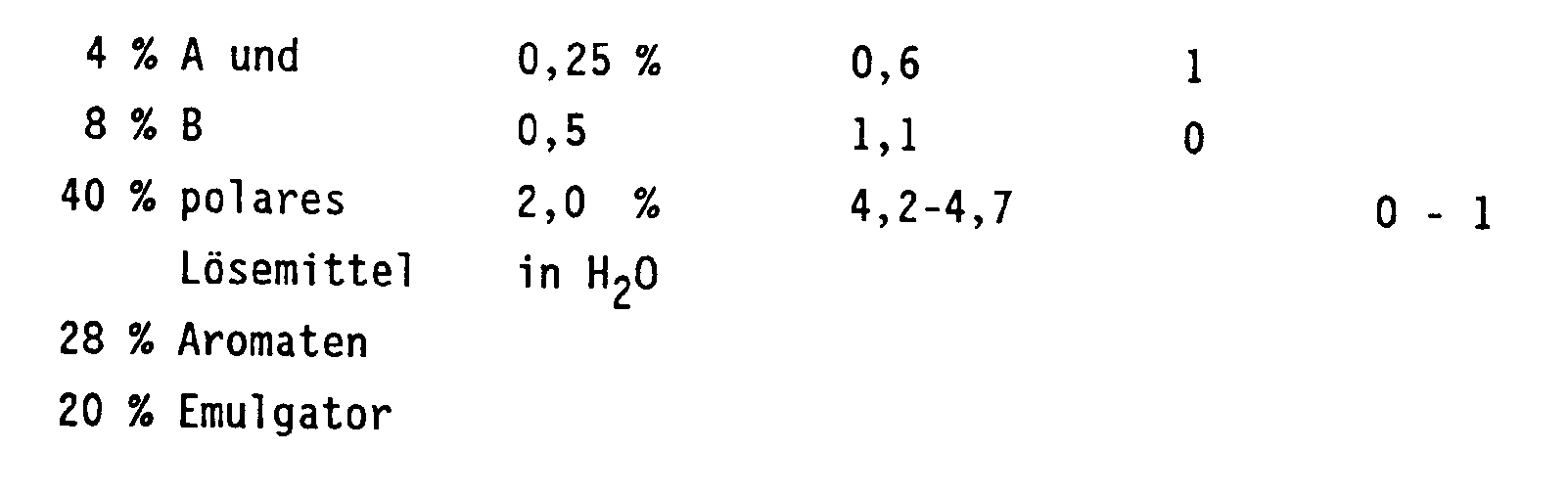

Hierbei bedeuten:
Befallsgrad - 0 :
- befallsfrei
- 1 :
- max.10 % der Oberfläche befallen
- 2 :
- max.30 % der Oberfläche befallen
- 3 :
- max.50 % der Oberfläche befallen
- 4 :
- max.80 % der Oberfläche befallen
- 5 :
- total befallen
in einem unpolaren und/oder polaren organischchemischen Lösemittel oder Lösemittelgemisch, vorzugsweise in einem polaren organisch-chemischen Lösemittel oder Lösemittelgemisch oder des Gemisches aus unpolaren und polaren organisch-chemischen Lösemitteln oder in einem Gemisch aus Wasser und einem organisch-chemischen Lösemittel, vorzugsweise einem polaren organischchemischen Lösemittel oder Lösemittelgemisch, und mindestens einen nichtionogenen Emulgator und/oder Netzmittel gelöst, besteht. Besonders bevorzugt wird ein Verhältnis der beiden Wirkstoffe von 1 : 1, da hierdurch eine zusätzliche Wirkung gegen Schimmelbefall erzielt wird.
des unpolaren und/oder polaren organisch-chemischen Lösemittels oder Lösemittelgemisches, vorzugsweise des polaren organisch-chemischen Lösemittels oder Lösemittelgemisches oder des Gemisches aus unpolaren und polaren organisch-chemischen Lösemitteln oder des Gemisches aus Wasser und einem organisch-chemischen Lösemittel, vorzugsweise einem polaren organischchemischen Lösemittel oder Lösemittelgemisch, und mindestens einen nichtionogenen Emulgator und/oder Netzmittel.
des unpolaren und/oder polaren organisch-chemischen Lösemittels oder Lösemittelgemisches, vorzugsweise des polaren organisch-chemischen Lösemittels oder Lösemittelgemisches oder des Gemisches aus unpolaren und polaren organisch-chemischen Lösemitteln oder des Gemisches aus Wasser und einem organisch-chemischen Lösemittel, vorzugsweise einem polaren organischchemischen Lösemittel oder Lösemittelgemisch, und mindestens einen nichtionogenen Emulgator und/oder Netzmittel
und
mehr als 79 Gew. %, vorzugsweise
mehr als 94 Gew. %,
Wasser.
Claims (7)
- Mittel oder Konzentrat zum Schutz von Schnittholz gegen holzverfärbende Pilze, dadurch gekennzeichnet, daß es aus einer Mischung vonA) 1-(2-(2',4'-Dichlorphenyl)-4-propyl-1,3-dioxolan-2-yl-methyl)-1H-1,2,4-triazol undB) Tris-(N-cyclohexyl-diazeniumdioxi)-aluminiumin einem unpolaren und/oder polaren organischchemischen Lösemittel oder Lösemittelgemisch, vorzugsweise in einem polaren organisch-chemischen Lösemittel oder Lösemittelgemisch oder in Mischungen aus unpolaren und polaren organisch-chemischen Lösemitteln oder in einem Gemisch aus Wasser und einem organisch-chemischen Lösemittel, vorzugsweise einem polaren organisch-chemischen Lösemittel oder Lösemittelgemisch, und mindestens einen nichtionogenen Emulgator und/oder Netzmittel gelöst besteht.
im Verhältnis von
8 : 1 bis 1 : 8, vorzugsweise
2 : 1 bis 1 : 2, - Konzentrat zum Schutz von Schnittholz gegen holzverfärbende Pilze nach Anspruch 1 dadurch gekennzeichnet, daß es
2 bis 20 Gew. %, vorzugsweise
8 bis 12 Gew. %,
des Gemisches ausA) 1-(2-(2',4'-Dichlorphenyl)-4-propyl-1,3-dioxolan-2-yl-methyl)-1H-1,2,4-triazol undB) Tris-(N-cyclohexyl-diazeniumdioxi)-aluminiumdes polaren und/oder unpolaren organisch-chemischen Lösemittels oder Lösemittelgemisches, vorzugsweise des polaren organisch-chemischen Lösemittels oder Lösemittelgemisches oder des Gemisches aus unpolaren und polaren organisch-chemischen Löstmitteln oder des Gemisches aus Wasser und einem organisch-chemischen Lösemittel, vorzugsweise einem polaren organisch-chemischen Lösemittel oder Lösemittelgemisch, und mindestens einen nichtionogenen Emulgator und/oder Netzmittel enthält.
im Verhältnis
8 : 1 bis 1 : 8, vorzugsweise
2 : 1 bis 1 : 2,
sowie
mehr als 79 Gew. %, vorzugsweise
mehr als 87 Gew. %, - Mittel zum Schutz von Schnittholz gegen holzverfärbende Pilze nach Anspruch 1, dadurch gekennzeichnet, daß das (anwendungsfertige) Mittel
1 bis 20 Gew. %, vorzugsweise
2 bis 5 Gew. %,
eines Konzentrates, bestehend aus
2 bis 20 Gew. %, vorzugsweise
8 bis 12 Gew. %,
der Mischung ausA) 1-(2-(2',4'-Dichlorphenyl)-4-propyl-1,3-dioxolan-2-yl-methyl)-1H-1,2,4-triazol undB) Tris-(N-cyclohexyl-diazeniumdioxi)-aluminium im Verhältnis vondes unpolaren und/oder polaren organisch-chemischen Lösemittels oder Lösemittelgemisches, vorzugsweise des polaren organisch-chemischen Lösemittels oder Lösemittelgemisches oder des Gemisches aus unpolaren und polaren organisch-chemischen Lösemitteln oder des Gemisches aus Wasser und einem organisch-chemischen Lösemittel, vorzugsweise einem polaren organisch-chemischen Lösemittel oder Lösemittelgemisch, und mindestens einen nichtionogenen Emulgator und/oder Netzmittel, und
8 : 1 bis 1 : 8, vorzugsweise
2 : 1 bis 1 : 2,
sowie
mehr als 79 Gew. %, vorzugsweise
mehr als 87 Gew. %,
mehr als 79 Gew. %, vorzugsweise
mehr als 94 Gew. %,
Wasser, enthält. - Mittel oder Konzentrat nach einem oder mehreren der Ansprüche 1 bis 3, dadurch gekennzeichnet, daß als unpolare organisch-chemische Lösemittel schwerflüchtige ölige oder ölartige Lösemittel wie Mineralöle oder mineralölhaltige Lösemittelgemische, vorzugsweise deren Aromatenfraktionen eingesetzt werden.
- Mittel oder Konzentrat nach einem oder mehreren der Ansprüche 1 bis 3, dadurch gekennzeichnet, daß als polares organisch-chemisches Lösemittel Hydroxy-, Ether, Ester- oder Ketogruppen enthaltende Lösemittel oder Lösemittelgemische, vorzugsweise Dipropylenglykolmonomethylether, eingesetzt werden.
- Mittel oder Konzentrat nach einem oder mehreren der Ansprüche 1 bis 3, dadurch gekennzeichnet, daß als nichtionogene Emulgatoren Alkylpolyglykolether oder Alkylarylpolyglykolether, vorzugsweise ethoxylierte Nonylphenole eingesetzt werden.
- Verfahren zum Schutz von Schnittholz gegen holzverfärbende Pilze, dadurch gekennzeichnet, daß auf die Holzoberfläche
2 bis 8 g/m² vorzugsweise
4 bis 6 g/m²
des Mittels oder Konzentrats nach einem oder mehreren der Ansprüche 1,2,4 bis 6 aufgebracht werden.
Applications Claiming Priority (2)
| Application Number | Priority Date | Filing Date | Title |
|---|---|---|---|
| DE4008837 | 1990-03-20 | ||
| DE4008837A DE4008837A1 (de) | 1990-03-20 | 1990-03-20 | Mittel oder konzentrat zum schutz von schnittholz gegen holzverfaerbende pilze |
Publications (2)
| Publication Number | Publication Date |
|---|---|
| EP0447756A1 EP0447756A1 (de) | 1991-09-25 |
| EP0447756B1 true EP0447756B1 (de) | 1994-04-27 |
Family
ID=6402586
Family Applications (1)
| Application Number | Title | Priority Date | Filing Date |
|---|---|---|---|
| EP91100791A Expired - Lifetime EP0447756B1 (de) | 1990-03-20 | 1991-01-23 | Mittel oder Konzentrat zum Schutz von Schnittholz gegen holzverfärbende Pilze |
Country Status (5)
| Country | Link |
|---|---|
| EP (1) | EP0447756B1 (de) |
| AT (1) | ATE104899T1 (de) |
| DE (2) | DE4008837A1 (de) |
| DK (1) | DK0447756T3 (de) |
| ES (1) | ES2055458T3 (de) |
Families Citing this family (2)
| Publication number | Priority date | Publication date | Assignee | Title |
|---|---|---|---|---|
| GB9116672D0 (en) * | 1991-08-01 | 1991-09-18 | Hickson Int Plc | Preservatives for wood and other cellulosic materials |
| WO1993002557A1 (en) * | 1991-08-01 | 1993-02-18 | Hickson International Plc | Preservatives for wood and other cellulosic materials |
Family Cites Families (4)
| Publication number | Priority date | Publication date | Assignee | Title |
|---|---|---|---|---|
| IL31491A (en) * | 1968-02-03 | 1972-09-28 | Basf Ag | Nonaqueous liquid formulations containing biologically active ingredients,polycyclic alcohols and cyclic polyethers |
| IT1053524B (it) * | 1972-10-13 | 1981-10-10 | Basf Ag | Antiparassitari e loro impiego per proteggere legno vernici per legno o pitture |
| DE3040499A1 (de) * | 1980-10-28 | 1982-06-03 | Basf Ag, 6700 Ludwigshafen | Holzschutzmittel |
| DE3151806A1 (de) * | 1981-12-29 | 1983-07-07 | Basf Ag, 6700 Ludwigshafen | Holzschutzmittel |
-
1990
- 1990-03-20 DE DE4008837A patent/DE4008837A1/de not_active Withdrawn
-
1991
- 1991-01-23 DE DE59101475T patent/DE59101475D1/de not_active Expired - Fee Related
- 1991-01-23 AT AT9191100791T patent/ATE104899T1/de active
- 1991-01-23 EP EP91100791A patent/EP0447756B1/de not_active Expired - Lifetime
- 1991-01-23 ES ES91100791T patent/ES2055458T3/es not_active Expired - Lifetime
- 1991-01-23 DK DK91100791.2T patent/DK0447756T3/da active
Also Published As
| Publication number | Publication date |
|---|---|
| ATE104899T1 (de) | 1994-05-15 |
| DE59101475D1 (de) | 1994-06-01 |
| DE4008837A1 (de) | 1991-09-26 |
| ES2055458T3 (es) | 1994-08-16 |
| EP0447756A1 (de) | 1991-09-25 |
| DK0447756T3 (da) | 1994-08-08 |
Similar Documents
| Publication | Publication Date | Title |
|---|---|---|
| DE4301885C2 (de) | Verwendung von Cyproconazol als Holzschutzmittel | |
| DE4217523A1 (de) | Mittel zum Schutz von Schnittholz | |
| EP0447756B1 (de) | Mittel oder Konzentrat zum Schutz von Schnittholz gegen holzverfärbende Pilze | |
| EP0448932B1 (de) | Mittel oder Konzentrat zum Schutz von Schnittholz gegen holzverfärbende Pilze | |
| EP0050738A1 (de) | Holzschutzmittel | |
| EP0072426B1 (de) | Mit Wasser verdünnbares Mittel mit bakterizider und fungizider Wirkung | |
| EP0269817B1 (de) | Mittel oder Konzentrat zum Konservieren von Holz und Holzwerkstoffen | |
| EP0208882B1 (de) | Biozide Wirkstoffkombinationen | |
| EP0320531B1 (de) | Mittel oder Konzentrat zum Konservieren von Holz und Holzwerkstoffen | |
| EP0529213B1 (de) | Mittel oder Konzentrat zum Schutz von Schnittholz gegen holzverfärbende Pilze | |
| EP0193890A1 (de) | Holzschutzmittel | |
| EP0447755B1 (de) | Mittel oder Konzentrat zum Schutz von Schnittholz gegen Bläuebefall und Schimmelbefall | |
| EP0682473B1 (de) | Mittel zum schutz technischer materialien, insbesondere holz und holzwerkstoffe | |
| EP0548759B1 (de) | Mittel oder Konzentrat zum Konservieren von Holz und Holzwerkstoffen | |
| DE60210097T2 (de) | Holzkonservierungskonzentrat | |
| EP0085162B1 (de) | Holzschutzmittel | |
| EP0124126B1 (de) | Holzschutzmittel | |
| EP0223095A1 (de) | Holzschutzmittel | |
| DE3829980A1 (de) | Para-hydroxybenzoesaeureester enthaltende holzschutz- und materialschutzmittel | |
| EP0402695B1 (de) | Mischung für den Holzschutz | |
| EP0494351A1 (de) | Mittel oder Konzentrat zum Schutz von Schnittholz gegen holzverfärbende Pilze | |
| DE19645863A1 (de) | Verwendung eines Holzschutzmittels | |
| EP0841134A1 (de) | Verwendung eines Holzschutzmittels | |
| EP0283643A1 (de) | Mittel oder Konzentrat zum Konservieren von Holz und Holzwerkstoffen |
Legal Events
| Date | Code | Title | Description |
|---|---|---|---|
| PUAI | Public reference made under article 153(3) epc to a published international application that has entered the european phase |
Free format text: ORIGINAL CODE: 0009012 |
|
| 17P | Request for examination filed |
Effective date: 19910219 |
|
| AK | Designated contracting states |
Kind code of ref document: A1 Designated state(s): AT BE CH DE DK ES FR GB GR IT LI LU NL SE |
|
| 17Q | First examination report despatched |
Effective date: 19930901 |
|
| GRAA | (expected) grant |
Free format text: ORIGINAL CODE: 0009210 |
|
| AK | Designated contracting states |
Kind code of ref document: B1 Designated state(s): AT BE CH DE DK ES FR GB GR IT LI LU NL SE |
|
| REF | Corresponds to: |
Ref document number: 104899 Country of ref document: AT Date of ref document: 19940515 Kind code of ref document: T |
|
| REF | Corresponds to: |
Ref document number: 59101475 Country of ref document: DE Date of ref document: 19940601 |
|
| ITF | It: translation for a ep patent filed | ||
| REG | Reference to a national code |
Ref country code: DK Ref legal event code: T3 |
|
| REG | Reference to a national code |
Ref country code: ES Ref legal event code: FG2A Ref document number: 2055458 Country of ref document: ES Kind code of ref document: T3 |
|
| ET | Fr: translation filed | ||
| GBT | Gb: translation of ep patent filed (gb section 77(6)(a)/1977) |
Effective date: 19940802 |
|
| REG | Reference to a national code |
Ref country code: GR Ref legal event code: FG4A Free format text: 3012448 |
|
| PGFP | Annual fee paid to national office [announced via postgrant information from national office to epo] |
Ref country code: CH Payment date: 19941220 Year of fee payment: 5 |
|
| PGFP | Annual fee paid to national office [announced via postgrant information from national office to epo] |
Ref country code: SE Payment date: 19941221 Year of fee payment: 5 |
|
| PGFP | Annual fee paid to national office [announced via postgrant information from national office to epo] |
Ref country code: FR Payment date: 19941222 Year of fee payment: 5 |
|
| PGFP | Annual fee paid to national office [announced via postgrant information from national office to epo] |
Ref country code: LU Payment date: 19950101 Year of fee payment: 5 |
|
| PGFP | Annual fee paid to national office [announced via postgrant information from national office to epo] |
Ref country code: AT Payment date: 19950110 Year of fee payment: 5 |
|
| PGFP | Annual fee paid to national office [announced via postgrant information from national office to epo] |
Ref country code: GB Payment date: 19950113 Year of fee payment: 5 |
|
| PGFP | Annual fee paid to national office [announced via postgrant information from national office to epo] |
Ref country code: ES Payment date: 19950117 Year of fee payment: 5 Ref country code: DK Payment date: 19950117 Year of fee payment: 5 |
|
| PGFP | Annual fee paid to national office [announced via postgrant information from national office to epo] |
Ref country code: GR Payment date: 19950120 Year of fee payment: 5 |
|
| PGFP | Annual fee paid to national office [announced via postgrant information from national office to epo] |
Ref country code: DE Payment date: 19950124 Year of fee payment: 5 |
|
| PGFP | Annual fee paid to national office [announced via postgrant information from national office to epo] |
Ref country code: BE Payment date: 19950130 Year of fee payment: 5 |
|
| EAL | Se: european patent in force in sweden |
Ref document number: 91100791.2 |
|
| PGFP | Annual fee paid to national office [announced via postgrant information from national office to epo] |
Ref country code: NL Payment date: 19950131 Year of fee payment: 5 |
|
| PLBE | No opposition filed within time limit |
Free format text: ORIGINAL CODE: 0009261 |
|
| STAA | Information on the status of an ep patent application or granted ep patent |
Free format text: STATUS: NO OPPOSITION FILED WITHIN TIME LIMIT |
|
| 26N | No opposition filed | ||
| PG25 | Lapsed in a contracting state [announced via postgrant information from national office to epo] |
Ref country code: LU Free format text: LAPSE BECAUSE OF NON-PAYMENT OF DUE FEES Effective date: 19960123 Ref country code: GB Effective date: 19960123 Ref country code: DK Effective date: 19960123 Ref country code: AT Effective date: 19960123 |
|
| REG | Reference to a national code |
Ref country code: DK Ref legal event code: EBP |
|
| PG25 | Lapsed in a contracting state [announced via postgrant information from national office to epo] |
Ref country code: SE Effective date: 19960124 Ref country code: ES Free format text: LAPSE BECAUSE OF NON-PAYMENT OF DUE FEES Effective date: 19960124 |
|
| PG25 | Lapsed in a contracting state [announced via postgrant information from national office to epo] |
Ref country code: LI Effective date: 19960131 Ref country code: CH Effective date: 19960131 Ref country code: BE Effective date: 19960131 |
|
| BERE | Be: lapsed |
Owner name: DESOWAG MATERIALSCHUTZ G.M.B.H. Effective date: 19960131 |
|
| PG25 | Lapsed in a contracting state [announced via postgrant information from national office to epo] |
Ref country code: GR Free format text: THE PATENT HAS BEEN ANNULLED BY A DECISION OF A NATIONAL AUTHORITY Effective date: 19960731 |
|
| PG25 | Lapsed in a contracting state [announced via postgrant information from national office to epo] |
Ref country code: NL Effective date: 19960801 |
|
| GBPC | Gb: european patent ceased through non-payment of renewal fee |
Effective date: 19960123 |
|
| REG | Reference to a national code |
Ref country code: CH Ref legal event code: PL |
|
| PG25 | Lapsed in a contracting state [announced via postgrant information from national office to epo] |
Ref country code: FR Effective date: 19960930 |
|
| REG | Reference to a national code |
Ref country code: GR Ref legal event code: MM2A Free format text: 3012448 |
|
| NLV4 | Nl: lapsed or anulled due to non-payment of the annual fee |
Effective date: 19960801 |
|
| PG25 | Lapsed in a contracting state [announced via postgrant information from national office to epo] |
Ref country code: DE Effective date: 19961001 |
|
| EUG | Se: european patent has lapsed |
Ref document number: 91100791.2 |
|
| REG | Reference to a national code |
Ref country code: FR Ref legal event code: ST |
|
| REG | Reference to a national code |
Ref country code: ES Ref legal event code: FD2A Effective date: 19990301 |
|
| PG25 | Lapsed in a contracting state [announced via postgrant information from national office to epo] |
Ref country code: IT Free format text: LAPSE BECAUSE OF NON-PAYMENT OF DUE FEES;WARNING: LAPSES OF ITALIAN PATENTS WITH EFFECTIVE DATE BEFORE 2007 MAY HAVE OCCURRED AT ANY TIME BEFORE 2007. THE CORRECT EFFECTIVE DATE MAY BE DIFFERENT FROM THE ONE RECORDED. Effective date: 20050123 |