EP0447708A2 - Vorrichtung und Verfahren zur quantitativen Untersuchung von menschlichem Gewebe und zu dessen Darstellung mit hoher Auflösung - Google Patents
Vorrichtung und Verfahren zur quantitativen Untersuchung von menschlichem Gewebe und zu dessen Darstellung mit hoher Auflösung Download PDFInfo
- Publication number
- EP0447708A2 EP0447708A2 EP90303902A EP90303902A EP0447708A2 EP 0447708 A2 EP0447708 A2 EP 0447708A2 EP 90303902 A EP90303902 A EP 90303902A EP 90303902 A EP90303902 A EP 90303902A EP 0447708 A2 EP0447708 A2 EP 0447708A2
- Authority
- EP
- European Patent Office
- Prior art keywords
- light
- tissue
- ccd detector
- light source
- normal
- Prior art date
- Legal status (The legal status is an assumption and is not a legal conclusion. Google has not performed a legal analysis and makes no representation as to the accuracy of the status listed.)
- Withdrawn
Links
Images

Classifications
-
- A—HUMAN NECESSITIES
- A61—MEDICAL OR VETERINARY SCIENCE; HYGIENE
- A61B—DIAGNOSIS; SURGERY; IDENTIFICATION
- A61B5/00—Measuring for diagnostic purposes; Identification of persons
- A61B5/0059—Measuring for diagnostic purposes; Identification of persons using light, e.g. diagnosis by transillumination, diascopy, fluorescence
- A61B5/0082—Measuring for diagnostic purposes; Identification of persons using light, e.g. diagnosis by transillumination, diascopy, fluorescence adapted for particular medical purposes
- A61B5/0091—Measuring for diagnostic purposes; Identification of persons using light, e.g. diagnosis by transillumination, diascopy, fluorescence adapted for particular medical purposes for mammography
-
- A—HUMAN NECESSITIES
- A61—MEDICAL OR VETERINARY SCIENCE; HYGIENE
- A61B—DIAGNOSIS; SURGERY; IDENTIFICATION
- A61B5/00—Measuring for diagnostic purposes; Identification of persons
- A61B5/0059—Measuring for diagnostic purposes; Identification of persons using light, e.g. diagnosis by transillumination, diascopy, fluorescence
-
- A—HUMAN NECESSITIES
- A61—MEDICAL OR VETERINARY SCIENCE; HYGIENE
- A61B—DIAGNOSIS; SURGERY; IDENTIFICATION
- A61B5/00—Measuring for diagnostic purposes; Identification of persons
- A61B5/41—Detecting, measuring or recording for evaluating the immune or lymphatic systems
- A61B5/414—Evaluating particular organs or parts of the immune or lymphatic systems
- A61B5/415—Evaluating particular organs or parts of the immune or lymphatic systems the glands, e.g. tonsils, adenoids or thymus
-
- A—HUMAN NECESSITIES
- A61—MEDICAL OR VETERINARY SCIENCE; HYGIENE
- A61B—DIAGNOSIS; SURGERY; IDENTIFICATION
- A61B5/00—Measuring for diagnostic purposes; Identification of persons
- A61B5/41—Detecting, measuring or recording for evaluating the immune or lymphatic systems
- A61B5/414—Evaluating particular organs or parts of the immune or lymphatic systems
- A61B5/418—Evaluating particular organs or parts of the immune or lymphatic systems lymph vessels, ducts or nodes
-
- A—HUMAN NECESSITIES
- A61—MEDICAL OR VETERINARY SCIENCE; HYGIENE
- A61B—DIAGNOSIS; SURGERY; IDENTIFICATION
- A61B5/00—Measuring for diagnostic purposes; Identification of persons
- A61B5/43—Detecting, measuring or recording for evaluating the reproductive systems
- A61B5/4306—Detecting, measuring or recording for evaluating the reproductive systems for evaluating the female reproductive systems, e.g. gynaecological evaluations
- A61B5/4312—Breast evaluation or disorder diagnosis
-
- G—PHYSICS
- G01—MEASURING; TESTING
- G01N—INVESTIGATING OR ANALYSING MATERIALS BY DETERMINING THEIR CHEMICAL OR PHYSICAL PROPERTIES
- G01N21/00—Investigating or analysing materials by the use of optical means, i.e. using sub-millimetre waves, infrared, visible or ultraviolet light
- G01N21/17—Systems in which incident light is modified in accordance with the properties of the material investigated
- G01N21/59—Transmissivity
Definitions
- the present invention relates to a device and method for medical diagnosis, especially to a device and method for examining and for high-resolution imaging of human tissue, utilizing non-ionizing radiation with a wide spectral bandwidth.
- a diffused light source emits visible and near infrared light to transilluminate human tissue;
- a CCD detector is employed to receive the light signals passing through the tissue and input the electrical signals which have been converted by the CCD into a computer processing system; then a quantitative measurement for diagnosing the diseased tissue is outputted by means of the image processing system.
- U.S. Pat. No. 4,649,275 disclosed a high-resolution breast imaging device using non-ionizing radiation of narrow spectral bandwidth.
- a collimated light source of narrow bandwidth is arranged to produce a small beam or a number of beams of very small spatial dimensions, which are performed together with two compression plates in order to obtain images of the breast.
- An optical detector corresponding to each source is located perpendicular to the breast to receive the collimated light passing through the breast and to convert the optical signals into electrical signals for processing. Since two transparent plates are used to compress the breast in between, this approach may entail discomfort to the examinee and inconvenience of operation, and also it is unable to examine the axillary area of the breast where lesions are of most common ocurrence.
- the stationary device will not permit an examination in motion, lesions in movable status can hardly be detected, and lesions in the overlapping state may be misdiagnosed.
- a collimated light source with narrow bandwidth in the form of a beam having small spatial dimension cannot illuminate a large examination area, so that a spatial image in a large scale can not be obtained at the same time, nor can a comparative analysis between the normal add the lesion regions be processed.
- the detector will be easily saturated and will produce poor grey scale and less contrast images, thus the advanced abilities of the computer in image processing, analysis and diagnosis will be limited.
- Another prior art technique in the field uses a collimated light source with a wide spectral bandwidth in the form of a broad beam to illuminate the breast, and disposes a video camera to record the transmitted light passing through the breast and then to display, process and analyze the signals.
- an optical detector is placed on the opposite side of the examined breast perpendicular to the light source.
- the collimated light through the breast will be directly received by the optical detector and easily cause the saturation of the detector, resulting in a poorly configured grey scale image.
- the absorption of the broad beam with such a wide spectral bandwidth varies between different types of tissue, this method shows poor ability to discriminate various tissue-types.
- the light scattered on the surface of the breast and detected by the detector will reduce the spatial resolution of images .
- the lesion sizes that are detectable with such a method have generally been no smaller than what the physician can detect by palpation.
- the present invention utilizes non-ionizing radiation with a wide spectral bandwidth in the visible and infrared to generate a diffused light with a diffuser and to enable a large area to be transilluminated.
- the diffused light is absorbed, refracted, reflected and scattered by the examined tissue, and results in even radiation in the illuminated area.
- a CCD detector is placed by the side of the tissue at certain angles to the normal of the diffuser surface. The transmitted light through the tissue is received by the CCD detector and processed into images for examination.
- the images obtained are of fine definition, clear shade of grey and high resolution, and the CCD detector is not so easily saturated, while the advantages of image processing, analysis and comparative calculation are fully utilized by the computer so as to provide the physician with density differences between the normal and lesion regions for quantitative diagnosis.
- the purpose of the present invention is to overcome shortcoming of prior art techniques, and to provide a device and quantitative method for examining human tissue and for high-resolution imaging.
- the method according to the present invention involves using a diffused light with the wide spectral bandwidth to transilluminate human tissue; a CCD detector which is placed at certain angles to the light source for obtaining images of the examined region with the quality of distinctive contrast and fine shade of grey; and a computer system which is employed to digitalize the images and to output the density difference between the normal and diseased regions from the same image for the diagnosis.
- the apparatus according to the present invention comprises a light source probe which is small in size and light in weight, a CCD detector with selected filters, as well as a computer system.
- the light source probe emitting diffused light is easy to hold and flexible to operate, and is used in conjunction with a scaled compression plate to clearly transilluminate the examined tissue.
- the compression plate with a handle has a measure scale in the central part which will be read together with the examined region by the CCD detector.
- the computer system enables accurate calculations of actual dimension, projected area and volume of the lesion according to the measurement of the scaled plate.
- the CCD detector receives images of the transilluminated tissue through selected filters, converts and inputs the signals into the computer system to be processed and analyzed, wherein the suspect area will be compared with the normal area. Finally the computer system outputs the density difference.
- the present invention adopts non-ionizing radiation with a wide spectral bandwidth which generates visible and near infrared light, and which can transilluminate a fairly large area through an optical diffuser, for example the entire breast.
- a scaled transparent plate is used to compress the breast.
- the breast is evenly transilluminated by the diffused light with the wide spectral bandwidth, and the CCD detector is disposed to receive the light passing through the breast.
- the axis of the CCD detector is situated at certain angles to the normal of the diffuser surface, generally at an angle of 50 to 110 degrees, but 90 degrees is preferred.
- the tissue surface which the scaled plate is pressing on is positioned essentially perpendicular to the axis of the CCD detector.
- This approach can be compared to what people observe when the dust in the air is illuminated: standing aside from the sun light the status of the dust can be identified more clearly.
- the light probe can be moved around and the breast can be illuminated from various directions, so as to detect distinctly the overlapping lesions as well as the movable characteristics of diseased areas.
- breast types In order to obtain clear images of each type of breast -- breast types vary in containing more or less fat and having big or small mammary glands -- a few cut-off filters with selected wavelengths are disposed in front of the CCD detector.
- These filters have the cut-off wavelength of 550nm, 650nm, and 700nm respectively.
- the light signals of the detected region are received by the CCD detector with the filters, and are converted into electrical signals to be inputted into computer for processing.
- a filter with the transmitting wavelength greater than 700 nm is selected; when the breast under examination has a big mammary gland and more fat, a filter with the transmitting wavelength greater than 550nm is selected.
- the computer system processes the elicited images and displays them precisely on the screen. For providing the physician with quantitative information to diagnose the diseased tissue, the image is digitalized, the density of the normal region and the density of the diseased region are compared, and finally the density difference between the two regions within the same image is outputted.
- the light soure probe comprises a light bulb, a reflecting cup, an optical diffuser, a light shield, a cooling fan, and a sealed heat shield.
- the light probe is small in size and light in weight, and is advantageous to be held and to be operated in conjunction with the scaled compression plate.
- the heat and the far infrared light generated by the probe have been successfully reduced to prevent examinees from being hurt by high temperature and by far infrared light.
- the reflecting cup is situated behind the light bulb like a parabolic mirror, which enables the light emitted to be reflected straight forward as a collimated light.
- the cup is coated with reflecting film and is manufactured with cooling holes.
- the holes on the reflecting cup will allow the cooling air to flow through and eventually to be discharged by the cooling fan sitting behind the cup.
- the efficiency of cooling is enhanced, and the size and the weight of the light probe can be reduced; otherwise, the dimension of the probe has to be big enough to leave a certain space between the reflecting cup and the light shield for air flowing through.
- the light shield at the front part of the probe is also manufactured with cooling grooves which perform the same function as the holes on the reflecting cup to allow cooling air to flow through.
- the light probe is equipped with image fixation and light intensity control facilities which are connected with the computer processing system.
- images observed can be fixed and stored with the probe at any time needed.
- the light intensity of the probe is adjustable up to 8 levels, so different types of breasts can be examined with different levels of light intensity. With this approach, not only the time used for searching the needed images can be saved, but also high-resolution images can be obtained with whatever types of breasts.
- operations of the computer system are selected with a menu-driven mode.
- the examiner can select the function he needs rapidly.
- An audio-instruction system is employed to speed up the function selection and to avoid misoperation, and can be used to train new examiners.
- the present invention is advantageous because the CCD detector is not easy to be saturated, a large area of tissue can be transilluminated, a good signal-noise ratio for imaging can be achieved by receiving signals through the selected filters, and therefore, images of high resolution in fine shade of grey and with distinct contrast can be obtained.
- This is advantageous to computer processing and analysis, so that eventually the computer system will output a density difference between the normal and the diseased areas from the same image. This will provide the physician with quantitative information and help him to diagnose the lesion and to enhance the accuracy of tissue examination.
- the examined area can be flexibly illuminated from various directions during the performance of a moving examination; the axillary region of the breast, which can be detected only with difficulty by other similar methods and devices, can be conveniently examined; the movable status of lesions can be observed; the nature of tumors can be discriminated; and missing and misdiagnosis of the overlapping lesions can be avoided.
- very small diseased areas which are impossible to detect by palpation become detectable with the present method and apparatus, realizing an early diagnosis of the breast lesions.
- the examiner can rapidly grasp and store the desired image, and the examination can result in a shorter time for the performance, a higher resolution for imaging, and more accuracy of diagnosis.
- the examined breast only needs to be pressed slightly, and does not need to be tightly compressed between two plates as by other existent techniques, and this can reduce discomfort to the examinee, while the whole examination procedure becomes simple, convenient, and easily accepted by examinees.
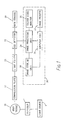
- Fig. 1 is the functional block diagram of the present invention.
- the light source 9 is of non-ionizing radiation with a wide spectral bandwidth. It emits diffused light generating through a diffuser 1 to transilluminate human tissue 19.
- the compression plate 17 will be slightly pressed on the area being examined, which will enable the CCD detector 22 with a selected filter 23, placing in between, to obtain a high resolution image. Normally, the CCD detector is situated about one meter from the examined area.
- 30 is a computer processing system. Signals caught by CCD detector 22 are handled by three image processing boards 24, and then input into the computer 26. After being processed by the computer 26, the signals are inputted into the image storage unit 28, further into the image printer 27. After handling by the image processing boards 24, images are displayed on the colour monitor 25 by means of digital-analogue converter. 29 is a gain controller of CCD detector.
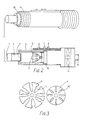
- Fig. 2 is the schematic drawings of the light probe.
- the diffuser 1 is the exit of the diffused outgoing light; 2 is a sealed heat shield; 3 is a piece of optical glass which prevents heat conduction; 4 is a light shield; 5 is a reflecting cup; 6 is an image fixation control button; 7 and 8 are the light intensity control buttons, which respectively increase and decrease light intensity; 9 is a light bulb; 10 is a holder; 11 is an axis-flow cooling fan; 12 is a cable connector; 13 are cooling holes, and 14 is an exit of heat.
- Fig. 3 shows schematic drawings of the reflecting cup.
- the total area of the cooling holes 15 occupies about 15% to 30% of the general area of the cup; 25% of the area is preferable.
- Fig. 4 shows schematic drawings of the light shield. There are cooling grooves 16 on the light shield, which is painted with a dark colour.
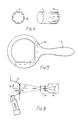
- Fig. 5 is the schematic drawing of the compression plate 17. It is made of transparent organic glass with a thickness of 2mm. It is scaled as shown in the central part 18.
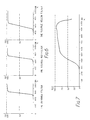
- Fig. 6 are the curves of transmitting wavelengths respective to each type of cut-off filters.
- the cut-off wavelength of the infrared filter is 700 nanometers; the cut-off wavelength of the visible red light filter is 650 nanometers; and the cut-off wavelength of the visible yellow light filter is 550 nanometers. All three are optical filters of the cut-off type. As shown on the curves, the absissa axis refers to the wavelengths, while the longitudinal axis presents the transmission ratio.
- Fig. 7 is the spectral response region of the CCD detector array.
- the absissa axis refers to the wavelengths and the longitudinal axis presents the spectral response ratio.
- Fig. 8 is the schematic drawing which shows the placing method and the relative positions of the light source and the CCD detector.
- the diffuser 1 changes the light beam generated by the source with wide bandwidth into diffused light.
- 20 is the normal direction of the diffuser surface.
- the compression plate 17 is placed perpendicularly to the diffuser surface.
- the CCD detector 22 receives images of human tissue 19 through the selected filters 23 in the direction shown in 21.
- the angles between the direction 21 and the direction 20 should be in the range of 50 to 110 degrees, preferably 90 degrees.
- Fig. 9 is the distribution chart of the density differences of the breast lesions, which are calculated by the computer system in comparisons between diseased areas separately in conjunction with their normal areas. Different kinds of lesions have different density difference distributions. The overlapping distributions of different types of lesions can be identified by the image characteristics of each. The density differences beyond the dotted lines are not relevant to the invention.
- Fig. 9 density differences corresponding to various pathological conditions in the breast are indicated, based upon the analysis and classification from medical case histories.
- the pathological region with regular edges distributing an average density difference from 10 to 35 can be diagnosed as breast proliferation.
- the focus of infection was diagnosed as proliferation, which was thus identified by pathology after biopsy.
- the density difference of normal benign fibre gland tumour is from 20 to 40, while that of benign lipoma is a little bit bigger, from 35 to 47, and has other characteristics, such as regular edge and concomitant blood vessel shadow.
- the lesion was diagnosed as benign lipoma, and was proved by pathology after operation.
- the density difference of breast cancer is generally from 33 to 85, and generally concentrates on the difference from 50 to 60.
- the lesion of a patient during menses was found with the density difference of 92. This was a special case; since the patient was in the period of menses, the congestion of the breast was taken into account.
- the density difference was modified and ended as 82. With this data and the movable status of the lesion, it was diagnosed as breast cancer but not as hydrops. This was proved by pathology after operation.
- the lesion was detected with a density difference from 63 to 67, and other symptom of it appeared like cancer. The lesion was diagnosed as cancer, and was proved by pathology after operation.
- the density difference shown of the former is less than that of the latter.
- the density difference of cystic hydrops is from 72 to 115, concentrating usually around the difference from 90 to 100.
- the density difference of both hematoma and internal hemorrhage is in the range between 105 and 165, and both of them always appear with surrounding blood vessels attached, but other characteristics of the two types of lesions are different and can be identified. For instance, the density difference of a patient's lesion was 133, and was diagnosed as hematoma. After the treatment of pharmacotherapy in combination with massotherapy, the lesion disappeared. For such cases as necrosis and extravasted blood, the density difference of those is even greater and in the range from 150 to 230, and their edges appear very sharp. These lesions can be considered rare.
- the density difference of infiltration infection is rather less, generally between 5 and 15, and the edges of the lesion are not clear.
- a patient had a lesion with a large area but a smaller density difference from 5 to 9. The lesion was diagnosed as infiltration infection, and the patient recovered after pharmacotherapy.
- the density difference of vessel dilation is from 30 to 65 and is similar to that of breast cancer. But there is an obvious characteristic in appearance.
- a patient had a linear lesion, the density difference of which was detected as 32.
- the lesion was diagnosed as vessel dilation, which was proved by pathology after operation.
- breast diseases exhibit their own ranges of density differences and all kinds of accompanying characteristics.
- the sensitivity achieves 96%; the specificity reaches to 97%; false positive and false negative respectively become 4% and 3%.
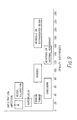
- Fig. 10 is the stream diagram of the menu-driven system in support of the system operation.
- the Start Menu is mainly used to catch images and to copy images, and also used to initialize the system.
- the Main Menu plays a role to manipulate the sub-menus.
- the Zoom Sub-menu drives the system functions for geometric processing, such as image enlargement and image reduction.
- the False Colour Sub-menu drives the functions such as adding false colour onto images, and calculating density value, density difference, etc.
- the Character Overlay Sub-menu is designed for word processing.
- the Enhancement Sub-menu drives the functions of various type of image intensity processing, such as increasing the resolution of image, extracting useful information, etc.
- the Calculation Sub-menu is used for outputting the dimension, the projected area and volume of the diseased area, and locating the lesion area, as well as other image processing.
- the Service Menu presents all the system functions; the functions used most often can be selected from this menu. Underneath some sub-menus, there are more detailed sub-menus of sub-menus for extending the system functions.
- the lesion was re-examined with the same approach by the system.
- the density difference increased up to 42 - 43, the maximum dimension was 1.7 cm, while the projected area became 2.4 cm. Since the lesion had a tendency toward movable status and other charactaristics of cancer, it was diagnosed as breast cancer with all data employed. This was proven by pathology after operation.
Landscapes
- Health & Medical Sciences (AREA)
- Life Sciences & Earth Sciences (AREA)
- Physics & Mathematics (AREA)
- General Health & Medical Sciences (AREA)
- Pathology (AREA)
- Biomedical Technology (AREA)
- Heart & Thoracic Surgery (AREA)
- Medical Informatics (AREA)
- Molecular Biology (AREA)
- Surgery (AREA)
- Animal Behavior & Ethology (AREA)
- Biophysics (AREA)
- Public Health (AREA)
- Veterinary Medicine (AREA)
- Engineering & Computer Science (AREA)
- Immunology (AREA)
- Vascular Medicine (AREA)
- Analytical Chemistry (AREA)
- General Physics & Mathematics (AREA)
- Biochemistry (AREA)
- Gynecology & Obstetrics (AREA)
- Reproductive Health (AREA)
- Chemical & Material Sciences (AREA)
- Endocrinology (AREA)
- Investigating Or Analysing Materials By Optical Means (AREA)
- Apparatus For Radiation Diagnosis (AREA)
Applications Claiming Priority (2)
| Application Number | Priority Date | Filing Date | Title |
|---|---|---|---|
| CN90101352A CN1012557B (zh) | 1990-03-17 | 1990-03-17 | 软组织检测成象方法及其装置 |
| CN90101352 | 1990-03-17 |
Publications (2)
| Publication Number | Publication Date |
|---|---|
| EP0447708A2 true EP0447708A2 (de) | 1991-09-25 |
| EP0447708A3 EP0447708A3 (en) | 1991-11-21 |
Family
ID=4877032
Family Applications (1)
| Application Number | Title | Priority Date | Filing Date |
|---|---|---|---|
| EP19900303902 Withdrawn EP0447708A3 (en) | 1990-03-17 | 1990-04-11 | Apparatus and method for quantitative examination and high-resolution imaging of human tissue |
Country Status (3)
| Country | Link |
|---|---|
| EP (1) | EP0447708A3 (de) |
| JP (1) | JPH03274444A (de) |
| CN (1) | CN1012557B (de) |
Cited By (11)
| Publication number | Priority date | Publication date | Assignee | Title |
|---|---|---|---|---|
| WO1994020022A1 (en) * | 1993-03-09 | 1994-09-15 | Medhealth Imaging, Inc. | Transillumination apparatus |
| WO1994024927A1 (en) * | 1993-05-04 | 1994-11-10 | Tam, Paul, Y. | Method and apparatus for examining tissue by transillumination using near infrared light |
| US5699797A (en) * | 1992-10-05 | 1997-12-23 | Dynamics Imaging, Inc. | Method of investigation of microcirculation functional dynamics of physiological liquids in skin and apparatus for its realization |
| US5730133A (en) * | 1994-05-20 | 1998-03-24 | Dynamics Imaging, Inc. | Optical functional mamoscope |
| US5747789A (en) * | 1993-12-01 | 1998-05-05 | Dynamics Imaging, Inc. | Method for investigation of distribution of physiological components in human body tissues and apparatus for its realization |
| US5865743A (en) * | 1994-02-23 | 1999-02-02 | Dynamics Imaging, Inc. | Method of living organism multimodal functional mapping |
| US6002958A (en) * | 1992-12-24 | 1999-12-14 | Dynamics Imaging, Inc. | Method and apparatus for diagnostics of internal organs |
| WO2000006016A1 (en) * | 1998-07-30 | 2000-02-10 | Yissum Research Development Company Of The Hebrew University Of Jerusalem | Optical mammography |
| WO2000010451A1 (en) * | 1998-08-19 | 2000-03-02 | Cedars-Sinai Medical Center | System and method for spectral topography of mammalian matter using white light illumination |
| US6192262B1 (en) | 1994-02-23 | 2001-02-20 | Dobi Medical Systems, Llc | Method of living organism multimodal functional mapping |
| US7286632B2 (en) | 2002-06-21 | 2007-10-23 | Sunnybrook And Women's College Health Sciences Ctr. | Method and apparatus for measuring the thickness of compressed objects |
Families Citing this family (12)
| Publication number | Priority date | Publication date | Assignee | Title |
|---|---|---|---|---|
| US7239909B2 (en) * | 2000-01-19 | 2007-07-03 | Luminetx Technologies Corp. | Imaging system using diffuse infrared light |
| US6675863B1 (en) * | 2000-09-07 | 2004-01-13 | Physical Optics Corporation | Seamless master and method of making same |
| JP4781548B2 (ja) * | 2001-03-14 | 2011-09-28 | 浜松ホトニクス株式会社 | 乳がん検出装置 |
| JP4280993B2 (ja) * | 2003-12-24 | 2009-06-17 | ソニー株式会社 | 撮像装置及びその方法並びにプログラム |
| CN100563552C (zh) * | 2007-03-14 | 2009-12-02 | 中国科学院自动化研究所 | 一种基于s形光子密度调整的目标检测装置 |
| CN104411247B (zh) * | 2012-06-25 | 2017-09-12 | 皇家飞利浦有限公司 | 光学适应性乳房压缩元件 |
| CN104146686B (zh) * | 2014-09-01 | 2015-12-23 | 江苏雷奥生物科技有限公司 | 可拆卸且带有数字显示的医用压板 |
| CN104274200B (zh) * | 2014-09-15 | 2016-12-07 | 上海闵灏信息科技有限公司 | 基于ct的宽幅面动态三维人体扫描方法 |
| CN105125171A (zh) * | 2015-06-23 | 2015-12-09 | 牛兆河 | 一种用于诊断乳腺癌的系统 |
| CN105147314A (zh) * | 2015-08-20 | 2015-12-16 | 京东方科技集团股份有限公司 | 一种人体参数检测方法及检测装置 |
| CN108392187B (zh) * | 2018-04-20 | 2021-08-20 | 四川知周光声医疗科技有限公司 | 用于光声乳腺成像仪的水循环系统 |
| CN109064509B (zh) * | 2018-06-29 | 2021-04-06 | 广州雅特智能科技有限公司 | 食物体积和食物热量的识别方法、装置和系统 |
Family Cites Families (6)
| Publication number | Priority date | Publication date | Assignee | Title |
|---|---|---|---|---|
| GB2068537B (en) * | 1980-02-04 | 1984-11-14 | Energy Conversion Devices Inc | Examining biological materials |
| US4467812A (en) * | 1982-07-19 | 1984-08-28 | Spectrascan, Inc. | Transillumination apparatus |
| US4600011A (en) * | 1982-11-03 | 1986-07-15 | The University Court Of The University Of Aberdeen | Tele-diaphanography apparatus |
| US4649275A (en) * | 1984-06-25 | 1987-03-10 | Nelson Robert S | High resolution breast imaging device utilizing non-ionizing radiation of narrow spectral bandwidth |
| IT1206462B (it) * | 1984-08-07 | 1989-04-27 | Anic Spa | Fotometro a luce impulsata a lunghezza d'onda multipla per monitoraggio non-invasivo. |
| GB8709406D0 (en) * | 1987-04-21 | 1987-05-28 | Aberdeen University Of Univers | Examining body of living tissues |
-
1990
- 1990-03-17 CN CN90101352A patent/CN1012557B/zh not_active Expired
- 1990-04-11 EP EP19900303902 patent/EP0447708A3/en not_active Withdrawn
- 1990-06-01 JP JP90144234A patent/JPH03274444A/ja active Pending
Cited By (12)
| Publication number | Priority date | Publication date | Assignee | Title |
|---|---|---|---|---|
| US5699797A (en) * | 1992-10-05 | 1997-12-23 | Dynamics Imaging, Inc. | Method of investigation of microcirculation functional dynamics of physiological liquids in skin and apparatus for its realization |
| US6002958A (en) * | 1992-12-24 | 1999-12-14 | Dynamics Imaging, Inc. | Method and apparatus for diagnostics of internal organs |
| WO1994020022A1 (en) * | 1993-03-09 | 1994-09-15 | Medhealth Imaging, Inc. | Transillumination apparatus |
| WO1994024927A1 (en) * | 1993-05-04 | 1994-11-10 | Tam, Paul, Y. | Method and apparatus for examining tissue by transillumination using near infrared light |
| US5747789A (en) * | 1993-12-01 | 1998-05-05 | Dynamics Imaging, Inc. | Method for investigation of distribution of physiological components in human body tissues and apparatus for its realization |
| US5865743A (en) * | 1994-02-23 | 1999-02-02 | Dynamics Imaging, Inc. | Method of living organism multimodal functional mapping |
| US6192262B1 (en) | 1994-02-23 | 2001-02-20 | Dobi Medical Systems, Llc | Method of living organism multimodal functional mapping |
| US5730133A (en) * | 1994-05-20 | 1998-03-24 | Dynamics Imaging, Inc. | Optical functional mamoscope |
| WO2000006016A1 (en) * | 1998-07-30 | 2000-02-10 | Yissum Research Development Company Of The Hebrew University Of Jerusalem | Optical mammography |
| US6668187B1 (en) | 1998-07-30 | 2003-12-23 | Yissum Research Development Company Of The Hebrew University Of Jerusalem | Optical mammography |
| WO2000010451A1 (en) * | 1998-08-19 | 2000-03-02 | Cedars-Sinai Medical Center | System and method for spectral topography of mammalian matter using white light illumination |
| US7286632B2 (en) | 2002-06-21 | 2007-10-23 | Sunnybrook And Women's College Health Sciences Ctr. | Method and apparatus for measuring the thickness of compressed objects |
Also Published As
| Publication number | Publication date |
|---|---|
| JPH03274444A (ja) | 1991-12-05 |
| CN1012557B (zh) | 1991-05-08 |
| CN1045519A (zh) | 1990-09-26 |
| EP0447708A3 (en) | 1991-11-21 |
Similar Documents
| Publication | Publication Date | Title |
|---|---|---|
| EP0447708A2 (de) | Vorrichtung und Verfahren zur quantitativen Untersuchung von menschlichem Gewebe und zu dessen Darstellung mit hoher Auflösung | |
| US5007428A (en) | Apparatus for examining a body of living tissues | |
| US20060184040A1 (en) | Apparatus, system and method for optically analyzing a substrate | |
| US6424858B1 (en) | Apparatus and method for viewing vasculature of a human being | |
| US6902935B2 (en) | Methods of monitoring effects of chemical agents on a sample | |
| Nordstrom et al. | Identification of cervical intraepithelial neoplasia (CIN) using UV‐excited fluorescence and diffuse‐reflectance tissue spectroscopy | |
| US4515165A (en) | Apparatus and method for detecting tumors | |
| EP0644740B1 (de) | Patiententisch zur stereotaktischen mammographie und zur probenentnahme mittels biopie-kanülen | |
| US4810875A (en) | Method and apparatus for examining the interior of semi-opaque objects | |
| JP7082383B2 (ja) | 触覚センサと光断層撮影を融合する検査装置と検査方法 | |
| US5365562A (en) | Digital imaging apparatus | |
| WO2008010604A1 (en) | Blood vessel imaging device and system for analyzing blood vessel distribution | |
| US20170078584A1 (en) | Optical dynamic imaging system | |
| GB2068537A (en) | Examining biological materials | |
| JP4570970B2 (ja) | 被検査者の皮膚検査方法および装置 | |
| US20030139672A1 (en) | Apparatus and methods for analysing epithelial tissue histology | |
| US20060079750A1 (en) | Systems and methods for localizing vascular architecture, and evaluation and monitoring of functional behavior of same | |
| US6741673B2 (en) | Mammography device and method utilizing optimally curved support plate configuration for accuracy in imaging and diagnosis | |
| Mishra et al. | Evolution of Colposcopy | |
| EP1003419B1 (de) | Vorrichtung zum bestimmen des umfanges eines abgetasteten gengenstandes | |
| AU2003208050B2 (en) | Apparatus and method for viewing vasculature of a human being | |
| Watmough et al. | ‘Son et lumière’: a new combined optical and Doppler ultrasound approach to the detection of breast cancer | |
| RU2171627C2 (ru) | Неинвазивный метод определения рака молочной железы и устройство | |
| US20070025521A1 (en) | Method and equipment arrangement for presenting information in radiology | |
| Zhu et al. | Optically guided ultrasound imaging system |
Legal Events
| Date | Code | Title | Description |
|---|---|---|---|
| PUAI | Public reference made under article 153(3) epc to a published international application that has entered the european phase |
Free format text: ORIGINAL CODE: 0009012 |
|
| AK | Designated contracting states |
Kind code of ref document: A2 Designated state(s): DE FR GB |
|
| PUAL | Search report despatched |
Free format text: ORIGINAL CODE: 0009013 |
|
| AK | Designated contracting states |
Kind code of ref document: A3 Designated state(s): DE FR GB |
|
| STAA | Information on the status of an ep patent application or granted ep patent |
Free format text: STATUS: THE APPLICATION IS DEEMED TO BE WITHDRAWN |
|
| 18D | Application deemed to be withdrawn |
Effective date: 19920522 |