EP0445643A2 - Process for preparation of 3,3-dialkyl-1-methyl-2-methyleneindolines - Google Patents
Process for preparation of 3,3-dialkyl-1-methyl-2-methyleneindolines Download PDFInfo
- Publication number
- EP0445643A2 EP0445643A2 EP91102908A EP91102908A EP0445643A2 EP 0445643 A2 EP0445643 A2 EP 0445643A2 EP 91102908 A EP91102908 A EP 91102908A EP 91102908 A EP91102908 A EP 91102908A EP 0445643 A2 EP0445643 A2 EP 0445643A2
- Authority
- EP
- European Patent Office
- Prior art keywords
- bis
- alkyl
- dialkyl
- oder
- und
- Prior art date
- Legal status (The legal status is an assumption and is not a legal conclusion. Google has not performed a legal analysis and makes no representation as to the accuracy of the status listed.)
- Granted
Links
- 0 CC(C1(*)*)=Nc2c1c(*)c(C)c(C)c2* Chemical compound CC(C1(*)*)=Nc2c1c(*)c(C)c(C)c2* 0.000 description 1
Classifications
-
- C—CHEMISTRY; METALLURGY
- C07—ORGANIC CHEMISTRY
- C07D—HETEROCYCLIC COMPOUNDS
- C07D209/00—Heterocyclic compounds containing five-membered rings, condensed with other rings, with one nitrogen atom as the only ring hetero atom
- C07D209/02—Heterocyclic compounds containing five-membered rings, condensed with other rings, with one nitrogen atom as the only ring hetero atom condensed with one carbocyclic ring
- C07D209/04—Indoles; Hydrogenated indoles
- C07D209/08—Indoles; Hydrogenated indoles with only hydrogen atoms or radicals containing only hydrogen and carbon atoms, directly attached to carbon atoms of the hetero ring
Definitions
- the invention relates to a new process for the preparation of 3,3-dialkyl-1-methyl-2-methyleneindolines by reacting 3,3-dialkyl-2-methylindolenines with dimethyl carbonate.
- DE-A-21 54 246 discloses a process for the preparation of 1,3,3-trialkyl-2-methyleneindolines from 3,3-dialkyl-2-methylindolenines with dialkyl sulfate or alkyl esters of organic sulfonic acids in the presence of alkaline compounds.
- the disadvantage of this process is the high salt accumulation, the high toxicity of the dialkyl sulfates and the high price of the alkyl sulfonates.
- the object of the present invention was therefore to remedy the disadvantages mentioned above.
- the process according to the invention can be carried out in such a way that the 3,3-dialkyl-2-methylindolenines of the formula II with dimethyl carbonate in a stoichometric amount, in excess or in excess, preferably in a molar ratio of 0.01: 1 to 1: 1 , preferably 0.1: 1 to 1: 1, particularly preferably 0.1: 1 to 0.5: 1 3,3-dialkyl-2-methylindolenine to dimethyl carbonate.
- the reaction can be carried out at a temperature above 1500C, generally between 150 and 3500C, preferably from 160 and 3000C, in particular from 170 and 2700C, without pressure or under pressure, preferably at 1 bar to 200 bar, particularly preferably 1 to 100 bar Carry out continuously or batchwise under the vapor pressure of the reaction mixture which arises in the autoclave at the aforementioned temperatures.
- the reaction mixture also serves as a solution medium.
- the process according to the invention provides 3,3-dialkyl-1-methyl-2-methyleneindolines in a good yield and purity in a simpler and more economical way. Cumbersome neutralization operations and corrosion problems are avoided.
- the target product only one mole of methanol and the non-toxic carbon dioxide are obtained.
- the method according to the invention is thus more environmentally friendly than the known methods.
- the methanol released can be processed in a known manner without carbon phosgene with carbon monoxide and oxygen to give dimethyl carbonate (DE-A-23 34 736). All of these advantageous properties of the method according to the invention are surprising with regard to the prior art.
- 3,3-Dialkyl-1-methyl-2-methyleneindolines are valuable intermediates for the production of methine and azomethine dyes (Ullmanns Encyklopadie der Technische Chemie, 4th edition, volume 16, pages 635 to 669), which are used for dyeing on a large scale Find polyacrylonitrile fibers.
Landscapes
- Chemical & Material Sciences (AREA)
- Organic Chemistry (AREA)
- Indole Compounds (AREA)
Abstract
Verfahren zur Herstellung von 3,3-Dialkyl-1-methyl-2-methylenindolinen der allgemeinen Formel I

in der
- R¹, R²
- unabhängig voneinander C₁- bis C₈-Alkyl
- R³, R⁴, R⁵, R⁶
- unabhängig voneinander Wasserstoff, C₁- bis C₄-Alkyl, C₁- bis C₄-Alkoxy, C₁- bis C₄-Halogenalkyl, Nitro, Cyano, Halogen, C₁- bis C₄-Alkylcarbonyl, Benzoyl, C₁- bis C₄-Alkylcarbonylamino, Benzoylamino, N-C₁- bis C₄-Alkyl-phenylamino, C₁- bis C₄-Alkoxycarbonyl, C₁- bis C₄-Alkylsulfonyl, Phenylsulfonyl, Aminosulfonyl, Aminocarbonyl, C₁- bis C₄-Phenylalkyl und Nitrobenzyl oder R³, R⁴ oder R⁴, R⁵ oder R⁵, R⁶ eine gegebenenfalls durch R³ bis R⁶ substituierte Butylendikette bedeuten,
indem man 3,3-Dialkyl-2-methylindolenine der allgemeinen Formel II
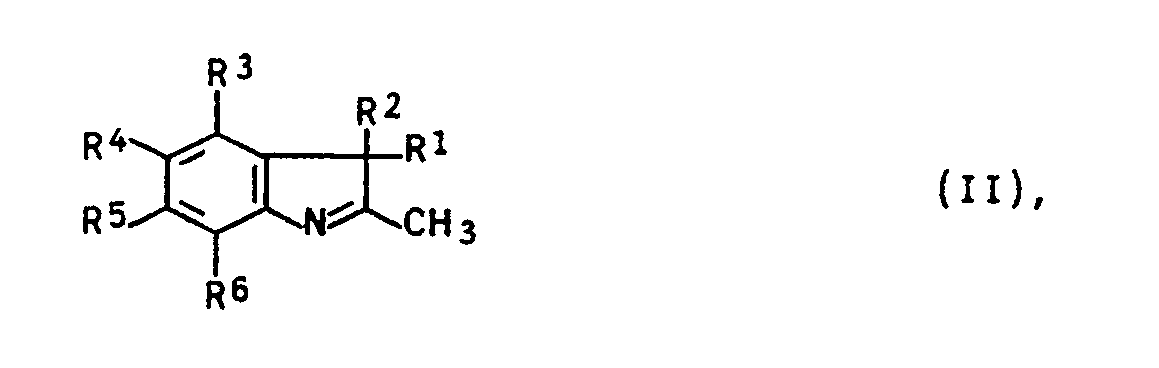
in der die Substituenten R¹ bis R⁶ die obengenannten Bedeutungen haben, mit Dimethylcarbonat bei Temperaturen von 150 bis 350°C und Drücken von 1 bis 200 bar umsetzt.Process for the preparation of 3,3-dialkyl-1-methyl-2-methylenindolines of the general formula I.
in the
- R1, R2
- independently of one another C₁ to C₈ alkyl
- R³, R⁴, R⁵, R⁶
- independently of one another hydrogen, C₁ to C₄ alkyl, C₁ to C₄ alkoxy, C₁ to C₄ haloalkyl, nitro, cyano, halogen, C₁ to C₄ alkylcarbonyl, benzoyl, C₁ to C₄ alkylcarbonylamino, benzoylamino, N. -C₁- to C₄-alkyl-phenylamino, C₁- to C₄-alkoxycarbonyl, C₁- to C₄-alkylsulfonyl, phenylsulfonyl, aminosulfonyl, aminocarbonyl, C₁- to C₄-phenylalkyl and nitrobenzyl or R³, R⁴ or R⁴, R⁵ or R⁵, R⁶ is a butylene label optionally substituted by R³ to R⁶,
by 3,3-dialkyl-2-methylindolenines of the general formula II
in which the substituents R¹ to R⁶ have the meanings given above, reacted with dimethyl carbonate at temperatures from 150 to 350 ° C and pressures from 1 to 200 bar.
Description
Die Erfindung betrifft ein neues verfahren zur Herstellung von 3,3-Dialkyl-1-methyl-2-methylenindolinen durch Umsetzung von 3,3-Dialkyl-2-methylindoleninen mit Dimethylcarbonat.The invention relates to a new process for the preparation of 3,3-dialkyl-1-methyl-2-methyleneindolines by reacting 3,3-dialkyl-2-methylindolenines with dimethyl carbonate.
Es sind aus Beilstein, Handbuch der organischen Chemie, Band 20, Hauptwerk Seite 324 bis 325 (1935) und 4. Ergänzungswerk Seite 3254 (1978) verschiedene Verfahren zur Herstellung von 1,3,3-Trialkyl-2-methylenindolinen bekannt. Für eine billige, technische Synthese sind diese Verfahren wegen ihrer aufwendigen Arbeitsweise und ihrer schlechten Ausbeuten ungeeignet.Various processes for the preparation of 1,3,3-trialkyl-2-methyleneindolines are known from Beilstein, Handbuch der organic chemistry, volume 20, main work pages 324 to 325 (1935) and 4th supplement page 3254 (1978). These processes are unsuitable for cheap, technical synthesis because of their complex procedure and their poor yields.
Aus der DE-A-21 54 246 ist ein Verfahren zur Herstellung von 1,3,3-Trialkyl-2-methylenindolinen aus 3,3-Dialkyl-2-methylindoleninen mit Dialkylsulfat oder Alkylestern organischer Sulfonsäuren in Gegenwart alkalisch wirkender Verbindungen bekannt. Nachteilig bei diesem Verfahren ist der hohe Salzanfall, die hohe Toxizität der Dialkylsulfate und der hohe Preis der Alkylsulfonate.DE-A-21 54 246 discloses a process for the preparation of 1,3,3-trialkyl-2-methyleneindolines from 3,3-dialkyl-2-methylindolenines with dialkyl sulfate or alkyl esters of organic sulfonic acids in the presence of alkaline compounds. The disadvantage of this process is the high salt accumulation, the high toxicity of the dialkyl sulfates and the high price of the alkyl sulfonates.
Der vorliegenden Erfindung lag daher die Aufgabe zugrunde den zuvorgenannten Nachteilen abzuhelfen.The object of the present invention was therefore to remedy the disadvantages mentioned above.
Demgemäß wurde ein neues und verbessertes Verfahren zur Herstellung von 3,3-Dialkyl-1-methyl-2-methylenindolinen der allgemeinen Formel I

in der
- R¹, R²
- unabhängig voneinander C₁- bis C₈-Alkyl
- R³, R⁴, R⁵, R⁶
- unabhängig voneinander Wasserstoff, C₁- bis C₄-Alkyl, C₁- bis C₄-Alkoxy, C₁- bis C₄-Halogenalkyl, Nitro, Cyano, Halogen, C₁- bis C₄-Alkylcarbonyl, Benzoyl, C₁- bis C₄-Alkylcarbonylamino, Benzoylamino, N-C₁- bis C₄-Alkyl-phenylamino, C₁- bis C₄-Alkoxycarbonyl, C₁- bis C₄-Alkylsulfonyl, Phenylsulfonyl, Aminosulfonyl, Aminocarbonyl, C₁- bis C₄-Phenylalkyl und Nitrobenzyl oder R³, R⁴ oder R⁴, R⁵ oder R⁵, R⁶ eine gegebenenfalls durch R³ bis R⁶ substituierte Butylendikette bedeuten,

in der die Substituenten R¹ bis R⁶ die obengenannten Bedeutungen haben, mit Dimethylcarbonat bei Temperaturen von 150 bis 350°C und Drücken von 1 bis 200 bar umsetzt.Accordingly, a new and improved process for the preparation of 3,3-dialkyl-1-methyl-2-methylenindolines of the general formula I
in the
- R1, R2
- independently of one another C₁ to C₈ alkyl
- R³, R⁴, R⁵, R⁶
- independently of one another hydrogen, C₁ to C₄ alkyl, C₁ to C₄ alkoxy, C₁ to C₄ haloalkyl, nitro, cyano, halogen, C₁ to C₄ alkylcarbonyl, benzoyl, C₁ to C₄ alkylcarbonylamino, benzoylamino, N. -C₁- to C₄-alkyl-phenylamino, C₁- to C₄-alkoxycarbonyl, C₁- to C₄-alkylsulfonyl, phenylsulfonyl, aminosulfonyl, aminocarbonyl, C₁- to C₄-phenylalkyl and nitrobenzyl or R³, R⁴ or R⁴, R⁵ or R⁵, R⁶ is a butylene label optionally substituted by R³ to R⁶,
in which the substituents R¹ to R⁶ have the meanings given above, reacted with dimethyl carbonate at temperatures from 150 to 350 ° C and pressures from 1 to 200 bar.
Das erfindungsgemäße Verfahren läßt sich in der Weise durchführen, daß man die 3,3-Dialkyl-2-methylindolenine der Formel II mit Dimethylcarbonat in stöchometrischer Menge, im Über- oder Unterschuß, vorzugsweise im Molverhältnis von 0,01:1 bis 1:1, bevorzugt 0,1:1 bis 1:1, besonders bevorzugt 0,1:1 bis 0,5:1 3,3-Dialkyl-2-methylindolenin zu Dimethylcarbonat, umsetzt. Die Umsetzung läßt sich bei einer Temperatur oberhalb 150⁰C, im allgemeinen zwischen 150 und 350⁰C, vorzugsweise von 160 und 300⁰C, insbesondere von 170 und 270⁰C, drucklos oder unter Druck, vorzugsweise bei 1 bar bis 200 bar, besonders bevorzugt 1 bis 100 bar, zweckmäßig unter dem im Autoklaven bei vorgenannten Temperaturen sich einstellenden Dampfdruck des Reaktionsgemischs, kontinuierlich oder diskontinuierlich durchführen. Zweckmäßig dient das Reaktionsgemisch gleichzeitig als Lösungsmedium.The process according to the invention can be carried out in such a way that the 3,3-dialkyl-2-methylindolenines of the formula II with dimethyl carbonate in a stoichometric amount, in excess or in excess, preferably in a molar ratio of 0.01: 1 to 1: 1 , preferably 0.1: 1 to 1: 1, particularly preferably 0.1: 1 to 0.5: 1 3,3-dialkyl-2-methylindolenine to dimethyl carbonate. The reaction can be carried out at a temperature above 150⁰C, generally between 150 and 350⁰C, preferably from 160 and 300⁰C, in particular from 170 and 270⁰C, without pressure or under pressure, preferably at 1 bar to 200 bar, particularly preferably 1 to 100 bar Carry out continuously or batchwise under the vapor pressure of the reaction mixture which arises in the autoclave at the aforementioned temperatures. The reaction mixture also serves as a solution medium.
Im Vergleich zu den bekannten Verfahren liefert das Verfahren nach der Erfindung auf einfacherem und wirtschaftlicherem Wege 3,3-Dialkyl-1-methyl-2-methylenindoline in guter Ausbeute und Reinheit. Umständliche Neutralisationsoperationen sowie Korrosionsprobleme werden vermieden. Außer dem Zielprodukt werden lediglich ein Mol Methanol sowie das nicht toxische Kohlendioxid erhalten. Das erfindungsgemäße Verfahren ist somit umweltfreundlicher als die bekannten Verfahren. Der freiwerdende Methanol kann in bekannter Weise ohne Phosgen wieder mit Kohlenmonoxid und Sauerstoff zu Dimethylcarbonat verarbeitet werden (DE-A-23 34 736). Alle diese vorteilhaften Eigenschaften des erfindungsgemäßen Verfahrens sind im Hinblick auf den Stand der Technik überraschend.In comparison to the known processes, the process according to the invention provides 3,3-dialkyl-1-methyl-2-methyleneindolines in a good yield and purity in a simpler and more economical way. Cumbersome neutralization operations and corrosion problems are avoided. In addition to the target product, only one mole of methanol and the non-toxic carbon dioxide are obtained. The method according to the invention is thus more environmentally friendly than the known methods. The methanol released can be processed in a known manner without carbon phosgene with carbon monoxide and oxygen to give dimethyl carbonate (DE-A-23 34 736). All of these advantageous properties of the method according to the invention are surprising with regard to the prior art.
Die Substituenten R¹ bis R⁶ in den Formeln I und II haben folgende Bedeutungen:
R¹, R² unbhängig voneinander
- C₁- bis C₈-Alkyl, vorzugsweise sind R¹ und R² gleich und bedeuten C₁- bis C₄-Alkyl wie Methyl, Ethyl, n-Propyl, iso-Propyl, n-Butyl, iso-Butyl, sec.-Butyl und tert.-Butyl,
- Wasserstoff,
- C₁- bis C₄-Alkyl wie Methyl, Ethyl, n-Propyl, iso-Propyl, n-Butyl, iso-Butyl, sec.-Butyl und tert.-Butyl, bevorzugt Methyl und Ethyl,
- C₁- bis C₄-Alkoxy wie Methoxy, Ethoxy, n-Propoxy, iso-Propoxy, n-Butoxy, iso-Butoxy, sec.-Butoxy und tert.-Butoxy, bevorzugt Methoxy oder Ethoxy,
- C₁- bis C₄-Halogenalkyl, bevorzugt C₁- bis C₂-Fluor oder Chloralkyl wie Fluormethyl, Difluormethyl, Trifluormethyl, Chlormethyl, Dichlormethyl und Trichlormethyl, bevorzugt Trifluormethyl,
- Nitro, bevorzugt ein oder zwei Nitrogruppen im Molekül, besonders bevorzugt eine Nitrogruppe,
- Cyano,
- Halogen wie Fluor, Chlor, Brom und Jod, bevorzugt Chlor und Brom,
- C₁- bis C₄-Alkylcarbonyl wie Methylcarbonyl, Ethylcarbonyl, n-Propylcarbonyl, iso-Propylcarbonyl, n-Butylcarbonyl, iso-Butylcarbonyl, sec.-Butylcarbonyl und tert.-Butylcarbonyl, bevorzugt Methylcarbonyl,
- Benzoyl
- C₁- bis C₄-Alkylcarbonylamino wie Methylcarbonylamino, Ethylcarbonylamino, n-Propylcarbonylamino und n-Butylcarbonylamino, bevorzugt Methylcarbonylamino,
- Benzoylamino,
- N-C₁- bis C₄-Alkyl-phenylamino wie N-Methyl-phenylamino, N-Ethyl-phenylamino, N-n-Propyl-phenylamino und N-iso-Propyl-phenylamino, bevorzugt N-Methylphenylamino,
- C₁- bis C₄-Alkoxycarbonyl wie Methoxycarbonyl, Ethoxycarbonyl, n-Propoxycarbonyl, iso-Propoxycarbonyl, n-Butoxycarbonyl, iso-Butoxycarbonyl, sec.-Butoxycarbonyl und tert.-Butoxycarbonyl, bevorzugt Methoxycarbonyl,
- C₁- bis C₄-Alkylsulfonyl wie Methylsulfonyl, Ethylsulfonyl, n-Propylsulfonyl, iso-Propylsulfonyl, n-Butylsulfonyl, iso-Butylsulfonyl, sec.-Butylsulfonyl und tert.-Butylsulfonyl, bevorzugt Methylsulfonyl und Ethylsulfonyl,
- Phenylsulfonyl,
- Aminosulfonyl,
- Aminocarbonyl,
- C₁- bis C₄-Phenylalkyl wie Benzyl, 1-Phenethyl und 2-Phenethyl, bevorzugt Benzyl,
- Nitrobenzyl wie 2-Nitrobenzyl, 3-Nitrobenzyl und 4-Nitrobenzyl,
- R³, R⁴ oder R⁴, R⁵ oder R⁵, R⁶ eine gegebenenfalls durch die zuvorgenannten Reste R³ bis R⁶ substituierte n-Butylendikette.
R¹, R² independently of each other
- C₁- to C₈-alkyl, preferably R¹ and R² are the same and are C₁- to C₄-alkyl such as methyl, ethyl, n-propyl, iso-propyl, n-butyl, iso-butyl, sec-butyl and tert.- Butyl,
- Hydrogen,
- C₁ to C₄ alkyl such as methyl, ethyl, n-propyl, iso-propyl, n-butyl, iso-butyl, sec-butyl and tert-butyl, preferably methyl and ethyl,
- C₁ to C₄ alkoxy such as methoxy, ethoxy, n-propoxy, iso-propoxy, n-butoxy, iso-butoxy, sec-butoxy and tert-butoxy, preferably methoxy or ethoxy,
- C₁ to C₄ haloalkyl, preferably C₁ to C₂ fluoro or chloroalkyl such as fluoromethyl, difluoromethyl, trifluoromethyl, chloromethyl, dichloromethyl and trichloromethyl, preferably trifluoromethyl,
- Nitro, preferably one or two nitro groups in the molecule, particularly preferably one nitro group,
- Cyano,
- Halogen such as fluorine, chlorine, bromine and iodine, preferably chlorine and bromine,
- C₁ to C₄ alkylcarbonyl such as methylcarbonyl, ethylcarbonyl, n-propylcarbonyl, iso-propylcarbonyl, n-butylcarbonyl, iso-butylcarbonyl, sec.-butylcarbonyl and tert.-butylcarbonyl, preferably methylcarbonyl,
- Benzoyl
- C₁ to C₄ alkylcarbonylamino such as methylcarbonylamino, ethylcarbonylamino, n-propylcarbonylamino and n-butylcarbonylamino, preferably methylcarbonylamino,
- Benzoylamino,
- N-C₁- to C₄-alkylphenylamino such as N-methylphenylamino, N-ethylphenylamino, Nn-propylphenylamino and N-iso-propylphenylamino, preferably N-methylphenylamino,
- C₁ to C₄ alkoxycarbonyl such as methoxycarbonyl, ethoxycarbonyl, n-propoxycarbonyl, iso-propoxycarbonyl, n-butoxycarbonyl, iso-butoxycarbonyl, sec.-butoxycarbonyl and tert.-butoxycarbonyl, preferably methoxycarbonyl,
- C₁ to C₄ alkylsulfonyl such as methylsulfonyl, ethylsulfonyl, n-propylsulfonyl, iso-propylsulfonyl, n-butylsulfonyl, iso-butylsulfonyl, sec-butylsulfonyl and tert-butylsulfonyl, preferably methylsulfonyl and ethylsulfonyl
- Phenylsulfonyl,
- Aminosulfonyl,
- Aminocarbonyl,
- C₁ to C₄ phenylalkyl such as benzyl, 1-phenethyl and 2-phenethyl, preferably benzyl,
- Nitrobenzyl such as 2-nitrobenzyl, 3-nitrobenzyl and 4-nitrobenzyl,
- R³, R⁴ or R⁴, R⁵ or R⁵, R⁶ an n-butylene label optionally substituted by the aforementioned radicals R³ to R⁶.
3,3-Dialkyl-1-methyl-2-methylenindoline sind wertvolle Zwischenprodukte zur Herstellung von Methin- und Azomethinfarbstoffen (Ullmanns Encyklopädie der technischen Chemie, 4. Auflage, Band 16, Seite 635 bis 669), die in großem Umfang zum Färben von Polyacrylnitrilfasern Verwendung finden.3,3-Dialkyl-1-methyl-2-methyleneindolines are valuable intermediates for the production of methine and azomethine dyes (Ullmanns Encyklopadie der Technische Chemie, 4th edition, volume 16, pages 635 to 669), which are used for dyeing on a large scale Find polyacrylonitrile fibers.
Die in den folgenden Beispielen aufgeführten Teile bedeuten Gewichtsteile.The parts listed in the following examples are parts by weight.
15,9 Teile 2,3,3-Trimethylindolenin und 27,0 Teile Dimethylcarbonat werden in einem Autoklaven 9 Stunden auf 200⁰C erhitzt. Überschüssiges Dimethylcarbonat und-Methanol werden bei Normaldruck abdestilliert. Man erhält 19,0 Teile Rückstand. Die gaschromatographische Analyse des Rückstandes zeigt, daß der Umsatz an 2,3,3-Trimethylindolenin 95 % beträgt. Die Ausbeute an 1,3,3-Trimethyl-2-methylenindolin beträgt 97 % (bezogen auf umgesetztes 2, 3, 3-Trimethylindolenin).15.9 parts of 2,3,3-trimethylindolenine and 27.0 parts of dimethyl carbonate are heated in an autoclave at 200 ° C. for 9 hours. Excess dimethyl carbonate and methanol are distilled off at normal pressure. 19.0 parts of residue are obtained. Gas chromatographic analysis of the residue shows that the conversion of 2,3,3-trimethylindolenine is 95%. The yield of 1,3,3-trimethyl-2-methyleneindoline is 97% (based on the converted 2, 3, 3-trimethylindolenine).
19,4 Teile 5-Chlor-2,3,3-trimethylindolenin und 27,0 Teile Dimethylcarbonat werden in einem Autoklaven 15 Stunden auf 200⁰C erhitzt. Überschüssiges Dimethylcarbonat und Methanol werden bei Normaldruck abdestilliert. Man erhält 22,0 Teile Rückstand. Die gaschromatographische Analyse des Rückstandes zeigt, daß der Umsatz an 5-Chlor-2,3,3-trimethylindolenin 96 % beträgt. Die Ausbeute an 5-Chlor-1,3,3-trimethyl-2-methylenindolin beträgt 94 % (bezogen auf umgesetztes 5-Chlor-2,3,3-trimethylindolenin).19.4 parts of 5-chloro-2,3,3-trimethylindolenine and 27.0 parts of dimethyl carbonate are heated in an autoclave at 200 ° C. for 15 hours. Excess dimethyl carbonate and methanol are distilled off at normal pressure. 22.0 parts of residue are obtained. Gas chromatographic analysis of the residue shows that the conversion of 5-chloro-2,3,3-trimethylindolenin is 96%. The yield of 5-chloro-1,3,3-trimethyl-2-methyleneindoline is 94% (based on the converted 5-chloro-2,3,3-trimethylindolenine).
Durch einen 2 m langen Rohrreaktor mit einem Durchmesser von 6 mm pumpt man bei 220⁰C und 50 bar stündlich 16,5 g einer Lösung aus 6,1 g 2,3,3-Trimethylindolenin und 10,4 g Dimethylcarbonat. Die gaschromatographische Analyse zeigt, daß der Umsatz an 2,3,3-Trimethylindolenin 94 % beträgt. Die Ausbeute an 1,3,3-Trimethyl-2-methylenindolin beträgt 99 % (bezogen auf umgesetztes 2,3,3-Trimethylindolenin).16.5 g of a solution of 6.1 g of 2,3,3-trimethylindolenine and 10.4 g of dimethyl carbonate are pumped through a 2 m long tubular reactor with a diameter of 6 mm at 220 ° C. and 50 bar. Gas chromatographic analysis shows that the conversion of 2,3,3-trimethylindolenine is 94%. The yield of 1,3,3-trimethyl-2-methyleneindoline is 99% (based on the 2,3,3-trimethylindolenine converted).
Claims (5)


Applications Claiming Priority (2)
| Application Number | Priority Date | Filing Date | Title |
|---|---|---|---|
| DE4006920A DE4006920A1 (en) | 1990-03-06 | 1990-03-06 | METHOD FOR PRODUCING 3,3-DIALKYL-1-METHYL-2-METHYLENE INDOLINES |
| DE4006920 | 1990-03-06 |
Publications (3)
| Publication Number | Publication Date |
|---|---|
| EP0445643A2 true EP0445643A2 (en) | 1991-09-11 |
| EP0445643A3 EP0445643A3 (en) | 1992-05-27 |
| EP0445643B1 EP0445643B1 (en) | 1995-05-17 |
Family
ID=6401478
Family Applications (1)
| Application Number | Title | Priority Date | Filing Date |
|---|---|---|---|
| EP91102908A Expired - Lifetime EP0445643B1 (en) | 1990-03-06 | 1991-02-28 | Process for preparation of 3,3-dialkyl-1-methyl-2-methyleneindolines |
Country Status (3)
| Country | Link |
|---|---|
| EP (1) | EP0445643B1 (en) |
| DE (2) | DE4006920A1 (en) |
| ES (1) | ES2071850T3 (en) |
Cited By (1)
| Publication number | Priority date | Publication date | Assignee | Title |
|---|---|---|---|---|
| CN112321480A (en) * | 2020-11-10 | 2021-02-05 | 白银帕潘纳科技有限公司 | Methylation synthesis method of N-heterocyclic compound |
Family Cites Families (1)
| Publication number | Priority date | Publication date | Assignee | Title |
|---|---|---|---|---|
| DE2154246C2 (en) * | 1971-10-30 | 1983-02-17 | Hoechst Ag, 6000 Frankfurt | Process for the preparation of 1,3,3-trimethyl-2-methylene indolines |
-
1990
- 1990-03-06 DE DE4006920A patent/DE4006920A1/en not_active Withdrawn
-
1991
- 1991-02-28 DE DE59105483T patent/DE59105483D1/en not_active Expired - Lifetime
- 1991-02-28 EP EP91102908A patent/EP0445643B1/en not_active Expired - Lifetime
- 1991-02-28 ES ES91102908T patent/ES2071850T3/en not_active Expired - Lifetime
Cited By (2)
| Publication number | Priority date | Publication date | Assignee | Title |
|---|---|---|---|---|
| CN112321480A (en) * | 2020-11-10 | 2021-02-05 | 白银帕潘纳科技有限公司 | Methylation synthesis method of N-heterocyclic compound |
| CN112321480B (en) * | 2020-11-10 | 2021-09-28 | 白银帕潘纳科技有限公司 | Methylation synthesis method of N-heterocyclic compound |
Also Published As
| Publication number | Publication date |
|---|---|
| DE59105483D1 (en) | 1995-06-22 |
| ES2071850T3 (en) | 1995-07-01 |
| DE4006920A1 (en) | 1991-09-12 |
| EP0445643A3 (en) | 1992-05-27 |
| EP0445643B1 (en) | 1995-05-17 |
Similar Documents
| Publication | Publication Date | Title |
|---|---|---|
| DE4234885A1 (en) | Process for the preparation of 4,5-diaminopyrazole derivatives, their use for dyeing hair and new pyrazole derivatives | |
| DE69205321T2 (en) | Manufacturing process for asymmetric isoindoline pigments. | |
| DE2820375C2 (en) | ||
| DE69125629T2 (en) | Process for the preparation of methoxyminoacetamide compounds | |
| DE2132761A1 (en) | 2-AEthynylcyclopropane compounds and process for making the same | |
| EP0293711B1 (en) | Process for the manufacture of 3-cyano-4-aryl-pyrroles | |
| DE69803734T2 (en) | Process for making cinnamic acid esters | |
| CH597199A5 (en) | 3-Phenyl pyridaz-6-ones prodn. | |
| EP0380712B1 (en) | Process for the preparation of 2,6-dichlorodiphenylaminoacetic-acid derivatives | |
| EP0445643B1 (en) | Process for preparation of 3,3-dialkyl-1-methyl-2-methyleneindolines | |
| CH619955A5 (en) | ||
| EP0500639B1 (en) | Process for the production of alkyl-(3-chlorophenyl) sulphones | |
| DE3342692A1 (en) | METHOD FOR PRODUCING SS HYDROXYETHYL (1,2,4-TRIAZOLE) DERIVATIVES | |
| DD209443A5 (en) | PROCESS FOR PREPARING ACYLAMINODERIVATES OF 1- (ARYL OR SUBST.-ARYL) AMINO-1-THIOALKANCARBOXYAURES | |
| EP0150026A2 (en) | Chemical process | |
| CH673279A5 (en) | ||
| EP0046193B1 (en) | 1-hydroxypyrazole and process for preparing the same | |
| DE10047109A1 (en) | Process for the preparation of DELTA · 1 · pyrrolines | |
| DE2800537C2 (en) | Process for the preparation of 1-amino-2-alkoxy-5-bromobenzenes | |
| DE2353580C2 (en) | Process for the preparation of o-acylamino-diaryl compounds | |
| EP0040358B1 (en) | Process for the preparation of sulphonyl carboxylic acids | |
| DE2922374A1 (en) | METHOD FOR THE PRODUCTION OF BENZOXANTHENE AND BENZOTHIOXANTHENE DYES | |
| DE19518473A1 (en) | Process for the preparation of aryl chloroformates | |
| DE2947475B1 (en) | Process for the preparation of 3-cyanopropionic acid amide | |
| EP0614891A2 (en) | Optionally 2-substituted 5-chloroimidazoles |
Legal Events
| Date | Code | Title | Description |
|---|---|---|---|
| PUAI | Public reference made under article 153(3) epc to a published international application that has entered the european phase |
Free format text: ORIGINAL CODE: 0009012 |
|
| AK | Designated contracting states |
Kind code of ref document: A2 Designated state(s): CH DE ES FR GB IT LI |
|
| PUAL | Search report despatched |
Free format text: ORIGINAL CODE: 0009013 |
|
| AK | Designated contracting states |
Kind code of ref document: A3 Designated state(s): CH DE ES FR GB IT LI |
|
| 17P | Request for examination filed |
Effective date: 19920423 |
|
| 17Q | First examination report despatched |
Effective date: 19930107 |
|
| GRAA | (expected) grant |
Free format text: ORIGINAL CODE: 0009210 |
|
| AK | Designated contracting states |
Kind code of ref document: B1 Designated state(s): CH DE ES FR GB IT LI |
|
| REF | Corresponds to: |
Ref document number: 59105483 Country of ref document: DE Date of ref document: 19950622 |
|
| REG | Reference to a national code |
Ref country code: ES Ref legal event code: FG2A Ref document number: 2071850 Country of ref document: ES Kind code of ref document: T3 |
|
| GBT | Gb: translation of ep patent filed (gb section 77(6)(a)/1977) |
Effective date: 19950612 |
|
| ITF | It: translation for a ep patent filed | ||
| ET | Fr: translation filed | ||
| PLBE | No opposition filed within time limit |
Free format text: ORIGINAL CODE: 0009261 |
|
| STAA | Information on the status of an ep patent application or granted ep patent |
Free format text: STATUS: NO OPPOSITION FILED WITHIN TIME LIMIT |
|
| 26N | No opposition filed | ||
| PGFP | Annual fee paid to national office [announced via postgrant information from national office to epo] |
Ref country code: FR Payment date: 20010116 Year of fee payment: 11 |
|
| PGFP | Annual fee paid to national office [announced via postgrant information from national office to epo] |
Ref country code: CH Payment date: 20010117 Year of fee payment: 11 |
|
| PGFP | Annual fee paid to national office [announced via postgrant information from national office to epo] |
Ref country code: ES Payment date: 20010212 Year of fee payment: 11 |
|
| PGFP | Annual fee paid to national office [announced via postgrant information from national office to epo] |
Ref country code: GB Payment date: 20010219 Year of fee payment: 11 |
|
| PGFP | Annual fee paid to national office [announced via postgrant information from national office to epo] |
Ref country code: DE Payment date: 20010220 Year of fee payment: 11 |
|
| REG | Reference to a national code |
Ref country code: GB Ref legal event code: IF02 |
|
| PG25 | Lapsed in a contracting state [announced via postgrant information from national office to epo] |
Ref country code: DE Free format text: LAPSE BECAUSE OF THE APPLICANT RENOUNCES Effective date: 20020215 |
|
| PG25 | Lapsed in a contracting state [announced via postgrant information from national office to epo] |
Ref country code: LI Free format text: LAPSE BECAUSE OF NON-PAYMENT OF DUE FEES Effective date: 20020228 Ref country code: GB Free format text: LAPSE BECAUSE OF NON-PAYMENT OF DUE FEES Effective date: 20020228 Ref country code: CH Free format text: LAPSE BECAUSE OF NON-PAYMENT OF DUE FEES Effective date: 20020228 |
|
| PG25 | Lapsed in a contracting state [announced via postgrant information from national office to epo] |
Ref country code: ES Free format text: LAPSE BECAUSE OF NON-PAYMENT OF DUE FEES Effective date: 20020301 |
|
| REG | Reference to a national code |
Ref country code: CH Ref legal event code: PL |
|
| GBPC | Gb: european patent ceased through non-payment of renewal fee |
Effective date: 20020228 |
|
| PG25 | Lapsed in a contracting state [announced via postgrant information from national office to epo] |
Ref country code: FR Free format text: LAPSE BECAUSE OF NON-PAYMENT OF DUE FEES Effective date: 20021031 |
|
| REG | Reference to a national code |
Ref country code: FR Ref legal event code: ST |
|
| REG | Reference to a national code |
Ref country code: ES Ref legal event code: FD2A Effective date: 20030922 |
|
| PG25 | Lapsed in a contracting state [announced via postgrant information from national office to epo] |
Ref country code: IT Free format text: LAPSE BECAUSE OF NON-PAYMENT OF DUE FEES;WARNING: LAPSES OF ITALIAN PATENTS WITH EFFECTIVE DATE BEFORE 2007 MAY HAVE OCCURRED AT ANY TIME BEFORE 2007. THE CORRECT EFFECTIVE DATE MAY BE DIFFERENT FROM THE ONE RECORDED. Effective date: 20050228 |