EP0444816A2 - Schaltungselementmessapparat und -verfahren - Google Patents
Schaltungselementmessapparat und -verfahren Download PDFInfo
- Publication number
- EP0444816A2 EP0444816A2 EP91301343A EP91301343A EP0444816A2 EP 0444816 A2 EP0444816 A2 EP 0444816A2 EP 91301343 A EP91301343 A EP 91301343A EP 91301343 A EP91301343 A EP 91301343A EP 0444816 A2 EP0444816 A2 EP 0444816A2
- Authority
- EP
- European Patent Office
- Prior art keywords
- terminal
- detection amplifier
- measuring
- zero detection
- voltage
- Prior art date
- Legal status (The legal status is an assumption and is not a legal conclusion. Google has not performed a legal analysis and makes no representation as to the accuracy of the status listed.)
- Withdrawn
Links
Images
Classifications
-
- G—PHYSICS
- G01—MEASURING; TESTING
- G01R—MEASURING ELECTRIC VARIABLES; MEASURING MAGNETIC VARIABLES
- G01R31/00—Arrangements for testing electric properties; Arrangements for locating electric faults; Arrangements for electrical testing characterised by what is being tested not provided for elsewhere
- G01R31/50—Testing of electric apparatus, lines, cables or components for short-circuits, continuity, leakage current or incorrect line connections
Definitions
- the present invention relates to a method and apparatus for high accuracy circuit element measurements by easily correcting changes, if any, in the measurement cables or range resistance.
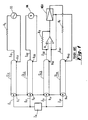
- FIG. 1 is a schematic circuit diagram showing a circuit element measuring apparatus for four-terminal pair measurements according to the prior art.
- a circuit element to be measured (hereinafter referred to as a "DUT" or element Z x ) is connected to a signal source SS, a volt meter VM, a range resistance R r and a zero detection amplifier A which together form a measuring apparatus.
- the impedance value of the element Z x shall also be referred to as Z x .
- the lines CL1, CL2, CL3 and CL4 are generally made of coaxial cables although not limited thereto, and their outer conductor terminals g11, g21, g31 and g41 at one end thereof are connected to one another and held at the same potential.
- the terminals l11 and l21 of the center conductor of the lines CL1 and CL2 at the same end thereof are connected to one terminal of the element Z x .
- the terminals l31 and l41 of CL3 and CL4 are connected to the other terminal of the element Z x .
- the terminals of the center conductors of the lines CL1, CL2, CL3 and CL4 and the outer conductor at the opposite end are respectively designated as l12, g12, l22, g22, l32, g32, l42 and g42.
- the signal source SS and a signal source resistance R s are connected in series.
- the volt meter VM is connected between the terminals l22 and g22.
- the terminals l32 and g32 are respectively connected to the inverted input terminal and non-inverted input terminal of the zero detection amplifier A.
- the feedback resistance R f is connected between the inverted input terminal and the output terminal of the zero detection amplifier A.
- the output of the zero detection amplifier A is introduced into a narrow-band amplification/phase compensation amplifier NBA.
- the output of the NBA is applied through the range resistance R r to the terminal l42.
- the NBA is similar to that used in the aforementioned meters 4274A and 4275A.
- the range resistance R r is placed between the terminal 142 and the NBA output, and the terminals g42 and g32 are also connected.
- an automatic control is performed on the voltage between the terminals l32 and g32, i.e., controlled such that the current flow through the terminal l32 may be substantially zero.
- a voltage V x to be applied to the element Z x is obtained as the indication of the volt meter VM.
- a current I x to flow through the element Z x is obtained as an indication of the range resistance R r .
- the method of measuring the complex voltage or current is well known in the art and is used together with the overall operations of the meter in the aforementioned 4274A or 4275A.
- the calibrations are carried out by the known method of replacing the measured element with a "short” or “open” or by using a known third impedance.
- the range resistance R r is selected to have a magnitude close to that of the Z x . This provides the advantage of a uniform dynamic range for succeeding volt meters by making the magnitudes of the V x and V i same.
- the stabilization of the automatic control loop composed of the line CL3, the zero detection amplifier A, the NBA, the range resistance R r and the line CL4 can be made excellent by selecting a sufficiently small value of the feedback resistance R f .
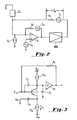
- Fig. 2 wherein a noise model of the automatic control loop of Fig. 1 is shown so as to provide an understanding of the problem of noise in the prior art thus far described.
- reference characters E1, and E2 designate the thermal noise of the resistors R r and R f respectively; and characters E n and I n designate an equivalent input noise voltage and an equivalent input noise current of the zero detection amplifier A respectively.
- These four noise sources are deemed to be random and therefore have no correlation among themselves.
- the individual noise sources are considered as white noise sources, as will be expressed by the following theoretical equations.
- E1 ⁇ (4kT ⁇ R r ⁇ f) ⁇ (1)
- E2 ⁇ (4kT ⁇ R f ⁇ f) ⁇ (2) wherein:
- the first-stage amplification element of the amplifier A is a field effect transistor (i.e., FET)
- E n ⁇ (4kT(2/(3g m ))f) ⁇ (5) wherein g m is mutual conductance [S] of the FET.
- I n can usually be ignored.
- V n 2 increases more the smaller R f is as compared with R r in the case of R r ⁇ Z x . It is, therefore, advisable that the R f should not be less than the R r .
- FETs have a sufficiently small I n but few FETs have a smaller E n than 2nV/ (Hz) and an FET is less suitable than the BT r (i.e., bipolar transistor) for the measurement of the DUT of a lower impedance because of higher DC bias current is needed.
- BT r i.e., bipolar transistor
- the bias conditions for the BT r may be determined as follows:
- the optimum value for the bias current I c of the amplification element at the first stage of the amplifier A is different for the case, in which a DUT of a low impedance is to be measured, and for the case in which a DUT of a high impedance is to be measured.
- the bias current I c uses a fixed value but not the proper value.
- the slew rate of the amplifier A is to be considered. In Fig. 1, it is necessary for the convergence of the aforementioned automatic control loop that the input voltage of the amplifier A be sufficiently close to zero.
- the DUT is to be measured with a high measurement frequency and/or a large measurement current, the change of the I x per unit time is enlarged. If the slew rate of the amplifier A becomes smaller, the amplifier A cannot absorb more than a portion of the I x . Then, the automatic control loop may perform in a nonlinear fashion and fail to converge.
- V o ( ⁇ 2) ⁇ I x ⁇ R f ⁇ sin(2 ⁇ ft) (13) wherein:
- Fig. 3 is a more detailed circuit diagram of the amplifier A.
- the transistor T r has its collector and emitter connected with power sources V cc and V ee through current sources CS1 and CS2 of the prior art, respectively.
- the emitter of the transistor T r is further connected through a bypass capacitor C o with the terminal g32 (at ground).
- the base of the transistor T r is the inverted input terminal of the amplifier A.
- a base-collector capacitor C1 and an output capacitor C2 are parasitic to the transistor T r .
- the output of the amplifier A is led out from the collector of the transistor T r through a buffer amplifier A1.
- the BT r is used at the first stage of the amplifier A
- the current measurement noise when a large impedance is to be measured is increased as seen from Equation (10) for a high DC bias current I c .
- the SR necessary for measurements with the high current and the high frequency is sufficiently short as may be seen from Equation (16) so that the automatic control loop is sufficiently destabilized to make the measurements impossible.
- the FET is improper for the DUT of a low impedance or for the measurements with high frequency and high current.
- both the BT r and the FET are used at the first stage of the amplifier A.
- the bias current value is fixed at a suitable compromising value so that the E n and the I n are not proper for the measurements of the DUT having a certain impedance.
- a compromise has to be made for the increase in noise for the measurement of the I x , and high-frequency and large-current measurements cannot be accomplished.
- an object of the present invention is to solve the above-specified problems by a circuit element measuring apparatus which executes high-frquency and large-current measurements precisely by controlling the amplifier A.
- a circuit element measuring apparatus for a device under test having one terminal and another terminal comprises a source of measurement voltage, means for detecting the measurement voltage, a zero detection amplifier, and a voltage-controlled source for drawing an electric current through the device to be measured in accordance with the output of the zero detection amplifier so as to drop the voltage of the other terminal of the device to be measured to zero.
- means are provided for changing the operation point of the zero detection amplifier in response to a measured condition.
- the operation point is the operating current of a first stage semiconductor element of the zero detection amplifier.
- the measuring condition is selected from a group consisting of the impedance of the device to be measured, feedback resistance of the zero detection amplifier, a measuring frequency, and a measuring current through the device.
- Fig. 1 is a schematic circuit diagram showing the circuit element measuring apparatus according to the prior art.
- Fig. 2 is a diagram for explaining the noise mode of Fig. 1.
- Fig. 3 is a schematic diagram showing one embodiment of the amplifier A of Fig. 1.
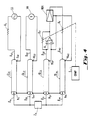
- Fig. 4 is a schematic circuit diagram showing the circuit element measuring apparatus according to one embodiment of the present invention.
- Fig. 4 is a schematic circuit diagram showing one embodiment of the present invention.
- the structure of the amplifier A used in Fig. 4 is shown in Fig. 3 where the parts serving the same functions are designated with common reference characters.
- Fig. 4 is different from Fig. 3 in that there is newly provided a control circuit block COMP.
- the prior art circuit element measuring apparatus of Fig. 1, according to the prior art is also equipped with a control not shown in Fig. 1.
- the function of setting the operation point of the amplifier A by setting the current I c in response to the control circuit COMP is not practiced by the prior art.
- the DC bias current I c of the first stage amplification element T r for the amplifier A is controlled in the following manner.
- the allowable range (I c1 , I c2 ) is given by Equation (10).
- I c1 , I c2 and I cmin are written into the following equations.
- I c1 0.025/2 x ⁇ R r //R f ⁇ / ⁇ Z x //R f ⁇ [A] (18)
- I c2 0.050 x h FE / ⁇ R r //R f ⁇ [A] (19)
- I cmin 2 ⁇ 2 ⁇ ⁇ fI x R f C t [A] (20) Equation (10) is written into the following form.
- the setting of the I c is determined to satisfy at least the Equation (16). In case, moreover, the I c can satisfy the Equation (10), it is set at that value. Otherwise, the I c is set at the minimum to satisfy the Equation (16) so that the value I n may be minimized.
- the I c may be set at about 1 mA from the Equation (12).
- the slew rate SR is increased by increasing either the collector voltage or the collector current.
- the object of the present invention is satisfied by raising the collector voltage with a high frequency. In this case, the power consumption of the transistor T r is increased.
- control circuit COMP may comprise a microprocessor capable of the aforesaid computations in response to the measuring conditions of the impedance (Z x ), the feedback resistance (R x ), a measuring frequency (f) or a measuring current I x for changing the operating point of the amplifier A, e.g., the current I c .
- the measurement accuracy and stability of the current I x to flow through the DUT can be improved.
- the accuracy and stability of the circuit element measurements are also improved. This result is achieved because the slew rate of the amplifier A sufficiently stabilizes the automatic control loop for measuring the value of I x and because the influence of noise on the amplifier A are reduced.
Landscapes
- Physics & Mathematics (AREA)
- General Physics & Mathematics (AREA)
- Measurement Of Resistance Or Impedance (AREA)
- Amplifiers (AREA)
Applications Claiming Priority (2)
| Application Number | Priority Date | Filing Date | Title |
|---|---|---|---|
| JP49052/90 | 1990-02-27 | ||
| JP2049052A JP2960095B2 (ja) | 1990-02-27 | 1990-02-27 | 回路素子測定装置 |
Publications (2)
| Publication Number | Publication Date |
|---|---|
| EP0444816A2 true EP0444816A2 (de) | 1991-09-04 |
| EP0444816A3 EP0444816A3 (en) | 1992-05-13 |
Family
ID=12820312
Family Applications (1)
| Application Number | Title | Priority Date | Filing Date |
|---|---|---|---|
| EP19910301343 Withdrawn EP0444816A3 (en) | 1990-02-27 | 1991-02-20 | Circuit element measuring method and apparatus |
Country Status (4)
| Country | Link |
|---|---|
| US (1) | US5086278A (de) |
| EP (1) | EP0444816A3 (de) |
| JP (1) | JP2960095B2 (de) |
| CA (1) | CA2036263A1 (de) |
Families Citing this family (3)
| Publication number | Priority date | Publication date | Assignee | Title |
|---|---|---|---|---|
| JP3329555B2 (ja) * | 1993-12-28 | 2002-09-30 | アジレント・テクノロジー株式会社 | インピーダンス・メータ |
| US20080229506A1 (en) * | 2007-03-19 | 2008-09-25 | Saman Natalie T | Diaper changing article |
| US8896331B2 (en) * | 2008-02-01 | 2014-11-25 | Keithley Instruments, Inc. | Impedance measuring instrument |
Family Cites Families (7)
| Publication number | Priority date | Publication date | Assignee | Title |
|---|---|---|---|---|
| US4241316A (en) * | 1979-01-18 | 1980-12-23 | Lawrence Kavanau | Field effect transconductance amplifiers |
| US4264871A (en) * | 1979-04-16 | 1981-04-28 | Hughes Aircraft Company | Low noise amplifiers |
| US4577160A (en) * | 1983-01-03 | 1986-03-18 | Robert H. Rines | Method of and apparatus for low noise current amplification |
| JPS6158307A (ja) * | 1984-08-30 | 1986-03-25 | Nec Ic Microcomput Syst Ltd | 利得可変増幅器 |
| JPH026268U (de) * | 1988-06-28 | 1990-01-16 | ||
| JP2698615B2 (ja) * | 1988-07-05 | 1998-01-19 | 日本ヒューレット・パッカード株式会社 | 回路素子測定装置 |
| US4905308A (en) * | 1989-04-05 | 1990-02-27 | Cascade Microtech, Inc. | Noise parameter determination method |
-
1990
- 1990-02-27 JP JP2049052A patent/JP2960095B2/ja not_active Expired - Fee Related
-
1991
- 1991-02-13 CA CA002036263A patent/CA2036263A1/en not_active Abandoned
- 1991-02-20 EP EP19910301343 patent/EP0444816A3/en not_active Withdrawn
- 1991-02-22 US US07/659,853 patent/US5086278A/en not_active Expired - Lifetime
Also Published As
| Publication number | Publication date |
|---|---|
| JP2960095B2 (ja) | 1999-10-06 |
| JPH03249570A (ja) | 1991-11-07 |
| EP0444816A3 (en) | 1992-05-13 |
| US5086278A (en) | 1992-02-04 |
| CA2036263A1 (en) | 1991-08-28 |
Similar Documents
| Publication | Publication Date | Title |
|---|---|---|
| US5970429A (en) | Method and apparatus for measuring electrical noise in devices | |
| EP0320265B1 (de) | Hochfrequenz-Leistungssensor mit grossem dynamischen Bereich | |
| US20040008043A1 (en) | Current probe device having an integrated amplifier | |
| US4647848A (en) | Broadband RF power detector using FET | |
| US6642741B2 (en) | Electronically adjustable integrated circuit input/output termination method and apparatus | |
| US3048776A (en) | Resistivity measuring circuit | |
| Cutkosky | An ac resistance thermometer bridge | |
| US5448173A (en) | Triple-probe plasma measuring apparatus for correcting space potential errors | |
| US3227953A (en) | Bridge apparatus for determining the input resistance and beta figure for an in-circuit transistor | |
| US6822433B1 (en) | Gain and phase detector having dual logarithmic amplifiers | |
| EP0444816A2 (de) | Schaltungselementmessapparat und -verfahren | |
| EP3101435B1 (de) | Leistungsdetektion | |
| CA1310368C (en) | Circuit element measuring apparatus | |
| US5732332A (en) | Transmitter having temperature-compensated detector | |
| US6608492B1 (en) | AC impedance bridge | |
| US20030173984A1 (en) | Current-comparator-based four-terminal resistance bridge for power frequencies | |
| JP2698615B2 (ja) | 回路素子測定装置 | |
| US4039945A (en) | Device for measuring and checking parameters of electric circuit elements | |
| Baechtold et al. | Noise in microwave transistors | |
| EP0874245A1 (de) | Verfahren und Gerät zur Bestimmung der Rauschcharakteristiken elektrischer Geräte | |
| US2897448A (en) | Circuit for measuring alpha of transistors | |
| JPS5910506B2 (ja) | 電子計測器 | |
| CN222994565U (zh) | 一种射频探头电路 | |
| JPH02300670A (ja) | インダクタス測定装置 | |
| Zawels | A wide-band bridge yielding directly the device parameters of junction transistors |
Legal Events
| Date | Code | Title | Description |
|---|---|---|---|
| PUAI | Public reference made under article 153(3) epc to a published international application that has entered the european phase |
Free format text: ORIGINAL CODE: 0009012 |
|
| AK | Designated contracting states |
Kind code of ref document: A2 Designated state(s): DE FR GB |
|
| PUAL | Search report despatched |
Free format text: ORIGINAL CODE: 0009013 |
|
| AK | Designated contracting states |
Kind code of ref document: A3 Designated state(s): DE FR GB |
|
| STAA | Information on the status of an ep patent application or granted ep patent |
Free format text: STATUS: THE APPLICATION IS DEEMED TO BE WITHDRAWN |
|
| 18D | Application deemed to be withdrawn |
Effective date: 19930129 |