EP0443548A2 - Speech coder - Google Patents
Speech coder Download PDFInfo
- Publication number
- EP0443548A2 EP0443548A2 EP91102440A EP91102440A EP0443548A2 EP 0443548 A2 EP0443548 A2 EP 0443548A2 EP 91102440 A EP91102440 A EP 91102440A EP 91102440 A EP91102440 A EP 91102440A EP 0443548 A2 EP0443548 A2 EP 0443548A2
- Authority
- EP
- European Patent Office
- Prior art keywords
- signal
- code book
- code
- speech
- gain
- Prior art date
- Legal status (The legal status is an assumption and is not a legal conclusion. Google has not performed a legal analysis and makes no representation as to the accuracy of the status listed.)
- Granted
Links
Images

Classifications
-
- G—PHYSICS
- G10—MUSICAL INSTRUMENTS; ACOUSTICS
- G10L—SPEECH ANALYSIS TECHNIQUES OR SPEECH SYNTHESIS; SPEECH RECOGNITION; SPEECH OR VOICE PROCESSING TECHNIQUES; SPEECH OR AUDIO CODING OR DECODING
- G10L19/00—Speech or audio signals analysis-synthesis techniques for redundancy reduction, e.g. in vocoders; Coding or decoding of speech or audio signals, using source filter models or psychoacoustic analysis
- G10L19/04—Speech or audio signals analysis-synthesis techniques for redundancy reduction, e.g. in vocoders; Coding or decoding of speech or audio signals, using source filter models or psychoacoustic analysis using predictive techniques
- G10L19/08—Determination or coding of the excitation function; Determination or coding of the long-term prediction parameters
- G10L19/12—Determination or coding of the excitation function; Determination or coding of the long-term prediction parameters the excitation function being a code excitation, e.g. in code excited linear prediction [CELP] vocoders
-
- G—PHYSICS
- G10—MUSICAL INSTRUMENTS; ACOUSTICS
- G10L—SPEECH ANALYSIS TECHNIQUES OR SPEECH SYNTHESIS; SPEECH RECOGNITION; SPEECH OR VOICE PROCESSING TECHNIQUES; SPEECH OR AUDIO CODING OR DECODING
- G10L19/00—Speech or audio signals analysis-synthesis techniques for redundancy reduction, e.g. in vocoders; Coding or decoding of speech or audio signals, using source filter models or psychoacoustic analysis
- G10L2019/0001—Codebooks
- G10L2019/0003—Backward prediction of gain
-
- G—PHYSICS
- G10—MUSICAL INSTRUMENTS; ACOUSTICS
- G10L—SPEECH ANALYSIS TECHNIQUES OR SPEECH SYNTHESIS; SPEECH RECOGNITION; SPEECH OR VOICE PROCESSING TECHNIQUES; SPEECH OR AUDIO CODING OR DECODING
- G10L19/00—Speech or audio signals analysis-synthesis techniques for redundancy reduction, e.g. in vocoders; Coding or decoding of speech or audio signals, using source filter models or psychoacoustic analysis
- G10L2019/0001—Codebooks
- G10L2019/0004—Design or structure of the codebook
- G10L2019/0005—Multi-stage vector quantisation
-
- G—PHYSICS
- G10—MUSICAL INSTRUMENTS; ACOUSTICS
- G10L—SPEECH ANALYSIS TECHNIQUES OR SPEECH SYNTHESIS; SPEECH RECOGNITION; SPEECH OR VOICE PROCESSING TECHNIQUES; SPEECH OR AUDIO CODING OR DECODING
- G10L19/00—Speech or audio signals analysis-synthesis techniques for redundancy reduction, e.g. in vocoders; Coding or decoding of speech or audio signals, using source filter models or psychoacoustic analysis
- G10L2019/0001—Codebooks
- G10L2019/0011—Long term prediction filters, i.e. pitch estimation
-
- G—PHYSICS
- G10—MUSICAL INSTRUMENTS; ACOUSTICS
- G10L—SPEECH ANALYSIS TECHNIQUES OR SPEECH SYNTHESIS; SPEECH RECOGNITION; SPEECH OR VOICE PROCESSING TECHNIQUES; SPEECH OR AUDIO CODING OR DECODING
- G10L19/00—Speech or audio signals analysis-synthesis techniques for redundancy reduction, e.g. in vocoders; Coding or decoding of speech or audio signals, using source filter models or psychoacoustic analysis
- G10L2019/0001—Codebooks
- G10L2019/0013—Codebook search algorithms
- G10L2019/0014—Selection criteria for distances
-
- G—PHYSICS
- G10—MUSICAL INSTRUMENTS; ACOUSTICS
- G10L—SPEECH ANALYSIS TECHNIQUES OR SPEECH SYNTHESIS; SPEECH RECOGNITION; SPEECH OR VOICE PROCESSING TECHNIQUES; SPEECH OR AUDIO CODING OR DECODING
- G10L25/00—Speech or voice analysis techniques not restricted to a single one of groups G10L15/00 - G10L21/00
- G10L25/03—Speech or voice analysis techniques not restricted to a single one of groups G10L15/00 - G10L21/00 characterised by the type of extracted parameters
- G10L25/06—Speech or voice analysis techniques not restricted to a single one of groups G10L15/00 - G10L21/00 characterised by the type of extracted parameters the extracted parameters being correlation coefficients
-
- G—PHYSICS
- G10—MUSICAL INSTRUMENTS; ACOUSTICS
- G10L—SPEECH ANALYSIS TECHNIQUES OR SPEECH SYNTHESIS; SPEECH RECOGNITION; SPEECH OR VOICE PROCESSING TECHNIQUES; SPEECH OR AUDIO CODING OR DECODING
- G10L25/00—Speech or voice analysis techniques not restricted to a single one of groups G10L15/00 - G10L21/00
- G10L25/03—Speech or voice analysis techniques not restricted to a single one of groups G10L15/00 - G10L21/00 characterised by the type of extracted parameters
- G10L25/18—Speech or voice analysis techniques not restricted to a single one of groups G10L15/00 - G10L21/00 characterised by the type of extracted parameters the extracted parameters being spectral information of each sub-band
-
- G—PHYSICS
- G10—MUSICAL INSTRUMENTS; ACOUSTICS
- G10L—SPEECH ANALYSIS TECHNIQUES OR SPEECH SYNTHESIS; SPEECH RECOGNITION; SPEECH OR VOICE PROCESSING TECHNIQUES; SPEECH OR AUDIO CODING OR DECODING
- G10L25/00—Speech or voice analysis techniques not restricted to a single one of groups G10L15/00 - G10L21/00
- G10L25/03—Speech or voice analysis techniques not restricted to a single one of groups G10L15/00 - G10L21/00 characterised by the type of extracted parameters
- G10L25/24—Speech or voice analysis techniques not restricted to a single one of groups G10L15/00 - G10L21/00 characterised by the type of extracted parameters the extracted parameters being the cepstrum
Definitions
- the present invention relates to a speech coder for coding a speech signal with high quality at low bit rates, specifically, at about 8 to 4.8 kb/s.
- CELP Code Excited LPC Coding
- a spectrum parameter representing the spectrum characteristics of a speech signal is extracted from a speech signal of each frame (e.g., 20 ms).
- a frame is divided into subframes (e.g., 5 ms), and a pitch parameter representing a long-term correlation (pitch correlation) is extracted from a past sound source signal in units of subframes.
- pitch correlation a pitch parameter representing a long-term correlation
- Long-term prediction of speech signals in the subframes is performed using the pitch parameter to obtain difference signals.
- one type of noise signal is selected so as to minimize the differential power between the speech signal and a signal synthesized by a signal selected from a code book constituted by predetermined types of noise signals.
- an optimal gain is calculated.
- an index representing the type of selected noise signal and the gain are transmitted together with the spectrum parameter and the pitch parameter. A description on the receiver side will be omitted.
- a scalar quantization method is used in reference 1.
- a vector quantization method is known as a method which allows more efficient quantization with a smaller amount of bits than the scalar quantization method.
- this method refer to, e.g., Buzo et al., "Speech Coding Based upon Vector Quantization", IEEE Trans ASSP, pp. 562 - 574, 1980 (reference 2).
- a data base training data
- the characteristics of a vector quantizer depend on training data used.
- a vector/scalar quantization method in which an error signal representing the difference between a vector-quantized signal and an input signal is scalar-quantized to combine the merits of the two methods.
- vector/scalar quantization refer to, e.g., Moriya et al., "Adaptive Transform Coding of Speech Using Vector Quantization", Journal of the Institute of Electronics and Communication Engineers of Japan, vol. J. 67-A, pp. 974 - 981, 1984 (reference 3). A description of this method will be omitted.
- the bit size of a code book constituted by noise signals must be set to be as large as 10 bits or more. Therefore, an enormous amount of operations is required to search the code book for an optimal noise signal (code word).
- a code book is basically constituted by noise signals, speech reproduced by a code word selected from the code book inevitably includes perceptual noise.
- quantization characteristics depend on training data used for preparing a vector quantization code book. For this reason, the quantization performance deteriorates with respect to a signal having characteristics which are not covered by the training data, resulting in a deterioration in speech quality.
- a speech coder characterized by comprising means for dividing an input discrete speech signal into signal components in units of frames each having a predetermined time length, and obtaining a spectrum parameter representing a spectrum envelope of the speech signal, means for obtaining a difference signal by dividing the frame into subframes each having a predetermined time length, and calculating a pitch parameter representing a long-term correlation on the basis of a past sound source signal, a first code book for storing a signal formed beforehand by learning based on the difference signal, a second code book for storing a signal having predetermined characteristics, and means for representing a sound source signal of the speech signal by a linear combination of a signal selected from the first code book in accordance with each obtained difference signal and a signal selected from the second code book, and outputting the combination.
- a sound source signal is obtained so as to minimize the following equation in units of subframes obtained by dividing a frame:
- ⁇ and M are the pitch parameters of pitch prediction (or an adaptive code book) based on long-term correlation, i.e., a gain and a delay
- v(n) is the sound source signal in a past subframe
- h(n) is the impulse response of a synthetic filter constituted by a spectrum parameter
- w(n) is the impulse response of a perceptual weighting filter.
- * represents a convolution operation. Refer to reference 1 for a detailed description of w(n).
- d(n) represents a sound source signal represented by a code book and is given by a linear combination of a code word c 1j (n) selected from a first code book and a code word c 2i (n) selected from a second code book as follows: where ⁇ 1 and ⁇ 2 are the gains of the selected code words c 1j (n) and c 2i (n).
- each code book is only required to have bits 1/2 the number of bits of the overall code book. For example, if the number of bits of the overall code book is 10 bits, each of the first and second code books is only required to have 5 bits. This greatly reduces the operation amount required to search the code book.
- the first code book is prepared by a learning procedure using training data.
- a method of preparing a code book by a learning procedure a method disclosed in Linde et al., "An algorithm for Vector Quantization Design", IEEE Trans. COM-28, pp. 84 - 95, 1980 (reference 4) is known.
- a square distance (Euclidean distance) is normally used.
- a perceptual weighting distance scale represented by the following equation, which allows higher perceptual performance than the square distance, is used: where t j (n) is the jth training data, and c1(n) is a code word in a cluster 1.
- a centroid s c1 (n) (representative code) of the cluster 1 is obtained so as to minimize equation (4) or (5) below by using training data in the cluster 1.
- equation (5) q is an optimal gain.
- a code book constituted by noise signals or random number signals whose statistical characteristics are determined in advance, such as Gaussian noise signals in reference 1, or a code book having different characteristics is used to compensate for the dependency of the first code book on training data. Note that a further improvement in characteristics can be ensured by selecting noise signal or random number code books on a certain distance scale.
- this method refer to T. Moriaya et al., "Transform Coding of speech using a Weighted Vector Quantizer", IEEE J. Sel. Areas, Commun., pp. 425 - 431, 1988 (reference 5).
- the spectrum parameters obtained in units of frames are subjected to vector/scalar quantization.
- spectrum parameters various types of parameters, e.g., LPC, PARCOR, and LSP, are known.
- LSP Line Spectrum Pair
- LSP Line Spectrum Pair
- an LSP coefficient is vector-quantized first.
- a vector quantizer for LSP prepares a vector quantization code book by performing a learning procedure with respect to LSP training data using the method in reference 4. Subsequently, in vector quantization, a code word which minimizes the distortion of the following equation is selected from the code book: where p(i) is the ith LSP coefficient obtained by analyzing a speech signal in a frame, L is the LSP analysis order, q j (i) is the ith coefficient of the code word, and B is the number of bits of the code book.
- p(i) is the ith LSP coefficient obtained by analyzing a speech signal in a frame
- L is the LSP analysis order
- q j (i) is the ith coefficient of the code word
- B is the number of bits of the code book.
- the difference signal e(i) is scalar-quantized by scalar quantization.
- the statistic distribution of e(i) of a large amount of signals e(i) is measured for every order i so as to determine the maximum and minimum values of the quantization range of the quantizer for each order. For example, a 1% point and a 99% point of the statistic distribution of e(i) are measured so that the measurement values are set to be the maximum and minimum values of the quantizer.
- an improvement in characteristics is realized by searching the first and second code books while adjusting at least one gain, or optimizing the two gains upon determination of code words of the two code books.
- first and second code books are searched while their gains are adjusted. More specifically, code words of the first code book are determined, and the second code book is searched while the following equation is minimized for each code word: where ⁇ 1 and ⁇ 2 are the gains of the first and second code books, and c 1j (n) and c 2i (n) are code words selected from the first and second code books. All the values of c 2i (n) in equation (8) are calculated to obtain the code word c 2i (n) which minimizes error power E and to obtain the gains ⁇ 1 and ⁇ 2 at the same time.
- the operation amount can be reduced in the following manner.
- the optimal gains ⁇ 1 and ⁇ 2 are obtained by independently determining the code words of the first and second code books and solving equation (8) for only the determined code words c 1j (n) and c 2i (n).
- the gains ⁇ 1 and ⁇ 2 of the first and second code books are efficiently vector-quantized by using a gain code book prepared by learning procedure.
- vector quantization when optimal code words are to be searched out, a code word which minimizes the following equation is selected: where ⁇ 1 is the vector-quantized gain represented by each code word, and c i (n) is a code word selected from each of the first and second code books.
- a code word may be selected according to the following equation: where a code book for vector-quantizing a gain is prepared by a training procedure using training data constituted by a large amount of values.
- the learning procedure for a code book may be performed by the method in reference 4.
- a square distance is normally used as a distance scale in learning.
- a distance scale represented by the following equation may be used: where ⁇ ti is gain data for a training procedure, and ⁇ ' i1 is a representative code word in the cluster 1 of the gain code book. If the distance scale represented by equation (15) is used, a centroid Sc 1i in the cluster 1 is obtained so as to minimize the following equation:
- the present invention is characterized in that the gain of a pitch parameter of pitch prediction (adaptive code book) is vector-quantized by using a code book formed beforehand by learning. If the order of pitch prediction is one, vector quantization of a gain is performed by selecting a code word which minimizes the following equation after determining a delay amount M of a pitch parameter:
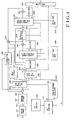
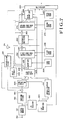
- Fig. 1 shows a speech coder according to an embodiment of the present invention.
- a speech signal is input from an input terminal 100, and a one-frame (e.g., 20 ms) speech signal is stored in a buffer memory 110.
- a one-frame e.g., 20 ms
- An LPC analyzer 130 performs known LPC analysis of an LSP parameter as a parameter representing the spectrum characteristics of a speech signal in a frame on the basis of the speech signal in the above-mentioned frame so as to perform calculations by an amount corresponding to predetermined order L.
- an LSP quantizer 140 quantizes the LSP parameter with a predetermined number of quantization bits, and outputs an obtained code 1 k to a multiplexer 260.
- the methods of coding an LSP parameter and converting it into a linear prediction coefficient refer to reference 6.
- a subframe divider 150 divides a speech signal in a frame into signal components in units of subframes. Assume, in this case, that the frame length is 20 ms, and the subframe length is 5 ms.
- a subtractor 190 subtracts an output, supplied from the synthetic filter 281, from a signal component obtained by dividing the input signal in units of subframes, and outputs the resultant value.
- the weighting circuit 200 performs a known perceptual weighting operation with respect to the signal obtained by subtraction. For a detailed description of a perceptual weighting function, refer to reference 1.
- An adaptive code book 210 receives an input signal v(n), which is input to the synthetic filter 281, through a delay circuit 206.
- the adaptive code book 210 receives a weighted impulse response h w (n) and a weighted signal from the impulse response calculator 170 and the weighting circuit 200, respectively, to perform pitch prediction based on long-term correlation, thus calculating a delay M and a gain ⁇ as pitch parameters.
- the prediction order of the adaptive code book is set to be 1. However, a second or higher prediction order may be set.
- a method of calculating the delay m and the gain ⁇ in an adaptive code book of first order is disclosed in Kleijin et al., "Improved speech quality and efficient vector quantization in SELP", ICASSP, pp. 155 - 158, 1988 (reference 7), and hence a description thereof will be omitted. Furthermore, the obtained gain ⁇ is quantized/decoded with a predetermined number of quantization bits to obtain a gain ⁇ ' by using a quantizer 220.
- a prediction signal x ⁇ w (n) is then calculated by using the obtained gain ⁇ ' according to the following equation and is output to a subtractor 205, while the delay M is output to the multiplexer 260: where v(n -M) is the input signal to the synthetic filter 281, and h w (n) is the weighted impulse response obtained by the impulse response calculator 170.
- the delay circuit 206 outputs the input signal v(n), which is input to the synthetic filter 281, to the adaptive code book 210 with a delay corresponding to one subframe.
- the quantizer 220 quantizes the gain ⁇ of the adaptive code book with a predetermined number of quantization bits, and outputs the quantized value to the multiplexer 260 and to the adaptive code book 210 as well.
- the subtractor 205 subtracts the output x ⁇ w (n), which is output from the adaptive code book 210, from an output signal from the weighting circuit 200 according to the following equation, and outputs a resulting difference signal e w (n) to a first code book search circuit 230:
- the impulse response calculator 170 calculates the perceptual-weighted impulse response h w (n) of the synthetic filter by an amount corresponding to a predetermined sample count Q. For a detailed description of this calculation method, refer to reference 1 and the like.
- the first code book search circuit 230 searches for an optimal code word c 1j (n) and an optimal gain ⁇ 1 by using a first code book 235.
- the first code book is prepared by a learning procedure using training signals.
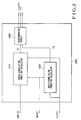
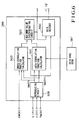
- Fig. 2 shows the first code book search circuit 230.
- a search for a code word is performed in accordance with the following equation:
- a value ⁇ 1 which minimizes equation (24) is obtained by using the following equation obtained by partially differentiating equation (24) with ⁇ 1 and substituting the zero therein:
- ⁇ 1 Gj / Cj (25) for Therefore, equation (24) is rewritten as:
- the first term of equation (28) is a constant
- a code word c 1j (n) is selected from the code book so as to maximize the second term.
- a cross-correlation function calculator 410 calculates equation (26), an auto-correlation function calculator 420 calculates equation (27), and a discriminating circuit 430 calculates equation (28) to select the code word c 1j (n) and output an index representing it.
- the discriminating circuit 430 also outputs the gain ⁇ 1 obtained from equation (25).
- ⁇ (i) and v j (i) are respectively auto-correlation functions delayed by an order i from the weighted impulse response h w (n) and from the code word c 1j (n).
- An index representing the code word obtained by the above method, and the gain ⁇ 1 are respectively output to the multiplexer 260 and a quantizer 240.
- the selected code word c j (n) is output to a multiplier 241.
- the quantizer 240 quantizes the gain ⁇ 1 with a predetermined number of bits to obtain a code, and outputs the code to the multiplexer 260. At the same time, the quantizer 240 outputs a quantized decoded value ⁇ '1 to the multiplier 241.
- a subtractor 255 subtracts y w (n) from e w (n) and outputs the result to a second code book search circuit 270.
- the second code book search circuit 270 selects an optimal code word from a second code book 275 and calculates an optimal gain ⁇ 2.
- the second code book search circuit 270 may be constituted by essentially the same arrangement of the first code book search circuit shown in Fig. 2.
- the same code word search method used for the first code book can be used for the second code book.
- a code book constituted by a random number series is used to compensate for the training data dependency while keeping the high efficiency of the code book formed by a learning procedure, which is described earlier herein.
- a method of forming the code book constituted by a random number series refer to reference 1.
- a random number code book having an overlap arrangement may be used as the second code book.
- methods of forming an overlap type random number code book and searching the code book refer to reference 7.
- a quantizer 285 performs the same operation as that performed by the quantizer 240 so as to quantize the gain ⁇ 2 with a predetermined number of quantization bits and to output it to the multiplexer 260. In addition, the quantizer 285 outputs a coded/decoded value ⁇ '2 of the gain to a multiplier 242.
- the multiplier 242 performs the same operation as that performed by the multiplier 241 so as to multiply a code word c 2i (n), selected from the second code book, by the gain ⁇ '2 , and outputs it to the adder 290.
- the adder 290 adds the output signals from the adaptive code book 210 and the multipliers 241 and 242, and outputs the addition result to a synthetic filter 281 and the delay circuit 206.
- v ( n ) ⁇ '1c 1 j ( n ) + ⁇ '2C 2 i ( n ) + ⁇ ' j v ( n - M ) (34)
- the synthetic filter 281 receives an output v(n) from the adder 290, and obtains a one-frame (N point) synthesized speech component according to the following equation. Upon reception of a 0 series of another one-frame speech component, the filter 281 further obtains a response signal series, and outputs a response signal series corresponding to one frame to the subtractor 190. for
- the multiplexer 260 outputs a combination of output code series from the LSP quantizer 140, the first code book search circuit 230, the second code book search circuit 270, the quantizer 240, and the quantizer 285.
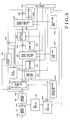
- Fig. 3 shows another embodiment of the present invention. Since the same reference numerals in Fig. 3 denote the same parts as in Fig. 1, and they perform the same operations, a description thereof will be omitted.
- an LSP quantizer 300 is a characteristic feature of this embodiment, the following description will be mainly associated with the LSP quantizer 300.
- Fig. 4 shows an arrangement of the LSP quantizer 300.
- an LSP converter 305 converts an input LPC coefficient a i into an LSP coefficient.
- a method of converting an LPC coefficient into an LSP coefficient refer to, e.g., reference 6.
- a vector quantizer 310 vector-quantizes the input LSP coefficient according to equation (6).
- a code book 320 is formed beforehand by a learning procedure using a large amount of LSP data.
- the vector quantizer 310 outputs an index representing a selected code word to a multiplexer 260, and outputs a vector-quantized LSP coefficient q j (i) to a subtractor 325 and an adder 335.
- the subtractor 325 subtracts the vector-quantized LSP coefficient q j (i), as the output from the vector quantizer 310, from the input LSP coefficient p(i), and outputs a difference signal e(i) to a scalar quantizer 330.
- the scalar quantizer 330 obtains the statistical distribution of a large number of difference signals in advance so as to determine a quantization range, as previously described with reference to the function of the present invention. For example, a 1% frequency point and a 99% frequency point in the statistic distribution of difference signals are measured for each order of a difference signal, and the measured frequency points are set as the lower and upper limits of quantization. A difference signal is then uniformly quantized between the lower and upper limits by a uniform quantizer. Alternatively, the variance of e(i) is checked for each order so that quantization is performed by a scalar quantizer having a predetermined statistic distribution, e.g., a Gaussian distribution.
- a scalar quantizer having a predetermined statistic distribution, e.g., a Gaussian distribution.
- the range of scalar quantization is limited in the following manner to prevent a synthetic filter from becoming unstable when the sequence of LSP coefficients is reversed upon scalar quantization.
- scalar quantization is performed by setting the 99% point and the 1% point of e(i - 1) to be the maximum and minimum values of a quantization range.
- scalar quantization is performed by setting ⁇ LSP'(i) - q j (i) ⁇ to be the maximum value of a quantization range.
- the scalar quantizer 330 outputs a code obtained by quantizing a difference signal, and outputs a quantized/decoded value e'(i) to the adder 335.
- the adder 335 adds the vector-quantized coefficient q j (i) and the scalar-quantized/decoded value e'(i) according to the following equation, thus obtaining and outputting a quantized/decoded LSP value LSP'(i):
- a converter 340 converts the quantized/decoded LSP into a linear prediction coefficient a' i by using a known method, and outputs it.
- the gain of the adaptive code book and the gains of the first and second code books are not simultaneously optimized.
- simultaneous optimization is performed for the gains of adaptive code book and of first and second code books to further improve the characteristics.
- this simultaneous optimization is applied to obtain code words of the first and second code books, an improvement in characteristics can be realized.
- ⁇ and ⁇ 1 are simultaneously optimized in units of code words by solving the following equation so as to minimize it: Then, In this case,
- the gains of the adaptive code book and of the first and second code books are simultaneously optimized to minimize the following equation:
- gain optimization may be performed by using equation (39) when the first code book is searched for a code word, so that no optimization need be performed in a search operation with respect to the second code book.
- the operation amount can be further reduced in the following manner.
- no gain optimization is performed.
- the gains of the adaptive code book and the first code book are simultaneously optimized.
- the gains of the adaptive code book and of the first and second code books are simultaneously optimized.
- the three types of gains i.e., the gain ⁇ of the adaptive code book and the gains ⁇ 1 and ⁇ 2 of the first and second code books, may be simultaneously optimized after code words are selected from the first and second code books.
- a known method other than the method in each embodiment described above may be used to search the first code book.
- the method described in reference 1 may be used.
- an orthogonal conversion value c1(k) of each code word c 1j (n) of a code book is obtained and stored in advance, and orthogonal conversion values H w (k) of the weighted impulse responses h w (n) and orthogonal conversion values E w (k) of the difference signals e w (n) are obtained by an amount corresponding to a predetermined number of points in units of subframes, so that the following equations are respectively used in place of equations (26) and (27):
- G j ( k ) E w ( k ) ⁇ C 1 j ( k ) H w ( k ) ⁇ (0 ⁇ k ⁇ N- 1) (42)
- C j ( k ) ⁇ C 1 j ( k ) H w ( k ) ⁇ 2 (0 ⁇ k ⁇ N- 1) (43)
- a method other than the method in each embodiment described above e.g., the method described above, the method in reference 7, or one of other known methods may be used.
- a method of forming the second code book a method other than the method in each embodiment described above may be used. For example, an enormous amount of random number series are prepared as a code book, and a search for random number series is performed with respect to training data by using the random number series. Subsequently, code words are sequentially registered in the order of decreasing frequencies at which they are selected or in the order of increasing error power with respect to the training data, thus forming the second code book. Note that this forming method can be used to form the first code book.
- the second code book can be constructed by learning the code book in advance, using the signal which is output from the subtractor 255.
- the adaptive code book of the first order is used.
- an adaptive code book of the second or higher order may be used.
- fractional delays may be set instead of integral delays while the first order of the code book is kept unchanged.
- Marques et al. "Pitch Prediction with Fractional Delays in CELP Coding", EUROSPEECH, pp. 509 - 513, 1989 (reference 8).
- K parameters and LSP parameters as spectrum parameters are coded, and LPC analysis is used as the method of analyzing these parameters.
- LPC analysis is used as the method of analyzing these parameters.
- other known parameters e.g., an LPC cepstrum, a cepstrum, an improved cepstrum, a general cepstrum, and a melcepstrum may be used.
- An optimal analysis method for each parameter may be used.
- LPC coefficients obtained in a frame may be interpolated in units of subframes so that an adaptive code book and first and second code books are searched by using the interpolated coefficients. With this arrangement, the speech quality can be further improved.
- calculations of influential signals may be omitted on the transmission side.
- the synthetic filter 281 and the subtractor 190 can be omitted, thus allowing a reduction in operation amount. In this case, however, the speech quality is slightly degraded.
- the weighting circuit 200 may be arranged in front of the subframe divider 150 or in front of the subtractor 190, and the synthetic filter 281 may be designed to calculate a weighted synthesized signal according to the following equation: where ⁇ is the weighting coefficient for determining the degree of perceptual weighting.
- an adaptive post filter which is operated in response to at least a pitch or a spectrum envelope may be additionally arranged on the receiver side so as to perceptually improve speech quality by shaping quantization noise.
- an adaptive post filter refer to, e.g., Kroon et al., "A Class of Analysis-by-synthesis Predictive Coders for High Quality Speech Coding at Rates between 4.8 and 16 kb/s", IEEE JSAC, vol. 6, 2, 353 - 363, 1988 (reference 9).
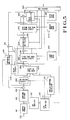
- Fig. 5 shows a speech coder according to still another embodiment of the present invention. Since the same reference numerals in Fig. 5 denote the same parts as in Fig. 1, and they perform the same operations, a description thereof will be omitted.
- An adaptive code book 210 calculates a prediction signal x ⁇ (n) by using an obtained gain ⁇ according to the following equation and outputs it to a subtractor 205. In addition, the adaptive code book 210 outputs a delay M to a multiplexer 260.
- v(n - M) is the input signal to a synthetic filter 281
- h w (n) is the weighted impulse response obtained by an impulse response calculator 170.
- a multiplier 241 multiplies a code word c j (n) by a gain ⁇ 1 according to the following equation to obtain a sound source signal q(n), and outputs the signal to a synthetic filter 250.
- q ( n ) ⁇ 1 c j ( n ) (46)
- a gain quantizer 286 vector-quantizes gains ⁇ 1 and ⁇ 2 by the method described above using a gain code book formed by using equation (15) or (16). In vector quantization, an optimal word code is selected by using equation (11).
- Fig. 6 shows an arrangement of the gain quantizer 286. Referring to Fig. 6, a reproducing circuit 505 receives c1(n), c2(n), and h w (n) to obtain s w1 (n) and s w2 (n) according to equations (12) and (13).
- a cross-correlation calculator 500 and an auto-correlation calculator 510 receive e w (n), s w1 (n), s w2 (n), and a code word output from the gain code book 287, and calculate the second and subsequent terms of equation (11).
- a maximum value discriminating circuit 520 discriminates the maximum value in the second and subsequent terms of equation (11) and outputs an index representing a corresponding code word from the gain code book.
- a gain decoder 530 decodes the gain by using the index and outputs the result. The gain decoder 530 then outputs the index of the code book to the multiplexer 260. In addition, the gain decoder 530 outputs decoded gain values ⁇ '1 and ⁇ '2 to a multiplier 242.
- the multiplier 242 multiplies the code words c 1j (n) and c 2i (n) respectively selected from the first and second code books by the quantized/decoded gains ⁇ '1 and ⁇ '2, and outputs the multiplication result to the adder 291.
- the adder 291 adds the output signals from the adaptive code book 210 and the multiplier 242, and outputs the addition result to the synthetic filter 281.
- the multiplexer 260 outputs a combination of code series output from an LSP quantizer 140, an adaptive code book 210, a first code book search circuit 230, a second code book search circuit 270, and the gain quantizer 286.
- Fig. 7 shows still another embodiment of the present invention. Since the same reference numerals in Fig. 7 denote the same parts as in Fig. 1, and they perform the same operations, a description thereof will be omitted.
- a quantizer 225 vector-quantizes the gain of an adaptive code book by using a code book 226 formed by a learning procedure according to equation (20). The quantizer 225 then outputs an index representing an optimal code word to a multiplexer 260. In addition, the quantizer 225 quantizes/decodes the gain and outputs the result.
- the gains of the adaptive code book and of the first and second code books may be vector-quantized together instead of performing the quantization described with reference to the above embodiment.
- optimal code words may be selected by using equations (21) and (14) in vector quantization of the gain of the adaptive code book and the gains ⁇ 1 and ⁇ 2.
- vector quantization of the gains of the adaptive code book and of the first and second code books may be performed such that a third code book is formed beforehand by a learning procedure on the basis of the absolute values of gains, and vector quantization is performed by quantizing the absolute values of gains while signs are separately transmitted.
- a code book representing sound source signals is divided into two code books.
- the first code book is formed beforehand by a learning procedure using training signals based on a large number of difference signals.
- the second code book has predetermined statistical characteristics.
- excellent characteristics can be obtained with a smaller operation amount than that of the conventional system.
- a further improvement in characteristics can be realized by optimizing the gains of the code books.
- the transmission information amount can be set to be smaller than that in the conventional system.
- the system of the present invention can provide better characteristics with a smaller operation amount than the conventional system.
- the system of the present invention has a great advantage that high-quality coded/reproduced speech can be obtained at a bit rate of 8 to 4.8 kb/s.
Landscapes
- Engineering & Computer Science (AREA)
- Computational Linguistics (AREA)
- Signal Processing (AREA)
- Health & Medical Sciences (AREA)
- Audiology, Speech & Language Pathology (AREA)
- Human Computer Interaction (AREA)
- Physics & Mathematics (AREA)
- Acoustics & Sound (AREA)
- Multimedia (AREA)
- Compression, Expansion, Code Conversion, And Decoders (AREA)
Abstract
Description
- The present invention relates to a speech coder for coding a speech signal with high quality at low bit rates, specifically, at about 8 to 4.8 kb/s.
- As a method of coding a speech signal at a low bit rate of about 8 to 4.8 kb/s, CELP (Code Excited LPC Coding) is known, which is disclosed in, e.g., M. Schroeder and B. Atal, "Code-excited linear prediction: High Quality speech at very low bit rates", ICASSP, pp. 937 - 940, 1985 (reference 1). According to this method, on the transmission side, a spectrum parameter representing the spectrum characteristics of a speech signal is extracted from a speech signal of each frame (e.g., 20 ms). A frame is divided into subframes (e.g., 5 ms), and a pitch parameter representing a long-term correlation (pitch correlation) is extracted from a past sound source signal in units of subframes. Long-term prediction of speech signals in the subframes is performed using the pitch parameter to obtain difference signals. For the difference signal obtained by long-term prediction, one type of noise signal is selected so as to minimize the differential power between the speech signal and a signal synthesized by a signal selected from a code book constituted by predetermined types of noise signals. In addition, an optimal gain is calculated. Subsequently, an index representing the type of selected noise signal and the gain are transmitted together with the spectrum parameter and the pitch parameter. A description on the receiver side will be omitted.
- As a method of quantizing a spectrum parameter, a scalar quantization method is used in reference 1. A vector quantization method is known as a method which allows more efficient quantization with a smaller amount of bits than the scalar quantization method. With regard to this method, refer to, e.g., Buzo et al., "Speech Coding Based upon Vector Quantization", IEEE Trans ASSP, pp. 562 - 574, 1980 (reference 2). In vector quantization, however, a data base (training data) for a learning procedure is required to form a vector quantization code book in advance. The characteristics of a vector quantizer depend on training data used. For this reason, the performance of the quantizer deteriorates with respect to a signal having characteristics which are not covered by the training data, resulting in a deterioration in speech quality. In order to solve such a problem, a vector/scalar quantization method is proposed, in which an error signal representing the difference between a vector-quantized signal and an input signal is scalar-quantized to combine the merits of the two methods. With regard to vector/scalar quantization, refer to, e.g., Moriya et al., "Adaptive Transform Coding of Speech Using Vector Quantization", Journal of the Institute of Electronics and Communication Engineers of Japan, vol. J. 67-A, pp. 974 - 981, 1984 (reference 3). A description of this method will be omitted.
- In the conventional method disclosed in reference 1, in order to obtain high speech quality, the bit size of a code book constituted by noise signals must be set to be as large as 10 bits or more. Therefore, an enormous amount of operations is required to search the code book for an optimal noise signal (code word). In addition, since a code book is basically constituted by noise signals, speech reproduced by a code word selected from the code book inevitably includes perceptual noise.
- Furthermore, in the conventional method in reference 1, since a spectrum parameter is quantized/coded by normal scalar quantization, a large number of bits are required for quantization. For this reason, it is difficult to decrease the bit rate while keeping high speech quality.
- In the vector quantization method which is more efficient than the scalar quantization method, quantization characteristics depend on training data used for preparing a vector quantization code book. For this reason, the quantization performance deteriorates with respect to a signal having characteristics which are not covered by the training data, resulting in a deterioration in speech quality.
- In the vector/scalar quantization method disclosed in reference 3, in addition to a code book table for vector quantization, another table is required to store information required for scalar quantization in accordance with the size of a code book for vector quantization. Assume that a 10th-order parameter and an 8-bit vector quantizer are used. The number of tables required for vector quantization is 256 x 10 = 2,560. The number of tables required for scalar quantization is 256 x 10 = 2,560. That is, a total of 5,120 tables are required, and hence a large memory capacity is required to store these tables.
- It is a principal object of the present invention to provide a speech coder which requires only a small amount of operations.
- It is another object of the present invention to provide a speed coder which requires only a small memory capacity.
- It is still another object of the present invention to provide a speech coder which ensures high speech quality.
- It is still another object of the present invention to provide a speech coder which can eliminate perceptual noise.
- It is another object of the present invention to provide a speech coder which can decrease a bit rate.
- In order to achieve the above objects, according to the present invention, there is provided a speech coder characterized by comprising means for dividing an input discrete speech signal into signal components in units of frames each having a predetermined time length, and obtaining a spectrum parameter representing a spectrum envelope of the speech signal, means for obtaining a difference signal by dividing the frame into subframes each having a predetermined time length, and calculating a pitch parameter representing a long-term correlation on the basis of a past sound source signal, a first code book for storing a signal formed beforehand by learning based on the difference signal, a second code book for storing a signal having predetermined characteristics, and means for representing a sound source signal of the speech signal by a linear combination of a signal selected from the first code book in accordance with each obtained difference signal and a signal selected from the second code book, and outputting the combination.
- A function of the speech coder of the present invention will be described below.
- According to the present invention, a sound source signal is obtained so as to minimize the following equation in units of subframes obtained by dividing a frame:

where β and M are the pitch parameters of pitch prediction (or an adaptive code book) based on long-term correlation, i.e., a gain and a delay, v(n) is the sound source signal in a past subframe, h(n) is the impulse response of a synthetic filter constituted by a spectrum parameter, and w(n) is the impulse response of a perceptual weighting filter. Note that * represents a convolution operation. Refer to reference 1 for a detailed description of w(n). - In addition, d(n) represents a sound source signal represented by a code book and is given by a linear combination of a code word c1j(n) selected from a first code book and a code word c2i(n) selected from a second code book as follows:

where γ₁ and γ₂ are the gains of the selected code words c1j(n) and c2i(n). In the present invention, since a sound source signal is represented by two types of code books, each code book is only required to have bits 1/2 the number of bits of the overall code book. For example, if the number of bits of the overall code book is 10 bits, each of the first and second code books is only required to have 5 bits. This greatly reduces the operation amount required to search the code book. - Assume that the noise code book in reference 1 is used as each code book, and the code book is divided in the same manner as indicated by equation (2). It is known, in this case, that a sound source signal obtained by this method deteriorates as compared with a signal obtained by a 10-bit code book in terms of characteristics, and the performance of the overall code book corresponds to only 7 to 8 bits.
- In the present invention, therefore, in order to obtain high performance, the first code book is prepared by a learning procedure using training data. As a method of preparing a code book by a learning procedure, a method disclosed in Linde et al., "An algorithm for Vector Quantization Design", IEEE Trans. COM-28, pp. 84 - 95, 1980 (reference 4) is known.
- As a distance scale for a learning procedure, a square distance (Euclidean distance) is normally used. In the method of the present invention, however, a perceptual weighting distance scale represented by the following equation, which allows higher perceptual performance than the square distance, is used:

where tj(n) is the jth training data, and c₁(n) is a code word in a cluster 1. A centroid sc1(n) (representative code) of the cluster 1 is obtained so as to minimize equation (4) or (5) below by using training data in the cluster 1.
In equation (5), q is an optimal gain. - As the second code book, a code book constituted by noise signals or random number signals whose statistical characteristics are determined in advance, such as Gaussian noise signals in reference 1, or a code book having different characteristics is used to compensate for the dependency of the first code book on training data. Note that a further improvement in characteristics can be ensured by selecting noise signal or random number code books on a certain distance scale. For a detailed description of this method, refer to T. Moriaya et al., "Transform Coding of speech using a Weighted Vector Quantizer", IEEE J. Sel. Areas, Commun., pp. 425 - 431, 1988 (reference 5).
- Furthermore, in the present invention, the spectrum parameters obtained in units of frames are subjected to vector/scalar quantization. As spectrum parameters, various types of parameters, e.g., LPC, PARCOR, and LSP, are known. In the following case, LSP (Line Spectrum Pair) is used as an example. For a detailed description of LSP, refer to Sugamura et al., "Quantizer Design in LSP Speech Analysis-Synthesis", IEEE J. Sel. Areas, Commun., pp. 432 - 440, 1988 (reference 6). In vector/scalar quantization, an LSP coefficient is vector-quantized first. A vector quantizer for LSP prepares a vector quantization code book by performing a learning procedure with respect to LSP training data using the method in reference 4. Subsequently, in vector quantization, a code word which minimizes the distortion of the following equation is selected from the code book:

where p(i) is the ith LSP coefficient obtained by analyzing a speech signal in a frame, L is the LSP analysis order, qj(i) is the ith coefficient of the code word, and B is the number of bits of the code book. Although a square distance is used as a distance scale in the above equation, another proper distance scale may be used. - A vector-quantized difference signal is then obtained by using the selected code word qj(i) according to the following equation:

- The difference signal e(i) is scalar-quantized by scalar quantization. In the design of a scalar quantizer, the statistic distribution of e(i) of a large amount of signals e(i) is measured for every order i so as to determine the maximum and minimum values of the quantization range of the quantizer for each order. For example, a 1% point and a 99% point of the statistic distribution of e(i) are measured so that the measurement values are set to be the maximum and minimum values of the quantizer. With this operation, in scalar quantization, if the order of LSP is represented by L, only L x 2 tables are required. Since the order L is normally set to be about 10, only 20 tables are required.
- In addition, according to the present invention, an improvement in characteristics is realized by searching the first and second code books while adjusting at least one gain, or optimizing the two gains upon determination of code words of the two code books.
- Assume that the first and second code books are searched while their gains are adjusted. More specifically, code words of the first code book are determined, and the second code book is searched while the following equation is minimized for each code word:

where γ₁ and γ₂ are the gains of the first and second code books, and c1j(n) and c2i(n) are code words selected from the first and second code books. All the values of c2i(n) in equation (8) are calculated to obtain the code word c2i(n) which minimizes error power E and to obtain the gains γ₁ and γ₂ at the same time. - These calculations can be performed by using the Gram-Schmidt orthogonalization process.
- The operation amount can be reduced in the following manner. Instead of calculating equation (8) in code word search, the optimal gains γ₁ and γ₂ are obtained by independently determining the code words of the first and second code books and solving equation (8) for only the determined code words c1j(n) and c2i(n).
- In addition, according to the present invention, after optimal code words are selected from the first and second code books, the gains γ₁ and γ₂ of the first and second code books are efficiently vector-quantized by using a gain code book prepared by learning procedure. In vector quantization, when optimal code words are to be searched out, a code word which minimizes the following equation is selected:

where γ₁ is the vector-quantized gain represented by each code word, and ci(n) is a code word selected from each of the first and second code books. If the following equations is established on the basis of equation (9):

then, the following equation is obtained from equations (9) and (10):
In this case,


Since the first term of equation (11) is a constant, a code word which maximizes the second and subsequent terms is selected in code word search. - In addition, in order to greatly reduce the operation amount required for code book search, a code word may be selected according to the following equation:

where a code book for vector-quantizing a gain is prepared by a training procedure using training data constituted by a large amount of values. The learning procedure for a code book may be performed by the method in reference 4. In this case, a square distance is normally used as a distance scale in learning. However, for a further improvement in characteristics, a distance scale represented by the following equation may be used:
where γti is gain data for a training procedure, and γ'i1 is a representative code word in the cluster 1 of the gain code book. If the distance scale represented by equation (15) is used, a centroid Sc1i in the cluster 1 is obtained so as to minimize the following equation:
- On the other hand, in order to greatly reduce the operation amount in learning, a distance scale represented by the following equation, which is based on a normal square distance, may be used:

- Moreover, the present invention is characterized in that the gain of a pitch parameter of pitch prediction (adaptive code book) is vector-quantized by using a code book formed beforehand by learning. If the order of pitch prediction is one, vector quantization of a gain is performed by selecting a code word which minimizes the following equation after determining a delay amount M of a pitch parameter:

A distance scale in a learning procedure for a code book is given by the following equation:
where βt is gain data for code book training. Note that the operation amount can also be reduced by using the following equation:

-
- Fig. 1 is a block diagram showing a speech coder according to an embodiment of the present invention;
- Fig. 2 is a block diagram showing an arrangement of a code book search circuit of the speech coder in Fig. 1;
- Fig. 3 is a block diagram showing a speech coder according to another embodiment of the present invention;
- Fig. 4 is a block diagram showing an arrangement of an LSP quantizer of the speech coder in Fig. 3;
- Fig. 5 is a block diagram showing a speech coder according to still another embodiment of the present invention;
- Fig. 6 is a block diagram showing an arrangement of a gain quantizer according to the present invention; and
- Fig. 7 is a block diagram showing a speech coder according to still another embodiment of the present invention.
- Fig. 1 shows a speech coder according to an embodiment of the present invention.
- Referring to Fig. 1, on the transmission side, a speech signal is input from an
input terminal 100, and a one-frame (e.g., 20 ms) speech signal is stored in abuffer memory 110. - An
LPC analyzer 130 performs known LPC analysis of an LSP parameter as a parameter representing the spectrum characteristics of a speech signal in a frame on the basis of the speech signal in the above-mentioned frame so as to perform calculations by an amount corresponding to predetermined order L. For a detailed description of this method, refer to reference 6. Subsequently, anLSP quantizer 140 quantizes the LSP parameter with a predetermined number of quantization bits, and outputs an obtained code 1k to amultiplexer 260. At the same time, the LSP quantizer 140 decodes this code to convert it into a linear prediction coefficient a'i (i = 1 ∼ L) and outputs it to aweighting circuit 200, animpulse response calculator 170, and asynthetic filter 281. With regard to the methods of coding an LSP parameter and converting it into a linear prediction coefficient, refer to reference 6. - A
subframe divider 150 divides a speech signal in a frame into signal components in units of subframes. Assume, in this case, that the frame length is 20 ms, and the subframe length is 5 ms. - A
subtractor 190 subtracts an output, supplied from thesynthetic filter 281, from a signal component obtained by dividing the input signal in units of subframes, and outputs the resultant value. - The
weighting circuit 200 performs a known perceptual weighting operation with respect to the signal obtained by subtraction. For a detailed description of a perceptual weighting function, refer to reference 1. - An
adaptive code book 210 receives an input signal v(n), which is input to thesynthetic filter 281, through adelay circuit 206. In addition, theadaptive code book 210 receives a weighted impulse response hw(n) and a weighted signal from theimpulse response calculator 170 and theweighting circuit 200, respectively, to perform pitch prediction based on long-term correlation, thus calculating a delay M and a gain β as pitch parameters. In the following description, the prediction order of the adaptive code book is set to be 1. However, a second or higher prediction order may be set. A method of calculating the delay m and the gain β in an adaptive code book of first order is disclosed in Kleijin et al., "Improved speech quality and efficient vector quantization in SELP", ICASSP, pp. 155 - 158, 1988 (reference 7), and hence a description thereof will be omitted. Furthermore, the obtained gain β is quantized/decoded with a predetermined number of quantization bits to obtain a gain β' by using aquantizer 220. A prediction signal x̂w(n) is then calculated by using the obtained gain β' according to the following equation and is output to asubtractor 205, while the delay M is output to the multiplexer 260:
where v(n -M) is the input signal to thesynthetic filter 281, and hw(n) is the weighted impulse response obtained by theimpulse response calculator 170. - The
delay circuit 206 outputs the input signal v(n), which is input to thesynthetic filter 281, to theadaptive code book 210 with a delay corresponding to one subframe. - The
quantizer 220 quantizes the gain β of the adaptive code book with a predetermined number of quantization bits, and outputs the quantized value to themultiplexer 260 and to theadaptive code book 210 as well. - The
subtractor 205 subtracts the output x̂w(n), which is output from theadaptive code book 210, from an output signal from theweighting circuit 200 according to the following equation, and outputs a resulting difference signal ew(n) to a first code book search circuit 230:
Theimpulse response calculator 170 calculates the perceptual-weighted impulse response hw(n) of the synthetic filter by an amount corresponding to a predetermined sample count Q. For a detailed description of this calculation method, refer to reference 1 and the like. - The first code
book search circuit 230 searches for an optimal code word c1j(n) and an optimal gain γ₁ by using afirst code book 235. As described earlier, the first code book is prepared by a learning procedure using training signals. - Fig. 2 shows the first code
book search circuit 230. A search for a code word is performed in accordance with the following equation:
A value γ₁ which minimizes equation (24) is obtained by using the following equation obtained by partially differentiating equation (24) with γ₁ and substituting the zero therein:

for
Therefore, equation (24) is rewritten as:
In this case, since the first term of equation (28) is a constant, a code word c1j(n) is selected from the code book so as to maximize the second term. - Referring to Fig. 2, a
cross-correlation function calculator 410 calculates equation (26), an auto-correlation function calculator 420 calculates equation (27), and adiscriminating circuit 430 calculates equation (28) to select the code word c1j(n) and output an index representing it. Thediscriminating circuit 430 also outputs the gain γ₁ obtained from equation (25). - In addition, the following method may be used to reduce the operation amount required to search the code book:

for
where µ(i) and vj(i) are respectively auto-correlation functions delayed by an order i from the weighted impulse response hw(n) and from the code word c1j(n). - An index representing the code word obtained by the above method, and the gain γ₁ are respectively output to the
multiplexer 260 and aquantizer 240. In addition, the selected code word cj(n) is output to amultiplier 241. - The
quantizer 240 quantizes the gain γ₁ with a predetermined number of bits to obtain a code, and outputs the code to themultiplexer 260. At the same time, thequantizer 240 outputs a quantized decoded value γ'₁ to themultiplier 241. - The
multiplier 241 multiplies the code word c1j(n) by the gain γ'₁ according to the following equation to obtain a sound source signal q(n), and outputs it to anadder 290 and a synthetic filter 250:

- The
synthetic filter 250 receives the output q(n) from themultiplier 241, obtains a weighted synthesized signal yw(n) according to the following equation, and outputs it:

- A
subtractor 255 subtracts yw(n) from ew(n) and outputs the result to a second codebook search circuit 270. - The second code
book search circuit 270 selects an optimal code word from asecond code book 275 and calculates an optimal gain γ₂. The second codebook search circuit 270 may be constituted by essentially the same arrangement of the first code book search circuit shown in Fig. 2. In addition, the same code word search method used for the first code book can be used for the second code book. As the second code book, a code book constituted by a random number series is used to compensate for the training data dependency while keeping the high efficiency of the code book formed by a learning procedure, which is described earlier herein. With regard to a method of forming the code book constituted by a random number series, refer to reference 1. - In addition, in order to reduce the operation amount for a search operation of the second code book, a random number code book having an overlap arrangement may be used as the second code book. With regard to methods of forming an overlap type random number code book and searching the code book, refer to reference 7.
- A
quantizer 285 performs the same operation as that performed by thequantizer 240 so as to quantize the gain γ₂ with a predetermined number of quantization bits and to output it to themultiplexer 260. In addition, thequantizer 285 outputs a coded/decoded value γ'₂ of the gain to amultiplier 242. - The
multiplier 242 performs the same operation as that performed by themultiplier 241 so as to multiply a code word c2i(n), selected from the second code book, by the gain γ'₂ , and outputs it to theadder 290. - The
adder 290 adds the output signals from theadaptive code book 210 and themultipliers synthetic filter 281 and thedelay circuit 206.

- The
synthetic filter 281 receives an output v(n) from theadder 290, and obtains a one-frame (N point) synthesized speech component according to the following equation. Upon reception of a 0 series of another one-frame speech component, thefilter 281 further obtains a response signal series, and outputs a response signal series corresponding to one frame to thesubtractor 190.
for
- The
multiplexer 260 outputs a combination of output code series from theLSP quantizer 140, the first codebook search circuit 230, the second codebook search circuit 270, thequantizer 240, and thequantizer 285. - Fig. 3 shows another embodiment of the present invention. Since the same reference numerals in Fig. 3 denote the same parts as in Fig. 1, and they perform the same operations, a description thereof will be omitted.
- Since an
LSP quantizer 300 is a characteristic feature of this embodiment, the following description will be mainly associated with theLSP quantizer 300. - Fig. 4 shows an arrangement of the
LSP quantizer 300. Referring to Fig 4, anLSP converter 305 converts an input LPC coefficient ai into an LSP coefficient. For a detailed description of a method of converting an LPC coefficient into an LSP coefficient, refer to, e.g., reference 6. - A
vector quantizer 310 vector-quantizes the input LSP coefficient according to equation (6). In this case, acode book 320 is formed beforehand by a learning procedure using a large amount of LSP data. For a detailed description of a learning method, refer to, e.g., reference 4. The vector quantizer 310 outputs an index representing a selected code word to amultiplexer 260, and outputs a vector-quantized LSP coefficient qj(i) to asubtractor 325 and anadder 335. - The
subtractor 325 subtracts the vector-quantized LSP coefficient qj(i), as the output from thevector quantizer 310, from the input LSP coefficient p(i), and outputs a difference signal e(i) to ascalar quantizer 330. - The
scalar quantizer 330 obtains the statistical distribution of a large number of difference signals in advance so as to determine a quantization range, as previously described with reference to the function of the present invention. For example, a 1% frequency point and a 99% frequency point in the statistic distribution of difference signals are measured for each order of a difference signal, and the measured frequency points are set as the lower and upper limits of quantization. A difference signal is then uniformly quantized between the lower and upper limits by a uniform quantizer. Alternatively, the variance of e(i) is checked for each order so that quantization is performed by a scalar quantizer having a predetermined statistic distribution, e.g., a Gaussian distribution. - In addition, the range of scalar quantization is limited in the following manner to prevent a synthetic filter from becoming unstable when the sequence of LSP coefficients is reversed upon scalar quantization.
- If

- If


- The
scalar quantizer 330 outputs a code obtained by quantizing a difference signal, and outputs a quantized/decoded value e'(i) to theadder 335. - The
adder 335 adds the vector-quantized coefficient qj(i) and the scalar-quantized/decoded value e'(i) according to the following equation, thus obtaining and outputting a quantized/decoded LSP value LSP'(i):

- A
converter 340 converts the quantized/decoded LSP into a linear prediction coefficient a'i by using a known method, and outputs it. - In the above embodiments, the gain of the adaptive code book and the gains of the first and second code books are not simultaneously optimized. In the following embodiment, however, simultaneous optimization is performed for the gains of adaptive code book and of first and second code books to further improve the characteristics. As described with reference to the function of the present invention, if this simultaneous optimization is applied to obtain code words of the first and second code books, an improvement in characteristics can be realized.
- For example, when a code word c1j(n) and a gain γ₁ are to be searched out after a delay and a gain β of the adaptive code book are obtained, β and γ₁ are simultaneously optimized in units of code words by solving the following equation so as to minimize it:

Then,
In this case,
- When the second code word is to be determined, the gains of the adaptive code book and of the first and second code books are simultaneously optimized to minimize the following equation:

- In order to reduce the operation amount, gain optimization may be performed by using equation (39) when the first code book is searched for a code word, so that no optimization need be performed in a search operation with respect to the second code book.
- The operation amount can be further reduced in the following manner. When a code book is searched for a code word, no gain optimization is performed. When a code word is selected from the first code book, the gains of the adaptive code book and the first code book are simultaneously optimized. When a code word is selected from the second code book, the gains of the adaptive code book and of the first and second code books are simultaneously optimized.
- In order to further reduce the operation amount, the three types of gains, i.e., the gain β of the adaptive code book and the gains γ₁ and γ₂ of the first and second code books, may be simultaneously optimized after code words are selected from the first and second code books.
- A known method other than the method in each embodiment described above may be used to search the first code book. For example, the method described in reference 1 may be used. In another method, an orthogonal conversion value c₁(k) of each code word c1j(n) of a code book is obtained and stored in advance, and orthogonal conversion values Hw(k) of the weighted impulse responses hw(n) and orthogonal conversion values Ew(k) of the difference signals ew(n) are obtained by an amount corresponding to a predetermined number of points in units of subframes, so that the following equations are respectively used in place of equations (26) and (27):


Equations (42) and (43) are then subjected to reverse orthogonal conversion to calculate a cross-correlation function Gj and an auto-correlation function Cj, and a search for a code word and calculations of gains are performed according to equations (28) and (25). According to this method, since the convolution operations in equations (26) and (27) can be replaced with multiplication operations on the frequency axis, the operation amount can be reduced. - As a method of searching the second code book, a method other than the method in each embodiment described above, e.g., the method described above, the method in reference 7, or one of other known methods may be used.
- As a method of forming the second code book, a method other than the method in each embodiment described above may be used. For example, an enormous amount of random number series are prepared as a code book, and a search for random number series is performed with respect to training data by using the random number series. Subsequently, code words are sequentially registered in the order of decreasing frequencies at which they are selected or in the order of increasing error power with respect to the training data, thus forming the second code book. Note that this forming method can be used to form the first code book.
- As another method, the second code book can be constructed by learning the code book in advance, using the signal which is output from the
subtractor 255. - In each embodiment described above, the adaptive code book of the first order is used. However, an adaptive code book of the second or higher order may be used. Alternatively, fractional delays may be set instead of integral delays while the first order of the code book is kept unchanged. For a detailed description of these arrangements, refer to, e.g., Marques et al., "Pitch Prediction with Fractional Delays in CELP Coding", EUROSPEECH, pp. 509 - 513, 1989 (reference 8). With the above-describe arrangements, an improvement in characteristics can be realized. However, the amount of information required for the transmission of gains or delays is slightly increased.
- Furthermore, in each embodiment described above, K parameters and LSP parameters as spectrum parameters are coded, and LPC analysis is used as the method of analyzing these parameters. However, other known parameters, e.g., an LPC cepstrum, a cepstrum, an improved cepstrum, a general cepstrum, and a melcepstrum may be used. An optimal analysis method for each parameter may be used.
- LPC coefficients obtained in a frame may be interpolated in units of subframes so that an adaptive code book and first and second code books are searched by using the interpolated coefficients. With this arrangement, the speech quality can be further improved.
- In order to reduce the operation amount, calculations of influential signals may be omitted on the transmission side. With this omission, the
synthetic filter 281 and thesubtractor 190 can be omitted, thus allowing a reduction in operation amount. In this case, however, the speech quality is slightly degraded. - Furthermore, in order to reduce the operation amount, the
weighting circuit 200 may be arranged in front of thesubframe divider 150 or in front of thesubtractor 190, and thesynthetic filter 281 may be designed to calculate a weighted synthesized signal according to the following equation:
where γ is the weighting coefficient for determining the degree of perceptual weighting. - Moreover, an adaptive post filter which is operated in response to at least a pitch or a spectrum envelope may be additionally arranged on the receiver side so as to perceptually improve speech quality by shaping quantization noise. With regard to an arrangement of an adaptive post filter, refer to, e.g., Kroon et al., "A Class of Analysis-by-synthesis Predictive Coders for High Quality Speech Coding at Rates between 4.8 and 16 kb/s", IEEE JSAC, vol. 6, 2, 353 - 363, 1988 (reference 9).
- As is well known in the field of digital signal processing, since an auto-correlation function and a cross-correlation function respectively correspond to a power spectrum and a cross power spectrum on the frequency axis, they can be calculated from these spectra. With regard to a method of calculating these functions, refer to Oppenheim et al., "Digital Signal Processing", Prentice-Hall, 1975 (reference 10).
- Fig. 5 shows a speech coder according to still another embodiment of the present invention. Since the same reference numerals in Fig. 5 denote the same parts as in Fig. 1, and they perform the same operations, a description thereof will be omitted.
- An
adaptive code book 210 calculates a prediction signal x̂(n) by using an obtained gain β according to the following equation and outputs it to asubtractor 205. In addition, theadaptive code book 210 outputs a delay M to amultiplexer 260.
where v(n - M) is the input signal to asynthetic filter 281, and hw(n) is the weighted impulse response obtained by animpulse response calculator 170. - A
multiplier 241 multiplies a code word cj(n) by a gain γ₁ according to the following equation to obtain a sound source signal q(n), and outputs the signal to asynthetic filter 250.

- A
gain quantizer 286 vector-quantizes gains γ₁ and γ₂ by the method described above using a gain code book formed by using equation (15) or (16). In vector quantization, an optimal word code is selected by using equation (11). Fig. 6 shows an arrangement of thegain quantizer 286. Referring to Fig. 6, a reproducingcircuit 505 receives c₁(n), c₂(n), and hw(n) to obtain sw1(n) and sw2(n) according to equations (12) and (13). - A
cross-correlation calculator 500 and an auto-correlation calculator 510 receive ew(n), sw1(n), sw2(n), and a code word output from thegain code book 287, and calculate the second and subsequent terms of equation (11). A maximumvalue discriminating circuit 520 discriminates the maximum value in the second and subsequent terms of equation (11) and outputs an index representing a corresponding code word from the gain code book. Again decoder 530 decodes the gain by using the index and outputs the result. Thegain decoder 530 then outputs the index of the code book to themultiplexer 260. In addition, thegain decoder 530 outputs decoded gain values γ'₁ and γ'₂ to amultiplier 242. - The
multiplier 242 multiplies the code words c1j(n) and c2i(n) respectively selected from the first and second code books by the quantized/decoded gains γ'₁ and γ'₂, and outputs the multiplication result to theadder 291. Theadder 291 adds the output signals from theadaptive code book 210 and themultiplier 242, and outputs the addition result to thesynthetic filter 281. - The
multiplexer 260 outputs a combination of code series output from anLSP quantizer 140, anadaptive code book 210, a first codebook search circuit 230, a second codebook search circuit 270, and thegain quantizer 286. - Fig. 7 shows still another embodiment of the present invention. Since the same reference numerals in Fig. 7 denote the same parts as in Fig. 1, and they perform the same operations, a description thereof will be omitted.
- A
quantizer 225 vector-quantizes the gain of an adaptive code book by using acode book 226 formed by a learning procedure according to equation (20). Thequantizer 225 then outputs an index representing an optimal code word to amultiplexer 260. In addition, thequantizer 225 quantizes/decodes the gain and outputs the result. - The gains of the adaptive code book and of the first and second code books may be vector-quantized together instead of performing the quantization described with reference to the above embodiment.
- Furthermore, in order to reduce the operation amount, optimal code words may be selected by using equations (21) and (14) in vector quantization of the gain of the adaptive code book and the gains γ₁ and γ₂.
- In addition, vector quantization of the gains of the adaptive code book and of the first and second code books may be performed such that a third code book is formed beforehand by a learning procedure on the basis of the absolute values of gains, and vector quantization is performed by quantizing the absolute values of gains while signs are separately transmitted.
- As has been described above, according to the present invention, a code book representing sound source signals is divided into two code books. The first code book is formed beforehand by a learning procedure using training signals based on a large number of difference signals. The second code book has predetermined statistical characteristics. By using the first and second code books, excellent characteristics can be obtained with a smaller operation amount than that of the conventional system. In addition, a further improvement in characteristics can be realized by optimizing the gains of the code books. Furthermore, by effectively quantizing spectrum parameters by using a combination of the vector quantizer and the scalar quantizer, the transmission information amount can be set to be smaller than that in the conventional system. Moreover, by vector-quantizing the gain of the code book and the gain of the adaptive code book based on pitch prediction by means of the gain code book formed beforehand by a learning procedure based on a large amount of training signals, the system of the present invention can provide better characteristics with a smaller operation amount than the conventional system.
- In comparison with the conventional system, the system of the present invention has a great advantage that high-quality coded/reproduced speech can be obtained at a bit rate of 8 to 4.8 kb/s.
Claims (9)
- A speech coder characterized by comprising:
means (130) for dividing an input discrete speech signal into signal components in units of frames each having a predetermined time length, and obtaining a spectrum parameter representing a spectrum envelope of the speech signal;
means (150, 190, 205, 210) for obtaining a difference signal by dividing the frame into subframes each having a predetermined time length, and calculating a pitch parameter representing a long-term correlation on the basis of a past sound source signal;
a first code book (235) for storing a signal formed beforehand by learning based on the difference signal;
a second code book (275) for storing a signal having predetermined characteristics; and
means (240) for representing a sound source signal of the speech signal by a linear combination of a signal selected from said first code book in accordance with each obtained difference signal and a signal selected from said second code book, and outputting the combination. - A coder according to claim 1, wherein said second code book (275) stores a signal formed beforehand by learning.
- A coder according to claim 1 or 2, further comprising a third code book (320) for storing predetermined types of signal formed in advance by learning based on a spectrum parameter, means (310, 325) for selecting one optimal type of signal from said third code book, and obtaining a differential parameter between the spectrum parameter and the selected signal from the third code book, and means (330) for quantizing the differential parameter on the basis of a statistical distribution range obtained in advance by measuring the differential parameter, thereby representing the spectrum parameter.
- A coder according to claim 1, 2, or 3, further comprising means (230, 270) for representing a sound source signal of the speech signal by a linear combination of a signal selected from said first code book and a signal selected from said second code book, the signals being selected while the pitch parameter and a gain of at least one of said first and second code books are adjusted.
- A coder according to claim 1, 2, or 3, further comprising means (230, 270) for selecting the pitch parameter and signals from said first and second code books, subsequently adjusting gains of the selected signals, and representing a sound source signal of the speech signal by a linear combination of the selected signals.
- A speech coder comprising:
means (130) for dividing an input discrete speech signal into signal components in units of frames each having a predetermined time length, and obtaining a spectrum parameter representing a spectrum envelope of the speech signal;
means (150, 210) for dividing the frame into subframes each having a predetermined time length, and obtaining a pitch parameter so as to approximate a signal reproduced on the basis of a past sound source signal to the speech signal;
a first code book (235) for storing a signal formed by learning based on the speech signal;
a second code book (275) for storing a signal having predetermined characteristics;
means (291) for representing a sound source signal of the speech signal by a linear combination of signals respectively selected from said first and second code books; and
means (286) for quantizing a gain of at least one of the pitch parameter and gains of said first and second code books by using a gain code book (287) formed in advance, and outputting the quantized gain. - A coder according to claim 6, wherein said second code book (275) stores a signal formed by learning.
- A speech coder comprising:
means (130) for dividing an input discrete speech signal into signal components in units of frames each having a predetermined time length, and obtaining a spectrum parameter representing a spectrum envelope of the speech signal;
means (150, 210) for dividing the frame into subframes each having a predetermined time length, and obtaining a delay amount of a pitch parameter so as to approximate a signal reproduced on the basis of a past sound source signal to the speech signal;
means (225) for quantizing a gain of the pitch parameter by using a fourth code book formed in advance;
a first code book (235) for storing a signal formed by learning based on the speech signal;
a second code book (275) for storing a signal having predetermined characteristics; and
means (260) for representing a sound source signal of the speech signal by a linear combination of signals respectively selected from said first and second code books, and outputting the linear combination. - A coder according to claim 8, wherein said second code book (275) stores a signal formed by learning.
Applications Claiming Priority (6)
| Application Number | Priority Date | Filing Date | Title |
|---|---|---|---|
| JP04295590A JP3194930B2 (en) | 1990-02-22 | 1990-02-22 | Audio coding device |
| JP04295690A JP3256215B2 (en) | 1990-02-22 | 1990-02-22 | Audio coding device |
| JP42955/90 | 1990-02-22 | ||
| JP42956/90 | 1990-02-22 | ||
| JP4295590 | 1990-02-22 | ||
| JP4295690 | 1990-02-22 |
Publications (3)
| Publication Number | Publication Date |
|---|---|
| EP0443548A2 true EP0443548A2 (en) | 1991-08-28 |
| EP0443548A3 EP0443548A3 (en) | 1991-12-27 |
| EP0443548B1 EP0443548B1 (en) | 2003-07-23 |
Family
ID=26382695
Family Applications (1)
| Application Number | Title | Priority Date | Filing Date |
|---|---|---|---|
| EP91102440A Expired - Lifetime EP0443548B1 (en) | 1990-02-22 | 1991-02-20 | Speech coder |
Country Status (3)
| Country | Link |
|---|---|
| US (1) | US5208862A (en) |
| EP (1) | EP0443548B1 (en) |
| DE (1) | DE69133296T2 (en) |
Cited By (12)
| Publication number | Priority date | Publication date | Assignee | Title |
|---|---|---|---|---|
| EP0545386A3 (en) * | 1991-12-03 | 1993-08-18 | Nec Corporation | Method for speech coding and voice-coder |
| EP0557940A3 (en) * | 1992-02-24 | 1994-03-23 | Nec Corp | |
| EP0616315A1 (en) * | 1993-03-12 | 1994-09-21 | France Telecom | Digital speech coding and decoding device, process for scanning a pseudo-logarithmic LTP codebook and process of LTP analysis |
| EP0628947A1 (en) * | 1993-06-10 | 1994-12-14 | SIP SOCIETA ITALIANA PER l'ESERCIZIO DELLE TELECOMUNICAZIONI P.A. | Method and device for speech signal pitch period estimation and classification in digital speech coders |
| US5432883A (en) * | 1992-04-24 | 1995-07-11 | Olympus Optical Co., Ltd. | Voice coding apparatus with synthesized speech LPC code book |
| US5487128A (en) * | 1991-02-26 | 1996-01-23 | Nec Corporation | Speech parameter coding method and appparatus |
| EP0630141A3 (en) * | 1993-01-08 | 1996-07-03 | Multi Tech Systems Inc | Computer-based multifunction personal communications system. |
| EP0718821A3 (en) * | 1994-12-21 | 1997-02-19 | At & T Corp | Linear prediction filter coefficient quantizer and filter set |
| EP0755047A3 (en) * | 1990-11-02 | 1997-04-23 | Nec Corp | Speech parameter encoding method capable of transmitting a spectrum parameter at a reduced number of bits |
| WO1998004046A3 (en) * | 1996-07-17 | 1998-03-26 | Univ Sherbrooke | Enhanced encoding of dtmf and other signalling tones |
| EP0910064A3 (en) * | 1991-02-26 | 1999-06-16 | Nec Corporation | Speech parameter coding method and apparatus |
| US6594626B2 (en) * | 1999-09-14 | 2003-07-15 | Fujitsu Limited | Voice encoding and voice decoding using an adaptive codebook and an algebraic codebook |
Families Citing this family (176)
| Publication number | Priority date | Publication date | Assignee | Title |
|---|---|---|---|---|
| JP2776050B2 (en) * | 1991-02-26 | 1998-07-16 | 日本電気株式会社 | Audio coding method |
| US5671327A (en) * | 1991-10-21 | 1997-09-23 | Kabushiki Kaisha Toshiba | Speech encoding apparatus utilizing stored code data |
| US5307460A (en) * | 1992-02-14 | 1994-04-26 | Hughes Aircraft Company | Method and apparatus for determining the excitation signal in VSELP coders |
| US7082106B2 (en) | 1993-01-08 | 2006-07-25 | Multi-Tech Systems, Inc. | Computer-based multi-media communications system and method |
| FR2700632B1 (en) * | 1993-01-21 | 1995-03-24 | France Telecom | Predictive coding-decoding system for a digital speech signal by adaptive transform with nested codes. |
| IT1270439B (en) * | 1993-06-10 | 1997-05-05 | Sip | PROCEDURE AND DEVICE FOR THE QUANTIZATION OF THE SPECTRAL PARAMETERS IN NUMERICAL CODES OF THE VOICE |
| JP2591430B2 (en) * | 1993-06-30 | 1997-03-19 | 日本電気株式会社 | Vector quantizer |
| JP2624130B2 (en) * | 1993-07-29 | 1997-06-25 | 日本電気株式会社 | Audio coding method |
| JP2655046B2 (en) * | 1993-09-13 | 1997-09-17 | 日本電気株式会社 | Vector quantizer |
| AU7960994A (en) * | 1993-10-08 | 1995-05-04 | Comsat Corporation | Improved low bit rate vocoders and methods of operation therefor |
| JPH07160297A (en) * | 1993-12-10 | 1995-06-23 | Nec Corp | Voice parameter encoding system |
| JP2616549B2 (en) * | 1993-12-10 | 1997-06-04 | 日本電気株式会社 | Voice decoding device |
| US5682386A (en) | 1994-04-19 | 1997-10-28 | Multi-Tech Systems, Inc. | Data/voice/fax compression multiplexer |
| JP3183074B2 (en) * | 1994-06-14 | 2001-07-03 | 松下電器産業株式会社 | Audio coding device |
| US5598505A (en) * | 1994-09-30 | 1997-01-28 | Apple Computer, Inc. | Cepstral correction vector quantizer for speech recognition |
| JP3303580B2 (en) * | 1995-02-23 | 2002-07-22 | 日本電気株式会社 | Audio coding device |
| JP3308764B2 (en) * | 1995-05-31 | 2002-07-29 | 日本電気株式会社 | Audio coding device |
| SE513892C2 (en) * | 1995-06-21 | 2000-11-20 | Ericsson Telefon Ab L M | Spectral power density estimation of speech signal Method and device with LPC analysis |
| US6175817B1 (en) * | 1995-11-20 | 2001-01-16 | Robert Bosch Gmbh | Method for vector quantizing speech signals |
| US6393391B1 (en) * | 1998-04-15 | 2002-05-21 | Nec Corporation | Speech coder for high quality at low bit rates |
| JPH09281995A (en) * | 1996-04-12 | 1997-10-31 | Nec Corp | Signal coding device and method |
| JP3335841B2 (en) * | 1996-05-27 | 2002-10-21 | 日本電気株式会社 | Signal encoding device |
| DE69737012T2 (en) * | 1996-08-02 | 2007-06-06 | Matsushita Electric Industrial Co., Ltd., Kadoma | LANGUAGE CODIER, LANGUAGE DECODER AND RECORDING MEDIUM THEREFOR |
| CA2213909C (en) * | 1996-08-26 | 2002-01-22 | Nec Corporation | High quality speech coder at low bit rates |
| US6397178B1 (en) * | 1998-09-18 | 2002-05-28 | Conexant Systems, Inc. | Data organizational scheme for enhanced selection of gain parameters for speech coding |
| DE19845888A1 (en) * | 1998-10-06 | 2000-05-11 | Bosch Gmbh Robert | Method for coding or decoding speech signal samples as well as encoders or decoders |
| US8645137B2 (en) | 2000-03-16 | 2014-02-04 | Apple Inc. | Fast, language-independent method for user authentication by voice |
| ITFI20010199A1 (en) | 2001-10-22 | 2003-04-22 | Riccardo Vieri | SYSTEM AND METHOD TO TRANSFORM TEXTUAL COMMUNICATIONS INTO VOICE AND SEND THEM WITH AN INTERNET CONNECTION TO ANY TELEPHONE SYSTEM |
| US8677377B2 (en) | 2005-09-08 | 2014-03-18 | Apple Inc. | Method and apparatus for building an intelligent automated assistant |
| US7633076B2 (en) | 2005-09-30 | 2009-12-15 | Apple Inc. | Automated response to and sensing of user activity in portable devices |
| US9318108B2 (en) | 2010-01-18 | 2016-04-19 | Apple Inc. | Intelligent automated assistant |
| US8977255B2 (en) | 2007-04-03 | 2015-03-10 | Apple Inc. | Method and system for operating a multi-function portable electronic device using voice-activation |
| US9053089B2 (en) | 2007-10-02 | 2015-06-09 | Apple Inc. | Part-of-speech tagging using latent analogy |
| US8620662B2 (en) | 2007-11-20 | 2013-12-31 | Apple Inc. | Context-aware unit selection |
| US10002189B2 (en) | 2007-12-20 | 2018-06-19 | Apple Inc. | Method and apparatus for searching using an active ontology |
| US9330720B2 (en) | 2008-01-03 | 2016-05-03 | Apple Inc. | Methods and apparatus for altering audio output signals |
| US8065143B2 (en) | 2008-02-22 | 2011-11-22 | Apple Inc. | Providing text input using speech data and non-speech data |
| US8996376B2 (en) | 2008-04-05 | 2015-03-31 | Apple Inc. | Intelligent text-to-speech conversion |
| US10496753B2 (en) | 2010-01-18 | 2019-12-03 | Apple Inc. | Automatically adapting user interfaces for hands-free interaction |
| US8464150B2 (en) | 2008-06-07 | 2013-06-11 | Apple Inc. | Automatic language identification for dynamic text processing |
| JP5710476B2 (en) * | 2008-07-10 | 2015-04-30 | ヴォイスエイジ・コーポレーション | Device and method for LPC filter quantization and inverse quantization in a superframe |
| US20100030549A1 (en) | 2008-07-31 | 2010-02-04 | Lee Michael M | Mobile device having human language translation capability with positional feedback |
| US8768702B2 (en) | 2008-09-05 | 2014-07-01 | Apple Inc. | Multi-tiered voice feedback in an electronic device |
| US8898568B2 (en) | 2008-09-09 | 2014-11-25 | Apple Inc. | Audio user interface |
| US8583418B2 (en) | 2008-09-29 | 2013-11-12 | Apple Inc. | Systems and methods of detecting language and natural language strings for text to speech synthesis |
| US8712776B2 (en) | 2008-09-29 | 2014-04-29 | Apple Inc. | Systems and methods for selective text to speech synthesis |
| US8676904B2 (en) | 2008-10-02 | 2014-03-18 | Apple Inc. | Electronic devices with voice command and contextual data processing capabilities |
| WO2010067118A1 (en) | 2008-12-11 | 2010-06-17 | Novauris Technologies Limited | Speech recognition involving a mobile device |
| US8862252B2 (en) | 2009-01-30 | 2014-10-14 | Apple Inc. | Audio user interface for displayless electronic device |
| US8380507B2 (en) | 2009-03-09 | 2013-02-19 | Apple Inc. | Systems and methods for determining the language to use for speech generated by a text to speech engine |
| US10241644B2 (en) | 2011-06-03 | 2019-03-26 | Apple Inc. | Actionable reminder entries |
| US9858925B2 (en) | 2009-06-05 | 2018-01-02 | Apple Inc. | Using context information to facilitate processing of commands in a virtual assistant |
| US10241752B2 (en) | 2011-09-30 | 2019-03-26 | Apple Inc. | Interface for a virtual digital assistant |
| US10255566B2 (en) | 2011-06-03 | 2019-04-09 | Apple Inc. | Generating and processing task items that represent tasks to perform |
| US10540976B2 (en) | 2009-06-05 | 2020-01-21 | Apple Inc. | Contextual voice commands |
| US9431006B2 (en) | 2009-07-02 | 2016-08-30 | Apple Inc. | Methods and apparatuses for automatic speech recognition |
| US8682649B2 (en) | 2009-11-12 | 2014-03-25 | Apple Inc. | Sentiment prediction from textual data |
| US8600743B2 (en) | 2010-01-06 | 2013-12-03 | Apple Inc. | Noise profile determination for voice-related feature |
| US8311838B2 (en) | 2010-01-13 | 2012-11-13 | Apple Inc. | Devices and methods for identifying a prompt corresponding to a voice input in a sequence of prompts |
| US8381107B2 (en) | 2010-01-13 | 2013-02-19 | Apple Inc. | Adaptive audio feedback system and method |
| US10679605B2 (en) | 2010-01-18 | 2020-06-09 | Apple Inc. | Hands-free list-reading by intelligent automated assistant |
| US10276170B2 (en) | 2010-01-18 | 2019-04-30 | Apple Inc. | Intelligent automated assistant |
| US10705794B2 (en) | 2010-01-18 | 2020-07-07 | Apple Inc. | Automatically adapting user interfaces for hands-free interaction |
| US10553209B2 (en) | 2010-01-18 | 2020-02-04 | Apple Inc. | Systems and methods for hands-free notification summaries |
| DE112011100329T5 (en) | 2010-01-25 | 2012-10-31 | Andrew Peter Nelson Jerram | Apparatus, methods and systems for a digital conversation management platform |
| US8682667B2 (en) | 2010-02-25 | 2014-03-25 | Apple Inc. | User profiling for selecting user specific voice input processing information |
| US8713021B2 (en) | 2010-07-07 | 2014-04-29 | Apple Inc. | Unsupervised document clustering using latent semantic density analysis |
| US8719006B2 (en) | 2010-08-27 | 2014-05-06 | Apple Inc. | Combined statistical and rule-based part-of-speech tagging for text-to-speech synthesis |
| US8719014B2 (en) | 2010-09-27 | 2014-05-06 | Apple Inc. | Electronic device with text error correction based on voice recognition data |
| US10515147B2 (en) | 2010-12-22 | 2019-12-24 | Apple Inc. | Using statistical language models for contextual lookup |
| US10762293B2 (en) | 2010-12-22 | 2020-09-01 | Apple Inc. | Using parts-of-speech tagging and named entity recognition for spelling correction |
| US8781836B2 (en) | 2011-02-22 | 2014-07-15 | Apple Inc. | Hearing assistance system for providing consistent human speech |
| US9262612B2 (en) | 2011-03-21 | 2016-02-16 | Apple Inc. | Device access using voice authentication |
| US10672399B2 (en) | 2011-06-03 | 2020-06-02 | Apple Inc. | Switching between text data and audio data based on a mapping |
| US10057736B2 (en) | 2011-06-03 | 2018-08-21 | Apple Inc. | Active transport based notifications |
| US8812294B2 (en) | 2011-06-21 | 2014-08-19 | Apple Inc. | Translating phrases from one language into another using an order-based set of declarative rules |
| US8706472B2 (en) | 2011-08-11 | 2014-04-22 | Apple Inc. | Method for disambiguating multiple readings in language conversion |
| US8994660B2 (en) | 2011-08-29 | 2015-03-31 | Apple Inc. | Text correction processing |
| US8762156B2 (en) | 2011-09-28 | 2014-06-24 | Apple Inc. | Speech recognition repair using contextual information |
| US10134385B2 (en) | 2012-03-02 | 2018-11-20 | Apple Inc. | Systems and methods for name pronunciation |
| US9483461B2 (en) | 2012-03-06 | 2016-11-01 | Apple Inc. | Handling speech synthesis of content for multiple languages |
| US9280610B2 (en) | 2012-05-14 | 2016-03-08 | Apple Inc. | Crowd sourcing information to fulfill user requests |
| US10417037B2 (en) | 2012-05-15 | 2019-09-17 | Apple Inc. | Systems and methods for integrating third party services with a digital assistant |
| US8775442B2 (en) | 2012-05-15 | 2014-07-08 | Apple Inc. | Semantic search using a single-source semantic model |
| WO2013185109A2 (en) | 2012-06-08 | 2013-12-12 | Apple Inc. | Systems and methods for recognizing textual identifiers within a plurality of words |
| US9721563B2 (en) | 2012-06-08 | 2017-08-01 | Apple Inc. | Name recognition system |
| US9495129B2 (en) | 2012-06-29 | 2016-11-15 | Apple Inc. | Device, method, and user interface for voice-activated navigation and browsing of a document |
| US9576574B2 (en) | 2012-09-10 | 2017-02-21 | Apple Inc. | Context-sensitive handling of interruptions by intelligent digital assistant |
| US9547647B2 (en) | 2012-09-19 | 2017-01-17 | Apple Inc. | Voice-based media searching |
| US8935167B2 (en) | 2012-09-25 | 2015-01-13 | Apple Inc. | Exemplar-based latent perceptual modeling for automatic speech recognition |
| KR102698417B1 (en) | 2013-02-07 | 2024-08-26 | 애플 인크. | Voice trigger for a digital assistant |
| US10642574B2 (en) | 2013-03-14 | 2020-05-05 | Apple Inc. | Device, method, and graphical user interface for outputting captions |
| US9733821B2 (en) | 2013-03-14 | 2017-08-15 | Apple Inc. | Voice control to diagnose inadvertent activation of accessibility features |
| US10572476B2 (en) | 2013-03-14 | 2020-02-25 | Apple Inc. | Refining a search based on schedule items |
| US9977779B2 (en) | 2013-03-14 | 2018-05-22 | Apple Inc. | Automatic supplementation of word correction dictionaries |
| US9368114B2 (en) | 2013-03-14 | 2016-06-14 | Apple Inc. | Context-sensitive handling of interruptions |
| US10652394B2 (en) | 2013-03-14 | 2020-05-12 | Apple Inc. | System and method for processing voicemail |
| AU2014233517B2 (en) | 2013-03-15 | 2017-05-25 | Apple Inc. | Training an at least partial voice command system |
| US11151899B2 (en) | 2013-03-15 | 2021-10-19 | Apple Inc. | User training by intelligent digital assistant |
| US10748529B1 (en) | 2013-03-15 | 2020-08-18 | Apple Inc. | Voice activated device for use with a voice-based digital assistant |
| KR102057795B1 (en) | 2013-03-15 | 2019-12-19 | 애플 인크. | Context-sensitive handling of interruptions |
| WO2014144579A1 (en) | 2013-03-15 | 2014-09-18 | Apple Inc. | System and method for updating an adaptive speech recognition model |
| US9582608B2 (en) | 2013-06-07 | 2017-02-28 | Apple Inc. | Unified ranking with entropy-weighted information for phrase-based semantic auto-completion |
| WO2014197334A2 (en) | 2013-06-07 | 2014-12-11 | Apple Inc. | System and method for user-specified pronunciation of words for speech synthesis and recognition |
| WO2014197336A1 (en) | 2013-06-07 | 2014-12-11 | Apple Inc. | System and method for detecting errors in interactions with a voice-based digital assistant |
| WO2014197335A1 (en) | 2013-06-08 | 2014-12-11 | Apple Inc. | Interpreting and acting upon commands that involve sharing information with remote devices |
| US10176167B2 (en) | 2013-06-09 | 2019-01-08 | Apple Inc. | System and method for inferring user intent from speech inputs |
| KR101959188B1 (en) | 2013-06-09 | 2019-07-02 | 애플 인크. | Device, method, and graphical user interface for enabling conversation persistence across two or more instances of a digital assistant |
| AU2014278595B2 (en) | 2013-06-13 | 2017-04-06 | Apple Inc. | System and method for emergency calls initiated by voice command |
| US10791216B2 (en) | 2013-08-06 | 2020-09-29 | Apple Inc. | Auto-activating smart responses based on activities from remote devices |
| US10296160B2 (en) | 2013-12-06 | 2019-05-21 | Apple Inc. | Method for extracting salient dialog usage from live data |
| US9620105B2 (en) | 2014-05-15 | 2017-04-11 | Apple Inc. | Analyzing audio input for efficient speech and music recognition |
| US10592095B2 (en) | 2014-05-23 | 2020-03-17 | Apple Inc. | Instantaneous speaking of content on touch devices |
| US9502031B2 (en) | 2014-05-27 | 2016-11-22 | Apple Inc. | Method for supporting dynamic grammars in WFST-based ASR |
| US10289433B2 (en) | 2014-05-30 | 2019-05-14 | Apple Inc. | Domain specific language for encoding assistant dialog |
| US9715875B2 (en) | 2014-05-30 | 2017-07-25 | Apple Inc. | Reducing the need for manual start/end-pointing and trigger phrases |
| US10078631B2 (en) | 2014-05-30 | 2018-09-18 | Apple Inc. | Entropy-guided text prediction using combined word and character n-gram language models |
| US9734193B2 (en) | 2014-05-30 | 2017-08-15 | Apple Inc. | Determining domain salience ranking from ambiguous words in natural speech |
| US9785630B2 (en) | 2014-05-30 | 2017-10-10 | Apple Inc. | Text prediction using combined word N-gram and unigram language models |
| AU2015266863B2 (en) | 2014-05-30 | 2018-03-15 | Apple Inc. | Multi-command single utterance input method |
| US9842101B2 (en) | 2014-05-30 | 2017-12-12 | Apple Inc. | Predictive conversion of language input |
| US9633004B2 (en) | 2014-05-30 | 2017-04-25 | Apple Inc. | Better resolution when referencing to concepts |
| US9430463B2 (en) | 2014-05-30 | 2016-08-30 | Apple Inc. | Exemplar-based natural language processing |
| US10170123B2 (en) | 2014-05-30 | 2019-01-01 | Apple Inc. | Intelligent assistant for home automation |
| US9760559B2 (en) | 2014-05-30 | 2017-09-12 | Apple Inc. | Predictive text input |
| US9338493B2 (en) | 2014-06-30 | 2016-05-10 | Apple Inc. | Intelligent automated assistant for TV user interactions |
| US10659851B2 (en) | 2014-06-30 | 2020-05-19 | Apple Inc. | Real-time digital assistant knowledge updates |
| US10446141B2 (en) | 2014-08-28 | 2019-10-15 | Apple Inc. | Automatic speech recognition based on user feedback |
| US9818400B2 (en) | 2014-09-11 | 2017-11-14 | Apple Inc. | Method and apparatus for discovering trending terms in speech requests |
| US10789041B2 (en) | 2014-09-12 | 2020-09-29 | Apple Inc. | Dynamic thresholds for always listening speech trigger |
| US10074360B2 (en) | 2014-09-30 | 2018-09-11 | Apple Inc. | Providing an indication of the suitability of speech recognition |
| US9668121B2 (en) | 2014-09-30 | 2017-05-30 | Apple Inc. | Social reminders |
| US9646609B2 (en) | 2014-09-30 | 2017-05-09 | Apple Inc. | Caching apparatus for serving phonetic pronunciations |
| US10127911B2 (en) | 2014-09-30 | 2018-11-13 | Apple Inc. | Speaker identification and unsupervised speaker adaptation techniques |
| US9886432B2 (en) | 2014-09-30 | 2018-02-06 | Apple Inc. | Parsimonious handling of word inflection via categorical stem + suffix N-gram language models |
| US10552013B2 (en) | 2014-12-02 | 2020-02-04 | Apple Inc. | Data detection |
| US9711141B2 (en) | 2014-12-09 | 2017-07-18 | Apple Inc. | Disambiguating heteronyms in speech synthesis |
| US9865280B2 (en) | 2015-03-06 | 2018-01-09 | Apple Inc. | Structured dictation using intelligent automated assistants |
| US9886953B2 (en) | 2015-03-08 | 2018-02-06 | Apple Inc. | Virtual assistant activation |
| US9721566B2 (en) | 2015-03-08 | 2017-08-01 | Apple Inc. | Competing devices responding to voice triggers |
| US10567477B2 (en) | 2015-03-08 | 2020-02-18 | Apple Inc. | Virtual assistant continuity |
| US9899019B2 (en) | 2015-03-18 | 2018-02-20 | Apple Inc. | Systems and methods for structured stem and suffix language models |
| US9842105B2 (en) | 2015-04-16 | 2017-12-12 | Apple Inc. | Parsimonious continuous-space phrase representations for natural language processing |
| US10083688B2 (en) | 2015-05-27 | 2018-09-25 | Apple Inc. | Device voice control for selecting a displayed affordance |
| US10127220B2 (en) | 2015-06-04 | 2018-11-13 | Apple Inc. | Language identification from short strings |
| US10101822B2 (en) | 2015-06-05 | 2018-10-16 | Apple Inc. | Language input correction |
| US10255907B2 (en) | 2015-06-07 | 2019-04-09 | Apple Inc. | Automatic accent detection using acoustic models |
| US11025565B2 (en) | 2015-06-07 | 2021-06-01 | Apple Inc. | Personalized prediction of responses for instant messaging |
| US10186254B2 (en) | 2015-06-07 | 2019-01-22 | Apple Inc. | Context-based endpoint detection |
| US10747498B2 (en) | 2015-09-08 | 2020-08-18 | Apple Inc. | Zero latency digital assistant |
| US10671428B2 (en) | 2015-09-08 | 2020-06-02 | Apple Inc. | Distributed personal assistant |
| US9697820B2 (en) | 2015-09-24 | 2017-07-04 | Apple Inc. | Unit-selection text-to-speech synthesis using concatenation-sensitive neural networks |
| US11010550B2 (en) | 2015-09-29 | 2021-05-18 | Apple Inc. | Unified language modeling framework for word prediction, auto-completion and auto-correction |
| US10366158B2 (en) | 2015-09-29 | 2019-07-30 | Apple Inc. | Efficient word encoding for recurrent neural network language models |
| US11587559B2 (en) | 2015-09-30 | 2023-02-21 | Apple Inc. | Intelligent device identification |
| US10691473B2 (en) | 2015-11-06 | 2020-06-23 | Apple Inc. | Intelligent automated assistant in a messaging environment |
| US10049668B2 (en) | 2015-12-02 | 2018-08-14 | Apple Inc. | Applying neural network language models to weighted finite state transducers for automatic speech recognition |
| US10223066B2 (en) | 2015-12-23 | 2019-03-05 | Apple Inc. | Proactive assistance based on dialog communication between devices |
| US10446143B2 (en) | 2016-03-14 | 2019-10-15 | Apple Inc. | Identification of voice inputs providing credentials |
| US9934775B2 (en) | 2016-05-26 | 2018-04-03 | Apple Inc. | Unit-selection text-to-speech synthesis based on predicted concatenation parameters |
| US9972304B2 (en) | 2016-06-03 | 2018-05-15 | Apple Inc. | Privacy preserving distributed evaluation framework for embedded personalized systems |
| US10249300B2 (en) | 2016-06-06 | 2019-04-02 | Apple Inc. | Intelligent list reading |
| US10049663B2 (en) | 2016-06-08 | 2018-08-14 | Apple, Inc. | Intelligent automated assistant for media exploration |
| DK179588B1 (en) | 2016-06-09 | 2019-02-22 | Apple Inc. | Intelligent automated assistant in a home environment |
| US10067938B2 (en) | 2016-06-10 | 2018-09-04 | Apple Inc. | Multilingual word prediction |
| US10490187B2 (en) | 2016-06-10 | 2019-11-26 | Apple Inc. | Digital assistant providing automated status report |
| US10509862B2 (en) | 2016-06-10 | 2019-12-17 | Apple Inc. | Dynamic phrase expansion of language input |
| US10192552B2 (en) | 2016-06-10 | 2019-01-29 | Apple Inc. | Digital assistant providing whispered speech |
| US10586535B2 (en) | 2016-06-10 | 2020-03-10 | Apple Inc. | Intelligent digital assistant in a multi-tasking environment |
| DK179343B1 (en) | 2016-06-11 | 2018-05-14 | Apple Inc | Intelligent task discovery |
| DK179415B1 (en) | 2016-06-11 | 2018-06-14 | Apple Inc | Intelligent device arbitration and control |
| DK179049B1 (en) | 2016-06-11 | 2017-09-18 | Apple Inc | Data driven natural language event detection and classification |
| DK201670540A1 (en) | 2016-06-11 | 2018-01-08 | Apple Inc | Application integration with a digital assistant |
| US10593346B2 (en) | 2016-12-22 | 2020-03-17 | Apple Inc. | Rank-reduced token representation for automatic speech recognition |
| DK179745B1 (en) | 2017-05-12 | 2019-05-01 | Apple Inc. | SYNCHRONIZATION AND TASK DELEGATION OF A DIGITAL ASSISTANT |
| DK201770431A1 (en) | 2017-05-15 | 2018-12-20 | Apple Inc. | Optimizing dialogue policy decisions for digital assistants using implicit feedback |
Family Cites Families (5)
| Publication number | Priority date | Publication date | Assignee | Title |
|---|---|---|---|---|
| GB8630820D0 (en) * | 1986-12-23 | 1987-02-04 | British Telecomm | Stochastic coder |
| US4852179A (en) * | 1987-10-05 | 1989-07-25 | Motorola, Inc. | Variable frame rate, fixed bit rate vocoding method |
| US5023910A (en) * | 1988-04-08 | 1991-06-11 | At&T Bell Laboratories | Vector quantization in a harmonic speech coding arrangement |
| DE68922134T2 (en) * | 1988-05-20 | 1995-11-30 | Nippon Electric Co | Coded speech transmission system with codebooks for synthesizing low amplitude components. |
| US4980916A (en) * | 1989-10-26 | 1990-12-25 | General Electric Company | Method for improving speech quality in code excited linear predictive speech coding |
-
1991
- 1991-02-20 DE DE69133296T patent/DE69133296T2/en not_active Expired - Lifetime
- 1991-02-20 US US07/658,473 patent/US5208862A/en not_active Expired - Lifetime
- 1991-02-20 EP EP91102440A patent/EP0443548B1/en not_active Expired - Lifetime
Cited By (14)
| Publication number | Priority date | Publication date | Assignee | Title |
|---|---|---|---|---|
| EP0755047A3 (en) * | 1990-11-02 | 1997-04-23 | Nec Corp | Speech parameter encoding method capable of transmitting a spectrum parameter at a reduced number of bits |
| EP0910064A3 (en) * | 1991-02-26 | 1999-06-16 | Nec Corporation | Speech parameter coding method and apparatus |
| US5487128A (en) * | 1991-02-26 | 1996-01-23 | Nec Corporation | Speech parameter coding method and appparatus |
| EP0545386A3 (en) * | 1991-12-03 | 1993-08-18 | Nec Corporation | Method for speech coding and voice-coder |
| EP0557940A3 (en) * | 1992-02-24 | 1994-03-23 | Nec Corp | |
| US5432883A (en) * | 1992-04-24 | 1995-07-11 | Olympus Optical Co., Ltd. | Voice coding apparatus with synthesized speech LPC code book |
| EP0630141A3 (en) * | 1993-01-08 | 1996-07-03 | Multi Tech Systems Inc | Computer-based multifunction personal communications system. |
| US5704002A (en) * | 1993-03-12 | 1997-12-30 | France Telecom Etablissement Autonome De Droit Public | Process and device for minimizing an error in a speech signal using a residue signal and a synthesized excitation signal |
| EP0616315A1 (en) * | 1993-03-12 | 1994-09-21 | France Telecom | Digital speech coding and decoding device, process for scanning a pseudo-logarithmic LTP codebook and process of LTP analysis |
| US5548680A (en) * | 1993-06-10 | 1996-08-20 | Sip-Societa Italiana Per L'esercizio Delle Telecomunicazioni P.A. | Method and device for speech signal pitch period estimation and classification in digital speech coders |
| EP0628947A1 (en) * | 1993-06-10 | 1994-12-14 | SIP SOCIETA ITALIANA PER l'ESERCIZIO DELLE TELECOMUNICAZIONI P.A. | Method and device for speech signal pitch period estimation and classification in digital speech coders |
| EP0718821A3 (en) * | 1994-12-21 | 1997-02-19 | At & T Corp | Linear prediction filter coefficient quantizer and filter set |
| WO1998004046A3 (en) * | 1996-07-17 | 1998-03-26 | Univ Sherbrooke | Enhanced encoding of dtmf and other signalling tones |
| US6594626B2 (en) * | 1999-09-14 | 2003-07-15 | Fujitsu Limited | Voice encoding and voice decoding using an adaptive codebook and an algebraic codebook |
Also Published As
| Publication number | Publication date |
|---|---|
| EP0443548B1 (en) | 2003-07-23 |
| EP0443548A3 (en) | 1991-12-27 |
| US5208862A (en) | 1993-05-04 |
| DE69133296D1 (en) | 2003-08-28 |
| DE69133296T2 (en) | 2004-01-29 |
Similar Documents
| Publication | Publication Date | Title |
|---|---|---|
| EP0443548B1 (en) | Speech coder | |
| EP0504627B1 (en) | Speech parameter coding method and apparatus | |
| CA2061803C (en) | Speech coding method and system | |
| US7925501B2 (en) | Speech coder using an orthogonal search and an orthogonal search method | |
| JP3114197B2 (en) | Voice parameter coding method | |
| US5271089A (en) | Speech parameter encoding method capable of transmitting a spectrum parameter at a reduced number of bits | |
| EP1339040B1 (en) | Vector quantizing device for lpc parameters | |
| JP3196595B2 (en) | Audio coding device | |
| CA2202825C (en) | Speech coder | |
| CA2061830C (en) | Speech coding system | |
| EP0704836B1 (en) | Vector quantization apparatus | |
| US20040023677A1 (en) | Method, device and program for coding and decoding acoustic parameter, and method, device and program for coding and decoding sound | |
| JPH056199A (en) | Voice parameter coding system | |
| JP2800618B2 (en) | Voice parameter coding method | |
| JPH05216500A (en) | Speech encoding device | |
| US6751585B2 (en) | Speech coder for high quality at low bit rates | |
| US5666464A (en) | Speech pitch coding system | |
| EP0483882B1 (en) | Speech parameter encoding method capable of transmitting a spectrum parameter with a reduced number of bits | |
| JP3256215B2 (en) | Audio coding device | |
| JP3252285B2 (en) | Audio band signal encoding method | |
| EP0910064B1 (en) | Speech parameter coding apparatus | |
| JP3192051B2 (en) | Audio coding device | |
| EP0755047B1 (en) | Speech parameter encoding method capable of transmitting a spectrum parameter at a reduced number of bits | |
| JP3230380B2 (en) | Audio coding device | |
| JP2808841B2 (en) | Audio coding method |
Legal Events
| Date | Code | Title | Description |
|---|---|---|---|
| PUAI | Public reference made under article 153(3) epc to a published international application that has entered the european phase |
Free format text: ORIGINAL CODE: 0009012 |
|
| 17P | Request for examination filed |
Effective date: 19910318 |
|
| AK | Designated contracting states |
Kind code of ref document: A2 Designated state(s): DE FR GB |
|
| PUAL | Search report despatched |
Free format text: ORIGINAL CODE: 0009013 |
|
| AK | Designated contracting states |
Kind code of ref document: A3 Designated state(s): DE FR GB |
|
| 17Q | First examination report despatched |
Effective date: 19940926 |
|
| GRAH | Despatch of communication of intention to grant a patent |
Free format text: ORIGINAL CODE: EPIDOS IGRA |
|
| RIC1 | Information provided on ipc code assigned before grant |
Ipc: 7G 10L 19/12 A |
|
| GRAH | Despatch of communication of intention to grant a patent |
Free format text: ORIGINAL CODE: EPIDOS IGRA |
|
| GRAA | (expected) grant |
Free format text: ORIGINAL CODE: 0009210 |
|
| AK | Designated contracting states |
Designated state(s): DE FR GB |
|
| REG | Reference to a national code |
Ref country code: GB Ref legal event code: FG4D |
|
| REF | Corresponds to: |
Ref document number: 69133296 Country of ref document: DE Date of ref document: 20030828 Kind code of ref document: P |
|
| ET | Fr: translation filed | ||
| PLBE | No opposition filed within time limit |
Free format text: ORIGINAL CODE: 0009261 |
|
| STAA | Information on the status of an ep patent application or granted ep patent |
Free format text: STATUS: NO OPPOSITION FILED WITHIN TIME LIMIT |
|
| 26N | No opposition filed |
Effective date: 20040426 |
|
| PGFP | Annual fee paid to national office [announced via postgrant information from national office to epo] |
Ref country code: FR Payment date: 20100223 Year of fee payment: 20 |
|
| PGFP | Annual fee paid to national office [announced via postgrant information from national office to epo] |
Ref country code: DE Payment date: 20100303 Year of fee payment: 20 Ref country code: GB Payment date: 20100202 Year of fee payment: 20 |
|
| REG | Reference to a national code |
Ref country code: DE Ref legal event code: R071 Ref document number: 69133296 Country of ref document: DE |
|
| REG | Reference to a national code |
Ref country code: GB Ref legal event code: PE20 Expiry date: 20110219 |
|
| PG25 | Lapsed in a contracting state [announced via postgrant information from national office to epo] |
Ref country code: GB Free format text: LAPSE BECAUSE OF EXPIRATION OF PROTECTION Effective date: 20110219 |
|
| PG25 | Lapsed in a contracting state [announced via postgrant information from national office to epo] |
Ref country code: DE Free format text: LAPSE BECAUSE OF EXPIRATION OF PROTECTION Effective date: 20110220 |