EP0443406A2 - Process for enzymatic racemate separation of pantolacton - Google Patents
Process for enzymatic racemate separation of pantolacton Download PDFInfo
- Publication number
- EP0443406A2 EP0443406A2 EP91101910A EP91101910A EP0443406A2 EP 0443406 A2 EP0443406 A2 EP 0443406A2 EP 91101910 A EP91101910 A EP 91101910A EP 91101910 A EP91101910 A EP 91101910A EP 0443406 A2 EP0443406 A2 EP 0443406A2
- Authority
- EP
- European Patent Office
- Prior art keywords
- pantolactone
- lipase
- racemic
- vinyl ester
- vinyl
- Prior art date
- Legal status (The legal status is an assumption and is not a legal conclusion. Google has not performed a legal analysis and makes no representation as to the accuracy of the status listed.)
- Withdrawn
Links
Classifications
-
- C—CHEMISTRY; METALLURGY
- C12—BIOCHEMISTRY; BEER; SPIRITS; WINE; VINEGAR; MICROBIOLOGY; ENZYMOLOGY; MUTATION OR GENETIC ENGINEERING
- C12P—FERMENTATION OR ENZYME-USING PROCESSES TO SYNTHESISE A DESIRED CHEMICAL COMPOUND OR COMPOSITION OR TO SEPARATE OPTICAL ISOMERS FROM A RACEMIC MIXTURE
- C12P17/00—Preparation of heterocyclic carbon compounds with only O, N, S, Se or Te as ring hetero atoms
- C12P17/02—Oxygen as only ring hetero atoms
- C12P17/04—Oxygen as only ring hetero atoms containing a five-membered hetero ring, e.g. griseofulvin, vitamin C
-
- C—CHEMISTRY; METALLURGY
- C12—BIOCHEMISTRY; BEER; SPIRITS; WINE; VINEGAR; MICROBIOLOGY; ENZYMOLOGY; MUTATION OR GENETIC ENGINEERING
- C12P—FERMENTATION OR ENZYME-USING PROCESSES TO SYNTHESISE A DESIRED CHEMICAL COMPOUND OR COMPOSITION OR TO SEPARATE OPTICAL ISOMERS FROM A RACEMIC MIXTURE
- C12P41/00—Processes using enzymes or microorganisms to separate optical isomers from a racemic mixture
- C12P41/003—Processes using enzymes or microorganisms to separate optical isomers from a racemic mixture by ester formation, lactone formation or the inverse reactions
- C12P41/004—Processes using enzymes or microorganisms to separate optical isomers from a racemic mixture by ester formation, lactone formation or the inverse reactions by esterification of alcohol- or thiol groups in the enantiomers or the inverse reaction
Definitions
- (R) - (-) - pantolactone ((R) - (-) - ⁇ , ⁇ -dimethyl- ⁇ -hydroxy- ⁇ -butyrolactone) is an intermediate in the synthesis of (R) - (+) - pantothenic acid, which belongs to the vitamin B group and is part of coenzyme A.
- (R) - (-) - Pantolactone can be prepared in various ways by cleaving racemic pantolactone.
- Many known processes are based on the resolution of racemic pantolactone with optically active auxiliaries (DE 2 404 305, U.S. 2,319,545, DE 1 568 755).
- the enzymatic resolution of racemates with selected enzymes by stereoselective resolution of racemic O-acetylpantolactone (Glänzer et al., Enzyme Microb. Technol., 10, 689-690, 1988) is known. Glazer et al. but also found that a lipase from Pseudomonas spec.
- racemate resolution of racemic pantolactone takes place in the presence of the vinyl ester of Formula I and lipase from Pseudomonas or from pig pancreas.
- the vinyl ester of the formula I preferably vinyl acetate or vinyl chloroacetate
- the lipase can also be used in immobilized form, with all common immobilization methods and carriers being suitable for this.
- Immobilized and free enzyme can also be used in the column process. The amount of enzyme used is freely selected depending on the size of the batch, the desired reaction time and the type of enzyme (free or fixed).
- the racemic pantolactone is used in amounts by weight of from 0.01 to 2 to 1, preferably from 0.1 to 1.5 to 1, based on the volume of the vinyl ester of the formula I used. In some cases it is also possible to present the vinyl ester only in stoichiometric amounts, based on an enantiomer.
- Other non-polar solvents can also optionally be added to the reaction solution, for example tertiary butyl methyl ether, hexane, isooctane, diethyl ether or dipropyl ether.
- the reaction temperature is in a range from 10 ° C to 80 ° C, preferably between 20 ° C and 50 ° C. It is advisable to stir the solution during the reaction.
- the response times vary depending on the amount of enzyme used between a few hours and up to 4 weeks. They are often between 3 hours and 14 days.
- the vinyl ester of the formula I can, if it is not commercially available, be prepared in a simple manner.
- the vinyl esters of the formula I can be obtained, for example, by metal-catalyzed transesterification of vinyl acetate with the corresponding carboxylic acids (Geckeler et al., Chemical Reports, 107, 1271-1274, 1974). Racemic pantolactone is commercially available (Sigma Chemie GmbH, FRG).
- Lipase from Pseudomonas can be purchased, for example, as Lipase P, Lipase FP or Lipase PS (Amano Pharmaceuticals, Nagoya, Japan). Porcine pancreatic lipase is also commercially available (Sigma Chem. Co. Type II).
- the process according to the invention produces (R) - (-) - pantolactone, which, depending on the vinyl ester of the formula I used, corresponds to the corresponding pantolactone ester, for example (S) -O-acyl-pantolactone or (S) -O-haloacylpantolactone and acetaldehyde or acetone as Reaction products.
- These products can be separated in a known manner.
- (R) - (-) - pantolactone can be obtained by distillation. If the separation by distillation is not possible, the separation takes place chromatographically, extractive or by crystallization.
- pantolactone ester is first isolated and split into acid and alcohol in a known manner.
- the lipases used for the reaction can easily be recovered by filtration, centrifugation or related processes.
- optical yields can be improved in a known manner by crystallization (DE 2 404 305) or by varying the reaction time or the conversion (Sih et al., J. Am. Chem. Soc., 104 , 7294-7299, 1982).
Landscapes
- Chemical & Material Sciences (AREA)
- Organic Chemistry (AREA)
- Engineering & Computer Science (AREA)
- Zoology (AREA)
- Life Sciences & Earth Sciences (AREA)
- Wood Science & Technology (AREA)
- Chemical Kinetics & Catalysis (AREA)
- Microbiology (AREA)
- General Chemical & Material Sciences (AREA)
- Biotechnology (AREA)
- Health & Medical Sciences (AREA)
- Biochemistry (AREA)
- Bioinformatics & Cheminformatics (AREA)
- General Engineering & Computer Science (AREA)
- General Health & Medical Sciences (AREA)
- Genetics & Genomics (AREA)
- Analytical Chemistry (AREA)
- Preparation Of Compounds By Using Micro-Organisms (AREA)
Abstract
Description
(R)-(-)-Pantolacton ((R)-(-)-β,β-Dimethyl-α-hydroxy-τ-butyrolacton) ist ein Zwischenprodukt in der Synthese von (R)-(+)-Pantothensäure, die zur Vitamin-B-Gruppe gehört und Bestandteil von Coenzym A ist.(R) - (-) - pantolactone ((R) - (-) - β, β-dimethyl-α-hydroxy-τ-butyrolactone) is an intermediate in the synthesis of (R) - (+) - pantothenic acid, which belongs to the vitamin B group and is part of coenzyme A.
Die Herstellung von (R)-(-)-Pantolacton kann auf verschiedene Arten durch Spaltung von racemischem Pantolacton erfolgen. Viele bekannte Verfahren beruhen auf einer Racematspaltung von racemischem Pantolacton mit optisch aktiven Hilfsstoffen (DE 2 404 305, U.S. 2,319,545, DE 1 568 755). Ferner ist die enzymatische Racematspaltung mit ausgewählten Enzymen durch eine stereoselektive Spaltung von racemischem O-Acetylpantolacton (Glänzer et al., Enzyme Microb. Technol., 10, 689 - 690, 1988) bekannt. Glänzer et al. stellten aber auch fest, daß eine Lipase aus Pseudomonas spec. (Amano Pharmaceuticals, Nagoya, Japan) sowie aus Schweinepanpkreas (Sigma Chem. Co. Typ II) nicht in der Lage ist, die Hydrolyse von racemischem O-Acetylpantolacton zu Essigsäure und Pantolacton zu katalysieren.(R) - (-) - Pantolactone can be prepared in various ways by cleaving racemic pantolactone. Many known processes are based on the resolution of racemic pantolactone with optically active auxiliaries (DE 2 404 305, U.S. 2,319,545, DE 1 568 755). Furthermore, the enzymatic resolution of racemates with selected enzymes by stereoselective resolution of racemic O-acetylpantolactone (Glänzer et al., Enzyme Microb. Technol., 10, 689-690, 1988) is known. Glazer et al. but also found that a lipase from Pseudomonas spec. (Amano Pharmaceuticals, Nagoya, Japan) and from pig pancreas (Sigma Chem. Co. Type II) is unable to catalyze the hydrolysis of racemic O-acetylpantolactone to acetic acid and pantolactone.
Überraschend wurde nun gefunden, daß sich die Umkehrreaktion, d.h. die enantioselektive Veresterung (O-Acylierung) von racemischem Pantolacton durch Lipasen aus Pseudomonas sowie aus Schweinepankreas (Serva, Heidelberg, BRD) katalysieren läßt, indem Vinylester oder Methylvinylester mit racemischem Pantolacton enzymkatalysiert umgesetzt werden. Dabei wird bevorzugt ein Enantiomer in den korrespondierenden Ester übergeführtSurprisingly, it has now been found that the reverse reaction, i.e. catalyzes the enantioselective esterification (O-acylation) of racemic pantolactone by lipases from Pseudomonas as well as from pig pancreas (Serva, Heidelberg, FRG) by enzyme-catalyzing vinyl ester or methyl vinyl ester with racemic pantolactone. An enantiomer is preferably converted into the corresponding ester
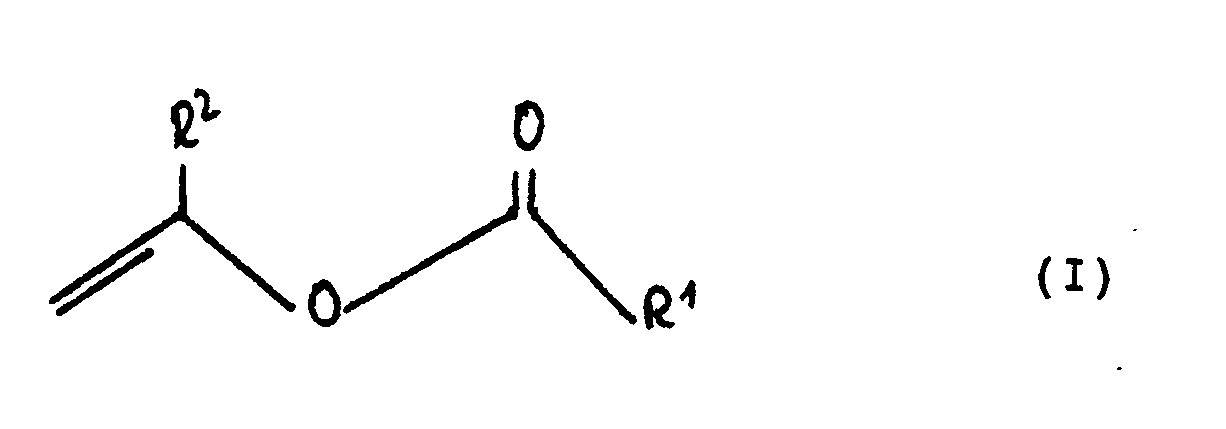
Die Erfindung betrifft somit ein Verfahren zur enzymatischen Racematspaltung von racemischem Pantolacton, das dadurch gekennzeichnet ist, daß der Vinylester der Formel I,

in der
- R¹
- für eine geradkettige oder verzweigte Alkylgruppe mit 1 bis 18 Kohlenstoffatomen, eine geradkettige oder verzweigte Halogenalkylgruppe mit 1 bis 18 Kohlenstoffatomen steht, wobei Halogen Chlor, Brom, Jod oder Fluor bedeutet oder eine Phenylgruppe, wobei die Phenylgruppe durch Chlor, Brom, Jod, Fluor, Cyanid, Nitro, Carboxy oder eine Alkoxygruppe mit 1 bis 4 Kohlenstoffatomen substituiert sein kann, und
- R²
- für Wasserstoff oder eine Methylgruppe steht,
in Gegenwart von Lipase aus Pseudomonas oder Schweinepankreas mit racemischem Pantolacton der Formel II,

umgesetzt wird und anschließend das verbliebene optisch aktive (R)-(-)-Pantolacton von dem gebildeten Pantolactonester getrennt wird.The invention thus relates to a process for the enzymatic resolution of racemic pantolactone, which is characterized in that the vinyl ester of the formula I
in the
- R¹
- represents a straight-chain or branched alkyl group having 1 to 18 carbon atoms, a straight-chain or branched haloalkyl group having 1 to 18 carbon atoms, where halogen is chlorine, bromine, iodine or fluorine or a phenyl group, the phenyl group being chlorine, bromine, iodine, fluorine, Cyanide, nitro, carboxy or an alkoxy group with 1 to 4 carbon atoms may be substituted, and
- R²
- represents hydrogen or a methyl group,
in the presence of lipase from Pseudomonas or porcine pancreas with racemic pantolactone of the formula II,
is implemented and then the remaining optically active (R) - (-) - pantolactone is separated from the pantolactone ester formed.
Die Erfindung wird im folgenden detailliert beschrieben, insbesondere in ihren bevorzugten Ausführungsformen.The invention is described in detail below, in particular in its preferred embodiments.
Die erfindungsgemäße Racematspaltung von racemischem Pantolacton erfolgt in Gegenwart des Vinylesters der Formel I und Lipase aus Pseudomonas bzw. aus Schweinepankreas. Dazu kann man beispielsweise den Vinylester der Formel I, bevorzugt Vinylacetat oder Chloressigsäurevinylester, vorlegen und sowohl die Lipase als auch racemisches Pantolacton dazugeben. Die Lipase kann auch in immobilisierter Form eingesetzt werden, wobei dafür alle gängigen Immobilisierungsmethoden und Träger in Frage kommen. Immobilisiertes und freies Enzym können auch im Säulenverfahren eingesetzt werden. Die verwendete Enzymmenge wird in Abhängigkeit von der Größe des Ansatzes, von der anzustrebenden Reaktionszeit und von der Art des Enzyms (frei oder fixiert) frei gewählt. Das Verhältnis von racemischem Pantolacton zu Lipase kann in einem weiten Bereich schwanken. Beispielsweise kann für eine Pseudomonas Lipase mit 30 000 U/g; (U = µmol Sesamöl/ min) das Verhältnis von racemischem Pantolacton zu Lipase (Volumen zu Gewicht) im Bereich von 50:1 bis 1:100, vorzugsweise im Bereich von 10:1 bis 2:1, schwanken. Entsprechende Bereiche für das Verhältnis von Pantolacton zu anderen Lipasen können nach der spezifischen Aktivität der Lipase berechnet werden. Einem Fachmann fällt es nicht schwer in einfachen Vorversuchen die optimale Menge zu bestimmen.The racemate resolution of racemic pantolactone according to the invention takes place in the presence of the vinyl ester of Formula I and lipase from Pseudomonas or from pig pancreas. To this end, for example, the vinyl ester of the formula I, preferably vinyl acetate or vinyl chloroacetate, can be introduced and both the lipase and racemic pantolactone added. The lipase can also be used in immobilized form, with all common immobilization methods and carriers being suitable for this. Immobilized and free enzyme can also be used in the column process. The amount of enzyme used is freely selected depending on the size of the batch, the desired reaction time and the type of enzyme (free or fixed). The ratio of racemic pantolactone to lipase can vary within a wide range. For example, for a Pseudomonas lipase at 30,000 U / g; (U = µmol sesame oil / min) the ratio of racemic pantolactone to lipase (volume to weight) fluctuate in the range from 50: 1 to 1: 100, preferably in the range from 10: 1 to 2: 1. Corresponding ranges for the ratio of pantolactone to other lipases can be calculated according to the specific activity of the lipase. It is not difficult for a specialist to determine the optimal amount in simple preliminary tests.
Das racemische Pantolacton wird in Gewichtsmengen von 0,01 bis 2 zu 1, bevorzugt von 0,1 bis 1,5 zu 1 - bezogen auf das Volumen des eingesetzten Vinylesters der Formel I - verwendet. In manchen Fällen ist es auch möglich, den Vinylester nur in stöchiometrischen Mengen - bezogen auf ein Enantiomer - vorzulegen. Zur Reaktionslösung können auch wahlweise noch andere unpolare Lösungsmittel zugesetzt werden, beispielsweise tertiär-Butylmethylether, Hexan, Isooctan, Diethylether oder Dipropylether.The racemic pantolactone is used in amounts by weight of from 0.01 to 2 to 1, preferably from 0.1 to 1.5 to 1, based on the volume of the vinyl ester of the formula I used. In some cases it is also possible to present the vinyl ester only in stoichiometric amounts, based on an enantiomer. Other non-polar solvents can also optionally be added to the reaction solution, for example tertiary butyl methyl ether, hexane, isooctane, diethyl ether or dipropyl ether.
Die Reaktionstemperatur liegt in einem Bereich von 10°C bis 80°C, bevorzugt zwischen 20°C und 50°C. Es ist zweckmäßig, die Lösung während der Reaktion zu rühren. Die Reaktionszeiten schwanken in Abhängigkeit von der verwendeten Enzymmenge zwischen wenigen Stunden und bis zu 4 Wochen. Sie liegen häufig zwischen 3 Stunden und 14 Tagen.The reaction temperature is in a range from 10 ° C to 80 ° C, preferably between 20 ° C and 50 ° C. It is advisable to stir the solution during the reaction. The response times vary depending on the amount of enzyme used between a few hours and up to 4 weeks. They are often between 3 hours and 14 days.
Der Vinylester der Formel I ist, sofern er nicht käuflich ist, auf einfache Weise herstellbar. Die Vinylester der Formel I können beispielsweise durch metallkatalysierte Umesterung von Vinylacetat mit den entsprechenden Carbonsäuren gewonnen werden (Geckeler et al., Chemische Berichte, 107, 1271-1274, 1974). Racemisches Pantolacton ist käuflich zu erwerben (Sigma Chemie GmbH, FRG). Lipase aus Pseudomonas kann beispielsweise als Lipase P, Lipase FP oder Lipase PS (Amano Pharmaceuticals, Nagoya, Japan) käuflich erworben werden. Schweinepankreas-Lipase ist ebenfalls käuflich erhältlich (Sigma Chem. Co. Typ II).The vinyl ester of the formula I can, if it is not commercially available, be prepared in a simple manner. The vinyl esters of the formula I can be obtained, for example, by metal-catalyzed transesterification of vinyl acetate with the corresponding carboxylic acids (Geckeler et al., Chemical Reports, 107, 1271-1274, 1974). Racemic pantolactone is commercially available (Sigma Chemie GmbH, FRG). Lipase from Pseudomonas can be purchased, for example, as Lipase P, Lipase FP or Lipase PS (Amano Pharmaceuticals, Nagoya, Japan). Porcine pancreatic lipase is also commercially available (Sigma Chem. Co. Type II).
Beim erfindungsgemäßen Verfahren entstehen (R)-(-)-Pantolacton, der je nach dem verwendeten Vinylester der Formel I entsprechende Pantolactonester, beispielsweise (S)-O-Acyl-pantolacton oder (S)-O-Halogenacylpantolacton und Acetaldehyd bzw. Aceton als Reaktionsprodukte. Diese Produkte lassen sich in bekannter Art und Weise trennen. Im Idealfall läßt sich (R)-(-)-Pantolacton durch Destillation gewinnen. Ist die destillative Trennung nicht möglich, so erfolgt die Trennung chromatographisch, extraktiv oder durch Kristallisation. Es besteht auch die Möglichkeit, die Siedepunktdifferenz zwischen dem enzymatisch gebildeten (S)-Pantolactonester und dem nicht umgesetzten (R)-(-)-Pantolacton dadurch zu erhöhen, daß anstelle von Vinylester der entsprechende Halogenalkylvinylester eingesetzt wird, beispielsweise Chloracetylvinylester.The process according to the invention produces (R) - (-) - pantolactone, which, depending on the vinyl ester of the formula I used, corresponds to the corresponding pantolactone ester, for example (S) -O-acyl-pantolactone or (S) -O-haloacylpantolactone and acetaldehyde or acetone as Reaction products. These products can be separated in a known manner. Ideally, (R) - (-) - pantolactone can be obtained by distillation. If the separation by distillation is not possible, the separation takes place chromatographically, extractive or by crystallization. There is also the possibility of increasing the boiling point difference between the enzymatically formed (S) -pantolactone ester and the unreacted (R) - (-) - pantolactone by using the corresponding haloalkyl vinyl ester, for example chloroacetyl vinyl ester, instead of vinyl ester.
Soll auch das andere Enantiomer von Pantolacton rein dargestellt werden, so isoliert man zunächst den Pantolactonester und spaltet diesen auf bekannte Weise in Säure und Alkohol.If the other enantiomer of pantolactone is also to be shown in pure form, the pantolactone ester is first isolated and split into acid and alcohol in a known manner.
Die für die Reaktion verwendeten Lipasen lassen sich leicht durch Filtration, Zentrifugation oder verwandte Verfahren wieder zurückgewinnen.The lipases used for the reaction can easily be recovered by filtration, centrifugation or related processes.
Die optischen Ausbeuten lassen sich auf bekannte Weise durch Kristallisation (DE 2 404 305) oder durch Variation der Reaktionszeit bzw. des Umsatzes verbessern (Sih et al., J. Am. Chem. Soc., 104, 7294-7299, 1982).The optical yields can be improved in a known manner by crystallization (DE 2 404 305) or by varying the reaction time or the conversion (Sih et al., J. Am. Chem. Soc., 104 , 7294-7299, 1982).
Die nachfolgend aufgeführten Beispiele dienen der weiteren Erläuterung der Erfindung.The examples listed below serve to explain the invention further.
- 1) 20 g (R,S)-Pantolacton werden in 200 ml Vinylacetat gelöst und nach Zugabe von 10.g Lipase P aus Pseudomonas für 10 Tage bei Raumtemperatur gerührt. Die Reaktion wird per Dünnschichtchromatographie verfolgt. Nach Beendigung der Reaktion (50 % Umsatz) filtriert man das Enzym ab, das in der anfallenden Form wiederholt eingesetzt werden kann. Die verbliebene Lösung wird im Vakuum bis zur Trockene eingeengt.
Die Trennung von (R)-(-)-Pantolacton und (S)-(+)-O-Acetyl-pantolacton erfolgt durch Säulenchromatographie an Kieselgel (Laufmittel Hexan und Essigester im Volumenverhältnis von 5:1). Die (R)-(-)-Pantolacton und (S)-(+)-O-Acetylpantolacton enthaltenden Fraktionen werden jeweils vereinigt und die Lösungen werden im Vakuum bis zur Trockene eingeengt.
Ausbeute:
11,4 g (S)-(+)-O-Acetylpantolacton
[α]
ee = 85 % (bestimmt durch ¹H-NMR mit Zugabe von Shiftreagenz Tris-[3-( heptafluoropropylhydroxymethylen)-(+)-camphorato]-europium (III) 8,0 g (R)-(-)-Pantolacton
[α]
ee = 85 % (Bestimmung wie oben) 2) Die Reaktion wird analog Beispiel 1 jedoch mit unterschiedlichen Ausgangsmengen durchgeführt. Es werden 0,2 g (R,S)-Pantolacton in 5 ml Vinylacetat gelöst und nach Zugabe von 0,2 g Lipase P aus Pseudomonas für 10 Tage bei Raumtemperatur gerührt.
Der Fortgang der Reaktion wird über den per Gaschromatographie bestimmten Umsatz kontrolliert.
Messung des Umsatzes über GC:
Eine Glassäule (2m) wird mit calciniertem Kieselgur (z.B. Reoplex auf ®Chromosorb, WZ Johns-Manville) gefüllt. Die Säule wird auf 100°C aufgeheizt und nach Aufgabe der Probe für zunächst 0,5 min bei dieser Temperatur gehalten, bevor mit einer Geschwindigkeit von 10°C/min bis zur Endtemperatur von 135°C aufgeheizt wird. Die Detektion erfolgt mit Hilfe eines
Flammenionisationsdetektors (FID).
Die Retentionszeiten betragen fürGC-Umsatz (% Fläche) nach:

- 3) Entsprechend dem in Beispiel 1 angegebenen Versuchsablauf kann die Reaktion auch mit der kommerziell erhältlichen Lipase aus Schweinepankreas durchgeführt werden.
Die Reaktion wird analog Beispiel 1, jedoch mit unterschiedlichen Ausgangsmengen durchgeführt. Es werden 0,2 g (R,S)-Pantolacton in 5 ml Vinylacetat gelöst und nach Zugabe von 0,2 g Lipase aus Schweinepankreas für 9 Tage bei Raumtemperatur gerührt.
Die Bestimmungsmethoden für Umsatz und Ausbeute stimmten ebenfalls mit denen von Beispiel 1 und 2 überein.
Die Reaktion wurde mittels Gaschromatographie verfolgt.
Die Messung des Umsatzes erfolgt über GC.
GC-Umsatz (% Fläche) nach:

Ausbeute:
30 mg (S)-(+)-O-Acetylpantolacton
165 mg (R)-(-)-Pantolacton
- 1) 20 g of (R, S) -pantolactone are dissolved in 200 ml of vinyl acetate and, after addition of 10. g of Lipase P from Pseudomonas, stirred for 10 days at room temperature. The reaction is followed by thin layer chromatography. After the reaction has ended (50% conversion), the enzyme is filtered off, which can be used repeatedly in the form obtained. The remaining solution is evaporated to dryness in vacuo.
(R) - (-) - Pantolactone and (S) - (+) - O-acetyl-pantolactone are separated by column chromatography on silica gel (mobile phase hexane and ethyl acetate in a volume ratio of 5: 1). The fractions containing (R) - (-) - pantolactone and (S) - (+) - O-acetylpantolactone are each combined and the solutions are evaporated to dryness in vacuo.
Yield:
11.4 g (S) - (+) - O-acetylpantolactone
[α]
ee = 85% (determined by 1 H-NMR with addition of shift reagent tris- [3- (heptafluoropropylhydroxymethylene) - (+) - camphorato] -europium (III) 8.0 g (R) - (-) - pantolactone
[α]
ee = 85% (determination as above) 2) The reaction is carried out analogously to Example 1, but with different starting amounts. 0.2 g of (R, S) -pantolactone are dissolved in 5 ml of vinyl acetate and, after adding 0.2 g of Lipase P from Pseudomonas, stirred for 10 days at room temperature.
The progress of the reaction is monitored via the conversion determined by gas chromatography.
Measuring sales via GC:
A glass column (2m) is filled with calcined diatomaceous earth (e.g. Reoplex on ®Chromosorb, WZ Johns-Manville). The column is heated to 100 ° C. and, after the sample has been placed, is kept at this temperature for 0.5 min before heating up to the final temperature of 135 ° C. at a rate of 10 ° C./min. The detection takes place with the help of a
Flame Ionization Detector (FID).
The retention times are forGC turnover (% area) according to: - 3) According to the experimental procedure given in Example 1, the reaction can also be carried out with the commercially available lipase from pig pancreas.
The reaction is carried out analogously to Example 1, but with different starting amounts. 0.2 g of (R, S) -pantolactone are dissolved in 5 ml of vinyl acetate and after adding 0.2 g of lipase from pork pancreas for 9 days at room temperature.
The determination methods for conversion and yield also corresponded to those of Examples 1 and 2.
The reaction was followed by gas chromatography.
The turnover is measured via GC.
GC turnover (% area) according to:
Yield:
30 mg (S) - (+) - O-acetylpantolactone
165 mg (R) - (-) - pantolactone
Die Reaktion wird analog Beispiel 1 bei verschiedenen Temperaturen durchgeführt. Die Ergebnisse sind in Tabelle 1 zusammengefaßt.The reaction is carried out analogously to Example 1 at different temperatures. The results are summarized in Table 1.
Die Reaktion wird analog Beispiel 1 unter Zusatz diverser Lösungsmittel durchgeführt. Die Ergebnisse sind in Tabelle 2 zusammengestellt.


Claims (7)

Applications Claiming Priority (2)
| Application Number | Priority Date | Filing Date | Title |
|---|---|---|---|
| DE19904005150 DE4005150A1 (en) | 1990-02-17 | 1990-02-17 | METHOD FOR THE ENZYMATIC RACEMATE CLEAVAGE OF PANTOLACTON |
| DE4005150 | 1990-02-17 |
Publications (2)
| Publication Number | Publication Date |
|---|---|
| EP0443406A2 true EP0443406A2 (en) | 1991-08-28 |
| EP0443406A3 EP0443406A3 (en) | 1992-07-29 |
Family
ID=6400476
Family Applications (1)
| Application Number | Title | Priority Date | Filing Date |
|---|---|---|---|
| EP19910101910 Withdrawn EP0443406A3 (en) | 1990-02-17 | 1991-02-12 | Process for enzymatic racemate separation of pantolacton |
Country Status (3)
| Country | Link |
|---|---|
| EP (1) | EP0443406A3 (en) |
| JP (1) | JPH0576388A (en) |
| DE (1) | DE4005150A1 (en) |
Cited By (8)
| Publication number | Priority date | Publication date | Assignee | Title |
|---|---|---|---|---|
| EP0439779A3 (en) * | 1990-02-02 | 1992-08-05 | Chisso Corporation | Process for producing optically active hydroxy lactones |
| EP0578016A3 (en) * | 1992-07-06 | 1995-03-01 | Chemie Linz Gmbh | Enzymatic process for the separation of racemic mixtures of delta-valerolactones. |
| WO1995008636A1 (en) * | 1993-09-25 | 1995-03-30 | Basf Aktiengesellschaft | Racemate cleavage of primary and secondary amines by enzyme-catalysed acylation |
| WO1998037225A1 (en) * | 1997-02-19 | 1998-08-27 | Basf Aktiengesellschaft | Method for producing esters free of enantiomers |
| WO2016202965A1 (en) | 2015-06-19 | 2016-12-22 | Basf Se | Preparation of pantolactone |
| CN110734415A (en) * | 2019-11-28 | 2020-01-31 | 安徽泰格生物科技有限公司 | Aqueous solution crystallization method of D-pantoic acid lactone |
| CN112048537A (en) * | 2019-06-07 | 2020-12-08 | 帝斯曼知识产权资产管理有限公司 | Synthesis of (R) -pantolactone acetate |
| EP3748008A1 (en) * | 2019-06-07 | 2020-12-09 | DSM IP Assets B.V. | Enantioselective acetylation of r/s-pantolactone |
Families Citing this family (2)
| Publication number | Priority date | Publication date | Assignee | Title |
|---|---|---|---|---|
| KR19980059286A (en) * | 1996-12-31 | 1998-10-07 | 박영구 | Method for preparing D-(-)-pantolactone |
| CA2389064A1 (en) | 1999-10-29 | 2001-05-10 | Maria Kesseler | L-pantolactone-hydrolase and a method for producing d-pantolactone |
Family Cites Families (2)
| Publication number | Priority date | Publication date | Assignee | Title |
|---|---|---|---|---|
| DE3743824C2 (en) * | 1987-12-23 | 1997-03-06 | Hoechst Ag | Process for the enzymatic resolution of racemic alcohols with / in vinyl esters by transesterification |
| JP2542941B2 (en) * | 1990-02-02 | 1996-10-09 | チッソ株式会社 | Method for producing optically active hydroxy lactones |
-
1990
- 1990-02-17 DE DE19904005150 patent/DE4005150A1/en not_active Withdrawn
-
1991
- 1991-02-12 EP EP19910101910 patent/EP0443406A3/en not_active Withdrawn
- 1991-02-15 JP JP4230991A patent/JPH0576388A/en active Pending
Cited By (13)
| Publication number | Priority date | Publication date | Assignee | Title |
|---|---|---|---|---|
| EP0439779A3 (en) * | 1990-02-02 | 1992-08-05 | Chisso Corporation | Process for producing optically active hydroxy lactones |
| EP0578016A3 (en) * | 1992-07-06 | 1995-03-01 | Chemie Linz Gmbh | Enzymatic process for the separation of racemic mixtures of delta-valerolactones. |
| WO1995008636A1 (en) * | 1993-09-25 | 1995-03-30 | Basf Aktiengesellschaft | Racemate cleavage of primary and secondary amines by enzyme-catalysed acylation |
| US5728876A (en) * | 1993-09-25 | 1998-03-17 | Basf Aktiengesellschaft | Resolution of the racemates of primary and secondary amines by enzyme-catalyzed acylation |
| WO1998037225A1 (en) * | 1997-02-19 | 1998-08-27 | Basf Aktiengesellschaft | Method for producing esters free of enantiomers |
| CN1127574C (en) * | 1997-02-19 | 2003-11-12 | Basf公司 | Process for the preparation of enantiomerically pure esters |
| WO2016202965A1 (en) | 2015-06-19 | 2016-12-22 | Basf Se | Preparation of pantolactone |
| US10150746B2 (en) | 2015-06-19 | 2018-12-11 | Basf Se | Preparation of pantolactone |
| CN112048537A (en) * | 2019-06-07 | 2020-12-08 | 帝斯曼知识产权资产管理有限公司 | Synthesis of (R) -pantolactone acetate |
| EP3748009A1 (en) * | 2019-06-07 | 2020-12-09 | DSM IP Assets B.V. | Synthesis of (r)-pantolactone acetate |
| EP3748008A1 (en) * | 2019-06-07 | 2020-12-09 | DSM IP Assets B.V. | Enantioselective acetylation of r/s-pantolactone |
| CN110734415A (en) * | 2019-11-28 | 2020-01-31 | 安徽泰格生物科技有限公司 | Aqueous solution crystallization method of D-pantoic acid lactone |
| CN110734415B (en) * | 2019-11-28 | 2021-09-17 | 安徽泰格生物科技有限公司 | Aqueous solution crystallization method of D-pantolactone |
Also Published As
| Publication number | Publication date |
|---|---|
| DE4005150A1 (en) | 1991-08-22 |
| EP0443406A3 (en) | 1992-07-29 |
| JPH0576388A (en) | 1993-03-30 |
Similar Documents
| Publication | Publication Date | Title |
|---|---|---|
| DE68913393T2 (en) | Method for the separation of hydroxy-cyclopentenones using a lipase and transacylation agents. | |
| EP1141373B1 (en) | Method for the enantioselective and regioselective reduction of 3,5-dioxocarboxylic acids, their salts and their esters | |
| EP0321918B2 (en) | Process for the enzymatic racemate cleavage of racemic alcohols with/in vinyl esters by transesterification | |
| Kitazume et al. | Microbial approach to the practical monofluorinated chiral synthons | |
| EP0812819B1 (en) | Enantiomer-enriched tertiary hydrocarbonrest-substituted malonic acid ester and the preparation | |
| DE4332738A1 (en) | Racemate resolution of primary and secondary amines by enzyme-catalyzed acylation | |
| EP0443406A2 (en) | Process for enzymatic racemate separation of pantolacton | |
| Paizs et al. | Biocatalytic enantioselective preparation of phenothiazine-based cyanohydrin acetates: kinetic and dynamic kinetic resolution | |
| EP0492497B1 (en) | Process for acylating alcohols with immobilized pseudomonaslipase | |
| DE69214484T2 (en) | Process for the optical separation of Corey lactone diols | |
| DE69127222T2 (en) | Process for the preparation of epoxy alcohols of high optical purity | |
| EP0507278A2 (en) | Immobilised biocatalyser, its preparation and use for ester synthesis in a column reactor | |
| EP0402771B1 (en) | Process for the enzymatic clearance of 2-arylpropionic acid vinyl esters | |
| DE69221685T2 (en) | METHOD FOR PRODUCING OPTICALLY ACTIVE 3-CHLORINE-1-PHENYL-PROPAN-1-OL AND ITS DERIVATIVE | |
| EP0632130B1 (en) | Enzymatic process for the production of aliphatic S-cyanhydrins | |
| EP0716712B1 (en) | Lipase-catalysed acylation of alcohols with diketenes | |
| AT401385B (en) | ENZYMATIC RACEMAT CLEAVAGE OF ASYMMETRIC ALCOHOLS BY MEANS OF VINYL ESTERS OF MULTI-BASED CARBONIC ACIDS | |
| DE69620437T2 (en) | METHOD FOR PRODUCING OPTICALLY ACTIVE 2-SUBSTITUTED TETRAHYDROPYRAN-4-ON | |
| DE3878264T2 (en) | MONOACETYLATION OF DIOLES WITH A BIOCATALYZER MADE OF CORYNE BACTERIUM OXIDANS. | |
| EP0350908A2 (en) | Process for the production of S-cyanohydrines | |
| DE3724721A1 (en) | Method for the enzymatic racemate resolution of 1-acyloxy-2-cyclopenten-4-one 2,2-dimethylpropanediol ketal | |
| EP1048737B1 (en) | Stereoselective synthesis of 2-hydroxycétones | |
| DE4414273A1 (en) | Optical resolution of racemic alcohols | |
| DE69026053T2 (en) | Process for the production of optically active hydroxy esters | |
| EP0419988A1 (en) | Enzymatic enantioselective synthesis of S(-) and R(+) esters of 4-hydroxy-1-cyclopentenone and its 2',2'-dimethyl-1',3'-propandiol ketal |
Legal Events
| Date | Code | Title | Description |
|---|---|---|---|
| PUAI | Public reference made under article 153(3) epc to a published international application that has entered the european phase |
Free format text: ORIGINAL CODE: 0009012 |
|
| AK | Designated contracting states |
Kind code of ref document: A2 Designated state(s): BE CH DE FR GB IT LI NL |
|
| PUAL | Search report despatched |
Free format text: ORIGINAL CODE: 0009013 |
|
| AK | Designated contracting states |
Kind code of ref document: A3 Designated state(s): BE CH DE FR GB IT LI NL |
|
| 18W | Application withdrawn |
Withdrawal date: 19920825 |
|
| STAA | Information on the status of an ep patent application or granted ep patent |
Free format text: STATUS: THE APPLICATION HAS BEEN WITHDRAWN |
|
| R18W | Application withdrawn (corrected) |
Effective date: 19920825 |