EP0442909B1 - Vorrichtung und verfahren zur behandlung und entfernung infektiöser abfälle - Google Patents
Vorrichtung und verfahren zur behandlung und entfernung infektiöser abfälle Download PDFInfo
- Publication number
- EP0442909B1 EP0442909B1 EP89912036A EP89912036A EP0442909B1 EP 0442909 B1 EP0442909 B1 EP 0442909B1 EP 89912036 A EP89912036 A EP 89912036A EP 89912036 A EP89912036 A EP 89912036A EP 0442909 B1 EP0442909 B1 EP 0442909B1
- Authority
- EP
- European Patent Office
- Prior art keywords
- reservoir
- waste material
- infectious waste
- infectious
- waste
- Prior art date
- Legal status (The legal status is an assumption and is not a legal conclusion. Google has not performed a legal analysis and makes no representation as to the accuracy of the status listed.)
- Expired - Lifetime
Links
Images



Classifications
-
- C—CHEMISTRY; METALLURGY
- C02—TREATMENT OF WATER, WASTE WATER, SEWAGE, OR SLUDGE
- C02F—TREATMENT OF WATER, WASTE WATER, SEWAGE, OR SLUDGE
- C02F1/00—Treatment of water, waste water, or sewage
- C02F1/02—Treatment of water, waste water, or sewage by heating
-
- A—HUMAN NECESSITIES
- A01—AGRICULTURE; FORESTRY; ANIMAL HUSBANDRY; HUNTING; TRAPPING; FISHING
- A01N—PRESERVATION OF BODIES OF HUMANS OR ANIMALS OR PLANTS OR PARTS THEREOF; BIOCIDES, e.g. AS DISINFECTANTS, AS PESTICIDES OR AS HERBICIDES; PEST REPELLANTS OR ATTRACTANTS; PLANT GROWTH REGULATORS
- A01N59/00—Biocides, pest repellants or attractants, or plant growth regulators containing elements or inorganic compounds
-
- A—HUMAN NECESSITIES
- A61—MEDICAL OR VETERINARY SCIENCE; HYGIENE
- A61L—METHODS OR APPARATUS FOR STERILISING MATERIALS OR OBJECTS IN GENERAL; DISINFECTION, STERILISATION OR DEODORISATION OF AIR; CHEMICAL ASPECTS OF BANDAGES, DRESSINGS, ABSORBENT PADS OR SURGICAL ARTICLES; MATERIALS FOR BANDAGES, DRESSINGS, ABSORBENT PADS OR SURGICAL ARTICLES
- A61L11/00—Methods specially adapted for refuse
-
- A—HUMAN NECESSITIES
- A61—MEDICAL OR VETERINARY SCIENCE; HYGIENE
- A61L—METHODS OR APPARATUS FOR STERILISING MATERIALS OR OBJECTS IN GENERAL; DISINFECTION, STERILISATION OR DEODORISATION OF AIR; CHEMICAL ASPECTS OF BANDAGES, DRESSINGS, ABSORBENT PADS OR SURGICAL ARTICLES; MATERIALS FOR BANDAGES, DRESSINGS, ABSORBENT PADS OR SURGICAL ARTICLES
- A61L2/00—Disinfection or sterilisation of materials or objects, in general; Accessories therefor
- A61L2/16—Disinfection or sterilisation of materials or objects, in general; Accessories therefor using chemical substances
-
- C—CHEMISTRY; METALLURGY
- C02—TREATMENT OF WATER, WASTE WATER, SEWAGE, OR SLUDGE
- C02F—TREATMENT OF WATER, WASTE WATER, SEWAGE, OR SLUDGE
- C02F1/00—Treatment of water, waste water, or sewage
- C02F1/72—Treatment of water, waste water, or sewage by oxidation
- C02F1/76—Treatment of water, waste water, or sewage by oxidation with halogens or compounds of halogens
-
- Y—GENERAL TAGGING OF NEW TECHNOLOGICAL DEVELOPMENTS; GENERAL TAGGING OF CROSS-SECTIONAL TECHNOLOGIES SPANNING OVER SEVERAL SECTIONS OF THE IPC; TECHNICAL SUBJECTS COVERED BY FORMER USPC CROSS-REFERENCE ART COLLECTIONS [XRACs] AND DIGESTS
- Y10—TECHNICAL SUBJECTS COVERED BY FORMER USPC
- Y10S—TECHNICAL SUBJECTS COVERED BY FORMER USPC CROSS-REFERENCE ART COLLECTIONS [XRACs] AND DIGESTS
- Y10S241/00—Solid material comminution or disintegration
- Y10S241/606—Medical/surgical waste comminution
Definitions
- the present invention relates generally to waste treatment and, in particular, to apparatus for treating and disposing of batches of infectious waste and converting it into a non-toxic and non-infectious waste residue that can be safely discharged into a sanitary sewer or landfill.
- infectious waste has become more clearly defined as a category of environmental waste material having treatment and disposal requirements which are distinctly different from other types of non-hazardous and hazardous wastes.
- pathogenic agents which are the focus of infectious waste are transmitted primarily by blood, blood products, body fluids, bone, and tissue, and secondarily by the containers, gloves, syringes, diapers, dressings, and other objects which have come in contact with the above-mentioned biological products.
- Effective treatment of infectious waste requires a treatment system which is effective against bacteria and viruses as well as other potentially pathogenic agents. Proper treatment of all of these forms of infectious waste requires a precisely controlled process whereby all pathogenic agents contained in the infectious waste come in contact with a chemical of sufficient content and concentration for a sufficient length of contact time to neutralize these pathogenic agents. Ideally, such a process should have a capability to be easily adjusted according to the volume and type of infectious waste being treated.
- Waste treatment processes have been developed which either address certain specific types of biological or non-biological waste materials or all forms of waste generated by a particular type of generator, such as a hospital.
- waste disposal processes have not focused exclusively on infectious waste. Therefore, such processes and systems are either not economically practicable or are otherwise unsuitable for many infectious waste generators.
- waste treatment processes have been developed to provide some level of treatment of infectious waste.
- such treatment has either focused on the neutralization of bacteria only or lacked the control necessary to insure that all potentially pathogenic agents present in infectious waste, as described above, are effectively treated.
- US-A-4185973 discloses a waste disposal system, e.g. for hospital use, having a shredder for comminuting waste which is then drawn by air suction through a closed ducting system, for destruction.
- US-A-3965006 describes apparatus for the disposal of liquid or semi-liquid hospital waste, having a wet-bottom chamber to receive waste discharging through a trap into a centralised treatment tank.
- the present invention provides an apparatus and method for infectious waste treatment whereby blood and other biological products, as well as disposable objects which have come in contact with such products, are first reduced to a liquid or liquid/sludge state and then treated in a batch process in which the volume of infectious waste, the formula and concentration of the chemical, and the time of contact of the chemical with the waste are precisely controlled so as to render the infectious waste non-toxic and non-infectious, thus allowing for safe disposal of the treated liquid or liquid/sludge residue in a sanitary sewer, landfill or other disposal source.
- an apparatus for treating and disposing of batches of infectious waste material and converting it into a non-toxic and non-infectious waste residue comprising: a comminution means including an inlet opening for receiving infectious waste material therethrough, said comminution means being adapted to reduce the particle size of the infectious waste material received through said inlet opening and mix the infectious waste material with water to form a slurry, a sealed airtight reservoir sized and arranged to receive the infectious waste material slurry from said comminution means, a discharge valve in communication with said reservoir, a mixer means for mixing the slurry of infectious waste material in said reservoir with a desired disinfectant material; and a control means for controlling the activating and deactivating of said mixer means and the opening and closing of said discharge valve, said control means including a level sensor operable to detect when the content of said reservoir reaches a pre-determined level corresponding to a desired batch size for treatment purposes, said control means operable to automatically activate said mixer means and deactivate said comminution
- a batch method for disinfecting infectious waste materials comprising the steps of: reducing the particle size of the infectious waste material in a comminuting chamber and mixing the infectious waste material with water to form a slurry; accumulating a desired batch size of the infectious waste material in a sealed airtight reservoir; treating said batch of infectious waste material in said reservoir with a pre-determined amount of a suitable chemical disinfectant; mixing the batch of infectious waste material with the chemical disinfectant in said reservoir for a predetermined time period sufficient to permit the chemical disinfectant to convert the infectious waste material to a non-toxic and non-infectious waste residue; and emptying the reservoir of the non-toxic and non-infectious waste residue after said mixing step is completed.
- the invention can be used as a point source treatment process, whereby infectious waste can be treated and rendered non-toxic and non-infectious on-site, eliminating the need for any further handling or treatment.
- the invention permits the treatment and rendering non-toxic and non-infectious of all bacterial, viral, and other pathogenic agents potentially found in infectious waste that includes blood, blood products, body fluids, bone, tissue, and other biological material, and disposables such as containers, gloves, syringes, diapers, dressings, and other objects that have come in contact with blood and other biological products.
- the above-described infectious waste is treated in a batch process, rather than a continous process, allowing for the precise treatment of a measured volume of infectious waste at a time.
- infectious waste is treated using a disinfectant chemical, preferably in a solid tablet form which is broken down and dissolved in a liquid in the same manner as the infectious waste being processed.
- the above-described infectious waste is broken down in a maceration or grinder pump process which converts the infectious waste into a liquid or liquid sludge with the biological component having a particle size of not greater than 0.16 cm (1/16th of an inch).
- the reduction in size and conversion of the infectious waste to a liquid or liquid sludge state ensures that the chemical comes in contact for an adequate time with every pathogenic agent contained in the infectious waste being treated.
- infectious waste may be treated in a reservoir/pump process which recirculates the liquid or liquid sludge and the chemical through the pump and reservoir for a detention time sufficient for contact of the infectious waste with the chemical to render non-toxic and non-infectious the type of infectious waste being treated.
- the above-described infectious waste is preferably treated to a degree sufficient to allow for the safe disposal of the liquid or liquid sludge residue in a sanitary sewer and/or landfill.
- the invention allows for the controlled batch testing of the liquid or liquid sludge residue remaining after treatment for such characteristics as biological composition oxygen demand, chemical oxygen demand, etc. , chemical composition and presence of pathogenic agents.
- FIG. 1 shows the apparatus of the invention generally designated at 10. All of the components of the apparatus 10 are enclosed in an exterior housing 11 made of non-corrosive materials such as stainless steel to facilitate cleaning.
- an electronic control panel 12 which provides all of the major operator controls for the apparatus 10.
- On the exterior of the control panel 12 is a power on switch 13, a power off/reset switch 14, a waste discharge indicator light 15, a processor forward/off/reverse switch 16, and an aspirator on/off switch 17. Connection to a suitable source of electric power to power the apparatus 10 is provided by electric power cord 18.
- a water line inlet 20 At the opposite end of the housing 11 from the control panel 12 is a water line inlet 20, an aspirator inlet 21, and a waste discharge line outlet 22. Infectious waste material may be received into the apparatus 10 through an inlet 23 located at the top of the housing 11 or, alternatively if desired, through a conventional aspirator suction line 24 (shown schematically in FIG. 6) which may be coupled to aspirator inlet 21.
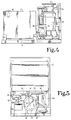
- the various inner components of the apparatus 10 are shown.
- the major components include a macerator 26 which comminutes the waste material received from aspirator suction line 24 or through waste inlet 23, a reservoir 27 which receives the comminuted waste material from macerator 26 for batch treatment, and a recirculation/discharge pump 28 for mixing the comminuted waste material in reservoir 27 with a chemical disinfectant and discharging the treated waste material from the reservoir.
- Waste inlet 23 opens upwardly from the top of macerator 26 and communicates with macerating chamber 31 through a channel 32 comprising the throat of the macerator.
- a water inlet 30 which communicates through supply line 30a with water line inlet 20.
- a one way valve 30b prevents backflow of liquid from macerating chamber 31 into line 30a while on/off valve 30c controls the flow of water into macerating chamber 31, thereby permitting water from a suitable external source (not shown) to be flushed into the macerating chamber 31 during operation.
- a pump 37 and motor 37a provides a source of vacuum for aspiration through aspirator line 37b which communicates with aspirator inlet 21.
- Aspirated waste from line 37b along with water from line 37c is pumped through pump 37 to line 38 which communicates to an inlet opening 36 separate from inlet 30 inside channel 32.
- the macerator 26 includes a rotating cutter bar 33 and grooved shredder ring 34 which cooperate to comminute the waste material by a shredding or cutting action as the waste material is thrown to the peripheral sides of the macerating chamber by centrifugal force.
- a splash guard 35 made of rubber or a suitable flexible plastic material is mounted within waste inlet 23 to prevent waste material, chemical disinfectant, or water from splashing out of the inlet 23 during operation.
- the macerator 26 In order to effectively treat the infectious waste material, the macerator 26 must be capable of fragmenting the biological component of the waste material to a particulate size no larger than 0.16cm (1/16th inch) diamater.
- macerator 26 is a commercially known design used to process food waste such as in the food service industry, and is available from In-sink-erator Division of Emerson Electric Co. under Model No. SS75.
- macerator 26 may be replaced by a grinder pump which comminutes the waste material by a grinding action as opposed to a cutting action.
- the reservoir 27 is fully enclosed and all openings in reservoir 27 which communicate externally of the apparatus 10 are valve sealed to render the reservoir airtight, thereby preventing the escape of airborne or waterborne contaminants during the treatment process.
- a conduit 39 communicates between macerating chamber 31 and the upper portion of reservoir 27 to convey the comminuted waste material to reservoir 27.
- Check valve 41 in conduit 39 prevents backflow into macerator 26.
- Inside of the reservoir 27 is a float-type level indicator 45.
- a waste discharge/recirculation line 41 extends from the bottom of reservoir 27 and communicates with pump 28 which is an open face impeller type pump.
- the discharge end of pump 28 communicates with a 3-way valve 43 which routes the discharge from pump 41 either to a return line 44 communicating with reservoir 27 or to a waste discharge line 46 communicating with waste discharge line outlet 22.
- the return line 44 is located near the bottom of reservoir 26. From this location, the discharge through the return line 44 serves to flush the bottom of the reservoir 27, enhancing the mixing effect.
- an air vent line 47 which communicates with the upper portion of reservoir 27 to provide ventilation thereof while preventing escape of airborne contaminants to the ambient air.
- power cord 18 is connected to an exterior electrical power source
- water line inlet 20 is connected to a suitable water supply
- aspirator inlet 21 is connected to an aspirator suction line 24
- the discharge line outlet 22 is coupled to a suitable disposal source, such as for example a sanitary sewer system.
- the power on switch 13 is activated to the "on” position. In the “on” position, power is directed to the waste processor forward/off/reverse switch 16, the power off/reset switch 14 and the level indicator 45 located in the reservoir 27.
- the waste processor forward/off/reverse switch 16 is turned to the forward or reverse position.
- the motor inside the macerator 26 is activated, which in turn activates the rotating cutter bar in the macerator.
- switch 16 activates the on/off valve 30c for water line 16 to its "on" or open position. Water flows from the water line inlet 20 through supply line 30a, and into macerator 26 through inlet 30. Waste material fed into the waste inlet 23 proceeds by gravity to the macerating chamber 31.
- waste material may be inserted into the waste inlet 23 for processing or aspirated through suction line 24.
- the waste material received through inlet 23 or by aspiration is reduced to a sludge or slurry form by the cutting action of the macerator 26 and mixing with water supplied from line 37c.
- the comminuted waste material, now in a slurry form moves by way of gravity through conduit 39 from the macerator 26 into reservoir 27.
- the check valve 40 prevents the waste material from backflowing into the macerator once it has passed through the conduit 39 into the reservoir 27.
- a waste shredder 48 is mounted over the waste inlet of the macerator 26 (see FIG. 6).
- the waste shredder includes a fixed cutter bar and rotating cutter arms which reduce the size of the infectious waste material by a cutting action to a physical size small enough to fit through the channel 32 of the macerator, thus allowing larger materials to be processed.
- control circuitry in control means 50 automatically shuts off the waste processor forward/off/reverse switch 16 which in turn shuts off the aspirator pump 37 and macerator 26, thus preventing any additional waste to enter the reservoir until the waste already present in the reservoir has been treated and discharged.
- the chemical used for treatment of the infectious waste material is of a formula and concentration sufficient, upon contact, to reduce and eliminate the pathogenic agents present in the type of waste being treated.
- the treatment chemical can be in tablet, pellet, liquid, or powdered form. Because treatment is of a precisely controlled batch size of waste material, the amount of chemical which is used for the treatment of each batch of infectious waste may be precisely controlled.
- the treatment chemical enters the apparatus by way of the waste inlet 23.
- the chemical disinfectant used is a chlorine based compound in tablet form. Because the apparatus is suited for use with a disinfectant in solid tablet form, problems associated with long term storage and transport of disinfectants and splashing and aeration of the chemical during handling is minimized or eliminated altogether.
- the chlorine tablets are structurally bonded in such a manner that they can be both mechanically broken down to a powder by the waste disposal system and completely dissolved to a liquid upon contact with water in the waste disposal system.
- the control means 50 activates recirculation pump 28 and a timer 49 and activates the 3-way valve 43 to route the output of pump 28 back to reservoir 27 through return line 44.
- the function of pump 28 is to thoroughly mix the infectious waste with the disinfectant chemical and keep it in continuous suspension during the treatment process.
- the pump 28 is an open face impeller pump.
- the pump 28 is a grinder pump which further physically reduces the size of the infectious waste at the same time that it is being recirculated through the grinder pump and reservoir.
- timer 49 which is set for a time sufficient for the chemical to come in contact and reduce and eliminate all of the pathogenic agents present in the infectious waste, resulting in a non-toxic and non-infectious liquid or liquid sludge residue.
- timer 49 sends a signal to the control means 50 which causes control means 50 to activate 3-way valve 43 to close return line 44 and open discharge line 46.
- the batch of treated waste material, now rendered non-toxic and non-infectious, is released under pressure supplied by the pump 28 into a sanitary sewer or other suitable discharge source.
- level indicator 45 sends a signal to control means 50 which then deactivates pump 28 and activates 3-way valve 43 to close discharge line 46 and reopen return line 44.
- a suitable filter media 51 (FIG. 6) is provided in communication with discharge line 46.
- the batch of treated liquid or liquid sludge, rendered non-toxic and non-infectious, is released under pressure from the recirculation pump 28 into filter media 51 which removes the solid particulate matter component from the liquid or liquid residue. Any liquid remaining after the filtering process if released into a sanitary sewer, while the filter media and filtered waste is disposed of in a manner suitable for the disposal of solid waste.
Landscapes
- Life Sciences & Earth Sciences (AREA)
- Health & Medical Sciences (AREA)
- Chemical & Material Sciences (AREA)
- Engineering & Computer Science (AREA)
- General Health & Medical Sciences (AREA)
- Environmental & Geological Engineering (AREA)
- Water Supply & Treatment (AREA)
- Epidemiology (AREA)
- Public Health (AREA)
- Veterinary Medicine (AREA)
- Hydrology & Water Resources (AREA)
- Animal Behavior & Ethology (AREA)
- Organic Chemistry (AREA)
- Inorganic Chemistry (AREA)
- Chemical Kinetics & Catalysis (AREA)
- Agronomy & Crop Science (AREA)
- General Chemical & Material Sciences (AREA)
- Pest Control & Pesticides (AREA)
- Plant Pathology (AREA)
- Dentistry (AREA)
- Wood Science & Technology (AREA)
- Zoology (AREA)
- Environmental Sciences (AREA)
- Apparatus For Disinfection Or Sterilisation (AREA)
- Processing Of Solid Wastes (AREA)
- Accommodation For Nursing Or Treatment Tables (AREA)
Claims (9)
- Vorrichtung (10) zur Behandlung und Entsorgung von Partien infektiösen Abfallmaterials und zum Umwandeln desselben in einen nicht toxischen und nicht infektiösen Abfallrückstand, welche aufweist:
eine Zerkleinerungseinrichtung (26) mit einer Einlaßöffnung (23), um durch diese hindurch infektiöses Abfallmaterial aufzunehmen, wobei die genannte Zerkleinerungseinrichtung (26) dazu eingerichtet ist, die Teilchengröße des infektiösen Abfallmaterials, das durch die genannte Einlaß-öffnung (23) hindurch aufgenommen wurde, zu verringern und das infektiöse Abfallmaterial mit Wasser zu vermischen, um eine Aufschlämmung zu bilden,
ein luftdicht abgedichtetes Reservoir (27), das so bemessen und angeordnet ist, daß es die Aufschlämmung des infektiösen Abfallmaterials von der genannten Zerkleinerungseinrichtung (26) aufnimmt,
ein Auslaßventil (43), das mit dem genannten Reservoir (27) in Verbindung ist,
eine Mischereinrichtung (28) zum Vermischen der Aufschlämmung infektiösen Abfallmaterials in dem genannten Reservoir (27) mit einem gewünschten desinfizierenden Material und
eine Steuereinrichtung (50) zur Steuerung des Einschaltens und Abschaltens der genannten Mischereinrichtung (28) und des Öffnens und Schließens des genannten Auslaßventils (43), wobei die genannte Steuereinrichtung (50) einen Füllstandsensor (45) beinhaltet, der betreibbar ist, um zu ermitteln, wann der Inhalt des genannten Reservoirs (27) ein vorbestimmtes Niveau erreicht, welches einer für die Behandlungszwecke erwünschten Partiegröße entspricht, wobei die genannte Steuereinrichtung (50) betreibbar ist, um selbsttätig die genannte Mischereinrichtung (28) einzuschalten und die genannte Zerkleinerungseinrichtung (26) abzuschalten, wenn das Abfallmaterial in dem genannten Reservoir (27) das vorbestimmte Niveau erreicht, die genannte Steuereinrichtung (50) außerdem einen Zeitgeber (49) beinhaltet, der den Betrieb der genannten Mischereinrichtung (28) auf eine gewünschte Kontaktzeit begrenzt, die ausreicht, um zu ermöglichen, daß das desinfizierende Material in dem genannten Reservoir das infektiöse Abfallmaterial in der genannten Partie desinfiziert, und die genannte Steuereinrichtung (50) betreibbar ist, um das Öffnen des genannten Auslaßventils (43) nach der genannten, gewünschten Kontaktzeit zu bewirken. - Vorrichtung nach Anspruch 1, bei der das genannte Reservoir (27) ein luftdicht geschlossener Raum ist und die Vorrichtung außerdem ein Einweg-Rückschlagventil (40) aufweist, das so betrieblich eingerichtet und angeordnet ist, daß es das Rückströmen von Abfallmaterial und Luft aus dem genannten Reservoir (27) in die genannte Zerkleinerungseinrichtung (26) unterbindet, während die genannte Mischereinrichtung (28) eine Partie des Abfallmaterials in dem genannten Reservoir (27) mischt.
- Vorrichtung nach Anspruch 1 oder 2, die außerdem einen Filter (51) aufweist, der mit dem genannten Reservoir (27) und Abfall-Ausgabemitteln (41, 46) verbunden und dazu betreibbar ist, Teilchenmaterial aus der behandelten Aufschlämmung infektiösen Abfallmaterials auszufiltern, das aus dem genannten Reservoir (27) abgegeben wird.
- Vorrichtung nach Anspruch 1, 2 oder 3, bei der die genannte Zerkleinerungseinrichtung (26) eine Zerkleinerungskammer (31) und einen Kanal (32) aufweist, der zwischen der genannten Einlaßöffnung (23) der Zerkleinerungseinrichtung und der genannten Zerkleinerungskammer (31) angeordnet ist, wobei die genannte Einlaßöffnung (23) oberhalb des genannten Kanals (32) gelegen ist und sich nach oben öffnet, wodurch infektiöses Abfallmaterial, das durch die genannte Einlaßöffnung (23) hindurch aufgenommen wird, beim Betrieb durch Schwerkraft durch den genannten Kanal (32) hindurch in die Zerkleinerungskammer (31) zugeführt wird.
- Vorrichtung nach irgendeinem vorausgehenden Anspruch, bei der die genannte Zerkleinerungseinrichtung einen Wassereinlaß (30) aufweist und die Vorrichtung außerdem eine Wasserleitung (30a) besitzt, die mit dem genannten Wassereinlaß (30) in Verbindung ist, wobei die genannte Steuereinrichtung (50) außerdem den Wasserzufluß in die genannte Zerkleinerungseinrichtung (26) hinein durch die genannte Wasserleitung (30a) steuert, so daß Wasser in den genannten Wassereinlaß (30) beim Einschalten der genannten Zerkleinerungseinrichtung (26) eintreten kann.
- Vorrichtung nach irgendeinem vorausgehenden Anspruch, die außerdem eine Mahlpumpe aufweist, die mit dem genannten Reservoir (27) und der genannten Mischereinrichtung (28) verbunden ist, wobei die genannte Mahlpumpe betreibbar ist, um die Teilchengröße des infektiösen Abfallmaterials weiter zu verringern, wenn das genannte infektiöse Abfallmaterial durch die genannte Mischereinrichtung (28) und das genannte Reservoir (27) hindurch zirkuliert wird.
- Vorrichtung nach irgendeinem vorausgehenden Anspruch, bei der die genannten Abfall-Ausgabemittel (41, 46) eine Auslaßleitung (41) für Abfall aufweisen, die mit dem genannten Reservoir (27) in Verbindung steht, sowie eine Belüftungsleitung (47), die eine Verbindung zwischen dem genannten Reservoir (27) und den genannten Abfall-Ausgabemitteln (41, 46) herstellt.
- Verfahren zur partieweisen Desinfektion infektiösen Abfallmaterials, welches die Schritte aufweist:
Verringern der Teilchengröße des infektiösen Abfallmaterials in einer Zerkleinerungskammer (26) und Mischen des infektiösen Abfallmaterials mit Wasser, um eine Aufschlämmung zu bilden;
Ansammeln einer gewünschten Partiegröße des infektiösen Abfallmaterials in einem luftdicht abgeschlossenen Reservoir (27);
Behandeln der genannten Partie infektiösen Abfallmaterials in dem genannten Reservoir (27) mit einer vorbestimmten Menge eines geeigneten chemischen Desinfektionsmittels;
Mischen der Partie des infekiösen Abfallmaterials in dem genannten Reservoir (27) mit dem chemischen Desinfektionsmittel während einer vorbestimmten Zeitdauer, die ausreicht, um zu ermöglichen, daß das chemische Desinfektionsmittel das infekiöse Abfallmaterial in einen nicht toxischen und nicht infekiösen Abfallrückstand umwandelt, und
Entleeren des Reservoirs (27) mit dem nicht toxischen und nicht infekiösen Abfallrückstand, nachdem der genannte Schritt des Mischens abgeschlossen ist. - Verfahren nach Anspruch 8, bei dem das chemische Desinfektionsmittel Chlor in fester Tablettenform ist und das genannte Verfahren außerdem den Schritt des Zerkleinerns einer oder mehrerer Chlortabletten in der Zerkleinerungskammer vor dem genannten Behandlungsschritt beinhaltet.
Applications Claiming Priority (3)
| Application Number | Priority Date | Filing Date | Title |
|---|---|---|---|
| US258156 | 1988-10-14 | ||
| US07/258,156 US5087420A (en) | 1988-10-14 | 1988-10-14 | Apparatus for treatment and disposal of infectious waste |
| PCT/US1989/004609 WO1990003949A1 (en) | 1988-10-14 | 1989-10-13 | Improved apparatus and method for treatment and disposal of infectious waste |
Publications (3)
| Publication Number | Publication Date |
|---|---|
| EP0442909A1 EP0442909A1 (de) | 1991-08-28 |
| EP0442909A4 EP0442909A4 (en) | 1991-10-09 |
| EP0442909B1 true EP0442909B1 (de) | 1995-03-01 |
Family
ID=22979326
Family Applications (1)
| Application Number | Title | Priority Date | Filing Date |
|---|---|---|---|
| EP89912036A Expired - Lifetime EP0442909B1 (de) | 1988-10-14 | 1989-10-13 | Vorrichtung und verfahren zur behandlung und entfernung infektiöser abfälle |
Country Status (7)
| Country | Link |
|---|---|
| US (1) | US5087420A (de) |
| EP (1) | EP0442909B1 (de) |
| JP (1) | JPH04501675A (de) |
| AT (1) | ATE119138T1 (de) |
| CA (1) | CA1334220C (de) |
| DE (1) | DE68921487T2 (de) |
| WO (1) | WO1990003949A1 (de) |
Families Citing this family (28)
| Publication number | Priority date | Publication date | Assignee | Title |
|---|---|---|---|---|
| US5425925A (en) * | 1990-04-19 | 1995-06-20 | Winfield Industries, Inc. | Multi-stage infectious waste treatment system |
| US5656248A (en) * | 1990-04-19 | 1997-08-12 | Winfield Industries Inc. | Multi-stage infectious waste treatment system |
| EP0510276B1 (de) * | 1991-04-23 | 1996-09-11 | Winfield Industries | Mehrstufiges Behandlungssystem für infektiösen Müll |
| US5582793A (en) * | 1991-10-03 | 1996-12-10 | Antaeus Group, Inc. | Process for treating waste material |
| JP2650784B2 (ja) * | 1991-10-03 | 1997-09-03 | メディカル ウェイスト テック、インコーポレイテッド | 廃棄物資材を生物学的に中性化する装置 |
| US5427737A (en) * | 1991-10-03 | 1995-06-27 | Anteus Group, Inc. | Process and system for biologically neutralizing waste material |
| CA2054841C (en) * | 1991-10-31 | 1999-12-07 | Erick Schmidt | Methods for treating infectious wastes |
| EP0586763B1 (de) * | 1992-09-08 | 1998-03-11 | Winfield Industries | Steuersystem für eine Vorrichtung zur Beseitigung von medizinischen Abfallmaterialien |
| US5251825A (en) * | 1992-10-19 | 1993-10-12 | Mediclean Technology, Inc. | Method and apparatus for comminuting and decontaminating waste material |
| ES2085212B1 (es) * | 1993-07-12 | 1998-05-16 | Carbonell Cia Anma S A | Aparato para tratar residuos liquidos hospitalarios. |
| FR2736268B1 (fr) * | 1995-07-06 | 1997-09-26 | Cme | Procede de sterilisation des residus corporels liquides |
| US5759491A (en) * | 1995-07-21 | 1998-06-02 | Bunin; Kiva | Process and apparatus for the decontamination of infectious waste |
| US5570845A (en) * | 1995-08-03 | 1996-11-05 | Sterile Technology Industries, Inc. | Waste treatment apparatus and method |
| US5692687A (en) * | 1996-03-11 | 1997-12-02 | Kateley; Richard D. | Medical waste processing and disinfecting apparatus |
| FR2762789B1 (fr) * | 1997-05-02 | 1999-12-31 | Genevieve Defond | Module de recuperation et de traitement des effluents de rincage en biologie |
| FR2772276B1 (fr) * | 1997-12-12 | 2000-03-17 | Armand Bortoluzzi | Procede de traitement en continu de rejets liquides souilles et/ou contamines par des micro-organismes et/ou des substances biologiquement actives et installation pour sa mise en oeuvre |
| US5941468A (en) * | 1998-01-22 | 1999-08-24 | Sterile Technology Industries, Inc. | Waste treatment apparatus and method |
| US6588690B1 (en) | 2000-03-14 | 2003-07-08 | Komar Industries, Inc. | System and method for treating process material |
| US7273585B1 (en) * | 2000-06-19 | 2007-09-25 | White James M | Biological fluid disposal system |
| US6499495B2 (en) | 2001-01-24 | 2002-12-31 | Allegiance Corporation | Waste treatment system for suction canisters |
| US20050044819A1 (en) * | 2003-09-02 | 2005-03-03 | Chomik Richard S. | Waste storage device |
| US8091325B2 (en) * | 2001-05-02 | 2012-01-10 | Playtex Products, Inc. | Waste disposal device including a diaphragm for twisting a flexible tubing dispensed from a cartridge |
| US6691939B2 (en) * | 2001-06-08 | 2004-02-17 | Tommin Enterprises, Llc | Pressure differential material transport and disposal system |
| ITBO20050094A1 (it) * | 2005-02-23 | 2006-08-24 | I M A Ind Macchine Automatic H | Impianto per il trattamento di materiale in polvere |
| US8740114B2 (en) | 2010-01-07 | 2014-06-03 | Metronic Xomed, Inc. | System and method of bone processing |
| ITBO20120467A1 (it) | 2012-09-04 | 2014-03-05 | Parentini Ignazio Ditta Individuale | Macchina e metodo di trattamento di rifiuti pericolosi ospedalieri |
| US20170107710A1 (en) * | 2015-09-18 | 2017-04-20 | Jack R. Terrazas | Portable Waste Maceration System and Apparatus |
| GB2599635A (en) * | 2020-09-30 | 2022-04-13 | Vernacare Ltd | Connected macerator |
Family Cites Families (19)
| Publication number | Priority date | Publication date | Assignee | Title |
|---|---|---|---|---|
| US2520320A (en) * | 1945-09-27 | 1950-08-29 | Georgia Kaolin Co | Process and apparatus for winning kaolin and the like |
| US2609331A (en) * | 1947-06-17 | 1952-09-02 | Sinclair Refining Co | Pyrolytic conversion of oil shale |
| US2676666A (en) * | 1950-10-14 | 1954-04-27 | Joseph P Graf | Disposal system |
| US2737129A (en) * | 1952-06-25 | 1956-03-06 | Pelbake Corp | Apparatus for measuring and introducing dry ingredients into processing machines using liquid therein |
| US2880941A (en) * | 1958-01-07 | 1959-04-07 | Hobart Mfg Co | Rotor actuated flushing water control for waste disposer |
| US3563384A (en) * | 1968-10-03 | 1971-02-16 | Koehler Dayton | Automatic macerator unit |
| GB1321618A (en) * | 1969-12-23 | 1973-06-27 | Anda Ltd | Waste disposal apparatus |
| US3567633A (en) * | 1970-03-30 | 1971-03-02 | Tekmar Corp | Method of treating waste matter |
| US3699592A (en) * | 1970-12-21 | 1972-10-24 | Preformed Line Products Co | Marine toilet assembly |
| US3762553A (en) * | 1971-05-05 | 1973-10-02 | Koehler Dayton | Indirector chlorinator |
| US3782550A (en) * | 1971-11-05 | 1974-01-01 | Dayton Mfg Co | Waste treatment system |
| US3824632A (en) * | 1972-10-06 | 1974-07-23 | Pure Way Corp | Self-contained water closet and digester |
| US3965006A (en) * | 1974-11-12 | 1976-06-22 | American Sterilizer Company | Liquid waste disposal |
| DE2512742C2 (de) * | 1975-03-22 | 1986-03-20 | Karl 7065 Winterbach Schnell | Einrichtung zur Verarbeitung von Fleischknochen |
| US4032446A (en) * | 1976-05-05 | 1977-06-28 | Hobart Corporation | Waste material handling system |
| GB1581356A (en) * | 1977-04-01 | 1980-12-10 | Metal Box Co Ltd | Waste disposal systems |
| US4233157A (en) * | 1977-11-23 | 1980-11-11 | Miller Peter A | Travelling sheet, flat-bed filter apparatus and system |
| US4378093A (en) * | 1980-12-11 | 1983-03-29 | Keener Steven M | Grinder pump cutter assembly |
| US4471916A (en) * | 1982-08-30 | 1984-09-18 | Chemfix Technologies, Inc. | Apparatus for treating liquid and semi-solid organic waste materials |
-
1988
- 1988-10-14 US US07/258,156 patent/US5087420A/en not_active Expired - Fee Related
-
1989
- 1989-09-29 CA CA000614508A patent/CA1334220C/en not_active Expired - Fee Related
- 1989-10-13 AT AT89912036T patent/ATE119138T1/de not_active IP Right Cessation
- 1989-10-13 WO PCT/US1989/004609 patent/WO1990003949A1/en not_active Ceased
- 1989-10-13 DE DE68921487T patent/DE68921487T2/de not_active Expired - Fee Related
- 1989-10-13 JP JP1511288A patent/JPH04501675A/ja active Pending
- 1989-10-13 EP EP89912036A patent/EP0442909B1/de not_active Expired - Lifetime
Also Published As
| Publication number | Publication date |
|---|---|
| DE68921487D1 (de) | 1995-04-06 |
| ATE119138T1 (de) | 1995-03-15 |
| EP0442909A1 (de) | 1991-08-28 |
| JPH04501675A (ja) | 1992-03-26 |
| US5087420A (en) | 1992-02-11 |
| EP0442909A4 (en) | 1991-10-09 |
| DE68921487T2 (de) | 1995-06-29 |
| CA1334220C (en) | 1995-01-31 |
| WO1990003949A1 (en) | 1990-04-19 |
Similar Documents
| Publication | Publication Date | Title |
|---|---|---|
| US5087420A (en) | Apparatus for treatment and disposal of infectious waste | |
| EP0662346B1 (de) | Vorrichtung zur Sanierung von medizinischen Abfall | |
| EP1019098B1 (de) | Mobile anordnung und prozess zur behandlung von infektiosem abfall | |
| JP2650784B2 (ja) | 廃棄物資材を生物学的に中性化する装置 | |
| JP4147279B2 (ja) | 体液を含む廃液の処理方法およびその処理装置 | |
| US5116574A (en) | Continuous treatment process and apparatus for the disinfection of infectious waste | |
| US8425857B2 (en) | System and method for processing waste material | |
| US5582793A (en) | Process for treating waste material | |
| US5639031A (en) | Sharps disposal system | |
| US5427737A (en) | Process and system for biologically neutralizing waste material | |
| US5077007A (en) | Batch treatment process and apparatus for the disinfection of infectious waste | |
| WO1991012889A1 (en) | Batch treatment process and apparatus for the disinfection of infectious waste | |
| US20040141877A1 (en) | Mobile apparatus and process for treating infectious waste | |
| JPWO1997027883A1 (ja) | 体液を含む廃液の処理方法およびその処理装置 | |
| US5240187A (en) | Medical waste treatment device and method | |
| KR101768887B1 (ko) | 음식물 쓰레기 소멸 시스템 | |
| EP0510276A2 (de) | Mehrstufiges Behandlungssystem für infektiösen Müll | |
| KR20060085847A (ko) | 의료용 폐기물 처리장치 | |
| CN211489006U (zh) | 一种护理用废弃物处理装置 | |
| KR200381987Y1 (ko) | 의료용 폐기물 처리장치 | |
| CA2122606A1 (en) | Process and device for treating liquid-containing, crushable waste | |
| WO2004022236A1 (en) | Apparatus for the disposal of waste | |
| US20260048167A1 (en) | Medical waste sterilizer | |
| MXPA97007401A (en) | System and process for dealing with desire material | |
| HK1195545A (en) | System and method for processing waste material |
Legal Events
| Date | Code | Title | Description |
|---|---|---|---|
| PUAI | Public reference made under article 153(3) epc to a published international application that has entered the european phase |
Free format text: ORIGINAL CODE: 0009012 |
|
| 17P | Request for examination filed |
Effective date: 19910412 |
|
| AK | Designated contracting states |
Kind code of ref document: A1 Designated state(s): AT BE CH DE FR GB IT LI LU NL SE |
|
| A4 | Supplementary search report drawn up and despatched |
Effective date: 19910822 |
|
| AK | Designated contracting states |
Kind code of ref document: A4 Designated state(s): AT BE CH DE FR GB IT LI LU NL SE |
|
| 17Q | First examination report despatched |
Effective date: 19920610 |
|
| GRAA | (expected) grant |
Free format text: ORIGINAL CODE: 0009210 |
|
| AK | Designated contracting states |
Kind code of ref document: B1 Designated state(s): AT BE CH DE FR GB IT LI LU NL SE |
|
| PG25 | Lapsed in a contracting state [announced via postgrant information from national office to epo] |
Ref country code: IT Free format text: LAPSE BECAUSE OF FAILURE TO SUBMIT A TRANSLATION OF THE DESCRIPTION OR TO PAY THE FEE WITHIN THE PRE;WARNING: LAPSES OF ITALIAN PATENTS WITH EFFECTIVE DATE BEFORE 2007 MAY HAVE OCCURRED AT ANY TIME BEFORE 2007. THE CORRECT EFFECTIVE DATE MAY BE DIFFERENT FROM THE ONE RECORDED.SCRIBED TIME-LIMIT Effective date: 19950301 Ref country code: CH Effective date: 19950301 Ref country code: AT Effective date: 19950301 Ref country code: BE Effective date: 19950301 Ref country code: LI Effective date: 19950301 Ref country code: NL Free format text: LAPSE BECAUSE OF NON-PAYMENT OF DUE FEES Effective date: 19950301 |
|
| REF | Corresponds to: |
Ref document number: 119138 Country of ref document: AT Date of ref document: 19950315 Kind code of ref document: T |
|
| ET | Fr: translation filed | ||
| REF | Corresponds to: |
Ref document number: 68921487 Country of ref document: DE Date of ref document: 19950406 |
|
| PG25 | Lapsed in a contracting state [announced via postgrant information from national office to epo] |
Ref country code: SE Effective date: 19950601 |
|
| REG | Reference to a national code |
Ref country code: CH Ref legal event code: PL |
|
| NLV1 | Nl: lapsed or annulled due to failure to fulfill the requirements of art. 29p and 29m of the patents act | ||
| PG25 | Lapsed in a contracting state [announced via postgrant information from national office to epo] |
Ref country code: GB Effective date: 19951013 |
|
| PG25 | Lapsed in a contracting state [announced via postgrant information from national office to epo] |
Ref country code: LU Free format text: LAPSE BECAUSE OF NON-PAYMENT OF DUE FEES Effective date: 19951031 |
|
| PLBE | No opposition filed within time limit |
Free format text: ORIGINAL CODE: 0009261 |
|
| STAA | Information on the status of an ep patent application or granted ep patent |
Free format text: STATUS: NO OPPOSITION FILED WITHIN TIME LIMIT |
|
| 26N | No opposition filed | ||
| PGFP | Annual fee paid to national office [announced via postgrant information from national office to epo] |
Ref country code: DE Payment date: 19960430 Year of fee payment: 7 Ref country code: FR Payment date: 19960430 Year of fee payment: 7 |
|
| GBPC | Gb: european patent ceased through non-payment of renewal fee |
Effective date: 19951013 |
|
| PG25 | Lapsed in a contracting state [announced via postgrant information from national office to epo] |
Ref country code: FR Effective date: 19970630 |
|
| PG25 | Lapsed in a contracting state [announced via postgrant information from national office to epo] |
Ref country code: DE Effective date: 19970701 |
|
| REG | Reference to a national code |
Ref country code: FR Ref legal event code: ST |