EP0441028B1 - Geräuscharmer Mauerkasten für Russbläser - Google Patents
Geräuscharmer Mauerkasten für Russbläser Download PDFInfo
- Publication number
- EP0441028B1 EP0441028B1 EP90311348A EP90311348A EP0441028B1 EP 0441028 B1 EP0441028 B1 EP 0441028B1 EP 90311348 A EP90311348 A EP 90311348A EP 90311348 A EP90311348 A EP 90311348A EP 0441028 B1 EP0441028 B1 EP 0441028B1
- Authority
- EP
- European Patent Office
- Prior art keywords
- assembly
- chamber
- wallbox
- chambers
- khz
- Prior art date
- Legal status (The legal status is an assumption and is not a legal conclusion. Google has not performed a legal analysis and makes no representation as to the accuracy of the status listed.)
- Revoked
Links
- 238000004140 cleaning Methods 0.000 claims abstract description 30
- 238000002485 combustion reaction Methods 0.000 claims abstract description 11
- 230000004323 axial length Effects 0.000 claims abstract description 10
- 230000003247 decreasing effect Effects 0.000 claims abstract description 3
- 238000007789 sealing Methods 0.000 claims description 11
- 239000007789 gas Substances 0.000 claims 1
- 230000001747 exhibiting effect Effects 0.000 abstract 1
- 125000006850 spacer group Chemical group 0.000 description 10
- 239000006227 byproduct Substances 0.000 description 9
- 238000003780 insertion Methods 0.000 description 4
- 239000010881 fly ash Substances 0.000 description 3
- 230000037431 insertion Effects 0.000 description 3
- 230000009467 reduction Effects 0.000 description 3
- 238000010521 absorption reaction Methods 0.000 description 2
- 230000000712 assembly Effects 0.000 description 2
- 238000000429 assembly Methods 0.000 description 2
- 230000002238 attenuated effect Effects 0.000 description 2
- 230000008901 benefit Effects 0.000 description 2
- 238000010276 construction Methods 0.000 description 2
- 230000006870 function Effects 0.000 description 2
- 238000012423 maintenance Methods 0.000 description 2
- 230000002787 reinforcement Effects 0.000 description 2
- 230000004044 response Effects 0.000 description 2
- 239000002893 slag Substances 0.000 description 2
- 239000004071 soot Substances 0.000 description 2
- PMZURENOXWZQFD-UHFFFAOYSA-L Sodium Sulfate Chemical compound [Na+].[Na+].[O-]S([O-])(=O)=O PMZURENOXWZQFD-UHFFFAOYSA-L 0.000 description 1
- 230000004075 alteration Effects 0.000 description 1
- 239000002131 composite material Substances 0.000 description 1
- 230000000694 effects Effects 0.000 description 1
- 230000036541 health Effects 0.000 description 1
- 238000004519 manufacturing process Methods 0.000 description 1
- 238000005259 measurement Methods 0.000 description 1
- 238000003466 welding Methods 0.000 description 1
Images

Classifications
-
- F—MECHANICAL ENGINEERING; LIGHTING; HEATING; WEAPONS; BLASTING
- F28—HEAT EXCHANGE IN GENERAL
- F28G—CLEANING OF INTERNAL OR EXTERNAL SURFACES OF HEAT-EXCHANGE OR HEAT-TRANSFER CONDUITS, e.g. WATER TUBES OR BOILERS
- F28G1/00—Non-rotary, e.g. reciprocated, appliances
-
- F—MECHANICAL ENGINEERING; LIGHTING; HEATING; WEAPONS; BLASTING
- F28—HEAT EXCHANGE IN GENERAL
- F28G—CLEANING OF INTERNAL OR EXTERNAL SURFACES OF HEAT-EXCHANGE OR HEAT-TRANSFER CONDUITS, e.g. WATER TUBES OR BOILERS
- F28G1/00—Non-rotary, e.g. reciprocated, appliances
- F28G1/16—Non-rotary, e.g. reciprocated, appliances using jets of fluid for removing debris
Definitions
- the present invention relates generally to a retracting sootblower wallbox sealing assembly for an opening in the wall of a large scale boiler. More specifically, the present invention is directed to a sootblower wallbox constructed to absorb noise emanating from the nozzle of a retractable sootblower lance.
- a number of cleaning lances also known as sootblowers, are mounted exteriorly of the boiler and are inserted periodically into the boiler through ports located in the boiler wall. Positioned on the forward end of the lances are one or more cleaning nozzles. The nozzles discharge a pressurized cleaning medium, such as air, steam or other solutions. The effects of the high pressure cleaning medium are such that deposits of soot, slag and flyash are dislodged from the internal structures of the boiler.
- Conventional wallbox assemblies serve a number of purposes. One purpose being that of a support structure for the previously mentioned cleaning lances. During cleaning, numerous combustion by-products escape to the exterior of the boiler between the cleaning lance and the walls of the cleaning port. For this reason, another purpose of a wallbox assembly is to retain combustion by-products within the boiler.
- Wallbox assemblies for example as disclosed in US-A-2 803 848 which provides the basis for the prior art portion of claim 1, designed to retard the escape of combustion by-products generally incorporate two chambers, a sealing air chamber and an aspirating air chamber. Both chambers provide air to the wallbox as a pressure greater than the internal operating pressure of the boiler.
- a sealing air chamber When the sootblower lance is dispensed through the wallbox for cleaning, positive pressure sealing air is provided to the wallbox assembly. Once the cleaning lance is removed, aspirating air is directed interiorly of the heat exchanger through and annular array of ports. The orientation of the aspirating ports, along with the increased pressure of the aspirating air, restricts the flow of combustion by-products from the cleaning port during normal operation of the boiler.
- a principal object of the present invention is to provide a wallbox assembly which effectively limits the noise emissions associated with sootblower operation.
- Another object of the present invention is to provide a wallbox assembly of a simple construction which thereby facilitates fabrication, service and maintenance.
- a further object of the present invention is to provide a wallbox assembly capable of reducing noise emissions while also preventing the emission of combustion by-products from the assembly.
- a sootblower wallbox assembly is provided with a number of sound absorbing reverberant annular chambers which surround the sootblower lance.
- the chambers are positioned coaxially and are bounded by baffle rings in close fit relation with the outside diameter of the lance.
- each chamber has a specific frequency range where it achieves its most significant noise reduction.
- each chamber Since the reverberant chambers reduce noise by negative reinforcement, each chamber has its best noise absorption centered about a frequency having a wavelength four times the length of the chamber. From this it can be noted that a plurality of chambers having various lengths must be provided in order to obtain noise reduction throughout the audible frequency range. In designing a wallbox assembly having a minimum number of resonating chambers, care must be taken in choosing chamber lengths so that each chamber will significantly increases the overall effective attenuation of the assembly.
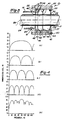
- Figure 1 is a side sectional view of a four chamber embodiment of the present invention having a cleaning lance disposed therethrough.
- Figure 2 is a side sectional view of a four chamber embodiment further including an air seal and an aspirating seal.
- Figure 3 is a side sectional view of a three chamber embodiment of the noise reducing wallbox of the present invention.
- Figures 4(a) - 4(d) display attenuation curves for various chamber lengths of the noise reducing wallbox of the present invention.
- Figure 4(e) displays the overall attenuation curve for a three chamber wallbox assembly having chamber lengths corresponding to the attenuation curves of Figures 4(a), 4(b) and 4(d).
- a wallbox assembly is illustrated as being mounted exteriorly of a boiler upon a sleeve pipe 14 extended through a cleaning port 16 in a boiler wall 10.
- An exterior housing 18 of the assembly 12 is rigidly secured to the outer and rearward end 15 of the sleeve pipe 14 by welding or other conventional securement means.
- Located on a forward face 22 of the housing 18 is a rim 20.
- the rim 20 is in nesting engagement with the outer most portion of the sleeve pipe 14.
- the forward face 22 may be separately secured to the housing 18 as seen in Figure 1, or alternatively, the forward face 22 may be formed or cast integral with the remainder of the housing 18 as seen in Figure 2.
- a cleaning lance 24 is inserted from the exterior side of the wallbox 12 through a lance opening 26 until extended into the boiler through the wallbox 12, sleeve pipe 14 and boiler wall 10.
- the lance 24 thus defines an axis of insertion 28 for the assembly 12.
- Figures 1 and 2 illustrate four chamber embodiments of the present invention.
- Figure 3 illustrates a three chamber embodiment.
- Each sound absorbing chamber varies as to length and are designated as chambers 30, 32, 34 and 36 in Figures 1 and 2 and as chambers 31, 35 and 37 in Figure 3. While the chambers are shown in a sequential arrangement, the order of chamber lengths does not affect the attenuation efficiency of the wallbox 12.
- each sound absorbing chamber is structurally similar and defined by a spacer ring 42 and one or more baffle rings 38.
- Each baffle ring 38 has a centrally located annular opening 40 which corresponds to the lance opening 26.
- the baffle rings 38 are positioned transversely to the axis of insertion 28 and are coaxial with the cleaning lance 24.
- the lance 24 may be inserted consecutively through each chamber.
- the inner diameters of the annular openings 40 are such that each baffle ring 38 is in close fit relation with the exterior surface of the lance 24.
- each spacer ring 42 consists of two portions, an axial portion 44 and a transverse flange portion 46.
- the rearmost spacer ring 43 varies only in that it contains an additional flange portion 47 as will be explained below.
- the axial portions 44 are positioned so as to be coaxial with the lance 24 when it is extended through the assembly 12.
- Each flange portion 46 extends transversely from one end of the axial portion 44.
- the flange portion 46 fastens the spacer ring 42 to the baffle ring 38 through the use of bolt fasteners 48 or other conventional fastening means. For the sake of clarity, only one bolt fastener 48 is shown in the figures.
- the remaining chambers are constructed in a similar fashion.
- each sound absorbing chamber could be constructed of a singularly cast part, including both the spacer ring 42 and baffle ring 38, or the entire series of chambers could be cast as a unitary part.
- the baffle ring 38 of the front chamber 30 is positioned closest to the interior of the boiler.
- a portion of the front chamber baffle ring 38 is in contacting relation, opposite of the rim 20, with the interior surface of the forward face 22 of the housing 18.
- a first middle chamber 32 is positioned adjacent to the front chamber 30 against baffle ring 38.
- the remaining chambers are mounted in like fashion to form a series of sound absorbing chambers all having a common exterior surface coaxial to the cleaning lance 24.
- a rear baffle ring 52 defining the lance opening 26, forms the rearmost wall of the chamber series.
- the rear baffle ring 52 is attached to the second flange portion 47 of the rear spacer ring 43 in the same manner as the previous baffle rings 38.
- baffle rings 38 and 52 are shown mounted exteriorly to the flange and axial portions 46 and 44, it is readily seen that the baffle rings 38 and 52 may alternatively be mounted interiorly, relative to the flange portion 46 and 47. Constructed in this manner, the dog portion 46 of the first chamber 30 would be in contacting relationship with the inner surface of the forward face 22 and the dog portion 47 of the rear chamber 36 would contact an exterior cover plate 58.
- the rear baffle ring 52 along with the other baffle rings also function as a scraper for the lance 24.
- sootblower lance 24 is extended into the boiler and retracted as a cleaning medium is sprayed from the lance nozzle block (not shown).
- the lance tube 24 is rotated simultaneous with its axial travel.
- some portion of lance tube 24 is within wallbox 12.
- the baffle ring 52 abrasively dislodges deposits, such as fly ash and salt cake, that have adhered to the exterior surface of the lance 24.
- the sound absorbing chambers of wallbox 12 are secured within the housing 18 by a cover plate 58.
- the cover plate 58 is fastened to the housing 18 by bolt fasteners 60 or another conventional attachment means. Again, one bolt fastener 60 is shown for the sake of clarity.
- the cover plate 58 and rear baffle ring 52 form the rear wall of the housing 18. So mounted, the sound absorbing chambers 30, 32, 34 and 36 are held in position by the pressure exerted on them through the cooperation of the forward face 22 and the cover plate 58. This mounting enables the chamber series to be capable of some transverse movement or self alignment in response to a corresponding movement of the cleaning lance 24.
- the outermost surfaces of the spacer rings 42 cooperate to form a common exterior surface of the chamber series.
- the overall exterior diameter of the chamber series is less than the interior diameter of the housing 18 and thus, an air space 62 is defined therebetween.
- the air space 62 assists in sealing the wallbox assembly 12 to prevent the escape of combustion by-products from the interior of the heat exchanger.
- the air space 62 will be described in greater detail below.
- Figure 2 illustrates a second embodiment of the wallbox assembly 12 of the present invention.
- the embodiment of Figure 2 is a four chamber reverberant wallbox assembly 12 incorporating both a positive pressure air seal 63 and a positive pressure aspirating seal 67.
- Much of the structure illustrated in Figure 2 is concurrent with that of Figure 1 and is therefore designated with like references.
- Each sealing system 63 and 67 assists in, preventing the escape of combustion by-products from the boiler and is readily adaptable to the three chambered wallbox assembly 12 illustrated in Figure 3.
- positive pressure sealing air is provided by an air source (not shown) through a supply inlet 64 to the air space 62 and subsequently through a sealing air port 66 in one (or more) of the spacer rings 42.
- the seal air is provided at a pressure greater than the internal operating pressure of the boiler. While the seal air port 66 is shown in the foremost chamber 30, it could be alternatively provided in any of the remaining chambers without affecting the systems operational capabilities.
- the aspirating seal 67 is provided forward of the first reverberant chamber 30 and consists of an aspirating air inlet 68 and an aspirating ring 70.
- the aspirating ring 70 is provided with a number of aspirating ports 72 which circumferentially encircle the cleaning lance 24 during its insertion into the heat exchanger.
- the aspirating ports 72 are positioned equidistantly around the ring 70 and are oriented toward the interior of the heat exchanger.
- aspirating air is provided through the aspirating inlet 68 at a pressure significantly greater than the internal operating pressure of the heat exchanger.
- the combination of the aspirating air's orientation and increased pressure is effective so as to prevent the emission of combustion by-products through the sleeve pipe 14 during normal operation of the heat exchanger.
- each chamber has a specific frequency range where its most significant attenuation is achieved.
- attenuation is accomplished by negative reinforcement and the best absorption for each cavity will be centered about a frequency (and overtones of this frequency) having a wavelength four times the chamber length.
- a frequency having a half wavelength equal to the length of the cavity will not be attenuated significantly.
- chamber length determines the frequency range of attenuation
- the radial height of the chamber determines the magnitude of this attenuation. Thus, as radial height increases, attenuation also increases.
- the attenuation curve for each cavity is a sine-squared curve, repeating for overtones of the attenuated frequency.
- the attenuation curve for each chamber is a series of peaks and valleys, the peaks representing maximum attenuation.
- Figure 4(a) illustrates the attenuation curve for a chamber having a 1.27 cm (1/2 inch) axial length.
- Figure 4(b) is the attenuation curve corresponding to a 2.54 cm (1 inch) axial chamber length.
- the attenuation curves for axial chamber lengths of 3.5 cm (1 3/8 inches) and 5.7 cm (2 1/4 inches) are respectively shown in Figures 4(c) and 4(d) respectively.
- Figure 4(e) shows the overall attenuation for a three chamber reverberate wallbox assembly (Figure 3) having axial chamber lengths of 1.27, 3.5 and 5.7 cms (1/2, 1 3/8 and 2 1/4 inches).
- A-weighted curve values are added to the raw sound pressure levels.
- raw sound levels are decreased in certain frequency ranges and increased in others to arrive at a composite sound level measure.
- the A-weighted curve has little attenuation.
- the attenuation of the 1.27 cm (1/2 inch) chamber is ineffective in the lower part of this important A-weighted range.
- the attenuation curve for the 5.7 cm (2 1/4 inch) chamber displays a much quicker rise and is above the 20 dB effective attenuation level from about 375 Hz to 2.7 KHz.
- the 5.7 cm (2 1/4 inch) chamber provides that which the 1.27 cm (1/2 inch) chamber lacks, namely, significant attenuation in the lower part of the critical A-weighted frequency range.
- Figure 4(e) represents the sum of Figures 4(a),(b) and (d).
- the valley of the attenuation curve at approximately 9 KHz would shift out to almost 10 KHz where the attenuation curve for the 3.5 cm (1 3/8 inch) chamber also has a valley.
- a four chamber wallbox incorporating a 1.27 cm (1/2 inch), 2.54 cm (1 inch), and 3.5 cm (1 3/8 inch) chamber would be more effective with a 5.7 cm (2 1/4 inch) fourth chamber, rather than 5.4 cm (2 1/8 inch) fourth chamber.
- the overall attenuation for the assembly 12 would differ by approximately 10 dB at that frequency.
Landscapes
- Engineering & Computer Science (AREA)
- Combustion & Propulsion (AREA)
- Mechanical Engineering (AREA)
- General Engineering & Computer Science (AREA)
- Chemical & Material Sciences (AREA)
- Filtering Of Dispersed Particles In Gases (AREA)
- Incineration Of Waste (AREA)
- Building Environments (AREA)
- Crushing And Pulverization Processes (AREA)
- Saccharide Compounds (AREA)
- Exhaust Silencers (AREA)
- Devices Affording Protection Of Roads Or Walls For Sound Insulation (AREA)
- Drying Of Solid Materials (AREA)
- Medicines Containing Plant Substances (AREA)
- Massaging Devices (AREA)
Claims (10)
- Rußbläser-Mauerkasten-Anordnung, um das Innere eines Wärmetauschers durch eine Reinigungsöffnung für ein Rohrlanzenelement (24) zugänglich zu machen, mit Mitteln (38), um das Hindurchführen des Rohrlanzenelements (24) bei Aufrechterhaltung einer abgedichteten Beziehung damit zu erlauben, dadurch gekennzeichnet, daß die Anordnung zwei oder mehr geräuschabsorbierende Kammern (30, 32, 34, 36) aufweist, die dazu ausgestaltet sind, das Rohrlanzenelement (24) in Seite-an-Seite liegender Anordnung entlang der Längsachse (28) des Rohrlanzenelements (24) zu umgeben, wobei die radialen Wände der Kammern durch Platten (38, 52) gebildet werden und die Platte (38) zwischen dem oder jedem Paar von Kammern (30-36) in Feinpassung (bei 40) auf dem Rohrlanzenelement (24) sitzt, wodurch die Kammern (30-36) geschlossen sind, indem ihre Innenwände durch das Rohrlanzenelement (24) gebildet werden, wobei die Kammern dazu ausgelegt sind, aus dem Wärmetauscher in die Mauerkasten-Anordnung (12) geleitete Geräusche zu dämpfen, wobei die Kammern (30-36) hohl sind und unterschiedliche axiale Längen haben, die es jeder Kammer ermöglichen, unterschiedliche Resonanzeigenschaften und geräuschabsorbierende Eigenschaften zu zeigen, wodurch die Mauerkasten-Anordnung (12) dazu ausgestaltet ist, insgesamt eine Geräuschdämpfung zu schaffen, die die Summe der geräuschabsorbierenden Eigenschaften der einzelnen Kammern ist.
- Rußbläser-Mauerkasten-Anordnung nach Anspruch 1, die drei (31, 35, 37) geräuschabsorbierende Kammern aufweist.
- Rußbläser-Mauerkasten-Anordnung nach Anspruch 2, wobei die erste Kammer (31) eine axiale Länge von etwa 1,27 cm (½''), eine zweite Kammer (35) eine axiale Länge von etwa 3,5 cm (1 3/8'') und eine dritte Kammer (37) eine axiale Länge von etwa 5,7 cm (2¼'') hat, alle Kammern einen im wesentlichen gleichen Außendurchmesser haben und von im wesentlichen ringförmiger Form sind.
- Rußbläser-Mauerkasten-Anordnung nach Anspruch 2 oder 3, wobei eine erste Kammer (31) merkliche Geäuschdämpfung für Frequenzen im Bereich von etwa 1,6 KHz bis 12,2 KHz und Obertöne dieser Frequenzen, eine zweite Kammer (35) merkliche Geräuschdämpfung für Frequenzen im Bereich von 0,5 KHz bis 4,5 KHz und Obertöne dieser Frequenzen und eine dritte Kammer (37) merkliche Geräuschdämpfung für Frequenzen im Bereich von etwa 0,3 KHz bis 2,7 KHz und Obertöne dieser Frequenzen bietet.
- Rußbläser-Mauerkasten-Anordnung nach Anspruch 1, die vier (30, 32, 34, 36) geräuschabsorbierende Kammern aufweist.
- Rußbläser-Mauerkasten-Anordnung nach Anspruch 5, wobei eine erste Kammer (30) eine axiale Länge von etwa 1,27 cm (½''), eine zweite Kammer (32) eine axiale Länge von etwa 2,54 cm (1''), eine dritte Kammer (34) eine axiale Länge von etwa 3,5 cm (1 3/8'') und eine vierte Kammer (36) eine axiale Länge von etwa 5,7 cm (2 ¼'') hat, alle Kammern (30-36) im wesentlichen den gleichen Außendurchmesser haben und von im wesentlichen ringförmiger Form sind.
- Rußbläser-Mauerkasten-Anordnung zur Absenkung von Lärmemission nach Anspruch 5 oder 6, wobei eine erste Kammer (30) merkliche Geräuschdämpfung für Frequenzen im Bereich von etwa 1,6 KHz bis 12,2 KHz und Obertöne dieser Frequenzen, eine zweite Kammer (32) merkliche Geräuschdämpfung für Frequenzen im Bereich von etwa 0,8 KHz bis 6,2 KHz und Obertöne dieser Frequenzen, eine dritte Kammer (34) merkliche Geräuschdämpfung für Frequenzen im Bereich von etwa 0,5 KHz bis 4,5 KHz und Obertöne dieser Frequenzen und eine vierte Kammer (36) merkliche Geräuschdämpfung für Frequenzen im Bereich von etwa 0,3 KHz bis 2,7 KHz und Obertöne dieser Frequenzen bietet.
- Rußbläser-Mauerkasten-Anordnung nach einem der vorhergehenden Ansprüche, wobei die Anordnung (12) weiter einen Dichtungslufteinlaß (66) aufweist, der sich im Inneren durch wenigstens eine (30) der geräuschabsorbierenden Kammern erstreckt, wodurch die Kammer (30) mit Luft mit positivem Druck versorgt wird, um die Mauerkasten-Anordnung (12) abzudichten, wenn das Rohrlanzenelement (24) durch die Anordnung hindurchläuft.
- Rußbläser-Mauerkasten-Anordnung nach einem der vorhergehenden Ansprüche, wobei die Anordnung weiter eine Lüftung (67) mit einem Lüftungs-Lufteinlaß (68) aufweist, der in einer im wesentlichen ringförmigen Lüfterdrossel (70) endet, die das Reinigungs-Rohrlanzenelement (24) umgibt, wobei die Lüfterdrossel Bereiche aufweist, die eine Mehrzahl von Lüftungsöffnungen (72) bilden, welche in einer Richtung im wesentlichen auf das Innere des Wärmeaustauschers zu gerichtet sind, wodurch der Lüftungs-Lufteinlaß (68) positiven Luftdruck an die Lüftungsöffnungen (72) liefert, wenn das Rohrlanzenelement (24) aus der Anordnung (12) entfernt ist.
- Rußbläser-Mauerkasten-Anordnung nach einem der vorhergehenden Ansprüche, wobei Mittel (63, 67) vorgesehen sind, um im wesentlichen zu verhindern, daß Verbrennungsprodukte und Gase aus dem Wärmetauscher austreten, indem sie die Anordnung passieren, wobei diese Mittel ein Gehäuse (18), welches die geräuschabsorbierende Kammern (30-36) im wesentlichen einschließt und einen größeren Durchmesser als die Kammern (30-36) hat, um einen Luft-Zwischenraum dazwischen zu bilden, eine Luftdichtung (63) mit einem Dichtungslufteinlaß (64), welcher durch das Gehäuse (18) zu dem Luft-Zwischenraum (62) verläuft, und einem Dichtungsluftdurchgang (66), der in eine oder mehrere der Kammern (30-36) verläuft, wodurch die Luftdichtung Luft mit positivem Druck in einer oder mehreren der Kammern (30) bereitstellt, wenn das Rohrlanzenelement (24) durch die Anordnung verläuft, eine Lüftungsdichtung (67) mit einem Lüftungseinlaß (68) aufweist, welcher durch das Gehäuse (18) verläuft und in einem ringförmigen Lüftungsring (70) endet, wobei der Lüftungsring (70) koaxial mit dem dadurch verlaufenden Rohrlanzenelement (24) ist, wobei der Lüftungsring (70) weiterhin Bereiche hat, die eine Mehrzahl von Lüftungsöffnungen (72) bilden, welche im wesentlichen auf das Innere des Wärmetauschers gerichtet sind, wobei die Lüftungsdichtung (67) dazu ausgelegt ist, Luft mit positivem Druck zu den Lüftungsöffnungen (72) zu liefern, wenn das Rohrlanzenelement (24) aus der Anordnung (12) entfernt ist.
Priority Applications (1)
| Application Number | Priority Date | Filing Date | Title |
|---|---|---|---|
| AT9090311348T ATE105624T1 (de) | 1990-02-07 | 1990-10-17 | Geraeuscharmer mauerkasten fuer russblaeser. |
Applications Claiming Priority (2)
| Application Number | Priority Date | Filing Date | Title |
|---|---|---|---|
| US07/476,337 US5048636A (en) | 1990-02-07 | 1990-02-07 | Low noise wallbox for sootblower |
| US476337 | 1990-02-07 |
Publications (3)
| Publication Number | Publication Date |
|---|---|
| EP0441028A2 EP0441028A2 (de) | 1991-08-14 |
| EP0441028A3 EP0441028A3 (en) | 1992-02-26 |
| EP0441028B1 true EP0441028B1 (de) | 1994-05-11 |
Family
ID=23891438
Family Applications (1)
| Application Number | Title | Priority Date | Filing Date |
|---|---|---|---|
| EP90311348A Revoked EP0441028B1 (de) | 1990-02-07 | 1990-10-17 | Geräuscharmer Mauerkasten für Russbläser |
Country Status (12)
| Country | Link |
|---|---|
| US (1) | US5048636A (de) |
| EP (1) | EP0441028B1 (de) |
| JP (1) | JPH03233210A (de) |
| KR (1) | KR910015837A (de) |
| CN (1) | CN1053949A (de) |
| AT (1) | ATE105624T1 (de) |
| AU (1) | AU6497090A (de) |
| BR (1) | BR9005843A (de) |
| CA (1) | CA2027759A1 (de) |
| DE (1) | DE69008843T2 (de) |
| FI (1) | FI905612L (de) |
| ZA (1) | ZA908781B (de) |
Families Citing this family (12)
| Publication number | Priority date | Publication date | Assignee | Title |
|---|---|---|---|---|
| US6676369B2 (en) | 2002-03-26 | 2004-01-13 | General Electric Company | Aspirating face seal with axially extending seal teeth |
| US6758477B2 (en) | 2002-03-26 | 2004-07-06 | General Electric Company | Aspirating face seal with axially biasing one piece annular spring |
| US6925969B1 (en) | 2004-06-24 | 2005-08-09 | Diamond Power International, Inc. | Boiler wall box cooling system |
| US8381690B2 (en) * | 2007-12-17 | 2013-02-26 | International Paper Company | Controlling cooling flow in a sootblower based on lance tube temperature |
| US8695514B2 (en) * | 2009-05-14 | 2014-04-15 | Alstom Technology Ltd. | Gas leakage reduction system |
| US8573598B2 (en) * | 2009-09-17 | 2013-11-05 | Diamond Power International, Inc. | Sootblower isolation wall box |
| US7865996B1 (en) | 2009-12-18 | 2011-01-11 | Diamond Power International, Inc. | Sootblower with progressive cleaning arc |
| US9541282B2 (en) | 2014-03-10 | 2017-01-10 | International Paper Company | Boiler system controlling fuel to a furnace based on temperature of a structure in a superheater section |
| US9927231B2 (en) * | 2014-07-25 | 2018-03-27 | Integrated Test & Measurement (ITM), LLC | System and methods for detecting, monitoring, and removing deposits on boiler heat exchanger surfaces using vibrational analysis |
| CA2955299C (en) | 2014-07-25 | 2017-12-12 | International Paper Company | System and method for determining a location of fouling on boiler heat transfer surface |
| WO2019127485A1 (zh) | 2017-12-29 | 2019-07-04 | 晨光生物科技集团股份有限公司 | 一种具有保鲜功能的番茄红素着色剂及其制备方法与应用 |
| US20210341140A1 (en) | 2020-05-01 | 2021-11-04 | International Paper Company | System and methods for controlling operation of a recovery boiler to reduce fouling |
Family Cites Families (16)
| Publication number | Priority date | Publication date | Assignee | Title |
|---|---|---|---|---|
| US2804032A (en) * | 1957-08-27 | Sealing means for soot blowers amd the like | ||
| USRE22283E (en) * | 1943-03-09 | Sound attenuating device | ||
| US2191620A (en) * | 1936-09-26 | 1940-02-27 | Gen Motors Corp | Resonator silencer |
| US2185450A (en) * | 1938-05-13 | 1940-01-02 | Wager Robert Hudson | Soot blower seal |
| US2477334A (en) * | 1944-05-02 | 1949-07-26 | Vulcan Soot Blower Corp | Seal around a cleaning element entering a combustion chamber |
| US2904125A (en) * | 1953-05-08 | 1959-09-15 | Emhart Mfg Co | Straight through silencer |
| US2803848A (en) * | 1953-09-30 | 1957-08-27 | Diamond Power Speciality | Means for supporting and sealing retractable soot blowers |
| US2988024A (en) * | 1959-11-30 | 1961-06-13 | Blaw Knox Co | Soot blower and valve therefor |
| US3385605A (en) * | 1966-04-04 | 1968-05-28 | Diamond Power Speciality | Wall box seal assembly |
| CA1027002A (en) * | 1974-08-30 | 1978-02-28 | Horst W.W. Hehmann | Phased treatment noise suppressor for acoustic duct applications |
| US4093242A (en) * | 1977-05-31 | 1978-06-06 | Terry Stevens M | Slag blower wall box seal |
| IT7853326U1 (it) * | 1978-05-17 | 1979-11-17 | Fiat Spa | Silenziatore di scarico per automotrice ferroviarie |
| GB2049887B (en) * | 1979-05-23 | 1982-12-01 | Coal Industry Patents Ltd | Acoustic liner for attenuating noise |
| DE3113268C2 (de) * | 1981-04-02 | 1983-12-22 | Messerschmitt-Bölkow-Blohm GmbH, 8000 München | Schwingungsabsorber |
| CN85102410B (zh) * | 1985-04-01 | 1985-09-10 | 孙义昌 | 内燃机排气消声器 |
| DE3633980C1 (de) * | 1986-10-06 | 1987-08-27 | Bergemann Gmbh | Vorrichtung zum Abdichten von zurueckziehbaren Russblaeserlanzen |
-
1990
- 1990-02-07 US US07/476,337 patent/US5048636A/en not_active Expired - Fee Related
- 1990-10-16 CA CA002027759A patent/CA2027759A1/en not_active Abandoned
- 1990-10-17 AT AT9090311348T patent/ATE105624T1/de not_active IP Right Cessation
- 1990-10-17 EP EP90311348A patent/EP0441028B1/de not_active Revoked
- 1990-10-17 DE DE69008843T patent/DE69008843T2/de not_active Revoked
- 1990-10-25 AU AU64970/90A patent/AU6497090A/en not_active Abandoned
- 1990-10-27 KR KR1019900017281A patent/KR910015837A/ko not_active Withdrawn
- 1990-11-01 ZA ZA908781A patent/ZA908781B/xx unknown
- 1990-11-13 FI FI905612A patent/FI905612L/fi not_active Application Discontinuation
- 1990-11-19 BR BR909005843A patent/BR9005843A/pt unknown
- 1990-11-20 JP JP2313030A patent/JPH03233210A/ja active Pending
- 1990-11-30 CN CN90109585A patent/CN1053949A/zh active Pending
Also Published As
| Publication number | Publication date |
|---|---|
| DE69008843T2 (de) | 1994-09-08 |
| DE69008843D1 (de) | 1994-06-16 |
| JPH03233210A (ja) | 1991-10-17 |
| CA2027759A1 (en) | 1991-08-08 |
| FI905612A7 (fi) | 1991-08-08 |
| CN1053949A (zh) | 1991-08-21 |
| KR910015837A (ko) | 1991-09-30 |
| BR9005843A (pt) | 1991-09-24 |
| EP0441028A3 (en) | 1992-02-26 |
| FI905612A0 (fi) | 1990-11-13 |
| AU6497090A (en) | 1991-08-08 |
| FI905612L (fi) | 1991-08-08 |
| ZA908781B (en) | 1991-11-27 |
| US5048636A (en) | 1991-09-17 |
| EP0441028A2 (de) | 1991-08-14 |
| ATE105624T1 (de) | 1994-05-15 |
Similar Documents
| Publication | Publication Date | Title |
|---|---|---|
| EP0441028B1 (de) | Geräuscharmer Mauerkasten für Russbläser | |
| US2514996A (en) | Flash eliminator and silencer for firearms | |
| US1259251A (en) | Firearm attachment. | |
| US4316523A (en) | Silencer for gas discharge devices | |
| US4974489A (en) | Suppressor for firearms | |
| EP3812686B1 (de) | Dämpfer für eine schusswaffe | |
| US4565324A (en) | Nozzle structure for sootblower | |
| US4143739A (en) | Concentric pass-type muffler construction | |
| US5109950A (en) | Silencer for exhaust gases and part of an exhaust line having such a silencer | |
| US4119174A (en) | Engine muffler | |
| US2705541A (en) | Muffler | |
| US5677518A (en) | Device for deadening sound in pipelines | |
| US3286787A (en) | Turbine exhaust silencer | |
| US4397349A (en) | Heat exchanger with improved tube cleaning element basket retaining | |
| AU2004295669A1 (en) | Sootblower nozzle assembly with nozzles having different geometries | |
| US3385605A (en) | Wall box seal assembly | |
| JP2012503130A (ja) | 開放チャンバー排気マフラーおよび関連する製造および使用方法 | |
| CN218721574U (zh) | 一种伸缩式的蒸汽吹灰器 | |
| KR102868474B1 (ko) | 다층 구조 증기 배출 소음기 | |
| CN212319751U (zh) | 一种用于吹灰器上的可调节枪头 | |
| CN212675905U (zh) | 一种蒸汽消音器 | |
| CN212028876U (zh) | 压缩空气消音器 | |
| CN216204339U (zh) | 集烟罩及燃气热水器 | |
| US3530665A (en) | Water injector for engine exhaust | |
| CN210998523U (zh) | 一种射钉器的一体式螺旋消音排渣散热结构及钉管 |
Legal Events
| Date | Code | Title | Description |
|---|---|---|---|
| PUAI | Public reference made under article 153(3) epc to a published international application that has entered the european phase |
Free format text: ORIGINAL CODE: 0009012 |
|
| AK | Designated contracting states |
Kind code of ref document: A2 Designated state(s): AT BE CH DE DK ES FR GB GR IT LI LU NL SE |
|
| PUAL | Search report despatched |
Free format text: ORIGINAL CODE: 0009013 |
|
| AK | Designated contracting states |
Kind code of ref document: A3 Designated state(s): AT BE CH DE DK ES FR GB GR IT LI LU NL SE |
|
| 17P | Request for examination filed |
Effective date: 19920602 |
|
| 17Q | First examination report despatched |
Effective date: 19921215 |
|
| GRAA | (expected) grant |
Free format text: ORIGINAL CODE: 0009210 |
|
| AK | Designated contracting states |
Kind code of ref document: B1 Designated state(s): AT BE CH DE DK ES FR GB GR IT LI LU NL SE |
|
| PG25 | Lapsed in a contracting state [announced via postgrant information from national office to epo] |
Ref country code: SE Free format text: LAPSE BECAUSE OF FAILURE TO SUBMIT A TRANSLATION OF THE DESCRIPTION OR TO PAY THE FEE WITHIN THE PRESCRIBED TIME-LIMIT Effective date: 19940511 Ref country code: NL Effective date: 19940511 Ref country code: LI Effective date: 19940511 Ref country code: FR Effective date: 19940511 Ref country code: DK Effective date: 19940511 Ref country code: CH Effective date: 19940511 Ref country code: AT Effective date: 19940511 |
|
| REF | Corresponds to: |
Ref document number: 105624 Country of ref document: AT Date of ref document: 19940515 Kind code of ref document: T |
|
| REF | Corresponds to: |
Ref document number: 69008843 Country of ref document: DE Date of ref document: 19940616 |
|
| ITF | It: translation for a ep patent filed | ||
| PG25 | Lapsed in a contracting state [announced via postgrant information from national office to epo] |
Ref country code: GR Free format text: LAPSE BECAUSE OF FAILURE TO SUBMIT A TRANSLATION OF THE DESCRIPTION OR TO PAY THE FEE WITHIN THE PRESCRIBED TIME-LIMIT Effective date: 19940812 Ref country code: ES Free format text: LAPSE BECAUSE OF FAILURE TO SUBMIT A TRANSLATION OF THE DESCRIPTION OR TO PAY THE FEE WITHIN THE PRESCRIBED TIME-LIMIT Effective date: 19940812 |
|
| REG | Reference to a national code |
Ref country code: CH Ref legal event code: PL |
|
| EN | Fr: translation not filed | ||
| NLV1 | Nl: lapsed or annulled due to failure to fulfill the requirements of art. 29p and 29m of the patents act | ||
| PG25 | Lapsed in a contracting state [announced via postgrant information from national office to epo] |
Ref country code: LU Free format text: LAPSE BECAUSE OF NON-PAYMENT OF DUE FEES Effective date: 19941031 |
|
| PLBI | Opposition filed |
Free format text: ORIGINAL CODE: 0009260 |
|
| ITPR | It: changes in ownership of a european patent |
Owner name: CAMBIO SEDE;1450 POYDRAS STREET , NEW ORLEANS - LO |
|
| 26 | Opposition filed |
Opponent name: DEUTSCHE BABCOCK AKTIENGESELLSCHAFT Effective date: 19950201 |
|
| PGFP | Annual fee paid to national office [announced via postgrant information from national office to epo] |
Ref country code: DE Payment date: 19950925 Year of fee payment: 6 Ref country code: BE Payment date: 19950925 Year of fee payment: 6 |
|
| PGFP | Annual fee paid to national office [announced via postgrant information from national office to epo] |
Ref country code: GB Payment date: 19950927 Year of fee payment: 6 |
|
| PG25 | Lapsed in a contracting state [announced via postgrant information from national office to epo] |
Ref country code: GB Effective date: 19961017 |
|
| PG25 | Lapsed in a contracting state [announced via postgrant information from national office to epo] |
Ref country code: BE Effective date: 19961031 |
|
| RDAH | Patent revoked |
Free format text: ORIGINAL CODE: EPIDOS REVO |
|
| BERE | Be: lapsed |
Owner name: THE BABCOCK & WILCOX CY Effective date: 19961031 |
|
| GBPC | Gb: european patent ceased through non-payment of renewal fee |
Effective date: 19961017 |
|
| RDAG | Patent revoked |
Free format text: ORIGINAL CODE: 0009271 |
|
| STAA | Information on the status of an ep patent application or granted ep patent |
Free format text: STATUS: PATENT REVOKED |
|
| 27W | Patent revoked |
Effective date: 19970328 |