EP0440374A2 - Chemical amplified resist material - Google Patents
Chemical amplified resist material Download PDFInfo
- Publication number
- EP0440374A2 EP0440374A2 EP91300562A EP91300562A EP0440374A2 EP 0440374 A2 EP0440374 A2 EP 0440374A2 EP 91300562 A EP91300562 A EP 91300562A EP 91300562 A EP91300562 A EP 91300562A EP 0440374 A2 EP0440374 A2 EP 0440374A2
- Authority
- EP
- European Patent Office
- Prior art keywords
- group
- tert
- formula
- resist material
- hydrogen atom
- Prior art date
- Legal status (The legal status is an assumption and is not a legal conclusion. Google has not performed a legal analysis and makes no representation as to the accuracy of the status listed.)
- Granted
Links
Images

Classifications
-
- G—PHYSICS
- G03—PHOTOGRAPHY; CINEMATOGRAPHY; ANALOGOUS TECHNIQUES USING WAVES OTHER THAN OPTICAL WAVES; ELECTROGRAPHY; HOLOGRAPHY
- G03F—PHOTOMECHANICAL PRODUCTION OF TEXTURED OR PATTERNED SURFACES, e.g. FOR PRINTING, FOR PROCESSING OF SEMICONDUCTOR DEVICES; MATERIALS THEREFOR; ORIGINALS THEREFOR; APPARATUS SPECIALLY ADAPTED THEREFOR
- G03F7/00—Photomechanical, e.g. photolithographic, production of textured or patterned surfaces, e.g. printing surfaces; Materials therefor, e.g. comprising photoresists; Apparatus specially adapted therefor
- G03F7/004—Photosensitive materials
- G03F7/039—Macromolecular compounds which are photodegradable, e.g. positive electron resists
-
- Y—GENERAL TAGGING OF NEW TECHNOLOGICAL DEVELOPMENTS; GENERAL TAGGING OF CROSS-SECTIONAL TECHNOLOGIES SPANNING OVER SEVERAL SECTIONS OF THE IPC; TECHNICAL SUBJECTS COVERED BY FORMER USPC CROSS-REFERENCE ART COLLECTIONS [XRACs] AND DIGESTS
- Y10—TECHNICAL SUBJECTS COVERED BY FORMER USPC
- Y10S—TECHNICAL SUBJECTS COVERED BY FORMER USPC CROSS-REFERENCE ART COLLECTIONS [XRACs] AND DIGESTS
- Y10S430/00—Radiation imagery chemistry: process, composition, or product thereof
- Y10S430/1053—Imaging affecting physical property or radiation sensitive material, or producing nonplanar or printing surface - process, composition, or product: radiation sensitive composition or product or process of making binder containing
- Y10S430/1055—Radiation sensitive composition or product or process of making
- Y10S430/106—Binder containing
- Y10S430/108—Polyolefin or halogen containing
-
- Y—GENERAL TAGGING OF NEW TECHNOLOGICAL DEVELOPMENTS; GENERAL TAGGING OF CROSS-SECTIONAL TECHNOLOGIES SPANNING OVER SEVERAL SECTIONS OF THE IPC; TECHNICAL SUBJECTS COVERED BY FORMER USPC CROSS-REFERENCE ART COLLECTIONS [XRACs] AND DIGESTS
- Y10—TECHNICAL SUBJECTS COVERED BY FORMER USPC
- Y10S—TECHNICAL SUBJECTS COVERED BY FORMER USPC CROSS-REFERENCE ART COLLECTIONS [XRACs] AND DIGESTS
- Y10S430/00—Radiation imagery chemistry: process, composition, or product thereof
- Y10S430/1053—Imaging affecting physical property or radiation sensitive material, or producing nonplanar or printing surface - process, composition, or product: radiation sensitive composition or product or process of making binder containing
- Y10S430/1055—Radiation sensitive composition or product or process of making
- Y10S430/106—Binder containing
- Y10S430/11—Vinyl alcohol polymer or derivative
-
- Y—GENERAL TAGGING OF NEW TECHNOLOGICAL DEVELOPMENTS; GENERAL TAGGING OF CROSS-SECTIONAL TECHNOLOGIES SPANNING OVER SEVERAL SECTIONS OF THE IPC; TECHNICAL SUBJECTS COVERED BY FORMER USPC CROSS-REFERENCE ART COLLECTIONS [XRACs] AND DIGESTS
- Y10—TECHNICAL SUBJECTS COVERED BY FORMER USPC
- Y10S—TECHNICAL SUBJECTS COVERED BY FORMER USPC CROSS-REFERENCE ART COLLECTIONS [XRACs] AND DIGESTS
- Y10S430/00—Radiation imagery chemistry: process, composition, or product thereof
- Y10S430/1053—Imaging affecting physical property or radiation sensitive material, or producing nonplanar or printing surface - process, composition, or product: radiation sensitive composition or product or process of making binder containing
- Y10S430/1055—Radiation sensitive composition or product or process of making
- Y10S430/114—Initiator containing
- Y10S430/122—Sulfur compound containing
-
- Y—GENERAL TAGGING OF NEW TECHNOLOGICAL DEVELOPMENTS; GENERAL TAGGING OF CROSS-SECTIONAL TECHNOLOGIES SPANNING OVER SEVERAL SECTIONS OF THE IPC; TECHNICAL SUBJECTS COVERED BY FORMER USPC CROSS-REFERENCE ART COLLECTIONS [XRACs] AND DIGESTS
- Y10—TECHNICAL SUBJECTS COVERED BY FORMER USPC
- Y10S—TECHNICAL SUBJECTS COVERED BY FORMER USPC CROSS-REFERENCE ART COLLECTIONS [XRACs] AND DIGESTS
- Y10S430/00—Radiation imagery chemistry: process, composition, or product thereof
- Y10S430/1053—Imaging affecting physical property or radiation sensitive material, or producing nonplanar or printing surface - process, composition, or product: radiation sensitive composition or product or process of making binder containing
- Y10S430/1055—Radiation sensitive composition or product or process of making
- Y10S430/114—Initiator containing
- Y10S430/124—Carbonyl compound containing
-
- Y—GENERAL TAGGING OF NEW TECHNOLOGICAL DEVELOPMENTS; GENERAL TAGGING OF CROSS-SECTIONAL TECHNOLOGIES SPANNING OVER SEVERAL SECTIONS OF THE IPC; TECHNICAL SUBJECTS COVERED BY FORMER USPC CROSS-REFERENCE ART COLLECTIONS [XRACs] AND DIGESTS
- Y10—TECHNICAL SUBJECTS COVERED BY FORMER USPC
- Y10S—TECHNICAL SUBJECTS COVERED BY FORMER USPC CROSS-REFERENCE ART COLLECTIONS [XRACs] AND DIGESTS
- Y10S430/00—Radiation imagery chemistry: process, composition, or product thereof
- Y10S430/1053—Imaging affecting physical property or radiation sensitive material, or producing nonplanar or printing surface - process, composition, or product: radiation sensitive composition or product or process of making binder containing
- Y10S430/1055—Radiation sensitive composition or product or process of making
- Y10S430/114—Initiator containing
- Y10S430/126—Halogen compound containing
Definitions
- This invention relates to a resist material usable in the production of semiconductor elements. More particularly the present invention relates to a resist material used in the formation of a positive tone pattern using deep ultraviolet (UV) light of 300 nm or less such as KrF excimer laser light, etc.
- UV deep ultraviolet
- dissolution inhibiting type resist materials comprising a resin having high transmittance for light of near 248.4 nm and a photosensitive compound having a group of the formula: as a resist material for a light source such as KrF excimer laser light and deep UV light
- a light source such as KrF excimer laser light and deep UV light
- dissolution inhibiting type resist materials are low in sensitivity, and thus cannot be used for deep UV light and KrF excimer laser light which require highly sensitive resist materials.
- phenol ether type resins such as poly(4-tert-butoxycarbonyloxystyrene), poly(4-tert-butoxycarbonyloxy- ⁇ -methylstyrene), poly(4-tert-butoxystyrene), poly(4-tert-butoxy- ⁇ -methylstyrene)
- heat resistance is poor
- resist films are easily peeled off at the time of development due to poor adhesion to substrates, resulting in failing to obtain pattern shapes.
- carboxylic acid ester type resins such as poly(tert-butyl-4-vinylbenzoate), etc. are used, the transmittance for light of near 248.4 nm is poor due to the aromatic rings of the resin.
- the resin When poly(tert-butylmethacryalte) and the like is used as the resin, heat resistance and resistance to dry etching are poor.
- the chemical amplified resist materials have higher sensitivity than known resist materials, but are poor in heat resistance of resin, poor in adhesiveness to substrates, and insufficient in transmittance for light of near 248.4 nm, resulting in making practical use difficult.
- practically usable highly sensitive resist materials overcoming these problems mentioned above are desired.
- the present invention provides a resist material comprising
- the prevent invention also provides a resist material comprising
- Figs. 1(a) to 1(c) are schematic cross-sectional views explaining a positive tone pattern forming process using the resist material of the present invention.
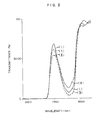
- Fig. 2 is a graph showing UV spectral curves of resist material films obtained in Experiment 1.
- the resist material of the present invention applys chemical amplification so as to make an exposure energy amount as low as possible. That is, the resist material of the present invention comprises (a) a polymer having a monomer unit having a functional group which becomes alkali-soluble by chemical change with heating under an atmosphere of an acid generated from a photosensitive compound when exposed to light, a monomer unit having a phenolic hydroxyl group, and if necessary a third monomer unit, (b) a photosensitive compound having high transmittance for light of near 248.4 nm and being able to generate an acid by exposure to light or by irradiation (hereinafter referred to as "photoacid generator"), and (c) a solvent for the components (a) and (b).
- photoacid generator a photosensitive compound having high transmittance for light of near 248.4 nm and being able to generate an acid by exposure to light or by irradiation
- the monomer unit having a functional group (special functional group) which becomes alkali-soluble by chemical change with heating in the presence of the acid can be obtained from p- or m-hydroxystyrene derivatives having protective groups which are released by the acid and p- or m-hydroxy- ⁇ -methylstyrene derivatives having protective groups which are released by the acid.
- Such monomers are p- or m-methoxystyrene, p- or m-isopropoxystyrene, p- or m-tert-butoxystyrene, p- or m-tetrahydropyranyloxystyrene, p- or m-trimethylsilyloxystyrene, p- or m-tert-butoxycarbonyloxystyrene, and p- or m-hydroxy- ⁇ -methylstyrene derivatives having the same protective groups as these p-hydroxystyrene derivatives mentioned above.
- the monomer unit having a phenolic hydroxyl group can be obtained from p- or m-vinylphenol and p- or m-hydroxy- ⁇ -methylstyrene.
- the third monomer unit which is used depending on purpose and has a function of enhancing the transmittance for light of the polymer as a whole at near 248.4 nm can be obtained from ⁇ -methylstyrene, p-chlorostyrene, acrylonitrile, fumaronitrile, methyl methacrylate, tert-butyl methacrylate, tert-butyl p-ethylphenoxyacetate, etc.
- the polymer has the monomer unit having the special functional group and the monomer unit having a phenolic hydroxyl group in a constituting ratio of 1: 9 to 9: 1.
- the constituting ratio is preferably in the range of 2: 8 to 7: 3.
- polymer of the formula are those having a tert-butyl group, a tetrahydropyranyl group or a trimethylsilyl group as R1 and a hydrogen atom as R2.
- Preferable examples of the polymer of the formula are those having a tert-butyl group, a tetrahydropyranyl group or a trimethylsilyl group as R1; a hydrogen atom or a cyano group as R4; a cyano group or a tert-butoxycarbonyl group as R6; and a hydrogen atom as R2, R3 and R5.
- These polymers can be prepared by the following processes 1 to 3.
- a monomer having the special functional group alone, and if necessary together with a third monomer, is polymerized according to a conventional method, e.g. in an organic solvent in the presence of a radical polymerization initiator in a stream of nitrogen or argon at 50°C to 110°C for 1 to 10 hours.
- a radical polymerization initiator in a stream of nitrogen or argon at 50°C to 110°C for 1 to 10 hours.
- the organic solvent there can be used benzene, toluene, tetrahydrofuran, 1,4-dioxane, etc.
- radical polymerization initiator there can be used azo series polymerization initiators such as 2,2′-azobisisobutyronitrile, 2,2′-azobis(2,4-dimethylvaleronitrile), 2,2′-azobis(methyl 2-methylpropionate), etc.; peroxide series polymerization initiators such as benzoyl peroxide, lauroyl peroxide, etc.
- the resulting polymer having the monomer unit having the special functional group alone or together with the third monomer unit is isolated by a conventional method. Then, the isolated polymer or copolymer is reacted with an acid in an organic solvent at 30° to 100°C for 1 to 10 hours to eliminate the special functional group at optional proportions.
- the organic solvent there can be used tetrahydrofuran, acetone, 1,4-dioxane, etc.
- the acid there can be used protonic acid such as sulfuric acid, phosphoric acid, hydrochloric acid, hydrobromic acid, p-toluenesulfonic acid, etc.
- a monomer of the formula: wherein R1 and R2 are as defined above is polymerized, followed by elimination of R1 at predetermined proportion using a suitable acid to obtain the polymer of the formula (I).
- the polymer of the formula (I) can also be obtained by polymerizing p-tert-butoxystyrene and eliminating R1 at predetermined proportion using a suitable acid.
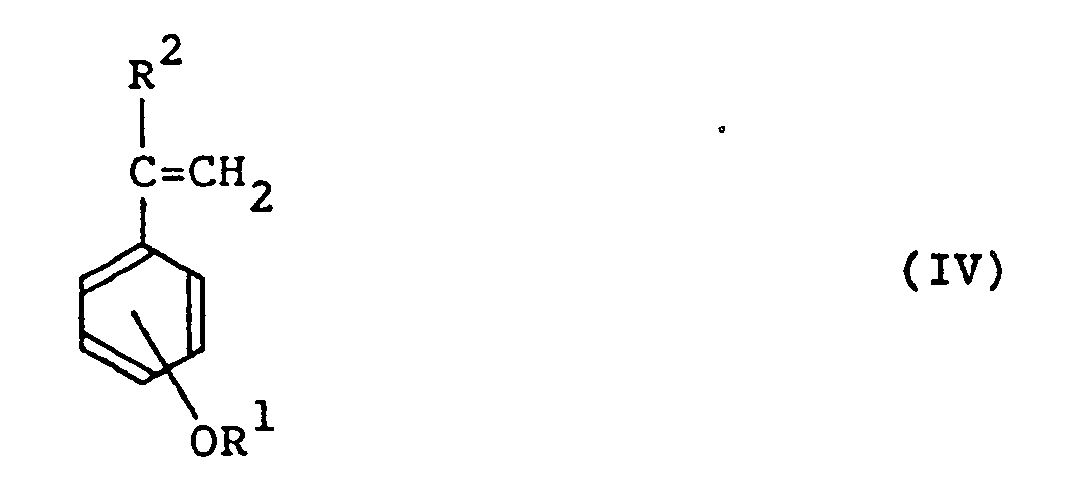
- the polymer of the formula (II) can be obtained by copolymerizing a monomer of the formula (IV) and a monomer of the formula: wherein R3 to R6 are as defined above, and eliminating R1 at predetermined proportion using a suitable acid.
- the polymer of the formula (II) can also be obtained by copolymerizing p-tert-butoxystyrene and a monomer of the formula (V), and eliminating R1 at predetermined proportion using a suitable acid.
- a monomer having the special functional group, p-hydroxystyrene (or p-hydroxy- ⁇ -methylstyrene), and if necessary a third monomer are copolymerized in the same manner as described in Process 1, after-treated by a conventional method to isolate the desired polymer.
- p-Hydroxystyrene (or p-hydroxy- ⁇ -methylstyrene) alone, or if necessary together with a third monomer, is polymerized or copolymerized in the same manner as described in Process 1.
- the resulting polymer or copolymer is subjected to chemical introduction of the special functional group in an optional proportion and after-treated by a conventional method to isolate the desired polymer.
- the polymer used in the present invention can be obtained by any one of the above-mentioned three processes. Among these processes, Process 1 is more preferable, since the polymer obtained by Process 1 is remarkably excellent in transmittance for light of near 248.4 nm compared with the polymers obtained by Processes 2 and 3.
- Poly(p-tert-bytoxystyrene-p-hydroxystyrene) obtained by Process 1 and poly(p-tert-bytoxystyrene-p-hydroxystyrene)s obtained by Processes 2 and 3 were film formed to give films of 1 ⁇ m thick. Using these films, the transmittance for light of 248.4 nm was measured. The transmittance of the polymer obtained by Process 1 was about 70%, and the polymers obtained by Processes 2 and 3 were about 55 to 61%.
- the polymer has the weight average molecular weight ( Mw ) of about 1000 to 40,000 in terms of polystyrene measured by GPC method. More preferable weight average molecular weight ( Mw ) is about 3000 to 20,000.
- photoacid generator (b) there can be used photosensitive compounds which can generate an acid by exposure to light and do not influence badly on the formation of photoresist pattern.
- Particularly preferable photoacid generators are as follows. wherein R9 and R10 are independently a straight-chain, branched or cyclic alkyl group having 1 to 10 carbon atoms, a haloalkyl group having 1 to 10 carbon atoms, or a group of the formula: wherein R11 and R12 are independently a hydrogen atom, a lower alkyl group having 1 to 5 carbon atoms, a haloalkyl group having 1 to 5 carbon atoms; n is zero or an integer of 1 or more; and X is a carbonyl group, a carbonyloxy group or a sulfonyl group.
- R13 is a straight-chain, branched or cyclic alkyl group having 1 to 10 carbon atoms, a trifluoromethyl group, or a group of the formula: wherein R17 is a hydrogen atom or a methyl group; R14 and R15 are independently a hydrogen atom, or a lower alkyl group having 1 to 5 carbon atoms; and R16 is a straight-chain, branched or cyclic alkyl group having 1 to 10 carbon atoms, preferably 3 to 6 carbon atoms, a phenyl group, a halogen-substituted phenyl group, an alkyl-substituted phenyl group, an alkoxy-substituted phenyl group, or an alkylthio-substituted phenyl group.
- R18, R19, R20 and R21 are independently a hydrogen atom, a halogen atom, a straight-chain, branched or cyclic alkyl group having 1 to 10 carbon atoms, or an alkoxy group having 1 to 10 carbon atoms;
- Z ⁇ is a perchlorate ion, a p-toluenesulfonate ion or a trifluoromethanesulfonate ion.
- R22 is a trichloroacetyl group, a p-toluenesulfonyl group, a p-trifluoromethylbenzenesulfonyl group, a methanesulfonyl group or a trifluoromethanesulfonyl group;
- R23 and R24 are independently a hydrogen atom, a halogen atom, or a nitro group.
- the solvent (c) there can be used those which can dissolve both the polymer (a) and the photoacid generator (b), and preferably have no absorption at near 230 to 300 nm.
- the solvent are methyl Cellosolve acetate, ethyl Cellosolve acetate, propylene glycol monoethyl ether acetate, methyl lactate, ethyl lactate, 2-ethoxyethyl lactate, methyl pyruvate, ethyl pyruvate, methyl 3-methoxypropionate, ethyl 3-methoxypropionate, N-methyl-2-pyrrolidone, cyclohexanone, methyl ethyl ketone, 1,4-dioxane, ethylene glycol monoisopropyl ether, diethylene glycol monomethyl ether, diethylene glycol dimethyl ether, etc.
- the resist material of the present invention may further contain one or more dyes, surface active agents, and the like.
- Pattern formation using the resist material of the present invention can be carried out as follows.
- the resist material of the present invention is coated on a substrate such as a silicon wafer so as to make the film thickness about 0.5 to 2 ⁇ m (in the case of forming the top layer among three layers, the film thickness being about 0.1 to 0.5 ⁇ m), and prebaked at 70° to 130°C for 10 to 30 minutes in an oven or at 70° to 130°C for 1 to 2 minutes on a hot plate.
- a mask is formed on the resulting resist film for forming the desired pattern, and exposed to deep UV light of 300 nm or less at an exposure dose of about 1 to 100 mJ/cm2.
- Development is carried out by a conventional method such as a dipping method, a puddle method, a spray method, etc., using a developing solution such as an aqueous solution of 0.1 to 5% tetramethylammonium hydoxide (TMAH) for 0.5 to 3 minutes to obtain the desired pattern on the substrate.
- TMAH tetramethylammonium hydoxide
- Mixing ratio of the polymer (a) and the photoacid generator (b) in the positive tone resist material is 1 to 20 parts by weight, preferably 1 to 10 parts by weight of the photoacid generator (b) per 100 parts by weight of the polymer (a).
- the solvent is used preferably in an amount of 100 to 2000 parts by weight, more preferably 150 to 600 parts by weight per 100 parts by weight of the polymer (a).
- the developing solution used for forming various pattern forming methods is selected from alkali solutions with suitable concentrations so as almost not to dissolve non-exposed portions and so as to dissolve exposed portions depending on the solubility for the alkali solutions of the resin (polymer) used in the resist material.
- concentration of alkali solutions is usually 0.01 to 20% by weight.
- the alkali solutions there can be used aqueous solutions of organic amines such as TMAH, choline, triethanolamine, etc., inorganic alkalis such as NaOH, KOH, etc.
- the resist material Since the polymer used in the resist material contains hydroxystyrene skeleton in its component, the resist material is excellent in heat resistance, resistance to dry etching and adhesiveness to the substrate. Further, when the polymer is produced by Process 1, it has remarkably excellent transmittance for light of near 248.4 nm compared with the polymers produced by Processes 2 and 3.
- the resist material of the present invention can generate an acid by not only KrF excimer laser light but also electron beams and X-rays to admit chemical amplifying action.
- the resist material of the present invention can form patterns by using deep UV light and KrF excimer laser light with a low exposure dose or by irradiation method using electron beams and X-rays, while applying chemical amplifying action of the resist material.
- the special functional group e.g. a tert-butoxy group in the reaction equation (5)
- the polymer is chemically changed to a hydroxyl group by the action of the acid, and becomes alkali-soluble and releases into the developing solution at the time of development.
- the photoacid generator acts so as to protect the hydrophilic moieties of the polymer used for improving adhesiveness to the substrate from wetting by the alkali developing solution.
- the precipitate was filtered by suction, washed with H2O and dried under reduced pressure to give 4.1 g of poly(p-tert-butoxystyrene-p-hydroxystyrene) as a white powder having Mw 10000 (GPC with polystyrene calibration).
- the composition of the polymer was found to be p-tert-butoxystyrene and p-hydroxystyrene in a molar ratio of ca. 1: 1 based on 1HNMR analysis.
- composition was spin coated on a substrate such as a semiconductor and soft baked at 90°C for 90 seconds on a hot plate to give a polymer film of 1 ⁇ m thick.
- the resulting polymer film was subjected to UV measurement.
- Fig. 2 shows UV spectra, wherein the curve I is a UV spectral curve of the resist material film using the polymer obtained in Synthesis Example 1, the curve II is that of the resist material film using the polymer obtained in Synthesis Example 3, and the curve III is that of the resist material film using the polymer obtained in Synthesis Example 4.
- the resist material film using the polymer obtained in Synthesis Example 1 is by far excellent in the transmittance for light of near 240 - 250 nm compared with the resist materials using the polymers obtained in Synthesis Examples 3 and 4.
- the heat resistance test was carried out by measuring the glass transition temperatures (Tg) of individual polymers using differential thermal analysis (DTA).
- the test for adhesiveness to the substrate was carried out by preparing the following resist material, forming a pattern as mentioned below, and evaluating with the naked eye.
- the pattern forming method is explained referring to Fig. 1.
- the resist material 2 as mentioned above is spin coated on a substrate 1 such as a semiconductor, and soft baked at 90°C for 90 seconds on a hot plate to give a resist material film of 1.0 ⁇ m thick (Fig. 1(a)).
- the resist material film is exposed to KrF excimer laser light 3 of 248.4 nm selectively via a mask 4 (Fig. 1(b)).
- development is carried out using an alkali developing solution (a 2.38% aqueous solution of tetramethylammonium hydroxide) for 60 seconds to remove only the exposed portions of the resist material film 2 to give positive pattern 2a (Fig. 1(c)).
- the resist materials containing the polymers with the monomer units having phenolic hydroxyl group are more excellent in the heat resistance and adhesiveness to substrate compared with the resist materials containing the polymers without the monomer units having phenolic hydroxyl group (obtained in Synthesis Examples 1(1) and 6(1)).
- the resulting positive tone pattern had resolution of 0.3 ⁇ m lines and spaces.
- the exposure energy amount was about 18 mJ/cm2.
- Resist materials containing 0.6 g of a polymer, 0.3 g of a photoacid generator and 13.7 g of diethylene glycol dimethyl ether as listed in Table 2 were prepared. Using these resist materials, pattern was formed in the same manner as described in Experiment 2. The results are shown in Table 2.
- the resist materials of the present invention when used, fine patterns of submicron order with good shape can easily be obtained by using a light source of 300 nm or less such as deep UV light, KrF excimer laser light (248.4 nm), etc. Therefore, the present invention has a large value on ultrafine pattern formation in semiconductor industry. Needless to say, the resist materials of the present invention can be used for pattern formation by using not only deep UV light and KrF excimer laser light, but also i-line light (365 nm), electron beams, X-rays, etc.
Landscapes
- Physics & Mathematics (AREA)
- Spectroscopy & Molecular Physics (AREA)
- General Physics & Mathematics (AREA)
- Materials For Photolithography (AREA)
- Addition Polymer Or Copolymer, Post-Treatments, Or Chemical Modifications (AREA)
Abstract
Description
- This invention relates to a resist material usable in the production of semiconductor elements. More particularly the present invention relates to a resist material used in the formation of a positive tone pattern using deep ultraviolet (UV) light of 300 nm or less such as KrF excimer laser light, etc.
- With recent higher density and larger scale integration of semiconductor devices, wavelengths used in exposing devices for minute processing, particularly for lithography become shorter and shorter. Now, KrF excimer laser light (248.4 nm) is studied. But, there have been no photosensitive materials suitable for such a wavelength.
- For example, there are proposed dissolution inhibiting type resist materials comprising a resin having high transmittance for light of near 248.4 nm and a photosensitive compound having a group of the formula:

as a resist material for a light source such as KrF excimer laser light and deep UV light (e.g. Japanese Patent Unexamined publication Nos. 1-80944, 1-154048, 1-155338, 1-155339, and 1-18852; Y. Tani et al: SPIE's 1989 Sympo., 1086-03, etc.). But, these dissolution inhibiting type resist materials are low in sensitivity, and thus cannot be used for deep UV light and KrF excimer laser light which require highly sensitive resist materials. - On the other hand, in order to reduce the exposure energy amount (so as to increase the sensitivity), there are proposed recently chemical amplified resist materials wherein an acid generated by exposure to light is used as a catalyst [H. Ito et al: poly. Eng. Sci. vol. 23, page 1012 (1983)]. Various chemical amplified resist materials are reported, for example, in U.S. patent Nos. 4,491,628 and 4,603,101, Japanese Patent Unexamined publication No. 62-115440, W.R. Brunsvold et al: SPIE's 1989 Sympo., 1086-40, T. Neenan et al: SPIE's 1989 Sympo., 1086-01, etc. But these chemical amplified resist materials have the following disadvantages. When phenol ether type resins such as poly(4-tert-butoxycarbonyloxystyrene), poly(4-tert-butoxycarbonyloxy-α-methylstyrene), poly(4-tert-butoxystyrene), poly(4-tert-butoxy-α-methylstyrene) are used, heat resistance is poor, and resist films are easily peeled off at the time of development due to poor adhesion to substrates, resulting in failing to obtain pattern shapes. Further, when carboxylic acid ester type resins such as poly(tert-butyl-4-vinylbenzoate), etc. are used, the transmittance for light of near 248.4 nm is poor due to the aromatic rings of the resin. When poly(tert-butylmethacryalte) and the like is used as the resin, heat resistance and resistance to dry etching are poor. As mentioned above, the chemical amplified resist materials have higher sensitivity than known resist materials, but are poor in heat resistance of resin, poor in adhesiveness to substrates, and insufficient in transmittance for light of near 248.4 nm, resulting in making practical use difficult. Thus, practically usable highly sensitive resist materials overcoming these problems mentioned above are desired.
- It is an object of the present invention to provide a positive tone resist material having high transmittance for deep UV light, KrF excimer laser light, etc., having high sensitivity for exposure to these light sources or irradiation of electron beams and X-rays, and using a special polymer remarkably excellent in heat resistance and adhesiveness to a substrate.
- The present invention provides a resist material comprising
- (a) a polymer represented by the formula:

- (b) a photosensitive compound being able to generate an acid by exposure to light, and
- (c) a solvent for dissolving the components (a) and (b).
- The prevent invention also provides a resist material comprising
- (a) a polymer represented by the formula:


- (b) a photosensitive compound being able to generate an acid by exposure to light, and
- (c) a solvent for dissolving the components (a) and (b).
- Figs. 1(a) to 1(c) are schematic cross-sectional views explaining a positive tone pattern forming process using the resist material of the present invention.
- Fig. 2 is a graph showing UV spectral curves of resist material films obtained in Experiment 1.
- The resist material of the present invention applys chemical amplification so as to make an exposure energy amount as low as possible. That is, the resist material of the present invention comprises (a) a polymer having a monomer unit having a functional group which becomes alkali-soluble by chemical change with heating under an atmosphere of an acid generated from a photosensitive compound when exposed to light, a monomer unit having a phenolic hydroxyl group, and if necessary a third monomer unit, (b) a photosensitive compound having high transmittance for light of near 248.4 nm and being able to generate an acid by exposure to light or by irradiation (hereinafter referred to as "photoacid generator"), and (c) a solvent for the components (a) and (b).
- The monomer unit having a functional group (special functional group) which becomes alkali-soluble by chemical change with heating in the presence of the acid can be obtained from p- or m-hydroxystyrene derivatives having protective groups which are released by the acid and p- or m-hydroxy-α-methylstyrene derivatives having protective groups which are released by the acid. Concrete examples of such monomers are p- or m-methoxystyrene, p- or m-isopropoxystyrene, p- or m-tert-butoxystyrene, p- or m-tetrahydropyranyloxystyrene, p- or m-trimethylsilyloxystyrene, p- or m-tert-butoxycarbonyloxystyrene, and p- or m-hydroxy-α-methylstyrene derivatives having the same protective groups as these p-hydroxystyrene derivatives mentioned above.
- The monomer unit having a phenolic hydroxyl group can be obtained from p- or m-vinylphenol and p- or m-hydroxy-α-methylstyrene.
- The third monomer unit which is used depending on purpose and has a function of enhancing the transmittance for light of the polymer as a whole at near 248.4 nm can be obtained from α-methylstyrene, p-chlorostyrene, acrylonitrile, fumaronitrile, methyl methacrylate, tert-butyl methacrylate, tert-butyl p-ethylphenoxyacetate, etc.
- The polymer has the monomer unit having the special functional group and the monomer unit having a phenolic hydroxyl group in a constituting ratio of 1: 9 to 9: 1. Considering heat resistance of polymer and adhesiveness to substrate, the constituting ratio is preferably in the range of 2: 8 to 7: 3.
- Preferable examples of the polymer of the formula:

are those having a tert-butyl group, a tetrahydropyranyl group or a trimethylsilyl group as R¹ and a hydrogen atom as R². - Preferable examples of the polymer of the formula:

are those having a tert-butyl group, a tetrahydropyranyl group or a trimethylsilyl group as R¹; a hydrogen atom or a cyano group as R⁴; a cyano group or a tert-butoxycarbonyl group as R⁶; and a hydrogen atom as R², R³ and R⁵. - Concrete examples of the polymer are as follows.
- p-isopropoxystyrene-p-hydroxystyrene polymer,
- m-isopropoxystyrene-m- or p-hydroxystyrene polymer,
- p-tetrahydropyranyloxystyrene-p-hydroxystyrene polymer,
- m-tetrahydropyranyloxystyrene-m- or p-hydroxystyrene polymer,
- p-tert-butoxystyrene-p-hydroxystyrene polymer,
- m-tert-butoxystyrene-m- or p-hydroxystyrene polymer,
- p-trimethylsilyloxystyrene-p-hydroxystyrene polymer,
- m-trimethylsilyloxystyrene-m- or p-hydroxystyrene polymer,
- p-tert-butoxycarbonyloxystyrene-p-hydroxystyrene polymer,
- m-tert-butoxycarbonyloxystyrene-m- or p-hydroxystyrene polymer,
- p-methoxy-α-methylstyrene-p-hydrxy-α-methylstyrene polymer,
- m-methoxy-α-methylstyrene-m- or p-hydroxy-α-methylstyrene polymer,
- p-tert-butoxycarbonyloxystyrene-p-hydroxystyrene-methyl methacrylate polymer,
- m-tert-butoxycarbonyloxystyrene-m- or p-hydroxystyrene-methyl methacrylate polymer,
- p-tetrahydroxypyranyloxystyrene-p-hydroxystyrene-tert-butyl methacrylate polymer,
- m-tetrahydroxypyranyloxystyrene-m- or p-hydroxystyrene-tert-butyl methacrylate polymer,
- p-tert-butoxystyrene-p-hydroxystyrene-fumaronitrile polymer,
- m-tert-butoxystyrene-m- or p-hydroxystyrene-fumaronitrile polymer,
- p-trimethylsilyloxystyrene-p-hydroxystyrene-p-chlorostyrene polymer,
- m-trimethylsilyloxystyrene-m- or p-hydroxystyrene-p-chlorostyrene polymer,
- p-tert-butoxystyrene-p-hydroxystyrene-tertbutyl methacrylate polymer,
- m-tert-butoxystyrene-m- or p-hydroxystyrene-tert-butyl methacrylate polymer,
- p-tert-butoxystyrene-p-hydroxystyrene-acrylonitrile polymer,
- m-tert-butoxystyrene-m- or p-hydroxystyrene-acrylonitrile polymer,
- p-tert-butoxystyrene-p-hydroxystyrene-tert-butyl-p-ethenylphenoxyacetate polymer,
- m-tert-butoxystyrene-m- or p-hydroxystyrene-tert-butyl p-ethenylphenoxyacetate polymer, etc.
- These polymers can be prepared by the following processes 1 to 3.
- A monomer having the special functional group alone, and if necessary together with a third monomer, is polymerized according to a conventional method, e.g. in an organic solvent in the presence of a radical polymerization initiator in a stream of nitrogen or argon at 50°C to 110°C for 1 to 10 hours. As the organic solvent, there can be used benzene, toluene, tetrahydrofuran, 1,4-dioxane, etc. As the radical polymerization initiator, there can be used azo series polymerization initiators such as 2,2′-azobisisobutyronitrile, 2,2′-azobis(2,4-dimethylvaleronitrile), 2,2′-azobis(methyl 2-methylpropionate), etc.; peroxide series polymerization initiators such as benzoyl peroxide, lauroyl peroxide, etc.
- After the polymerization, the resulting polymer having the monomer unit having the special functional group alone or together with the third monomer unit (copolymer) is isolated by a conventional method. Then, the isolated polymer or copolymer is reacted with an acid in an organic solvent at 30° to 100°C for 1 to 10 hours to eliminate the special functional group at optional proportions.
- As the organic solvent, there can be used tetrahydrofuran, acetone, 1,4-dioxane, etc. As the acid, there can be used protonic acid such as sulfuric acid, phosphoric acid, hydrochloric acid, hydrobromic acid, p-toluenesulfonic acid, etc. After the reaction, the resulting polymer is after-treated by a conventional method to isolate the desired polymer.
- For example, a monomer of the formula:

wherein R¹ and R² are as defined above, is polymerized, followed by elimination of R¹ at predetermined proportion using a suitable acid to obtain the polymer of the formula (I). - The polymer of the formula (I) can also be obtained by polymerizing p-tert-butoxystyrene and eliminating R¹ at predetermined proportion using a suitable acid.
- On the other hand, the polymer of the formula (II) can be obtained by copolymerizing a monomer of the formula (IV) and a monomer of the formula:

wherein R³ to R⁶ are as defined above, and eliminating R¹ at predetermined proportion using a suitable acid. - The polymer of the formula (II) can also be obtained by copolymerizing p-tert-butoxystyrene and a monomer of the formula (V), and eliminating R¹ at predetermined proportion using a suitable acid.
- A monomer having the special functional group, p-hydroxystyrene (or p-hydroxy-α-methylstyrene), and if necessary a third monomer are copolymerized in the same manner as described in Process 1, after-treated by a conventional method to isolate the desired polymer.
- p-Hydroxystyrene (or p-hydroxy-α-methylstyrene) alone, or if necessary together with a third monomer, is polymerized or copolymerized in the same manner as described in Process 1. The resulting polymer or copolymer is subjected to chemical introduction of the special functional group in an optional proportion and after-treated by a conventional method to isolate the desired polymer.
- The polymer used in the present invention can be obtained by any one of the above-mentioned three processes. Among these processes, Process 1 is more preferable, since the polymer obtained by Process 1 is remarkably excellent in transmittance for light of near 248.4 nm compared with the polymers obtained by
Processes - This is explained in detail referring to a typical polymer of poly(p-tert-butoxystyrene-p-hydroxystyrene) represented by the formula (I).
- Poly(p-tert-bytoxystyrene-p-hydroxystyrene) obtained by Process 1 and poly(p-tert-bytoxystyrene-p-hydroxystyrene)s obtained by
Processes 2 and 3 (proportion of individual monomer units being 1: 1) were film formed to give films of 1 µm thick. Using these films, the transmittance for light of 248.4 nm was measured. The transmittance of the polymer obtained by Process 1 was about 70%, and the polymers obtained byProcesses - When the resist material is used for photolithography of ultrafine processing, to have high transmittance for light is important.
- It is preferable that the polymer has the weight average molecular weight (
Mw ) of about 1000 to 40,000 in terms of polystyrene measured by GPC method. More preferable weight average molecular weight (Mw ) is about 3000 to 20,000. - As the photoacid generator (b), there can be used photosensitive compounds which can generate an acid by exposure to light and do not influence badly on the formation of photoresist pattern.
- Particularly preferable photoacid generators are as follows.

wherein R⁹ and R¹⁰ are independently a straight-chain, branched or cyclic alkyl group having 1 to 10 carbon atoms, a haloalkyl group having 1 to 10 carbon atoms, or a group of the formula:
wherein R¹¹ and R¹² are independently a hydrogen atom, a lower alkyl group having 1 to 5 carbon atoms, a haloalkyl group having 1 to 5 carbon atoms; n is zero or an integer of 1 or more; and X is a carbonyl group, a carbonyloxy group or a sulfonyl group.
wherein R¹³ is a straight-chain, branched or cyclic alkyl group having 1 to 10 carbon atoms, a trifluoromethyl group, or a group of the formula:
wherein R¹⁷ is a hydrogen atom or a methyl group; R¹⁴ and R¹⁵ are independently a hydrogen atom, or a lower alkyl group having 1 to 5 carbon atoms; and R¹⁶ is a straight-chain, branched or cyclic alkyl group having 1 to 10 carbon atoms, preferably 3 to 6 carbon atoms, a phenyl group, a halogen-substituted phenyl group, an alkyl-substituted phenyl group, an alkoxy-substituted phenyl group, or an alkylthio-substituted phenyl group.
wherein R¹⁸, R¹⁹, R²⁰ and R²¹ are independently a hydrogen atom, a halogen atom, a straight-chain, branched or cyclic alkyl group having 1 to 10 carbon atoms, or an alkoxy group having 1 to 10 carbon atoms; Z⁻ is a perchlorate ion, a p-toluenesulfonate ion or a trifluoromethanesulfonate ion.
wherein R²² is a trichloroacetyl group, a p-toluenesulfonyl group, a p-trifluoromethylbenzenesulfonyl group, a methanesulfonyl group or a trifluoromethanesulfonyl group; R²³ and R²⁴ are independently a hydrogen atom, a halogen atom, or a nitro group. - Preferable examples of the compound of the formula (VI) are as follows:

wherein R⁹ and R¹⁰ are as defined above.
wherein R⁹ and R¹⁰ are as defined above.
- Concrete examples of the photoacid generator are as follows.
- bis(p-toluenesulfonyl)diazomethane,
- 1-p-toluenesulfonyl-1-methanesulfonyldiazomethane,
- bis(isopropylsulfonyl)diazomethane,
- bis(cyclohexylsulfonyl)diazomethane,
- 1-cyclohexylsulfonyl-1-tert-butylsulfonyldiazomethane,
- 1-p-toluenesulfonyl-1-cyclohexylcarbonyldiazomethane,
- 2-methyl-2-p-toluenesulfonylpropiophenone,
- 2-methanesulfonyl-2-methyl-(4-methylthio)-propiophenone,
- 2,4-dimethyl-2-(p-toluenesulfonyl)pentane-3-on,
- 2-(cyclohexylcarbonyl)-2-(p-toluenesulfonyl)-propane,
- diphenyl-p-methylphenacylsulfonium perchlorate,
- diphenyl-2,5-dimethoxyphenacylsulfonium p-toluenesulfonate,
- 2-nitrobenzyl p-toluenesulfonate,
- 2,6-dinitrobenzyl trichloroacetate,
- 2,4-dinitrobenzyl p-trifluoromethylbenzenesulfonate, etc.
- As the solvent (c), there can be used those which can dissolve both the polymer (a) and the photoacid generator (b), and preferably have no absorption at near 230 to 300 nm.
- Concrete examples of the solvent are methyl Cellosolve acetate, ethyl Cellosolve acetate, propylene glycol monoethyl ether acetate, methyl lactate, ethyl lactate, 2-ethoxyethyl lactate, methyl pyruvate, ethyl pyruvate, methyl 3-methoxypropionate, ethyl 3-methoxypropionate, N-methyl-2-pyrrolidone, cyclohexanone, methyl ethyl ketone, 1,4-dioxane, ethylene glycol monoisopropyl ether, diethylene glycol monomethyl ether, diethylene glycol dimethyl ether, etc.
- The resist material of the present invention may further contain one or more dyes, surface active agents, and the like.
- Pattern formation using the resist material of the present invention can be carried out as follows.
- The resist material of the present invention is coated on a substrate such as a silicon wafer so as to make the film thickness about 0.5 to 2 µm (in the case of forming the top layer among three layers, the film thickness being about 0.1 to 0.5 µm), and prebaked at 70° to 130°C for 10 to 30 minutes in an oven or at 70° to 130°C for 1 to 2 minutes on a hot plate. Then, a mask is formed on the resulting resist film for forming the desired pattern, and exposed to deep UV light of 300 nm or less at an exposure dose of about 1 to 100 mJ/cm².Development is carried out by a conventional method such as a dipping method, a puddle method, a spray method, etc., using a developing solution such as an aqueous solution of 0.1 to 5% tetramethylammonium hydoxide (TMAH) for 0.5 to 3 minutes to obtain the desired pattern on the substrate.
- Mixing ratio of the polymer (a) and the photoacid generator (b) in the positive tone resist material is 1 to 20 parts by weight, preferably 1 to 10 parts by weight of the photoacid generator (b) per 100 parts by weight of the polymer (a).
- The solvent is used preferably in an amount of 100 to 2000 parts by weight, more preferably 150 to 600 parts by weight per 100 parts by weight of the polymer (a).
- The developing solution used for forming various pattern forming methods is selected from alkali solutions with suitable concentrations so as almost not to dissolve non-exposed portions and so as to dissolve exposed portions depending on the solubility for the alkali solutions of the resin (polymer) used in the resist material. The concentration of alkali solutions is usually 0.01 to 20% by weight. As the alkali solutions, there can be used aqueous solutions of organic amines such as TMAH, choline, triethanolamine, etc., inorganic alkalis such as NaOH, KOH, etc.
- Since the polymer used in the resist material contains hydroxystyrene skeleton in its component, the resist material is excellent in heat resistance, resistance to dry etching and adhesiveness to the substrate. Further, when the polymer is produced by Process 1, it has remarkably excellent transmittance for light of near 248.4 nm compared with the polymers produced by
Processes - The resist material of the present invention can generate an acid by not only KrF excimer laser light but also electron beams and X-rays to admit chemical amplifying action.
- Therefore, the resist material of the present invention can form patterns by using deep UV light and KrF excimer laser light with a low exposure dose or by irradiation method using electron beams and X-rays, while applying chemical amplifying action of the resist material.
- More concretely, when the resist material film is exposed to KrF excimer laser light, deep UV light, etc., exposed portions generate an acid by photo reaction as shown below:


- When heat treatment is carried out subsequent to the exposure step, the special functional group (e.g. a tert-butoxy group in the reaction equation (5)) of the polymer is chemically changed to a hydroxyl group by the action of the acid, and becomes alkali-soluble and releases into the developing solution at the time of development.

- On the other hand, since no acid is generated on non-exposed portions, no chemical change takes place by the heat treatment. Instead, the photoacid generator acts so as to protect the hydrophilic moieties of the polymer used for improving adhesiveness to the substrate from wetting by the alkali developing solution.
- As mentioned above, when the pattern is formed by using the resist material of the present invention, since a large difference in solubility in the alkali developing solution takes place between the exposed portions and non-exposed portions and the resin (polymer) in the non-exposed portions has strong adhesiveness to the substrate, there takes place no peeling of the resist material film at the time of development, resulting in forming positive tone pattern with good contrast. Further, as shown in the reaction equation (5), since the acid generated by exposure to light acts catalytically, the exposure to light can be limited to generating a necessary amount of acid, resulting in making the reduction of exposure energy amount possible.
- The present invention is illustrated by way of the following Examples.
- Synthesis of poly(p-tert-butoxystyrene-p-hydroxystyrene)
- (1) Free radical polymerization of p-tert-butoxystyrene
- A solution of p-tert-butoxystyrene (17.6 g) in toluene containing catalytic amount of 2,2′-azobisisobutyronitrile (AIBN) was heated at 80°C for 6 hours under nitrogen. After cooling, the reaction mixture was poured into methanol and the polymer was precipitated. The polymer was filtered, washed with methanol and dried under reduced pressure to afford 15.5 g of poly(p-tert-butoxystyrene) as a white powder having
Mw 10000 (GPC with polystyrene calibration). - (2) Synthesis of poly(p-tert-butoxystyrene-p-hydroxystyrene)
- A solution of poly(p-tert-butoxystyrene) (15.0 g) obtained in above (1) and hydrochloric acid (10 ml) in 1,4-dioxane was refluxed for 1.5 hours with stirring. The mixture was cooled, poured into H₂O and the white solid was precipitated. The polymer was filtered, washed and dried under reduced pressure to afford 11.8 g of the title compound as a white powder having
Mw 10000 (GPC with polystyrene calibration). The composition of the polymer was found to be p-tert-butoxystyrene and p-hydroxystyrene in a molar ratio of ca 1: 1 based on ¹HNMR analysis. - Synthesis of poly(p-tert-butoxystyrene-p-hydroxystyrene-tert-butyl methacrylate)
- (1) Free radical polymerization of p-tert-butoxystyrene
- A solution of p-tert-butoxystyrene (28.2 g, 0.16 mole) and tert-butyl methacrylate (5.7 g, 0.04 mole) in toluene containing catalytic amount of 2,2′-azobis(2,4-dimethylvaleronitrile) was heated at 80°C for 8 hours under nitrogen. After cooling, the reaction mixture was poured into petroleum ether and the polymer was precipitated. The polymer was filtered, washed with petroleum ether and dried under reduced pressure to give 23.8 g of poly(p-tert-butoxystyrene-tert-butyl methacrylate) as a white powder.
- (2) Synthesis of poly(p-tert-butoxystyrene-p-hydroxystyrene-tert-butyl methacrylate)
- A solution of poly(p-tert-butoxystyrene-tert-butyl methacrylate) (23.5 g) obtained in above (1) and p-toluenesulfonic acid (2 g) in 1,4-dioxane was refluxed for 1.5 hours with stirring. The mixture was cooled, poured into H₂O and the polymer was precipitated. The polymer was filtered, washed with H₂O and dried under reduced pressure to afford 14.1 g of the title compound as a white powder having
Mw 15000 (GPC with polystyrene calibration). ¹HNMR analysis indicated that 60% of p-tert-butoxy group was converted into p-hydroxy group. - Synthesis of poly(p-tert-butoxystyrene-p-hydroxystyrene)
- Using p-tert-butoxystyrene (3.5 g, 0.02 mole) and p-hydroxystyrene (2.7 g, 0.02 mole), free radical polymerization was carried out in the same manner as described in Synthesis Example 1. Then, the reaction mixture was poured into petroleum ether, and the precipitate was filtered, washed and dried in vacuo to give 5.0 g of the title compound as a white powder having
Mw 10000 (GPC with polystyrene calibration). The composition of the polymer was found to be p-tert-butoxystyrene and p-hydroxystyrene in a molar ratio of ca. 1: 1 based on ¹HNMR analysis. - Synthesis of poly(p-tert-butoxystyrene-p-hydroxystyrene)
- (1) Free radical polymerization of p-hydroxystyrene
- Using p-hydroxystyrene (5.0 g), the free radial polymerization was carried out in the same manner as described in Synthesis Example 1. Then the precipitate was filtered by suction, washed and dried under reduced pressure to afford 4.2 g of poly(p-hydroxystyrene) as a white powder.
- (2) Synthesis of poly(p-tert-butoxystyrene-p-hydroxystyrene)
- To a solution of poly(p-hydroxystyrene) (4.0 g) obtained in above (1) in dimethoxyethane (70 ml) in a pressure vessel, isobutyrene (60 g) and conc. sulfuric acid (0.3 ml) were added at -60°C or lower, the mixture was brought to 45°C for 1 hour with stirring, and then stirring was continued at room temperature for 22 hours. After reaction, the mixture was evaporated, the residue was neutralized by addition of sodium carbonate and poured into H₂O. The precipitate was filtered by suction, washed with H₂O and dried under reduced pressure to give 4.1 g of poly(p-tert-butoxystyrene-p-hydroxystyrene) as a white powder having
Mw 10000 (GPC with polystyrene calibration). The composition of the polymer was found to be p-tert-butoxystyrene and p-hydroxystyrene in a molar ratio of ca. 1: 1 based on ¹HNMR analysis. - Synthesis of poly(p-tert-butoxystyrene-p-hydroxystyrene-fumaronitrile)
- (1) Free radical polymerization of p-tert-butoxystyrene and fumaronitrile
- A solution of p-tert-butoxystyrene (28.2 g, 0.16 mole) and fumaronitrile (3.1 g, 0.04 mole) in toluene containing catalytic amount of 2,2′-azobis(methyl 2-methyl propionate) was heated at 90°C for 2 hours under nitrogen. After reaction, the reaction solution was poured into methanol and polymer was precipitated. The polymer was filtered, washed and dried in vacuo to give 21.3 g of poly(p-tert-butoxystyrene-fumaronitrile) as a white powder.
- (2) Synthesis of poly(p-tert-butoxystyrene-p-hydroxystyrene-fumaronitrile
- Using poly(p-tert-butoxystyrene-fumaronitrile) (20.0 g) obtained in above (1), the reaction was carried out in the same manner as described in Synthesis Example 1, (2) to afford 15.4 g of the title compound as a white powder having
Mw 12000 (GPC with polystyrene calibration). ¹HNMR analysis indicated that 50% of p-tert-butpxy group was converted into p-hydroxy group. - synthesis of poly-(p-tert-butoxycarbonyloxystyrene-p-hydroxystyrene)
- (1) Free radical polymerization of p-tert-butoxycarbonyloxystyrene
- A solution of p-tert-butoxycarbonyloxystyrene (22 g, 0.1 mole) obtained by the method of USP 4,491,628 (1985) in toluene containing catalytic amount of 2,2′-azobis(2,4-dimethylvaleronitrile) was heated at 90°C for 5 hours under stream of N₂. The reaction mixture was treated in the same manner as described in Synthesis Example 1(1) to give 15.2 g of poly(p-tert-butoxycarbonyloxystyrene) as a white powder having
Mw 12000 (GPC with polystyrene calibration). - (2) Synthesis of poly(p-tert-butoxycarbonyloxystyrene-p-hydroxystyrene)
- Using poly(p-tert-butoxycarbonyloxystyrene) (7 g), the reaction was carried out in the same manner as described in Synthesis Example 1, (2), to give 4.8 g of the title compound as a white powder. The composition of the polymer was found to be p-tert-butoxycarbonyloxystyrene and p-hydroxystyrene in a molar ratio of ca. 1: 1 based on ¹HNMR analysis.
- Synthesis of poly(p-tetrahydropyranyloxystyrene-phydroxystyrene)
- To a solution of poly(p-hydroxystyrene) [
Mw 12000: GPC] (9 g) in dimethoxyethane (100 ml), 3,4-dihydro-2H-pyran (12.6 g) and conc. sulfuric acid (0.5 ml) were added, followed by reaction at 30 - 40°C for 15 hours with stirring. After reaction, the mixture was evaporated, the residue was neutralized by addition of sodium carbonate and poured into H₂O. The precipitate was filtered by suction, washed with H₂O and dried under reduced pressure to give 11.0 g of the title compound as a white powder. The composition of the polymer was found to be p-tetrahydropyranyloxystyrene and p-hydroxystyrene in a molar ratio of ca. 3: 7 based on ¹HNMR analysis. - Synthesis of poly(p-tert-butoxystyrene-p-hydroxystyrene-methyl methacrylate)
- (1) Free radical polymerization of p-tert-butoxystyrene and methyl methacrylate
- A solution of p-tert-butoxystyrene (15.8 g, 0.09 mole) and methyl methacrylate (1.0 g, 0.09 mole) in toluene containing catalytic amount of 2,2′-azobis(2,4-dimethylvaleronitrile) was heated at 80°C for 8 hours under nitrogen. After cooling, the reaction mixture was poured into petroleum ether and polymer was precipitated. The polymer was filtered by suction, washed with petroleum ether and dried in vacuo to give 10.9 g of poly(p-tert-butoxystyrene-methyl methacrylate) as a white powder.
- (2) Synthesis of poly(p-tert-butoxystyrene-p-hydroxystyrene-methyl methacrylate)
- A solution of poly(p-tert-butoxystyrene-methyl methacrylate) (10.5 g) obtained in above (1) and p-toluenesulfonic acid (1 g) in 1,4-dioxane was relfuxed for 1.5 hours with stirring. After cooling, the mixture was poured into H₂O, the precipitate was filtered, washed with H₂O and dried under reduced pressure to afford 7.1 g of the title compound as a white powder having
Mw 15000 (GPC with polystyrene calibration). ¹HNMR analysis indicated that 60% of p-tert-butoxy group was converted into p-hydroxy group. - Synthesis of 2-cyclohexylcarbonyl-2-(p-toluenesulfonyl)propane
- (1) Synthesis of 1-cyclohexyl-2-methyl-1-propanone
- To a suspension of magnesium turning (23.9 g, 0.98 atom) in dry ethyl ether, cyclohexylbromide (160 g, 0.98 mole) was added dropwise under mild reflux, followed by reaction with stirring for 1 hour under reflux to afford Grignard reagent. After cooling, Grignard reagent was added dropwise to a solution of isobutyloyl chloride (95 g, 0.89 mole) in dry ethyl ether at -5 - 0°C, the resultant mixture was stirred at the same temperature for 3 hours and standed at room temperature overnight. The reaction mixture was poured into H₂O, and the organic layer was separated, washed with H₂O, dried over anhydrous MgSO₄ and evaporated. The residue was distilled under reduced pressure to give 50 g of 1-cyclohexyl-2-methyl-1-propanone as a pale yellow oil having a boiling point of 95 - 100°C/20 mmHg.
- ¹NHMR δppm (CDCl₃): 1.06(6H, d, CH₃x2), 1.12-1.87(10H, m, cyclohexylic CH₂x5), 2.51(1H, m, cyclohexylic CH), 2.76(1H, m, CH).
- IR(neat) νcm⁻¹: 1710(C=O)
- (2) Synthesis of 2-chloro-1-cyclohexyl-2-methyl-1-propanone
- To 1-cyclohexyl-2-methyl-1-propanone (47.6 g, 0.31 mole) obtained in above (1), sulfuryl chloride (42 g, 0.31 mole) was added dropwise at 25 - 35°C, and the mixture was stirred at 50°C for 3.5 hours and then evaporated. The resultant residue was distilled under reduced pressure to give 30.1 g of 2-chloro-1-cyclohexyl-2-methyl-1-propanone as a yellow oil.
- bp. 99 - 105°C/18 mmHg.
- ¹HNMR δppm (CDCl₃): 1.18-1.87(16H, m, CH₃x2 and cyclohexylic CH₂x5), 3.13(1H, m, cyclohexylic CH).
- (3) Synthesis of 2-cyclohexylcarbonyl-2-(p-toluenesulfonyl)propane
- A solution of 2-chloro-1-cyclohexyl-2-methyl-1-propanone (30.0 g, 0.16 mole) and sodium p-toluenesulfonate (30.0 g, 0.17 mole) in dimethylsulfoxide was reacted with stirring at 60°C for 20 hours. The reaction mixture was poured into cold H₂O, continued to stirr at 0 - 5°C for 1 hour. The precipitate was filtered, washed with H₂O and dried. The crude solid (18 g) was recrystallized from n-hexane/benzene to give 13.5 g of 2-cyclohexylcarbonyl-2-(p-toluenesulfonyl)propane as white needles.
- m.p. 123 - 123.5°C
- ¹NMR δppm (CDCl₃): 1.19-1.91(16H, m, CH₃x2 and cyclohexylic CH₂x5), 2.45(3H, s, Ar-CH₃), 3.25(1H, m, cyclohexylic CH), 7.33(2H, d, J=8Hz, Ar 3-H, 5-H), 7.65(2H, d, J=8Hz, Ar 2-H, 6-H).
- IR (KBr-disk) νcm⁻¹: 1705 (C=O), 1310.
- Synthesis of bis(cyclohexylsulfonyl)diazomethane
- (1) Synthesis of p-toluenesulfonylazide
- After dissolving sodium azide (22.5 g, 0.35 mole) in a small amount of H₂O, the resulting solution was diluted with a 90% ethanol aqueous solution (130 ml). To this, an ethanol solution dissolving p-toluenesulfonyl chloride (60 g, 0.32 mole) was added dropwise at 10 - 25°C, followed by reaction at room temperature for 2.5 hours. The reaction solution was concentrated at room temperature under reduced pressure. The resulting oily residue was washed with H₂O several times and dried over anhydrous MgSO₄. After removing the drying agent by filtration, there was obtained 50.7 g of the title compound as a colorless oil.
- ¹HNMR δppm (CDCl₃): 2.43(3H, s, CH₃), 7.24(2H, d, J=8Hz, Ar 3-H, 5-H), 7.67(2H, d, J=8Hz, Ar 2-H, 6-H).
- IR (Neat) νcm⁻¹: 2120 (-N₃).
- (2) Synthesis of bis(cyclohexylsulfonyl)methane
- To cyclohexylthiol (20.2 g, 0.17 mole), an ethanol solution dissolving pottasium hydroxide (12.0 g, 0.21 mole) was added dropwise at room temperature and mixture was stirred at 30 ±5°C for 30 minutes. Then methylene chloride (18.2 g, 2.14 mole) was added to this mixture and reacted with stirring at 50 ±5°C for 6 hours. After standing at room temperature overnight, the reaction mixture was diluted with ethanol (55 ml) and added sodium tungstate (0.4 g), 30% hydrogen peroxide (50 g, 0.44 mole) was added dropwise to this solution at 45 - 50°C, reacted with stirring for 4 hours at the same temperature, then added H₂O (200 ml) and standed overnight at room temperature. The precipitate was filtered, washed with H₂O and dried. The resultant solid was recrystallized from ethanol to give 15.5 g of bis(cyclohexylsulfonyl)methane as white needles.
- m.p. 137 - 139°C.
- ¹HNMR δppm (CDCl₃): 1.13-2.24(20H, m, cyclohexylic CH₂x10), 3.52-3.66(2H, m, cyclohexylic CHx2), 4.39(2H, s, CH₂).
- IR (KBr-disk) νcm⁻¹: 1320, 1305.
- (3) Synthesis of bis(cyclohexylsulfonyl)diazomethane
- To a solution of sodium hydroxide (1.7 g) in a 60% ethanol aqueous solution (70 ml), bis(cyclohexylsulfonyl)methane (12.1 g, 0.04 mole) obtained in above (2) was added, then an ethanol solution of p-toluenesulfonyl azide (8.2 g, 0.04 mole) obtained in above (1) was added dropwise at 5 - 10°C, followed by the reaction at room temperature for 7 hours. After standing at room temperature overnight, the precipitate was filtered, washed with ethanol and dried. The resultant solid was recrystallized from acetonitrile to give 8.0 g of bis(cyclohexylsulfonyl)diazomethane as pale yellow prisms.
- p.m. 130 - 131°C.
- ¹HNMR δppm (CDCl₃): 1.13-2.25(20H, m, cyclohexylic CH₂x10), 3.36-3.52(2H, m, cyclohexylic CHx2).
- IR (KBr-disk) νcm⁻¹: 2130(CN₂), 1340, 1320.
- Synthesis of 2,6-dinitrobenzyl p-toluenesulfonate
- (1) Synthesis of 2,6-dinitrobenzylalcohol
- To a suspension of 2,6-dinitrobenzaldehyde (19.6 g, 0.1 mole) in methanol (200 ml), sodium borohydride (5.8 g) was added in a small portion at 15 - 25°C, the resultant mixture was stirred at room temperature for 1 hour and then concentrated. To the residue, H₂O (100 ml) and chloroform (100 ml) were added, followed to stir for 1 hour, the chloroform layer was separated, washed witH H₂O, dried over anhydrous MgSO₄ and evaporated to afford 15.0 g of 2,6-dinitrobenzyl alcohol as yellow crystals.
- m.p. 92.5 - 93.5°C.
- ¹HNMR δppm (CDCl₃): 2.77(1H, t, J=7Hz, OH),
4.97(2H, d, J=7Hz, CH₂), 7.66(1H, t, J=8Hz, Ar 4-H), 8.08(2H, t, J=8Hz, Ar 3-H, 5-H). - (2) Synthesis of 2,6-dinitrobenzyl p-toluenesulfonate
- To a solution of 2,6-dinitrobenzylalcohol (14.9 g, 0.075 mole) obtained in above (1) and p-toluenesulfonyl chloride (15.7 g, 0.083 mole) in acetone (150 ml), a solution of dicyclohexylamine (15 g) in acetone was added dropwise at 0 - 10°C, stirring was continued for 4 hours at room temperature, the precipitate was filtered off and the filtrate was evaporated. The residue (29 g) was recrystallized from carbon tetrachloride to give 19.8 g of 2,6-dinitrobenzyl p-toluenesulfonate as pale yellow leaflets.
- m.p. 98 - 99°C.
- ¹HNMR δppm (CDCl₃): 2.45(3H, s, CH₃),
5.57(2H, s, CH₂), 7.34(2H, d, J=8Hz, p-Me-Ar 3-H, 5-H, 7.68(1H, t, J=8Hz, 2.6-(NO₂)₂-Ar 4-H), 7.72(2H, d, J=8Hz, p-Me-Ar 2-H, 6-H), 8.06(2H, d, J=8Hz, 2.6-(NO₂)₂-Ar 3-H, 5-H). - IR (KBr-disk) νcm⁻¹: 1360, 1170.
- Synthesis of 2-methyl-2-(p-toluenesulfonyl)-propiophenone
- Using isobutyrophenone, the reaction was carried out in the same manner as described in Synthesis Example 9, (2) and (3), the crude solid was recrystallized from methanol to afford
2-methyl-2-(p-toluenesulfonyl)propiophenone as a white needles. - m.p. 64 - 64.5°C
- ¹HNMR νppm (CDCl₃): 1.70(6H, s, CH₃x2),
2.45(3H, s, Ar-CH₃), 7.32(2H, d, J=7Hz, p-Me-Ar 3-H, 5-H), 7.44(2H, t, J=7Hz, Ar 3-H, 5-H), 7.54(1H, t, J=7Hz, Ar 4-H), 7.67(2H, d, J=7Hz, p-Me-Ar 2-H, 6-H), 7.95(2H, d, J=7Hz, Ar 2-H, 6-H). - IR (KBr-disk) νcm⁻¹: 1680(C=O), 1303, 1290.
- Synthesis of 2,4-dimethyl-2-(p-toluenesulfonyl)-pentan-3-one
- using diisopropylketone, the reaction was carried out in the same manner as described in Synthesis Example 9, (2) and (3). The crude solid was recrystallized from n-hexane/benzene to afford 2,4-dimethyl-2-(p-toluenesulfonyl)pentan-3-one as white leaflets.
- m.p. 76 - 79°C.
- ¹HNMR δppm (CDCl₃): 1.15(6H, d, CH₃x2),
1.55(6H, s, CH₃x2), 2.45(3H, s, Ar-CH₃),
3.54(1H, m, J=7Hz, CH), 7.34(2H, d, J=8Hz, Ar 3-H, 5-H), 7.65(2H, d, J=8Hz, Ar 2-H, 6-H). - IR (KBr-DISK) νcm⁻¹: 1715(C=O), 1305, 1290.
- Synthesis of methylsulfonyl p-toluenesulfonyldiazomethane
- (1) Synthesis of methylsulfonyl p-toluenesulfonylmethane
- To a solution of methylthiomethyl p-tolylsulfone (6.0 g, 0.03 mole) and sodium tungstate (0.06 g) in methanol (40 ml) and H₂O (4 ml), 30% hydrogen peroxide (6.8 g, 0.06 mole) was added dropwise at 45 - 50°C, reacted with stirring for 10 hours under reflux, and standed at room temperature overnight. The reaction mixture was poured into H₂O (400 ml), and the precipitate was filtered, washed with H₂O and dried. The crude solid (7.2 g) was recrystallized from ethanol to give 6.1 g of methylsulfonyl p-toluenesulfonylmethane as white needles.
- m.p. 163.5 - 165°C.
- ¹HNMR δppm (CDCl₃): 2.48(3H, s, Ar-CH₃),
3.28(3H, s, CH₃), 4.56(2H, s, CH₂), 7.40(2H, d, J=8Hz, Ar 3-H, 5-H), 7.87(2H, d, J=8Hz, Ar 2-H, 6-H). - (2) Synthesis of methylsulfonyl p-toluenesulfonyldiazomethane
- Using methylsulfonyl p-toluenesulfonylmethane (5.0 g, 0.02 mole) obtained in above (1), the reaction was carried out in the same manner as described in Synthesis Example 10, (3), and the crude solid (3 g) was recrystallized from ethanol to give 2.2 g of methylsulfonyl p-toleuensulfonyldiazomethane as pale yellow leaflets.
- m.p. 107.5 - 109°C.
- ¹HNMR δppm (CDCl₃): 2.46(3H, s, Ar-CH₃),
3.42(3H, s, CH₃), 7.38(2H, d, J=8Hz, Ar 3-H, 5-H), 7.87(2H, d, J=8Hz, Ar 2-H, 6-H). - IR (KBr-disk) νcm⁻¹: 2120(CN₂), 1350, 1330.
- Synthesis of 1-diazo-1-methylsulfonyl-4-phenylbutan-2-one
- (1) Synthesis of methyl 3-phenylpropionate
- A solution of 3-phenylpropionic acid (50 g, 0.33 mole) and conc. sulfuric acid (5 g) in methanol (220 ml) was refluxed for 1 hour with the stirring, concentrated and poured into cold H₂O. The mixture was extracted with methylene chloride (75 ml x 3), the organic layer was washed with H₂O (125 ml x 2), dried over anhydrous MgSO₄ and evaporated. The residue (54 g) was distilled under reduced pressure to give 51.5 g of methyl 3-phenylpropionate as a colorless oil.
- bp. 94 - 95°C/5 mmHg.
- IR (Neat) νcm⁻¹: 1745 (CO0).
- (2) Synthesis of 1-methylsulfonyl-4-phenylbutan-2-one
- To a solution of dimethylsulfone (42 g, 0.45 mole) in dimethylsufoxide (225 ml), 60% sodium hydride (17.9 g, 0.45 mole) was added in a small portion at 18 - 20°C, stirring was continued at 65 - 70°C for 30 minutes, and then diluted with tetrahydrofuran (225 ml). Then to this mixture, a solution of methyl 3-phenylpropionate (36.6 g, 0.22 mole) obtained in above (1) in tetrahydrofuran (110 ml) was added dropwise at 33 - 41°C, and reacted for 1 hour with stirring. After cooling, the reaction mixture was poured into dilute hydrochloric acid, extracted with chloroform (100 ml x 5), the organic layer was washed with H₂O (200 ml x 3), saturated aqueous NaHCO₃ (200 ml x 1), then H₂O (200 ml), dried over anhydrous MgSO₄ and evaporated. The crude solid (60.8 g) was recrystallized from ethyl acetate to give 24.7 g of 1-methylsulfonyl-4-phenylbutan-2-one as white needles.
- m.p. 97.6 - 98.4°C.
- ¹HNMR δppm (CDCl₃): 2.91-3.09(7H, m, CH₂ CH₂ and CH₃), 3.99(2H, s, CH₂), 7.16-7.33(5H, m, Aromatic).
- IR (KBr-disk) νcm⁻¹: 1730(C=O), 1320, 1305.
- (3) Synthesis of 1-diazo-1-methylsulfonyl-4-phenylbutan-2-one
- To a solution of 1-methylsulfonyl-4-phenylbutan-2-one (12 g, 0.05 mole) obtained in above (2) in methylene chloride (135 ml), triethylamine (11.5 g) was added dropwise, stirring was continued for 30 minutes. To this solution, p-toluenesulfonyl azide (11.5 g, 0.06 mole) obtained in Synthesis Example 10, (1), was added dropwise at 0 - 5°C, followed by reaction at the same temperature for 5 hours and the solvent was removed. The residual solid (26.6 g) was recrystallized from carbon tetrachloride to afford 7.5 g of 1-diazo-1-methylsulfonyl-4-phenylbutan-2-one as pale yellow needles having a melting point of 52.5 - 54°C.
- ¹HNMR νppm (CDCl₃): 2.88-3.07(4H, m, CH₂ CH₂), 3.17(3H, s, CH₃), 7.16-7.35(5H, m, Aromatic).
- IR (KBr-disk) νcm⁻¹: 2120(CN₂), 1655(C=O), 1335, 1315.
- Synthesis of 1-diazo-1-(p-toluenesulfonyl)-3,3-dimethylbutan-2-one
- (1) Synthesis of 1-(p-toluenesulfonyl)-3,3-dimethylbutan-2-one
- To a solution of 1-bromo-3,3-dimethylbutan-2-one (33.3 g, 0.19 mole) in dimethylsulfoxide (330 ml), sodium p-toluenesulfinate (34.9 g, 0.20 mole) was added in a small portion at 30 - 40°C, stirring was continued at 60 - 70°C for 18 hours. The resultant mixture was poured into ice-cold H₂O (2 ℓ), the precipitate was filtered by suction, washed with H₂O and dried to give 41.6 g of 1-(p-toluenesulfonyl)-3,3-dimethylbutan-2-one as white crystals.
- m.p. 119 - 122°C.
- ¹HNMR δppm (CDCl₃): 1.12(9H, s, C(CH₃)₃),
2.45(3H, s, CH₃): 4.31(2H, s, CH₂), 7.36(2H, d, J=8Hz, Ar 3-H, 5-H), 7.82(2H, d, J=8Hz, Ar 2-H, 6-H). - IR (KBr-disk) νcm⁻¹: 1715(C=O), 1320, 1290.
- (2) Synthesis of 1-diazo-1-(p-toleuenesulfonyl)-3,3-dimethylbutan-2-one
- Using 1-(p-toluenesulfonyl)-3,3-dimethylbutan-2-one (20 g, 0.08 mole), the reaction was carried out in the same manner as described in Synthesis Example 15, (3), and the crude solid (24 g) was recrystallized from ethanol to give 12.6 g of 1-diazo-1-(p-toleuensulfonyl)-3,3-dimethylbutan-2-one as pale yellow microneedles.
- m.p. 120.5 - 121.5°C.
- ¹HNMR δppm (CDCl₃): 1.17(9H, s, C(CH₃)₃),
2.44(3H, s, CH₃), 7.34(2H, d, J=8Hz, Ar 3-H, 5-H), 7.93(2H, d, J=8Hz, Ar 2-H, 6-H). - IR (KBr-disk) νcm⁻¹: 2140(CN₂), 1660(C=O), 1305.
- Synthesis of cyclohexyl 2-diazo-2-phenylsulfonylacetate
- (1) Synthesis of cyclohexyl 2-phenylsulfonylacetate
- To a solution of cyclohexyl 2-bromoacetate (15.6 g, 0.07 mole) in dimethylsulfoxide (120 ml), sodium benzenesulfinate dihydrate (15 g, 0.075 mole) was added in a small portion at 30 - 40°C, stirring was continued at 60°C for 6 hours. The resultant mixture was poured into ice-cold H₂O (1.5 ℓ). The precipitate was filtered, washed with H₂O and dried to afford 15.3 g of cyclohexyl 2-phenylsulfonylacetate as white crystals.
- m.p. 35 - 38°C.
- ¹HNMR δppm (CDCl₃): 1.11-1.82(10H, m, cyclohexylic CH₂x5), 4.11(2H, s, CH₂), 4.64-4.82(1H, m, cyclohexylic CH), 7.50-7.98(5H, m, Aromatic).
- IR(KBr-disk) νcm⁻¹: 1735(C=O), 1290.
- (2) Synthesis of cyclohexyl 2-diazo-2-phenylsulfonylacetate
- Using cyclohexyl 2-phenylsulfonylacetate (10 g, 0.035 mole) obtained in above (1), the reaction was carried out in the same manner as described in Synthesis Example 15, (3), and the residual solid (11 g) was chromatographed on silica gel (Wakogel C-200, a trade name, mfd. by Wako pure Chemical Industries, Ltd.) with n-hexane/methylenechloride (6/1 → 4/1 → 1/1) as eluent to afford 5.8 g of 2-diazo-2-phenylsulfonylacetate as a pale yellow oil.
- ¹HNMR δppm (CDCl₃): 1.15-1.86(10H, m, cyclohexylic CH₂x5), 4.73-4.89(1H, m, cyclohexylic CH), 7.47-8.07(5H, m, Aromatic).
- IR (Neat) νcm ⁻¹: 2160(CN₂), 1730(C=O), 1310.
- Using poly(p-tert-butoxystyrene-p-hydroxystyrene) obtained in Synthesis Examples 1, 3 and 4, the following compositions were prepared;

- Each composition was spin coated on a substrate such as a semiconductor and soft baked at 90°C for 90 seconds on a hot plate to give a polymer film of 1 µm thick. The resulting polymer film was subjected to UV measurement.
- Fig. 2 shows UV spectra, wherein the curve I is a UV spectral curve of the resist material film using the polymer obtained in Synthesis Example 1, the curve II is that of the resist material film using the polymer obtained in Synthesis Example 3, and the curve III is that of the resist material film using the polymer obtained in Synthesis Example 4. As is clear from Fig. 2, the resist material film using the polymer obtained in Synthesis Example 1 is by far excellent in the transmittance for light of near 240 - 250 nm compared with the resist materials using the polymers obtained in Synthesis Examples 3 and 4.
- Using polymers obtained in Synthesis Examples 1(1), 1(2), 6(1) and 6(2), comparison was made as to heat resistance and adhesiveness.
- The heat resistance test was carried out by measuring the glass transition temperatures (Tg) of individual polymers using differential thermal analysis (DTA).
- The test for adhesiveness to the substrate was carried out by preparing the following resist material, forming a pattern as mentioned below, and evaluating with the naked eye.

- The pattern forming method is explained referring to Fig. 1. The resist
material 2 as mentioned above is spin coated on a substrate 1 such as a semiconductor, and soft baked at 90°C for 90 seconds on a hot plate to give a resist material film of 1.0 µm thick (Fig. 1(a)). Then, the resist material film is exposed to KrFexcimer laser light 3 of 248.4 nm selectively via a mask 4 (Fig. 1(b)). After baking at 110°C for 90 seconds on a hot plate, development is carried out using an alkali developing solution (a 2.38% aqueous solution of tetramethylammonium hydroxide) for 60 seconds to remove only the exposed portions of the resistmaterial film 2 to give positive pattern 2a (Fig. 1(c)). - The results are shown in Table 1.

- As is clear from Table 1, the resist materials containing the polymers with the monomer units having phenolic hydroxyl group (obtained in Synthesis Examples 1(2) and 6(2)) are more excellent in the heat resistance and adhesiveness to substrate compared with the resist materials containing the polymers without the monomer units having phenolic hydroxyl group (obtained in Synthesis Examples 1(1) and 6(1)).
- Using the following resist material, the pattern was formed in the same manner as described in
Experiment 2.
- The resulting positive tone pattern had resolution of 0.3 µm lines and spaces. The exposure energy amount was about 18 mJ/cm².
- Resist materials containing 0.6 g of a polymer, 0.3 g of a photoacid generator and 13.7 g of diethylene glycol dimethyl ether as listed in Table 2 were prepared. Using these resist materials, pattern was formed in the same manner as described in
Experiment 2. The results are shown in Table 2.
- As is clear from Table 2, when the pattern is formed by using the resist materials of the present invention, there can be obtained fine patterns of submicron order with good shape.
- Further, as shown in Examples 2 to 4, when the pattern is formed by using the resist material containing the polymer obtained in Synthesis Example 1, fine pattern can easily be formed with less exposure energy amount than the case of using the resist materials containing the polymers obtained in Synthesis Examples 3 and 4 (produced by
processes 2 and 3). - As mentioned above, when the resist materials of the present invention are used, fine patterns of submicron order with good shape can easily be obtained by using a light source of 300 nm or less such as deep UV light, KrF excimer laser light (248.4 nm), etc. Therefore, the present invention has a large value on ultrafine pattern formation in semiconductor industry. Needless to say, the resist materials of the present invention can be used for pattern formation by using not only deep UV light and KrF excimer laser light, but also i-line light (365 nm), electron beams, X-rays, etc.
Claims (15)
- A resist material comprising(a) a polymer represented by the formula:
 (b) a photosensitive compound being able to generate an acid by exposure to light, and(c) a solvent for dissolving the components (a) and (b).
 - A resist material according to Claim 1, wherein in the formula (I), R¹ is a tert-butyl group, a tetrahydropyranyl group or a trimethylsilyl group; and R² is a hydrogen atom.
- A resist material according to Claim 1, wherein in the formula (I), R¹ is a tert-butyl group; and R² is a hydrogen atom.
- A resist material comprising(a) a polymer represented by the formula:

 (b) a photosensitive compound being able to generate an acid by exposure to light, and(c) a solvent for dissolving the components (a) and (b).
 - A resist material according to Claim 4, wherein in the formula (II), R¹ is a tert-butyl group, a tetrahydropyranyl group, or a trimethylsilyl group; R⁴ is a hydrogen atom or a cyano group; R⁶ is a cyano group or a tert-butoxycarbonyl group; and R², R³ and R⁵ are independently a hydrogen atom.
- A resist material according to Claim 4, wherein in the formula (II), R¹ is a tert-butyl group; R⁴ is a hydrogen atom or a cyano group; R⁶ is a cyano group; and R², R³ and R⁵ are independently a hydrogen atom.
- A resist material according to Claim 4, wherein in the formula (II), R¹ is a tert-butyl group; R⁶ is a tert-butoxycarbonyl group; and R², R³, R⁴ and R⁵ are independently a hydrogen atom.
- A resist material according to Claim 1, wherein the polymer of the formula (I) is obtained by polymerizing a monomer of the formula:

- A resist material according to Claim 1, wherein the polymer of the formula (I) is obtained by polymerizing p-tert-butoxystyrene and eliminating R¹ at predetermined proportion using a suitable acid.
- A resist material according to Claim 4, wherein the polymer of the formula (II) is obtained by copolymerizing a monomer of the formula:

- A resist material according to Claim 4, wherein the polymer of the formula (II) is obtained by copolymerizing p-tert-butoxystyrene and a monomer of the formula:

- A resist material according to any one of Claims 1 to 11, wherein the photosensitive compound (b) is a compound of the formula:


- A resist material according to any one of Claims 1 to 11, wherein the photosensitive compound (b) is a compound of the formula:


- A resist material according to any one of Claims 1 to 11, wherein the photosensitive compound (b) is a compound of the formula:

- A resist material according to any one of Claim 1 to 11, wherein the photosensitive compound (b) is a compound of the formula:

Applications Claiming Priority (10)
| Application Number | Priority Date | Filing Date | Title |
|---|---|---|---|
| JP19614/90 | 1990-01-30 | ||
| JP19617/90 | 1990-01-30 | ||
| JP2019617A JPH03223866A (en) | 1990-01-30 | 1990-01-30 | Resist material |
| JP2019611A JPH03223860A (en) | 1990-01-30 | 1990-01-30 | Novel resist material |
| JP19612/90 | 1990-01-30 | ||
| JP19611/90 | 1990-01-30 | ||
| JP2019614A JPH03223863A (en) | 1990-01-30 | 1990-01-30 | Resist material |
| JP2019612A JPH03223861A (en) | 1990-01-30 | 1990-01-30 | Novel resist material |
| JP32955290 | 1990-11-30 | ||
| JP329552/90 | 1990-11-30 |
Publications (3)
| Publication Number | Publication Date |
|---|---|
| EP0440374A2 true EP0440374A2 (en) | 1991-08-07 |
| EP0440374A3 EP0440374A3 (en) | 1992-04-29 |
| EP0440374B1 EP0440374B1 (en) | 1997-04-16 |
Family
ID=27520157
Family Applications (1)
| Application Number | Title | Priority Date | Filing Date |
|---|---|---|---|
| EP91300562A Expired - Lifetime EP0440374B1 (en) | 1990-01-30 | 1991-01-24 | Chemical amplified resist material |
Country Status (4)
| Country | Link |
|---|---|
| US (1) | US5350660A (en) |
| EP (1) | EP0440374B1 (en) |
| KR (1) | KR0163785B1 (en) |
| DE (1) | DE69125634T2 (en) |
Cited By (27)
| Publication number | Priority date | Publication date | Assignee | Title |
|---|---|---|---|---|
| EP0484021A1 (en) * | 1990-10-19 | 1992-05-06 | Nippon Paint Co., Ltd. | Resist composition |
| EP0520642A1 (en) * | 1991-06-18 | 1992-12-30 | Wako Pure Chemical Industries Ltd | Resist material and pattern formation process |
| EP0524759A1 (en) * | 1991-07-23 | 1993-01-27 | AT&T Corp. | Device fabrication process |
| EP0534324A1 (en) * | 1991-09-23 | 1993-03-31 | Shipley Company Inc. | Radiation sensitive compositions comprising polymer having acid labile groups |
| EP0546997A1 (en) * | 1991-12-10 | 1993-06-16 | OCG Microelectronic Materials Inc. | Radiation-sensitive polymer |
| EP0553737A1 (en) * | 1992-01-31 | 1993-08-04 | BASF Aktiengesellschaft | Radiation-sensitive composition |
| EP0562819A3 (en) * | 1992-03-23 | 1993-11-03 | Japan Synthetic Rubber Co., Ltd. | Resist coating composition |
| EP0634696A1 (en) * | 1993-07-15 | 1995-01-18 | Japan Synthetic Rubber Co., Ltd. | Chemically amplified resist composition |
| EP0607899A3 (en) * | 1993-01-18 | 1995-02-01 | Sumitomo Chemical Co | Positive photoresist composition. |
| EP0701171A1 (en) * | 1993-04-15 | 1996-03-13 | Shin-Etsu Chemical Co., Ltd. | Resist compositions |
| EP0704762A1 (en) | 1994-09-02 | 1996-04-03 | Wako Pure Chemical Industries Ltd | Resist material and pattern formation |
| EP0732626A3 (en) * | 1995-03-16 | 1997-03-26 | Shipley Co Llc | Radiation-sensitive composition containing a polymer with protective groups |
| US5627006A (en) * | 1991-12-16 | 1997-05-06 | Wako Pure Chemical Industries, Ltd. | Resist material |
| EP0789279A1 (en) | 1996-02-09 | 1997-08-13 | Wako Pure Chemical Industries Ltd | Polymer and resist material |
| EP0813113A1 (en) * | 1996-06-11 | 1997-12-17 | Shipley Company LLC | Copolymers and photoresist compositions comprising copolymer resin binder component |
| US5759739A (en) * | 1993-04-15 | 1998-06-02 | Shin-Etsu Chemical Co., Ltd. | Resist composition with polymeric dissolution inhibitor and alkali soluble resin |
| EP0605089B1 (en) * | 1992-11-03 | 1999-01-07 | International Business Machines Corporation | Photoresist composition |
| EP0923115A1 (en) * | 1997-12-10 | 1999-06-16 | International Business Machines Corporation | Method for etching a silicon dioxide layer with a fluorocarbon plasma |
| EP0959389A1 (en) * | 1998-05-19 | 1999-11-24 | JSR Corporation | Diazodisulfone compound and radiation-sensitive resin composition |
| US6136501A (en) * | 1998-08-28 | 2000-10-24 | Shipley Company, L.L.C. | Polymers and photoresist compositions comprising same |
| EP1193558A3 (en) * | 2000-09-18 | 2002-08-14 | JSR Corporation | Radiation-sensitive resin composition |
| US6479210B2 (en) | 1998-04-08 | 2002-11-12 | Clariant Finance (Bvi) Limited | Chemically amplified resist composition |
| EP1308782A1 (en) * | 2001-10-30 | 2003-05-07 | Shin-Etsu Chemical Co., Ltd. | Resist composition and patterning process |
| US6770413B1 (en) | 1999-01-12 | 2004-08-03 | Shipley Company, L.L.C. | Hydroxyphenyl copolymers and photoresists comprising same |
| EP1637927A1 (en) * | 2004-09-02 | 2006-03-22 | Fuji Photo Film Co., Ltd. | Positive resist composition and pattern forming method using the same |
| US7820355B2 (en) | 2002-11-29 | 2010-10-26 | Zeon Corporation | Radiation sensitive resin composition |
| WO2013007442A1 (en) * | 2011-07-08 | 2013-01-17 | Asml Netherlands B.V. | Lithographic patterning process and resists to use therein |
Families Citing this family (130)
| Publication number | Priority date | Publication date | Assignee | Title |
|---|---|---|---|---|
| US6051659A (en) * | 1992-08-20 | 2000-04-18 | International Business Machines Corporation | Highly sensitive positive photoresist composition |
| US5506088A (en) * | 1991-09-17 | 1996-04-09 | Fujitsu Limited | Chemically amplified resist composition and process for forming resist pattern using same |
| EP0608983B1 (en) * | 1993-01-25 | 1997-11-12 | AT&T Corp. | A process for controlled deprotection of polymers and a process for fabricating a device utilizing partially deprotected resist polymers |
| US5688628A (en) * | 1993-11-11 | 1997-11-18 | Nippon Zeon Co., Ltd. | Resist composition |
| JP3116751B2 (en) * | 1993-12-03 | 2000-12-11 | ジェイエスアール株式会社 | Radiation-sensitive resin composition |
| JP3573358B2 (en) * | 1994-02-25 | 2004-10-06 | クラリアント インターナショナル リミテッド | Radiation-sensitive composition |
| US5691101A (en) * | 1994-03-15 | 1997-11-25 | Kabushiki Kaisha Toshiba | Photosensitive composition |
| DE4414896A1 (en) * | 1994-04-28 | 1995-11-02 | Hoechst Ag | Positive working radiation sensitive mixture |
| JP3426704B2 (en) * | 1994-06-16 | 2003-07-14 | 株式会社東芝 | Thermopolymerizable composition |
| US5700624A (en) * | 1995-05-09 | 1997-12-23 | Shipley Company, L.L.C. | Positive acid catalyzed resists having an alkali soluble resin with acid labile groups and inert blocking groups |
| JP3506817B2 (en) * | 1995-07-26 | 2004-03-15 | クラリアント インターナショナル リミテッド | Radiation sensitive composition |
| TW448344B (en) * | 1995-10-09 | 2001-08-01 | Shinetsu Chemical Co | Chemically amplified positive resist composition |
| EP0780732B1 (en) | 1995-12-21 | 2003-07-09 | Wako Pure Chemical Industries Ltd | Polymer composition and resist material |
| WO1997033201A1 (en) * | 1996-03-07 | 1997-09-12 | Clariant International, Ltd. | Bottom antireflective coatings through refractive index modification by anomalous dispersion |
| KR0183901B1 (en) * | 1996-07-03 | 1999-04-01 | 삼성전자 주식회사 | Resist composition |
| US5908730A (en) * | 1996-07-24 | 1999-06-01 | Tokyo Ohka Kogyo Co., Ltd. | Chemical-sensitization photoresist composition |
| US5945248A (en) * | 1996-07-24 | 1999-08-31 | Tokyo Ohka Kogyo Co., Ltd. | Chemical-sensitization positive-working photoresist composition |
| US5945517A (en) * | 1996-07-24 | 1999-08-31 | Tokyo Ohka Kogyo Co., Ltd. | Chemical-sensitization photoresist composition |
| US5733714A (en) * | 1996-09-30 | 1998-03-31 | Clariant Finance (Bvi) Limited | Antireflective coating for photoresist compositions |
| JP2998682B2 (en) * | 1997-03-13 | 2000-01-11 | 日本電気株式会社 | Chemical amplification resist |
| US5981145A (en) * | 1997-04-30 | 1999-11-09 | Clariant Finance (Bvi) Limited | Light absorbing polymers |
| US5958654A (en) * | 1997-08-25 | 1999-09-28 | Lucent Technologies Inc. | Lithographic process and energy-sensitive material for use therein |
| US7482107B2 (en) * | 1997-08-28 | 2009-01-27 | Shipley Company, L.L.C. | Photoresist composition |
| US7026093B2 (en) * | 1997-08-28 | 2006-04-11 | Shipley Company, L.L.C. | Photoresist compositions |
| US6037107A (en) * | 1997-08-28 | 2000-03-14 | Shipley Company, L.L.C. | Photoresist compositions |
| US6117622A (en) * | 1997-09-05 | 2000-09-12 | Fusion Systems Corporation | Controlled shrinkage of photoresist |
| US6057084A (en) * | 1997-10-03 | 2000-05-02 | Fusion Systems Corporation | Controlled amine poisoning for reduced shrinkage of features formed in photoresist |
| US6190839B1 (en) * | 1998-01-15 | 2001-02-20 | Shipley Company, L.L.C. | High conformality antireflective coating compositions |
| US6153733A (en) | 1998-05-18 | 2000-11-28 | Tokyo Ohka Kogyo Co., Ltd. | (Disulfonyl diazomethane compounds) |
| US6114085A (en) * | 1998-11-18 | 2000-09-05 | Clariant Finance (Bvi) Limited | Antireflective composition for a deep ultraviolet photoresist |
| JP3294233B2 (en) | 1999-06-04 | 2002-06-24 | 群栄化学工業株式会社 | Phenolic resin |
| JP3348040B2 (en) | 1999-06-04 | 2002-11-20 | 群栄化学工業株式会社 | Novolak type phenolic resin |
| TW502133B (en) | 1999-06-10 | 2002-09-11 | Wako Pure Chem Ind Ltd | Resist composition, agent and method for reducing substrate dependence thereof |
| US6187506B1 (en) | 1999-08-05 | 2001-02-13 | Clariant Finance (Bvi) Limited | Antireflective coating for photoresist compositions |
| US6365322B1 (en) | 1999-12-07 | 2002-04-02 | Clariant Finance (Bvi) Limited | Photoresist composition for deep UV radiation |
| AU2001238706A1 (en) * | 2000-02-27 | 2001-09-03 | Shipley Company, L.L.C. | Photoacid generators and photoresists comprising same |
| KR100553263B1 (en) * | 2000-04-14 | 2006-02-20 | 주식회사 동진쎄미켐 | Polymer for chemically amplified resist and resist composition using same |
| JP4449176B2 (en) * | 2000-06-30 | 2010-04-14 | 住友化学株式会社 | Chemically amplified resist composition |
| US6447980B1 (en) | 2000-07-19 | 2002-09-10 | Clariant Finance (Bvi) Limited | Photoresist composition for deep UV and process thereof |
| KR100504436B1 (en) * | 2000-12-29 | 2005-07-29 | 주식회사 하이닉스반도체 | Polymer for photoresist and prepartion thereof |
| US6686429B2 (en) | 2001-05-11 | 2004-02-03 | Clariant Finance (Bvi) Limited | Polymer suitable for photoresist compositions |
| US6737215B2 (en) | 2001-05-11 | 2004-05-18 | Clariant Finance (Bvi) Ltd | Photoresist composition for deep ultraviolet lithography |
| US6673514B2 (en) | 2001-09-07 | 2004-01-06 | Kodak Polychrome Graphics Llc | Imagable articles and compositions, and their use |
| JP2003107707A (en) * | 2001-09-28 | 2003-04-09 | Clariant (Japan) Kk | Chemically amplifying positive radiation sensitive resin composition |
| US6723488B2 (en) | 2001-11-07 | 2004-04-20 | Clariant Finance (Bvi) Ltd | Photoresist composition for deep UV radiation containing an additive |
| US7070914B2 (en) * | 2002-01-09 | 2006-07-04 | Az Electronic Materials Usa Corp. | Process for producing an image using a first minimum bottom antireflective coating composition |
| US6800416B2 (en) | 2002-01-09 | 2004-10-05 | Clariant Finance (Bvi) Ltd. | Negative deep ultraviolet photoresist |
| US6844131B2 (en) | 2002-01-09 | 2005-01-18 | Clariant Finance (Bvi) Limited | Positive-working photoimageable bottom antireflective coating |
| US20030235775A1 (en) * | 2002-06-13 | 2003-12-25 | Munirathna Padmanaban | Photoresist composition for deep ultraviolet lithography comprising a mixture of photoactive compounds |
| US7264913B2 (en) * | 2002-11-21 | 2007-09-04 | Az Electronic Materials Usa Corp. | Antireflective compositions for photoresists |
| JP4222850B2 (en) | 2003-02-10 | 2009-02-12 | Spansion Japan株式会社 | Radiation-sensitive resin composition, method for producing the same, and method for producing a semiconductor device using the same |
| US20040166434A1 (en) * | 2003-02-21 | 2004-08-26 | Dammel Ralph R. | Photoresist composition for deep ultraviolet lithography |
| US7189491B2 (en) * | 2003-12-11 | 2007-03-13 | Az Electronic Materials Usa Corp. | Photoresist composition for deep UV and process thereof |
| US7473512B2 (en) * | 2004-03-09 | 2009-01-06 | Az Electronic Materials Usa Corp. | Process of imaging a deep ultraviolet photoresist with a top coating and materials thereof |
| US20050214674A1 (en) * | 2004-03-25 | 2005-09-29 | Yu Sui | Positive-working photoimageable bottom antireflective coating |
| US7081511B2 (en) * | 2004-04-05 | 2006-07-25 | Az Electronic Materials Usa Corp. | Process for making polyesters |
| US7060416B2 (en) * | 2004-04-08 | 2006-06-13 | Eastman Kodak Company | Positive-working, thermally sensitive imageable element |
| WO2005100412A1 (en) | 2004-04-13 | 2005-10-27 | Tokyo Ohka Kogyo Co., Ltd. | Polymer compound, photoresist composition containing such polymer compound, and method for forming resist pattern |
| EP1741730B1 (en) * | 2004-04-27 | 2010-05-12 | Tokyo Ohka Kogyo Co., Ltd. | Resist protecting film forming material for immersion exposure process and resist pattern forming method using the protecting film |
| JP4368267B2 (en) * | 2004-07-30 | 2009-11-18 | 東京応化工業株式会社 | Resist protective film forming material and resist pattern forming method using the same |
| US20060057501A1 (en) * | 2004-09-15 | 2006-03-16 | Hengpeng Wu | Antireflective compositions for photoresists |
| US7691556B2 (en) * | 2004-09-15 | 2010-04-06 | Az Electronic Materials Usa Corp. | Antireflective compositions for photoresists |
| US7537879B2 (en) | 2004-11-22 | 2009-05-26 | Az Electronic Materials Usa Corp. | Photoresist composition for deep UV and process thereof |
| US20060177772A1 (en) * | 2005-02-10 | 2006-08-10 | Abdallah David J | Process of imaging a photoresist with multiple antireflective coatings |
| US7255056B2 (en) * | 2005-03-04 | 2007-08-14 | Lockheed Martin Corporation | Stable, high-speed marine vessel |
| US7521170B2 (en) * | 2005-07-12 | 2009-04-21 | Az Electronic Materials Usa Corp. | Photoactive compounds |
| WO2007047379A2 (en) * | 2005-10-12 | 2007-04-26 | Sundance Enterprises | Fluidized positioning and protection system |
| US7553905B2 (en) * | 2005-10-31 | 2009-06-30 | Az Electronic Materials Usa Corp. | Anti-reflective coatings |
| JP4582331B2 (en) * | 2005-11-08 | 2010-11-17 | 信越化学工業株式会社 | Resist material and pattern forming method |
| US20070298349A1 (en) * | 2006-06-22 | 2007-12-27 | Ruzhi Zhang | Antireflective Coating Compositions Comprising Siloxane Polymer |
| US7704670B2 (en) * | 2006-06-22 | 2010-04-27 | Az Electronic Materials Usa Corp. | High silicon-content thin film thermosets |
| US7638262B2 (en) | 2006-08-10 | 2009-12-29 | Az Electronic Materials Usa Corp. | Antireflective composition for photoresists |
| US7416834B2 (en) | 2006-09-27 | 2008-08-26 | Az Electronic Materials Usa Corp. | Antireflective coating compositions |
| US7666575B2 (en) * | 2006-10-18 | 2010-02-23 | Az Electronic Materials Usa Corp | Antireflective coating compositions |
| US7824844B2 (en) * | 2007-01-19 | 2010-11-02 | Az Electronic Materials Usa Corp. | Solvent mixtures for antireflective coating compositions for photoresists |
| US7736837B2 (en) * | 2007-02-20 | 2010-06-15 | Az Electronic Materials Usa Corp. | Antireflective coating composition based on silicon polymer |
| JP2010519398A (en) | 2007-02-27 | 2010-06-03 | エイゼット・エレクトロニック・マテリアルズ・ユーエスエイ・コーポレイション | Composition for anti-reflective coating based on silicon |
| US8017296B2 (en) * | 2007-05-22 | 2011-09-13 | Az Electronic Materials Usa Corp. | Antireflective coating composition comprising fused aromatic rings |
| US20090035704A1 (en) * | 2007-08-03 | 2009-02-05 | Hong Zhuang | Underlayer Coating Composition Based on a Crosslinkable Polymer |
| US20090042148A1 (en) * | 2007-08-06 | 2009-02-12 | Munirathna Padmanaban | Photoresist Composition for Deep UV and Process Thereof |
| US20090042133A1 (en) * | 2007-08-10 | 2009-02-12 | Zhong Xiang | Antireflective Coating Composition |
| US8088548B2 (en) * | 2007-10-23 | 2012-01-03 | Az Electronic Materials Usa Corp. | Bottom antireflective coating compositions |
| US8039201B2 (en) * | 2007-11-21 | 2011-10-18 | Az Electronic Materials Usa Corp. | Antireflective coating composition and process thereof |
| US20090162800A1 (en) * | 2007-12-20 | 2009-06-25 | David Abdallah | Process for Imaging a Photoresist Coated over an Antireflective Coating |
| TWI452419B (en) * | 2008-01-28 | 2014-09-11 | Az電子材料Ip股份有限公司 | Fine pattern mask, manufacturing method thereof, and fine pattern forming method using same |
| US7989144B2 (en) * | 2008-04-01 | 2011-08-02 | Az Electronic Materials Usa Corp | Antireflective coating composition |
| US20090253080A1 (en) * | 2008-04-02 | 2009-10-08 | Dammel Ralph R | Photoresist Image-Forming Process Using Double Patterning |
| US20090253081A1 (en) * | 2008-04-02 | 2009-10-08 | David Abdallah | Process for Shrinking Dimensions Between Photoresist Pattern Comprising a Pattern Hardening Step |
| JP5358211B2 (en) * | 2008-04-25 | 2013-12-04 | 東京応化工業株式会社 | Positive resist composition and resist pattern forming method |
| US7932018B2 (en) * | 2008-05-06 | 2011-04-26 | Az Electronic Materials Usa Corp. | Antireflective coating composition |
| US8329387B2 (en) | 2008-07-08 | 2012-12-11 | Az Electronic Materials Usa Corp. | Antireflective coating compositions |
| US8221965B2 (en) * | 2008-07-08 | 2012-07-17 | Az Electronic Materials Usa Corp. | Antireflective coating compositions |
| US20100015550A1 (en) * | 2008-07-17 | 2010-01-21 | Weihong Liu | Dual damascene via filling composition |
| US20100040838A1 (en) * | 2008-08-15 | 2010-02-18 | Abdallah David J | Hardmask Process for Forming a Reverse Tone Image |
| US20100092894A1 (en) * | 2008-10-14 | 2010-04-15 | Weihong Liu | Bottom Antireflective Coating Compositions |
| US8455176B2 (en) * | 2008-11-12 | 2013-06-04 | Az Electronic Materials Usa Corp. | Coating composition |
| US20100119979A1 (en) * | 2008-11-13 | 2010-05-13 | Rahman M Dalil | Antireflective Coating Composition Comprising Fused Aromatic Rings |
| US20100119980A1 (en) * | 2008-11-13 | 2010-05-13 | Rahman M Dalil | Antireflective Coating Composition Comprising Fused Aromatic Rings |
| US8084186B2 (en) * | 2009-02-10 | 2011-12-27 | Az Electronic Materials Usa Corp. | Hardmask process for forming a reverse tone image using polysilazane |
| US20100316949A1 (en) * | 2009-06-10 | 2010-12-16 | Rahman M Dalil | Spin On Organic Antireflective Coating Composition Comprising Polymer with Fused Aromatic Rings |
| US8632948B2 (en) * | 2009-09-30 | 2014-01-21 | Az Electronic Materials Usa Corp. | Positive-working photoimageable bottom antireflective coating |
| US8551686B2 (en) | 2009-10-30 | 2013-10-08 | Az Electronic Materials Usa Corp. | Antireflective composition for photoresists |
| US8486609B2 (en) | 2009-12-23 | 2013-07-16 | Az Electronic Materials Usa Corp. | Antireflective coating composition and process thereof |
| US8507192B2 (en) | 2010-02-18 | 2013-08-13 | Az Electronic Materials Usa Corp. | Antireflective compositions and methods of using same |
| US8445181B2 (en) | 2010-06-03 | 2013-05-21 | Az Electronic Materials Usa Corp. | Antireflective coating composition and process thereof |
| US8852848B2 (en) | 2010-07-28 | 2014-10-07 | Z Electronic Materials USA Corp. | Composition for coating over a photoresist pattern |
| US20120122029A1 (en) | 2010-11-11 | 2012-05-17 | Takanori Kudo | Underlayer Developable Coating Compositions and Processes Thereof |
| US8465902B2 (en) | 2011-02-08 | 2013-06-18 | Az Electronic Materials Usa Corp. | Underlayer coating composition and processes thereof |
| US8906590B2 (en) | 2011-03-30 | 2014-12-09 | Az Electronic Materials Usa Corp. | Antireflective coating composition and process thereof |
| US8623589B2 (en) | 2011-06-06 | 2014-01-07 | Az Electronic Materials Usa Corp. | Bottom antireflective coating compositions and processes thereof |
| US8568958B2 (en) | 2011-06-21 | 2013-10-29 | Az Electronic Materials Usa Corp. | Underlayer composition and process thereof |
| JP5889568B2 (en) | 2011-08-11 | 2016-03-22 | メルク、パテント、ゲゼルシャフト、ミット、ベシュレンクテル、ハフツングMerck Patent GmbH | Composition for forming tungsten oxide film and method for producing tungsten oxide film using the same |
| US8906592B2 (en) | 2012-08-01 | 2014-12-09 | Az Electronic Materials (Luxembourg) S.A.R.L. | Antireflective coating composition and process thereof |
| US9315636B2 (en) | 2012-12-07 | 2016-04-19 | Az Electronic Materials (Luxembourg) S.A.R.L. | Stable metal compounds, their compositions and methods |
| US9291909B2 (en) | 2013-05-17 | 2016-03-22 | Az Electronic Materials (Luxembourg) S.A.R.L. | Composition comprising a polymeric thermal acid generator and processes thereof |
| US9152051B2 (en) | 2013-06-13 | 2015-10-06 | Az Electronics Materials (Luxembourg) S.A.R.L. | Antireflective coating composition and process thereof |
| US9201305B2 (en) | 2013-06-28 | 2015-12-01 | Az Electronic Materials (Luxembourg) S.A.R.L. | Spin-on compositions of soluble metal oxide carboxylates and methods of their use |
| US9296922B2 (en) | 2013-08-30 | 2016-03-29 | Az Electronic Materials (Luxembourg) S.A.R.L. | Stable metal compounds as hardmasks and filling materials, their compositions and methods of use |
| US9409793B2 (en) | 2014-01-14 | 2016-08-09 | Az Electronic Materials (Luxembourg) S.A.R.L. | Spin coatable metallic hard mask compositions and processes thereof |
| US9418836B2 (en) | 2014-01-14 | 2016-08-16 | Az Electronic Materials (Luxembourg) S.A.R.L. | Polyoxometalate and heteropolyoxometalate compositions and methods for their use |
| US9274426B2 (en) | 2014-04-29 | 2016-03-01 | Az Electronic Materials (Luxembourg) S.A.R.L. | Antireflective coating compositions and processes thereof |
| JP6348045B2 (en) * | 2014-10-16 | 2018-06-27 | 富士フイルム株式会社 | Copolymer and resin composition, film and retardation film containing the same |
| US9499698B2 (en) | 2015-02-11 | 2016-11-22 | Az Electronic Materials (Luxembourg)S.A.R.L. | Metal hardmask composition and processes for forming fine patterns on semiconductor substrates |
| US10241409B2 (en) | 2015-12-22 | 2019-03-26 | AZ Electronic Materials (Luxembourg) S.à.r.l. | Materials containing metal oxides, processes for making same, and processes for using same |
| TWI737870B (en) | 2016-12-21 | 2021-09-01 | 德商馬克專利公司 | Compositions of spin-on materials containing metal oxide nanoparticles and an organic polymer |
| US11042091B2 (en) | 2017-09-06 | 2021-06-22 | Merck Patent Gmbh | Spin-on inorganic oxide containing composition useful as hard masks and filling materials with improved thermal stability |
| JP7475111B2 (en) | 2018-11-14 | 2024-04-26 | 東京応化工業株式会社 | Method for forming resist pattern, resist composition and method for producing same |
| WO2022233919A2 (en) | 2021-05-06 | 2022-11-10 | Merck Patent Gmbh | Spin on metal-organic formulations |
| CN121079290A (en) | 2023-04-27 | 2025-12-05 | 默克专利股份有限公司 | Photoactive compounds |
| TW202546550A (en) | 2023-12-19 | 2025-12-01 | 德商馬克專利公司 | Resists using pfas free pags |
Family Cites Families (19)
| Publication number | Priority date | Publication date | Assignee | Title |
|---|---|---|---|---|
| GB1231789A (en) * | 1967-09-05 | 1971-05-12 | ||
| GB1231780A (en) * | 1969-12-24 | 1971-05-12 | ||
| GB1385183A (en) * | 1971-02-26 | 1975-02-26 | Agfa Gevaert | Process for the production of half-tone and line-work multi- colour photographic images |
| US4343885A (en) * | 1978-05-09 | 1982-08-10 | Dynachem Corporation | Phototropic photosensitive compositions containing fluoran colorformer |
| JPS58184944A (en) * | 1982-04-23 | 1983-10-28 | Fujitsu Ltd | Pattern forming material |
| US4491628A (en) * | 1982-08-23 | 1985-01-01 | International Business Machines Corporation | Positive- and negative-working resist compositions with acid generating photoinitiator and polymer with acid labile groups pendant from polymer backbone |
| DE3406927A1 (en) * | 1984-02-25 | 1985-08-29 | Hoechst Ag, 6230 Frankfurt | RADIATION-SENSITIVE MIXTURE BASED ON ACID-CLEARABLE COMPOUNDS |
| US4603101A (en) * | 1985-09-27 | 1986-07-29 | General Electric Company | Photoresist compositions containing t-substituted organomethyl vinylaryl ether materials |
| JPS62227143A (en) * | 1986-03-28 | 1987-10-06 | Toshiba Corp | Photosensitive composition |
| JPS6336602A (en) * | 1986-07-31 | 1988-02-17 | Nippon Telegr & Teleph Corp <Ntt> | Snow melting device for antenna |
| JPH01155338A (en) * | 1987-12-14 | 1989-06-19 | Hitachi Ltd | Photosensitive resin composition |
| JPH07117750B2 (en) * | 1987-09-24 | 1995-12-18 | 株式会社日立製作所 | Photosensitive resin composition |
| JPH07117752B2 (en) * | 1987-12-14 | 1995-12-18 | 株式会社日立製作所 | Photosensitive resin composition |
| JPH01154048A (en) * | 1987-12-10 | 1989-06-16 | Toshiba Corp | Photosensitive composition |
| JP2615742B2 (en) * | 1988-01-22 | 1997-06-04 | 松下電器産業株式会社 | Resist using photosensitive compound |
| JP2540199B2 (en) * | 1988-02-25 | 1996-10-02 | アメリカン テレフォン アンド テレグラフ カムパニー | Device manufacturing method |
| DE3812326A1 (en) * | 1988-04-14 | 1989-10-26 | Basf Ag | POSITIVELY WORKING, RADIATION-SENSITIVE MIXTURE BASED ON ACID-CLEARABLE AND PHOTOCHEMICALLY ACID-RELATING COMPOUNDS AND METHOD FOR THE PRODUCTION OF RELIEF PATTERNS AND RELIEF IMAGES |
| DE3817012A1 (en) * | 1988-05-19 | 1989-11-30 | Basf Ag | POSITIVE AND NEGATIVE WORKING RADIATION-SENSITIVE MIXTURES AND METHOD FOR THE PRODUCTION OF RELIEF PATTERNS |
| EP0366590B2 (en) * | 1988-10-28 | 2001-03-21 | International Business Machines Corporation | Highly sensitive positive photoresist compositions |
-
1991
- 1991-01-24 EP EP91300562A patent/EP0440374B1/en not_active Expired - Lifetime
- 1991-01-24 DE DE69125634T patent/DE69125634T2/en not_active Expired - Lifetime
- 1991-01-28 US US07/646,026 patent/US5350660A/en not_active Expired - Lifetime
- 1991-01-30 KR KR1019910001552A patent/KR0163785B1/en not_active Expired - Lifetime
Cited By (48)
| Publication number | Priority date | Publication date | Assignee | Title |
|---|---|---|---|---|
| EP0484021A1 (en) * | 1990-10-19 | 1992-05-06 | Nippon Paint Co., Ltd. | Resist composition |
| EP0520642A1 (en) * | 1991-06-18 | 1992-12-30 | Wako Pure Chemical Industries Ltd | Resist material and pattern formation process |
| US5670299A (en) * | 1991-06-18 | 1997-09-23 | Wako Pure Chemical Industries, Ltd. | Pattern formation process |
| US5468589A (en) * | 1991-06-18 | 1995-11-21 | Wako Pure Chemical Industries, Ltd. | Resist material and pattern formation process |
| US5366851A (en) * | 1991-07-23 | 1994-11-22 | At&T Bell Laboratories | Device fabrication process |
| EP0524759A1 (en) * | 1991-07-23 | 1993-01-27 | AT&T Corp. | Device fabrication process |
| US5258257A (en) * | 1991-09-23 | 1993-11-02 | Shipley Company Inc. | Radiation sensitive compositions comprising polymer having acid labile groups |
| US5362600A (en) * | 1991-09-23 | 1994-11-08 | Shipley Company Inc. | Radiation sensitive compositions comprising polymer having acid labile groups |
| EP0534324A1 (en) * | 1991-09-23 | 1993-03-31 | Shipley Company Inc. | Radiation sensitive compositions comprising polymer having acid labile groups |
| EP0546997A1 (en) * | 1991-12-10 | 1993-06-16 | OCG Microelectronic Materials Inc. | Radiation-sensitive polymer |
| US5627006A (en) * | 1991-12-16 | 1997-05-06 | Wako Pure Chemical Industries, Ltd. | Resist material |
| EP0553737A1 (en) * | 1992-01-31 | 1993-08-04 | BASF Aktiengesellschaft | Radiation-sensitive composition |
| US5759750A (en) * | 1992-01-31 | 1998-06-02 | Basf Aktiengesellschaft | Radiation-sensitive mixture |
| EP0562819A3 (en) * | 1992-03-23 | 1993-11-03 | Japan Synthetic Rubber Co., Ltd. | Resist coating composition |
| EP0605089B1 (en) * | 1992-11-03 | 1999-01-07 | International Business Machines Corporation | Photoresist composition |
| EP0607899A3 (en) * | 1993-01-18 | 1995-02-01 | Sumitomo Chemical Co | Positive photoresist composition. |
| US6156476A (en) * | 1993-01-18 | 2000-12-05 | Sumitomo Chemical Company, Limited | Positive photoresist composition |
| US5759739A (en) * | 1993-04-15 | 1998-06-02 | Shin-Etsu Chemical Co., Ltd. | Resist composition with polymeric dissolution inhibitor and alkali soluble resin |
| EP0701171A1 (en) * | 1993-04-15 | 1996-03-13 | Shin-Etsu Chemical Co., Ltd. | Resist compositions |
| US5629135A (en) * | 1993-07-15 | 1997-05-13 | Japan Synthetic Rubber Co., Ltd. | Chemically amplified resist composition |
| EP0634696A1 (en) * | 1993-07-15 | 1995-01-18 | Japan Synthetic Rubber Co., Ltd. | Chemically amplified resist composition |
| US5916729A (en) * | 1993-07-15 | 1999-06-29 | Jsr Corporation | Chemically amplified resist composition |
| US6114086A (en) * | 1993-07-15 | 2000-09-05 | Jsr Corporation | Chemically amplified resist composition |
| EP0704762A1 (en) | 1994-09-02 | 1996-04-03 | Wako Pure Chemical Industries Ltd | Resist material and pattern formation |
| EP0732626A3 (en) * | 1995-03-16 | 1997-03-26 | Shipley Co Llc | Radiation-sensitive composition containing a polymer with protective groups |
| EP0789279A1 (en) | 1996-02-09 | 1997-08-13 | Wako Pure Chemical Industries Ltd | Polymer and resist material |
| US5861231A (en) * | 1996-06-11 | 1999-01-19 | Shipley Company, L.L.C. | Copolymers and photoresist compositions comprising copolymer resin binder component |
| EP1669803A3 (en) * | 1996-06-11 | 2007-11-28 | Rohm and Haas Electronic Materials LLC | Novel copolymers and photoresist compositions comprising copolymer resin binder component |
| US6042997A (en) * | 1996-06-11 | 2000-03-28 | Ibm Corporation | Copolymers and photoresist compositions comprising copolymer resin binder component |
| EP0813113A1 (en) * | 1996-06-11 | 1997-12-17 | Shipley Company LLC | Copolymers and photoresist compositions comprising copolymer resin binder component |
| EP0923115A1 (en) * | 1997-12-10 | 1999-06-16 | International Business Machines Corporation | Method for etching a silicon dioxide layer with a fluorocarbon plasma |
| US6207353B1 (en) | 1997-12-10 | 2001-03-27 | International Business Machines Corporation | Resist formulation which minimizes blistering during etching |
| US6479210B2 (en) | 1998-04-08 | 2002-11-12 | Clariant Finance (Bvi) Limited | Chemically amplified resist composition |
| US6143460A (en) * | 1998-05-19 | 2000-11-07 | Jsr Corporation | Diazodisulfone compound and radiation-sensitive resin composition |
| EP0959389A1 (en) * | 1998-05-19 | 1999-11-24 | JSR Corporation | Diazodisulfone compound and radiation-sensitive resin composition |
| US6136501A (en) * | 1998-08-28 | 2000-10-24 | Shipley Company, L.L.C. | Polymers and photoresist compositions comprising same |
| US6770413B1 (en) | 1999-01-12 | 2004-08-03 | Shipley Company, L.L.C. | Hydroxyphenyl copolymers and photoresists comprising same |
| EP1193558A3 (en) * | 2000-09-18 | 2002-08-14 | JSR Corporation | Radiation-sensitive resin composition |
| US6933094B2 (en) | 2000-09-18 | 2005-08-23 | Jsr Corporation | Radiation-sensitive resin composition |
| US7202016B2 (en) | 2000-09-18 | 2007-04-10 | Jsr Corporation | Radiation-sensitive resin composition |
| US6949323B2 (en) | 2001-10-30 | 2005-09-27 | Shin-Etsu Chemical Co., Ltd. | Resist composition and patterning process |
| EP1308782A1 (en) * | 2001-10-30 | 2003-05-07 | Shin-Etsu Chemical Co., Ltd. | Resist composition and patterning process |
| US7820355B2 (en) | 2002-11-29 | 2010-10-26 | Zeon Corporation | Radiation sensitive resin composition |
| EP1637927A1 (en) * | 2004-09-02 | 2006-03-22 | Fuji Photo Film Co., Ltd. | Positive resist composition and pattern forming method using the same |
| US7504193B2 (en) | 2004-09-02 | 2009-03-17 | Fujifilm Corporation | Positive resist composition and pattern forming method using the same |
| WO2013007442A1 (en) * | 2011-07-08 | 2013-01-17 | Asml Netherlands B.V. | Lithographic patterning process and resists to use therein |
| CN103649830A (en) * | 2011-07-08 | 2014-03-19 | Asml荷兰有限公司 | Photolithographic patterning process and the resists used in it |
| US9261784B2 (en) | 2011-07-08 | 2016-02-16 | Asml Netherlands B.V. | Lithographic patterning process and resists to use therein |
Also Published As
| Publication number | Publication date |
|---|---|
| KR910014750A (en) | 1991-08-31 |
| US5350660A (en) | 1994-09-27 |
| KR0163785B1 (en) | 1998-12-15 |
| DE69125634T2 (en) | 1998-01-02 |
| EP0440374B1 (en) | 1997-04-16 |
| EP0440374A3 (en) | 1992-04-29 |
| DE69125634D1 (en) | 1997-05-22 |
Similar Documents
| Publication | Publication Date | Title |
|---|---|---|
| EP0440374B1 (en) | Chemical amplified resist material | |
| EP0520642A1 (en) | Resist material and pattern formation process | |
| JP2970879B2 (en) | Chemically amplified resist material | |
| EP0836119B1 (en) | Chemically amplified resist composition | |
| US5852128A (en) | Acid-labile group protected hydroxystyrene polymers or copolymers thereof and their application to radiation sensitive materials | |
| EP0704762A1 (en) | Resist material and pattern formation | |
| US6300036B1 (en) | Photosensitive polymers and chemically amplified photoresist compositions using the same | |
| JPH09221519A (en) | Acid derivative compound, polymer compound, photosensitive resin composition using the same, and pattern forming method | |
| EP0579420B1 (en) | Negative working resist material and pattern forming process | |
| US6716573B2 (en) | Resist Composition | |
| KR100245410B1 (en) | Photosensitive polymer and chemically amplified resist composition using the same | |
| KR100313150B1 (en) | Lysocolyl ecidyl (meth) acrylate monomer, copolymer resin which introduce | transduced it, and photoresist using this resin | |
| US20080057436A1 (en) | Photosensitive polymer and photoresist composition | |
| EP0588544A2 (en) | Fine pattern forming material and pattern formation process | |
| KR100632572B1 (en) | Novel Photoresist Polymers and Photoresist Compositions Containing the Same | |
| KR100546105B1 (en) | Novel Photoresist Polymers and Photoresist Compositions Containing the Same | |
| KR19990076735A (en) | Resist composition | |
| KR19980081458A (en) | (Meth) acrylate, polymer, photoresist composition and method for forming a pattern using the same | |
| US5212047A (en) | Resist material and process for use | |
| EP0476865A1 (en) | Resist material and process for forming pattern using the same | |
| KR20010011772A (en) | Novel photoresist monomer, polymer thereof and photoresist composition containing it | |
| KR100198408B1 (en) | Resist material and process for use | |
| KR100520187B1 (en) | Novel photoresist containing halogen | |
| JPH0784364A (en) | Resist composition and fine pattern forming method using this resist composition | |
| JP3022416B2 (en) | Chemically amplified resist material |
Legal Events
| Date | Code | Title | Description |
|---|---|---|---|
| PUAI | Public reference made under article 153(3) epc to a published international application that has entered the european phase |
Free format text: ORIGINAL CODE: 0009012 |
|
| AK | Designated contracting states |
Kind code of ref document: A2 Designated state(s): DE FR GB |
|
| PUAL | Search report despatched |
Free format text: ORIGINAL CODE: 0009013 |
|
| AK | Designated contracting states |
Kind code of ref document: A3 Designated state(s): DE FR GB |
|
| 17P | Request for examination filed |
Effective date: 19920819 |
|
| 17Q | First examination report despatched |
Effective date: 19940328 |
|
| GRAG | Despatch of communication of intention to grant |
Free format text: ORIGINAL CODE: EPIDOS AGRA |
|
| GRAH | Despatch of communication of intention to grant a patent |
Free format text: ORIGINAL CODE: EPIDOS IGRA |
|
| GRAH | Despatch of communication of intention to grant a patent |
Free format text: ORIGINAL CODE: EPIDOS IGRA |
|
| GRAA | (expected) grant |
Free format text: ORIGINAL CODE: 0009210 |
|
| AK | Designated contracting states |
Kind code of ref document: B1 Designated state(s): DE FR GB |
|
| REF | Corresponds to: |
Ref document number: 69125634 Country of ref document: DE Date of ref document: 19970522 |
|
| ET | Fr: translation filed | ||
| PLBI | Opposition filed |
Free format text: ORIGINAL CODE: 0009260 |
|
| PLBF | Reply of patent proprietor to notice(s) of opposition |
Free format text: ORIGINAL CODE: EPIDOS OBSO |
|
| PLBQ | Unpublished change to opponent data |
Free format text: ORIGINAL CODE: EPIDOS OPPO |
|
| PLAB | Opposition data, opponent's data or that of the opponent's representative modified |
Free format text: ORIGINAL CODE: 0009299OPPO |
|
| 26 | Opposition filed |
Opponent name: AGFA-GEVAERT AG Effective date: 19980113 |
|
| R26 | Opposition filed (corrected) |
Opponent name: AGFA-GEVAERT AG Effective date: 19980113 |
|
| PLBF | Reply of patent proprietor to notice(s) of opposition |
Free format text: ORIGINAL CODE: EPIDOS OBSO |
|
| PLBO | Opposition rejected |
Free format text: ORIGINAL CODE: EPIDOS REJO |
|
| PLBN | Opposition rejected |
Free format text: ORIGINAL CODE: 0009273 |
|
| STAA | Information on the status of an ep patent application or granted ep patent |
Free format text: STATUS: OPPOSITION REJECTED |
|
| 27O | Opposition rejected |
Effective date: 20000317 |
|
| REG | Reference to a national code |
Ref country code: GB Ref legal event code: IF02 |
|
| PLAB | Opposition data, opponent's data or that of the opponent's representative modified |
Free format text: ORIGINAL CODE: 0009299OPPO |
|
| PGFP | Annual fee paid to national office [announced via postgrant information from national office to epo] |
Ref country code: FR Payment date: 20100223 Year of fee payment: 20 |
|
| PGFP | Annual fee paid to national office [announced via postgrant information from national office to epo] |
Ref country code: DE Payment date: 20100129 Year of fee payment: 20 Ref country code: GB Payment date: 20100120 Year of fee payment: 20 |
|
| REG | Reference to a national code |
Ref country code: GB Ref legal event code: PE20 Expiry date: 20110123 |
|
| PG25 | Lapsed in a contracting state [announced via postgrant information from national office to epo] |
Ref country code: GB Free format text: LAPSE BECAUSE OF EXPIRATION OF PROTECTION Effective date: 20110123 |
|
| PG25 | Lapsed in a contracting state [announced via postgrant information from national office to epo] |
Ref country code: DE Free format text: LAPSE BECAUSE OF EXPIRATION OF PROTECTION Effective date: 20110124 |