EP0436923A2 - Flexible Kühlflüssigkeitsleitungen - Google Patents
Flexible Kühlflüssigkeitsleitungen Download PDFInfo
- Publication number
- EP0436923A2 EP0436923A2 EP90125395A EP90125395A EP0436923A2 EP 0436923 A2 EP0436923 A2 EP 0436923A2 EP 90125395 A EP90125395 A EP 90125395A EP 90125395 A EP90125395 A EP 90125395A EP 0436923 A2 EP0436923 A2 EP 0436923A2
- Authority
- EP
- European Patent Office
- Prior art keywords
- line according
- coolant line
- layer
- outer layer
- homo
- Prior art date
- Legal status (The legal status is an assumption and is not a legal conclusion. Google has not performed a legal analysis and makes no representation as to the accuracy of the status listed.)
- Granted
Links
Images
Classifications
-
- F—MECHANICAL ENGINEERING; LIGHTING; HEATING; WEAPONS; BLASTING
- F16—ENGINEERING ELEMENTS AND UNITS; GENERAL MEASURES FOR PRODUCING AND MAINTAINING EFFECTIVE FUNCTIONING OF MACHINES OR INSTALLATIONS; THERMAL INSULATION IN GENERAL
- F16L—PIPES; JOINTS OR FITTINGS FOR PIPES; SUPPORTS FOR PIPES, CABLES OR PROTECTIVE TUBING; MEANS FOR THERMAL INSULATION IN GENERAL
- F16L11/00—Hoses, i.e. flexible pipes
- F16L11/04—Hoses, i.e. flexible pipes made of rubber or flexible plastics
- F16L11/11—Hoses, i.e. flexible pipes made of rubber or flexible plastics with corrugated wall
- F16L11/118—Hoses, i.e. flexible pipes made of rubber or flexible plastics with corrugated wall having arrangements for particular purposes, e.g. electrically conducting
Definitions
- the invention relates to a flexible coolant line with high hydrolysis and burst pressure resistance for engines, in particular vehicle engines.
- the term flexible is used to express that such lines can also be bent around narrow radii of curvature, although relatively rigid polymers are used for the production.
- reinforced rubber lines are used for coolant lines with fiber fabric.
- Such rubber lines which are preferably used for vehicle engines, have the disadvantage that, on the one hand, they are relatively expensive and yet they cannot fully meet the requirements, especially when the temperatures in the engine compartment are high. After an operating time that corresponds to approx. 100,000 kilometers, the mechanical properties already drop sharply. The stability of cooling water rubber pipes for future automotive engines is even more critical, causing the temperatures in the engine compartment to rise even further than before, which further accelerates the drop in mechanical properties. Completely new solutions are therefore required.
- Cooling water pipes consisting of a single polymer layer, so-called mono pipes, have also only been used to a limited extent to date. Lines made of polyolefins show insufficient burst pressure resistance above 100 ° C. In addition, polyolefins tend to stress corrosion cracking against oils and greases. Polyamide mono lines have insufficient hydrolysis resistance above 100 ° C.
- the object was therefore to create coolant lines which do not have the disadvantages mentioned.
- This object is achieved by the flexible coolant line according to claim 1 and its manufacture according to claim 16, wherein pipes with ring-shaped or spirally corrugated wall are particularly suitable for use as coolant lines for engines, especially vehicle engines.
- One advantage is that a coolant line according to the invention manages without additional reinforcement, as is required in the known rubber lines.
- multilayer pipes with a combination of layers of different polymers having a different activity for example with an inner layer which is inert to coolant and which cannot be swelled and a rigid, load-bearing, particularly burst-proof outer layer, do not have the deficiencies mentioned.
- These layers must be compatible with one another or connected by an intermediate layer compatible with the two layers.
- Such tubes according to the invention are preferably produced by coextrusion from the polymer components.
- Multi-layer pipes with a polyolefinic inner layer and polyamide as the outer layer are particularly preferred.
- the polyolefinic inner layer which does not swell in the coolant, ensures excellent resistance to hydrolysis.
- Polyamide in the outer layer ensures a high burst pressure resistance and allows the 8 bar / 120 ° C required by the automobile manufacturers to be easily reached, so that the fiber fabric reinforcement, which is inevitable for rubber coolant lines, can be omitted.
- corrugated pipes the wall of which is known from the prior art, e.g. was curled in a ring or spiral.
- the corrugated pipes according to the invention are considerably more flexible than the reinforced rubber lines according to the prior art.
- Experience has shown that the bending of smooth pipes made of solid polymeric materials leads to kinking with larger diameters. This is particularly important for smooth lines with an internal diameter of more than 15 mm made of polymers according to the invention and for those with a total wall thickness of more than 0.4 mm.
- the proportion of the burst pressure-resistant outer layer is preferably 25% to 95% of this total wall thickness.
- Burst-proof materials for the outer layer are especially polyamides, preferably homo- or copolyamides made of linear aliphatic monomers with 6 to 12 carbon atoms, e.g. from lactams, aminocarboxylic acids or diamines and dicarboxylic acids, or those made from aromatic monomers with 6 to 12 carbon atoms, e.g. alkylated or non-alkylated aromatic diamines or dicarboxylic acids or those made from cycloaliphatic monomers, such as, for example, alkylated or non-alkylated diamines or dicarboxylic acids having 6 to 20 carbon atoms, with one or more cyclohexane rings, which in turn can be connected via acylene groups.
- polyamides preferably homo- or copolyamides made of linear aliphatic monomers with 6 to 12 carbon atoms, e.g. from lactams, aminocarboxylic acids or diamines and dicarboxylic acids, or those
- the semicrystalline polyamides of the series PA 6 to PA 12 and the series PA 6.6 to PA 6.12 and PA 12.6 to PA 12.12 may be mentioned as examples. Mixtures and blends of the polyamides mentioned are also suitable, grades with viscosities above 10,000 Pa.s (Pascal seconds) being particularly preferred.
- Inert, swell-resistant polymers for the inner layer are halogenated or non-halogenated homo- or copolyolefins, their mixtures or blends.
- homopolyolefins preference is given to the copolyolefins of ethylene or propylene with further ⁇ -olefins.
- Chlorinated, especially fluorinated polyolefins and copolyolefins and also polyvinyl chloride are suitable.
- the homo- or copolyolefins themselves have to carry reactive, compatibilizing groups, such as those e.g. by grafting with ⁇ -unsaturated acids or their derivatives or by suitable comonomers such as Acrylic or methacrylic acids or their derivatives can be achieved.
- the inner layer can, however, also be connected to the outer layer by an intermediate layer which is compatible with both.
- an intermediate layer which is compatible with both.
- polyolefins or copolyolefins which have been given reactive groups, in particular carboxyl or acid anhydride groups, by grafting or by the comonomers mentioned.
- a very particularly preferred embodiment of the coolant line according to the invention consists of a corrugated two-layer tube which has an inner layer of maleic acid-grafted polyolefin and an outer layer of highly viscous polyamide 6 and was produced by coextrusion.
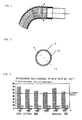
- Fig. 1 shows part of a flexible coolant line 10 with an annular corrugated wall, which is placed on a tube 16 at its open end shown.
- the coolant line 10 consists of two layers 12 and 14 arranged coaxially one inside the other, the radial wall thicknesses of which are shown slightly enlarged in comparison with the diameter in the drawing.
- the outer layer 12 is designed as a burst-resistant layer
- the inner layer 14 consists of a material which is inert to the coolant and cannot be swelled.
- Both layers 12 and 14 consist of mutually compatible polymers. If polymers are selected for the inner layer and the outer layer which are incompatible with one another, then it is possible to use an additional intermediate layer which is made compatible or compatible with the materials of both the inner and the outer layer.
- FIG. 3 shows a diagram of the elongation at break under continuous load at 120 ° C. for up to 3,000 hours of a coextruded cooling liquid line according to the invention with an 8 mm outside diameter with 0.8 mm polyamide 6 outer layer of the GRILON R47W40 type and 0.2 mm polyolefin inner layer of the polymer XE type 3153 compared to a mono tube with 1.0 mm wall thickness made of the same polyamide 6 type, both filled with the cooling liquid water / diethylene glycol 1: 1 during 120 ° C storage and then tested.
- the 50% limit applies to the use in the automotive industry as a suitability limit.
- GRILON R 47 W 40 is a plasticized PA 6 from EMS-CHEMIE AG. Viscosity 20,000 Pa.s / 270 ° C, 122.6 N.
- Polymer XE 3153 is a polypropylene grafted with approximately 5% by weight of maleic anhydride.
- MFI ASTM D 1238) 4.0 g / 10 mm / 230 ° C, density 0.90, melting point 165 ° C.
- tables 1 and 2 show some data for the production of two embodiments with different diameters.
Landscapes
- Engineering & Computer Science (AREA)
- General Engineering & Computer Science (AREA)
- Mechanical Engineering (AREA)
- Laminated Bodies (AREA)
- Rigid Pipes And Flexible Pipes (AREA)
Abstract
Description
- Die Erfindung betrifft eine flexible Kühlflüssigkeitsleitung mit hoher Hydrolyse- und Berstdruckfestigkeit für Motoren, insbesondere Fahrzeugmotoren. Mit dem Begriff flexibel wird zum Ausdruck gebracht, dass solche Leitungen auch um enge Krümmungsradien gebogen werden können, obwohl zur Herstellung relativ steife Polymere verwendet werden.
- Gemäss Stand der Technik werden für Kühlflüssigkeitsleitungen mit Fasergewebe verstärkte Gummileitungen eingesetzt. Solche bevorzugt für Fahrzeugmotoren eingesetzten Gummileitungen haben den Nachteil, dass sie einerseits relativ teuer sind und trotzdem nicht den Anforderungen, besonders bei im Motorraum entstehenden hohen Temperaturen, vollständig gewachsen sind. Nach einer Betriebsdauer, die ca. 100'000 Fahrkilometern entspricht, fallen die mechanischen Eigenschaften bereits stark ab. Noch kritischer wird die Stabilität von Kühlwassergummileitungen für zukünftige Automobilmotoren, die die Temperaturen im Motorraum noch weiter ansteigen lassen als bisher, wodurch der Abfall der mechanischen Eigenschaften zusätzlich beschleunigt wird. Es sind deshalb völlig neuartige Lösungen erforderlich.
- Kühlwasserleitungen, bestehend aus einer einzigen Polymerschicht, sog. Monoleitungen, finden bisher ebenfalls nur begrenzte Einsatzmöglichkeiten. Leitungen aus Polyolefinen zeigen oberhalb von 100°C eine ungenügende Berstdruckbeständigkeit. Zudem neigen Polyolefine zur Spannungsrisskorrosion gegenüber Ölen und Fetten. Polyamid-Monoleitungen weisen oberhalb von 100°C eine ungenügende Hydrolysebeständigkeit auf.
- Zudem wir durch die starke Quellen von Polyamid in Kühlflüssigkeiten die Berstdruckbeständigkeit herabgesetzt. Aus diesem Grunde wird nur glasfaserverstärktes Polyamid für Teile eingesetzt, die direkt mit Kühlflüssigkeit in Kontakt kommen, da die Glasfasern den Verlust an mechanischen Eigenschaften, z.B. durch Quellung, teilweise kompensieren können. Glasfaserverstärkte Rohre sind jedoch nicht flexibel.
- Es bestand daher die Aufgabe, Kühlflüssigkeitsleitungen zu schaffen, die die genannten Nachteile nicht aufweisen. diese Aufgabe wird gelöst durch die flexible Kühlflüssigkeitsleitung gemäss Anspruch 1 und ihre Herstellung gemäss Anspruch 16, wobei sich für den Einsatz als Kühlflüssigkeitsleitungen für Motoren, speziell Fahrzeugmotoren besonders Rohre mit ringförmig oder spiralig gewellter Wandung eignen. Ein Vorteil besteht darin, dass eine erfindungsgemässe Kühlflüssigkeitsleitung ohne zusätzliche Verstärkung, wie sie bei den bekannten Gummileitungen erforderlich ist, auskommt.
- Es wurde überraschenderweise gefunden, dass Mehrschichtrohre mit einer Kombination von unterschiedlich wirksamen Schichten aus geeigneten Polymeren, z.B. mit einer für Kühlmittel inerten, nicht quellbaren Innenschicht und einer steifen, tragenden, besonders berstdruckfesten Aussenschicht, die genannten Mängel nicht aufweisen. Diese Schichten müssen miteinander verträglich oder durch eine mit den beiden Schichten verträgliche Zwischenschicht verbunden sein. Solche erfindungsgemässen Rohre werden bevorzugt durch Coextrusion aus den Polymerkomponenten hergestellt. Besonders bevorzugt sind Mehrschichtrohre mit polyolefinischer Innenschicht und Polyamid als Aussenschicht. Durch die polyolefinische im Kühlmittel nicht quellbare Innenschicht wird eine hervorragende Hydrolysebeständigkeit gewährleistet. Polyamid in der Aussenschicht gewährleistet eine hohe Berstdruckbeständigkeit und lässt die von den Automobil-Herstellern geforderten 8 bar/120°C leicht erreichen, so dass die für Kühlflüssigkeitsleitungen aus Gummi unumgängliche Fasergewebe-Verstärkung entfallen kann.
- Die erforderliche Flexibilität, die sich aus der Notwendigkeit ergibt, auf engem Raum starke Leitungs-Krümmungen zu ermöglichen, ist durch sog. Wellrohre erreichbar, deren Wandung durch nach dem Stand der Technik bekannten Verfahren z.B. ringförmig oder spiralig gewellt wurde.
- Die erfindungsgemäss gewellten Rohre sind wesentlich flexibler als die verstärkten Gummileitungen nach dem Stand der Technik. Erfahrungsgemäss führt das Verbiegen von glatten Rohren aus festen polymeren Materialien bei grösseren Durchmessern zum Verknicken. Das ist besonders für glatte Leitungen mit mehr als 15 mm Innendurchmesser aus erfindungsgemässen Polymeren und für solche mit mehr als 0,4 mm Gesamtwandstärke von Bedeutung. Der Anteil der berstdruckfesten Aussenschicht beträgt dabei bevorzugt 25% bis 95% dieser Gesamtwandstärke.
- Zusätzliche Vorteile solcher erfindungsgemässen Leitungen sind nicht nur das geringere Gewicht sondern auch die geringeren Rohstoff- und Herstellungskosten.
- Berstdruckfeste Materialien für die Aussenschicht sind besonders Polyamide, bevorzugt Homo- oder Copolyamide aus linearen aliphatischen Monomeren mit 6 bis 12 C-Atomen, z.B. aus Laktamen, Aminocarbonsäuren oder Diaminen und Dicarbonsäuren, oder solche aus aromatischen Monomeren mit 6 bis 12 C-Atomen, z.B. alkylierte oder nicht alkylierte aromatische Diamine oder Dicarbonsäuren oder solche aus cycloaliphatischen Monomeren, wie z.B. alkylierte oder nicht alkylierte Diamine oder Dicarbonsäuren mit 6 bis 20 C-Atomen, mit einem oder mehreren Cyclohexan-Ringen, die ihrerseits über Akylengruppen verbunden sein können. Beispielhaft genannt seien die semikristallinen Polyamide der Reihe PA 6 bis PA 12 und der Reihen PA 6,6 bis PA 6,12 sowie PA 12,6 bis PA 12,12. Es eignen sich auch Mischungen und Blends der genannten Polyamide, wobei Qualitäten mit Viskositäten über 10'000 Pa.s (Pascalsekunden) besonders bevorzugt sind.
- Inerte, quellungsbeständige Polymere für die Innenschicht sind halogenierte oder nicht halogenierte Homo- oder Copolyolefine, deren Mischungen oder Blends. Bevorzugt sind neben Homopolyolefinen die Copolyolefine des Ethylen bzw. Propylen mit weiteren α - Olefinen. Geeignet sind chlorierte, besonders auch fluorierte Polyolefine und Copolyolefine und auch Polyvinylchlorid.
- Für zweischichtige Rohre müssen die Homo- oder Copolyolefine selbst reaktive, verträglich machende Gruppen tragen, wie sie z.B. durch Pfropfung mit α - ungesättigten Säuren bzw. ihren Derivaten oder durch geeignete Comonomere wie z.B. Acryl- oder Methacrylsäuren oder deren Derivate zu erzielen sind.
- Die innere Schicht kann aber auch mit der Aussenschicht durch eine mit beiden verträgliche Zwischenschicht genügend fest verbunden werden. Auch dafür eignen sich in besonderem Masse Polyolefine oder Copolyolefine, die reaktionsfähige Gruppen, besonders Carboxyl- oder Säureanhydridgruppen, durch Pfropfung oder durch die genannten Comonomeren erhalten haben.
- Eine ganz besonders bevorzugte Ausführungsform der erfindungsgemässen Kühlflüssigkeitsleitung besteht aus einem gewellten Zweischichtrohr, das eine Innenschicht aus maleinsäuregepfropftem Polyolefin und eine Aussenschicht aus hochviskosem Polyamid 6 aufweist und durch Coextrusion hergestellt wurde.
- Die Erfindung wir im folgenden anhand der Zeichnung beispielsweise beschrieben; in dieser zeigt;
- Fig. 1
- einen Längsschnitt durch eine gewellte Kühlflüssigkeitsleitung, die aus zwei koaxialen Schichten besteht;
- Fig. 2
- eine Querschnittsansicht entlang der Linie A-A; und
- Fig. 3
- ein Belastungsdiagramm.
- Fig. 1 zeigt einen Teil einer flexiblen Kühlflüssigkeitsleitung 10 mit einer ringförmig gewellten Wandung, die an ihrem gezeigten offenen Ende auf ein Rohr 16 aufgesetzt ist.
- Nach Fig. 2 besteht die Kühlflüssigkeitsleitung 10 aus zwei koaxial ineinander angeordneten Schichten 12 und 14, deren radiale Wandstärken in der Zeichnung im Vergleich zum Durchmesser leicht vergrössert dargestellt sind. Die äussere Schicht 12 ist als berstdruckfeste Schicht ausgebildet, während die innere Schicht 14 aus einem gegenüber dem Kühlmittel inerten, nicht quellbaren Material besteht. Beide Schichten 12 und 14 bestehen aus miteinander verträglichen Polymeren. Wenn für die innere Schicht und die äussere Schicht Polymere gewählt werden, die miteinander nicht verträglich sind, dann ist es möglich, eine zusätzliche Zwischenschicht einzusetzen, die mit den Materialien sowohl der inneren als auch der äusseren Schicht verträglich oder verträglich gemacht ist.
- Fig. 3 zeigt als Diagramm die Bruchdehnung bei Dauerbelastung bei 120°C bis zu 3'000 Stunden einer erfindungsgemässen coextrudierten Kühlflüssigkeitsleitung mit 8mm Aussendurchmesser mit 0,8mm Polyamid 6-Aussenschicht vom Typ GRILON R47W40 und 0,2mm Polyolefin-Innenschicht vom Typ Polymer XE 3153 im Vergleich zu einem Monorohr mit 1,0 mm Wandstärke aus dem gleichen Polyamid 6-Typ, beide während der 120°C-Lagerung mit der Kühlflüssigkeit Wasser/Diethylenglykol 1 : 1 gefüllt und anschliessend geprüft. Die 50% Limite gilt für die Verwendung in der Automobil-Industrie als Eignungsgrenze.
- GRILON R 47 W 40 ist ein weichmacherhaltiges PA 6 der Firma EMS-CHEMIE AG. Viskosität 20'000 Pa.s/270°C, 122,6 N.
- Polymer XE 3153 ist ein mit ca. 5 Gew.-% Maleinsäureanhydrid gepfropftes Polypropylen. MFI (ASTM D 1238) 4,0 g/10 mm/230°C, Dichte 0,90, Schmelzpunkt 165°C.
- Nachfolgend sind in den Tabellen 1 und 2 einige Daten für die Herstellung von zwei Ausführungsformen mit verschieden grossen Durchmessern wiedergegeben.

Claims (13)
- Flexible Kühlflüssigkeitsleitung (10) mit hoher Hydrolyse- und Berstdruckfestigkeit für Motoren, insbesondere Fahrzeugmotoren, die aus mehreren Schichten (12, 14) von miteinander zumindest an ihren Berührungsflächen verträglichen Polymeren besteht, und die zumindest auf Teilstücken eine ringförmig oder spiralförmig gewellte Wandung aufweist.
- Kühlflüssigkeitsleitung gemäss Anspruch 1, die zumindest aus einer inneren, gegenüber dem Kühlmittel inerten, nicht quellbaren Schicht (14) und einer äusseren berstdruckfesten Schicht (12) besteht.
- Kühlflüssigkeitsleitung gemäss Anspruch 2, bei der die äussere Schicht (12) aus einem Homo- oder Copolyamid, aus Mischungen oder Blends derselben besteht.
- Kühlflüssigkeitsleitung gemäss Anspruch 3, bei der die Homo- oder Copolyamide aus linearen aliphatischen Monomeren mit 6 bis 12 C-Atomen, aus aromatischen Monomeren mit 6 bis 12 C-Atomen oder aus cycloaliphatischen Monomeren mit 6 bis 20 C-Atomen bestehen.
- Kühlflüssigkeitsleitung gemäss Anspruch 1 bis 4 , bei der die innere Schicht (14) aus halogenierten oder nicht halogenierten Homo- oder Copolyolefinen, aus Mischungen oder Blends derselben besteht, die funktionelle mit der äusseren Schicht (12) verträglich machende Gruppen aufweisen.
- Kühlflüssigkeitsleitung gemäss Anspruch 1 bis 5, die aus zwei Schichten (12, 14) besteht.
- Kühlflüssigkeitsleitung gemäss einem der Ansprüche 1 bis 6, bei der die äussere Schicht aus Polyamid 6 und die innere Schicht aus einem Copolyolefin mit aufgepfropften α -ungesättigten Dicarbonsäuren oder deren Derivaten besteht.
- Kühlflüssigkeitsleitung gemäss Anspruch 1 bis 4, bei der die innere Schicht (14) aus halogenierten oder nicht halogenierten Homo- oder Copolyolefinen, aus Mischungen oder Blends derselben besteht, die mit der äusseren Schicht nicht verträglich sind, wobei zwischen der inneren und der äusseren Schicht (12) eine mit diesen beiden verträgliche Zwischenschicht angeordnet ist.
- Kühlflüssigkeitsleitung gemäss Anspruch 8, bei der die innere Schicht aus chlorierten oder unchlorierten Homo- oder Copolyolefinen oder aus PVC besteht.
- Kühlflüssigkeitsleitung gemäss den Ansprüchen 6 oder 9, bei der die mit der äusseren Schicht verträgliche innere oder Zwischenschicht ein durch Pfropfung oder Copolymerisation mit funktionellen Gruppen versehenes Polyolefin bzw. Copolyolefin ist.
- Kühlflüssigkeitsleitung gemäss einem der Ansprüche 1 bis 10, bei der die Wandstärke der äusseren berstdruckfesten Schicht (12) 25% bis 95% der Gesamtwandstärke ausmacht.
- Kühlflüssigkeitsleitung gemäss einem der Ansprüche 1 bis 11, bei der die Berstdruckfestigkeit bei 100°C über 8 bar liegt.
- Verfahren zur Herstellung von Kühlflüssigkeitsleitungen gemäss einem der Ansprüche 1 bis 12 durch Coextrusion.
Applications Claiming Priority (2)
| Application Number | Priority Date | Filing Date | Title |
|---|---|---|---|
| DE4000434 | 1990-01-09 | ||
| DE4000434A DE4000434C2 (de) | 1990-01-09 | 1990-01-09 | Mehrlagige flexible Kühlflüssigkeitsleitung |
Publications (4)
| Publication Number | Publication Date |
|---|---|
| EP0436923A2 true EP0436923A2 (de) | 1991-07-17 |
| EP0436923A3 EP0436923A3 (en) | 1992-04-29 |
| EP0436923B1 EP0436923B1 (de) | 1995-05-24 |
| EP0436923B2 EP0436923B2 (de) | 2000-03-29 |
Family
ID=6397779
Family Applications (1)
| Application Number | Title | Priority Date | Filing Date |
|---|---|---|---|
| EP90125395A Expired - Lifetime EP0436923B2 (de) | 1990-01-09 | 1990-12-23 | Flexible Kühlflüssigkeitsleitungen |
Country Status (3)
| Country | Link |
|---|---|
| EP (1) | EP0436923B2 (de) |
| JP (1) | JP3249142B2 (de) |
| DE (2) | DE4000434C2 (de) |
Cited By (21)
| Publication number | Priority date | Publication date | Assignee | Title |
|---|---|---|---|---|
| EP0659535A3 (de) * | 1993-12-23 | 1995-11-29 | Inventa Ag | Kühlflüssigkeitsleitung. |
| EP0659534A3 (de) * | 1993-12-23 | 1995-11-29 | Inventa Ag | Kühlflüssigkeitsleitung. |
| US5867883A (en) * | 1994-05-02 | 1999-02-09 | Itt Industries, Inc. | Extruded multiple plastic layer coating bonded to the outer surface of a metal tube having an optional non-reactive inner layer and process for making the same |
| US5884672A (en) * | 1992-04-14 | 1999-03-23 | Itt Industries, Inc. | Multi-layer fuel and vapor tube |
| US5960977A (en) * | 1998-05-14 | 1999-10-05 | Itt Manufacturing Enterprises, Inc. | Corrugated polymeric filler neck tubing |
| US5996642A (en) * | 1992-04-14 | 1999-12-07 | Itt Industries, Inc. | Multi-layer tubing having electrostatic dissipation for handling hydrocarbon fluids |
| US6130404A (en) * | 1997-03-03 | 2000-10-10 | Itt Automotive, Inc. | Electro-optical removal of plastic layer bonded to a metal tube |
| DE19919440A1 (de) * | 1999-04-29 | 2000-11-02 | Vickers Aeroquip Int Gmbh | Schlauch mit gewellter Innenfläche und Einschubteil |
| US6170534B1 (en) | 1992-04-14 | 2001-01-09 | Itt Industries, Inc. | Multi-layer fuel and vapor tube |
| US6245183B1 (en) | 1994-05-02 | 2001-06-12 | Itt Manufacturing Enterprises, Inc. | Process for manufacturing tubing having a metal layer with an external surface overlaying by multiple plastic layers bonded thereto |
| US6257281B1 (en) | 1998-02-13 | 2001-07-10 | Itt Manufacturing Enterprises, Inc. | Multi-layer tubing having at least one intermediate layer formed from a polyamide alloy |
| SG83665A1 (en) * | 1996-05-14 | 2001-10-16 | Totaku Ind | Washing machine hose |
| US6321795B1 (en) | 1992-04-14 | 2001-11-27 | Itt Industries, Inc. | Multi-layer fuel and vapor tube |
| US6378562B1 (en) | 1992-04-14 | 2002-04-30 | Itt Industries, Inc. | Multi-layer tubing having electrostatic dissipation for handling hydrocarbon fluids |
| DE19535489C2 (de) * | 1995-09-23 | 2003-08-21 | Cooper Standard Automotive D | Flexible Kühlwasserleitung für Kraftfahrzeuge |
| EP1290368A4 (de) * | 2000-10-13 | 2004-10-06 | Oem Miller Division Of Holm In | Co-extrudiertes doppelwand wellrohr |
| WO2006010736A1 (de) * | 2004-07-26 | 2006-02-02 | Degussa Ag | Kühlmittelleitung |
| RU2505733C2 (ru) * | 2011-03-29 | 2014-01-27 | НОРМА Германи ГмбХ | Трубопровод для текучей среды с внутренним контуром |
| CN111601995A (zh) * | 2018-01-16 | 2020-08-28 | 宇部兴产株式会社 | 层叠管 |
| EP4566806A1 (de) | 2023-12-08 | 2025-06-11 | Evonik Operations GmbH | Hohlkörper mit peba in der aussenschicht |
| WO2025261672A1 (de) * | 2024-06-21 | 2025-12-26 | Norma Germany Gmbh | Fluidleitung mit einem mehrschichtrohr |
Families Citing this family (8)
| Publication number | Priority date | Publication date | Assignee | Title |
|---|---|---|---|---|
| DE4432584C1 (de) | 1994-09-13 | 1996-02-29 | Inventa Ag | Polymerleitung |
| DE19729523B4 (de) * | 1997-07-10 | 2008-05-29 | Murrplastik System-Technik Gmbh | Wellenschlauch |
| US6240970B1 (en) | 1999-04-01 | 2001-06-05 | Itt Manufacturing Enterprises, Inc. | Tubing for handling hydrocarbon materials and having an outer jacket layer adhered thereto |
| US6276400B1 (en) | 1999-06-08 | 2001-08-21 | Itt Manufacturing Enterprises, Inc. | Corrosion resistant powder coated metal tube and process for making the same |
| JP2001280555A (ja) * | 2000-03-31 | 2001-10-10 | Asahi Kasei Corp | 自動車冷却系用複層ホース |
| DE10065177A1 (de) | 2000-12-23 | 2002-06-27 | Degussa | Mehrschichtverbund auf Polyamid/Polyolefin-Basis |
| DE102005036015A1 (de) * | 2005-08-01 | 2007-02-08 | Volkswagen Ag | Wellrohr aus thermoplastischem Material und Verfahren zur Herstellung |
| BR112021022143A2 (pt) | 2019-05-08 | 2021-12-28 | Basf Se | Composição de poliamida, processo para a preparação de uma composição de poliamida, artigo modelado, utilização da composição de poliamida e estrutura multicamadas tubular ou de cano |
Family Cites Families (4)
| Publication number | Priority date | Publication date | Assignee | Title |
|---|---|---|---|---|
| GB1175042A (en) * | 1966-03-11 | 1969-12-23 | Compoflex Co Ltd | Improvements in or relating to Flexible Hose or Tubing |
| CA1192850A (en) * | 1982-04-01 | 1985-09-03 | Daniel Polasky | Flexible hose having moisture barrier |
| JPH0232515B2 (ja) * | 1983-10-27 | 1990-07-20 | Toyoda Gosei Kk | Purasuchitsukuhoosunoseizohoho |
| JPH0697076B2 (ja) * | 1986-12-16 | 1994-11-30 | 横浜ゴム株式会社 | 低透過性ホ−ス |
-
1990
- 1990-01-09 DE DE4000434A patent/DE4000434C2/de not_active Expired - Fee Related
- 1990-12-23 EP EP90125395A patent/EP0436923B2/de not_active Expired - Lifetime
- 1990-12-23 DE DE59009137T patent/DE59009137D1/de not_active Expired - Lifetime
-
1991
- 1991-01-07 JP JP00013591A patent/JP3249142B2/ja not_active Expired - Fee Related
Cited By (30)
| Publication number | Priority date | Publication date | Assignee | Title |
|---|---|---|---|---|
| US6321795B1 (en) | 1992-04-14 | 2001-11-27 | Itt Industries, Inc. | Multi-layer fuel and vapor tube |
| US5884672A (en) * | 1992-04-14 | 1999-03-23 | Itt Industries, Inc. | Multi-layer fuel and vapor tube |
| US5996642A (en) * | 1992-04-14 | 1999-12-07 | Itt Industries, Inc. | Multi-layer tubing having electrostatic dissipation for handling hydrocarbon fluids |
| US6378562B1 (en) | 1992-04-14 | 2002-04-30 | Itt Industries, Inc. | Multi-layer tubing having electrostatic dissipation for handling hydrocarbon fluids |
| US6896005B2 (en) | 1992-04-14 | 2005-05-24 | Itt Manufacturing Enterprises, Inc. | Multi-layer tubing having electrostatic dissipation for handling hydrocarbon fluids |
| US6170534B1 (en) | 1992-04-14 | 2001-01-09 | Itt Industries, Inc. | Multi-layer fuel and vapor tube |
| EP0659534A3 (de) * | 1993-12-23 | 1995-11-29 | Inventa Ag | Kühlflüssigkeitsleitung. |
| US5560398A (en) * | 1993-12-23 | 1996-10-01 | Ems-Inventa Ag | Sequentially coextruded coolant conduit |
| US5588468A (en) * | 1993-12-23 | 1996-12-31 | Ems-Inventa Ag | Blow-molded coolant conduit |
| EP0659535A3 (de) * | 1993-12-23 | 1995-11-29 | Inventa Ag | Kühlflüssigkeitsleitung. |
| US5867883A (en) * | 1994-05-02 | 1999-02-09 | Itt Industries, Inc. | Extruded multiple plastic layer coating bonded to the outer surface of a metal tube having an optional non-reactive inner layer and process for making the same |
| US6245183B1 (en) | 1994-05-02 | 2001-06-12 | Itt Manufacturing Enterprises, Inc. | Process for manufacturing tubing having a metal layer with an external surface overlaying by multiple plastic layers bonded thereto |
| DE19535489C2 (de) * | 1995-09-23 | 2003-08-21 | Cooper Standard Automotive D | Flexible Kühlwasserleitung für Kraftfahrzeuge |
| SG83665A1 (en) * | 1996-05-14 | 2001-10-16 | Totaku Ind | Washing machine hose |
| US6660350B1 (en) | 1997-03-03 | 2003-12-09 | Itt Automotive, Inc. | Electro-optical removal of plastic layer bonded to a metal tube |
| US6130404A (en) * | 1997-03-03 | 2000-10-10 | Itt Automotive, Inc. | Electro-optical removal of plastic layer bonded to a metal tube |
| US6257281B1 (en) | 1998-02-13 | 2001-07-10 | Itt Manufacturing Enterprises, Inc. | Multi-layer tubing having at least one intermediate layer formed from a polyamide alloy |
| US5960977A (en) * | 1998-05-14 | 1999-10-05 | Itt Manufacturing Enterprises, Inc. | Corrugated polymeric filler neck tubing |
| DE19919440A1 (de) * | 1999-04-29 | 2000-11-02 | Vickers Aeroquip Int Gmbh | Schlauch mit gewellter Innenfläche und Einschubteil |
| US6623046B1 (en) | 1999-04-29 | 2003-09-23 | Aeroquip-Vickers International Gmbh | Tube with a corrugated inner surface and an insertable component |
| EP1290368A4 (de) * | 2000-10-13 | 2004-10-06 | Oem Miller Division Of Holm In | Co-extrudiertes doppelwand wellrohr |
| WO2006010736A1 (de) * | 2004-07-26 | 2006-02-02 | Degussa Ag | Kühlmittelleitung |
| KR100886582B1 (ko) * | 2004-07-26 | 2009-03-05 | 에보닉 데구사 게엠베하 | 냉각관 |
| US7939151B2 (en) | 2004-07-26 | 2011-05-10 | Evonik Degussa Gmbh | Coolant line |
| RU2505733C2 (ru) * | 2011-03-29 | 2014-01-27 | НОРМА Германи ГмбХ | Трубопровод для текучей среды с внутренним контуром |
| US9309999B2 (en) | 2011-03-29 | 2016-04-12 | Norma Germany Gmbh | Directional fluid line |
| CN111601995A (zh) * | 2018-01-16 | 2020-08-28 | 宇部兴产株式会社 | 层叠管 |
| EP4566806A1 (de) | 2023-12-08 | 2025-06-11 | Evonik Operations GmbH | Hohlkörper mit peba in der aussenschicht |
| WO2025119635A1 (de) | 2023-12-08 | 2025-06-12 | Evonik Operations Gmbh | Hohlkörper mit peba in der aussenschicht |
| WO2025261672A1 (de) * | 2024-06-21 | 2025-12-26 | Norma Germany Gmbh | Fluidleitung mit einem mehrschichtrohr |
Also Published As
| Publication number | Publication date |
|---|---|
| JPH04290691A (ja) | 1992-10-15 |
| DE4000434C2 (de) | 1997-07-24 |
| JP3249142B2 (ja) | 2002-01-21 |
| DE4000434C1 (de) | 1991-04-18 |
| DE59009137D1 (de) | 1995-06-29 |
| EP0436923A3 (en) | 1992-04-29 |
| EP0436923B2 (de) | 2000-03-29 |
| EP0436923B1 (de) | 1995-05-24 |
Similar Documents
| Publication | Publication Date | Title |
|---|---|---|
| EP0436923B1 (de) | Flexible Kühlflüssigkeitsleitungen | |
| EP0659535B1 (de) | Kühlflüssigkeitsleitung | |
| EP0659534B1 (de) | Kühlflüssigkeitsleitung | |
| DE69830427T2 (de) | Polymer-wellrohr für einen einfüllstutzen | |
| DE60004907T2 (de) | Aus mehreren auf Polyamid basierenden Schichten zusammengesetzter Schlauch für den Kraftstofftransport | |
| DE4310159C3 (de) | Kraftstoff-Förderschlauch mit einem Harzrohr aus einer Schicht aus fluorhaltigem Harz und einer Schicht aus anderem Kunstharz und Verfahren zur Herstellung des Harzrohrs | |
| DE4214383C1 (de) | ||
| DE69521841T2 (de) | Kraftstofführendes Rohr | |
| DE69311403T2 (de) | Brennstoffübertragendes Rohr | |
| DE69325661T2 (de) | Mehrschichtiger wellschlauch mit fluorplastikschichten | |
| EP0671582B1 (de) | Kühlflüssigkeitsleitung | |
| DE69128081T2 (de) | Kühlmittel-Förderschlauch mit kunstharzbeschichtetem Innenschlauch sowie Verbindungsstück für ihn | |
| EP1162061B1 (de) | Thermoplastische Mehrschichtverbunde | |
| EP0542184B1 (de) | Mehrschichtiges Kunststoffrohr | |
| DE4025301C1 (de) | ||
| DE69604338T2 (de) | Flexibler Schlauch mit einer Seele aus Verbundwerkstoff | |
| EP1452307B1 (de) | Thermoplastischer Mehrschichtverbund in Form eines Hohlkörpers | |
| DE69718765T2 (de) | Kühlmittelförderschlauch | |
| DE102007025089B4 (de) | Kühlmittel-Förderschlauch | |
| EP1884356B1 (de) | Mehrschichtverbund in form eines extrudierten hohlprofils | |
| DE69525964T3 (de) | Rohrleitungen aus Polyamid und Polyolefin zum Gastransport | |
| DE102016013584A1 (de) | Schlauch zum Leiten eines Kältemittels | |
| EP1145844A2 (de) | Extrudiertes, spritzgegossenes oder blasgeformtes Rohr, Fitting oder Formstück aus Kunststoff | |
| DE102008014988A1 (de) | Schlauch mit einer elektrisch leitfähigen Innenschicht | |
| DE69417447T2 (de) | Kraftstoffzufuhrrohr |
Legal Events
| Date | Code | Title | Description |
|---|---|---|---|
| PUAI | Public reference made under article 153(3) epc to a published international application that has entered the european phase |
Free format text: ORIGINAL CODE: 0009012 |
|
| 17P | Request for examination filed |
Effective date: 19901224 |
|
| AK | Designated contracting states |
Kind code of ref document: A2 Designated state(s): CH DE FR GB IT LI SE |
|
| GBC | Gb: translation of claims filed (gb section 78(7)/1977) | ||
| EL | Fr: translation of claims filed | ||
| ITCL | It: translation for ep claims filed |
Representative=s name: BARZANO' E ZANARDO ROMA S.P.A. |
|
| PUAL | Search report despatched |
Free format text: ORIGINAL CODE: 0009013 |
|
| AK | Designated contracting states |
Kind code of ref document: A3 Designated state(s): CH DE FR GB IT LI SE |
|
| 17Q | First examination report despatched |
Effective date: 19930707 |
|
| GRAA | (expected) grant |
Free format text: ORIGINAL CODE: 0009210 |
|
| AK | Designated contracting states |
Kind code of ref document: B1 Designated state(s): CH DE FR GB IT LI SE |
|
| ITF | It: translation for a ep patent filed | ||
| REF | Corresponds to: |
Ref document number: 59009137 Country of ref document: DE Date of ref document: 19950629 |
|
| GBT | Gb: translation of ep patent filed (gb section 77(6)(a)/1977) |
Effective date: 19950807 |
|
| ET | Fr: translation filed | ||
| PLBI | Opposition filed |
Free format text: ORIGINAL CODE: 0009260 |
|
| PLBF | Reply of patent proprietor to notice(s) of opposition |
Free format text: ORIGINAL CODE: EPIDOS OBSO |
|
| 26 | Opposition filed |
Opponent name: HUELS AKTIENGESELLSCHAFT Effective date: 19960216 |
|
| PLBF | Reply of patent proprietor to notice(s) of opposition |
Free format text: ORIGINAL CODE: EPIDOS OBSO |
|
| PLBF | Reply of patent proprietor to notice(s) of opposition |
Free format text: ORIGINAL CODE: EPIDOS OBSO |
|
| PLAW | Interlocutory decision in opposition |
Free format text: ORIGINAL CODE: EPIDOS IDOP |
|
| APAC | Appeal dossier modified |
Free format text: ORIGINAL CODE: EPIDOS NOAPO |
|
| APAE | Appeal reference modified |
Free format text: ORIGINAL CODE: EPIDOS REFNO |
|
| APAC | Appeal dossier modified |
Free format text: ORIGINAL CODE: EPIDOS NOAPO |
|
| APAC | Appeal dossier modified |
Free format text: ORIGINAL CODE: EPIDOS NOAPO |
|
| PLAW | Interlocutory decision in opposition |
Free format text: ORIGINAL CODE: EPIDOS IDOP |
|
| PUAH | Patent maintained in amended form |
Free format text: ORIGINAL CODE: 0009272 |
|
| STAA | Information on the status of an ep patent application or granted ep patent |
Free format text: STATUS: PATENT MAINTAINED AS AMENDED |
|
| 27A | Patent maintained in amended form |
Effective date: 20000329 |
|
| AK | Designated contracting states |
Kind code of ref document: B2 Designated state(s): CH DE FR GB IT LI SE |
|
| REG | Reference to a national code |
Ref country code: CH Ref legal event code: AEN Free format text: AUFRECHTERHALTUNG DES PATENTES IN GEAENDERTER FORM |
|
| ITF | It: translation for a ep patent filed | ||
| ET3 | Fr: translation filed ** decision concerning opposition | ||
| GBTA | Gb: translation of amended ep patent filed (gb section 77(6)(b)/1977) | ||
| PGFP | Annual fee paid to national office [announced via postgrant information from national office to epo] |
Ref country code: CH Payment date: 20011130 Year of fee payment: 12 |
|
| REG | Reference to a national code |
Ref country code: GB Ref legal event code: IF02 |
|
| PG25 | Lapsed in a contracting state [announced via postgrant information from national office to epo] |
Ref country code: LI Free format text: LAPSE BECAUSE OF NON-PAYMENT OF DUE FEES Effective date: 20021231 Ref country code: CH Free format text: LAPSE BECAUSE OF NON-PAYMENT OF DUE FEES Effective date: 20021231 |
|
| REG | Reference to a national code |
Ref country code: CH Ref legal event code: PL |
|
| PGFP | Annual fee paid to national office [announced via postgrant information from national office to epo] |
Ref country code: SE Payment date: 20031202 Year of fee payment: 14 |
|
| PG25 | Lapsed in a contracting state [announced via postgrant information from national office to epo] |
Ref country code: SE Free format text: LAPSE BECAUSE OF NON-PAYMENT OF DUE FEES Effective date: 20041224 |
|
| EUG | Se: european patent has lapsed | ||
| APAH | Appeal reference modified |
Free format text: ORIGINAL CODE: EPIDOSCREFNO |
|
| REG | Reference to a national code |
Ref country code: GB Ref legal event code: 732E |
|
| REG | Reference to a national code |
Ref country code: FR Ref legal event code: CD Ref country code: FR Ref legal event code: TP Ref country code: FR Ref legal event code: CA |
|
| PGFP | Annual fee paid to national office [announced via postgrant information from national office to epo] |
Ref country code: IT Payment date: 20091223 Year of fee payment: 20 Ref country code: FR Payment date: 20100108 Year of fee payment: 20 Ref country code: GB Payment date: 20091218 Year of fee payment: 20 |
|
| PGFP | Annual fee paid to national office [announced via postgrant information from national office to epo] |
Ref country code: DE Payment date: 20091222 Year of fee payment: 20 |
|
| REG | Reference to a national code |
Ref country code: GB Ref legal event code: PE20 Expiry date: 20101222 |
|
| PG25 | Lapsed in a contracting state [announced via postgrant information from national office to epo] |
Ref country code: GB Free format text: LAPSE BECAUSE OF EXPIRATION OF PROTECTION Effective date: 20101222 |
|
| PG25 | Lapsed in a contracting state [announced via postgrant information from national office to epo] |
Ref country code: DE Free format text: LAPSE BECAUSE OF EXPIRATION OF PROTECTION Effective date: 20101223 |