EP0435197A1 - Rear body structure of automotive vehicle - Google Patents
Rear body structure of automotive vehicle Download PDFInfo
- Publication number
- EP0435197A1 EP0435197A1 EP90125102A EP90125102A EP0435197A1 EP 0435197 A1 EP0435197 A1 EP 0435197A1 EP 90125102 A EP90125102 A EP 90125102A EP 90125102 A EP90125102 A EP 90125102A EP 0435197 A1 EP0435197 A1 EP 0435197A1
- Authority
- EP
- European Patent Office
- Prior art keywords
- fuel tank
- body structure
- cited
- pair
- section
- Prior art date
- Legal status (The legal status is an assumption and is not a legal conclusion. Google has not performed a legal analysis and makes no representation as to the accuracy of the status listed.)
- Granted
Links
- 239000002828 fuel tank Substances 0.000 claims abstract description 116
- XDDAORKBJWWYJS-UHFFFAOYSA-N glyphosate Chemical compound OC(=O)CNCP(O)(O)=O XDDAORKBJWWYJS-UHFFFAOYSA-N 0.000 claims description 21
- 239000000446 fuel Substances 0.000 claims description 16
- 239000000945 filler Substances 0.000 claims description 7
- 230000017525 heat dissipation Effects 0.000 claims description 5
- 238000007789 sealing Methods 0.000 claims description 4
- 238000002955 isolation Methods 0.000 claims 4
- 238000007599 discharging Methods 0.000 claims 2
- 238000005452 bending Methods 0.000 abstract description 3
- 238000009434 installation Methods 0.000 description 9
- 208000027418 Wounds and injury Diseases 0.000 description 3
- 230000006378 damage Effects 0.000 description 3
- 208000014674 injury Diseases 0.000 description 3
- 230000000694 effects Effects 0.000 description 2
- 239000007788 liquid Substances 0.000 description 2
- 239000004033 plastic Substances 0.000 description 2
- 229910000831 Steel Inorganic materials 0.000 description 1
- 239000012141 concentrate Substances 0.000 description 1
- 238000005192 partition Methods 0.000 description 1
- 230000002093 peripheral effect Effects 0.000 description 1
- 230000002787 reinforcement Effects 0.000 description 1
- 230000003014 reinforcing effect Effects 0.000 description 1
- 230000000630 rising effect Effects 0.000 description 1
- 239000010959 steel Substances 0.000 description 1
- 239000000725 suspension Substances 0.000 description 1
Images




Classifications
-
- B—PERFORMING OPERATIONS; TRANSPORTING
- B62—LAND VEHICLES FOR TRAVELLING OTHERWISE THAN ON RAILS
- B62D—MOTOR VEHICLES; TRAILERS
- B62D25/00—Superstructure or monocoque structure sub-units; Parts or details thereof not otherwise provided for
- B62D25/08—Front or rear portions
-
- B—PERFORMING OPERATIONS; TRANSPORTING
- B60—VEHICLES IN GENERAL
- B60K—ARRANGEMENT OR MOUNTING OF PROPULSION UNITS OR OF TRANSMISSIONS IN VEHICLES; ARRANGEMENT OR MOUNTING OF PLURAL DIVERSE PRIME-MOVERS IN VEHICLES; AUXILIARY DRIVES FOR VEHICLES; INSTRUMENTATION OR DASHBOARDS FOR VEHICLES; ARRANGEMENTS IN CONNECTION WITH COOLING, AIR INTAKE, GAS EXHAUST OR FUEL SUPPLY OF PROPULSION UNITS IN VEHICLES
- B60K15/00—Arrangement in connection with fuel supply of combustion engines or other fuel consuming energy converters, e.g. fuel cells; Mounting or construction of fuel tanks
- B60K15/03—Fuel tanks
- B60K15/063—Arrangement of tanks
-
- B—PERFORMING OPERATIONS; TRANSPORTING
- B60—VEHICLES IN GENERAL
- B60K—ARRANGEMENT OR MOUNTING OF PROPULSION UNITS OR OF TRANSMISSIONS IN VEHICLES; ARRANGEMENT OR MOUNTING OF PLURAL DIVERSE PRIME-MOVERS IN VEHICLES; AUXILIARY DRIVES FOR VEHICLES; INSTRUMENTATION OR DASHBOARDS FOR VEHICLES; ARRANGEMENTS IN CONNECTION WITH COOLING, AIR INTAKE, GAS EXHAUST OR FUEL SUPPLY OF PROPULSION UNITS IN VEHICLES
- B60K15/00—Arrangement in connection with fuel supply of combustion engines or other fuel consuming energy converters, e.g. fuel cells; Mounting or construction of fuel tanks
- B60K15/03—Fuel tanks
-
- B—PERFORMING OPERATIONS; TRANSPORTING
- B62—LAND VEHICLES FOR TRAVELLING OTHERWISE THAN ON RAILS
- B62D—MOTOR VEHICLES; TRAILERS
- B62D25/00—Superstructure or monocoque structure sub-units; Parts or details thereof not otherwise provided for
- B62D25/08—Front or rear portions
- B62D25/087—Luggage compartments
-
- B—PERFORMING OPERATIONS; TRANSPORTING
- B62—LAND VEHICLES FOR TRAVELLING OTHERWISE THAN ON RAILS
- B62D—MOTOR VEHICLES; TRAILERS
- B62D43/00—Spare wheel stowing, holding, or mounting arrangements
- B62D43/06—Spare wheel stowing, holding, or mounting arrangements within the vehicle body
- B62D43/10—Spare wheel stowing, holding, or mounting arrangements within the vehicle body and arranged substantially horizontally
-
- B—PERFORMING OPERATIONS; TRANSPORTING
- B60—VEHICLES IN GENERAL
- B60K—ARRANGEMENT OR MOUNTING OF PROPULSION UNITS OR OF TRANSMISSIONS IN VEHICLES; ARRANGEMENT OR MOUNTING OF PLURAL DIVERSE PRIME-MOVERS IN VEHICLES; AUXILIARY DRIVES FOR VEHICLES; INSTRUMENTATION OR DASHBOARDS FOR VEHICLES; ARRANGEMENTS IN CONNECTION WITH COOLING, AIR INTAKE, GAS EXHAUST OR FUEL SUPPLY OF PROPULSION UNITS IN VEHICLES
- B60K15/00—Arrangement in connection with fuel supply of combustion engines or other fuel consuming energy converters, e.g. fuel cells; Mounting or construction of fuel tanks
- B60K15/03—Fuel tanks
- B60K15/063—Arrangement of tanks
- B60K2015/0638—Arrangement of tanks the fuel tank is arranged in the rear of the vehicle
Definitions
- This invention pertains to part of the body structure of a vehicle, and more particularly, to the rear body structure of a car body for the installation of a fuel tank.
- a fuel tank is installed under a floor panel a car body, forming a part of a rear trunk space or room.
- a fuel tank is installed under a floor panel a car body, forming a part of a rear trunk space or room.
- one of recent tendencies of vehicles, in particular passenger cars is to lower the floor of the car body in position and it is, therefor, difficult to provide such a space for a fuel tank under the floor panel.
- an extra or additional member is used to provide a space for the fuel tank.
- the fuel tank in the space occupies part of the passenger room.
- the fuel tank is pushed into the passenger room as a result of a deformation of the extra or additional member providing the space for the fuel tank.
- the body structure be improved.
- the body structure of this kind has the demand of removably installing the fuel tank into the space from a side of the rear trunk room and, therefore, a worker or mechanic must physically climb into the rear trunk room looking the interior of the rear trunk room.
- This installation of fuel tank is troublesome and lowers efficiency in working in comparison with, for instance, the conventional fuel tank installation.
- a fuel tank into a space, open to the underside of the car body, which is formed or provided by a car body floor (comprising a rear floor panel of the passenger room and a floor panel of the rear trunk room) kicked up, from the underside of the car body.
- the fuel tank is bolted to and supported by a pair of, or front or rear, brackets secured to the car body floor, or otherwise is suspended and supported by a belt.
- a space for fuel tank provided by rising up part of the car body floor lowers the structural rigidity of the car body floor, in particular part of the car body floor where the space is provided, in a lengthwise direction of the car body. This local lowering in rigidity causes a deformation of the car body floor upon a rear-end collision, resulting in an easy collapse of the fuel tank.
- This kind of deformation may be suppressed 5 by bolting the fuel tank to the brackets to some extent.
- the rigidity of car body floor can be increased by the fuel tank, larger working space should be left between the fuel tank 60 and the space for the fuel tank for allowing an easy bolting of the fuel tank to the brackets. This results in an inefficient use of space of the car body.
- a rear body structure of a vehicle includes support means for supporting a fuel tank, from underside, in a space defined under a floor panel between a passenger room and a trunk room.
- the space is formed by bending up and down a floor panel in a lengthwise direction of the car body, such as a rear floor panel of the passenger room and a trunk floor panel of the trunk room.
- the support means comprises a pair of support beams, disposed in parallel and extending in a lengthwise direction of the car body, and a pair of connecting beams, extending between in a transverse direction of the car body and connected to the supporting beams, which are assembled in parallel crosses.
- the rear body section Z includes a pair of, i.e., left and right, rear side frames 1 located on opposite sides thereof.
- Each rear side frame 1 is welded, or otherwise secured, at its front end 1a to rear end of a pair of, i.e. , left and right, side sills 2 and 2.
- a wheel housing 8 for enclosing a rear wheel 8 is secured to the outer side of a front half section, between the front end 1a and mid portion 1b, of each rear side frame 1.
- the rear wheels 8 are operationally connected to an engine mounted in a front engine room (both not shown) via a rear differential gear 31 located under the rear side frames 1 of the car body between the mid portions 1b of the rear side frames 1.
- An exhaust pipe 36, provided with a main and a sub-silencer 34 and 35 are located separately in the lengthwise direction and closely to one of, i.e. , right rear side frames 1.
- Designated by a reference numeral 32 is a suspension tower.
- a rear floor panel 3 for a passenger compartment or room 10 is welded, or otherwise secured to upper surfaces of both the rear side frames 1.
- This rear floor panel 3 comprises a floor section 3a, as a floor of the passenger room 10; a rear wall section 3b inclined rearward up at a proper angle with respect to the floor section 3a and extending near the top end 11a of a rear sheet 11 to be located in the passenger room 10, as a partition between the passenger room 10 and a rear trunk compartment or room 9; and a trim section 3c bent rearward from the rear wall section 3b and extending rearward from the top of the rear wall section 3b, all sections 3a - 3c being formed integrally.
- a front cross beam 6, transversely extending between the rear side frames 1, is secured to the back of the rear wall section 3b of the rear floor panel 3.
- This front cross beam 6 has its under surface 6a serving as a reference surface for bolting support means 20 thereto which will be described later.
- Trunk floor panel 4 is installed behind the rear wall section 3b of the rear floor panel 3 and comprises a upper front floor section 4a, extending horizontally rearward from the rear wall section 3b and secured, approximately at the mid portion of height of the rear wall section 3b, to the back surface of the rear wall section 3a of the rear floor panel 3; a wall section 4b bent down at approximately a right dangle from the upper front floor section 4a; and a lower rear floor section 4c bent approximately at a right dangle and extending horizontally rearward from the lower end of the wall section 4b. All the sections 4a - 4c are made integrally.
- a rear cross beam 7, transversely extending between the rear side frames 1, is secured to the under surface of the lower rear floor section 4c of the trunk floor panel 4.
- This rear cross beam 6 also has its under surface 7a serving as a reference surface for bolting the support means 20 thereto.
- the rear floor panel 3 and trunk floor panel 4 thus shaped and connected to each other, forms a desired dimension of space or fuel tank chamber 5 with a bottom opening 5a (see Figure 4), defined by the rear wall section 3b of the rear floor panel 3, the upper front floor and wall sections 4a and 4b of the trunk floor panel 4 and the left and right side frames 1, behind the rear wall section 3b of the rear floor panel 3.
- the fuel tank comprises, for instance, a generally rectangular box-shaped main housing 15' with a peripheral flange 15a which is made of a steel or a plastic.
- the fuel tank 15 is formed with a pair of, or left and right, fuel outlet housings 15b wherein floats or float valves 15c are hinged.
- Each fuel outlet housing 15b is connected with a vapor storage canister (not shown) with a fuel vapor supply conduit 15d.
- Each outlet housing 15b projects in the rear trunk room 9 through an opening 4a' formed in the upper front floor section 4a of the trunk floor panel 4 and is covered with a cap 15e.
- This float valve 15e prevents fuel liquid in the fuel tank 15 from flowing out into the fuel vapor supply conduit 15d when the surface level of fuel liquid rises due to vibrations of the car body.
- the fuel tank 15 is put in the space or fuel tank chamber 5 formed in the rear body section Z of the car body through the bottom opening 5a in the underside of the car body.
- the fuel tank 15 in the fuel chamber 5 is supported by the support means 20 from its underside.
- the support means 20 comprises a pair of, or left and right, lengthwise extending support beams 21 and a pair of, or front and rear, connecting beams 22 transversely extending between and connected to the support beams 21.
- the fuel tank 15 is stably and firmly placed on the upper surfaces of the support frames 21, particularly the kick-down support section 21a, of the support means 20. It is preferred to put cushioning members 23 between the top of the main housing 15' of the fuel tank 15 and the under surface of the upper front floor section 4a of the trunk floor panel 4 so as to press up the fuel tank 15 against the upper front floor section 4a of the trunk floor panel 4 and retain it firmly between the support frames 21 of the support means 20 and the upper front floor section 4a of the trunk floor panel 4.
- a fuel filler such as a conduit 16, which extends from the fuel tank 15 to one rear side fender 33, is supported near the fuel tank 15 by a hollow cylindrical collar 24 whose bore 24a has a diameter slightly larger than that of the fuel filler conduit 16 so as to provide or form a small air gap 24b between the collar 24 and the fuel filler conduit 16.
- the collar 24 is inserted in and secured to the left rear side frame 1. This air gap 24b is utilized as an aerating opening.
- the right rear side frame 1 is provided with a hollow cylindrical collar 25 having a bore 25a which serves as an aerating opening.
- These bores 24a and 25a i.e. , heat dissipation openings of the collars 24 and 25, allows air heated by an exhaust pipe 36 and trapped in upper part of the fuel tank chamber 5 unoccupied by the fuel tank 15, to escape outside the fuel tank chamber 5 therethrough, so as to prevent a rise in internal pressure in the fuel tank 15.
- the sealing means such as a rubber gasket 39
- the sealing means is fitted to periphery of the flange 15a of the main housing 15' of the tank 15 so as to be kept in contact with both inner surfaces of the wall section 3b and 4b of the rear floor panel 3 and the trunk floor panel 4 defining the fuel tank chamber 5 when the fuel tank 15 is installed in the fuel tank chamber 5.
- the rubber gasket 39 when the fuel tank 15 is installed, divides the inside space of the fuel tank chamber 5 into upper and lower spaces 5b and 5c isolated from each other, so as to prevent air heated by exhaust gas from entering the upper space 5b.
- the rubber gasket 39 is preferably formed to have a top surface 39a bent inwardly up so as to serve as a guide member for the fuel tank 15 relative to the inner surfaces of the wall section 3b and 4b of the rear floor panel 3 and the trunk floor panel 4 defining the space 5 when the fuel tank 15 is installed in the fuel tank chamber 5.
- the fuel tank 15 is completely located outside both the passenger room 10 and the trunk room 9; thus, the fuel tank 15 is prevented from projecting into the passenger room 10 even when the rear floor, and hence the fuel tank chamber 5, deforms on a collision, in particular a rear-end collision, so as to protect a passenger or passengers in the passenger room 10 of the vehicle against injury from the fuel tank 15.
- the rear body structure Z which allows the fuel tank 15 to be installed in the fuel tank chamber 5 from the underside of the car body makes the installing work of the fuel tank 15 more easier compared to the installation of fuel tank 15 through the trunk room 9.
- the highly-rigid support means 20, comprising the support beams 21 and connecting beams 22 constructed or assembled in parallel crosses, ensures the rigidity of structure surrounding the fuel tank chamber 5. This prevents the rear floor, and hence the fuel tank chamber 5, from deforming on a collision, so as also to protect a passenger or passengers in the passenger room 10 of the vehicle against injury from the fuel tank 15.
- the support means 20, attached and bolted to the front and rear cross beams 6 and 7 from the underside to support and retain firmly the fuel tank 15 in the fuel tank chamber 5, eliminates the necessity of leaving a sufficient working space between the fuel tank 15 and the rear wall section 3b of the rear floor panel 3 and the upper front floor and wall sections 4a and 4b of the trunk floor panel 4 defining the fuel tank chamber 5 for bolting, or otherwise securing, the fuel tank 15 to the rear body structure Z .
- supporting means 40 for supporting the fuel tank 15 from the underside, comprises a pair of, or left and right, lengthwise extending support beams 41 and a pair of, or front and rear, transversely extending connecting beams 42, connected in generally parallel crosses.
- each supporting beams 41 made of an integral U-channel frame opening downward, comprises a kick-down support section 41a, a front section 41b extending in a straight line with respect to the kick-down support section 41a, and a rear section 41c bent outward toward a side corner 48 formed between inner surfaces 1c and 7c of the rear side frame 1 and rear cross beam 7, respectively.
- a triangular corner gusset 49 is welded to both the inner surfaces 1c and 7c of the rear side frame 1 and rear cross beam 7 at the side corner 48. It is to be understood that the rear body structure Z is intended to have the highest structural rigidity at the side corner 49 at each intersection of the rear side frame 1 and rear cross beam 7.
- the support beam 41 is secured, at its front end, by a bolt 43 to the under surface 6c of the front cross beam 6 through an L-shaped angle bracket 44 and is secured, at its rear end, by a bolt 46 through a washer cap 47 to an under surface 45a of the triangular corner gusset 45.
- the transversely extending connecting beams 42 are welded, or otherwise secured, to the kick-down support sections 41a of the support beams 41.
- the fuel tank 15 is stably and firmly placed on the upper surfaces of the support sections 41a of the left and right support frames 41 of the support means 40.
- a rear side frame assembly 1A comprises a kick-down, main rear side frame 50 and six sub-frames 51 - 56 secured, as reinforcements, to the main rear side frame 50 at proper locations. All these frames, excepting fifth sub-frame 55, are made of a U-channel frame.
- the main rear side frame 50 opening upside, has three sections; front section 50b, kick-down section 50a and rear section 50c, and extends in a lengthwise direction of the car body between the side sill 2 and a rear bumper (not shown).
- first sub-frame 51 opening laterally outside, is welded, or otherwise secured, to an outer surface of the front section 50b of the main rear side frame 50 and to inner surface of the wheel house 8 through its flanges 51a.
- Second sub-frame 52 opening upside, is inserted in the kick-down section 50a of the main rear side frame 50 and is welded, or otherwise secured, to an inner surface of the full length of kick-down section 50a.
- Third sub-frame 53, opening upside, is welded, or otherwise secured, to upper inner sides of the full length of second sub-frame 52 so as to form a closed cross-section therebetween.
- Fourth sub-frame 54 opening upside and formed with side flanges 54a extending over its full length, is welded, or otherwise secured, to upper inner sides of the kick-down section 50a of the main rear side frame 50 so as to form a closed cross-section between the rear side frame 50 and third and fourth sub-frames 53 and 54.
- the fourth sub-frame 54 has a height sufficient to reach the upper front floor section 4a of the trunk floor panel 4 and is welded, or otherwise secured, to both the rear wall section 3b of the rear floor panel 3 and the upper front floor section 4a of the trunk floor panel 4 through the side flanges 54a. Therefore, the fourth sub-frame 54 serves as a side protection wall on and for each side of the fuel tank 15.
- the kick-down section 50a of the main rear side frame 50 constructed as a double closed cross-section structure as apparent from Figure 9(b), has a considerably increased structural rigidity.
- Fifth sub-frame 55 in the form of a L-shaped angle frame, is inserted in the rear section 50c of the main rear side frame 50 and is welded, or otherwise secured, to inner wall of the rear section 50c as is shown in Figure 9(c). As is seen in Figure 8, the fifth sub-frame 55 overlaps at its front end and is cut off near the front end as is indicated by a reference number 55a. Because of the fifth sub-frame 55 partly cut off, the rear side frame assembly 1A is locally weaken in structural rigidity at the junction between the second and fifth sub-frames 52 and 55.
- Sixth sub-frame 56 is provided as a bumper bracket for interconnecting the main rear side frame 50 and a rear bumper (well known in the art and not shown).
- the sixth sub-frame 56 opening downside and formed with rear flanges 56a, is inserted in the rear section 50c of the main rear side frame 50 to overlap the fifth sub-frame 55 and is welded, or otherwise secured, to upper inner surfaces of the fifth sub-frame 55 as is shown in Figure 9(d).
- the rear body section Z including the rear side frame assembly 1A has a higher structural rigidity between its front and mid portion and a lower structural rigidity between its mid and rear portion and therefore, controls and impact acting on the fuel tank 15 and the passenger room 10 during a rear-end collision. Since the rear side frame assembly 1A is weak in structural rigidity particularly at the front end of the fifth sub-frame 55, it is easy to crush between the kick-down section 50a and rear section 50c upon a rear-end collision, so as to effectively absorb impact load acting thereon.
- the rear body structure Z is also improved to absorb impact upon a rear-end collision load by varying a structure surrounding the trunk room 9.
- the trunk room 9 is typically provided with a spare tire space 60 formed by bending the lower rear floor section 4c of the trunk floor panel 4 in a transverse direction of the car body.
- the lower floor section 4c of the trunk floor panel 4 is formed with flanges 61 along its rear edge over its full length. These flanges 61 are secured to a rear wall (not shown) of the trunk room 9.
- the lower rear floor section 4c of the trunk floor panel 4 is also formed with notches 62 in the rear edge on both sides of the space, such as a spear tire chamber 60.
- a seal member such as a plastic closer 64 may be attached to each notch 62.
Landscapes
- Engineering & Computer Science (AREA)
- Chemical & Material Sciences (AREA)
- Combustion & Propulsion (AREA)
- Transportation (AREA)
- Mechanical Engineering (AREA)
- Life Sciences & Earth Sciences (AREA)
- Sustainable Development (AREA)
- Sustainable Energy (AREA)
- Body Structure For Vehicles (AREA)
- Cooling, Air Intake And Gas Exhaust, And Fuel Tank Arrangements In Propulsion Units (AREA)
Abstract
Description
- This invention pertains to part of the body structure of a vehicle, and more particularly, to the rear body structure of a car body for the installation of a fuel tank.
- Conventionally, a fuel tank is installed under a floor panel a car body, forming a part of a rear trunk space or room. However, one of recent tendencies of vehicles, in particular passenger cars, is to lower the floor of the car body in position and it is, therefor, difficult to provide such a space for a fuel tank under the floor panel.
- An attempt to eliminate such a problem is to locate and instal a fuel tank above the floor panel of the car body, in a manner is named a "saddling installation," between the passenger room and rear trunk room. Such a body structure is known from, for instance, Japanese Unexamined Utility Model Publication No. 61-61227.
- In such a saddling installation structure for a fuel tank, an extra or additional member is used to provide a space for the fuel tank. In effect, the fuel tank in the space occupies part of the passenger room. Hence, upon, for instance, a rear-end collision, the fuel tank is pushed into the passenger room as a result of a deformation of the extra or additional member providing the space for the fuel tank. To protect the passengers in the vehicle against injury on the occurrence of a collision, the body structure be improved.
- The body structure of this kind has the demand of removably installing the fuel tank into the space from a side of the rear trunk room and, therefore, a worker or mechanic must physically climb into the rear trunk room looking the interior of the rear trunk room. This installation of fuel tank is troublesome and lowers efficiency in working in comparison with, for instance, the conventional fuel tank installation.
- To improve the efficiency in installing a fuel tank on the car body, it must be advantageous to install a fuel tank into a space, open to the underside of the car body, which is formed or provided by a car body floor (comprising a rear floor panel of the passenger room and a floor panel of the rear trunk room) kicked up, from the underside of the car body. In this case, the fuel tank is bolted to and supported by a pair of, or front or rear, brackets secured to the car body floor, or otherwise is suspended and supported by a belt.
- A space for fuel tank provided by rising up part of the car body floor, however, lowers the structural rigidity of the car body floor, in particular part of the car body floor where the space is provided, in a lengthwise direction of the car body. This local lowering in rigidity causes a deformation of the car body floor upon a rear-end collision, resulting in an easy collapse of the fuel tank.
- This kind of deformation may be suppressed 5 by bolting the fuel tank to the brackets to some extent. Although, in this structure, the rigidity of car body floor can be increased by the fuel tank, larger working space should be left between the
fuel tank 60 and the space for the fuel tank for allowing an easy bolting of the fuel tank to the brackets. This results in an inefficient use of space of the car body. - On the other hand, because of an easy hanging or deflection of belt due to a deformation of the car body floor during the occurrence of a rear-end collision, suspending and supporting the fuel tank by belt is not contributive to reinforcing the car body at all, in addition to an insufficient use of space of the car body. For these reasons, neither of these car body structure is desirable for the installation of fuel tank.
- it is, therefore, a primary object of the present invention to provide a car body structure of a vehicle improved in structural rigidity and in strength against rear-end collisions.
- It is another object of the present invention to provide a car body structure of a vehicle, which realizes an easy installation of fuel tank and uses more efficiently a space of a vehicle.
- A rear body structure of a vehicle according to the present invention includes support means for supporting a fuel tank, from underside, in a space defined under a floor panel between a passenger room and a trunk room. The space is formed by bending up and down a floor panel in a lengthwise direction of the car body, such as a rear floor panel of the passenger room and a trunk floor panel of the trunk room. The support means comprises a pair of support beams, disposed in parallel and extending in a lengthwise direction of the car body, and a pair of connecting beams, extending between in a transverse direction of the car body and connected to the supporting beams, which are assembled in parallel crosses.
- The rear body structure thus constructed brings about the following results:
- (1) A fuel tank, which is installed on the underside of the car body, is not crushed and projected into the passenger room due to a deformation of the car body, in particular the floor panel, on a collision, such as a rear-end collision;
- (2) Although the floor panel, bent up and down to form the space for the fuel tank, has its own lower rigidity in the lengthwise direction, the support means attached to the floor panel considerably increases the structural rigidity of the floor panel in the lengthwise direction and accordingly, the structural rigidity of the overall rear body of the vehicle;
- (3) The rear body structure allows the fuel tank to be installed through the bottom opening of the space formed underside the rear body structure and to be supported by and held on the support means secured to the rear body structure surrounding the bottom opening of the space, so that the fuel tank is rather easily installed in the space in comparison with being installed through the inside of the trunk room as conventional; and
- (4) The support means supports and hold thereon the fuel tank avoids bolting or fastening the fuel tank in a small gap left between the fuel tank and the floor panel and accordingly, the fuel tank as large as the space can be installed or the space can be formed as small as the fuel tank.
- The above and other object and features of the present invention will be apparent to those skilled in the art from the following description of preferred embodiments thereof when considered in conjunction with the appended drawings, wherein similar reference numerals have been used to designate the same or similar elements throughout the drawings, and in which:
- Figure 1 is a schematic cross-sectional view of a rear body section of a car body in accordance with a preferred embodiment of the present invention;
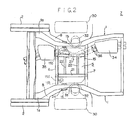
- Figure 2 is a top view of Figure 1 along line II-II;
- Figure 3 is a cross-sectional view of Figure 1 along line III-III;
- Figure 4 is an enlarged view showing a part of fuel tank chamber;
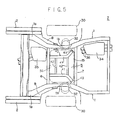
- Figure 5 is a schematic plan view of a frame work of a rear body section of a car body in accordance with another preferred embodiment of the present invention;
- Figure 6 is an enlarged perspective view showing part of support means of the rear body section of Figure 5;
- Figure 7 is a cross-sectional view of Figure 6 along line VII-VII;
- Figure 8 is a perspective view of a rear side frame assembly as a variant of a rear side frame assembly of the rear body section of Figure 5;
- Figure 9(a) through 9(d) are cross-sectional views of Figure 8 along lines A-A, B-B, C-C and D-D, respectively; and
- Figure 10 is a schematic view showing part of a trunk room.
- Referring to the drawings in detail, and, in particular, to Figures 1 - 3, details of a rear body section in which a fuel tank is installed, generally designated by a reference character Z, are illustrated. The rear body section Z includes a pair of, i.e., left and right,
rear side frames 1 located on opposite sides thereof. Eachrear side frame 1 is welded, or otherwise secured, at itsfront end 1a to rear end of a pair of, i.e., left and right,side sills - A
wheel housing 8 for enclosing arear wheel 8 is secured to the outer side of a front half section, between thefront end 1a and mid portion 1b, of eachrear side frame 1. Therear wheels 8 are operationally connected to an engine mounted in a front engine room (both not shown) via a reardifferential gear 31 located under therear side frames 1 of the car body between the mid portions 1b of therear side frames 1. Anexhaust pipe 36, provided with a main and asub-silencer rear side frames 1. Designated by areference numeral 32 is a suspension tower. - As is clearly shown in Figure 1, a
rear floor panel 3 for a passenger compartment orroom 10 is welded, or otherwise secured to upper surfaces of both therear side frames 1. Thisrear floor panel 3 comprises a floor section 3a, as a floor of thepassenger room 10; arear wall section 3b inclined rearward up at a proper angle with respect to the floor section 3a and extending near the top end 11a of a rear sheet 11 to be located in thepassenger room 10, as a partition between thepassenger room 10 and a rear trunk compartment orroom 9; and a trim section 3c bent rearward from therear wall section 3b and extending rearward from the top of therear wall section 3b, all sections 3a - 3c being formed integrally. In order to reinforce a transitional portion 3d of therear floor panel 3 between the floor section 3a andrear wall section 3b, afront cross beam 6, transversely extending between therear side frames 1, is secured to the back of therear wall section 3b of therear floor panel 3. Thisfront cross beam 6 has its under surface 6a serving as a reference surface for bolting support means 20 thereto which will be described later. -
Trunk floor panel 4 is installed behind therear wall section 3b of therear floor panel 3 and comprises a upper front floor section 4a, extending horizontally rearward from therear wall section 3b and secured, approximately at the mid portion of height of therear wall section 3b, to the back surface of the rear wall section 3a of therear floor panel 3; awall section 4b bent down at approximately a right dangle from the upper front floor section 4a; and a lowerrear floor section 4c bent approximately at a right dangle and extending horizontally rearward from the lower end of thewall section 4b. All the sections 4a - 4c are made integrally. In order to reinforce atransitional portion 4d between thewall section 4b and lowerrear floor section 4c, arear cross beam 7, transversely extending between therear side frames 1, is secured to the under surface of the lowerrear floor section 4c of thetrunk floor panel 4. Thisrear cross beam 6 also has its under surface 7a serving as a reference surface for bolting the support means 20 thereto. - The
rear floor panel 3 andtrunk floor panel 4, thus shaped and connected to each other, forms a desired dimension of space orfuel tank chamber 5 with a bottom opening 5a (see Figure 4), defined by therear wall section 3b of therear floor panel 3, the upper front floor andwall sections 4a and 4b of thetrunk floor panel 4 and the left andright side frames 1, behind therear wall section 3b of therear floor panel 3. - Referring to Figure 4, part of the rear body section Z surrounding a gas or
fuel tank 15 is shown, The fuel tank comprises, for instance, a generally rectangular box-shaped main housing 15' with aperipheral flange 15a which is made of a steel or a plastic. Thefuel tank 15 is formed with a pair of, or left and right,fuel outlet housings 15b wherein floats orfloat valves 15c are hinged. Eachfuel outlet housing 15b is connected with a vapor storage canister (not shown) with a fuelvapor supply conduit 15d. Eachoutlet housing 15b projects in therear trunk room 9 through an opening 4a' formed in the upper front floor section 4a of thetrunk floor panel 4 and is covered with acap 15e. Thisfloat valve 15e prevents fuel liquid in thefuel tank 15 from flowing out into the fuelvapor supply conduit 15d when the surface level of fuel liquid rises due to vibrations of the car body. Thefuel tank 15 is put in the space orfuel tank chamber 5 formed in the rear body section Z of the car body through thebottom opening 5a in the underside of the car body. Thefuel tank 15 in thefuel chamber 5 is supported by the support means 20 from its underside. - Referring back to Figure 2, the support means 20 comprises a pair of, or left and right, lengthwise extending support beams 21 and a pair of, or front and rear, connecting
beams 22 transversely extending between and connected to the support beams 21. Each supportingbeams 21, desirably made of a U-channel frame opening downward, comprises a kick-down support section 21a and front and rear sections 21b and 21c. Both ends of eachsupport beam 21 are bolted to the under surfaces 6a and 7a of the front andrear cross beams fuel tank 15 from the underside so as to install it into the rear body structure Z of the car body. Once the support means 20 has been bolted to the front andrear cross beams fuel tank 15 is stably and firmly placed on the upper surfaces of the support frames 21, particularly the kick-down support section 21a, of the support means 20. It is preferred to putcushioning members 23 between the top of the main housing 15' of thefuel tank 15 and the under surface of the upper front floor section 4a of thetrunk floor panel 4 so as to press up thefuel tank 15 against the upper front floor section 4a of thetrunk floor panel 4 and retain it firmly between the support frames 21 of the support means 20 and the upper front floor section 4a of thetrunk floor panel 4. - As is seen in Figure 3, a fuel filler, such as a
conduit 16, which extends from thefuel tank 15 to onerear side fender 33, is supported near thefuel tank 15 by a hollowcylindrical collar 24 whose bore 24a has a diameter slightly larger than that of thefuel filler conduit 16 so as to provide or form a small air gap 24b between thecollar 24 and thefuel filler conduit 16. Thecollar 24 is inserted in and secured to the leftrear side frame 1. This air gap 24b is utilized as an aerating opening. The rightrear side frame 1 is provided with a hollowcylindrical collar 25 having a bore 25a which serves as an aerating opening. - These bores 24a and 25a, i.e., heat dissipation openings of the
collars exhaust pipe 36 and trapped in upper part of thefuel tank chamber 5 unoccupied by thefuel tank 15, to escape outside thefuel tank chamber 5 therethrough, so as to prevent a rise in internal pressure in thefuel tank 15. - Otherwise, such an undesirable effect of heat generated by exhaust gas may be prevented by such sealing means as shown in Figure 4. That is, the sealing means, such as a
rubber gasket 39, is fitted to periphery of theflange 15a of the main housing 15' of thetank 15 so as to be kept in contact with both inner surfaces of thewall section rear floor panel 3 and thetrunk floor panel 4 defining thefuel tank chamber 5 when thefuel tank 15 is installed in thefuel tank chamber 5. Therubber gasket 39, when thefuel tank 15 is installed, divides the inside space of thefuel tank chamber 5 into upper andlower spaces 5b and 5c isolated from each other, so as to prevent air heated by exhaust gas from entering theupper space 5b. - The
rubber gasket 39 is preferably formed to have atop surface 39a bent inwardly up so as to serve as a guide member for thefuel tank 15 relative to the inner surfaces of thewall section rear floor panel 3 and thetrunk floor panel 4 defining thespace 5 when thefuel tank 15 is installed in thefuel tank chamber 5. - Thanks to the installation of the
fuel tank 15 into thefuel tank chamber 5 defined by the rear floor bent upwardly and downward, i.e., therear floor panel 3 bent upward and thetrunk floor panel 4 bent downward, thefuel tank 15 is completely located outside both thepassenger room 10 and thetrunk room 9; thus, thefuel tank 15 is prevented from projecting into thepassenger room 10 even when the rear floor, and hence thefuel tank chamber 5, deforms on a collision, in particular a rear-end collision, so as to protect a passenger or passengers in thepassenger room 10 of the vehicle against injury from thefuel tank 15. - The rear body structure Z which allows the
fuel tank 15 to be installed in thefuel tank chamber 5 from the underside of the car body makes the installing work of thefuel tank 15 more easier compared to the installation offuel tank 15 through thetrunk room 9. - Furthermore, the highly-rigid support means 20, comprising the support beams 21 and connecting
beams 22 constructed or assembled in parallel crosses, ensures the rigidity of structure surrounding thefuel tank chamber 5. This prevents the rear floor, and hence thefuel tank chamber 5, from deforming on a collision, so as also to protect a passenger or passengers in thepassenger room 10 of the vehicle against injury from thefuel tank 15. - In addition, the support means 20, attached and bolted to the front and
rear cross beams fuel tank 15 in thefuel tank chamber 5, eliminates the necessity of leaving a sufficient working space between thefuel tank 15 and therear wall section 3b of therear floor panel 3 and the upper front floor andwall sections 4a and 4b of thetrunk floor panel 4 defining thefuel tank chamber 5 for bolting, or otherwise securing, thefuel tank 15 to the rear body structure Z. - Referring to Figures 5 - 10 showing a rear body structure Z in accordance with another preferred embodiment of the present invention, elements which are the same in structure and function as the elements of the rear body structure shown in Figures 1 - 3 are designated by same reference numerals or characters and needed not be explained again. As is clearly shown in Figure 5, supporting
means 40, for supporting thefuel tank 15 from the underside, comprises a pair of, or left and right, lengthwise extending support beams 41 and a pair of, or front and rear, transversely extending connectingbeams 42, connected in generally parallel crosses. - As is shown in Figures 6 and 7, each supporting beams 41, made of an integral U-channel frame opening downward, comprises a kick-down
support section 41a, a front section 41b extending in a straight line with respect to the kick-downsupport section 41a, and a rear section 41c bent outward toward aside corner 48 formed betweeninner surfaces 1c and 7c of therear side frame 1 andrear cross beam 7, respectively. Atriangular corner gusset 49 is welded to both theinner surfaces 1c and 7c of therear side frame 1 andrear cross beam 7 at theside corner 48. It is to be understood that the rear body structure Z is intended to have the highest structural rigidity at theside corner 49 at each intersection of therear side frame 1 andrear cross beam 7. Thesupport beam 41 is secured, at its front end, by abolt 43 to the under surface 6c of thefront cross beam 6 through an L-shapedangle bracket 44 and is secured, at its rear end, by a bolt 46 through awasher cap 47 to an under surface 45a of the triangular corner gusset 45. - The transversely extending connecting
beams 42 are welded, or otherwise secured, to the kick-downsupport sections 41a of the support beams 41. - Once the support means 40 has been bolted to front and
rear cross beams fuel tank 15 is stably and firmly placed on the upper surfaces of thesupport sections 41a of the left and right support frames 41 of the support means 40. - The rear body structure Z is more improved so as to absorb impact, or external load, acting on the rear side frames and rear trunk floor panels during, for instance, the occurrence of a rear-end collision. As is shown in Figure 8, a rear
side frame assembly 1A comprises a kick-down, mainrear side frame 50 and six sub-frames 51 - 56 secured, as reinforcements, to the mainrear side frame 50 at proper locations. All these frames, exceptingfifth sub-frame 55, are made of a U-channel frame. The mainrear side frame 50, opening upside, has three sections;front section 50b, kick-downsection 50a and rear section 50c, and extends in a lengthwise direction of the car body between theside sill 2 and a rear bumper (not shown). - As is shown in Figures 9(a) -9(d),
first sub-frame 51, opening laterally outside, is welded, or otherwise secured, to an outer surface of thefront section 50b of the mainrear side frame 50 and to inner surface of thewheel house 8 through itsflanges 51a.Second sub-frame 52, opening upside, is inserted in the kick-downsection 50a of the mainrear side frame 50 and is welded, or otherwise secured, to an inner surface of the full length of kick-downsection 50a.Third sub-frame 53, opening upside, is welded, or otherwise secured, to upper inner sides of the full length ofsecond sub-frame 52 so as to form a closed cross-section therebetween.Fourth sub-frame 54, opening upside and formed withside flanges 54a extending over its full length, is welded, or otherwise secured, to upper inner sides of the kick-downsection 50a of the mainrear side frame 50 so as to form a closed cross-section between therear side frame 50 and third andfourth sub-frames fourth sub-frame 54 has a height sufficient to reach the upper front floor section 4a of thetrunk floor panel 4 and is welded, or otherwise secured, to both therear wall section 3b of therear floor panel 3 and the upper front floor section 4a of thetrunk floor panel 4 through theside flanges 54a. Therefore, thefourth sub-frame 54 serves as a side protection wall on and for each side of thefuel tank 15. - The kick-down
section 50a of the mainrear side frame 50, constructed as a double closed cross-section structure as apparent from Figure 9(b), has a considerably increased structural rigidity. -
Fifth sub-frame 55, in the form of a L-shaped angle frame, is inserted in the rear section 50c of the mainrear side frame 50 and is welded, or otherwise secured, to inner wall of the rear section 50c as is shown in Figure 9(c). As is seen in Figure 8, thefifth sub-frame 55 overlaps at its front end and is cut off near the front end as is indicated by a reference number 55a. Because of thefifth sub-frame 55 partly cut off, the rearside frame assembly 1A is locally weaken in structural rigidity at the junction between the second andfifth sub-frames Sixth sub-frame 56 is provided as a bumper bracket for interconnecting the mainrear side frame 50 and a rear bumper (well known in the art and not shown). Thesixth sub-frame 56, opening downside and formed withrear flanges 56a, is inserted in the rear section 50c of the mainrear side frame 50 to overlap thefifth sub-frame 55 and is welded, or otherwise secured, to upper inner surfaces of thefifth sub-frame 55 as is shown in Figure 9(d). - The rear body section Z including the rear
side frame assembly 1A has a higher structural rigidity between its front and mid portion and a lower structural rigidity between its mid and rear portion and therefore, controls and impact acting on thefuel tank 15 and thepassenger room 10 during a rear-end collision. Since the rearside frame assembly 1A is weak in structural rigidity particularly at the front end of thefifth sub-frame 55, it is easy to crush between the kick-downsection 50a and rear section 50c upon a rear-end collision, so as to effectively absorb impact load acting thereon. - The rear body structure Z is also improved to absorb impact upon a rear-end collision load by varying a structure surrounding the
trunk room 9. As is shown in Figure 10, thetrunk room 9 is typically provided with aspare tire space 60 formed by bending the lowerrear floor section 4c of thetrunk floor panel 4 in a transverse direction of the car body. Thelower floor section 4c of thetrunk floor panel 4 is formed withflanges 61 along its rear edge over its full length. Theseflanges 61 are secured to a rear wall (not shown) of thetrunk room 9. The lowerrear floor section 4c of thetrunk floor panel 4 is also formed withnotches 62 in the rear edge on both sides of the space, such as aspear tire chamber 60. Because external load, acting on thetrunk floor panel 4 during a rear-end collision, concentrates on thenotches 62, the lowerrear floor section 4c of thetrunk floor panel 4 cracks along crack lines D, which will develops in the lengthwise direction from thenotches 62, as is shown in Figure 10. The higher the external load acting on the rear body structure Z from its rear end is, the larger the cracks become; and a spear tire 63 (see Figure 1) bends down the part E of lowerrear floor section 4c between the crack lines D, as is shown in Figure 1, and slides down on the part E. As a result, thetrunk floor panel 4 can be crashed in a wide area upon a collision, so as to effectively absorb the external load acting thereon during the occurrence of a rear-end collision. Furthermore, because thespear tire 63 will slides down upon a rear-end collision, thefuel tank 15 is protected against deformation by thespear tire 63. For a neat edge line of the lowerrear floor section 4c of thetrunk floor panel 4, a seal member, such as a plastic closer 64 may be attached to eachnotch 62. - It is to be understood that whereas the invention has been described in detail with respect to a preferred embodiment, nevertheless, various other embodiments and variants are possible which are within the spirit and scope of the invention, and such other embodiments and variants are intended to be covered by the following claims.
Claims (33)
- A rear body structure of a vehicle, comprising:
a pair of rear side frames located separately in a transverse direction of the vehicle and extending in a lengthwise direction, from front to back, of the vehicle;
a pair of cross beams extending between said pair of rear side frames and located separately in said lengthwise direction, each said cross beam being connected to said pair of cross beams so as to form side corners therebetween;
means cooperating with said pair of rear side frames and said pair of cross beams to form a fuel tank chamber with a bottom opening open in an underside of the vehicle;
a fuel tank installed in said fuel tank chamber; and
rigid means secured between one of said pair of cross beams and said side corners formed by said pair of rear side frames and the other of said pair of cross beams so as to support said fuel tank from an underside of said fuel tank. - A rear body structure as cited in claim 1, wherein said rigid means comprises a pair of support beams between and connected to one of said pair of cross beams and said side corners formed by said pair of rear side frames and the other of said pair of cross beams connected to said pair of cross beams, respectively, and a pair of connecting beams, each extending in said transverse direction and connected to said pair of support beams.
- A rear body structure as cited in claim 2, further comprising a gusset secured to said rear side frame and said pair of cross beam at said side corner, to which said support beam is connected.
- A rear body structure as cited in claim 3, wherein each said support beam comprises a kick-down section for supporting said fuel tank thereon, a front section extending from said kick-down section to said one of said pair of cross beams and a rear section extending from said kick-down section to said side corner.
- A rear body structure as cited in claim 4, wherein said connecting beams are secured to said kick-down section.
- A rear body structure as cited in claim 4, wherein each said rear side frame extends between a side shill and a rear bumper of the car body and comprises a kick-down section, a front section extending from said kick-down section to said side shill and a rear section extending from said kick-down section to said rear bumper.
- A rear body structure as cited in claim 6, wherein each said rear side frame comprises a substantially U-shaped channel frame opening upward.
- A rear body structure as cited in claim 7, wherein each said rear side frame further comprises a substantially U-shaped channel frame inserted in said kick-down section so as to form a closed cross-section in said kick-down section.
- A rear body structure as cited in claim 7, wherein each said rear side frame further comprises a substantially L-shaped angle frame inserted in said rear section, said substantially L-shaped angle frame being connected to said substantially U-shaped channel frame.
- A rear body structure as cited in claim 7, wherein said substantially L-shaped angle frame is cut off near said substantially U-shaped channel frame so as to locally weaken said rear side frame in structural rigidity.
- A rear body structure as cited in claim 3, wherein said fuel tank comprises a generally rectangular box-shaped main housing, an outlet housing, located at a front end of a top of said main housing, which projects outside said fuel tank chamber, a fuel filler conduit connected to one side of said main housing, and a fuel supply conduit connected to said outlet housing.
- A rear body structure as cited in claim 11, further comprises a float valve disposed in said outlet housing.
- A rear body structure as cited in claim 3, further comprising cushioning means disposed in said fuel tank chamber between a top of said main housing and said means.
- A rear body structure as cited in claim 3, further comprising heat dissipation means for discharging heated air in said fuel tank chamber.
- A rear body structure as cited in claim 12, wherein said heat dissipation means comprises a bore formed in upper part of said rear side frame for communicating inside and outside of said fuel tank chamber.
- A rear body structure as cited in claim 3, wherein said fuel filler conduit extends passing through said bore with leaving an air gap in said bore.
- A rear body structure as cited in claim 3, further comprising heat isolation means for isolating said fuel tank chamber from atmosphere.
- A rear body structure as cited in claim 17, said heat isolation means comprises a sealing gusset disposed in said fuel tank chamber so as to surround four sides of said fuel tank and be in contact with said means.
- A rear body structure as cited in claim 1, wherein said means comprises a floor panel of the passenger room having a floor section and a rear section bent upward from said floor section, and a floor panel of the trunk room having front and rear floor sections which are separated up and down and connected to each other, said front floor section being secured to said rear section to form said fuel tank chamber between said floor panels of the passenger room and the trunk room.
- A rear body structure as cited in claim 19, wherein said rear floor section of said floor panel of the trunk room is bend down to form a spear tire receiving space.
- A rear body structure as cited in claim 20, wherein said rear floor section of said floor panel of the trunk room is formed with a crack line on each side of said spear tire space.
- A rear body structure of a vehicle constructing at least a passenger room and a trunk room, comprising:
a pair of rear side frames located separately in a transverse direction of the vehicle and extending in a lengthwise direction, from front to back, of the vehicle;
means cooperating with said pair of rear side frames to form a fuel tank chamber with a bottom opening in an underside of the vehicle;
a fuel tank installed in said fuel tank chamber; and
rigid means extending across over said bottom opening in said lengthwise direction and secured to said means so as to support said fuel tank from an underside of said fuel tank. - A rear body structure as cited in claim 22, further comprising a pair of cross beams extending in a transverse direction of the vehicle between said pair of rear side frames and located separately on both sides of said bottom opening in said lengthwise direction, to which said rigid means is secured.
- A rear body structure as cited in claim 23, wherein said rigid means comprises a pair of support beams, each extending in said lengthwise direction and connected to said pair of cross beams, and a pair of connecting beams, each extending in said transverse direction and connected to said pair of support beams.
- A rear body structure as cited in claim 24, wherein said fuel tank comprises a generally rectangular box-shaped main housing, an outlet housing, located at a front end of a top of said main housing, which projects said fuel tank chamber, a fuel filler conduit connected to one side of said main tank housing, and a fuel supply conduit connected to said outlet housing.
- A rear body structure as cited in claim 25, further comprises a float valve disposed in said outlet housing.
- A rear body structure as cited in claim 25, further comprising cushioning means disposed in said fuel tank chamber between a top of said main housing and said means.
- A rear body structure as cited in claim 25, further comprising heat dissipation means for discharging heated air in said fuel tank chamber.
- A rear body structure as cited in claim 28, wherein said heat dissipation means comprises a bore formed in upper part of said rear side frame for communicating inside and outside of said fuel tank chamber.
- A rear body structure as cited in claim 29, wherein said fuel filler conduit extends passing through said bore with leaving an air gap in said bore.
- A rear body structure as cited in claim 25, further comprising heat isolation means for isolating said fuel tank chamber from atmosphere.
- A rear body structure as cited in claim 31, wherein said heat isolation means comprises a sealing gusset disposed in said fuel tank chamber so as to surround four sides of said fuel tank and be in contact with said means.
- A rear body structure as cited in claim 22 wherein said means comprises a floor panel of the passenger room having a floor section and a rear section bent upward from said floor section, and a floor panel of the trunk room having front and rear floor sections which are separated up and down and connected to each other, said front floor section being secured to said rear section to form said fuel tank chamber between said floor panels of the passenger room and the trunk room.
Applications Claiming Priority (4)
| Application Number | Priority Date | Filing Date | Title |
|---|---|---|---|
| JP14994889U JPH0386824U (en) | 1989-12-25 | 1989-12-25 | |
| JP149948/89 | 1989-12-25 | ||
| JP11907690U JPH0475782U (en) | 1990-11-13 | 1990-11-13 | |
| JP119076/90 | 1990-11-13 |
Publications (2)
| Publication Number | Publication Date |
|---|---|
| EP0435197A1 true EP0435197A1 (en) | 1991-07-03 |
| EP0435197B1 EP0435197B1 (en) | 1994-11-23 |
Family
ID=26456878
Family Applications (1)
| Application Number | Title | Priority Date | Filing Date |
|---|---|---|---|
| EP90125102A Expired - Lifetime EP0435197B1 (en) | 1989-12-25 | 1990-12-21 | Rear body structure of automotive vehicle |
Country Status (4)
| Country | Link |
|---|---|
| US (1) | US5195780A (en) |
| EP (1) | EP0435197B1 (en) |
| KR (1) | KR940007253Y1 (en) |
| DE (1) | DE69014286T2 (en) |
Cited By (6)
| Publication number | Priority date | Publication date | Assignee | Title |
|---|---|---|---|---|
| WO2005077737A1 (en) * | 2004-02-12 | 2005-08-25 | Daimlerchrysler Ag | Rear end for a motor vehicle |
| EP1602564A3 (en) * | 2004-06-04 | 2006-11-15 | Bayerische Motoren Werke Aktiengesellschaft | Motor vehicle |
| FR2913649A1 (en) * | 2007-03-12 | 2008-09-19 | Peugeot Citroen Automobiles Sa | Motor vehicle, has noise absorption material e.g. foam plate, placed in noise concentration space formed between floor and fuel tank, where fuel tank is mounted on underbody of case, where material is formed with cotton or glass |
| FR2957888A1 (en) * | 2010-03-29 | 2011-09-30 | Renault Sa | VEHICLE AND SUPPORT FOR ENERGY TANK |
| FR3121878A1 (en) | 2021-04-20 | 2022-10-21 | Psa Automobiles Sa | Fuel tank protection device for a motor vehicle |
| FR3122361A1 (en) | 2021-04-29 | 2022-11-04 | Psa Automobiles Sa | Device for protecting hybrid motor vehicles against impacts |
Families Citing this family (47)
| Publication number | Priority date | Publication date | Assignee | Title |
|---|---|---|---|---|
| JP3357680B2 (en) * | 1992-01-18 | 2002-12-16 | マツダ株式会社 | Lower body structure of car |
| US5560651A (en) * | 1993-03-26 | 1996-10-01 | Honda Giken Kogyo Kabushiki Kaisha | Subframe and subframe assembly |
| US5405167A (en) * | 1994-01-21 | 1995-04-11 | Hyundai Motor Company | Combined subframe and fuel tank for use in automobiles |
| JPH0834368A (en) * | 1994-07-21 | 1996-02-06 | Honda Motor Co Ltd | Automobile frame connection structure |
| JP3057474B2 (en) * | 1994-08-17 | 2000-06-26 | 本田技研工業株式会社 | Arrangement structure of canisters in vehicles |
| US5997040A (en) * | 1996-04-26 | 1999-12-07 | Honda Giken Kogyo Kabushiki Kaisha | Fuel cylinder mounting structure in motorcar |
| JP3205254B2 (en) * | 1996-05-09 | 2001-09-04 | 本田技研工業株式会社 | Vehicle fuel cylinder mounting structure |
| JP3182503B2 (en) * | 1996-08-07 | 2001-07-03 | 本田技研工業株式会社 | Fuel tank support structure |
| DE29703663U1 (en) * | 1997-02-28 | 1998-08-20 | Sommer Ulrich | Passenger cars with a supporting structure that has at least two side members |
| DE19728081C2 (en) * | 1997-07-02 | 2001-08-16 | Daimler Chrysler Ag | Lowerable rear window for a folding roof |
| US6099042A (en) * | 1997-12-05 | 2000-08-08 | Ford Global Technologies, Inc. | Fuel tank support |
| US5860687A (en) * | 1997-12-19 | 1999-01-19 | Chrysler Corporation | Vehicle spare tire storage system having stiffening plate |
| DE19829432C2 (en) * | 1998-07-01 | 2003-07-17 | Daimler Chrysler Ag | Floor structure for a self-supporting bodyshell of a motor vehicle |
| DE19843025C1 (en) | 1998-09-19 | 2000-04-20 | Daimler Chrysler Ag | Separation arrangement for a self-supporting body |
| JP2000108813A (en) * | 1998-10-02 | 2000-04-18 | Honda Motor Co Ltd | Vehicle front structure |
| JP2000168377A (en) * | 1998-12-09 | 2000-06-20 | Suzuki Motor Corp | Vehicle canister mounting structure |
| KR100324399B1 (en) * | 1999-11-26 | 2002-02-16 | 류정열 | Rear vent of car body |
| KR100333889B1 (en) * | 1999-12-21 | 2002-04-25 | 류정열 | Reinforcement structure having a member for reinforcing a frame for a motor vehicle |
| JP3864037B2 (en) * | 2000-05-24 | 2006-12-27 | 株式会社共立 | Fuel tank mounting structure |
| US6588189B2 (en) * | 2001-01-09 | 2003-07-08 | Case Corporation | Compound bend chassis frame for a harvesting machine |
| DE10149245B4 (en) * | 2001-10-05 | 2005-06-16 | Daimlerchrysler Ag | Separating arrangement for vehicle body |
| DE10153391B4 (en) * | 2001-11-01 | 2016-10-20 | GM Global Technology Operations LLC (n. d. Ges. d. Staates Delaware) | Body part with a spar to prevent damage to fuel-carrying components |
| JP4094357B2 (en) * | 2002-07-02 | 2008-06-04 | 本田技研工業株式会社 | Fuel cell vehicle body structure |
| JP3746758B2 (en) * | 2002-11-11 | 2006-02-15 | 本田技研工業株式会社 | Piping structure for fuel cell vehicles |
| US6886861B2 (en) * | 2003-02-19 | 2005-05-03 | General Motors Corporation | Trunk mounted fuel tank assembly |
| JP2005029000A (en) * | 2003-07-11 | 2005-02-03 | Honda Motor Co Ltd | Piping structure of filler pipe |
| DE102004003713A1 (en) * | 2004-01-24 | 2005-08-25 | Daimlerchrysler Ag | Storage space for fluids and gases in bodywork of road vehicle is mounted behind rear axle to increase load on rear axle for maximum traction and includes sensor and pump |
| JP4207790B2 (en) * | 2004-02-02 | 2009-01-14 | トヨタ自動車株式会社 | Lower body structure |
| JP4542516B2 (en) * | 2006-03-02 | 2010-09-15 | 本田技研工業株式会社 | Canister drainpipe |
| US20070240926A1 (en) * | 2006-04-18 | 2007-10-18 | Sung Soo Chae | Exhaust device and understructure of vehicle |
| JP4258527B2 (en) * | 2006-04-28 | 2009-04-30 | トヨタ自動車株式会社 | Vehicle exhaust heat recovery device mounting structure |
| US20080136110A1 (en) * | 2006-12-07 | 2008-06-12 | Gm Global Technology Operations, Inc. | Acoustic Perimeter Seal for Vehicle Energy Storage Module |
| JP2009126197A (en) * | 2007-11-19 | 2009-06-11 | Suzuki Motor Corp | Rear body structure |
| JP4380760B2 (en) * | 2007-11-28 | 2009-12-09 | トヨタ自動車株式会社 | Sheet holder structure |
| JP5211659B2 (en) * | 2007-11-30 | 2013-06-12 | 日産自動車株式会社 | Canister mounting structure |
| JP5493363B2 (en) * | 2008-04-15 | 2014-05-14 | 日産自動車株式会社 | Canister arrangement structure |
| JP5382494B2 (en) * | 2008-08-08 | 2014-01-08 | スズキ株式会社 | Canister mounting structure |
| JP5311203B2 (en) * | 2008-10-31 | 2013-10-09 | スズキ株式会社 | Fuel tank support structure |
| JP5299635B2 (en) * | 2009-08-26 | 2013-09-25 | スズキ株式会社 | Exhaust pipe support structure |
| JP5585277B2 (en) * | 2010-07-30 | 2014-09-10 | スズキ株式会社 | Vehicle fuel tank mounting structure |
| WO2013059679A1 (en) | 2011-10-21 | 2013-04-25 | Fisker Automotive, Inc. | Rear-wheel drive, plug-in hybrid electric vehicle modular subframe assembly and method |
| KR101488326B1 (en) | 2013-08-30 | 2015-01-30 | 현대자동차주식회사 | Structure of engine-room |
| JP6098622B2 (en) * | 2014-12-05 | 2017-03-22 | マツダ株式会社 | Rear body structure of automobile |
| JP6558524B2 (en) * | 2015-03-17 | 2019-08-14 | 三菱自動車工業株式会社 | Canister layout |
| JP6452044B2 (en) * | 2015-04-02 | 2019-01-16 | スズキ株式会社 | Rear body structure of automobile |
| KR101703596B1 (en) * | 2015-07-24 | 2017-02-07 | 현대자동차 주식회사 | Front vehicle body structure |
| JP7295075B2 (en) * | 2020-09-04 | 2023-06-20 | トヨタ自動車株式会社 | Trailing arm mounting structure |
Citations (6)
| Publication number | Priority date | Publication date | Assignee | Title |
|---|---|---|---|---|
| US3014730A (en) * | 1959-10-01 | 1961-12-26 | Gen Motors Corp | Motor vehicle fuel tank installation |
| US3661419A (en) * | 1969-12-09 | 1972-05-09 | Mitsubishi Motors Corp | Rear body construction for an automobile |
| EP0035739A1 (en) * | 1980-03-07 | 1981-09-16 | Nissan Motor Co., Ltd. | Fuel tank fitting structure |
| DE3409667A1 (en) * | 1984-03-16 | 1985-09-26 | Audi AG, 8070 Ingolstadt | Rear part of a motor vehicle |
| JPS6161227U (en) * | 1984-09-28 | 1986-04-24 | ||
| DE3711781A1 (en) * | 1986-04-11 | 1987-10-15 | Italiana Serrature Torino | VENTILATION PIPE SYSTEM FOR A VEHICLE FUEL TANK |
Family Cites Families (9)
| Publication number | Priority date | Publication date | Assignee | Title |
|---|---|---|---|---|
| DE1964124A1 (en) * | 1969-12-22 | 1971-07-08 | Opel Adam Ag | Fuel tanks, in particular for motor vehicles |
| DE2849485A1 (en) * | 1978-11-15 | 1980-05-22 | Daimler Benz Ag | PASSENGER VEHICLE WITH A FUEL TANK REAR SEATS |
| JPS57134325A (en) * | 1981-02-10 | 1982-08-19 | Nissan Motor Co Ltd | Supporting device of fuel tank for automobile |
| JPS57205227A (en) * | 1981-06-12 | 1982-12-16 | Toyota Motor Corp | Structure for supporting fuel tank of automobile |
| JPS597144A (en) * | 1982-07-05 | 1984-01-14 | Daicel Chem Ind Ltd | Preparation of malonic acid monoamide sulfate |
| JPS59190023A (en) * | 1983-04-09 | 1984-10-27 | Nissan Motor Co Ltd | Protective structure of fuel tank made of resin |
| US4723810A (en) * | 1984-06-18 | 1988-02-09 | Mazda Motor Corporation | Underbody structure for vehicle |
| JPS61291217A (en) * | 1985-06-18 | 1986-12-22 | Nissan Motor Co Ltd | Evaporated-fuel effluence preventing apparatus for fuel tank for vehicle |
| JPH0620823B2 (en) * | 1985-09-20 | 1994-03-23 | 日産自動車株式会社 | Fuel vent tube piping structure |
-
1990
- 1990-12-21 DE DE69014286T patent/DE69014286T2/en not_active Expired - Fee Related
- 1990-12-21 EP EP90125102A patent/EP0435197B1/en not_active Expired - Lifetime
- 1990-12-24 US US07/630,974 patent/US5195780A/en not_active Expired - Fee Related
- 1990-12-24 KR KR2019900020776U patent/KR940007253Y1/en not_active Expired - Fee Related
Patent Citations (6)
| Publication number | Priority date | Publication date | Assignee | Title |
|---|---|---|---|---|
| US3014730A (en) * | 1959-10-01 | 1961-12-26 | Gen Motors Corp | Motor vehicle fuel tank installation |
| US3661419A (en) * | 1969-12-09 | 1972-05-09 | Mitsubishi Motors Corp | Rear body construction for an automobile |
| EP0035739A1 (en) * | 1980-03-07 | 1981-09-16 | Nissan Motor Co., Ltd. | Fuel tank fitting structure |
| DE3409667A1 (en) * | 1984-03-16 | 1985-09-26 | Audi AG, 8070 Ingolstadt | Rear part of a motor vehicle |
| JPS6161227U (en) * | 1984-09-28 | 1986-04-24 | ||
| DE3711781A1 (en) * | 1986-04-11 | 1987-10-15 | Italiana Serrature Torino | VENTILATION PIPE SYSTEM FOR A VEHICLE FUEL TANK |
Cited By (10)
| Publication number | Priority date | Publication date | Assignee | Title |
|---|---|---|---|---|
| WO2005077737A1 (en) * | 2004-02-12 | 2005-08-25 | Daimlerchrysler Ag | Rear end for a motor vehicle |
| EP1602564A3 (en) * | 2004-06-04 | 2006-11-15 | Bayerische Motoren Werke Aktiengesellschaft | Motor vehicle |
| FR2913649A1 (en) * | 2007-03-12 | 2008-09-19 | Peugeot Citroen Automobiles Sa | Motor vehicle, has noise absorption material e.g. foam plate, placed in noise concentration space formed between floor and fuel tank, where fuel tank is mounted on underbody of case, where material is formed with cotton or glass |
| FR2957888A1 (en) * | 2010-03-29 | 2011-09-30 | Renault Sa | VEHICLE AND SUPPORT FOR ENERGY TANK |
| WO2011121202A1 (en) * | 2010-03-29 | 2011-10-06 | Renault S.A.S. | Vehicle and associated energy reservoir support |
| CN102905959A (en) * | 2010-03-29 | 2013-01-30 | 雷诺股份公司 | Vehicles and associated accumulator supports |
| US8646830B2 (en) | 2010-03-29 | 2014-02-11 | Renault S.A.S. | Vehicle and associated energy reservoir support |
| FR3121878A1 (en) | 2021-04-20 | 2022-10-21 | Psa Automobiles Sa | Fuel tank protection device for a motor vehicle |
| WO2022223895A1 (en) | 2021-04-20 | 2022-10-27 | Psa Automobiles Sa | Device for protecting a fuel tank for a motor vehicle |
| FR3122361A1 (en) | 2021-04-29 | 2022-11-04 | Psa Automobiles Sa | Device for protecting hybrid motor vehicles against impacts |
Also Published As
| Publication number | Publication date |
|---|---|
| US5195780A (en) | 1993-03-23 |
| DE69014286D1 (en) | 1995-01-05 |
| EP0435197B1 (en) | 1994-11-23 |
| DE69014286T2 (en) | 1995-06-29 |
| KR910011431U (en) | 1991-07-29 |
| KR940007253Y1 (en) | 1994-10-17 |
Similar Documents
| Publication | Publication Date | Title |
|---|---|---|
| EP0435197B1 (en) | Rear body structure of automotive vehicle | |
| JP4298940B2 (en) | Car body rear structure | |
| JP4477246B2 (en) | Sub-frame | |
| KR950010168Y1 (en) | Structure of side bodies of an automotive vehicle | |
| KR100491670B1 (en) | Fuel tank mounting structure for fuel-cell vehicle | |
| JP4500856B2 (en) | Car body rear structure | |
| CN113247115B (en) | Vehicle bulkhead and method of manufacturing a vehicle | |
| CN115503835A (en) | Vehicle Front Structure | |
| KR940010695B1 (en) | Vehicle rear body structure | |
| JP5703145B2 (en) | Vehicle front body | |
| CN114620131A (en) | Vehicle body structure | |
| JP4894613B2 (en) | Bumper mounting structure for vehicles | |
| JP5690669B2 (en) | Vehicle front body | |
| JP5636340B2 (en) | Vehicle front body | |
| JP4935968B2 (en) | Auto body structure | |
| KR100424016B1 (en) | Reinforcing structure of side panel for body | |
| JPS6136453Y2 (en) | ||
| JP2996038B2 (en) | Car rear body structure | |
| JPH0416777Y2 (en) | ||
| KR200197176Y1 (en) | Lateral Rigidity Reinforcement Structure | |
| JP2001106120A (en) | Lower body structure of vehicle | |
| JPS63265776A (en) | Front body structure of vehicle | |
| KR100268686B1 (en) | Side seal and side outer member coupling structure of automobile | |
| KR200216708Y1 (en) | Reinforcement member of the lower body of automobile | |
| JPH065960Y2 (en) | Vehicle suspension tower structure |
Legal Events
| Date | Code | Title | Description |
|---|---|---|---|
| PUAI | Public reference made under article 153(3) epc to a published international application that has entered the european phase |
Free format text: ORIGINAL CODE: 0009012 |
|
| AK | Designated contracting states |
Kind code of ref document: A1 Designated state(s): DE |
|
| 17P | Request for examination filed |
Effective date: 19910906 |
|
| 17Q | First examination report despatched |
Effective date: 19930609 |
|
| GRAA | (expected) grant |
Free format text: ORIGINAL CODE: 0009210 |
|
| AK | Designated contracting states |
Kind code of ref document: B1 Designated state(s): DE |
|
| REF | Corresponds to: |
Ref document number: 69014286 Country of ref document: DE Date of ref document: 19950105 |
|
| PLBE | No opposition filed within time limit |
Free format text: ORIGINAL CODE: 0009261 |
|
| STAA | Information on the status of an ep patent application or granted ep patent |
Free format text: STATUS: NO OPPOSITION FILED WITHIN TIME LIMIT |
|
| 26N | No opposition filed | ||
| PGFP | Annual fee paid to national office [announced via postgrant information from national office to epo] |
Ref country code: DE Payment date: 19951222 Year of fee payment: 6 |
|
| PG25 | Lapsed in a contracting state [announced via postgrant information from national office to epo] |
Ref country code: DE Effective date: 19970902 |