EP0435162A2 - Verfahren zur selektiven Dehydrohalogenierung von einer Alkylhalogenidmischung - Google Patents
Verfahren zur selektiven Dehydrohalogenierung von einer Alkylhalogenidmischung Download PDFInfo
- Publication number
- EP0435162A2 EP0435162A2 EP90124839A EP90124839A EP0435162A2 EP 0435162 A2 EP0435162 A2 EP 0435162A2 EP 90124839 A EP90124839 A EP 90124839A EP 90124839 A EP90124839 A EP 90124839A EP 0435162 A2 EP0435162 A2 EP 0435162A2
- Authority
- EP
- European Patent Office
- Prior art keywords
- column
- olefins
- distillation
- liquid
- alkylhalides
- Prior art date
- Legal status (The legal status is an assumption and is not a legal conclusion. Google has not performed a legal analysis and makes no representation as to the accuracy of the status listed.)
- Withdrawn
Links
- 238000000034 method Methods 0.000 title claims abstract description 21
- 238000006704 dehydrohalogenation reaction Methods 0.000 title claims abstract description 13
- 150000001350 alkyl halides Chemical class 0.000 title claims description 7
- 150000001336 alkenes Chemical class 0.000 claims abstract description 49
- 150000001347 alkyl bromides Chemical group 0.000 claims abstract description 21
- 150000005375 primary alkyl halides Chemical class 0.000 claims abstract description 18
- 150000005376 secondary alkyl halides Chemical class 0.000 claims abstract description 17
- 150000005377 tertiary alkyl halides Chemical class 0.000 claims abstract description 17
- 239000007788 liquid Substances 0.000 claims description 39
- 238000009835 boiling Methods 0.000 claims description 19
- 229910000039 hydrogen halide Inorganic materials 0.000 claims description 17
- 239000012433 hydrogen halide Substances 0.000 claims description 17
- 238000010992 reflux Methods 0.000 claims description 12
- 230000001174 ascending effect Effects 0.000 claims description 5
- 230000000630 rising effect Effects 0.000 claims description 2
- CPELXLSAUQHCOX-UHFFFAOYSA-N Hydrogen bromide Chemical compound Br CPELXLSAUQHCOX-UHFFFAOYSA-N 0.000 abstract description 14
- 238000006243 chemical reaction Methods 0.000 abstract description 10
- 229910000042 hydrogen bromide Inorganic materials 0.000 abstract description 7
- 238000007269 dehydrobromination reaction Methods 0.000 abstract description 6
- 239000011541 reaction mixture Substances 0.000 abstract 1
- JRZJOMJEPLMPRA-UHFFFAOYSA-N olefin Natural products CCCCCCCC=C JRZJOMJEPLMPRA-UHFFFAOYSA-N 0.000 description 16
- 239000000203 mixture Substances 0.000 description 15
- 239000000047 product Substances 0.000 description 11
- 238000004821 distillation Methods 0.000 description 7
- 150000003512 tertiary amines Chemical class 0.000 description 5
- 239000007795 chemical reaction product Substances 0.000 description 3
- 230000001419 dependent effect Effects 0.000 description 3
- 238000011084 recovery Methods 0.000 description 3
- 238000000926 separation method Methods 0.000 description 3
- 230000000694 effects Effects 0.000 description 2
- 239000007789 gas Substances 0.000 description 2
- 239000012263 liquid product Substances 0.000 description 2
- 238000012856 packing Methods 0.000 description 2
- 230000008016 vaporization Effects 0.000 description 2
- -1 1° alkylbromides Chemical class 0.000 description 1
- 230000015572 biosynthetic process Effects 0.000 description 1
- 230000000052 comparative effect Effects 0.000 description 1
- 239000012141 concentrate Substances 0.000 description 1
- 238000009833 condensation Methods 0.000 description 1
- 230000005494 condensation Effects 0.000 description 1
- 238000011109 contamination Methods 0.000 description 1
- 238000005336 cracking Methods 0.000 description 1
- 230000009977 dual effect Effects 0.000 description 1
- 238000005647 hydrohalogenation reaction Methods 0.000 description 1
- 239000000543 intermediate Substances 0.000 description 1
- 239000007791 liquid phase Substances 0.000 description 1
- 239000000463 material Substances 0.000 description 1
- 239000012071 phase Substances 0.000 description 1
- 238000000197 pyrolysis Methods 0.000 description 1
- 230000002441 reversible effect Effects 0.000 description 1
- 239000000344 soap Substances 0.000 description 1
- 239000007858 starting material Substances 0.000 description 1
- 239000004094 surface-active agent Substances 0.000 description 1
- 238000003786 synthesis reaction Methods 0.000 description 1
- 239000012808 vapor phase Substances 0.000 description 1
- 238000009834 vaporization Methods 0.000 description 1
- 239000004711 α-olefin Substances 0.000 description 1
Images
Classifications
-
- C—CHEMISTRY; METALLURGY
- C07—ORGANIC CHEMISTRY
- C07C—ACYCLIC OR CARBOCYCLIC COMPOUNDS
- C07C1/00—Preparation of hydrocarbons from one or more compounds, none of them being a hydrocarbon
- C07C1/26—Preparation of hydrocarbons from one or more compounds, none of them being a hydrocarbon starting from organic compounds containing only halogen atoms as hetero-atoms
- C07C1/30—Preparation of hydrocarbons from one or more compounds, none of them being a hydrocarbon starting from organic compounds containing only halogen atoms as hetero-atoms by splitting-off the elements of hydrogen halide from a single molecule
-
- Y—GENERAL TAGGING OF NEW TECHNOLOGICAL DEVELOPMENTS; GENERAL TAGGING OF CROSS-SECTIONAL TECHNOLOGIES SPANNING OVER SEVERAL SECTIONS OF THE IPC; TECHNICAL SUBJECTS COVERED BY FORMER USPC CROSS-REFERENCE ART COLLECTIONS [XRACs] AND DIGESTS
- Y02—TECHNOLOGIES OR APPLICATIONS FOR MITIGATION OR ADAPTATION AGAINST CLIMATE CHANGE
- Y02P—CLIMATE CHANGE MITIGATION TECHNOLOGIES IN THE PRODUCTION OR PROCESSING OF GOODS
- Y02P20/00—Technologies relating to chemical industry
- Y02P20/10—Process efficiency
-
- Y—GENERAL TAGGING OF NEW TECHNOLOGICAL DEVELOPMENTS; GENERAL TAGGING OF CROSS-SECTIONAL TECHNOLOGIES SPANNING OVER SEVERAL SECTIONS OF THE IPC; TECHNICAL SUBJECTS COVERED BY FORMER USPC CROSS-REFERENCE ART COLLECTIONS [XRACs] AND DIGESTS
- Y10—TECHNICAL SUBJECTS COVERED BY FORMER USPC
- Y10S—TECHNICAL SUBJECTS COVERED BY FORMER USPC CROSS-REFERENCE ART COLLECTIONS [XRACs] AND DIGESTS
- Y10S203/00—Distillation: processes, separatory
- Y10S203/06—Reactor-distillation
Definitions
- This invention relates to a process for selectively dehydrohalogenating the secondary and tertiary alkylhalide components of a mixture of primary, secondary, and tertiary alkylhalides.
- linear tertiary amines such as N-alkyldimethylamines
- a particularly desirable means of modifying the synthesis of tertiary amines from mixed olefin feeds would be to subject the mixture of primary, secondary, and tertiary alkylhalides resulting from the hydrohalogenation of a mixed olefin feed to a selective dehydrohalogenation process that would permit an easy separation of unreacted primary alkylhalide from the other components of the mixture.
- a feed constituted of a mixture of primary, secondary, and tertiary alkylhalides can be dehydrohalogenated in a distillation-reaction zone, distillation-reactor column, or vessel to simultaneously (i) convert the secondary and tertiary alkylhalides to olefins and hydrogen halide, (ii) separate off the olefins and hydrogen bromide, and (iii) concentrate the primary alkylhalides for recovery.
- the liquid alkylhalide feed stream is introduced into the distillation-reactor column, preferably above the center of the column, at a temperature and residence time sufficient to dehydrohalogenate and convert the secondary and tertiary alkylhalides, branched chain or straight chain, or both, to olefins and gaseous hydrogen halide.
- Vaporized components of the feed and gaseous hydrogen halide ascend or rise within the column, which may be packed, or preferably provided with sieve, valve, or bubble trays, or the functional equivalents thereof, while a boiling liquid is collected at the bottom of the column, where heat is applied as via a reboiler or still.
- the bottom product is constituted of a liquid rich in primary alkylhalides, whereas olefins as condensate and hydrogen halide gas are removed from the overhead, or top of the column, and a portion of the olefins returned to the column as reflux.
- the secondary and tertiary alkylhalides of the feed are converted to olefins and hydrogen halide in the dehydrohalogenation reaction, the vaporous olefin and gaseous hydrogen halide ascending within the column.
- the less volatile, or higher boiling components, notably the primary alkylhalide, are concentrated within the lower portion of the column.
- the overhead olefin product is condensed, a portion thereof is recovered, and a portion of the liquid olefin as recycle liquid, generally at, or near, its boiling point, is recycled and brought into intimate countercurrent contact with the ascending stream of vapor.
- the hydrogen halide is separately recovered as a product.
- the distillation-reactor In its operation and function, the distillation-reactor is dual functional. It is a vessel or enclosure wherein the secondary and tertiary alkylhalides components of the feed are dehydrohalogenated to form olefins and hydrogen halide. However, it also functions as a distillation column to separate out any unreacted feed components, particularly the primary alkylhalides, from the reaction products, notably the olefins and hydrogen halide formed from the secondary and tertiary alkylhalides in the dehydrohalogenation reaction.
- the olefins can be recovered as high purity coproducts; reactor time is reduced; and there is minimal loss, if any, of primary linear alkylhalides.
- the selective dehydrohalogenation reaction and distillation are carried out continuously in a single piece of equipment.
- the process of this invention is particularly applicable to the selective dehydrobromination of an admixture of primary, secondary and tertiary alkylbromides; whether the alkylbromides are branched chain or linear, or both.
- an alkylbromide feed stream of this composition readily simultaneously (i) converts the secondary and tertiary alkylbromide to olefins and hydrogen bromide, (ii) separates the olefins and hydrogen bromide from the reacting mixture, these components being evolved from the top of the column, and (iii) separates the primary alkylbromide from the reacting mixture, this component being removed from the bottom of the column.
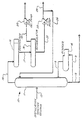
- FIGURE schematically depicts a side elevation view of a preferred distillation-reactor, as used in carrying out the selective dehydrobromination of a feed constituted of an admixture of primary, secondary and tertiary alkylhalides, with the simultaneous separation of olefin and hydrogen halide coproducts from the top of the distillation-reactor, and separation of primary alkylhalide from the bottom of the distillation-reactor.
- the principle of operation of the distillation-reactor will be understood by reference to the following detailed description which makes direct reference to the FIGURE in describing a typical operation.
- the distillation-reactor 10 is constituted of a column formed by an enclosing wall 11, provided with a feed inlet 12, bottom liquid product outlet 13, a reboiler 14, or still, and overhead vapor outlet 15 for removal of coproducts.
- the vaporous coproducts removed from the top of distillation-reactor 10 are heat exchanged and at least partially liquified within a condenser 16 at the top of the column.
- the coproducts from the condenser 16 are passed via line 17 to an accumulator 18.
- a gaseous hydrogen halide product is removed via a gas outlet from the top of the accumulator 18, with the aid of a vacuum pump 20, and pumped via line 19 to a recovery vessel; or recycled.
- a liquid olefin coproduct is removed via an outlet at the bottom of the accumulator 18, and pumped through line 21 via the use of a pump 22.
- a first portion of the liquid olefin coproduct is passed via line 23 to a storage vessel for recovery, while a second portion of the liquid olefin product is recycled to the top of the column 11 via line 24 as reflux.
- the inside of the column can be provided with trays, plates or packings as typically used in distillation towers.
- trays or plates typically from about 5 to about 50, preferably from about 10 to about 20 trays or plates (actual or theoretical), are employed dependent to some extent on the amount of olefin and hydrogen halide coproduct that is to be separated, and the molecular weights of the alkylhalides contained within the feed.
- the feed is generally introduced above the middle and near the top of the column, generally at about the level where the temperature would boil off and drive a large amount of the lighter boiling components up the column, and permit a major amount of the higher boiling components to descend to the bottom of the column.
- the dehydrohalogenation takes place primarily in the bottom portion of the distillation-reactor, while the mid portion and upper portion of the distillation-reactor constitutes largely stripping and rectifying sections for minimizing the carryover of alkylhalides in the overhead olefin stream.
- the design of the column may optionally be different above and below the feed point.
- it may be chosen to have a section below the feed point consisting of trays and a section above the feed point consisting of packings.
- the section above the feed point can have a smaller diameter than the diameter of the section below the feed point.
- the feed prior to introduction via line 12 into the column, may be preheated, if desired.
- the reboiler 14 receives liquid from the bottom of the column via line 9, and returns the heated liquid to the column via line 8.
- the bottoms product is removed from the column via line 13.
- the temperature and residence time of the liquid within the column are two of the more important of the major operating variables.
- the temperature of the column and reaction is controlled by setting the temperature at the bottom of the column and by system pressure.
- the bottom temperature controls the temperature gradient established throughout the column, or temperature at the different levels of the column, and the operating pressure.
- the bottom temperature, or temperature of operation of the reboiler 14, dependent on the composition of the feed ranges from 4OO°F to 7OO°F (205-370°C), more preferably from 5OO°F to 58O°F (260-305°C).
- the bottom temperature in any given operation must, of course, be sufficiently high to maintain the temperature of the olefin stream removed from the top of the column above its dew point, at the pressure existing in the column.
- the bottom temperature should not be high enough to produce cracking, or pyrolysis.
- the column pressure generally ranges from 1 pound per square inch absolute, psia, to 45 psia (6.9-310.3 kPa), more generally from 5 psia to 20 psia (34.5-137.9 kPa).
- the residence time must be sufficient to permit essentially complete dehydrohalogenation of the secondary and tertiary olefins, and hence is dependent on feed composition. Generally, a residence time of the liquid within the column ranges from 10 minutes to 2 hours, more often from 20 minutes to 30 minutes, to complete the dehydrohalogenation of the secondary and tertiary alkylhalides.
- the distillation-reaction is carried out such that the rising vapor is contacted with a condensed portion of previously evolved vapor; a transfer of material and an exchange of heat occurring as a result of the contact. Vapor is removed from the top of the distillation-reactor the vapor is condensed and liquid olefins returned to the top of the column as reflux to produce greater enrichment of the vapor in the olefins than possible in a single distillation using the same amount of heat.
- the reflux is generally set at a liquid:distillate ratio ranging from 0.1:1 to 10:1, or higher, preferably from 0.2:1 to 2:1, based on the quantity of olefins recycled to the column vis-a-vis the quantity of olefins removed as distillate from the process as a coproduct, or coproducts.
- a feed constituting an admixture of primarily primary linear (1° linear), primary branched (1° branched), secondary and tertiary alkylbromides.
- the column was fed with the admixture at a rate of 6.5 lbs./hr. (2.9 kg/hr.), a two-minute liquid residence time was provided for each of the fifteen trays (a total of 30 minutes), and the bottom temperature of the distillation-reactor was maintained sufficient to provide a column pressure of 5 pounds per square inch absolute, psia (34.5 kPa).
- the coproducts of the distillation-reaction was removed from the column overhead at a rate of 0.6 lb./hr. (272.2 g/hr.) condensed, a portion of the olefins returned to the top of the column as liquid reflux, and the balance of the liquid olefin and hydrogenbromide recovered.
- a third demonstration run was made essentially as described with reference to the second demonstration run. Essentially the same feed and feed rate were employed as in the second demonstration run; the feed again entering on Tray 9 while the column was operated at 5 psia (34.5 kPa). In this instance however, 0.9 lb./hr. (408.2 g/hr.) of liquid reflux was returned to the overhead of this column, with the total overhead rate being 1.2 lbs./hr. (544.3 g/hr.). Product was removed from the bottom of the distillation-reactor at a rate of 5.4 lbs./hr. (2.4 kg/hr.). The data for this operation are given in Table 3
Landscapes
- Chemical & Material Sciences (AREA)
- Organic Chemistry (AREA)
- Organic Low-Molecular-Weight Compounds And Preparation Thereof (AREA)
Applications Claiming Priority (2)
| Application Number | Priority Date | Filing Date | Title |
|---|---|---|---|
| US07/456,969 US4982024A (en) | 1989-12-26 | 1989-12-26 | Process for the selective dehydrohalogenation of an admixture of alkylhalides |
| US456969 | 1989-12-26 |
Publications (2)
| Publication Number | Publication Date |
|---|---|
| EP0435162A2 true EP0435162A2 (de) | 1991-07-03 |
| EP0435162A3 EP0435162A3 (en) | 1991-10-23 |
Family
ID=23814889
Family Applications (1)
| Application Number | Title | Priority Date | Filing Date |
|---|---|---|---|
| EP19900124839 Withdrawn EP0435162A3 (en) | 1989-12-26 | 1990-12-19 | Process for the selective dehydrohalogenation of an admixture of alkylhalides |
Country Status (2)
| Country | Link |
|---|---|
| US (1) | US4982024A (de) |
| EP (1) | EP0435162A3 (de) |
Families Citing this family (36)
| Publication number | Priority date | Publication date | Assignee | Title |
|---|---|---|---|---|
| US5235112A (en) * | 1992-05-29 | 1993-08-10 | Exxon Chemical Patents Inc. | Stripper-reactor for volatile cobalt recovery |
| US5347053A (en) * | 1992-11-04 | 1994-09-13 | Albemarle Corporation | Process for preparing alkylamines |
| US5332496A (en) * | 1993-04-12 | 1994-07-26 | Electrocom Gard, Ltd. | System for performing catalytic dehalogenation of aqueous and/or non-aqueous streams |
| US7230150B2 (en) * | 2001-04-18 | 2007-06-12 | Grt, Inc. | Zone reactor |
| US6525230B2 (en) * | 2001-04-18 | 2003-02-25 | Grt, Inc. | Zone reactor |
| US7019182B2 (en) * | 2001-04-18 | 2006-03-28 | Grt, Inc. | Method of hydrocarbon preservation and environmental protection |
| US20030078456A1 (en) * | 2001-06-20 | 2003-04-24 | Aysen Yilmaz | Integrated process for synthesizing alcohols, ethers, aldehydes, and olefins from alkanes |
| US20030069452A1 (en) * | 2001-06-20 | 2003-04-10 | Sherman Jeffrey H. | Method and apparatus for synthesizing from alcohols and ethers from alkanes, alkenes, and aromatics |
| US20050192468A1 (en) * | 2001-06-20 | 2005-09-01 | Sherman Jeffrey H. | Hydrocarbon conversion process improvements |
| US7838708B2 (en) * | 2001-06-20 | 2010-11-23 | Grt, Inc. | Hydrocarbon conversion process improvements |
| US7161050B2 (en) * | 2001-06-20 | 2007-01-09 | Grt, Inc. | Method and apparatus for synthesizing olefins, alcohols, ethers, and aldehydes |
| US6639118B1 (en) | 2002-10-11 | 2003-10-28 | Mckinnie Bonnie G. | Isomerization of vinylidene olefins |
| MXPA06000470A (es) * | 2003-07-15 | 2006-08-23 | Grt Inc | Sintesis de hidrocarburos. |
| US20050171393A1 (en) * | 2003-07-15 | 2005-08-04 | Lorkovic Ivan M. | Hydrocarbon synthesis |
| US20060100469A1 (en) * | 2004-04-16 | 2006-05-11 | Waycuilis John J | Process for converting gaseous alkanes to olefins and liquid hydrocarbons |
| US7244867B2 (en) | 2004-04-16 | 2007-07-17 | Marathon Oil Company | Process for converting gaseous alkanes to liquid hydrocarbons |
| US8642822B2 (en) | 2004-04-16 | 2014-02-04 | Marathon Gtf Technology, Ltd. | Processes for converting gaseous alkanes to liquid hydrocarbons using microchannel reactor |
| US7674941B2 (en) * | 2004-04-16 | 2010-03-09 | Marathon Gtf Technology, Ltd. | Processes for converting gaseous alkanes to liquid hydrocarbons |
| US20080275284A1 (en) | 2004-04-16 | 2008-11-06 | Marathon Oil Company | Process for converting gaseous alkanes to liquid hydrocarbons |
| US8173851B2 (en) * | 2004-04-16 | 2012-05-08 | Marathon Gtf Technology, Ltd. | Processes for converting gaseous alkanes to liquid hydrocarbons |
| US20060229475A1 (en) * | 2005-04-11 | 2006-10-12 | Weiss Michael J | Synthesis of hydroxylated hydrocarbons |
| US20060229228A1 (en) * | 2005-04-11 | 2006-10-12 | Zachary John Anthony Komon | Method of making alkoxylates |
| KR101335397B1 (ko) * | 2006-02-03 | 2013-12-02 | 지알티, 인코포레이티드 | 할로겐으로부터 가벼운 기체를 분리하는 방법 |
| CN101484406B (zh) | 2006-02-03 | 2014-01-22 | Grt公司 | 天然气转化为液体烃的连续方法 |
| US20080314758A1 (en) * | 2007-05-14 | 2008-12-25 | Grt, Inc. | Process for converting hydrocarbon feedstocks with electrolytic recovery of halogen |
| CN101765574A (zh) | 2007-05-24 | 2010-06-30 | Grt公司 | 使卤化氢可逆性俘获与释放相结合的区域反应器 |
| US8282810B2 (en) * | 2008-06-13 | 2012-10-09 | Marathon Gtf Technology, Ltd. | Bromine-based method and system for converting gaseous alkanes to liquid hydrocarbons using electrolysis for bromine recovery |
| NZ591207A (en) * | 2008-07-18 | 2013-03-28 | Grt Inc | Continuous process for converting natural gas to liquid hydrocarbons |
| WO2010124041A1 (en) * | 2009-04-22 | 2010-10-28 | Grt, Inc. | Process for converting hydrocarbon feedstocks with electrolytic and photoelectrocatalytic recovery of halogens |
| US8367884B2 (en) | 2010-03-02 | 2013-02-05 | Marathon Gtf Technology, Ltd. | Processes and systems for the staged synthesis of alkyl bromides |
| US8198495B2 (en) | 2010-03-02 | 2012-06-12 | Marathon Gtf Technology, Ltd. | Processes and systems for the staged synthesis of alkyl bromides |
| US8815050B2 (en) | 2011-03-22 | 2014-08-26 | Marathon Gtf Technology, Ltd. | Processes and systems for drying liquid bromine |
| US8436220B2 (en) | 2011-06-10 | 2013-05-07 | Marathon Gtf Technology, Ltd. | Processes and systems for demethanization of brominated hydrocarbons |
| US8829256B2 (en) | 2011-06-30 | 2014-09-09 | Gtc Technology Us, Llc | Processes and systems for fractionation of brominated hydrocarbons in the conversion of natural gas to liquid hydrocarbons |
| US8802908B2 (en) | 2011-10-21 | 2014-08-12 | Marathon Gtf Technology, Ltd. | Processes and systems for separate, parallel methane and higher alkanes' bromination |
| US9193641B2 (en) | 2011-12-16 | 2015-11-24 | Gtc Technology Us, Llc | Processes and systems for conversion of alkyl bromides to higher molecular weight hydrocarbons in circulating catalyst reactor-regenerator systems |
Family Cites Families (4)
| Publication number | Priority date | Publication date | Assignee | Title |
|---|---|---|---|---|
| NL293359A (de) * | 1962-06-02 | |||
| US3240834A (en) * | 1962-07-02 | 1966-03-15 | Phillips Petroleum Co | Dehydrohalogenation of hydrocarbon halides |
| US3257472A (en) * | 1962-09-10 | 1966-06-21 | Phillips Petroleum Co | Dehydrohalogenation |
| US4024189A (en) * | 1975-06-02 | 1977-05-17 | Ethyl Corporation | Chemical process |
-
1989
- 1989-12-26 US US07/456,969 patent/US4982024A/en not_active Expired - Fee Related
-
1990
- 1990-12-19 EP EP19900124839 patent/EP0435162A3/en not_active Withdrawn
Also Published As
| Publication number | Publication date |
|---|---|
| US4982024A (en) | 1991-01-01 |
| EP0435162A3 (en) | 1991-10-23 |
Similar Documents
| Publication | Publication Date | Title |
|---|---|---|
| EP0435162A2 (de) | Verfahren zur selektiven Dehydrohalogenierung von einer Alkylhalogenidmischung | |
| EP1003733B1 (de) | Reindarstellung von propylenoxid | |
| US3745092A (en) | Recovery and purification of ethylene oxide by distillation and absorption | |
| US4475005A (en) | Process for preparing tertiary alkyl ethers | |
| US6075168A (en) | Selective production of diethanolamine | |
| US4035242A (en) | Distillative purification of alkane sulfonic acids | |
| EP0161111B1 (de) | Reinigung von Ethylenglykol hergestellt aus Ethylenkarbonat | |
| KR102216821B1 (ko) | 분리 벽 칼럼 증류를 사용하는 머캅탄 또는 티오펜의 정제 | |
| CA2366457C (en) | Method for separating a liquid crude aldehyde mixture by distillation | |
| US4992582A (en) | Method for making isobutyric acid | |
| US5344998A (en) | Preparation of bis(fluoromethy)ether and difluoromethane | |
| US5821384A (en) | Process for generating vinyl carboxylate esters | |
| CA2169225A1 (en) | Process for cracking tertiary butyl alcohol in a reaction distillation column | |
| GB1266187A (de) | ||
| US5789632A (en) | Process of purifying 1,1,1,3,3,-pentafluoro-2,3 dichloropropane | |
| US3987121A (en) | Process for separating alpha-pinene from beta-pinene | |
| US3325532A (en) | Manufacture of adiponitrile | |
| JPH101460A (ja) | 芳香族炭酸エステルの製造方法 | |
| US3173963A (en) | Chlorinated hydrocarbon production | |
| JP3407332B2 (ja) | 1,1,1,2−テトラフルオロエタンの製造方法 | |
| EP0190790A1 (de) | Verfahren zur Reinigung von Phenol | |
| EP0170205A2 (de) | Verfahren zur Herstellung von Dihydromyrcenol oder Dihydromyrcenylacetat | |
| US3499935A (en) | Production of dichloroacetaldehyde and trichloroacetaldehyde | |
| US6242410B1 (en) | Azeotropic composition of hexafluoropropylene dimer and acetonitrile and separation process using the same | |
| US3065279A (en) | Resolution of trichloroethylene from reaction products |
Legal Events
| Date | Code | Title | Description |
|---|---|---|---|
| PUAI | Public reference made under article 153(3) epc to a published international application that has entered the european phase |
Free format text: ORIGINAL CODE: 0009012 |
|
| AK | Designated contracting states |
Kind code of ref document: A2 Designated state(s): BE DE FR GB IT |
|
| PUAL | Search report despatched |
Free format text: ORIGINAL CODE: 0009013 |
|
| AK | Designated contracting states |
Kind code of ref document: A3 Designated state(s): BE DE FR GB IT |
|
| 17P | Request for examination filed |
Effective date: 19920302 |
|
| 17Q | First examination report despatched |
Effective date: 19930909 |
|
| STAA | Information on the status of an ep patent application or granted ep patent |
Free format text: STATUS: THE APPLICATION HAS BEEN WITHDRAWN |
|
| 18W | Application withdrawn |
Withdrawal date: 19931210 |