EP0434584B1 - Dispositif d'égalisation de perturbations linéaires et non-linéaires d'un signal reçu à travers un canal de transmission perturbé - Google Patents
Dispositif d'égalisation de perturbations linéaires et non-linéaires d'un signal reçu à travers un canal de transmission perturbé Download PDFInfo
- Publication number
- EP0434584B1 EP0434584B1 EP19900460048 EP90460048A EP0434584B1 EP 0434584 B1 EP0434584 B1 EP 0434584B1 EP 19900460048 EP19900460048 EP 19900460048 EP 90460048 A EP90460048 A EP 90460048A EP 0434584 B1 EP0434584 B1 EP 0434584B1
- Authority
- EP
- European Patent Office
- Prior art keywords
- signal
- calculation
- linear
- coefficients
- equalization
- Prior art date
- Legal status (The legal status is an assumption and is not a legal conclusion. Google has not performed a legal analysis and makes no representation as to the accuracy of the status listed.)
- Expired - Lifetime
Links
Images

Classifications
-
- H—ELECTRICITY
- H04—ELECTRIC COMMUNICATION TECHNIQUE
- H04N—PICTORIAL COMMUNICATION, e.g. TELEVISION
- H04N7/00—Television systems
- H04N7/08—Systems for the simultaneous or sequential transmission of more than one television signal, e.g. additional information signals, the signals occupying wholly or partially the same frequency band, e.g. by time division
- H04N7/083—Systems for the simultaneous or sequential transmission of more than one television signal, e.g. additional information signals, the signals occupying wholly or partially the same frequency band, e.g. by time division with signal insertion during the vertical and the horizontal blanking interval, e.g. MAC data signals
-
- H—ELECTRICITY
- H04—ELECTRIC COMMUNICATION TECHNIQUE
- H04L—TRANSMISSION OF DIGITAL INFORMATION, e.g. TELEGRAPHIC COMMUNICATION
- H04L25/00—Baseband systems
- H04L25/02—Details ; arrangements for supplying electrical power along data transmission lines
- H04L25/03—Shaping networks in transmitter or receiver, e.g. adaptive shaping networks
- H04L25/03006—Arrangements for removing intersymbol interference
- H04L25/03012—Arrangements for removing intersymbol interference operating in the time domain
- H04L25/03114—Arrangements for removing intersymbol interference operating in the time domain non-adaptive, i.e. not adjustable, manually adjustable, or adjustable only during the reception of special signals
-
- H—ELECTRICITY
- H04—ELECTRIC COMMUNICATION TECHNIQUE
- H04N—PICTORIAL COMMUNICATION, e.g. TELEVISION
- H04N5/00—Details of television systems
- H04N5/14—Picture signal circuitry for video frequency region
- H04N5/21—Circuitry for suppressing or minimising disturbance, e.g. moiré or halo
- H04N5/211—Ghost signal cancellation
Definitions
- the field of the invention is that of signal processing, in receivers of transmission or broadcasting systems. More specifically, the invention relates to the equalization of such signals on reception, so as to correct the linear and non-linear disturbances induced in the transmission channel.
- the equalizer applies to all types of analog and / or digital signals, regardless of the transmission or broadcast mode.
- the device of the invention allows the equalization of television signals transmitted according to X-MAC standards.
- the invention can also be applied to other types of television signals, as well as sound signals and data signals.
- the purpose of the equalization operation is, in a known manner, to process the signal received in an equalization module whose transfer function is as close as possible to the inverse of that of the transmission channel at all times, so as to compensate for the disturbances induced in the channel.
- Linear disturbances are for example due to the distortion of the amplitude and phase responses as a function of frequency, or to echo phenomena.
- Linear distortion correction devices are known, in particular in the form of a self-adjusting equalizer adapting to a data signal, as described in patent document FR-A-2 556 530.
- equalization consists in implementing an algorithm for minimizing the mean square error in the received signal, by adjusting the filter coefficients a digital filter to equalize the received signal.
- a large number of algorithms can be envisaged, like those presented in the thesis "study and realization of an echo corrector adapted to the diffusion of DIDON data" (defended on December 9, 1983 before the University of Rennes I by M Jacques PALICOT).
- the French patent document FR-A-2 627 340 also discloses a self-adapting equalizer applicable to X-MAC type signals, and in particular to HD-MAC signals, consisting in introducing a reference signal into the time multiplex of the signals. analog images and digital sound and data signals characteristic of X-MAC signals, so as to use this reference signal to achieve adaptive equalization at reception.
- the equalization is then carried out by using an adaptive transversal filter, supplied with the samples of the HD-MAC signal, provided with means for adapting its coefficients by comparison between the reference sequence received at the output of the filter and the reference sequence memorized.
- linear equalizers act effectively on the linear disturbances, but cannot correct the non-linear disturbances, however frequently encountered in practice.
- These non-linear disturbances can in particular be due to the saturations of amplifiers, to the non-linearities of the traveling wave tubes during a satellite path, to the radio frequency selection and intermediate frequency demodulation modules of a television receiver, clipping phenomena and non-linearities related to signal quantization.
- Figures 1-A and 1-B show an example of non-linear perturbation, on a diagram of the eye corresponding to a duobinary signal.
- Figure 1-A represents the diagram of the eye without disturbance, as it is with the emission.
- the fixed thresholds 11 and 12 make it possible to easily differentiate the values 1, 0 and -1, the instant the eye is opened.
- Figure 1-B presents the same diagram of the eye, at reception, in the case of a non-linearity, which is here a saturation. It is clear that the distortion of the signal makes it largely unreadable without processing. Thus, a fixed threshold 13,14 would entail the interpretation of all the values -1 as worth 0.
- the invention aims to overcome this drawback.
- the invention aims to provide an equalization device allowing the correction of non-linear disturbances.
- a complementary objective of the invention is to provide such a device for correcting non-linear disturbances also allowing the correction of linear disturbances.
- Another objective of the invention is to provide such an equalization device compatible with the receivers of existing transmission systems.
- the equalization device of the invention can advantageously replace, in these receivers, the known equalization devices.
- the invention also aims to use known filtering means.
- said selection means comprise means for analyzing said signal and calculating at least one threshold value, and a level separator.
- the analysis of the received signal allows the positioning of the threshold (s) of the level separator, which directs the signal elements towards the desired linear filter (s).
- Said signal analysis and calculation means advantageously comprise means for detecting the non-linearities of said signal, by analysis of test lines present in said signal, such as ramps or staircase signals.
- said level selector is directly controlled by said signal.
- Said level selector can, in an even more simplified manner, be with fixed threshold (s).
- said equalization device comprises means for calculating the coefficients of said linear filters, by minimizing the mean square error.
- said means for calculating the coefficients advantageously use said digital data signal.
- the device operates on the data.
- the equalization is therefore self-adjusting.
- said means for calculating the coefficients use a reference signal inserted in the analog signal and known to said means for calculating.
- Said reference signal advantageously comprises a first pseudo-random binary sequence, combined with a second pseudo-random sequence giving the amplitudes of the binary values.
- said means for calculating the coefficients perform the calculation on a single one of said filters at each iteration, and / or on a single coefficient of each of said filters, cyclically.
- said means for calculating the coefficients take into account the average value of said signal and / or the maximum values of said signal.
- said means for calculating the coefficients take account of the threshold values calculated by said means for analyzing the signal for calculating the threshold values of the level separator.
- said means for calculating the coefficients advantageously take account of code breaks.
- said linear filters are filters with finite impulse response.
- said device behaves, in the initialization phase of the calculations of said threshold values and / or of the calculations of said coefficients, like a transparent or predetermined linear filter.
- FIGS. 2 to 5 corresponds in particular to the equalization of a signal of X-MAC type, that is to say constituted by a multiplex of a burst of sound and digital data and an analog luminance and chrominance signal, for each line of a television signal.
- the device according to the invention can operate both adaptively and self-adaptively.
- the equalization is done directly on this signal. It is then a self-adaptive equalization. This has the advantage of not requiring a learning phase.
- the device can operate on data multiplexed to the television signal, and the principle remains the same as in the case of a data signal. This principle can in particular be used in the case of D2-MAC signals.
- the equalization is done adaptively, using a signal particular reference, multiplexed to the image signal, and known to the receiver.
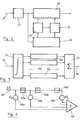
- Figure 2 shows schematically the non-linear equalization device according to the invention.
- the received signal 20, previously digitized by an anological / digital converter 21 is subjected in parallel to a non-linear filter module 22 and to a signal analysis module 23, via a memory 24.
- the signal analysis consists in detecting the non-linearities of the signal, and in determining the values of the different thresholds used by the filtering module 22 and possibly the algorithmic calculation module 25.
- the linear equalization device preferably operates at a frequency multiple of that of the data.
- the algorithmic calculation module 25 determines the values of the filter coefficients, using the stored data and an algorithm detailed below.
- Figure 3 shows the structure of the non-linear filter module. This consists of a level separator 31, at least two linear filters 32 A , 32 B , 32 C in parallel and a summator 33.
- the level separator 31 makes it possible, by comparison with thresholds, to direct the incoming data 34 to one or more linear filters 32 A , 32 B , 32 C.
- These thresholds are set by the module 23 (FIG. 2) for analyzing the signal, as detailed below.
- the values of threshold can of course be fixed. In the latter case, the calculation module 23 is deleted.
- test line existing in the signal.
- MAC type signals it can be line 312, providing a staircase signal, or line 623, providing a ramp.
- a linear filter 32 A is associated with each threshold.
- a sample of the signal is only present in a single linear filter, and passes through this same filter. It is also possible to direct, depending on the levels, the samples to several linear filters 32 A , 32 B , 32 C in parallel.
- the linear filters 32 A , 32 B , 32 C are transverse filters with finite impulse response, of known type, all comprising the same number of coefficients.
- FIG. 4 shows schematically a transverse filter with finite impulse response.
- Each sample x i 41 of the input signal crosses a chain of cells 42 A , 42 B , 42 C connected in series and each introducing a delay. This delay is for example equal to T, T being the sampling period of the received signal.
- Each of the cells is on the other hand connected to an adder 43, by means of multipliers 44 A , 44 B , 44 C.
- the multiplication coefficients of the multipliers are determined by the algorithmic calculation module 25 of FIG. 2.
- the device of the invention is also compatible with the other types of transverse filters, as well as with other types of digital filters.
- the output 35 of the non-linear filter module 22 is obtained by summing 33 from the outputs of all the linear filters.
- the equalization is self-adaptive. Any non-linear perturbation indeed affects known levels, for example binary or duobinary.
- the analysis of the signal can then consist in calculating the average value of the received signal.
- This average value is used to position the thresholds of the level separator, as well as the decision thresholds for the algorithm for calculating the coefficients of the linear filters.
- the device When the device applies to a television signal, it can also operate in a self-adaptive manner on a data signal multiplexed to the television signal. This is for example the case of signals of the D2-MAC type.
- the correction is then optimal for the data signal, but not necessarily for the image signal.
- the duobinary signal is not representative, as regards both the frequency and the amplitude, of the image signal, which consists of a set of independent samples at 20.25 MHz.
- This reference signal can be multiplexed into a line of frame suppression of the television signal. It then undergoes the same processing as the image signal. It is therefore completely representative, on reception, of this image signal.
- the reference signal being known to the receiver, the equalization device is adaptive.
- This reference signal is a pseudo-random binary signal. It can also be combined in time with a second pseudo-random sequence, giving the amplitude of "0" and "1".
- the first binary pseudo-random sequence can be: 0 1 0 1
- the second corresponding sequence can be, in the case where the value 0 normally corresponds to 0V and 0.2V and the value 1 to 0.3V and 0.4V: 0V 0.3V 0.2V 0.4V
- the algorithmic calculation module 25 is for example constituted by a specialized processor or automaton which uses the data stored in memory 24, and supplies the filter coefficients to the linear filters 32 A , 32 B , 32 C digital after calculation.
- the convergence algorithm making it possible to obtain the minimization of the criterion can be a matrix generalization of the gradient and derivative algorithms, of which one will find examples in the aforementioned thesis document, or in the prior French patent documents FR-A- 2,556,530 and FR-A-2,627,340.
- the error is given by the difference between the output of the equalizer and the estimate of this output.
- the output In order to determine the value of the estimate, the output must be compared with decision thresholds. When the algorithm works offline, this comparison is made by the simulation algorithm. On the other hand, if the algorithm works in real time, the comparison is made with the real output. The device is then automatic, and does not require any memory.
- decision thresholds can be set in the conventional way: SF1, -SF1. They can also be variable, depending on the signal.
- this type of signal having an intrinsic redundancy, to increase the speed of convergence of the algorithm by taking account in the calculation of the error code breaks, or prohibited transitions of the duobinary signal.
- the filter module 22 is, before reception of the first calculated coefficients, is transparent, that is to say that the output signal is identical to the signal input, or a predetermined filter, for example low pass.
- the non-linear filtering module 22 behaves like a linear filter.
- the non-linear disturbance equalization device also allows the equalization of linear disturbances.
- Figure 5 presents the diagram of the duobinary eye obtained after equalization of the signal represented in figure 1-B.
- the effects of non-linearity are very attenuated, and the diagram obtained is again interpretable, the threshold levels 51 and 52 making it possible to distinguish the three levels of the signal when the eye is open.
- the non-linear disturbance equalization device can be implemented in most of the existing reception devices. It can, by way of example, constitute the equalization module of the “data reception device with deferred equalization and retroactive rhythm recovery” described in patent document FR-A-2 650 137, published on 25.01.91 .
Landscapes
- Engineering & Computer Science (AREA)
- Signal Processing (AREA)
- Multimedia (AREA)
- Power Engineering (AREA)
- Computer Networks & Wireless Communication (AREA)
- Cable Transmission Systems, Equalization Of Radio And Reduction Of Echo (AREA)
- Filters That Use Time-Delay Elements (AREA)
Applications Claiming Priority (2)
| Application Number | Priority Date | Filing Date | Title |
|---|---|---|---|
| FR8917158 | 1989-12-20 | ||
| FR8917158A FR2656184B1 (enExample) | 1989-12-20 | 1989-12-20 |
Publications (2)
| Publication Number | Publication Date |
|---|---|
| EP0434584A1 EP0434584A1 (fr) | 1991-06-26 |
| EP0434584B1 true EP0434584B1 (fr) | 1995-11-22 |
Family
ID=9388940
Family Applications (1)
| Application Number | Title | Priority Date | Filing Date |
|---|---|---|---|
| EP19900460048 Expired - Lifetime EP0434584B1 (fr) | 1989-12-20 | 1990-12-17 | Dispositif d'égalisation de perturbations linéaires et non-linéaires d'un signal reçu à travers un canal de transmission perturbé |
Country Status (3)
| Country | Link |
|---|---|
| EP (1) | EP0434584B1 (enExample) |
| DE (1) | DE69023749T2 (enExample) |
| FR (1) | FR2656184B1 (enExample) |
Families Citing this family (1)
| Publication number | Priority date | Publication date | Assignee | Title |
|---|---|---|---|---|
| US5420884A (en) * | 1991-04-11 | 1995-05-30 | Canon Kabushiki Kaisha | Automatic equalizer |
Family Cites Families (3)
| Publication number | Priority date | Publication date | Assignee | Title |
|---|---|---|---|---|
| US4091418A (en) * | 1977-03-02 | 1978-05-23 | Zenith Radio Corporation | Automatic channel equalization with time base expansion |
| JPS56166620A (en) * | 1980-05-28 | 1981-12-21 | Toshiba Corp | Automatic equalizer |
| FR2627340B1 (fr) * | 1988-02-11 | 1991-10-31 | France Etat | Procede de diffusion de programme de television a haute definition et recepteur a egaliseur destine a recevoir un tel programme |
-
1989
- 1989-12-20 FR FR8917158A patent/FR2656184B1/fr not_active Expired - Fee Related
-
1990
- 1990-12-17 EP EP19900460048 patent/EP0434584B1/fr not_active Expired - Lifetime
- 1990-12-17 DE DE1990623749 patent/DE69023749T2/de not_active Expired - Fee Related
Also Published As
| Publication number | Publication date |
|---|---|
| EP0434584A1 (fr) | 1991-06-26 |
| DE69023749D1 (de) | 1996-01-04 |
| FR2656184A1 (enExample) | 1991-06-21 |
| FR2656184B1 (enExample) | 1996-10-25 |
| DE69023749T2 (de) | 1996-07-04 |
Similar Documents
| Publication | Publication Date | Title |
|---|---|---|
| CA1173965A (fr) | Procede et dispositif de detection de la sequence d'apprentissage d'un egaliseur autoadaptatif | |
| EP0013343B1 (fr) | Procédé et dispositif pour détecter une séquence pseudo-aléatoire de changements de phase de 0 degré et 180 degrés de la porteuse dans un récepteur de données | |
| FR2546008A1 (fr) | Circuit d'egalisation adaptative et de demodulation conjointes | |
| FR2623669A1 (fr) | Appareil et procede d'egalisation pour la transmission de donnees | |
| EP0576359B1 (fr) | Procédé et dispositif égaliseur à retour de décisions pour la transmission par blocs de symboles d'information | |
| CA1137176A (fr) | Procede de compensation des bruits de phase a la reception d'une transmission de donnees | |
| EP0106406A1 (fr) | Egaliseur auto-adaptatif pour signal de données en bande de base | |
| WO1995029539A1 (fr) | Procede de transmission optique presentant une sensibilite reduite a la dispersion; dispositif et systeme de transmission pour la mise en ×uvre de ce procede | |
| EP0409756B1 (fr) | Dispositif de réception de données à égalisation différée et récupération de rythme rétroactive | |
| LU82859A1 (fr) | Circuit de correction des bruits de phase pour un systeme de transmission de donnees | |
| EP0376250B1 (fr) | Dispositif d'égalisation auto-adaptative pour installation de démodulation différentiellement cohérente | |
| EP0599722B1 (fr) | Dispositif de récupération du rythme baud dans un récepteur pour modem | |
| EP0017716A1 (fr) | Procédé pour initialiser un égaliseur adaptatif à partir d'un signal de données inconnu dans un système de transmission utilisant une modulation à double bande latérale-porteuse en quadrature | |
| EP0524597B1 (fr) | Procédé itératif de réduction de l'interférence intersymbole, et dispositif de réception et application correspondants | |
| EP0230900B1 (fr) | Dispositif de récupération de rythme | |
| CA1137177A (fr) | Procede de reduction des bruits de phase a la reception d'une transmission de donnees | |
| EP1236321B1 (fr) | Egaliseur adaptatif multi-voies | |
| EP0434584A1 (fr) | Dispositif d'égalisation de perturbations linéaires et non-linéaires d'un signal reçu à travers un canal de transmission perturbé | |
| EP0981881B1 (fr) | Dispositif d'egalisation et de decodage pour un canal de transmission numerique selectif en frequence | |
| FR2724512A1 (fr) | Dispositif d'identification d'une sequence predeterminee de signaux dans un modem | |
| EP0411526B1 (fr) | Dispositif de correction des distorsions de transmission d'un signal de données en fonction des violations du code de transmission | |
| CA2057942C (fr) | Systeme recepteur pour le traitement de signaux recus sur des voies de diversite | |
| EP0328461B1 (fr) | Procédé de diffusion de programme de télévision à haute définition et récepteur à égaliseur destiné à recevoir un tel programme | |
| EP1107528B1 (fr) | Méthode de détection de blocs pour canal soumis à évanouissement | |
| EP0405679A1 (fr) | Dispositif d'égalisation autoadaptive pour des échantillons numériques codÀ©s en duobinaire |
Legal Events
| Date | Code | Title | Description |
|---|---|---|---|
| PUAI | Public reference made under article 153(3) epc to a published international application that has entered the european phase |
Free format text: ORIGINAL CODE: 0009012 |
|
| AK | Designated contracting states |
Kind code of ref document: A1 Designated state(s): DE GB IT NL |
|
| 17P | Request for examination filed |
Effective date: 19911118 |
|
| 17Q | First examination report despatched |
Effective date: 19931126 |
|
| RAP1 | Party data changed (applicant data changed or rights of an application transferred) |
Owner name: FRANCE TELECOM Owner name: TELEDIFFUSION DE FRANCE S.A. |
|
| GRAA | (expected) grant |
Free format text: ORIGINAL CODE: 0009210 |
|
| AK | Designated contracting states |
Kind code of ref document: B1 Designated state(s): DE GB IT NL |
|
| PG25 | Lapsed in a contracting state [announced via postgrant information from national office to epo] |
Ref country code: IT Free format text: LAPSE BECAUSE OF FAILURE TO SUBMIT A TRANSLATION OF THE DESCRIPTION OR TO PAY THE FEE WITHIN THE PRE;WARNING: LAPSES OF ITALIAN PATENTS WITH EFFECTIVE DATE BEFORE 2007 MAY HAVE OCCURRED AT ANY TIME BEFORE 2007. THE CORRECT EFFECTIVE DATE MAY BE DIFFERENT FROM THE ONE RECORDED.SCRIBED TIME-LIMIT Effective date: 19951122 Ref country code: NL Free format text: LAPSE BECAUSE OF NON-PAYMENT OF DUE FEES Effective date: 19951122 |
|
| REF | Corresponds to: |
Ref document number: 69023749 Country of ref document: DE Date of ref document: 19960104 |
|
| GBT | Gb: translation of ep patent filed (gb section 77(6)(a)/1977) |
Effective date: 19960111 |
|
| NLV1 | Nl: lapsed or annulled due to failure to fulfill the requirements of art. 29p and 29m of the patents act | ||
| PLBE | No opposition filed within time limit |
Free format text: ORIGINAL CODE: 0009261 |
|
| STAA | Information on the status of an ep patent application or granted ep patent |
Free format text: STATUS: NO OPPOSITION FILED WITHIN TIME LIMIT |
|
| 26N | No opposition filed | ||
| PGFP | Annual fee paid to national office [announced via postgrant information from national office to epo] |
Ref country code: DE Payment date: 19971120 Year of fee payment: 8 |
|
| PGFP | Annual fee paid to national office [announced via postgrant information from national office to epo] |
Ref country code: GB Payment date: 19981123 Year of fee payment: 9 |
|
| PG25 | Lapsed in a contracting state [announced via postgrant information from national office to epo] |
Ref country code: DE Free format text: LAPSE BECAUSE OF NON-PAYMENT OF DUE FEES Effective date: 19991001 |
|
| PG25 | Lapsed in a contracting state [announced via postgrant information from national office to epo] |
Ref country code: GB Free format text: LAPSE BECAUSE OF NON-PAYMENT OF DUE FEES Effective date: 19991217 |
|
| GBPC | Gb: european patent ceased through non-payment of renewal fee |
Effective date: 19991217 |