EP0432684A1 - Herladbarer elektrochemischer Generator, der eine Kathode auf der Basis von Vanadiumoxid enthält - Google Patents
Herladbarer elektrochemischer Generator, der eine Kathode auf der Basis von Vanadiumoxid enthält Download PDFInfo
- Publication number
- EP0432684A1 EP0432684A1 EP90123682A EP90123682A EP0432684A1 EP 0432684 A1 EP0432684 A1 EP 0432684A1 EP 90123682 A EP90123682 A EP 90123682A EP 90123682 A EP90123682 A EP 90123682A EP 0432684 A1 EP0432684 A1 EP 0432684A1
- Authority
- EP
- European Patent Office
- Prior art keywords
- discharge
- lithium
- generator according
- electrochemical
- vanadium oxide
- Prior art date
- Legal status (The legal status is an assumption and is not a legal conclusion. Google has not performed a legal analysis and makes no representation as to the accuracy of the status listed.)
- Withdrawn
Links
Images








Classifications
-
- H—ELECTRICITY
- H01—ELECTRIC ELEMENTS
- H01M—PROCESSES OR MEANS, e.g. BATTERIES, FOR THE DIRECT CONVERSION OF CHEMICAL ENERGY INTO ELECTRICAL ENERGY
- H01M4/00—Electrodes
- H01M4/02—Electrodes composed of, or comprising, active material
- H01M4/36—Selection of substances as active materials, active masses, active liquids
- H01M4/48—Selection of substances as active materials, active masses, active liquids of inorganic oxides or hydroxides
- H01M4/485—Selection of substances as active materials, active masses, active liquids of inorganic oxides or hydroxides of mixed oxides or hydroxides for inserting or intercalating light metals, e.g. LiTi2O4 or LiTi2OxFy
-
- H—ELECTRICITY
- H01—ELECTRIC ELEMENTS
- H01M—PROCESSES OR MEANS, e.g. BATTERIES, FOR THE DIRECT CONVERSION OF CHEMICAL ENERGY INTO ELECTRICAL ENERGY
- H01M4/00—Electrodes
- H01M4/02—Electrodes composed of, or comprising, active material
- H01M4/36—Selection of substances as active materials, active masses, active liquids
- H01M4/58—Selection of substances as active materials, active masses, active liquids of inorganic compounds other than oxides or hydroxides, e.g. sulfides, selenides, tellurides, halogenides or LiCoFy; of polyanionic structures, e.g. phosphates, silicates or borates
-
- H—ELECTRICITY
- H01—ELECTRIC ELEMENTS
- H01M—PROCESSES OR MEANS, e.g. BATTERIES, FOR THE DIRECT CONVERSION OF CHEMICAL ENERGY INTO ELECTRICAL ENERGY
- H01M10/00—Secondary cells; Manufacture thereof
- H01M10/05—Accumulators with non-aqueous electrolyte
- H01M10/052—Li-accumulators
-
- H—ELECTRICITY
- H01—ELECTRIC ELEMENTS
- H01M—PROCESSES OR MEANS, e.g. BATTERIES, FOR THE DIRECT CONVERSION OF CHEMICAL ENERGY INTO ELECTRICAL ENERGY
- H01M10/00—Secondary cells; Manufacture thereof
- H01M10/05—Accumulators with non-aqueous electrolyte
- H01M10/056—Accumulators with non-aqueous electrolyte characterised by the materials used as electrolytes, e.g. mixed inorganic/organic electrolytes
- H01M10/0564—Accumulators with non-aqueous electrolyte characterised by the materials used as electrolytes, e.g. mixed inorganic/organic electrolytes the electrolyte being constituted of organic materials only
- H01M10/0566—Liquid materials
- H01M10/0569—Liquid materials characterised by the solvents
-
- H—ELECTRICITY
- H01—ELECTRIC ELEMENTS
- H01M—PROCESSES OR MEANS, e.g. BATTERIES, FOR THE DIRECT CONVERSION OF CHEMICAL ENERGY INTO ELECTRICAL ENERGY
- H01M4/00—Electrodes
- H01M4/02—Electrodes composed of, or comprising, active material
- H01M4/13—Electrodes for accumulators with non-aqueous electrolyte, e.g. for lithium-accumulators; Processes of manufacture thereof
- H01M4/131—Electrodes based on mixed oxides or hydroxides, or on mixtures of oxides or hydroxides, e.g. LiCoOx
-
- Y—GENERAL TAGGING OF NEW TECHNOLOGICAL DEVELOPMENTS; GENERAL TAGGING OF CROSS-SECTIONAL TECHNOLOGIES SPANNING OVER SEVERAL SECTIONS OF THE IPC; TECHNICAL SUBJECTS COVERED BY FORMER USPC CROSS-REFERENCE ART COLLECTIONS [XRACs] AND DIGESTS
- Y02—TECHNOLOGIES OR APPLICATIONS FOR MITIGATION OR ADAPTATION AGAINST CLIMATE CHANGE
- Y02E—REDUCTION OF GREENHOUSE GAS [GHG] EMISSIONS, RELATED TO ENERGY GENERATION, TRANSMISSION OR DISTRIBUTION
- Y02E60/00—Enabling technologies; Technologies with a potential or indirect contribution to GHG emissions mitigation
- Y02E60/10—Energy storage using batteries
Definitions
- the present invention relates to a rechargeable electrochemical generator with lithium anode and nonaqueous electrolyte, comprising a cathodic material based on vanadium oxide V2O5.
- V2O5 vanadium oxide
- V2O5 is a product which is easy to obtain and to use industrially in the form of electrodes.
- the object of the invention is to increase the mass energy of rechargeable electrochemical generators comprising vanadium oxide as cathode material.
- the subject of the present invention is a rechargeable electrochemical generator, the anode of which is based on lithium or on lithium alloy, the electrolyte of which consists of a solution of a lithium salt in a non-aqueous solvent, and the cathodic material is based on crystallized vanadium oxide, characterized in that said vanadium oxide contains a ⁇ phase, resulting from the chemical or electrochemical oxidation of a LiV2O5 ⁇ phase obtained by insertion into said oxide a number of lithium atoms per mole of V2O5 between 0.9 and 2.
- said cathode material has, in electrochemical cycling between 2.0 V and 3.8 V, a capacity of at least 0.6 Faradays / mole for a discharge voltage greater than 3.3 volts.
- the discharge characteristic curve comprises several distinct voltage levels located above 3 volts and a voltage level located substantially at 2.3 volts.
- said cathode material present in cycling with a limited discharge depth, that is to say less than a value of 0.5 Faraday per mole, an average discharge voltage greater than 3.5 volts.
- said material is obtained in situ by an initial partial or total discharge of the generator below 3 V to the first bearing located at around 2.3 V and a subsequent charge up to 3.8 V.
- the discharge should not be continued on the plateau below about 2 V because, in this case, the structure of the material would be destroyed and the electrochemical characteristics would be profoundly altered: modification of the shape of the charge-discharge curves and loss of reversibility in cycling as already mentioned previously.
- said cathode material is obtained by chemical oxidation of LiV2O5 ⁇ treated with a solution of an oxidant such as bromine in acetonitrile at room temperature; the bromine concentration can be 0.1 mol / liter.
- the non-aqueous electrolyte of a generator according to the invention consists of a solvent, chosen from linear or cyclic ethers, esters or their mixtures, and a solute chosen from LiAsF6, LiCF3SO3, LiBF4, LiPF6, LiClO4 and their mixtures ;
- the electrolyte is a solution of LiAsF6 in a mixture of propylene carbonate, ethylene carbonate.
- the electrolyte is a solution of LiAsF6 in a mixture of propylene carbonate, ethylene carbonate and dimethoxyethane.
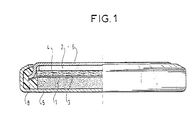
- FIG. 1 very schematically shows in semi-cut view an example of a button type rechargeable electrochemical generator.
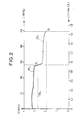
- Figure 2 shows the first discharge curves of two buttons B1 of the prior art and B2 according to the invention up to 2.8 V and 2.0 V respectively.
- Figure 3 shows the curves of first charge up to 3.8 V performed on the buttons B1 and B2 after the discharge of Figure 2.
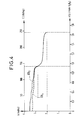
- Figure 4 shows the curves of the second discharge of the two buttons B1 and B2 respectively up to 2.8 V and 2.0 V.
- FIG. 5 shows the curves of evolution of the specific capacity of the cathode material of the two buttons B1 and B2 as a function of the number of cycles n.
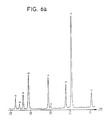
- FIG. 6a shows the diffraction diagram "X" of the commercial oxide V2O5 ⁇ .
- FIG. 6b shows the diffraction diagram "X" of the cathodic material of the button B1 at the end of the first discharge (point D1 in FIG. 2).
- FIG. 6c shows the diffraction diagram "X" of the cathodic material of the button B1 at the end of the first charge (point C1 in FIG. 3).
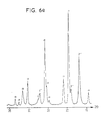
- FIG. 6d shows the diffraction diagram "X" of the cathode material of the button B2 at the end of the first discharge (point D2 in FIG. 2).
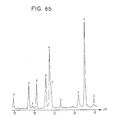
- Figure 6e shows the diffraction diagram "X" of the cathodic material of the button B2 at the end of the first charge (point C2 in Figure 3).
- Figure 7 shows the discharge curves of two buttons B3 of the prior art and B4 according to the invention for 4 hours at 1 mA.
- Figure 8 shows the load curves of the two buttons B3 and B4 at 1 mA up to 3.8 V.
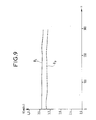
- Figure 9 shows the curves of evolution of the voltage at the end of discharge from 4 hours to 1 mA of buttons B3 and B4 as a function of the number of cycles.
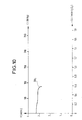
- FIG. 10 shows the discharge curve up to 2.8 V of the button B5 of the prior art produced with a vanadium oxide of poor quality.
- FIG. 11 shows discharge curves of the button B'5 according to the invention up to 2.0 V.
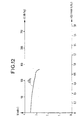
- Figure 12 shows the discharge curve of button B'5 up to 2.8 V after two operating cycles between 2.0 and 3.8 V.
- Figure 13 shows the evolution curve as a function of the number of cycles of the specific capacity of the cathodic material of button B5 and the corresponding curve of button B'5 after two operating cycles between 2.0 and 3.8 V.
- FIG. 14 shows the evolution curve as a function of the number of cycles of the discharge voltage of the cathodic material of button B5 and the corresponding curve of button B'5 after two cycles of operation between 2.0 and 3.8 V.
- button accumulators of the type which appears in FIG. 1, are constituted in the following way.
- the commercial crystalline V2O5 cathode material, battery quality, is intimately mixed with acetylene black, graphite and PTFE in the following respective weight proportions: 80%, 7.5%, 7.5% and 5%.
- a cathode 1 is made by embedding a certain amount of this mixture on a stainless steel grid. After drying and cutting with an appropriate tool, an electrode is obtained in the form of a disc 20 mm in diameter and approximately 0.5 mm thick containing approximately 150 mg of V2O5.
- Anode 2 consists of a lithium disc of the same diameter and with a mass of approximately 150 mg.
- the electrolyte used in this case is a molar solution of lithium hexafluoroarsenate in a mixture of propylene carbonate, ethylene carbonate and dimethoxyethane in the respective weight proportions of 25%, 25% and 50%.
- the electrodes 1 and 2 are separated by a microporous polypropylene separator 3 and a reservoir separator 4 made of polypropylene fibers in the form of felt.
- the assembly is arranged in a cup 5 closed in leaktight manner by a cover 6 by means of a seal 8.
- Two button type batteries B1 and B2 are produced as described in FIG. 1 and are subjected to charge-discharge cycles under a current of 1 mA in charge and 2 mA in discharge. Charging is carried out up to a maximum voltage of 3.8 V for the two buttons B1 and B2. The discharge is stopped at a minimum voltage of 2.8 V for the button B1 in accordance with the prior art, and at 2.0 V for the button B2, according to the invention.
- FIG. 2 represents the evolution of the voltage V (in volts) as a function of the number of lithium atoms "x" inserted per mole of VO2 during the first discharge.
- the specific capacity "C” (in Ah / Kg) corresponding to V2O5 has also been shown.
- the discharge curves DB1 and DB2 are associated with the buttons B1 and B2 respectively.
- FIG. 3 represents the evolution of the voltage V (in volts) as a function of the number of lithium atoms "x" disintercaled per mole of V2O5 during the first charge up to 3.8 V carried out on the buttons B1 and B2 after the previous discharge.
- CB1 and CB2 are the load curves associated with B1 and B2 respectively.
- the quantity of charged electricity Q has also been represented (in Ah / Kg of V2O5).
- FIG. 4 shows, in the same presentation as Figure 2, the characteristics obtained during the second discharge of the buttons B1 and B2.
- the B1 button works in the same way as in the first cycle; the discharge curve D'B1 is identical to the curve DB1 in FIG. 2).
- the button B2 has, above 3 V, a voltage of discharge approximately 0.2 V greater than that of button B1 and that obtained on this same button B2 during the first discharge (see curve DB2 in FIG. 2).
- the end of the discharge takes place as in the first cycle, on a plateau at about 2.3 V.
- the capacities restored during this discharge are identical to those of the first cycle and are maintained during the subsequent cycling as shown in FIG. 5 on which the specific capacity measured "C" is represented as a function of the number of cycles "n" for the cathodic material of the buttons B1 and B2.
- buttons B boutons and B2 In order to understand the differences in electrochemical behavior of cathode materials in buttons B boutons and B2, "X" diffraction examinations were carried out on samples taken during these tests using the K ⁇ radiation from copper. In all the diffractograms of Figures 6a to whom will follow, we have indicated on the abscissa the diffraction angle 2 ⁇ . The line marked C corresponds to the graphite used as an additive in the production of the cathodes.
- FIG. 6a represents the diffractogram "X" of the commercial oxide V2O5 used for the production of the cathodes of the buttons B1 and B2.
- the spectrum obtained shows that this material has the previously determined and well known structure of the crystallized oxide V2O5 ⁇ (R. ENJALBERT and J. GALY, Acta Cryst. C 42, 1467 - 1986 - and references included).
- FIGS. 6b and 6c give the diffractograms "X" of the cathode materials obtained at the end of discharge and at the end of charge of the button B1 corresponding respectively to point D1 of FIG. 2 and to point C1 of FIG. 3.
- the diffractogram 6b makes it possible to identify, in the cathode material of the button B1 discharged up to 2.8 V, the phase LiV2O5 ⁇ whose structure has been determined by CAVA et al. (RS CAVA, A. SANTORO, OW MURPHY, SM ZAHURAK, RM FLEMING, P. MARSH, RS ROTH, J. Solid State Chem. 65, 6371, 1986).
- the diffractogram 6c shows, by comparison with the diffractogram 6a, that the cathode material has a structure V2O5 ⁇ identical to that of the initial product.
- FIGS. 6d and 6e give the diffractograms "X" of the cathode materials obtained at the end of discharge and at the end of charge of the button B2 according to the invention, corresponding respectively to point D2 in FIG. 2 and to point C2 in FIG. 3.
- the 6d diffractogram makes it possible to highlight, in the cathode material of the button B2 discharged up to 2 volts, the appearance of an additional phase corresponding to the phase LiV2O5 ⁇ obtained at high temperature by reaction of LiVO3 and VO2 (J. DARRIET, P. HAGENMULLER, Revue de Chimie minérale, 8, 529 - 1971 - and references included).
- This new phase appears when the discharge is continued beyond the insertion of one lithium atom per mole of V2O5 and this result is in agreement with that obtained by S. OKADA and J. YAMAKI (Extended Abstracts. 176th Meeting of the Electrochemical Society, Hollywood, October 15-20, 1989, p. 62).
- the diffractogram 6e shows that, unlike the material of the button B1, the material of the button B2 does not return to the initial V2O5 ⁇ state after complete recharging.
- the ⁇ lines we observe the presence of additional lines whose indexing reveals a structural isotype with LiV2O5 ⁇ already mentioned.
- the relative displacement of these lines compared to those of LiV2O5 ⁇ ( Figure 6d) reflects a strong evolution of the crystalline parameters which is explained by the deintercalation of lithium within the cathode material.
- This new material obtained by deintercalation of LiV2O5 ⁇ contains a new vanadium oxide which we will call V2O5 ⁇ '.
- Figure 7 shows the evolution of the voltage V (in volts) as a function of the time t (in hours) of the discharge (curves DB3 for B3 and DB4 for B4). It is noted that the button B4 according to the invention has a discharge voltage close to 3.6 V while the button B bouton operates at a voltage of the order of 3.4 V. This difference also appears on the charge curves CB3 and CB4 of figure 8 which represent the evolution of the voltage V (in volts) as a function of the charging time t (in hours).
- FIG. 9 represents the evolution of the voltage V (volts) at the end of discharge from 4 hours to 1 mA as a function of the number of cycles n for the two buttons B3 and B4. There is again an improvement in the voltage of the button B4 with respect to B3 and the slight variation in this parameter after 300 cycles.
- a B5 accumulator according to the prior art of the same type as the preceding ones is produced with a vanadium oxide originating from a batch of different manufacture and has undergone 31 cycles with discharge at 2 mA up to 2.8 V and charge at 1 mA up to 3.8 V.
- FIG. 11 represents the corresponding characteristics D'B5 and D "B5 of the 32nd and 33rd discharges It can be seen that the first discharge up to 2 V (32nd discharge of the button) has the effect of significantly modifying the profile of the next discharge (33rd discharge) by increasing the duration of the discharge, especially above 3 V and by raising the voltage of the upper discharge stage. Thanks to this discharge, a button B'5 according to the invention was obtained.
- FIG. 12 representing the discharge characteristic D "B5 of the button B'5 in the 40th cycle.
- the specific capacity is equal to 135 Ah / Kg and corresponds to the intercalation of 0.91 atom of lithium per mole of V2O5 and the average discharge voltage is 3.37 V; before the 2 operating cycles between 2.0 and 3.8 V, the specific capacity was only equal to 87 Ah / Kg corresponding to the intercalation of 0.6 lithium atom per mole of V2O5 and the average discharge voltage was 3.19 V.
- the improvement provided by the invention is clearly shown in FIGS.
Landscapes
- Chemical & Material Sciences (AREA)
- Chemical Kinetics & Catalysis (AREA)
- Electrochemistry (AREA)
- General Chemical & Material Sciences (AREA)
- Inorganic Chemistry (AREA)
- Engineering & Computer Science (AREA)
- Manufacturing & Machinery (AREA)
- Battery Electrode And Active Subsutance (AREA)
- Secondary Cells (AREA)
Applications Claiming Priority (2)
| Application Number | Priority Date | Filing Date | Title |
|---|---|---|---|
| FR8916337 | 1989-12-11 | ||
| FR8916337A FR2655777A1 (fr) | 1989-12-11 | 1989-12-11 | Generateur electrochimique rechargeable comprenant une cathode a base d'oxyde de vanadium. |
Publications (1)
| Publication Number | Publication Date |
|---|---|
| EP0432684A1 true EP0432684A1 (de) | 1991-06-19 |
Family
ID=9388354
Family Applications (1)
| Application Number | Title | Priority Date | Filing Date |
|---|---|---|---|
| EP90123682A Withdrawn EP0432684A1 (de) | 1989-12-11 | 1990-12-10 | Herladbarer elektrochemischer Generator, der eine Kathode auf der Basis von Vanadiumoxid enthält |
Country Status (5)
| Country | Link |
|---|---|
| US (1) | US5219677A (de) |
| EP (1) | EP0432684A1 (de) |
| JP (1) | JPH04363874A (de) |
| CA (1) | CA2031884A1 (de) |
| FR (1) | FR2655777A1 (de) |
Families Citing this family (8)
| Publication number | Priority date | Publication date | Assignee | Title |
|---|---|---|---|---|
| US5366830A (en) * | 1993-02-12 | 1994-11-22 | Valence Technology, Inc. | Vanadium oxide cathode active material and method of making same |
| US5496663A (en) * | 1994-08-19 | 1996-03-05 | Tracor Applied Sciences, Inc. | Lithium ion battery with lithium vanadium pentoxide positive electrode |
| US7001690B2 (en) | 2000-01-18 | 2006-02-21 | Valence Technology, Inc. | Lithium-based active materials and preparation thereof |
| US6528033B1 (en) | 2000-01-18 | 2003-03-04 | Valence Technology, Inc. | Method of making lithium-containing materials |
| US20040048157A1 (en) * | 2002-09-11 | 2004-03-11 | Neudecker Bernd J. | Lithium vanadium oxide thin-film battery |
| JP5025951B2 (ja) * | 2005-12-13 | 2012-09-12 | 富士重工業株式会社 | リチウム二次電池用正極およびそれを用いた非水系リチウム二次電池 |
| EP2784847B1 (de) | 2013-03-26 | 2015-09-30 | Belenos Clean Power Holding AG | Oberflächenmodifiziertes lithiumhaltiges H2V3O8 |
| KR102567962B1 (ko) * | 2018-07-18 | 2023-08-16 | 주식회사 엘지에너지솔루션 | 리튬 이차전지용 바나듐 양극의 전기화학적 전처리 방법 및 이에 의해 전처리된 리튬 이차전지용 바나듐 양극 |
Citations (3)
| Publication number | Priority date | Publication date | Assignee | Title |
|---|---|---|---|---|
| FR2615657A1 (fr) * | 1987-05-19 | 1988-11-25 | Bridgestone Corp | Pile secondaire a electrolyte non aqueux |
| FR2629947A1 (fr) * | 1988-04-07 | 1989-10-13 | Bridgestone Corp | Pile secondaire a electrolyte non aqueux |
| US4874680A (en) * | 1988-10-21 | 1989-10-17 | Matsushita Electric Industrial Co., Ltd. | Lithium secondary battery |
Family Cites Families (1)
| Publication number | Priority date | Publication date | Assignee | Title |
|---|---|---|---|---|
| GB8329701D0 (en) * | 1983-11-07 | 1983-12-07 | Secr Defence | Electrochemical cell structures |
-
1989
- 1989-12-11 FR FR8916337A patent/FR2655777A1/fr active Pending
-
1990
- 1990-12-10 CA CA002031884A patent/CA2031884A1/fr not_active Abandoned
- 1990-12-10 EP EP90123682A patent/EP0432684A1/de not_active Withdrawn
- 1990-12-11 JP JP2415726A patent/JPH04363874A/ja not_active Withdrawn
- 1990-12-11 US US07/625,714 patent/US5219677A/en not_active Expired - Fee Related
Patent Citations (3)
| Publication number | Priority date | Publication date | Assignee | Title |
|---|---|---|---|---|
| FR2615657A1 (fr) * | 1987-05-19 | 1988-11-25 | Bridgestone Corp | Pile secondaire a electrolyte non aqueux |
| FR2629947A1 (fr) * | 1988-04-07 | 1989-10-13 | Bridgestone Corp | Pile secondaire a electrolyte non aqueux |
| US4874680A (en) * | 1988-10-21 | 1989-10-17 | Matsushita Electric Industrial Co., Ltd. | Lithium secondary battery |
Non-Patent Citations (6)
| Title |
|---|
| ELECTROCHIMICA ACTA, vol. 33, no. 7, 1988, pages 997-1002, Pergamon Press, Plc, GB; S. HUB et al.: "X-ray investigations on electroformed LixV205 bronzes" * |
| EXTENDED ABSTRACTS, vol. 89-2, FALL MEETING, Hollywood, Florida, 15-20 octobre 1989, pages 62-63, abrégé no. 44; S. OKADA et al.: "Lithium insertion reaction of crystalline and amorphous V205(-P205) cathodes" * |
| JOURNAL OF POWER SOURCES, vol. 20, 1987, pages 157-164, Elsevier Sequoia, NL; K. WIESENER et al.: "Vanadium oxides in electrodes for rechargeable lithium cells" * |
| JOURNAL OF POWER SOURCES, vol. 24, 1988, pages 85-93, Elsevier Sequoia, NL; A. TRANCHANT et al.: "A comparative electrochemical study of M003, V205 and M0V208 as rechargeable cathodes in lithium cells" * |
| PROCEEDINGS OF THE SYMPOSIUM ON PRIMARY AND SECONDARY AMBIENT TEMPERATURE LITHIUM BATTERIES, Honolulu, 18-23 octobre 1987, vol. 88-6, 1989, pages 503-510, Electrochemical Society, Pennington, US; M. SUGAWARA et al.: "Electrochemical behavior of vanadium(V) oxide in propylene carbonate-Lic104" * |
| PROCEEDINGS OF THE SYMPOSIUM ON PRIMARY AND SECONDARY AMBIENT TEMPERATURE LITHIUM BATTERIES, Honolulu, 18-23 octobre 1987, vol. 88-6, pages 494-502, Electrochemical Society, Pennington, US; J. LABAT et al.: "Oxide based intercalation compounds for organic electrolyte rechargeable lithium cells" * |
Also Published As
| Publication number | Publication date |
|---|---|
| JPH04363874A (ja) | 1992-12-16 |
| US5219677A (en) | 1993-06-15 |
| FR2655777A1 (fr) | 1991-06-14 |
| CA2031884A1 (fr) | 1991-06-12 |
Similar Documents
| Publication | Publication Date | Title |
|---|---|---|
| EP2297812B1 (de) | Nicht-wässriger elektrolyt für hochspannungs-lithiumbatterie | |
| EP0386682B1 (de) | Wieder aufladbarer elektrochemischer Generator mit Lithiumanode | |
| EP2318315B1 (de) | Material für positive elektrode aus einem oxid vom lamellaren typ für eine lithiumbatterie | |
| EP1523052B1 (de) | Elektrochemisches aktives material für negative elektrode in einem wiederaufladbaren elektrochemischen lithium-generator | |
| EP0633617B1 (de) | Wiederaufladebarer Lithiumenthaltender elektrochemischer Stromgenerator und Verfahren zu ihrer Herstellung | |
| EP0660432B1 (de) | Wiederaufladbarer electrochemischer Lithiumgenerator enthaltend eine Kohlenstoffanode und Herstellungsverfahren | |
| FR2890241A1 (fr) | Materiau d'electrode positive haute tension de structure spinelle a base de nickel et de manganese pour accumulateurs au lithium | |
| EP1531506B1 (de) | Elektrochemisch aktives Material für eine positive Elektrode einer Sekundär-Lithium-Batterie | |
| EP0432684A1 (de) | Herladbarer elektrochemischer Generator, der eine Kathode auf der Basis von Vanadiumoxid enthält | |
| EP0993057A1 (de) | Kathodisches Aktivmaterial für Lithium-Akkumulator | |
| EP0464117B1 (de) | Elektrodenmaterial auf der basis von lithium enthaltendem vanadiumoxyd, verfahren zur herstellung und anwendung in einem elektrochemischen generator | |
| EP1860713B1 (de) | Lithiumeinlagerungsverbindung verwendbar als kathodisches Aktivmaterial in einem wiederaufladbaren elektrochemischen Lithium-Generator | |
| EP0996591B1 (de) | Verfahren zur herstellung von lithiertem oder überlithiertem übergangsmetalloxid, dieses aktive materialien fur positive elektrode und batterie enthaltend | |
| FR2972442A1 (fr) | Materiau d'electrode positive pour accumulateur lithium-ion | |
| EP1756893B1 (de) | Komponente mit kollektorelektrode und aktivmaterial sowie deren verwendung als batterieelektrode | |
| FR3106020A1 (fr) | Cellule électrochimique spécifique pour accumulateur fonctionnant selon le principe de formation d’un alliage avec le matériau actif de l’électrode negative comprenant un couple d’électrodes spécifique | |
| EP3647443B1 (de) | Spezifische negative elektrode auf lithiumbasis und elektrochemischer generator auf lithiumbasis, der eine solche negative elektrode umfasst | |
| FR2725709A1 (fr) | Oxyde de lithium et son utilisation comme matiere active d'une electrode | |
| FR2656957A1 (fr) | Generateur electrochimique rechargeable a anode de lithium. | |
| FR3131452A1 (fr) | Procédé de délithiation d’au moins un nitrure de métal(aux) de transition et de lithium | |
| FR2777388A1 (fr) | Accumulateur au lithium fonctionnant jusqu'a une borne superieure de tension de 3,5 volts | |
| FR2777387A1 (fr) | Accumulateur au lithium fonctionnant entre 1,8 volts et 4,3 volts | |
| WO2014041076A1 (fr) | Procede de fonctionnement d'un accumulateur au lithium impliquant un materiau actif d'electrode specifique | |
| FR3091623A1 (fr) | Cellule electrochimique pour accumulateur au lithium comprenant une electrode negative specifique en lithium metallique et une electrode positive sur collecteur en aluminium |
Legal Events
| Date | Code | Title | Description |
|---|---|---|---|
| PUAI | Public reference made under article 153(3) epc to a published international application that has entered the european phase |
Free format text: ORIGINAL CODE: 0009012 |
|
| AK | Designated contracting states |
Kind code of ref document: A1 Designated state(s): DE FR GB IT NL SE |
|
| 17P | Request for examination filed |
Effective date: 19911218 |
|
| RAP1 | Party data changed (applicant data changed or rights of an application transferred) |
Owner name: SAFT |
|
| 17Q | First examination report despatched |
Effective date: 19931124 |
|
| STAA | Information on the status of an ep patent application or granted ep patent |
Free format text: STATUS: THE APPLICATION IS DEEMED TO BE WITHDRAWN |
|
| 18D | Application deemed to be withdrawn |
Effective date: 19951129 |