EP0428800B1 - Bioreactor - Google Patents
Bioreactor Download PDFInfo
- Publication number
- EP0428800B1 EP0428800B1 EP89312079A EP89312079A EP0428800B1 EP 0428800 B1 EP0428800 B1 EP 0428800B1 EP 89312079 A EP89312079 A EP 89312079A EP 89312079 A EP89312079 A EP 89312079A EP 0428800 B1 EP0428800 B1 EP 0428800B1
- Authority
- EP
- European Patent Office
- Prior art keywords
- enzyme
- column
- bioreactor
- sepiolite
- particles
- Prior art date
- Legal status (The legal status is an assumption and is not a legal conclusion. Google has not performed a legal analysis and makes no representation as to the accuracy of the status listed.)
- Expired - Lifetime
Links
- 238000006243 chemical reaction Methods 0.000 claims description 32
- 239000004113 Sepiolite Substances 0.000 claims description 28
- 239000003054 catalyst Substances 0.000 claims description 28
- 239000002245 particle Substances 0.000 claims description 28
- 229910052624 sepiolite Inorganic materials 0.000 claims description 28
- 235000019355 sepiolite Nutrition 0.000 claims description 28
- 108090000790 Enzymes Proteins 0.000 claims description 22
- 102000004190 Enzymes Human genes 0.000 claims description 22
- 238000000034 method Methods 0.000 claims description 3
- 239000012527 feed solution Substances 0.000 claims description 2
- 239000012530 fluid Substances 0.000 claims 2
- 229940088598 enzyme Drugs 0.000 description 17
- 239000000126 substance Substances 0.000 description 10
- QTBSBXVTEAMEQO-UHFFFAOYSA-N Acetic acid Chemical compound CC(O)=O QTBSBXVTEAMEQO-UHFFFAOYSA-N 0.000 description 9
- 239000011324 bead Substances 0.000 description 7
- 239000000919 ceramic Substances 0.000 description 7
- 239000005373 porous glass Substances 0.000 description 7
- 239000007864 aqueous solution Substances 0.000 description 5
- 108010051210 beta-Fructofuranosidase Proteins 0.000 description 5
- 239000001573 invertase Substances 0.000 description 5
- 235000011073 invertase Nutrition 0.000 description 5
- 239000000243 solution Substances 0.000 description 5
- LFQSCWFLJHTTHZ-UHFFFAOYSA-N Ethanol Chemical compound CCO LFQSCWFLJHTTHZ-UHFFFAOYSA-N 0.000 description 4
- 239000000969 carrier Substances 0.000 description 4
- 239000011521 glass Substances 0.000 description 4
- 239000011148 porous material Substances 0.000 description 4
- 239000000843 powder Substances 0.000 description 4
- 229930006000 Sucrose Natural products 0.000 description 3
- CZMRCDWAGMRECN-UGDNZRGBSA-N Sucrose Chemical compound O[C@H]1[C@H](O)[C@@H](CO)O[C@@]1(CO)O[C@@H]1[C@H](O)[C@@H](O)[C@H](O)[C@@H](CO)O1 CZMRCDWAGMRECN-UGDNZRGBSA-N 0.000 description 3
- 239000004575 stone Substances 0.000 description 3
- 239000005720 sucrose Substances 0.000 description 3
- XLYOFNOQVPJJNP-UHFFFAOYSA-N water Substances O XLYOFNOQVPJJNP-UHFFFAOYSA-N 0.000 description 3
- WQZGKKKJIJFFOK-GASJEMHNSA-N Glucose Natural products OC[C@H]1OC(O)[C@H](O)[C@@H](O)[C@@H]1O WQZGKKKJIJFFOK-GASJEMHNSA-N 0.000 description 2
- MCMNRKCIXSYSNV-UHFFFAOYSA-N Zirconium dioxide Chemical compound O=[Zr]=O MCMNRKCIXSYSNV-UHFFFAOYSA-N 0.000 description 2
- PNEYBMLMFCGWSK-UHFFFAOYSA-N aluminium oxide Inorganic materials [O-2].[O-2].[O-2].[Al+3].[Al+3] PNEYBMLMFCGWSK-UHFFFAOYSA-N 0.000 description 2
- 229910052878 cordierite Inorganic materials 0.000 description 2
- 239000013078 crystal Substances 0.000 description 2
- JSKIRARMQDRGJZ-UHFFFAOYSA-N dimagnesium dioxido-bis[(1-oxido-3-oxo-2,4,6,8,9-pentaoxa-1,3-disila-5,7-dialuminabicyclo[3.3.1]nonan-7-yl)oxy]silane Chemical compound [Mg++].[Mg++].[O-][Si]([O-])(O[Al]1O[Al]2O[Si](=O)O[Si]([O-])(O1)O2)O[Al]1O[Al]2O[Si](=O)O[Si]([O-])(O1)O2 JSKIRARMQDRGJZ-UHFFFAOYSA-N 0.000 description 2
- 230000000694 effects Effects 0.000 description 2
- 238000010304 firing Methods 0.000 description 2
- -1 for example Substances 0.000 description 2
- 239000008103 glucose Substances 0.000 description 2
- HCWCAKKEBCNQJP-UHFFFAOYSA-N magnesium orthosilicate Chemical compound [Mg+2].[Mg+2].[O-][Si]([O-])([O-])[O-] HCWCAKKEBCNQJP-UHFFFAOYSA-N 0.000 description 2
- 239000000391 magnesium silicate Substances 0.000 description 2
- 229910052919 magnesium silicate Inorganic materials 0.000 description 2
- 235000019792 magnesium silicate Nutrition 0.000 description 2
- 238000010298 pulverizing process Methods 0.000 description 2
- 238000007493 shaping process Methods 0.000 description 2
- 239000000758 substrate Substances 0.000 description 2
- ULGJWNIHLSLQPZ-UHFFFAOYSA-N 7-[(6,8-dichloro-1,2,3,4-tetrahydroacridin-9-yl)amino]-n-[2-(1h-indol-3-yl)ethyl]heptanamide Chemical compound C1CCCC2=NC3=CC(Cl)=CC(Cl)=C3C(NCCCCCCC(=O)NCCC=3C4=CC=CC=C4NC=3)=C21 ULGJWNIHLSLQPZ-UHFFFAOYSA-N 0.000 description 1
- 102100026189 Beta-galactosidase Human genes 0.000 description 1
- 108010059881 Lactase Proteins 0.000 description 1
- 102000057297 Pepsin A Human genes 0.000 description 1
- 108090000284 Pepsin A Proteins 0.000 description 1
- 108091005804 Peptidases Proteins 0.000 description 1
- 239000004365 Protease Substances 0.000 description 1
- 102100037486 Reverse transcriptase/ribonuclease H Human genes 0.000 description 1
- 239000006087 Silane Coupling Agent Substances 0.000 description 1
- 102000004142 Trypsin Human genes 0.000 description 1
- 108090000631 Trypsin Proteins 0.000 description 1
- 108700040099 Xylose isomerases Proteins 0.000 description 1
- 108010003977 aminoacylase I Proteins 0.000 description 1
- 108010005774 beta-Galactosidase Proteins 0.000 description 1
- 239000011942 biocatalyst Substances 0.000 description 1
- 238000005842 biochemical reaction Methods 0.000 description 1
- 239000011449 brick Substances 0.000 description 1
- 239000000679 carrageenan Substances 0.000 description 1
- 235000010418 carrageenan Nutrition 0.000 description 1
- 229920001525 carrageenan Polymers 0.000 description 1
- 229940113118 carrageenan Drugs 0.000 description 1
- 239000007795 chemical reaction product Substances 0.000 description 1
- 238000011109 contamination Methods 0.000 description 1
- 238000000354 decomposition reaction Methods 0.000 description 1
- 230000003247 decreasing effect Effects 0.000 description 1
- 230000002950 deficient Effects 0.000 description 1
- 239000012153 distilled water Substances 0.000 description 1
- 239000000835 fiber Substances 0.000 description 1
- 229940116108 lactase Drugs 0.000 description 1
- 239000000463 material Substances 0.000 description 1
- 238000002844 melting Methods 0.000 description 1
- 230000008018 melting Effects 0.000 description 1
- 244000005700 microbiome Species 0.000 description 1
- 239000000203 mixture Substances 0.000 description 1
- 238000012986 modification Methods 0.000 description 1
- 230000004048 modification Effects 0.000 description 1
- 229940111202 pepsin Drugs 0.000 description 1
- 238000005191 phase separation Methods 0.000 description 1
- 229920002401 polyacrylamide Polymers 0.000 description 1
- 239000000047 product Substances 0.000 description 1
- 230000002035 prolonged effect Effects 0.000 description 1
- 230000035484 reaction time Effects 0.000 description 1
- 238000003303 reheating Methods 0.000 description 1
- 238000011160 research Methods 0.000 description 1
- 239000000454 talc Substances 0.000 description 1
- 229910052623 talc Inorganic materials 0.000 description 1
- 239000012588 trypsin Substances 0.000 description 1
- 229960001322 trypsin Drugs 0.000 description 1
- UHVMMEOXYDMDKI-JKYCWFKZSA-L zinc;1-(5-cyanopyridin-2-yl)-3-[(1s,2s)-2-(6-fluoro-2-hydroxy-3-propanoylphenyl)cyclopropyl]urea;diacetate Chemical compound [Zn+2].CC([O-])=O.CC([O-])=O.CCC(=O)C1=CC=C(F)C([C@H]2[C@H](C2)NC(=O)NC=2N=CC(=CC=2)C#N)=C1O UHVMMEOXYDMDKI-JKYCWFKZSA-L 0.000 description 1
Images

Classifications
-
- C—CHEMISTRY; METALLURGY
- C12—BIOCHEMISTRY; BEER; SPIRITS; WINE; VINEGAR; MICROBIOLOGY; ENZYMOLOGY; MUTATION OR GENETIC ENGINEERING
- C12M—APPARATUS FOR ENZYMOLOGY OR MICROBIOLOGY; APPARATUS FOR CULTURING MICROORGANISMS FOR PRODUCING BIOMASS, FOR GROWING CELLS OR FOR OBTAINING FERMENTATION OR METABOLIC PRODUCTS, i.e. BIOREACTORS OR FERMENTERS
- C12M21/00—Bioreactors or fermenters specially adapted for specific uses
- C12M21/18—Apparatus specially designed for the use of free, immobilized or carrier-bound enzymes
-
- C—CHEMISTRY; METALLURGY
- C12—BIOCHEMISTRY; BEER; SPIRITS; WINE; VINEGAR; MICROBIOLOGY; ENZYMOLOGY; MUTATION OR GENETIC ENGINEERING
- C12M—APPARATUS FOR ENZYMOLOGY OR MICROBIOLOGY; APPARATUS FOR CULTURING MICROORGANISMS FOR PRODUCING BIOMASS, FOR GROWING CELLS OR FOR OBTAINING FERMENTATION OR METABOLIC PRODUCTS, i.e. BIOREACTORS OR FERMENTERS
- C12M25/00—Means for supporting, enclosing or fixing the microorganisms, e.g. immunocoatings
- C12M25/16—Particles; Beads; Granular material; Encapsulation
- C12M25/18—Fixed or packed bed
Definitions
- the present invention relates to a bound enzyme bioreactor using an enzyme as a biocatalyst for carrying out a biochemical reaction industrially.
- bioreactors using usual ceramic substances as carrier of the enzyme-fixed catalyst have drawbacks in that the catalyst can fix thereon only a small amount of enzyme, so that the productivity of the bioreactor using such catalyst becomes bad, and the whole plant has to be made large or the reaction time has to be prolonged.
- porous glass beads As a carrier of the enzyme-fixed catalyst have been of interest (Sumio Sakka “Application of Ceramics to Enzyme-fixed Carriers” in "Kagakusohchi” [3], 1983, pp.52-58).
- the porous glass beads have many advantages of small pores of diameter of a few hundred ⁇ by utilizing phase separation of glass resulting in a large specific surface area of 60-75 m2/g, stable thermal and chemical properties, strong mechanical strength, and outstandingly large amount of enzyme that can be fixed on a unit amount of carrier as compared with conventional ceramics carriers.
- the porous glass beads have drawbacks in that they have to be produced by complicated process of melting a glass at a high temperature of 1,500°C, reheating the melted glass to 500-600°C, and further heat treating the melted glass for a long time, so that they are very expensive as a carrier and difficult to use commercially in bioreactors of industrial scale.
- a bioreactor having all of chemical and thermal stabilities, productivity, and economicity, has not been accomplished.
- An object of the present invention is to obviate the above drawbacks.
- an enzyme-fixed reactor containing in a reaction column a thermally and chemically stable enzyme-fixed catalyst composed of a carrier and an enzyme carried on the carrier in an outstandingly large amount per unit amount of the carrier as compared with that of the porous glass beads, and which can be produced cheaply.
- the present invention is a bound enzyme bioreactor, comprising a reaction column, and catalyst particles uniformly and densely packed or filled in the reaction column, the catalyst particles being composed of carrier sepiolite particles consisting of sepiolite and an enzyme fixed on the surface of the carrier sepiolite particles.
- the carrier sepiolite used is fired sepiolite preferably obtained by pulverizing a raw sepiolite material consisting of sepiolite or raw sepiolite stone to form sepiolite powder, optionally adjusting chemical composition and/or particle size distribution of the sepiolite powder, shaping the sepiolite powder to a desired form, such as particles, and firing the shaped powder at a temperature of about 300-1,100°C.
- a raw sepiolite stone is a lump of magnesium silicate fibers, which has a unique crystal structure of stacking talc fractions in a brick wall form, and has peaks at around 10 ⁇ and 200 ⁇ in pore size distribution.
- the inventors have ascertained that, if a raw sepiolite stone is fired, it loses crystalline water therefrom to assume a ceramic body, while changing its crystal structure and pore size distribution to have a large peak in a range of 200-400 ⁇ of pores.
- carrier sepiolite has a specific surface area of 230 m2/g which is more larger than that of the porous glass beads, so that it has a beautiful functional ability of fixing enzyme thereon, as well as thermal and chemical stabilities due to ceramicisation thereof.
- the carrier sepiolite may be silanified on the surface by means of a silane-coupling agent using a known process, and then treated to fix enzyme on the silanified surface to obtain enzyme-fixed catalyst which is then packed in the reaction column of the bioreactor.
- Usual means can be adopted for fixing enzyme on the carrier sepiolite, and enzyme is fixed firmly on the surface of the carrier sepiolite consisting of magnesium silicate at a high density by means of covalent bond.
- Enzymes to be fixed on the carrier sepiolite are not limited at all, and illustrative examples thereof are, invertase, lactase, pepsin, trypsin, protease, glucoamilase, glucoseisomerase, aminoacylase, etc.
- an embodiment of the bioreactor of the present invention is shown, wherein the enzyme-fixed catalyst 1 is packed in the reaction column 2.
- the enzyme-fixed catalyst 1 using the carrier sepiolite has a shortcoming in that it is fragile when scrubbed to each other as compared with conventional catalysts using the porous glass beads or alumina ceramics. Therefore, the enzyme-fixed catalyst 1 according to the present invention should be uniformly and densely packed in the reaction column 2 so as to prevent relative movements thereof.
- the enzyme-fixed bioreactor of the present invention has preferably a movable plate 3 on the bottom and/or the top of the reaction column 2, and the plate 3 is movable by means of a screw 4, etc., to uniformly and densely pack the enzyme-fixed catalyst 1 in the reaction column 2, as shown in Fig. 1.
- a raw feed solution is supplied upwardly in the reaction column 2 through the interior of the screw 4, and an outlet solution containing reaction products is taken out from a discharge port 5 at the top of the reaction column 5.
- the uniformly and densely packed enzyme-fixed catalyst particles do not move in the reaction column 2, even in case of rinsing thereof for preventing decrease of the enzyme activity, resorbing of enzymes of decreased activity, and refixing of new enzymes on the catalyst carrier, etc., so that they are not broken or destructed and do not cause troubles, such as, clogging or short path, in the reaction column 2.
- Fired sepiolite particles produced by pulverizing, shaping and firing as set out above, of an average particle diameter of 0.3 mm,are densely packed in a reaction column of an inner diameter of 20 cm and a height of 8 cm, and pressed in the reaction column by means of a movable plate arranged on the reaction column. Volume of the catalyst particles packed layer at this point is about 1 l.
- Another reaction column filled with carrier cordierite particles having the same average particle size as that of the sepiolite particles, is prepared, for comparison.
- the two reaction columns are feeded with a 70% aqueous solution of ethanol at a flow rate of 30 ml/min, and the bioreactors are evacuated. Subsequently, the reaction columns is feeded with distilled water of a flow rate of 100 ml/min to wash out ethanol therefrom, then with 50 mA of a buffer acetic acid aqueous solution (pH 4.0) of a flow rate of 100 ml/min to exchange the solution in the reaction columns. Thereafter, 2% commercial invertase/50 mA buffer acetic acid aqueous solution is circulated in the reaction columns at a flow rate of 30 ml/min for 3 hrs to fix invertase on the carrier surface.
- a buffer acetic acid aqueous solution pH 4.0
- the bioreactor of the present invention has a sucrose decomposition speed of about 30 times faster than the conventional bioreactor using the carrier cordierite particles.
- the bioreactor of the present invention has a productivity of 30 times larger than the conventional bioreactor of a same volume. If the productivity of the bioreactor of the present invention is held constant, i.e., to the same as that of the conventional bioreactor, the average residence time of the substrate in the reaction column or the volume of the bioreactor of the present invention can be made to 1/30 as those of the conventional bioreactor.
- the bioreactor of the present invention using enzyme-fixed catalyst particles composed of carrier sepiolite particles and enzyme fixed on the surface of the carrier sepiolite particles uniformly and densely packed or filled in the reaction column has far superior productivity of the aimed product as compared with a conventional bioreactor using a ceramic catalyst carrier, as well as spectacular heat resistant and chemical resistant properties.
- the bioreactor of the present invention with the conventional bioreactor using porous glass beads the bioreactor of the present invention has an excellent economicity, because the carrier sepiolite particles can be produced very cheaply or economically, so that even a large bioreactor can be produced with cheap expenditure.
- the enzyme-fixed bioreactor of the present invention obviates all the prior problems, and is eminently useful industrially.
Landscapes
- Health & Medical Sciences (AREA)
- Life Sciences & Earth Sciences (AREA)
- Wood Science & Technology (AREA)
- Organic Chemistry (AREA)
- Engineering & Computer Science (AREA)
- Bioinformatics & Cheminformatics (AREA)
- Chemical & Material Sciences (AREA)
- Zoology (AREA)
- Genetics & Genomics (AREA)
- Sustainable Development (AREA)
- Microbiology (AREA)
- Biotechnology (AREA)
- Biochemistry (AREA)
- General Engineering & Computer Science (AREA)
- General Health & Medical Sciences (AREA)
- Biomedical Technology (AREA)
- Immunology (AREA)
- Molecular Biology (AREA)
- Immobilizing And Processing Of Enzymes And Microorganisms (AREA)
- Apparatus Associated With Microorganisms And Enzymes (AREA)
Description
- The present invention relates to a bound enzyme bioreactor using an enzyme as a biocatalyst for carrying out a biochemical reaction industrially.
- Recently, researches of bioreactors containing in a reaction column an enzyme-fixed catalyst carrying an enzyme fixed on the carrier surface, have been progressed rapidly. For that purpose, various carriers have been proposed, such as high molecular organic substances, for example, carrageenan, or polyacrylamide, etc., or usual ceramic substances, for example, alumina, zirconia, etc. However, in reaction systems using a bioreactor having an enzyme-fixed catalyst, operations at high temperatures are often necessary to prevent contaminations of the bioreactor caused by undesirable micro organisms, and bioreactors using organic substances as carriers of the enzyme-fixed catalyst have drawbacks in that they are deficient in chemical stability and heat resistant property to endure the operations of high temperatures. Meanwhile, bioreactors using usual ceramic substances as carrier of the enzyme-fixed catalyst have drawbacks in that the catalyst can fix thereon only a small amount of enzyme, so that the productivity of the bioreactor using such catalyst becomes bad, and the whole plant has to be made large or the reaction time has to be prolonged.
- For solving these drawbacks, bioreactors using porous glass beads as a carrier of the enzyme-fixed catalyst have been of interest (Sumio Sakka "Application of Ceramics to Enzyme-fixed Carriers" in "Kagakusohchi" [3], 1983, pp.52-58). The porous glass beads have many advantages of small pores of diameter of a few hundred Å by utilizing phase separation of glass resulting in a large specific surface area of 60-75 m²/g, stable thermal and chemical properties, strong mechanical strength, and outstandingly large amount of enzyme that can be fixed on a unit amount of carrier as compared with conventional ceramics carriers. However, the porous glass beads have drawbacks in that they have to be produced by complicated process of melting a glass at a high temperature of 1,500°C, reheating the melted glass to 500-600°C, and further heat treating the melted glass for a long time, so that they are very expensive as a carrier and difficult to use commercially in bioreactors of industrial scale. Thus, hitherto, a bioreactor having all of chemical and thermal stabilities, productivity, and economicity, has not been accomplished.
- An object of the present invention is to obviate the above drawbacks.
- By the present invention it is possible to provide an enzyme-fixed reactor containing in a reaction column a thermally and chemically stable enzyme-fixed catalyst composed of a carrier and an enzyme carried on the carrier in an outstandingly large amount per unit amount of the carrier as compared with that of the porous glass beads, and which can be produced cheaply.
- The present invention is a bound enzyme bioreactor, comprising a reaction column, and catalyst particles uniformly and densely packed or filled in the reaction column, the catalyst particles being composed of carrier sepiolite particles consisting of sepiolite and an enzyme fixed on the surface of the carrier sepiolite particles.
- The carrier sepiolite used is fired sepiolite preferably obtained by pulverizing a raw sepiolite material consisting of sepiolite or raw sepiolite stone to form sepiolite powder, optionally adjusting chemical composition and/or particle size distribution of the sepiolite powder, shaping the sepiolite powder to a desired form, such as particles, and firing the shaped powder at a temperature of about 300-1,100°C. A raw sepiolite stone is a lump of magnesium silicate fibers, which has a unique crystal structure of stacking talc fractions in a brick wall form, and has peaks at around 10 Å and 200 Å in pore size distribution. The inventors have ascertained that, if a raw sepiolite stone is fired, it loses crystalline water therefrom to assume a ceramic body, while changing its crystal structure and pore size distribution to have a large peak in a range of 200-400 Å of pores. Thus obtained carrier sepiolite has a specific surface area of 230 m²/g which is more larger than that of the porous glass beads, so that it has a splendid functional ability of fixing enzyme thereon, as well as thermal and chemical stabilities due to ceramicisation thereof.
- The carrier sepiolite may be silanified on the surface by means of a silane-coupling agent using a known process, and then treated to fix enzyme on the silanified surface to obtain enzyme-fixed catalyst which is then packed in the reaction column of the bioreactor. Usual means can be adopted for fixing enzyme on the carrier sepiolite, and enzyme is fixed firmly on the surface of the carrier sepiolite consisting of magnesium silicate at a high density by means of covalent bond. Enzymes to be fixed on the carrier sepiolite are not limited at all, and illustrative examples thereof are, invertase, lactase, pepsin, trypsin, protease, glucoamilase, glucoseisomerase, aminoacylase, etc.
- For a better understanding of the present invention, reference is made to the accompanying drawings, in which:
- Fig. 1 is a schematic crosssectional view of the enzyme-fixed bioreactor of the present invention; and
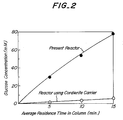
- Fig. 2 is a characteristic graph showing a relation between average residence time of a sucrose solution in the reaction column of the present bioreactor and glucose concentration at the outlet of the bioreactor.
- Numberings in the drawings.
- 1 ... enzyme-fixed catalyst
- 2 ... reaction column
- 3 ... movable plate
- 4 ... screw
- 5... discharge port
- Referring to Fig. 1, an embodiment of the bioreactor of the present invention is shown, wherein the enzyme-fixed catalyst 1 is packed in the
reaction column 2. The enzyme-fixed catalyst 1 using the carrier sepiolite has a shortcoming in that it is fragile when scrubbed to each other as compared with conventional catalysts using the porous glass beads or alumina ceramics. Therefore, the enzyme-fixed catalyst 1 according to the present invention should be uniformly and densely packed in thereaction column 2 so as to prevent relative movements thereof. For that purpose, the enzyme-fixed bioreactor of the present invention has preferably amovable plate 3 on the bottom and/or the top of thereaction column 2, and theplate 3 is movable by means of ascrew 4, etc., to uniformly and densely pack the enzyme-fixed catalyst 1 in thereaction column 2, as shown in Fig. 1. In the embodiment shown in Fig. 1, a raw feed solution is supplied upwardly in thereaction column 2 through the interior of thescrew 4, and an outlet solution containing reaction products is taken out from adischarge port 5 at the top of thereaction column 5. The uniformly and densely packed enzyme-fixed catalyst particles do not move in thereaction column 2, even in case of rinsing thereof for preventing decrease of the enzyme activity, resorbing of enzymes of decreased activity, and refixing of new enzymes on the catalyst carrier, etc., so that they are not broken or destructed and do not cause troubles, such as, clogging or short path, in thereaction column 2. - Hereinafter, the present invention will be explained in more detail with reference to an example.
- Fired sepiolite particles, produced by pulverizing, shaping and firing as set out above, of an average particle diameter of 0.3 mm,are densely packed in a reaction column of an inner diameter of 20 cm and a height of 8 cm, and pressed in the reaction column by means of a movable plate arranged on the reaction column. Volume of the catalyst particles packed layer at this point is about 1 ℓ. Another reaction column filled with carrier cordierite particles having the same average particle size as that of the sepiolite particles, is prepared, for comparison.
- Then, the two reaction columns are feeded with a 70% aqueous solution of ethanol at a flow rate of 30 mℓ/min, and the bioreactors are evacuated. Subsequently, the reaction columns is feeded with distilled water of a flow rate of 100 mℓ/min to wash out ethanol therefrom, then with 50 mA of a buffer acetic acid aqueous solution (pH 4.0) of a flow rate of 100 mℓ/min to exchange the solution in the reaction columns. Thereafter, 2% commercial invertase/50 mA buffer acetic acid aqueous solution is circulated in the reaction columns at a flow rate of 30 mℓ/min for 3 hrs to fix invertase on the carrier surface. Excess invertase is recovered, and then 30% sucrose aqueous solution/50 mA buffer acetic acid aqueous solution (pH 4.0) as a substrate for the invertase is feeded to the reaction columns in such flow rates that average residence times of the solution in the column becomes 5 min, 10 min, and 15 min, respectively, to measure glucose concentration of the solution at the outlet of the bioreactor, while keeping the reaction columns warm by passing warm water of 37°C through jackets of the reaction columns.
- The result is shown in Fig. 2. As seen from Fig. 2, the bioreactor of the present invention has a sucrose decomposition speed of about 30 times faster than the conventional bioreactor using the carrier cordierite particles. Thus, the bioreactor of the present invention has a productivity of 30 times larger than the conventional bioreactor of a same volume. If the productivity of the bioreactor of the present invention is held constant, i.e., to the same as that of the conventional bioreactor, the average residence time of the substrate in the reaction column or the volume of the bioreactor of the present invention can be made to 1/30 as those of the conventional bioreactor.
- As apparent from the foregoing explanations, the bioreactor of the present invention using enzyme-fixed catalyst particles composed of carrier sepiolite particles and enzyme fixed on the surface of the carrier sepiolite particles uniformly and densely packed or filled in the reaction column has far superior productivity of the aimed product as compared with a conventional bioreactor using a ceramic catalyst carrier, as well as splendid heat resistant and chemical resistant properties. When compared also the bioreactor of the present invention with the conventional bioreactor using porous glass beads, the bioreactor of the present invention has an excellent economicity, because the carrier sepiolite particles can be produced very cheaply or economically, so that even a large bioreactor can be produced with cheap expenditure. Moreover, if the enzyme-fixed catalyst particles are packed uniformly and densely in the reaction column by means of a movable plate, etc., breakage of the enzyme-fixed catalyst particles, short path and clogging, are prevented in the reaction column. Therefore, the enzyme-fixed bioreactor of the present invention obviates all the prior problems, and is eminently useful industrially.
- Although the present invention has been explained with reference to specific values and embodiments, it is of course apparent to those skilled in the art that various variations and modifications are possible.
Claims (4)
- A bound enzyme bioreactor comprising
a reaction column (2) and, in the column, catalyst particles (1) composed of carrier sepiolite particles consisting of fired sepiolite with enzyme carried on their surface, and
a movable member (3) at at least one end of the column (2) adjusted such that the particles (1) fill the column space, packed uniformly and densely so as to prevent their relative movement when a fluid is passed through the column (2). - A bioreactor according to claim 1 in which the movable member (3) is a movable plate at the inlet end of the column.
- A bioreactor according to claim 2 in which a fluid inlet for the reactor column (2) passes through a screw (4) for adjustably moving the plate (3).
- A method of operating a bound enzyme bioreactor, comprising
filling a reactor column (2) with catalyst particles (1) composed of carrier sepiolite particles consisting of fired sepiolite with enzyme carried on their surface,
adjusting a movable member (3) at at least one end of the reactor column (2), to pack the catalyst particles (1) uniformly and densely therein, and
passing a feed solution through the reactor column (2) over the catalyst particles (1) without relative movement occurring among said particles.
Priority Applications (1)
| Application Number | Priority Date | Filing Date | Title |
|---|---|---|---|
| DE1989607409 DE68907409T2 (en) | 1989-11-21 | 1989-11-21 | Bioreactor. |
Applications Claiming Priority (1)
| Application Number | Priority Date | Filing Date | Title |
|---|---|---|---|
| JP63127627A JPH0695929B2 (en) | 1988-05-25 | 1988-05-25 | Enzyme-immobilized bioreactor |
Publications (2)
| Publication Number | Publication Date |
|---|---|
| EP0428800A1 EP0428800A1 (en) | 1991-05-29 |
| EP0428800B1 true EP0428800B1 (en) | 1993-06-30 |
Family
ID=14964763
Family Applications (1)
| Application Number | Title | Priority Date | Filing Date |
|---|---|---|---|
| EP89312079A Expired - Lifetime EP0428800B1 (en) | 1988-05-25 | 1989-11-21 | Bioreactor |
Country Status (4)
| Country | Link |
|---|---|
| US (1) | US5143847A (en) |
| EP (1) | EP0428800B1 (en) |
| JP (1) | JPH0695929B2 (en) |
| CA (1) | CA2003232C (en) |
Families Citing this family (17)
| Publication number | Priority date | Publication date | Assignee | Title |
|---|---|---|---|---|
| US5262130A (en) * | 1990-12-07 | 1993-11-16 | Baker Hughes Inc. | Fixed bed chemical reactor |
| FR2690926B1 (en) * | 1992-05-06 | 1995-08-04 | Lvmh Rech | VARIABLE VOLUME REACTOR DEVICE AND CELL CULTURE METHOD. |
| ES2095160T3 (en) * | 1993-03-11 | 1997-02-01 | Naintsch Mineralwerke | PERFECTED WASTEWATER TREATMENT PROCEDURE, OF THE "ACTIVATED SLUDGE" TYPE, WHICH ALLOWS TO INCREASE THE TREATMENT YIELDS. |
| JPH0818814B2 (en) * | 1993-06-23 | 1996-02-28 | 東洋電化工業株式会社 | Porous powder and method for producing the same |
| US5614401A (en) * | 1993-06-23 | 1997-03-25 | Toyo Denka Kogyo Co., Ltd. | Enzyme immobilizing carrier containing kaolin |
| AU6104596A (en) * | 1995-06-07 | 1996-12-30 | Michael C. Trachtenberg | Enzyme systems for gas processing |
| AU6029998A (en) * | 1997-01-17 | 1998-08-07 | Regents Of The University Of Minnesota | Dna molecules and protein displaying improved triazine compound degrading ability |
| AU2001231155A1 (en) * | 2000-01-25 | 2001-08-07 | Hugh Mctavish | Microbes and methods for remediation |
| CA2353307A1 (en) * | 2001-07-13 | 2003-01-13 | Carmen Parent | Device and procedure for processing gaseous effluents |
| WO2003060061A1 (en) * | 2001-12-21 | 2003-07-24 | Organogenesis Inc. | Chamber with adjustable volume for cell culture and organ assist |
| CA2405635A1 (en) | 2002-09-27 | 2004-03-27 | C02 Solution Inc. | A process and a plant for the production of useful carbonated species and for the recycling of carbon dioxide emissions from power plants |
| US7763097B2 (en) | 2006-06-08 | 2010-07-27 | University of Pittsburgh—of the Commonwealth System of Higher Education | Devices, systems and methods for reducing the concentration of a chemical entity in fluids |
| JP4842770B2 (en) * | 2006-11-13 | 2011-12-21 | 花王株式会社 | Method for producing immobilized enzyme reaction tower |
| US20110076756A1 (en) * | 2007-01-22 | 2011-03-31 | Ian Malcolm Wright | variable volume bioreactor |
| JP2009153448A (en) * | 2007-12-26 | 2009-07-16 | National Institute Of Advanced Industrial & Technology | Silica-based mesoporous material-starch hydrolyzing enzyme complex |
| US8066800B2 (en) | 2009-10-23 | 2011-11-29 | Hamilton Sundstrand Corporation | Film-based system and method for carbon dioxide separation |
| WO2014113740A1 (en) | 2013-01-18 | 2014-07-24 | University Of Pittsburgh - Of The Commonwealth System Of Higher Education | Removal of carbon dioxide via dialysis |
Family Cites Families (15)
| Publication number | Priority date | Publication date | Assignee | Title |
|---|---|---|---|---|
| CH214929A (en) * | 1938-09-05 | 1941-05-31 | Auergesellschaft Ag | Device for filtering air, in particular filters for air protection rooms. |
| DE869938C (en) * | 1949-11-28 | 1953-03-09 | Stanislas Morel | Method and device for cleaning and drying compressed gases |
| US3374052A (en) * | 1965-12-20 | 1968-03-19 | Dept Of Chemical Engineering | System for solid particles-fluid contact operations |
| US3628314A (en) * | 1969-11-20 | 1971-12-21 | Phillips Petroleum Co | Packed-bed retainer |
| US3838977A (en) * | 1972-02-24 | 1974-10-01 | Ethyl Corp | Catalytic muffler |
| US4016044A (en) * | 1973-01-10 | 1977-04-05 | Battelle Memorial Institute | Method and apparatus for governing the reaction rate of enzymatic reactions |
| CH576996A5 (en) * | 1974-05-31 | 1976-11-15 | Battelle Memorial Institute | Enzymatic catalysis plant to convert lactose to glucose - by controlled electrocatalysis using enzymatic electrode bed of granules or fibres |
| DE3213074A1 (en) * | 1982-04-07 | 1983-10-20 | Linde Ag, 6200 Wiesbaden | METHOD AND DEVICE FOR BIOLOGICAL WASTE WATER TREATMENT |
| JPS6187700A (en) * | 1984-10-05 | 1986-05-06 | Shimadzu Corp | Immobilized peptide-containing substance |
| JPS61115493A (en) * | 1984-11-08 | 1986-06-03 | Shimadzu Corp | Production of immobilized enzyme |
| JPS6391083A (en) * | 1986-10-03 | 1988-04-21 | Ngk Insulators Ltd | Production of carrier for immobilizing enzyme |
| JPS63190637A (en) * | 1987-02-02 | 1988-08-08 | Ngk Insulators Ltd | Manufacture of enzyme immobilizing carrier |
| JPH0638904B2 (en) * | 1987-07-14 | 1994-05-25 | キッコーマン株式会社 | Continuously moving packed bed equipment |
| JPS6487700A (en) * | 1987-09-29 | 1989-03-31 | Tamanohada Setsuken Kk | Soap composition |
| JPH03190637A (en) * | 1989-12-15 | 1991-08-20 | Meihan:Kk | Fixing device for polished tile |
-
1988
- 1988-05-25 JP JP63127627A patent/JPH0695929B2/en not_active Expired - Fee Related
-
1989
- 1989-11-17 CA CA002003232A patent/CA2003232C/en not_active Expired - Fee Related
- 1989-11-21 EP EP89312079A patent/EP0428800B1/en not_active Expired - Lifetime
- 1989-11-27 US US07/441,475 patent/US5143847A/en not_active Expired - Lifetime
Also Published As
| Publication number | Publication date |
|---|---|
| CA2003232A1 (en) | 1991-05-17 |
| CA2003232C (en) | 1995-05-02 |
| JPH0695929B2 (en) | 1994-11-30 |
| EP0428800A1 (en) | 1991-05-29 |
| JPH01296975A (en) | 1989-11-30 |
| US5143847A (en) | 1992-09-01 |
Similar Documents
| Publication | Publication Date | Title |
|---|---|---|
| EP0428800A1 (en) | Bioreactor | |
| CA1255074A (en) | Method and apparatus for contacting reactants in chemical and biological reactions | |
| WO2011032703A2 (en) | Hollow particulate support | |
| CA2532970A1 (en) | Cell cultivation and breeding method | |
| JPS61111140A (en) | Catalyst for hydrocarbon synthesis | |
| CN1168812A (en) | Process and reactor for carrying out conversions with catalysts suspended in liquids | |
| US4001085A (en) | Immobilization of enzymes on an inorganic matrix | |
| EP0293186A2 (en) | Microporous membrane trickle bed process | |
| EP0188182B1 (en) | A fluid-permeable fibre matrix and a method of producing said matrix | |
| Pitcher Jr | Engineering of immobilized enzyme systems | |
| EP0334966B1 (en) | Process for synthesizing optically active compounds | |
| KR900007661B1 (en) | Novel Porous Extruded Biocarriers | |
| JPS62237946A (en) | Improved hydrogenation catalyst | |
| EP0446106B1 (en) | Process for producing organic carboxylic acid esters | |
| US4301308A (en) | Process for the preparation of o-cresol and 2,6-xylenol | |
| US5614401A (en) | Enzyme immobilizing carrier containing kaolin | |
| EP0195013B1 (en) | Preparation and use of co-formed catalyst | |
| RU2224020C2 (en) | Biocatalyst for preparing invert sugar and method for preparing invert sugar | |
| DE68907409T2 (en) | Bioreactor. | |
| US4292205A (en) | Ion exchange and impregnation of catalysts | |
| US5756415A (en) | Method of making a enzyme immobilizing carrier | |
| JP2571181B2 (en) | Quartz glass porous molded body and method for producing the same | |
| Tiltscher et al. | Immobilization of the slime mould Dictyostelium discoideum for the continuous production of recombinant human antithrombin III | |
| Charles et al. | Lactase immobilized on stainless steel and other dense metal and metal oxide supports | |
| JPH044014B2 (en) |
Legal Events
| Date | Code | Title | Description |
|---|---|---|---|
| PUAI | Public reference made under article 153(3) epc to a published international application that has entered the european phase |
Free format text: ORIGINAL CODE: 0009012 |
|
| 17P | Request for examination filed |
Effective date: 19901204 |
|
| AK | Designated contracting states |
Kind code of ref document: A1 Designated state(s): CH DE FR GB IT LI LU NL SE |
|
| 17Q | First examination report despatched |
Effective date: 19920921 |
|
| GRAA | (expected) grant |
Free format text: ORIGINAL CODE: 0009210 |
|
| AK | Designated contracting states |
Kind code of ref document: B1 Designated state(s): CH DE FR GB IT LI LU NL SE |
|
| REF | Corresponds to: |
Ref document number: 68907409 Country of ref document: DE Date of ref document: 19930805 |
|
| ITF | It: translation for a ep patent filed | ||
| ET | Fr: translation filed | ||
| EPTA | Lu: last paid annual fee | ||
| PLBE | No opposition filed within time limit |
Free format text: ORIGINAL CODE: 0009261 |
|
| STAA | Information on the status of an ep patent application or granted ep patent |
Free format text: STATUS: NO OPPOSITION FILED WITHIN TIME LIMIT |
|
| 26N | No opposition filed | ||
| EAL | Se: european patent in force in sweden |
Ref document number: 89312079.0 |
|
| PGFP | Annual fee paid to national office [announced via postgrant information from national office to epo] |
Ref country code: CH Payment date: 19971119 Year of fee payment: 9 |
|
| PGFP | Annual fee paid to national office [announced via postgrant information from national office to epo] |
Ref country code: LU Payment date: 19971120 Year of fee payment: 9 |
|
| PGFP | Annual fee paid to national office [announced via postgrant information from national office to epo] |
Ref country code: NL Payment date: 19971130 Year of fee payment: 9 |
|
| PG25 | Lapsed in a contracting state [announced via postgrant information from national office to epo] |
Ref country code: LU Free format text: LAPSE BECAUSE OF NON-PAYMENT OF DUE FEES Effective date: 19981121 |
|
| PG25 | Lapsed in a contracting state [announced via postgrant information from national office to epo] |
Ref country code: LI Free format text: LAPSE BECAUSE OF NON-PAYMENT OF DUE FEES Effective date: 19981130 Ref country code: CH Free format text: LAPSE BECAUSE OF NON-PAYMENT OF DUE FEES Effective date: 19981130 |
|
| PG25 | Lapsed in a contracting state [announced via postgrant information from national office to epo] |
Ref country code: NL Free format text: LAPSE BECAUSE OF NON-PAYMENT OF DUE FEES Effective date: 19990601 |
|
| REG | Reference to a national code |
Ref country code: CH Ref legal event code: PL |
|
| NLV4 | Nl: lapsed or anulled due to non-payment of the annual fee |
Effective date: 19990601 |
|
| REG | Reference to a national code |
Ref country code: GB Ref legal event code: IF02 |
|
| PGFP | Annual fee paid to national office [announced via postgrant information from national office to epo] |
Ref country code: GB Payment date: 20031111 Year of fee payment: 15 |
|
| PGFP | Annual fee paid to national office [announced via postgrant information from national office to epo] |
Ref country code: FR Payment date: 20031120 Year of fee payment: 15 |
|
| PGFP | Annual fee paid to national office [announced via postgrant information from national office to epo] |
Ref country code: DE Payment date: 20031127 Year of fee payment: 15 |
|
| PGFP | Annual fee paid to national office [announced via postgrant information from national office to epo] |
Ref country code: SE Payment date: 20040128 Year of fee payment: 15 |
|
| PG25 | Lapsed in a contracting state [announced via postgrant information from national office to epo] |
Ref country code: GB Free format text: LAPSE BECAUSE OF NON-PAYMENT OF DUE FEES Effective date: 20041121 |
|
| PG25 | Lapsed in a contracting state [announced via postgrant information from national office to epo] |
Ref country code: SE Free format text: LAPSE BECAUSE OF NON-PAYMENT OF DUE FEES Effective date: 20041122 |
|
| PG25 | Lapsed in a contracting state [announced via postgrant information from national office to epo] |
Ref country code: DE Free format text: LAPSE BECAUSE OF NON-PAYMENT OF DUE FEES Effective date: 20050601 |
|
| EUG | Se: european patent has lapsed | ||
| GBPC | Gb: european patent ceased through non-payment of renewal fee |
Effective date: 20041121 |
|
| PG25 | Lapsed in a contracting state [announced via postgrant information from national office to epo] |
Ref country code: FR Free format text: LAPSE BECAUSE OF NON-PAYMENT OF DUE FEES Effective date: 20050729 |
|
| REG | Reference to a national code |
Ref country code: FR Ref legal event code: ST |
|
| PG25 | Lapsed in a contracting state [announced via postgrant information from national office to epo] |
Ref country code: IT Free format text: LAPSE BECAUSE OF NON-PAYMENT OF DUE FEES Effective date: 20051121 |