EP0425235A2 - Cytotoxic agents comprising maytansinoids and their therapeutic use - Google Patents
Cytotoxic agents comprising maytansinoids and their therapeutic use Download PDFInfo
- Publication number
- EP0425235A2 EP0425235A2 EP90311590A EP90311590A EP0425235A2 EP 0425235 A2 EP0425235 A2 EP 0425235A2 EP 90311590 A EP90311590 A EP 90311590A EP 90311590 A EP90311590 A EP 90311590A EP 0425235 A2 EP0425235 A2 EP 0425235A2
- Authority
- EP
- European Patent Office
- Prior art keywords
- ester
- maytansinoid
- methyl
- maytansinol
- alanine
- Prior art date
- Legal status (The legal status is an assumption and is not a legal conclusion. Google has not performed a legal analysis and makes no representation as to the accuracy of the status listed.)
- Granted
Links
- 0 CCNC(C)*(C(C)(C)C(O)=O)N Chemical compound CCNC(C)*(C(C)(C)C(O)=O)N 0.000 description 2
Images


Classifications
-
- A—HUMAN NECESSITIES
- A61—MEDICAL OR VETERINARY SCIENCE; HYGIENE
- A61K—PREPARATIONS FOR MEDICAL, DENTAL OR TOILETRY PURPOSES
- A61K31/00—Medicinal preparations containing organic active ingredients
- A61K31/33—Heterocyclic compounds
- A61K31/395—Heterocyclic compounds having nitrogen as a ring hetero atom, e.g. guanethidine or rifamycins
- A61K31/535—Heterocyclic compounds having nitrogen as a ring hetero atom, e.g. guanethidine or rifamycins having six-membered rings with at least one nitrogen and one oxygen as the ring hetero atoms, e.g. 1,2-oxazines
-
- A—HUMAN NECESSITIES
- A61—MEDICAL OR VETERINARY SCIENCE; HYGIENE
- A61K—PREPARATIONS FOR MEDICAL, DENTAL OR TOILETRY PURPOSES
- A61K47/00—Medicinal preparations characterised by the non-active ingredients used, e.g. carriers or inert additives; Targeting or modifying agents chemically bound to the active ingredient
- A61K47/50—Medicinal preparations characterised by the non-active ingredients used, e.g. carriers or inert additives; Targeting or modifying agents chemically bound to the active ingredient the non-active ingredient being chemically bound to the active ingredient, e.g. polymer-drug conjugates
- A61K47/51—Medicinal preparations characterised by the non-active ingredients used, e.g. carriers or inert additives; Targeting or modifying agents chemically bound to the active ingredient the non-active ingredient being chemically bound to the active ingredient, e.g. polymer-drug conjugates the non-active ingredient being a modifying agent
- A61K47/68—Medicinal preparations characterised by the non-active ingredients used, e.g. carriers or inert additives; Targeting or modifying agents chemically bound to the active ingredient the non-active ingredient being chemically bound to the active ingredient, e.g. polymer-drug conjugates the non-active ingredient being a modifying agent the modifying agent being an antibody, an immunoglobulin or a fragment thereof, e.g. an Fc-fragment
- A61K47/6801—Drug-antibody or immunoglobulin conjugates defined by the pharmacologically or therapeutically active agent
- A61K47/6803—Drugs conjugated to an antibody or immunoglobulin, e.g. cisplatin-antibody conjugates
- A61K47/68033—Drugs conjugated to an antibody or immunoglobulin, e.g. cisplatin-antibody conjugates the drug being a maytansine
-
- A—HUMAN NECESSITIES
- A61—MEDICAL OR VETERINARY SCIENCE; HYGIENE
- A61P—SPECIFIC THERAPEUTIC ACTIVITY OF CHEMICAL COMPOUNDS OR MEDICINAL PREPARATIONS
- A61P25/00—Drugs for disorders of the nervous system
-
- A—HUMAN NECESSITIES
- A61—MEDICAL OR VETERINARY SCIENCE; HYGIENE
- A61P—SPECIFIC THERAPEUTIC ACTIVITY OF CHEMICAL COMPOUNDS OR MEDICINAL PREPARATIONS
- A61P29/00—Non-central analgesic, antipyretic or antiinflammatory agents, e.g. antirheumatic agents; Non-steroidal antiinflammatory drugs [NSAID]
-
- A—HUMAN NECESSITIES
- A61—MEDICAL OR VETERINARY SCIENCE; HYGIENE
- A61P—SPECIFIC THERAPEUTIC ACTIVITY OF CHEMICAL COMPOUNDS OR MEDICINAL PREPARATIONS
- A61P31/00—Antiinfectives, i.e. antibiotics, antiseptics, chemotherapeutics
-
- A—HUMAN NECESSITIES
- A61—MEDICAL OR VETERINARY SCIENCE; HYGIENE
- A61P—SPECIFIC THERAPEUTIC ACTIVITY OF CHEMICAL COMPOUNDS OR MEDICINAL PREPARATIONS
- A61P31/00—Antiinfectives, i.e. antibiotics, antiseptics, chemotherapeutics
- A61P31/04—Antibacterial agents
-
- A—HUMAN NECESSITIES
- A61—MEDICAL OR VETERINARY SCIENCE; HYGIENE
- A61P—SPECIFIC THERAPEUTIC ACTIVITY OF CHEMICAL COMPOUNDS OR MEDICINAL PREPARATIONS
- A61P31/00—Antiinfectives, i.e. antibiotics, antiseptics, chemotherapeutics
- A61P31/12—Antivirals
-
- A—HUMAN NECESSITIES
- A61—MEDICAL OR VETERINARY SCIENCE; HYGIENE
- A61P—SPECIFIC THERAPEUTIC ACTIVITY OF CHEMICAL COMPOUNDS OR MEDICINAL PREPARATIONS
- A61P35/00—Antineoplastic agents
-
- A—HUMAN NECESSITIES
- A61—MEDICAL OR VETERINARY SCIENCE; HYGIENE
- A61P—SPECIFIC THERAPEUTIC ACTIVITY OF CHEMICAL COMPOUNDS OR MEDICINAL PREPARATIONS
- A61P37/00—Drugs for immunological or allergic disorders
-
- A—HUMAN NECESSITIES
- A61—MEDICAL OR VETERINARY SCIENCE; HYGIENE
- A61P—SPECIFIC THERAPEUTIC ACTIVITY OF CHEMICAL COMPOUNDS OR MEDICINAL PREPARATIONS
- A61P37/00—Drugs for immunological or allergic disorders
- A61P37/02—Immunomodulators
- A61P37/06—Immunosuppressants, e.g. drugs for graft rejection
-
- Y—GENERAL TAGGING OF NEW TECHNOLOGICAL DEVELOPMENTS; GENERAL TAGGING OF CROSS-SECTIONAL TECHNOLOGIES SPANNING OVER SEVERAL SECTIONS OF THE IPC; TECHNICAL SUBJECTS COVERED BY FORMER USPC CROSS-REFERENCE ART COLLECTIONS [XRACs] AND DIGESTS
- Y02—TECHNOLOGIES OR APPLICATIONS FOR MITIGATION OR ADAPTATION AGAINST CLIMATE CHANGE
- Y02A—TECHNOLOGIES FOR ADAPTATION TO CLIMATE CHANGE
- Y02A50/00—TECHNOLOGIES FOR ADAPTATION TO CLIMATE CHANGE in human health protection, e.g. against extreme weather
- Y02A50/30—Against vector-borne diseases, e.g. mosquito-borne, fly-borne, tick-borne or waterborne diseases whose impact is exacerbated by climate change
Definitions
- the present invention relates to novel cytotoxic agents and their therapeutic use. More specifically, the invention relates to novel cytotoxic agents comprising maytansinoids and their therapeutic use. These novel cytotoxic agents have therapeutic use as a result of delivering the maytansinoids to a specific cell population in a targeted fashion by chemically linking the maytansinoid to a cell binding agent.
- Cytotoxic drugs such as methotrexate, daunorubicin, doxorubicin, vincristine, vinblastine, melphalan, mitomycin C, and chlorambucil have been conjugated to a variety of murine monoclonal antibodies.
- the drug molecules were linked to the antibody molecules through an intermediary carrier molecule such as serum albumin (Garnett et al, 46 Cancer Res. 2407-2412 (1986); Ohkawa et al 23 Cancer Immunol. Immunother. 81-86 (1986); Endo et al, 47 Cancer Res. 1076-1080 (1980)), dextran (Hurwitz et al, 2 Appl. Biochem. 25-35 (1980); Manabi et al, 34 Biochem.
- an intermediary carrier molecule such as serum albumin (Garnett et al, 46 Cancer Res. 2407-2412 (1986); Ohkawa et al 23 Cancer Immunol. Immunother. 81-86 (1986); Endo et al, 47 Cancer
- One of the cleavable linkers that has been employed for the preparation of antibody-drug conjugates is an acid-labile linker based on cis -aconitic acid that takes advantage of the acidic environment of different intracellular compartments such as the endosomes encountered during receptor mediated endocytosis and the lysosomes.
- Shen and Ryser introduced this method for the preparation of conjugates of daunorubicin with macromolecular carriers (102 Biochem. Biophys. Res. Commun. 1048-1054 (1981)).
- Yang and Reisfeld used the same technique to conjugate daunorubicin to an anti-melanoma antibody (80 J. Natl. Canc. Inst. 1154-1159 (1988)).
- Dillman et al also used an acid-labile linker in a similar fashion to prepare conjugates of daunorubicin with an anti-T cell antibody (48 Cancer Res. 6097-6102 (1988)).
- Another major drawback with existing antibody-drug conjugates is their inability to deliver a sufficient concentration of drug to the target site because of the limited number of targeted antigens and the relatively moderate cytotoxicity of cancerostatic drugs like methotrexate, daunorubicin and vincristine.
- cancerostatic drugs like methotrexate, daunorubicin and vincristine.
- linkage of large number of drug molecules either directly to the antibody or through a polymeric carrier molecule becomes necessary.
- heavily modified antibodies often display impaired binding to the target antigen and fast in vivo clearance from the blood stream.
- Maytansinoids are highly cytotoxic drugs. Maytansine was first isolated by Kupchan et al from the east African shrub Maytenus serrata and shown to be 100 to 1000 fold more cytotoxic than conventional cancer chemotherapeutic agents like methotrexate, daunorubicin, and vincristine (U.S. Patent No. 3,896,111). Subsequently it was discovered that some microbes also produce maytansinoids, such as maytansinol and C-3 esters of maytansinol (U.S. Patent No. 4,151,042). Synthetic C-3 esters of maytansinol and analogues of maytansinol have also been reported (Kupchan et al, 21 J. Med. Chem.
- Examples of analogues of maytansinol from which C-3 esters have been prepared include maytansinol with modifications on the aromatic ring (e.g. dechloro) or at the C-9, C-14 (e.g. hydroxylated methyl group), C-15, C-18, C-20 and C-4,5.
- the naturally occurring and synthetic C-3 esters can be classified into two groups:
- Esters of group (b) were found to be much more cytotoxic than esters of group (a).
- Maytansine is a mitotic inhibitor.
- Treatment of L1210 cells in vitro with maytansine has been reported to result in 67% of the cells accumulating in mitosis.
- Untreated control cells were reported to demonstrate a mitotic index ranging from between 3.2 to 5.8% (Sieber et al, 43 Comparative Leukemia Research 1975, Bibl. Haemat. 495-500 (1976)).
- Experiments with sea urchin eggs and clam eggs have suggested that maytansine inhibits mitosis by interfering with the formation of microtubules through the inhibition of the polymerization of the microtubule protein, tubulin (Remillard et al, 189 Science 1002-1005 (1975)).
- maytansine has also been shown to be active. Tumor growth in the P388 lymphocytic leukemia system was shown to be inhibited over a 50- to 100-fold dosage range which suggested a high therapeutic index; also significant inhibitory activity could be demonstrated with the L1210 mouse leukemia system, the human Lewis lung carcinoma system and the human B-16 melanocarcinoma system (Kupchan, 33 Ped. Proc 2288-2295 (1974)).
- the maytansinoids are highly cytotoxic, they were expected to be of use in the treatment of many diseases such as cancer. This expectation has yet to be realized. Clinical trials with maytansine were not favorable due to a number of side effects (Issel et al, 5 Can. Trtmnt. Rev. 199-207 (1978)). Adverse effects to the central nervous system and gastrointestinal symptoms were responsible for some patients refusing further therapy (Issel at 204), and it appeared that maytansine was associated with peripheral neuropathy that might be cumulative (Issel at 207).
- one object of the present invention is to provide maytansinoids in a form that are highly cytotoxic and that can still be effectively used in the treatment of many diseases.
- Another object of the present invention is to provide novel maytansinoid esters.
- cytotoxic agent comprising one or more maytansinoids linked to a cell binding agent.
- the present invention provides a therapeutic agent for killing selected cell populations comprising:
- the present invention provides a method for killing selected cell populations comprising contacting a cell population or tissue suspected of containing cells from said selected cell population with a cytotoxic amount of a cytotoxic agent comprising one or more maytansinoids linked to a cell binding agent.
- the present invention provides an N -methyl-alanine-containing ester of maytansinol or an analogue of maytansinol, said N -methyl-alanine-containing ester comprising a linking group capable of linking an N -methyl-alanine-containing maytansinoid ester to a chemical moiety.
- the present invention provides an N -methyl-cysteine-containing ester of maytansinol or an analogue of maytansinol.
- This invention is based on the synthesis of novel maytansinoid derivatives that retain high cytotoxicity and that can be effectively linked to cell binding agents.
- the art reveals that it is extremely difficult to modify existing drugs without diminishing their cytotoxic potential.
- the disclosed invention overcomes this problem by modifying the disclosed maytansinoid derivatives with chemical moieties, especially ones containing thiol or disulfide groups, to which appropriate cell binding agents can be linked.
- the disclosed novel maytansinoid derivatives preserve and in some cases even enhance the cytotoxic potency of the naturally occurring maytansinoids.
- the cell binding agent-maytansinoid derivative conjugates permit the full measure of the cytotoxic action of the maytansinoid derivatives to be applied in a targeted fashion against unwanted cells only, therefore, avoiding side effects due to damage to non-targeted healthy cells.
- This invention permits the maytansinoid derivatives to live up to their potential, something their undirected cytotoxic effects has previously made impossible.
- the invention provides useful agents for the elimination of diseased or abnormal cells that are to be killed or lysed such as tumor cells (particularly solid tumor cells), virus infected cells, microorganism infected cells, parasite infected cells, autoimmune cells (cells that produce autoantibodies), activated cells (those involved in graft rejection or graft vs. host disease), or any other type of diseased or abnormal cells, while exhibiting a minimum of side effects.
- this invention teaches the synthesis of maytansinoid derivatives that can be chemically linked to a cell binding agent while keeping a high cytotoxicity either in bound form or in released form or in both states.
- High cytotoxicity is defined as exhibiting a toxicity having an IC50 - the inhibiting concentration of a toxic substance that leaves a surviving fraction of 0.5 - of about 10 ⁇ 8 M or less when measured in vitro with KB cells upon a 24 hour exposure time to the drug.
- the cytotoxic agent according to the present invention comprises one or more maytansinoids linked to a cell binding agent.
- the maytansinoid In order to link the maytansinoid to a cell binding agent, the maytansinoid must first be modified.
- Maytansinoids that can be used in the present invention to produce the modified maytansinoid capable of being linked to a cell binding agent are well known in the art and can be isolated from natural sources according to known method or prepared synthetically according to known methods.
- Suitable maytansinoids include maytansinol and maytansinol analogues.
- suitable maytansinol analogues include those having a modified aromatic ring and those having modifications at other positions.
- Suitable analogues of maytansinol having a modified aromatic ring include:
- a linking group is used.
- Suitable linking groups are well known in the art and include disulfide groups, thioether groups, acid labile groups, photolabile groups, peptidase labile groups and esterase labile groups. Preferred are disulfide groups and thioether groups.
- the linking group is part of a chemical moiety that is covalently bound to the maytansinoid through conventional methods.
- the chemical moiety can be covalently bound to the maytansinoid via an ester linkage.
- the linkage position is expected to be useful as the linkage position, depending upon the type of link.
- the C-3 position having a hydroxy group, the C-14 position modified with hydroxymethyl, the C-15 position modified with hydroxy and the C-20 position having a hydroxy group are all expected to be useful.
- the C-3 position is preferred and the C-3 position of maytansinol is especially preferred.
- N -methyl-alanine-containing C-3 ester and an N -methyl-cysteine-containing C-3 ester of maytansinol or its analogues.
- maytansinoid derivatives can be described by reference to Figures 1, 2, 3, 4(A) and 4(B), where disulfide-containing maytansinoid esters are prepared by condensing maytansinol 1b with freshly prepared N -methyl- L -alanine or N -methyl- L -cysteine derivatives containing a disulfide group.
- the carboxylic acids are activated and then reacted with N -methyl- L -alanine to form the desired carboxylic acid compounds, e.g. 5a to 5f for condensation with maytansinol 1b .
- N -methyl- L -alanine can be prepared as described in the literature ( See , Fu, S.J. & Birnbaum, S.M., 75 J. Amer. Chem. Soc. 918 (1953); or is obtainable commercially (Sigma Chemical Company)).
- N -methyl-cysteine can be prepared as described in Undheim and Eidem, 23 Acta Chem. Scand. 3129-3133 (1970).
- maytansinol 1b is derived from maytansine 1a or other esters of maytansinol by reduction such as with lithium aluminum hydride.
- maytansinol 1b is derived from maytansine 1a or other esters of maytansinol by reduction such as with lithium aluminum hydride.
- Maytansinol is then converted to the different ester derivatives, 6a to 6f and 10 , using a suitable agent such as dicyclohexylcarbodiimide (DCC) and catalytic amounts of zinc chloride (see , U.S. Patent No. 4,137,230; Kawai et al, 32 Chem. Pharm. Bull. 3441-3951 (1984); U.S. Patent No. 4,260,609).
- DCC dicyclohexylcarbodiimide
- zinc chloride See , U.S. Patent No. 4,137,230; Kawai et al, 32 Chem. Pharm. Bull. 3441-3951 (1984); U.S. Patent No. 4,260,609.
- the two diastereomeric products containing the D and L -aminoacyl side chains result.
- the diastereomeric maytansinoid esters are readily separated by preparative TLC on silica gel.
- Reduction of the disulfide-containing maytansinoids to the corresponding mercapto-maytansinoids 7a , 7b , 7c and 11 is achieved by treatment with dithiothreitol (DTT) and purification by HPLC using a Waters radialpak C-18 column and eluting with a linear gradient of 55% to 80% acetonitrile in H2O over 10 min. at a flow rate of 1.5 ml/min.
- DTT dithiothreitol
- analogues of maytansinol are used as the starting material to give analogous disulfide-containing maytansinoid esters
- the analogues are prepared before reacting them with the N -methyl- L -alanine or N -methyl- L -cysteine derivatives.
- N -methyl-alanine-containing maytansinoid derivatives useful in the present invention are represented by the formulae (I), (II), (III) and (IV).
- Z0 represents H or SR, wherein R represents methyl, linear alkyl, branched alkyl, cyclic alkyl, simple or substituted aryl or heterocyclic; l represents an integer of 1 to 10; and may represents a maytansinoid.
- R1 and R2 which may be the same or different, represents H, CH3 or CH2CH3;
- Z1 represents H or SR3, wherein R3 represents methyl, linear alkyl, branched alkyl, cyclic alkyl, simple or substituted aryl, or heterocyclic;
- m represents 0, 1, 2 or 3; and may represents a maytansinoid.
- Z2 represents H or SR4, wherein R4 represents methyl, linear alkyl, branched alkyl, cyclic alkyl, simple or substituted aryl, or heterocyclic;
- n represents an integer of 3 to 8; and may represents a maytansinoid.
- Z0 represents H or SR, wherein R represents methyl, linear alkyl, branched alkyl, cyclic alkyl, simple or substituted aryl or heterocyclic; l represents 1, 2 or 3; y0 represents Cl or H; and X3 represents H or CH3.
- N -methyl-cysteine-containing maytansinoid derivatives useful in the present invention are represented by the formulae (V) and (VI).
- Z3 represents H or SR5, wherein R5 represents methyl, linear alkyl, branched alkyl, cyclic alkyl, simple or substituted aryl, or heterocyclic; o represents 1, 2 or 3; p represents 0 or an integer of 1 to 10; and may represents a maytansinoid
- Z3 represents H or SR5, wherein R5 represents methyl, linear alkyl, branched alkyl, cyclic alkyl, simple or substituted aryl or heterocyclic; o represents 1, 2, or 3; q represents 0 or an integer of 1 to 10; Y0 represents Cl or H; and X3 represents H or CH3.
- linear alkyls examples include methyl, ethyl, propyl, butyl, pentyl and hexyl.
- branched alkyls examples include isopropyl, isobutyl, sec.-butyl, tert.-butyl, isopentyl and 1-ethyl-propyl.
- cyclic alkyls examples include cyclopropyl, cyclobutyl, cyclopentyl and cyclohexyl.
- Examples of simple aryls include phenyl and naphthyl.
- substituted aryls include aryls such as those described above substituted with alkyl groups, with halogens, such as Cl, Br, F, nitro groups, amino groups, sulfonic acid groups, carboxylic acid groups, hydroxy groups and alkoxy groups.
- heterocyclics are compounds wherein the heteroatoms are selected from O, N and S, and include pyrrollyl, pyridyl, furyl and thiophene.
- Disulfide-containing and mercapto-containing maytansinoid drugs of the invention can be evaluated for their ability to suppress proliferation of various unwanted cell lines in vitro .
- cell lines such as the human epidermoid carcinoma line KB, the human breast tumor line SKBR3, and the Burkitt's lymphoma line Namalwa can easily be used for the assessment of cytotoxicity of these compounds.
- Cells to be evaluated can be exposed to the compounds for 24 hours and the surviving fractions of cells measured in direct assays by known methods. IC50 values can then be calculated from the results of the assays.
- Cell binding agents may be of any kind presently known, or that become known and include peptides and non-peptides. Generally, these can be antibodies (especially monoclonal antibodies), lymphokines, hormones, growth factors, nutrient-transport molecules (such as transferrin), or any other cell binding molecule or substance.
- cell binding agents that can be used include: -monoclonal antibodies; -fragments of antibodies such as Fab, Fab′, and F(ab′)2 (Parham, 131 J. Immunol. 2895-2902 (1983); Spring et al, 113 J. Immunol. 470-478 (1974); Nisonoff et al, 89 Arch. Biochem. Biophys. 230-244 (1960)); -interferons (e.g.
- -lymphokines such as IL-2, IL-3, IL-4, IL-6; -hormones such as insulin, TRH (thyrotropin releasing hormone), MSH (melanocyte-stimulating hormone), steriod hormones, such as androgens and estrogens; -growth factors and colony-stimulating factors such as EGF, TGF- ⁇ , G-CSF, M-CSF and GM-CSF (Burgess, 5 Immunology Today 155-158 (1984)); and -transferrin (O'Keefe et al, 260 J. Biol. Chem. 932-937 (1985)).
- Monoclonal antibody techniques allow for the production of extremely specific cell binding agents in the form of specific monoclonal antibodies.
- Particularly well known in the art are techniques for creating monoclonal antibodies produced by immunizing mice, rats, hamsters or any other mammal with the antigen of interest such as the intact target cell, antigens isolated from the target cell, whole virus, attenuated whole virus, and viral proteins such as viral coat proteins.
- Sensitized human cells can also be used.
- the monoclonal antibody J5 is a murine IgG 2a antibody that is specific for the Common Acute Lymphoblastic Leukemia Antigen (CALLA) (Ritz et al, 283 Nature 583-585 (1980)) and can be used if the target cells express CALLA such as in the disease of acute lymphoblastic leukemia.
- the monoclonal antibody anti-B4 is a murine IgG1, that binds to the CD19 antigen on B cells (Nadler et al, 131 J. Immunol. 244-250 (1983)) and can be used if the target cells are B cells or diseased cells that express this antigen such as in non-Hodgkin's lymphoma or chronic lymphoblastic leukemia.
- GM-CSF which binds to myeloid cells can be used as a cell binding agent to diseased cells from acute myelogenous leukemia.
- IL-2 which binds to activated T-cells can be used for prevention of transplant graft rejection, for therapy and prevention of graft-versus-host disease, and for treatment of acute T-cell leukemia.
- MSH which binds to melanocytes can be used for the treatment of melanoma.
- Cancers of the breast and testes can be successfully targeted with estrogen (or estrogen analogues) or androgen (or androgen analogues) respectively as cell binding agents.
- Conjugates of the maytansinoid derivatives of the invention and a cell binding agent can be formed using any techniques presently known or later developed.
- the maytansinoid ester can be modified to yield a free amino group and then linked to an antibody or other cell binding agent via an acid-labile linker, or a photolabile linker.
- the maytansinoid ester can be condensed with a peptide and subsequently linked to a cell binding agent to produce a peptidase-labile linker.
- the maytansinoid ester can be treated to yield a primary hydroxyl group, which can be succinylated and linked to a cell binding agent to produce a conjugate that can be cleaved by intracellular esterases to liberate free drug.
- the maytansinoid esters are treated to create a free or protected thiol group, and then one or many disulfide or thiol-containing maytansinoid derivatives are covalently linked to the cell binding agent via disulfide bond(s).
- Representational conjugates of the invention are antibody/maytansinoid derivatives, antibody fragment/maytansinoid derivatives, epidermal growth factor (EGF)/maytansinoid derivatives, melanocyte stimulating hormone (MSH)/maytansinoid derivatives, thyroid stimulating hormone (TSH)/maytansinoid derivatives, estrogen/maytansinoid derivatives, estrogen analogue/maytansinoid derivatives, androgen/maytansinoid derivatives, androgen analogue/maytansinoid derivatives.
- EGF epidermal growth factor
- MSH melanocyte stimulating hormone
- TSH thyroid stimulating hormone
- Maytansinoid conjugates of antibodies, antibody fragments, protein hormones, protein growth factors and other proteins are made in the same way.
- peptides and antibodies can be modified with crosslinking reagents such as N -succinimidyl 3-(2-pyridyldithio)propionate, 4-succinimidyl-oxycarbonyl- ⁇ -methyl- ⁇ -(2-pyridyldithio)-toluene (SMPT), N-succinimidyl-3-(2-pyridyldithio)-butyrate (SDPB), 2-iminothiolane, or S -acetylsuccinic anhydride by known methods.
- crosslinking reagents such as N -succinimidyl 3-(2-pyridyldithio)propionate, 4-succinimidyl-oxycarbonyl- ⁇ -methyl- ⁇ -(2-pyridyldithi
- the cell binding agent containing free or protected thiol groups thus derived is then reacted with a disulfide- or thiol-containing maytansinoid to produce conjugates.
- the conjugates can be purified by HPLC or by gel filtration.
- estrogen and androgen cell binding agents such as estradiol and androstenediol can be esterified at the C-17 hydroxy group with an appropriate disulfide-containing carboxylic acid using e.g. dicyclohexylcarbodiimide as a condensing agent.
- carboxylic acids that can be employed are 3-(2-pyridyldithio)propanoic acid, 3-methyldithiopropanoic acid, and 3-phenyldithiopropanoic acid.
- Esterification of the C-17 hydroxy group can also be achieved by reaction with an appropriately protected thiol group-containing carboxylic acid chloride such as 3-S-acetylpropanoyl chloride.
- esterification can also be employed as described in the literature (Haslam, 36 Tetrahedron 2409-2433 (1980)).
- the protected or free thiol-containing androgen or estrogen can then be reacted with a disulfide or thiol-containing maytansinoid to produce conjugates.
- the conjugates can be purified by column chromatography on silica gel or by HPLC.
- monoclonal antibody or cell binding agent/maytansinoid conjugates are those that are joined via a disulfide bond, as discussed above, that are capable of delivering maytansinoid molecules.
- Such cell binding conjugates are prepared by known methods such as modifying monoclonal antibodies with succinimidyl pyridyl-dithiopropionate (SPDP) (Carlsson et al, 173 Biochem. J. 723-737 (1978)). The resulting thiopyridyl group is then displaced by treatment with thiol-containing maytansinoids to produce disulfide linked conjugates.
- SPDP succinimidyl pyridyl-dithiopropionate
- the formation of the cell binding conjugate is effected by direct displacement of the aryl-thiol of the maytansinoid by sulfhydryl groups previously introduced into antibody molecules.
- Conjugates containing 1 to 10 maytansinoid drugs linked via a disulfide bridge are readily prepared by either method.
- a solution of the dithiopyridyl modified antibody at a concentration of 1 mg/ml in 0.1 M potassium phosphate buffer, at pH 7.0 containing 1 mM EDTA is treated with the thiol-containing maytansinoid (1.25 molar equivalent/dithiopyridyl group).
- the release of pyridine-2-thione from the modified antibody is monitored spectrophotometrically at 343nm and is complete in about 30 min.
- the antibody-maytansinoid conjugate is purified and freed of unreacted drug and other low molecular weight material by gel filtration through a column of Sephadex G-25.
- the number of maytansinoids bound per antibody molecule can be determined by measuring the ratio of the absorbance at 252nm and 280nm. An average of 1-10 maytansinoid molecules/antibody molecule can be linked via disulfide bonds by this method.
- Antibody-maytansinoid conjugates with non-cleavable links can also be prepared.
- the antibody can be modified with crosslinking reagents such as succinimidyl 4-( N -maleimidomethyl)-cyclohexane-1-carboxylate (SMCC), sulfo-SMCC, m -maleimidobenzoyl- N -hydroxysuccinimide ester (MBS), sulfo-MBS or succinimidyl-iodoacetate, as described in the literature, to introduce 1-10 reactive groups. See , Yoshitake et al, 101 Eur. J. Biochem. 395-399 (1979); Hashida et al, J. Applied Biochem.
- crosslinking reagents such as succinimidyl 4-( N -maleimidomethyl)-cyclohexane-1-carboxylate (SMCC), sulfo-SMCC, m -maleimidobenzoy
- the modified antibody is then reacted with the thiol-containing maytansinoid derivative to produce a conjugate.
- the conjugate can be purified by gel filtration through a Sephadex G-25 column.
- the modified antibodies are treated with the thiol-containing maytansinoid (1.25 molar equivalent/maleimido group). The mixtures are incubated overnight at about 4°C.
- the antibody-maytansinoid conjugates are purified by gel filtration through a Sephadex G-25 column. Typically, an average of 1-10 maytansinoids/antibody are linked.
- a preferred method is to modify antibodies with succinimidyl 4-( N -maleimidomethyl)-cyclohexane-1-carboxylate (SMCC) to introduce maleimido groups followed by reaction of the modified antibody with a thiol-containing maytansinoid to give a thioether-linked conjugate. Again conjugates with 1 to 10 drug molecules per antibody molecule result.
- SMCC succinimidyl 4-( N -maleimidomethyl)-cyclohexane-1-carboxylate
- Cytotoxicity of the maytansinoids and their antibody conjugates to non-adherent cell lines such as Namalwa and HL-60 can be measured by back-extrapolation of cell proliferation curves as described in Goldmacher et al, 135 J. Immunol. 3648-3651 (1985). Cytotoxicity of these compounds to adherent cell lines such as SKBR3 and KB can be determined by clonogenic assays as described in Goldmacher et al, 102 J. Cell Biol. 1312-1319 (1986).
- the present invention also provides a therapeutic agent for killing selected cell populations comprising:
- the present invention provides a method for killing selected cell populations comprising contacting a cell population or tissue suspected of containing cells from said selected cell population with a cytotoxic amount of a cytotoxic agent comprising one or more maytansinoids linked to a cell binding agent.
- the cytotoxic agent is prepared as described above.
- Suitable pharmaceutically acceptable carriers, diluents, and excipients are well known and can be determined by those of skill in the art as the clinical situation warrants.
- Suitable carriers, diluents and/or excipients include: (1) Dulbecco's phosphate buffered saline, pH about 7.4, containing about 1 mg/ml to 25 mg/ml human serum albumin, (2) 0.9% saline (0.9% w/v NaCl), and (3) 5% (w/v) dextrose.
- the method for killing selected cell populations can be practices in vitro, in vivo, or ex vivo .
- Examples of in vitro uses include treatments of autologous bone marrow prior to their transplant into the same patient in order to kill diseased or malignant cells: treatments of bone marrow prior to their transplantation in order to kill competent T cells and prevent graft-versus-host-disease (GVHD); treatments of cell cultures in order to kill all cells except for desired variants that do not express the target antigen; or to kill variants that express undesired antigen.
- treatments of autologous bone marrow prior to their transplant into the same patient in order to kill diseased or malignant cells treatments of bone marrow prior to their transplantation in order to kill competent T cells and prevent graft-versus-host-disease (GVHD); treatments of cell cultures in order to kill all cells except for desired variants that do not express the target antigen; or to kill variants that express undesired antigen.
- GVHD graft-versus-host-disease
- the bone marrow cells After incubation the bone marrow cells are washed with medium containing serum and returned to the patient by i.v. infusion according to known methods. In circumstances where the patient receives other treatment such as a course of ablative chemotherapy or total-body irradiation between the time of harvest of the marrow and reinfusion of the treated cells, the treated marrow cells are stored frozen in liquid nitrogen using standard medical equipment.
- the cytotoxic agent of the invention will be supplied as solutions that are tested for sterility and for endotoxin levels.
- suitable protocols of conjugate administration are as follows. Conjugates are given daily for 5 days either as an i.v. bolus each day for 5 days, or as a continuous infusion for 5 days. Bolus doses are given in 50 to 100 ml of normal saline to which 5 to 10 ml of human serum albumin has been added. Continuous infusions are given in 250 to 500 ml of normal saline, to which 25 to 50 ml of human serum albumin has been added, per 24 hour period. Dosages will be 10 ⁇ g to 100 mg/kg of body weight per day, i.v.
- Examples of medical conditions that can be treated according to the in vivo or ex vivo methods of killing selected cell populations include malignancy of any type including, for example, cancer of the lung, breast, colon, prostate, kidney, pancreas, ovary, and lymphatic organs; autoimmune diseases, such as systemic lupus, rheumatoid arthritis, and multiple sclerosis; graft rejections, such as renal transplant rejection, liver transplant rejection, lung transplant rejection, cardiac transplant rejection, and bone marrow transplant rejection; graft versus host disease; viral infections, such as CMV infection, HIV invection, AIDS, etc,; and parasite infections, such as giardiasis, amoebiasis, schistosomiasis, and others as determined by one skilled in the art.
- 3-Methyldithio-propanoic acid (3b) 3-Methyldithio-propanoic acid (3b) .
- 3-mercaptopropanoic acid ( 2b ) 5.00 g. 0.047 mol
- water 150 ml
- methyl methanethiosulfonate 6.54 g. 0.052 mol
- absolute ethanol 75 ml
- the reaction mixture was stirred overnight at room temperature.
- the mixture was then diluted with saturated, aqueous NaCl (400 ml) and extracted with ether (3 x 150 ml). The combined ether extracts were washed with saturated NaCl, dried over Na2SO4 and concentrated.
- 5-Mercaptopentanoic acid (2d) was prepared by a modification of a literature method (Khim et al, 37 J. Org. Chem. 2714-2720 (1972)). To a stirred solution of 5-bromopentanoic acid (1.80 g, 0.01 mol) in absolute ethanol (25 ml) was added thiourea (0.761 g, 0.01 mol) and the reaction mixture was refluxed for 6 hours. A solution of 50% aqueous NaOH (20 ml) was then added and the mixture refluxed for an additional two hours.
- 5-Methyldithio-pentanoic acid (3d) To a stirred solution of 5-mercaptopentanoic acid ( 2d ) (0.500 g, 3.73 mmol) in water (20 ml) was added a solution of methyl methanethiosulfonate (0.517 g, 4.10 mmol) in absolute ethanol (5 ml) and the mixture was stirred at room temperature for 3 hours. The mixture was then diluted with aqueous, saturated NaCl (100 ml) and extracted with ethyl ether (3 x 100 ml).
- 3-(4-Nitrophenyldithio)-propanoic acid (4b) .
- One drop of a solution of 10 N NaOH was then added to the mixture and the reaction stirred for one hour.
- the reaction mixture was then diluted with saturated NaCl (100 ml) and extracted with ethyl acetate (3 x 75 ml).
- N -methyl- N -methyldithioacetoyl- L -alanine (5a) .
- 1-(3-dimethylaminopropyl)-3-ethylcarbodiimide hydrochloride (2.99 g, 15.6 mmol) and triethylamine (1.58 g, 15.6 mmol) in dry CH2Cl2 (40 ml) at 0°C was added a solution of methyldithioacetic acid (Singh et al, 104 Anal. Biochem. 51-58 (1980) ( 2a ) (1.66 g, 12.0 mmol) in dry CH2Cl2 (20 ml).
- N -methyl- N -(4-methyldithio-butanoyl)- L -alanine 5c
- 4-methyldithiobutanoic acid ( 3c ) (0.200 g, 1.20 mmol) in dry THF (10 ml) at -20°C under Argon was added isobutyl chloroformate (0.164 g, 1.20 mmol) and triethylamine (0.121 g, 1.20 mmol) and the mixture was stirred for twenty minutes.
- N -methyl- N -(5-methyldithio-pentanoyl)- L -alanine 5d
- isobutyl chloroformate 0.153 g, 1.12 mmol
- triethylamine 0.113 g, 1.12 mmol
- N -Methyl- N -(3-phenyldithio-propanoyl)- L -alanine (5e) A solution of 3-phenyldithio-propanoic acid ( 4a ) (1.8 g, 8.4 mmol) in dry THF was stirred vigorously under a nitrogen atmosphere and cooled to -15°C. Isobutyl chloroformate (1.2 ml, 9.25 mmol) and triethylamine (1.29 ml, 9.25 mmol) were added and the reaction mixture was stirred at this temperature for ten minutes.
- the disulfide-containing maytansinoid drugs of the invention were evaluated for their ability to suppress proliferation of various human tumor cell lines in vitro .
- Two adherent cell lines KB (human epidermoid carcinoma) and SKBR3 (human breast tumor) and the non-adherent cell line, Namalwa (Burkitt's lymphoma) were used for the assessment of cytotoxicity of these compounds.
- Cells were exposed to the compounds for 24 hours and the surviving fractions of cells were measured in direct assays. (KB and SKBR3 were assayed for plating efficiency (Goldmacher et al, 102 J. Cell. Biol.
- the L -aminoacyl isomers 6b and 6c are highly toxic towards KB and SKBR3 cells with IC50 values of ⁇ 1x10 ⁇ 11 M while the corresponding phenyl-dithio analog 6e has an IC50 value of 1x10 ⁇ 10 M on KB cells.
- the methyl-dithio analogs 6b and 6c are 3-10 fold more toxic than maytansine which has an IC50 of 3x10 ⁇ 11 M and 1x10 ⁇ 10 M to KB and SKBR3 cells respectively.
- the high cytotoxicity of the methyl-dithio maytansinoids to adherent cell lines is an unexpectedly superior property of these compounds and indicates that cancers caused by solid tumors are good targets for treatment with conjugates of these compounds with appropriate cell targeting agents.
- Antibody-SS-Maytansinoid Conjugates Preparation of Antibody-SS-Maytansinoid Conjugates .
- Antibodies anti-B4, anti-T9 and A7 were modified with SPDP as described in the literature. Between 1 t 10 dithiopyridyl groups were introduced on the average per antibody molecule.
- a solution of the dithiopyridyl modified antibody at a concentration of 1 mg/ml in 0.1 M potassium phosphate buffer pH 7.0 containing 1 mM EDTA at 25°C was treated with the thiol-containing maytansinoid 7b (1.25 molar equivalent/dithiopyridyl group).
- the release of pyridine-2-thione from the modified antibody was monitored spectrophotometrically at 343 nm and was found to be complete in 30 minutes.
- the antibody-maytansinoid conjugate was purified and freed of unreacted drug and other low molecular weight material by gel filtration through a column of Sephadex G-25.
- the number of maytansinoid molecules bound per antibody molecule was determined by measuring the ratio between the absorbances at 252 nm and 280 nm. An average of 1-10 maytansinoid molecules/antibody molecule can be linked via disulfide bonds by this method.
- Antibody- Maytansinoid Conjugates (non-cleavable) .
- Antibodies, anti-B4, anti-T9 and A7 were modified with SMCC as described in the literature.
- the modified antibodies were treated with maytansinoid ( 7b ) (1.25 molar equivalent/maleimido group). The mixtures were incubated overnight at 4°C. The antibody-maytansinoid conjugates were purified as described above. Typically, an average of 1-10 maytansinoid molecules/antibody molecule were linked.
- Maytansinol can be esterified with N -methyl- N -(3-t-boc-aminopropanoyl)- L -alanine in the presence of dicyclohexylcarbodiimide and zinc chloride as described for 6b . Cleavage of the t-boc protecting group with trifluoracetic acid will give a C-3 ester of maytansinol containing a terminal amino group. This amino group containing maytansinoid derivative can be linked to antibodies and other cell binding agents via an acid labile linker as previously described (Blattler et al, 24 Biochemistry , 1517-1524 (1985), U.S. Patent Nos. 4,542,225, 4,569,789 and 4,764,368).
- amino group-containing maytansinoid derivative described above can be linked to cell binding agents via a photolabile linker as previously described (Senter et al, 42 Photochemistry and Photobiology , 231-237 (1985), U.S. Patent 4,625,014).
- amino group-containing maytansinoid described above can also be linked to cell binding agents via peptide spacer linkers. It has been previously shown that short peptide spacers between drugs and macromolecular protein carriers are stable in serum but are readily hydrolyzed by intracellular lysosomal peptidases (Trouet et al, 79 Proc. Nat'l. Acad. Sci. , 626-629 (1982)).
- the amino group-containing maytansinoid can be condensed with peptides such as Ala-Leu, Leu-Ala-Leu and Ala-Leu-Ala-Leu using condensing agents such as 1-ethyl-3-(3-dimethylaminopropyl) carbodiimide-HCl to give a peptide derivative of the maytansinoid which can then be linked to cell binding agents.
- condensing agents such as 1-ethyl-3-(3-dimethylaminopropyl) carbodiimide-HCl
- Maytansinol can be esterified with N -methyl- N -(3- tert -butoxy-propanoyl)- L -alanine in the presence of dicyclohexyl-carbodiimide and zinc chloride as previously described for 6b .
- Cleavage of the tert -butyl protecting group with trifluoroacetic acid gives a C-3 ester of maytansinol containing a terminal primary hydroxyl group.
- This maytansinoid derivative can be succinylated with succinic anhydride and then linked to a cell binding agent to produce a conjugate that can be cleaved by intracellular esterases to liberate free drug.
- Aboud-Pirak et al, 38 Biochem. Pharmacol. , 641-648 (1989), Laguzza et al, 32 J. Med. Chem. , 549-555 (1989) for examples see: Aboud-Pirak et al
- the disulfide-containing esters 10 of maytansinol can be reduced with dithiothreitol as described for 7b to produce the thiol-containing maytansinoids 11 which can be conjugated to cell binding agents via disulfide or thioether links as previously described (See Example 3).
- Methyldithio- N -Methylcysteine (8) A solution of N -methylcysteine (Undhein, K., & Eidem, A., 23 Acta Chem. Scandinavica 3129-3133 (1970) (1.5 g, 11.1 mmol) in H2O (20 ml) was stirred at room temperature, under an atmosphere of argon, and treated with a solution of methyl methanethiol sulfonate (3.0 ml, 29.2 mmol) in ethanol (10 ml). The reaction mixture was stirred at this temperature for two hours and then diluted with H2O (100 ml) and washed with ether (4 x 40 ml).
- N -Acetyl- N -Methyl-Methyldithiocysteine (9) To a solution of glacial acetic acid (0.25 ml, 4.4 mmol) in dry THF(4 ml), at -20°C under an atmosphere of N2 were added, with stirring, isobutylchloroformate (0.57 ml, 4.4 mmol) and triethylamine (0.61 ml, 4.4 mmol).
- reaction mixture was stirred at this temperature for 20 minutes and then treated with a solution of methyldithio- N -methylcysteine (0.4 g, 2.2 mmol) and triethylamine (0.45 ml, 3.3 mmol) in H2O and then allowed to stir overnight.
- the mixture was then diluted with water (25 ml) and acidified to pH 2 with HCl and extracted with ethyl acetate (4 x 50 ml).
- Cells of the human promyelocytic leukemia cell line, HL-60 (ATCC CCL 240) and the Burkitt's lymphoma cell line Namalwa (ATCC CRL 1432) were grown as suspension cultures in RPMI-1640 medium supplemented with 10% fetal calf serum and 2 mM L-glutamine. All other cell lines described below were grown as adherent cultures.
- Human epidermoid carcinoma cell line, KB (ATCC CCL 17), human renal carcinoma cell line A498 (ATCC HTB 44), human colon adenocarcinoma cell lines SW620 (ATCC CCL 227) and HT-29 (ATCC HTB 38) were grown in RPMI-1640 medium supplemented with 10% fetal calf serum and 2 mM L-glutamine.
- Human breast carcinoma SKBR3 cells (ATCC HTB 30) were grown in DMEM supplemented with 15% fetal calf serum containing 2 mM glutamine and the human ovarian adenocarcinoma cell line OVCAR3 (ATCC HTB 161) was grown in RPMI-1640 medium supplemented with 10% fetal calf serum containing 10 ⁇ g/ml insulin and 2 mM L-glutamine.
- Cytotoxicity assays were performed in the respective media described above. The cytotoxicity of the maytansinoids and their antibody conjugates to HL-60 and Namalwa cells was measured by back-extrapolation of cell proliferation curves. Cytotoxicity of these compounds to the rest of the cell lines was determined using a clonogenic assay as previously described.
- the disulfide-linked anti-T9 conjugate is even more toxic to KB cells with an IC50 value of 2 x 10 ⁇ 10 M.
- a conjugate in which the maytansinoid was linked to the antibody via a non-cleavable thioether bond was prepared.
- the A7-maytansinoid conjugate is highly toxic to the colon adenocarcinoma cell lines HT-29 and SW620.
- the IC50 for these cell lines after a 24 hour exposure to the conjugate were 1.5 x 10 ⁇ 10 M and 1.6 x 10 ⁇ 10 M, respectively.
- the specific affinities of disulfide-linked A7-maytansinoid conjugates were analyzed by competition binding assays.
- the competition of binding of FITC-labeled A7 antibody to HT-29 and SW620 cells by unlabeled A7 and its maytansinoid conjugates were determined by direct immunofluorescence on a Becton-Dickinson FACS.
- the two cell lines were grown as adherent cells in tissue culture grade flasks containing Dulbecco's modified minimum essential medium with 15% fetal bovine calf serum. The cells were then trypsinized and incubated in suspension, at 37°C, for 30 minutes in the same medium in non-tissue culture grade flasks to prevent adherence of cells to the plastic.
- the cells were then transferred to wells of 96 well plates and resuspended in minimum essential medium containing 25% pooled human serum.
- Cell suspensions (0.2 ml suspension containing 100,000 cells/well) were incubated with 6 nM FITC-labeled A7, at the indicated concentrations of unlabeled antibody or maytansinoid conjugates for 1 hour at 0°C.
- the cells were then washed once with buffer and fixed with 1% formaldehyde in phosphate buffered saline. Mean cell fluorescence was measured on a FACS.
- Figures 6(A) and 6(B) show that A7-maytansinoid conjugates containing between 3 to 6 drug molecules/antibody molecule bind as well as unconjugated antibody to HT-29 or SW620 cells. This indicates that the present method of conjugation of the maytansinoids to antibodies does not cause any impairment of binding to target cells.
- the invention is of use in killing cell populations which cause cancer, melanomas or graft versus host disease (GVHD).
- the invention can be used to kill cell infected with bacteria.
Landscapes
- Health & Medical Sciences (AREA)
- Life Sciences & Earth Sciences (AREA)
- Pharmacology & Pharmacy (AREA)
- Engineering & Computer Science (AREA)
- Bioinformatics & Cheminformatics (AREA)
- Veterinary Medicine (AREA)
- Public Health (AREA)
- Chemical & Material Sciences (AREA)
- General Health & Medical Sciences (AREA)
- Medicinal Chemistry (AREA)
- Animal Behavior & Ethology (AREA)
- General Chemical & Material Sciences (AREA)
- Nuclear Medicine, Radiotherapy & Molecular Imaging (AREA)
- Chemical Kinetics & Catalysis (AREA)
- Organic Chemistry (AREA)
- Immunology (AREA)
- Epidemiology (AREA)
- Oncology (AREA)
- Communicable Diseases (AREA)
- Pain & Pain Management (AREA)
- Virology (AREA)
- Rheumatology (AREA)
- Biomedical Technology (AREA)
- Neurology (AREA)
- Neurosurgery (AREA)
- Transplantation (AREA)
- Pharmaceuticals Containing Other Organic And Inorganic Compounds (AREA)
- Nitrogen And Oxygen Or Sulfur-Condensed Heterocyclic Ring Systems (AREA)
- Medicinal Preparation (AREA)
- Medicines That Contain Protein Lipid Enzymes And Other Medicines (AREA)
- Medicines Containing Antibodies Or Antigens For Use As Internal Diagnostic Agents (AREA)
Abstract
Description
- The present invention relates to novel cytotoxic agents and their therapeutic use. More specifically, the invention relates to novel cytotoxic agents comprising maytansinoids and their therapeutic use. These novel cytotoxic agents have therapeutic use as a result of delivering the maytansinoids to a specific cell population in a targeted fashion by chemically linking the maytansinoid to a cell binding agent.
- In recent years, a myriad of reports have appeared on the attempted specific targeting of tumor cells with monoclonal antibody-drug conjugates (Sela et al, in Immunoconjugates 189-216 (C. Vogel, ed. 1987); Ghose et al, in Targeted Drugs 1-22 (E. Goldberg, ed. 1983); Diener et al, in Antibody mediated delivery systems 1-23 (J. Rodwell, ed. 1988); Pietersz et al, in Antibody mediated delivery systems 25-53 (J. Rodwell, ed. 1988); Bumol et al, in Antibody mediated delivery systems 55-79 (J. Rodwell, ed. 1988). Cytotoxic drugs such as methotrexate, daunorubicin, doxorubicin, vincristine, vinblastine, melphalan, mitomycin C, and chlorambucil have been conjugated to a variety of murine monoclonal antibodies. In some cases, the drug molecules were linked to the antibody molecules through an intermediary carrier molecule such as serum albumin (Garnett et al, 46 Cancer Res. 2407-2412 (1986); Ohkawa et al 23 Cancer Immunol. Immunother. 81-86 (1986); Endo et al, 47 Cancer Res. 1076-1080 (1980)), dextran (Hurwitz et al, 2 Appl. Biochem. 25-35 (1980); Manabi et al, 34 Biochem. Pharmacol. 289-291 (1985); Dillman et al, 46 Cancer Res. 4886-4891 (1986); Shoval et al , 85 Proc. Natl. Acad. Sci. 8276-8280 (1988)), or polyglutamic acid (Tsukada et al, 73 J. Natl. Canc. Inst. 721-729 (1984); Kato et al 27 J. Med. Chem. 1602-1607 (1984); Tsukada et al, 52 Br. J. Cancer 111-116 (1985)).
- A wide array of linker technologies have been employed for the preparation of such immunoconjugates and both cleavable and non-cleavable linkers have been investigated. In most cases, the full cytotoxic potential of the drugs could only be observed, however, if the drug molecules could be released from the conjugates in unmodified form at the target site.
- One of the cleavable linkers that has been employed for the preparation of antibody-drug conjugates is an acid-labile linker based on cis-aconitic acid that takes advantage of the acidic environment of different intracellular compartments such as the endosomes encountered during receptor mediated endocytosis and the lysosomes. Shen and Ryser introduced this method for the preparation of conjugates of daunorubicin with macromolecular carriers (102 Biochem. Biophys. Res. Commun. 1048-1054 (1981)). Yang and Reisfeld used the same technique to conjugate daunorubicin to an anti-melanoma antibody (80 J. Natl. Canc. Inst. 1154-1159 (1988)). Recently, Dillman et al also used an acid-labile linker in a similar fashion to prepare conjugates of daunorubicin with an anti-T cell antibody (48 Cancer Res. 6097-6102 (1988)).
- An alternative approach, explored by Trouet et al, involved linking daunorubicin to an antibody via a peptide spacer arm (79 Proc. Natl. Acad. Sci. 626-629 (1982)). This was done under the premise that free drug could be released from such a conjugate by the action of lysosomal peptidases.
- In vitro cytotoxicity tests, however, have revealed that antibody-drug conjugates rarely achieved the same cytotoxic potency as the free unconjugated drugs. This suggested that mechanisms by which drug molecules are released from the antibodies are very inefficient. In the area of immunotoxins, conjugates formed via disulfide bridges between monoclonal antibodies and catalytically active protein toxins were shown to be more cytotoxic than conjugates containing other linkers. See, Lambert et al, 260 J. Biol. Chem. 12035-12041 (1985); Lambert et al, in Immunotoxins 175-209′ (A. Frankel, ed. 1988); Ghetie et al 48 Cancer Res. 2610-2617 (1988). This was attributed to the high intracellular concentration of glutathione contributing to the efficient cleavage of the disulfide bond between an antibody molecule and a toxin. Despite this, there are only a few reported examples of the use of disulfide bridges for the preparation of conjugates between drugs and macromolecules. Shen et al described the conversion of methotrexate into a mercaptoethylamide derivative followed by conjugation with poly-D-lysine via a disulfide bond (260 J. Biol. Chem. 10905-10908 (1985)). A recent report described the preparation of a conjugate of the trisulfide-containing toxic drug calicheamycin with an antibody (Menendez et al, Fourth International Conference on Monoclonal Antibody Immunoconjugates for Cancer, San Diego, Abstract 81 (1989)).
- One reason for the lack of disulfide linked antibody-drug conjugates is the unavailablility of cytotoxic drugs possessing a sulfur atom containing moiety that can be readily used to link the drug to an antibody via a disulfide bridge. Furthermore, chemical modification of existing drugs is difficult without diminishing their cytotoxic potential.
- Another major drawback with existing antibody-drug conjugates is their inability to deliver a sufficient concentration of drug to the target site because of the limited number of targeted antigens and the relatively moderate cytotoxicity of cancerostatic drugs like methotrexate, daunorubicin and vincristine. In order to achieve significant cytotoxicity, linkage of large number of drug molecules either directly to the antibody or through a polymeric carrier molecule becomes necessary. However such heavily modified antibodies often display impaired binding to the target antigen and fast in vivo clearance from the blood stream.
- Maytansinoids are highly cytotoxic drugs. Maytansine was first isolated by Kupchan et al from the east African shrub Maytenus serrata and shown to be 100 to 1000 fold more cytotoxic than conventional cancer chemotherapeutic agents like methotrexate, daunorubicin, and vincristine (U.S. Patent No. 3,896,111). Subsequently it was discovered that some microbes also produce maytansinoids, such as maytansinol and C-3 esters of maytansinol (U.S. Patent No. 4,151,042). Synthetic C-3 esters of maytansinol and analogues of maytansinol have also been reported (Kupchan et al, 21 J. Med. Chem. 31-37 (1978); Higashide et al, 270 Nature 721-722 (1977); Kawai et al, 32 Chem. Pharm. Bull. 3441-3451 (1984)). Examples of analogues of maytansinol from which C-3 esters have been prepared include maytansinol with modifications on the aromatic ring (e.g. dechloro) or at the C-9, C-14 (e.g. hydroxylated methyl group), C-15, C-18, C-20 and C-4,5.
- The naturally occurring and synthetic C-3 esters can be classified into two groups:
- (a) C-3 esters with simple carboxylic acids (U.S. Patent Nos. 4,248,870; 4,265,814; 4,308,268; 4,308,269; 4,309,428; 4,317,821; 4,322,348; and 4,331,598), and
- (b) C-3 esters with derivatives of N-methyl-L-alanine (U.S. Patent Nos. 4,137,230; 4,260,608; and 12 Chem. Pharm. Bull. 3441 (1984)).
- Esters of group (b) were found to be much more cytotoxic than esters of group (a).
- Maytansine is a mitotic inhibitor. Treatment of L1210 cells in vitro with maytansine has been reported to result in 67% of the cells accumulating in mitosis. Untreated control cells were reported to demonstrate a mitotic index ranging from between 3.2 to 5.8% (Sieber et al, 43 Comparative Leukemia Research 1975, Bibl. Haemat. 495-500 (1976)). Experiments with sea urchin eggs and clam eggs have suggested that maytansine inhibits mitosis by interfering with the formation of microtubules through the inhibition of the polymerization of the microtubule protein, tubulin (Remillard et al, 189 Science 1002-1005 (1975)).
- In vitro P388, L1210, and LY5178 murine leukemic cell suspensions have been found to be inhibited by maytansine at doses of 10⁻³ to 10⁻⁷ microgram/ml, with the P388 line being the most sensitive. Maytansine has also been shown to be an active inhibitor of in vitro growth of human nasopharyngeal carcinoma cells and the human acute lymphoblastic leukemia line C.E.M. was reported inhibited by concentrations as low as 10⁻⁷ microgram/ml (Wolpert-DeFillippes et al, 24 Biochem. Pharmacol. 1735-1738 (1975)).
- In vivo, maytansine has also been shown to be active. Tumor growth in the P388 lymphocytic leukemia system was shown to be inhibited over a 50- to 100-fold dosage range which suggested a high therapeutic index; also significant inhibitory activity could be demonstrated with the L1210 mouse leukemia system, the human Lewis lung carcinoma system and the human B-16 melanocarcinoma system (Kupchan, 33 Ped. Proc 2288-2295 (1974)).
- Because the maytansinoids are highly cytotoxic, they were expected to be of use in the treatment of many diseases such as cancer. This expectation has yet to be realized. Clinical trials with maytansine were not favorable due to a number of side effects (Issel et al, 5 Can. Trtmnt. Rev. 199-207 (1978)). Adverse effects to the central nervous system and gastrointestinal symptoms were responsible for some patients refusing further therapy (Issel at 204), and it appeared that maytansine was associated with peripheral neuropathy that might be cumulative (Issel at 207).
- Accordingly, a method of treating diseases with maytansinoids wherein their side effects are reduced without compromising their cytotoxicity is greatly needed.
- Thus, one object of the present invention is to provide maytansinoids in a form that are highly cytotoxic and that can still be effectively used in the treatment of many diseases.
- Another object of the present invention is to provide novel maytansinoid esters.
- These and other objects have been achieved by providing a cytotoxic agent comprising one or more maytansinoids linked to a cell binding agent.
- In a second embodiment, the present invention provides a therapeutic agent for killing selected cell populations comprising:
- (a) a cytotoxic amount of one or more maytansinoids linked to a cell binding agent, and
- (b) a pharmaceutically acceptable carrier, diluent or excipient.
- In a third embodiment, the present invention provides a method for killing selected cell populations comprising contacting a cell population or tissue suspected of containing cells from said selected cell population with a cytotoxic amount of a cytotoxic agent comprising one or more maytansinoids linked to a cell binding agent.
- In a fourth embodiment, the present invention provides an N-methyl-alanine-containing ester of maytansinol or an analogue of maytansinol, said N-methyl-alanine-containing ester comprising a linking group capable of linking an N-methyl-alanine-containing maytansinoid ester to a chemical moiety.
- In a fifth embodiment, the present invention provides an N-methyl-cysteine-containing ester of maytansinol or an analogue of maytansinol.
-
- Fig. 1 shows maytansine (1a) and maytansinol (1b).
- Fig. 2 shows the synthesis of disulfide-containing derivatives of N-methyl-L-alanine.
- Fig. 3 shows the synthesis of disulfide- and thiol-containing maytansinoids which can be linked to cell binding agents via a disulfide or any other sulfur-containing link such as thioether or thioester links. The synthesis starts with the intermediates of Fig. 2.
- Fig 4(A) shows the synthesis of disulfide- and thiol-containing derivatives of N-methyl-L-cysteine.
- Fig. 4(B) shows the synthesis of disulfide- and thiol-containing maytansinoids from the intermediates of Fig 4(A) that can be conjugated to cell binding agents via a disulfide or any other sulfur-containing link such as thioether or thioester links.
- Fig. 5 shows graphically the cytotoxicity of antibody-maytansinoid conjugates.
- Figs. 6(A) and 6(B) show graphically results of competitive binding assays of antibody-maytansinoid conjugates.
- Fig. 7 shows graphically the blood clearance of an antibody-maytansinoid conjugate in mice.
- This invention is based on the synthesis of novel maytansinoid derivatives that retain high cytotoxicity and that can be effectively linked to cell binding agents. The art reveals that it is extremely difficult to modify existing drugs without diminishing their cytotoxic potential. The disclosed invention overcomes this problem by modifying the disclosed maytansinoid derivatives with chemical moieties, especially ones containing thiol or disulfide groups, to which appropriate cell binding agents can be linked. As a result, the disclosed novel maytansinoid derivatives preserve and in some cases even enhance the cytotoxic potency of the naturally occurring maytansinoids. The cell binding agent-maytansinoid derivative conjugates permit the full measure of the cytotoxic action of the maytansinoid derivatives to be applied in a targeted fashion against unwanted cells only, therefore, avoiding side effects due to damage to non-targeted healthy cells. This invention permits the maytansinoid derivatives to live up to their potential, something their undirected cytotoxic effects has previously made impossible. Thus the invention provides useful agents for the elimination of diseased or abnormal cells that are to be killed or lysed such as tumor cells (particularly solid tumor cells), virus infected cells, microorganism infected cells, parasite infected cells, autoimmune cells (cells that produce autoantibodies), activated cells (those involved in graft rejection or graft vs. host disease), or any other type of diseased or abnormal cells, while exhibiting a minimum of side effects.
- Thus, this invention teaches the synthesis of maytansinoid derivatives that can be chemically linked to a cell binding agent while keeping a high cytotoxicity either in bound form or in released form or in both states. High cytotoxicity is defined as exhibiting a toxicity having an IC₅₀ - the inhibiting concentration of a toxic substance that leaves a surviving fraction of 0.5 - of about 10⁻⁸ M or less when measured in vitro with KB cells upon a 24 hour exposure time to the drug.
- The cytotoxic agent according to the present invention comprises one or more maytansinoids linked to a cell binding agent.
- In order to link the maytansinoid to a cell binding agent, the maytansinoid must first be modified.
- Maytansinoids that can be used in the present invention to produce the modified maytansinoid capable of being linked to a cell binding agent are well known in the art and can be isolated from natural sources according to known method or prepared synthetically according to known methods.
- Examples of suitable maytansinoids include maytansinol and maytansinol analogues. Examples of suitable maytansinol analogues include those having a modified aromatic ring and those having modifications at other positions.
- Specific examples of suitable analogues of maytansinol having a modified aromatic ring include:
- (1) C-19-dechloro (U.S. Patent #4,256,746) (prepared by LAH reduction of ansamytocin P2);
- (2) C-20-hydroxy (or C-20-demethyl) +/-C-19-dechloro (U.S. Patent #4,361,650 and #4,307,016) (prepared by demethylation using Streptomyces or Actinomyces or dechlorination using LAH); and
- (3) C-20-demethoxy, C-20-acyloxy (-OCOR), +/-dechloro (U.S. Patent #4,294,757) (prepared by acylation using acyl chlorides).
- Specific examples of suitable analogues of maytansinol having modifications of other positions include:
- (1) C-9-SH (U.S. Patent #4,424,219) (prepared by the reaction of maytansinol with H₂S or P₂S₅);
- (2) C-14-alkoxymethyl(demethoxy/CH₂OR) (U.S. Patent #4,331,598);
- (3) C-14-hydroxymethyl or acyloxymethyl (CH₂OH or CH₂OAc) (U.S. Patent #4,450,254) (prepared from Nocardia);
- (4) C-15-hydroxy/acyloxy (U.S. Patent #4,364,866) (prepared by the conversion of maytansinol by Streptomyces);
- (5) C-15-methoxy (U.S. Patent #4,313,946 and #4,315,929) (isolated from Trewia nudiflora);
- (6) C-18-N-demethyl (U.S. Patent #4,362,663 and #4,322,348) (prepared by the demethylation of maytansinol by Streptomyces); and
- (7) 4,5-deoxy (U.S. Patent #4,371,533) (prepared by the titanium trichloride/LAH reduction of maytansinol).
- In order to link the maytansinoid to the cell binding agent, a linking group is used.
- Suitable linking groups are well known in the art and include disulfide groups, thioether groups, acid labile groups, photolabile groups, peptidase labile groups and esterase labile groups. Preferred are disulfide groups and thioether groups.
- According to the present invention the linking group is part of a chemical moiety that is covalently bound to the maytansinoid through conventional methods. In a preferred embodiment, the chemical moiety can be covalently bound to the maytansinoid via an ester linkage.
- Many positions on maytansinoids are expected to be useful as the linkage position, depending upon the type of link. For example, for forming an ester linkage, the C-3 position having a hydroxy group, the C-14 position modified with hydroxymethyl, the C-15 position modified with hydroxy and the C-20 position having a hydroxy group are all expected to be useful. However the C-3 position is preferred and the C-3 position of maytansinol is especially preferred.
- Also preferred is an N-methyl-alanine-containing C-3 ester and an N-methyl-cysteine-containing C-3 ester of maytansinol or its analogues.
- While the synthesis of esters of maytansinol having a linking group is described below in terms of thiol and disulfide linking groups, one of skill in the art will understand that other linking groups, specific representative examples of which are set forth in Example 4, can also be used with the present invention as can other maytansinoids.
- The synthesis of maytansinoid derivatives can be described by reference to Figures 1, 2, 3, 4(A) and 4(B), where disulfide-containing maytansinoid esters are prepared by condensing maytansinol 1b with freshly prepared N-methyl-L-alanine or N-methyl-L-cysteine derivatives containing a disulfide group.
- ω-Mercapto-carboxylic acids of varying chain lengths are converted into their respective methyl-dithio, e.g. 3a to 3d (where n = 1-10, including branched and cyclic aliphatics), or aryl-dithio, e.g. 4a to 4b, derivatives by reacting them with methyl methanethiosulfonate or aryldisulfides, such as diphenyldisulfide and ring substituted diphenyldisulfides and heterocyclic disulfides such as 2,2-dithiopyridine. The carboxylic acids are activated and then reacted with N-methyl-L-alanine to form the desired carboxylic acid compounds, e.g. 5a to 5f for condensation with maytansinol 1b.
- Esterification of maytansinol 1b or an analogue with the carboxylic acids 5a to 5f gives the disulfide-containing maytansinoids 6a to 6f. Cleavage of the disulfide group in 6a to 6f with dithiothreitol gives the thiol-containing maytansinoids 7a to 7c, which readily linked via disulfide or thioether links to cell binding agents.
- N-methyl-L-alanine can be prepared as described in the literature (See, Fu, S.J. & Birnbaum, S.M., 75 J. Amer. Chem. Soc. 918 (1953); or is obtainable commercially (Sigma Chemical Company)).
- In another embodiment, N-methyl-cysteine or N-methyl-homocysteine can be converted to the respective disulfide derivatives 8 (n=1 and 2, respectively), which are then acylated to yield the desired carboxylic acids 9 (n=1 and 2, respectively). Maytansinol is then esterified with 9 (n = 1) to give disulfide-containing
ester 10. Reduction of 10a with dithiothreitol as described for 7b produces the thiol-containingmaytansinoid 11 which can be conjugated to cell binding agents. - N-methyl-cysteine can be prepared as described in Undheim and Eidem, 23 Acta Chem. Scand. 3129-3133 (1970).
- More specifically, maytansinol 1b is derived from maytansine 1a or other esters of maytansinol by reduction such as with lithium aluminum hydride. (Kupchan, S.M. et al 21 J. Med. Chem. 31-37 (1978); U.S. Patent #4,360,462). It is also possible to isolate maytansinol from the microorganism Nocardia, see, Higashide et al, U.S. Patent #4,151,042 (1979). Maytansinol is then converted to the different ester derivatives, 6a to 6f and 10, using a suitable agent such as dicyclohexylcarbodiimide (DCC) and catalytic amounts of zinc chloride (See, U.S. Patent No. 4,137,230; Kawai et al, 32 Chem. Pharm. Bull. 3441-3951 (1984); U.S. Patent No. 4,260,609). The two diastereomeric products containing the D and L-aminoacyl side chains result. The diastereomeric maytansinoid esters are readily separated by preparative TLC on silica gel. For example, using Analtech GF plates (1000 microns) and developing with 6% methanol in chloroform yields distinct banding; the desired bands are scraped off the plate and the products extracted with ethyl acetate. See, Kupchan, S.M., 21 J. Med. Chem. 31-37 (1978); and Higashide et al, U.S. Patent No. 4,360,462 (1982).
- Reduction of the disulfide-containing maytansinoids to the corresponding mercapto-maytansinoids 7a, 7b, 7c and 11, is achieved by treatment with dithiothreitol (DTT) and purification by HPLC using a Waters radialpak C-18 column and eluting with a linear gradient of 55% to 80% acetonitrile in H₂O over 10 min. at a flow rate of 1.5 ml/min.
- When analogues of maytansinol are used as the starting material to give analogous disulfide-containing maytansinoid esters, the analogues are prepared before reacting them with the N-methyl-L-alanine or N-methyl-L-cysteine derivatives.
- Specific examples of N-methyl-alanine-containing maytansinoid derivatives useful in the present invention are represented by the formulae (I), (II), (III) and (IV).

Z₀ represents H or SR, wherein R represents methyl, linear alkyl, branched alkyl, cyclic alkyl, simple or substituted aryl or heterocyclic;
ℓ represents an integer of 1 to 10; and
may represents a maytansinoid.
R₁ and R₂, which may be the same or different, represents H, CH₃ or CH₂CH₃;
Z₁ represents H or SR₃, wherein R₃ represents methyl, linear alkyl, branched alkyl, cyclic alkyl, simple or substituted aryl, or heterocyclic;
m represents 0, 1, 2 or 3; and
may represents a maytansinoid.
Z₂ represents H or SR₄, wherein R₄ represents methyl, linear alkyl, branched alkyl, cyclic alkyl, simple or substituted aryl, or heterocyclic;
n represents an integer of 3 to 8; and
may represents a maytansinoid.
Z₀ represents H or SR, wherein R represents methyl, linear alkyl, branched alkyl, cyclic alkyl, simple or substituted aryl or heterocyclic;
ℓ represents 1, 2 or 3;
y₀ represents Cl or H; and
X₃ represents H or CH₃. - Specific examples of N-methyl-cysteine-containing maytansinoid derivatives useful in the present invention are represented by the formulae (V) and (VI).
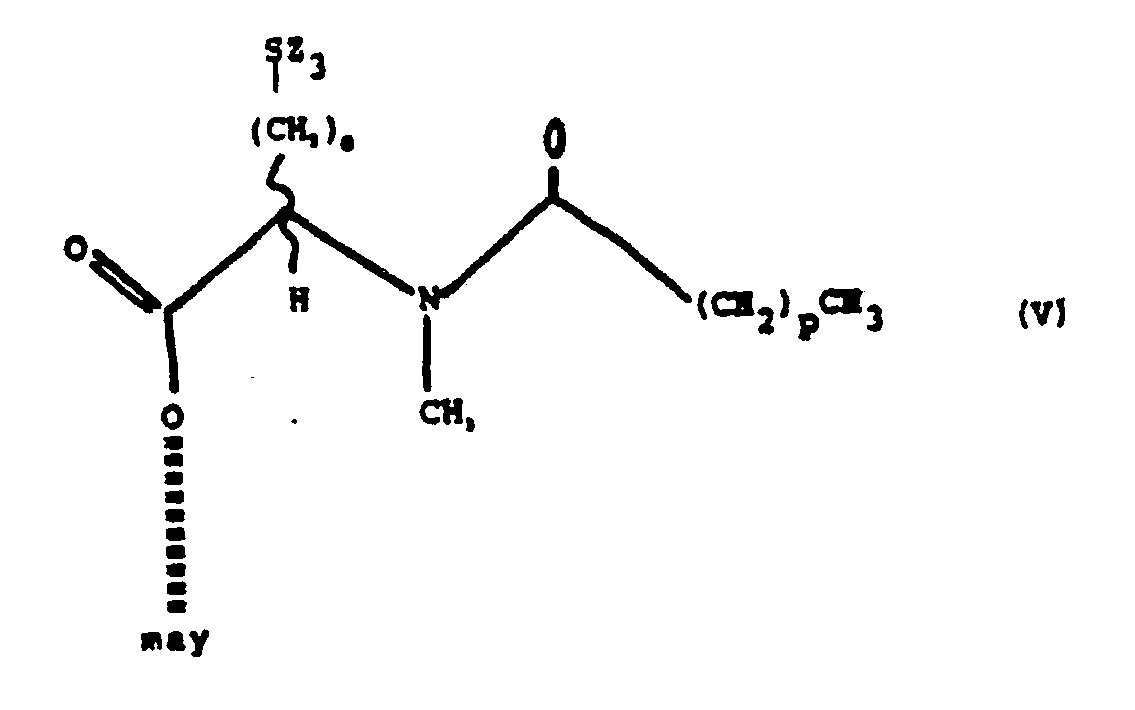
Z₃ represents H or SR₅, wherein R₅ represents methyl, linear alkyl, branched alkyl, cyclic alkyl, simple or substituted aryl, or heterocyclic;
o represents 1, 2 or 3;
p represents 0 or an integer of 1 to 10; and
may represents a maytansinoid
Z₃ represents H or SR₅, wherein R₅ represents methyl, linear alkyl, branched alkyl, cyclic alkyl, simple or substituted aryl or heterocyclic;
o represents 1, 2, or 3;
q represents 0 or an integer of 1 to 10;
Y₀ represents Cl or H; and
X₃ represents H or CH₃. - Examples of linear alkyls include methyl, ethyl, propyl, butyl, pentyl and hexyl.
- Examples of branched alkyls include isopropyl, isobutyl, sec.-butyl, tert.-butyl, isopentyl and 1-ethyl-propyl.
- Examples of cyclic alkyls include cyclopropyl, cyclobutyl, cyclopentyl and cyclohexyl.
- Examples of simple aryls include phenyl and naphthyl.
- Examples of substituted aryls include aryls such as those described above substituted with alkyl groups, with halogens, such as Cl, Br, F, nitro groups, amino groups, sulfonic acid groups, carboxylic acid groups, hydroxy groups and alkoxy groups.
- Examples of heterocyclics are compounds wherein the heteroatoms are selected from O, N and S, and include pyrrollyl, pyridyl, furyl and thiophene.
- Disulfide-containing and mercapto-containing maytansinoid drugs of the invention can be evaluated for their ability to suppress proliferation of various unwanted cell lines in vitro. For example, cell lines such as the human epidermoid carcinoma line KB, the human breast tumor line SKBR3, and the Burkitt's lymphoma line Namalwa can easily be used for the assessment of cytotoxicity of these compounds. Cells to be evaluated can be exposed to the compounds for 24 hours and the surviving fractions of cells measured in direct assays by known methods. IC₅₀ values can then be calculated from the results of the assays.
- The effectiveness of the compounds of the invention as therapeutic agents depends on the careful selection of an appropriate cell binding agent. Cell binding agents may be of any kind presently known, or that become known and include peptides and non-peptides. Generally, these can be antibodies (especially monoclonal antibodies), lymphokines, hormones, growth factors, nutrient-transport molecules (such as transferrin), or any other cell binding molecule or substance.
- More specific examples of cell binding agents that can be used include:
-monoclonal antibodies;
-fragments of antibodies such as Fab, Fab′, and F(ab′)₂ (Parham, 131 J. Immunol. 2895-2902 (1983); Spring et al, 113 J. Immunol. 470-478 (1974); Nisonoff et al, 89 Arch. Biochem. Biophys. 230-244 (1960));
-interferons (e.g. α, β, γ);
-lymphokines such as IL-2, IL-3, IL-4, IL-6;
-hormones such as insulin, TRH (thyrotropin releasing hormone), MSH (melanocyte-stimulating hormone), steriod hormones, such as androgens and estrogens;
-growth factors and colony-stimulating factors such as EGF, TGF-α, G-CSF, M-CSF and GM-CSF (Burgess, 5 Immunology Today 155-158 (1984)); and
-transferrin (O'Keefe et al, 260 J. Biol. Chem. 932-937 (1985)). - Monoclonal antibody techniques allow for the production of extremely specific cell binding agents in the form of specific monoclonal antibodies. Particularly well known in the art are techniques for creating monoclonal antibodies produced by immunizing mice, rats, hamsters or any other mammal with the antigen of interest such as the intact target cell, antigens isolated from the target cell, whole virus, attenuated whole virus, and viral proteins such as viral coat proteins. Sensitized human cells can also be used.
- Selection of the appropriate cell binding agent is a matter of choice that depends upon the particular cell population that is to be targeted, but in general monoclonal antibodies are preferred if an appropriate one is available.
- For example, the monoclonal antibody J5 is a murine IgG2a antibody that is specific for the Common Acute Lymphoblastic Leukemia Antigen (CALLA) (Ritz et al, 283 Nature 583-585 (1980)) and can be used if the target cells express CALLA such as in the disease of acute lymphoblastic leukemia. Similarly, the monoclonal antibody anti-B4 is a murine IgG₁, that binds to the CD19 antigen on B cells (Nadler et al, 131 J. Immunol. 244-250 (1983)) and can be used if the target cells are B cells or diseased cells that express this antigen such as in non-Hodgkin's lymphoma or chronic lymphoblastic leukemia.
- Additionally, GM-CSF which binds to myeloid cells can be used as a cell binding agent to diseased cells from acute myelogenous leukemia. IL-2 which binds to activated T-cells can be used for prevention of transplant graft rejection, for therapy and prevention of graft-versus-host disease, and for treatment of acute T-cell leukemia. MSH which binds to melanocytes can be used for the treatment of melanoma.
- Cancers of the breast and testes can be successfully targeted with estrogen (or estrogen analogues) or androgen (or androgen analogues) respectively as cell binding agents.
- Conjugates of the maytansinoid derivatives of the invention and a cell binding agent can be formed using any techniques presently known or later developed. The maytansinoid ester can be modified to yield a free amino group and then linked to an antibody or other cell binding agent via an acid-labile linker, or a photolabile linker. The maytansinoid ester can be condensed with a peptide and subsequently linked to a cell binding agent to produce a peptidase-labile linker. The maytansinoid ester can be treated to yield a primary hydroxyl group, which can be succinylated and linked to a cell binding agent to produce a conjugate that can be cleaved by intracellular esterases to liberate free drug. Most preferably, the maytansinoid esters are treated to create a free or protected thiol group, and then one or many disulfide or thiol-containing maytansinoid derivatives are covalently linked to the cell binding agent via disulfide bond(s).
- Representational conjugates of the invention are antibody/maytansinoid derivatives, antibody fragment/maytansinoid derivatives, epidermal growth factor (EGF)/maytansinoid derivatives, melanocyte stimulating hormone (MSH)/maytansinoid derivatives, thyroid stimulating hormone (TSH)/maytansinoid derivatives, estrogen/maytansinoid derivatives, estrogen analogue/maytansinoid derivatives, androgen/maytansinoid derivatives, androgen analogue/maytansinoid derivatives.
- Maytansinoid conjugates of antibodies, antibody fragments, protein hormones, protein growth factors and other proteins are made in the same way. For example, peptides and antibodies can be modified with crosslinking reagents such as N-succinimidyl 3-(2-pyridyldithio)propionate, 4-succinimidyl-oxycarbonyl-α-methyl-α-(2-pyridyldithio)-toluene (SMPT), N-succinimidyl-3-(2-pyridyldithio)-butyrate (SDPB), 2-iminothiolane, or S-acetylsuccinic anhydride by known methods. See, Carlsson et al, 173 Biochem. J. 723-737 (1978); Blattler et al, 24 Biochem. 1517-1524 (1985); Lambert et al, 22 Biochem. 3913-3920 (1983); Klotz et al, 96 Arch. Biochem. Biophys. 605 (1962); and Liu et al, 18 Biochem, 690 (1979), Blakey and Thorpe, 1 Antibody, Immunoconjugates & Radiopharmaceuticals, 1-16 (1988), Worrell et al 1 Anti-Cancer Drug Design 179-184 (1986). The cell binding agent containing free or protected thiol groups thus derived is then reacted with a disulfide- or thiol-containing maytansinoid to produce conjugates. The conjugates can be purified by HPLC or by gel filtration.
- Similarly, for example, estrogen and androgen cell binding agents such as estradiol and androstenediol can be esterified at the C-17 hydroxy group with an appropriate disulfide-containing carboxylic acid using e.g. dicyclohexylcarbodiimide as a condensing agent. Examples of such carboxylic acids that can be employed are 3-(2-pyridyldithio)propanoic acid, 3-methyldithiopropanoic acid, and 3-phenyldithiopropanoic acid. Esterification of the C-17 hydroxy group can also be achieved by reaction with an appropriately protected thiol group-containing carboxylic acid chloride such as 3-S-acetylpropanoyl chloride. Other methods of esterification can also be employed as described in the literature (Haslam, 36 Tetrahedron 2409-2433 (1980)). The protected or free thiol-containing androgen or estrogen can then be reacted with a disulfide or thiol-containing maytansinoid to produce conjugates. The conjugates can be purified by column chromatography on silica gel or by HPLC.
- Preferably monoclonal antibody or cell binding agent/maytansinoid conjugates are those that are joined via a disulfide bond, as discussed above, that are capable of delivering maytansinoid molecules. Such cell binding conjugates are prepared by known methods such as modifying monoclonal antibodies with succinimidyl pyridyl-dithiopropionate (SPDP) (Carlsson et al, 173 Biochem. J. 723-737 (1978)). The resulting thiopyridyl group is then displaced by treatment with thiol-containing maytansinoids to produce disulfide linked conjugates. Alternatively, in the case of the aryldithiomaytansinoids, the formation of the cell binding conjugate is effected by direct displacement of the aryl-thiol of the maytansinoid by sulfhydryl groups previously introduced into antibody molecules. Conjugates containing 1 to 10 maytansinoid drugs linked via a disulfide bridge are readily prepared by either method.
- More specifically, a solution of the dithiopyridyl modified antibody at a concentration of 1 mg/ml in 0.1 M potassium phosphate buffer, at pH 7.0 containing 1 mM EDTA is treated with the thiol-containing maytansinoid (1.25 molar equivalent/dithiopyridyl group). The release of pyridine-2-thione from the modified antibody is monitored spectrophotometrically at 343nm and is complete in about 30 min. The antibody-maytansinoid conjugate is purified and freed of unreacted drug and other low molecular weight material by gel filtration through a column of Sephadex G-25. The number of maytansinoids bound per antibody molecule can be determined by measuring the ratio of the absorbance at 252nm and 280nm. An average of 1-10 maytansinoid molecules/antibody molecule can be linked via disulfide bonds by this method.
- Antibody-maytansinoid conjugates with non-cleavable links can also be prepared. The antibody can be modified with crosslinking reagents such as succinimidyl 4-(N-maleimidomethyl)-cyclohexane-1-carboxylate (SMCC), sulfo-SMCC, m-maleimidobenzoyl-N-hydroxysuccinimide ester (MBS), sulfo-MBS or succinimidyl-iodoacetate, as described in the literature, to introduce 1-10 reactive groups. See, Yoshitake et al, 101 Eur. J. Biochem. 395-399 (1979); Hashida et al, J. Applied Biochem. 56-63 (1984); and Liu et al, 18 Biochem. 690-697 (1979). The modified antibody is then reacted with the thiol-containing maytansinoid derivative to produce a conjugate. The conjugate can be purified by gel filtration through a Sephadex G-25 column.
- The modified antibodies are treated with the thiol-containing maytansinoid (1.25 molar equivalent/maleimido group). The mixtures are incubated overnight at about 4°C. The antibody-maytansinoid conjugates are purified by gel filtration through a Sephadex G-25 column. Typically, an average of 1-10 maytansinoids/antibody are linked.
- A preferred method is to modify antibodies with succinimidyl 4-(N-maleimidomethyl)-cyclohexane-1-carboxylate (SMCC) to introduce maleimido groups followed by reaction of the modified antibody with a thiol-containing maytansinoid to give a thioether-linked conjugate. Again conjugates with 1 to 10 drug molecules per antibody molecule result.
- Cytotoxicity of the maytansinoids and their antibody conjugates to non-adherent cell lines such as Namalwa and HL-60 can be measured by back-extrapolation of cell proliferation curves as described in Goldmacher et al, 135 J. Immunol. 3648-3651 (1985). Cytotoxicity of these compounds to adherent cell lines such as SKBR3 and KB can be determined by clonogenic assays as described in Goldmacher et al, 102 J. Cell Biol. 1312-1319 (1986).
- The present invention also provides a therapeutic agent for killing selected cell populations comprising:
- (a) a cytotoxic amount of one or more maytansinoids linked to a cell binding agent, and
- (b) a pharmaceutically acceptable carrier, diluent or excipient.
- Similarly, the present invention provides a method for killing selected cell populations comprising contacting a cell population or tissue suspected of containing cells from said selected cell population with a cytotoxic amount of a cytotoxic agent comprising one or more maytansinoids linked to a cell binding agent.
- The cytotoxic agent is prepared as described above.
- Suitable pharmaceutically acceptable carriers, diluents, and excipients are well known and can be determined by those of skill in the art as the clinical situation warrants.
- Examples of suitable carriers, diluents and/or excipients include: (1) Dulbecco's phosphate buffered saline, pH about 7.4, containing about 1 mg/ml to 25 mg/ml human serum albumin, (2) 0.9% saline (0.9% w/v NaCl), and (3) 5% (w/v) dextrose.
- The method for killing selected cell populations can be practices in vitro, in vivo, or ex vivo.
- Examples of in vitro uses include treatments of autologous bone marrow prior to their transplant into the same patient in order to kill diseased or malignant cells: treatments of bone marrow prior to their transplantation in order to kill competent T cells and prevent graft-versus-host-disease (GVHD); treatments of cell cultures in order to kill all cells except for desired variants that do not express the target antigen; or to kill variants that express undesired antigen.
- The conditions of non-clinical in vitro use are readily determined by the skilled artisan.
- For clinical ex vivo use to remove tumor cells or lymphoid cells from bone marrow prior to autologous transplantation in cancer treatment or in treatment of autoimmune disease, or to remove T cells and other lymphoid cells from autologous or allogeneic bone marrow or tissue prior to transplantation in order to prevent GVHD, treatment can be carried out as follows. Bone marrow is harvested from the patient or other individual and then incubated in medium containing serum to which is added the cytotoxic agent of the invention, concentrations range from about 10 µM to 1 pM, for about 30 minutes to about 48 hours at about 37°C. The exact conditions of concentration and time of incubation (= dose) are readily determined by the skilled artisan. After incubation the bone marrow cells are washed with medium containing serum and returned to the patient by i.v. infusion according to known methods. In circumstances where the patient receives other treatment such as a course of ablative chemotherapy or total-body irradiation between the time of harvest of the marrow and reinfusion of the treated cells, the treated marrow cells are stored frozen in liquid nitrogen using standard medical equipment.
- For clinical in vivo use, the cytotoxic agent of the invention will be supplied as solutions that are tested for sterility and for endotoxin levels. Examples of suitable protocols of conjugate administration are as follows. Conjugates are given daily for 5 days either as an i.v. bolus each day for 5 days, or as a continuous infusion for 5 days. Bolus doses are given in 50 to 100 ml of normal saline to which 5 to 10 ml of human serum albumin has been added. Continuous infusions are given in 250 to 500 ml of normal saline, to which 25 to 50 ml of human serum albumin has been added, per 24 hour period. Dosages will be 10 µg to 100 mg/kg of body weight per day, i.v. (range of 1 ng to 10 mg/kg per day). Four weeks after treatment, the patient may receive a second course of treatment. Specific clinical protocols with regard to route of administration, excipients, diluents, dosages, times, etc., can be determined by the skilled artisan as the clinical situation warrants.
- Examples of medical conditions that can be treated according to the in vivo or ex vivo methods of killing selected cell populations include malignancy of any type including, for example, cancer of the lung, breast, colon, prostate, kidney, pancreas, ovary, and lymphatic organs; autoimmune diseases, such as systemic lupus, rheumatoid arthritis, and multiple sclerosis; graft rejections, such as renal transplant rejection, liver transplant rejection, lung transplant rejection, cardiac transplant rejection, and bone marrow transplant rejection; graft versus host disease; viral infections, such as CMV infection, HIV invection, AIDS, etc,; and parasite infections, such as giardiasis, amoebiasis, schistosomiasis, and others as determined by one skilled in the art.
- The invention will now be illustrated by reference to non-limiting examples. Unless otherwise stated, all percents, ratios, parts, etc. are by weight.
- Melting points were determined on a Electrothermal melting point apparatus. Proton magnetic resonance (¹H NMR) spectra were obtained on a Varian EM360 spectrometer at 60 MHz or on a Bruker AM300 machine at 300 MHz. Chemical shifts are reported in δ values relative to an internal tetramethylsilane (TMS) standard. UV spectra were recorded on a Perkin Elmer λ4A spectrophotometer. Optical rotations were determined using a Perkin Elmer model 241 polarimeter. A Rainin HPX instrument equipped with a Gilson variable wavelength UV detector and a Waters Radialpak C-18 column was used for HPLC analyses. Elemental analyses were performed by Atlantic Microlabs, Atlanta, Ga.
- 3-Methyldithio-propanoic acid (3b). To a stirred solution of 3-mercaptopropanoic acid (2b) (5.00 g. 0.047 mol) in water (150 ml), cooled in an ice bath, was added methyl methanethiosulfonate (6.54 g. 0.052 mol) in absolute ethanol (75 ml). The reaction mixture was stirred overnight at room temperature. The mixture was then diluted with saturated, aqueous NaCl (400 ml) and extracted with ether (3 x 150 ml). The combined ether extracts were washed with saturated NaCl, dried over Na₂SO₄ and concentrated. The residue was distilled to afford a colorless liquid (6.47 g, 90%): bp1.0105⁰C. ¹H NMR(CDCl₃) δ 2.3 (3H, s), 2.8 (4H, m), 11.2 (1H, s).
- 4-methyldithio-butanoic acid (3c). To a stirred solution of bis-(3-carboxypropyl)-disulfide (1.00 g, 4.20 mmol) in methanol (20 ml) was added a solution of dithiothreitol (0.647 g, 4.20 mmol) in H₂O (20 ml). A solution of 10 M NaOH (0.842 ml, 8.42 mmol) was then added and the mixture was allowed to stir at room temperature overnight to effect complete reduction. Methyl methanethiosulfonate (1.17 g, 9.24 mmol) was added and the reaction mixture allowed to stir for another three hours. The mixture was then diluted with saturated, aqueous NaCl (150 ml), acidified (aqueous HCl), and extracted with ethyl ether (3 x 100 ml). The combined organic layers were washed with saturated NaCl, dried (Na₂SO₄), concentrated and the concentrate was chromatographed on silica gel eluting with methylene chloride/ethyl acetate to give 0.867 g (56%) of a clear liquid. ¹H NMR (CDCl₃) δ 2.1 (2H, m), 2.4 (3H, s), 2.4 (2H, m), 2.7 (2H, m), 11.1 (1H,s).
- 5-Mercaptopentanoic acid (2d). Compound 2d was prepared by a modification of a literature method (Khim et al, 37 J. Org. Chem. 2714-2720 (1972)). To a stirred solution of 5-bromopentanoic acid (1.80 g, 0.01 mol) in absolute ethanol (25 ml) was added thiourea (0.761 g, 0.01 mol) and the reaction mixture was refluxed for 6 hours. A solution of 50% aqueous NaOH (20 ml) was then added and the mixture refluxed for an additional two hours. The mixture was then diluted with water (100 ml), acidified (aqueous HCL), and extracted with ethyl acetate (4 x 50 ml). The combined organic layers were dried over sodium sulfate and evaporated under reduced pressure. The residue was chromatographed over silica gel eluting with methylene chloride/ethyl acetate to give 0.885 g (66%) of a colorless liquid. ¹H NMR (CDCl₃) δ 1.3 (1H, t), 1.6 (4H, m), 2.4 (4H, m), 11.5 (1H, s).
- 5-Methyldithio-pentanoic acid (3d). To a stirred solution of 5-mercaptopentanoic acid (2d) (0.500 g, 3.73 mmol) in water (20 ml) was added a solution of methyl methanethiosulfonate (0.517 g, 4.10 mmol) in absolute ethanol (5 ml) and the mixture was stirred at room temperature for 3 hours. The mixture was then diluted with aqueous, saturated NaCl (100 ml) and extracted with ethyl ether (3 x 100 ml). The combined organic layers were washed with saturated NaCl, dried (Na₂SO₄), evaporated under reduced pressure and the concentrate was chromatographed over silica eluting with methylene chloride/ethyl acetate to yield 0.602 g (90%) white crystals: mp 42-44°C. ¹H NMR (CDCl₃) δ 1.7 (4H, m), 2.4 (3H, s), 2.4 (2H, m), 2.7 (2H, m), 11.1 (1H, s).
- 3-Phenyldithio-propanoic acid (4a). To a stirred solution of diphenyl disulfide (3.0 g, 13.8 mmol) in a mixture of ether (10 ml) and methanol (20 ml), under a nitrogen atmosphere, at room temperature was added a solution of 3-mercaptopropanoic acid (2b) (0.49 g, 4.6 mmol) in ether (5 ml), followed by a solution of 10 M NaOH (0.46 ml, 4.6 mmol). The reaction mixture was stirred at room temperature for 20 hours, then stripped of the solvents under reduced pressure. The product was purified by column chromatography on silica gel eluting with ethyl acetate/hexane. The product was obtained as a white solid (0.56 g, 56.6%), mp 57-59°C. NMR (CDCl₃, TMS) δ 2.6-3.0 (4H, m), 7.1-7.6 (5H, m), 10.6 (1H, s).
- 3-(4-Nitrophenyldithio)-propanoic acid (4b). To a stirred solution of bis-(4-nitrophenyl-disulfide (3.00 g, 9.73 mmol) dissolved in a mixture of THF (200 ml) and methanol (50 ml) was added 3-mercaptopropanoic acid (2b) (0.688 g, 6.49 mmol). One drop of a solution of 10 N NaOH was then added to the mixture and the reaction stirred for one hour. The reaction mixture was then diluted with saturated NaCl (100 ml) and extracted with ethyl acetate (3 x 75 ml). The combined organic layers were dried over sodium sulfate, evaporated under reduced pressure and the product was chromatographed over silica gel eluting with methylene chloride/ethyl acetate to yield 0.885 g (53%) of a light yellow solid; mp 98-100°C. ¹H NMR (CD₃COCD₃) δ2.8 (2H, m), 3.1 (2H, m), 7.8 (2H, d), 8.2 (2H, d).
- N-methyl-N-methyldithioacetoyl-L-alanine (5a). To a stirred solution of 1-(3-dimethylaminopropyl)-3-ethylcarbodiimide hydrochloride (2.99 g, 15.6 mmol) and triethylamine (1.58 g, 15.6 mmol) in dry CH₂Cl₂ (40 ml) at 0°C was added a solution of methyldithioacetic acid (Singh et al, 104 Anal. Biochem. 51-58 (1980) (2a) (1.66 g, 12.0 mmol) in dry CH₂Cl₂ (20 ml). A solution of 4-dimethylaminopyridine (0.073 g, 0.60 mmol) in dry CH₂Cl₂ (2 ml) was added and the mixture stirred for 45 min. at O°C. A mixture of N-methyl-L-alanine (0.619 g, 6.00 mmol) and triethylamine (0.607 g, 6.00 mmol) in dry DMF (30 ml) was then added and the mixture stirred at 0°C for two hours. The reaction mixture was diluted with water (100 ml), stirred for another thirty minutes, then acidified (aqueous HCl) and extracted with ethyl acetate (4 x 75 ml). The combined organic layers were washed several times with water, dried over Na₂SO₄, and evaporated under reduced pressure. The residue was chromatographed over silica gel eluting with methylene chloride ethyl acetate to yield 0.25 g (19%) of a pale yellow oil. ¹H- NMR (CDCl₃) δ 1.4 (3H, d), 2.4 (3H, s), 2.9, 3.0 (total 3H, 2s), 3.6 (2H, s), 4.7, 5.2 (total 1H, 2q), 9.8 (1H, s).
- N-methyl-N-(3-methyldithio-propanoyl)-L-alanine (5b). To a stirred solution of 3-methyldithiopropanoic acid (3b) (1.00 g, 6.57 mmol) in dry THF (20 ml) at -10°C under argon was added isobutylchloroformate (0.897g, 6.57mmol) and triethylamine (0.665 g, 6.57 mmol) and the reaction mixture was stirred for 15 minutes. A mixture of N-methyl-L-alanine (0.677 g, 6.57 mmol) and triethylamine (1.33 g, 13.14 mmol) in water (10 ml) was added and the reaction mixture was stirred at room temperature overnight. The mixture was then diluted with water (50 ml), acidified (aqueous HCl), and extracted with ethyl acetate (4 x 50 ml). The combined organic layers were dried over sodium sulfate, the solvent evaporated under reduced pressure and the residue chromatographed over silica gel eluting with methylene chloride/ethyl acetate to yield 0.556 g (34%) white crystals: mp 98-100°C. ¹H NMR (CDCl₃) δ 1.3 (3H, d), 2.2 (3H, s), 2.7 (4H, m), 4.5 (1H, q), 10.7 (1H, s). Anal. Calculated for C₈H₁₅NO₃S₂: C, 40.49; H, 6.37; N, 5.90; mol wt. 237.33. Found: C, 40.42; H, 6.41; N, 5.93.
- N-methyl-N-(4-methyldithio-butanoyl)-L-alanine (5c). To a stirred solution of 4-methyldithiobutanoic acid (3c) (0.200 g, 1.20 mmol) in dry THF (10 ml) at -20°C under Argon was added isobutyl chloroformate (0.164 g, 1.20 mmol) and triethylamine (0.121 g, 1.20 mmol) and the mixture was stirred for twenty minutes. A mixture of N-methyl-L-alanine (0.124 g, 1.20 mmol) and triethylamine (0.243 g, 2.40 mmol) in water (5 ml) was then added and the reaction mixture was stirred at room temperature for five hours. The reaction mixture was then treated as described above for 5b giving the title compound as white crystals (0.135 g, 44%): mp 92-93°C. ¹H NMR (CDCl₃) δ 1.4 (3H, d), 2.0 (2H, m), 2.3 (3H, s), 2.7 (4H, m), 2.9 (3H, s), 5.1 (1H, g), 10.5 (1H, s).
- N-methyl-N-(5-methyldithio-pentanoyl)-L-alanine (5d). To a stirred solution of 5-methyldithio-pentanoic acid (3d) (0.202 g, 1.12 mmol) in dry THF (15 ml) at -40°C under Argon was added isobutyl chloroformate (0.153 g, 1.12 mmol) and triethylamine (0.113 g, 1.12 mmol) and the reaction mixture was stirred for 20 minutes at -10°C. A solution of N-methyl-L-alanine (0.116 g, 1.12 mmol) and triethylamine (0.227 g, 2.24 mmol) in water (5 ml) was then added and the mixture was stirred at 0°C for five hours. The reaction mixture was treated as described above for 5b affording the title compound as white crystals (0.196 g, 66%): mp 84°C. ¹H NMR (CDCl₃) δ 1.4 (3H, d), 1.8 (4H, m), 2.4 (3H, s), 2.7 (4H, m), 3.0 (3H, s), 5.2 (1H, q), 10.7 (1H, s).
- N-Methyl-N-(3-phenyldithio-propanoyl)-L-alanine (5e). A solution of 3-phenyldithio-propanoic acid (4a) (1.8 g, 8.4 mmol) in dry THF was stirred vigorously under a nitrogen atmosphere and cooled to -15°C. Isobutyl chloroformate (1.2 ml, 9.25 mmol) and triethylamine (1.29 ml, 9.25 mmol) were added and the reaction mixture was stirred at this temperature for ten minutes. A solution of N-methyl-L-alanine (0.87 g, 8.4 mmol) and triethylamine (1.29 ml, 9.25 mmol) in water (10 ml) was then added and the reaction mixture was stirred for fifteen minutes at -15°C and then warmed to room temperature and stirred for an additional period of 2.5 hours. 1 M HCl (10 ml) was added and the reaction mixture was extracted with ethyl acetate (4 x 50 ml). The combined organic layers were dried with Na₂SO₄, filtered, and evaporated under reduced pressure. The crude mixture was purified by column chromatography on silica gel eluting with ethyl acetate/hexane-containing 2% acetic acid to give a white solid (1.5 g, 60%): mp 96-97°C. NMR (CDCl₃/TMS) δ 1.4 (2H, d), 2.7-3.0 (7H, m), 5.2 (1H, q), 7.2-7.6 (5H, m).
- N-Methyl-N-[3-(4-Nitrophenyldithio)-propanoyl]L-alanine (5f). To a stirred solution of 3-(4-nitrophenyldithio)-propanoic acid (4b (0.100 g, 0.386 mmol) in dry THF (10 ml) at -40°C under argon was added isobutyl chloroformate (0.053 g, 0.386 mmol) and triethylamine (0.039 g, 0.38 mmol) and the reaction stirred at 0°C for sixty minutes. An aqueous solution (5 ml) of N-methyl-L-alanine (0.040 g, 0.386 mmol) and triethylamine (0.039 g, 0.386 mmol) was then added and the mixture stirred at 0°C for five hours. The mixture was diluted with water (50 ml), acidified (aqueous HCl), and extracted with ethyl ether (3 x 25 ml). The combined organic layers were dried (Na₂SO₄), and the solvent evaporated under reduced pressure. The residue was chromatographed over silica gel eluting with methylene chloride/ethyl acetate to yield 0.048 g (36%) yellow crystals: mp 74-77°C. NMR (CDCl₃) δ 1.4 (3H, d), 2.6-3.4 (4H, m), 2.9 (3H, s), 5.1 (1H, q), 7.6-8.3 (4H, 2d).
- Esterification of Maytansinol. In a typical experiment, a solution of the carboxylic acid 5 (133 µmols) in dry methylene chloride (0.3 ml), was stirred under an argon atmosphere, and treated sequentially with solutions of dicyclohexylcarbodiimide (160 µmol) in methylene chloride (0.2 ml), 1 M ZnCl₂ in ether (26.2 µmol) and maytansinol (15 mg, 26.6 µmol) in methylene chloride (0.3 ml). The reaction mixture was stirred at room temperature for three hours, and then filtered and the filtrate evaporated under reduced pressure. Preparative TLC of the crude mixture on silica gel, eluting twice with 6% methanol in CHCl₃ gave two major UV absorbing band. Both bands were isolated by extraction with ethyl acetate and characterized by NMR spectroscopy.
- Esterification of Maytansinol with N-methyl-N-(methyldithio-propanoyl)-L-alanine. A solution of the carboxylic acid 5b (31.5 mg., 133 µmol) in dry CH₂CL₂ (0.3 ml) was stirred under an argon atmosphere and treated sequentially with solutions of dicyclohexyl-carbodiimide (33 mg, 160 µmol) in CH₂Cl₂, 1 M ZnCl₂ in ether (26.6 µmol), and maytansinol (15 mg, 26.6 µmol) in CH₂Cl₂ (0.3 ml). The reaction mixture was stirred at room temperature for three hours and then filtered and the solvent evaporated under reduced pressure. Preparative TLC on silica gel, eluting twice with 6% methanol in CHCl₃ gave two strong UV absorbing bands with Rf values of 0.6 and 0.7 respectively. Both bands were isolated by extraction with ethyl acetate. NMR spectra and cytotoxicity analyses confirmed that the higher Rf band was the D-aminoacyl ester (45%) while the lower band was the desired L-aminoacyl ester 6b (55%). Both bands were further purified by HPLC on a Waters Radialpak C-18 column, eluting at a flow rate of 1.5 ml/min with a linear gradient of acetonitrile in H₂O (55% CH₃CN to 80% CH₃CN, over 10 min). Under these conditions both isomers had an identical retention time of 7.3 min. NMR (CDCl₃) L-aminoacyl isomer: δ 0.84(3H, s), 1.11-1.23 (1H, m), 1.31 (3H, d, J = 6Hz), 1.35 (3H, d, J = 7Hz), 1.46-1.52 (1H, m), 1.68 (3H, s), 1.97 (1H, d, J = 9Hz), 2.24 (1H, dd, J = 12Hz and 15Hz), 2.30 (3H, s), 2.65 (1H, dd, J = 12Hz and 15Hz), 2.73-2.86 (2H, m), 2.90 (3H, s), 2.92-3.03 (2H, m), 3.08 (1H, d, J = 9Hz), 3.14 (1H, d, J = 12Hz), 3.28 (3H, s), 3.39 (3H, s), 3.54 (1H, d, J = 9Hz), 3.72 (1H, d, J = 13Hz), 4.02 (3H, s), 4.31 (1H, t, J = 11Hz), 4.82 (1H, dd, J = 3Hz and 12Hz), 5.45 (1H, q, J = 7Hz), 5.69 (1H, dd, J = 9Hz and 15Hz), 6.25 (1H, s), 6.47 (1H, dd, J = 11Hz and 15Hz), 6.67 (1H, d, J = 1.5Hz), 6.77 (1H, d, J = 11Hz), 6.85 (1H, d, J =1.5Hz).
- Esterification of Maytansinol with N-methyl-N-(methyl-dithiobutanoyl)-L-alanine. A solution of the carboxylic acid 5c (8.9 mg, 35.5 µmol) in CH₂Cl₂ (0.15 ml) was stirred under an atmosphere of argon, and treated sequentially with solutions of DCC (8.8 mg, 42.6 µmol) in CH₂CL₂, 1M ZnCl₂ (7.1 µmol) in ether and maytansinol (4.0 mg, 7.1 µmol) in CH₂Cl₂. The reaction mixture was stirred at room temperature for 3 hours, and then filtered and the filtrate was evaporated under reduced pressure. The residue was purified by preparative TLC on silica gel, eluting twice with 7% methanol in CHCl₃. Two new UV absorbing bands (Rf = 0.65 and 0.75) were obtained. The products were isolated by extraction with ethyl acetate. The higher Rf band was determined to be the D-aminoacyl ester 6d (41%), while the lower Rf band was the desired L-aminoacyl ester 6c (59%). Both isomers were further purified by HPLC using a Waters Radialpak C-18 column, eluting at a flow rate of 2 ml/min, with a linear gradient of acetonitrile in water (50% to 80% acetonitrile, over 10 minutes). Under these conditions the D-aminoacyl ester had a retention time of 7.4 minutes, while the L-aminoacyl isomer had a retention time of 7.6 min.
- Esterification of Maytansinol with N-methyl-N-(phenyldithio-propanoyl)-L-alanine. A solution of the carboxylic acid 5e (31.5 mg, 105 µmol) in CH₂Cl₂ (0.4 ml) was stirred under argon and treated sequentially with solutions of DCC (26 mg, 126 µmol) in CH₂Cl₂, 1 M ZnCl₂ (17.7 µmol) in ether and maytansinol (10 mg, 17.7 µmol) in CH₂Cl₂ (0.2 ml). The reaction mixture was stirred at room temperature for three hours. The precipitate was removed by filtration and the filtrate concentrated under reduced pressure. Preparative TLC of the residue on silica gel, eluting twice with 5% methanol in CHCl₃ gave two strongly UV absorbing bands with Rf values of 0.5 and 0.6. The two products were isolated by extraction with ethyl acetate and characterized by NMR spectroscopy. The higher Rf band was found to be the D-aminoacyl ester 6f (45%) of maytansinol and the lower band was the L-aminoacyl ester 6e (55%). The overall yield of ester from maytansinol was 44%. The products were further purified by HPLC on a Waters Radialpak C-18 column, eluting at a flow rate of 1.5 ml/min. with a linear gradient of acetonitrile in water (70% to 90% acetonitrile, over 10 min). Under these conditions both isomers had an identical retention time of 6.0 min. NMR (CDCl₃) L-aminoacyl isomer 6e: δ 0.82 (3H, s), 1.11-1.25 (1H, m), 1.33 (3H, d, J = 3Hz), 1.61 (3H, s), 1.63 (3H, d, J = 14Hz), 2.19 (1H, dd, J = 13Hz and 15Hz), 2.61 (1H, dd, J = 12Hz and 15Hz), 2.78 (3H, s), 2.68-3.03 (2H, m), 3.07 (1H, d, J = 9Hz), 3.20 (3H, s), 3.38 (3H, s), 3.53 (1H, d, J = 9Hz), 3.63 (1H, d, J = 13Hz), 3.68 (3H, s), 4.01 (3H, s), 4.30 (1H, t, J = 11Hz), 4.79 (1H, dd, J = 3Hz and 8 Hz), 5.43 (1H, q, J = 7Hz), 5.68 (1H, dd, J = 9Hz and 15Hz), 6.23 (1H, s), 6.45 (1H, dd, J = 12Hz and 15Hz), 6.60 (1H, d, J = 1,5 Hz), 6.75 (1H, d, J = 12Hz), 6.77 (1H, d, J = 1.5Hz), 7.22-7.40 (5H, m).
- Reduction of Maytansinoids. The disulfide-containing
esters 6 of maytansinol were reduced to the thiol-containingmaytansinoids 7 with dithiothreitol by the methods outlined below. In all cases the reactions were performed at 4°C and the products were purified by HPLC. - Reduction of Maytansinoid (6b). A solution of the methyl disulfide ester 6b (0.89 µmol) in ethanol (0.23 ml) and 0.1 M potassium phosphate buffer pH 7.5 (0.16 ml) containing 1 mM EDTA was cooled in ice, under an argon atmosphere and treated with a solution of 100 mM dithiothreitol (1.33 µmol). The progress of reduction was followed by HPLC and judged to be complete after ten hours. The thiol-containing maytansinoid 7b was purified by HPLC using a Waters Radialpak C-18 column at a flow rate of 1.5 ml/min. eluting with a linear gradient of acetonitrile in water (55%-80% acetonitrile, over 10 min). Under these conditions the product eluted as a single peak with a retention time of 5.4 minutes. The presence of one mole of sulfhydryl group/mol product was confirmed using Ellman's assay. The product was further characterized by NMR spectroscopy. NMR (CDCl₃): δ 0.84 (3H, s), 1.33 (3H, d, J = 5Hz), 1.35 (3H, d, J = 5Hz), 1.60 (3H, s), 1.68 (3H, s), 2.22 (1H, dd, J = 3Hz and 14Hz, 2.60-2.82 (2H, m), 2.88 (3H, s), 3.08-3.20 (2H, m), 3.25 (3H, s), 3.39 (3H, s), 3.55 (1H, d, J = 9Hz), 3.71 (1H, d, J = 12Hz), 4.02 (3H, s), 4.32 (1H, t, J = 10Hz), 4.81 (1H, dd, J = 3Hz and 12Hz), 5.45 (1H, q, J = 7Hz), 5.67 (1H, dd J = 9Hz and 15Hz), 6.25 (1H, s), 6.47 (1H, dd, J = 11 Hz and 15Hz), 6.70 (1H, d, J = 1.5Hz), 6.75 (1H, d, J = 11Hz), 6.86 (1H, d, J = 1.5Hz).
- Reduction of Maytansinoid (6e). A solution of the phenyldisulfide ester 6e (0.463 µmol) in ethanol (0.22 ml) and 0.1 M potassium phosphate buffer, pH 7.5 (0.18 ml) containing 2 mM EDTA was cooled in ice and treated with a solution of 20 mM dithiothreitol (0.69 µmol, 0.035 ml). The progress of the reaction was monitored by HPLC and judged to be complete in 40 minutes. The thiol-containing maytansinoid generated in this manner was purified as described above and found to be identical to 7b.
- The disulfide-containing maytansinoid drugs of the invention were evaluated for their ability to suppress proliferation of various human tumor cell lines in vitro. Two adherent cell lines KB (human epidermoid carcinoma) and SKBR3 (human breast tumor) and the non-adherent cell line, Namalwa (Burkitt's lymphoma) were used for the assessment of cytotoxicity of these compounds. Cells were exposed to the compounds for 24 hours and the surviving fractions of cells were measured in direct assays. (KB and SKBR3 were assayed for plating efficiency (Goldmacher et al, 102 J. Cell. Biol. 1312-1319 (1986) and Namalwa was assayed by growth back-extrapolation (Goldmacher et al, 135 J. Immunol. 3648-3651 (1985)). IC₅₀ values were then calculated from these data. The results of these tests are presented in Table 1.
Table 1 Cytotoxicity of New Maytansinoid Derivatives IC₅₀ (M) values for 24 hour exposure Compound Cell Line KB SKBR3 NAMALWA 1a 3.4x10⁻¹¹ 1.1x10⁻¹⁰ 4x10⁻¹⁰ 6b 1.1x10⁻¹¹ 1.1x10⁻¹¹ 6.4x10⁻⁹ 6c 8.5x10⁻¹² 3.8x10⁻¹¹ 3.2x10⁻⁹ 6d 1.9x10⁻¹⁰ nd 1.3x10⁻⁸ 6e 1.0x10⁻¹⁰ nd 6x10⁻¹⁰ 6f 2.0x10⁻⁹ nd 8x10⁻⁹ 7b 6x10⁻¹⁰ < 10⁻¹¹ 1x10⁻⁸ 7c 4x10⁻¹⁰ nd nd - The L-aminoacyl isomers 6b and 6c are highly toxic towards KB and SKBR3 cells with IC₅₀ values of ≦ 1x10⁻¹¹ M while the corresponding phenyl-dithio analog 6e has an IC₅₀ value of 1x10⁻¹⁰ M on KB cells. The methyl-dithio analogs 6b and 6c are 3-10 fold more toxic than maytansine which has an IC₅₀ of 3x10⁻¹¹ M and 1x10⁻¹⁰ M to KB and SKBR3 cells respectively. These two compounds, however, are somewhat less toxic, IC₅₀ ≧ 3x10⁻⁹ M, than maytansine, IC₅₀ = 4x10⁻¹⁰ M, to Namalwa cells while the phenyldithio compound 6e is almost as toxic, IC₅₀ = 6x10⁻¹⁰ M, as maytansine. The D-aminoacyl isomers 6d and 6f were as least 20 times less toxic than their L counterparts, 6c and 6e, to all three cell lines. The free thiol-containing maytansinoids are also very toxic to KB and SKBR3 cells with IC₅₀ values for 7b of 6x10⁻¹⁰ M and < 10⁻¹¹ M respectively.
- Since the methyldithio-maytansinoids are even more toxic than maytansine to solid tumor cell lines like KB and SKBR3, a wider panel of solid tumor cell lines was tested in a manner analogous to that described above to see whether this was a general phenomenon. The results are summarized in Table 2.
Table 2 IN VITRO CYTOTOXICITY OF MAYTANSINE (1a) AND MAYTANSINOID DERIVATIVE (6b) TOWARDS DIFFERENT CELL LINES CELL LINE IC₅₀(24hr.exposure) Molar Maytansine May-CH₂CH₂SSMe(6b) KB (Epidermoid Carcinoma) 3.4x10⁻¹¹ 1.1x10⁻¹¹ SKBR3 (Breast adenocarcinoma) 1.1x10⁻¹⁰ 1.2x10⁻¹¹ (1x10⁻¹³, 72hr exposure) SW620 (Colon adenocarcinoma) >10⁻¹⁰ 4x10⁻¹¹ A498 (Renal carcinoma) >10⁻¹⁰ 1x10⁻¹⁰ Ovcar3 (Ovarian carcinoma) 1.0x10⁻¹⁰ 5x10⁻¹¹ Namalwa (Burkitt's lymphoma) 4x10⁻¹⁰ 6x10⁻⁹ HL60 (Promyelocytic leukemia) 5x10⁻¹⁰ 8x10⁻¹⁰ - The methyldithio compound 6b was very toxic to SW620 (colon adenocarcinoma) and A498 cells (renal carcinoma) with IC₅₀ values of 4x10⁻¹¹ M and 1x10⁻¹⁰ M respectively, while maytansine was nontoxic (surviving fraction = 100%) even at 1x10⁻¹⁰ M to these cell lines. Compound 6b was twice as cytotoxic, IC₅₀ = 5x10⁻¹¹ M, as maytansine to the ovarian cancer cell line OVCAR3. The high cytotoxicity of the methyl-dithio maytansinoids to adherent cell lines is an unexpectedly superior property of these compounds and indicates that cancers caused by solid tumors are good targets for treatment with conjugates of these compounds with appropriate cell targeting agents.
- Conjugation of Maytansinoid 7b to Antibodies via Disulfide links: The conjugation of the thiol-containing maytansinoid 7b to antibodies via disulfide links was performed in two steps. In the first step dithiopyridyl groups were introduced into antibodies using succinimidyl pyridyldithiopropionate (SPDP) as described by Carlsson et al. The thiopyridyl groups were then displaced by reaction with the maytansinoid 7b to produce a conjugate.
- Preparation of Antibody-SS-Maytansinoid Conjugates. Antibodies anti-B4, anti-T9 and A7 were modified with SPDP as described in the literature. Between 1
t 10 dithiopyridyl groups were introduced on the average per antibody molecule. - A solution of the dithiopyridyl modified antibody at a concentration of 1 mg/ml in 0.1 M potassium phosphate buffer pH 7.0 containing 1 mM EDTA at 25°C was treated with the thiol-containing maytansinoid 7b (1.25 molar equivalent/dithiopyridyl group). The release of pyridine-2-thione from the modified antibody was monitored spectrophotometrically at 343 nm and was found to be complete in 30 minutes. The antibody-maytansinoid conjugate was purified and freed of unreacted drug and other low molecular weight material by gel filtration through a column of Sephadex G-25. The number of maytansinoid molecules bound per antibody molecule was determined by measuring the ratio between the absorbances at 252 nm and 280 nm. An average of 1-10 maytansinoid molecules/antibody molecule can be linked via disulfide bonds by this method.
- Conjugation of Maytansinoid 7b to Antibodies via a Noncleavable Thioether Link: The conjugation of the thiol-containing maytansinoid 7b was performed in two steps. The antibody was first reacted with succinimidyl maleimidomethylcyclohexane carboxylate (SMCC) to introduce maleimido groups. The modified antibody was then reacted with maytansinoid 7b forming thioether links.
- Preparation of Antibody-Maytansinoid Conjugates (non-cleavable). Antibodies, anti-B4, anti-T9 and A7 were modified with SMCC as described in the literature.
- The modified antibodies were treated with maytansinoid (7b) (1.25 molar equivalent/maleimido group). The mixtures were incubated overnight at 4°C. The antibody-maytansinoid conjugates were purified as described above. Typically, an average of 1-10 maytansinoid molecules/antibody molecule were linked.
- Maytansinol can be esterified with N-methyl-N-(3-t-boc-aminopropanoyl)-L-alanine in the presence of dicyclohexylcarbodiimide and zinc chloride as described for 6b. Cleavage of the t-boc protecting group with trifluoracetic acid will give a C-3 ester of maytansinol containing a terminal amino group. This amino group containing maytansinoid derivative can be linked to antibodies and other cell binding agents via an acid labile linker as previously described (Blattler et al, 24 Biochemistry, 1517-1524 (1985), U.S. Patent Nos. 4,542,225, 4,569,789 and 4,764,368).
- The amino group-containing maytansinoid derivative described above can be linked to cell binding agents via a photolabile linker as previously described (Senter et al, 42 Photochemistry and Photobiology, 231-237 (1985), U.S. Patent 4,625,014).
- The amino group-containing maytansinoid described above can also be linked to cell binding agents via peptide spacer linkers. It has been previously shown that short peptide spacers between drugs and macromolecular protein carriers are stable in serum but are readily hydrolyzed by intracellular lysosomal peptidases (Trouet et al, 79 Proc. Nat'l. Acad. Sci., 626-629 (1982)). The amino group-containing maytansinoid can be condensed with peptides such as Ala-Leu, Leu-Ala-Leu and Ala-Leu-Ala-Leu using condensing agents such as 1-ethyl-3-(3-dimethylaminopropyl) carbodiimide-HCl to give a peptide derivative of the maytansinoid which can then be linked to cell binding agents.
- Maytansinol can be esterified with N-methyl-N-(3-tert-butoxy-propanoyl)-L-alanine in the presence of dicyclohexyl-carbodiimide and zinc chloride as previously described for 6b. Cleavage of the tert-butyl protecting group with trifluoroacetic acid gives a C-3 ester of maytansinol containing a terminal primary hydroxyl group. This maytansinoid derivative can be succinylated with succinic anhydride and then linked to a cell binding agent to produce a conjugate that can be cleaved by intracellular esterases to liberate free drug. (For examples see: Aboud-Pirak et al, 38 Biochem. Pharmacol., 641-648 (1989), Laguzza et al, 32 J. Med. Chem., 549-555 (1989)).
- The disulfide-containing
esters 10 of maytansinol can be reduced with dithiothreitol as described for 7b to produce the thiol-containingmaytansinoids 11 which can be conjugated to cell binding agents via disulfide or thioether links as previously described (See Example 3). - Methyldithio-N-Methylcysteine (8): A solution of N-methylcysteine (Undhein, K., & Eidem, A., 23 Acta Chem. Scandinavica 3129-3133 (1970) (1.5 g, 11.1 mmol) in H₂O (20 ml) was stirred at room temperature, under an atmosphere of argon, and treated with a solution of methyl methanethiol sulfonate (3.0 ml, 29.2 mmol) in ethanol (10 ml). The reaction mixture was stirred at this temperature for two hours and then diluted with H₂O (100 ml) and washed with ether (4 x 40 ml). The aqueous layer was acidified to
pH 2 and passed through an Amberlite IRA 93 (-OH form) column. The column was washed with water and the effluent was collected and evaporated to dryness under reduced pressure to give a white solid (1.2g, 60%), mp 194-5°C. NMR (D₂O, TMS ext. standard): δ2.2(3H,s), 2.5(3H,s), 3.2(2H,d), 3.7(1H,q). - N-Acetyl-N-Methyl-Methyldithiocysteine (9): To a solution of glacial acetic acid (0.25 ml, 4.4 mmol) in dry THF(4 ml), at -20°C under an atmosphere of N₂ were added, with stirring, isobutylchloroformate (0.57 ml, 4.4 mmol) and triethylamine (0.61 ml, 4.4 mmol). The reaction mixture was stirred at this temperature for 20 minutes and then treated with a solution of methyldithio-N-methylcysteine (0.4 g, 2.2 mmol) and triethylamine (0.45 ml, 3.3 mmol) in H₂O and then allowed to stir overnight. The mixture was then diluted with water (25 ml) and acidified to
pH 2 with HCl and extracted with ethyl acetate (4 x 50 ml). The combined organic layer was dried with sodium sulfate and the solvent evaporated under reduced pressure to give the product as a pale yellow solid (0.2g, 55%) mp 137-8⁰C NMR (CDCl₃): 2.1(3H,s), 2.3(3H,s), 3.0(3H,s), 3.2(2H,d) and 4.8(1H,q). - Esterification Of Maytansinol with N-Acetyl-N-Methyl Methyldithiocysteine: A solution of compound 9 (15.6 mg, 0.07 mmol) in dry methylene chloride (0.45 ml) was stirred at room temperature under an argon atmosphere and treated sequentially with solutions of 1 M ZnCl₂ in ethyl ether (0.028 mmol), DCC (17.3 mg, 0.084 mmol) in methylene chloride (0.2 ml), and maytansinol (4.0 mg, 0.007 mmol) in CH₂Cl₂ (0.1 ml). The reaction mixture was stirred for 3 hours and then filtered and the filtrate evaporated under reduced pressure. The residue was purified by preparative TLC on silica gel eluting with 6% methanol in CHCl₃. The product was isolated by extraction with ethyl acetate and further purified by HPLC on a Waters Radialpak C-18 column eluting with a linear gradient of acetonitrile in water (55-80% acetonitrile/10 min) at a flow rate of 1.5 ml/min. The L-aminoacyl ester 10a and the D-aminoacyl ester 10b of maytansinol that were obtained by this method were readily separable with retention times of 5.0 and 5.8 minutes respectively.
- Cells of the human promyelocytic leukemia cell line, HL-60 (ATCC CCL 240) and the Burkitt's lymphoma cell line Namalwa (ATCC CRL 1432) were grown as suspension cultures in RPMI-1640 medium supplemented with 10% fetal calf serum and 2 mM L-glutamine. All other cell lines described below were grown as adherent cultures. Human epidermoid carcinoma cell line, KB (ATCC CCL 17), human renal carcinoma cell line A498 (ATCC HTB 44), human colon adenocarcinoma cell lines SW620 (ATCC CCL 227) and HT-29 (ATCC HTB 38) were grown in RPMI-1640 medium supplemented with 10% fetal calf serum and 2 mM L-glutamine. Human breast carcinoma SKBR3 cells (ATCC HTB 30) were grown in DMEM supplemented with 15% fetal calf serum containing 2 mM glutamine and the human ovarian adenocarcinoma cell line OVCAR3 (ATCC HTB 161) was grown in RPMI-1640 medium supplemented with 10% fetal calf serum containing 10 µg/ml insulin and 2 mM L-glutamine.
- Three different antibodies were used for conjugation via disulfide links to thiol-containing maytansinoids. In all these experiments the maytansinoid derivative 7b was used for conjugation. Conjugates were prepared with the antibodies anti-B4, which is against the B cell antigen CD19; anti-T9 (5E9) which is an anti-human transferrin receptor antibody, and A7, which is an anti-human colon cancer antibody.
- Cytotoxicity assays were performed in the respective media described above. The cytotoxicity of the maytansinoids and their antibody conjugates to HL-60 and Namalwa cells was measured by back-extrapolation of cell proliferation curves. Cytotoxicity of these compounds to the rest of the cell lines was determined using a clonogenic assay as previously described.
- the conjugates were assessed for in vitro cytotoxicity and the IC₅₀ values for cell lines Namalwa, KB, HT-29 and SW620 are summarized in Table 3.
TABLE 3 IN VITRO CYTOTOXICITY AND SPECIFICITY OF ANTIBODY-MAYTANSINOID CONJUGATES CELL LINE CONJUGATE IC₅₀ (Molar) (24 h exposure) Namalwa anti-B4-SS-May 7 x 10⁻⁹ anti-T9-SS-May 2 x 10⁻⁹ KB anti-T9-SS-May 2 x 10⁻¹⁰ anti-T9-May (non cleavable) 4 x 10⁻⁹ A7-SS-May 8 x 10⁻⁹ (Non-Binding Antibody, 72 hr Exp.) HT-29 A7-SS-May 1.5 x 10⁻¹⁰ 4 x 10⁻¹¹ (72 hr. Exp.) SW620 A7-SS-May 1.6 x 10⁻¹⁰ - The disulfide-linked anti-B4-maytansinoid conjugate (anti-B4-SS-May) and the anti-T9-drug conjugate (anti-T9-SS-May) were both cytotoxic to Namalwa cells (IC₅₀ = 7 x 10⁻⁹ M and 2 x 10⁻⁹ M, respectively). The disulfide-linked anti-T9 conjugate is even more toxic to KB cells with an IC₅₀ value of 2 x 10⁻¹⁰ M. In order to prove the importance of an intracellularly cleavable disulfide link between antibody and drug, a conjugate in which the maytansinoid was linked to the antibody via a non-cleavable thioether bond was prepared. Thus an anti-T9-drug conjugate linked in such a non cleavable fashion was at least 20 times less toxic, (IC₅₀ = 4 x 10⁻⁹ M) than the corresponding disulfide linked conjugate.
- The A7-maytansinoid conjugate is highly toxic to the colon adenocarcinoma cell lines HT-29 and SW620. The IC₅₀ for these cell lines after a 24 hour exposure to the conjugate were 1.5 x 10⁻¹⁰ M and 1.6 x 10⁻¹⁰ M, respectively. The cytotoxicity after a 72 hour exposure was even more dramatic (IC₅₀ = 4 x 10⁻¹¹ M on HT-29 cells). Several experiments were designed to demonstrate in vitro specificity of these immunoconjugates. (Some of the data is shown graphically in Fig. 5). First, addition of an excess of unconjugated A7 antibody completely abolishes cytotoxicity of the A7-maytansinoid conjugate to HT-29 and SW620 cells at both 24 and 72 hour exposures. This observation also indicates the absence of free drug in the conjugate. Second, the conjugate prepared above with the antibody anti-B4, which does not bind to HT-29 and SW620 cells, is much less cytotoxic to these cells than the A7 conjugate. Another independent experiment that establishes specificity is the 100 fold lower cytotoxicity of the A7-maytansinoid conjugate to antigen-negative KB cells, (IC₅₀KB = 8 x 10⁻⁹ M vs. IC₅₀HT-29 = 4 x 10⁻¹¹ M, 72 hr Exp.).
- The specific affinities of disulfide-linked A7-maytansinoid conjugates were analyzed by competition binding assays. The competition of binding of FITC-labeled A7 antibody to HT-29 and SW620 cells by unlabeled A7 and its maytansinoid conjugates were determined by direct immunofluorescence on a Becton-Dickinson FACS. The two cell lines were grown as adherent cells in tissue culture grade flasks containing Dulbecco's modified minimum essential medium with 15% fetal bovine calf serum. The cells were then trypsinized and incubated in suspension, at 37°C, for 30 minutes in the same medium in non-tissue culture grade flasks to prevent adherence of cells to the plastic. The cells were then transferred to wells of 96 well plates and resuspended in minimum essential medium containing 25% pooled human serum. Cell suspensions (0.2 ml suspension containing 100,000 cells/well) were incubated with 6 nM FITC-labeled A7, at the indicated concentrations of unlabeled antibody or maytansinoid conjugates for 1 hour at 0°C. The cells were then washed once with buffer and fixed with 1% formaldehyde in phosphate buffered saline. Mean cell fluorescence was measured on a FACS.
- The results are shown in Figures 6(A) and 6(B). Figures 6(A) and 6(B) show that A7-maytansinoid conjugates containing between 3 to 6 drug molecules/antibody molecule bind as well as unconjugated antibody to HT-29 or SW620 cells. This indicates that the present method of conjugation of the maytansinoids to antibodies does not cause any impairment of binding to target cells.
- Blood clearances of a typical ¹²⁵I-labelled murine IgG₁ antibody and of its corresponding ¹²⁵I-labelled maytansinoid conjugate, containing an average of 4 drug molecules/antibody molecule, were determined in female CD-1 mice. The antibody and the maytansinoid conjugates had been radiodinated by the method of Bolton and Hunter (133 Biochem. J. 529-539 (1973)). Greater than 99% of the radioactivity in the samples was bound to protein. The antibody and conjugates (2.7 x 10⁵ cpm each) were injected separately i.v. into the tail vein. Heparinized blood samples were collected from the retroorbital venus plexus at the indicated times and measured for radioactivity content. The results are summarized in Figure 7. The antibody and its maytansinoid conjugate display very similar biphasic clearance profiles.
- While the invention has been described in detail and with reference to specific embodiments thereof, it will be apparent to one skilled in the art that various changes and modifications can be made therein without departing from the spirit and scope of the invention.
- The invention is of use in killing cell populations which cause cancer, melanomas or graft versus host disease (GVHD). The invention can be used to kill cell infected with bacteria.
- Some features of the invention are set out in the following numbered clauses:
- 1. A cytotoxic agent comprising one or more maytansinoids linked to a cell binding agent.
- 2. The cytotoxic agent of
clause 1, wherein the maytansinoid is a maytansinoid ester. - 3. The cytotoxic agent of
clause 2, wherein the maytansinoid ester is a C-3 maytansinoid ester. - 4. The cytotoxic agent of
clause 2 wherein the maytansinoid ester is an N-methyl-alanine-containing maytansinoid ester. - 5. The cytotoxic agent of
clause 4, wherein the N-methyl-alanine-containing maytansinoid ester is represented by formula (I)
Z₀ represents H or SR, wherein R represents methyl, linear alkyl, branched alkyl, cyclic alkyl, simple or substituted aryl or heterocyclic;
ℓ represents an integer of 1 to 10 and;
may represents a maytansinoid. - 6. The cytotoxic agent of
clause 4, wherein the N-methyl-alanine-containing maytansinoid ester is represented by formula (II):
R₁ and R₂, which may be the same or different, represents H, CH₃ or CH₂CH₃;
Z₁ represents H or SR₃, wherein R₃ represents methyl, linear alkyl, branched alkyl, cyclic alkyl, simple or substituted aryl, or heterocyclic;
m represents 0,1, 2 or 3; and
may represents a maytansinoid. - 7. A cytotoxic agent of
clause 4, wherein the N-methyl-alanine-containing maytansinoid ester is represnted by formula (III):
Z₂represents H or SR₄ wherein R₄represents methyl, linear alkyl, branched alkyl, cyclic alkyl, simple or substituted aryl, or heterocyclic;
n represents an integer of 3 to 8; and
may represents a maytansinoid. - 8. The cytotoxic agent of
clause 4, wherein the N-methyl-alanine-containing maytansinoid ester is a C-3 ester of maytansinol. - 9. The cytotoxic agent of
clause 8, wherein the maytansinoid ester is an ester of an analogue of maytansinol that has a modification at C-19 or C-20. - 10. The cytotoxic agent of
clause 8, wherein the maytansinoid ester is an ester of dechloro maytansinol. - 11. The cytotoxic agent of
clause 8, wherein the C-3 ester of maytansinol is represented by formula (IV):
Z₀ represents H or SR, wherein R represents methyl, linear alkyl, branched alkyl, cyclic alkyl, simple or substituted aryl or heterocyclic;
ℓ represents 1, 2 or 3
Y₀ represents Cl or H; and
X₃ represents H or CH₃. - 12. The cytotoxic agent of
clause 11, wherein R represents methyl. - 13. The cytotoxic agent of
clause 8, which comprises N- methyl-N-(3-methyldithiopropanoyl)-L-alanine. - 14. The cytotoxic agent of
clause 2 wherein the maytansinoid ester is an N-methyl-cysteine-containing maytansinoid ester. - 15. The cytotoxic agent of
clause 14, wherein the N-methyl-cysteine-containing maytansinoid ester is represented by formula (V):
Z₃ represents H or SR₅, wherein R₅ represents methyl, linear alkyl, branched alkyl, cyclic alkyl, simple or substituted aryl, or a heterocyclic;
o represents 1, 2 or 3;
p represents 0 or an integer of 1 to 10; and
may represents a maytansinod. - 16. The cytotoxic agent of
clause 14, wherein the N-methyl-cysteine-containing ester is a C-3 ester of maytansinol. - 17. The cytotoxic agent of
clause 16, wherein the maytansinoid ester is an ester of an analogue of maytansinol that has a modification at C-19 or C-20. - 18. The cytotoxic agent of
clause 16, wherein the maytansinoid ester is an ester of dechloro maytansinol. - 19. The cytotoxic agent of
clause 14, wherein the N-methyl-cysteine-containing maytansinoid ester is represented by formula (VI):
Z₃ represents H or SR₅, wherein R₅ represents methyl, linear alkyl, branched alkyl, cyclic alkyl, simple or substituted aryl or heterocyclic;
o represents 1, 2 or 3;
q represents 0 or an integer of 1 to 10;
Y₀ represents Cl or H; and
X₃ represents H or CH₃. - 20. The cytotoxic agent of
clause 19, wherein R₅ represents methyl. - 21. The cytotoxic agent of
clause 16, which comprises N-acetyl-N-methyl-methyldithiocysteine. - 22. The cytotoxic agent of
clause 1, wherein the maytansinoid is linked to the cell binding agent through a linking group comprising a disulfide group or a thioether group. - 23. The cytotoxic agent of
clause 1, wherein the maytansinoid is linked to the cell binding agent through a linking group comprising an acid-labile group, a photolabile group, a peptidase-labile group, or an esterase-labile group. - 24. The cytotoxic agent of
clause 1, wherein said cell binding agent is a peptide or a non-peptide. - 25. The cytotoxic agent of
clause 1, wherein said cell binding agent is a polyclonal or monoclonal antibody. - 26. The cytotoxic agent of clause 25, wherein said cell binding agent is a monoclonal antibody.
- 27. The cytotoxic agent of
clause 25 or 26, wherein said cell binding agent comprises at least one binding site of said antibody. - 28. The cytotoxic agent of
clause 1, wherein said cell binding agent is a hormone. - 29. The cytotoxic agent of clause 28, wherein said hormone is melanocyte stimulating hormone (MSH) or an analogue thereof.
- 30. The cytotoxic agent of clause 28, wherein said hormone is thyroid stimulating hormone (TSH) or an analogue thereof.
- 31. The cytotoxic agent of
clause 1, wherein said cell binding agent is a growth factor. - 32. The cytotoxic agent of clause 31, wherein said growth factor is epidermal growth factor (EGF).
- 33. The cytotoxic agent of clause 31, wherein said growth factor is transforming growth factor alpha (TGF-α)
- 34. A therapeutic agent for killing selected cell populations comprising:
- (a) a cytotoxic amount of one or more maytansinoids linked to a cell binding agent, and
- (b) a pharmaceutically acceptable carrier, diluent or excipient.
- 35. A method for killing selected cell populations comprising contacting a cell population or tissue suspected of containing cells from said selected cell population with a cytotoxic amount of a cytotoxic agent comprising one or more maytansinoids linked to a cell binding agent.
- 36. An N-methyl-alanine-containing ester of maytansinol or an analogue of maytansinol, siad N-methyl-alanine-containing ester comprising a linking group capable of linking an N-methyl-alanine-containing maytansinoid ester to a chemical moiety.
- 37. An N-methyl-cysteine-containing ester of maytansinol or an analogue of maytansinol.
Claims (28)

Z₀ represents H or SR, wherein R represents methyl, linear alkyl, branched alkyl, cyclic alkyl, simple or substituted aryl or heterocyclic;
ℓ represents an integer of 1 to 10; and
may represents a maytansinoid.

R₁ and R₂, which may be the same or different, represents H, CH₃ or CH₂CH₃;
Z₁ represents H or SR₃, wherein R₃ represents methyl, linear alkyl, branched alkyl, cyclic alkyl, simple or substituted aryl, or heterocyclic;
m represents 0,1, 2 or 3; and
may represents a maytansinoid.

Z₂ represents H or SR₄, wherein R₄ represents methyl, linear alkyl, branched alkyl, cyclic alkyl, simple or substituted aryl, or heterocyclic;
n represents an integer of 3 to 8; and
may represents a maytansinoid.

Z₀ represents H or SR, wherein R represents methyl, linear alkyl, branched alkyl, cyclic alkyl, simple or substituted aryl or heterocyclic;
ℓ represents 1, 2 or 3;
Y₀ represents Cl or H; and
X₃ represents H or CH₃.

Z₃ represents H or SR₅, wherein R₅ represents methyl, linear alkyl, branched alkyl, cyclic alkyl, simple or substituted aryl, or a heterocyclic;
o represents 1, 2 or 3;
p represents 0 or an integer of 1 to 10; and
may represents a maytansinod.
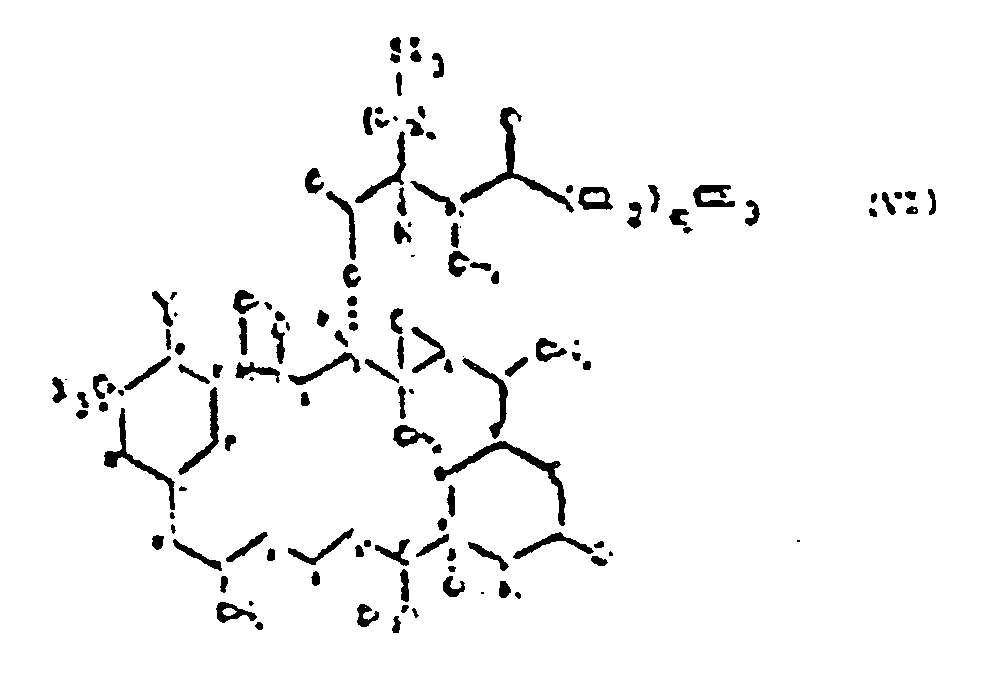
Z₃ represents H or SR₅, wherein R₅ represents methyl, linear alkyl, branched alkyl, cyclic alkyl, simple or substituted aryl or heterocyclic;
o represents 1, 2 or 3;
q represents 0 or an integer of 1 to 10;
Y₀ represents Cl or H; and
X₃ represents H or CH₃.
Applications Claiming Priority (2)
| Application Number | Priority Date | Filing Date | Title |
|---|---|---|---|
| US42624789A | 1989-10-25 | 1989-10-25 | |
| US426247 | 1989-10-25 |
Publications (3)
| Publication Number | Publication Date |
|---|---|
| EP0425235A2 true EP0425235A2 (en) | 1991-05-02 |
| EP0425235A3 EP0425235A3 (en) | 1992-03-18 |
| EP0425235B1 EP0425235B1 (en) | 1996-09-25 |
Family
ID=23689973
Family Applications (1)
| Application Number | Title | Priority Date | Filing Date |
|---|---|---|---|
| EP90311590A Expired - Lifetime EP0425235B1 (en) | 1989-10-25 | 1990-10-23 | Cytotoxic agents comprising maytansinoids and their therapeutic use |
Country Status (7)
| Country | Link |
|---|---|
| EP (1) | EP0425235B1 (en) |
| JP (1) | JP3155998B2 (en) |
| AT (1) | ATE143268T1 (en) |
| CA (1) | CA2026147C (en) |
| DE (1) | DE69028678T2 (en) |
| DK (1) | DK0425235T3 (en) |
| ES (1) | ES2091226T3 (en) |
Cited By (178)
| Publication number | Priority date | Publication date | Assignee | Title |
|---|---|---|---|---|
| EP0602290A1 (en) * | 1992-12-04 | 1994-06-22 | Philippe Pouletty | Cellular drug anchors |
| WO2001000244A3 (en) * | 1999-06-25 | 2001-10-04 | Genentech Inc | METHODS OF TREATMENT USING ANTI-ErbB ANTIBODY-MAYTANSINOID CONJUGATES |
| EP1258255A1 (en) * | 2001-05-18 | 2002-11-20 | Boehringer Ingelheim International GmbH | Conjugates of an antibody to CD44 and a maytansinoid |
| EP1432446A4 (en) * | 2001-09-05 | 2004-09-08 | Genentech Inc | METHODS OF IDENTIFYING POLYPEPTIDE ANTIGENS RELATED TO DISORDERED CELL PROLIFERATION AND COMPOSITIONS FOR THE TREATMENT OF SUCH DISORDERS |
| EP1445317A3 (en) * | 2000-08-24 | 2004-12-15 | Genentech Inc. | Compositions and methods for the diagnosis and treatment of tumor |
| EP1390370A4 (en) * | 2001-05-31 | 2005-07-06 | Immunogen Inc | Methods for preparation of cytotoxic conjugates of maytansinoids and cell binding agents |
| EP1322597A4 (en) * | 2000-09-12 | 2005-10-19 | Smithkline Beecham Corp | Process and intermediates |
| EP1507781A4 (en) * | 2002-05-13 | 2006-03-15 | Smithkline Beecham Corp | Process for preparing maytansinol |
| NO20231301A1 (en) * | 2003-10-10 | 2006-04-21 | Immunogen Inc | Method for targeting specific cell populations by using cell binding agent-maytansinoid conjugates bound via a non-cleavable linker, said conjugates and preparation of said conjugates. |
| WO2006062779A2 (en) | 2004-12-09 | 2006-06-15 | Centocor, Inc. | Anti-integrin immunoconjugates, methods and uses |
| WO2005117986A3 (en) * | 2004-06-01 | 2006-06-15 | Genentech Inc | Antibody drug conjugates and methods |
| EP1695717A1 (en) * | 2005-02-23 | 2006-08-30 | Ludwig-Maximilians-Universität | Transport of nano-and macromolecular structures into cytoplasm and nucleus of cells |
| WO2006086733A3 (en) * | 2005-02-11 | 2007-06-07 | Immunogen Inc | Process for preparing maytansinoid antibody conjugates |
| US7361347B2 (en) | 2001-05-18 | 2008-04-22 | Boehringer Ingelheim International Gmbh | Cytotoxic CD44 antibody immunoconjugates |
| EP1995321A2 (en) | 2005-08-15 | 2008-11-26 | Genentech, Inc. | Gene disruptions, compositions and methods relating thereto |
| US7575748B1 (en) | 2000-03-16 | 2009-08-18 | Genentech, Inc. | Methods of treatment using anti-ErbB antibody-maytansinoid conjugates |
| EP2143438A1 (en) | 2001-09-18 | 2010-01-13 | Genentech, Inc. | Compositions and methods for the diagnosis and treatment of tumor |
| EP2161283A1 (en) | 2003-11-17 | 2010-03-10 | Genentech, Inc. | Compositions comprising antibodies against CD79b conjugated to a growth inhibitory agent or cytotoxic agent and methods for the treatment of tumor of hematopoietic origin |
| WO2010080528A1 (en) | 2008-12-17 | 2010-07-15 | Genentech, Inc. | Hepatitis c virus combination therapy |
| EP1689846A4 (en) * | 2003-10-10 | 2010-08-04 | Immunogen Inc | Method of targeting specific cell populations using cell-binding agent maytansinoid conjugates linked via a non-cleavable linker, said conjugates, and methods of making said conjugates |
| WO2010108127A1 (en) | 2009-03-20 | 2010-09-23 | Genentech, Inc. | Bispecific anti-her antibodies |
| US7811572B2 (en) | 2005-08-24 | 2010-10-12 | Immunogen, Inc. | Process for preparing purified drug conjugates |
| US7851432B2 (en) | 2003-05-20 | 2010-12-14 | Immunogen Inc. | Cytotoxic agents comprising new maytansinoids |
| WO2011039721A1 (en) | 2009-10-02 | 2011-04-07 | Sanofi-Aventis | New maytansinoids and the use of said maytansinoids to prepare conjugates with an antibody |
| EP2266607A3 (en) * | 1999-10-01 | 2011-04-20 | Immunogen, Inc. | Immunoconjugates for treating cancer |
| US8057796B2 (en) | 2007-11-12 | 2011-11-15 | Theraclone Sciences, Inc. | Compositions and methods for the therapy and diagnosis of influenza |
| WO2012018771A1 (en) | 2010-08-03 | 2012-02-09 | Genentech, Inc. | Chronic lymphocytic leukemia (cll) biomarkers |
| WO2012031027A1 (en) | 2010-08-31 | 2012-03-08 | Genentech, Inc. | Biomarkers and methods of treatment |
| WO2012064836A1 (en) | 2010-11-10 | 2012-05-18 | Genentech, Inc. | Methods and compositions for neural disease immunotherapy |
| WO2012085111A1 (en) | 2010-12-23 | 2012-06-28 | F. Hoffmann-La Roche Ag | Polypeptide-polynucleotide-complex and its use in targeted effector moiety delivery |
| WO2012088313A1 (en) | 2010-12-22 | 2012-06-28 | Genentech, Inc. | Anti-pcsk9 antibodies and methods of use |
| WO2012092539A2 (en) | 2010-12-31 | 2012-07-05 | Takeda Pharmaceutical Company Limited | Antibodies to dll4 and uses thereof |
| US8226945B2 (en) | 2006-05-30 | 2012-07-24 | Genentech, Inc. | Antibodies and immunoconjugates and uses therefor |
| US8268309B2 (en) | 2008-03-10 | 2012-09-18 | Theraclone Sciences, Inc. | Compositions and methods for the therapy and diagnosis of cytomegalovirus |
| WO2012143379A1 (en) | 2011-04-20 | 2012-10-26 | Roche Glycart Ag | Method and constructs for the ph dependent passage of the blood-brain-barrier |
| WO2013056148A2 (en) | 2011-10-15 | 2013-04-18 | Genentech, Inc. | Methods of using scd1 antagonists |
| CN103145844A (en) * | 2003-07-21 | 2013-06-12 | 伊缪诺金公司 | A ca6 antigen-specific cytotoxic conjugate and methods of using the same |
| WO2013093809A1 (en) | 2011-12-23 | 2013-06-27 | Pfizer Inc. | Engineered antibody constant regions for site-specific conjugation and methods and uses therefor |
| WO2012177837A3 (en) * | 2011-06-21 | 2013-07-11 | Immunogen, Inc. | Novel maytansinoid derivatives with peptide linker and conjugates thereof |
| WO2013106485A2 (en) | 2012-01-09 | 2013-07-18 | The Scripps Research Institute | Ultralong complementarity determining regions and uses thereof |
| WO2013106489A1 (en) | 2012-01-09 | 2013-07-18 | The Scripps Research Institute | Humanized antibodies with ultralong cdr3s |
| EP2679600A1 (en) | 2009-03-25 | 2014-01-01 | Genentech, Inc. | Anti-FGFR3 antibodies and methods using same |
| WO2014001326A1 (en) | 2012-06-27 | 2014-01-03 | F. Hoffmann-La Roche Ag | Method for the selection and production of tailor-made, selective and multi-specific therapeutic molecules comprising at least two different targeting entities and uses thereof |
| WO2014006123A1 (en) | 2012-07-04 | 2014-01-09 | F. Hoffmann-La Roche Ag | Anti-biotin antibodies and methods of use |
| US8663643B2 (en) | 2008-03-18 | 2014-03-04 | Genentech, Inc. | Combinations of an anti-HER2 antibody-drug conjugate and chemotherapeutic agents, and methods of use |
| US8679490B2 (en) | 2005-11-07 | 2014-03-25 | Genentech, Inc. | Binding polypeptides with diversified and consensus VH/VL hypervariable sequences |
| WO2014107739A1 (en) | 2013-01-07 | 2014-07-10 | Eleven Biotherapeutics, Inc. | Antibodies against pcsk9 |
| WO2014114207A1 (en) | 2013-01-23 | 2014-07-31 | 上海新理念生物医药科技有限公司 | Tridentate connexon and use thereof |
| US8795673B2 (en) | 2011-03-29 | 2014-08-05 | Immunogen, Inc. | Preparation of maytansinoid antibody conjugates by a one-step process |
| WO2014144850A1 (en) | 2013-03-15 | 2014-09-18 | Genentech, Inc. | Methods of treating cancer and preventing cancer drug resistance |
| WO2014153030A2 (en) | 2013-03-14 | 2014-09-25 | Genentech, Inc. | Methods of treating cancer and preventing cancer drug resistance |
| WO2015010100A2 (en) | 2013-07-18 | 2015-01-22 | Fabrus, Inc. | Humanized antibodies with ultralong complementarity determining regions |
| WO2015017146A2 (en) | 2013-07-18 | 2015-02-05 | Fabrus, Inc. | Antibodies with ultralong complementarity determining regions |
| US8957187B2 (en) | 2005-12-02 | 2015-02-17 | Genentech, Inc. | Binding polypeptides and uses thereof |
| US8999327B2 (en) | 2009-12-10 | 2015-04-07 | Hoffman-La Roche Inc. | Antibodies against human CSF-1R and uses thereof |
| US9056910B2 (en) | 2012-05-01 | 2015-06-16 | Genentech, Inc. | Anti-PMEL17 antibodies and immunoconjugates |
| US9085630B2 (en) | 2002-11-15 | 2015-07-21 | Genentech, Inc. | Compositions and methods for the treatment of tumor of hematopoietic origin |
| US9085621B2 (en) | 2010-09-10 | 2015-07-21 | Apexigen, Inc. | Anti-IL-1β antibodies |
| CN101518653B (en) * | 1999-06-25 | 2015-08-19 | 基因技术股份有限公司 | Use the Therapeutic Method of anti-ErbB antibody-maytansinoid conjugate |
| WO2015157592A1 (en) | 2014-04-11 | 2015-10-15 | Medimmune, Llc | Bispecific her2 antibodies |
| US9175089B2 (en) | 2012-03-30 | 2015-11-03 | Genentech, Inc. | Anti-LGR5 antibodies and immunoconjugates |
| US9192667B2 (en) | 2013-04-22 | 2015-11-24 | Hoffmann-La Roche Inc. | Method of treating cancer by administering CSF-1R antibodies and a TLR9 agonist |
| WO2015187596A3 (en) * | 2014-06-02 | 2016-02-25 | Regeneron Pharmaceuticals, Inc. | Antibody-drug conjugates, their preparation and their therapeutic use |
| WO2016098356A1 (en) | 2014-12-19 | 2016-06-23 | Chugai Seiyaku Kabushiki Kaisha | Anti-c5 antibodies and methods of use |
| US9376500B2 (en) | 2009-06-03 | 2016-06-28 | Immunogen, Inc. | Conjugation methods |
| WO2016118961A1 (en) | 2015-01-24 | 2016-07-28 | Academia Sinica | Cancer markers and methods of use thereof |
| WO2016150899A2 (en) | 2015-03-23 | 2016-09-29 | Bayer Pharma Aktiengesellschaft | Anti-ceacam6 antibodies and uses thereof |
| WO2016192527A1 (en) | 2015-05-29 | 2016-12-08 | Newbio Therapeutics, Inc. | Derivatives of dolastatin 10 and uses thereof |
| WO2017004091A1 (en) | 2015-06-29 | 2017-01-05 | Genentech, Inc. | Type ii anti-cd20 antibody for use in organ transplantation |
| WO2017088734A1 (en) | 2015-11-23 | 2017-06-01 | 四川科伦博泰生物医药股份有限公司 | Anti-erbb2 antibody-drug conjugate and composition thereof, preparation method therefor, and application thereof |
| US9684000B2 (en) | 2010-12-16 | 2017-06-20 | Genentech, Inc. | Diagnosis and treatments relating to TH2 inhibition |
| WO2017104779A1 (en) | 2015-12-18 | 2017-06-22 | Chugai Seiyaku Kabushiki Kaisha | Anti-c5 antibodies and methods of use |
| AU2015224535B2 (en) * | 2011-06-21 | 2017-07-20 | Immunogen, Inc. | Novel maytansinoid derivatives with peptide linker and conjugates thereof |
| WO2017132298A1 (en) | 2016-01-27 | 2017-08-03 | Medimmune, Llc | Methods for preparing antibodies with a defined glycosylation pattern |
| WO2017194441A1 (en) | 2016-05-11 | 2017-11-16 | F. Hoffmann-La Roche Ag | Modified anti-tenascin antibodies and methods of use |
| WO2017205741A1 (en) | 2016-05-27 | 2017-11-30 | Genentech, Inc. | Bioanalytical method for the characterization of site-specific antibody-drug conjugates |
| US9834612B2 (en) | 2011-07-22 | 2017-12-05 | The Research Foundation Of State University Of New York | Antibodies to the B12-transcobalamin receptor |
| EP3296321A1 (en) | 2010-12-20 | 2018-03-21 | F. Hoffmann-La Roche AG | Anti-mesothelin antibodies and immunoconjugates |
| US9925272B2 (en) | 2012-07-04 | 2018-03-27 | Hoffmann-La Roche Inc. | Anti-theophylline antibodies and methods of use |
| US9950076B2 (en) | 2016-01-25 | 2018-04-24 | Regeneron Pharmaceuticals, Inc. | Maytansinoid derivatives, conjugates thereof, and methods of use |
| US9975957B2 (en) | 2014-03-31 | 2018-05-22 | Genentech, Inc. | Anti-OX40 antibodies and methods of use |
| EP3323427A1 (en) | 2009-03-17 | 2018-05-23 | Theraclone Sciences, Inc. | Human immunodeficiency virus (hiv)-neutralizing antibodies |
| US9994646B2 (en) | 2009-09-16 | 2018-06-12 | Genentech, Inc. | Coiled coil and/or tether containing protein complexes and uses thereof |
| WO2018129524A1 (en) | 2017-01-09 | 2018-07-12 | Lentigen Technology, Inc. | Compositions and methods for treating cancer with anti-mesothelin immunotherapy |
| US10023643B2 (en) | 2011-12-15 | 2018-07-17 | Hoffmann-La Roche Inc. | Antibodies against human CSF-1R and uses thereof |
| US10035817B2 (en) | 2012-10-04 | 2018-07-31 | Immunogen, Inc. | Method of purifying cell-binding agent-cytotoxic agent conjugates with a PVDF membrane |
| WO2018148585A1 (en) | 2017-02-10 | 2018-08-16 | Genentech, Inc. | Anti-tryptase antibodies, compositions thereof, and uses thereof |
| WO2018160841A1 (en) | 2017-03-01 | 2018-09-07 | Genentech, Inc. | Diagnostic and therapeutic methods for cancer |
| US10106612B2 (en) | 2012-06-27 | 2018-10-23 | Hoffmann-La Roche Inc. | Method for selection and production of tailor-made highly selective and multi-specific targeting entities containing at least two different binding entities and uses thereof |
| EP3424530A1 (en) | 2013-03-15 | 2019-01-09 | Zyngenia, Inc. | Multivalent and monovalent multispecific complexes and their uses |
| EP3428190A1 (en) | 2014-02-12 | 2019-01-16 | F. Hoffmann-La Roche AG | Anti-jagged1 antibodies and methods of use |
| US10208120B2 (en) | 2014-11-05 | 2019-02-19 | Genentech, Inc. | Anti-FGFR2/3 antibodies and methods using same |
| US10246518B2 (en) | 2013-12-23 | 2019-04-02 | Genentech, Inc. | Nucleic acids encoding bispecific antibodies binding to beta-Klotho and fibroblast growth factor receptor 1 |
| US10246515B2 (en) | 2013-09-17 | 2019-04-02 | Genentech, Inc. | Methods of treating hedgehog-related diseases with an anti-LGR5 antibody |
| EP3461839A1 (en) | 2011-10-14 | 2019-04-03 | F. Hoffmann-La Roche AG | Anti-htra1 antibodies and methods of use |
| US10300115B2 (en) | 2005-09-30 | 2019-05-28 | The United States Of America, As Represented By The Secretary, Department Of Health & Human Services | Methods and compositions for modulating immune tolerance |
| WO2019105972A1 (en) | 2017-11-30 | 2019-06-06 | Bayer Aktiengesellschaft | Ildr2 antagonists and combinations thereof |
| US10342858B2 (en) | 2015-01-24 | 2019-07-09 | Academia Sinica | Glycan conjugates and methods of use thereof |
| WO2019143636A1 (en) | 2018-01-16 | 2019-07-25 | Lakepharma, Inc. | Bispecific antibody that binds cd3 and another target |
| WO2019165434A1 (en) | 2018-02-26 | 2019-08-29 | Genentech, Inc. | Dosing for treatment with anti-tigit and anti-pd-l1 antagonist antibodies |
| US10407511B2 (en) | 2014-01-03 | 2019-09-10 | Hoffmann-La Roche Inc. | Covalently linked helicar-anti-helicar antibody conjugates and uses thereof |
| WO2019178316A1 (en) | 2018-03-14 | 2019-09-19 | Genentech, Inc. | Anti-klk5 antibodies and methods of use |
| US10428155B2 (en) | 2014-12-22 | 2019-10-01 | Xencor, Inc. | Trispecific antibodies |
| WO2019195514A1 (en) | 2018-04-04 | 2019-10-10 | Genentech, Inc. | Methods for detecting and quantifying fgf21 |
| US10449258B2 (en) | 2015-06-09 | 2019-10-22 | Xdcexplorer (Shanghai) Co., Ltd. | Antibody drug conjugate, intermediate, preparation method, pharmaceutical composition and uses thereof |
| EP3556396A1 (en) | 2010-08-31 | 2019-10-23 | Theraclone Science, Int. | Human immunodeficiency virus (hiv)-neutralizing antibodies |
| WO2019202040A1 (en) | 2018-04-18 | 2019-10-24 | F. Hoffmann-La Roche Ag | Anti-hla-g antibodies and use thereof |
| WO2019238843A1 (en) | 2018-06-14 | 2019-12-19 | Berlin-Chemie Ag | Pharmaceutical combinations |
| US10517945B2 (en) | 2012-07-04 | 2019-12-31 | Hoffman-La Roche Inc. | Covalently linked antigen-antibody conjugates |
| US10519249B2 (en) | 2014-01-03 | 2019-12-31 | Hoffmann-La Roche Inc. | Covalently linked polypeptide toxin-antibody conjugates |
| EP3587448A1 (en) | 2013-03-15 | 2020-01-01 | Xencor, Inc. | Heterodimeric proteins |
| WO2020010079A2 (en) | 2018-07-02 | 2020-01-09 | Amgen Inc. | Anti-steap1 antigen-binding protein |
| US10533055B2 (en) | 2014-08-28 | 2020-01-14 | Juno Therapeutics, Inc. | Antibodies and chimeric antigen receptors specific for CD19 |
| EP3594228A1 (en) | 2003-07-08 | 2020-01-15 | Genentech, Inc. | Il-17a/f heterologous polypedtides and therapeutic uses thereof |
| EP3594240A1 (en) | 2013-05-20 | 2020-01-15 | F. Hoffmann-La Roche AG | Anti-transferrin receptor antibodies and methods of use |
| WO2020023300A1 (en) | 2018-07-22 | 2020-01-30 | Bioasis Technologies, Inc. | Treatment of lymmphatic metastases |
| EP3605088A1 (en) | 2008-04-09 | 2020-02-05 | Genentech, Inc. | Compositions and methods for the treatment of immune related diseases |
| EP3611187A1 (en) | 2011-10-10 | 2020-02-19 | Xencor, Inc. | A method for purifying antibodies |
| US10570151B2 (en) | 2013-03-15 | 2020-02-25 | Regeneron Pharmaceuticals, Inc. | Biologically active molecules, conjugates thereof, and therapeutic uses |
| EP3620470A1 (en) | 2013-10-11 | 2020-03-11 | The United States of America, as represented by The Secretary, Department of Health and Human Services | Tem8 antibodies and their use |
| WO2020061060A1 (en) | 2018-09-19 | 2020-03-26 | Genentech, Inc. | Therapeutic and diagnostic methods for bladder cancer |
| WO2020061194A2 (en) | 2016-09-02 | 2020-03-26 | Lentigen Technology, Inc. | Compositions and methods for treating cancer with duocars |
| WO2020061498A1 (en) | 2018-09-20 | 2020-03-26 | Lentigen Technology, Inc. | Compositions and methods for treating cancer with anti-cd123 immunotherapy |
| WO2020069184A2 (en) | 2018-09-26 | 2020-04-02 | Lentigen Technology, Inc. | Compositions and methods for treating cancer with anti-cd19/cd22 immunotherapy |
| EP3632934A1 (en) | 2014-03-31 | 2020-04-08 | F. Hoffmann-La Roche AG | Anti-ox40 antibodies and methods of use |
| EP3633377A1 (en) | 2013-03-15 | 2020-04-08 | F. Hoffmann-La Roche AG | Biomarkers and methods of treating pd-1 and pd-l1 related conditions |
| US10639329B2 (en) | 2015-06-12 | 2020-05-05 | Lentigen Technology, Inc. | Method to treat cancer with engineered T-cells |
| US10654873B2 (en) | 2016-09-15 | 2020-05-19 | Polytherics Limited | Cytotoxic agents and conjugates thereof |
| EP3662930A1 (en) | 2015-09-24 | 2020-06-10 | AbVitro LLC | Hiv antibody compositions and methods of use |
| WO2020117257A1 (en) | 2018-12-06 | 2020-06-11 | Genentech, Inc. | Combination therapy of diffuse large b-cell lymphoma comprising an anti-cd79b immunoconjugates, an alkylating agent and an anti-cd20 antibody |
| WO2020132230A2 (en) | 2018-12-20 | 2020-06-25 | Genentech, Inc. | Modified antibody fcs and methods of use |
| WO2020153467A1 (en) | 2019-01-24 | 2020-07-30 | 中外製薬株式会社 | Novel cancer antigens and antibodies of said antigens |
| WO2020181164A1 (en) | 2019-03-06 | 2020-09-10 | Lentigen Technology, Inc. | Compositions and methods for treating cancer with self-driving chimeric antigen receptors |
| WO2020243546A1 (en) | 2019-05-30 | 2020-12-03 | Lentigen Technology, Inc. | Compositions and methods for treating cancer with anti-bcma immunotherapy |
| US10858451B2 (en) | 2014-03-28 | 2020-12-08 | Xencor, Inc. | Bispecific antibodies that bind to CD38 and CD3 |
| US10889652B2 (en) | 2015-01-16 | 2021-01-12 | Juno Therapeutics, Inc. | Antibodies and chimeric antigen receptors specific for ROR1 |
| WO2021010326A1 (en) | 2019-07-12 | 2021-01-21 | 中外製薬株式会社 | Anti-mutation type fgfr3 antibody and use therefor |
| WO2021131021A1 (en) | 2019-12-27 | 2021-07-01 | 中外製薬株式会社 | Anti-ctla-4 antibody and use thereof |
| US11053308B2 (en) | 2016-08-05 | 2021-07-06 | Chugai Seiyaku Kabushiki Kaisha | Method for treating IL-8-related diseases |
| EP3845565A2 (en) | 2014-11-19 | 2021-07-07 | Genentech, Inc. | Antibodies against bace1 and use thereof for neural disease immunotherapy |
| WO2021139777A1 (en) | 2020-01-10 | 2021-07-15 | 上海复宏汉霖生物技术股份有限公司 | Anti-tigit antibodies and usage method |
| WO2021188749A1 (en) | 2020-03-19 | 2021-09-23 | Genentech, Inc. | Isoform-selective anti-tgf-beta antibodies and methods of use |
| EP3889175A1 (en) | 2016-05-02 | 2021-10-06 | F. Hoffmann-La Roche AG | The contorsbody - a single chain target binder |
| US11149088B2 (en) | 2016-04-15 | 2021-10-19 | Bioatla, Inc. | Anti-Axl antibodies, antibody fragments and their immunoconjugates and uses thereof |
| US11180548B2 (en) | 2015-02-05 | 2021-11-23 | Chugai Seiyaku Kabushiki Kaisha | Methods of neutralizing IL-8 biological activity |
| EP3936524A2 (en) | 2015-05-11 | 2022-01-12 | F. Hoffmann-La Roche AG | Compositions and methods of treating lupus nephritis |
| WO2022015726A1 (en) | 2020-07-13 | 2022-01-20 | Genentech, Inc. | Cell-based methods for predicting polypeptide immunogenicity |
| WO2022031948A1 (en) | 2020-08-07 | 2022-02-10 | Genentech, Inc. | T cell-based methods for predicting polypeptide immunogenicity |
| US11254742B2 (en) | 2016-05-13 | 2022-02-22 | Bioatla, Inc. | Anti-Ror2 antibodies, antibody fragments, their immunoconjugates and uses thereof |
| WO2022099026A1 (en) | 2020-11-05 | 2022-05-12 | Lentigen Technology, Inc. | Compositions and methods for treating cancer with anti-cd19/cd22 immunotherapy |
| US11332533B2 (en) | 2007-09-26 | 2022-05-17 | Chugai Seiyaku Kabushiki Kaisha | Modified antibody constant region |
| US11352442B2 (en) | 2014-11-26 | 2022-06-07 | Xencor, Inc. | Heterodimeric antibodies that bind CD3 and CD38 |
| WO2022116877A1 (en) | 2020-12-02 | 2022-06-09 | Shanghai Henlius Biotech, Inc. | ANTI-GARP/TGFβ ANTIBODIES AND METHODS OF USE |
| US11365258B2 (en) | 2017-03-10 | 2022-06-21 | Berlin-Chemie Ag | Pharmaceutical combinations comprising an anti-LY75 antibody |
| US11421022B2 (en) | 2012-06-27 | 2022-08-23 | Hoffmann-La Roche Inc. | Method for making antibody Fc-region conjugates comprising at least one binding entity that specifically binds to a target and uses thereof |
| US11440942B2 (en) | 2016-09-19 | 2022-09-13 | Hoffmann-La Roche Inc. | Complement factor based affinity chromatography |
| WO2022207554A1 (en) | 2021-03-30 | 2022-10-06 | Bayer Aktiengesellschaft | Anti-sema3a antibodies and uses thereof |
| WO2022270612A1 (en) | 2021-06-25 | 2022-12-29 | 中外製薬株式会社 | Use of anti-ctla-4 antibody |
| WO2022270611A1 (en) | 2021-06-25 | 2022-12-29 | 中外製薬株式会社 | Anti–ctla-4 antibody |
| US11584927B2 (en) | 2014-08-28 | 2023-02-21 | Bioatla, Inc. | Conditionally active chimeric antigen receptors for modified T-cells |
| US11596635B2 (en) | 2013-08-26 | 2023-03-07 | Regeneron Pharmaceuticals, Inc. | Pharmaceutical compositions comprising macrolide diastereomers, methods of their synthesis and therapeutic uses |
| WO2023031366A1 (en) | 2021-09-02 | 2023-03-09 | Deutsches Krebsforschungszentrum Stiftung des öffentlichen Rechts | Anti-cecam6 antibodies with reduced side-effects |
| EP4155321A1 (en) | 2021-06-04 | 2023-03-29 | Chugai Seiyaku Kabushiki Kaisha | Anti-ddr2 antibodies and uses thereof |
| US11623961B2 (en) | 2017-11-01 | 2023-04-11 | Juno Therapeutics, Inc. | Antibodies and chimeric antigen receptors specific for B-cell maturation antigen |
| WO2023058705A1 (en) | 2021-10-08 | 2023-04-13 | 中外製薬株式会社 | Drug formulation of anti-hla-dq2.5 antibody |
| WO2023109901A1 (en) | 2021-12-17 | 2023-06-22 | Shanghai Henlius Biotech, Inc. | Anti-ox40 antibodies and methods of use |
| WO2023109900A1 (en) | 2021-12-17 | 2023-06-22 | Shanghai Henlius Biotech, Inc. | Anti-ox40 antibodies, multispecific antibodies and methods of use |
| EP4223319A2 (en) | 2017-05-26 | 2023-08-09 | MedImmune, LLC | Method and molecules |
| WO2023179740A1 (en) | 2022-03-25 | 2023-09-28 | Shanghai Henlius Biotech , Inc. | Anti-msln antibodies and methods of use |
| US12006370B2 (en) | 2018-07-23 | 2024-06-11 | Heidelberg Pharma Research Gmbh | Use of anti-CD5 antibody drug conjugate (ADC) in allogeneic cell therapy |
| EP4424376A2 (en) | 2015-08-11 | 2024-09-04 | Legend Biotech Ireland Limited | Chimeric antigen receptors based on single-domain antibodies and methods of use thereof |
| US12251448B2 (en) | 2017-11-29 | 2025-03-18 | Heidelberg Pharma Research Gmbh | Compositions and methods for the depletion of CD5+ cells |
| US12297207B2 (en) | 2015-03-27 | 2025-05-13 | Regeneron Pharmaceuticals, Inc. | Maytansinoid derivatives, conjugates thereof, and methods of use |
| US12344645B2 (en) | 2017-03-29 | 2025-07-01 | Polaris Group | Protein conjugates |
| US12403185B2 (en) | 2018-07-23 | 2025-09-02 | Heidelberg Pharma Research Gmbh | Use of anti-CD137 antibody drug conjugate (ADC) in allogeneic cell therapy |
| US12570749B2 (en) | 2019-12-06 | 2026-03-10 | Juno Therapeutics, Inc. | Anti-idiotypic antibodies to GPRC5D-targeted binding domains and related compositions and methods |
| US12590166B2 (en) | 2020-07-16 | 2026-03-31 | Legend Biotech Ireland Limited | CD20 binding molecules and uses thereof |
| US12686728B2 (en) | 2019-12-06 | 2026-07-21 | Juno Therapeutics, Inc. | Anti-idiotypic antibodies to BCMA-targeted binding domains and related compositions and methods |
Families Citing this family (401)
| Publication number | Priority date | Publication date | Assignee | Title |
|---|---|---|---|---|
| US5776093A (en) * | 1985-07-05 | 1998-07-07 | Immunomedics, Inc. | Method for imaging and treating organs and tissues |
| US6824780B1 (en) | 1999-10-29 | 2004-11-30 | Genentech, Inc. | Anti-tumor antibody compositions and methods of use |
| US6333410B1 (en) * | 2000-08-18 | 2001-12-25 | Immunogen, Inc. | Process for the preparation and purification of thiol-containing maytansinoids |
| US20070160576A1 (en) | 2001-06-05 | 2007-07-12 | Genentech, Inc. | IL-17A/F heterologous polypeptides and therapeutic uses thereof |
| EP1409549A4 (en) | 2001-06-20 | 2007-10-24 | Genentech Inc | COMPOSITIONS AND METHODS FOR DIAGNOSING AND TREATING TUMORS |
| US7803915B2 (en) | 2001-06-20 | 2010-09-28 | Genentech, Inc. | Antibody compositions for the diagnosis and treatment of tumor |
| US20030228319A1 (en) | 2002-04-16 | 2003-12-11 | Genentech, Inc. | Compositions and methods for the diagnosis and treatment of tumor |
| EP1575571A4 (en) * | 2002-01-02 | 2008-06-25 | Genentech Inc | COMPOSITIONS AND METHODS FOR DIAGNOSING AND TREATING A TUMOR |
| US7619068B2 (en) | 2003-05-09 | 2009-11-17 | Diadexus, Inc. | Ovr110 antibody compositions and methods of use |
| EP1651162B1 (en) * | 2003-05-20 | 2015-10-21 | ImmunoGen, Inc. | Improved cytotoxic agents comprising new maytansinoids |
| PT1718677E (en) | 2003-12-19 | 2012-07-18 | Genentech Inc | Monovalent antibody fragments useful as therapeutics |
| SI1771474T1 (en) | 2004-07-20 | 2010-06-30 | Genentech Inc | Inhibitors of angiopoietin-like 4 protein, combinations, and their use |
| KR101222254B1 (en) | 2004-07-26 | 2013-01-16 | 제넨테크, 인크. | Methods and compositions for mudulating hepatocyte growth factor activation |
| AU2005281359A1 (en) * | 2004-08-26 | 2006-03-16 | Apparao Satyam | Prodrugs and codrugs containing novel bio-cleavable disulfide linkers |
| ES2377979T3 (en) | 2004-09-03 | 2012-04-03 | Genentech, Inc. | Humanized anti-beta7 antagonists and uses for them |
| DK1841793T3 (en) | 2005-01-07 | 2010-07-19 | Diadexus Inc | Ovr110 antibody compositions and methods for their use |
| WO2006132788A2 (en) | 2005-06-06 | 2006-12-14 | Genentech, Inc. | Transgenic models for different genes and their use for gene characterization |
| ATE535529T1 (en) * | 2005-08-09 | 2011-12-15 | Millennium Pharm Inc | METHOD FOR ACYLATION OF MAYTANSINOL WITH CHIRAL AMINO ACIDS |
| WO2007081608A2 (en) | 2005-11-21 | 2007-07-19 | Genentech, Inc. | Novel gene disruptions, compositions and methods relating thereto |
| JP2009518314A (en) | 2005-12-02 | 2009-05-07 | ジェネンテック・インコーポレーテッド | Compositions and methods for the treatment of diseases and disorders associated with cytokine signaling comprising antibodies that bind IL-22 and antibodies that bind IL-22R |
| EP1973948B1 (en) | 2005-12-15 | 2015-02-11 | Genentech, Inc. | Methods and compositions for targeting polyubiquitin |
| US8101365B2 (en) | 2006-01-05 | 2012-01-24 | Genentech, Inc. | Anti-EphB4 antibodies and methods using same |
| RU2451031C2 (en) | 2006-01-20 | 2012-05-20 | Дженентек, Инк. | Ephrine b2 antibodies and methods for using them |
| CA2638821A1 (en) | 2006-02-17 | 2007-10-11 | Genentech, Inc. | Gene disruptons, compositions and methods relating thereto |
| AR059851A1 (en) | 2006-03-16 | 2008-04-30 | Genentech Inc | ANTIBODIES OF EGFL7 AND METHODS OF USE |
| CA2647277A1 (en) | 2006-04-05 | 2007-11-08 | Genentech, Inc. | Method for using boc/cdo to modulate hedgehog signaling |
| CA2649387A1 (en) | 2006-04-19 | 2008-03-27 | Genentech, Inc. | Novel gene disruptions, compositions and methods relating thereto |
| EP2061906B1 (en) | 2006-09-12 | 2011-08-31 | Genentech, Inc. | Methods and compositions for the diagnosis and treatment of lung cancer using pdgfra, kit or kdr gene as genetic marker |
| PT2845866T (en) | 2006-10-27 | 2017-08-09 | Genentech Inc | ANTIBODIES AND IMMUNOCONUELS AND UTILIZATIONS THEREOF |
| AU2007325283B2 (en) | 2006-11-27 | 2012-08-30 | Diadexus, Inc. | Ovr110 antibody compositions and methods of use |
| US7834154B2 (en) | 2007-02-09 | 2010-11-16 | Genentech, Inc. | Anti-ROBO4 antibodies and uses therefor |
| US7960139B2 (en) | 2007-03-23 | 2011-06-14 | Academia Sinica | Alkynyl sugar analogs for the labeling and visualization of glycoconjugates in cells |
| PE20140625A1 (en) | 2007-07-16 | 2014-05-29 | Genentech Inc | ANTI-CD79b ANTIBODIES AND HUMANIZED IMMUNOCONJUGATES |
| PT2474557E (en) | 2007-07-16 | 2014-12-03 | Genentech Inc | ANTIBODIES AND IMMUNOCONJUGATES ANTI-CD79B AND METHODS OF USE |
| AU2008308761B2 (en) | 2007-10-02 | 2014-10-16 | Genentech, Inc. | NLRR-1 antagonists and uses thereof |
| TWI468417B (en) | 2007-11-30 | 2015-01-11 | Genentech Inc | Anti-vegf antibodies |
| DK2657253T3 (en) | 2008-01-31 | 2017-10-09 | Genentech Inc | Anti-CD79b antibodies and immune conjugates and methods of use |
| DK2318832T3 (en) | 2008-07-15 | 2014-01-20 | Academia Sinica | Glycan arrays on PTFE-like aluminum coated slides and related methods |
| MX2011002928A (en) | 2008-10-01 | 2011-04-11 | Genentech Inc | Anti-notch2 antibodies and methods of use. |
| TWI544077B (en) | 2009-03-19 | 2016-08-01 | 中外製藥股份有限公司 | Antibody constant region change body |
| CN103755808B (en) | 2009-03-25 | 2016-02-10 | 霍夫曼-拉罗奇有限公司 | Anti-alpha 5 beta 1 antibodies and application thereof |
| MA33256B1 (en) | 2009-04-01 | 2012-05-02 | Genentech Inc | Antibody ,,, fcrh5 and methods of use |
| BRPI1014089A2 (en) | 2009-04-02 | 2016-04-19 | Roche Glycart Ag | multispecific antibodies comprising full length antibodies and single chain fab fragments |
| CA2759506A1 (en) | 2009-04-23 | 2010-10-28 | Theraclone Sciences, Inc. | Granulocyte-macrophage colony-stimulating factor (gm-csf) neutralizing antibodies |
| CA2762302A1 (en) | 2009-05-20 | 2010-11-25 | Theraclone Sciences, Inc. | Compositions and methods for the therapy and diagnosis of influenza |
| BRPI1015234A2 (en) | 2009-06-22 | 2018-02-20 | Medimmune Llc | fc regions designed for site specific conjugation. |
| ES2513292T3 (en) | 2009-07-31 | 2014-10-24 | Genentech, Inc. | Inhibition of tumor metastases using anti-G-CSF antibodies |
| JP5887270B2 (en) | 2009-09-02 | 2016-03-16 | ジェネンテック, インコーポレイテッド | Mutant SMOOTHENED AND METHOD OF USING THE SAME |
| US9493578B2 (en) | 2009-09-02 | 2016-11-15 | Xencor, Inc. | Compositions and methods for simultaneous bivalent and monovalent co-engagement of antigens |
| CA2771817A1 (en) | 2009-10-19 | 2011-04-28 | Genentech, Inc. | Modulators of hepatocyte growth factor activator |
| RU2539772C2 (en) | 2009-10-22 | 2015-01-27 | Дженентек, Инк. | Methods and compositions for hepsin modulation of macrophage-stimulating protein |
| EP2491059B1 (en) | 2009-10-22 | 2015-02-25 | F.Hoffmann-La Roche Ag | Anti-hepsin antibodies and methods using same |
| WO2011056502A1 (en) | 2009-10-26 | 2011-05-12 | Genentech, Inc. | Bone morphogenetic protein receptor type ii compositions and methods of use |
| WO2011056494A1 (en) | 2009-10-26 | 2011-05-12 | Genentech, Inc. | Activin receptor-like kinase-1 antagonist and vegfr3 antagonist combinations |
| WO2011056497A1 (en) | 2009-10-26 | 2011-05-12 | Genentech, Inc. | Activin receptor type iib compositions and methods of use |
| KR101968766B1 (en) | 2009-11-05 | 2019-04-12 | 제넨테크, 인크. | Methods and composition for secretion of heterologous polypeptides |
| TWI507524B (en) | 2009-11-30 | 2015-11-11 | 建南德克公司 | Composition and method for diagnosing and treating tumor |
| US11377485B2 (en) | 2009-12-02 | 2022-07-05 | Academia Sinica | Methods for modifying human antibodies by glycan engineering |
| US10087236B2 (en) | 2009-12-02 | 2018-10-02 | Academia Sinica | Methods for modifying human antibodies by glycan engineering |
| US8486397B2 (en) | 2009-12-11 | 2013-07-16 | Genentech, Inc. | Anti-VEGF-C antibodies and methods using same |
| MX2012007379A (en) | 2009-12-23 | 2012-08-31 | Genentech Inc | Anti-bv8 antibodies and uses thereof. |
| ES2519348T3 (en) | 2010-02-18 | 2014-11-06 | Genentech, Inc. | Neurregulin antagonists and their use in cancer treatment |
| AU2011221226A1 (en) | 2010-02-23 | 2012-08-16 | Genentech, Inc. | Compositions and methods for the diagnosis and treatment of tumor |
| RU2617971C2 (en) | 2010-03-05 | 2017-04-28 | Ф.Хоффманн-Ля Рош Аг | Antibodies to human csf-1r and use thereof |
| CN102918061B (en) | 2010-03-05 | 2016-06-08 | 霍夫曼-拉罗奇有限公司 | Antibodies against human CSF-1R and uses thereof |
| KR101899835B1 (en) | 2010-03-24 | 2018-09-19 | 제넨테크, 인크. | Anti-lrp6 antibodies |
| TW201138821A (en) | 2010-03-26 | 2011-11-16 | Roche Glycart Ag | Bispecific antibodies |
| WO2011130332A1 (en) | 2010-04-12 | 2011-10-20 | Academia Sinica | Glycan arrays for high throughput screening of viruses |
| WO2011133886A2 (en) | 2010-04-23 | 2011-10-27 | Genentech, Inc. | Production of heteromultimeric proteins |
| CN102958941A (en) | 2010-05-03 | 2013-03-06 | 霍夫曼-拉罗奇有限公司 | Compositions and methods for tumor diagnosis and treatment |
| NZ701208A (en) | 2010-06-03 | 2016-05-27 | Genentech Inc | Immuno-pet imaging of antibodies and immunoconjugates and uses thereof |
| CN103080136B (en) | 2010-06-18 | 2015-08-12 | 霍夫曼-拉罗奇有限公司 | Anti-Axl antibody and using method |
| WO2011161119A1 (en) | 2010-06-22 | 2011-12-29 | F. Hoffmann-La Roche Ag | Antibodies against insulin-like growth factor i receptor and uses thereof |
| WO2011161189A1 (en) | 2010-06-24 | 2011-12-29 | F. Hoffmann-La Roche Ag | Anti-hepsin antibodies and methods of use |
| EP2598530A2 (en) | 2010-07-29 | 2013-06-05 | Xencor, Inc. | Antibodies with modified isoelectric points |
| EP2603237A4 (en) | 2010-08-12 | 2014-05-21 | Theraclone Sciences Inc | ANTI-HEMAGGLUTININ ANTIBODY COMPOSITIONS AND METHODS OF USE |
| BR112013002444A2 (en) | 2010-08-13 | 2016-05-24 | Roche Glycart Ag | isolated antibody, polynucleotide and polypeptide, composition, vector, host cell, antibody conjugate, pharmaceutical formulation, use of the antibody, methods of producing an antibody, treating an individual, inducing cell lysis of a tumor cell and diagnosing a disease in an individual |
| PE20171512A1 (en) | 2010-08-13 | 2017-10-20 | Roche Glycart Ag | ANTI-FAP ANTIBODIES |
| CN104474546A (en) | 2010-08-13 | 2015-04-01 | 弗·哈夫曼-拉罗切有限公司 | Antibodies to il-1beta and il-18, for treatment of disease |
| CN103068846B9 (en) | 2010-08-24 | 2016-09-28 | 弗·哈夫曼-拉罗切有限公司 | Bispecific antibodies comprising disulfide-stabilized Fv fragments |
| ES2874306T3 (en) | 2010-09-29 | 2021-11-04 | Agensys Inc | Conjugates of antibodies and drugs (CAF) that bind to 191P4D12 proteins |
| US9228023B2 (en) | 2010-10-01 | 2016-01-05 | Oxford Biotherapeutics Ltd. | Anti-ROR1 antibodies and methods of use for treatment of cancer |
| US8481680B2 (en) | 2010-10-05 | 2013-07-09 | Genentech, Inc. | Mutant smoothened and methods of using the same |
| US9090629B2 (en) * | 2010-11-03 | 2015-07-28 | Immunogen, Inc. | Cytotoxic agents comprising new ansamitocin derivatives |
| JOP20210044A1 (en) | 2010-12-30 | 2017-06-16 | Takeda Pharmaceuticals Co | Anti-CD38 . antibody |
| AR085138A1 (en) | 2011-02-04 | 2013-09-11 | Genentech Inc | Fc VARIATIONS AND METHODS FOR PRODUCTION |
| US10689447B2 (en) | 2011-02-04 | 2020-06-23 | Genentech, Inc. | Fc variants and methods for their production |
| US20140088019A1 (en) | 2011-02-11 | 2014-03-27 | Zyngenia, Inc. | Monovalent and Multivalent Multispecific Complexes and Uses Thereof |
| AU2012217867A1 (en) | 2011-02-14 | 2013-09-05 | Theraclone Sciences, Inc. | Compositions and methods for the therapy and diagnosis of influenza |
| CN103502274B (en) | 2011-03-03 | 2016-01-06 | 埃派斯进有限公司 | Anti-IL-6 receptor antibodies and methods of use thereof |
| AU2012229188A1 (en) | 2011-03-15 | 2013-09-26 | Theraclone Sciences, Inc. | Compositions and methods for the therapy and diagnosis of influenza |
| LT2691417T (en) | 2011-03-29 | 2018-10-25 | Roche Glycart Ag | Antibody fc variants |
| CA2828890A1 (en) | 2011-04-07 | 2012-10-11 | Genentech, Inc. | Anti-fgfr4 antibodies and methods of use |
| KR102037432B1 (en) | 2011-04-29 | 2019-11-27 | 아펙시젠, 인코포레이티드 | Anti-cd40 antibodies and methods of use |
| RU2013154048A (en) | 2011-05-09 | 2015-06-20 | Юниверсити Оф Вирджиния Пэтент Фаундейшн | COMPOSITIONS AND METHODS FOR TREATING CANCER |
| WO2012158704A1 (en) | 2011-05-16 | 2012-11-22 | Genentech, Inc. | Fgfr1 agonists and methods of use |
| DK2714738T3 (en) | 2011-05-24 | 2019-01-28 | Zyngenia Inc | MULTIVALENT AND MONOVALENT MULTISPECIFIC COMPLEXES AND THEIR APPLICATIONS |
| RU2013155695A (en) | 2011-06-30 | 2015-08-10 | Дженентек, Инк. | ANTIBODIES AGAINST C-MET |
| AU2012278944B2 (en) | 2011-07-05 | 2015-09-17 | Bioasis Technologies Inc. | p97-antibody conjugates and methods of use |
| WO2013015821A1 (en) | 2011-07-22 | 2013-01-31 | The Research Foundation Of State University Of New York | Antibodies to the b12-transcobalamin receptor |
| WO2013022855A1 (en) | 2011-08-05 | 2013-02-14 | Xencor, Inc. | Antibodies with modified isoelectric points and immunofiltering |
| JP2014525412A (en) | 2011-08-17 | 2014-09-29 | ジェネンテック, インコーポレイテッド | Inhibition of angiogenesis in refractory tumors |
| BR112014003431A2 (en) | 2011-08-17 | 2017-06-13 | Genentech Inc | antibody, nucleic acid, host cell, method of producing an antibody, immunoconjugate, pharmaceutical formulation, pharmaceutical agent, use of the antibody, method of treating an individual who has cancer, and time-lapse method for tumor recurrence |
| KR101870555B1 (en) | 2011-08-23 | 2018-06-22 | 로슈 글리카트 아게 | Bispecific antibodies specific for t-cell activating antigens and a tumor antigen and methods of use |
| KR101886983B1 (en) | 2011-08-23 | 2018-08-08 | 로슈 글리카트 아게 | Fc-free antibodies comprising two fab fragments and methods of use |
| WO2013033069A1 (en) | 2011-08-30 | 2013-03-07 | Theraclone Sciences, Inc. | Human rhinovirus (hrv) antibodies |
| CN103930781A (en) | 2011-09-15 | 2014-07-16 | 霍夫曼-拉罗奇有限公司 | Methods of promoting differentiation |
| AU2012312515A1 (en) | 2011-09-19 | 2014-03-13 | Genentech, Inc. | Combination treatments comprising c-met antagonists and B-raf antagonists |
| HK1200850A1 (en) | 2011-09-23 | 2015-08-14 | 罗氏格黎卡特股份公司 | Bispecific anti-egfr/anti igf-1r antibodies |
| US20130089562A1 (en) | 2011-10-05 | 2013-04-11 | Genenthech, Inc. | Methods of treating liver conditions using notch2 antagonists |
| US12466897B2 (en) | 2011-10-10 | 2025-11-11 | Xencor, Inc. | Heterodimeric human IgG1 polypeptides with isoelectric point modifications |
| US10851178B2 (en) | 2011-10-10 | 2020-12-01 | Xencor, Inc. | Heterodimeric human IgG1 polypeptides with isoelectric point modifications |
| MX355128B (en) | 2011-10-14 | 2018-04-06 | Genentech Inc | Peptide inhibitors of bace1. |
| KR20140097205A (en) | 2011-10-28 | 2014-08-06 | 제넨테크, 인크. | Therapeutic combinations and methods of treating melanoma |
| US9441042B2 (en) | 2011-11-02 | 2016-09-13 | Apexigen, Inc. | Anti-KDR antibodies and methods of use |
| SG11201402485UA (en) | 2011-11-21 | 2014-06-27 | Genentech Inc | Purification of anti-c-met antibodies |
| WO2013096812A1 (en) | 2011-12-23 | 2013-06-27 | Genentech, Inc. | Articles of manufacture and methods for co-administration of antibodies |
| SG10201601747XA (en) | 2012-01-18 | 2016-04-28 | Genentech Inc | Anti-LRP5 Antibodies And Methods Of Use |
| RU2014133547A (en) | 2012-01-18 | 2016-03-10 | Дженентек, Инк. | WAYS OF APPLICATION OF FGF19 MODULATORS |
| MX2014009565A (en) | 2012-02-10 | 2014-11-10 | Genentech Inc | Single-chain antibodies and other heteromultimers. |
| BR112014019741A2 (en) | 2012-02-11 | 2020-12-22 | Genentech, Inc | USES OF AN ANTAGONIST OF THE WNT VIA, USE OF ANTI-CANCER THERAPY, METHOD OF IDENTIFICATION OF AN INDIVIDUAL WITH CANCER, METHODS FOR PREVENTING, METHOD OF INHIBITION OF A CANCER CELL PROLIFERATION, USE OF AN ANGONIST ANTAGONIST TRANSLOCATION OF ISOLATED R-SPONDINA |
| KR102069397B1 (en) | 2012-02-15 | 2020-01-22 | 에프. 호프만-라 로슈 아게 | Fc-receptor based affinity chromatography |
| US10130714B2 (en) | 2012-04-14 | 2018-11-20 | Academia Sinica | Enhanced anti-influenza agents conjugated with anti-inflammatory activity |
| WO2013170191A1 (en) | 2012-05-11 | 2013-11-14 | Genentech, Inc. | Methods of using antagonists of nad biosynthesis from nicotinamide |
| AR091462A1 (en) | 2012-06-15 | 2015-02-04 | Genentech Inc | ANTI-PCSK9 ANTIBODIES, FORMULATIONS, DOSAGE AND METHODS OF USE |
| SI3495387T1 (en) | 2012-07-13 | 2021-12-31 | Roche Glycart Ag | Bispecific antibodies against VEGF / against ANG-2 and their use in the treatment of vascular diseases |
| WO2014022515A1 (en) | 2012-07-31 | 2014-02-06 | Bioasis Technologies, Inc. | Dephosphorylated lysosomal storage disease proteins and methods of use thereof |
| US9914956B2 (en) | 2012-08-18 | 2018-03-13 | Academia Sinica | Cell-permeable probes for identification and imaging of sialidases |
| TR201900694T4 (en) | 2012-08-23 | 2019-02-21 | Agensys Inc | Antibody drug conjugates (ADC) that bind to 158p1d7 proteins. |
| MX2015003616A (en) | 2012-10-08 | 2015-06-05 | Roche Glycart Ag | Fc-free antibodies comprising two fab-fragments and methods of use. |
| CA2888763A1 (en) | 2012-10-30 | 2014-05-08 | Apexigen, Inc. | Anti-cd40 antibodies and methods of use |
| CN104755500B (en) | 2012-11-08 | 2020-10-02 | 霍夫曼-拉罗奇有限公司 | HER3 antigen binding proteins that bind to the HER3 beta-hairpin |
| BR112015010817A8 (en) | 2012-11-13 | 2018-01-23 | Genentech Inc | isolated anti-hemagglutinin antibodies, method of treating, inhibiting or preventing infections, composition, pharmaceutical composition, isolated nucleic acid, host cell, antibody production method and use of anti-hemagglutinin antibody |
| KR102391731B1 (en) | 2013-01-14 | 2022-04-27 | 젠코어 인코포레이티드 | Novel heterodimeric proteins |
| US9605084B2 (en) | 2013-03-15 | 2017-03-28 | Xencor, Inc. | Heterodimeric proteins |
| US10487155B2 (en) | 2013-01-14 | 2019-11-26 | Xencor, Inc. | Heterodimeric proteins |
| US10131710B2 (en) | 2013-01-14 | 2018-11-20 | Xencor, Inc. | Optimized antibody variable regions |
| US10968276B2 (en) | 2013-03-12 | 2021-04-06 | Xencor, Inc. | Optimized anti-CD3 variable regions |
| US9701759B2 (en) | 2013-01-14 | 2017-07-11 | Xencor, Inc. | Heterodimeric proteins |
| US11053316B2 (en) | 2013-01-14 | 2021-07-06 | Xencor, Inc. | Optimized antibody variable regions |
| WO2014113510A1 (en) | 2013-01-15 | 2014-07-24 | Xencor, Inc. | Rapid clearance of antigen complexes using novel antibodies |
| WO2014128235A1 (en) | 2013-02-22 | 2014-08-28 | F. Hoffmann-La Roche Ag | Methods of treating cancer and preventing drug resistance |
| MX2015010789A (en) | 2013-02-26 | 2015-11-26 | Roche Glycart Ag | Anti-mcsp antibodies. |
| JP2016510751A (en) | 2013-03-06 | 2016-04-11 | ジェネンテック, インコーポレイテッド | Methods of treating and preventing anticancer drug resistance |
| NZ711373A (en) | 2013-03-13 | 2020-07-31 | Bioasis Technologies Inc | Fragments of p97 and uses thereof |
| MX2015010777A (en) | 2013-03-14 | 2016-04-25 | Genentech Inc | Anti-b7-h4 antibodies and immunoconjugates. |
| US9562099B2 (en) | 2013-03-14 | 2017-02-07 | Genentech, Inc. | Anti-B7-H4 antibodies and immunoconjugates |
| MX374811B (en) | 2013-03-15 | 2025-03-06 | Ac Immune Sa | ANTI-TAU ANTIBODIES AND METHODS OF USE. |
| US10858417B2 (en) | 2013-03-15 | 2020-12-08 | Xencor, Inc. | Heterodimeric proteins |
| MX2015011444A (en) | 2013-03-15 | 2015-12-16 | Genentech Inc | Compositions and methods for diagnosis and treatment of hepatic cancers. |
| US10106624B2 (en) | 2013-03-15 | 2018-10-23 | Xencor, Inc. | Heterodimeric proteins |
| EP3421495A3 (en) | 2013-03-15 | 2019-05-15 | Xencor, Inc. | Modulation of t cells with bispecific antibodies and fc fusions |
| US10519242B2 (en) | 2013-03-15 | 2019-12-31 | Xencor, Inc. | Targeting regulatory T cells with heterodimeric proteins |
| BR112015021521A2 (en) | 2013-03-15 | 2017-10-10 | Genentech Inc | anti-crth2 antibodies and methods for their use |
| CA2904805A1 (en) | 2013-04-29 | 2014-11-06 | F. Hoffmann-La Roche Ag | Fc-receptor binding modified asymmetric antibodies and methods of use |
| WO2014210397A1 (en) | 2013-06-26 | 2014-12-31 | Academia Sinica | Rm2 antigens and use thereof |
| EP3013347B1 (en) | 2013-06-27 | 2019-12-11 | Academia Sinica | Glycan conjugates and use thereof |
| AR097161A1 (en) | 2013-08-01 | 2016-02-24 | Agensys Inc | ANTIBODY DRUG CONJUGATES (ADC) THAT JOIN THE CD37 PROTEINS |
| US20150093399A1 (en) | 2013-08-28 | 2015-04-02 | Bioasis Technologies, Inc. | Cns-targeted conjugates having modified fc regions and methods of use thereof |
| EP3041484B1 (en) | 2013-09-06 | 2021-03-03 | Academia Sinica | Human inkt cell activation using glycolipids with altered glycosyl groups |
| AR097584A1 (en) | 2013-09-12 | 2016-03-23 | Hoffmann La Roche | ANTIBODY COMBINATION THERAPY AGAINST HUMAN CSF-1R AND ANTIBODIES AGAINST HUMAN PD-L1 |
| CR20160156A (en) * | 2013-10-11 | 2016-11-01 | Oxford Biotherapeutics Ltd | CONJUGATED ANTIBODIES AGAINST LY75 FOR CANCER TREATMENT |
| US20150147333A1 (en) | 2013-10-18 | 2015-05-28 | Genentech, Inc. | Anti-rspo antibodies and methods of use |
| EP3066118B1 (en) | 2013-11-06 | 2020-01-08 | The U.S.A. as represented by the Secretary, Department of Health and Human Services | Alk antibodies, conjugates, and chimeric antigen receptors, and their use |
| AR098743A1 (en) | 2013-12-13 | 2016-06-08 | Genentech Inc | ANTI-CD33 ANTIBODIES AND IMMUNOCATION |
| UA118113C2 (en) | 2013-12-16 | 2018-11-26 | Дженентек, Інк. | Peptidomimetic compounds and antibody-drug conjugates thereof |
| WO2015101586A1 (en) | 2014-01-03 | 2015-07-09 | F. Hoffmann-La Roche Ag | Bispecific anti-hapten/anti-blood brain barrier receptor antibodies, complexes thereof and their use as blood brain barrier shuttles |
| US10150818B2 (en) | 2014-01-16 | 2018-12-11 | Academia Sinica | Compositions and methods for treatment and detection of cancers |
| KR20160104727A (en) | 2014-01-16 | 2016-09-05 | 아카데미아 시니카 | Compositions and methods for treatment and detection of cancers |
| WO2015112909A1 (en) | 2014-01-24 | 2015-07-30 | Genentech, Inc. | Methods of using anti-steap1 antibodies and immunoconjugates |
| US20170044232A1 (en) | 2014-02-04 | 2017-02-16 | Genentech, Inc. | Mutant smoothened and methods of using the same |
| JP2017507939A (en) | 2014-02-21 | 2017-03-23 | ジェネンテック, インコーポレイテッド | Anti-IL-13 / IL-17 bispecific antibody and use thereof |
| SG11201607519VA (en) | 2014-03-14 | 2016-10-28 | Genentech Inc | Methods and compositions for secretion of heterologous polypeptides |
| RU2688349C2 (en) | 2014-03-21 | 2019-05-21 | Ф. Хоффманн-Ля Рош Аг | In vitro prediction of antibody half-life in vivo |
| EP3122900A1 (en) | 2014-03-24 | 2017-02-01 | F. Hoffmann-La Roche AG | Cancer treatment with c-met antagonists and correlation of the latter with hgf expression |
| TWI797430B (en) | 2014-03-27 | 2023-04-01 | 中央研究院 | Reactive labelling compounds and uses thereof |
| PL3140392T3 (en) | 2014-05-06 | 2023-11-27 | F. Hoffmann-La Roche Ag | Production of heteromultimeric proteins using mammalian cells |
| JP2017522861A (en) | 2014-05-22 | 2017-08-17 | ジェネンテック, インコーポレイテッド | Anti-GPC3 antibody and immunoconjugate |
| KR20170005016A (en) | 2014-05-23 | 2017-01-11 | 제넨테크, 인크. | Mit biomarkers and methods using the same |
| US10118969B2 (en) | 2014-05-27 | 2018-11-06 | Academia Sinica | Compositions and methods relating to universal glycoforms for enhanced antibody efficacy |
| EP4116329A1 (en) | 2014-05-27 | 2023-01-11 | Academia Sinica | Anti-her2 glycoantibodies and uses thereof |
| JP2017518989A (en) | 2014-05-27 | 2017-07-13 | アカデミア シニカAcademia Sinica | Anti-CD20 glycoengineered antibody group and use thereof |
| KR20170010003A (en) | 2014-05-27 | 2017-01-25 | 아카데미아 시니카 | Fucosidase from bacteroides and methods using the same |
| JP7063538B2 (en) | 2014-05-28 | 2022-05-09 | アカデミア シニカ | Anti-TNFα sugar-manipulated antibody group and its use |
| WO2015191986A1 (en) | 2014-06-13 | 2015-12-17 | Genentech, Inc. | Methods of treating and preventing cancer drug resistance |
| CN106687476B (en) | 2014-06-26 | 2020-11-13 | 豪夫迈·罗氏有限公司 | Anti-BRDU antibody and method of use |
| EP3166627A1 (en) | 2014-07-11 | 2017-05-17 | Genentech, Inc. | Notch pathway inhibition |
| US20160060360A1 (en) | 2014-07-24 | 2016-03-03 | Xencor, Inc. | Rapid clearance of antigen complexes using novel antibodies |
| EP3191500A4 (en) | 2014-09-08 | 2018-04-11 | Academia Sinica | HUMAN iNKT CELL ACTIVATION USING GLYCOLIPIDS |
| TW201625689A (en) | 2014-09-12 | 2016-07-16 | 建南德克公司 | anti-B7-H4 antibody and immunoconjugate |
| SI3191135T1 (en) | 2014-09-12 | 2021-01-29 | Genentech, Inc. | Anti-her2 antibodies and immunoconjugates |
| MA40579A (en) | 2014-09-12 | 2016-03-17 | Genentech Inc | ANTI-CLL-1 ANTIBODIES AND IMMUNOCONJUGATES |
| CA2979671C (en) | 2014-09-23 | 2020-03-10 | Genentech, Inc. | Methods of using anti-cd79b immunoconjugates |
| RU2715905C2 (en) | 2014-10-01 | 2020-03-04 | МЕДИММЬЮН, ЭлЭлСи | Method for conjugation of a polypeptide |
| JP2017536102A (en) | 2014-10-16 | 2017-12-07 | ジェネンテック, インコーポレイテッド | Anti-alpha-synuclein antibodies and methods of use |
| CN107148283A (en) | 2014-10-31 | 2017-09-08 | 豪夫迈·罗氏有限公司 | Anti-IL-17A and IL-17F cross-reactive antibody variants, compositions comprising the same, and methods of making and using the same |
| CA2966507A1 (en) | 2014-11-03 | 2016-05-12 | Genentech, Inc. | Methods and biomarkers for predicting efficacy and evaluation of an ox40 agonist treatment |
| KR20170086540A (en) | 2014-11-03 | 2017-07-26 | 제넨테크, 인크. | Assays for detecting t cell immune subsets and methods of use thereof |
| PT3215528T (en) | 2014-11-06 | 2019-10-11 | Hoffmann La Roche | Fc-region variants with modified fcrn-binding and methods of use |
| WO2016073157A1 (en) | 2014-11-06 | 2016-05-12 | Genentech, Inc. | Anti-ang2 antibodies and methods of use thereof |
| JP6929771B2 (en) | 2014-11-10 | 2021-09-01 | ジェネンテック, インコーポレイテッド | Anti-interleukin-33 antibody and its use |
| JP6779876B2 (en) | 2014-11-19 | 2020-11-04 | ジェネンテック, インコーポレイテッド | Anti-transferrin receptor antibody and how to use it |
| EP3221361B1 (en) | 2014-11-19 | 2021-04-21 | Genentech, Inc. | Anti-transferrin receptor / anti-bace1 multispecific antibodies and methods of use |
| JP6696982B2 (en) | 2014-11-26 | 2020-05-20 | ゼンコー・インコーポレイテッドXencor、 Inc. | Heterodimeric antibodies that bind to CD3 and tumor antigens |
| US10259887B2 (en) | 2014-11-26 | 2019-04-16 | Xencor, Inc. | Heterodimeric antibodies that bind CD3 and tumor antigens |
| WO2016087416A1 (en) | 2014-12-03 | 2016-06-09 | F. Hoffmann-La Roche Ag | Multispecific antibodies |
| MX386587B (en) | 2014-12-05 | 2025-03-19 | Genentech Inc | ANTI-CD79b ANTIBODIES AND METHODS OF USE. |
| SG11201703750XA (en) | 2014-12-10 | 2017-06-29 | Genentech Inc | Blood brain barrier receptor antibodies and methods of use |
| MX2017005774A (en) | 2014-12-19 | 2017-07-28 | Chugai Pharmaceutical Co Ltd | Anti-myostatin antibodies, polypeptides containing variant fc regions, and methods of use. |
| US10495645B2 (en) | 2015-01-16 | 2019-12-03 | Academia Sinica | Cancer markers and methods of use thereof |
| US9975965B2 (en) | 2015-01-16 | 2018-05-22 | Academia Sinica | Compositions and methods for treatment and detection of cancers |
| US20180016327A1 (en) | 2015-01-22 | 2018-01-18 | Chugai Seiyaku Kabushiki Kaisha | A Combination of Two or More Anti-C5 Antibodies and Methods of Use |
| US10227411B2 (en) | 2015-03-05 | 2019-03-12 | Xencor, Inc. | Modulation of T cells with bispecific antibodies and FC fusions |
| CA2978631C (en) | 2015-03-09 | 2023-06-27 | Agensys, Inc. | Antibody drug conjugates (adc) that bind to flt3 proteins |
| EP3286315B1 (en) | 2015-04-24 | 2021-05-26 | F. Hoffmann-La Roche AG | Methods of identifying bacteria comprising binding polypeptides |
| CA2980189A1 (en) | 2015-04-24 | 2016-10-27 | Genentech, Inc. | Multispecific antigen-binding proteins |
| EP3778640A1 (en) | 2015-05-01 | 2021-02-17 | Genentech, Inc. | Masked anti-cd3 antibodies and methods of use |
| DK3294770T4 (en) | 2015-05-12 | 2024-05-21 | Hoffmann La Roche | Therapeutic and diagnostic approaches to cancer |
| EP3302563A1 (en) | 2015-05-29 | 2018-04-11 | H. Hoffnabb-La Roche Ag | Humanized anti-ebola virus glycoprotein antibodies and methods of use |
| EP3303632B2 (en) | 2015-05-29 | 2023-05-10 | F. Hoffmann-La Roche AG | Therapeutic and diagnostic methods for cancer |
| EP3303397A1 (en) | 2015-06-08 | 2018-04-11 | H. Hoffnabb-La Roche Ag | Methods of treating cancer using anti-ox40 antibodies and pd-1 axis binding antagonists |
| AU2016274585A1 (en) | 2015-06-08 | 2017-12-14 | Genentech, Inc. | Methods of treating cancer using anti-OX40 antibodies |
| EP3310811B1 (en) | 2015-06-16 | 2021-06-16 | Genentech, Inc. | Anti-cd3 antibodies and methods of use |
| TW201718647A (en) | 2015-06-16 | 2017-06-01 | 建南德克公司 | Anti-CLL-1 antibodies and methods of use |
| US10323094B2 (en) | 2015-06-16 | 2019-06-18 | Genentech, Inc. | Humanized and affinity matured antibodies to FcRH5 and methods of use |
| ES3043088T3 (en) | 2015-06-17 | 2025-11-24 | Hoffmann La Roche | Anti-her2 antibodies and methods of use |
| AU2016282334B2 (en) | 2015-06-24 | 2022-07-21 | F. Hoffmann-La Roche Ag | Anti-transferrin receptor antibodies with tailored affinity |
| JP7021955B2 (en) | 2015-06-24 | 2022-03-03 | エフ・ホフマン-ラ・ロシュ・アクチェンゲゼルシャフト | Trispecific antibodies specific for HER2 and blood-brain barrier receptors and how to use them |
| HK1255056A1 (en) | 2015-09-16 | 2019-08-02 | Ablexis, Llc | Anti-cd115 antibodies |
| JP6959912B2 (en) | 2015-09-23 | 2021-11-05 | ジェネンテック, インコーポレイテッド | Optimized variant of anti-VEGF antibody |
| SG10202007764TA (en) | 2015-09-25 | 2020-09-29 | Genentech Inc | Anti-tigit antibodies and methods of use |
| AR106189A1 (en) | 2015-10-02 | 2017-12-20 | Hoffmann La Roche | BIESPECTIFIC ANTIBODIES AGAINST HUMAN A-b AND THE HUMAN TRANSFERRINE RECEIVER AND METHODS OF USE |
| MX2018003822A (en) | 2015-10-02 | 2018-06-22 | Hoffmann La Roche | Bispecific anti-human cd20/human transferrin receptor antibodies and methods of use. |
| MA43028B1 (en) | 2015-10-02 | 2021-09-30 | Hoffmann La Roche | Bispecific antibodies for pd1 and tim3 |
| SI3356404T1 (en) | 2015-10-02 | 2021-11-30 | F. Hoffmann-La Roche Ag | Anti-pd1 antibodies and methods of use |
| ES2778651T3 (en) | 2015-10-09 | 2020-08-11 | Miltenyi Biotec Technology Inc | Chimeric antigen receptors and methods of use |
| MA43354A (en) | 2015-10-16 | 2018-08-22 | Genentech Inc | CONJUGATE DRUG CONJUGATES WITH CLOUDY DISULPHIDE |
| EP3184547A1 (en) | 2015-10-29 | 2017-06-28 | F. Hoffmann-La Roche AG | Anti-tpbg antibodies and methods of use |
| SI3368579T1 (en) | 2015-10-30 | 2022-04-29 | F.Hoffmann-La Roche Ag | Hinge modified antibody fragments and methods of making |
| WO2017079768A1 (en) | 2015-11-08 | 2017-05-11 | Genentech, Inc. | Methods of screening for multispecific antibodies |
| EP3387013B1 (en) | 2015-12-07 | 2022-06-08 | Xencor, Inc. | Heterodimeric antibodies that bind cd3 and psma |
| EP3178848A1 (en) | 2015-12-09 | 2017-06-14 | F. Hoffmann-La Roche AG | Type ii anti-cd20 antibody for reducing formation of anti-drug antibodies |
| IL313608A (en) | 2015-12-09 | 2024-08-01 | Hoffmann La Roche | Type ii anti-cd20 antibody for reducing formation of anti-drug antibodies |
| EA201891420A1 (en) | 2015-12-18 | 2019-02-28 | Чугаи Сейяку Кабусики Кайся | ANTIBODIES TO MYOSTATIN, POLYPEPTIDES, CONTAINING OPTIONS OF FC-REGIONS, AND METHODS OF THEIR APPLICATION |
| AU2017213826A1 (en) | 2016-02-04 | 2018-08-23 | Curis, Inc. | Mutant smoothened and methods of using the same |
| WO2017151502A1 (en) | 2016-02-29 | 2017-09-08 | Genentech, Inc. | Therapeutic and diagnostic methods for cancer |
| CN109195996A (en) | 2016-03-08 | 2019-01-11 | 中央研究院 | Modular synthesis method of N-glycan and array thereof |
| CN109641037B (en) | 2016-04-13 | 2022-09-06 | 西安奥瑞单抗生物技术有限公司 | anti-PSMA antibodies and uses thereof |
| EP3443004A1 (en) | 2016-04-14 | 2019-02-20 | H. Hoffnabb-La Roche Ag | Anti-rspo3 antibodies and methods of use |
| CN109069633A (en) | 2016-04-15 | 2018-12-21 | 宏观基因有限公司 | Novel B7-H3- binding molecule, its antibody drug conjugate and its application method |
| WO2017181079A2 (en) | 2016-04-15 | 2017-10-19 | Genentech, Inc. | Methods for monitoring and treating cancer |
| PL3443350T3 (en) | 2016-04-15 | 2021-05-31 | F. Hoffmann-La Roche Ag | Methods of monitoring and treating cancer |
| EP3252078A1 (en) | 2016-06-02 | 2017-12-06 | F. Hoffmann-La Roche AG | Type ii anti-cd20 antibody and anti-cd20/cd3 bispecific antibody for treatment of cancer |
| CA3026151A1 (en) | 2016-06-14 | 2017-12-21 | Xencor, Inc. | Bispecific checkpoint inhibitor antibodies |
| TWI760396B (en) | 2016-06-17 | 2022-04-11 | 日商中外製藥股份有限公司 | Anti-myostatin antibodies and methods of use |
| RU2019102008A (en) | 2016-06-28 | 2020-07-28 | Ксенкор, Инк. | HETERODIMERIC ANTIBODIES THAT BIND TYPE 2 SOMATOSTATIN RECEPTOR |
| MA45784A (en) | 2016-07-29 | 2019-06-05 | Juno Therapeutics Inc | ANTI-BODY ANTI-IDIOTYPES DIRECTED AGAINST ANTI-CD19 ANTIBODY |
| AR109279A1 (en) | 2016-08-03 | 2018-11-14 | Achaogen Inc | ANTI-PLAZOMYCIN ANTIBODIES AND METHODS OF USE OF THE SAME |
| PL3896091T3 (en) | 2016-08-10 | 2024-04-29 | Legend Biotech Ireland Limited | Chimeric antigen receptors targeting bcma and methods of use thereof |
| CA3034057A1 (en) | 2016-08-22 | 2018-03-01 | CHO Pharma Inc. | Antibodies, binding fragments, and methods of use |
| EP3504239B1 (en) | 2016-08-25 | 2024-05-29 | F. Hoffmann-La Roche AG | Intermittent dosing of an anti-csf-1r antibody in combination with macrophage activating agent |
| US10793632B2 (en) | 2016-08-30 | 2020-10-06 | Xencor, Inc. | Bispecific immunomodulatory antibodies that bind costimulatory and checkpoint receptors |
| SG10201607778XA (en) | 2016-09-16 | 2018-04-27 | Chugai Pharmaceutical Co Ltd | Anti-Dengue Virus Antibodies, Polypeptides Containing Variant Fc Regions, And Methods Of Use |
| KR102804118B1 (en) | 2016-10-06 | 2025-05-09 | 제넨테크, 인크. | Treatment and Diagnosis of Cancer |
| MX2019004327A (en) | 2016-10-14 | 2019-10-14 | Xencor Inc | Bispecific heterodimeric fusion proteins containing il-15/il-15ralpha fc-fusion proteins and pd-1 antibody fragments. |
| EP3532091A2 (en) | 2016-10-29 | 2019-09-04 | H. Hoffnabb-La Roche Ag | Anti-mic antibidies and methods of use |
| EP3541843A1 (en) | 2016-11-15 | 2019-09-25 | Genentech, Inc. | Dosing for treatment with anti-cd20/anti-cd3 bispecific antibodies |
| TW201829463A (en) | 2016-11-18 | 2018-08-16 | 瑞士商赫孚孟拉羅股份公司 | anti-HLA-G antibody and use thereof |
| CA3036983A1 (en) | 2016-11-21 | 2018-05-24 | Cureab Gmbh | Anti-gp73 antibodies and immunoconjugates |
| CN110072553B (en) | 2016-12-22 | 2023-09-15 | 豪夫迈·罗氏有限公司 | Combination of anti-CSF-1R antibody and anti-PD-L1 antibody for the treatment of tumors after failure of anti-PD-L1/PD1 therapy |
| TWI791519B (en) | 2017-04-27 | 2023-02-11 | 美商提薩羅有限公司 | Antibody agents directed against lymphocyte activation gene-3 (lag-3) and uses thereof |
| AU2018291497A1 (en) | 2017-06-30 | 2020-01-16 | Xencor, Inc. | Targeted heterodimeric Fc fusion proteins containing IL-15/IL-15Ra and antigen binding domains |
| AU2018304458B2 (en) | 2017-07-21 | 2021-12-09 | Foundation Medicine, Inc. | Therapeutic and diagnostic methods for cancer |
| AU2018309735B2 (en) | 2017-07-31 | 2025-03-13 | Lentigen Technology, Inc. | Compositions and methods for treating cancer with anti-CD19/CD20 immunotherapy |
| JP7035170B2 (en) | 2017-09-15 | 2022-03-14 | レンティジェン・テクノロジー・インコーポレイテッド | Compositions and Methods for Treating Cancer with Anti-CD19 Immunotherapy |
| EP4279584A3 (en) | 2017-10-16 | 2024-03-06 | Lentigen Technology, Inc. | Compositions and methods for treating cancer with anti-cd22 immunotherapy |
| JP7232190B2 (en) | 2017-10-20 | 2023-03-02 | 中外製薬株式会社 | Methods for Measuring Uptake of Molecules into Cells |
| IL274071B2 (en) | 2017-10-30 | 2025-10-01 | Hoffmann La Roche | Method for in vivo generation of multispecific antibodies from monospecific antibodies |
| CN111295392A (en) | 2017-11-01 | 2020-06-16 | 豪夫迈·罗氏有限公司 | Compbody-multivalent target binders |
| BR112020008031A2 (en) | 2017-11-01 | 2020-10-27 | F. Hoffmann-La Roche Ag | multispecific antibody, method for preparing multispecific antibody, set of nucleic acids, expression vector, host cell and pharmaceutical composition |
| CN117756946A (en) | 2017-11-03 | 2024-03-26 | 莱蒂恩技术公司 | Compositions and methods for treating cancer with anti-ROR1 immunotherapy |
| WO2019090263A1 (en) | 2017-11-06 | 2019-05-09 | Genentech, Inc. | Diagnostic and therapeutic methods for cancer |
| AU2018366199A1 (en) | 2017-11-08 | 2020-05-28 | Xencor, Inc. | Bispecific and monospecific antibodies using novel anti-PD-1 sequences |
| US10981992B2 (en) | 2017-11-08 | 2021-04-20 | Xencor, Inc. | Bispecific immunomodulatory antibodies that bind costimulatory and checkpoint receptors |
| EP4640703A3 (en) | 2017-11-14 | 2026-04-08 | Chugai Seiyaku Kabushiki Kaisha | Anti-c1s antibodies and methods of use |
| JP7418332B2 (en) | 2017-12-19 | 2024-01-19 | スロゼン オペレーティング, インコーポレイテッド | Anti-Frizzled antibody and usage method |
| CN111699003B (en) | 2017-12-19 | 2024-05-03 | 瑟罗泽恩奥普瑞汀公司 | Anti-LRP 5/6 antibodies and methods of use |
| CN118271444A (en) | 2017-12-19 | 2024-07-02 | 瑟罗泽恩奥普瑞汀公司 | WNT replacement molecules and uses thereof |
| JP7765181B2 (en) | 2017-12-19 | 2025-11-06 | ゼンコア インコーポレイテッド | Modified IL-2 FC fusion proteins |
| JP7377802B2 (en) | 2017-12-20 | 2023-11-10 | レンティジェン・テクノロジー・インコーポレイテッド | Compositions and methods for treating HIV/AIDS using immunotherapy |
| JP7314146B2 (en) | 2017-12-28 | 2023-07-25 | 中外製薬株式会社 | Cytotoxicity-inducing therapeutic agent |
| US12247060B2 (en) | 2018-01-09 | 2025-03-11 | Marengo Therapeutics, Inc. | Calreticulin binding constructs and engineered T cells for the treatment of diseases |
| CN111699004A (en) | 2018-02-06 | 2020-09-22 | 豪夫迈·罗氏有限公司 | Treatment of ophthalmic disorders |
| CR20200391A (en) | 2018-02-08 | 2020-10-19 | Genentech Inc | Bispecific antigen-binding molecules and methods of use |
| EP3765517A1 (en) | 2018-03-14 | 2021-01-20 | Elstar Therapeutics, Inc. | Multifunctional molecules that bind to calreticulin and uses thereof |
| TWI827585B (en) | 2018-03-15 | 2024-01-01 | 日商中外製藥股份有限公司 | Anti-dengue virus antibodies having cross-reactivity to zika virus and methods of use |
| WO2019192432A1 (en) | 2018-04-02 | 2019-10-10 | 上海博威生物医药有限公司 | Lymphocyte activation gene-3 (lag-3) binding antibody and use thereof |
| CN112469477A (en) | 2018-04-04 | 2021-03-09 | Xencor股份有限公司 | Heterodimeric antibodies binding to fibroblast activation proteins |
| CA3097593A1 (en) | 2018-04-18 | 2019-10-24 | Xencor, Inc. | Pd-1 targeted heterodimeric fusion proteins containing il-15/il-15ra fc-fusion proteins and pd-1 antigen binding domains and uses thereof |
| KR20210003814A (en) | 2018-04-18 | 2021-01-12 | 젠코어 인코포레이티드 | TIM-3 targeting heterodimer fusion protein containing IL-15/IL-15Rα Fc-fusion protein and TIM-3 antigen binding domain |
| WO2020010250A2 (en) | 2018-07-03 | 2020-01-09 | Elstar Therapeutics, Inc. | Anti-tcr antibody molecules and uses thereof |
| AU2019297522B2 (en) | 2018-07-05 | 2026-04-23 | Surrozen Operating, Inc. | Multi-specific Wnt surrogate molecules and uses thereof |
| MX2021001431A (en) | 2018-08-10 | 2021-05-12 | Chugai Pharmaceutical Co Ltd | MOLECULE FOR BINDING ANTI-DIFFERENTIATION GROUP ANTIGEN 137 (CD137) AND ITS USE. |
| WO2020052543A1 (en) | 2018-09-10 | 2020-03-19 | Nanjing Legend Biotech Co., Ltd. | Single-domain antibodies against cd33 and constructs thereof |
| CN113286812B (en) | 2018-09-27 | 2025-05-30 | 西里欧发展公司 | Masked cytokine peptides |
| KR102884523B1 (en) | 2018-10-03 | 2025-11-10 | 젠코어 인코포레이티드 | IL-12 heterodimeric Fc-fusion protein |
| EP3867646A1 (en) | 2018-10-18 | 2021-08-25 | F. Hoffmann-La Roche AG | Diagnostic and therapeutic methods for sarcomatoid kidney cancer |
| CN119033684A (en) | 2018-10-29 | 2024-11-29 | 豪夫迈·罗氏有限公司 | Antibody formulations |
| AU2019387377B2 (en) | 2018-11-30 | 2026-07-09 | Lentigen Technology, Inc. | Compositions and methods for treating cancer with anti-CD38 immunotherapy |
| BR112021012631A2 (en) | 2018-12-26 | 2021-12-14 | Xilio Dev Inc | Anti-ctla4 antibodies and methods of using them |
| SG11202107981VA (en) | 2019-01-22 | 2021-08-30 | Genentech Inc | Immunoglobulin a antibodies and methods of production and use |
| EA202192103A1 (en) | 2019-01-29 | 2021-12-15 | Джуно Терапьютикс, Инк. | ANTIBODIES AND CHIMERIC ANTIGEN RECEPTORS SPECIFIC TO ORPHAN RECEPTOR TYPE OF RECEPTOR TYROSINE KINASE 1 (ROR1) |
| AU2020226893B2 (en) | 2019-02-21 | 2025-02-27 | Marengo Therapeutics, Inc. | Multifunctional molecules that bind to T cell related cancer cells and uses thereof |
| JP7579795B2 (en) | 2019-02-21 | 2024-11-08 | マレンゴ・セラピューティクス,インコーポレーテッド | Antibody molecules that bind to NKp30 and uses thereof |
| CN113710706A (en) | 2019-02-27 | 2021-11-26 | 豪夫迈·罗氏有限公司 | Administration for anti-TIGIT antibody and anti-CD 20 antibody or anti-CD 38 antibody treatment |
| EP3930850A1 (en) | 2019-03-01 | 2022-01-05 | Xencor, Inc. | Heterodimeric antibodies that bind enpp3 and cd3 |
| MA55296A (en) | 2019-03-14 | 2022-03-23 | Hoffmann La Roche | CANCER TREATMENT WITH BISPECIFIC ANTIBODIES TO HER2XCD3 IN COMBINATION WITH AN ANTI-HER2 MAB |
| KR20220002967A (en) | 2019-04-19 | 2022-01-07 | 제넨테크, 인크. | Anti-MERTK antibodies and methods of use thereof |
| BR112021022815A2 (en) | 2019-05-14 | 2021-12-28 | Genentech Inc | Methods to treat follicular lymphoma, kits, immunoconjugates and polatuzumab vedotin |
| CA3137649A1 (en) | 2019-05-15 | 2020-11-19 | Chugai Seiyaku Kabushiki Kaisha | An antigen-binding molecule, a pharmaceutical composition, and a method |
| MX2022000174A (en) | 2019-07-02 | 2022-05-20 | Us Health | MONOCLONAL ANTIBODIES THAT BIND TO EGFRVIII AND THEIR USES. |
| JP7359864B2 (en) | 2019-07-10 | 2023-10-11 | 中外製薬株式会社 | Claudin-6 binding molecules and their uses |
| AU2020351734A1 (en) | 2019-09-27 | 2022-04-14 | Genentech, Inc. | Dosing for treatment with anti-TIGIT and anti-PD-L1 antagonist antibodies |
| CR20220166A (en) | 2019-10-18 | 2022-06-15 | Genentech Inc | METHODS FOR USING ANTI-CD79B IMMUNOCONJUGATES TO TREAT DIFFUSE LARGE B-CELL LYMPHOMA |
| IL292458A (en) | 2019-11-06 | 2022-06-01 | Genentech Inc | Diagnostic and therapeutic methods for treatment of hematologic cancers |
| CR20220330A (en) | 2019-12-13 | 2022-08-04 | Genentech Inc | ANTI-LY6G6D ANTIBODIES AND METHODS OF USE. |
| WO2021138474A2 (en) | 2020-01-03 | 2021-07-08 | Marengo Therapeutics, Inc. | Anti-tcr antibody molecules and uses thereof |
| WO2021194481A1 (en) | 2020-03-24 | 2021-09-30 | Genentech, Inc. | Dosing for treatment with anti-tigit and anti-pd-l1 antagonist antibodies |
| WO2022050954A1 (en) | 2020-09-04 | 2022-03-10 | Genentech, Inc. | Dosing for treatment with anti-tigit and anti-pd-l1 antagonist antibodies |
| IL295382B1 (en) | 2020-02-12 | 2026-08-01 | Chugai Seiyaku Kk | Anti-cd137 antigen-binding molecule for use in cancer treatment |
| EP4118114A1 (en) | 2020-03-13 | 2023-01-18 | Genentech, Inc. | Anti-interleukin-33 antibodies and uses thereof |
| CN115698717A (en) | 2020-04-03 | 2023-02-03 | 基因泰克公司 | Cancer treatment and diagnosis methods |
| MX2022013198A (en) | 2020-04-24 | 2022-11-14 | Genentech Inc | Methods of using anti-cd79b immunoconjugates. |
| EP4143345A1 (en) | 2020-04-28 | 2023-03-08 | Genentech, Inc. | Methods and compositions for non-small cell lung cancer immunotherapy |
| WO2021231976A1 (en) | 2020-05-14 | 2021-11-18 | Xencor, Inc. | Heterodimeric antibodies that bind prostate specific membrane antigen (psma) and cd3 |
| EP4149632A1 (en) | 2020-05-14 | 2023-03-22 | Xencor, Inc. | Heterodimeric antibodies that bind msln and cd3 |
| US20210355468A1 (en) | 2020-05-18 | 2021-11-18 | Bioasis Technologies, Inc. | Compositions and methods for treating lewy body dementia |
| JP2023529206A (en) | 2020-06-12 | 2023-07-07 | ジェネンテック, インコーポレイテッド | Methods and compositions for cancer immunotherapy |
| US20210393787A1 (en) | 2020-06-17 | 2021-12-23 | Bioasis Technologies, Inc. | Compositions and methods for treating frontotemporal dementia |
| WO2021257124A1 (en) | 2020-06-18 | 2021-12-23 | Genentech, Inc. | Treatment with anti-tigit antibodies and pd-1 axis binding antagonists |
| EP4168437A1 (en) | 2020-06-22 | 2023-04-26 | Lentigen Technology, Inc. | Compositions and methods for treating cancer with tslpr-cd19 or tslpr-cd22 immunotherapy |
| CA3186065A1 (en) | 2020-07-16 | 2022-01-20 | Xiaohu FAN | Cd19 binding molecules and uses thereof |
| US20230296612A1 (en) | 2020-07-29 | 2023-09-21 | Chugai Seiyaku Kabushiki Kaisha | Method for measuring pharmacokinetics of agent labeled with non-radioactive substance |
| KR20230095918A (en) | 2020-08-05 | 2023-06-29 | 주노 쎄러퓨티크스 인코퍼레이티드 | Anti-idiotype antibodies to the ROR1-target binding domain and related compositions and methods |
| TW202221016A (en) | 2020-08-07 | 2022-06-01 | 美商建南德克公司 | Flt3 ligand fusion proteins and methods of use |
| CA3128035A1 (en) | 2020-08-13 | 2022-02-13 | Bioasis Technologies, Inc. | Combination therapies for delivery across the blood brain barrier |
| US11919958B2 (en) | 2020-08-19 | 2024-03-05 | Xencor, Inc. | Anti-CD28 compositions |
| MX2023002191A (en) | 2020-09-18 | 2023-03-03 | Chugai Pharmaceutical Co Ltd | Anti-hla-dq2.5 antibody and its use for the treatment of celiac disease. |
| TW202446417A (en) | 2020-10-05 | 2024-12-01 | 美商建南德克公司 | Dosing for treatment with anti-fcrh5/anti-cd3 bispecific antibodies |
| WO2022098638A2 (en) | 2020-11-04 | 2022-05-12 | Genentech, Inc. | Dosing for treatment with anti-cd20/anti-cd3 bispecific antibodies |
| EP4240493A2 (en) | 2020-11-04 | 2023-09-13 | Genentech, Inc. | Dosing for treatment with anti-cd20/anti-cd3 bispecific antibodies and anti-cd79b antibody drug conjugates |
| JP7716473B2 (en) | 2020-11-04 | 2025-07-31 | ジェネンテック, インコーポレイテッド | Subcutaneous administration of anti-CD20/anti-CD3 bispecific antibodies |
| EP4251187A4 (en) | 2020-11-25 | 2025-09-10 | Xilio Dev Inc | Tumor-specific cleavable linkers |
| WO2022129120A1 (en) | 2020-12-17 | 2022-06-23 | F. Hoffmann-La Roche Ag | Anti-hla-g antibodies and use thereof |
| TW202317612A (en) | 2021-03-01 | 2023-05-01 | 美商艾希利歐發展股份有限公司 | Combination of ctla4 and pd1/pdl1 antibodies for treating cancer |
| WO2022187272A1 (en) | 2021-03-01 | 2022-09-09 | Xilio Development, Inc. | Combination of masked ctla4 and pd1/pdl1 antibodies for treating cancer |
| EP4305067A1 (en) | 2021-03-09 | 2024-01-17 | Xencor, Inc. | Heterodimeric antibodies that bind cd3 and cldn6 |
| US11859012B2 (en) | 2021-03-10 | 2024-01-02 | Xencor, Inc. | Heterodimeric antibodies that bind CD3 and GPC3 |
| AR125344A1 (en) | 2021-04-15 | 2023-07-05 | Chugai Pharmaceutical Co Ltd | ANTI-C1S ANTIBODY |
| WO2022228706A1 (en) | 2021-04-30 | 2022-11-03 | F. Hoffmann-La Roche Ag | Dosing for treatment with anti-cd20/anti-cd3 bispecific antibody |
| CA3213632A1 (en) | 2021-04-30 | 2022-11-03 | F. Hoffmann-La Roche Ag | Dosing for combination treatment with anti-cd20/anti-cd3 bispecific antibody and anti-cd79b antibody drug conjugate |
| EP4337266A1 (en) | 2021-05-12 | 2024-03-20 | Genentech, Inc. | Methods of using anti-cd79b immunoconjugates to treat diffuse large b-cell lymphoma |
| EP4342984A4 (en) | 2021-05-19 | 2025-04-23 | Chugai Seiyaku Kabushiki Kaisha | Method for predicting the in vivo pharmaceutical kinetics of a molecule |
| US11807685B2 (en) | 2021-08-05 | 2023-11-07 | The Uab Research Foundation | Anti-CD47 antibody and uses thereof |
| US20240336697A1 (en) | 2021-08-07 | 2024-10-10 | Genentech, Inc. | Methods of using anti-cd79b immunoconjugates to treat diffuse large b-cell lymphoma |
| WO2023056403A1 (en) | 2021-09-30 | 2023-04-06 | Genentech, Inc. | Methods for treatment of hematologic cancers using anti-tigit antibodies, anti-cd38 antibodies, and pd-1 axis binding antagonists |
| WO2023091887A1 (en) | 2021-11-16 | 2023-05-25 | Genentech, Inc. | Methods and compositions for treating systemic lupus erythematosus (sle) with mosunetuzumab |
| EP4433170A1 (en) | 2021-11-18 | 2024-09-25 | Oxford BioTherapeutics Ltd | Pharmaceutical combinations |
| UY40097A (en) | 2022-01-07 | 2023-07-14 | Johnson & Johnson Entpr Innovation Inc | MATERIALS AND METHODS FOR IL-1B BINDING PROTEINS |
| US11590169B1 (en) | 2022-03-02 | 2023-02-28 | Lentigen Technology, Inc. | Compositions and methods for treating cancer with anti-CD123 immunotherapy |
| US20230338424A1 (en) | 2022-03-02 | 2023-10-26 | Lentigen Technology, Inc. | Compositions and Methods for Treating Cancer with Anti-CD123 Immunotherapy |
| US20230414750A1 (en) | 2022-03-23 | 2023-12-28 | Hoffmann-La Roche Inc. | Combination treatment of an anti-cd20/anti-cd3 bispecific antibody and chemotherapy |
| WO2023191816A1 (en) | 2022-04-01 | 2023-10-05 | Genentech, Inc. | Dosing for treatment with anti-fcrh5/anti-cd3 bispecific antibodies |
| WO2023198727A1 (en) | 2022-04-13 | 2023-10-19 | F. Hoffmann-La Roche Ag | Pharmaceutical compositions of anti-cd20/anti-cd3 bispecific antibodies and methods of use |
| TW202545564A (en) | 2022-04-13 | 2025-12-01 | 美商建南德克公司 | Pharmaceutical compositions of therapeutic proteins and methods of use |
| JP2025517650A (en) | 2022-05-11 | 2025-06-10 | ジェネンテック, インコーポレイテッド | Administration for Treatment with Anti-FcRH5/Anti-CD3 Bispecific Antibody |
| JP2025523387A (en) | 2022-06-07 | 2025-07-23 | ジェネンテック, インコーポレイテッド | Methods for determining efficacy of lung cancer treatments including anti-PD-L1 antagonist and anti-TIGIT antagonist antibodies |
| CN119585308A (en) | 2022-07-13 | 2025-03-07 | 基因泰克公司 | Administration of anti-FCRH5/anti-CD3 bispecific antibodies for treatment |
| KR20250040020A (en) | 2022-07-19 | 2025-03-21 | 제넨테크, 인크. | Dosage regimen for treatment with anti-FCRH5/anti-CD3 bispecific antibodies |
| CN119654349A (en) | 2022-07-22 | 2025-03-18 | 基因泰克公司 | Anti-STEAP1 antigen binding molecules and uses thereof |
| CN119923410A (en) | 2022-07-28 | 2025-05-02 | 莱蒂恩技术公司 | Chimeric antigen receptor therapy for the treatment of solid tumors |
| WO2024044743A1 (en) | 2022-08-26 | 2024-02-29 | Lentigen Technology, Inc. | Compositions and methods for treating cancer with fully human anti-cd20/cd19 immunotherapy |
| EP4581366A1 (en) | 2022-09-01 | 2025-07-09 | Genentech, Inc. | Therapeutic and diagnostic methods for bladder cancer |
| JP2026502768A (en) | 2022-10-25 | 2026-01-27 | アブレクシス, エルエルシー | anti-CD3 antibody |
| JP2026500084A (en) | 2022-10-25 | 2026-01-06 | ジェネンテック, インコーポレイテッド | Methods for treating and diagnosing multiple myeloma |
| WO2024102948A1 (en) | 2022-11-11 | 2024-05-16 | Celgene Corporation | Fc receptor-homolog 5 (fcrh5) specific binding molecules and bispecific t-cell engaging antibodies including same and related methods |
| WO2024107731A2 (en) | 2022-11-14 | 2024-05-23 | Ablexis, Llc | Anti-pd-l1 antibodies |
| US20260207667A1 (en) | 2022-12-13 | 2026-07-23 | Juno Therapeutics, Inc. | Chimeric antigen receptors specific for baff-r and cd19 and methods and uses thereof |
| WO2024233341A1 (en) | 2023-05-05 | 2024-11-14 | Genentech, Inc. | Dosing for treatment with anti-fcrh5/anti-cd3 bispecific antibodies |
| WO2024254455A1 (en) | 2023-06-08 | 2024-12-12 | Genentech, Inc. | Macrophage signatures for diagnostic and therapeutic methods for lymphoma |
| WO2025014896A1 (en) | 2023-07-07 | 2025-01-16 | The United States Of America, As Represented By The Secretary, Department Of Health And Human Services | Humanized 40h3 antibody |
| AU2024324215A1 (en) | 2023-08-11 | 2026-02-26 | Abalytics Oncology, Inc. | Anti-ctla-4 antibodies and related binding molecules and methods and uses thereof |
| WO2025106474A1 (en) | 2023-11-14 | 2025-05-22 | Genentech, Inc. | Therapeutic and diagnostic methods for treating cancer with anti-fcrh5/anti-cd3 bispecific antibodies |
| WO2025111402A1 (en) | 2023-11-21 | 2025-05-30 | Board Of Regents Of The University Of Nebraska | Anti-amyloid beta antibodies and related compositions and methods thereof |
| AU2024406222A1 (en) | 2023-12-20 | 2026-06-04 | Bristol-Myers Squibb Company | Antibodies targeting il-18 receptor beta (il-18rβ) and related methods |
| WO2025151752A1 (en) | 2024-01-10 | 2025-07-17 | Xilio Development, Inc. | Masked il-2 cytokines and methods of use thereof |
| WO2025199352A2 (en) | 2024-03-20 | 2025-09-25 | Juno Therapeutics, Inc. | Antibodies specific for solute carrier family 34 member 2 (slc34a2) |
| WO2025240670A2 (en) | 2024-05-15 | 2025-11-20 | Abalytics Oncology, Inc. | Anti-pd-1 antibodies and related binding molecules and methods and uses thereof |
| US20260000765A1 (en) | 2024-06-27 | 2026-01-01 | Lentigen Technology, Inc. | CHIMERIC ANTIGEN RECEPTOR THERAPIES FOR TREATING CANCER WITH IL7Fc ARMORED CAR-T CELLS |
| WO2026030464A1 (en) | 2024-07-30 | 2026-02-05 | Genentech, Inc. | Dosage regimen for reducing cytokine release syndrome (crs) with anti-fcrh5/anti-cd3 bispecific antibodies in multiple myeloma therapy |
| WO2026102349A1 (en) | 2024-11-08 | 2026-05-15 | Genentech, Inc. | Anti-interleukin-23 receptor vhh antibodies and uses thereof |
Family Cites Families (3)
| Publication number | Priority date | Publication date | Assignee | Title |
|---|---|---|---|---|
| JPS5566585A (en) * | 1978-11-14 | 1980-05-20 | Takeda Chem Ind Ltd | Novel maytansinoid compound and its preparation |
| JPS55102583A (en) * | 1979-01-31 | 1980-08-05 | Takeda Chem Ind Ltd | 20-acyloxy-20-demethylmaytansinoid compound |
| CA2006408A1 (en) * | 1988-12-27 | 1990-06-27 | Susumu Iwasa | Bispecific monoclonal antibody, its production and use |
-
1990
- 1990-09-25 CA CA002026147A patent/CA2026147C/en not_active Expired - Lifetime
- 1990-10-23 ES ES90311590T patent/ES2091226T3/en not_active Expired - Lifetime
- 1990-10-23 DE DE69028678T patent/DE69028678T2/en not_active Expired - Lifetime
- 1990-10-23 EP EP90311590A patent/EP0425235B1/en not_active Expired - Lifetime
- 1990-10-23 AT AT90311590T patent/ATE143268T1/en not_active IP Right Cessation
- 1990-10-23 DK DK90311590.5T patent/DK0425235T3/en active
- 1990-10-25 JP JP29062590A patent/JP3155998B2/en not_active Expired - Lifetime
Cited By (273)
| Publication number | Priority date | Publication date | Assignee | Title |
|---|---|---|---|---|
| EP0602290A1 (en) * | 1992-12-04 | 1994-06-22 | Philippe Pouletty | Cellular drug anchors |
| CN101518653B (en) * | 1999-06-25 | 2015-08-19 | 基因技术股份有限公司 | Use the Therapeutic Method of anti-ErbB antibody-maytansinoid conjugate |
| WO2001000244A3 (en) * | 1999-06-25 | 2001-10-04 | Genentech Inc | METHODS OF TREATMENT USING ANTI-ErbB ANTIBODY-MAYTANSINOID CONJUGATES |
| EP2803367A1 (en) * | 1999-06-25 | 2014-11-19 | ImmunoGen, Inc. | Methods of treatment using anti-ERBB antibody-maytansinoid conjugates |
| EP2266607A3 (en) * | 1999-10-01 | 2011-04-20 | Immunogen, Inc. | Immunoconjugates for treating cancer |
| US8337856B2 (en) | 2000-03-16 | 2012-12-25 | Immunogen, Inc. | Methods of treatment using anti-ERBB antibody-maytansinoid conjugates |
| US7575748B1 (en) | 2000-03-16 | 2009-08-18 | Genentech, Inc. | Methods of treatment using anti-ErbB antibody-maytansinoid conjugates |
| EP1445317A3 (en) * | 2000-08-24 | 2004-12-15 | Genentech Inc. | Compositions and methods for the diagnosis and treatment of tumor |
| EP1322597A4 (en) * | 2000-09-12 | 2005-10-19 | Smithkline Beecham Corp | Process and intermediates |
| EP1258255A1 (en) * | 2001-05-18 | 2002-11-20 | Boehringer Ingelheim International GmbH | Conjugates of an antibody to CD44 and a maytansinoid |
| WO2002094325A3 (en) * | 2001-05-18 | 2003-04-17 | Boehringer Ingelheim Int | Cytotoxic cd44 antibody immunoconjugates |
| US7361347B2 (en) | 2001-05-18 | 2008-04-22 | Boehringer Ingelheim International Gmbh | Cytotoxic CD44 antibody immunoconjugates |
| EP1390370A4 (en) * | 2001-05-31 | 2005-07-06 | Immunogen Inc | Methods for preparation of cytotoxic conjugates of maytansinoids and cell binding agents |
| EP2348024A3 (en) * | 2001-05-31 | 2012-04-18 | ImmunoGen, Inc. | Methods for preparation of cytotoxic conjugates of maytansinoids and cell binding agents |
| EP1390370B1 (en) | 2001-05-31 | 2016-04-13 | ImmunoGen, Inc. | Methods for preparation of cytotoxic conjugates of maytansinoids and cell binding agents |
| EP2348024B1 (en) | 2001-05-31 | 2015-07-29 | ImmunoGen, Inc. | Methods for preparation of cytotoxic conjugates of maytansinoids and cell binding agents |
| US7368565B2 (en) | 2001-05-31 | 2008-05-06 | Immunogen Inc. | Methods for preparation of cytotoxic conjugates of maytansinoids and cell binding agents |
| EP1432446A4 (en) * | 2001-09-05 | 2004-09-08 | Genentech Inc | METHODS OF IDENTIFYING POLYPEPTIDE ANTIGENS RELATED TO DISORDERED CELL PROLIFERATION AND COMPOSITIONS FOR THE TREATMENT OF SUCH DISORDERS |
| EP2143438A1 (en) | 2001-09-18 | 2010-01-13 | Genentech, Inc. | Compositions and methods for the diagnosis and treatment of tumor |
| EP1507781A4 (en) * | 2002-05-13 | 2006-03-15 | Smithkline Beecham Corp | Process for preparing maytansinol |
| US9085630B2 (en) | 2002-11-15 | 2015-07-21 | Genentech, Inc. | Compositions and methods for the treatment of tumor of hematopoietic origin |
| US8841425B2 (en) | 2003-05-20 | 2014-09-23 | Immunogen, Inc. | Cytotoxic agents comprising new maytansinoids |
| US8435528B2 (en) | 2003-05-20 | 2013-05-07 | Immunogen, Inc. | Cytotoxic agents comprising new maytansinoids |
| US7851432B2 (en) | 2003-05-20 | 2010-12-14 | Immunogen Inc. | Cytotoxic agents comprising new maytansinoids |
| EP3594228A1 (en) | 2003-07-08 | 2020-01-15 | Genentech, Inc. | Il-17a/f heterologous polypedtides and therapeutic uses thereof |
| CN103145844A (en) * | 2003-07-21 | 2013-06-12 | 伊缪诺金公司 | A ca6 antigen-specific cytotoxic conjugate and methods of using the same |
| CN103554261B (en) * | 2003-07-21 | 2017-03-01 | 伊缪诺金公司 | CA6 antigen-specific cytotoxic conjugate and its application process |
| EP2612682A3 (en) * | 2003-10-10 | 2013-09-25 | ImmunoGen, Inc. | Method of targeting specific cell populations using cell-binding agent maytansinoid conjugates linked via a non-cleavable linker, said conjugates, and methods of making said conjugates |
| US8163888B2 (en) | 2003-10-10 | 2012-04-24 | Immunogen, Inc. | Method of targeting specific cell populations using cell-binding agent maytansinoid conjugates linked via a non-cleavable linker, said conjugates and methods of making said conjugates |
| NO20231301A1 (en) * | 2003-10-10 | 2006-04-21 | Immunogen Inc | Method for targeting specific cell populations by using cell binding agent-maytansinoid conjugates bound via a non-cleavable linker, said conjugates and preparation of said conjugates. |
| EP2596804A2 (en) * | 2003-10-10 | 2013-05-29 | ImmunoGen, Inc. | Method of targeting specific cell populations using cell-binding agent maytansinoid conjugates linked via a non-cleavable linker, said conjugates, and methods of making said conjugates |
| EP2596803A3 (en) * | 2003-10-10 | 2013-09-11 | ImmunoGen, Inc. | Method of targeting specific cell populations using cell-binding agent maytansinoid conjugates linked via a non-cleavable linker, said conjugates, and methods of making said conjugates |
| US7989598B2 (en) | 2003-10-10 | 2011-08-02 | Immunogen Inc. | Method of targeting specific cell populations using cell-binding agent maytansinoid conjugates linked via a non-cleavable linker, said conjugates and methods of making said conjugates |
| US8563509B2 (en) | 2003-10-10 | 2013-10-22 | Immunogen Inc. | Method of targeting specific cell populations using cell-binding agent maytansinoid conjugates linked via a non-cleavable linker, said conjugates and methods of making said conjugates |
| US8088387B2 (en) | 2003-10-10 | 2012-01-03 | Immunogen Inc. | Method of targeting specific cell populations using cell-binding agent maytansinoid conjugates linked via a non-cleavable linker, said conjugates, and methods of making said conjugates |
| EP1689846A4 (en) * | 2003-10-10 | 2010-08-04 | Immunogen Inc | Method of targeting specific cell populations using cell-binding agent maytansinoid conjugates linked via a non-cleavable linker, said conjugates, and methods of making said conjugates |
| US10844135B2 (en) | 2003-10-10 | 2020-11-24 | Immunogen, Inc. | Method of targeting specific cell populations using cell-binding agent maytansinoid conjugates linked via a non-cleavable linker, said conjugates and methods of making said |
| US8198417B2 (en) | 2003-10-10 | 2012-06-12 | Immunogen Inc. | Method of targeting specific cell populations using cell-binding agent maytansinoid conjugates linked via a non-cleavable linker, said conjugates and methods of making said conjugates |
| US8685920B2 (en) | 2003-10-10 | 2014-04-01 | Immunogen Inc. | Method of targeting specific cell populations using cell-binding agent maytansinoid conjugates linked via a non-cleavable linker, said conjugates and methods of making said conjugates |
| EP2295073A1 (en) | 2003-11-17 | 2011-03-16 | Genentech, Inc. | Antibody against CD22 for the treatment of tumour of hematopoietic origin |
| EP2161283A1 (en) | 2003-11-17 | 2010-03-10 | Genentech, Inc. | Compositions comprising antibodies against CD79b conjugated to a growth inhibitory agent or cytotoxic agent and methods for the treatment of tumor of hematopoietic origin |
| US8142784B2 (en) | 2004-06-01 | 2012-03-27 | Genentech, Inc. | Antibody-drug conjugates and methods |
| WO2005117986A3 (en) * | 2004-06-01 | 2006-06-15 | Genentech Inc | Antibody drug conjugates and methods |
| EP2286844A3 (en) * | 2004-06-01 | 2012-08-22 | Genentech, Inc. | Antibody-drug conjugates and methods |
| US8652479B2 (en) | 2004-06-01 | 2014-02-18 | Genentech, Inc. | Antibody-drug conjugates and methods |
| WO2006062779A2 (en) | 2004-12-09 | 2006-06-15 | Centocor, Inc. | Anti-integrin immunoconjugates, methods and uses |
| CN101193916B (en) * | 2004-12-09 | 2012-09-05 | 森托科尔公司 | Anti-integrin immunoconjugates, methods and uses |
| US8603483B2 (en) | 2004-12-09 | 2013-12-10 | Janssen Biotech, Inc. | Anti-integrin immunoconjugates, methods and uses |
| TWI400087B (en) * | 2004-12-09 | 2013-07-01 | Centocor Inc | Anti-integrin immunoconjugates, methods and uses |
| EP1819359A4 (en) * | 2004-12-09 | 2010-04-28 | Centocor Ortho Biotech Inc | Anti-integrin immunoconjugates, methods and uses |
| AU2005314392B2 (en) * | 2004-12-09 | 2011-04-14 | Centocor, Inc. | Anti-integrin immunoconjugates, methods and uses |
| WO2006086733A3 (en) * | 2005-02-11 | 2007-06-07 | Immunogen Inc | Process for preparing maytansinoid antibody conjugates |
| AU2006213662B2 (en) * | 2005-02-11 | 2010-08-05 | Immunogen, Inc. | Process for preparing stable drug conjugates |
| EP1695717A1 (en) * | 2005-02-23 | 2006-08-30 | Ludwig-Maximilians-Universität | Transport of nano-and macromolecular structures into cytoplasm and nucleus of cells |
| WO2006089668A1 (en) * | 2005-02-23 | 2006-08-31 | Ludwig-Maximilians-Universität | Transport of nano- and macromolecular structures into cytoplasm and nucleus of cells |
| EP1995321A2 (en) | 2005-08-15 | 2008-11-26 | Genentech, Inc. | Gene disruptions, compositions and methods relating thereto |
| US8933205B2 (en) | 2005-08-24 | 2015-01-13 | Immunogen, Inc. | Process for preparing purified drug conjugates |
| US7811572B2 (en) | 2005-08-24 | 2010-10-12 | Immunogen, Inc. | Process for preparing purified drug conjugates |
| US8383122B2 (en) | 2005-08-24 | 2013-02-26 | Immunogen, Inc. | Process for preparing purified drug conjugates |
| US11471536B2 (en) | 2005-08-24 | 2022-10-18 | Immunogen, Inc. | Process for preparing purified drug conjugates |
| US9789204B2 (en) | 2005-08-24 | 2017-10-17 | Immunogen, Inc. | Process for preparing purified drug conjugates |
| US10300115B2 (en) | 2005-09-30 | 2019-05-28 | The United States Of America, As Represented By The Secretary, Department Of Health & Human Services | Methods and compositions for modulating immune tolerance |
| US8679490B2 (en) | 2005-11-07 | 2014-03-25 | Genentech, Inc. | Binding polypeptides with diversified and consensus VH/VL hypervariable sequences |
| US8957187B2 (en) | 2005-12-02 | 2015-02-17 | Genentech, Inc. | Binding polypeptides and uses thereof |
| US8226945B2 (en) | 2006-05-30 | 2012-07-24 | Genentech, Inc. | Antibodies and immunoconjugates and uses therefor |
| US8524865B2 (en) | 2006-05-30 | 2013-09-03 | Genentech, Inc. | Antibodies and immunoconjugates and uses therefor |
| US8394607B2 (en) | 2006-05-30 | 2013-03-12 | Genentech, Inc. | Anti-CD22 antibodies and immunoconjugates and methods of use |
| US8968741B2 (en) | 2006-05-30 | 2015-03-03 | Genentech, Inc. | Anti-CD22 antibodies and immunoconjugates and methods of use |
| US12600789B2 (en) | 2007-09-26 | 2026-04-14 | Chugai Seiyaku Kabushiki Kaisha | Modified antibody constant region |
| US11332533B2 (en) | 2007-09-26 | 2022-05-17 | Chugai Seiyaku Kabushiki Kaisha | Modified antibody constant region |
| US8460671B2 (en) | 2007-11-12 | 2013-06-11 | Theraclone Sciences, Inc. | Compositions and methods for the therapy and diagnosis of influenza |
| US8057796B2 (en) | 2007-11-12 | 2011-11-15 | Theraclone Sciences, Inc. | Compositions and methods for the therapy and diagnosis of influenza |
| US8114402B2 (en) | 2007-11-12 | 2012-02-14 | Theraclone Sciences, Inc. | Compositions and methods for the therapy and diagnosis of influenza |
| US8268309B2 (en) | 2008-03-10 | 2012-09-18 | Theraclone Sciences, Inc. | Compositions and methods for the therapy and diagnosis of cytomegalovirus |
| US8852594B2 (en) | 2008-03-10 | 2014-10-07 | Theraclone Sciences, Inc. | Compositions and methods for the therapy and diagnosis of cytomegalovirus infections |
| US8663643B2 (en) | 2008-03-18 | 2014-03-04 | Genentech, Inc. | Combinations of an anti-HER2 antibody-drug conjugate and chemotherapeutic agents, and methods of use |
| EP3605088A1 (en) | 2008-04-09 | 2020-02-05 | Genentech, Inc. | Compositions and methods for the treatment of immune related diseases |
| WO2010080528A1 (en) | 2008-12-17 | 2010-07-15 | Genentech, Inc. | Hepatitis c virus combination therapy |
| EP3323427A1 (en) | 2009-03-17 | 2018-05-23 | Theraclone Sciences, Inc. | Human immunodeficiency virus (hiv)-neutralizing antibodies |
| WO2010108127A1 (en) | 2009-03-20 | 2010-09-23 | Genentech, Inc. | Bispecific anti-her antibodies |
| EP2679600A1 (en) | 2009-03-25 | 2014-01-01 | Genentech, Inc. | Anti-FGFR3 antibodies and methods using same |
| EP3702371A1 (en) | 2009-03-25 | 2020-09-02 | Genentech, Inc. | Anti-fgfr3 antibodies and methods using same |
| US11401333B2 (en) | 2009-03-25 | 2022-08-02 | Genentech, Inc. | Anti-FGFR3 antibodies and methods using same |
| US11498979B2 (en) | 2009-06-03 | 2022-11-15 | Immunogen, Inc. | Methods for preparing a purified maytansinoid conjugate in a solution |
| US9376500B2 (en) | 2009-06-03 | 2016-06-28 | Immunogen, Inc. | Conjugation methods |
| US10815309B2 (en) | 2009-06-03 | 2020-10-27 | Immunogen, Inc. | Methods for preparing antibody-drug conjugates |
| US10233257B2 (en) | 2009-06-03 | 2019-03-19 | Immunogen, Inc. | Methods for preparing antibody-drug conjugates |
| US9771432B2 (en) | 2009-06-03 | 2017-09-26 | Immunogen, Inc. | Conjugation methods |
| US9994646B2 (en) | 2009-09-16 | 2018-06-12 | Genentech, Inc. | Coiled coil and/or tether containing protein complexes and uses thereof |
| WO2011039721A1 (en) | 2009-10-02 | 2011-04-07 | Sanofi-Aventis | New maytansinoids and the use of said maytansinoids to prepare conjugates with an antibody |
| US8999327B2 (en) | 2009-12-10 | 2015-04-07 | Hoffman-La Roche Inc. | Antibodies against human CSF-1R and uses thereof |
| WO2012018771A1 (en) | 2010-08-03 | 2012-02-09 | Genentech, Inc. | Chronic lymphocytic leukemia (cll) biomarkers |
| WO2012031027A1 (en) | 2010-08-31 | 2012-03-08 | Genentech, Inc. | Biomarkers and methods of treatment |
| EP3556396A1 (en) | 2010-08-31 | 2019-10-23 | Theraclone Science, Int. | Human immunodeficiency virus (hiv)-neutralizing antibodies |
| US9085621B2 (en) | 2010-09-10 | 2015-07-21 | Apexigen, Inc. | Anti-IL-1β antibodies |
| WO2012064836A1 (en) | 2010-11-10 | 2012-05-18 | Genentech, Inc. | Methods and compositions for neural disease immunotherapy |
| US9684000B2 (en) | 2010-12-16 | 2017-06-20 | Genentech, Inc. | Diagnosis and treatments relating to TH2 inhibition |
| US11226341B2 (en) | 2010-12-16 | 2022-01-18 | Genentech, Inc. | Method of treating asthma using an IL-13 antibody |
| EP3296321A1 (en) | 2010-12-20 | 2018-03-21 | F. Hoffmann-La Roche AG | Anti-mesothelin antibodies and immunoconjugates |
| WO2012088313A1 (en) | 2010-12-22 | 2012-06-28 | Genentech, Inc. | Anti-pcsk9 antibodies and methods of use |
| WO2012085111A1 (en) | 2010-12-23 | 2012-06-28 | F. Hoffmann-La Roche Ag | Polypeptide-polynucleotide-complex and its use in targeted effector moiety delivery |
| US11618790B2 (en) | 2010-12-23 | 2023-04-04 | Hoffmann-La Roche Inc. | Polypeptide-polynucleotide-complex and its use in targeted effector moiety delivery |
| WO2012092539A2 (en) | 2010-12-31 | 2012-07-05 | Takeda Pharmaceutical Company Limited | Antibodies to dll4 and uses thereof |
| US11744900B2 (en) | 2011-03-29 | 2023-09-05 | Immunogen, Inc. | Preparation of maytansinoid antibody conjugates by a one-step process |
| US9914748B2 (en) | 2011-03-29 | 2018-03-13 | Immunogen, Inc. | Preparation of maytansinoid antibody conjugates by a one-step process |
| US8795673B2 (en) | 2011-03-29 | 2014-08-05 | Immunogen, Inc. | Preparation of maytansinoid antibody conjugates by a one-step process |
| US10435432B2 (en) | 2011-03-29 | 2019-10-08 | Immunogen, Inc. | Preparation of maytansinoid antibody conjugates by a one-step process |
| US11090390B2 (en) | 2011-03-29 | 2021-08-17 | Immunogen, Inc. | Preparation of maytansinoid antibody conjugates by a one-step process |
| US9428543B2 (en) | 2011-03-29 | 2016-08-30 | Immunogen, Inc. | Preparation of maytansinoid antibody conjugates by a one-step process |
| WO2012143379A1 (en) | 2011-04-20 | 2012-10-26 | Roche Glycart Ag | Method and constructs for the ph dependent passage of the blood-brain-barrier |
| CN103648532A (en) * | 2011-06-21 | 2014-03-19 | 伊缪诺金公司 | Novel maytansinoid derivatives with peptide linker and conjugates thereof |
| AU2015224535B2 (en) * | 2011-06-21 | 2017-07-20 | Immunogen, Inc. | Novel maytansinoid derivatives with peptide linker and conjugates thereof |
| US9289512B2 (en) | 2011-06-21 | 2016-03-22 | Immunogen, Inc. | Maytansinoid derivatives with peptide linker and conjugates thereof |
| WO2012177837A3 (en) * | 2011-06-21 | 2013-07-11 | Immunogen, Inc. | Novel maytansinoid derivatives with peptide linker and conjugates thereof |
| EA029797B1 (en) * | 2011-06-21 | 2018-05-31 | Иммуноджен, Инк. | Novel maytansinoid derivatives with peptide linker and conjugates thereof |
| AU2012272930B2 (en) * | 2011-06-21 | 2015-06-11 | Immunogen, Inc. | Novel maytansinoid derivatives with peptide linker and conjugates thereof |
| US10494423B2 (en) | 2011-06-21 | 2019-12-03 | Immunogen, Inc. | Maytansinoid derivatives with peptide linker and conjugates thereof |
| US9834612B2 (en) | 2011-07-22 | 2017-12-05 | The Research Foundation Of State University Of New York | Antibodies to the B12-transcobalamin receptor |
| EP3611187A1 (en) | 2011-10-10 | 2020-02-19 | Xencor, Inc. | A method for purifying antibodies |
| EP3461839A1 (en) | 2011-10-14 | 2019-04-03 | F. Hoffmann-La Roche AG | Anti-htra1 antibodies and methods of use |
| WO2013056148A2 (en) | 2011-10-15 | 2013-04-18 | Genentech, Inc. | Methods of using scd1 antagonists |
| US10023643B2 (en) | 2011-12-15 | 2018-07-17 | Hoffmann-La Roche Inc. | Antibodies against human CSF-1R and uses thereof |
| WO2013093809A1 (en) | 2011-12-23 | 2013-06-27 | Pfizer Inc. | Engineered antibody constant regions for site-specific conjugation and methods and uses therefor |
| EP3663314A1 (en) | 2012-01-09 | 2020-06-10 | The Scripps Research Institute | Humanized antibodies with ultralong cdr3s |
| WO2013106489A1 (en) | 2012-01-09 | 2013-07-18 | The Scripps Research Institute | Humanized antibodies with ultralong cdr3s |
| WO2013106485A2 (en) | 2012-01-09 | 2013-07-18 | The Scripps Research Institute | Ultralong complementarity determining regions and uses thereof |
| US9175089B2 (en) | 2012-03-30 | 2015-11-03 | Genentech, Inc. | Anti-LGR5 antibodies and immunoconjugates |
| US10196454B2 (en) | 2012-05-01 | 2019-02-05 | Genentech, Inc. | Anti-PMEL17 antibodies and immunoconjugates |
| US9056910B2 (en) | 2012-05-01 | 2015-06-16 | Genentech, Inc. | Anti-PMEL17 antibodies and immunoconjugates |
| US9597411B2 (en) | 2012-05-01 | 2017-03-21 | Genentech, Inc. | Anti-PMEL17 antibodies and immunoconjugates |
| US10106612B2 (en) | 2012-06-27 | 2018-10-23 | Hoffmann-La Roche Inc. | Method for selection and production of tailor-made highly selective and multi-specific targeting entities containing at least two different binding entities and uses thereof |
| US12698332B2 (en) | 2012-06-27 | 2026-08-04 | Hoffmann-La Roche Inc. | Method for selection and production of multi-specific targeting entities containing at least an antibody fc-region and an antigen binding peptide and uses thereof |
| US11421022B2 (en) | 2012-06-27 | 2022-08-23 | Hoffmann-La Roche Inc. | Method for making antibody Fc-region conjugates comprising at least one binding entity that specifically binds to a target and uses thereof |
| US11407836B2 (en) | 2012-06-27 | 2022-08-09 | Hoffmann-La Roche Inc. | Method for selection and production of tailor-made highly selective and multi-specific targeting entities containing at least two different binding entities and uses thereof |
| WO2014001326A1 (en) | 2012-06-27 | 2014-01-03 | F. Hoffmann-La Roche Ag | Method for the selection and production of tailor-made, selective and multi-specific therapeutic molecules comprising at least two different targeting entities and uses thereof |
| US9765153B2 (en) | 2012-07-04 | 2017-09-19 | Hoffmann-La Roche Inc. | Anti-biotin antibodies and methods of use |
| WO2014006123A1 (en) | 2012-07-04 | 2014-01-09 | F. Hoffmann-La Roche Ag | Anti-biotin antibodies and methods of use |
| US10517945B2 (en) | 2012-07-04 | 2019-12-31 | Hoffman-La Roche Inc. | Covalently linked antigen-antibody conjugates |
| US9925272B2 (en) | 2012-07-04 | 2018-03-27 | Hoffmann-La Roche Inc. | Anti-theophylline antibodies and methods of use |
| US10035817B2 (en) | 2012-10-04 | 2018-07-31 | Immunogen, Inc. | Method of purifying cell-binding agent-cytotoxic agent conjugates with a PVDF membrane |
| WO2014107739A1 (en) | 2013-01-07 | 2014-07-10 | Eleven Biotherapeutics, Inc. | Antibodies against pcsk9 |
| US10960082B2 (en) | 2013-01-23 | 2021-03-30 | Newbio Therapeutics, Inc. | Tridentate connexon and use thereof |
| WO2014114207A1 (en) | 2013-01-23 | 2014-07-31 | 上海新理念生物医药科技有限公司 | Tridentate connexon and use thereof |
| WO2014153030A2 (en) | 2013-03-14 | 2014-09-25 | Genentech, Inc. | Methods of treating cancer and preventing cancer drug resistance |
| US12378258B2 (en) | 2013-03-15 | 2025-08-05 | Regeneron Pharmaceuticals, Inc. | Biologically active molecules, conjugates thereof, and therapeutic uses |
| EP3587448A1 (en) | 2013-03-15 | 2020-01-01 | Xencor, Inc. | Heterodimeric proteins |
| EP3424530A1 (en) | 2013-03-15 | 2019-01-09 | Zyngenia, Inc. | Multivalent and monovalent multispecific complexes and their uses |
| EP3633377A1 (en) | 2013-03-15 | 2020-04-08 | F. Hoffmann-La Roche AG | Biomarkers and methods of treating pd-1 and pd-l1 related conditions |
| US11345715B2 (en) | 2013-03-15 | 2022-05-31 | Regeneron Pharmaceuticals, Inc. | Biologically active molecules, conjugates thereof, and therapeutic uses |
| US10570151B2 (en) | 2013-03-15 | 2020-02-25 | Regeneron Pharmaceuticals, Inc. | Biologically active molecules, conjugates thereof, and therapeutic uses |
| WO2014144850A1 (en) | 2013-03-15 | 2014-09-18 | Genentech, Inc. | Methods of treating cancer and preventing cancer drug resistance |
| US9192667B2 (en) | 2013-04-22 | 2015-11-24 | Hoffmann-La Roche Inc. | Method of treating cancer by administering CSF-1R antibodies and a TLR9 agonist |
| EP3594240A1 (en) | 2013-05-20 | 2020-01-15 | F. Hoffmann-La Roche AG | Anti-transferrin receptor antibodies and methods of use |
| WO2015017146A2 (en) | 2013-07-18 | 2015-02-05 | Fabrus, Inc. | Antibodies with ultralong complementarity determining regions |
| WO2015010100A2 (en) | 2013-07-18 | 2015-01-22 | Fabrus, Inc. | Humanized antibodies with ultralong complementarity determining regions |
| US11596635B2 (en) | 2013-08-26 | 2023-03-07 | Regeneron Pharmaceuticals, Inc. | Pharmaceutical compositions comprising macrolide diastereomers, methods of their synthesis and therapeutic uses |
| US10246515B2 (en) | 2013-09-17 | 2019-04-02 | Genentech, Inc. | Methods of treating hedgehog-related diseases with an anti-LGR5 antibody |
| EP3620470A1 (en) | 2013-10-11 | 2020-03-11 | The United States of America, as represented by The Secretary, Department of Health and Human Services | Tem8 antibodies and their use |
| US10246518B2 (en) | 2013-12-23 | 2019-04-02 | Genentech, Inc. | Nucleic acids encoding bispecific antibodies binding to beta-Klotho and fibroblast growth factor receptor 1 |
| US10882921B2 (en) | 2013-12-23 | 2021-01-05 | Genentech, Inc. | Host cell comprising nucleic acids encoding bispecific antibodies binding to beta-klotho and fibroblast growth factor receptor 1 and antibody production |
| EP4219555A1 (en) | 2013-12-23 | 2023-08-02 | F. Hoffmann-La Roche AG | Antibodies and methods of use |
| US10519249B2 (en) | 2014-01-03 | 2019-12-31 | Hoffmann-La Roche Inc. | Covalently linked polypeptide toxin-antibody conjugates |
| US10407511B2 (en) | 2014-01-03 | 2019-09-10 | Hoffmann-La Roche Inc. | Covalently linked helicar-anti-helicar antibody conjugates and uses thereof |
| EP3825332A1 (en) | 2014-02-12 | 2021-05-26 | F. Hoffmann-La Roche AG | Anti-jagged1 antibodies and methods of use |
| EP3428190A1 (en) | 2014-02-12 | 2019-01-16 | F. Hoffmann-La Roche AG | Anti-jagged1 antibodies and methods of use |
| US10858451B2 (en) | 2014-03-28 | 2020-12-08 | Xencor, Inc. | Bispecific antibodies that bind to CD38 and CD3 |
| US9975957B2 (en) | 2014-03-31 | 2018-05-22 | Genentech, Inc. | Anti-OX40 antibodies and methods of use |
| EP3632934A1 (en) | 2014-03-31 | 2020-04-08 | F. Hoffmann-La Roche AG | Anti-ox40 antibodies and methods of use |
| US10730951B2 (en) | 2014-03-31 | 2020-08-04 | Genentech, Inc. | Anti-OX40 antibodies and methods of use |
| WO2015157592A1 (en) | 2014-04-11 | 2015-10-15 | Medimmune, Llc | Bispecific her2 antibodies |
| WO2015187596A3 (en) * | 2014-06-02 | 2016-02-25 | Regeneron Pharmaceuticals, Inc. | Antibody-drug conjugates, their preparation and their therapeutic use |
| US9951141B2 (en) | 2014-06-02 | 2018-04-24 | Regeneron Pharmaceuticals, Inc. | Antibody-drug conjugates, their preparation and their therapeutic use |
| US10752690B2 (en) | 2014-06-02 | 2020-08-25 | Regeneron Pharmaceuticals, Inc. | Biologically active molecule conjugates, reagents and methods of manufacture, and therapeutic uses |
| US10533055B2 (en) | 2014-08-28 | 2020-01-14 | Juno Therapeutics, Inc. | Antibodies and chimeric antigen receptors specific for CD19 |
| US12674000B2 (en) | 2014-08-28 | 2026-07-07 | Juno Therapeutics, Inc. | Antibodies and chimeric antigen receptors specific for CD19 |
| US11584927B2 (en) | 2014-08-28 | 2023-02-21 | Bioatla, Inc. | Conditionally active chimeric antigen receptors for modified T-cells |
| US11827714B2 (en) | 2014-08-28 | 2023-11-28 | Juno Therapeutics, Inc. | Antibodies and chimeric antigen receptors specific for CD19 |
| US10208120B2 (en) | 2014-11-05 | 2019-02-19 | Genentech, Inc. | Anti-FGFR2/3 antibodies and methods using same |
| EP3845565A2 (en) | 2014-11-19 | 2021-07-07 | Genentech, Inc. | Antibodies against bace1 and use thereof for neural disease immunotherapy |
| US11352442B2 (en) | 2014-11-26 | 2022-06-07 | Xencor, Inc. | Heterodimeric antibodies that bind CD3 and CD38 |
| WO2016098356A1 (en) | 2014-12-19 | 2016-06-23 | Chugai Seiyaku Kabushiki Kaisha | Anti-c5 antibodies and methods of use |
| US10428155B2 (en) | 2014-12-22 | 2019-10-01 | Xencor, Inc. | Trispecific antibodies |
| US10889652B2 (en) | 2015-01-16 | 2021-01-12 | Juno Therapeutics, Inc. | Antibodies and chimeric antigen receptors specific for ROR1 |
| US11919970B2 (en) | 2015-01-16 | 2024-03-05 | Juno Therapeutics, Inc. | Antibodies and chimeric antigen receptors specific for ROR1 |
| US10342858B2 (en) | 2015-01-24 | 2019-07-09 | Academia Sinica | Glycan conjugates and methods of use thereof |
| WO2016118961A1 (en) | 2015-01-24 | 2016-07-28 | Academia Sinica | Cancer markers and methods of use thereof |
| US12595299B2 (en) | 2015-02-05 | 2026-04-07 | Chugai Seiyaku Kabushiki Kaisha | FC variants |
| US11180548B2 (en) | 2015-02-05 | 2021-11-23 | Chugai Seiyaku Kabushiki Kaisha | Methods of neutralizing IL-8 biological activity |
| WO2016150899A2 (en) | 2015-03-23 | 2016-09-29 | Bayer Pharma Aktiengesellschaft | Anti-ceacam6 antibodies and uses thereof |
| US12297207B2 (en) | 2015-03-27 | 2025-05-13 | Regeneron Pharmaceuticals, Inc. | Maytansinoid derivatives, conjugates thereof, and methods of use |
| EP3936524A2 (en) | 2015-05-11 | 2022-01-12 | F. Hoffmann-La Roche AG | Compositions and methods of treating lupus nephritis |
| EP4238994A2 (en) | 2015-05-11 | 2023-09-06 | F. Hoffmann-La Roche AG | Compositions and methods of treating lupus nephritis |
| WO2016192527A1 (en) | 2015-05-29 | 2016-12-08 | Newbio Therapeutics, Inc. | Derivatives of dolastatin 10 and uses thereof |
| US10449258B2 (en) | 2015-06-09 | 2019-10-22 | Xdcexplorer (Shanghai) Co., Ltd. | Antibody drug conjugate, intermediate, preparation method, pharmaceutical composition and uses thereof |
| EP4286511A2 (en) | 2015-06-12 | 2023-12-06 | Lentigen Technology, Inc. | Method to treat cancer with engineered t-cells |
| US10639329B2 (en) | 2015-06-12 | 2020-05-05 | Lentigen Technology, Inc. | Method to treat cancer with engineered T-cells |
| WO2017004091A1 (en) | 2015-06-29 | 2017-01-05 | Genentech, Inc. | Type ii anti-cd20 antibody for use in organ transplantation |
| EP4424376A2 (en) | 2015-08-11 | 2024-09-04 | Legend Biotech Ireland Limited | Chimeric antigen receptors based on single-domain antibodies and methods of use thereof |
| EP3662930A1 (en) | 2015-09-24 | 2020-06-10 | AbVitro LLC | Hiv antibody compositions and methods of use |
| WO2017088734A1 (en) | 2015-11-23 | 2017-06-01 | 四川科伦博泰生物医药股份有限公司 | Anti-erbb2 antibody-drug conjugate and composition thereof, preparation method therefor, and application thereof |
| WO2017104779A1 (en) | 2015-12-18 | 2017-06-22 | Chugai Seiyaku Kabushiki Kaisha | Anti-c5 antibodies and methods of use |
| US12691182B2 (en) | 2016-01-25 | 2026-07-28 | Regeneron Pharmaceuticals, Inc. | Maytansinoid derivatives, conjugates thereof, and methods of use |
| US10463749B2 (en) | 2016-01-25 | 2019-11-05 | Regeneron Pharmaceuticals, Inc. | Maytansinoid derivatives, conjugates thereof, and methods of use |
| US11446389B2 (en) | 2016-01-25 | 2022-09-20 | Regeneron Pharmaceuticals, Inc. | Maytansinoid derivatives, conjugates thereof, and methods of use |
| US9950076B2 (en) | 2016-01-25 | 2018-04-24 | Regeneron Pharmaceuticals, Inc. | Maytansinoid derivatives, conjugates thereof, and methods of use |
| WO2017132298A1 (en) | 2016-01-27 | 2017-08-03 | Medimmune, Llc | Methods for preparing antibodies with a defined glycosylation pattern |
| US11149088B2 (en) | 2016-04-15 | 2021-10-19 | Bioatla, Inc. | Anti-Axl antibodies, antibody fragments and their immunoconjugates and uses thereof |
| US11897959B2 (en) | 2016-04-15 | 2024-02-13 | Bioatla, Inc. | Anti-AXL antibodies, antibody fragments and their immunoconjugates and uses thereof |
| EP3889175A1 (en) | 2016-05-02 | 2021-10-06 | F. Hoffmann-La Roche AG | The contorsbody - a single chain target binder |
| WO2017194441A1 (en) | 2016-05-11 | 2017-11-16 | F. Hoffmann-La Roche Ag | Modified anti-tenascin antibodies and methods of use |
| US11879011B2 (en) | 2016-05-13 | 2024-01-23 | Bioatla, Inc. | Anti-ROR2 antibodies, antibody fragments, their immunoconjucates and uses thereof |
| US11254742B2 (en) | 2016-05-13 | 2022-02-22 | Bioatla, Inc. | Anti-Ror2 antibodies, antibody fragments, their immunoconjugates and uses thereof |
| US12311032B2 (en) | 2016-05-13 | 2025-05-27 | BioAlta, Inc. | Anti-Ror2 antibodies, antibody fragments, their immunoconjugates and uses thereof |
| WO2017205741A1 (en) | 2016-05-27 | 2017-11-30 | Genentech, Inc. | Bioanalytical method for the characterization of site-specific antibody-drug conjugates |
| US11780912B2 (en) | 2016-08-05 | 2023-10-10 | Chugai Seiyaku Kabushiki Kaisha | Composition for prophylaxis or treatment of IL-8 related diseases |
| US12516115B2 (en) | 2016-08-05 | 2026-01-06 | Chugai Seiyaku Kabushiki Kaisha | Composition for prophylaxis or treatment of IL-8 related diseases |
| US11053308B2 (en) | 2016-08-05 | 2021-07-06 | Chugai Seiyaku Kabushiki Kaisha | Method for treating IL-8-related diseases |
| WO2020061194A2 (en) | 2016-09-02 | 2020-03-26 | Lentigen Technology, Inc. | Compositions and methods for treating cancer with duocars |
| US10654873B2 (en) | 2016-09-15 | 2020-05-19 | Polytherics Limited | Cytotoxic agents and conjugates thereof |
| US11440942B2 (en) | 2016-09-19 | 2022-09-13 | Hoffmann-La Roche Inc. | Complement factor based affinity chromatography |
| EP3882265A1 (en) | 2017-01-09 | 2021-09-22 | Lentigen Technology, Inc. | Compositions and methods for treating cancer with anti-mesothelin immunotherapy |
| EP4183798A1 (en) | 2017-01-09 | 2023-05-24 | Lentigen Technology, Inc. | Compositions and methods for treating cancer with anti-mesothelin immunotherapy |
| WO2018129524A1 (en) | 2017-01-09 | 2018-07-12 | Lentigen Technology, Inc. | Compositions and methods for treating cancer with anti-mesothelin immunotherapy |
| WO2018148585A1 (en) | 2017-02-10 | 2018-08-16 | Genentech, Inc. | Anti-tryptase antibodies, compositions thereof, and uses thereof |
| WO2018160841A1 (en) | 2017-03-01 | 2018-09-07 | Genentech, Inc. | Diagnostic and therapeutic methods for cancer |
| US11365258B2 (en) | 2017-03-10 | 2022-06-21 | Berlin-Chemie Ag | Pharmaceutical combinations comprising an anti-LY75 antibody |
| US12344645B2 (en) | 2017-03-29 | 2025-07-01 | Polaris Group | Protein conjugates |
| EP4223319A2 (en) | 2017-05-26 | 2023-08-09 | MedImmune, LLC | Method and molecules |
| US11623961B2 (en) | 2017-11-01 | 2023-04-11 | Juno Therapeutics, Inc. | Antibodies and chimeric antigen receptors specific for B-cell maturation antigen |
| US12251448B2 (en) | 2017-11-29 | 2025-03-18 | Heidelberg Pharma Research Gmbh | Compositions and methods for the depletion of CD5+ cells |
| US11655297B2 (en) | 2017-11-30 | 2023-05-23 | Bayer Aktiengesellschaft | ILDR2 antagonists and combinations thereof |
| WO2019105972A1 (en) | 2017-11-30 | 2019-06-06 | Bayer Aktiengesellschaft | Ildr2 antagonists and combinations thereof |
| WO2019143636A1 (en) | 2018-01-16 | 2019-07-25 | Lakepharma, Inc. | Bispecific antibody that binds cd3 and another target |
| WO2019165434A1 (en) | 2018-02-26 | 2019-08-29 | Genentech, Inc. | Dosing for treatment with anti-tigit and anti-pd-l1 antagonist antibodies |
| WO2019178316A1 (en) | 2018-03-14 | 2019-09-19 | Genentech, Inc. | Anti-klk5 antibodies and methods of use |
| WO2019195514A1 (en) | 2018-04-04 | 2019-10-10 | Genentech, Inc. | Methods for detecting and quantifying fgf21 |
| WO2019202040A1 (en) | 2018-04-18 | 2019-10-24 | F. Hoffmann-La Roche Ag | Anti-hla-g antibodies and use thereof |
| WO2019238843A1 (en) | 2018-06-14 | 2019-12-19 | Berlin-Chemie Ag | Pharmaceutical combinations |
| US11530274B2 (en) | 2018-07-02 | 2022-12-20 | Amgen Inc. | Anti-STEAP1 antigen-binding protein |
| WO2020010079A2 (en) | 2018-07-02 | 2020-01-09 | Amgen Inc. | Anti-steap1 antigen-binding protein |
| WO2020023300A1 (en) | 2018-07-22 | 2020-01-30 | Bioasis Technologies, Inc. | Treatment of lymmphatic metastases |
| US12006370B2 (en) | 2018-07-23 | 2024-06-11 | Heidelberg Pharma Research Gmbh | Use of anti-CD5 antibody drug conjugate (ADC) in allogeneic cell therapy |
| US12403185B2 (en) | 2018-07-23 | 2025-09-02 | Heidelberg Pharma Research Gmbh | Use of anti-CD137 antibody drug conjugate (ADC) in allogeneic cell therapy |
| WO2020061060A1 (en) | 2018-09-19 | 2020-03-26 | Genentech, Inc. | Therapeutic and diagnostic methods for bladder cancer |
| WO2020061498A1 (en) | 2018-09-20 | 2020-03-26 | Lentigen Technology, Inc. | Compositions and methods for treating cancer with anti-cd123 immunotherapy |
| WO2020069184A2 (en) | 2018-09-26 | 2020-04-02 | Lentigen Technology, Inc. | Compositions and methods for treating cancer with anti-cd19/cd22 immunotherapy |
| WO2020117257A1 (en) | 2018-12-06 | 2020-06-11 | Genentech, Inc. | Combination therapy of diffuse large b-cell lymphoma comprising an anti-cd79b immunoconjugates, an alkylating agent and an anti-cd20 antibody |
| WO2020132230A2 (en) | 2018-12-20 | 2020-06-25 | Genentech, Inc. | Modified antibody fcs and methods of use |
| WO2020153467A1 (en) | 2019-01-24 | 2020-07-30 | 中外製薬株式会社 | Novel cancer antigens and antibodies of said antigens |
| WO2020181164A1 (en) | 2019-03-06 | 2020-09-10 | Lentigen Technology, Inc. | Compositions and methods for treating cancer with self-driving chimeric antigen receptors |
| US11052112B2 (en) | 2019-05-30 | 2021-07-06 | Lentigen Technology, Inc. | Compositions and methods for treating cancer with anti-BCMA immunotherapy |
| WO2020243546A1 (en) | 2019-05-30 | 2020-12-03 | Lentigen Technology, Inc. | Compositions and methods for treating cancer with anti-bcma immunotherapy |
| US12391740B2 (en) | 2019-05-30 | 2025-08-19 | Lentigen Technology, Inc. | Compositions and methods for treating cancer with anti-BCMA immunotherapy |
| WO2021010326A1 (en) | 2019-07-12 | 2021-01-21 | 中外製薬株式会社 | Anti-mutation type fgfr3 antibody and use therefor |
| US12570749B2 (en) | 2019-12-06 | 2026-03-10 | Juno Therapeutics, Inc. | Anti-idiotypic antibodies to GPRC5D-targeted binding domains and related compositions and methods |
| US12686728B2 (en) | 2019-12-06 | 2026-07-21 | Juno Therapeutics, Inc. | Anti-idiotypic antibodies to BCMA-targeted binding domains and related compositions and methods |
| WO2021131021A1 (en) | 2019-12-27 | 2021-07-01 | 中外製薬株式会社 | Anti-ctla-4 antibody and use thereof |
| WO2021139777A1 (en) | 2020-01-10 | 2021-07-15 | 上海复宏汉霖生物技术股份有限公司 | Anti-tigit antibodies and usage method |
| WO2021188749A1 (en) | 2020-03-19 | 2021-09-23 | Genentech, Inc. | Isoform-selective anti-tgf-beta antibodies and methods of use |
| WO2022015726A1 (en) | 2020-07-13 | 2022-01-20 | Genentech, Inc. | Cell-based methods for predicting polypeptide immunogenicity |
| US12590166B2 (en) | 2020-07-16 | 2026-03-31 | Legend Biotech Ireland Limited | CD20 binding molecules and uses thereof |
| WO2022031948A1 (en) | 2020-08-07 | 2022-02-10 | Genentech, Inc. | T cell-based methods for predicting polypeptide immunogenicity |
| WO2022099026A1 (en) | 2020-11-05 | 2022-05-12 | Lentigen Technology, Inc. | Compositions and methods for treating cancer with anti-cd19/cd22 immunotherapy |
| WO2022116877A1 (en) | 2020-12-02 | 2022-06-09 | Shanghai Henlius Biotech, Inc. | ANTI-GARP/TGFβ ANTIBODIES AND METHODS OF USE |
| WO2022207554A1 (en) | 2021-03-30 | 2022-10-06 | Bayer Aktiengesellschaft | Anti-sema3a antibodies and uses thereof |
| EP4155321A1 (en) | 2021-06-04 | 2023-03-29 | Chugai Seiyaku Kabushiki Kaisha | Anti-ddr2 antibodies and uses thereof |
| WO2022270611A1 (en) | 2021-06-25 | 2022-12-29 | 中外製薬株式会社 | Anti–ctla-4 antibody |
| WO2022270612A1 (en) | 2021-06-25 | 2022-12-29 | 中外製薬株式会社 | Use of anti-ctla-4 antibody |
| WO2023031366A1 (en) | 2021-09-02 | 2023-03-09 | Deutsches Krebsforschungszentrum Stiftung des öffentlichen Rechts | Anti-cecam6 antibodies with reduced side-effects |
| WO2023058705A1 (en) | 2021-10-08 | 2023-04-13 | 中外製薬株式会社 | Drug formulation of anti-hla-dq2.5 antibody |
| WO2023109900A1 (en) | 2021-12-17 | 2023-06-22 | Shanghai Henlius Biotech, Inc. | Anti-ox40 antibodies, multispecific antibodies and methods of use |
| WO2023109901A1 (en) | 2021-12-17 | 2023-06-22 | Shanghai Henlius Biotech, Inc. | Anti-ox40 antibodies and methods of use |
| WO2023179740A1 (en) | 2022-03-25 | 2023-09-28 | Shanghai Henlius Biotech , Inc. | Anti-msln antibodies and methods of use |
Also Published As
| Publication number | Publication date |
|---|---|
| DK0425235T3 (en) | 1997-01-06 |
| DE69028678D1 (en) | 1996-10-31 |
| CA2026147A1 (en) | 1991-04-26 |
| EP0425235A3 (en) | 1992-03-18 |
| JPH03161490A (en) | 1991-07-11 |
| CA2026147C (en) | 2006-02-07 |
| ATE143268T1 (en) | 1996-10-15 |
| DE69028678T2 (en) | 1997-02-20 |
| JP3155998B2 (en) | 2001-04-16 |
| ES2091226T3 (en) | 1996-11-01 |
| EP0425235B1 (en) | 1996-09-25 |
Similar Documents
| Publication | Publication Date | Title |
|---|---|---|
| EP0425235B1 (en) | Cytotoxic agents comprising maytansinoids and their therapeutic use | |
| US5208020A (en) | Cytotoxic agents comprising maytansinoids and their therapeutic use | |
| EP3524611B1 (en) | Improved cytotoxic agents comprising new maytansinoids | |
| US8435528B2 (en) | Cytotoxic agents comprising new maytansinoids | |
| US7528130B2 (en) | Cytotoxic agents comprising taxanes and their therapeutic use | |
| US6596757B1 (en) | Cytotoxic agents comprising polyethylene glycol-containing taxanes and their therapeutic use | |
| DK2348024T3 (en) | PROCEDURES FOR PREPARING CYTOTOXIC CONJUGATES OF MAYTANSINOIDS AND CELL BINDING AGENTS | |
| AU2004282491A1 (en) | Method of targeting specific cell populations using cell-binding agent maytansinoid conjugates linked via a non-cleavable linker, said conjugates, and methods of making said conjugates | |
| HK40012682B (en) | Improved cytotoxic agents comprising new maytansinoids | |
| HK40012682A (en) | Improved cytotoxic agents comprising new maytansinoids | |
| HK1225022A1 (en) | Improved cytotoxic agents comprising new maytansinoids | |
| HK1116777B (en) | Improved cytotoxic agents comprising new maytansinoids |
Legal Events
| Date | Code | Title | Description |
|---|---|---|---|
| PUAI | Public reference made under article 153(3) epc to a published international application that has entered the european phase |
Free format text: ORIGINAL CODE: 0009012 |
|
| AK | Designated contracting states |
Kind code of ref document: A2 Designated state(s): AT BE CH DE DK ES FR GB GR IT LI LU NL SE |
|
| PUAL | Search report despatched |
Free format text: ORIGINAL CODE: 0009013 |
|
| AK | Designated contracting states |
Kind code of ref document: A3 Designated state(s): AT BE CH DE DK ES FR GB GR IT LI LU NL SE |
|
| 17P | Request for examination filed |
Effective date: 19920824 |
|
| 17Q | First examination report despatched |
Effective date: 19940728 |
|
| GRAH | Despatch of communication of intention to grant a patent |
Free format text: ORIGINAL CODE: EPIDOS IGRA |
|
| GRAH | Despatch of communication of intention to grant a patent |
Free format text: ORIGINAL CODE: EPIDOS IGRA |
|
| GRAA | (expected) grant |
Free format text: ORIGINAL CODE: 0009210 |
|
| AK | Designated contracting states |
Kind code of ref document: B1 Designated state(s): AT BE CH DE DK ES FR GB GR IT LI LU NL SE |
|
| PG25 | Lapsed in a contracting state [announced via postgrant information from national office to epo] |
Ref country code: GR Free format text: LAPSE BECAUSE OF FAILURE TO SUBMIT A TRANSLATION OF THE DESCRIPTION OR TO PAY THE FEE WITHIN THE PRESCRIBED TIME-LIMIT Effective date: 19960925 |
|
| REF | Corresponds to: |
Ref document number: 143268 Country of ref document: AT Date of ref document: 19961015 Kind code of ref document: T |
|
| REG | Reference to a national code |
Ref country code: CH Ref legal event code: NV Representative=s name: ISLER & PEDRAZZINI AG |
|
| REF | Corresponds to: |
Ref document number: 69028678 Country of ref document: DE Date of ref document: 19961031 |
|
| REG | Reference to a national code |
Ref country code: ES Ref legal event code: FG2A Ref document number: 2091226 Country of ref document: ES Kind code of ref document: T3 |
|
| ITF | It: translation for a ep patent filed | ||
| ET | Fr: translation filed |
Free format text: CORRECTIONS |
|
| REG | Reference to a national code |
Ref country code: DK Ref legal event code: T3 |
|
| PLBE | No opposition filed within time limit |
Free format text: ORIGINAL CODE: 0009261 |
|
| STAA | Information on the status of an ep patent application or granted ep patent |
Free format text: STATUS: NO OPPOSITION FILED WITHIN TIME LIMIT |
|
| 26N | No opposition filed | ||
| REG | Reference to a national code |
Ref country code: GB Ref legal event code: 711B |
|
| REG | Reference to a national code |
Ref country code: GB Ref legal event code: 711H |
|
| REG | Reference to a national code |
Ref country code: GB Ref legal event code: IF02 |
|
| REG | Reference to a national code |
Ref country code: CH Ref legal event code: PCAR Free format text: ISLER & PEDRAZZINI AG;POSTFACH 1772;8027 ZUERICH (CH) |
|
| PGFP | Annual fee paid to national office [announced via postgrant information from national office to epo] |
Ref country code: AT Payment date: 20091015 Year of fee payment: 20 Ref country code: DE Payment date: 20091026 Year of fee payment: 20 Ref country code: DK Payment date: 20091014 Year of fee payment: 20 Ref country code: ES Payment date: 20091023 Year of fee payment: 20 Ref country code: LU Payment date: 20091120 Year of fee payment: 20 Ref country code: CH Payment date: 20091026 Year of fee payment: 20 Ref country code: SE Payment date: 20091014 Year of fee payment: 20 |
|
| PGFP | Annual fee paid to national office [announced via postgrant information from national office to epo] |
Ref country code: NL Payment date: 20091016 Year of fee payment: 20 |
|
| PGFP | Annual fee paid to national office [announced via postgrant information from national office to epo] |
Ref country code: GB Payment date: 20091022 Year of fee payment: 20 Ref country code: IT Payment date: 20091028 Year of fee payment: 20 Ref country code: FR Payment date: 20091110 Year of fee payment: 20 |
|
| PGFP | Annual fee paid to national office [announced via postgrant information from national office to epo] |
Ref country code: BE Payment date: 20091130 Year of fee payment: 20 |
|
| REG | Reference to a national code |
Ref country code: CH Ref legal event code: PL |
|
| BE20 | Be: patent expired |
Owner name: *IMMUNOGEN INC. Effective date: 20101023 |
|
| REG | Reference to a national code |
Ref country code: NL Ref legal event code: V4 Effective date: 20101023 |
|
| REG | Reference to a national code |
Ref country code: DK Ref legal event code: EUP |
|
| REG | Reference to a national code |
Ref country code: GB Ref legal event code: PE20 Expiry date: 20101022 |
|
| EUG | Se: european patent has lapsed | ||
| PG25 | Lapsed in a contracting state [announced via postgrant information from national office to epo] |
Ref country code: NL Free format text: LAPSE BECAUSE OF EXPIRATION OF PROTECTION Effective date: 20101023 |
|
| PG25 | Lapsed in a contracting state [announced via postgrant information from national office to epo] |
Ref country code: GB Free format text: LAPSE BECAUSE OF EXPIRATION OF PROTECTION Effective date: 20101022 |
|
| PG25 | Lapsed in a contracting state [announced via postgrant information from national office to epo] |
Ref country code: DE Free format text: LAPSE BECAUSE OF EXPIRATION OF PROTECTION Effective date: 20101023 |
|
| REG | Reference to a national code |
Ref country code: ES Ref legal event code: FD2A Effective date: 20130722 |