EP0424525B1 - Novel amines and their use - Google Patents
Novel amines and their use Download PDFInfo
- Publication number
- EP0424525B1 EP0424525B1 EP89900305A EP89900305A EP0424525B1 EP 0424525 B1 EP0424525 B1 EP 0424525B1 EP 89900305 A EP89900305 A EP 89900305A EP 89900305 A EP89900305 A EP 89900305A EP 0424525 B1 EP0424525 B1 EP 0424525B1
- Authority
- EP
- European Patent Office
- Prior art keywords
- alkyl
- alkoxy
- formula
- hydrochloride
- compound
- Prior art date
- Legal status (The legal status is an assumption and is not a legal conclusion. Google has not performed a legal analysis and makes no representation as to the accuracy of the status listed.)
- Expired - Lifetime
Links
- 0 CC1CC(CCCCC(C2)C3(CC4)C2C*C4C3)C1 Chemical compound CC1CC(CCCCC(C2)C3(CC4)C2C*C4C3)C1 0.000 description 13
- ZBCJHBJHGYXWBX-UHFFFAOYSA-N Oc1cc(OC(C2)C=O)c2cc1 Chemical compound Oc1cc(OC(C2)C=O)c2cc1 ZBCJHBJHGYXWBX-UHFFFAOYSA-N 0.000 description 1
Classifications
-
- C—CHEMISTRY; METALLURGY
- C07—ORGANIC CHEMISTRY
- C07D—HETEROCYCLIC COMPOUNDS
- C07D209/00—Heterocyclic compounds containing five-membered rings, condensed with other rings, with one nitrogen atom as the only ring hetero atom
- C07D209/02—Heterocyclic compounds containing five-membered rings, condensed with other rings, with one nitrogen atom as the only ring hetero atom condensed with one carbocyclic ring
- C07D209/44—Iso-indoles; Hydrogenated iso-indoles
- C07D209/48—Iso-indoles; Hydrogenated iso-indoles with oxygen atoms in positions 1 and 3, e.g. phthalimide
-
- C—CHEMISTRY; METALLURGY
- C07—ORGANIC CHEMISTRY
- C07C—ACYCLIC OR CARBOCYCLIC COMPOUNDS
- C07C217/00—Compounds containing amino and etherified hydroxy groups bound to the same carbon skeleton
- C07C217/02—Compounds containing amino and etherified hydroxy groups bound to the same carbon skeleton having etherified hydroxy groups and amino groups bound to acyclic carbon atoms of the same carbon skeleton
- C07C217/04—Compounds containing amino and etherified hydroxy groups bound to the same carbon skeleton having etherified hydroxy groups and amino groups bound to acyclic carbon atoms of the same carbon skeleton the carbon skeleton being acyclic and saturated
- C07C217/06—Compounds containing amino and etherified hydroxy groups bound to the same carbon skeleton having etherified hydroxy groups and amino groups bound to acyclic carbon atoms of the same carbon skeleton the carbon skeleton being acyclic and saturated having only one etherified hydroxy group and one amino group bound to the carbon skeleton, which is not further substituted
- C07C217/14—Compounds containing amino and etherified hydroxy groups bound to the same carbon skeleton having etherified hydroxy groups and amino groups bound to acyclic carbon atoms of the same carbon skeleton the carbon skeleton being acyclic and saturated having only one etherified hydroxy group and one amino group bound to the carbon skeleton, which is not further substituted the oxygen atom of the etherified hydroxy group being further bound to a carbon atom of a six-membered aromatic ring
- C07C217/18—Compounds containing amino and etherified hydroxy groups bound to the same carbon skeleton having etherified hydroxy groups and amino groups bound to acyclic carbon atoms of the same carbon skeleton the carbon skeleton being acyclic and saturated having only one etherified hydroxy group and one amino group bound to the carbon skeleton, which is not further substituted the oxygen atom of the etherified hydroxy group being further bound to a carbon atom of a six-membered aromatic ring the six-membered aromatic ring or condensed ring system containing that ring being further substituted
-
- C—CHEMISTRY; METALLURGY
- C07—ORGANIC CHEMISTRY
- C07C—ACYCLIC OR CARBOCYCLIC COMPOUNDS
- C07C217/00—Compounds containing amino and etherified hydroxy groups bound to the same carbon skeleton
- C07C217/02—Compounds containing amino and etherified hydroxy groups bound to the same carbon skeleton having etherified hydroxy groups and amino groups bound to acyclic carbon atoms of the same carbon skeleton
- C07C217/04—Compounds containing amino and etherified hydroxy groups bound to the same carbon skeleton having etherified hydroxy groups and amino groups bound to acyclic carbon atoms of the same carbon skeleton the carbon skeleton being acyclic and saturated
- C07C217/06—Compounds containing amino and etherified hydroxy groups bound to the same carbon skeleton having etherified hydroxy groups and amino groups bound to acyclic carbon atoms of the same carbon skeleton the carbon skeleton being acyclic and saturated having only one etherified hydroxy group and one amino group bound to the carbon skeleton, which is not further substituted
- C07C217/14—Compounds containing amino and etherified hydroxy groups bound to the same carbon skeleton having etherified hydroxy groups and amino groups bound to acyclic carbon atoms of the same carbon skeleton the carbon skeleton being acyclic and saturated having only one etherified hydroxy group and one amino group bound to the carbon skeleton, which is not further substituted the oxygen atom of the etherified hydroxy group being further bound to a carbon atom of a six-membered aromatic ring
- C07C217/18—Compounds containing amino and etherified hydroxy groups bound to the same carbon skeleton having etherified hydroxy groups and amino groups bound to acyclic carbon atoms of the same carbon skeleton the carbon skeleton being acyclic and saturated having only one etherified hydroxy group and one amino group bound to the carbon skeleton, which is not further substituted the oxygen atom of the etherified hydroxy group being further bound to a carbon atom of a six-membered aromatic ring the six-membered aromatic ring or condensed ring system containing that ring being further substituted
- C07C217/22—Compounds containing amino and etherified hydroxy groups bound to the same carbon skeleton having etherified hydroxy groups and amino groups bound to acyclic carbon atoms of the same carbon skeleton the carbon skeleton being acyclic and saturated having only one etherified hydroxy group and one amino group bound to the carbon skeleton, which is not further substituted the oxygen atom of the etherified hydroxy group being further bound to a carbon atom of a six-membered aromatic ring the six-membered aromatic ring or condensed ring system containing that ring being further substituted by carbon atoms having at least two bonds to oxygen atoms
-
- C—CHEMISTRY; METALLURGY
- C07—ORGANIC CHEMISTRY
- C07C—ACYCLIC OR CARBOCYCLIC COMPOUNDS
- C07C217/00—Compounds containing amino and etherified hydroxy groups bound to the same carbon skeleton
- C07C217/02—Compounds containing amino and etherified hydroxy groups bound to the same carbon skeleton having etherified hydroxy groups and amino groups bound to acyclic carbon atoms of the same carbon skeleton
- C07C217/04—Compounds containing amino and etherified hydroxy groups bound to the same carbon skeleton having etherified hydroxy groups and amino groups bound to acyclic carbon atoms of the same carbon skeleton the carbon skeleton being acyclic and saturated
- C07C217/28—Compounds containing amino and etherified hydroxy groups bound to the same carbon skeleton having etherified hydroxy groups and amino groups bound to acyclic carbon atoms of the same carbon skeleton the carbon skeleton being acyclic and saturated having one amino group and at least two singly-bound oxygen atoms, with at least one being part of an etherified hydroxy group, bound to the carbon skeleton, e.g. ethers of polyhydroxy amines
- C07C217/30—Compounds containing amino and etherified hydroxy groups bound to the same carbon skeleton having etherified hydroxy groups and amino groups bound to acyclic carbon atoms of the same carbon skeleton the carbon skeleton being acyclic and saturated having one amino group and at least two singly-bound oxygen atoms, with at least one being part of an etherified hydroxy group, bound to the carbon skeleton, e.g. ethers of polyhydroxy amines having the oxygen atom of at least one of the etherified hydroxy groups further bound to a carbon atom of a six-membered aromatic ring
- C07C217/32—Compounds containing amino and etherified hydroxy groups bound to the same carbon skeleton having etherified hydroxy groups and amino groups bound to acyclic carbon atoms of the same carbon skeleton the carbon skeleton being acyclic and saturated having one amino group and at least two singly-bound oxygen atoms, with at least one being part of an etherified hydroxy group, bound to the carbon skeleton, e.g. ethers of polyhydroxy amines having the oxygen atom of at least one of the etherified hydroxy groups further bound to a carbon atom of a six-membered aromatic ring the six-membered aromatic ring or condensed ring system containing that ring being further substituted
-
- C—CHEMISTRY; METALLURGY
- C07—ORGANIC CHEMISTRY
- C07D—HETEROCYCLIC COMPOUNDS
- C07D209/00—Heterocyclic compounds containing five-membered rings, condensed with other rings, with one nitrogen atom as the only ring hetero atom
- C07D209/02—Heterocyclic compounds containing five-membered rings, condensed with other rings, with one nitrogen atom as the only ring hetero atom condensed with one carbocyclic ring
- C07D209/04—Indoles; Hydrogenated indoles
- C07D209/08—Indoles; Hydrogenated indoles with only hydrogen atoms or radicals containing only hydrogen and carbon atoms, directly attached to carbon atoms of the hetero ring
-
- C—CHEMISTRY; METALLURGY
- C07—ORGANIC CHEMISTRY
- C07D—HETEROCYCLIC COMPOUNDS
- C07D211/00—Heterocyclic compounds containing hydrogenated pyridine rings, not condensed with other rings
- C07D211/04—Heterocyclic compounds containing hydrogenated pyridine rings, not condensed with other rings with only hydrogen or carbon atoms directly attached to the ring nitrogen atom
- C07D211/06—Heterocyclic compounds containing hydrogenated pyridine rings, not condensed with other rings with only hydrogen or carbon atoms directly attached to the ring nitrogen atom having no double bonds between ring members or between ring members and non-ring members
- C07D211/08—Heterocyclic compounds containing hydrogenated pyridine rings, not condensed with other rings with only hydrogen or carbon atoms directly attached to the ring nitrogen atom having no double bonds between ring members or between ring members and non-ring members with hydrocarbon or substituted hydrocarbon radicals directly attached to ring carbon atoms
- C07D211/10—Heterocyclic compounds containing hydrogenated pyridine rings, not condensed with other rings with only hydrogen or carbon atoms directly attached to the ring nitrogen atom having no double bonds between ring members or between ring members and non-ring members with hydrocarbon or substituted hydrocarbon radicals directly attached to ring carbon atoms with radicals containing only carbon and hydrogen atoms attached to ring carbon atoms
- C07D211/14—Heterocyclic compounds containing hydrogenated pyridine rings, not condensed with other rings with only hydrogen or carbon atoms directly attached to the ring nitrogen atom having no double bonds between ring members or between ring members and non-ring members with hydrocarbon or substituted hydrocarbon radicals directly attached to ring carbon atoms with radicals containing only carbon and hydrogen atoms attached to ring carbon atoms with hydrocarbon or substituted hydrocarbon radicals attached to the ring nitrogen atom
-
- C—CHEMISTRY; METALLURGY
- C07—ORGANIC CHEMISTRY
- C07D—HETEROCYCLIC COMPOUNDS
- C07D215/00—Heterocyclic compounds containing quinoline or hydrogenated quinoline ring systems
- C07D215/02—Heterocyclic compounds containing quinoline or hydrogenated quinoline ring systems having no bond between the ring nitrogen atom and a non-ring member or having only hydrogen atoms or carbon atoms directly attached to the ring nitrogen atom
- C07D215/04—Heterocyclic compounds containing quinoline or hydrogenated quinoline ring systems having no bond between the ring nitrogen atom and a non-ring member or having only hydrogen atoms or carbon atoms directly attached to the ring nitrogen atom with only hydrogen atoms or radicals containing only hydrogen and carbon atoms, directly attached to the ring carbon atoms
-
- C—CHEMISTRY; METALLURGY
- C07—ORGANIC CHEMISTRY
- C07D—HETEROCYCLIC COMPOUNDS
- C07D217/00—Heterocyclic compounds containing isoquinoline or hydrogenated isoquinoline ring systems
- C07D217/02—Heterocyclic compounds containing isoquinoline or hydrogenated isoquinoline ring systems with only hydrogen atoms or radicals containing only carbon and hydrogen atoms, directly attached to carbon atoms of the nitrogen-containing ring; Alkylene-bis-isoquinolines
-
- C—CHEMISTRY; METALLURGY
- C07—ORGANIC CHEMISTRY
- C07D—HETEROCYCLIC COMPOUNDS
- C07D217/00—Heterocyclic compounds containing isoquinoline or hydrogenated isoquinoline ring systems
- C07D217/22—Heterocyclic compounds containing isoquinoline or hydrogenated isoquinoline ring systems with hetero atoms or with carbon atoms having three bonds to hetero atoms with at the most one bond to halogen, e.g. ester or nitrile radicals, directly attached to carbon atoms of the nitrogen-containing ring
- C07D217/24—Oxygen atoms
-
- C—CHEMISTRY; METALLURGY
- C07—ORGANIC CHEMISTRY
- C07D—HETEROCYCLIC COMPOUNDS
- C07D235/00—Heterocyclic compounds containing 1,3-diazole or hydrogenated 1,3-diazole rings, condensed with other rings
- C07D235/02—Heterocyclic compounds containing 1,3-diazole or hydrogenated 1,3-diazole rings, condensed with other rings condensed with carbocyclic rings or ring systems
- C07D235/04—Benzimidazoles; Hydrogenated benzimidazoles
- C07D235/06—Benzimidazoles; Hydrogenated benzimidazoles with only hydrogen atoms, hydrocarbon or substituted hydrocarbon radicals, directly attached in position 2
-
- C—CHEMISTRY; METALLURGY
- C07—ORGANIC CHEMISTRY
- C07D—HETEROCYCLIC COMPOUNDS
- C07D265/00—Heterocyclic compounds containing six-membered rings having one nitrogen atom and one oxygen atom as the only ring hetero atoms
- C07D265/28—1,4-Oxazines; Hydrogenated 1,4-oxazines
- C07D265/34—1,4-Oxazines; Hydrogenated 1,4-oxazines condensed with carbocyclic rings
- C07D265/36—1,4-Oxazines; Hydrogenated 1,4-oxazines condensed with carbocyclic rings condensed with one six-membered ring
-
- C—CHEMISTRY; METALLURGY
- C07—ORGANIC CHEMISTRY
- C07D—HETEROCYCLIC COMPOUNDS
- C07D307/00—Heterocyclic compounds containing five-membered rings having one oxygen atom as the only ring hetero atom
- C07D307/77—Heterocyclic compounds containing five-membered rings having one oxygen atom as the only ring hetero atom ortho- or peri-condensed with carbocyclic rings or ring systems
- C07D307/78—Benzo [b] furans; Hydrogenated benzo [b] furans
-
- C—CHEMISTRY; METALLURGY
- C07—ORGANIC CHEMISTRY
- C07D—HETEROCYCLIC COMPOUNDS
- C07D307/00—Heterocyclic compounds containing five-membered rings having one oxygen atom as the only ring hetero atom
- C07D307/77—Heterocyclic compounds containing five-membered rings having one oxygen atom as the only ring hetero atom ortho- or peri-condensed with carbocyclic rings or ring systems
- C07D307/78—Benzo [b] furans; Hydrogenated benzo [b] furans
- C07D307/79—Benzo [b] furans; Hydrogenated benzo [b] furans with only hydrogen atoms, hydrocarbon or substituted hydrocarbon radicals, directly attached to carbon atoms of the hetero ring
-
- C—CHEMISTRY; METALLURGY
- C07—ORGANIC CHEMISTRY
- C07D—HETEROCYCLIC COMPOUNDS
- C07D307/00—Heterocyclic compounds containing five-membered rings having one oxygen atom as the only ring hetero atom
- C07D307/77—Heterocyclic compounds containing five-membered rings having one oxygen atom as the only ring hetero atom ortho- or peri-condensed with carbocyclic rings or ring systems
- C07D307/78—Benzo [b] furans; Hydrogenated benzo [b] furans
- C07D307/79—Benzo [b] furans; Hydrogenated benzo [b] furans with only hydrogen atoms, hydrocarbon or substituted hydrocarbon radicals, directly attached to carbon atoms of the hetero ring
- C07D307/80—Radicals substituted by oxygen atoms
-
- C—CHEMISTRY; METALLURGY
- C07—ORGANIC CHEMISTRY
- C07D—HETEROCYCLIC COMPOUNDS
- C07D307/00—Heterocyclic compounds containing five-membered rings having one oxygen atom as the only ring hetero atom
- C07D307/77—Heterocyclic compounds containing five-membered rings having one oxygen atom as the only ring hetero atom ortho- or peri-condensed with carbocyclic rings or ring systems
- C07D307/78—Benzo [b] furans; Hydrogenated benzo [b] furans
- C07D307/82—Benzo [b] furans; Hydrogenated benzo [b] furans with hetero atoms or with carbon atoms having three bonds to hetero atoms with at the most one bond to halogen, e.g. ester or nitrile radicals, directly attached to carbon atoms of the hetero ring
- C07D307/83—Oxygen atoms
-
- C—CHEMISTRY; METALLURGY
- C07—ORGANIC CHEMISTRY
- C07D—HETEROCYCLIC COMPOUNDS
- C07D307/00—Heterocyclic compounds containing five-membered rings having one oxygen atom as the only ring hetero atom
- C07D307/77—Heterocyclic compounds containing five-membered rings having one oxygen atom as the only ring hetero atom ortho- or peri-condensed with carbocyclic rings or ring systems
- C07D307/78—Benzo [b] furans; Hydrogenated benzo [b] furans
- C07D307/86—Benzo [b] furans; Hydrogenated benzo [b] furans with an oxygen atom directly attached in position 7
-
- C—CHEMISTRY; METALLURGY
- C07—ORGANIC CHEMISTRY
- C07D—HETEROCYCLIC COMPOUNDS
- C07D307/00—Heterocyclic compounds containing five-membered rings having one oxygen atom as the only ring hetero atom
- C07D307/77—Heterocyclic compounds containing five-membered rings having one oxygen atom as the only ring hetero atom ortho- or peri-condensed with carbocyclic rings or ring systems
- C07D307/91—Dibenzofurans; Hydrogenated dibenzofurans
-
- C—CHEMISTRY; METALLURGY
- C07—ORGANIC CHEMISTRY
- C07D—HETEROCYCLIC COMPOUNDS
- C07D311/00—Heterocyclic compounds containing six-membered rings having one oxygen atom as the only hetero atom, condensed with other rings
- C07D311/02—Heterocyclic compounds containing six-membered rings having one oxygen atom as the only hetero atom, condensed with other rings ortho- or peri-condensed with carbocyclic rings or ring systems
- C07D311/04—Benzo[b]pyrans, not hydrogenated in the carbocyclic ring
-
- C—CHEMISTRY; METALLURGY
- C07—ORGANIC CHEMISTRY
- C07D—HETEROCYCLIC COMPOUNDS
- C07D311/00—Heterocyclic compounds containing six-membered rings having one oxygen atom as the only hetero atom, condensed with other rings
- C07D311/02—Heterocyclic compounds containing six-membered rings having one oxygen atom as the only hetero atom, condensed with other rings ortho- or peri-condensed with carbocyclic rings or ring systems
- C07D311/04—Benzo[b]pyrans, not hydrogenated in the carbocyclic ring
- C07D311/06—Benzo[b]pyrans, not hydrogenated in the carbocyclic ring with oxygen or sulfur atoms directly attached in position 2
- C07D311/08—Benzo[b]pyrans, not hydrogenated in the carbocyclic ring with oxygen or sulfur atoms directly attached in position 2 not hydrogenated in the hetero ring
- C07D311/14—Benzo[b]pyrans, not hydrogenated in the carbocyclic ring with oxygen or sulfur atoms directly attached in position 2 not hydrogenated in the hetero ring substituted in position 6 and unsubstituted in position 7
-
- C—CHEMISTRY; METALLURGY
- C07—ORGANIC CHEMISTRY
- C07D—HETEROCYCLIC COMPOUNDS
- C07D311/00—Heterocyclic compounds containing six-membered rings having one oxygen atom as the only hetero atom, condensed with other rings
- C07D311/02—Heterocyclic compounds containing six-membered rings having one oxygen atom as the only hetero atom, condensed with other rings ortho- or peri-condensed with carbocyclic rings or ring systems
- C07D311/04—Benzo[b]pyrans, not hydrogenated in the carbocyclic ring
- C07D311/06—Benzo[b]pyrans, not hydrogenated in the carbocyclic ring with oxygen or sulfur atoms directly attached in position 2
- C07D311/08—Benzo[b]pyrans, not hydrogenated in the carbocyclic ring with oxygen or sulfur atoms directly attached in position 2 not hydrogenated in the hetero ring
- C07D311/16—Benzo[b]pyrans, not hydrogenated in the carbocyclic ring with oxygen or sulfur atoms directly attached in position 2 not hydrogenated in the hetero ring substituted in position 7
-
- C—CHEMISTRY; METALLURGY
- C07—ORGANIC CHEMISTRY
- C07D—HETEROCYCLIC COMPOUNDS
- C07D311/00—Heterocyclic compounds containing six-membered rings having one oxygen atom as the only hetero atom, condensed with other rings
- C07D311/02—Heterocyclic compounds containing six-membered rings having one oxygen atom as the only hetero atom, condensed with other rings ortho- or peri-condensed with carbocyclic rings or ring systems
- C07D311/04—Benzo[b]pyrans, not hydrogenated in the carbocyclic ring
- C07D311/06—Benzo[b]pyrans, not hydrogenated in the carbocyclic ring with oxygen or sulfur atoms directly attached in position 2
- C07D311/08—Benzo[b]pyrans, not hydrogenated in the carbocyclic ring with oxygen or sulfur atoms directly attached in position 2 not hydrogenated in the hetero ring
- C07D311/18—Benzo[b]pyrans, not hydrogenated in the carbocyclic ring with oxygen or sulfur atoms directly attached in position 2 not hydrogenated in the hetero ring substituted otherwise than in position 3 or 7
-
- C—CHEMISTRY; METALLURGY
- C07—ORGANIC CHEMISTRY
- C07D—HETEROCYCLIC COMPOUNDS
- C07D311/00—Heterocyclic compounds containing six-membered rings having one oxygen atom as the only hetero atom, condensed with other rings
- C07D311/02—Heterocyclic compounds containing six-membered rings having one oxygen atom as the only hetero atom, condensed with other rings ortho- or peri-condensed with carbocyclic rings or ring systems
- C07D311/04—Benzo[b]pyrans, not hydrogenated in the carbocyclic ring
- C07D311/06—Benzo[b]pyrans, not hydrogenated in the carbocyclic ring with oxygen or sulfur atoms directly attached in position 2
- C07D311/20—Benzo[b]pyrans, not hydrogenated in the carbocyclic ring with oxygen or sulfur atoms directly attached in position 2 hydrogenated in the hetero ring
-
- C—CHEMISTRY; METALLURGY
- C07—ORGANIC CHEMISTRY
- C07D—HETEROCYCLIC COMPOUNDS
- C07D311/00—Heterocyclic compounds containing six-membered rings having one oxygen atom as the only hetero atom, condensed with other rings
- C07D311/02—Heterocyclic compounds containing six-membered rings having one oxygen atom as the only hetero atom, condensed with other rings ortho- or peri-condensed with carbocyclic rings or ring systems
- C07D311/04—Benzo[b]pyrans, not hydrogenated in the carbocyclic ring
- C07D311/22—Benzo[b]pyrans, not hydrogenated in the carbocyclic ring with oxygen or sulfur atoms directly attached in position 4
-
- C—CHEMISTRY; METALLURGY
- C07—ORGANIC CHEMISTRY
- C07D—HETEROCYCLIC COMPOUNDS
- C07D311/00—Heterocyclic compounds containing six-membered rings having one oxygen atom as the only hetero atom, condensed with other rings
- C07D311/02—Heterocyclic compounds containing six-membered rings having one oxygen atom as the only hetero atom, condensed with other rings ortho- or peri-condensed with carbocyclic rings or ring systems
- C07D311/04—Benzo[b]pyrans, not hydrogenated in the carbocyclic ring
- C07D311/22—Benzo[b]pyrans, not hydrogenated in the carbocyclic ring with oxygen or sulfur atoms directly attached in position 4
- C07D311/24—Benzo[b]pyrans, not hydrogenated in the carbocyclic ring with oxygen or sulfur atoms directly attached in position 4 with carbon atoms having three bonds to hetero atoms with at the most one bond to halogen, e.g. ester or nitrile radicals, directly attached in position 2
-
- C—CHEMISTRY; METALLURGY
- C07—ORGANIC CHEMISTRY
- C07D—HETEROCYCLIC COMPOUNDS
- C07D311/00—Heterocyclic compounds containing six-membered rings having one oxygen atom as the only hetero atom, condensed with other rings
- C07D311/02—Heterocyclic compounds containing six-membered rings having one oxygen atom as the only hetero atom, condensed with other rings ortho- or peri-condensed with carbocyclic rings or ring systems
- C07D311/04—Benzo[b]pyrans, not hydrogenated in the carbocyclic ring
- C07D311/58—Benzo[b]pyrans, not hydrogenated in the carbocyclic ring other than with oxygen or sulphur atoms in position 2 or 4
-
- C—CHEMISTRY; METALLURGY
- C07—ORGANIC CHEMISTRY
- C07D—HETEROCYCLIC COMPOUNDS
- C07D317/00—Heterocyclic compounds containing five-membered rings having two oxygen atoms as the only ring hetero atoms
- C07D317/08—Heterocyclic compounds containing five-membered rings having two oxygen atoms as the only ring hetero atoms having the hetero atoms in positions 1 and 3
- C07D317/44—Heterocyclic compounds containing five-membered rings having two oxygen atoms as the only ring hetero atoms having the hetero atoms in positions 1 and 3 ortho- or peri-condensed with carbocyclic rings or ring systems
- C07D317/46—Heterocyclic compounds containing five-membered rings having two oxygen atoms as the only ring hetero atoms having the hetero atoms in positions 1 and 3 ortho- or peri-condensed with carbocyclic rings or ring systems condensed with one six-membered ring
-
- C—CHEMISTRY; METALLURGY
- C07—ORGANIC CHEMISTRY
- C07D—HETEROCYCLIC COMPOUNDS
- C07D317/00—Heterocyclic compounds containing five-membered rings having two oxygen atoms as the only ring hetero atoms
- C07D317/08—Heterocyclic compounds containing five-membered rings having two oxygen atoms as the only ring hetero atoms having the hetero atoms in positions 1 and 3
- C07D317/44—Heterocyclic compounds containing five-membered rings having two oxygen atoms as the only ring hetero atoms having the hetero atoms in positions 1 and 3 ortho- or peri-condensed with carbocyclic rings or ring systems
- C07D317/46—Heterocyclic compounds containing five-membered rings having two oxygen atoms as the only ring hetero atoms having the hetero atoms in positions 1 and 3 ortho- or peri-condensed with carbocyclic rings or ring systems condensed with one six-membered ring
- C07D317/48—Methylenedioxybenzenes or hydrogenated methylenedioxybenzenes, unsubstituted on the hetero ring
-
- C—CHEMISTRY; METALLURGY
- C07—ORGANIC CHEMISTRY
- C07D—HETEROCYCLIC COMPOUNDS
- C07D327/00—Heterocyclic compounds containing rings having oxygen and sulfur atoms as the only ring hetero atoms
- C07D327/02—Heterocyclic compounds containing rings having oxygen and sulfur atoms as the only ring hetero atoms one oxygen atom and one sulfur atom
- C07D327/04—Five-membered rings
-
- C—CHEMISTRY; METALLURGY
- C07—ORGANIC CHEMISTRY
- C07D—HETEROCYCLIC COMPOUNDS
- C07D401/00—Heterocyclic compounds containing two or more hetero rings, having nitrogen atoms as the only ring hetero atoms, at least one ring being a six-membered ring with only one nitrogen atom
- C07D401/02—Heterocyclic compounds containing two or more hetero rings, having nitrogen atoms as the only ring hetero atoms, at least one ring being a six-membered ring with only one nitrogen atom containing two hetero rings
- C07D401/12—Heterocyclic compounds containing two or more hetero rings, having nitrogen atoms as the only ring hetero atoms, at least one ring being a six-membered ring with only one nitrogen atom containing two hetero rings linked by a chain containing hetero atoms as chain links
-
- C—CHEMISTRY; METALLURGY
- C07—ORGANIC CHEMISTRY
- C07D—HETEROCYCLIC COMPOUNDS
- C07D405/00—Heterocyclic compounds containing both one or more hetero rings having oxygen atoms as the only ring hetero atoms, and one or more rings having nitrogen as the only ring hetero atom
- C07D405/02—Heterocyclic compounds containing both one or more hetero rings having oxygen atoms as the only ring hetero atoms, and one or more rings having nitrogen as the only ring hetero atom containing two hetero rings
- C07D405/12—Heterocyclic compounds containing both one or more hetero rings having oxygen atoms as the only ring hetero atoms, and one or more rings having nitrogen as the only ring hetero atom containing two hetero rings linked by a chain containing hetero atoms as chain links
-
- C—CHEMISTRY; METALLURGY
- C07—ORGANIC CHEMISTRY
- C07D—HETEROCYCLIC COMPOUNDS
- C07D407/00—Heterocyclic compounds containing two or more hetero rings, at least one ring having oxygen atoms as the only ring hetero atoms, not provided for by group C07D405/00
- C07D407/02—Heterocyclic compounds containing two or more hetero rings, at least one ring having oxygen atoms as the only ring hetero atoms, not provided for by group C07D405/00 containing two hetero rings
- C07D407/12—Heterocyclic compounds containing two or more hetero rings, at least one ring having oxygen atoms as the only ring hetero atoms, not provided for by group C07D405/00 containing two hetero rings linked by a chain containing hetero atoms as chain links
-
- C—CHEMISTRY; METALLURGY
- C07—ORGANIC CHEMISTRY
- C07D—HETEROCYCLIC COMPOUNDS
- C07D471/00—Heterocyclic compounds containing nitrogen atoms as the only ring hetero atoms in the condensed system, at least one ring being a six-membered ring with one nitrogen atom, not provided for by groups C07D451/00 - C07D463/00
- C07D471/02—Heterocyclic compounds containing nitrogen atoms as the only ring hetero atoms in the condensed system, at least one ring being a six-membered ring with one nitrogen atom, not provided for by groups C07D451/00 - C07D463/00 in which the condensed system contains two hetero rings
- C07D471/10—Spiro-condensed systems
-
- C—CHEMISTRY; METALLURGY
- C07—ORGANIC CHEMISTRY
- C07D—HETEROCYCLIC COMPOUNDS
- C07D487/00—Heterocyclic compounds containing nitrogen atoms as the only ring hetero atoms in the condensed system, not provided for by groups C07D451/00 - C07D477/00
- C07D487/02—Heterocyclic compounds containing nitrogen atoms as the only ring hetero atoms in the condensed system, not provided for by groups C07D451/00 - C07D477/00 in which the condensed system contains two hetero rings
- C07D487/04—Ortho-condensed systems
-
- C—CHEMISTRY; METALLURGY
- C07—ORGANIC CHEMISTRY
- C07D—HETEROCYCLIC COMPOUNDS
- C07D491/00—Heterocyclic compounds containing in the condensed ring system both one or more rings having oxygen atoms as the only ring hetero atoms and one or more rings having nitrogen atoms as the only ring hetero atoms, not provided for by groups C07D451/00 - C07D459/00, C07D463/00, C07D477/00 or C07D489/00
- C07D491/02—Heterocyclic compounds containing in the condensed ring system both one or more rings having oxygen atoms as the only ring hetero atoms and one or more rings having nitrogen atoms as the only ring hetero atoms, not provided for by groups C07D451/00 - C07D459/00, C07D463/00, C07D477/00 or C07D489/00 in which the condensed system contains two hetero rings
- C07D491/10—Spiro-condensed systems
-
- C—CHEMISTRY; METALLURGY
- C07—ORGANIC CHEMISTRY
- C07C—ACYCLIC OR CARBOCYCLIC COMPOUNDS
- C07C2602/00—Systems containing two condensed rings
- C07C2602/02—Systems containing two condensed rings the rings having only two atoms in common
- C07C2602/04—One of the condensed rings being a six-membered aromatic ring
- C07C2602/08—One of the condensed rings being a six-membered aromatic ring the other ring being five-membered, e.g. indane
Definitions
- This invention relates to amines useful for the treatment and prevention of heart disease in animals, particularly arrhythmia.
- arrhythmia Disorder in the regularity of the sytolic motion of the heart is called arrhythmia.
- Conditions of arrhythmia include one in which cardiac output decreases markedly to induce ischemia in the whole body, one which invokes a danger of aggravation to serious arrhythmia, and one which has a strong subjective symptom.
- Treatment of arrhythmia is mainly by chemotherapy, and many anti-arrhythmic drugs have been clinically applied.
- anti-arrhythmic drugs have been clinically applied.
- JP-A-60-258 174 discloses that compounds of the following formula have beta-adrenaline acceptor blocking action and are useful for treating or preventing hypertension and cardiac diseases such as angina or arrhythmia: wherein R is H or lower alkyl; R1 is unsubstituted lower alkyl, lower alkoxy, phenyl mono- or di-substituted with lower alkoxy, thienyl, hydroxy, carbamoylphenoxy or lower alkyl substituted with acetylamino-phenoxy, carbonylaminoethyl of formula CH 2 CH 2 NHCOR 2 (wherein R 2 is lower alkyl, phenyl, benzyl or pyridyl) or ureidoethyl of formula CH 2 CH 2 NHCONR 2 R 4 (wherein R 2 is H, lower alkyl or phenyl; R4 is lower alkyl, phenyl, benzyl, naphthyl, thioazoly
- JP-A-42815/1974 discloses a method of producing a compound having anti-arrhythmic activity which is represented by the formula wherein X- is an anion such as a halide, sulfate, methyl sulfate, alkylsulfonate (where the alkyl moiety has 1 to 4 carbon atoms), or ortho-, meta- or pyrro-phosphate ion, which comprises contacting a tertiary amine represented by the formula wherein R represents methyl and R' represents methyl or isopropyl, with a compound represented by wherein one of the alkyl group and R' is methyl and the other is isopropyl, and X is as defined.
- X- is an anion such as a halide, sulfate, methyl sulfate, alkylsulfonate (where the alkyl moiety has 1 to 4 carbon atoms), or ortho-, meta- or pyrro-phosphate ion,
- JP-A-9952/1986 discloses a benzo(b)furan derivative represented by the following formula and its salt wherein R 1 and R 2 , independently from each other, represent alkyl, or form a 4- to 8-membered saturated heterocycle which may contain an oxygen or nitrogen atom as a second hetero atom together with the nitrogen atom to which they are bonded, the nitrogen atom may be substituted by phenyl which may be substituted by halogen, trifluoromethyl, alkyl or alkoxy, and n is 2 or 3.
- JP-A-14538/1987 discloses the use of a quaternary ammonium salt of a phenylalkylamine represented by the formula wherein n is 1 or 2; R 1 represents H or C 1 -C 2 alkyl; R 2 represents H or C 1 -C 3 alkyl; R 3 represents C 1 -C 4 alkyl or phenyl-C1-C4alkyl; R 4 represents C 1 -C 8 alkyl; R 5 represents C 1 -C 10 alkyl: R 6 and R 7 , independently from each other, represent H, OH, halogen, N0 2 , C 1 -C 3 alkoxy or C 1 -C 3 alkyl (with the proviso that at least one of R 6 and R 7 is H, and when n is 1 and both R 6 and R 7 are N0 2 , R 5 is C 6 -C 10 alkyl); and X represents a phamaceutically acceptable anion, as an anti-arrhythmic agent.
- JP-A-252783/1987 discloses compounds of the formula wherein
- Het is selected from the following groups
- A represents phenyl or phenyl substituted by lower alkyl, lower alkoxy, lower thioalkoxy, halogen or trifluoromethyl; 2-, 3- or 4-pyridinyl or 2-, 3- or 4-pyridinyl substituted by lower alkyl, lower alkoxy or halogen; 2-, 4- or 5-pyrimidinyl or 2-, 4- or 5-pyrimidinyl substituted by lower alkyl, lower alkoxy or halogen; 2-pyrazinyl or 2-pyrazinyl substituted by lower alkyl, lower alkoxy or halogen; 2- or 3-thienyl or 2- or 3-thienyl substituted by lower alkyl or halogen; 2- or 3-furanyl or 2- or 3-furanyl substituted by lower alkyl or halogen; or 2- or 5-thiazolyl or 2- or 5-thiazolyl substituted by lower alkyl or halogen, or pharmaceutically acceptable acid addition salts thereof (excepting compounds of the above formula in which X is N, Het
- Anti-arrhythmic agents are classified by the differences in their action on the potential difference between the inside and outside of the myocardial cell membrane, which differences occur when the anti-arrhythmic agents bind to various ion channels of the myocardial cell membrane to change the ion permeability of these channels.
- Vaughan Williams classified anti-arrhythmic agents as classes I, II, III and IV on the basis of their electrophysiological characteristics, and this classification has generally been used.
- action potential duration The series of changes in membrane potential which occur when a myocardial cell in a stationary state is stimulated and gets excited and returns to the stationary state are called an action potential, and the time required from the occurrence of the action potential until the stationary state is restored is known as action potential duration (APD for short).
- the cardiac muscles cannot be re-excited immediately after, or during, the occurrence of an action potential. This is called refractoriness, and the time during which even a great stimulation cannot induce excitation is called the effective refractory period, or ERP. This refractory period is closely related to the duration of the action potential.
- Anti-arrhythmic agents belonging to class I are sodium channel blockers, and are sub-classified into la, Ib and lc by the mechanism of their action on APD and ERP.
- la drugs prolong APD and ERP and include, for example, quinidine, procainamide and disopyramide.
- Ib drugs shortens APD and ERP and include, for example, lidocaine and mexiletine.
- lc drugs maintain APD and ERP unchanged, and include, for example, flecainide.
- Anti-arrhythmic agents belonging to class II are sympathiotonia inhibitors which correspond to many beta-blockers.
- Anti-arrhythmic agents of class III are drugs which markedly prolong APD and ERP, and include, for example, amiodarone, bretylium, and sotalol, but have not yet been marketed in Japan.
- Anti-arrhythmic agents belonging to class IV are calcium channel blockers and include, for example, verapamil, diltiazem and nicardipine.
- the excitation of the heart is successively transmitted through a stimulation transmitting system ranging from the stinoatrial node to the Purkinje fiber, and contracts the atrium and ventricle. Swinging of the excitation transmission as a result of the stimulation transmitting system getting out of order is called reentry. If the excitation swinging ends through one turn, extrasystole occurs, and if it continues, tachycardia occurs. If reentry occurs here and there simultaneously, flutter and fibrillation result.
- the anti-arrhythmic agents of class III correspond to these drugs, and are useful for treating and preventing ventricular arrhythmia which are serious or on which the other class of drugs are ineffective, but the research and development of these drugs has fallen behind the research and development of the anti-arrhythmic agents of classes I, II and IV, particularly class I.
- Clofilium [JP-A-95520/1979, JP-A-14538/1987, US-A-4 395 410, US-A-4 336 269, US-A-4 289 787, US-A-4 277 501 and EP-A-2604 (1979)], melperone, meobentine, pirmentol, and the above-mentioned amiodarone, bretylium, and sotalol are among known anti-arrhythmic agents of claas III. Some of them have strong class I activity, and it is only the last three compounds which are actually applied clinically.
- Another object of this invention is to provide novel and useful class III anti-arrhythmic agents which have very favourable biological activity, prolong APD and ERP markedly, and exhibit anti-arrhythmic activity in various arrhythmic models.
- the invention provides an amine represented by the formula (1) wherein A and B, taken together, represent or
- A, B, R 1 , R 2 , R° 3 , R° 4 and n are as defined above in relation to formula (1), or an acid addition salt thereof or a quaternary ammonium salt thereof as defined above.
- a 0 and B 0 represent the group (a) as defined in above; R 1 , R 2 , n, R 05 , R 06 , X, Y and Z are as defined above; provided that when the ring formed by N, X, Y and Z is a 6-membered ring, the fourth position of the 6-membered ring counted from the nitrogen atom bonded to (CH 2 ) n as the first position is not C 1 -C 4 alkylimino, phenylimino, 2-pyridinylimino, C 1 -C 4 alkylmethylene or phenylmethylene; or an acid addition salt thereof or a quaternary ammonium salt thereof as defined above.
- a and B taken together, represent group (a) or (e).
- the right-hand side of formula (1) i.e. the following portion of formula (1) is desirably bonded to the benzene ring to which A and B are bonded in such a manner that it is para to A or B.
- formula (1) is preferably or
- R 1 represents hydrogen, C 1 -C 4 alkyl, C 1 -C 4 alkoxy, halogen, amino, nito or C 1 -C 4 alkylsulfamoyl.
- a C 1 -C 4 alkyl group may be linear or branched. Examples of C 1 -C 4 alkyl groups are methyl, ethyl, n-propyl, iso-propyl, n-butyl, sec-butyl, iso-butyl and t-butyl.
- a C 1 -C 4 alkoxy group may be linear or branched.
- halogen atoms examples include fluorine, chlorine, bormine and iodine.
- a C 1 -C 4 alkylsulfamoyl group may be linear or branched.
- R 2 is hydrogen, hydroxyl or C 1 -C 4 alkyl. Examples of the C 1 -C 4 alkyl group are the same as those given above with regard to R 1.
- R 3 and R 03 are hydrogen, C 1 -C 10 alkyl, C 1 -C 3 alkoxy-C 1 -C 3 alkyl, C 1 -C 3 alkoxy-C 1 -C 3 alkoxy-C 1 -C 3 alkyl, C 1 -C 3 alkoxycarbonyl-C 1 -C 3 alkyl, C 2 -C 4 acyl-C i -C 3 alkyl, ethylenedioxy C 2 -C 3 alkyl, C 2 -C 4 alkenyl, C 2 -C 4 alkynyl, cycloalkyl, phenyl, benzyl,
- a C 1 -C 10 alkyl group may be linear or branched. Besides the alkyl groups exemplified for R 1 , n-pentyl, iso-pentyl, n-hexyl, n-heptyl, n-octyl, n-nonyl and n-decyl may be cited as examples.
- examples of the alkoxy moiety are methoxy, ethoxy and propoxy, and examples of the alkyl moiety are methyl, ethyl, n-propyl, and iso-propyl.
- each alkoxy moiety and the alkyl moiety are the same as those given above for a C 1 -C 3 alkoxy-C, -C 3 alkyl group.
- examples of the alkoxy moiety and the alkyl moiety are the same as those given above for a C 1 -C 3 alkoxy-C, -C 3 alkyl group.
- acyl-C 1 -C 3 alkyl group examples of the alkyl moiety are the same as those given above for a C 1 -C 3 alkoxy-C 1 -C 3 alkyl group.
- examples of the acyl moiety are acetyl, propionyl and butyryl.
- Examples of an ethylenedioxy-C 2 -C 3 alkyl group are beta-(ethylenedioxy)ethyl, gamma-(ethylenedioxy)-ethyl and gamma-(ethylenedioxy)propyl.
- Examples of a C 2 -C 4 alkenyl group are vinyl, propenyl, allyl and butenyl.
- Examples of a C 2 -C 4 alkynyl group include ethynyl, propargyl and butynyl.
- a cycloalkyl group preferably has 5 to 7 carbon atoms, and examples are cyclopentyl, cyclohexyl and cyclobutyl.
- Examples of the C l -C 3 alkyl groups represented by R 51 , R 52 , R 53 are the same as those given above for a C 1 -C 3 alkoxy-C, -C 3 alkyl group.
- R 4 and R 04 may be C 1 -C 10 alkyl, C 2 -C 4 alkenyl, C 2 -C 4 alkynyl, C 1 -C 3 alkoxy-Ci-C 3 alkyl, C 2 -C 7 hydroxyalkyl, cycloalkyl, benzyl, phenethyl, cyclohexyloxy, 2-bicyclo [2.2.1]heptanyl, adamantyl, piperidino which may be substituted by methyl or ethyl, or 2-tetrahydrofuranylmethyl.
- alkyl, alkenyl, alkynyl and cycloalkyl groups are the same as those given above with regard to R3.
- hydroxyalkyl group examples include hydroxyethyl, hydroxypropyl, hydroxybutyl, hydroxypentyl, hydroxyhexyl and hydroxyheptyl.
- R 5 , R 6 , R 17 and R 18 are identical or different, and each represents hydrogen or C 1 -C 3 alkyl.
- Examples of the C 1 -C 3 alkyl group are the same as the C 1 -C 3 alkyl groups given above for R 1 .
- X and Y independently from each other, represent C 1 -C 5 alkylene, for example, methylene, dimethylene, trimethylene, tetramethylene and pentamethylene.
- Z is methylene, imino, oxygen or sulfur.
- R 05 and R° 6 are each a substituent on X, Y or Z, and independently from each other, may represent hydrogen, C 1 -C 4 alkyl, hydroxy-C 1 -C 4 alkyl, C 1 -C 4 alkoxy, cyclohexyl, hydroxyl, carboxyl, carbamoyl, alkoxycarbonyl in which the alkoxy moiety is C 1 -C 3 , alkylsulfonamide in which the alkoxy moiety is C 1 -C 3 , di-C 1 -C 3 alkylcarbamoyl, C 1 -C 3 alkylamide, phenyl which may be substituted by C 1 -C 4 alkoxy, halogen, nitro, amino, hydroxy or acetamide, benzyl which may be substituted by halogen, C 1 -C 4 alkyl or C 1 -C 4 alkoxy, benzoyl which may be substituted by halogen C 1 -C 4
- Examples of the C 1 -C 4 alkyl group and C 1 -C 4 alkoxy group are the same as those given above with regard to R 1 .
- a hydroxy C 1 -C 4 alkyl group may be, for example, hydroxymethyl and hydroxyethyl.
- alkoxycarbonyl group in which the alkoxy moiety is C 1 -C 3 may be, for example, methoxycarbonyl and ethoxycarbonyl.
- alkylsulfonamide group in which the alkyl moiety is C 1 -C 3 may be, for example, methylsulfonamide and ethylsulfonamide.
- a di-C 1 -C 3 alkylcarbamoyl group the two alkyl groups may be identical or different.
- Examples of a di-C 1 -C 3 alkylcarbamoyl group are dimethylcarbamoyl, di-ethylcarbamoyl and methylethylcarbamoyl.
- Examples of a C 1 -C 3 alkylamide group include methylamide, ethylamide and n-propylamide.
- Examples of the C 1 -C 5 alkylene may be the same as given above with regard to X.
- the compounds of formula (1) can be produced by methods known per se.
- compounds of formula (1) in which A and B represent the group (a) can be produced by process (I), (II) or (III).
- the reaction of compounds (2) and (3) may be carried out in accordance with the method of J. Am. Chem. Soc., 70, 3619 (1948).
- compounds (2) and (3) are heated to a temperature of below about 30 °C in ether in the presence of ZnC1 2 while blowing HCI gas.
- the reaction mixture is heated at the refluxing temperature in ethanol to form compound (4).
- the reaction of compounds (5) and (6) is carried out at 40 to 120 °C, preferably 60 to 100 °C, for 1 to 20 hours, preferably 4 to 10 hours in the presence of an acid scavenger such as K 2 C0 3 or Na 2 C0 3 in a reaction medium, for example benzene, toluene, xylene, dimethylformrnide, acetonitrile or ethyl acetate to form compound (7).
- an acid scavenger such as K 2 C0 3 or Na 2 C0 3
- the amounts of compounds (5) and (6) and the acid scavenger used are preferably nearly 1:1:1 by mole.
- reaction of compounds (4) and (7) is carried out in a reaction medium, for example benzene, toluene, xylene, acetonitrile, dimethylformamide or water, at room temperature, preferably 40 to 110 °C while using 1 to 2 equivalents, preferably 1 to 1.2 equivalents, each of compound (4) and the acid scavenger, per mole of compound (7).
- a reaction medium for example benzene, toluene, xylene, acetonitrile, dimethylformamide or water
- reaction of compounds (4) and (8) is carried out in the presence of an acid scavenger such as K 2 C0 3 in a reaction medium, for example dimethylformamide, toluene or acetonitrile at a temperature of 40 to 100 °C, preferably 60 to 80 °C, for 1 to 10 hours, preferably 2 to 4 hours, to form compound (9).
- an acid scavenger such as K 2 C0 3 in a reaction medium, for example dimethylformamide, toluene or acetonitrile at a temperature of 40 to 100 °C, preferably 60 to 80 °C, for 1 to 10 hours, preferably 2 to 4 hours, to form compound (9).
- reaction of compound (9) with compound (6) is carried out in a reaction medium, for example dimethylformamide, acetonitrile or toluene at 40 to 100 °C, preferably 60 to 80 °C, for 4 to 60 hours, preferably 6 to 12 hours, to form compound (1 )-3.
- a reaction medium for example dimethylformamide, acetonitrile or toluene at 40 to 100 °C, preferably 60 to 80 °C, for 4 to 60 hours, preferably 6 to 12 hours, to form compound (1 )-3.
- Process III is a process for producing compounds of formula (1) in which R 2 is hydroxyl.
- reaction of compounds (4) and (10) is carried out in a reaction medium such as acetonitrile or dimethylformamide at 40 to 100 °C, preferably 60 to 80 °C, for 1 to 8 hours, preferably 2 to 4 hours, to form compound (11).
- a reaction medium such as acetonitrile or dimethylformamide
- reaction of compound (11) with compound (6) is carried out in a reaction medium, for example acetonitrile or dimethylformamide, at 30 to 100 °C, preferably 40 to 80 °C, for 4 to 24 hours, preferably 6 to 15 hours, to form compound (1 )-4.
- a reaction medium for example acetonitrile or dimethylformamide
- the quaternary ammonium salts in this invention may also be produced by reactions known per se, for example the following reaction.
- reaction of compounds (12) and (13) is carried out in a reaction medium, for example acetonitrile, toluene, ethyl acetate or dimethylformamide at room temperature to 150 °C, preferably 50 to 100 °C, to form compound (1 )-3.
- a reaction medium for example acetonitrile, toluene, ethyl acetate or dimethylformamide at room temperature to 150 °C, preferably 50 to 100 °C, to form compound (1 )-3.
- the compounds of this invention represented by general formula (1) described above are valuable as anti-arrhythmic agents of class III having marked APD and ERP prolonging activity, and exhibit anti-arrhythmic activity in various arrhythmic models. Some of the compounds of general formula (I) also have the activity of suppressing the maximum rising speed (Vmax) of myocardial action potential, but the other compounds are pure class III anti-arrhythmic agents having no Vmax suppressing activity. Thus, the compounds of general formula (1) have valuable anti-arrhythmic activity and are used for the treatment and prevention of ischemic heart diseases, myocardial infarction, angina pectoris, cardiomyopathy, valvular disease of the heart, hypertensive heart disease and heart failure which induce, or possibly induce, arrhythmia.
- the compounds of general formula (1) are used normally in the form of a pharmaceutical composition and are administered to an animal through various routes such as oral, subcutaneous, intromuscular, intravenous, introduodenum, intrarhinal, sublingual, skin permeating and intrarectal.
- the present invention also provides a pharmaceutical preparation comprising a pharmaceutically accceptable carrier and, as an active ingredient, a compound of general formula (1) or a pharmaceutically acceptable salt thereof.
- Examples of pharmaceutically acceptable salts of compounds of general formula (1) include salts formed from acids forming pharmaceutically acceptable nontoxic acid addition salts containing anions, such as hydrohlorides, hydrobromides, sulfates, bisulfates, phosphates, acid phosphates, acetates, oxalates, maleates, fumarates, succinates, lactates, tartrates, benzoates, citrates, gluconates, saccharates, cyclohexyl- sulfamates, methanesulfonates, p-toluenesulfonates and naphthalenesulfonates.
- anions such as hydrohlorides, hydrobromides, sulfates, bisulfates, phosphates, acid phosphates, acetates, oxalates, maleates, fumarates, succinates, lactates, tartrates, benzoates, citrates, gluconates, saccharates,
- quaternary ammonium salts are salts formed between alkyl halides and compounds of general formula (1).
- composition of this invention may be prepared in the form of a tablet, capsule, powder, granule, trouch, sublingual tablet, cachet wafer capsule, elixir, emulsion, solution, syrup, suspension, aerosol, ointment, eye drop, sterilized injectable solution, cataplasm, tape, soft or hard gelatin capsule, suppository, or sterile packed powder.
- Examples of the pharmaceutically acceptable carrier include lactose, glucose, sucrose, sorbitol, mannitol, corn starch, crystalline cellulose, gum arabic, calcium phosphate, crystalline cellulose, calcium phosphate, sodium alginate, calcium silicate, calcium sulfate, microcrystalline cellulose, polyvinyl pyrrolidone, tragacanth rubber, gelatin, syrup, methyl cellulose, carboxymethyl cellulose, sodium benzoate, methyl hydroxybenzoate, propyl hydroxybenzoate, talc, magnesium stearate, inert polymers, water, mineral oils, peanut oil acceptable for injection, and suppository bases such as glycerides.
- the composition may contain a filler, a binder, a lubricant, a wetting agent, a disintegrant, an emulsifier, a suspending agent, a preservative, a sweetner or a flavor.
- the present composition may be prescribed such that after administration to a patient, the active component can be rapidly, continuously or retardedly released.
- a compound of general formula (1) is mixed with a carrier and a diluent, and formulated into the form of tablets, capsules, etc.
- the active ingredient is dissolved in 10 % aqueous glucose solution, isotonic aqueous salt solution, sterilized water or a similar liquid, and sealed up in a viale or ampoule for administration into the vein by drip infusion or injection, or into the muscles by injection.
- a dissolution aid, a local anesthetic, a preservative and a buffer may also be included in the medium.
- the present composition can be lyophilized after it is filled into a viale or ampoule.
- a molded cataplasma or a tape agent is advantageous.
- the present composition suitably contains 1 microgram to 1 g, generally 10 micrograms to 500 mg, of the active component per unit dosage form.
- a compound of general formula (1) is effective over a wide dose range.
- the dose per day usually falls within the range of 0.1 microgram/kg to 100 mg/kg.
- the amount of the compound to be actually administered is determined by a physician or veterinary-depending upon the age, body weight, response, symptom (for example in the case of arrhythmia, the type and strength of arrhythmia, and in the case of a central nervous disease, its symptom and history, etc.), and the administration route. Accordingly, the above range of the dose does not limit the scope of the invention.
- the suitable number of administrations per day is 1 to 6, usually 1 to 4.
- Compounds of general formula (1) are by themselves effective anti-arrhythmic agents, and are therapeutic and prophylactic agents for ischemic heart diseases, myocardial infarction, angina pectoris and heart failure. As required, they may be administered in combination with one or several other equivalent drugs.
- vasodilators such as dipyridamole, isosorbide dinitrate, molsidomine, trapidil, nicorandil, nitroglycerin, pentaerythritol tetranitrate, etafenone hydrochloride, ox- yfedrine hydrochloride, trimetazidine hydrochloride, dilazep hydrochloride, carbocromene; calcium antagonists such as diltiazem hydrochloride, verapamil hydrochloride, nifedipine and nicardipine; cardiotonic agents such as digitoxin, digoxin, lanatoside, amrinone and milrinone; diuretics such as trichloromethiazide, hydrochlorothiazide, furosemide, bumetanide, mefruside, triamterene, clofenamide and spironolactone; hypotens, vasod
- Hydrogen chloride gas was blown into a mixture of 150 g (1.36 moles) of resorcinol, 800 ml of dry ether, 100 g (1.32 moles) of chloroacetonitrile and 100 g (0.73 mole) of zinc chloride for about 2 hours. Crystals which precipitated were obtained by decantation. The crystals were washed with ether and 1500 ml of water was added. The mixture was refluxed for 1 our and then cooled. The crystals were collected by filtration. Potassium acetate (130 g; 1.33 moles) and 850 ml of ethanol were added to the crystals, and the mixture was refluxed for 30 minutes.
- the compounds shown in Table 1 were obtained by operating as in Referential Example 1 except that 4-methylresorcinol, 5-methylresorcinol, 2-methoxyresorcinol, 2-methylresorcinol and 4-chlororesorcinol were used respectively instead of the resorcinol, and 2-chloropropionitrile was used instead of the chloroacetonitrile.
- Boiling point 41-42 ° C/2 mmHg.
- the organic layer was further extracted by adding 2N hydrochloric acid.
- the dark brown viscous matter in an oil-water interlayer and the aqueous layer were separated from the organic layer, and then extracted by adding ethyl acetate and a 6N aqueous solution of sodium hydroxide.
- the organic layer was dried and conentrated.
- the resulting reddish brown oil was dissolved in ether in a smallest required amount, and 2 to 3 times the weight of ether of hexane was gradually added. At this time, a dark reddish brown precipitate formed and adhered to the glass wall.
- the precipitate was again dissolved in ether, and hexane was added. This operation was repeated two or three times.
- Example 116 In the same way as in Example 116, the compounds given in Table 8 were produced from the corresponding starting compounds.
- Example 178 In the same way as in Example 178, the compounds indicated in Table 11 were produced from the corresponding starting materials.
- Tablets containing 10 mg of an active ingredient are prepared by the following procedure.
- the active ingredient, corn starch and crystalline cellulose are passed through an 80-mesh sieve, and thoroughly mixed.
- the resulting powder is mixed with the polyvinyl pyrrolidone solution, and the mixture is granulated and passed through an 18-mesh sieve.
- the resulting granules are dried at 50 to 60 °C, and again passed through an 18-mesh sieve to adjust their size.
- the carboxymethyl cellulose calcium, magnesium stearate and talc previously passed through an 80-mesh sieve, are added to the granules, and they are mixed.
- the mixture is tableted by a tableting machine to produce tablets each having a weight of 120 mg.
- Tablets containing 100 mg of an active ingredient are produced by the following procedure.
- the above ingredients are passed through an 80-mesh sieve and thoroughly mixed.
- the resulting powder is compression-molded to produce tablets each having a weight of 200 mg.
- Capsules containing 50 mg of an active ingredient are produced by the following procedure.
- the above ingredients are mixed, passed through an 80-mesh sieve, and thoroughly mixed.
- the resulting powder is filled into capsules in an amount of 100 mg for each.
- Injectable preparations containing 5 mg of an active ingredient in a vial for dissolution before use are produced by the following procedure.
- Injectable preparations containing 20 mg of an active ingredient in an ampoule are produced by the following procedure.
- An adhesive patch preparation containing 17.5 mg of on active ingredient is produced by the following procedure.
- poly(ammonium acrylate) Ten parts of poly(ammonium acrylate) is dissolved in 60 parts of water. Separately, 2 parts of glycerin diglycidyl ether is dissolved in 10 parts of water while heating. Furthermore, 10 parts of polyethylene glycol (grade 400), 10 parts of water and 1 part of the active ingredient are dissolved with stirring. Then, while the aqueous solution of poly(ammonium acrylate) is stirred, the aqueous solution of glycerin diglycidyl ether and the aqueous soluiton containing polyethylene glycol and the active ingredient are mixed to form a hydrogel-like solution containing the drug. The solution is coated on a pliable plastic film so that the rate of the active ingredient is 0.5 mg per cm 2. The coated surface is covered with releasing paper and cut to a size of 35 cm 2 to form the adhesive patch preparation.
- An adhesive patch containing 10 mg of an active ingredient is produced by the following procedure.
- An aqueous sol is prepared from 100 parts of poly(sodium acrylate), 100 parts of glycerol, 150 parts of water, 0.2 part of triepoxypropyl isocyanurate, 100 parts of ethanol, 25 parts of isopropyl myristate, 25 parts of propylone glycol and 15 parts of the active ingredient.
- the sol is then coated to a thickness of 100 micrometers on the non-woven fabric surface of a composite film composed of a rayon non-woven fabric and a polyethylene film to form an adhesive layer containing the drug.
- the amount of the release aids (isopropyl myristate and propylene glycol) contained in this layer is about 20 % by weight.
- the adhesive layer is then crosslinked at 25 ° C for 24 hours, and a releasing film is bonded to the adhesive layer surface. The entire film is then cut into pieces each having an area of 35 cm 2.
- the pharmacological effects of the compounds of this invention represented by general formula (1) were studied.
- the heart of an adult mongrel dog the activity of the compounds of general formula (1) were tested in vitro and in vivo.
- the heart of an anaethetized dog was extracted and suspended in a chamber at 37 ° C in Tyrode's solution.
- the drug was added to Tyrode's solution being perfused through the heart specimen, and electrophysiological effects of the drug on cardiac action potential duration (APD) and maximum rate of depolarization were studied.
- An anaethetized dog was cut open at the chest. The sinus node was crushed to extinguish the pacemaker activity and under ventricular pacing via an electrode sutured on the right ventricle, the effective refractory period (ERP) of the right ventricle was measured before and after administration of the drug.
- EPP effective refractory period
- the anaethetized dog was cut open at the chest. Bipolar electrodes were sutured to the right atrial surface, and stimulation electrodes were attached to the vagus nerves at both sides of the cervical region. Atrial fibrillation was induced by the method of Goldberger et al. [A. L. Goldberger et al.: International Journal of Cardiology, 13, 47 (1986)], and the effect of the drug to cause disappearance of fibrillation was examined. Further, the anaethetized dog was cut open at the chest. Left anterior descending coronary artery was ligated, and ninety minutes later, reperfused to prepare a myocardial infarction which was liable to develop tachycardia.
- a bipolar plunge electrode was placed in the interventricular septum near the ligated site.
- programmed electrical stimulation was applied to induce tachycardia. The effect of the drug to cause disapperance of tachycardia was examined.
- An adult mongrel dog was anaethetized with intravenous administration of pentobarbital, 30 mg/kg.
- the heart was quickly removed, and the right ventricular free wall was dissected in the Tyrode's solution.
- the right ventricular free wall was fixed within an incubator at 37 ° C, and field stimulation at 1 Hz was carried out.
- Intracellular potentials were measured by piercing glass microelectrodes (10-20 magaohms) into the Purkinje fiber and the wave form of cardiac action potential drawn on an oscilloBraun tube via an amplifier was analyzed by a computer. Value of APD was obtained at 75 % of full repolarization (APD 75 ).
- the drug was added to Tyrode's solution (20 ml) perfused through the specimen.
- the effect of the drug was expressed by a percent change in APD 75 after incubation for 20 minutes with the control value of APD before application of the drug being taken as 100 %.
- the results are shown in Tables 4D
- a silver-silver chloride electrode was sutured to the right ventricle, and ventricular pacing was performed at a stimulation interval of 400 msec for a duration time of 4 msec, twice diastolic threshold. Then, a small amount of alcohol was injected through the sinus artery to extinguish the pace maker activity, and under ventricular pacing, ERP was measured. Ten stimulations were taken as one train, and the interval between trains when the response to the first stimulation disappeared was defined as ERP. Programmable cardiac stimulator (DHM-226-3 made by Daiya Medical Co., Ltd.) was used to determine ERP. ERP before drug administration (intravenously or intraduodenally) was taken as 100 %, and ERP prolonging activity of the drugs was expressed by %. The results are shown in Tables 5D, 11 D and 12D.
- bipolar electrodes (silver and silver-silver chloride electrodes) were sutured respectively to the right atrium for stimulation and recording.
- the vagus nerves on both sides of the cervical region were isolated and cut, and stimulation electrodes were attached to the peripheral end.
- the atrial fibrillation was induced in accordance with the method of Goldberger et al. After cardiac arrest induced by stimulating the vagus nerves, electrical stimulation was applied to the right atria at a high frequency.
- Compounds Nos. 102, 144, 1126, 1118, and 1146 can cause disappearance of fibrillation occurring continuously when they are administered in a dose of 0.3 to 3 mg/kg or 1 to 10 mg/kg.
- mice By using male ddY-strain 5-week old mice (3 to 4 per group), the compounds of general formula (1) were each administered orally or intraperitoneally as a solution in saline or as a suspension in methyl cellulose, and 24 hours after the administration, the toxicity of the compounds was evaluated. The results are shown in Tables 6D and 13D.
- Examples 1D and 2D and Tables 4D, 5D and 9D-12D show that the compounds of general formula (1) of this invention have equivalent or greater electrophysiological activities and anti-arrhythmic activity to or than clofilium, etc. used as a control.
- the toxicitiy of the compounds of general formula (1) in accordance with this invention is generally weak, as shown in Test Example 3 and Table 13.
- the compounds of general formula (1) are thus considered to be drugs which generally have high activity, weak toxicity and high safety.
- the compounds of general formula (1) in accordance with this invention are useful as therapeutic and prophylactic agents for arrhythmia, ischemic heart diseases, myocardial infarction, angina pectoris and heart failure.
- the compounds of this invention represented by general formula (1) can be used especially favorably for that type of arrhythmia which is difficult to cure with conventional anti-arrhythmic agents belonging to classes I to IV. They are applicable to, and expected to be effective for, patients who are suffering, or likely to suffer, from ventricular tachycardia entailing sudden death or ventricular arrhythmia involving ventricular fibrillation.
Landscapes
- Chemical & Material Sciences (AREA)
- Organic Chemistry (AREA)
- Pharmaceuticals Containing Other Organic And Inorganic Compounds (AREA)
- Acyclic And Carbocyclic Compounds In Medicinal Compositions (AREA)
- Organic Low-Molecular-Weight Compounds And Preparation Thereof (AREA)
- Polymers With Sulfur, Phosphorus Or Metals In The Main Chain (AREA)
- Pyrane Compounds (AREA)
- Heterocyclic Compounds That Contain Two Or More Ring Oxygen Atoms (AREA)
- Indole Compounds (AREA)
- Heterocyclic Compounds Containing Sulfur Atoms (AREA)
- Furan Compounds (AREA)
- Plural Heterocyclic Compounds (AREA)
Abstract
Description
- This invention relates to amines useful for the treatment and prevention of heart disease in animals, particularly arrhythmia.
- Disorder in the regularity of the sytolic motion of the heart is called arrhythmia. Conditions of arrhythmia include one in which cardiac output decreases markedly to induce ischemia in the whole body, one which invokes a danger of aggravation to serious arrhythmia, and one which has a strong subjective symptom. Treatment of arrhythmia is mainly by chemotherapy, and many anti-arrhythmic drugs have been clinically applied. Heretofore, the following proposals have been made with regard to anti-arrhythmic drugs.
- JP-A-60-258 174 discloses that compounds of the following formula have beta-adrenaline acceptor blocking action and are useful for treating or preventing hypertension and cardiac diseases such as angina or arrhythmia:

- Crowther et al (1972) J. Med.Chem.Vol.15, no.3, pp 260-266 discloses inter alia compounds of formula

- JP-A-42815/1974 discloses a method of producing a compound having anti-arrhythmic activity which is represented by the formula


- JP-A-9952/1986 discloses a benzo(b)furan derivative represented by the following formula and its salt

- This patent document describes that the above compounds have anti-arrhythmic activity as well as analgesic activity.
- JP-A-14538/1987 discloses the use of a quaternary ammonium salt of a phenylalkylamine represented by the formula

- JP-A-252783/1987 discloses compounds of the formula

- Het is selected from the following groups


- n is an integer of 2 to 5;
- represents a single or double bond;

- X represents C or N; and
- A represents phenyl or phenyl substituted by lower alkyl, lower alkoxy, lower thioalkoxy, halogen or trifluoromethyl; 2-, 3- or 4-pyridinyl or 2-, 3- or 4-pyridinyl substituted by lower alkyl, lower alkoxy or halogen; 2-, 4- or 5-pyrimidinyl or 2-, 4- or 5-pyrimidinyl substituted by lower alkyl, lower alkoxy or halogen; 2-pyrazinyl or 2-pyrazinyl substituted by lower alkyl, lower alkoxy or halogen; 2- or 3-thienyl or 2- or 3-thienyl substituted by lower alkyl or halogen; 2- or 3-furanyl or 2- or 3-furanyl substituted by lower alkyl or halogen; or 2- or 5-thiazolyl or 2- or 5-thiazolyl substituted by lower alkyl or halogen, or pharmaceutically acceptable acid addition salts thereof (excepting compounds of the above formula in which X is N, Het is

- Anti-arrhythmic agents are classified by the differences in their action on the potential difference between the inside and outside of the myocardial cell membrane, which differences occur when the anti-arrhythmic agents bind to various ion channels of the myocardial cell membrane to change the ion permeability of these channels. Vaughan Williams classified anti-arrhythmic agents as classes I, II, III and IV on the basis of their electrophysiological characteristics, and this classification has generally been used.
- The series of changes in membrane potential which occur when a myocardial cell in a stationary state is stimulated and gets excited and returns to the stationary state are called an action potential, and the time required from the occurrence of the action potential until the stationary state is restored is known as action potential duration (APD for short).
- The cardiac muscles cannot be re-excited immediately after, or during, the occurrence of an action potential. This is called refractoriness, and the time during which even a great stimulation cannot induce excitation is called the effective refractory period, or ERP. This refractory period is closely related to the duration of the action potential.
- Anti-arrhythmic agents belonging to class I are sodium channel blockers, and are sub-classified into la, Ib and lc by the mechanism of their action on APD and ERP. la drugs prolong APD and ERP and include, for example, quinidine, procainamide and disopyramide. Ib drugs shortens APD and ERP and include, for example, lidocaine and mexiletine. lc drugs maintain APD and ERP unchanged, and include, for example, flecainide.
- Anti-arrhythmic agents belonging to class II are sympathiotonia inhibitors which correspond to many beta-blockers. Anti-arrhythmic agents of class III are drugs which markedly prolong APD and ERP, and include, for example, amiodarone, bretylium, and sotalol, but have not yet been marketed in Japan. Anti-arrhythmic agents belonging to class IV are calcium channel blockers and include, for example, verapamil, diltiazem and nicardipine.
- The excitation of the heart is successively transmitted through a stimulation transmitting system ranging from the stinoatrial node to the Purkinje fiber, and contracts the atrium and ventricle. Swinging of the excitation transmission as a result of the stimulation transmitting system getting out of order is called reentry. If the excitation swinging ends through one turn, extrasystole occurs, and if it continues, tachycardia occurs. If reentry occurs here and there simultaneously, flutter and fibrillation result.
- It has been suggested that drugs which markedly prolong APD and ERP can inhibit or prevent ventricular extrasystole, tachycardia, ventricular fibrillation, etc. [Annual Reports in Medicinal Chemistry, H. J. Hess ed., Academic Press, New York, N. Y.; see General Review of J. Thomis et al. in Vol. 18, Chapter 11 (1983).]
- The anti-arrhythmic agents of class III correspond to these drugs, and are useful for treating and preventing ventricular arrhythmia which are serious or on which the other class of drugs are ineffective, but the research and development of these drugs has fallen behind the research and development of the anti-arrhythmic agents of classes I, II and IV, particularly class I.
- Clofilium, [JP-A-95520/1979, JP-A-14538/1987, US-A-4 395 410, US-A-4 336 269, US-A-4 289 787, US-A-4 277 501 and EP-A-2604 (1979)], melperone, meobentine, pirmentol, and the above-mentioned amiodarone, bretylium, and sotalol are among known anti-arrhythmic agents of claas III. Some of them have strong class I activity, and it is only the last three compounds which are actually applied clinically. The reason which can be cited is that many of these drugs exhibit strong toxicity and poor transport to tissues, and inhibit the function of the heart at effective concentrations, and may induce undesirable central nervous side-effects. Furthermore, these compounds are not orally administrable because of their properties, and this prevents their clinical application. The aforesaid drugs now clinically applied exhibit the above problems to varying degrees.
- It is an object of this invention to provide novel amines, acid addition salts and quaternary ammonium salts thereof.
- Another object of this invention is to provide novel and useful class III anti-arrhythmic agents which have very favourable biological activity, prolong APD and ERP markedly, and exhibit anti-arrhythmic activity in various arrhythmic models.
- Further objects of the invention along with its advantages will become apparent from the following description.
- The invention provides an amine represented by the formula (1)


- R1 is hydrogen, C1-C4 alkyl, C1-C4 alkoxy, halogen, amino, nitro or C1-C4 alkylsulfamoyl;
- R2 is hydrogen, hydroxyl or C1-C4 alkyl;
- R3 is hydrogen, C1-C10 alkyl, C1-C2 alkoxy-C1-C3 alkyl, C1-C3 alkoxy-C1-C3 alkoxy-C1-C3 alkyl, C1-C3 alkoxycarbonyl-C1-C3 alkyl, C2-C4 acyl-C1-C3 alkyl, ethylenedioxy C2-C3 alkyl, C2-C4 alkenyl, C2C4 alkynyl, cycloalkyl, phenyl, benzyl,


- R4 is C1-C10 alkyl, C2-C4 alkenyl, C2-C4 alkynyl, C1-C3 alkoxy-C1-C3 alkyl, C2-C7 hydroxyalkyl, cycloalkyl, benzyl, phenethyl, cyclohexyloxy, 2-bicyclo[2.2.1]- heptanyl, adamantyl, piperidino which may be substituted by methyl or ethyl, or 2-tetrahydrofuranylmethyl, or R3 and R4, taken together with the nitrogen atom to which they are bonded may form a 4- to 8-membered ring represented by the following formula

- R5, R6, R17 and R18 are identical or different, and each represents hydrogen or C1-C4 alkyl;
- R51-R53 are identical or different and each represents C1-C3 alkyl;
- X and Y are identical or different and each represents C1 -C5 alkylene;
- Z is methylene, imino, oxygen or sulfur;
- R05 and R°6 are substituents on X, Y or Z, and, independently from each other, represent hydrogen, C1-C4 alkyl, hydroxy-C1-C4 alkyl, C1-C4 alkoxy, cyclohexyl, hydroxyl, carboxyl, carbamoyl, alkoxycarbonyl in which the alkoxy moiety is C1-C3, alkylsulfonamide in which the alkyl moiety is C1-C3, di-Ci-C3- alkylcarbamoyl, C1-C3 alkylamide, phenyl which may be substituted by C1-C4 alkoxy, halogen, nitro, amino, hydroxy or acetamide, benzyl which may be substituted by halogen, C1-C4 alkyl or C1-C4 alkoxy, benzoyl which may be substituted by halogen, C1-C4 alkyl or C1-C4 alkoxy, or furyl, pyrrolyl, thiophenyl, pyridyl, pyrimidyl, imidazolyl, thiazolyl, oxazolyl or piperidyl which may be substituted by C1-C4 alkyl, C1-C4 alkoxy or halogen, or R05 and R06, bonded to each other, may form oxo (=0), C1-C5 alkylene, ethylenedioxy or -CONHCH02N(C6H5)-, or when they are present on adjacent carbon atoms, they may form a benzene ring together with the carbon atoms;
- n is a number of 0, 1, 2, 3 or 4;
- or an acid addition salt thereof, or a quaternary ammonium salt thereof wherein the quaternary ammonium salt moiety is represented by the formula -[NR03R04R54]⊕.X⊖ in which
- R°3 is hydrogen, C1-C10alkyl, C1-C3 alkoxy-C1-C3 alkyl, C1-C3 alkoxy-C1-C3 alkoxy-C1-C3 alkyl, C1-C3 alkoxycarbonyl-C1-C3 alkyl, C2-C4 acyl-C1-C3 alkyl, ethylenedioxy C2-C3 alkyl, C2-C4 alkenyl, C2-C4 alkynyl, cycloalkyl, phenyl, benzyl,


- R°4 is C1-C10 alkyl, C2-C4 alkenyl, C2-C4 alkynyl, C1-C3 alkoxy-C1-C3 alkyl, C2-C7 hydroxyalkyl, cycloalkyl, benzyl, phenethyl, cyclohexyloxy, 2-bicyclo[2.2.1)- heptanyl, adamantyl, piperidino which may be substituted by methyl or ethyl, or 2-tetrahydrofuranylmethyl; R54 is a C1-C10 alkyl group; and X⊖ is a pharmaceutically acceptable one equivalent anion; provided that
- (i) when R3 and R4 form a 4- to 8-membered ring together with the nitrogen atom to which they are bonded, A and B together represent a group of formula (a), and
- (ii) when A and B together represent a group of formula (a) and R3 and R4 form a 6-membered ring together with the nitrogen atom to which they are bonded, the fourth position of the 6-membered ring counted from the nitrogen atom bonded to (CH2)n as the first position is not Ci-C4 alkylimino, phenylimino, 2-pyridinylimino, C1-C4 alkylmethylene or phenylmethylene.
- Compounds represented by formula (1) can be divided into two groups of compounds represented by the following formulae (1)-1 and (1)-2:
-

-
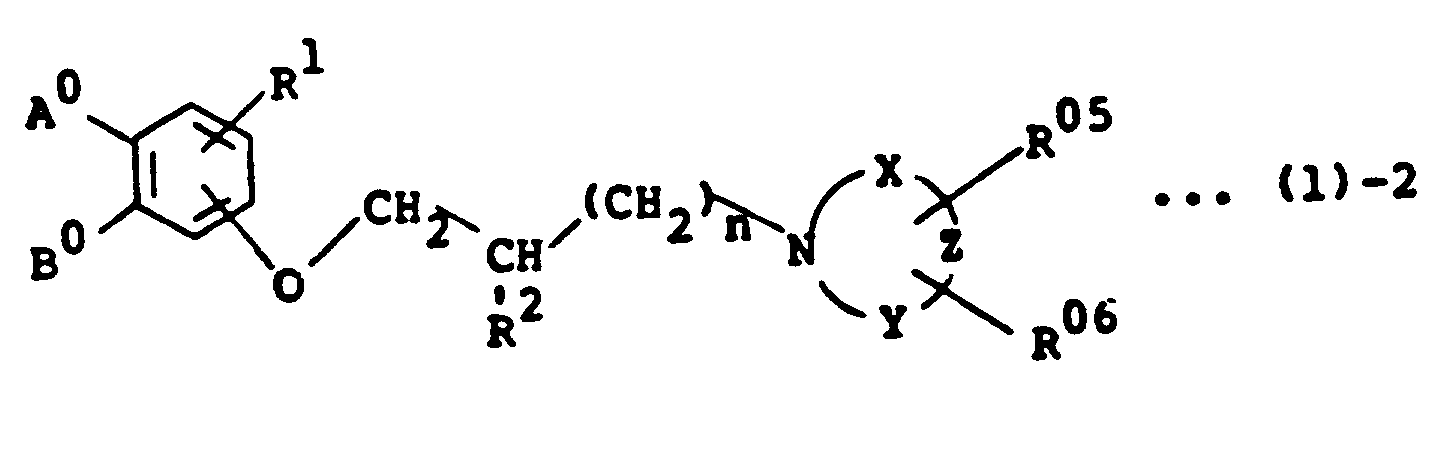
- A and B, taken together, represent group (a) or (e).
- When A and B represent a group (a), the left-hand side of formula (1) is as follows:
-

- When A and B represent a group (e), the left-hand side of formula (1) is as follows:

- The right-hand side of formula (1), i.e. the following portion of formula (1)

- For example, when A and B form a group (a), formula (1) is preferably
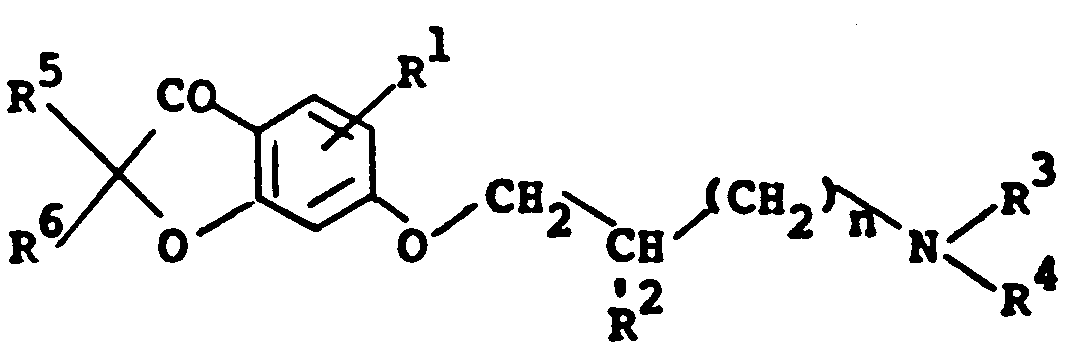

- In formula (1), R1 represents hydrogen, C1-C4 alkyl, C1-C4 alkoxy, halogen, amino, nito or C1-C4 alkylsulfamoyl. A C1-C4 alkyl group may be linear or branched. Examples of C1-C4 alkyl groups are methyl, ethyl, n-propyl, iso-propyl, n-butyl, sec-butyl, iso-butyl and t-butyl.
- A C1-C4 alkoxy group may be linear or branched.
- Examples of preferred halogen atoms are fluorine, chlorine, bormine and iodine.
- A C1-C4 alkylsulfamoyl group may be linear or branched.
- R2 is hydrogen, hydroxyl or C1-C4 alkyl. Examples of the C1-C4 alkyl group are the same as those given above with regard to R1.
- R3 and R03 are hydrogen, C1-C10 alkyl, C1-C3 alkoxy-C1-C3 alkyl, C1-C3 alkoxy-C1-C3 alkoxy-C1-C3 alkyl, C1-C3 alkoxycarbonyl-C1-C3 alkyl, C2-C4 acyl-Ci-C3 alkyl, ethylenedioxy C2-C3 alkyl, C2-C4 alkenyl, C2-C4 alkynyl, cycloalkyl, phenyl, benzyl,


- A C1-C10 alkyl group may be linear or branched. Besides the alkyl groups exemplified for R1, n-pentyl, iso-pentyl, n-hexyl, n-heptyl, n-octyl, n-nonyl and n-decyl may be cited as examples.
- In a C1-C3 alkoxy-C1-C3 alkyl group, examples of the alkoxy moiety are methoxy, ethoxy and propoxy, and examples of the alkyl moiety are methyl, ethyl, n-propyl, and iso-propyl.
- In a C1-C3 alkoxy-C1-C3-alkoxy-C1-C3 alkyl group, examples of each alkoxy moiety and the alkyl moiety are the same as those given above for a C1 -C3 alkoxy-C, -C3 alkyl group.
- In a C1 -C3 alkoxycarbonyl-C, -C3 alkyl group, examples of the alkoxy moiety and the alkyl moiety are the same as those given above for a C1 -C3 alkoxy-C, -C3 alkyl group.
- In a C2-C4 acyl-C1-C3 alkyl group, examples of the alkyl moiety are the same as those given above for a C1-C3 alkoxy-C1 -C3 alkyl group. Examples of the acyl moiety are acetyl, propionyl and butyryl.
- Examples of an ethylenedioxy-C2-C3 alkyl group are beta-(ethylenedioxy)ethyl, gamma-(ethylenedioxy)-ethyl and gamma-(ethylenedioxy)propyl.
- Examples of a C2-C4 alkenyl group are vinyl, propenyl, allyl and butenyl.
- Examples of a C2-C4 alkynyl group include ethynyl, propargyl and butynyl.
- A cycloalkyl group preferably has 5 to 7 carbon atoms, and examples are cyclopentyl, cyclohexyl and cyclobutyl.
- Examples of the Cl-C3 alkyl groups represented by R51, R52, R53 are the same as those given above for a C1 -C3 alkoxy-C, -C3 alkyl group.
- R4 and R04 may be C1-C10 alkyl, C2-C4 alkenyl, C2-C4 alkynyl, C1-C3 alkoxy-Ci-C3 alkyl, C2-C7 hydroxyalkyl, cycloalkyl, benzyl, phenethyl, cyclohexyloxy, 2-bicyclo [2.2.1]heptanyl, adamantyl, piperidino which may be substituted by methyl or ethyl, or 2-tetrahydrofuranylmethyl.
- Examples of the alkyl, alkenyl, alkynyl and cycloalkyl groups are the same as those given above with regard to R3.
- Examples of a hydroxyalkyl group include hydroxyethyl, hydroxypropyl, hydroxybutyl, hydroxypentyl, hydroxyhexyl and hydroxyheptyl.
- R5, R6, R17 and R18 are identical or different, and each represents hydrogen or C1-C3 alkyl. Examples of the C1-C3 alkyl group are the same as the C1-C3 alkyl groups given above for R1.
- X and Y, independently from each other, represent C1-C5 alkylene, for example, methylene, dimethylene, trimethylene, tetramethylene and pentamethylene.
- Z is methylene, imino, oxygen or sulfur.
- R05 and R°6 are each a substituent on X, Y or Z, and independently from each other, may represent hydrogen, C1-C4 alkyl, hydroxy-C1-C4 alkyl, C1-C4 alkoxy, cyclohexyl, hydroxyl, carboxyl, carbamoyl, alkoxycarbonyl in which the alkoxy moiety is C1-C3, alkylsulfonamide in which the alkoxy moiety is C1-C3, di-C1-C3 alkylcarbamoyl, C1-C3 alkylamide, phenyl which may be substituted by C1-C4 alkoxy, halogen, nitro, amino, hydroxy or acetamide, benzyl which may be substituted by halogen, C1-C4 alkyl or C1-C4 alkoxy, benzoyl which may be substituted by halogen C1-C4 alkyl or C1-C4 alkoxy, or furyl, pyrrolyl, thiophenyl, pyridyl, pyrimidyl, imidazolyl, thiazolyl, oxazolyl or piperidyl which may be substituted by C1-C4 alkyl, C1-C4 alkoxy or halogen.
- Examples of the C1-C4 alkyl group and C1-C4 alkoxy group are the same as those given above with regard to R1. A hydroxy C1-C4 alkyl group may be, for example, hydroxymethyl and hydroxyethyl.
- An alkoxycarbonyl group in which the alkoxy moiety is C1-C3 may be, for example, methoxycarbonyl and ethoxycarbonyl.
- An alkylsulfonamide group in which the alkyl moiety is C1 -C3 may be, for example, methylsulfonamide and ethylsulfonamide.
- In a di-C1-C3 alkylcarbamoyl group, the two alkyl groups may be identical or different. Examples of a di-C1-C3 alkylcarbamoyl group are dimethylcarbamoyl, di-ethylcarbamoyl and methylethylcarbamoyl. Examples of a C1-C3 alkylamide group include methylamide, ethylamide and n-propylamide.
- R05 and R06 may be bonded to each other to form oxo (=0), C1-C5 alkylene, ethylenedioxy or -CONHCH2 N(C6 H5)-, and when they are on adjacent carbon atoms, they may form a benzene ring together with the carbon atoms.
- Examples of the C1 -C5 alkylene may be the same as given above with regard to X.
- The following compounds may be cited as examples of the compounds of the invention.
- These compounds are of the formula


- (102) Hydrochloride of (100),
- (104) p-Toluenesulfonate of (100),

- (108) p-Toluenesulfonate of (106),

- (112) p-Toluenesulfonate of (110),

- (116) Hydrochloride of (114),
- (118) E-CH2-CH2-NH-i-C4H9
- (120) Hydrochloride of (118),

- (124) Hydrochloride of (122),

- (128) Hydrochloride of (126),
- (130) E-CH2-CH2-N(̵i-C4H9)2,
- (132) Hydrochloride of (130),

- (136) Hydrochloride of (134),

- (140) Hydrochloride of (138),
- (142) E-CH2-CH2-N(̵n-C4H9)2
- (144) p-Toluenesulfonate of (142),
- (150) E-CH2-CH2-N(̵CH2-C≡CH)2,
- (152) Hydrochloride of (150),
- (154) E-CH2-CH2-N CH2-CH = CH2)2,
- (156) Hydrochloride of (154),

- (160) Hydrochloride of (158).
- (162) E-CH2-CH2-N-(Cs H∴ > )2.
- (164) Hydrochloride of (162),

- (168) p-Toluenesulfonate of (166),

- (172) Hydrochloride of (170).
- (174) E-CH2-CH2-N(̵CH2C6H5)2,
- (176) Hydrochloride of (174),

- (180) Hydrochloride of (178),

- (184) Hydrochloride of (182),

- (188) Hydrochloride of (186),

- (192) p-Toluenesulfonate of (190),

- (196) p-Toluenesulfonate of (194),

- (200) p-Toluenesulfonate of (198),
- (202) E-CH2-N(̵n-C4H9)2,
- (204) p-Toluenesulfonate of (202),

- (208) p-Toluenesulfonaie of (206),

- (212) p-Toluenesulfonate of (210),

- (216) p-Toluenesulfonate of (214),

- (220) p-Toluenesulfonate of (218),

- (224) Hydrochloride of (222),

- (228) Hydrochloride of (226),

- (232) Hydrochloride of (230),

- (236) Hydrochloride of (234),

- (240) p-Toluenesulfonate of (238),

- (244) Hydrochloride of (242),
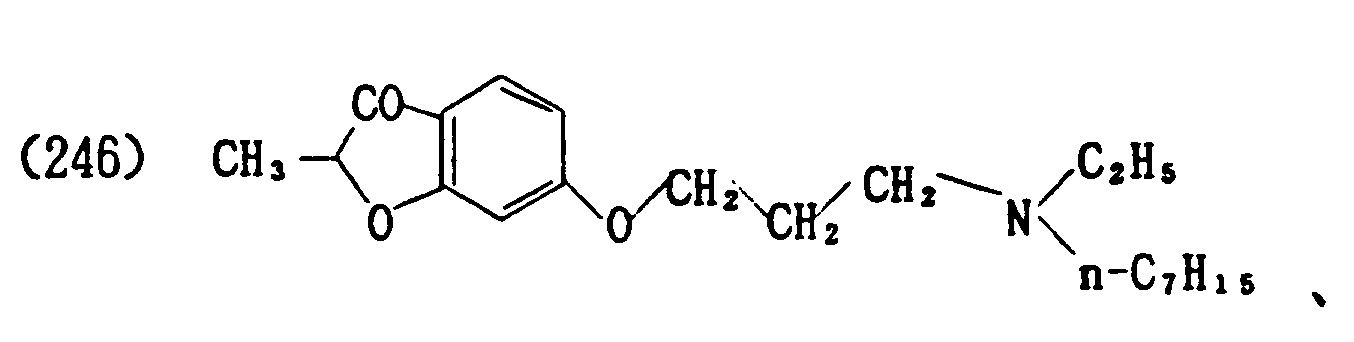
- (248) Hydrochloride of (246),
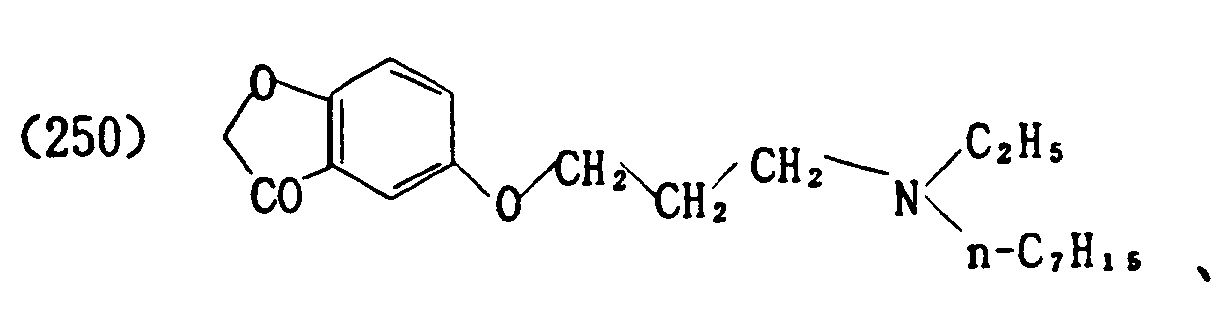
- (252) p-Toluenesulfonate of (250),

- (253)' Hydrochloride of (254),
- (254) E-CH2CH2-NH-t-C4H9.
- (254)' Hydrochloride of (254),
- (255) E-CH2CH2-N(̵n-C7H15)2

- (256)' Hydrochloride of (256),
-


- (258)' p-Toluenesulfonate of (258),
- (259) E-CH2CH2NH-iSOC3H7,
- (259)' Hydrochloride of (259),

- (260)' Hydrochloride of (260),

- (261)' Hydrochloride of (261),

- (262)' Hydrochloride of (262),
- (263) E-CH2-NH-i50-C3H7,
- (263)' Hydrochloride of (263),
- (264) E-CH2-NH(̵iSO-C3H7)2,
- (264)' Hydrochloride of (264),
- (265) E CH2 )̵4 N(̵n-C4 H9)2
- (265)' p-Toluenesulfonate of (265),
- (266) E(̵CH2)̵5N n-C4H9)2,
- (266)' p-Toluenesulfonate of (266),
- (267) E(̵CH2)̵2 NHCH3,
- (267)' E(̵ CH2)̵2 NHCH3,
- (267)" Hydrobromide of (267),

- (268)' p-Toluenesulfonate of (268),
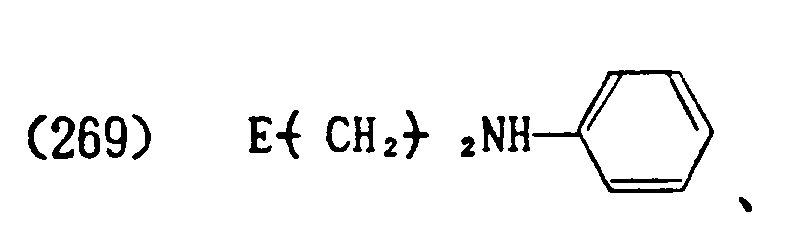
- (269)' Hydrochloride of (269),

- (270)' Hydrochloride of (270),

- (271)' Hydrochloride of (271),

- (272)' p-Toluenesulfonate of (272),

- (273)' p-Toluenesulfonate of (273),
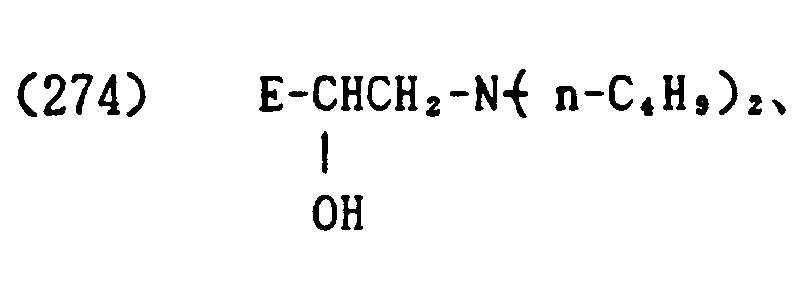
- (274)' Hydrochloride of (274),

- (275)' Hydrochloride of (275),
- (276) Ef CH2 )̵2N(̵ CH2CH20CH3)2 ,
- (276)' Hydrochloride of(276),


- (277)' p-Toluenesulfonate of (277),

- (278)' p-Toluenesulfonate of (278),

- (279)' p-Toluenesulfonate of (279),

- (280)' p-Toluenesulfonate of (280),

- (281)' p-Toluenesulfonate of (281), (282)' p-Toluenesulfonate of (282),

- (283)' p-Toluenesulfonate of (283),

- (284)' p-Toluenesulfonate of (284),

- (285)' p-Toluenesulfonate of (285).
- Compound of formula (1)-1 in which A and B represent a group (e)

- Quaternary ammonium salts of compounds of formula (1)-1
- These compounds are compounds of formula (1')'-1


- The compounds are compounds of the following formulae. In compound (1104) and subsequent compounds, the moiety of the following structure is represented by G:

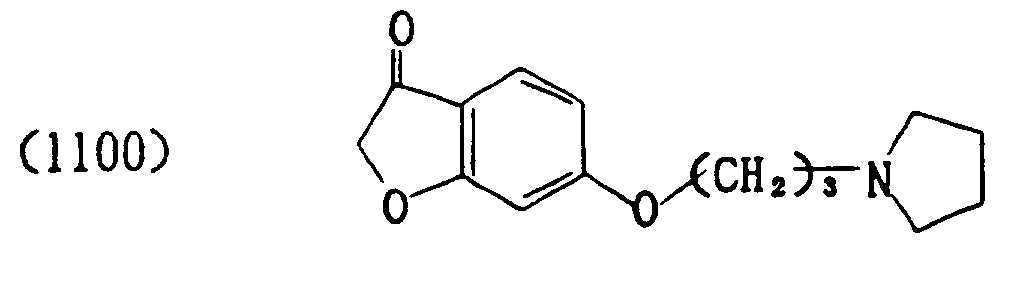
- (1102) p-Toluenesulfonate of (1100),

- (1106) Hydrochloride of (1104),

- (1110) Hydrochloride of (1108),
-


- (1118) Hydrochloride of (1116),
- (1119) Quaternary ammonium salt of an ethyl bromide adduct of (1118),

- (1126) Hydrochloride of (1124),


- (1130) Hydrochloride of (1128),
- (1131) Hydrochloride of (1129),

- (1134) Hydrochloride of (1132),

- (1146) Hydrochloride of (1144),

- (1150) Hydrochloride of (1148),

- (1154) Hydrochloride of (1152),

- (1158) Hydrochloride of (1156),

- (1162) Hydrochloride of (1160),

- (1166) p-Toluenesulfonate of (1164),

- (1170) p-Toluenesulfonate of (1168),
- (1171) Quaternary ammonium salt of an ethyl bromide adduct of (1168),
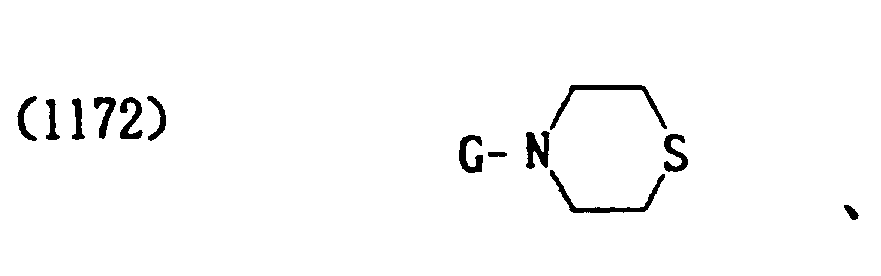
- (1174) p-Toluenesulfonate of (1172),
- (1175) Quaternary ammonium salt of an ethyl bromide adduct of (1172),

- (1182) Hydrochloride of (1180),

- (1186) Hydrochloride of (1184),
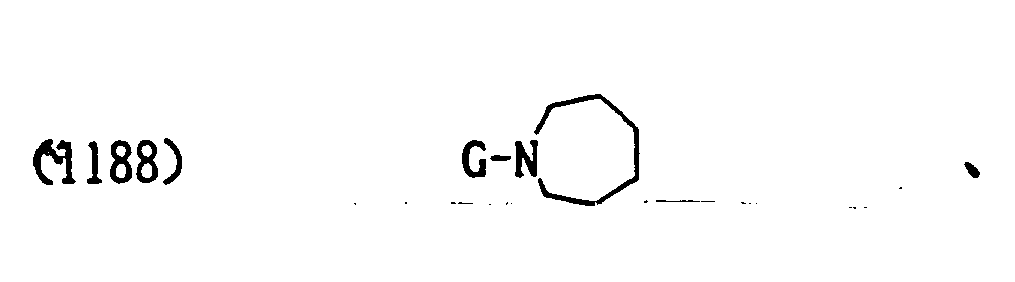
- (1190) p-Toluenesulfonate of (1188),

- (1194) Hydrochloride of (1192),
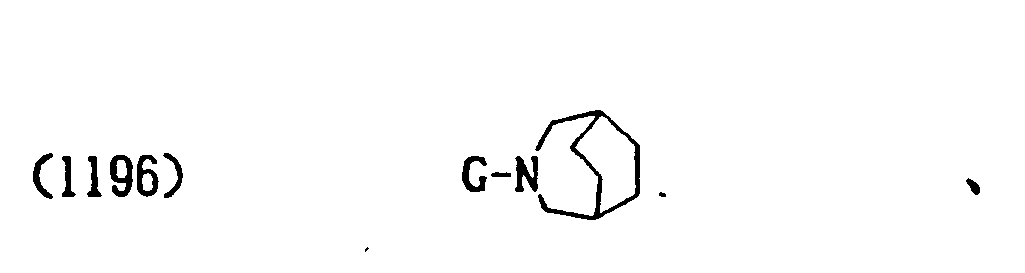
- (1198) Hydrochloride of (1196),

- (1206) Hydrochloride of compound No. (1204),

- (1210) Hydrochloride of compound No. (1208),

- (1214) Hydrochloride of compound No. (1212),


- (1220) Hydrochloride of compound No. (1218),

- (1224) Hydrochloride of compound No. (1222),

- (1228) Dihydrochloride of compound No. (1226),

- (1232) Hydrochloride of compound No. (1230),

- (1236) Hydrochloride of compound No. (1234),

- (1240) Hydrochloride of compound No. (1238),

- (1248) Hydrochloride of compound No. (1246),

- (1282) Hydrochloride of (1280),

- (1286) Hydrochloride of (1284),

- (1290) Hydrochloride of (1288),
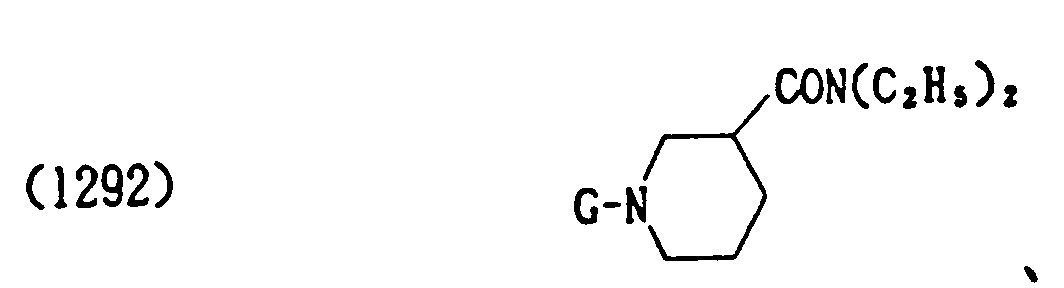
- (1294) p-Toluenesulfonate of (1292),

- (1298) p-Toluenesulfonate of (1296),

- (1302) Hydrochloride of (1300),


- (1322) Hydrochloride of (1320),

- (1326) Hydrochloride of (1324),
- The compounds of formula (1) can be produced by methods known per se.
- For example, compounds of formula (1) in which A and B represent the group (a) can be produced by process (I), (II) or (III).
-


-

-

- In process I, the reaction of compounds (2) and (3) may be carried out in accordance with the method of J. Am. Chem. Soc., 70, 3619 (1948). For example, compounds (2) and (3) are heated to a temperature of below about 30 °C in ether in the presence of ZnC12 while blowing HCI gas. Then, the reaction mixture is heated at the refluxing temperature in ethanol to form compound (4).
- The reaction of compounds (5) and (6) is carried out at 40 to 120 °C, preferably 60 to 100 °C, for 1 to 20 hours, preferably 4 to 10 hours in the presence of an acid scavenger such as K2C03 or Na2C03 in a reaction medium, for example benzene, toluene, xylene, dimethylformrnide, acetonitrile or ethyl acetate to form compound (7). The amounts of compounds (5) and (6) and the acid scavenger used are preferably nearly 1:1:1 by mole.
- The reaction of compounds (4) and (7) is carried out in a reaction medium, for example benzene, toluene, xylene, acetonitrile, dimethylformamide or water, at room temperature, preferably 40 to 110 °C while using 1 to 2 equivalents, preferably 1 to 1.2 equivalents, each of compound (4) and the acid scavenger, per mole of compound (7). Thus, compound (1 )-3 is formed.
- In process II, the reaction of compounds (4) and (8) is carried out in the presence of an acid scavenger such as K2C03 in a reaction medium, for example dimethylformamide, toluene or acetonitrile at a temperature of 40 to 100 °C, preferably 60 to 80 °C, for 1 to 10 hours, preferably 2 to 4 hours, to form compound (9).
- The reaction of compound (9) with compound (6) is carried out in a reaction medium, for example dimethylformamide, acetonitrile or toluene at 40 to 100 °C, preferably 60 to 80 °C, for 4 to 60 hours, preferably 6 to 12 hours, to form compound (1 )-3.
- Process III is a process for producing compounds of formula (1) in which R2 is hydroxyl.
- The reaction of compounds (4) and (10) is carried out in a reaction medium such as acetonitrile or dimethylformamide at 40 to 100 °C, preferably 60 to 80 °C, for 1 to 8 hours, preferably 2 to 4 hours, to form compound (11).
- The reaction of compound (11) with compound (6) is carried out in a reaction medium, for example acetonitrile or dimethylformamide, at 30 to 100 °C, preferably 40 to 80 °C, for 4 to 24 hours, preferably 6 to 15 hours, to form compound (1 )-4.
- Compounds of formula (1) in which A and B represent the other groups may also be produced by known reaction similar to the above-mentioned reactions. These reactions are described in the following known publications.
- J. Am. Chem. Soc., 94, 9166 (1972), J. Org. Chem. Soc., 26, 240 (1961), Angew. Chem. lnt. Ed. Engl., 21, 225 (1982), and West German OLS No. 2550965.
- The quaternary ammonium salts in this invention may also be produced by reactions known per se, for example the following reaction.

- The reaction of compounds (12) and (13) is carried out in a reaction medium, for example acetonitrile, toluene, ethyl acetate or dimethylformamide at room temperature to 150 °C, preferably 50 to 100 °C, to form compound (1 )-3.
- The compounds of this invention represented by general formula (1) described above are valuable as anti-arrhythmic agents of class III having marked APD and ERP prolonging activity, and exhibit anti-arrhythmic activity in various arrhythmic models. Some of the compounds of general formula (I) also have the activity of suppressing the maximum rising speed (Vmax) of myocardial action potential, but the other compounds are pure class III anti-arrhythmic agents having no Vmax suppressing activity. Thus, the compounds of general formula (1) have valuable anti-arrhythmic activity and are used for the treatment and prevention of ischemic heart diseases, myocardial infarction, angina pectoris, cardiomyopathy, valvular disease of the heart, hypertensive heart disease and heart failure which induce, or possibly induce, arrhythmia.
- The compounds of general formula (1) are used normally in the form of a pharmaceutical composition and are administered to an animal through various routes such as oral, subcutaneous, intromuscular, intravenous, introduodenum, intrarhinal, sublingual, skin permeating and intrarectal.
- The present invention also provides a pharmaceutical preparation comprising a pharmaceutically accceptable carrier and, as an active ingredient, a compound of general formula (1) or a pharmaceutically acceptable salt thereof.
- Examples of pharmaceutically acceptable salts of compounds of general formula (1) include salts formed from acids forming pharmaceutically acceptable nontoxic acid addition salts containing anions, such as hydrohlorides, hydrobromides, sulfates, bisulfates, phosphates, acid phosphates, acetates, oxalates, maleates, fumarates, succinates, lactates, tartrates, benzoates, citrates, gluconates, saccharates, cyclohexyl- sulfamates, methanesulfonates, p-toluenesulfonates and naphthalenesulfonates.
- Examples of quaternary ammonium salts are salts formed between alkyl halides and compounds of general formula (1).
- The composition of this invention may be prepared in the form of a tablet, capsule, powder, granule, trouch, sublingual tablet, cachet wafer capsule, elixir, emulsion, solution, syrup, suspension, aerosol, ointment, eye drop, sterilized injectable solution, cataplasm, tape, soft or hard gelatin capsule, suppository, or sterile packed powder. Examples of the pharmaceutically acceptable carrier include lactose, glucose, sucrose, sorbitol, mannitol, corn starch, crystalline cellulose, gum arabic, calcium phosphate, crystalline cellulose, calcium phosphate, sodium alginate, calcium silicate, calcium sulfate, microcrystalline cellulose, polyvinyl pyrrolidone, tragacanth rubber, gelatin, syrup, methyl cellulose, carboxymethyl cellulose, sodium benzoate, methyl hydroxybenzoate, propyl hydroxybenzoate, talc, magnesium stearate, inert polymers, water, mineral oils, peanut oil acceptable for injection, and suppository bases such as glycerides.
- The composition, whether solid or liquid, may contain a filler, a binder, a lubricant, a wetting agent, a disintegrant, an emulsifier, a suspending agent, a preservative, a sweetner or a flavor. The present composition may be prescribed such that after administration to a patient, the active component can be rapidly, continuously or retardedly released.
- In oral administration, a compound of general formula (1) is mixed with a carrier and a diluent, and formulated into the form of tablets, capsules, etc. In parenteral administration, the active ingredient is dissolved in 10 % aqueous glucose solution, isotonic aqueous salt solution, sterilized water or a similar liquid, and sealed up in a viale or ampoule for administration into the vein by drip infusion or injection, or into the muscles by injection. Advantageously, a dissolution aid, a local anesthetic, a preservative and a buffer may also be included in the medium. To enhance stability, the present composition can be lyophilized after it is filled into a viale or ampoule. In another case of parenteral administration, there is a preparation to be administered through the skin as an ointment or cataplasm. In this case, a molded cataplasma or a tape agent is advantageous.
- The present composition suitably contains 1 microgram to 1 g, generally 10 micrograms to 500 mg, of the active component per unit dosage form.
- A compound of general formula (1) is effective over a wide dose range. For example, the dose per day usually falls within the range of 0.1 microgram/kg to 100 mg/kg. The amount of the compound to be actually administered is determined by a physician or veterinary-depending upon the age, body weight, response, symptom (for example in the case of arrhythmia, the type and strength of arrhythmia, and in the case of a central nervous disease, its symptom and history, etc.), and the administration route. Accordingly, the above range of the dose does not limit the scope of the invention. The suitable number of administrations per day is 1 to 6, usually 1 to 4.
- Compounds of general formula (1) are by themselves effective anti-arrhythmic agents, and are therapeutic and prophylactic agents for ischemic heart diseases, myocardial infarction, angina pectoris and heart failure. As required, they may be administered in combination with one or several other equivalent drugs. Examples of the additional drugs include vasodilators such as dipyridamole, isosorbide dinitrate, molsidomine, trapidil, nicorandil, nitroglycerin, pentaerythritol tetranitrate, etafenone hydrochloride, ox- yfedrine hydrochloride, trimetazidine hydrochloride, dilazep hydrochloride, carbocromene; calcium antagonists such as diltiazem hydrochloride, verapamil hydrochloride, nifedipine and nicardipine; cardiotonic agents such as digitoxin, digoxin, lanatoside, amrinone and milrinone; diuretics such as trichloromethiazide, hydrochlorothiazide, furosemide, bumetanide, mefruside, triamterene, clofenamide and spironolactone; hypotensive agents such as hydralazine hydrochloride, rauwolfia alkaloids, rescinnamine reserpine, dihydroergotoxin mesilate, prazosin hydrochloride, clonidine hydrochlorde, Guanfacine hydrochloride, in- dapamide, labetalol, capropril, guanabenz acetate, tripamide, meticrane, methyldopa, guanethidine sulfate and betanidine sulfate; beta-blockers such as propranolol hydrochloride, pindolol and metoprolol tartrate; sympathomimetic agents such as ephedrine hydrochloride, etc. and the various anti-arrhythmic agents described above.
- The following examples and experimental examples illustrate formulation of compounds of general formula (1) and their biological activities. The present invention, however, is not limited to them. In the following examples of compositions, compounds described in this invention are used as active components.
-

- Hydrogen chloride gas was blown into a mixture of 150 g (1.36 moles) of resorcinol, 800 ml of dry ether, 100 g (1.32 moles) of chloroacetonitrile and 100 g (0.73 mole) of zinc chloride for about 2 hours. Crystals which precipitated were obtained by decantation. The crystals were washed with ether and 1500 ml of water was added. The mixture was refluxed for 1 our and then cooled. The crystals were collected by filtration. Potassium acetate (130 g; 1.33 moles) and 850 ml of ethanol were added to the crystals, and the mixture was refluxed for 30 minutes. After cooling, 1500 ml of water was added, and the crystals were collected by filtration to give 107 g of the desired product (yield 54 %). Melting point: 240-241 ° C. 1H-NMR spectrum (DMSO-d6-CDCl3 solution, δ ppm):
- 4.60(3H, s), 6.50(1 H, d, J = 2Hz), 6.63 (1 H, dd, J = 2 and 9Hz), and 7.44 (1 H, d, J = 9Hz).
- The compounds shown in Table 1 were obtained by operating as in Referential Example 1 except that 4-methylresorcinol, 5-methylresorcinol, 2-methoxyresorcinol, 2-methylresorcinol and 4-chlororesorcinol were used respectively instead of the resorcinol, and 2-chloropropionitrile was used instead of the chloroacetonitrile.

- Production of heptylacetamide [CH3(CH2)5NHCOCH3]:-Heptylamine (39 g; 0.34 mole) was added dropwise to 46.6 g (0.59 mole) of pyridine and 43.4 g (0.43 mole) of acetic anhydride over 30 minutes, and the mixture was further stirred for 2 hours. After the reaction, the mixture was concentrated and extracted by adding water and ether. The ethereal layer was washed successively with a saturated aqueous solution of sodium hydrogen carbonate and then a saturated aqueous solution of sodium chloride, and then dried over anhydrous magnesium sulfate and concentrated to give 51 g of the desired compound (yield 96 %).
- 1H-NMR spectrum (CDCl3 solution, 6 ppm):
- 0.90(3H, t, J = 7Hz), 1.30(1 OH, m), 1.98 (3H, s), 3.24(2H, m).
- In the same way as above, tetrahydrofurfuryl acetamide (yield 52 %) was obtained by using tetrahydrofufurylamine instead of the heptylamine.
- 1H-NMR spectrum (CDCl3 solution, δ ppm):
- 1.92(3H, m), 2.0(3H, s), 3.18(1 H, m), 3.52-4.1 (5H, m).
- A solution composed of 15 g (0.2 mole) of 2-methoxyethylamine and 12.3 g (0.1 mole) of propyl- bromide was stirred at room temperature for 2 hours. Ether was added and mixed with the resulting reaction mixture. The ethereal layer was removed, and the residue was extracted with water-methylene chloride. The methylene chloride layer was dried over anhydrous magnesium sulfate and concentrated to give 2.6 g (yield 22 %) of the desired compound. 1H-NMR spectrum (CDCl3 solution, 6 ppm):
- 0.93(3H, t, J = 7Hz), 1.54(2H, m), 2.72(4H, m), 3.39(3H, s), 3.48(2H, m).
- Production of ethylheptylamine [CH3CH2NH(CH2)5CH3]:-Heptylacetamide (50 g; 0.32 mole) was added dropwise to a mixture of 500 ml of dry ether and 12.8 g (0.34 mole) of lithium aluminum hydride so that the mixture refluxed gently. After the addition, the refluxing was continued for another 10 hours. After cooling, 25 ml of water and 25 ml of 6N potassium hydroxide was added dropwise. The mixture was filtered and concentrated. Simple distillation of the resulting concentrate gave 30.5 g (yield 68 %) of the desired product.
- Boiling point: 41-42 ° C/2 mmHg.
- 1H-NMR spectrum (CDCl3 solution, δ ppm):
- 0.87(3H, t, J = 7Hz), 1.09(3H, t, J = 7Hz), 1.28(1 OH, m), 2.64(4H, m).
- Production of tetrahydrofurfurylethylamine:-Referential Example 10 was repeated except that tetrahydrofurfurylacetamide was used instead of heptylacetamide. Tetrahydrofurfurylethylamine was obtained in a yield of 86 %.
- 1H-NMR spectrum (CDCIa solution, δ ppm):
- 1.12(3H, t, J = 7Hz), 1.88(6H, m), 2.68 (3H, m), 3.78(4H, m).
-

- A mixture of 30 g (0.19 mole) of 1-bromo-3-chloropropane, 25 g (0.17 mole) of ethylheptylamine, 28 g (0.20 mole) of potassium carbonate and 250 ml of toluene was refluxed for 8 hours. After cooling, the solid was collected by filtration, and concentrated. The residue was purified by silica gel column chromatography (ethyl acetate) to give 17 g of the desired compound (yield 44 %).
- 1H-NMR spectrum (CDCl3 solution, δ ppm):
- 0.90(3H, t, J = 7Hz), 1.02(3H, t, J=7Hz), 1.30(1 OH, m), 1.90(2H, m), 2.50(6H, m), 3.60 (2H, t, J=7Hz).
- The amines indicated in Table 2 were produced from Referential Example 12.

- Production of 6-[3-(N-ethyl-N-heptylamino)-propoxy]coumaran-3-one (compound No. 100):-A mixture composed of 4.4 g (31.9 millimoles) of 6-hydroxycoumaran-3-one, 6 g (27.3 millimoles) of 3-chloropropylethylheptylamine, 4.8 g (34.8 millimoles) of potassium carbonate and 120 ml of toluene was refluxed for 30 hours. After cooling, the solid was collected by filtration and concentrated. The residue was purified by silica gel column chromatography (CH2CI2/MeOH=95/5) to give 3.4 g (yield 37 %) of the desired compound as an oil.
- 1H-NMR spectrum (CDCl3 solution, 6 ppm):
- 0.80(3H, t, J = 7Hz), 1.02(3H, t, J = 7Hz), 1.98(2H, m), 2.54(4H, m), 4.10(2H, t, J = 7Hz), 4.63(2H, s), 6.58-(1 H, d, J = 2Hz), 6.64 (1 H, dd, J = 2 and 9Hz), 7.56(1 H, d, J = 9Hz).
- In the same way as in Example 1, the compounds shown in Table 3 were produced from the corresponding starting compounds.


- Production of 6-[3-(N-ethyl-N-heptylamino)-propyloxy]coumaran-3-one hydrochloride (compound No. 102):-3.4 g (10.2 moles) of 6-[3-(N-ethyl-N-heptylamino)propyloxy]coumaran-3-one was dissolved in 30 ml of acetonitrile, and 1.0 g (10.2 millimoles) of concentrated hydrochloric acid was added. The mixture was stirred for 0.5 hour. Then, the solvent was evaporated under reduced pressure, and the residue was crystallized from ethyl acetate/ether to give 3.5 g (yield 95 %) of the desired compound.
- Melting point: 92-93 °C.
- 1H-NMR spectrum (CDCl3 solution, 6 ppm):
- 0.90(3H, t, J = 5Hz), 1.34(11 H, m), 1.88 (2H, m), 2.48(2H, m), 3.20(6H, m), 4.20 (2H, t, J = 5Hz), 4.64(2H, s), 6.58(1 H, d, J = 2Hz), 6.62(1 H, dd, J = 2 and 9Hz), 7.58 (1 H, d, J = 9Hz).
- In the same way as in Example 15, the compounds indicated in Table 4 were obtained from the corresponding starting compounds.


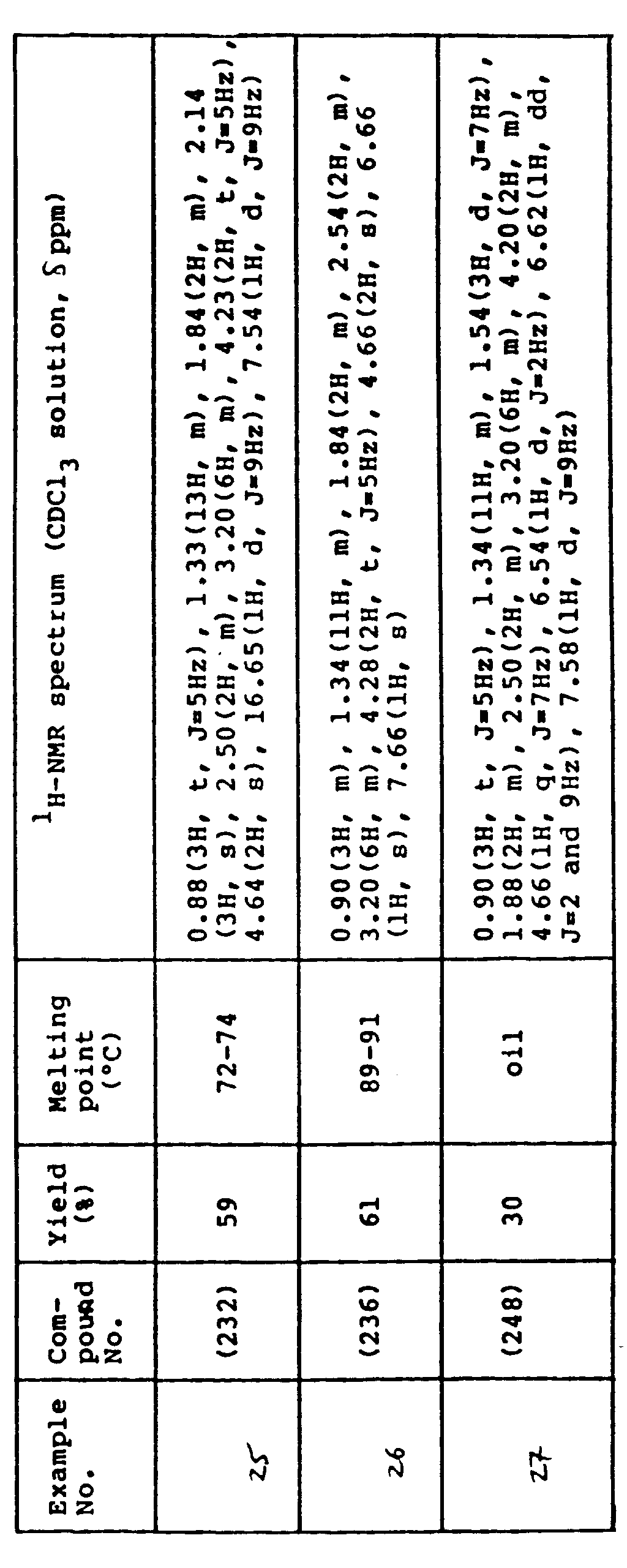


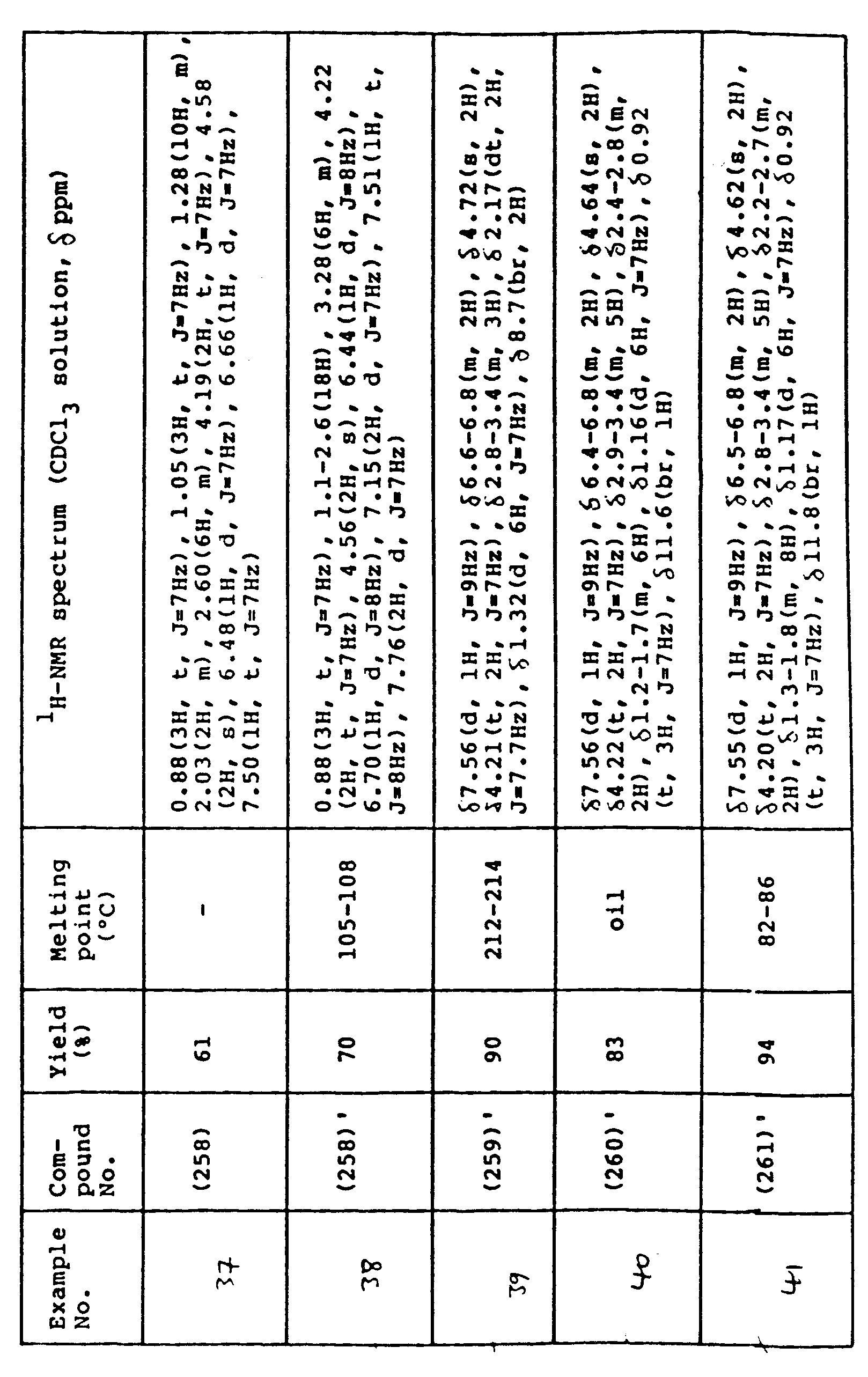


- Production of 6-(3-N-methylamino)propyloxy-coumaran-3-onehydrobromide (compound No. 267'):-By repeating Example 15 using hydrobromic acid instead of concentrated hydrochloric acid, compound No. 267' was obtained in a yield of 97 %.
- Melting point: 202-204 ° C.
- 1H-NMR spectrum (CDCl3 solution, 6 ppm):
- 7.45(d, 1 H, J = 9Hz), 6.6-6.9(m, 2H), 4.69 (s, 2H), 4.20(t, 2H, J = 7Hz), 3.12(t, 2H, J = 7Hz), 2.24(dt, 2H, J = 7, 7Hz), 2.64(s, 3H).
-

- A mixture composed of 2 g (13.3 millimoles) of 6-hydroxycoumaran-3-one, 2.1 g (13.3 millimoles) of 1-bromo-3-chloropropane, 1.85 g (13.3 millimoles) of potassium carbonate and 40 ml of dimethylformamide was stirred at 80 °C for 2.5 hours. Then, the solvent was evaporated under reduced pressure, and the residue was extracted by adding water and ethyl acetate. The ethyl acetate layer was washed with a saturated aqueous solution of sodium chloride, dried over magnesium sulfate, and concentrated to give 2.6 g (yield 87 %) of the desired compound.
- 1H-NMR spectrum (CDCl3 solution, 6 ppm):
- 2.32(2H, m), 3.77(2H, t, J = 7.2Hz), 4.22 (2H, t, J = 7.2Hz), 4.64(2H, s), 6.60(1 H, d, J = 2Hz), 6.65(1 H, dd, J = 2 and 9Hz), 7.58(1 H, d, J = 9Hz).
- In the same way as in Referential Example 19 except that 1-bromo-2-chloroethane, 1-bromo-4-chlorobuthane and 1-bromo-3-chloro-2-methylpropane were used respectively instead of 1-bromo-3-chloropropane. Thus, the compounds indicated in Table 5 were obtained.

- Production of 6-[3-(N-ethyl-N-pentylamino)propyloxy]coumaran-3-one (compound No. 106):-A mixture of 2 g (8.8 millimoles) of 6-(3-chloropropyloxy)coumaran-3-one, 1.5 g (13.2 millimoles) of ethylpentylamine, 1.82 g (13.2 millimoles) of potassium hydrochloride and 30 ml of dimethylformamide was stirred at 70 °C for 10 hours. The solvent was then evaporated under reduced pressure. The residue was extracted by adding water and ether. The etheral layer was washed with water and dried over magnesium sulfate. The concentrate was purified by silica gel column chromatography (CH30H/CHCI3=1/30) to give 0.9 g (yield 33 %) of the desired compound.
- 1H-NMR spectrum (CDCI3 solution, δ ppm):
- 0.89(3H, t, J=4Hz), 1.04(3H, t, J=4Hz), 1.30(6H, m), 2.0(2H, q, J=7Hz), 2.52 (6H, m), 4.10(2H, t, J = 4Hz), 4.62(2H, s), 6.59(1 H, d, J = 2Hz), 6.64(1 H, dd, J = 2 and 9Hz), 7.56(1 H, d, J = 9Hz).
- The compounds indicated in Table 6 were produced from the corresponding starting compounds in the same way as in Example 51.


- Production of 6-[3-(N-ethyl-N-pentylamino)propyloxy]coumaran-3-one p-toluenesulfonate (compound No. 108):-0.78 g (2.5 millimoles) of 3-(N-ethyl-N-pentylamino)propyloxycoumaran-3-one was dissolved in 5 ml of ethyl acetate. Separately, 0.49 g (2.5 millimoles) of p-toluenesulfonic acid monohydrate was heated under reflux with 10 ml of toluene to remove water. The solvent was evaporated under reduced pressure. To the residue was added 5 ml of ethyl acetate to dissolve it. The solution was gradually added at room temperature to the ethyl acetate solution prepared previously. The mixture was filtered, and dried to give 1.1 g (yield 89 %) of the desired compound.
- Melting point: 133 to 135 ° C.
- 1H-NMR spectrum (CDCI3 solution, 6 ppm):
- 0.89 (3H, t, J = 4Hz), 1.35(6H, m), 1.80 (3H, br. s), 2.37(3H, s), 2.40(2H, m), 3.1 (6H, m), 4.15(2H, t, J = 4Hz), 4.62 (2H, s), 6.54(1 H, br. s), 6.58(1 H, dd, J = 2 and 9Hz), 7.16(2H, d, J = 9Hz), 7.58 (1 H, d, J = 9Hz), 7.79(2H, d, J = 9Hz), 10.8 (1 H, m).
- The compounds indicated in Table 7 were produced from the corresponding starting compounds in the same way as in Example 84.


-

- A mixture composed of 6.0 g (40 millimoles) of 6-hydroxycoumaran-3-one, 6.0 g (43 millimoles) of anhydrous potassium carbonate, 22.2 g (240 millimoles) of epichlorohydrin and 70 ml of DMF was stirred at 70 ° C for 3 hours. The reaction mixture was cooled, and the solid was separated by filtratrion. DMF was evaporated from the filtrate. The residue was extracted by adding ethyl acetate and an aqueous solution of sodium hydroxide. The organic layer was washed with water, dried and concentrated under reduced pressure to give 7.4 g of a brown viscous oil. Ethyl acetate and ether (1:40) were added to the oil and the mixture was refluxed, and separated into a solution and a brown solid. The above mixed solvent was added to the solid, and the same operation was repeated three times. The solution was combined, and the mixture was concentrated under reduced pressure to give 5.9 g (yield 61 %) of yellow crude crystals of the captioned compound. The crude crystals were recrystallized from ethyl acetate to form a final product.
- Melting point: 107-109 ° C.
- 'H-NMR spectrum (CDCI3 solution, 6 ppm):
- 2.76(1 H, dd, J = 3 and 5Hz), 2.94(1 H, t, J = 5Hz), 3.38(1 H, m), 4.00(1 H, dd, J = 7 and 10Hz), 4.32(1 H, dd, J = 10 and 3Hz), 4.63(2H, s), 6.58(1 H, d, J = 2Hz), 6.68 (1 H, dd, J = 2 and 9Hz), 7.58(1 H, d, J = 9Hz).
- Production of 6-[3-(N-ethyl-N-heptylamino)-2-hydroxypropyloy]coumaran-3-one (compound No. 214):-2.24 g (9.23 millimoles) of 6-(2,3-epoxypropyloxy)coumaran-3-one, 1.36 g (9.49 millimoles) of ethylheptylamine, 1.31 g (9.48 millimoles) of anhydrous potassium carbbonate and 20 ml of acetonitrile were mixed and stirred at 77 ° C for 12 hours. After cooling, the solid matter was removed by filtration and the filtrate was extracted by adding ethyl acetate and water. The organic layer was further extracted by adding 2N hydrochloric acid. The dark brown viscous matter in an oil-water interlayer and the aqueous layer were separated from the organic layer, and then extracted by adding ethyl acetate and a 6N aqueous solution of sodium hydroxide. The organic layer was dried and conentrated. The resulting reddish brown oil was dissolved in ether in a smallest required amount, and 2 to 3 times the weight of ether of hexane was gradually added. At this time, a dark reddish brown precipitate formed and adhered to the glass wall. The precipitate was again dissolved in ether, and hexane was added. This operation was repeated two or three times. The solutions were combined and concentrated to give 1.66 g of a yellowish oil. This oil was purified by silica gel column chromatography (eluted with ether), 1.11 g (yield 34 %) of the captioned compound was obtained as a pale yellow oil.
- 'H-NMR spectrum (CDCI3 solution, 6 ppm):
- 0.88(3H, t, J = 7Hz), 1.03(3H, t, J = 7Hz), 1.0-1.6(10H, m), 2.60(6H, m), 3.95(1 H, brs), 4.02(3H, m), 4.62-(2H, s), 6.58 (1 H, d, J = 2Hz), 6.67(1 H, dd, J = 2 and 9Hz), 7.53(1 H, d, J = 9Hz).
- The compounds shown in Table 7' was obtained from the corresponding starting compounds in the same way as in Example 108.

- Production of 6-[3-(N-ethyl-N-heptylamino)-2-hydroxypropyloxy]coumaran-3-one p-toluenesulfonate (compound No. 216):-Anhydrous p-toluenesulfonic acid obtained by azeotropic dehydration of a toluene solution of 0.60 g (3.2 millimoles) of p-toluenesulfonic acid monohydrate was dissolved in ethyl acetate. The resulting solution was added to an ethyl acetate solution of 1.11 g (3.2 millimoles) of 6-[3-(N-ethyl-N-heptylamino)-2-hydrox- ypropyloxy]coumaran-3-one. While the mixed solution was stirred at room temperature, crystals were precipitated. The crystals were collected by filtration and dried under reduced pressure to give 1.15 g (yield 70 %) of the captioned compound as pale yellow crystals.
- Melting point: 120.9-121.0 ° C.
-

- Twenty milliliters of DMF was added to 3.0 g (20 millimoles) of 6-hydroxycoumaran-3-one, 23.7 g (80 millimoles) of 1,3-diiodopropane and 5.52 g (40 millimoles) of potassium carbonate, and the mixture was stirred overnight at room temperature. The precipitate was separated by filtration, and DMF was evaporated under reduced pressure. The residue was purified by silica gel column chromatography (eluent: hex- ane/ethyl acetate = 7:3) to give 4.22 g (yield 66 %) of the captioned compound as yellow crystals.
- 1H-NMR spectrum (CDCI3 solution, 6 ppm):
- 2.32(2H, quintet, J=6.3Hz), 3.38(2H, t, J=6.3Hz), 4.14(2H, t, J=6Hz), 4.64(2H, s), 6.5-6.8(2H, m), 7.58-(1 H, d, J = 9Hz).
- Production of 6-[3-(2-exo-norbornyl)aminopropyloxy]coumaran-3-one (compound No. 166):-Ten milliliters of acetonitrile was added to 0.954 g (3 millimoles) of 5-(3-iodopropyloxy)coumaran-3-one, 0.366 g (3.3 millimoles) of 2-exo-aminonorbornane and 0.690 g (5 millimoles) of potassium carbonate, and the mixture was stirred at room temperature for 4 hours. Acetonitrile was evaporated under reduced pressure, and the residue was purified by silica gel column chromatography (eluent: dichloromethane:methanol =10:1). The product was further dissolved in hexane, and the insoluble matter was separated by filtration. Hexane was evaporated-under reduced pressure to give 0.36 g of the captioned compound.
- 1H-NMR spectrum (CDCI3 solution, 6 ppm):
- 0.85-1.75(10H, m), 1.75-2.3(4H, m), 2.45-2.9(3H, m), 4.11(2H, t, J=6Hz), 4.61 (2H, s), 6.49-6.75(2H, m), 7.51 (1 H, d, J = 9Hz).
- Production of 6-[3-(2-exo-norbornyl)aminopropyloxy]coumaran-3-one p-toluenesulfonate (compound No. 168):-6-[3-(2-exo-norbornyl)aminopropyloxy]coumaran-3-one (0.6 millimole) was dissolved in ethanol, and an ethanol solution of 0.075 g (0.6 millimole) of p-toluenesulfonic acid monohydrate was added. Ethanol was evaporated under reduced pressure to give 0.24 g of the captioned compound as yellow crystals. The yield was quantitative.
- Melting point: 118-124 ° C.
- Production of 6-[3-(N-ethyl-N-heptylamino)propyloxy]3-hydroxycoumaran (compound No. 450):-0.5 g (1.5 millimoles) of 6-[3-(N-ethyl-N-heptylamino)propyloxy]coumaran-3-one, 0.15 g (3.6 millimoles) of sodium borohydride and 10 ml of ethanol were stirred at room temperature for 3 hours. The solvent was evaporated under reduced pressure, and the residue was extracted by adding water and dichloromethane. The dichloromethane layer was washed with water, dried over sodium sulfate and concentrated to give 0.41 g (yield 80 %) of the desired compound as an oil.
- 1H-NMR spectrum (CDCI3 solution, 6 ppm):
- 0.88(3H, m), 1.01 (3H, t, J = 7.2Hz), 1.30 (6H, m), 1.82(4H, m), 2.50(6H, m), 3.99 (2H, t, J = 5Hz), 4.50(2H, m), 5.30(1 H, m), 6.45(1 H, s), 6.50(1 H, dd, J = 2 and 9Hz), 7.29(1 H, d, J = 9Hz).
- Production of (3-oxo-6-coumaranoxypropyl)diethylheptyl ammonium bromide (compound No. 286):-A solution composed of 2.7 g (8.1 millimoles) of 3-(N-ethyl-N-heptylamino)propyloxycoumaran-3-one, 12 g of ethyl bromide and 40 ml of acetonitrile were refluxed for 8 hours. Then, the solvent was evaporated under reduced pressure. The residue was purified by silica gel column chromatography (CH2 CI/CH3 OH =95-90/5-10) to give 2.8 g (yield 78 %) of the desired compound.
- Melting point: 106-108 ° C.
- 1H-NMR spectrum (CDCI3 solution, 6 ppm):
- 0.90(3H, t, J=5Hz), 1.2-1.8(16H, m), 2.45 (2H, m), 3.3-3.8(8H, m), 4.30(2H, t, J=5Hz), 4.63(2H, s), 6.58-(1 H, d, J = 2Hz), 6.63(1 H, dd, J = 2.9Hz), 7.56(1 H, d, J = 9Hz.
- In the same way as in Example 116, the compounds given in Table 8 were produced from the corresponding starting compounds.


- Production of compound No. 1196:-A mixture composed of 4.4 g (31.9 millimoles) of 6-hydroxycoumaran-3-one, 5.5 g (27.3 millimoles) of the compound produced in Referential Example 13, 4.8 g (34.8 millimoles) of potassium carbonate and 120 ml of toluene was refluxed for 30 hours. After cooling, the solid was separated by filtration and concentrated. The residue was purified by silica gel column chromatography (CH2CI2/MeOH=95/5) to give the desired compound as an oil in a yield of 42 %.
- 1H-NMR spectrum (CDCI3 solution, 6 ppm):
- 1.70(12H, m), 2.56(6H, m), 4.15(2H, t, J = 7Hz), 4.64(2H, s), 6.58(1 H, d, J = 2Hz), 6.65(1 H, dd, J = 2 and 9Hz), 7.57(1 H, d, J = 9Hz).
- The compounds indicated in Table 9 were produced from the corresponding starting compounds in the same way as in Example 124.


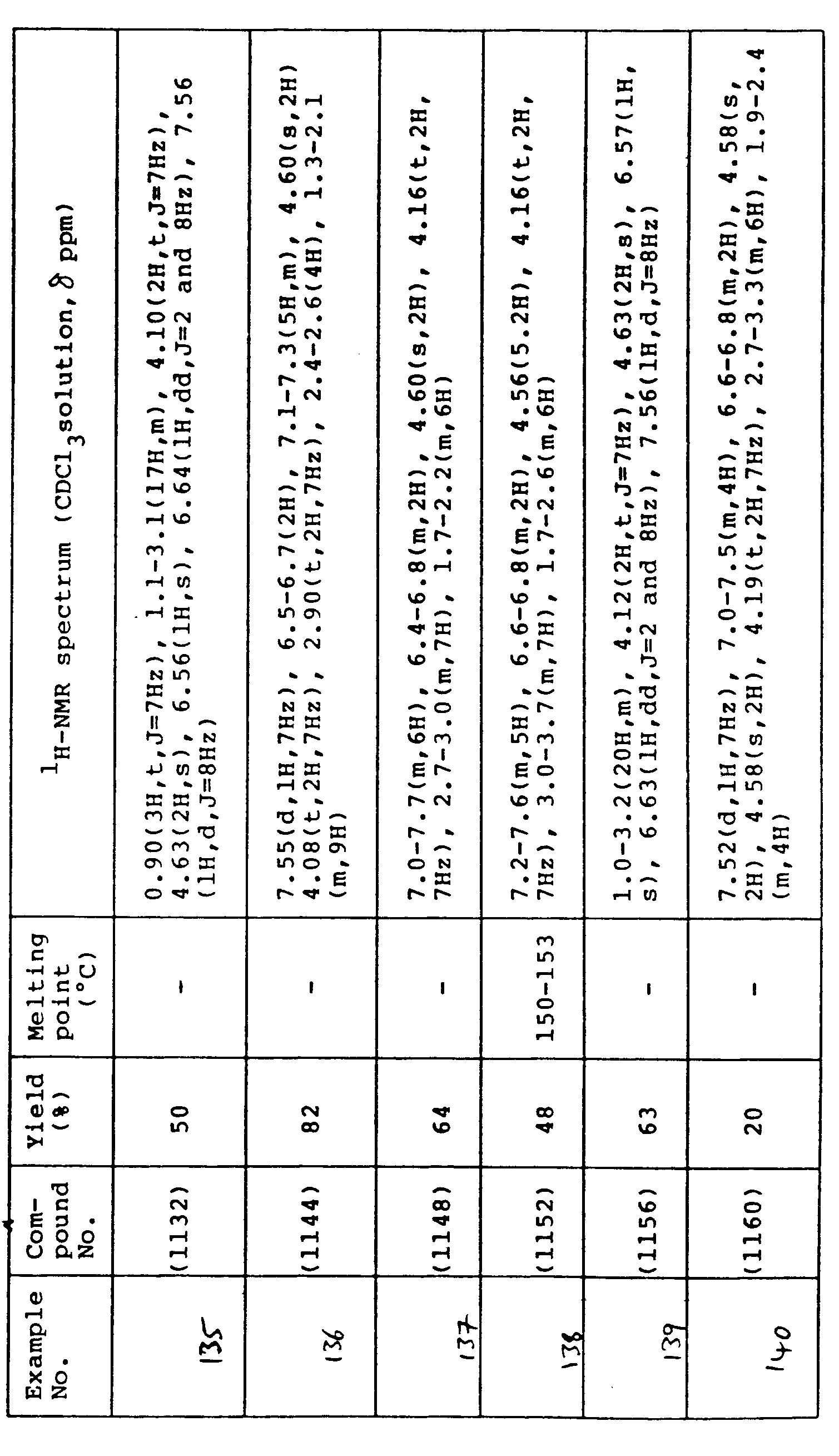


- Production of compound No. 1198:-Two grams (10 millimoles) of compound No. 1196 was dissolved in 30 ml of acetonitrile, and 1.0 g (10.2 milimoles) of concentrated hydrochloric acid was added. The mixture was stirred for 0.5 hour. Then, under reduced pressure, the solvent was evaporated. The resiude was crystallized from ethyl acetate/ether to give the desired compound in a yield of 29 %.
- Melting point: 258-260 ° C.
- 1H-NMR spectrum (CDCI3 solution, δ ppm):
- 1.8-3.8(18H, m), 4.17(2H, t, J = 5Hz), 4.64(2H, s), 6.60(1 H, d, J = 2Hz), 6.64(1 H, dd, J = 2 and 9Hz), 7.52-(1 H, d, J = 9Hz).
- The compounds indicated in Table 10 were produced from the corresponding starting compounds in the same way as in Example 154.


- Production of compound No. 1171:-A mixture of 0.35 g (1.1 millimoles) of compound No. 1168, 2 ml (26.8 millimoles) of ethyl bromide and 12 ml of acetonitrile was refluxed for 10 hours. After cooling, the reaction mixture was concentrated and the residue was washed with ether to obtain the desired compound in a yield of 40 %.
- Melting point: 205-209 ° C.
- 1H-NMR spectrum (CDCI3 solution, 6 ppm):
- 1.23(6H, d, J = 7Hz), 1.32(3H, t, J = 7Hz), 2.28(2H, m), 2.94(2H, m), 3.54(6H, m), 4.16(4H, m), 4.58(2H, s), 6.55(1 H, s), 6.60(1 H, dd, J = 2 and 8Hz), 7.30(1 H, d, J = 8Hz).
- Production of compound No. 1166:-0.69 g (2.5 millimoles) of compound No. 1164 was dissolved in 5 ml of ethyl acetate. Separately, 0.49 g (2.5 millimoles) of p-toluenesulfonic acid monohydrate was heated under reflux with 10 ml of toluene to remove water. The solvent was evaporated under reduced pressure, and the residue was dissolved by adding 5 ml of ethyl acetate. The resulting solution was gradually added to the previously prepared ethyl acetate solution at room temperature. The mixed solution was filtered and then dried to give the desired compound in a yield of 85 %.
- Melting point: 162-164 ° C.
- 1H-NMR spectrum (CDCI3, δ ppm):
- 2.36(3H, s), 2.4-3.4(6H, m), 3.60(2H, m), 4.03(6H, m), 4.62(2H, s), 6.47(1 H, d, J = 2Hz), 6.54(1 H, dd, J = 2 and 9Hz), 7.16(2H, d, J = 9Hz), 7.53(1 H, d, J = 9Hz), 7.76(2H, d, J = 9Hz), 11.2(1 H, brs).
- In the same way as in Example 178, the compounds indicated in Table 11 were produced from the corresponding starting materials.


- Tablets containing 10 mg of an active ingredient are prepared by the following procedure.
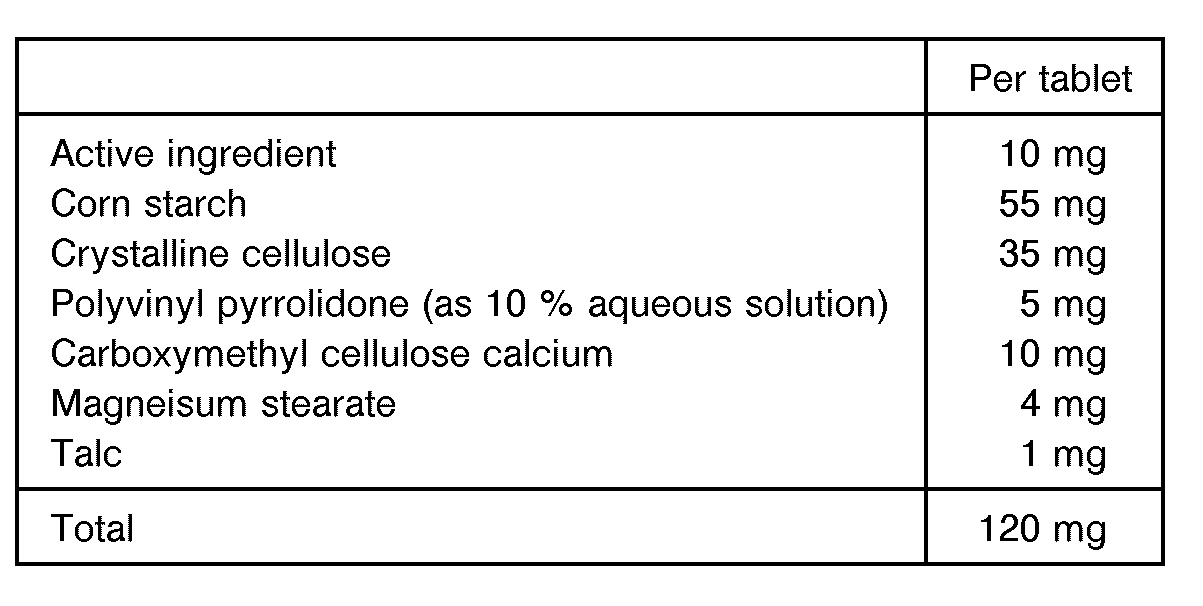
- The active ingredient, corn starch and crystalline cellulose are passed through an 80-mesh sieve, and thoroughly mixed. The resulting powder is mixed with the polyvinyl pyrrolidone solution, and the mixture is granulated and passed through an 18-mesh sieve. The resulting granules are dried at 50 to 60 °C, and again passed through an 18-mesh sieve to adjust their size. The carboxymethyl cellulose calcium, magnesium stearate and talc, previously passed through an 80-mesh sieve, are added to the granules, and they are mixed. The mixture is tableted by a tableting machine to produce tablets each having a weight of 120 mg.
- Tablets containing 100 mg of an active ingredient are produced by the following procedure.

- The above ingredients are passed through an 80-mesh sieve and thoroughly mixed. The resulting powder is compression-molded to produce tablets each having a weight of 200 mg.
- Capsules containing 50 mg of an active ingredient are produced by the following procedure.

- The above ingredients are mixed, passed through an 80-mesh sieve, and thoroughly mixed. The resulting powder is filled into capsules in an amount of 100 mg for each.
- Injectable preparations containing 5 mg of an active ingredient in a vial for dissolution before use are produced by the following procedure.

- Just before use, these ingredients are dissolved in 1 ml of injectable distilled water, and the resulting preparations are used.
- Injectable preparations containing 20 mg of an active ingredient in an ampoule are produced by the following procedure.

- An adhesive patch preparation containing 17.5 mg of on active ingredient is produced by the following procedure.
- Ten parts of poly(ammonium acrylate) is dissolved in 60 parts of water. Separately, 2 parts of glycerin diglycidyl ether is dissolved in 10 parts of water while heating. Furthermore, 10 parts of polyethylene glycol (grade 400), 10 parts of water and 1 part of the active ingredient are dissolved with stirring. Then, while the aqueous solution of poly(ammonium acrylate) is stirred, the aqueous solution of glycerin diglycidyl ether and the aqueous soluiton containing polyethylene glycol and the active ingredient are mixed to form a hydrogel-like solution containing the drug. The solution is coated on a pliable plastic film so that the rate of the active ingredient is 0.5 mg per cm2. The coated surface is covered with releasing paper and cut to a size of 35 cm2 to form the adhesive patch preparation.
- An adhesive patch containing 10 mg of an active ingredient is produced by the following procedure.
- An aqueous sol is prepared from 100 parts of poly(sodium acrylate), 100 parts of glycerol, 150 parts of water, 0.2 part of triepoxypropyl isocyanurate, 100 parts of ethanol, 25 parts of isopropyl myristate, 25 parts of propylone glycol and 15 parts of the active ingredient. The sol is then coated to a thickness of 100 micrometers on the non-woven fabric surface of a composite film composed of a rayon non-woven fabric and a polyethylene film to form an adhesive layer containing the drug. The amount of the release aids (isopropyl myristate and propylene glycol) contained in this layer is about 20 % by weight. The adhesive layer is then crosslinked at 25 ° C for 24 hours, and a releasing film is bonded to the adhesive layer surface. The entire film is then cut into pieces each having an area of 35 cm2.
- The pharmacological effects of the compounds of this invention represented by general formula (1) were studied. By using the heart of an adult mongrel dog, the activity of the compounds of general formula (1) were tested in vitro and in vivo. The heart of an anaethetized dog was extracted and suspended in a chamber at 37 ° C in Tyrode's solution. The drug was added to Tyrode's solution being perfused through the heart specimen, and electrophysiological effects of the drug on cardiac action potential duration (APD) and maximum rate of depolarization were studied. An anaethetized dog was cut open at the chest. The sinus node was crushed to extinguish the pacemaker activity and under ventricular pacing via an electrode sutured on the right ventricle, the effective refractory period (ERP) of the right ventricle was measured before and after administration of the drug.
- Furthermore, the anaethetized dog was cut open at the chest. Bipolar electrodes were sutured to the right atrial surface, and stimulation electrodes were attached to the vagus nerves at both sides of the cervical region. Atrial fibrillation was induced by the method of Goldberger et al. [A. L. Goldberger et al.: International Journal of Cardiology, 13, 47 (1986)], and the effect of the drug to cause disappearance of fibrillation was examined. Further, the anaethetized dog was cut open at the chest. Left anterior descending coronary artery was ligated, and ninety minutes later, reperfused to prepare a myocardial infarction which was liable to develop tachycardia. At that time, a bipolar plunge electrode was placed in the interventricular septum near the ligated site. Several days after the operation, programmed electrical stimulation was applied to induce tachycardia. The effect of the drug to cause disapperance of tachycardia was examined.
- These tests showed that the compounds of general formula (1) are valuable as class III-type anti-arrhythmic agents having marked APD and ERP prolonging activity, and exhibit anti-arrhythmic activity in arrhythmic models. It was confirmed that some of the compounds of general formula (1) also have the activity of inhibiting the maximum rate of depolarization (Vmax) of the myocardial action potential which the class I-type anti-arrhythmic agents have, but the others have the characteristics of pure class III anti-arrhythmic agents having no Vmax inhibiting activity. It was also found that the compounds of general formula (1) have equivalent or greater APD and ERP prolonging activity to or than clofilium and sotalol used as controls.
- A toxicity test on the compounds of general formula (1) showed that these compounds have relatively weak toxicity and can be used as a medicine having a broad safety range.
- An adult mongrel dog was anaethetized with intravenous administration of pentobarbital, 30 mg/kg. The heart was quickly removed, and the right ventricular free wall was dissected in the Tyrode's solution. The right ventricular free wall was fixed within an incubator at 37 ° C, and field stimulation at 1 Hz was carried out. Intracellular potentials were measured by piercing glass microelectrodes (10-20 magaohms) into the Purkinje fiber and the wave form of cardiac action potential drawn on an oscilloBraun tube via an amplifier was analyzed by a computer. Value of APD was obtained at 75 % of full repolarization (APD 75). The drug was added to Tyrode's solution (20 ml) perfused through the specimen. The effect of the drug was expressed by a percent change in APD75 after incubation for 20 minutes with the control value of APD before application of the drug being taken as 100 %. The results are shown in Tables 4D, 9D and 10D.


- In an anaethetized and open-chested adult mongrel dug, a silver-silver chloride electrode was sutured to the right ventricle, and ventricular pacing was performed at a stimulation interval of 400 msec for a duration time of 4 msec, twice diastolic threshold. Then, a small amount of alcohol was injected through the sinus artery to extinguish the pace maker activity, and under ventricular pacing, ERP was measured. Ten stimulations were taken as one train, and the interval between trains when the response to the first stimulation disappeared was defined as ERP. Programmable cardiac stimulator (DHM-226-3 made by Daiya Medical Co., Ltd.) was used to determine ERP. ERP before drug administration (intravenously or intraduodenally) was taken as 100 %, and ERP prolonging activity of the drugs was expressed by %. The results are shown in Tables 5D, 11 D and 12D.

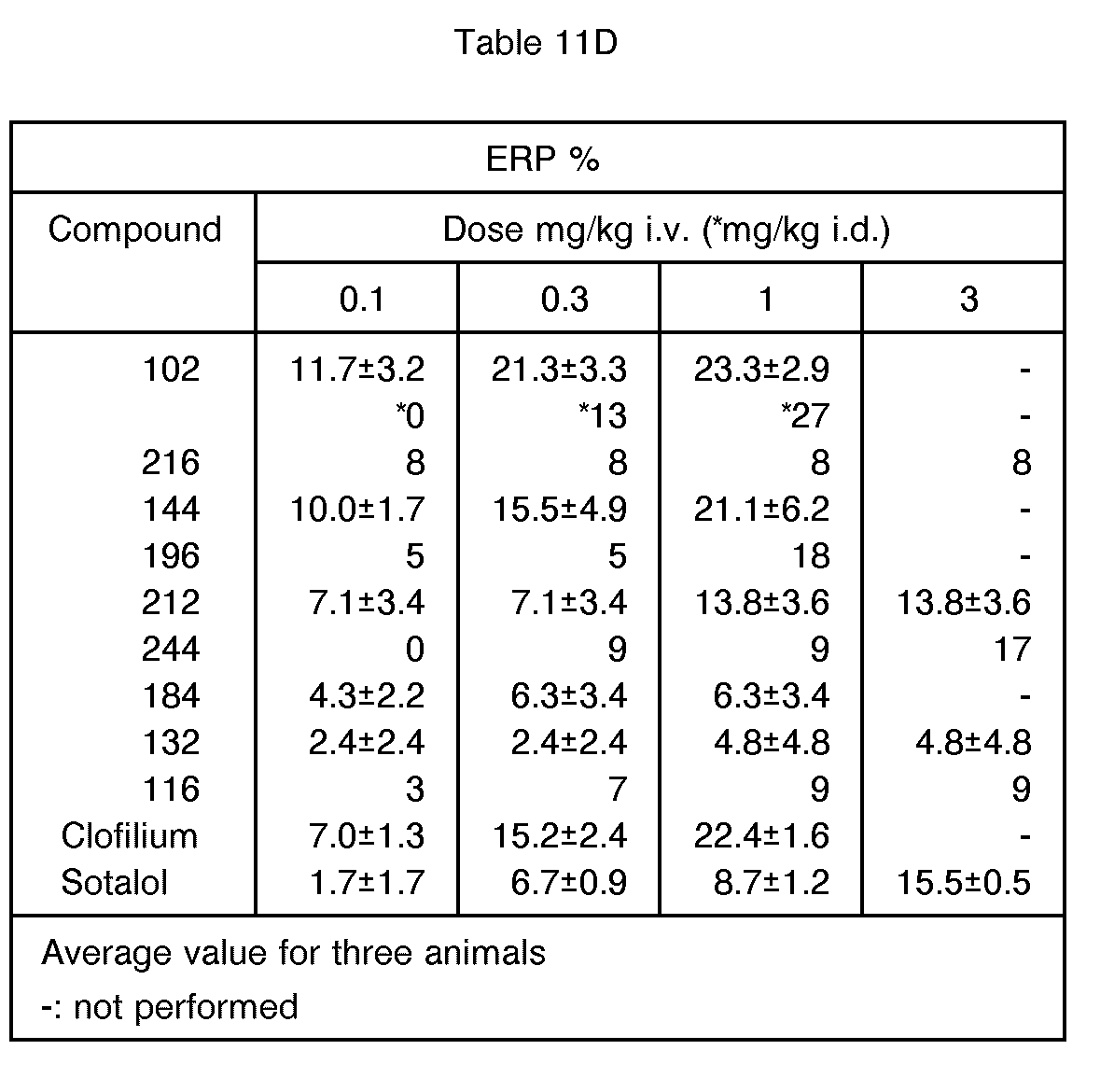

- In an anaethetized and open-chested mongrel dog, bipolar electrodes (silver and silver-silver chloride electrodes) were sutured respectively to the right atrium for stimulation and recording. The vagus nerves on both sides of the cervical region were isolated and cut, and stimulation electrodes were attached to the peripheral end. The atrial fibrillation was induced in accordance with the method of Goldberger et al. After cardiac arrest induced by stimulating the vagus nerves, electrical stimulation was applied to the right atria at a high frequency. Compounds Nos. 102, 144, 1126, 1118, and 1146 can cause disappearance of fibrillation occurring continuously when they are administered in a dose of 0.3 to 3 mg/kg or 1 to 10 mg/kg.
- By using male ddY-strain 5-week old mice (3 to 4 per group), the compounds of general formula (1) were each administered orally or intraperitoneally as a solution in saline or as a suspension in methyl cellulose, and 24 hours after the administration, the toxicity of the compounds was evaluated. The results are shown in Tables 6D and 13D.


- Examples 1D and 2D and Tables 4D, 5D and 9D-12D show that the compounds of general formula (1) of this invention have equivalent or greater electrophysiological activities and anti-arrhythmic activity to or than clofilium, etc. used as a control. The toxicitiy of the compounds of general formula (1) in accordance with this invention is generally weak, as shown in Test Example 3 and Table 13. The compounds of general formula (1) are thus considered to be drugs which generally have high activity, weak toxicity and high safety.
- Accordingly, the compounds of general formula (1) in accordance with this invention are useful as therapeutic and prophylactic agents for arrhythmia, ischemic heart diseases, myocardial infarction, angina pectoris and heart failure. The compounds of this invention represented by general formula (1) can be used especially favorably for that type of arrhythmia which is difficult to cure with conventional anti-arrhythmic agents belonging to classes I to IV. They are applicable to, and expected to be effective for, patients who are suffering, or likely to suffer, from ventricular tachycardia entailing sudden death or ventricular arrhythmia involving ventricular fibrillation.
Claims (10)


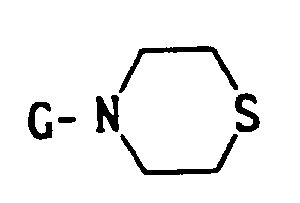

Applications Claiming Priority (5)
| Application Number | Priority Date | Filing Date | Title |
|---|---|---|---|
| JP31211387 | 1987-12-11 | ||
| JP312113/87 | 1987-12-11 | ||
| JP314234/87 | 1987-12-14 | ||
| JP31423487 | 1987-12-14 | ||
| PCT/JP1988/001240 WO1989005289A1 (en) | 1987-12-11 | 1988-12-09 | Novel amines and their use |
Publications (3)
| Publication Number | Publication Date |
|---|---|
| EP0424525A4 EP0424525A4 (en) | 1990-09-05 |
| EP0424525A1 EP0424525A1 (en) | 1991-05-02 |
| EP0424525B1 true EP0424525B1 (en) | 1994-12-21 |
Family
ID=26567036
Family Applications (1)
| Application Number | Title | Priority Date | Filing Date |
|---|---|---|---|
| EP89900305A Expired - Lifetime EP0424525B1 (en) | 1987-12-11 | 1988-12-09 | Novel amines and their use |
Country Status (9)
| Country | Link |
|---|---|
| US (1) | US5192799A (en) |
| EP (1) | EP0424525B1 (en) |
| JP (1) | JP2779240B2 (en) |
| KR (1) | KR920000799B1 (en) |
| CN (1) | CN1034331C (en) |
| AT (1) | ATE115953T1 (en) |
| DE (1) | DE3852551T2 (en) |
| HU (1) | HUT58275A (en) |
| WO (1) | WO1989005289A1 (en) |
Families Citing this family (24)
| Publication number | Priority date | Publication date | Assignee | Title |
|---|---|---|---|---|
| GB9207855D0 (en) * | 1992-04-09 | 1992-05-27 | Ici Plc | Therapeutic amines |
| DE4410822A1 (en) * | 1994-03-24 | 1995-09-28 | Schering Ag | New piperidine derivatives |
| ZA9610736B (en) | 1995-12-22 | 1997-06-27 | Warner Lambert Co | 2-Substituted piperidine analogs and their use as subtypeselective nmda receptor antagonists |
| ZA9610741B (en) | 1995-12-22 | 1997-06-24 | Warner Lambert Co | 4-Substituted piperidine analogs and their use as subtype selective nmda receptor antagonists |
| ZA9610745B (en) * | 1995-12-22 | 1997-06-24 | Warner Lambert Co | 4-Subsituted piperidine analogs and their use as subtype selective nmda receptor antagonists |
| ZA9610738B (en) | 1995-12-22 | 1997-06-24 | Warner Lambert Co | Subtype selective nmda receptor ligands and the use thereof |
| SK18097A3 (en) * | 1996-02-28 | 1997-10-08 | American Cyanamid Co | Substituted omega £phenoxy, phenylthio, phenylsulfinyl, phenylsulfonyl| £alkyl, alkenyl or alkinyl|amino carboxamides, sulfonamides and phosphonyl amides, pharmaceutical preparation containing them, process for producing them and their use |
| FR2788773B1 (en) * | 1999-01-21 | 2001-03-09 | Oreal | NOVEL CATIONIC METHYLENEDIOXY-BENZENES, THEIR USE FOR OXIDATION DYEING OF KERATINIC FIBERS, TINCTORIAL COMPOSITIONS AND DYEING METHODS |
| DE10030646A1 (en) * | 2000-06-29 | 2002-01-10 | Henkel Kgaa | Indigo derivatives |
| AU2002322720B2 (en) | 2001-07-25 | 2008-11-13 | Raptor Pharmaceutical Inc. | Compositions and methods for modulating blood-brain barrier transport |
| CN102379684B (en) | 2005-04-28 | 2014-11-19 | 普罗透斯数字保健公司 | Pharma-informatics system |
| JP2009517432A (en) * | 2005-11-30 | 2009-04-30 | エフ.ホフマン−ラ ロシュ アーゲー | 3-Amino-2-arylpropyl azaindole and uses thereof |
| KR20090071598A (en) | 2006-09-18 | 2009-07-01 | 랩터 파마슈티컬 인코포레이티드 | Treatment of liver disease by administration of receptor binding protein (RAP) -conjugates |
| CN101353338B (en) * | 2008-07-10 | 2011-05-04 | 上海交通大学 | Osamine modified water-soluble coumarin ketone derivates and preparation thereof |
| EP2398500B1 (en) | 2009-02-20 | 2019-03-13 | 2-BBB Medicines B.V. | Glutathione-based drug delivery system |
| ES2942923T3 (en) | 2009-05-06 | 2023-06-07 | Laboratory Skin Care Inc | Dermal delivery compositions comprising complexes of active agent-calcium phosphate particles and methods of use thereof |
| US20120077778A1 (en) | 2010-09-29 | 2012-03-29 | Andrea Bourdelais | Ladder-Frame Polyether Conjugates |
| JP2012184225A (en) * | 2011-02-18 | 2012-09-27 | Otsuka Pharmaceut Co Ltd | Pharmaceutical composition |
| CA2872883A1 (en) * | 2012-05-09 | 2013-11-14 | Sunovion Pharmaceuticals Inc. | Heteroaryl compounds and methods of use thereof |
| EP2958906A1 (en) * | 2013-02-21 | 2015-12-30 | Nobel Ilaç Sanayii Ve Ticaret A.S. | 3-substituted-6h-benzo[c]chromen-6-ones and 3-substituted-7,8,9,10-tetrahydro-6h-benzo[c]chromen-6-ones against senile dementia |
| EP3831820A1 (en) * | 2019-12-05 | 2021-06-09 | ETH Zurich | Compounds and methods for amine oxidase imaging |
| CN113816944B (en) * | 2020-06-20 | 2023-06-27 | 中山大学 | Anti-filovirus compounds and uses thereof |
| US12310974B1 (en) | 2023-12-19 | 2025-05-27 | Samuel Aballea | Method of treating post-traumatic stress disorder with carpipramine |
| CN119462586B (en) * | 2024-11-08 | 2025-05-06 | 安徽中医药大学 | A coumarin derivative and its application |
Citations (4)
| Publication number | Priority date | Publication date | Assignee | Title |
|---|---|---|---|---|
| GB1357633A (en) * | 1971-03-02 | 1974-06-26 | Beecham Group Ltd | Chromanone basic ether derivatives |
| GB2089338A (en) * | 1980-12-16 | 1982-06-23 | Chinoin Gyogyszer Es Vegyeszet | 7-Substituted benzopyranes |
| EP0175541A1 (en) * | 1984-09-19 | 1986-03-26 | Warner-Lambert Company | Aminoalkoxybenzopyranones and processes for the production thereof |
| EP0237781A2 (en) * | 1986-02-13 | 1987-09-23 | Warner-Lambert Company | Phenyl and heterocyclic tetrahydropyridyl and piperazinyl alkoxy-benzheterocyclic compounds as antipsychotic agents |
Family Cites Families (9)
| Publication number | Priority date | Publication date | Assignee | Title |
|---|---|---|---|---|
| US3853923A (en) * | 1971-05-13 | 1974-12-10 | Kakenyaku Kako Kk | 2-substituted-(2-hydroxy-3-lower alkaminopropoxy)-benzofurans |
| IL48309A (en) * | 1974-10-25 | 1980-01-31 | Robins Co Inc A H | 1-aryloxy-4-amino-2-butanols and pharmaceutical compositions containing them |
| DE2503222A1 (en) * | 1975-01-27 | 1976-07-29 | Boehringer Sohn Ingelheim | PROCESS FOR THE PREPARATION OF 1-ARYL-OXY-3-N-SUBSTITUTED AMINOPROPAN DERIVATIVES |
| FR2431491A1 (en) * | 1978-07-18 | 1980-02-15 | Delalande Sa | 5-Amino-alkoxy-acetyl or styryl-carbonyl benzofuran and indole derivs. - have cardiovascular esp. antiarrhythmic and diuretic activity |
| DE3103069A1 (en) * | 1981-01-30 | 1982-08-26 | Basf Ag, 6700 Ludwigshafen | DIBENZOFURANE DERIVATIVES, METHOD FOR THE PRODUCTION THEREOF AND THEIR USE AS FUNGICIDES |
| JPS60209551A (en) * | 1984-04-04 | 1985-10-22 | Hokuriku Seiyaku Co Ltd | 1,1-dialkyl-6-(3-amino-2-hydroxypropoxy)indane and indene derivative |
| JPS62502463A (en) * | 1984-04-27 | 1987-09-24 | ロウラ− インタ−ナシヨナル(オ−バ−シ−ズ) インコ−ポレ−テツド | Benzocyclobutene aminoalkylene ethers and thioethers and their pharmaceutical uses |
| JPS60258174A (en) * | 1984-06-06 | 1985-12-20 | Nippon Soda Co Ltd | Dihydrobenzofuranyloxypropanol derivative and preparation thereof |
| JPH06143184A (en) * | 1992-11-05 | 1994-05-24 | Matsushita Electric Ind Co Ltd | Robot hand |
-
1988
- 1988-12-09 JP JP1500419A patent/JP2779240B2/en not_active Expired - Lifetime
- 1988-12-09 HU HU89387A patent/HUT58275A/en unknown
- 1988-12-09 EP EP89900305A patent/EP0424525B1/en not_active Expired - Lifetime
- 1988-12-09 AT AT89900305T patent/ATE115953T1/en not_active IP Right Cessation
- 1988-12-09 KR KR1019890701498A patent/KR920000799B1/en not_active Expired
- 1988-12-09 DE DE3852551T patent/DE3852551T2/en not_active Expired - Fee Related
- 1988-12-09 WO PCT/JP1988/001240 patent/WO1989005289A1/en not_active Ceased
-
1989
- 1989-07-10 CN CN89106715A patent/CN1034331C/en not_active Expired - Fee Related
-
1992
- 1992-06-05 US US07/895,417 patent/US5192799A/en not_active Expired - Fee Related
Patent Citations (4)
| Publication number | Priority date | Publication date | Assignee | Title |
|---|---|---|---|---|
| GB1357633A (en) * | 1971-03-02 | 1974-06-26 | Beecham Group Ltd | Chromanone basic ether derivatives |
| GB2089338A (en) * | 1980-12-16 | 1982-06-23 | Chinoin Gyogyszer Es Vegyeszet | 7-Substituted benzopyranes |
| EP0175541A1 (en) * | 1984-09-19 | 1986-03-26 | Warner-Lambert Company | Aminoalkoxybenzopyranones and processes for the production thereof |
| EP0237781A2 (en) * | 1986-02-13 | 1987-09-23 | Warner-Lambert Company | Phenyl and heterocyclic tetrahydropyridyl and piperazinyl alkoxy-benzheterocyclic compounds as antipsychotic agents |
Non-Patent Citations (2)
| Title |
|---|
| Chem. Pharm. Bull., vol. 35(1987), pages 632-641; * |
| J. Med. Chem., vol. 15(1972), pages 260-266; * |
Also Published As
| Publication number | Publication date |
|---|---|
| DE3852551D1 (en) | 1995-02-02 |
| EP0424525A4 (en) | 1990-09-05 |
| JP2779240B2 (en) | 1998-07-23 |
| WO1989005289A1 (en) | 1989-06-15 |
| CN1034331C (en) | 1997-03-26 |
| KR900700435A (en) | 1990-08-13 |
| HU890387D0 (en) | 1990-12-28 |
| EP0424525A1 (en) | 1991-05-02 |
| CN1043319A (en) | 1990-06-27 |
| DE3852551T2 (en) | 1995-05-18 |
| HUT58275A (en) | 1992-02-28 |
| ATE115953T1 (en) | 1995-01-15 |
| US5192799A (en) | 1993-03-09 |
| KR920000799B1 (en) | 1992-01-23 |
Similar Documents
| Publication | Publication Date | Title |
|---|---|---|
| DE3852551T2 (en) | AMINES AND THEIR USE. | |
| US4001238A (en) | 1,3,4-oxadiazole amides | |
| JPWO1989005289A1 (en) | New amines and their uses | |
| JP2651043B2 (en) | Diphenylmethylpiperazine derivative | |
| JPWO1999020620A1 (en) | Isoquinoline derivatives and medicines | |
| RU2130019C1 (en) | Derivatives of 3(2)-pyridazinone, a pharmaceutical composition, a method of treatment | |
| Hester et al. | N-[(. omega.-Amino-1-hydroxyalkyl) phenyl] methanesulfonamide derivatives with class III antiarrhythmic activity | |
| DD201305A5 (en) | PROCESS FOR THE PREPARATION OF SUBSTITUTED BENZOPYRANES IN 7-POSITION | |
| HUT54346A (en) | Process for producing new, antiarrhythmic, sulfur-containing cyanophenol derivatives and medical compositions comprising same | |
| KR880001828B1 (en) | 2-hydroxyethylamine derivative and preparation method thereof | |
| RU2122546C1 (en) | N-[[1-[4-(fluorophenoxy)butyl]-4-piperidinyl]-n-methylamino]-2-benzthiazoles or their pharmaceutically acceptable acid salts, a method of synthesis, an antiarrhythmic composition of the third-class and a method of its preparing | |
| US3959272A (en) | Aminoalkyl esters of 2-anilino-nicotinic acids | |
| KR900001186B1 (en) | Method for preparing 5-substituted-6-aminopyrimidine derivative | |
| SU1087519A1 (en) | Salts of derivatives of 1,2,4-oxadiazolin-5-one having properties of cardiovascular stimulators | |
| JPH08502057A (en) | Heterocyclic amines with calmodulin-antagonistic properties | |
| KR870001681B1 (en) | Method for preparing hydantoin derivative | |
| JP2507764B2 (en) | Lower alkylsulfamoylamines, salts thereof and uses thereof | |
| JPS63255258A (en) | N-phenetylaminoalkyl-benzamide antiarrythmic agent | |
| FI89799B (en) | FREQUENCY REQUIREMENT FOR THERAPEUTIC ACTIVATION ACTIVATED 2,5-DIAZABIC CYCLES / 2.2.1 / HEPTANDERIVAT | |
| DE69022442T2 (en) | Aminoalkoxyphenyl derivatives, processes for their preparation and compositions containing them. | |
| KR20010043618A (en) | Benzofuran derivatives, pharmaceutical composition containing the same, and a process for the preparation of the active ingredient | |
| JPH07502273A (en) | Benzopyran class 3 antiarrhythmic drug | |
| US4994459A (en) | Aryloxypropane substituted piperazine derivatives with antiarrhythmic and antifibrillatory activity | |
| EP0000693A1 (en) | Aminophenoxymethyl-2-morpholine derivatives, the preparation thereof and pharmaceuticals containing them | |
| US4406907A (en) | Certain 2,5-disubstituted pyridine derivatives producing β-adrenergic blocking action |
Legal Events
| Date | Code | Title | Description |
|---|---|---|---|
| PUAI | Public reference made under article 153(3) epc to a published international application that has entered the european phase |
Free format text: ORIGINAL CODE: 0009012 |
|
| 17P | Request for examination filed |
Effective date: 19890803 |
|
| AK | Designated contracting states |
Kind code of ref document: A1 Designated state(s): AT BE CH DE FR GB IT LI LU NL SE |
|
| 17Q | First examination report despatched |
Effective date: 19920214 |
|
| GRAA | (expected) grant |
Free format text: ORIGINAL CODE: 0009210 |
|
| AK | Designated contracting states |
Kind code of ref document: B1 Designated state(s): AT BE CH DE FR GB IT LI LU NL SE |
|
| PG25 | Lapsed in a contracting state [announced via postgrant information from national office to epo] |
Ref country code: IT Free format text: LAPSE BECAUSE OF FAILURE TO SUBMIT A TRANSLATION OF THE DESCRIPTION OR TO PAY THE FEE WITHIN THE PRE;WARNING: LAPSES OF ITALIAN PATENTS WITH EFFECTIVE DATE BEFORE 2007 MAY HAVE OCCURRED AT ANY TIME BEFORE 2007. THE CORRECT EFFECTIVE DATE MAY BE DIFFERENT FROM THE ONE RECORDED.SCRIBED TIME-LIMIT Effective date: 19941221 Ref country code: AT Effective date: 19941221 Ref country code: BE Effective date: 19941221 Ref country code: NL Effective date: 19941221 Ref country code: CH Effective date: 19941221 Ref country code: LI Effective date: 19941221 |
|
| REF | Corresponds to: |
Ref document number: 115953 Country of ref document: AT Date of ref document: 19950115 Kind code of ref document: T |
|
| ET | Fr: translation filed | ||
| REF | Corresponds to: |
Ref document number: 3852551 Country of ref document: DE Date of ref document: 19950202 |
|
| PG25 | Lapsed in a contracting state [announced via postgrant information from national office to epo] |
Ref country code: SE Effective date: 19950321 |
|
| REG | Reference to a national code |
Ref country code: CH Ref legal event code: PL |
|
| NLV1 | Nl: lapsed or annulled due to failure to fulfill the requirements of art. 29p and 29m of the patents act | ||
| PLBE | No opposition filed within time limit |
Free format text: ORIGINAL CODE: 0009261 |
|
| STAA | Information on the status of an ep patent application or granted ep patent |
Free format text: STATUS: NO OPPOSITION FILED WITHIN TIME LIMIT |
|
| 26N | No opposition filed | ||
| PG25 | Lapsed in a contracting state [announced via postgrant information from national office to epo] |
Ref country code: LU Free format text: LAPSE BECAUSE OF NON-PAYMENT OF DUE FEES Effective date: 19951231 |
|
| PGFP | Annual fee paid to national office [announced via postgrant information from national office to epo] |
Ref country code: GB Payment date: 19971201 Year of fee payment: 10 |
|
| PGFP | Annual fee paid to national office [announced via postgrant information from national office to epo] |
Ref country code: FR Payment date: 19971209 Year of fee payment: 10 |
|
| PGFP | Annual fee paid to national office [announced via postgrant information from national office to epo] |
Ref country code: DE Payment date: 19971212 Year of fee payment: 10 |
|
| PG25 | Lapsed in a contracting state [announced via postgrant information from national office to epo] |
Ref country code: GB Free format text: LAPSE BECAUSE OF NON-PAYMENT OF DUE FEES Effective date: 19981209 |
|
| GBPC | Gb: european patent ceased through non-payment of renewal fee |
Effective date: 19981209 |
|
| PG25 | Lapsed in a contracting state [announced via postgrant information from national office to epo] |
Ref country code: FR Free format text: LAPSE BECAUSE OF NON-PAYMENT OF DUE FEES Effective date: 19990831 |
|
| REG | Reference to a national code |
Ref country code: FR Ref legal event code: ST |
|
| PG25 | Lapsed in a contracting state [announced via postgrant information from national office to epo] |
Ref country code: DE Free format text: LAPSE BECAUSE OF NON-PAYMENT OF DUE FEES Effective date: 19991001 |