EP0422178B1 - Pyrimidine derivatives - Google Patents
Pyrimidine derivatives Download PDFInfo
- Publication number
- EP0422178B1 EP0422178B1 EP90906289A EP90906289A EP0422178B1 EP 0422178 B1 EP0422178 B1 EP 0422178B1 EP 90906289 A EP90906289 A EP 90906289A EP 90906289 A EP90906289 A EP 90906289A EP 0422178 B1 EP0422178 B1 EP 0422178B1
- Authority
- EP
- European Patent Office
- Prior art keywords
- alkyl
- methyl
- phenyl
- formula
- ethyl
- Prior art date
- Legal status (The legal status is an assumption and is not a legal conclusion. Google has not performed a legal analysis and makes no representation as to the accuracy of the status listed.)
- Expired - Lifetime
Links
- 0 C*C(C)NC(C)C(*)C(*(C)C)N*(C)C Chemical compound C*C(C)NC(C)C(*)C(*(C)C)N*(C)C 0.000 description 5
- XDTMQSROBMDMFD-UHFFFAOYSA-N C1CCCCC1 Chemical compound C1CCCCC1 XDTMQSROBMDMFD-UHFFFAOYSA-N 0.000 description 1
- RRHKNJGXOBJBGJ-UHFFFAOYSA-N CC1[N]2(C)C1C2 Chemical compound CC1[N]2(C)C1C2 RRHKNJGXOBJBGJ-UHFFFAOYSA-N 0.000 description 1
- QLHUVADGWGXJEI-UHFFFAOYSA-N CCC(CC)NC(C)C(C1)C1C(C)C Chemical compound CCC(CC)NC(C)C(C1)C1C(C)C QLHUVADGWGXJEI-UHFFFAOYSA-N 0.000 description 1
Classifications
-
- C—CHEMISTRY; METALLURGY
- C07—ORGANIC CHEMISTRY
- C07D—HETEROCYCLIC COMPOUNDS
- C07D239/00—Heterocyclic compounds containing 1,3-diazine or hydrogenated 1,3-diazine rings
- C07D239/02—Heterocyclic compounds containing 1,3-diazine or hydrogenated 1,3-diazine rings not condensed with other rings
- C07D239/24—Heterocyclic compounds containing 1,3-diazine or hydrogenated 1,3-diazine rings not condensed with other rings having three or more double bonds between ring members or between ring members and non-ring members
- C07D239/28—Heterocyclic compounds containing 1,3-diazine or hydrogenated 1,3-diazine rings not condensed with other rings having three or more double bonds between ring members or between ring members and non-ring members with hetero atoms or with carbon atoms having three bonds to hetero atoms with at the most one bond to halogen, directly attached to ring carbon atoms
- C07D239/46—Two or more oxygen, sulphur or nitrogen atoms
- C07D239/48—Two nitrogen atoms
-
- A—HUMAN NECESSITIES
- A61—MEDICAL OR VETERINARY SCIENCE; HYGIENE
- A61K—PREPARATIONS FOR MEDICAL, DENTAL OR TOILETRY PURPOSES
- A61K31/00—Medicinal preparations containing organic active ingredients
- A61K31/33—Heterocyclic compounds
- A61K31/395—Heterocyclic compounds having nitrogen as a ring hetero atom, e.g. guanethidine or rifamycins
- A61K31/495—Heterocyclic compounds having nitrogen as a ring hetero atom, e.g. guanethidine or rifamycins having six-membered rings with two or more nitrogen atoms as the only ring heteroatoms, e.g. piperazine or tetrazines
- A61K31/505—Pyrimidines; Hydrogenated pyrimidines, e.g. trimethoprim
-
- A—HUMAN NECESSITIES
- A61—MEDICAL OR VETERINARY SCIENCE; HYGIENE
- A61P—SPECIFIC THERAPEUTIC ACTIVITY OF CHEMICAL COMPOUNDS OR MEDICINAL PREPARATIONS
- A61P9/00—Drugs for disorders of the cardiovascular system
-
- A—HUMAN NECESSITIES
- A61—MEDICAL OR VETERINARY SCIENCE; HYGIENE
- A61P—SPECIFIC THERAPEUTIC ACTIVITY OF CHEMICAL COMPOUNDS OR MEDICINAL PREPARATIONS
- A61P9/00—Drugs for disorders of the cardiovascular system
- A61P9/06—Antiarrhythmics
-
- A—HUMAN NECESSITIES
- A61—MEDICAL OR VETERINARY SCIENCE; HYGIENE
- A61P—SPECIFIC THERAPEUTIC ACTIVITY OF CHEMICAL COMPOUNDS OR MEDICINAL PREPARATIONS
- A61P9/00—Drugs for disorders of the cardiovascular system
- A61P9/08—Vasodilators for multiple indications
-
- A—HUMAN NECESSITIES
- A61—MEDICAL OR VETERINARY SCIENCE; HYGIENE
- A61P—SPECIFIC THERAPEUTIC ACTIVITY OF CHEMICAL COMPOUNDS OR MEDICINAL PREPARATIONS
- A61P9/00—Drugs for disorders of the cardiovascular system
- A61P9/10—Drugs for disorders of the cardiovascular system for treating ischaemic or atherosclerotic diseases, e.g. antianginal drugs, coronary vasodilators, drugs for myocardial infarction, retinopathy, cerebrovascula insufficiency, renal arteriosclerosis
-
- C—CHEMISTRY; METALLURGY
- C07—ORGANIC CHEMISTRY
- C07D—HETEROCYCLIC COMPOUNDS
- C07D239/00—Heterocyclic compounds containing 1,3-diazine or hydrogenated 1,3-diazine rings
- C07D239/70—Heterocyclic compounds containing 1,3-diazine or hydrogenated 1,3-diazine rings condensed with carbocyclic rings or ring systems
- C07D239/72—Quinazolines; Hydrogenated quinazolines
- C07D239/95—Quinazolines; Hydrogenated quinazolines with hetero atoms directly attached in positions 2 and 4
-
- C—CHEMISTRY; METALLURGY
- C07—ORGANIC CHEMISTRY
- C07D—HETEROCYCLIC COMPOUNDS
- C07D401/00—Heterocyclic compounds containing two or more hetero rings, having nitrogen atoms as the only ring hetero atoms, at least one ring being a six-membered ring with only one nitrogen atom
- C07D401/02—Heterocyclic compounds containing two or more hetero rings, having nitrogen atoms as the only ring hetero atoms, at least one ring being a six-membered ring with only one nitrogen atom containing two hetero rings
- C07D401/04—Heterocyclic compounds containing two or more hetero rings, having nitrogen atoms as the only ring hetero atoms, at least one ring being a six-membered ring with only one nitrogen atom containing two hetero rings directly linked by a ring-member-to-ring-member bond
-
- C—CHEMISTRY; METALLURGY
- C07—ORGANIC CHEMISTRY
- C07D—HETEROCYCLIC COMPOUNDS
- C07D401/00—Heterocyclic compounds containing two or more hetero rings, having nitrogen atoms as the only ring hetero atoms, at least one ring being a six-membered ring with only one nitrogen atom
- C07D401/02—Heterocyclic compounds containing two or more hetero rings, having nitrogen atoms as the only ring hetero atoms, at least one ring being a six-membered ring with only one nitrogen atom containing two hetero rings
- C07D401/12—Heterocyclic compounds containing two or more hetero rings, having nitrogen atoms as the only ring hetero atoms, at least one ring being a six-membered ring with only one nitrogen atom containing two hetero rings linked by a chain containing hetero atoms as chain links
-
- C—CHEMISTRY; METALLURGY
- C07—ORGANIC CHEMISTRY
- C07D—HETEROCYCLIC COMPOUNDS
- C07D403/00—Heterocyclic compounds containing two or more hetero rings, having nitrogen atoms as the only ring hetero atoms, not provided for by group C07D401/00
- C07D403/02—Heterocyclic compounds containing two or more hetero rings, having nitrogen atoms as the only ring hetero atoms, not provided for by group C07D401/00 containing two hetero rings
- C07D403/04—Heterocyclic compounds containing two or more hetero rings, having nitrogen atoms as the only ring hetero atoms, not provided for by group C07D401/00 containing two hetero rings directly linked by a ring-member-to-ring-member bond
-
- C—CHEMISTRY; METALLURGY
- C07—ORGANIC CHEMISTRY
- C07D—HETEROCYCLIC COMPOUNDS
- C07D471/00—Heterocyclic compounds containing nitrogen atoms as the only ring hetero atoms in the condensed system, at least one ring being a six-membered ring with one nitrogen atom, not provided for by groups C07D451/00 - C07D463/00
- C07D471/02—Heterocyclic compounds containing nitrogen atoms as the only ring hetero atoms in the condensed system, at least one ring being a six-membered ring with one nitrogen atom, not provided for by groups C07D451/00 - C07D463/00 in which the condensed system contains two hetero rings
- C07D471/04—Ortho-condensed systems
Definitions
- This invention concerns novel heterocyclic compounds and, more particularly, novel aminopyrimidine derivatives which possess beneficial effects on the cardiovascular system (and in particular beneficial effects modulated via the sino-atrial node), pharmaceutical compositions containing such a derivative as active ingredient, and processes for the manufacture of and medical use of the said derivatives.
- Pyrimidine derivatives have been extensively studied in the search for new pharmacologically active agents.
- a series of aminopyrimidine derivatives has been described as having cardiotonic properties (US Patent no. 4,725,600).
- Various 4-aminopyrimidinium salts have been described as antifungal and anti-bacterial agents (US Patent no. 4,339,453).
- the present invention is based on the unexpected and beneficial sino-atrial node modulatory effects of a novel series of aminopyrimidine derivatives of formula I defined below.
- R1 is (1-10C)alkyl, (3-6C)alkenyl, (4-7C)cycloalkyl, phenyl, phenyl(1-4C)alkyl or (3-6C)cycloalkyl-(1-4C)alkyl;
- one of R2 and R6 is a basic group selected from amino, (1-6C)alkylamino, dialkylamino of up to eight carbon atoms, pyrrolidino, piperidino and morpholino; and the other of R2 and R6 is hydrogen, (1-6C)alkyl, (3-6C)alkenyl, (1-4C)alkoxy(1-4C)alkyl, phenyl, phenyl(1-4C)alkyl, (3-6C)cycloalkyl or (3-6C)cycloalkyl-(1-4C)alkyl; or both of R2 and
- R4 is hydrogen, or when R2 or R6 is amino or alkylamino
- the amino derivatives of the invention may exist in another tautomeric form to that depicted in formula I, or in a mixture of one or more of the possible tautomeric forms.
- one of the substituents in the formula I compounds contains a chiral centre
- the compounds of the invention may exist in, and be isolated in, optically active or racemic form.
- the invention includes any tautomeric, optically active or racemic from of a compound of formula I which possesses the afore-mentioned beneficial pharmacological effects.
- the compounds of formula I are quaternary salts and in some cases, for example, when R2 or R6 is alkylamino and the other of R2 and R6 has any of the meanings defined above, may be converted, for example by treatment with an quaternary ammonium hydroxide (and especially one in macroreticular resin form) to the corresponding non-ionic anhydro-base forms of the formula Ia or Ib, respectively, (or to a tautomeric form thereof when R4 is hydrogen or when the other of the groups R2 and R6 is amino or alkylamino).
- Such non-ionic forms of the formula Ia or Ib in which alk stands for (1-6C)alkyl are provided as a further feature of the invention and may readily be reconverted to the quaternary salt form, for example, by treatment with the appropriate acid of the formula H.Y .
- R1 when it is alkyl is, for example, (1-7C)alkyl, such as methyl, ethyl, propyl, butyl, pentyl or heptyl, of which values methyl and ethyl are generally preferred.
- R2 or R6 when it is alkyl is, for example, methyl, ethyl, propyl, butyl or isobutyl.
- R1, R2, R4, R5 or R6 when it is alkenyl is, for example, allyl, but-2-enyl, but-3-enyl, 2-methyl-2-propenyl or pentenyl.
- R1 when it is cycloalkyl is, for example, cyclopropyl, cyclobutyl, cyclopentyl, cyclohexyl or cycloheptyl
- R2 or R6 is, for example, cyclopropyl, cyclobutyl, cyclopentyl or cyclohexyl.
- R1, R2, R4 or R6 when it is phenyl(1-4C)alkyl or for a phenyl(1-4C)alkyl substituent which is a part of R4 is, for example, benzyl, 1-phenylethyl or 2-phenylethyl.
- R1, R2, R4 or R6 when it is cycloalkyl-alkyl is, for example, cyclopropyl-methyl, cylopentyl-methyl, cyclohexylmethyl or 2-(cyclohexyl)ethyl.
- R5 when it is alkyl is, for example, methyl, ethyl, propyl, isopropyl or butyl.
- R2 or R6 when it is alkoxyalkyl is for example, methoxymethyl, ethoxymethyl, 2-methoxyethyl or 2-ethoxyethyl.
- R5 and R6 when together they form (3-6C)alkylene is, for example, trimethylene, tetramethylene, pentamethylene or a group of the formula - CH2.C(CH3)2.CH2 - or - CH2.C(CH3)2.CH2.CH2 - .
- R4 when it is alkyl is, for example, methyl, ethyl, propyl, isopropyl, butyl, isobutyl, sec -butyl or pentyl, of which values methyl and especially ethyl are particularly preferred.
- R4 when it is alkynyl is, for example, prop-2-ynyl or but-2-ynyl.
- R2 or R6 when it is alkylamino is, for example, methylamino, ethylamino, propylamino or butylamino, and when it is dialkylamino is, for example, dimethylamino, diethylamino, methylpropylamino or dipropylamino.
- R4 when it is alkylene or alkenylene linked to the nitrogen atom of the group Q.A.N - is for example, methylene, ethylidene, ethylene, isopropylidene, trimethylene, tetramethylene, vinylene or 1,3-propenylene; and a particular value for a substituent which may be present on such a linking group is, for example, methyl, ethyl, propyl, butyl, phenyl, benzyl, 1-phenylethyl or 2-phenylethyl (the benzene moiety of any of the last four groups themselves optionally substituted as defined above).
- a particular value for A when it is alkylene is, for example, methylene, ethylene, trimethylene or tetramethylene, any of which may optionally bear one or two methyl substituents; and when it is oxyalkylene is, for example, oxyethylene, oxytrimethylene, methyleneoxyethylene or ethyleneoxyethylene, any of which may optionally bear one or two methyl substituents.
- a preferred value for A is, for example, when it is a direct bond, methylene or ethylene.
- Particular values for optional substituents which may be present as defined hereinabove on a phenyl or benzene moiety include, by way of example: for halogeno, fluoro, chloro and bromo; for alkyl, methyl, ethyl and propyl; for alkenyl, allyl and 2-methyl-2-propenyl; for alkoxy, methoxy, ethoxy and propoxy; for alkylamino, methylamino and ethylamino; for dialkylamino, dimethylamino and diethylamino; for alkylthio, methylthio and ethylthio; for alkylsulphinyl, methylsulphinyl and ethylsulphinyl; for alkylsulphonyl, methylsulphonyl and ethylsulphonyl; and for alkylenedioxy, methylenedioxy and isopropylidenedioxy.
- Q is a phenyl or benzene moiety it is unsubstituted or bears up to three substituents.
- Q include, for example, phenyl, 4-chlorophenyl, 4-methylphenyl, 2-nitrophenyl, 2-methylphenyl, 2-carboxyphenyl, 2-methoxyphenyl, 4-methylthiophenyl, 2,5-dinitrophenyl, 2,5-dimethylphenyl, 3,5-dimethylphenyl, 3,5-dichlorophenyl, 3,5-dibromophenyl, 3,5-dimethoxyphenyl, furyl, thienyl and pyridyl.
- R4 is alkylene or alkenylene
- R4 is alkylene or alkenylene
- R4 is alkylene or alkenylene
- R6 is, alkylamino such as methylamino or ethylamino
- R5 is hydrogen
- Q is phenyl (optionally substituted as indicated above) and for A is a direct link.
- a group of compounds of the invention which are of particular interest comprises those compounds of the formula II wherein: Ra is (1-10C)alkyl, (3-6C)alkenyl, phenyl, phenyl(1-4C)alkyl, (3-6C)cycloalkyl or (3-6C)cycloalkyl-(1-4C)alkyl; Rb is (1-6C)alkyl, phenyl, phenyl(1-4C)alkyl, (3-6C)cycloalkyl or (3-6C)cycloalkyl-(1-4C)alkyl, amino, (1-4C)alkylamino or dialkylamino of up to 6 carbon atoms; Rc is hydrogen, (3-6C)cycloalkyl-(1-4C)alkyl, (1-6C)alkyl, (3-6C)alkenyl, (3-6C)alkynyl or phenyl(1-4C)alkyl; or Rc is (1-4C)alkylene or (2-4C)alkenylene linked to the nitrogen
- Ra, Rb, Rc, Rd, Re, Rf, Aa and Qa include, for example, the relevant values mentioned hereinabove for R1, R2, R4, R5, R6, Q and A.
- R1 or Ra is, for example, methyl, ethyl, butyl, phenyl or cyclohexyl, of which methyl is especially preferred.
- R4 or Rc is, for example, methyl or ethyl, of which ethyl is especially preferred.
- a yet further group of compounds of the invention of particular interest comprises compounds of the formula II wherein Qa is phenyl; Aa is a direct bond to the group - N(Rc) - ; Ra is (1-7C)alkyl or (3-6C)alkenyl; Rb is (1-4C)alkyl (such as methyl or ethyl); Rc is hydrogen, (1-6C)alkyl (such as methyl, ethyl, propyl or pentyl), (3-6C)cycloalkylmethyl (such as cyclopropylmethyl), or (3-6C)alkenyl (such as allyl or but-2-enyl); or Rc is (2-4C)alkylene (such as ethylene or trimethylene) or (2-4C)alkenylene (such as vinylene or 1,3-propenylene) completing a ring including two adjacent carbon atoms of benzene ring Qa and the nitrogen atom of the group - N(Rc) - ; Rd
- a still further group of compounds of the invention of special interest comprises compounds of the formula II wherein Qa is phenyl; Aa is a direct bond to the group - N(Rc) - ; Ra is methyl or ethyl; Rb is methyl, ethyl or propyl; Rc is ethyl; or Rc is ethylene or vinylene completing an indoline or indole ring, repectively, including two adjacent carbon atoms of benzene ring Qa and the nitrogen atom of the group - N(Rc) - ; Rd is hydrogen or methyl; Re is hydrogen and Rf is methyl or ethyl; Y is a physiologically acceptable anion; and wherein benzene ring Qa may optionally be unsubstituted or bear one or two substituents independently selected from halogeno (such as fluoro, chloro or bromo), (1-4C)alkyl (such as methyl) and (1-4C)al
- Particular physiologically acceptable counter anions Y include, for example, halide (such as chloride, bromide or iodide), sulphate, fluoroborate, phosphate, nitrate, acetate, benzoate, butyrate, citrate, tartrate, dibenzoyltartrate, fumarate, trifluoroacetate, methosulphate and p -toluenesulphonate.
- halide such as chloride, bromide or iodide
- sulphate fluoroborate
- phosphate nitrate
- acetate benzoate
- butyrate citrate
- tartrate dibenzoyltartrate
- fumarate trifluoroacetate
- methosulphate and p -toluenesulphonate.
- a preferred group of non-ionic anhydro-bases of the invention defined above comprises a compound of the formula IIa in which Ra, Rb, Rc, Rd, Aa and Qa have any of the meanings defined above and alk stands for (1-4C)alkyl (especially methyl or ethyl).
- the compounds of the invention may be obtained by standard procedures of organic chemistry already known to be applicable to the preparation of structurally analogous compounds, for example those procedures described in standard reference works on the chemistry of the pyrimidines. Such procedures for the manufacture of the novel compounds of formula I are provided as a further feature of the invention and are illustrated by the following preferred processes in which the various generic radicals have any of the meanings defined hereinbefore:-
- a preferred value of Z is, for example, halide (especially iodide, bromide or chloride), sulphate and p -toluenesulphate.
- the reaction is generally carried out by heating the alkylating agent with the compound of formula III at a temperature of, for example, 40-120 °C and is conveniently carried out in a suitable solvent or diluent, for example, in an ether such as dioxane, tetrahydrofuran or t -butyl methyl ether.
- a suitable solvent or diluent for example, in an ether such as dioxane, tetrahydrofuran or t -butyl methyl ether.
- the starting materials of formula III can be made, for example, by reaction of the corresponding halogeno pyrimidine of the formula IV wherein X is chloro or bromo with the appropriate amine of the formula Q.A.N(R4)H at a temperature in the range, for example, 40-150°C. this particular reaction may be carried out in the presence of a suitable solvent or diluent such as a (1-4C)alkanol or N , N -dimethylformamide, or as a melt of the reagents alone.
- a suitable solvent or diluent such as a (1-4C)alkanol or N , N -dimethylformamide, or as a melt of the reagents alone.
- the amines of the formula Q.A.N(R4)H and the compounds of formula IV are in general known or may be made by conventional techniques well known in the art of organic and pyrimidine chemistry.
- alkylation in principle it is possible for alkylation to occur on either of the endocyclic nitrogen atoms, in general alkylation takes place predominantly on the nitrogen shown bearing R1 in formula I and any small amount of the alternative isomer may be removed by well known methods for the purification of organic compounds, for example by chromatographic means or by fractional crystallisation.
- the principle exception to this is, those compounds of formula III in which R6 is a tertiary amino group and R2 is other than alkylamino, which compounds alkylate under the conditions of process (a) predominantly on the nitrogen atom numbered N(3) and for which values of R2 and R6, the corresponding compounds of formula I are best prepared by process (b) or (c) hereinafter.
- the position of alkylation can be established by standard techniques, for example by studies of the nuclear Overhauser effect on the proton magnetic resonance of the sample concerned.
- the process will be seen to be analogous to that described above for the production of the starting materials of the formula IV and analogous conditions may in general be used.
- the process is generally carried out at an elevated temperature in the range, for example, 20-150 °C and in the presence of a suitable solvent or diluent such as a (1-4C)alkanol or N,N-dimethylformamide.
- a particularly suitable leaving group X is, for example, halogeno (especially chloro or bromo), dichlorophosphinoyl [-O.PO.Cl2], or dibromophosphinoyl [-O.PO.Br2].
- the latter two groups may conveniently be introduced in situ by the reaction of the corresponding pyrimidinone with phosphorus oxychloride or oxybromide, respectively, for example as described in the accompanying Examples. [ Note : it will readily be appreciated by those skilled in the art that the precise identity of the group X is not generally critical to the process (b)].
- the pyrimidinium salts of formula V may alternatively be obtained, for example, by analogy with process (a) above, that is by reaction of a halogeno pyrimidine of the formula IV with the appropriate alkylating agent of the formula R1.Z and in particular an iodide or bromide of the formula R1.I or R1.Br .
- the pyrimidinones may themselves be obtained by standard procedures, for example when R1 is phenyl and the like, as described in connection with Examples 1-8 hereinafter.
- a pyrimidinium salt of the formula VI wherein X is a suitable leaving group is reacted with the appropriate amine selected from ammonia, (1-6C)alkylamine, dialkylamine of up to 6 carbon atoms, pyrrolidine, piperidine and morpholine, or a salt thereof with a (1-4C)alkanoic acid (such as acetic acid).
- the counter anion Y ⁇ in the formula I compounds may readily be changed, for example, by reaction of the formula I compound with a suitable salt such as a silver salt or by ion-exchange chromatography on a column of a basic macroreticular resin in the form of its salt with the desired counter anion, or another conventional method.
- a suitable salt such as a silver salt
- ion-exchange chromatography on a column of a basic macroreticular resin in the form of its salt with the desired counter anion, or another conventional method.
- the non-ionic anhydro-base form of a compound of I is required, (for example a compound of formula Ia, Ib or IIa), it may be obtained, for example, by reaction of the appropriate compound of formula I in which one of R2 and R6 is alkylamino, with a macroreticular resin containing quaternary ammonium hydroxide groups.
- the process is conveniently carried out by exposing a solution of the compound of formula I in an aqueous solvent such as an aqueous (1-4C)alkanol (for example methanol, ethanol or 2-propanol) to the resin at or near ambient temperature, for example by trickling the solution over a bed or through a column of the resin.
- anhydo-base form may then conveniently be returned to an ionic form of fromula I by recation with the appropriate acid of formula H.Y .
- the compounds of the invention possess useful pharmacological properties and modulate the action of the sino-atrial node in warm-blooded animals in a beneficial, selective and medically useful manner so that the agents are useful in treating cardiovascular disorders associated with an inappropriately elevated heart rate and with minimal effects on other haemodynamic parameters such as blood pressure or cardiac output.
- the beneficial and selective effects of the cardiovascular system may be demonstrated using one or more of the following standard laboratory techniques.
- This technique involves the dissection of the right atrium from a guinea pig heart, taking care not to damage the sino-atrial node region.
- the atrium is established in oxygenated (95% O2; 5% CO2) Tyrode's solution [containing 8.0g NaCl, 0.19g KCl, 0.025g MgCl2, 0.05g NaH2PO4, 1.0g NaHCO3, 0.2g CaCl2 and 2.7g glucose, per litre of deionised water] between two platinum spikes which are connected via an amplifier to a conventional rate-meter, triggered by the action potentials across the atrium.
- the preparation is bathed in oxygenated Tyrode's solution at 37 degrees Celsius and allowed to equilibrate for 30 minutes before the addition of a solution of the test compound in a mixture of dimethyl sulphoxide and Cremophor EL, diluted as required with Tyrode's solution. Further solutions of test compound are then added cumulatively at 15 minute intervals or when a steady-state beating rate has been attained. This enables an IC20 (i.e. the micromolar concentration required to reduce the beating rate by 20%) to be calculated. Typically, a compound of formula I will have an IC20 of 10 micromolar or less.
- This technique involves the dissection of the left atrium from a guinea pig heart into oxygenated Tyrode's solution.
- the atrium is then clamped in a polyacrylate plastic holder containing two stainless steel stimulating electrodes.
- the free end of the atrium (normally the atrial appendage) is attached with silk thread to an isometric force transducer.
- the atrium is then set under a resting tension of 1g and is allowed to equilibrate in oxygenated Tyrode's solution for 20 minutes before being stimulated into beating by application of 2.5 Hz, 3 mS pulses at 1.5 times the threshold voltage (normally in the range 3-7 V).
- a solution (10 ⁇ 5 M or less) of the test compound [made up essentially as in (a) above, but using physiological saline solution in place of Tyrode's solution] is then added and the effect on contractile force measured. In this way a comparison of the effect with that of a control solution without any test compound can be obtained.
- a concentration in the range 1-30 micromolar compounds of the formula I show ⁇ 15% reduction in contractile force.
- Wistar rats Alderley Park strain
- Wistar rats Alderley Park strain
- alphaxalone/ alphadalone 1.5ml per kg
- a polyethylene cannula is inserted into the jugular vein and anaesthesia is maintained by infusion of alphaxalone/alphadalone at a rate of 0.025-0.12 ml per kg per minute.
- a polyethylene cannula is also inserted into the carotid artery and connected to a pressure transducer filled with physiological saline solution. The arterial blood pressure signal is used to trigger an internally calibrated heart rate meter and the transducer is calibrated with a mercury manometer.
- the output of the heart rate meter and of the pressure transducer are then recorded simultaneously on a standard chart recorder.
- the rat preparation is allowed to stabilise for 10 minutes.
- a solution of a test compound [made up as in (a) above, in a volume of 1ml per kg] is then administered via the venous cannula in four cumulative doses separated by 5 minute intervals.
- a group of five rats is used for each test compound.
- the effects on heart rate and blood pressure may then be determined in comparison with those of a control injection.
- a compound of formula I active using this procedure will require an i.v. dose of 5 mg/kg or less to produce a 30% reduction in heart rate (i.e. the ED30 dose).
- the beneficial effects of a test compound on the cardiovascular system may also be determined in anaesthetised dogs and in dogs in which tachycardia had been induced by exercise.
- the compounds of the invention show significant and predominantly selective bradycardic effects as evidenced by activity in at least two of the above mentioned test techniques. No overt toxicity is generally observed with the compounds of formula I in the above in vivo test techniques at doses several multiples of those at which significant bradycaridc effects are seen.
- Example 51 the compound described hereinafter in Example 51 had an IC20 of about 10 ⁇ 6 M in procedure (a) and had an ED30 of 0.3 mg/kg i.v. for reduction of heart rate in procedure (c).
- Other compounds of formula I exemplified hereinafter will in general show activity of the same general order.
- a compound of formula I When used in the treatment of diseases of the cardiovascular system, such as myocardial ischaemia affecting warm-blooded animals (and in particular man), it is envisaged that a compound of formula I will be administered orally, intravenously or by some other medically acceptable route (such as by inhalation, insufflation, sub-lingual or transdermal means) so that a dose in the general range, for example, 0.01 mg to 10 mg per kg body weight is received.
- some other medically acceptable route such as by inhalation, insufflation, sub-lingual or transdermal means
- the precise dose administered will necessarily vary according to the nature and severity of the disease and the age and sex of the patient being treated.
- the pyrimidinium salts of formula I (or the related non-ionic anhydro-bases) will usually be administered in the form of a pharmaceutical composition, that is, together with a pharmaceutically acceptable diluent or carrier and such a composition is provided as a further feature of the invention. It will be recognised that it may be convenient to produce a particular pyridinium salt of formula I in situ , by using the appropriate anhydro-base and incorporating an acid of the formula HX during the production of a particular formulation.
- a composition of the invention may be in a variety of dosage forms.
- it may be in the form of tablets, capsules, solutions or suspensions for oral administration; in the form of a suppository for rectal administration; in the form of a sterile solution or suspension for administration by intravenous or intramuscular injection; in the form of an aerosol or a nebuliser solution or suspension, for administration by inhalation; in the form of a powder, together with pharmaceutically acceptable inert solid diluents such as lactose, for administration by insufflation; or in the form of a skin patch for transdermal administration.
- the compositions may conveniently be in unit dose form containing, for example, 5 - 200 mg of the compound of formula I.
- a composition may be obtained by conventional procedures using pharmaceutically acceptable diluents and carriers well known in the art.
- Tablets and capsules for oral administration may conveniently be formed with a coating, such as an enteric coating (for example, one based on cellulose acetate phthalate) to minimise dissolution of the active ingredient of formula I in the stomach or to mask unpleasant taste.
- a coating such as an enteric coating (for example, one based on cellulose acetate phthalate) to minimise dissolution of the active ingredient of formula I in the stomach or to mask unpleasant taste.
- compositions of the invention may also contain one or more agents known to be of value in the diseases or conditions of the cardiovasculature intended to be treated.
- they may contain, in addition to the compound of formula I, for example, one or more other known agents selected from platelet aggregation inhibitors, prostanoid constrictor antagonists or synthase inhibitors (such as thromboxane A2 antagonists or synthase inhibitors), cyclooxygenase inhibitors, hypolipidemic agents, anti-hypertensive agents (such as an angiotensin converting enzyme inhibitors, renin inhibitors or angiotensin antagonists), inotropic agents, ⁇ -adrenergic antagonists, thrombolytic agents, vasodilators and calcium channel antagonists.
- platelet aggregation inhibitors such as thromboxane A2 antagonists or synthase inhibitors
- cyclooxygenase inhibitors such as thromboxane A2 antagonists or synthase inhibitors
- the compounds of formula I are also useful as pharmacological tools in the development and standardisation of test systems for the evaluation of the new cardiovascular agents in laboratory animals such as cats, dogs, rabbits, monkeys, rats and mice.
- This material was mixed with ethanol (5ml) and N -methylaniline (0.8 g, 7.5mM). The solution obtained was heated at reflux for 2.5 hours. The ethanol was removed by evaporation and water (10 ml) was added to the residue. The aqueous mixture was extracted with ether (4 x 10 ml) and the extracts were discarded. The aqueous phase was extracted with methylene chloride (4 x 10 ml). Water was removed from these extracts by filtration through phase-separating filter paper and the solvent was evaporated. The brown, oily residue obtained crystallised on trituration with ether to give a white solid (0.742 g).
- Example 2 The procedure described in Example 1 was repeated using N -ethylaniline. There was thus obtained 4- N -ethylanilino-1-heptyl-6-methyl-2-methylaminopyrimidinium chloride (0.527 g, 48% yield), m.p.
- the starting material for Example 3 was prepared as follows:-
- the pyrimidine starting material was prepared as follows:- A mixture of 4-chloro-2-aminopyrimidine (4.63 mM) and N -aniline (1.0 ml, 9.2 mM) was heated as a melt at 95-100°C for 15 hours. The residue was partitioned between methylene chloride (50 ml) and 2 M hydrochloric acid (50 ml) and stirred for 15 minutes. The organic phase was separated and the aqueous phase was extracted again with further portions of methylene chloride (2x20 ml).
- Example 9 The procedure described in Example 9 was repeated, but using the appropriate substituted pyrimidine of formula III and appropriate alkylating agent of formula R1.Y heated together for about 18 hours.
- Example 12 The necessary starting 2-amino-4- N -propylanilinopyrimidine for Example 12 was made in an analogous manner to that described for the analogous intermediate in Example 9 and was obtained as a solid, m.p. 82-84°C in 89% yield.
- the starting material was prepared as follows:- A suspension of 2-amino-4-chloropyrimidine (1.3 g; 10 mM) in dioxan (30ml) was treated with indoline (2.4g; 20mM) and the mixture was heated for 18 hours at 95-100°C. The precipitated product was separated from the cooled mixture by filtration and suspended in a mixture of 2-propanol (30ml) and a solution of potassium hydroxide flake (6g) in water (10ml). This mixture was stirred and heated at 95-100°c for one hour. The hot 2-propanol solution was separated from the aqueous layer and allowed to cool.
- Example 14 2-amino-4-(indolin-1-yl)-1-propylpyrimidinium iodide , as a solid, m.p. >310°C, in 42% yield; and
- Example 15 2-amino-4-(indolin-1-yl)-1-heptylpyrimidinium iodide, as a solid, m.p. 219-221°C, in 57% yield.
- the indole starting material was prepared as follows:- A mixture of 2-amino-4-(indolin-1-yl)pyrimidine (2.6 g, 12 mM) and 30% w/w palladium on charcoal (260 mg) in diphenyl ether (15 ml) was heated under reflux for 2 hours. The mixture was cooled, diluted with methylene chloride (100 ml) and filtered through diatomaceous earth. The filtrate was concentrated in vacuo and the residual oil was diluted with hexane (200 ml). The precipitated solid was collected by filtration and washed with hexane.
- Example 17 2-amino-1-ethyl-4-(indol-1-yl)pyrimidinium iodide , as a solid, m.p. 248-250°C (with decomposition), after recrystallisation from methanol and in 59% yield;
- Example 18 2-amino-4-(indol-1-yl)-1-propylpyrimidinium iodide , as a solid, m.p.
- the pyrimidine starting material was prepared as follows:- A mixture of 4-chloro-6-methyl-2-methylaminopyrimidine (21.0 g, 133 mM; described in UK Patent Specification Ser. No. 152327) and N -methylaniline (15.69 g, 147 mM) was heated as a melt at 95-100°C for 15 hours. The residue was partitioned between methylene chloride (200 mL) and 2 M hydrochloric acid (200 ml) and then stirred for 15 minutes. The organic phase was separated and the aqueous phase was extracted again with further portions of methylene chloride (2 x 25 ml). This procedure was repeated and the combined organic layers were dried (MgSO4) and the solvent evaporated.
- 1,6-dimethyl-4-(1,2,3,4-tetrahydro-1-quinolylamino)-2-methylaminopyrimidinium iodide was obtained as a solid in 28% yield, m.p. 128-130°C, by reaction of 6-methyl-4-(1,2,3,4-tetrahydro-1-quinolylamino)-2-methylaminopyrimidine with methyl iodide.
- Example 45 the starting material for Example 45, that is 6-methyl-4-(1,2,3,4-tetrahydro-1-quinolylamino)-2-methylaminopyrimidine, was obtained as a solid in 41% yield, m.p. 215-216°C (hydrochloride salt), by reaction of 4-chloro-6-methyl-2-methylaminopyrimidine with 1,2,3,4-tetrahydroquinoline.
- Example 48 2-amino-4- N -ethylanilino-1,6-dimethylpyrimidinium iodide , as a solid in 25% yield, m.p. 231-232°C (recrystallised from 2-propanol), using N-ethylaniline instead of N -allylaniline; and
- Example 49 2-amino-4-( p -methylthioanilino)-1,6-dimethylpyrimidinium iodide , as a solid in 51% yield, m.p. 260-262°C (recrystallised from water) using p -methylthioaniline instead of N -allylaniline.
- 1,6-dimethyl-4-(1-indolyl)-2-methylaminopyrimidinium iodide was obtained as a solid in 33% yield.
- m.p. 304-305°C by reaction of 4-(1-indolyl)-6-methyl-2-methylaminopyrimidine with methyl iodide.
- the starting material was prepared as follows:- A mixture of 4-(1-indolinyl)-6-methyl-2-methylaminopyrimidine (2.4 g, 0.01M), 30% w/w palladium on charcoal (0.24 g) and diphenyl ether (10 ml) was heated under reflux in an argon atmosphere for 1 hour.
- the 4-(1-indolinyl)-6-methyl-2-methylaminopyrimidine was obtained in 45% yield as its hydrochloride salt, m.p. >300°C using a similar procedure to that described for the analogous intermediate in Example 20 but by reacting 4-chloro-6-methyl-2-methylaminopyrimidine with indoline.
- the pyrimidine starting material was prepared as follows:- A mixture of 4-chloro-2-methyl-6-methylaminopyrimidine (2.0 g, 12.7 mM) and N -ethylaniline (3.06 g, 25.4 mM) was heated as a melt at 160°C for 3 hours. The residue was cooled and acetone (10 ml) added. The resultant solid was collected by filtration and washed with acetone. There was thus obtained 2-methyl-6-methylamino-4- N -ethylanilinopyrimidine (2.25 g) as the hydrochloric salt.
- This salt (2.25 g, 7.9 mM) was dissolved in 2-propanol (50 ml) and a solution of potassium hydroxide (0.44 g, 7.9 mM) dissolved in the minimum volume of water was added. The mixture was heated at 90°C for 5 minutes. The solvent was removed in vacuo . The resultant solid was stirred with water (25 ml) and then collected by filtration, washed with water and then dried at 100°C to give 2-methyl-6-methylamino-4- N -ethylanilinopyrimidine (1.4 g, 46% yield), m.p. 144-145°C; microanalysis, found: C,69.1; H,7.5; N,22.8%; C14H18N4 requires C,69.4; H,7.5; N,23.1%.
- Example 52 1,2-dimethyl-6-amino-4- N -ethylanilinopyrimidinium iodide , as a solid, m.p.
- Example 53 1,2-dimethyl-6-methylamino-4- N -methylanilinopyrimidinium iodide , as a solid, m.p. 198-200°C (recrystallised from 2-propanol) in 50% yield; and
- Example 54 1,2-dimethyl-6-ethylamino-4- N -methylanilinopyrimidinium iodide , as a solid, m.p. 212-213°C (recrystallised from acetone) in 49% yield.
- 1,2-dimethyl-4-(1-indolyl)-6-aminopyrimidinium iodide was obtained as a crystalline solid in 27% yield, m.p. 286°C (with decomposition), (after recrystallisation from methanol), by reaction of 6-amino-4-(1-indolyl)-2-methylpyrimidine with methyl iodide.
- the starting material was prepared as follows:- A mixture of 6-amino-4-(1-indolinyl)-2-methylpyrimidine (4.5 g, 20 mM), 30% w/w palladium on charcoal (0.45 g) and diphenyl ether (15 ml) was heated under reflux in an argon atmosphere for 1 hour. The solid was removed by filtration and the filtrate was diluted with hexane (100 ml) to give 6-amino-4-(1-indolyl)-2-methylpyrimidine (4.25g, 95%) as a pale yellow solid, m.p. 176-177°C; microanalysis, found: C,69.5; H,5.5; N,24.4%; C13H12N4 requires C,69.64; H,5.36; N,25.0%.
- 6-amino-4-(1-indolinyl)-2-methylpyrimidine was obtained as a solid, m.p. 209-210°C, in a similar number to that described for the analogous intermediate in Example 51 by reaction of 6-amino-4-chloro-2-methylpyrimidine with indoline.
- the filtrate was distilled under reduced pressure to reduce the volume to about 400ml.
- the pH of the solution was adjusted, carefully to 6.65 by addition of M -hydrochloric acid.
- the mixture was then evaporated to dryness and triturated with ethyl acetate.
- the white crystalline solid was recrystallised from a mixture of ethyl acetate and 2-propanol to give 1,2-dimethyl-6-methylamino-4- N -ethylanilinopyrimidinium chloride (4.69g), m.p.
- the starting 4-anilino-2-crotylamino-6-methylpyrimidine required to prepare the compound III for Example 58 was prepared as follows:- A mixture of 2-amino-4-anilino-6-methylpyrimidine (1 g) (5mM), potassium carbonate (0.4 g, 5.5 mM), crotyl bromide (0.61 ml) (5mM) and acetone (25 ml) was heated at reflux for 20 hours. The solvent was then evaporated and the residue triturated with methylene chloride. The methylene chloride extracts were combined and the solvent removed by evaporation.
- the starting 2-amino-4-chloroquinazoline derivatives (from which the 2-amino-4- N -ethylanilino starting materials for Examples 101 and 102 were prepared) were obtained in an analogous manner to the above chloropyrimidines and were used without purification.
- the starting 2-amino-4-hydroxyquinazoline derivatives were themselves obtainable as solids, m.p. >300°C using literature procedures (for example 2-amino-5,6,7,8-tetrahydro-4-hydroxyquinazoline Chem . Pharm . Bull . (Japan), 1986, 34 , 4150; 2-amino-4-hydroxyquinazoline: Rec . trav . chim . Pays . Bas ., 1960, 79 , 443).
- Example X Recryst. solvent(s) M.P. (°C) Yield (%) 103 H Pr Me2CO * 250-255 25 104 H 2-butynyl Me2CO 182-184 47 105 H Bu Pr i OH/Et2O 184-186 25 106 2-MeO Et Pr i OH/Et2O 267-269 12 107 2-Me Et CH2Cl2 * 216-217 22 108 4-Cl Et MeOH/Et2O 244-246 42 109 4-Me Et MeOH/Et2O 240-242 32 * triturated with solvent
- Example 110 and 113 The indolyl starting materials for Examples 110 and 113 were prepared in a similar manner to Example 20 and Example 50 by dehydrogenating the appropriate 4-(indolin-1-yl)pyrimidine with 30% w/w palladium-on-charcoal heated under reflux with diphenyl ether in an argon atmosphere.
- the required starting 2-amino-4-(1-indolinyl)-6-methylpyrimidine was obtained as a solid, m.p. 242-244°C in 48% yield in a similar manner to that described for the analogous intermediate in Example 13 by reaction of 2-amino-4-chloro-6-methylpyrimidine with indoline.
- indolyl starting materials of formula 2 were obtained by alkylation of the appropriate indole with the required chloropyrimidine in DMF using as base a 60% w/w dispersion of sodium hydride in mineral oil.
- Example 123 1,6-dimethyl-4-(indolin-1-yl)-2-methylaminopyrimidinium iodide , as a solid, m.p. >300°C (recrystallised from DMF ), in 74% yield, starting from 4-(indolin-1-yl)-6-methyl-2-methylaminopyrimidine [described above in connection with Example 50];
- Example 124 2-amino-1,6-dimethyl-4-(indolin-1-yl)pyrimidinium iodide , as a solid, m.p.
- Example R4 Recryst. solvent(s) M.P. (°C) Yield (%) 131 Me Et Pr i OH/Et2O 173-174 41 132 Me H Pr i OH/Et2O 172-173 81 133 Et Et EtOAc 146-147 44 134 Et Pr Me2CO/Et2O 127-130 27 135 Et Bu MeOH/Et2O 144-146 19
- Example 148 A mixture of 3-ethylindole (1.45 g, 10 mM), sodium hydride (60% w/w oil dispersion) (0.44 g, 11 mM) and dry DMF (10 ml) was stirred under an argon atmosphere. When effervescence had ceased, a mixture of 4-chloro-2-methyl-6-methylaminopyrimidine (1.575 g, 10 mM) and DMF (15 ml) was added.
- the starting material was prepared as follows:-
- the starting 1,2-disubstituted-6-methylpyrimidin-4-ones of formula 6 were obtained in an analogous manner to that described in parts (i)-(iii) of Example 2 that is by reaction of the appropriate 1-substituted-6-methyl-2-methylthiopyrimidin-4-one of the formula 7 (set out hereinafter) with methylammonium acetate, ammonium acetate or ethylammonium acetate, the formula 7 compounds being obtained by methylation of the corresponding thiones of formula 8 (set out hereinafter).
- the latter thiones were made by analogous procedures to those described in parts (i) and (ii) of Example 3.
- the pyrimidin-4-ones of formula 6 had the following properties:-
- the thiones of formula 8 had the following properties:- Formula 8 for Example R1 M.P. Yield Recryst. 161 2-MeO-Ph 232-234 56 EtOH 163 2-Me-Ph 235-237 83 EtOH 164 3-MeO-Ph 225-227 12 EtOH 165 * Bu 165-166 46 MeOH 166 * Bu i 189-191 35 EtOH/MeOH/H2O 169 * Pr i 154-157 13 EtOAc 170 pentyl 134-136 44 EtOAc 183* hexyl 136-137 34 MeOH 184* PhCH2 210-212 55 EtOH Note : * also required for other Examples
- Example 187 1,6-dimethyl-2-methylamino-4-( N -ethyl-2-(2-methoxyphenoxyethylamino)pyrimidinium chloride, as a solid, m.p.
- Example 190 2-amino-1,6-dimethyl-4-( N -ethyl-2-(2-methoxyphenoxyethylamino)pyrimidinium iodide, as a solid, m.p. 138-140°C (recrystallised from acetone/water) in 23% yield; and
- Example 191 2-amino-4-(1,2,3,4-tetrahydroisoquinol-2-yl)-1,6-dimethylpyrimidinium bromide, as a solid, m.p. 275-276°C (recrystallised from ethanol)in 12% yield (partial hydrate: 0.25 H2O).
- the above formulations may be obtained by conventional procedures well known in the pharmaceutical art.
- the tablets may be coated by conventional means, for example to modify dissolution/disintegration characteristics or improve palatability or stability.
- a coating of cellulose acetate phthalate may be applied to the tablets to provide a formulation which predominantly releases the majority of the active ingredient in or near the lower alimentary tract.
Landscapes
- Chemical & Material Sciences (AREA)
- Organic Chemistry (AREA)
- Health & Medical Sciences (AREA)
- Life Sciences & Earth Sciences (AREA)
- Veterinary Medicine (AREA)
- Public Health (AREA)
- Engineering & Computer Science (AREA)
- General Health & Medical Sciences (AREA)
- Pharmacology & Pharmacy (AREA)
- Medicinal Chemistry (AREA)
- Animal Behavior & Ethology (AREA)
- Bioinformatics & Cheminformatics (AREA)
- General Chemical & Material Sciences (AREA)
- Nuclear Medicine, Radiotherapy & Molecular Imaging (AREA)
- Chemical Kinetics & Catalysis (AREA)
- Heart & Thoracic Surgery (AREA)
- Cardiology (AREA)
- Urology & Nephrology (AREA)
- Vascular Medicine (AREA)
- Epidemiology (AREA)
- Pharmaceuticals Containing Other Organic And Inorganic Compounds (AREA)
- Plural Heterocyclic Compounds (AREA)
- Medicines Containing Material From Animals Or Micro-Organisms (AREA)
Abstract
Description
- This invention concerns novel heterocyclic compounds and, more particularly, novel aminopyrimidine derivatives which possess beneficial effects on the cardiovascular system (and in particular beneficial effects modulated via the sino-atrial node), pharmaceutical compositions containing such a derivative as active ingredient, and processes for the manufacture of and medical use of the said derivatives.
- Although numerous compounds are known to have medically useful effects on the cardiovascular system, hitherto there have not existed satisfactory agents which modulate the action of the sino-atrial node in warm-blooded animals such as man in a beneficial, selective and medically useful manner so that the agents are useful in treating cardiovascular disorders associated with an inappropriately elevated heart rate (that is by having a bradycardic effect) and yet have minimal effects on other haemodynamic parameters such as blood pressure or cardiac output. It is an object of the invention to provide such an agent which has inter alia bradycardic properties.
- Pyrimidine derivatives have been extensively studied in the search for new pharmacologically active agents. A series of aminopyrimidine derivatives has been described as having cardiotonic properties (US Patent no. 4,725,600). Various 4-aminopyrimidinium salts have been described as antifungal and anti-bacterial agents (US Patent no. 4,339,453). The present invention is based on the unexpected and beneficial sino-atrial node modulatory effects of a novel series of aminopyrimidine derivatives of formula I defined below.
- According to the invention there is provided an aminopyrimidine derivative of the formula I (set out hereinafter, together with the other chemical formulae appearing herein) wherein:
R¹ is (1-10C)alkyl, (3-6C)alkenyl, (4-7C)cycloalkyl, phenyl, phenyl(1-4C)alkyl or (3-6C)cycloalkyl-(1-4C)alkyl;
one of R² and R⁶ is a basic group selected from amino, (1-6C)alkylamino, dialkylamino of up to eight carbon atoms, pyrrolidino, piperidino and morpholino; and the other of R² and R⁶ is hydrogen, (1-6C)alkyl, (3-6C)alkenyl, (1-4C)alkoxy(1-4C)alkyl, phenyl, phenyl(1-4C)alkyl, (3-6C)cycloalkyl or (3-6C)cycloalkyl-(1-4C)alkyl;
or both of R² and R⁶ are basic groups independently selected from the above defined basic groups; and R⁵ is hydrogen, (1-4C)alkyl or (3-6C)alkenyl;
or R² is a basic group as defined above, and R⁵ and R⁶ together form (3-6C)alkylene or, together with the appendant carbon atoms of the pyrimidine ring, complete a benzene ring;
R⁴ is hydrogen, (3-6C)cycloalkyl-(1-4C)alkyl, (1-6C)alkyl, (3-6C)alkenyl, (3-6C)alkynyl or phenyl(1-4C)alkyl; or R⁴ is a (1-4C)alkylene or (2-4C)alkenylene linked to the nitrogen atom of the group Q.A.N- , either of which linking groups may optionally bear a (1-4C)alkyl, phenyl or phenyl(1-4C)alkyl substituent and either of which linking groups thereby completing a ring including two adjacent carbon atoms of Q, the carbon atoms of A and the adjacent nitrogen atom of the group -A.N- ; A is a direct bond to the the group -N(R⁴)-or is (1-6C)alkylene or is oxy(2-6C)alkylene in which the oxy group is at least 2 carbon atoms away from the group -N(R⁴)- ; Q is a pyridyl, furyl, thienyl or phenyl moiety;
Y is a physiologically acceptable anion;
and wherein any one or more of said phenyl or benzene moieties may optionally be unsubstituted or bear one or more substituents independently selected from halogeno, (1-4C)alkyl, (3-6C)alkenyl, (1-4C)alkoxy, cyano, trifluoromethyl, nitro, carboxy, (1-4C)alkylamino, dialkylamino of up to six carbon atoms, (1-4C)alkylthio, (1-4C)alkylsulphinyl, (1-4C)alkylsulphonyl and (1-4C)alkylenedioxy;
but excluding those compounds in which: - (a) R¹ is alkyl, R² is amino or alkylamino, R⁴ is hydrogen or alkyl, R⁵ is hydrogen or alkyl, R⁶ is hydrogen or phenyl optionally bearing an alkyl or alkoxy substituent, A is a direct link and Q is phenyl optionally bearing an alkyl or alkoxy substituent;
- (b) R¹ is methyl or ethyl, R² is amino, R⁴ and R⁵ are hydrogen, R⁶ is methyl, and Q.A- is unsubstituted phenyl; or
- (c) R¹, R⁵ and R⁶ are methyl, R² is methylamino, R⁴ is hydrogen and Q.A- is 3,5-dimethylphenyl; and, in any of which, Y has the meaning stated above.
- It will be understood that when R⁴ is hydrogen, or when R² or R⁶ is amino or alkylamino, the amino derivatives of the invention may exist in another tautomeric form to that depicted in formula I, or in a mixture of one or more of the possible tautomeric forms. It will also be understood that when one of the substituents in the formula I compounds contains a chiral centre, the compounds of the invention may exist in, and be isolated in, optically active or racemic form. The invention includes any tautomeric, optically active or racemic from of a compound of formula I which possesses the afore-mentioned beneficial pharmacological effects.
- The compounds of formula I are quaternary salts and in some cases, for example, when R² or R⁶ is alkylamino and the other of R² and R⁶ has any of the meanings defined above, may be converted, for example by treatment with an quaternary ammonium hydroxide (and especially one in macroreticular resin form) to the corresponding non-ionic anhydro-base forms of the formula Ia or Ib, respectively, (or to a tautomeric form thereof when R⁴ is hydrogen or when the other of the groups R² and R⁶ is amino or alkylamino). Such non-ionic forms of the formula Ia or Ib in which alk stands for (1-6C)alkyl are provided as a further feature of the invention and may readily be reconverted to the quaternary salt form, for example, by treatment with the appropriate acid of the formula H.Y .
- A particular value for R¹ when it is alkyl is, for example, (1-7C)alkyl, such as methyl, ethyl, propyl, butyl, pentyl or heptyl, of which values methyl and ethyl are generally preferred.
- A particular value for R² or R⁶ when it is alkyl is, for example, methyl, ethyl, propyl, butyl or isobutyl.
- A particular value for R¹, R², R⁴, R⁵ or R⁶ when it is alkenyl is, for example, allyl, but-2-enyl, but-3-enyl, 2-methyl-2-propenyl or pentenyl.
- A particular value for R¹ when it is cycloalkyl is, for example, cyclopropyl, cyclobutyl, cyclopentyl, cyclohexyl or cycloheptyl, and for R² or R⁶ is, for example, cyclopropyl, cyclobutyl, cyclopentyl or cyclohexyl.
- A particular value for R¹, R², R⁴ or R⁶ when it is phenyl(1-4C)alkyl or for a phenyl(1-4C)alkyl substituent which is a part of R⁴ is, for example, benzyl, 1-phenylethyl or 2-phenylethyl.
- A particular value for R¹, R², R⁴ or R⁶ when it is cycloalkyl-alkyl is, for example, cyclopropyl-methyl, cylopentyl-methyl, cyclohexylmethyl or 2-(cyclohexyl)ethyl.
- A particular value for R⁵ when it is alkyl is, for example, methyl, ethyl, propyl, isopropyl or butyl.
- A particular value for R² or R⁶ when it is alkoxyalkyl is for example, methoxymethyl, ethoxymethyl, 2-methoxyethyl or 2-ethoxyethyl.
- A particular value for R⁵ and R⁶ when together they form (3-6C)alkylene is, for example, trimethylene, tetramethylene, pentamethylene or a group of the formula -CH₂.C(CH₃)₂.CH₂- or -CH₂.C(CH₃)₂.CH₂.CH₂- .
- A particular value for R⁴ when it is alkyl is, for example, methyl, ethyl, propyl, isopropyl, butyl, isobutyl, sec-butyl or pentyl, of which values methyl and especially ethyl are particularly preferred.
- A particular value for R⁴ when it is alkynyl is, for example, prop-2-ynyl or but-2-ynyl.
- A particular value for R² or R⁶ when it is alkylamino is, for example, methylamino, ethylamino, propylamino or butylamino, and when it is dialkylamino is, for example, dimethylamino, diethylamino, methylpropylamino or dipropylamino.
- A particular value for R⁴ when it is alkylene or alkenylene linked to the nitrogen atom of the group Q.A.N- is for example, methylene, ethylidene, ethylene, isopropylidene, trimethylene, tetramethylene, vinylene or 1,3-propenylene; and a particular value for a substituent which may be present on such a linking group is, for example, methyl, ethyl, propyl, butyl, phenyl, benzyl, 1-phenylethyl or 2-phenylethyl (the benzene moiety of any of the last four groups themselves optionally substituted as defined above).
- A particular value for A when it is alkylene is, for example, methylene, ethylene, trimethylene or tetramethylene, any of which may optionally bear one or two methyl substituents; and when it is oxyalkylene is, for example, oxyethylene, oxytrimethylene, methyleneoxyethylene or ethyleneoxyethylene, any of which may optionally bear one or two methyl substituents.
- A preferred value for A is, for example, when it is a direct bond, methylene or ethylene.
- Particular values for optional substituents which may be present as defined hereinabove on a phenyl or benzene moiety include, by way of example:
for halogeno, fluoro, chloro and bromo;
for alkyl, methyl, ethyl and propyl;
for alkenyl, allyl and 2-methyl-2-propenyl;
for alkoxy, methoxy, ethoxy and propoxy;
for alkylamino, methylamino and ethylamino;
for dialkylamino, dimethylamino and diethylamino;
for alkylthio, methylthio and ethylthio;
for alkylsulphinyl, methylsulphinyl and ethylsulphinyl;
for alkylsulphonyl, methylsulphonyl and ethylsulphonyl; and
for alkylenedioxy, methylenedioxy and isopropylidenedioxy. - In general, it is preferred that, when Q is a phenyl or benzene moiety it is unsubstituted or bears up to three substituents.
- Specific values for Q include, for example, phenyl, 4-chlorophenyl, 4-methylphenyl, 2-nitrophenyl, 2-methylphenyl, 2-carboxyphenyl, 2-methoxyphenyl, 4-methylthiophenyl, 2,5-dinitrophenyl, 2,5-dimethylphenyl, 3,5-dimethylphenyl, 3,5-dichlorophenyl, 3,5-dibromophenyl, 3,5-dimethoxyphenyl, furyl, thienyl and pyridyl.
- Specific values for the group Q.A.N(R⁴)- when R⁴ is alkylene or alkenylene include, for example, 1-indolyl, 3-methyl-1-indolyl, 3-ethyl-1-indolyl, 3-propyl-1-indolyl, 5-bromo-1-indolyl, 5-chloro-1-indolyl, 5-fluoro-1-indolyl, 5-methyl-1-indolyl, 5-methoxy-1-indolyl, 1-indolinyl, 3-methyl-1-indolinyl, 3-ethyl-1-indolinyl, 3-isopropyl-1-indolinyl, 1-indolinyl, 1,2,3,4-tetrahydro-1-quinolyl, 1,2,3,4-tetrahydro-2-isoquinolyl and 3,4-dihydro-1,4-benzoxazin-4-yl.
- By way of example, a preferred value for R⁶ is, alkylamino such as methylamino or ethylamino, for R5 is hydrogen, for Q is phenyl (optionally substituted as indicated above) and for A is a direct link.
- A group of compounds of the invention which are of particular interest comprises those compounds of the formula II wherein:
Ra is (1-10C)alkyl, (3-6C)alkenyl, phenyl, phenyl(1-4C)alkyl, (3-6C)cycloalkyl or (3-6C)cycloalkyl-(1-4C)alkyl; Rb is (1-6C)alkyl, phenyl, phenyl(1-4C)alkyl, (3-6C)cycloalkyl or (3-6C)cycloalkyl-(1-4C)alkyl, amino, (1-4C)alkylamino or dialkylamino of up to 6 carbon atoms; Rc is hydrogen, (3-6C)cycloalkyl-(1-4C)alkyl, (1-6C)alkyl, (3-6C)alkenyl, (3-6C)alkynyl or phenyl(1-4C)alkyl; or Rc is (1-4C)alkylene or (2-4C)alkenylene linked to the nitrogen atom of the group Qa.Aa.N- , either of which linking groups may optionally bear a (1-4C)alkyl, phenyl or phenyl(1-4C)alkyl substituent and either of which linking groups thereby completes a ring including two adjacent carbon atoms of Q, the atoms of A and the nitrogen of group -Aa.N- ;
Rd is hydrogen; Re and Rf are independently selected from hydrogen and (1-4C)alkyl, or together form (3-6C)alkylene; Qa is phenyl or pyridyl; Aa is a direct bond to the group -NRc- ; Y is a physiologically acceptable anion; and wherein any one or more of said phenyl moieties may optionally be unsubstituted or bear one or more substituents independently selected from halogeno, trifluoromethyl, cyano, nitro, (1-4C)alkyl and (1-4C)alkoxy. - Specific values for Ra, Rb, Rc, Rd, Re, Rf, Aa and Qa include, for example, the relevant values mentioned hereinabove for R¹, R², R⁴, R⁵, R⁶, Q and A.
- A preferred value for R¹ or Ra is, for example, methyl, ethyl, butyl, phenyl or cyclohexyl, of which methyl is especially preferred.
- A preferred value for R⁴ or Rc is, for example, methyl or ethyl, of which ethyl is especially preferred.
- A yet further group of compounds of the invention of particular interest comprises compounds of the formula II wherein Qa is phenyl; Aa is a direct bond to the group -N(Rc)- ; Ra is (1-7C)alkyl or (3-6C)alkenyl; Rb is (1-4C)alkyl (such as methyl or ethyl); Rc is hydrogen, (1-6C)alkyl (such as methyl, ethyl, propyl or pentyl), (3-6C)cycloalkylmethyl (such as cyclopropylmethyl), or (3-6C)alkenyl (such as allyl or but-2-enyl); or Rc is (2-4C)alkylene (such as ethylene or trimethylene) or (2-4C)alkenylene (such as vinylene or 1,3-propenylene) completing a ring including two adjacent carbon atoms of benzene ring Qa and the nitrogen atom of the group -N(Rc)- ; Rd is hydrogen or (1-4C)alkyl (such as methyl or ethyl); Re and Rf are independently selected from hydrogen and (1-4C)alkyl (such as methyl or ethyl); Y is a physiologically acceptable anion; and wherein benzene ring Qa may optionally be unsubstituted or bear one or two substituents independently selected from halogeno (such as fluoro, chloro or bromo), (1-4C)alkyl (such as methyl) and (1-4C)alkoxy (such as methoxy).
- A still further group of compounds of the invention of special interest comprises compounds of the formula II wherein Qa is phenyl; Aa is a direct bond to the group -N(Rc)- ; Ra is methyl or ethyl; Rb is methyl, ethyl or propyl; Rc is ethyl; or Rc is ethylene or vinylene completing an indoline or indole ring, repectively, including two adjacent carbon atoms of benzene ring Qa and the nitrogen atom of the group -N(Rc)- ; Rd is hydrogen or methyl; Re is hydrogen and Rf is methyl or ethyl; Y is a physiologically acceptable anion; and wherein benzene ring Qa may optionally be unsubstituted or bear one or two substituents independently selected from halogeno (such as fluoro, chloro or bromo), (1-4C)alkyl (such as methyl) and (1-4C)alkoxy (such as methoxy).
- Particular physiologically acceptable counter anions Y include, for example, halide (such as chloride, bromide or iodide), sulphate, fluoroborate, phosphate, nitrate, acetate, benzoate, butyrate, citrate, tartrate, dibenzoyltartrate, fumarate, trifluoroacetate, methosulphate and p-toluenesulphonate.
- A preferred group of non-ionic anhydro-bases of the invention defined above comprises a compound of the formula IIa in which Ra, Rb, Rc, Rd, Aa and Qa have any of the meanings defined above and alk stands for (1-4C)alkyl (especially methyl or ethyl).
- Compounds of the invention which are of particular interest include the compounds described in the accompanying Examples of which, the compounds described in Examples 20, 51, 56, 145, 147-149, 151, 156 and 158 are of special interest. The latter compounds, as described herein (or, except in the case of the non-ionic anhydro-base form described in the first part of Example 56, in the form of an alternative physiologically acceptable counter anion), are provided as a further feature of the invention.
- The compounds of the invention may be obtained by standard procedures of organic chemistry already known to be applicable to the preparation of structurally analogous compounds, for example those procedures described in standard reference works on the chemistry of the pyrimidines. Such procedures for the manufacture of the novel compounds of formula I are provided as a further feature of the invention and are illustrated by the following preferred processes in which the various generic radicals have any of the meanings defined hereinbefore:-
- A preferred value of Z is, for example, halide (especially iodide, bromide or chloride), sulphate and p-toluenesulphate.
- The reaction is generally carried out by heating the alkylating agent with the compound of formula III at a temperature of, for example, 40-120 °C and is conveniently carried out in a suitable solvent or diluent, for example, in an ether such as dioxane, tetrahydrofuran or t-butyl methyl ether.
- The starting materials of formula III can be made, for example, by reaction of the corresponding halogeno pyrimidine of the formula IV wherein X is chloro or bromo with the appropriate amine of the formula Q.A.N(R⁴)H at a temperature in the range, for example, 40-150°C. this particular reaction may be carried out in the presence of a suitable solvent or diluent such as a (1-4C)alkanol or N,N-dimethylformamide, or as a melt of the reagents alone. The amines of the formula Q.A.N(R⁴)H and the compounds of formula IV are in general known or may be made by conventional techniques well known in the art of organic and pyrimidine chemistry.
- Although it will be appreciated that in principle it is possible for alkylation to occur on either of the endocyclic nitrogen atoms, in general alkylation takes place predominantly on the nitrogen shown bearing R¹ in formula I and any small amount of the alternative isomer may be removed by well known methods for the purification of organic compounds, for example by chromatographic means or by fractional crystallisation. The principle exception to this is, those compounds of formula III in which R⁶ is a tertiary amino group and R² is other than alkylamino, which compounds alkylate under the conditions of process (a) predominantly on the nitrogen atom numbered N(3) and for which values of R² and R⁶, the corresponding compounds of formula I are best prepared by process (b) or (c) hereinafter. The position of alkylation can be established by standard techniques, for example by studies of the nuclear Overhauser effect on the proton magnetic resonance of the sample concerned.
- The process will be seen to be analogous to that described above for the production of the starting materials of the formula IV and analogous conditions may in general be used. Thus, the process is generally carried out at an elevated temperature in the range, for example, 20-150 °C and in the presence of a suitable solvent or diluent such as a (1-4C)alkanol or N,N-dimethylformamide.
- A particularly suitable leaving group X is, for example, halogeno (especially chloro or bromo), dichlorophosphinoyl [-O.PO.Cl₂], or dibromophosphinoyl [-O.PO.Br₂]. The latter two groups may conveniently be introduced in situ by the reaction of the corresponding pyrimidinone with phosphorus oxychloride or oxybromide, respectively, for example as described in the accompanying Examples. [Note: it will readily be appreciated by those skilled in the art that the precise identity of the group X is not generally critical to the process (b)].
- The pyrimidinium salts of formula V may alternatively be obtained, for example, by analogy with process (a) above, that is by reaction of a halogeno pyrimidine of the formula IV with the appropriate alkylating agent of the formula R¹.Z and in particular an iodide or bromide of the formula R¹.I or R¹.Br . The pyrimidinones may themselves be obtained by standard procedures, for example when R¹ is phenyl and the like, as described in connection with Examples 1-8 hereinafter.
- The process will be seen to be analogous to process (b) described above and analogous considerations and reaction conditions may in general be used. In general an excess of the starting amine or an alkanoic acid salt thereof will be used. The starting compounds of formula VI may be obtained in a generally similar manner to those for the formula V compounds.
- It will be appreciated that the counter anion Y⁻ in the formula I compounds may readily be changed, for example, by reaction of the formula I compound with a suitable salt such as a silver salt or by ion-exchange chromatography on a column of a basic macroreticular resin in the form of its salt with the desired counter anion, or another conventional method. When the non-ionic anhydro-base form of a compound of I is required, (for example a compound of formula Ia, Ib or IIa), it may be obtained, for example, by reaction of the appropriate compound of formula I in which one of R² and R⁶ is alkylamino, with a macroreticular resin containing quaternary ammonium hydroxide groups. The process is conveniently carried out by exposing a solution of the compound of formula I in an aqueous solvent such as an aqueous (1-4C)alkanol (for example methanol, ethanol or 2-propanol) to the resin at or near ambient temperature, for example by trickling the solution over a bed or through a column of the resin. The anhydo-base form may then conveniently be returned to an ionic form of fromula I by recation with the appropriate acid of formula H.Y .
- It will also be appreciated that certain of the various optional substituents in the compounds of the invention may be introduced by standard aromatic substitution reactions or generated by conventional functional group modifications either prior to or immediately following process (a), (b) or (c) above, and as such are included in the process aspect of the invention. Such reactions and modifications include, for example, introduction of nitro or halogeno, reductive alkylation of nitro, oxidation of alkylthio to alkylsulphinyl or alkylsulphonyl and reduction of alkynyl or alkenyl. The reagents and reaction conditions for such procedures are well known in the chemical art.
- As indicated above, the compounds of the invention possess useful pharmacological properties and modulate the action of the sino-atrial node in warm-blooded animals in a beneficial, selective and medically useful manner so that the agents are useful in treating cardiovascular disorders associated with an inappropriately elevated heart rate and with minimal effects on other haemodynamic parameters such as blood pressure or cardiac output. The beneficial and selective effects of the cardiovascular system may be demonstrated using one or more of the following standard laboratory techniques.
- This technique involves the dissection of the right atrium from a guinea pig heart, taking care not to damage the sino-atrial node region. The atrium is established in oxygenated (95% O₂; 5% CO₂) Tyrode's solution [containing 8.0g NaCl, 0.19g KCl, 0.025g MgCl₂, 0.05g NaH₂PO₄, 1.0g NaHCO₃, 0.2g CaCl₂ and 2.7g glucose, per litre of deionised water] between two platinum spikes which are connected via an amplifier to a conventional rate-meter, triggered by the action potentials across the atrium. The preparation is bathed in oxygenated Tyrode's solution at 37 degrees Celsius and allowed to equilibrate for 30 minutes before the addition of a solution of the test compound in a mixture of dimethyl sulphoxide and Cremophor EL, diluted as required with Tyrode's solution. Further solutions of test compound are then added cumulatively at 15 minute intervals or when a steady-state beating rate has been attained. This enables an IC₂₀ (i.e. the micromolar concentration required to reduce the beating rate by 20%) to be calculated. Typically, a compound of formula I will have an IC₂₀ of 10 micromolar or less.
- This technique involves the dissection of the left atrium from a guinea pig heart into oxygenated Tyrode's solution. The atrium is then clamped in a polyacrylate plastic holder containing two stainless steel stimulating electrodes. The free end of the atrium (normally the atrial appendage) is attached with silk thread to an isometric force transducer. The atrium is then set under a resting tension of 1g and is allowed to equilibrate in oxygenated Tyrode's solution for 20 minutes before being stimulated into beating by application of 2.5 Hz, 3 mS pulses at 1.5 times the threshold voltage (normally in the range 3-7 V). A solution (10⁻⁵ M or less) of the test compound [made up essentially as in (a) above, but using physiological saline solution in place of Tyrode's solution] is then added and the effect on contractile force measured. In this way a comparison of the effect with that of a control solution without any test compound can be obtained. Typically, at a concentration in the range 1-30 micromolar compounds of the formula I show <15% reduction in contractile force.
- This technique involves the use of Wistar rats (Alderley Park strain) which are pre-anaesthetised by intravenous injection of alphaxalone/ alphadalone (1.5ml per kg). A polyethylene cannula is inserted into the jugular vein and anaesthesia is maintained by infusion of alphaxalone/alphadalone at a rate of 0.025-0.12 ml per kg per minute. A polyethylene cannula is also inserted into the carotid artery and connected to a pressure transducer filled with physiological saline solution. The arterial blood pressure signal is used to trigger an internally calibrated heart rate meter and the transducer is calibrated with a mercury manometer. The output of the heart rate meter and of the pressure transducer are then recorded simultaneously on a standard chart recorder. After cannulation, the rat preparation is allowed to stabilise for 10 minutes. A solution of a test compound [made up as in (a) above, in a volume of 1ml per kg] is then administered via the venous cannula in four cumulative doses separated by 5 minute intervals. A group of five rats is used for each test compound. The effects on heart rate and blood pressure may then be determined in comparison with those of a control injection. Typically, a compound of formula I active using this procedure will require an i.v. dose of 5 mg/kg or less to produce a 30% reduction in heart rate (i.e. the ED₃₀ dose).
- The beneficial effects of a test compound on the cardiovascular system, such as bradycardic effects without an adverse effect on heart force, blood pressure and or cardiac output, may also be determined in anaesthetised dogs and in dogs in which tachycardia had been induced by exercise. In general, the compounds of the invention show significant and predominantly selective bradycardic effects as evidenced by activity in at least two of the above mentioned test techniques. No overt toxicity is generally observed with the compounds of formula I in the above in vivo test techniques at doses several multiples of those at which significant bradycaridc effects are seen.
- By way of illustration, the compound described hereinafter in Example 51 had an IC₂₀ of about 10⁻⁶ M in procedure (a) and had an ED₃₀ of 0.3 mg/kg i.v. for reduction of heart rate in procedure (c). Other compounds of formula I exemplified hereinafter will in general show activity of the same general order.
- When used in the treatment of diseases of the cardiovascular system, such as myocardial ischaemia affecting warm-blooded animals (and in particular man), it is envisaged that a compound of formula I will be administered orally, intravenously or by some other medically acceptable route (such as by inhalation, insufflation, sub-lingual or transdermal means) so that a dose in the general range, for example, 0.01 mg to 10 mg per kg body weight is received. However, it will be understood that the precise dose administered will necessarily vary according to the nature and severity of the disease and the age and sex of the patient being treated.
- In general, the pyrimidinium salts of formula I (or the related non-ionic anhydro-bases) will usually be administered in the form of a pharmaceutical composition, that is, together with a pharmaceutically acceptable diluent or carrier and such a composition is provided as a further feature of the invention. It will be recognised that it may be convenient to produce a particular pyridinium salt of formula I in situ, by using the appropriate anhydro-base and incorporating an acid of the formula HX during the production of a particular formulation.
- A composition of the invention may be in a variety of dosage forms. For example, it may be in the form of tablets, capsules, solutions or suspensions for oral administration; in the form of a suppository for rectal administration; in the form of a sterile solution or suspension for administration by intravenous or intramuscular injection; in the form of an aerosol or a nebuliser solution or suspension, for administration by inhalation; in the form of a powder, together with pharmaceutically acceptable inert solid diluents such as lactose, for administration by insufflation; or in the form of a skin patch for transdermal administration. The compositions may conveniently be in unit dose form containing, for example, 5 - 200 mg of the compound of formula I.
- A composition may be obtained by conventional procedures using pharmaceutically acceptable diluents and carriers well known in the art. Tablets and capsules for oral administration may conveniently be formed with a coating, such as an enteric coating (for example, one based on cellulose acetate phthalate) to minimise dissolution of the active ingredient of formula I in the stomach or to mask unpleasant taste.
- The compositions of the invention may also contain one or more agents known to be of value in the diseases or conditions of the cardiovasculature intended to be treated. Thus, they may contain, in addition to the compound of formula I, for example, one or more other known agents selected from platelet aggregation inhibitors, prostanoid constrictor antagonists or synthase inhibitors (such as thromboxane A₂ antagonists or synthase inhibitors), cyclooxygenase inhibitors, hypolipidemic agents, anti-hypertensive agents (such as an angiotensin converting enzyme inhibitors, renin inhibitors or angiotensin antagonists), inotropic agents, β-adrenergic antagonists, thrombolytic agents, vasodilators and calcium channel antagonists.
- In addition to their use in therapeutic medicine, the compounds of formula I are also useful as pharmacological tools in the development and standardisation of test systems for the evaluation of the new cardiovascular agents in laboratory animals such as cats, dogs, rabbits, monkeys, rats and mice.
- The invention will now be illustrated by the following non-limiting Examples in which, unless otherwise stated:-
- (i) evaporations were carried out by rotary evaporation in vacuo;
- (ii) operations were carried out at room temperature, that is in the range 18-26°C;
- (iii) flash column chromatography or medium pressure liquid chromatography (MPLC) was performed on silica gel [either Fluka Kieselgel 60 (catalogue no. 60738) obtained from Fluka AG, Buchs, Switzerland, or Merck Kieselgel Art. 9385, obtained from E Merck, Darmstadt, Germany];
- (iv) yields are given for illustration only and are not necessarily the maximum attainable by diligent process development;
- (v) proton NMR spectra were normally determined at 200 MHz in deuterated dimethyl sulphoxide as solvent, using tetramethylsilane (TMS) as an internal standard, and are expressed as chemical shifts (delta values) in parts per million relative to TMS using conventional abbreviations for designation of major peaks: s, singlet; m, multiplet; t, triplet; br, broad; d,doublet;
- (vi) all end-products were characterised by microanalysis, NMR and/or mass spectroscopy; and
- (vii) conventional abbreviations are used for individual radicals and recrystallisation solvents, for example, Me = methyl, Et = ethyl, Pr = Propyl, Pri = isopropyl, Bu = butyl, Bui = isobutyl, Ph = phenyl; EtOAc = ethyl acetate, Et₂O = ether, MeCN = acetonitrile, MeOH = methanol, EtOH = ethanol, PriOH = 2-propanol, H₂O = water.
- A mixture of 1,4-dihydro-1-heptyl-6-methyl-2-methylamino-4-pyrimidinone monohydrate (0.75 g, 2.9 mM) and phosphorus oxychloride (3.5 ml, an excess) was heated at a bath temperature of 130°C for 2.5 hours. Excess phosphorus oxychloride was removed by evaporation. The residue was mixed with toluene (20ml) and the volatile material evaporated. The procedure was repeated with a further portion of toluene (20ml) to give 4-chloro-1-heptyl-6-methyl-2-methylaminopyrimidinium chloride as a crude solid. This material was mixed with ethanol (5ml) and N-methylaniline (0.8 g, 7.5mM). The solution obtained was heated at reflux for 2.5 hours. The ethanol was removed by evaporation and water (10 ml) was added to the residue. The aqueous mixture was extracted with ether (4 x 10 ml) and the extracts were discarded. The aqueous phase was extracted with methylene chloride (4 x 10 ml). Water was removed from these extracts by filtration through phase-separating filter paper and the solvent was evaporated. The brown, oily residue obtained crystallised on trituration with ether to give a white solid (0.742 g). This solid was recrystallised from acetone-ether to give 1-heptyl-6-methyl-2-methylamino-4-N-methylanilinopyrimidinium chloride as a crystalline solid (0.49 g, 46% yield), m.p. 154-155°C; microanalysis, found: C,65.7; H,8.6; N,14.9%; C₂₀H₃₁N₄Cl.0.25 H₂O requires C,65.3; H,8.6; N,15.2%; NMR: 0.9(3H,t,CH₃), 1.3[10H,complex,(CH₂)₅], 2.36(3H,s,CH₃), 2.9(3H,br,NCH₃), 3.5(3H,s,N-CH₃), 4.0(2H,t,NCH₂), 5.8(1H,br,aromatic), 7.4-7.6(5H,complex,aromatic), 8.65(1H,br,NH).
- The procedure described in Example 1 was repeated using N-ethylaniline. There was thus obtained 4-N-ethylanilino-1-heptyl-6-methyl-2-methylaminopyrimidinium chloride (0.527 g, 48% yield), m.p. 126-128°C; microanalysis, found: C,66.7; H.9.0; N,14.5%: C₂₁H₃₃N₄Cl requires C,66.9; H,8.8; N,14.9%: NMR: 0.87(3H,t,CH₃), 1.2(3H,t,CH₃), 1.26[10H,complex,(CH₂)₅], 2.3(3H,s,CH₃), 3.0(3H,br, NCH₃), 4.0(4H,complex,NCH₂), 5.6(1H,br,aromatic) 7.3-7.6(5H,complex,aromatic).
- The pyrimidinone starting material for Examples 1 and 2 was prepared as follows:-
- (i) A solution of heptylamine (9.66 g, 84 mM) in methylene chloride (30 ml) was added dropwise to a stirred suspension of 2H-3,4-dihydro-6-methyl-2-thioxo-1,3-oxazin-4-one (6 g, 42 mM) in methylene chloride (120 ml). The resulting solution was left at ambient temperature for 16 hours and the solvent removed by evaporation. A mixture of the residue in acetic acid (20 ml) was heated under reflux for 30 minutes. The solvent was removed by evaporation and the residue purified by flash column chromatography on Fluka Kieselgel 60 using ether as eluant to give 2,3-dihydro-1-heptyl-6-methyl-2-thioxo-4(1H)-pyrimidinone as a solid having a satisfactory microanalysis.
- (ii) The thioxo compound (2.42 g, 1.01mM) from (i) above in acetonitrile (30 ml) and methyl iodide (4 ml, an excess) was heated under reflux for 8 hours. The solvent was removed by evaporation and the residue was shaken with a mixture of methylene chloride (20 ml) and saturated aqueous sodium carbonate solution (30 ml). The organic layer was washed with water (20 ml) and water removed by filtration through phase-separating filter paper. Removal of the solvent by evaporation gave an oily residue, which slowly solidified to give 1,4-dihydro-1-heptyl-6-methyl-2-methylthio-4-pyrimidinone (2.2 g) as a solid which was used without further purification.
- (iii) Methylammonium acetate (14 g, an excess) was added to the methylthio compound (2.2 g) from (ii) above. The mixture was heated at a bath temperature of 175-180°C for 0.5 hours and allowed to cool. Water (10 ml) was added and the oily mixture was extracted with methylene chloride (4 x 10 ml). Water was removed from the extracts by filtration through phase-separating filter paper. Evaporation of the solvent left a residue, which was treated with water (10 ml). The crystalline solid which was precipitated was collected by filtration, washed with water, and recrystallised from ethyl acetate to give 1,4-dihydro-1-heptyl-6-methyl-2-methylamino-4-pyrimidinone monohydrate (1.68 g, 65% yield), m.p. 100-103°C; microanalysis, found: C,61.5; H,9.8; N,16.7%; C₁₃H₂₂N₃O.H₂O requires: C,61.4; H,9.4; N,16.5%.
- The procedure described in example 1 was repeated using the appropriate 4-chloro-1-substituted-pyrimidine derivative of the formula V (X = Cl) [obtained in situ from the corresponding 4-pyrimidinone] and the appropriate aniline. There were thus obtained the following compounds of the formula I (R⁵=H, R⁶=CH₃, A=direct bond, Q=phenyl, Y=Cl⁻):-
Hydration Example R¹ R² R⁴ m.p.°C yield (%) (recryst. solvent) --- 3 cyclohexyl NH₂ Et 219-220 34 (Me₂CO/Et₂O) 0.25 H₂O 4 phenyl NHMe Me 227-228 37 (Me₂CO) 1.0 H₂O 5 phenyl NHMe Et 128-129 15 (EtOAc) 1.33 H₂O 6 phenyl NH₂ Me 125-127 8 (Me₂CO/Et₂O) 0.25 H₂O 7 4-MeO-phenyl NH₂ Et 215-216 46 (Me₂CO/Et₂O) 0.75 H₂O 8 phenyl NH₂ Et 249-250 11 (EtOAC)/Et₂O - The starting material for Example 3 was prepared as follows:-
- (i) Cyclohexylthiourea (27.8 g, 176 mM) and 2,6,6-trimethyl-1,3-dioxin-4-one (90%, 36 ml, 229 mM) were heated with a bath temperature of 120°C for 2 hours. The mixture was allowed to cool and was triturated with ether. The solid obtained was purified by filtration chromatography on silica (Fluka Kieselgel 60) using methylene chloride/pentane (1:1) as eluant. The material obtained was purified by further chromatography on silica (Kieselgel 60) using ethyl acetate/pentane (1:4) as eluent. There was thus obtained 1-cyclohexyl-3-(3-oxobutanoyl)thiourea (17.7 g, 42%) as a solid, m.p. 100-102°C: m/e: 242(M⁺).
- (ii) A mixture of the above thiourea (10.7 g, 44 mM) and p-toluenesulphonic acid (10.7 g, 56 mM) was heated in refluxing ethanol (80 ml) for 18 hours. The solution was cooled to 5°C. The resulting crystalline precipitate was collected by filtration to give 1-cyclohexyl-2,3-dihydro-6-methyl-2-thioxo-4(1H)-pyrimidinone (3.6 g, 36%), m.p. 240-243°C; microanalysis, found: C,59.1; H,7.3; N,12.4%; C₁₁H₁₆N₂OS requires: C,58.9; H,7.1; N,12.5%.
- (iii) A mixture of the above thioxo compound (2.96 g, 13.2 mM) and methyl iodide (8.8 mL, an excess) was heated under reflux in acetonitrile (10 ml) for 5 hours. The solvent was removed by evaporation and the residue was shaken with a mixture of saturated aqueous sodium carbonate (50 ml) and ethyl acetate (50 ml). The aqueous phase was further extracted with ethyl acetate (3 x 50 ml). The combined extracts were dried (MgSO₄) and solvent removed by evaporation to give 1-cyclohexyl-1,4-dihydro-6-methyl-2-methylthio-4-pyrimidinone as a crude solid (3.1 g) which was used without further purification. [A sample from a repeat preparation was recrystallised from ethyl acetate/ petroleum ether (b.p. 60-80°C.) to give solid of m.p. 184-186°C and microanalysis, found: C,60.5; H,7.9; N,11.8%; C₁₂H₁₈H₂OS requires: C,60.5; H,7.6; N,11.8%.]
- (iv) A mixture of the above methylthio compound (3.1 g) and ammonium acetate (15 g) was heated at 180°C (bath temperature) for 2 hours. Further portions (5g) of ammonium acetate were added at intervals of 20 minutes. The mixture was then cooled and water (50 ml) was added. The aqueous mixture was extracted with methylene chloride (8 x 30 ml) and the combined organic extracts were dried (MgSO₄) and the solvent evaporated. The semi-solid residue was dissolved in ethanol (50 ml) and concentrated aqueous sodium hydroxide solution (5 ml). The volatile material was removed by evaporation. The residue was treated with ethanol (50 ml), followed by 2M hydrochloric acid to pH<3. The solvents were then removed from the acid mixture. The solid residue was extracted with hot methanol and the extracts clarified by filtration. The filtrate was evaporated and the residue was recrystallised first from ethanol/2-propanol (1:1v/v) and then from ethanol. There was thus obtained 2-amino-1-cyclohexyl-1,4-dihydro-6-methyl-4-pyrimidinone hydrochloride (0.98 g, 30% based on thioxo compound), m.p.225-226°C, with a satisfactory microanalysis.
- (1) 1,4-dihydro-6-methyl-2-methylthio-1-phenyl-4-pyrimidinone (required for Examples 4-6 and 8): obtained as a solid in 67% yield, m.p. 225°C (dec.) after trituration with acetone; and
- (2) 1,4-dihydro-6-methyl-1-(4-methoxyphenyl)-2-methylthio-4-pyrimidinone (required for Example 7): obtained as a solid in 73% yield, m.p. 211-213°C after recrystallisation from acetonitrile.
- The necessary aminopyrimidinones were obtained in an analogous manner to that described for the equivalent starting material for Example 3:-
- (3) 1,4-dihydro-6-methyl-2-methylamino-1-phenyl-4-pyrimidinone hydrochloride (required for Examples 4 and 5): obtained as a solid, m.p. 199-200°C in 90% yield, after purification by flash column chromatography on silica (Kieselgel 60) using methylene chloride/methanol (9:1v/v) as eluant:
- (4) 2-amino-1,4-dihydro-6-methyl-1-phenyl-4-pyrimidinone acetate (required for Examples 6 and 8): obtained as a solid, m.p. 269-271°C in 42% yield, after recrystallisation from ether/acetic acid; and
- (5) 2-amino-1,4-dihydro-1-(4-methoxyphenyl)-6-methyl-4-pyrimidinone hydrochloride (required for Example 7): obtained as a solid, m.p. 287-289°C in 56% yield, after recrystallisation from ethanol.
- A mixture of 2-amino-4-N-ethylanilinopyrimidine (2.2 mM), allyl bromide (6.5 mM) and dioxan (1 ml) was heated at 100°C for 1.5 hours. The precipitated solid was collected by filtration, washed with dioxan and ether and then dried. There was thus obtained 1-allyl-2-amino-4-N-ethylanilinopyrimidinium iodide in 60% yield, m.p. 174-176°C; having a satisfactory microanalysis and NMR spectrum. [Note : the site of quaternisation was confirmed by conventional Nuclear Overhauser studies]
The pyrimidine starting material was prepared as follows:-
A mixture of 4-chloro-2-aminopyrimidine (4.63 mM) and N-aniline (1.0 ml, 9.2 mM) was heated as a melt at 95-100°C for 15 hours. The residue was partitioned between methylene chloride (50 ml) and 2M hydrochloric acid (50 ml) and stirred for 15 minutes. The organic phase was separated and the aqueous phase was extracted again with further portions of methylene chloride (2x20 ml). The combined organic layers were washed successively with saturated sodium bicarbonate solution, water and brine (50 ml each), dried (MgSO₄) and then the solvent was evaporated. The residual solid was triturated with ether and hexane and separated by filtration to give 2-amino-4-N-ethylanilinopyrimidine in 17% yield, m.p. 188-190 °C. - The procedure described in Example 9 was repeated, but using the appropriate substituted pyrimidine of formula III and appropriate alkylating agent of formula R¹.Y heated together for about 18 hours. The following compounds of formula I (Q=phenyl, A=direct bond, R⁵=R⁶=H) were obtained, all of which were recrystallised from methanol and ether:-
Example R² R¹ R⁴ Y m.p. (°C) yield (%) 10 NH₂ Prc.CH₂ Et Br 215-216 57 11 NH₂ benzyl Et Cl 254-256 65* 12 NH₂ allyl Pr Br 175-177 39 Notes:
(1) * obtained as a partial hydrate (0.25 H₂O).(2) Prc.CH₂ stands for cyclopropylmethyl. - The necessary starting 2-amino-4-N-propylanilinopyrimidine for Example 12 was made in an analogous manner to that described for the analogous intermediate in Example 9 and was obtained as a solid, m.p. 82-84°C in 89% yield.
- A solution of 2-amino-4-(indolin-l-yl)pyrimidine (212 mg; 1 mM) in warm N,N-dimethylformamide (DMF,15 ml) was treated with ethyl iodide (1ml). The mixture was allowed to stand at ambient temperature for 15 hours and the precipitated solid was filtered and washed with ethyl acetate. There was thus obtained 1-ethyl-2-amino-4-(indolin-1-yl)pyrimidinium iodide (280 mg, 79%), m.p. >310°C; microanalysis, found: C,44.2; H,4.8; N,15.1%; C₁₄H₁₇N₄I.O.5H₂O requires: C,44.6; H,4.8; N,14.9%; NMR: 1.2-1.4(3H,t, CH₂CH₃), 3-2-3.4 (2H,t, indoline-3CH₂), 3.95-4.1(2H,q,CH₂CH₃), 4.1-4.3(2H,t,indoline-2CH₂), 6.55-6.65(1H,d,pyrimidine-5H), 7.1-7.4(3H,complex,aromatic), 8.1-8.2(1H,d,indoline-7H),8.25-8.5 (2H,br,NH₂), 8.63-8.73 (1H,d, pyrimidine-6H).
The starting material was prepared as follows:-
A suspension of 2-amino-4-chloropyrimidine (1.3 g; 10 mM) in dioxan (30ml) was treated with indoline (2.4g; 20mM) and the mixture was heated for 18 hours at 95-100°C. The precipitated product was separated from the cooled mixture by filtration and suspended in a mixture of 2-propanol (30ml) and a solution of potassium hydroxide flake (6g) in water (10ml). This mixture was stirred and heated at 95-100°c for one hour. The hot 2-propanol solution was separated from the aqueous layer and allowed to cool. The solid product was recrystallised from 2-propanol to give 2-amino-4-(indolin-1-yl)pyrimidine as a solid (1.9g, 89.6%), m.p. 177-179°C; microanalysis, found: C,62.2; H,6.2; N,23.8%; C₁₂H₁₂N₄.H₂O requires: C, 62.6; H,6.1; N,24.3%. - The procedure described in Example 13 was repeated using propyl or heptyl iodide. There were thus obtained the following compounds:-
(Example 14): 2-amino-4-(indolin-1-yl)-1-propylpyrimidinium iodide, as a solid, m.p. >310°C, in 42% yield; and
( Example 15 ): 2-amino-4-(indolin-1-yl)-1-heptylpyrimidinium iodide, as a solid, m.p. 219-221°C, in 57% yield. - A mixture of 2-amino-4-(indol-1-yl)pyrimidine (210 mg, 1 mM) and methyl iodide (1 ml) in dioxan (5 ml) was heated for 2 hours at 95-100°C. The mixture was cooled and the precipitated product was collected by filtration, washed with ethyl acetate and then crystallised from methanol. There was thus obtained 2-amino-4-(indol-1-yl)-1-methyl-pyrimidinium iodide (280 mg; 79.5%) m.p. 295-296°C (decomp.), microanalysis, found: C,44.3; H,3.6; N,15.5%; C₁₃H₁₃N₄I requires: C,44.3; H,3.7; N,15.9%; NMR: 3.71(3H,s,N-CH₃), 6.95-7.05 (1H,d,indole-3H), 7.3-7.45(3H,complex,aromatic), 7.45-7.55 (1H,d,pyrimidine-5H) 7.65-7.75(1H,complex,indole-7H), 8.15-8.25 (1H,d,indole-2H), 8.45-8.55(1H,d,pyrimidine-6H), 8.8-9.5(2H,br,NH₂).
- The indole starting material was prepared as follows:-
A mixture of 2-amino-4-(indolin-1-yl)pyrimidine (2.6 g, 12 mM) and 30% w/w palladium on charcoal (260 mg) in diphenyl ether (15 ml) was heated under reflux for 2 hours. The mixture was cooled, diluted with methylene chloride (100 ml) and filtered through diatomaceous earth. The filtrate was concentrated in vacuo and the residual oil was diluted with hexane (200 ml). The precipitated solid was collected by filtration and washed with hexane. There was thus obtained 2-amino-4-(indol-1-yl)-pyrimidine (2.1 g; 81.5%), m.p. 163-165°C; microanalysis, found: C,68.5; H,4.6; N,26.2%; C₁₂H₁₀N₄ requires: C,68.6; H,4.8; N,26.7%. - The procedure described in Example 16 was repeated using ethyl, propyl or pentyl iodide as alkylating agent for 18 hours instead of 2 hours. there were thus obtained the following compounds of formula I:-
(Example 17): 2-amino-1-ethyl-4-(indol-1-yl)pyrimidinium iodide, as a solid, m.p. 248-250°C (with decomposition), after recrystallisation from methanol and in 59% yield;
(Example 18): 2-amino-4-(indol-1-yl)-1-propylpyrimidinium iodide, as a solid, m.p. 256-258°C (with decomposition), after recrystallisation from methanol/ether and in 32% yield; and
( Example 19 ): 2-amino-4-(indol-1-yl)-1-pentylpyrimidinium iodide as a solid, (isolated as a methanolate), m.p. 134-136°C, after recrystallisation from methanol/ether and in 25% yield. - A mixture of 6-methyl-2-methylamino-4-N-methylanilinopyrimidine (14.01, 61.5 mM), methyl iodide (10.7 ml, 172 mM) and dioxan (140 ml) was heated at reflux for 15 hours. The mixture was cooled. The solid was collected by filtration, washed with dioxan (10 ml) and hexane (100 ml) and then recrystallised from 2-propanol. There was thus obtained 1,6-dimethyl-2-methylamino-4-N-methylanilinopyrimidinium iodide (15.38 g, 67.6% yield) m.p. 212- 213°C, microanalysis, found: C,45.6; H,5.1; N,15.4%; C₁₄H₁₉NI requires: C,45.52; H,5.17; N,15.13%; NMR: 2.2-2.4(3H,s,CH₃), 2.85-3.15 (3H,br,NHCH₃), 3.4(3H,s,N₄-CH₃), 3.5-(3H,s,N-CH₃), 5.7-5.85 (1H,br,pyrimidine 5-H), 7.35-7.6(5H, complex, aromatic), 8.1-8.25(1H,br,NH).
[Note: the site of quaternisation was confirmed by conventional Nuclear Overhauser studies].
The pyrimidine starting material was prepared as follows:-
A mixture of 4-chloro-6-methyl-2-methylaminopyrimidine (21.0 g, 133 mM; described in UK Patent Specification Ser. No. 152327) and N-methylaniline (15.69 g, 147 mM) was heated as a melt at 95-100°C for 15 hours. The residue was partitioned between methylene chloride (200 mL) and 2M hydrochloric acid (200 ml) and then stirred for 15 minutes. The organic phase was separated and the aqueous phase was extracted again with further portions of methylene chloride (2 x 25 ml). This procedure was repeated and the combined organic layers were dried (MgSO₄) and the solvent evaporated. The residual solid was recrystallised from hexane to give 6-methyl-2-methylamino-4-N-methylanilinopyrimidine (21.8 g, 72% yield), m.p. 114-114.5°C; microanalysis, found: C,68.2; H,7.1; N,24.7%; C₁₃H₁₆N₄ requires C,68.39; H,7.06; N,24.54%. - The procedure described in Example 20 was repeated using the appropriate substituted pyrimidine of formula III and alkylating agent of formula R¹.Y. There were thus obtained the following compounds of formula I (R¹=R⁶=CH₃, R⁵=H; Y⁻ = iodide):-


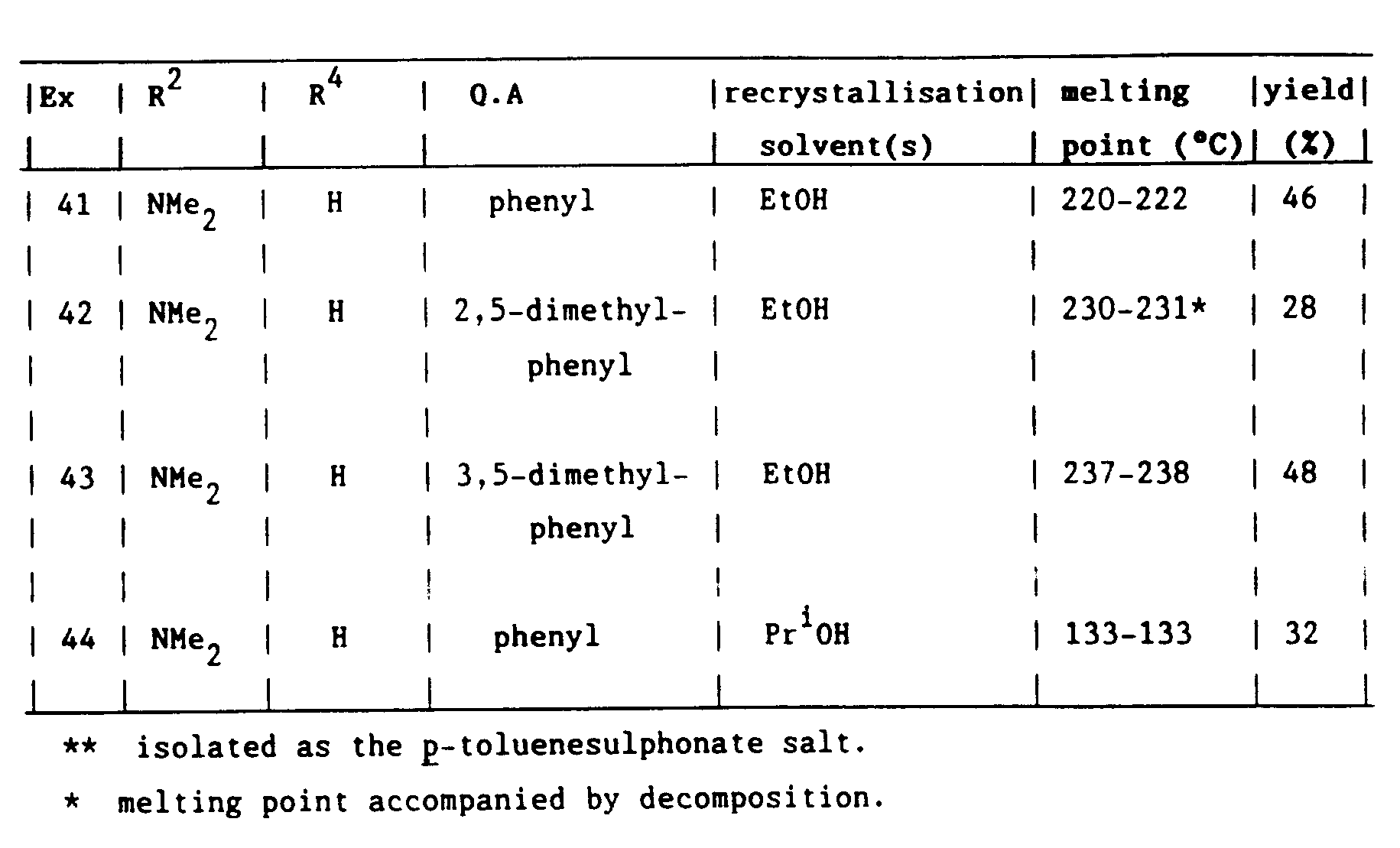
- Similarly, 1,6-dimethyl-4-(1,2,3,4-tetrahydro-1-quinolylamino)-2-methylaminopyrimidinium iodide was obtained as a solid in 28% yield, m.p. 128-130°C, by reaction of 6-methyl-4-(1,2,3,4-tetrahydro-1-quinolylamino)-2-methylaminopyrimidine with methyl iodide.
- The necessary starting pyrimidines of formula III (R⁶=CH₃, R⁵=H) were made in an analogous manner to that described for the starting material of Example 20 and had the following properties:-


- Similarly the starting material for Example 45, that is 6-methyl-4-(1,2,3,4-tetrahydro-1-quinolylamino)-2-methylaminopyrimidine, was obtained as a solid in 41% yield, m.p. 215-216°C (hydrochloride salt), by reaction of 4-chloro-6-methyl-2-methylaminopyrimidine with 1,2,3,4-tetrahydroquinoline.
- Using an analogous procedure to that described in Example 1, was repeated but starting from the known compound 1,6-dimethyl-2-methylaminopyrimidin-4-one (Agai et alia, Period. Polytech. Chem. Eng., 1974, 18, 47) which was then reacted with phosphorus oxychloride to produce the corresponding reactive quaternary derivative, there was obtained 1,6-dimethyl-2-methylamino-4-( N -methyl-3-phenoxypropylamino)pyrimidinium chloride, as a solid, m.p. 167-169°C (recrystallised from acetone/water) in 22% yield (partial hydrate: 0.25 H₂O).
- A mixture of 2-amino-4-chloro-1,6-dimethylpyrimidinium iodide (1.43g, 5 mM), N-allylaniline (0.67 g, 5 mM), dioxan (15 ml) and N,N-dimethylformamide (15 ml) was heated at 90-100°C for 15 hours. The volatile material was removed by evaporation and the residue was crystallised from ethanol to give 4-N-allylanilino-2-amino-1,6-dimethylpyrimidinium iodide, (Example 47), (0.35 g, 15% yield), m.p. 271-272°C; microanalysis, found: C,46.8; H,5.0; N,14.9; C₁₅H₁₉N₄I requires: C,47.1; H,4.97; N,14.66; NMR (200 MHz): 2.3(3H,s,C.CH₃), 3.45(3H,s,N.CH₃), 4.5-4.6(2H,d,NCH₂), 5.1-5.25(2H, s+d, CH=CH₂), 5.65-5.8(1H, br, pyrimidine 5H), 5.8-6.0(1H,m,CH=CH₂), 7.3-7.6(5H, complex, aromatic), 8.0-8.4(2H,br,NH₂).
- [Note: the starting aminochloropyrimidine may is described by Ainley et alia in J. Chem. Soc., 1953, 59-70].
- Using a similar procedure the following compounds of formula I were obtained:-
(Example 48): 2-amino-4-N-ethylanilino-1,6-dimethylpyrimidinium iodide, as a solid in 25% yield, m.p. 231-232°C (recrystallised from 2-propanol), using N-ethylaniline instead of N-allylaniline; and
(Example 49):
2-amino-4-(p-methylthioanilino)-1,6-dimethylpyrimidinium iodide, as a solid in 51% yield, m.p. 260-262°C (recrystallised from water) using p-methylthioaniline instead of N-allylaniline. - Using a similar procedure to that described in Example 20, 1,6-dimethyl-4-(1-indolyl)-2-methylaminopyrimidinium iodide was obtained as a solid in 33% yield. m.p. 304-305°C, by reaction of 4-(1-indolyl)-6-methyl-2-methylaminopyrimidine with methyl iodide. The starting material was prepared as follows:-
A mixture of 4-(1-indolinyl)-6-methyl-2-methylaminopyrimidine (2.4 g, 0.01M), 30% w/w palladium on charcoal (0.24 g) and diphenyl ether (10 ml) was heated under reflux in an argon atmosphere for 1 hour. The catalyst was then removed by filtration. The filtrate was then diluted with a large volume of hexane (100 ml). This gave a pale yellow solid which was recrystallised from 2-propanol to give 4-(1-indolyl)-6-methyl-2-methylaminopyrimidine (1.47 g, 62%), m.p. 160-162°C; microanalysis, found: C,70.5; H,5.9; N,23.6%; C₁₄H₁₄N₄ requires C,70.6; H,5.9; N,23.5%. - The 4-(1-indolinyl)-6-methyl-2-methylaminopyrimidine was obtained in 45% yield as its hydrochloride salt, m.p. >300°C using a similar procedure to that described for the analogous intermediate in Example 20 but by reacting 4-chloro-6-methyl-2-methylaminopyrimidine with indoline.
- A mixture of 2-methyl-6-methylamino-4-N-ethylanilinopyrimidine (0.7 g, 2.9 mM), methyl iodide (0.54 ml, 8.7 mM) and dioxan (20 ml) was heated at reflux for 15 hours. The mixture was cooled. The solvent was removed in vacuo and the residual syrup was crystallised by addition of acetone. The solid was collected by filtration, washed with acetone and then recrystallised from ethyl acetate to give 1,2-dimethyl-6-methylamino-4-N-ethylanilinopyridinium iodide (0.55 g, 50%, yield), m.p. 175-177°C; microanalysis, found: C,46.8; H,5.6; N,14.3%; C₁₅H₂₁N₅I requires: C,46.88; H,5.5; N,14.58%; NMR: 1.1-1.2(3H,t,CH₂CH₃), 2.6(3H,s,CH₃), 2.6-2.7(3H,d,NHCH₃) 3.5(3H,s,N-CH₃), 3.9-4.1(2H,q,CH₂CH₃), 5.15(1H,s,pyrimidine 5-H), 7.3-7.65(5H, complex, aromatic), 7.8-7.95(1H,br,NH).
[ Note: the site of quaternisation was confirmed by conventional Nuclear Overhauser studies]. - The pyrimidine starting material was prepared as follows:-
A mixture of 4-chloro-2-methyl-6-methylaminopyrimidine (2.0 g, 12.7 mM) and N-ethylaniline (3.06 g, 25.4 mM) was heated as a melt at 160°C for 3 hours. The residue was cooled and acetone (10 ml) added. The resultant solid was collected by filtration and washed with acetone. There was thus obtained 2-methyl-6-methylamino-4-N-ethylanilinopyrimidine (2.25 g) as the hydrochloric salt. This salt (2.25 g, 7.9 mM) was dissolved in 2-propanol (50 ml) and a solution of potassium hydroxide (0.44 g, 7.9 mM) dissolved in the minimum volume of water was added. The mixture was heated at 90°C for 5 minutes. The solvent was removed in vacuo. The resultant solid was stirred with water (25 ml) and then collected by filtration, washed with water and then dried at 100°C to give 2-methyl-6-methylamino-4-N-ethylanilinopyrimidine (1.4 g, 46% yield), m.p. 144-145°C; microanalysis, found: C,69.1; H,7.5; N,22.8%; C₁₄H₁₈N₄ requires C,69.4; H,7.5; N,23.1%. - The procedure described in Example 51 was repeated using the appropriate substituted pyrimidine of formula III and alkylating agent of formula R¹.Y. There were thus obtained the following compounds of formula I (A=direct bond, R¹=R²=CH₃,R⁵=H; Y⁻=iodide):-
(Example 52): 1,2-dimethyl-6-amino-4-N-ethylanilinopyrimidinium iodide, as a solid, m.p. 195-196°C (recrystallised from ethyl acetate) in 65% yield;
(Example 53): 1,2-dimethyl-6-methylamino-4-N-methylanilinopyrimidinium iodide, as a solid, m.p. 198-200°C (recrystallised from 2-propanol) in 50% yield; and
(Example 54): 1,2-dimethyl-6-ethylamino-4-N-methylanilinopyrimidinium iodide, as a solid, m.p. 212-213°C (recrystallised from acetone) in 49% yield. - The necessary starting materials were made in an analogous manner to that described for the starting material of Example 51 and had the following properties:-
- a) 6-amino-2-methyl-4-N-ethylanilinopyrimidine, as a solid, m.p. 126-127°C (triturated with ether) in 71% yield;
- b) 2-methyl-6-methylamino-4-N-methylanilinopyrimidine, as a solid, m.p. 123-124°C (triturated with ether) in 60% yield; and
- c) 6-ethylamino-2-methyl-4-N-methylanilinopyrimidine, as a solid, m.p. 87-89°C (triturated with methylene chloride) in 80% yield.
- Using a similar procedure to that described in Example 51, 1,2-dimethyl-4-(1-indolyl)-6-aminopyrimidinium iodide was obtained as a crystalline solid in 27% yield, m.p. 286°C (with decomposition), (after recrystallisation from methanol), by reaction of 6-amino-4-(1-indolyl)-2-methylpyrimidine with methyl iodide.
The starting material was prepared as follows:-
A mixture of 6-amino-4-(1-indolinyl)-2-methylpyrimidine (4.5 g, 20 mM), 30% w/w palladium on charcoal (0.45 g) and diphenyl ether (15 ml) was heated under reflux in an argon atmosphere for 1 hour. The solid was removed by filtration and the filtrate was diluted with hexane (100 ml) to give 6-amino-4-(1-indolyl)-2-methylpyrimidine (4.25g, 95%) as a pale yellow solid, m.p. 176-177°C; microanalysis, found: C,69.5; H,5.5; N,24.4%; C₁₃H₁₂N₄ requires C,69.64; H,5.36; N,25.0%. - The 6-amino-4-(1-indolinyl)-2-methylpyrimidine was obtained as a solid, m.p. 209-210°C, in a similar number to that described for the analogous intermediate in Example 51 by reaction of 6-amino-4-chloro-2-methylpyrimidine with indoline.
- A column of quaternary ammonium hydroxide anion exchange resin was prepared from Amberlite* IRA400 (chloride form) by eluting the resin with sodium hydroxide (1M solution) until the eluate was free of chloride ions and then washing with deionised water (until the eluate was pH=7) and then with 10% v/v ethanol/water (500ml). A mixture of 1,2-dimethyl-6-methylamino-4-N-ethylanilinopyrimidinium iodide (10.0g) and 10% v/v ethanol/water (200ml) was then loaded onto the column (approximate resin volume 100ml). The column was eluted with 10% v/v ethanol/water (11). The white solid which crystallised from the eluate was collected by filtration and recrystallised from ethanol/water to give 1,2-dimethyl-6-methylimino-4-N-ethylanilinopyrimidine (0.93g), m.p. 82-83°C; microanalysis, found: C, 70.1; H, 7.8; N, 21.9%; C₁₅H₂₀N₄ requires: C, 70.3; H, 7.84; N, 21.86%; NMR (200MHz, DMSOd₆): 1.09(3H,t,-CH₂CH₃); 2.38(3H,s,pyrimidine-2-CH₃); 2.53(3H,s,=N-CH₃); 3.36(3H,s, pyrimidine N(1)-CH₃); 3.88(2H,q,-CH₂CH₃); 4.78(1H,s, pyrimidine 5-H); 7.22-7.34(3H, complex, aromatic), 7.40-7.50(2H, complex, aromatic).
[* Amberlite is a trade mark, the property of the Rohm and Haas Co.] - The filtrate was distilled under reduced pressure to reduce the volume to about 400ml. The pH of the solution was adjusted, carefully to 6.65 by addition of M-hydrochloric acid. The mixture was then evaporated to dryness and triturated with ethyl acetate. The white crystalline solid was recrystallised from a mixture of ethyl acetate and 2-propanol to give 1,2-dimethyl-6-methylamino-4-N-ethylanilinopyrimidinium chloride (4.69g), m.p. 201.5-202.5°C, microanalysis, found C, 61.2;H, 7.3;N, 19.1%; C₁₅H₂₁N₄Cl requires: C, 61.5;H, 7.2;N, 19.1%; NMR (200MHz, DMSOd₆): 1.14(3H,t,-CH₂CH₃); 2.61(3H,s,pyrimidine-2-CH₃); 2.63(3H,s,NHCH₃); 3.65 (3H,s, pyrimidine-N(1)-CH₃); 4.01(2H,q,-CH₂-CH₃); 5.13 (1H,s,pyrimidine-5-H); 7.32-7.61(5H, complex, aromatic), 8.87 (1H,s,NH).
- Using a similar procedure to that described in Example 20, the following compounds of formula I (R¹=R⁶=CH₃, R⁵=H; Y⁻=iodide) were obtained:-
Example R² R⁴ Q.A Recryst. Solvent(s) M.P. (°C) Yield (%) 57 NHMe Et 4-methylphenyl MeOH/EtOAc 196-199 88 58 NH.crotyl H phenyl MeOH/EtOAc 220-221 14 59 NHMe 2-butynyl phenyl PriOH 191-183 47 60 NH₂ 2-propynyl phenyl PriOH 232-234 (dec.) 62 Example R² R⁴ Q.A Recryst. Solvent(s) M.P. (°C) Yield (%) 61 NHEt Et phenyl PriOH 172-173 39 62 NHEt Me phenyl PriOH 183-184 39 63 NHEt allyl phenyl EtOAc 104-106 46 64 NHPri Me phenyl PriOH/Et₂O 165-166 37 65 NHBu Me phenyl Me₂CO/Et₂O⁺ 146-147 40 Note: crotyl is equivalent to 2-butenyl
+ triturated with solvent - The following compounds of formula I (R⁶=CH₃, R⁵=H, Q.A-phenyl; Y⁻=iodide) were obtained in a similar manner:-

( Example 74 ): 2-amino-1-ethyl-4-(3,5-dimethylanilino)-6-methylpyrimidinium iodide was similarly obtained as a solid in 28% yield, m.p. 226-227°C, by reaction of 2-amino-4-(3,5-dimethylanilino)-6-methylpyrimidine with ethyl iodide;
(Example 75 ): 2-amino-1,6-dimethyl-4-(2-methyl-1,2,3,4-tetrahydro-1-quinolylamino)pyrimidinium iodide was similarly obtained as a solid in 32% yield, m.p. 216-218°C, by reaction of 2-amino-6-methyl-4-(2-methyl-1,2,3,4-tetrahydro-1-quinolylamino)pyrimidine with methyl iodide; and
(Example 76): 2-amino-1,6-dimethyl-4-(2,4-dimethyl-1,2,3,4-tetrahydro-1-quinolylamino)pyridinium iodide was similarly obtained as a solid in 8% yield, m.p. 140-142°C, by reaction of 2-amino-6-methyl-4-(2,4-dimethyl-1,2,3,4-tetrahydro-1-quinolylamino)pyrimidine with methyl iodide. - The necessary starting pyrimidines of formula III (R⁶=CH₃, R⁵=H) were obtained in an analogous manner to that described for the starting material of Example 20 and had the following properties:-
[ Note : the starting material for Example 60 was made by alkylation of a solution of the starting material for Example 66 in DMF with propargyl bromide using sodium hydride as base.]

The starting 2-butylamino-4-chloro-6-methylpyrimidine needed to prepare the compound III for Example 65 was prepared as follows:-
2-Butylamino-6-methylpyrimidin-4-one (8.4 g, 0.046 M) was treated with phosphorus oxychloride (5 ml). A vigorous reaction ensued. When this had subsided, the resultant mixture was heated at 90°C for 30 minutes. This gave an orange coloured syrup which was cooled and added to water to decompose the excess phosphorus oxychloride. The aqueous solution was adjusted to pH 7 using 2M sodium hydroxide solution. The resultant white precipitate was extracted with methylene chloride. The extracts were dried (MgSO₄) and the solvent evaporated to give 2-butylamino-4-chloro-6-methylpyrimidine (8.1 g) as a solid, m.p. 35-36°C, in 88% yield.
The starting 4-anilino-2-crotylamino-6-methylpyrimidine required to prepare the compound III for Example 58 was prepared as follows:-
A mixture of 2-amino-4-anilino-6-methylpyrimidine (1 g) (5mM), potassium carbonate (0.4 g, 5.5 mM), crotyl bromide (0.61 ml) (5mM) and acetone (25 ml) was heated at reflux for 20 hours. The solvent was then evaporated and the residue triturated with methylene chloride. The methylene chloride extracts were combined and the solvent removed by evaporation. The residual syrup was purified by flash chromatography using Merck 9835 silica (200 g) and eluting with 5% v/v methanol/methylene chloride. There thus was obtained 4-anilino-2-crotylamino-6-methylpyrimidine as a viscous oil (0.36 g) which was used without characterisation.
The starting 2-amino-6-methyl-4-(2-methyl-1,2,3,4-tetrahydro-1-quinolylamino)pyrimidine for Example 75 was obtained as a solid in 32% yield, m.p. 140-142°C, by reaction of 4-chloro-6-methyl-2-methylaminopyrimidine with 2-methyl-1,2,3,4-tetrahydroquinoline. Similarly, the starting 2-amino-6-methyl-4-(2,4-dimethyl-1,2,3,4-tetrahydro-1-quinolylamino)pyrimidine for Example 76, was obtained as a solid in 44% yield, m.p. 144-146°C, by reaction of 4-chloro-6-methyl-2-methylaminopyrimidine with the known compound 2,4-dimethyl-1,2,3,4-tetrahydroquinoline (Chemical Abstracts Registry No. 67525-06-8). - The procedure described in Example 20 was repeated using the appropriate substituted pyrimidine of formula III and alkylating agent of formula R¹.I . There were thus obtained the following compounds of formula I (Q.A=phenyl, R⁵=H, Y⁻=iodide):-


The necessary starting pyrimidines of formula III (Q.A=phenyl, R⁵=H) were made in an analogous mannner to that described for the starting material of Example 20 and had the following properties:-

- The following compounds of formula I were obtained in a similar manner:-
(Example 101): 2-amino-4-(N-ethylanilino)-5,6,7,8-tetrahydro-1-methylquinazolinium iodide obtained as a partial hydrate (0.25 H₂O), m.p. 221-223°C (after recrystallisation from methanol/ether) in 48% yield by reaction of methyl iodide with 2-amino-(4-N-ethylanilino)-5,6,7,8-tetrahydroquinazoline; [the latter compound was itself obtained as a solid, m.p. 132-134°C, in 11% yield by reaction of 2-amino-4-chloro-5,6,7,8-tetrahydroquinazoline with N-ethylaniline;].
(Example 102): 2-amino-4-(N-ethylanilino)-1-methylquinazolinium iodide was similarly obtained as a solid. m.p. 252-254°C (dec.) (recrystallised from methanol/ether) in 37% yield by reaction of methyl iodide with 2-amino-(4-N-ethylanilino)-quinazoline; [the latter compound was itself obtained as a solid, m.p. 168-170°C, in 11% yield by reaction of 2-amino-4-chloroquinazoline with N-ethylaniline;]
Certain of the chloropyrimidines of formula IV (X=Cl, R⁵=H) which were used as starting materials in Examples 77-102 are known compounds, and are described in the following references:- - (a) R⁶=H, R²=NH₂; Tetrahedron, 1968, 24, 3595;
- (b) R⁶=Et, R²=NH₂; Belgian Patent no. 657, 135, Jan 15, 1965; and
- (c) R⁶=CH₂CH₂Ph, R².NH₂; J. Org. Chem., 27, 1717.
- (a) Ethyl 3-oxo-hexanoate (4.74 g; 30 mM) and N-ethylguanidine sulphate (4.08 g; 30 mM) were dissolved in a solution prepared by dissolving sodium (1.4 g; 0.65 g atom) in ethanol (100 ml) and the mixture was heated under reflux on the steam bath for 18 hours. Acetic acid (5 ml) was added to the cooled mixture which was stirred for 10 minutes. Insoluble material was removed by filtration and the filtrate was evaporated. The residue was partitioned between water (50 ml) and methylene chloride (50 ml). The aqueous layer was extracted twice with methylene chloride (50 ml). The combined extracts were dried and the solvent evaporated. The residue was crystallised from cyclohexane to give 2-ethylamino-4-hydroxy-6-propylpyrimidine as a solid (4.6 g; 85% yield), m.p. 108-110°C.
- (b) A mixture of 2-ethylamino-4-hydroxy-6-propylpyrimidine (1.81 g, 10 mM) and phosphorus oxychloride (15 ml) was heated at 100°C for 18 hours. The excess of phosphorus oxychloride was removed under reduced pressure and the residual was decomposed with ice-water (50 ml). The solution was made basic with concentrated aqueous ammonia and extracted with ethyl acetate (3 x 50 ml). The extracts were combined, dried and the solvent evaporated to give 4-chloro-2-ethylamino-6-propylpyrimidine (1.79 g; 90% yield) as an oil which was used without purification.
- Other chloropyrimidines of formula IV (X=Cl, R⁵=H) were obtained using a similar procedure from the corresponding hydroxypyrimidines of formula IV (X=OH, R⁵=H). The latter compounds had the following properties:-
Number R² R⁶ Recryst. solvent(s) M.P. (°C) Yield (%) 1 NH₂ Bu + 212-216 85 2 NH₂ Bui + 231-234 30 3 NH₂ 3-butenyl + 186-189 83 4 NH₂ pentyl + 188-191 79 5 NH₂ EtOCH₂ + 244-245 69 6 NHMe Et EtOAc 204-208 46 7 NHMe Pr EtOAc 190-192 54 8 NHEt Et cyclohexane 144-116 39 9 NHEt CH₂OEt cyclohexane 106-108 54 + Triturated with ether and used without further purification - The majority of chloropyrimidines of formula IV (X=Cl, R⁵=H) were used without characterisation, but the following were characterised:-
Number R² R⁶ Recryst. solvent(s) M.P. (°C) Yield (%) 1 NH₂ Bu Et₂O/hexane 58-59 50 2 NH₂ Bui Et₂O/hexane 104-106 33 3 NH₂ pentyl Et₂O/hexane 58-59 29 - The starting 2-amino-4-chloroquinazoline derivatives (from which the 2-amino-4-N-ethylanilino starting materials for Examples 101 and 102 were prepared) were obtained in an analogous manner to the above chloropyrimidines and were used without purification.
- The starting 2-amino-4-hydroxyquinazoline derivatives were themselves obtainable as solids, m.p. >300°C using literature procedures (for example 2-amino-5,6,7,8-tetrahydro-4-hydroxyquinazoline Chem. Pharm. Bull. (Japan), 1986, 34, 4150; 2-amino-4-hydroxyquinazoline: Rec. trav. chim. Pays. Bas., 1960, 79, 443).
- Using a similar procedure to that described in Example 47, the following compounds of the formula 1 (as set out hereinafter) were obtained:-
Example X R⁴ Recryst. solvent(s) M.P. (°C) Yield (%) 103 H Pr Me₂CO * 250-255 25 104 H 2-butynyl Me₂CO 182-184 47 105 H Bu PriOH/Et₂O 184-186 25 106 2-MeO Et PriOH/Et₂O 267-269 12 107 2-Me Et CH₂Cl₂ * 216-217 22 108 4-Cl Et MeOH/Et₂O 244-246 42 109 4-Me Et MeOH/Et₂O 240-242 32 * triturated with solvent - Using an analogous procedure to that described in Example 20, but starting from the appropriate 4-(indol-1-yl)-6-methylpyrimidine of formula 2 (as set out hereinafter) and alkylating agent of formula R¹.I , the following compounds of the formula 3 (set out hereinafter; R⁶=CH₃) were obtained:-
Example R¹ R² X B Recryst. Solvent(s) M.P. (°C) Yield (%) 110 Et NHMe H H Dioxan * 294-295 6 111 Me NHMe H 2-Me EtOH/H₂O 301-302+ 43 112 Me NHMe 5-MeO H EtOH/H₂O 304-305+ 31 113 Me NH₂ H H EtOH/Et₂O 295-296 55 114 Et NH₂ H H EtOH * 284-286 7 115 Me NH₂ 5-MeO H H₂O/EtOH 297-298 47 116 Me NH₂ H 2-Me EtOH/H₂O 286-288 43 117 Me NH₂ 5-Cl H EtOH/H₂O 288-290 37 118 Me NH₂ 5-CN H EtOH 280-282 10 119 Me NH₂ 5-Br H EtOH/H₂O 295-296 41 120 Me NH₂ 5-Me H EtOH/H₂O 287-288 37 121 Me NH₂ 7-aza H EtOH/H₂O 285+ 9 122 Me NH₂ 5-F H MeOH 279-281 15 + with decomposition * triturated with solvent - The indolyl starting materials for Examples 110 and 113 were prepared in a similar manner to Example 20 and Example 50 by dehydrogenating the appropriate 4-(indolin-1-yl)pyrimidine with 30% w/w palladium-on-charcoal heated under reflux with diphenyl ether in an argon atmosphere. The required starting 2-amino-4-(1-indolinyl)-6-methylpyrimidine was obtained as a solid, m.p. 242-244°C in 48% yield in a similar manner to that described for the analogous intermediate in Example 13 by reaction of 2-amino-4-chloro-6-methylpyrimidine with indoline.
- The remaining indolyl starting materials of formula 2 were obtained by alkylation of the appropriate indole with the required chloropyrimidine in DMF using as base a 60% w/w dispersion of sodium hydride in mineral oil.
- The following 4-(indol-1-yl)-6-methylpyrimidine derivatives of formula 2 (R⁶=CH₃) were thus obtained :-
Cpd. 2 for Ex. R² X B Recryst. solvent(s) m.p. (°C) yield (%) 110 NHMe H H PriOH 160-162 62 111 NHMe H 2-Me cyclohexane 163-165 54 112 NHMe 5-MeO H EtOAc 188-189 47 113,114 NH₂ H H CH₂Cl₂* 178-180 56 115 NH₂ 5-MeO H EtOH 179-180 28 116 NH₂ H 2-Me EtOAc 186-188 48 117 NH₂ 5-Cl H EtOAc 193-195 42 118 NH₂ 5-CN H EtOAc 210-212 56 119 NH₂ 5-Br H Me₂CO 194-196 21 120 NH₂ 5-Me H EtOAc 186-188 33 121 NH₂ 7-aza H cyclohexane 171-173 35 122 NH₂ 5-F H EtOAc 198-200 38 * triturated with solvent - Using a similar procedure to that described in Example 20, the following compounds of formula I were obtained:-
(Example 123): 1,6-dimethyl-4-(indolin-1-yl)-2-methylaminopyrimidinium iodide, as a solid, m.p. >300°C (recrystallised from DMF), in 74% yield, starting from 4-(indolin-1-yl)-6-methyl-2-methylaminopyrimidine [described above in connection with Example 50];
( Example 124 ): 2-amino-1,6-dimethyl-4-(indolin-1-yl)pyrimidinium iodide, as a solid, m.p. 274-276 (recrystallised from ethanol), in 43%, starting from 2-amino-4-(indolin-1-yl)-6-methylpyrimidine, itself obtained in 64% yield as a solid, m.p. 157-159°C (recrystallised from cyclohexane), using a similar procedure to that for the analogous starting material in Example 50, but using 2-methylindoline instead of indoline; and
( Example 125 ): 2-amino-1,6-dimethyl-4-(2,3-dimethylindolin-1-yl)pyrimidinium iodide, as a solid, m.p. 279-281°C (recrystallised from ethanol), in 55% yield, starting from 2-amino-6-methyl-4-(2,3-dimethylindolin-1-yl)pyrimidine, itself obtained in 50% yield as a solid, m.p. 179-181°C (recrystallised from ethyl acetate) using a similar procedure to that for the analogous starting material in Example 50, but using 2,3-dimethylindoline instead of indoline. - Using a similar procedure to that described in Example 51, but starting with the appropriate substituted pyrimidine of formula III and methyl iodide, the following compounds of formula I (Q.A=phenyl; R¹=R²=CH₃, R⁵=H; Y-=iodide) were obtained:-
Example R⁴ R⁶ Recryst. solvent(s) M.P. (°C) Yield (%) 126 Me NH₂ 2-propanol 228-230 86 127 allyl NHMe EtOAc/MeOH 68-71 59 128 2-butynyl NHMe EtOAc/MeOH syrup 15 129 Pr NHMe EtOAc 139-140 38 130 Prc.CH₂ NHMe EtOAc 147-149 47 Note: Prc = cyclopropyl - The necessary starting materials of formula III were made in an analogous manner to that described for the starting materials of Example 51 from the appropriate chloropyrimidines of formula IV (X = Cl) and had the following properties:-
III for Ex. no. R⁴ R⁶ Recryst. solvent(s) M.P. (°C) Yield (%) 126 Me NH₂ CH₂Cl₂ 128-130 53 127 allyl NHMe Et₂O 98-101 43 128 2-butynyl NHMe --- syrup 45 129 Prn NHMe hexane 114-114.5 53 130 Prc.CH₂ NHMe hexane 98-100 28 Note: Prc = cyclopropyl * having a satisfactory NMR spectrum - The procedure described in Example 51 was repeated using the appropriate substituted pyrimidine of formula III and methyl iodide. There were thus obtained the following compounds of formula I (Q.A=phenyl, R¹=CH₃, R⁵=H, R⁶=NHCH₃; Y⁻=iodide):-
Example R⁴ R² Recryst. solvent(s) M.P. (°C) Yield (%) 131 Me Et PriOH/Et₂O 173-174 41 132 Me H PriOH/Et₂O 172-173 81 133 Et Et EtOAc 146-147 44 134 Et Pr Me₂CO/Et₂O 127-130 27 135 Et Bu MeOH/Et₂O 144-146 19 - The necessary starting materials of formula III (Q.A=phenyl; R²=CH₃, R⁵=H) were made in an analogous manner to that described for the starting material of Example 51 from the apropriate chloropyrimidine of formula IV (X = Cl) and had the following properties:-
No. R⁴ R² Trituration solvent(s) M.P. (°C) Yield (%) 131 Me Et CH₂Cl₂ 98-100 71 132 Et H Pr¹OH/Et₂O 113-114 44 133 Et Et CH₂Cl₂ 97-99 63.5 134 Et Pr CH₂Cl₂ 69-71 22 135 Et Bu hexane 75-75.5 31 - The required chloropyridine starting materials of formula (IV) are themselves prepared by the addition of the appropriate 2-substituted-4,6-dichloropyrimidine to an alcoholic solution of the required amine with cooling below 10°C. The reaction mixture was then allowed to warm to ambient temperature and the solvent evaporated. The residue was partitioned between water and methylene chloride. The organic phase was dried (MgSO₄) and concentrated in vacuo to give the required compound of formula IV (X=Cl):-
- (a) 4-chloro-2-ethyl-6-methylaminopyrimidine, obtained as a solid, m.p. 80-81°C;
- (b) 4-chloro-6-methylamino-2-propylpyrimidine, obtained as a solid, m.p. 30-40°C; and
- (c) 2-butyl-4-chloro-6-methylaminopyrimidine,obtained as an oil.
- The procedure described in Example 51 was repeated using the appropriate substituted pyrimidine of formula III and alkylating agent of formula R¹.Y . There were thus obtained the following compounds of formula I (R⁴=Et, R²=CH₃, R⁵=H, R⁶=NHCH₃):-
A=direct bond;Example Q.A- R¹ Y Recryst. solvent(s) m.p. (°C) yield (%) 146 p-tolyl Me I MeOH/Et₂O 188-191 31 147 p-anisyl Me I EtOH 211-214 40 148 p-Cl-phenyl Me I MeOH/Et₂O 243-245 60 149 phenyl Et BF₄ EtOAc* 126-128 8 * triturated with solvent
The necessary starting materials of formula III were made in an analogous manner to that described for the starting material of Example 51, but using the appropriate N-ethylaniline:- - a) 4-(N-ethyl-4-methylanilino)-2-methyl-6-methylaminopyrimidine obtained as a solid, m.p. 140-143°C, in 70% yield;
- (b) 4-(N-ethyl-4-methoxyanilino)-2-methyl-6-methylaminopyrimidine, obtained as a solid, m.p. 116-118°C, in 71% yield; and
- (c) 4-(N-ethyl-4-chloroanilino)-2-methyl-6-methylaminopyrimidine, obtained as a solid, m.p. 133-136, in 79% yield.
- Using a similar procedure to that described in Example 56, the following 1,2-dimethyl-6-methylamino-4-N-ethylanilinopyrimidium salts were obtained by reacting 1,2-dimethyl-6-methylimino-4-N-ethylanilinopyrimidine with the appropriate acid:-
Example Salt Recryst. solvent(s) M.P. (°C) Yield (%) 140 fumarate acetonitrile 152-154 80 141 benzoate hexane * 46-47 93 142 hydrogen sulphate PriOH/Et₂O 146-147 58 143 acetate hexane * 43-45 62 144 butyrate Et₂O/hexane 52-58 56 * triturated with solvent - Using a similar procedure to that described in Example 51, but starting from the appropriately substituted 4-(indol-1-yl)pyrimidine of formula 2 and methyl iodide, the following 4-(indol-1-yl)-1,2-dimethyl-6-methylaminopyrimidinium salts of the formula 3 (R1=R²=CH₃ and R⁶=NHCH₃, except where stated) were obtained:-
Example X B Recryst. solvent(s) M.P. (°C) Yield (%) 145 H H MeOH 270-272 (decomp.) 14 146 + H 3-Me MeOH 276-277 7 147 H 3-Me EtOH/H₂O 257-258 24 148 H 3-Et EtOH 259-260 16 149 * H 3-Et EtOH 249-250 24 150 ** H 3-Et EtOH 240-242 21 151 H 3-Pr EtOH 245-247 35 152 H 3-Ph MeOH/H₂O 254.5-255.5 20 153 H 3-Pri H₂O 251-252 4 154 5-MeO H MeOH 309-310 8 + R⁶=NH₂ * R²=Et ** R⁶=NHEt
The starting 4-(indol-1-yl)pyrimidines of formula 2 for Examples 145, 149 and 150 were obtained from the appropriate indoline and chloropyrimidine using a similar procedure to that used for the analogous starting material in Example 55.
The preparation of the starting 4-(indol-1-yl)pyrimidines of formula 2 for Examples 146, 147 and 151-154 is illustrated by the following preparation of the starting material for Example 148:-
A mixture of 3-ethylindole (1.45 g, 10 mM), sodium hydride (60% w/w oil dispersion) (0.44 g, 11 mM) and dry DMF (10 ml) was stirred under an argon atmosphere. When effervescence had ceased, a mixture of 4-chloro-2-methyl-6-methylaminopyrimidine (1.575 g, 10 mM) and DMF (15 ml) was added. The mixture was stirred at 110°C for 20 hours, cooled, water (10 ml) added and the solvent evaporated. The residue was dissolved in methylene chloride and purified by flash column chromatography on silica (Merck 9385) using ether as eluant to give 4-(3-ethyl-1-indolyl)-2-methyl-6-methylaminopyrimdine as a solid (0.64 g, 25%), m.p. 161-162°C, (after recrystallisation from ethyl acetate); microanalysis, found: C,72.4; H,6.9; N,21.1%; C₁₆H₁₈N₄ requires C,72.18; H,6.77; N,21.05%. - The properties of the various starting materials of formula 2 for Examples 145-154 are summarised below:-
Cpd. 2 for Ex. X B R² R⁶ Recryst. solvent(s) M.P. (°C) Yield (%) 145 H H Me NHMe Et₂O 153-154 65 146 H Me Me NH₂ EtOAc 183-184 29 147 H Me Me NHMe EtOAc/hexane 156-157 32 148 H Et Me NHMe EtOAc 161-162 25 149 H Et Et NHMe cyclohexane 128-130 58 150 H Et Me NHEt cyclohexane 117-118 44 151 H Pr Me NHMe EtOAc * 144-146 31 152 H Ph Me NHMe Et₂O 151-152 35 153 H Pri Me NHMe hexane 130-131 40 154 5-MeO H Me NH₂ EtOAC 162-164 31 * triturated with solvent - The 4-(indolin-1-yl)-6-aminopyrimidines of the formula 4 (set out hereinafter) required for the formula 2 starting materials to Examples 145, 149 and 150, respectively, were obtained in a similar manner to that described for the analogous intermediate in Example 51 by reacting the appropriately substituted indoline with the required chloropyridine and had the following properties:-
No. B R₂ R⁶ Recryst. solvent(s) m.p. (°C) yield (%) 1 H Me NHMe Ether/hexane 174-177 93 2 3-Et Et NHMe EtOAc 168-170 32 3 Et Me NHEt MeCN 146-148 17 - Using a similar procedure to that described in Example 51, the following 1-indolinyl compounds of formula 5 (set out hereinafter) were obtained by reacting the appropriate indoline of formula 4 (R⁶=NHCH₃) with methyl iodide:-
Example B R² Recryst. solvent(s) M.P. (°C) Yield (%) 155 H Me EtOH 281-283 + 50 156 3-Me Me EtOH 261-262 51 157 3-Et Et Ether * 240-241 + 36 158 3-Et Me EtOH 262-263 51 * triturated with solvent + with decomposition
The starting indolines of formula 4 have either been described hereinabove (i.e. in connection with Examples 145 and 149) or may be obtained in an analogous manner by reaction of the appropriate substituted indoline with the required chloropyrimidine derivative. Thus, the following additional starting materials of formula 4 (R⁶=NHCH₃) were obtained:-Cpd. No. B R² Recryst. solvent(s) m.p. (°C) yield (%) 4 3-Me Me EtOAc 164-165 59 5 3-Et Me EtOH 178-180 25 - A mixture of 4-N-ethylanilino-2-methyl-1-phenylpyrimidin-6-one (0.6 g, 1.76 mM) and phosphorus oxychloride (6 ml) was heated under reflux for 2 hours. The excess phosphorus oxychloride was removed by evaporation. The residue was dissolved in toluene and the solvent evaporated. The process was repeated and the oily residue (containing the corresponding chloride salt of the dichlorophospinoyl derivative of the starting pyrimidinone was added slowly to a stirred solution of methylamine in ethanol (10 ml of 33% w/w). After 16 hours, the solvent was evaporated. 1M Sodium hydroxide solution (10 ml) was added to the residue and the mixture was extracted with ether (2 x 10 ml). The extracts were dried by filtration through phase-separating paper and treated with ethereal hydrogen chloride. The precipitate was collected by filtration and recrystallised from ethanol/ether to give 4-N-ethylanilino-2-methyl-6-methylamino-1-phenylpyrimidinium chloride (0.364 g), m.p. >330°C; microanalysis, found: C,64.8; H,6.6; N,15.2; C₂₀H₂₃N₄Cl.0.75H₂O requires: C,65.2; H,6.7; N,15.2%; NMR (200 MHz): 1.1(3H,t, CH₃), 2.7(3H,s, CH₃), 3.8(3H,s, CH₃), 4.0(2H,q, CH₂), 5.24(1H,s, CH), 7.1-7.3(10H, complex, aromatic H).
- The starting material was prepared as follows:-
- (i) A mixture of 2-methyl-1-phenyl-1,4,5,6-tetrahydropyrimidin-4,6-dione (obtained by the procedure of L.B. Dashkevich, Dokl. Akad. Nauk. SSSR, 1962, 145, 323), (2.02 g, 10 mM) and phosphorus oxychloride (10 ml) was heated at 100°C for 1 hour. Excess phosphorus oxychloride was removed by evaporation and the residue was added to ice-water with stirring. Sodium carbonate was added to the stirred mixture until there was no more effervescence. The mixture was extracted with methylene chloride (2 x 20 ml) and the extracts were dried by filtration through phase separation paper. The filtrate was diluted to a a volume of 250 ml with methylene chloride and subjected to filtration chromatography on silica (Merck 7736). There was thus obtained 4-chloro-2-methyl-1-phenylpyrimidin-6-one (1.1 g), m.p. 109-110°C; NMR (200 MHz): 2.28(3H,s, CH₃), 6.5(1H,s, CH), 7.15-7.6(complex, 5 aromatic H).
- (ii) A mixture of the above chloropyrimidinone (1.1 g, 50 mM) and N-ethylaniline (1.81 g, 15 mM) was heated at 180°C (external temperature) under argon for 18 hours. The mixture was cooled and ether (15 ml) was then added. The precipitate of N-ethylaniline hydrochloride was removed by filtration. The filtrate was evaporated and the residue was partitioned between 10% sodium carbonate solution and methylene chloride. The organic layer was dried by filtration through phase separating paper and evaporated. The residue was purified by flash chromatography on silica (Merck 9385) using 3:1 v/v ethyl acetate and hexane to give, after recrystallisation from ethyl acetate/hexane, 4-N-ethylanilino-2-methyl-1-phenylpyrimidin-6-one (0.68 g), m.p. 131-132°C; NMR (200 MHz): 1.21(3H,t, CH₃), 2.1(3H,s, CH₃), 3.9(2H,q, CH₂), 5.1(1H,s, CH), 7.14-7.55 (complex, 10 aromatic H).
- A mixture of 1,2-dimethyl-4-N-ethylanilinopyrimidin-6-one (1.13 g, 4.65 mM) and phosphorus oxychloride (10 ml) was heated at 100°C for 4 hours. The excess phosphorus oxychloride was removed by evaporation. The residual gum (containing the corresponding chloride salt of the dichlorophospinoyl derivative of the starting pyrimidinone) was dissolved in ethanol (10 ml). To this solution was added dropwise with stirring and ice-cooling, a 32% w/w solution of methylamine in ethanol (10 ml) so that the temperature did not exceed 30°C. The solution was kept at room temperature for 2 hours after the addition was complete. Solvent was removed by evaporation and the residue was partitioned between 10% w/v sodium carbonate solution (20 ml) and ether (20 ml). The aqueous layer was separated and extracted with methylene chloride (4 x 10 ml). The combined organic extracts were dried (MgSO₄) and evaporated to give a gum (1.3 g) which was crystallised from a mixture of acetone and ether to give 1,2-dimethyl-4- N -ethylanilino-6-methylaminopyrimidinium chloride as a solid (0.81 g), m.p. 202-203°C.
The starting material was prepared as follows:- - (i) 4-Chloro-6-hydroxy-2-methylpyrimidine (1.3 g, 10 mM) and N-ethylaniline (5 ml) were heated to 200°C under argon for 4 hours. The mixture was cooled to room temperature and treated with ethanol (10 ml). The crystalline solid thus obtained was isolated by filtration, washed with ethanol and dried to give 4-N-ethylanilino-6-hydroxy-2-methylpyrimidine (1.28 g), m.p. 265-266°C; NMR (200 MHz): 1.0-1.1(3H,t, CH₃), 2.0(3H,s, CH₃), 3.9(2H,q, CH₂), 4.5(1H,s, CH), 7.2-7.5 (complex, 5 aromatic H), 11.5-11.64(1H,br, NH).
- (ii) A mixture of the above anilinopyrimidine (1.15 g, 50 mM), methyl iodide (1.9 ml, 0.03 mmol) and potassium hydroxide flake (0.56 g, 10 mM) in ethanol (50 ml) was heated under reflux for 4 hours. Further portions of potassium hydroxide (0.56 g) and methyl iodide (1.9 ml) were then added and heating continued for an extra 3 hours. Solvent was evaporated and the residue was partitioned between 2M sodium hydroxide (25 ml) and ether (25 ml). The ethereal layer was separated, dried (MgSO₄) and the ether evaporated to give 1,2-dimethyl-4-N-ethylanilinopyrimidin-6-one as an oil (1.13 g); NMR (200 MHz): 1.17(3H,t, CH₃), 2.45(3H,s, 6H₃), 3.4(3H,s, CH₃), 3.92(2H,q, CH₂), 5.05(1H,s,CH), 7.1-7.47(complex, 5 aromatic H).
- The general procedure described in Example 1 was repeated but starting from the appropriate 1,2-disubstituted-6-methylpyrimdin-1-one of formula 6 (set out hereinafter) producing in situ the chloride salt of the dichlorophospinoyl derivative of the starting pyrimidinone, which latter is then reacted with N-ethylaniline or N-methylaniline to give the following compounds of formula I (Q.A=phenyl; R⁶=CH₃; R⁵=H; Y⁻ = Cl⁻):-


- The starting 1,2-disubstituted-6-methylpyrimidin-4-ones of formula 6 were obtained in an analogous manner to that described in parts (i)-(iii) of Example 2 that is by reaction of the appropriate 1-substituted-6-methyl-2-methylthiopyrimidin-4-one of the formula 7 (set out hereinafter) with methylammonium acetate, ammonium acetate or ethylammonium acetate, the formula 7 compounds being obtained by methylation of the corresponding thiones of formula 8 (set out hereinafter). The latter thiones were made by analogous procedures to those described in parts (i) and (ii) of Example 3.
- The pyrimidin-4-ones of formula 6 had the following properties:-


- The methylthio derivatives of formula 7 had the following properties:-


- The thiones of formula 8 had the following properties:-
Formula 8 for Example R¹ M.P. Yield Recryst. 161 2-MeO-Ph 232-234 56 EtOH 163 2-Me-Ph 235-237 83 EtOH 164 3-MeO-Ph 225-227 12 EtOH 165 * Bu 165-166 46 MeOH 166 * Bui 189-191 35 EtOH/MeOH/H₂O 169 * Pri 154-157 13 EtOAc 170 pentyl 134-136 44 EtOAc 183* hexyl 136-137 34 MeOH 184* PhCH₂ 210-212 55 EtOH Note:
* also required for other Examples - The starting thiones of formula 8 for Examples 178 and 186 were obtained as described by Agai et alia, Period. Polytech. Chem. Eng., 1974, 18, 47 and West German OLS No. 252729 (published 8 Jan 1976).
- The general procedure described in Example 1, was repeated but starting from the known compound 1,6-dimethyl-2-methylaminopyrimidin-4-one (Agai et alia, Period. Polytech. Chem. Eng., 1974, 18, 47) and phosphorus oxychloride to produce the corresponding reactive derivative, which derivative was then reacted with the appropriate amine of the formula Q.A.NHR⁴ . There were thus obtained the following compounds of formula I (R¹=R⁶=CH₃):-
( Example 187 ): 1,6-dimethyl-2-methylamino-4-(N-ethyl-2-(2-methoxyphenoxyethylamino)pyrimidinium chloride, as a solid, m.p. 170-171°C (recrystallised from acetone) in 40% yield (partial hydrate: 0.5 H₂O; and
(Example 188 ): 1,6-dimethyl-2-methylamino-4-(N-methyl-2-phenylethylamino)pyrimidinium bromide (mixed with 33% chloride), as a solid, m.p. 219-221°C (recrystallised from 2-propanol/ether) in 44% yield. - Using a similar procedure to that described in Example 47 but using the appropriate amine of the formula Q.A.NHR⁴ , there were obtained the following compounds of formula I (R¹=R⁶=CH₃):-
( Example 189 ): 2-amino-1,6-dimethyl-4-(N-methyl-2-phenylethylamino)pyrimidinium iodide, as a solid, m.p. 168-169°C (recrystallised from 2-propanol/ether) in 45% yield;
( Example 190 ): 2-amino-1,6-dimethyl-4-(N-ethyl-2-(2-methoxyphenoxyethylamino)pyrimidinium iodide, as a solid, m.p. 138-140°C (recrystallised from acetone/water) in 23% yield; and
( Example 191 ): 2-amino-4-(1,2,3,4-tetrahydroisoquinol-2-yl)-1,6-dimethylpyrimidinium bromide, as a solid, m.p. 275-276°C (recrystallised from ethanol)in 12% yield (partial hydrate: 0.25 H₂O). - Using a similar procedure to that described in Example 160 but using dimethylamine instead of methylamine, there was obtained 1,2-dimethyl-6-dimethylamino-4- N -ethylanilinopyrimidinium chloride as a glassy solid in 76% yield; NMR(200MHz; d₆-DMSO): 1.16(3H, t, CH₂CH₃), 2.64(3H, s, pyrimidine-2-CH₃), 2.8[6H, s, N(CH₃)₂], 3.65(3H, s, pyrimidine-1-CH₃), 4.06(2H, q, CH₂CH₃), 5.54(1H, br s, pyrimidine-5H), 7.3-7.65(5H, complex, phenyl).
- The following illustrate representative pharmaceutical dosage forms containing a compound of formula I, or an alternative non-toxic salt thereof, which may be used for therapeutic or prophylactic purpose in humans:-
(a)Tablet mg/tablet Compound X 50 Lactose Ph.Eur 223.75 Croscarmellose sodium 6.0 Maize starch 15.0 Polyvinylpyrrolidone (5% w/v paste) 2.25 Magnesium stearate 3.0
(b)Capsule mg/capsule Compound X 10 Lactose Ph.Eur 488.5 Magnesium stearate 1.5
"Compound X" stands for a typical compound of the formula I or an alternative non-toxic salt thereof such as is described in any preceding Example herein. - The above formulations may be obtained by conventional procedures well known in the pharmaceutical art. The tablets may be coated by conventional means, for example to modify dissolution/disintegration characteristics or improve palatability or stability. For example, a coating of cellulose acetate phthalate may be applied to the tablets to provide a formulation which predominantly releases the majority of the active ingredient in or near the lower alimentary tract.


N-(4-Methoxyphenyl)thiourea (18.2 g, 100 mM) and 2,6,6-trimethyl-1,3-dioxin-4-one (21.3 g, 150 mM) were heated together at 140°C (bath temperature) for 30 minutes. The solid product was cooled, treated with ethanol (100 ml), boiled for 10 minutes, cooled and the solid product was isolated by filtration. More dioxinone (21.3 g) was added to the above material and the mixture was heated at 140°C for a further 20 minutes. Ethanol (50 ml) was then added to the cooled mixture, which was then heated under reflux for 5 minutes. The mixture was cooled and the solid product isolated by filtration to give 2,3-dihydro-1-(4-methoxyphenyl)-6-methyl-2-thioxo-4(1H)-pyrimidinone (17.9 g, 72% yield) m.p. 248-249°C; microanalysis, found: C,58.2; H,4.9; N,11.0%; C₁₂H₁₂N₂OS requires: C,58.1; H,4.8; N,11.3%.
The methylthio pyrimidinones necessary for the preparation of Examples 4-8 were obtained in an analogous manner to that described for the equivalent starting material for Example 3:-
Claims (16)
- An aminopyrimidine derivative of the formula I:
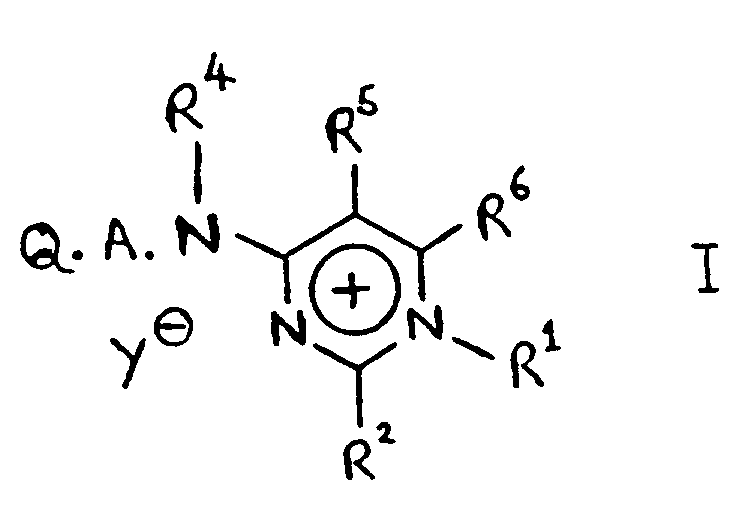
one of R² and R⁶ is a basic group selected from amino, (1-6C)alkylamino, dialkylamino of up to eight carbon atoms, pyrrolidino, piperidino and morpholino; and the other of R² and R⁶ is hydrogen, (1-6C)alkyl, (3-6C)alkenyl, (1-4C)alkoxy(1-4C)alkyl, phenyl, phenyl(1-4C)alkyl, (3-6C)cycloalkyl or (3-6C)cycloalkyl-(1-4C)alkyl; or both of R² and R⁶ are basic groups independently selected from the above defined basic groups; and R⁵ is hydrogen, (1-4C)alkyl or (3-6C)alkenyl;
or R² is a basic group as defined above, and R⁵ and R⁶ together form (3-6C)alkylene or, together with the appendant carbon atoms of the pyrimidine ring, complete a benzene ring;
R⁴ is hydrogen, (3-6C)cycloalkyl-(1-4C)alkyl, (1-6C)alkyl, (3-6C)alkenyl, (3-6C)alkynyl or phenyl(1-4C)alkyl; or R⁴ is a (1-4C)alkylene or (2-4C)alkenylene linked to the nitrogen atom of the group Q.A.N- , either of which linking groups may optionally bear a (1-4C)alkyl, phenyl or phenyl(1-4C)alkyl substituent and either of which linking groups thereby completing a ring including two adjacent carbon atoms of Q, the carbon atoms of A and the adjacent nitrogen atom of the group -A.N- ; A is a direct bond to the the group -N(R⁴)-or is (1-6C)alkylene or is oxy(2-6C)alkylene in which the oxy group is at least 2 carbon atoms away from the group -N(R⁴)- ; Q is a pyridyl, furyl, thienyl or phenyl moiety;
Y is a physiologically acceptable anion;
and wherein any one or more of said phenyl or benzene moieties may optionally be unsubstituted or bear one or more substituents independently selected from halogeno, (1-4C)alkyl, (3-6C)alkenyl, (1-4C)alkoxy, cyano, trifluoromethyl, nitro, carboxy, (1-4C)alkylamino, dialkylamino of up to six carbon atoms, (1-4C)alkylthio, (1-4C)alkylsulphinyl, (1-4C)alkylsulphonyl and (1-4C)alkylenedioxy;
but excluding those compounds in which:(a) R¹ is alkyl, R² is amino or alkylamino, R⁴ is hydrogen or alkyl, R⁵ is hydrogen or alkyl, R⁶ is hydrogen or phenyl optionally bearing an alkyl or alkoxy substituent, A is a direct link and Q is phenyl optionally bearing an alkyl or alkoxy substituent;(b) R¹ is methyl or ethyl, R² is amino, R⁴ and R⁵ are hydrogen, R⁶ is methyl, and Q.A- is unsubstituted phenyl; or(c) R¹, R⁵ and R⁶ are methyl, R² is methylamino, R⁴ is hydrogen and Q.A- is 3,5-dimethylphenyl; and, in any of which, Y has the meaning stated above. - A compound as claimed in claim 1 wherein:
R¹ is methyl, ethyl, propyl, butyl, pentyl, heptyl, allyl, but-2-enyl, but-3-enyl, 2-methyl-2-propenyl, pentenyl, cyclopropyl, cyclobutyl, cyclopentyl, cyclohexyl, cycloheptyl, phenyl, benzyl, 1-phenylethyl, 2-phenylethyl, cyclopropyl-methyl, cylopentyl-methyl, cyclohexylmethyl or 2-(cyclohexyl)ethyl;
one of R² and R⁶ is a basic group selected from amino, methylamino, ethylamino, propylamino, butylamino, dimethylamino, diethylamino, methylpropylamino, dipropylamino, pyrrolidino, piperidino and morpholino; and the other of R² and R⁶ is hydrogen, methyl, ethyl, propyl, butyl, isobutyl, allyl, but-2-enyl, but-3-enyl, 2-methyl-2-propenyl, pentenyl, methoxymethyl, ethoxymentyl, 2-methoxyethyl, 2-ethoxyethyl, phenyl, benzyl, 1-phenylethyl, 2-phenylethyl, cyclopropyl, cyclobutyl, cyclopentyl, cyclohexyl, cyclopropyl-methyl, cyclopentyl-methyl, cyclohexyl-methyl or 2-(cyclohexyl)ethyl; or both of R² and R⁶ are basic groups independently selected from the above defined basic groups; and R⁵ is hydrogen, methyl, ethyl, propyl, isopropyl, allyl, but-2-enyl, but-3-enyl or pentenyl;
or R² is a basic group as defined above, and R⁵ and R⁶ together form trimethylene, tetramethylene, pentamethylene or a group of the formula -CH₂.C(CH₃)₂.CH₂- or -CH₂.C(CH₃)₂.CH₂.CH₂- , R⁵ and R⁶ together with the appendant carbon atoms of the pyrimidine ring, complete a benzene ring;
R⁴ is hydrogen, cyclopropyl-methyl, cyclopentyl-methyl, cyclohexyl-methyl or 2-(cyclohexyl)ethyl, methyl, ethyl, propyl, isopropyl, butyl, isobutyl, sec-butyl, pentyl, allyl, but-2-enyl, but-3-enyl, pentenyl, prop-2-ynyl, but-2-ynyl, benzyl, 1-pehnylethyl and 2-phenylethyl; or R⁴ is methylene, ethylidene, ethylene, isopropylidene, trimethylene, tetramethylene, vinylene or 1,3-propenylene linked to the nitrogen atom of the group Q.A.N- , any of which linking groups may optionally bear a methyl, ethyl, propyl, butyl, phenyl, benzyl, 1-phenylethyl or 2-phenylethyl substituent and any of which linking groups thereby completing a ring including two adjacent carbon atoms of Q, the carbon atoms of A and the adjacent nitrogen atom of the group -A.N- ;
A is a direct bond to the the group -N(R⁴)- or is methylene, ethylene, trimethylene, tetramethylene, any of which may optionally bear one or two methyl substituents, or A is oxyethylene, oxytrimethylene, methyleneoxyethylene or ethyleneoxyethylene, any of which may optionally bear one or two methyl substituents;
Q has the meanings defined in claim 1; Y is a physiologically acceptable anion;
and wherein any one or more of said phenyl or benzene moieties may optionally be unsubstituted or bear one or more substituents independently selected from fluoro, chloro, bromo, methyl, ethyl, propyl, allyl, 2-methyl-2-propenyl, methoxy, ethoxy, propoxy, cyano, trifluormethyl, nitro, carboxy, methylamino, ethylamino, dimethylamino, diethylamino, methylthio, ethylthio, methylsulphinyl, ethylsulphinyl, methylsulphonyl, ethylsulphonyl, methylenedioxy and isopropylidenedioxy. - A compound as claimed in claim 1 or 2 wherein R⁴ is (1-6C)alkyl, A is a direct link and Q is selected from phenyl, 4-chlorophenyl, 4-methylphenyl, 2-nitrophenyl, 2-methylphenyl, 2-carboxyphenyl, 2-methoxyphenyl, 4-methylthiophenyl, 2,5-dinitrophenyl, 2,5-dimethylphenyl, 3,5-dimethylphenyl, 3,5-dichlorophenyl, 3,5-dibromophenyl and 3,5-dimethoxyphenyl; or the group of the formula Q.A.N(R⁴)- is selected from 1-indolyl, 3-methyl-1-indolyl, 3-ethyl-1-indolyl, 3-propyl-1-indolyl, 5-bromo-1-indolyl, 5-chloro-1-indolyl, 5-fluoro-1-indolyl, 5-methyl-1-indolyl, 5-methoxy-1-indolyl, 1-indolinyl, 3-methyl-1-indolinyl, 3-ethyl-1-indolinyl, 3-isopropyl-1-indolinyl and 1-indolinyl.
- A compound according to claim 1 of the formula II:

- A compound as claimed in claim 4 in which Ra is methyl, ethyl, butyl, phenyl or cyclohexyl, Qa is phenyl optionally substituted as defined in claim 4, and Rc is methyl or ethyl.
- A compound according to claim 1 of the formula II wherein Qa is phenyl; Aa is a direct bond to the group -N(Rc)- ; Ra is (1-7C)alkyl or (3-6C)alkenyl; Rb is (1-4C)alkyl; Rc is hydrogen, (1-6C)alkyl, (3-6C)cycloalkylmethyl or (3-6C)alkenyl; or Rc is (2-4C)alkylene or (2-4C)alkenylene completing a ring including two adjacent carbon atoms of benzene ring Qa and the nitrogen atom of the group -N(Rc)- ; Rd is hydrogen or (1-4C)alkyl; Re and Rf are independently selected from hydrogen and (1-4C)alkyl; Y is a physiologically acceptable anion; and wherein benzene ring Qa may optionally be unsubstituted or bear one or two substituents independently selected from halogeno, (1-4C)alkyl and (1-4C)alkoxy.
- A compound as claimed in claim 6 wherein Qa is phenyl; Aa is a direct bond to the group -N(Rc)- ; Ra is methyl or ethyl; Rb is methyl, ethyl or propyl; Rc is ethyl; or Rc is ethylene or vinylene completing an indoline or indole ring, repectively, including two adjacent carbon atoms of benzene ring Qa and the nitrogen atom of the group -N(Rc)- ; Rd is hydrogen or methyl; Re is hydrogen and Rf is methyl or ethyl; Y is a physiologically acceptable anion; and wherein benzene ring Qa may optionally be unsubstituted or bear one or two substituents independently selected from fluoro, chloro, bromo, methyl and methoxy.
- A non-ionic form of a compound of formula I as defined in claim 1 having the structure Ia or Ib:

- A non-ionic form of a compound of the formula II as defined in claim 4 having the structure IIa:

- A compound as claimed in claim 1, 4 or 6 in which Y is selected from halide, sulphate, fluoroborate, phosphate, nitrate, acetate, benzoate, butyrate, citrate, tartrate, dibenzoyltartrate, fumarate, trifluoroacetate, methosulphate and p-toluenesulphonate.
- A compound of the formula I as claimed in claim 1 wherein Y is a halide ion and the pyrimidinium counter-cation is selected from 1,6-dimethyl-2-methylamino-4-N-methylanilinopyrimidinium, 1,2-dimethyl-6-methylamino-4-N-ethylanilinopyrimidinium, 1,2-dimethyl-4-(1-indolyl)-6-methylaminopyrimidinium; 1,2-dimethyl-4-(3-methyl-1-indolyl)-6-methylaminopyrimidinium; 1,2-dimethyl-4-(3-ethyl-1-indolyl)-6-methylaminopyrimidinium; 2-ethyl-4-(3-ethyl-1-indolyl)-1-methyl-6-methylaminopyrimidinium; 1,2-dimethyl-6-methylamino-4-(3-propyl-1-indolyl)pyrimidinium; 1,2-dimethyl-4-(3-methyl-1-indolinyl)-6-methylaminopyrimidinium iodide; and 1,2-dimethyl-4-(3-ethyl-1-indolinyl)-6-methylaminopyrimidinium.
- The compound 1,2-dimethyl-6-methylamino-4-N-ethylanilinopyrimidinium chloride or iodide.
- A process for the manufacture of a compound of the formula I as claimed in claim 1 and wherein R¹, R², R⁴, R⁵, R⁶, A, Q and Y have any of the meanings defined in any preceding claim which is
characterised in that:a) an amino compound of the formula III: b) a pyrimidinium salt of the formula V:
 c) for those compounds wherein R⁶ is amino, (1-6C)alkylamino, dialkylamino of up to 6 carbon atoms, pyrrolidino, piperidino or morpholino, a pyrimidinium salt of the formula VI:whereafter when a different counter-anion Y is required, the compound of formula I is reacted with a suitable metal salt with the desired couter-anion or subjected to ion exchange with a basic resin in the form of its salt with the desired counter-anion.
- A process for the manufacture of a non-ionic form of a compound of formula I having the structure Ia, Ib or IIa (or a tautomeric structure thereof) as defined in claim 8 or 9, which is characterised by reacting a compound of the formula I wherein one of R² or R⁶ is amino or (1-6C)alkylamino, and the other of R² and R⁶, and R¹, R⁴, R⁵, Q, A and Y have any of the respective meanings defined therefor in claim 1, by treatment with a strong base.
- An aminopyrimidine of the formula III:

- A pharmaceutical composition comprising an active ingredient selected from a compound of the formula I as claimed in claim 1, a non-ionic form thereof having the formula Ia or Ib (or a tautomeric form thereof) as claimed in claim 8, and a non-ionic form of said formula I compound having the formula IIa; together with or in admixture with a pharmaceutically acceptable diluent or carrier.
Applications Claiming Priority (5)
| Application Number | Priority Date | Filing Date | Title |
|---|---|---|---|
| GB8909054 | 1989-04-21 | ||
| GB898909054A GB8909054D0 (en) | 1989-04-21 | 1989-04-21 | Amino heterocycles |
| GB8910548 | 1989-05-08 | ||
| GB898910548A GB8910548D0 (en) | 1989-05-08 | 1989-05-08 | Heterocyclic compounds |
| PCT/GB1990/000595 WO1990012790A1 (en) | 1989-04-21 | 1990-04-19 | Pyrimidine derivatives |
Publications (2)
| Publication Number | Publication Date |
|---|---|
| EP0422178A1 EP0422178A1 (en) | 1991-04-17 |
| EP0422178B1 true EP0422178B1 (en) | 1994-10-05 |
Family
ID=26295250
Family Applications (1)
| Application Number | Title | Priority Date | Filing Date |
|---|---|---|---|
| EP90906289A Expired - Lifetime EP0422178B1 (en) | 1989-04-21 | 1990-04-19 | Pyrimidine derivatives |
Country Status (29)
| Country | Link |
|---|---|
| US (1) | US5223505A (en) |
| EP (1) | EP0422178B1 (en) |
| JP (1) | JP2528218B2 (en) |
| KR (1) | KR920700203A (en) |
| CN (1) | CN1024793C (en) |
| AT (1) | ATE112561T1 (en) |
| AU (1) | AU635260B2 (en) |
| BG (1) | BG93508A (en) |
| CA (1) | CA2014457C (en) |
| DE (1) | DE69013112T2 (en) |
| DK (1) | DK0422178T3 (en) |
| ES (1) | ES2064727T3 (en) |
| FI (1) | FI95377C (en) |
| GB (1) | GB2230527B (en) |
| GR (1) | GR1000371B (en) |
| HR (1) | HRP930793A2 (en) |
| HU (1) | HU209586B (en) |
| IE (1) | IE63502B1 (en) |
| IL (1) | IL94062A (en) |
| MW (1) | MW9090A1 (en) |
| MY (1) | MY105637A (en) |
| NO (1) | NO177054C (en) |
| NZ (1) | NZ233292A (en) |
| PL (2) | PL165917B1 (en) |
| PT (1) | PT93823B (en) |
| RU (1) | RU2108329C1 (en) |
| SI (1) | SI9010799A (en) |
| WO (1) | WO1990012790A1 (en) |
| YU (1) | YU79990A (en) |
Families Citing this family (39)
| Publication number | Priority date | Publication date | Assignee | Title |
|---|---|---|---|---|
| GB9012592D0 (en) * | 1990-06-06 | 1990-07-25 | Smithkline Beecham Intercredit | Compounds |
| GB9022644D0 (en) * | 1990-10-18 | 1990-11-28 | Ici Plc | Heterocyclic compounds |
| TW440563B (en) * | 1996-05-23 | 2001-06-16 | Hoffmann La Roche | Aryl pyrimidine derivatives and a pharmaceutical composition thereof |
| US5958934A (en) * | 1996-05-23 | 1999-09-28 | Syntex (U.S.A.) Inc. | Aryl pyrimidine derivatives and uses thereof |
| US5952331A (en) * | 1996-05-23 | 1999-09-14 | Syntex (Usa) Inc. | Aryl pyrimidine derivatives |
| JP2002503662A (en) | 1998-02-17 | 2002-02-05 | テュラリク インコーポレイテッド | Antiviral pyrimidine derivatives |
| ES2361146T3 (en) | 1998-03-27 | 2011-06-14 | Janssen Pharmaceutica Nv | DERIVATIVES OF HIV INHIBITATORY PYRAMIDINE. |
| DE19851421A1 (en) * | 1998-11-07 | 2000-05-11 | Boehringer Ingelheim Pharma | New pyrimidines, their production and use |
| DE60025837T2 (en) | 1999-09-24 | 2006-11-02 | Janssen Pharmaceutica N.V. | ANTIVIRAL SOLID DISPERSIONS |
| US6410726B1 (en) * | 2000-01-12 | 2002-06-25 | Tularik Inc. | Arylsulfonic acid salts of pyrimidine-based antiviral |
| US7205306B2 (en) * | 2001-05-14 | 2007-04-17 | Bristol-Myers Squibb Pharma Company | Substituted pyrazinones, pyridines and pyrimidines as corticotropin releasing factor ligands |
| TWI329105B (en) | 2002-02-01 | 2010-08-21 | Rigel Pharmaceuticals Inc | 2,4-pyrimidinediamine compounds and their uses |
| BR0313059B8 (en) | 2002-07-29 | 2021-07-27 | Rigel Pharmaceuticals | compound, and, pharmaceutical composition |
| CA2518465A1 (en) | 2003-03-25 | 2004-10-14 | Takeda San Diego, Inc. | Dipeptidyl peptidase inhibitors |
| US8309562B2 (en) | 2003-07-03 | 2012-11-13 | Myrexis, Inc. | Compounds and therapeutical use thereof |
| WO2005003100A2 (en) * | 2003-07-03 | 2005-01-13 | Myriad Genetics, Inc. | 4-arylamino-quinazolines as activators of caspases and inducers of apoptosis |
| WO2006074147A2 (en) | 2005-01-03 | 2006-07-13 | Myriad Genetics, Inc. | Nitrogen containing bicyclic compounds and therapeutical use thereof |
| CN102358738A (en) | 2003-07-30 | 2012-02-22 | 里格尔药品股份有限公司 | 2,4-pyrimidinediamine compounds and uses of treating or preventing autoimmune diseases thereof |
| KR20060041309A (en) | 2003-08-13 | 2006-05-11 | 다케다 야쿠힌 고교 가부시키가이샤 | 4-pyrimidone derivatives and their use as peptidyl peptidase inhibitors |
| JP2007505121A (en) | 2003-09-08 | 2007-03-08 | 武田薬品工業株式会社 | Dipeptidyl peptidase inhibitor |
| EA013427B1 (en) | 2004-03-15 | 2010-04-30 | Такеда Фармасьютикал Компани Лимитед | DIPEPTIDYLPEPTIDASE INHIBITORS |
| JP5095409B2 (en) | 2004-11-24 | 2012-12-12 | ライジェル ファーマシューティカルズ, インコーポレイテッド | Spiro 2,4-pyrimidinediamine compounds and uses thereof |
| EP1828192B1 (en) | 2004-12-21 | 2014-12-03 | Takeda Pharmaceutical Company Limited | Dipeptidyl peptidase inhibitors |
| US8258145B2 (en) | 2005-01-03 | 2012-09-04 | Myrexis, Inc. | Method of treating brain cancer |
| JP4801096B2 (en) | 2005-01-19 | 2011-10-26 | ライジェル ファーマシューティカルズ, インコーポレイテッド | Prodrugs of 2,4-pyrimidinediamine compounds and their use |
| US20060270694A1 (en) * | 2005-05-03 | 2006-11-30 | Rigel Pharmaceuticals, Inc. | JAK kinase inhibitors and their uses |
| ES2437202T3 (en) | 2005-05-26 | 2014-01-09 | Janssen R&D Ireland | Procedure for preparing 4 - [(1,6-dihydro-6-oxo-2-pyrimidinyl) -amino] benzonitrile |
| AU2006290205B2 (en) | 2005-09-14 | 2012-12-13 | Takeda Pharmaceutical Company Limited | Dipeptidyl peptidase inhibitors for treating diabetes |
| CA2622642C (en) | 2005-09-16 | 2013-12-31 | Takeda Pharmaceutical Company Limited | Dipeptidyl peptidase inhibitors |
| US20090221610A1 (en) * | 2006-01-31 | 2009-09-03 | Yale University | Compositions and Methods for Treating Cognitive Disorders |
| US8324383B2 (en) | 2006-09-13 | 2012-12-04 | Takeda Pharmaceutical Company Limited | Methods of making polymorphs of benzoate salt of 2-[[6-[(3R)-3-amino-1-piperidinyl]-3,4-dihydro-3-methyl-2,4-dioxo-1(2H)-pyrimidinyl]methyl]-benzonitrile |
| TW200838536A (en) | 2006-11-29 | 2008-10-01 | Takeda Pharmaceutical | Polymorphs of succinate salt of 2-[6-(3-amino-piperidin-1-yl)-3-methyl-2,4-dioxo-3,4-dihydro-2H-pyrimidin-1-ylmethy]-4-fluor-benzonitrile and methods of use therefor |
| TW200904437A (en) * | 2007-02-14 | 2009-02-01 | Janssen Pharmaceutica Nv | 2-aminopyrimidine modulators of the histamine H4 receptor |
| US20080217501A1 (en) * | 2007-02-14 | 2008-09-11 | Chad Jensen | Power a-frame |
| US8093236B2 (en) | 2007-03-13 | 2012-01-10 | Takeda Pharmaceuticals Company Limited | Weekly administration of dipeptidyl peptidase inhibitors |
| TWI468407B (en) * | 2008-02-06 | 2015-01-11 | Du Pont | Mesoionic pesticides |
| US9616064B2 (en) | 2011-03-30 | 2017-04-11 | H. Lee Moffitt Cancer Center And Research Institute, Inc. | Rho kinase inhibitors and methods of use |
| WO2018187652A1 (en) | 2017-04-06 | 2018-10-11 | Janssen Pharmaceutica Nv | 2,4-diaminopyrimidine derivatives as histamine h4 modulators |
| EP3697777A1 (en) | 2017-10-19 | 2020-08-26 | eFFECTOR Therapeutics, Inc. | Benzimidazole-indole inhibitors of mnk1 and mnk2 |
Family Cites Families (14)
| Publication number | Priority date | Publication date | Assignee | Title |
|---|---|---|---|---|
| GB815833A (en) * | 1956-09-26 | 1959-07-01 | Boots Pure Drug Co Ltd | Phenanthridine compounds |
| BE492034A (en) * | 1948-11-05 | |||
| US2784124A (en) * | 1953-07-01 | 1957-03-05 | Howard R Moore | Method of coating ferrous metal surface and composition therefor |
| US2748124A (en) * | 1954-05-06 | 1956-05-29 | Searle & Co | 1-(4-anilino-2-pyrimidino)-3-alkylureas |
| US2845425A (en) * | 1956-10-04 | 1958-07-29 | Lilly Co Eli | Substituted aminopyrimidines |
| DE1241832B (en) * | 1963-02-23 | 1967-06-08 | Hoechst Ag | Process for the preparation of pyrimidinium compounds |
| DE1445740A1 (en) * | 1963-09-04 | 1968-11-28 | Bayer Ag | Process for the preparation of bispyrimidinium compounds |
| GB1229413A (en) * | 1967-06-14 | 1971-04-21 | ||
| IN142539B (en) * | 1974-05-10 | 1977-07-23 | Ciba Geigy India Ltd | |
| US4339453A (en) * | 1979-07-23 | 1982-07-13 | Merck & Co., Inc. | Antimicrobial aminopyrimidinium salts |
| GR80171B (en) * | 1983-08-29 | 1985-01-02 | Ciba Geigy Ag | N-(2-nitrophenyl)-4-aminopyrimidine derivatives process for the preparation thereof and use |
| US4725600A (en) * | 1984-07-13 | 1988-02-16 | Fujisawa Pharmaceutical Co., Ltd. | Pyrimidine compounds having activity as a cardiotonic anti-hypertensive cerebrovascular vasodilator and anti-platelet aggregation agent |
| DE3717480A1 (en) * | 1987-05-23 | 1988-12-01 | Shell Agrar Gmbh & Co Kg | Novel herbicidal and microbicidal 2,6-diaminopyrimidines |
| IL88507A (en) * | 1987-12-03 | 1993-02-21 | Smithkline Beckman Intercredit | 2,4-diaminoquinazolines, process for their preparation and pharmaceutical compositions comprising them |
-
1990
- 1990-04-06 IE IE125890A patent/IE63502B1/en not_active IP Right Cessation
- 1990-04-09 GB GB9007964A patent/GB2230527B/en not_active Expired - Fee Related
- 1990-04-11 NZ NZ233292A patent/NZ233292A/en unknown
- 1990-04-11 IL IL9406290A patent/IL94062A/en not_active IP Right Cessation
- 1990-04-12 CA CA002014457A patent/CA2014457C/en not_active Expired - Fee Related
- 1990-04-19 RU SU4894489A patent/RU2108329C1/en active
- 1990-04-19 DK DK90906289.5T patent/DK0422178T3/en active
- 1990-04-19 WO PCT/GB1990/000595 patent/WO1990012790A1/en not_active Ceased
- 1990-04-19 JP JP2506034A patent/JP2528218B2/en not_active Expired - Lifetime
- 1990-04-19 ES ES90906289T patent/ES2064727T3/en not_active Expired - Lifetime
- 1990-04-19 HU HU903555A patent/HU209586B/en not_active IP Right Cessation
- 1990-04-19 AT AT90906289T patent/ATE112561T1/en not_active IP Right Cessation
- 1990-04-19 EP EP90906289A patent/EP0422178B1/en not_active Expired - Lifetime
- 1990-04-19 AU AU54354/90A patent/AU635260B2/en not_active Ceased
- 1990-04-19 KR KR1019900702652A patent/KR920700203A/en not_active Ceased
- 1990-04-19 YU YU00799/90A patent/YU79990A/en unknown
- 1990-04-19 DE DE69013112T patent/DE69013112T2/en not_active Expired - Fee Related
- 1990-04-20 PL PL90301231A patent/PL165917B1/en unknown
- 1990-04-20 SI SI9010799A patent/SI9010799A/en unknown
- 1990-04-20 PT PT93823A patent/PT93823B/en not_active IP Right Cessation
- 1990-04-20 PL PL90284871A patent/PL165502B1/en unknown
- 1990-04-20 US US07/513,304 patent/US5223505A/en not_active Expired - Fee Related
- 1990-04-21 CN CN90103931A patent/CN1024793C/en not_active Expired - Fee Related
- 1990-04-21 MY MYPI90000670A patent/MY105637A/en unknown
- 1990-04-23 GR GR900100304A patent/GR1000371B/en not_active IP Right Cessation
- 1990-12-06 MW MW90/90A patent/MW9090A1/en unknown
- 1990-12-20 FI FI906307A patent/FI95377C/en not_active IP Right Cessation
- 1990-12-20 NO NO905519A patent/NO177054C/en not_active IP Right Cessation
- 1990-12-21 BG BG093508A patent/BG93508A/en unknown
-
1993
- 1993-04-06 HR HRP-799/90A patent/HRP930793A2/en not_active Application Discontinuation
Also Published As
Similar Documents
| Publication | Publication Date | Title |
|---|---|---|
| AU635260B2 (en) | Aminopyrimidinum salts sino-atrial node modulated effects | |
| FI92697C (en) | Process for the preparation of imidazo [4,5-b] quinolinyloxyalkanoic acid amides useful as medicaments | |
| US7312330B2 (en) | Bicycloheteroarylamine compounds as ion channel ligands and uses thereof | |
| EP0168262A2 (en) | Pyrimidine derivatives, processes for preparation thereof and use thereof | |
| SK90799A3 (en) | Quinoline and quinazoline compounds useful in therapy, particularly in the treatment of begnin prostatic hyperplasia | |
| EP0453197B1 (en) | Amine derivatives | |
| EP0482804B1 (en) | Pyrrolo[2,3-d]pyrimidines with cardiovascular activity, process for their preparation and pharmaceutical compositions containing them | |
| EP0434341B1 (en) | Diazine derivatives | |
| US5332737A (en) | Amino-1,3,5-triazines and their anhydrobase derivatives as agents for cardiovascular system | |
| CS220343B2 (en) | Method of producing new imidazoquinazoline derivatives | |
| DD297406A5 (en) | PYRIMIDINE DERIVATIVES |
Legal Events
| Date | Code | Title | Description |
|---|---|---|---|
| PUAI | Public reference made under article 153(3) epc to a published international application that has entered the european phase |
Free format text: ORIGINAL CODE: 0009012 |
|
| 17P | Request for examination filed |
Effective date: 19901214 |
|
| AK | Designated contracting states |
Kind code of ref document: A1 Designated state(s): AT BE CH DE DK ES FR GB IT LI LU NL SE |
|
| 17Q | First examination report despatched |
Effective date: 19930210 |
|
| RAP1 | Party data changed (applicant data changed or rights of an application transferred) |
Owner name: ZENECA LIMITED |
|
| RBV | Designated contracting states (corrected) |
Designated state(s): AT BE CH DE DK ES FR IT LI LU NL SE |
|
| GRAA | (expected) grant |
Free format text: ORIGINAL CODE: 0009210 |
|
| AK | Designated contracting states |
Kind code of ref document: B1 Designated state(s): AT BE CH DE DK ES FR IT LI LU NL SE |
|
| REF | Corresponds to: |
Ref document number: 112561 Country of ref document: AT Date of ref document: 19941015 Kind code of ref document: T |
|
| REF | Corresponds to: |
Ref document number: 69013112 Country of ref document: DE Date of ref document: 19941110 |
|
| ET | Fr: translation filed | ||
| REG | Reference to a national code |
Ref country code: DK Ref legal event code: T3 |
|
| ITF | It: translation for a ep patent filed | ||
| EAL | Se: european patent in force in sweden |
Ref document number: 90906289.5 |
|
| REG | Reference to a national code |
Ref country code: ES Ref legal event code: FG2A Ref document number: 2064727 Country of ref document: ES Kind code of ref document: T3 |
|
| PLBE | No opposition filed within time limit |
Free format text: ORIGINAL CODE: 0009261 |
|
| STAA | Information on the status of an ep patent application or granted ep patent |
Free format text: STATUS: NO OPPOSITION FILED WITHIN TIME LIMIT |
|
| 26N | No opposition filed | ||
| BECA | Be: change of holder's address |
Free format text: 20001129 *ASTRAZENECA A.B.:151 85 SUEDERTALJE |
|
| REG | Reference to a national code |
Ref country code: CH Ref legal event code: PUE Owner name: ZENECA LIMITED TRANSFER- ASTRAZENECA AB |
|
| PGFP | Annual fee paid to national office [announced via postgrant information from national office to epo] |
Ref country code: AT Payment date: 20020313 Year of fee payment: 13 |
|
| PGFP | Annual fee paid to national office [announced via postgrant information from national office to epo] |
Ref country code: DK Payment date: 20020319 Year of fee payment: 13 |
|
| PGFP | Annual fee paid to national office [announced via postgrant information from national office to epo] |
Ref country code: NL Payment date: 20020325 Year of fee payment: 13 |
|
| PGFP | Annual fee paid to national office [announced via postgrant information from national office to epo] |
Ref country code: FR Payment date: 20020404 Year of fee payment: 13 |
|
| PGFP | Annual fee paid to national office [announced via postgrant information from national office to epo] |
Ref country code: SE Payment date: 20020405 Year of fee payment: 13 |
|
| PGFP | Annual fee paid to national office [announced via postgrant information from national office to epo] |
Ref country code: ES Payment date: 20020411 Year of fee payment: 13 |
|
| PGFP | Annual fee paid to national office [announced via postgrant information from national office to epo] |
Ref country code: DE Payment date: 20020430 Year of fee payment: 13 |
|
| PGFP | Annual fee paid to national office [announced via postgrant information from national office to epo] |
Ref country code: BE Payment date: 20020523 Year of fee payment: 13 |
|
| PGFP | Annual fee paid to national office [announced via postgrant information from national office to epo] |
Ref country code: CH Payment date: 20020618 Year of fee payment: 13 |
|
| PGFP | Annual fee paid to national office [announced via postgrant information from national office to epo] |
Ref country code: LU Payment date: 20020719 Year of fee payment: 13 |
|
| PG25 | Lapsed in a contracting state [announced via postgrant information from national office to epo] |
Ref country code: LU Free format text: LAPSE BECAUSE OF NON-PAYMENT OF DUE FEES Effective date: 20030419 Ref country code: AT Free format text: LAPSE BECAUSE OF NON-PAYMENT OF DUE FEES Effective date: 20030419 |
|
| PG25 | Lapsed in a contracting state [announced via postgrant information from national office to epo] |
Ref country code: SE Free format text: LAPSE BECAUSE OF NON-PAYMENT OF DUE FEES Effective date: 20030420 |
|
| PG25 | Lapsed in a contracting state [announced via postgrant information from national office to epo] |
Ref country code: ES Free format text: LAPSE BECAUSE OF NON-PAYMENT OF DUE FEES Effective date: 20030421 |
|
| PG25 | Lapsed in a contracting state [announced via postgrant information from national office to epo] |
Ref country code: LI Free format text: LAPSE BECAUSE OF NON-PAYMENT OF DUE FEES Effective date: 20030430 Ref country code: DK Free format text: LAPSE BECAUSE OF NON-PAYMENT OF DUE FEES Effective date: 20030430 Ref country code: CH Free format text: LAPSE BECAUSE OF NON-PAYMENT OF DUE FEES Effective date: 20030430 Ref country code: BE Free format text: LAPSE BECAUSE OF NON-PAYMENT OF DUE FEES Effective date: 20030430 |
|
| BERE | Be: lapsed |
Owner name: *ASTRAZENECA A.B. Effective date: 20030430 |
|
| PG25 | Lapsed in a contracting state [announced via postgrant information from national office to epo] |
Ref country code: NL Free format text: LAPSE BECAUSE OF NON-PAYMENT OF DUE FEES Effective date: 20031101 Ref country code: DE Free format text: LAPSE BECAUSE OF NON-PAYMENT OF DUE FEES Effective date: 20031101 |
|
| NLV4 | Nl: lapsed or anulled due to non-payment of the annual fee |
Effective date: 20031101 |
|
| REG | Reference to a national code |
Ref country code: DK Ref legal event code: EBP |
|
| EUG | Se: european patent has lapsed | ||
| REG | Reference to a national code |
Ref country code: CH Ref legal event code: PL |
|
| PG25 | Lapsed in a contracting state [announced via postgrant information from national office to epo] |
Ref country code: FR Free format text: LAPSE BECAUSE OF NON-PAYMENT OF DUE FEES Effective date: 20031231 |
|
| REG | Reference to a national code |
Ref country code: FR Ref legal event code: ST |
|
| REG | Reference to a national code |
Ref country code: ES Ref legal event code: FD2A Effective date: 20030421 |
|
| PG25 | Lapsed in a contracting state [announced via postgrant information from national office to epo] |
Ref country code: IT Free format text: LAPSE BECAUSE OF NON-PAYMENT OF DUE FEES;WARNING: LAPSES OF ITALIAN PATENTS WITH EFFECTIVE DATE BEFORE 2007 MAY HAVE OCCURRED AT ANY TIME BEFORE 2007. THE CORRECT EFFECTIVE DATE MAY BE DIFFERENT FROM THE ONE RECORDED. Effective date: 20050419 |