EP0420710A2 - Unter Verwendung von Emulgatoren hergestellte Umkehremulsionen und Verwendung dieser Emulsionen in Bohrlöchern - Google Patents
Unter Verwendung von Emulgatoren hergestellte Umkehremulsionen und Verwendung dieser Emulsionen in Bohrlöchern Download PDFInfo
- Publication number
- EP0420710A2 EP0420710A2 EP90402386A EP90402386A EP0420710A2 EP 0420710 A2 EP0420710 A2 EP 0420710A2 EP 90402386 A EP90402386 A EP 90402386A EP 90402386 A EP90402386 A EP 90402386A EP 0420710 A2 EP0420710 A2 EP 0420710A2
- Authority
- EP
- European Patent Office
- Prior art keywords
- emulsion
- emulsions
- aging
- emulsifier
- brine
- Prior art date
- Legal status (The legal status is an assumption and is not a legal conclusion. Google has not performed a legal analysis and makes no representation as to the accuracy of the status listed.)
- Granted
Links
Images






Classifications
-
- C—CHEMISTRY; METALLURGY
- C09—DYES; PAINTS; POLISHES; NATURAL RESINS; ADHESIVES; COMPOSITIONS NOT OTHERWISE PROVIDED FOR; APPLICATIONS OF MATERIALS NOT OTHERWISE PROVIDED FOR
- C09K—MATERIALS FOR MISCELLANEOUS APPLICATIONS, NOT PROVIDED FOR ELSEWHERE
- C09K8/00—Compositions for drilling of boreholes or wells; Compositions for treating boreholes or wells, e.g. for completion or for remedial operations
- C09K8/02—Well-drilling compositions
- C09K8/32—Non-aqueous well-drilling compositions, e.g. oil-based
-
- C—CHEMISTRY; METALLURGY
- C09—DYES; PAINTS; POLISHES; NATURAL RESINS; ADHESIVES; COMPOSITIONS NOT OTHERWISE PROVIDED FOR; APPLICATIONS OF MATERIALS NOT OTHERWISE PROVIDED FOR
- C09K—MATERIALS FOR MISCELLANEOUS APPLICATIONS, NOT PROVIDED FOR ELSEWHERE
- C09K23/00—Use of substances as emulsifying, wetting, dispersing, or foam-producing agents
-
- C—CHEMISTRY; METALLURGY
- C09—DYES; PAINTS; POLISHES; NATURAL RESINS; ADHESIVES; COMPOSITIONS NOT OTHERWISE PROVIDED FOR; APPLICATIONS OF MATERIALS NOT OTHERWISE PROVIDED FOR
- C09K—MATERIALS FOR MISCELLANEOUS APPLICATIONS, NOT PROVIDED FOR ELSEWHERE
- C09K23/00—Use of substances as emulsifying, wetting, dispersing, or foam-producing agents
- C09K23/34—Higher-molecular-weight carboxylic acid esters
-
- C—CHEMISTRY; METALLURGY
- C09—DYES; PAINTS; POLISHES; NATURAL RESINS; ADHESIVES; COMPOSITIONS NOT OTHERWISE PROVIDED FOR; APPLICATIONS OF MATERIALS NOT OTHERWISE PROVIDED FOR
- C09K—MATERIALS FOR MISCELLANEOUS APPLICATIONS, NOT PROVIDED FOR ELSEWHERE
- C09K23/00—Use of substances as emulsifying, wetting, dispersing, or foam-producing agents
- C09K23/54—Silicon compounds
Definitions
- the present invention relates to a new emulsifier. It also relates to reverse emulsions, that is to say of the water in oil type, produced using this emulsifier, and to the use of these reverse emulsions in oil, mining or geothermal wells.
- the inverse emulsions commonly used in these techniques generally comprise up to 50% by volume of a brine containing different salts or mixtures of salts, 50% by volume of oil, one or more oil-soluble emulsifiers, and a solid phase, which serves both to adjust the density of the emulsion by acting as an oil-hardener, to control filtration and to adjust the viscosity of the emulsion.
- weighting solids such as barium sulfate or calcium carbonate are used, which can, however, seriously damage the reservoir.
- weighting agents not comprising solids such as heavy brines, simple or complexed, based on salts: CaBr2 and / or ZnBr2, CaCl2, NaCl, KCl, K2CO3 etc.
- lime or alkaline compounds can cause compatibility problems with certain salts, which are stable at weakly acidic pHs.
- This composition with a specific mass of 1.15 g / cm3, consists of an HDF 200 oil, of density 0.817, sold by the TOTAL group, and of a mixed CaBr2-CaCl2 brine, of density 1.63, with a H / S ratio (oil / brine) of 60/40.
- This emulsion also comprises the agents sold under the following names: - VERSAMOD: 20 g / l, - VERSAMUL: 23 g / l, DOVAMUL HV: 9 g / l, as well as 12 g / l of Ca (OH) 2.
- Another formation, of density 1.15 comprises, like Composition A, an HDF 200 oil, of density 0.817, and a mixed brine CaBr2 or CaCl2 of density 1.63, with the following additives (designated, for some, by their trade names): - KENCAL (emulsifier): 8 cm3 / l, - KENOL (emulsifier): 24 cm3 / l, - F54 (emulsifier): 15 cm3 / l, - RF3 (filtrate reducer): 10 cm3 / l, - Ca (OH) 2: 5 g / l.
- the present invention aims to remedy these drawbacks of the known technique by proposing an emulsifier making it possible to produce reverse emulsions of high density, stable in pressure and in temperature, between a heavy brine and an oil of low density which can be used in drilling, without damaging the permeability of the reservoirs.
- the invention also aims to propose such an emulsifier which makes it possible to produce an inverse emulsion of this type between two phases of very different density and to avoid the problems of segregation of liquid phases, of sedimentation of heavy brine droplets and the coalescence of fine brine droplets dispersed in the oil phase.
- Another object of the invention is to produce, using such an emulsifier, heavy inverse emulsions without solids, which can be used in petroleum, mining or geothermal drilling, without risk of damaging the tanks.
- the subject of the invention is the use as emulsifiers of compounds of formula: in which : - A denotes a usual terminal group for polyacrylates; - R1 is an oleyloxy group which can contain up to 20% mol. stearyloxy group - R2 is a residue of formula - (C2H4O) x (C3H16O) y -CH3; with l between 1 and 3, m between 0.85 and 3.5, n is between 0.12 and 0.5, x is between 8 and 24, preferably between 10 and 16, and y between 0.75 and 2.25, preferably between 1 and 2; these compounds having a molecular mass of between 3,000 and 10,000, preferably between 4,000 and 8,000.
- A denotes a dodecylmercaptan group.
- the subject of the invention is also a heavy inverse emulsion, without solids, characterized in that it comprises 10 to 70% by volume of a dispersed brine phase, with a density between 1.20 and 2.77, 90 to 30% by volume of a continuous oil phase, and 15 to 60 g / l of the above emulsifier.
- emulsifier concentration will depend on the oil and brine used, as well as the oil / brine volume ratio.
- the brine may be a simple or complex brine, composed of various salts or mixtures of salts (NaCl, CaCl2, MgCl2, CaBr2, KCl, CaBr2, ZnBr2, etc.).
- the emulsions in accordance with the invention are particularly advantageous, since they make it possible in particular to solve the following problems: - clogging problems: the emulsifier is oil-soluble and makes it possible to produce an inverse brine emulsion in the oil phase, no clogging due to solids is therefore to be feared in the face of potential reservoirs; - high pressure problems: the specific mass desired for the emulsion is added using the brine phase, simple or complex, and it is therefore easy to modify this mass by adapting the density of the brine or by adjusting the ratio of the oil / brine volumes; temperature problems: the emulsions according to the invention are stable in temperature, up to at least 150 ° C., as will be shown by the tests reported below, carried out in both static and dynamic conditions.
- Another object of the invention therefore consists of the use of the emulsions according to the invention in wells, in particular for oil drilling.
- emulsions will be mentioned as: - completion fluids, - fluids called “work over”, - packer fluids, - intermediate fluids called “spacers”, - drilling fluids, - viscous plugs.
- the emulsifier used will be the compound referenced TEGOPREN LE 1733, manufactured by the German company TH. GOLDSCHMIDT A.G., the formulation of which was given above.
- FIGS. 1 to 25 are curves presenting the results of the tests carried out. Each of these figures will be explained in the relevant Example.
- This example relates to the preparation and the physical characteristics of various emulsions in accordance with the invention.
- Emulsions are prepared having the following characteristics: - "ecotoxic” (TR3) type oil, of specific gravity 0.826, - CaBr2-ZnBr2 brine with density 2.31, - H / S ratio: 50/50 by volume, - final density: 1.56, - concentration of TEGOPRENS LE 1733 emulsifier: between 15 and 66 g / l, - anticorrosive: 0.4% by weight of brine.
- TR3 "ecotoxic”
- TR3 ecotoxic
- CaBr2-ZnBr2 brine with density 2.31
- - H / S ratio 50/50 by volume
- - final density 1.56
- concentration of TEGOPRENS LE 1733 emulsifier between 15 and 66 g / l
- - anticorrosive 0.4% by weight of brine.
- the emulsifier is dissolved beforehand in the oil phase, with magnetic stirring for 5 minutes and at room temperature.
- the brine is slowly incorporated into the oil phase.
- the solution is then kept under stirring for a variable time depending on the quantity of emulsion produced. For a volume of one liter of emulsion, for example, the minimum agitation time will be one hour.
- the temperature of the mixture is regulated below 40 ° C. After the brine has completely dispersed in the oil, an anticorrosive can be incorporated under mixing using the JABSCO pump.
- the rheological and electrical stability characteristics of the emulsions were measured according to API standards, and aging tests were then carried out at 150 ° C. (static as well as dynamic tests).
- the curves of FIG. 1 show the variation of the electrical stability VB as a function of the concentration of emulsifier, after manufacture and after maintenance at 150 ° C. for 96 hours.
- the curves in FIG. 2 illustrate the variants of the plastic viscosity VP and of the Yield Value YV as a function of the emulsifier concentration, after manufacture (curves VP (1) or YV (1) and after aging at 150 ° C. for 96 hours (VP (2) and YV (2) curves).
- VP and YV values vary inversely with the emulsifier concentration, after aging at 150 ° C.
- FIG. 3 is a curve illustrating the variation of the electrical stability VB in dynamic regime as a function of the aging time, for an emulsifier concentration of 45 g / l.
- FIG. 4 represents the evolution of the plastic viscosity VP and of the Yield Value YV as a function of the aging time, in dynamic regime, for an emulsifier concentration of 45 g / l.
- the system may have a phase shift after aging in static regime at 150 ° C, after 48 hours, while it remains stable after aging at 150 ° C in dynamic regime. Below 40g / l of emulsifier, the system has instability after aging for 48 hours at 150 ° C under static conditions.
- FIG. 5 shows the evolution of the electrical stability VB in static regime and in dynamic regime, as a function of time, for an emulsifier concentration of 45 g / l. It is noted that this electrical stability is weaker in static regime than in dynamic regime.
- FIG. 6 represents the evolution of the plastic viscosity VP and of the Yield Value YV as a function of the aging time for an emulsifier concentration of 45 g / l. It is noted that the plastic viscosity is stable in dynamic aging, while it tends to drop slightly in static aging. The Yield Value remains stable and is not affected by the aging process.
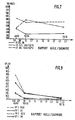
- FIG. 7 represents the evolution of the electrical stability VB as a function of the H / S ratio immediately after manufacture of the emulsion and after respectively 48 hours and 162 hours of aging under dynamic conditions at 150 ° C.
- Figure 8 shows the evolution of electrical stability as a function of aging for different H / S ratios with an emulsifier concentration of 45g / l.
- FIG. 9 illustrates the evolution of the plastic viscosity VP and of the Yield Value YV as a function of the H / S ratio after manufacture of the emulsion (curves VP1 and YV1) and after 162 hours of aging under dynamic conditions at 150 ° C. . It is noted that an increase in the brine concentration increases the rheological characteristics of the emulsion. For an H / S ratio of 40/60, the plastic viscosity increases as a function of the aging time.
- the Yield Value is not very sensitive to aging time. It remains high for H / S ratios of 40/60 but it drops very quickly as soon as the H / S ratio reaches 70/30, and even from 50/50.
- This example relates to emulsions of final density 1.15 produced with a brine with a single salt (CaBr2), of density 1.49 for an oil / brine volume ratio (H / S) of 50/50, and of density 1 , 66 for an H / S volume of 60/40, with an HDF 200 oil with a density of 0.817 and an emulsifier concentration varying from 25 to 45 g / l.
- FIGS. 10 and 11 show the variation of the electrical stability VB as a function of the emulsifier concentration, respectively after manufacture of the emulsion and after aging under dynamic conditions at 150 ° C. for 114 hours.
- the emulsions After aging at 150 ° C for 114 hours, the emulsions are stable. As a general rule, the electrical stability remains higher for an H / S ratio of 60/40 than of 50/50.
- FIGS. 12 and 13 respectively represent the variation in plastic viscosity VP and in Yield Value YV as a function of the emulsifier concentration, for different H / S ratios, after manufacture of the emulsion and after aging thereof in dynamic regime at 150 ° C for 114 hours.
- the plastic viscosity is greater for a 50/50 ratio than 60/40.
- the Yield Value is lower, at concentrations of 40-45 g / l of emulsifier, than during manufacture.
- Emulsions of density 1.15 are prepared, with HDF 200 oil of density 0.817, brines of density varying between 1.33 and 1.41 and comprising as salt (s) either CaBr2, ZnBr2 or the mixture CaBr2-ZnBr2, with an oil / brine volume ratio (H / S) equal to 44/56, and with an emulsifier concentration equal to 35 g / l.
- FIGS. 14 and 15 show the evolution of the electrical stability of the emulsions as a function of the H / S ratio, respectively after manufacture of the emulsions and after aging of the latter in static mode at 150 ° C. for 166 hours.
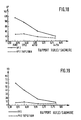
- Figures 16 and 17 on the one hand, 18 ′ and 19 on the other hand, 20 and 21 on the third hand, represent the evolution of the plastic viscosity VP and of the Yield Value YV of the emulsions as a function of the H / S ratio , respectively for emulsions based on CaBr2-ZnBr2, based on ZnBr2 and based on CaBr2, after manufacture of the emulsions and after aging thereof in a static regime at 150 ° C for 166 hours.
- the variation in the H / S ratio, in the direction of a decrease in the H / S ratio has the consequences: - a fall in VP and YV whatever the type of brine; - a decrease in YV, more noticeable for the brine ZnBr2 than for the two other brines CaBr2 or CaBr2-ZnBr2; - a non-continuous evolution of VP for the CaBr2 brine, before and after aging, except for the H / S 40/60 ratio; - a tendency of the plastic viscosity to drop for the two brines based on CaBr2-ZnBr2 and ZnBr2, both before and after aging.
- This example concerns the effect of contamination of a stable emulsion according to the invention with an FGN clay or with fresh water.
- An emulsion having a final density of 1.15 was used, comprising, in an H / S volume ratio of 40/60, an HDF 200 oil of density 0.817, a CaBr2-based brine of density 1.376 and a concentration of emulsifier of 35 g / l.
- Contamination tests with FGN filler clay were carried out with clay levels of 25, 50, 75, 100, 125 and 150 g / l of emulsion.
- VP and YV remain stable after contamination of clay up to concentrations of 100 g / l. Beyond this concentration, the contamination is too high and generates very high values of YV and VP.
- FIG. 24 shows the variations in the electrical stability as a function of the water contamination expressed in% by volume, after aging under dynamic conditions of the emulsion for 72 hours at 150 ° C.
- FIG. 25 shows the variations in the plastic viscosity VP and in the Yield Value of the YV emulsion as a function of the contamination rate in fresh water, expressed in% by volume of water, after aging of the emulsion in dynamic regime for 72 hours at 150 ° C.
- This example is intended to illustrate the advantage of these fluids with reverse emulsion without solids used as completion fluid in oil drilling.
- the tests were carried out on a Hassler type permeability measurement cell.
- the Hassler assembly consists in placing a sample of ground (carrot) in a flexible rubber tube. At each end, the core is extended by steel heads which make it possible to inject or collect fluids at each end and to measure the pressure. Sealing is ensured by inflation with a liquid under pressure.
- the permeability calculation is done by application of Darcy's law.
- the permeability is a function of the differential pressure and the flow rate of the fluid in the core.
- the measurement of permeability amounts to measuring the variations of differential pressure in the core.
- the emulsion used had a density of 1.57 and consisted of a TR3 oil and a brine based on CaBr2-ZnBr2 with an H / S ratio of 50/50, with 30 g / l of emulsifier.
- the emulsion had been aged for 72 hours at 150 ° C. under dynamic conditions.
- the tested fluid Under a pressure of 25.105Pa, the tested fluid is injected (reverse emulsion), for 1 hour 30 minutes and at a temperature of 65 ° C, until the filtrate appears.
- the remaining fluid in the circuit is purged and Kerdane is injected, under a pressure of 35.105Pa, at a temperature of 65 ° C, for 10 minutes.
- the permeability is measured at a stabilized temperature at 65 ° C, under constant flow and constant pressure, under Kerdane injection.
Landscapes
- Chemical & Material Sciences (AREA)
- Engineering & Computer Science (AREA)
- Materials Engineering (AREA)
- Organic Chemistry (AREA)
- Oil, Petroleum & Natural Gas (AREA)
- Life Sciences & Earth Sciences (AREA)
- General Life Sciences & Earth Sciences (AREA)
- Colloid Chemistry (AREA)
- Emulsifying, Dispersing, Foam-Producing Or Wetting Agents (AREA)
- Organic Low-Molecular-Weight Compounds And Preparation Thereof (AREA)
Applications Claiming Priority (2)
| Application Number | Priority Date | Filing Date | Title |
|---|---|---|---|
| FR8911601 | 1989-09-05 | ||
| FR8911601A FR2651446B1 (fr) | 1989-09-05 | 1989-09-05 | Nouvel emulsifiant, emulsions inverses realisees a l'aide de cet emulsifiant et leur utilisation dans des puits de forage. |
Publications (3)
| Publication Number | Publication Date |
|---|---|
| EP0420710A2 true EP0420710A2 (de) | 1991-04-03 |
| EP0420710A3 EP0420710A3 (en) | 1991-08-07 |
| EP0420710B1 EP0420710B1 (de) | 1994-12-07 |
Family
ID=9385149
Family Applications (1)
| Application Number | Title | Priority Date | Filing Date |
|---|---|---|---|
| EP90402386A Expired - Lifetime EP0420710B1 (de) | 1989-09-05 | 1990-08-29 | Unter Verwendung von Emulgatoren hergestellte Umkehremulsionen und Verwendung dieser Emulsionen in Bohrlöchern |
Country Status (5)
| Country | Link |
|---|---|
| EP (1) | EP0420710B1 (de) |
| CA (1) | CA2024545C (de) |
| DE (1) | DE69014805T2 (de) |
| FR (1) | FR2651446B1 (de) |
| NO (1) | NO300357B1 (de) |
Family Cites Families (6)
| Publication number | Priority date | Publication date | Assignee | Title |
|---|---|---|---|---|
| MX154899A (es) * | 1979-05-03 | 1987-12-29 | Ciba Geigy Ag | Procedimiento para la preparacion de oligomeros terminados en sulfuro de perfluordalquilo |
| US4381241A (en) * | 1981-02-23 | 1983-04-26 | Dow Corning Corporation | Invert emulsions for well-drilling comprising a polydiorganosiloxane and method therefor |
| US4421656A (en) * | 1981-12-31 | 1983-12-20 | Dow Corning Corporation | Silicone emulsifier composition, invert emulsions therefrom and method therefor |
| DE3636429A1 (de) * | 1986-02-26 | 1987-08-27 | Basf Ag | Polymere tenside auf basis von copolymerisaten aus hydrophoben und hydrophilen monomeren |
| US4745154A (en) * | 1986-04-14 | 1988-05-17 | Alco Chemical Corporation | Water soluble polymers, their preparation and their uses |
| DE3906702A1 (de) * | 1989-03-03 | 1990-09-13 | Goldschmidt Ag Th | Polyacrylsaeureester mit langkettigen kohlenwasserstoff- und polyoxyalkylengruppen und deren verwendung als grenzflaechenaktive substanzen |
-
1989
- 1989-09-05 FR FR8911601A patent/FR2651446B1/fr not_active Expired - Lifetime
-
1990
- 1990-08-29 EP EP90402386A patent/EP0420710B1/de not_active Expired - Lifetime
- 1990-08-29 DE DE69014805T patent/DE69014805T2/de not_active Expired - Lifetime
- 1990-09-04 CA CA002024545A patent/CA2024545C/fr not_active Expired - Lifetime
- 1990-09-04 NO NO903856A patent/NO300357B1/no not_active IP Right Cessation
Also Published As
| Publication number | Publication date |
|---|---|
| NO903856L (no) | 1991-03-06 |
| EP0420710A3 (en) | 1991-08-07 |
| DE69014805T2 (de) | 1995-07-06 |
| CA2024545C (fr) | 2003-04-08 |
| CA2024545A1 (fr) | 1991-03-06 |
| FR2651446A1 (fr) | 1991-03-08 |
| NO300357B1 (no) | 1997-05-20 |
| EP0420710B1 (de) | 1994-12-07 |
| FR2651446B1 (fr) | 1991-12-27 |
| DE69014805D1 (de) | 1995-01-19 |
| NO903856D0 (no) | 1990-09-04 |
Similar Documents
| Publication | Publication Date | Title |
|---|---|---|
| EP0091377A1 (de) | Zementzusammensetzungen für Bohrlöcher zum Bekämpfen von annularen Gasentweichungen unter Druck | |
| FR3094373A1 (fr) | Emulsion inverse pour la fracturation hydraulique | |
| RU2179568C1 (ru) | Безглинистый буровой раствор для вскрытия продуктивных пластов | |
| FR3102479A1 (fr) | Emulsion inverse pour la fracturation hydraulique | |
| EP3585836B1 (de) | Polyphasige polymersuspension und ihre verwendung | |
| EP0420710B1 (de) | Unter Verwendung von Emulgatoren hergestellte Umkehremulsionen und Verwendung dieser Emulsionen in Bohrlöchern | |
| EP3380579A1 (de) | Zusammensetzung zur begrenzung der bildung und/oder agglomeration von gashydraten | |
| EP1412448B1 (de) | Methode zur kontrolle der sättigung einer formation in der nähe eines bohrlochs | |
| WO2018206881A1 (fr) | Composition permettant de retarder la formation d'hydrates de gaz | |
| EP1697482B1 (de) | Ölbasierte bohrflüssigkeit mit einem umweltmässig unbedenklichen, für alle basisöle einsetzbaren und gegenüber gashydratbildung stabilen emulgiersystem | |
| FR2863301A1 (fr) | Methode et composition pour remedier aux pertes de fluides en cours de forage | |
| EP3699255A1 (de) | Schaumformulierungen für die unterstützte rückgewinnung von erdöl | |
| EP0425521A1 (de) | Verfahren zur Anwendung eines Gels in Bohrlöchern. | |
| FR2473054A1 (fr) | Fluide de forage contenant un agent alourdissant | |
| EP0245157A1 (de) | Emulgierende Zusammensetzung und dieselbe enthaltende umgekehrte Emulsion | |
| FR2534268A1 (fr) | Fluide de completion allege a l'aide de billes creuses en verre | |
| EP3921384A1 (de) | Verwendung von esteramin zur verhinderung der agglomeration von gashydraten | |
| CA2043340A1 (fr) | Application de boues contenant du scleroglucane au forage des puits a gros diametre | |
| CA2032986C (fr) | Procede et composition pour la reduction selective de la permeabilite a l'eau dans les reservoirs d'hydrocarbures chauds et sales | |
| CN111484835A (zh) | 一种水溶性油基钻井液润滑剂及其制备方法 | |
| CA2075936A1 (fr) | Application des boues au scleroglucane au forage des puits devies | |
| RU2006572C1 (ru) | Состав для вытеснения нефти | |
| US5242899A (en) | Emulsfiying agent, reverse emulsions produced using this emulsifying agent and use of these emulsions in drilling wells | |
| WO2018007305A1 (fr) | Stabilisation de mousses par des particules d'argile | |
| WO2003037496A1 (fr) | Emulsion a base de tensioactif et de polymere de charge opposee et procede de fabrication |
Legal Events
| Date | Code | Title | Description |
|---|---|---|---|
| PUAI | Public reference made under article 153(3) epc to a published international application that has entered the european phase |
Free format text: ORIGINAL CODE: 0009012 |
|
| AK | Designated contracting states |
Kind code of ref document: A2 Designated state(s): DE FR GB IT NL SE |
|
| RHK1 | Main classification (correction) |
Ipc: B01F 17/00 |
|
| PUAL | Search report despatched |
Free format text: ORIGINAL CODE: 0009013 |
|
| AK | Designated contracting states |
Kind code of ref document: A3 Designated state(s): DE FR GB IT NL SE |
|
| RHK1 | Main classification (correction) |
Ipc: B01F 17/52 |
|
| 17P | Request for examination filed |
Effective date: 19911121 |
|
| 17Q | First examination report despatched |
Effective date: 19930413 |
|
| RAP1 | Party data changed (applicant data changed or rights of an application transferred) |
Owner name: TOTAL |
|
| GRAA | (expected) grant |
Free format text: ORIGINAL CODE: 0009210 |
|
| ITF | It: translation for a ep patent filed | ||
| AK | Designated contracting states |
Kind code of ref document: B1 Designated state(s): DE FR GB IT NL SE |
|
| REF | Corresponds to: |
Ref document number: 69014805 Country of ref document: DE Date of ref document: 19950119 |
|
| EAL | Se: european patent in force in sweden |
Ref document number: 90402386.8 |
|
| GBT | Gb: translation of ep patent filed (gb section 77(6)(a)/1977) |
Effective date: 19950208 |
|
| PLBE | No opposition filed within time limit |
Free format text: ORIGINAL CODE: 0009261 |
|
| STAA | Information on the status of an ep patent application or granted ep patent |
Free format text: STATUS: NO OPPOSITION FILED WITHIN TIME LIMIT |
|
| 26N | No opposition filed | ||
| REG | Reference to a national code |
Ref country code: GB Ref legal event code: IF02 |
|
| PGFP | Annual fee paid to national office [announced via postgrant information from national office to epo] |
Ref country code: DE Payment date: 20090907 Year of fee payment: 20 Ref country code: SE Payment date: 20090727 Year of fee payment: 20 Ref country code: NL Payment date: 20090724 Year of fee payment: 20 Ref country code: GB Payment date: 20090728 Year of fee payment: 20 |
|
| PGFP | Annual fee paid to national office [announced via postgrant information from national office to epo] |
Ref country code: IT Payment date: 20090826 Year of fee payment: 20 |
|
| PGFP | Annual fee paid to national office [announced via postgrant information from national office to epo] |
Ref country code: FR Payment date: 20100208 Year of fee payment: 20 |
|
| REG | Reference to a national code |
Ref country code: NL Ref legal event code: V4 Effective date: 20100829 |
|
| REG | Reference to a national code |
Ref country code: GB Ref legal event code: PE20 Expiry date: 20100828 |
|
| EUG | Se: european patent has lapsed | ||
| PG25 | Lapsed in a contracting state [announced via postgrant information from national office to epo] |
Ref country code: NL Free format text: LAPSE BECAUSE OF EXPIRATION OF PROTECTION Effective date: 20100829 |
|
| PG25 | Lapsed in a contracting state [announced via postgrant information from national office to epo] |
Ref country code: GB Free format text: LAPSE BECAUSE OF EXPIRATION OF PROTECTION Effective date: 20100828 |
|
| PG25 | Lapsed in a contracting state [announced via postgrant information from national office to epo] |
Ref country code: DE Free format text: LAPSE BECAUSE OF EXPIRATION OF PROTECTION Effective date: 20100829 |