EP0420277B1 - Amusement system - Google Patents
Amusement system Download PDFInfo
- Publication number
- EP0420277B1 EP0420277B1 EP90118703A EP90118703A EP0420277B1 EP 0420277 B1 EP0420277 B1 EP 0420277B1 EP 90118703 A EP90118703 A EP 90118703A EP 90118703 A EP90118703 A EP 90118703A EP 0420277 B1 EP0420277 B1 EP 0420277B1
- Authority
- EP
- European Patent Office
- Prior art keywords
- game
- carrier
- score
- players
- player
- Prior art date
- Legal status (The legal status is an assumption and is not a legal conclusion. Google has not performed a legal analysis and makes no representation as to the accuracy of the status listed.)
- Expired - Lifetime
Links
Images



Classifications
-
- A—HUMAN NECESSITIES
- A63—SPORTS; GAMES; AMUSEMENTS
- A63G—MERRY-GO-ROUNDS; SWINGS; ROCKING-HORSES; CHUTES; SWITCHBACKS; SIMILAR DEVICES FOR PUBLIC AMUSEMENT
- A63G33/00—Devices allowing competitions between several persons, not otherwise provided for
-
- A—HUMAN NECESSITIES
- A63—SPORTS; GAMES; AMUSEMENTS
- A63F—CARD, BOARD, OR ROULETTE GAMES; INDOOR GAMES USING SMALL MOVING PLAYING BODIES; VIDEO GAMES; GAMES NOT OTHERWISE PROVIDED FOR
- A63F9/00—Games not otherwise provided for
- A63F9/02—Shooting or hurling games
- A63F9/0291—Shooting or hurling games with a simulated projectile, e.g. an image on a screen
Definitions
- the present invention relates to an amusement system and particularly to an amusement system in which players can play a game on the respective carriers moving along a given path within a play zone.
- each of the trains on which a player or players are getting first moves through a cluster of UFO's.
- Each of UFO's includes a photosensor which will produce a certain sound when it is hit by a light beam from a beam gun manipulated by the player.
- Each of these space monsters also includes a photosensor which, when it is hit by the light beam from the beam gun, causes a hit space monster to move or lash out.
- the players will return to the space station after they have fought against the cluster of UFO's and space monsters while getting on the trains.
- Such a para-experience type amusement system provides a new and very increased amusingness of a shooting game since players can shoot targets successively appearing in a playing space while moving within the playing space.
- the amusement system as aforementioned has a problem in that it easily causes the players to have lost interest in playing the game since the game is played by the players only in a single representation mode.
- the present invention provides an amusement system according to the preamble of claim 1 comprising score computing means for processing the score obtained by each player on the same carrier means; and representing means being adapted to change the game representation mode from one to another at a game stage through which said carrier means is moving or will move, depending on the carrier score which is computed by the score processing means.
- the play zone includes a plurality of game stages in combination.
- targets are displayed depending on a game representation mode at that time.
- the score computing means will be count to provide his score at that time point.
- the amusement system of the present invention can provide a substantially real feel in shooting to the player when he shoots and/or hits targets while getting on the carrier means moving within the game zone and yet provide a very increased amusingness in the shooting game since a plurality of players can compete in their scores with each of the players confirming his their score substantially at real time.
- the present invention is characterized by that the game representation mode is changed from one to another in a game stage through which said carrier means is being moved or another game stage through which said carrier means will be moved subsequently, depending on the processed score for each player.
- any one of the game stages is constructed to be variable in game representation mode.
- the game representation mode may be simply changed in the variable mode stage at each time when the carrier means is moving or will move through that variable mode stage, depending on the computed score of each player on the carrier means.
- the other means for changing the game representation mode may be that the travel path is branched at a given point into a different travel path along which the carrier means can run.
- the carrier means may be conducted onto any selected one of the travel paths along which the carrier means will move through a game stage with a different representation mode.
- the present invention can cause the player to play the game with new excitation and amusingness even if the same player plays the game repeatedly.
- FIGS 1 through 10 illustrate a first preferred embodiment of an amusement system constructed in accordance with the present invention.
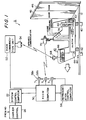
- Figure 1 illustrates the relationship between a control circuit in each of the game stages and various instruments in a carrier.
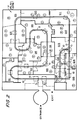
- Figure 2 illustrates the travel path of the carrier in a play zone consisting of a plurality of game stages.
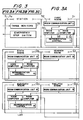
- Figure 3 is a block diagram of a circuitry used in the amusement system according the first embodiment of the present invention.
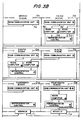
- Figure 4 illustrates the entire system constructed of the game stages and a central control room.
- Figure 5 illustrates one game representation in a given game stage.
- Figure 6 illustrates the concrete form of a beam gun in each carrier.
- Figure 7 illustrates a score display panel in each carrier.
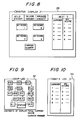
- Figure 8 illustrates one display used in a station platform at which the players gets on and off the carrier.
- Figures 9 and 10 illustrate displays on the outer wall of a building defining the play zone.
- FIG 11 illustrates another embodiment of an amusement system constructed in accordance with the present invention.
- the amusement system comprises a play zone P and a plurality of game stages G1, G2 , G17.
- Each of the game stages G1 - G17 is set in an individual room and have a different game representation mode from game representation modes in the other game stages.
- each of the game stages G1 - G15 is provided with targets T compatible with its game representation mode.
- the amusement system further comprises a plurality of carriers 10, each of which starts at a getting-on station S1, moves on a rail 12 sequentially through the first game stage G1 ?? the seventeenth game stage G17, and finally returns to a getting-off station S2.
- a player thereon can shoot the targets T through his shooting device. If a target T is hit, it generates a hit signal which in turn is wireless transmitted to the carrier 10.
- the carrier 10 receives the hit signal, it displays the counted score of the player.
- Each of the game stages G13, G14, G16 and G17 includes a branch table C1, C2, C3 or C4. Two of these branch tables C1 and C2 are used to divide the rail 12 into two branch rail sections while the remaining branch tables C3 and C4 are used to merge the two branch rail sections into the rail 12.
- Figure 3 shows the relationship between the game stages G1 - G15 in the first preferred embodiment while Figure 4 shows the circuitry of said system in details.
- the amusement system further comprises a central control room 20 in addition to the game stages G1 - G15.
- the central control room 20 includes a system control computer 22, a display computer 24 and a carrier controller 26.
- the system control computer 22 is connected with the control circuits of the respective game stages G1 - G17 through LAN for transmission of data therebetween.
- the carrier controller 26 is adapted to control the movement of the respective carriers 10 on and along the rail 12 and to control the operation of the branch tables C1 - C4. More particularly, the carrier 10 is not self propelled, but is supplied with a drive power from the rail 12.
- the rail 12 includes, at preselected positions, carrier position sensors 40 ( Figure 1) each for sensing the position of a moving carrier on the rail 12. When the carrier controller 26 receives a detection signal from each of the sensors 40, the controller 26 controls the speed of each of the moving carriers 10.
- each of the game stages G includes, in principle, a room computer 50, a room communication unit 52 and an infrared transmitter-receiver 54.
- a representation control computer 56 is further provided, in principle, one for two game stages.
- Figure 1 shows part of the arrangement of a game stage G and also the concrete structure of a carrier 10.
- Each of the game stages G is provided, at its entrance, with a sensor 42 for detecting the entry of each carrier 10 and a carrier position plate 44.
- the sensor 42 detects the entry of a carrier 10, it generates a detection signal which is supplied to the representation control computer 56.
- the representation control computer 56 On receiving the detection signal from the sensor 42, the representation control computer 56 then initiates a game representation in that game stage G.
- such a game representation is accomplished by sequentially controlling variable components, such as targets T, sounding instruments, illuminating lamps, doors 46 and others, in accordance with preselected game processing modes.
- variable components such as targets T, sounding instruments, illuminating lamps, doors 46 and others.
- the processing of game may be carried out, for example, by controlling the behavior of monsters attacking the player with sound and illumination.
- each of the monsters may have some vital points at its eyes, arm roots and others, which vital points are set as targets T.
- each of the targets T includes an LED 58a for indicating the position of that target and an infrared sensor 58b for detecting the beam of a gun manipulated by the player. If any one of the vital points is hit by the beam, the count belonging to that player will be incremented.
- Each of the carriers 10 further comprises a computer 60 for processing the score of the player; a RAM 62 for storing the score of the player; a sensor 64 for sensing the entry and exit of a carrier 10 in a game stage at each time when that carrier 10 moves past the carrier position plate 44; a communication unit 66; a beam gun 70 adapted to direct a beam of infrared against the targets T; and a score display panel 74 for displaying the score of the player in the game.
- a carrier 10 has seats on which four players sit. Therefore, each of the seats will include a beam gun 70 and a score display panel 74.
- the beam guns 70 are adapted to emit beams including different identification codes from one another. Furthermore, the four beam guns 70 are controlled so that each beam gun is slightly out of timing from the other guns on firing. Even if the four beam guns 70 are simultaneously fired, each of the beam guns 70 may be energized out of timing from the other beam guns.
- Figure 6 shows the concrete structure of a beam gun 70 which includes a trigger switch 70a.
- the trigger switch 70a When the trigger switch 70a is turned on, the beam gun 70 causes its fire display LED 70c to light on.
- a beam of infrared containing its identification code is emitted from an infrared emitting element 70b in the beam gun 70.
- the sensor 58b therein receives the beam of infrared with its identification code to generate a receipt signal which in turn is supplied to the room computer 50.
- the room computer 50 On receiving the receipt signal, the room computer 50 then generates a hit signal which is supplied to the representation control computer 56. On receiving the hit signal, the representation control computer 56 causes the target T to initiate a behavior so preselected that target T acts when it is hit by the beam of infrared. At the same time, the room computer 50 also transmits this hit signal with the identification code to the room communication unit 50. The room communication unit 50 then causes the transmitter-receiver 54 to wireless transmit the data to the carrier 10.
- the carrier 10 receives the data through the transmitting and receiving device 68 and the communication unit 66, the data being then supplied to the computer 60.
- the computer 60 processes the score of the corresponding player in accordance with the input data and rewrites the score data in the RAM 62.
- the computer 60 causes the score display panel 74 to display new score with respect to the corresponding player.
- the score display panel 74 includes a my score display section 74a for displaying scores in the respective players; a treasure display section 74b for displaying treasures won by the players; a total score display section 74c for displaying the total score of all the players on the same carrier 10; and gold, silver and bronze knight display sections 74d, 74e and 74f for displaying the final scores of the players.
- each of the players can confirm his own score and the scores of the other players in the same carrier through viewing the my score display section 74a, the treasure display section 74b and the total carrier score display section 74c during the playing of game. In such a manner, each of the players can compete with the other players on the same carrier in score while trying to increment the total carrier score together with the other players.
- the present invention is mainly characterized by that the game representation mode in each game stage G through which a carrier 10 moves or will move is variable depending on the scores of the players.
- the illustrated embodiment of the amusement system is so arranged that when a carrier 10 enters each of the game stages G and moves past the carrier position plate 44, it is detected by the sensor 64 which in turn generates a data transmission command to be applied to the computer 60. Immediately when the computer 60 receives this signal, it wireless transmits the score of each of the players stored in the RAM 62 to the transmitting and receiving device 54 in the game stage G through the transmitting and receiving device 68 in the carrier 10. The transmitted data is applied to the room computer 50 which in turn determines a game representation mode. The determined game representation mode is then supplied to the representation control computer 56.
- the representation control computer 56 has previously stored a plurality of game representation modes for each of the game stages G1 - G17. Depending on the command inputted into the representation control computer 56, it sequentially controls the representation of game.
- the computer 60 in each of the carriers 10 also functions as a part of the representing means. More particularly, the computer 60 is adapted to provide changes in the game representation by increasing or decreasing the power of a beam gun 70 used by each player, depending on the score of that player which is read out from the RAM 62. For example, if a treasure for increasing the power of a beam gun is set as a target T and when this target T is hit by the beam of that beam gun, the score of a player handling this beam gun will be incremented as one treasure point and stored in the RAM 62. As the carrier 10 enters the next game stage G, the computer 60 increases the power of the beam gun 70 depending on this treasure point. The powering-up of the beam gun 70 enables it to fire two or three times per second, which would otherwise normally fire one time per second.
- the amusement system can provide a multi-scenario game which is variable in representation for each of the game stages, depending on the carrier score won by the players thereon. Even if the game is repeatedly played by the players on the carrier, they can always play the game with fresh excitement and enjoyment.
- the amusement system of the present invention is characterized by a multi-ending type representation in which the game completes with a different ending, depending on the total carrier score.
- the travel path of the amusement system may include branch tables C1 and C2 on the respective game stages G13 and G14 adjacent to the ending of the game.
- the carrier 10 will be conducted to the game stages G16 and G17 through the branch table C1, in which the game is over. At this time, each of the players on the carrier will only obtain a bronze knight title which is in the minimum rank.
- the carrier will advance the game stage G14 wherein the players on the carrier can fight new monsters. If the players do not defeat all the monsters, the carrier will be conducted to the game stages G16 and G17 through the branch table C2, in which the game is over. At this time, each of the players on the carrier can won a silver knight title.
- the carrier 10 can advance the final game stage G15 and each of the players can win the maximum title, that is, a gold knight.
- the titles won by the players may be displayed on the respective knight display sections 74d, 74e and 74f in the display panel 74 within the carrier 10.
- the score data of each of the players is transmitted from the room computer 50 of each of the game stages G1 - G15 to the system control computer 22 of the central control room 20 through the LAN.
- the system control computer 22 then processes the transmitted data to determine the score of each player.
- These determined scores are displayed on three monitors 28 in the getting-on and -off stations S1 and S2, as shown in Figure 8. Accordingly, each of the players can compare his own score with the scores of the other players and the best-5 scores in the getting-off station S2. Further, any other players waiting their own carrier in the getting-on station S1 can view the scores of the players which have completed the game.
- the outer wall 30 defining the play zone P includes a map display portion 32 for displaying the positions of the moving carriers 10 as shown in Figure 9 and a score display portion 34 for displaying the best-5 scores as shown in Figure 10.
- These outer wall display portions 32 and 34 are controlled by the system control computer 22.
- the amusement system may be arranged such that each of the game stages G1 - G15 has an independent control including the room computer 50, the representation control computer 56 and others, each game stage being capable of operating independently of the other game stages.
- the system control computer 22 may totally monitor the game stages G1 - G15 through the LAN through which the data are transmitted and received between the respective game stages.
- the system control computer 22 can rapidly detect it. Therefore, any failure may be repaired promptly. This can facilitate maintenance and inspection in the entire amusement system.
- the game can proceed utilizing the remaining game stages since each game stage is independent from the other game stages. This can improve the efficiency of operation in the amusement system.
- the system control computer 22 may distribute the total carrier score in the failed game stage to the remaining game stages which are in the normal operation. Thus, the multi-ending score in the game stages G13 and G14 may be properly estimated.
- the infrared transmitter-receiver 54 has a frequency different from those of the adjacent transmitter-receiver 54 such that there will not occur any interference.
- the frequencies of the transmitter-receiver 54 at the game stages G1, G3, ... G15 may be set to be different from those of the game stages G2, G4, ... G14.
- the frequency of the transmitter-receiver 68 thereof is changed into another frequency which is used to perform the transmission and reception of data only between the transmitter-receiver 68 and the corresponding transmitter-receiver 54.
- This game is of a multi-scenario and multi-ending type wherein each player acts a role as a hero "Gil” who helps a heroine “Kay” caught by Matter “Dole-Urger”. Gil gets on a carrier 10 and wins his power capable of overcoming the power of the final enemy, "Dole-Urger” while fighting various devils and monsters with a beam gun 70.
- the game is played by the players in accordance with a story constructed by a multi-scenario representation variable depending on the manner in which the players fight and a multi-ending representation in which if the total carrier score is lower than a predetermined level, the game is over and in which only a true hero can help Kay.
- each of the players gets on the carrier 10 and starts the getting-on station S1 to the play zone P in which he fights various enemies with his beam gun 70 and goes to help Kay.
- the carrier 10 first reaches the game stage G1.
- the game stage G1 two slimes on which yellow-colored light rolls squirm on the dark floor. If each of the slimes is hit by the beam from the beam gun 70, the color of its body is first changed from one to another and then disappears (that player wins one hundred points).
- the carrier 10 is then advanced to the second game stage G2.
- this game stage G2 two slimes emitting red color move upwardly on the wall slowly. As each of the red slimes is hit by the beam from the beam gun 70, it falls onto the floor (that player wins one hundred points).
- the treasure display section 74b in the score display panel 74 causes a necklace lamp to turn on, representative of one hundred points. If a player has such a magic necklace, he can unlock a treasure box by the use of the magic necklace when Kay will have helped by the player.
- the carrier 10 is moved to the third game stage G3 wherein three "Rockmen” move in a rocking manner, each "Rockman” having an open and clattering mouth and ominously sparkling eyes.
- Each of the “Rockmen” includes a target T in its mouth. If the target T in the mouth of a “Rockman” is hit by the beam from the beam gun 70, that "Rockman” shouts and puts off the light in its eyes (the player wins two hundred points).
- each of the sousaras is a monster which has shining red eyes viewed through a gap in a mantle and a pendant suspended from its neck. If the pendant is hit by the beam from the beam gun one time, its color changes from one to another. If the pendant is hit by the beam two times, the flames disappear and the face of that sousara varies into a skull face (one defeated sousara being equal to one - two hundred points).
- the players encounter two small and green bottles shining on a shelf. These bottles contain a poison. If a player attacks the bottles, he will lose many points (one bottle corresponds to minus two hundred points).
- the players After the carrier 10 has successfully moved through the game stages G7 - G10 and when it enters the game stage G11 or G12 which is one of the most difficult stages, the players encounter a dragon having a vertically moving head and a horizontally moving tail.
- the dragon has vital points at its head, forelegs and tail. If any one of these vital points is hit by the beam from the beam gun, the red color of the dragon's eyes changes to green color. Substantially at the same time, the dragon shouts and disappears (points won by the defeat of the dragon being equal to two or eight hundred points). If the dragon is defeated, all the players on the carrier 10 are given treasure points which are displayed in the form of a key of hope on the treasure display section 74b (one key of hope corresponding to two hundred points).
- the carrier 10 then enters the game stage G13. If the players defeat a dragon, all of them are given a title of silver knight. This means that the total carrier score reaches four or more thousand points. Only in such a situation, the players can open the brave's door and advance the game stage G14.
- Dole-Urger When the carrier 10 opens the brave's door and enters the game stage G14, the players on the carrier 10 must fight Dole-Urger.
- Dole-Urger sits on a chair and two skeletons stay on the opposite walls about the chair (one skeleton corresponding to one hundred points).
- Dole-Urger has eight moving arms, three of which are vital points.
- Dole-Urger also has another vital point at a pendant which is suspended from the neck and becomes invisible from time to time (Dole-Urger corresponding to two - four hundred points).
- the carrier 10 If the players on the carrier 10 defeat Dole-Urger, they are given a crystal rod which enables the players to help Kay in the next game stage G15. If the players do not defeat Dole-Urger, the carrier 10 is moved to the game stages G16 and G17, with the players thereon being given a title of silver knight. Further, the carrier 10 will be returned to the getting-off station S2 through the defeated road in which the players are scorned by Dole-Urger.
- the carrier 10 After the players on the carrier 10 have completed their fight, the carrier 10 is returned to the getting-off station S2. As shown in Figure 8, the getting-off station S2 displays the score of each of the players, the titles given to all the players on the carrier 10 (gold knight, silver knight and bronze knight). Thus, the players can enjoy the game ending while viewing their scores and titles.
- the aforementioned treasure points may be more positively utilized as game representing points. For example, if a treasure point is won by any player on the carrier, such a treasure point may be utilized to change the game representation mode from one to another in a game stage through which the carrier is moving or will move. More particularly, there may be provided any speci al target appearing only when such a treasure point is won by the player on the carrier. This will aid the change of game representation mode.
- the present invention has been described as to a single rail 12 extending through the game stages G1 - G13, it may be applied to such an embodiment that the rail 12 is branched into one or more branch rail sections in the game stages G1 - G13.
- the carrier 10 may be selectively conducted to any one of the branch rail sections which leads to a game stage represented in a different mode, depending on the total carrier score.
- Figure 11 exemplifies such an arrangement wherein the game stages G2 and G10 include branch tables C5 and C6, respectively.
- the rail 12 is branched into two rail sections 12-1 and 12-2 at the game stage G2.
- the two rail sections 12-1 and 12-2 are merged into the rail 12 at the game stage G10.
- One of the branched rail sections 12-1 extends through the game stages G3, G4 and G5 while the other rail section 12-2 extends through the game stages G6, G7, G8 and G9.
- the carrier 10 As the carrier 10 enters the branch table C5 in the game stage G2, it is temporally stopped for a period of time during which data relating to the total carrier score in that carrier 10 is transmitted and received between the carrier 10 and the room computer 50 located in the game stage G2.
- the room computer 50 determines a branch rail section for the carrier to be conducted and provides a branch selection command to the carrier controller 26.
- the carrier controller 26 functions as part of the game representation means.
- the carrier controller 26 receives the branch selection command, it actuates the branch table C5 so that the carrier 10 will be selectively conducted to either of the branch rail section 12-1 or 12-2.
- this embodiment can cause the carrier to move onto any given one of the game stages in which the scene of game is played in a different representation mode, depending on the total carrier score.
- only a single representation mode may be set at each of the game stages G1 - G15.
- a plurality of game representation modes may be set at each of the game stages G1 - G15 to provide a more varied stage effect in each game stage, as in the first embodiment.
- the rail 12 includes more branch rail sections rather than two as described, if necessary.
- the carrier 10 running on the rail 12 may be replaced by any other travelling means which can move on and along a given travel path.
- the carrier 10 may be replaced by a vehicle running on roads in the play zone or a ship or boat moving within channels provided in the play zone.
- infrared beam gun 70 it may be replaced by any other shooting means. If only one player is adapted to get on the carrier means, any model gun launching BB bullets may be used in place of such a beam gun.
- system control computer 22 may be actuated under time sharing technique to control the shooting and representing operations in each of the game stages G1 - G17.
- the present invention may be applied to various other types of games, that is, a game wherein balls are thrown against targets to compete for score between players at each game stage; another game wherein players answer quizes provided at each of the game stages to increment their scores; and a further game wherein each player holds a hammer as in the mole beating game and beats targets such as monsters appearing at each of the game stages to increment his score.
- the present invention provides an amusement system in which a player or players can enjoy the game with more amusingness since the player or players on the carrier travelling in the play zone can confirm his own score or their own scores at real time while playing the game.
- the present invention provides a play zone consisting of a plurality of game stages in combination and adopts a new arrangement in which depending on the total carrier score, the game representation mode is variable at a game stage through which the carrier is moving or will move. Even if the players repeatedly play the game, therefore, they will not have lost interest in playing since the players can encounter various different representations at the respective game stages.
- a large-scaled amusement system which utilizes carriers moving along a given travel path has very important subject that does not cause many players to have lost interest in playing.
- the present invention is extremely effective for such a large-scaled amusement system.
Landscapes
- Engineering & Computer Science (AREA)
- Multimedia (AREA)
- Toys (AREA)
- Pinball Game Machines (AREA)
- Shift Register Type Memory (AREA)
Description
- The present invention relates to an amusement system and particularly to an amusement system in which players can play a game on the respective carriers moving along a given path within a play zone.
- There are known such a kind of game playing systems, one of which comprises Galaxy railroad adventure trains each traveling round within a play zone for about 2 or 3 minutes and target display means for representing a cluster of UFO's and huge space monsters as targets around the railroad.
- In such a game playing system, each of the trains on which a player or players are getting first moves through a cluster of UFO's. Each of UFO's includes a photosensor which will produce a certain sound when it is hit by a light beam from a beam gun manipulated by the player.
- After passed through the cluster of UFO's, a cluster of huge space monsters then appear around the moving train. Each of these space monsters also includes a photosensor which, when it is hit by the light beam from the beam gun, causes a hit space monster to move or lash out.
- The players will return to the space station after they have fought against the cluster of UFO's and space monsters while getting on the trains.
- Such a para-experience type amusement system provides a new and very increased amusingness of a shooting game since players can shoot targets successively appearing in a playing space while moving within the playing space.
- In the prior art, however, the players on the train only shoot and hit the targets without counting of their scores. Therefore, the prior art amusement system lacks a lot of fun in competition.
- The amusement system as aforementioned has a problem in that it easily causes the players to have lost interest in playing the game since the game is played by the players only in a single representation mode.
- In view of the fact that such an amusement system is large-scaled and expensive, it is desirable to provide any new amusement which will not easily cause players to have lost interest in playing a game.
- It is therefore an object of the present invention to provide a new and novel amusement system which can cause any player on a train traveling along a given path in a play zone to enjoy a game while confirming his score and yet which will not easily cause the player to have lost interest in playing the game by changing one representation mode to another, even though the player plays the same game repeatedly.
- To this end, the present invention provides an amusement system according to the preamble of claim 1 comprising
score computing means for processing the score obtained by each player on the same carrier means; and
representing means being adapted to change the game representation mode from one to another at a game stage through which said carrier means is moving or will move, depending on the carrier score which is computed by the score processing means. - The operation of such an amusement system according to the present invention will now be described as to when it is applied to a shooting game.
- In the amusement system of the present invention, the play zone includes a plurality of game stages in combination.
- At each time when the player or players on the carrier means are being moved through each of the game stages, targets are displayed depending on a game representation mode at that time.
- If a player shoots and hits any target by the use of any suitable gun, the score computing means will be count to provide his score at that time point.
- In such a manner, the amusement system of the present invention can provide a substantially real feel in shooting to the player when he shoots and/or hits targets while getting on the carrier means moving within the game zone and yet provide a very increased amusingness in the shooting game since a plurality of players can compete in their scores with each of the players confirming his their score substantially at real time.
- In addition, the present invention is characterized by that the game representation mode is changed from one to another in a game stage through which said carrier means is being moved or another game stage through which said carrier means will be moved subsequently, depending on the processed score for each player.
- One means for changing the game representation mode is that any one of the game stages is constructed to be variable in game representation mode. Thus, the game representation mode may be simply changed in the variable mode stage at each time when the carrier means is moving or will move through that variable mode stage, depending on the computed score of each player on the carrier means.
- The other means for changing the game representation mode may be that the travel path is branched at a given point into a different travel path along which the carrier means can run. Depending on the score of the player or players, the carrier means may be conducted onto any selected one of the travel paths along which the carrier means will move through a game stage with a different representation mode.
- Since the game representation mode is changed from one to another depending on the player's score during playing, the present invention can cause the player to play the game with new excitation and amusingness even if the same player plays the game repeatedly.
- Figures 1 through 10 illustrate a first preferred embodiment of an amusement system constructed in accordance with the present invention.
- Figure 1 illustrates the relationship between a control circuit in each of the game stages and various instruments in a carrier.
- Figure 2 illustrates the travel path of the carrier in a play zone consisting of a plurality of game stages.
- Figure 3 is a block diagram of a circuitry used in the amusement system according the first embodiment of the present invention.
- Figure 4 illustrates the entire system constructed of the game stages and a central control room.
- Figure 5 illustrates one game representation in a given game stage.
- Figure 6 illustrates the concrete form of a beam gun in each carrier.
- Figure 7 illustrates a score display panel in each carrier.
- Figure 8 illustrates one display used in a station platform at which the players gets on and off the carrier.
- Figures 9 and 10 illustrate displays on the outer wall of a building defining the play zone.
- Figure 11 illustrates another embodiment of an amusement system constructed in accordance with the present invention.
- Referring first to Figure 2, there is shown a preferred embodiment of an amusement system constructed in accordance with the present invention. The amusement system comprises a play zone P and a plurality of game stages G₁, G₂ ..... G₁₇.
- Each of the game stages G₁ - G₁₇ is set in an individual room and have a different game representation mode from game representation modes in the other game stages. In addition, each of the game stages G₁ - G₁₅ is provided with targets T compatible with its game representation mode.
- The amusement system further comprises a plurality of
carriers 10, each of which starts at a getting-on station S₁, moves on arail 12 sequentially through the first game stage G₁ ..... the seventeenth game stage G₁₇, and finally returns to a getting-off station S₂. During the movement of thecarrier 10, a player thereon can shoot the targets T through his shooting device. If a target T is hit, it generates a hit signal which in turn is wireless transmitted to thecarrier 10. When thecarrier 10 receives the hit signal, it displays the counted score of the player. Each of the game stages G₁₃, G₁₄, G₁₆ and G₁₇ includes a branch table C₁, C₂, C₃ or C₄. Two of these branch tables C₁ and C₂ are used to divide therail 12 into two branch rail sections while the remaining branch tables C₃ and C₄ are used to merge the two branch rail sections into therail 12. - Figure 3 shows the relationship between the game stages G₁ - G₁₅ in the first preferred embodiment while Figure 4 shows the circuitry of said system in details.
- Referring to Figure 3, the amusement system further comprises a
central control room 20 in addition to the game stages G₁ - G₁₅. Thecentral control room 20 includes asystem control computer 22, adisplay computer 24 and acarrier controller 26. - The
system control computer 22 is connected with the control circuits of the respective game stages G₁ - G₁₇ through LAN for transmission of data therebetween. - The
carrier controller 26 is adapted to control the movement of therespective carriers 10 on and along therail 12 and to control the operation of the branch tables C₁ - C₄. More particularly, thecarrier 10 is not self propelled, but is supplied with a drive power from therail 12. Therail 12 includes, at preselected positions, carrier position sensors 40 (Figure 1) each for sensing the position of a moving carrier on therail 12. When thecarrier controller 26 receives a detection signal from each of thesensors 40, thecontroller 26 controls the speed of each of themoving carriers 10. - As seen from Figure 1, each of the game stages G includes, in principle, a
room computer 50, aroom communication unit 52 and an infrared transmitter-receiver 54. Arepresentation control computer 56 is further provided, in principle, one for two game stages. - Figure 1 shows part of the arrangement of a game stage G and also the concrete structure of a
carrier 10. - Each of the game stages G is provided, at its entrance, with a
sensor 42 for detecting the entry of eachcarrier 10 and acarrier position plate 44. When thesensor 42 detects the entry of acarrier 10, it generates a detection signal which is supplied to therepresentation control computer 56. On receiving the detection signal from thesensor 42, therepresentation control computer 56 then initiates a game representation in that game stage G. - In the illustrated embodiment, such a game representation is accomplished by sequentially controlling variable components, such as targets T, sounding instruments, illuminating lamps,
doors 46 and others, in accordance with preselected game processing modes. As shown in Figure 5, the processing of game may be carried out, for example, by controlling the behavior of monsters attacking the player with sound and illumination. - In this connection, for example, each of the monsters may have some vital points at its eyes, arm roots and others, which vital points are set as targets T. As shown in Figure 1, each of the targets T includes an
LED 58a for indicating the position of that target and aninfrared sensor 58b for detecting the beam of a gun manipulated by the player. If any one of the vital points is hit by the beam, the count belonging to that player will be incremented. - Each of the
carriers 10 further comprises acomputer 60 for processing the score of the player; aRAM 62 for storing the score of the player; asensor 64 for sensing the entry and exit of acarrier 10 in a game stage at each time when thatcarrier 10 moves past thecarrier position plate 44; acommunication unit 66; abeam gun 70 adapted to direct a beam of infrared against the targets T; and ascore display panel 74 for displaying the score of the player in the game. - In the illustrated embodiment, a
carrier 10 has seats on which four players sit. Therefore, each of the seats will include abeam gun 70 and ascore display panel 74. - Since it is required in such a case to know which
gun 70 emits the beam, thebeam guns 70 are adapted to emit beams including different identification codes from one another. Furthermore, the fourbeam guns 70 are controlled so that each beam gun is slightly out of timing from the other guns on firing. Even if the fourbeam guns 70 are simultaneously fired, each of thebeam guns 70 may be energized out of timing from the other beam guns. - Figure 6 shows the concrete structure of a
beam gun 70 which includes atrigger switch 70a. When thetrigger switch 70a is turned on, thebeam gun 70 causes itsfire display LED 70c to light on. At the same time, a beam of infrared containing its identification code is emitted from an infrared emittingelement 70b in thebeam gun 70. - If the beam of infrared hits a target T, the
sensor 58b therein receives the beam of infrared with its identification code to generate a receipt signal which in turn is supplied to theroom computer 50. - On receiving the receipt signal, the
room computer 50 then generates a hit signal which is supplied to therepresentation control computer 56. On receiving the hit signal, therepresentation control computer 56 causes the target T to initiate a behavior so preselected that target T acts when it is hit by the beam of infrared. At the same time, theroom computer 50 also transmits this hit signal with the identification code to theroom communication unit 50. Theroom communication unit 50 then causes the transmitter-receiver 54 to wireless transmit the data to thecarrier 10. - The
carrier 10 receives the data through the transmitting and receivingdevice 68 and thecommunication unit 66, the data being then supplied to thecomputer 60. Thecomputer 60 processes the score of the corresponding player in accordance with the input data and rewrites the score data in theRAM 62. At the same time, thecomputer 60 causes thescore display panel 74 to display new score with respect to the corresponding player. - As seen from Figure 7, the
score display panel 74 includes a my score display section 74a for displaying scores in the respective players; a treasure display section 74b for displaying treasures won by the players; a totalscore display section 74c for displaying the total score of all the players on thesame carrier 10; and gold, silver and bronzeknight display sections score display section 74c during the playing of game. In such a manner, each of the players can compete with the other players on the same carrier in score while trying to increment the total carrier score together with the other players. - In such an arrangement, however, if the contents of the game in the game stages G₁ - G₁₇ are always played in a given representation mode, the players will be easily able to foresee the representation of game in the next game stage when they repeatedly play the game. Therefore, the players would easily have lost interest in playing the game.
- The present invention is mainly characterized by that the game representation mode in each game stage G through which a
carrier 10 moves or will move is variable depending on the scores of the players. - Even though the players repeatedly play the game, therefore, they can enjoy the game in various game representation modes.
- To this end, the illustrated embodiment of the amusement system is so arranged that when a
carrier 10 enters each of the game stages G and moves past thecarrier position plate 44, it is detected by thesensor 64 which in turn generates a data transmission command to be applied to thecomputer 60. Immediately when thecomputer 60 receives this signal, it wireless transmits the score of each of the players stored in theRAM 62 to the transmitting and receivingdevice 54 in the game stage G through the transmitting and receivingdevice 68 in thecarrier 10. The transmitted data is applied to theroom computer 50 which in turn determines a game representation mode. The determined game representation mode is then supplied to therepresentation control computer 56. - The
representation control computer 56 has previously stored a plurality of game representation modes for each of the game stages G₁ - G₁₇. Depending on the command inputted into therepresentation control computer 56, it sequentially controls the representation of game. - In addition, the
computer 60 in each of thecarriers 10 also functions as a part of the representing means. More particularly, thecomputer 60 is adapted to provide changes in the game representation by increasing or decreasing the power of abeam gun 70 used by each player, depending on the score of that player which is read out from theRAM 62. For example, if a treasure for increasing the power of a beam gun is set as a target T and when this target T is hit by the beam of that beam gun, the score of a player handling this beam gun will be incremented as one treasure point and stored in theRAM 62. As thecarrier 10 enters the next game stage G, thecomputer 60 increases the power of thebeam gun 70 depending on this treasure point. The powering-up of thebeam gun 70 enables it to fire two or three times per second, which would otherwise normally fire one time per second. - Thus, the amusement system can provide a multi-scenario game which is variable in representation for each of the game stages, depending on the carrier score won by the players thereon. Even if the game is repeatedly played by the players on the carrier, they can always play the game with fresh excitement and enjoyment.
- In addition to such a multi-scenario type representation, the amusement system of the present invention is characterized by a multi-ending type representation in which the game completes with a different ending, depending on the total carrier score.
- For such a purpose, the travel path of the amusement system may include branch tables C₁ and C₂ on the respective game stages G₁₃ and G₁₄ adjacent to the ending of the game.
- If the total carrier score does not reach a predetermined level in the game stage G₁₃, the
carrier 10 will be conducted to the game stages G₁₆ and G₁₇ through the branch table C₁, in which the game is over. At this time, each of the players on the carrier will only obtain a bronze knight title which is in the minimum rank. - On the contrary, if the total carrier score clears the predetermined level in the game stage G₁₃, the carrier will advance the game stage G₁₄ wherein the players on the carrier can fight new monsters. If the players do not defeat all the monsters, the carrier will be conducted to the game stages G₁₆ and G₁₇ through the branch table C₂, in which the game is over. At this time, each of the players on the carrier can won a silver knight title.
- If the players defeat all the monsters in the game stage G₁₄, the
carrier 10 can advance the final game stage G₁₅ and each of the players can win the maximum title, that is, a gold knight. - In such a multi-ending type representation, the titles won by the players may be displayed on the respective
knight display sections display panel 74 within thecarrier 10. - As shown in Figure 3, the score data of each of the players is transmitted from the
room computer 50 of each of the game stages G₁ - G₁₅ to thesystem control computer 22 of thecentral control room 20 through the LAN. Thesystem control computer 22 then processes the transmitted data to determine the score of each player. These determined scores are displayed on threemonitors 28 in the getting-on and -off stations S₁ and S₂, as shown in Figure 8. Accordingly, each of the players can compare his own score with the scores of the other players and the best-5 scores in the getting-off station S₂. Further, any other players waiting their own carrier in the getting-on station S₁ can view the scores of the players which have completed the game. - In addition, the
outer wall 30 defining the play zone P includes amap display portion 32 for displaying the positions of the movingcarriers 10 as shown in Figure 9 and ascore display portion 34 for displaying the best-5 scores as shown in Figure 10. These outerwall display portions system control computer 22. - The amusement system may be arranged such that each of the game stages G₁ - G₁₅ has an independent control including the
room computer 50, therepresentation control computer 56 and others, each game stage being capable of operating independently of the other game stages. Thesystem control computer 22 may totally monitor the game stages G₁ - G₁₅ through the LAN through which the data are transmitted and received between the respective game stages. - If any failure occurs, the
system control computer 22 can rapidly detect it. Therefore, any failure may be repaired promptly. This can facilitate maintenance and inspection in the entire amusement system. - Even if any one of the game stages G₁ - G₁₅ is in failure, the game can proceed utilizing the remaining game stages since each game stage is independent from the other game stages. This can improve the efficiency of operation in the amusement system.
- The
system control computer 22 may distribute the total carrier score in the failed game stage to the remaining game stages which are in the normal operation. Thus, the multi-ending score in the game stages G₁₃ and G₁₄ may be properly estimated. - The infrared transmitter-
receiver 54 has a frequency different from those of the adjacent transmitter-receiver 54 such that there will not occur any interference. For example, the frequencies of the transmitter-receiver 54 at the game stages G₁, G₃, ... G₁₅ may be set to be different from those of the game stages G₂, G₄, ... G₁₄. - At each time when a
carrier 10 enters a new game stage G, the frequency of the transmitter-receiver 68 thereof is changed into another frequency which is used to perform the transmission and reception of data only between the transmitter-receiver 68 and the corresponding transmitter-receiver 54. - The illustrated embodiment of the amusement system according to the present invention will now be described in operation with respect to a game "Tower of Dole-Urger".
- This game is of a multi-scenario and multi-ending type wherein each player acts a role as a hero "Gil" who helps a heroine "Kay" caught by Satan "Dole-Urger". Gil gets on a
carrier 10 and wins his power capable of overcoming the power of the final enemy, "Dole-Urger" while fighting various devils and monsters with abeam gun 70. - The game is played by the players in accordance with a story constructed by a multi-scenario representation variable depending on the manner in which the players fight and a multi-ending representation in which if the total carrier score is lower than a predetermined level, the game is over and in which only a true hero can help Kay.
- As shown in Figure 2, each of the players gets on the
carrier 10 and starts the getting-on station S₁ to the play zone P in which he fights various enemies with hisbeam gun 70 and goes to help Kay. - The
carrier 10 first reaches the game stage G₁. In the game stage G₁, two slimes on which yellow-colored light rolls squirm on the dark floor. If each of the slimes is hit by the beam from thebeam gun 70, the color of its body is first changed from one to another and then disappears (that player wins one hundred points). - The
carrier 10 is then advanced to the second game stage G₂. In this game stage G₂, two slimes emitting red color move upwardly on the wall slowly. As each of the red slimes is hit by the beam from thebeam gun 70, it falls onto the floor (that player wins one hundred points). - If all the monsters (slimes) are defeated by the player or players on the
carrier 10 in the game stages G₁ and G₂, they win treasure points such as magic necklaces. The treasure display section 74b in thescore display panel 74 causes a necklace lamp to turn on, representative of one hundred points. If a player has such a magic necklace, he can unlock a treasure box by the use of the magic necklace when Kay will have helped by the player. - Next, the
carrier 10 is moved to the third game stage G₃ wherein three "Rockmen" move in a rocking manner, each "Rockman" having an open and clattering mouth and ominously sparkling eyes. Each of the "Rockmen" includes a target T in its mouth. If the target T in the mouth of a "Rockman" is hit by the beam from thebeam gun 70, that "Rockman" shouts and puts off the light in its eyes (the player wins two hundred points). - If all the three "Rockmen" are defeated, all the players on the
carrier 10 win lamps as treasure points (one lamp being equal to one hundred points). These treasure points are displayed by lighting lamp-shaped marks on the treasure display section 74b. - Depending on the total carrier score won by the players on the
same carrier 10, the players are given, at the exit of the game stage G₃, any significant hint for the next game stage, for example, "a sousara has two lives" or "if all sousaras are defeated, you can win a magic handbook". - After the
carrier 10 has passed through the game stage G₄ while defeating the targets T and when it is moved into the next game stage G₅, the players encounter four sousaras before flames. Each of the sousaras is a monster which has shining red eyes viewed through a gap in a mantle and a pendant suspended from its neck. If the pendant is hit by the beam from the beam gun one time, its color changes from one to another. If the pendant is hit by the beam two times, the flames disappear and the face of that sousara varies into a skull face (one defeated sousara being equal to one - two hundred points). - If the players on the
same carrier 10 is given one of the aforementioned hints, "a sousara has two lives" in the game stage G₃, they can efficiently defeat the sousaras since all the players on the carrier have already known that each sousara can be defeated only by two hits. - If all the four sousaras are defeated, all the players on the
carrier 10 are given magic handbooks as treasure points (a magic handbook corresponds to two hundred points). Moreover, each of the players is given a hint, "you must not attack any green bright thing", from his magic handbook. Such a hint is important to increase the score in the subsequent game stages. - As the
carrier 10 enters the sixth game stage G₆, the players encounter two small and green bottles shining on a shelf. These bottles contain a poison. If a player attacks the bottles, he will lose many points (one bottle corresponds to minus two hundred points). - Therefore, only a player can avoid loss of his points, who has been given said hint from the magic handbook in the fifth game stage G₅.
- After the
carrier 10 has successfully moved through the game stages G₇ - G₁₀ and when it enters the game stage G₁₁ or G₁₂ which is one of the most difficult stages, the players encounter a dragon having a vertically moving head and a horizontally moving tail. The dragon has vital points at its head, forelegs and tail. If any one of these vital points is hit by the beam from the beam gun, the red color of the dragon's eyes changes to green color. Substantially at the same time, the dragon shouts and disappears (points won by the defeat of the dragon being equal to two or eight hundred points). If the dragon is defeated, all the players on thecarrier 10 are given treasure points which are displayed in the form of a key of hope on the treasure display section 74b (one key of hope corresponding to two hundred points). - The
carrier 10 then enters the game stage G₁₃. If the players defeat a dragon, all of them are given a title of silver knight. This means that the total carrier score reaches four or more thousand points. Only in such a situation, the players can open the brave's door and advance the game stage G₁₄. - In the other cases, the game is over. The players are only given the lowest-ranked title, "bronze knight". The carrier on which they ride is separately conducted to the game stages G₁₆ and G₁₇ through the branch table C₁ and finally returned to the getting-off station S₂ through the shame road.
- When the
carrier 10 opens the brave's door and enters the game stage G₁₄, the players on thecarrier 10 must fight Dole-Urger. Dole-Urger sits on a chair and two skeletons stay on the opposite walls about the chair (one skeleton corresponding to one hundred points). Dole-Urger has eight moving arms, three of which are vital points. Dole-Urger also has another vital point at a pendant which is suspended from the neck and becomes invisible from time to time (Dole-Urger corresponding to two - four hundred points). - If the players on the
carrier 10 defeat Dole-Urger, they are given a crystal rod which enables the players to help Kay in the next game stage G₁₅. If the players do not defeat Dole-Urger, thecarrier 10 is moved to the game stages G₁₆ and G₁₇, with the players thereon being given a title of silver knight. Further, thecarrier 10 will be returned to the getting-off station S₂ through the defeated road in which the players are scorned by Dole-Urger. - After the players defeat Dole-Urger and as the
carrier 10 reaches the final game stage G₁₅, they can find Kay caught by Dole-Urger. Kay holds a crystal rod at her hand. The players, which have won the magic necklaces as treasure points, can open a treasure box. At this time, all the players on thecarrier 10 are given two hundred points and also the highest title of gold knight with special points (equal to three hundred points). - After the players on the
carrier 10 have completed their fight, thecarrier 10 is returned to the getting-off station S₂. As shown in Figure 8, the getting-off station S₂ displays the score of each of the players, the titles given to all the players on the carrier 10 (gold knight, silver knight and bronze knight). Thus, the players can enjoy the game ending while viewing their scores and titles. - In this embodiment, further, the aforementioned treasure points may be more positively utilized as game representing points. For example, if a treasure point is won by any player on the carrier, such a treasure point may be utilized to change the game representation mode from one to another in a game stage through which the carrier is moving or will move. More particularly, there may be provided any speci al target appearing only when such a treasure point is won by the player on the carrier. This will aid the change of game representation mode.
- The present invention is not limited to the aforementioned embodiment, but may be carried out in various other arrangements and/or representations within the scope of the invention.
- Although the present invention has been described as to a
single rail 12 extending through the game stages G₁ - G₁₃, it may be applied to such an embodiment that therail 12 is branched into one or more branch rail sections in the game stages G₁ - G₁₃. Thus, thecarrier 10 may be selectively conducted to any one of the branch rail sections which leads to a game stage represented in a different mode, depending on the total carrier score. - Figure 11 exemplifies such an arrangement wherein the game stages G₂ and G₁₀ include branch tables C₅ and C₆, respectively. The
rail 12 is branched into two rail sections 12-1 and 12-2 at the game stage G₂. The two rail sections 12-1 and 12-2 are merged into therail 12 at the game stage G₁₀. - One of the branched rail sections 12-1 extends through the game stages G₃, G₄ and G₅ while the other rail section 12-2 extends through the game stages G₆, G₇, G₈ and G₉.
- As the
carrier 10 enters the branch table C₅ in the game stage G₂, it is temporally stopped for a period of time during which data relating to the total carrier score in thatcarrier 10 is transmitted and received between thecarrier 10 and theroom computer 50 located in the game stage G₂. - Based on the total carrier score received, the
room computer 50 determines a branch rail section for the carrier to be conducted and provides a branch selection command to thecarrier controller 26. - In this embodiment, the
carrier controller 26 functions as part of the game representation means. When thecarrier controller 26 receives the branch selection command, it actuates the branch table C₅ so that thecarrier 10 will be selectively conducted to either of the branch rail section 12-1 or 12-2. - In such a manner, this embodiment can cause the carrier to move onto any given one of the game stages in which the scene of game is played in a different representation mode, depending on the total carrier score.
- In this embodiment, only a single representation mode may be set at each of the game stages G₁ - G₁₅. However, a plurality of game representation modes may be set at each of the game stages G₁ - G₁₅ to provide a more varied stage effect in each game stage, as in the first embodiment.
- In accordance with the principle of the present invention, it is to be understood that the
rail 12 includes more branch rail sections rather than two as described, if necessary. - The
carrier 10 running on therail 12 may be replaced by any other travelling means which can move on and along a given travel path. For example, thecarrier 10 may be replaced by a vehicle running on roads in the play zone or a ship or boat moving within channels provided in the play zone. - Although the previous embodiments have been described as to the use of
infrared beam gun 70, it may be replaced by any other shooting means. If only one player is adapted to get on the carrier means, any model gun launching BB bullets may be used in place of such a beam gun. - Although the previous embodiments have been described as to the connection of the
system control computer 22 in thecentral control room 20 with theroom computer 50 in each of the game stages G through the LAN, all the processing and controlling may be performed only by thesystem control computer 22 without use of theroom computers 50 and therepresentation control computer 56. In such a case, thesystem control computer 22 may be actuated under time sharing technique to control the shooting and representing operations in each of the game stages G₁ - G₁₇. - Although the previous embodiment have been described as to the shooting game, the present invention may be applied to various other types of games, that is, a game wherein balls are thrown against targets to compete for score between players at each game stage; another game wherein players answer quizes provided at each of the game stages to increment their scores; and a further game wherein each player holds a hammer as in the mole beating game and beats targets such as monsters appearing at each of the game stages to increment his score.
- As will be apparent from the foregoing, the present invention provides an amusement system in which a player or players can enjoy the game with more amusingness since the player or players on the carrier travelling in the play zone can confirm his own score or their own scores at real time while playing the game.
- The present invention provides a play zone consisting of a plurality of game stages in combination and adopts a new arrangement in which depending on the total carrier score, the game representation mode is variable at a game stage through which the carrier is moving or will move. Even if the players repeatedly play the game, therefore, they will not have lost interest in playing since the players can encounter various different representations at the respective game stages.
- Particularly, a large-scaled amusement system which utilizes carriers moving along a given travel path has very important subject that does not cause many players to have lost interest in playing. The present invention is extremely effective for such a large-scaled amusement system.
Claims (11)
- An amusement system comprising:
a play zone (P) including, in combination, a plurality of game stages (G₁ - G₁₇) and a travel path (12) extending through the respective game stages (G₁ - G₁₇);
carrier means (10) for receiving a player or players thereon and for moving along said travel path (12) while causing the player or players to play a game;
means for representing (56) the game at each of the game stages;
characterized by
score processing means (60) for computing the score of said player or the scores of said players on the same carrier means (10); and
said representing means (56) being adapted to change the game representation mode from one to another at a game stage (G₁ - G₁₇) through which said carrier means (10) is moving or will move, depending on the carrier score which is computed by the score processing means (60). - An amusement system as defined in claim 1, wherein at least one of said game stages (G₁ - G₁₇) is variable in game representation mode and wherein said representing means (56) causes the game representation mode to change from one to another at said variable mode game stage through which said carrier means (10) is moving or will move, depending on the carrier score computed by the score processing means (60).
- An amusement system as defined in claim 1 or 2, wherein said travel path (12) is branched into different travel path sections (12-1, 12-2) and wherein depending on the carrier score computed by the score processing means (60), said representing means (56) changes the game representation mode from one to another by selecting one of said different travel path sections (12-1, 12-2).
- An amusement system as defined in any one of claims 1 to 3, wherein each of said game stages (G₁ - G₁₇) includes target means (T) and said carrier means (10) includes means for shooting (70) said target means (T) and wherein said score processing means (60) detects any hit of said target means (T) to compute the score of a player who shot said target means (T).
- An amusement system as defined in any one of claims 1 to 4, wherein said representing means (56) causes the game representation mode to change from one to another at a game stage (G₁ - G₁₇) through which said carrier means (10) is moving or will move, depending on the carrier score computed by the score processing means (60), whereby there can be provided a multi-scenario game and at the same time a multi-ending game providing a different game ending depending on the total carrier score won by a player.
- An amusement system as defined in any one of claims 1 to 5, wherein said travel path (12) is divided into different path sections (12-1, 12-2) at a game stage (G₁ - G₁₇) adjacent to the game ending, said carrier means (10) being capable of moving along any one of separate travel path sections (12-1, 12-2) and reaching any one of separate game finish points and wherein said representing means (56) selects a travel path sections (12-1, 12-2) through which said carrier means (10) is to be moved, to provide a multi-ending game having different game endings, depending on the carrier score computed by the score processing means (60).
- An amusement system as defined in any one of claims 1 to 6, further comprising a first transmitter-receiver (54) located in each of said game stages (G₁ - G₁₇); and a second transmitter-receiver (68) located in each of said carrier means (10) and adapted to perform the transmission and reception of data between said first and second transmitter-receivers (54 and 68) and wherein said target means (T) is adapted to transmit a hit detection signal to the second transmitter-receiver (68) through the first transmitter-receiver (54) and wherein said score processing means (60) is located in each of said carrier means (10) and adapted to compute the score of the player or the scores of the players based on a target hit signal received through the second transmitter-receiver (68) and to display the computed score or scores on display means (74).
- An amusement system as defined in any one of claims 1 to 7, further comprising a carrier entry sensor (42) located at the entry of each of said game stages (G₁ - G₁₇) and wherein at each time when said carrier entry sensor (42) detects the entry of the carrier means (10) into the game stage (G₁ - G₁₇), said representing means (56) reads out the carrier score from said score processing means (60) and changes the game representation mode from one to another at the game stage (G₁ - G₁₇) through which said carrier means (10) is moving, depending on the carrier score computed by the score processing means (60).
- An amusement system as defined in any one of claims 1 to 8, wherein said representing means (56) includes a plurality of game representation modes preset for each game stage (G₁ - G₁₇), said representing means (56) being adapted to select one of said game representation modes, depending on the carrier score computed by the score processing means (60).
- An amusement system as defined in any one of claims 4 to 9, wherein each of said carrier means (10) includes a plurality of shooting means (70) which can be utilized to shoot the target means (T) by a plurality of players, each of said shooting means (70) emitting a beam including a different identification code, the target means (T) being adapted to provide a hit signal for each player based on his identification code which is included in the beam hit the target means (T), said score processing means (60) being adapted to compute and display the score of each of the players on the same carrier means (10) and to totalize the scores of the players, based on the number of detected hit signals, and said representing means (56) being adapted to change the game representation mode from one to another at a game stage (G₁ - G₁₇) through which the carrier means (10) is moving or will move, depending on the carrier score computed by said score processing means (60).
- An amusement system as defined in claim 5, wherein said play zone (P) includes a game stage (G₁ - G₁₇) having at least one game representing point which can be won by a player on the carrier (10) and wherein depending on the content of said won game representing point, said representing means (56) changes the game representation mode from one to another in a game stage (G₁ - G₁₇) through which the carrier (10) is moving or will move.
Applications Claiming Priority (2)
| Application Number | Priority Date | Filing Date | Title |
|---|---|---|---|
| JP254016/89 | 1989-09-29 | ||
| JP1254016A JPH0632700B2 (en) | 1989-09-29 | 1989-09-29 | Amusement device |
Publications (2)
| Publication Number | Publication Date |
|---|---|
| EP0420277A1 EP0420277A1 (en) | 1991-04-03 |
| EP0420277B1 true EP0420277B1 (en) | 1993-09-08 |
Family
ID=17259081
Family Applications (1)
| Application Number | Title | Priority Date | Filing Date |
|---|---|---|---|
| EP90118703A Expired - Lifetime EP0420277B1 (en) | 1989-09-29 | 1990-09-28 | Amusement system |
Country Status (8)
| Country | Link |
|---|---|
| US (1) | US5127657A (en) |
| EP (1) | EP0420277B1 (en) |
| JP (1) | JPH0632700B2 (en) |
| KR (1) | KR0157313B1 (en) |
| AU (1) | AU635565B2 (en) |
| CA (1) | CA2026514C (en) |
| DE (1) | DE69003212T2 (en) |
| ES (1) | ES2044361T3 (en) |
Families Citing this family (53)
| Publication number | Priority date | Publication date | Assignee | Title |
|---|---|---|---|---|
| CA2075122A1 (en) * | 1991-09-23 | 1993-03-24 | He Holdings, Inc. | Multiple participant moving vehicle shooting gallery |
| US5253049A (en) * | 1992-02-24 | 1993-10-12 | Hughes Training, Inc. | Tunnel vision video display system |
| JP2751745B2 (en) * | 1992-07-01 | 1998-05-18 | 株式会社ナムコ | Fortune-telling method and device |
| JPH0719755U (en) * | 1992-08-26 | 1995-04-07 | 株式会社セガ・エンタープライゼス | Interactive recreational vehicle equipment by combining video and computer images |
| US5320358A (en) * | 1993-04-27 | 1994-06-14 | Rpb, Inc. | Shooting game having programmable targets and course for use therewith |
| US5583844A (en) * | 1993-06-19 | 1996-12-10 | The Walt Disney Company | Programming device and method for controlling ride vehicles in an amusement attraction |
| WO1995005222A1 (en) | 1993-08-19 | 1995-02-23 | The Walt Disney Company | Dynamic ride vehicle |
| US5403238A (en) * | 1993-08-19 | 1995-04-04 | The Walt Disney Company | Amusement park attraction |
| US5473990A (en) * | 1993-08-19 | 1995-12-12 | The Walt Disney Company | Ride vehicle control system |
| US5393074A (en) * | 1993-09-07 | 1995-02-28 | Bear; Thomas | Modular electronic gaming system |
| US5320362A (en) * | 1993-09-07 | 1994-06-14 | Thomas Bear | Computer controlled amusement structure |
| JPH07275511A (en) * | 1994-04-06 | 1995-10-24 | Sega Enterp Ltd | Shooting game system attraction development method |
| JP3877079B2 (en) * | 1995-03-20 | 2007-02-07 | 株式会社セガ | Shooting input unit support device and game apparatus having shooting input unit |
| US5716281A (en) * | 1995-11-27 | 1998-02-10 | Sega Enterprises, Ltd. | Game apparatus using a vehicle with an optical image synthesizing system |
| US5785592A (en) * | 1996-08-12 | 1998-07-28 | Sarcos, Inc. | Interactive target game system |
| US5984788A (en) * | 1997-06-09 | 1999-11-16 | Toymax Inc. | Interactive toy shooting game having a target with a feelable output |
| US6302796B1 (en) | 1997-02-05 | 2001-10-16 | Toymax Inc. | Player programmable, interactive toy for a shooting game |
| CN1143710C (en) * | 1997-08-25 | 2004-03-31 | 世雅企业股份有限公司 | Game facilities, cars for game facilities, and display devices for game facilities |
| KR100254499B1 (en) * | 1997-12-19 | 2000-05-01 | 주재홍 | A ventilated toilet |
| US6220965B1 (en) | 1998-07-08 | 2001-04-24 | Universal City Studios Inc. | Amusement system |
| US7749089B1 (en) * | 1999-02-26 | 2010-07-06 | Creative Kingdoms, Llc | Multi-media interactive play system |
| US20060287030A1 (en) * | 1999-02-26 | 2006-12-21 | Briggs Rick A | Systems and methods for interactive game play |
| US6761637B2 (en) | 2000-02-22 | 2004-07-13 | Creative Kingdoms, Llc | Method of game play using RFID tracking device |
| US7878905B2 (en) | 2000-02-22 | 2011-02-01 | Creative Kingdoms, Llc | Multi-layered interactive play experience |
| US7445550B2 (en) | 2000-02-22 | 2008-11-04 | Creative Kingdoms, Llc | Magical wand and interactive play experience |
| US7066781B2 (en) | 2000-10-20 | 2006-06-27 | Denise Chapman Weston | Children's toy with wireless tag/transponder |
| US6796908B2 (en) | 2001-06-14 | 2004-09-28 | Creative Kingdoms, Llc | Interactive dark ride |
| US7614958B2 (en) * | 2001-11-16 | 2009-11-10 | Creative Kingdoms, Llc | Interactive quest game |
| US20070066396A1 (en) | 2002-04-05 | 2007-03-22 | Denise Chapman Weston | Retail methods for providing an interactive product to a consumer |
| US6967566B2 (en) | 2002-04-05 | 2005-11-22 | Creative Kingdoms, Llc | Live-action interactive adventure game |
| AU2003228871A1 (en) * | 2002-05-07 | 2003-11-11 | 4Kids Entertainment Licensing, Inc. | Infrared toy viewing scope and games utilizing infrared radiation |
| US6786830B2 (en) * | 2002-06-28 | 2004-09-07 | Koala Corporation | Modular water play structure |
| US7674184B2 (en) | 2002-08-01 | 2010-03-09 | Creative Kingdoms, Llc | Interactive water attraction and quest game |
| WO2004045731A2 (en) * | 2002-11-18 | 2004-06-03 | Soft Play, L.L.C. | Interactive laser amusement systems |
| US9446319B2 (en) | 2003-03-25 | 2016-09-20 | Mq Gaming, Llc | Interactive gaming toy |
| RU2248833C1 (en) * | 2003-06-21 | 2005-03-27 | Гнездилов Владимир Алексеевич | Attraction |
| US20060287114A1 (en) * | 2005-06-03 | 2006-12-21 | Binh Luong | Electronic tag game |
| US7955168B2 (en) * | 2005-06-24 | 2011-06-07 | Disney Enterprises, Inc. | Amusement ride and video game |
| US20070135218A1 (en) * | 2005-12-13 | 2007-06-14 | Regina Williams | Blank ammunition and method of use therefore |
| CA2648224A1 (en) * | 2006-04-14 | 2007-10-25 | Creative Kingdoms, Llc | Interactive waterplay apparatus and methods |
| US20070243916A1 (en) * | 2006-04-14 | 2007-10-18 | Lee Ren E | Objective oriented reality horror survival game |
| JP4586004B2 (en) * | 2006-10-02 | 2010-11-24 | 泉陽興業株式会社 | Haunted house |
| US20090005196A1 (en) * | 2007-06-27 | 2009-01-01 | Cyber Sport Manufacturing Llc | Court-based game played by players riding vehicles |
| TWM444868U (en) * | 2012-07-20 | 2013-01-11 | Axpro Technology Inc | Direction control apparatus for shooting equipment of gaming |
| GB2516629B (en) * | 2013-07-26 | 2020-04-08 | Randoll Electrical Ltd | Interactive vehicles |
| US10238979B2 (en) * | 2014-09-26 | 2019-03-26 | Universal City Sudios LLC | Video game ride |
| US10758831B2 (en) | 2014-11-17 | 2020-09-01 | Whitewater West Industries Ltd. | Interactive play center with interactive elements and consequence elements |
| CA3299594A1 (en) | 2016-11-14 | 2026-03-02 | Whitewater West Industries Ltd. | Play Center Using Structural Monoliths For Water Delivery Capabilities |
| US10525364B2 (en) * | 2017-11-07 | 2020-01-07 | Universal City Studios Llc | Speed simulation effect |
| IT201800006284A1 (en) * | 2018-06-13 | 2019-12-13 | AMUSEMENT RIDE TARGETS | |
| US10765962B2 (en) | 2018-11-28 | 2020-09-08 | Universal City Studios Llc | Interactive maze attraction systems and methods |
| BE1028489B1 (en) * | 2020-07-16 | 2022-02-15 | Alterface Holdings | ATTRACTION, METHOD OF IMPLEMENTATION, COMPUTER PROGRAM AND COMPUTER READABLE MEDIA |
| US11786807B2 (en) | 2020-12-30 | 2023-10-17 | David Timothy Dobney | Game system, device and method for playing a game |
Family Cites Families (18)
| Publication number | Priority date | Publication date | Assignee | Title |
|---|---|---|---|---|
| US572142A (en) * | 1896-12-01 | Percy g | ||
| US2364699A (en) * | 1941-06-28 | 1944-12-12 | Futura Amusement Corp | Amusement or instruction device |
| GB1451192A (en) * | 1972-08-18 | 1976-09-29 | Solartron Electronic Group | Weapon training systems |
| US3949679A (en) * | 1974-10-04 | 1976-04-13 | Venture Ride Mfg., Inc. | Amusement ride |
| US4296929A (en) * | 1976-02-19 | 1981-10-27 | Marvin Glass & Associates | Electric eye actuated gun arcade |
| US4154440A (en) * | 1977-06-02 | 1979-05-15 | Maze America, Inc. | Walkthrough maze apparatus |
| US4192507A (en) * | 1977-07-08 | 1980-03-11 | Atari, Inc. | Light actuated shooting arcade game |
| DE2737455C2 (en) * | 1977-08-19 | 1982-11-04 | Max 8100 Garmisch-Partenkirchen Mayer | Automatic hit game device with mechanically moved seat for the player |
| DE2905422C2 (en) * | 1979-02-13 | 1982-07-22 | Precitronic Gesellschaft für Feinmechanik und Electronic mbH, 2000 Hamburg | Device for shot simulation with hit display |
| US4340370A (en) * | 1980-09-08 | 1982-07-20 | Marshall Albert H | Linear motion and pop-up target training system |
| DE3234949C1 (en) * | 1982-09-21 | 1983-12-15 | Precitronic Gesellschaft für Feinmechanik und Electronic mbH, 2000 Hamburg | Gun battle simulation facility between combat participants |
| DE3332582A1 (en) * | 1983-09-09 | 1985-03-28 | Wegmann & Co GmbH, 3500 Kassel | DEVICE FOR MONITORING COMBAT VEHICLES, IN PARTICULAR COMBAT ARMOR |
| SU1308343A1 (en) * | 1985-02-14 | 1987-05-07 | .Шипилов, С.А.Запитецкий и Н.С.Бестужев | Attraction |
| US4662845A (en) * | 1985-09-27 | 1987-05-05 | Loral Electro-Optical Systems, Inc. | Target system for laser marksmanship training devices |
| US4830381A (en) * | 1986-08-15 | 1989-05-16 | Sellner Productions, Inc. | Simulated laser weapon and amusement application therefore |
| US4772028A (en) * | 1987-08-27 | 1988-09-20 | Rockhold Christopher K | Electronic shootout game |
| US4948371A (en) * | 1989-04-25 | 1990-08-14 | The United States Of America As Represented By The United States Department Of Energy | System for training and evaluation of security personnel in use of firearms |
| JPH0440710U (en) * | 1990-08-07 | 1992-04-07 |
-
1989
- 1989-09-29 JP JP1254016A patent/JPH0632700B2/en not_active Expired - Fee Related
-
1990
- 1990-09-26 US US07/588,550 patent/US5127657A/en not_active Expired - Lifetime
- 1990-09-28 DE DE90118703T patent/DE69003212T2/en not_active Expired - Fee Related
- 1990-09-28 CA CA002026514A patent/CA2026514C/en not_active Expired - Fee Related
- 1990-09-28 EP EP90118703A patent/EP0420277B1/en not_active Expired - Lifetime
- 1990-09-28 ES ES90118703T patent/ES2044361T3/en not_active Expired - Lifetime
- 1990-09-28 AU AU63667/90A patent/AU635565B2/en not_active Ceased
- 1990-09-29 KR KR1019900015824A patent/KR0157313B1/en not_active Expired - Fee Related
Also Published As
| Publication number | Publication date |
|---|---|
| KR910005898A (en) | 1991-04-27 |
| AU6366790A (en) | 1991-04-11 |
| JPH0632700B2 (en) | 1994-05-02 |
| CA2026514C (en) | 1999-07-20 |
| US5127657A (en) | 1992-07-07 |
| KR0157313B1 (en) | 1998-12-01 |
| EP0420277A1 (en) | 1991-04-03 |
| JPH03123579A (en) | 1991-05-27 |
| AU635565B2 (en) | 1993-03-25 |
| CA2026514A1 (en) | 1991-03-30 |
| DE69003212D1 (en) | 1993-10-14 |
| ES2044361T3 (en) | 1994-01-01 |
| DE69003212T2 (en) | 1994-04-28 |
Similar Documents
| Publication | Publication Date | Title |
|---|---|---|
| US5127657A (en) | Amusement system | |
| US5320362A (en) | Computer controlled amusement structure | |
| US5890715A (en) | Linkable pinball machine | |
| US4363485A (en) | Time based pinball game machine | |
| KR100556980B1 (en) | Board game | |
| US4448417A (en) | Pinball game with simulated projectile display | |
| EP2889110B1 (en) | Dart game system | |
| JPH0793983B2 (en) | Multi-participant movement vehicle shooting range | |
| CN108521764B (en) | Intelligent Competition System and Robot | |
| US10357708B2 (en) | Systems and methods for non-synchronous cooperative and competitive play on multiple connected pinball machines | |
| US7663091B2 (en) | Laser controller | |
| US5205554A (en) | Intersecting race track with obstructing means to promote collisions | |
| US20100255894A1 (en) | Method for combining multiple actions in single video game | |
| US9302180B2 (en) | Laser maze | |
| CA2022761C (en) | Shooting game machine | |
| US20240233494A1 (en) | A Play Until You Win Amusement Machine | |
| US9052162B1 (en) | Indoor long range shooting gallery | |
| KR102839941B1 (en) | Target for shooting game using a laser gun | |
| JPH07100085B2 (en) | Shooting game device | |
| JPH0357267Y2 (en) | ||
| JP3499858B2 (en) | Shooting play equipment | |
| US20200298134A1 (en) | Iot interactive magnetic smart modular toy | |
| JP3090370U (en) | Gaming robot | |
| KR102302501B1 (en) | Station for Drone Game, Dron Gamefield System Using The same | |
| JP3515540B2 (en) | Game machine and program |
Legal Events
| Date | Code | Title | Description |
|---|---|---|---|
| PUAI | Public reference made under article 153(3) epc to a published international application that has entered the european phase |
Free format text: ORIGINAL CODE: 0009012 |
|
| 17P | Request for examination filed |
Effective date: 19901114 |
|
| AK | Designated contracting states |
Kind code of ref document: A1 Designated state(s): DE ES FR GB IT NL |
|
| 17Q | First examination report despatched |
Effective date: 19920601 |
|
| ITF | It: translation for a ep patent filed | ||
| GRAA | (expected) grant |
Free format text: ORIGINAL CODE: 0009210 |
|
| AK | Designated contracting states |
Kind code of ref document: B1 Designated state(s): DE ES FR GB IT NL |
|
| REF | Corresponds to: |
Ref document number: 69003212 Country of ref document: DE Date of ref document: 19931014 |
|
| ET | Fr: translation filed | ||
| REG | Reference to a national code |
Ref country code: ES Ref legal event code: FG2A Ref document number: 2044361 Country of ref document: ES Kind code of ref document: T3 |
|
| PLBE | No opposition filed within time limit |
Free format text: ORIGINAL CODE: 0009261 |
|
| STAA | Information on the status of an ep patent application or granted ep patent |
Free format text: STATUS: NO OPPOSITION FILED WITHIN TIME LIMIT |
|
| 26N | No opposition filed | ||
| REG | Reference to a national code |
Ref country code: GB Ref legal event code: IF02 |
|
| PGFP | Annual fee paid to national office [announced via postgrant information from national office to epo] |
Ref country code: NL Payment date: 20060918 Year of fee payment: 17 |
|
| PGFP | Annual fee paid to national office [announced via postgrant information from national office to epo] |
Ref country code: GB Payment date: 20060922 Year of fee payment: 17 |
|
| PGFP | Annual fee paid to national office [announced via postgrant information from national office to epo] |
Ref country code: ES Payment date: 20060926 Year of fee payment: 17 |
|
| PGFP | Annual fee paid to national office [announced via postgrant information from national office to epo] |
Ref country code: IT Payment date: 20060930 Year of fee payment: 17 |
|
| PGFP | Annual fee paid to national office [announced via postgrant information from national office to epo] |
Ref country code: DE Payment date: 20061002 Year of fee payment: 17 |
|
| REG | Reference to a national code |
Ref country code: FR Ref legal event code: CA Ref country code: FR Ref legal event code: CD |
|
| GBPC | Gb: european patent ceased through non-payment of renewal fee |
Effective date: 20070928 |
|
| PG25 | Lapsed in a contracting state [announced via postgrant information from national office to epo] |
Ref country code: NL Free format text: LAPSE BECAUSE OF NON-PAYMENT OF DUE FEES Effective date: 20080401 |
|
| NLV4 | Nl: lapsed or anulled due to non-payment of the annual fee |
Effective date: 20080401 |
|
| PG25 | Lapsed in a contracting state [announced via postgrant information from national office to epo] |
Ref country code: DE Free format text: LAPSE BECAUSE OF NON-PAYMENT OF DUE FEES Effective date: 20080401 |
|
| PG25 | Lapsed in a contracting state [announced via postgrant information from national office to epo] |
Ref country code: GB Free format text: LAPSE BECAUSE OF NON-PAYMENT OF DUE FEES Effective date: 20070928 |
|
| PGFP | Annual fee paid to national office [announced via postgrant information from national office to epo] |
Ref country code: FR Payment date: 20080917 Year of fee payment: 19 |
|
| REG | Reference to a national code |
Ref country code: ES Ref legal event code: FD2A Effective date: 20070929 |
|
| PG25 | Lapsed in a contracting state [announced via postgrant information from national office to epo] |
Ref country code: ES Free format text: LAPSE BECAUSE OF NON-PAYMENT OF DUE FEES Effective date: 20070929 |
|
| PG25 | Lapsed in a contracting state [announced via postgrant information from national office to epo] |
Ref country code: IT Free format text: LAPSE BECAUSE OF NON-PAYMENT OF DUE FEES Effective date: 20070928 |
|
| REG | Reference to a national code |
Ref country code: FR Ref legal event code: ST Effective date: 20100531 |
|
| PG25 | Lapsed in a contracting state [announced via postgrant information from national office to epo] |
Ref country code: FR Free format text: LAPSE BECAUSE OF NON-PAYMENT OF DUE FEES Effective date: 20090930 |