EP0417772B1 - Composition for external application - Google Patents
Composition for external application Download PDFInfo
- Publication number
- EP0417772B1 EP0417772B1 EP90117591A EP90117591A EP0417772B1 EP 0417772 B1 EP0417772 B1 EP 0417772B1 EP 90117591 A EP90117591 A EP 90117591A EP 90117591 A EP90117591 A EP 90117591A EP 0417772 B1 EP0417772 B1 EP 0417772B1
- Authority
- EP
- European Patent Office
- Prior art keywords
- external application
- composition
- skin
- feel
- mixture
- Prior art date
- Legal status (The legal status is an assumption and is not a legal conclusion. Google has not performed a legal analysis and makes no representation as to the accuracy of the status listed.)
- Expired - Lifetime
Links
- 239000000203 mixture Substances 0.000 title claims description 52
- 125000002496 methyl group Chemical group [H]C([H])([H])* 0.000 claims description 6
- 229930195734 saturated hydrocarbon Natural products 0.000 claims description 5
- 239000000969 carrier Substances 0.000 claims description 3
- 125000000217 alkyl group Chemical group 0.000 claims description 2
- 125000004432 carbon atom Chemical group C* 0.000 claims description 2
- 125000004435 hydrogen atom Chemical group [H]* 0.000 claims description 2
- PEDCQBHIVMGVHV-UHFFFAOYSA-N Glycerine Chemical compound OCC(O)CO PEDCQBHIVMGVHV-UHFFFAOYSA-N 0.000 description 18
- 238000009472 formulation Methods 0.000 description 15
- 230000000694 effects Effects 0.000 description 11
- 238000003756 stirring Methods 0.000 description 11
- 239000002537 cosmetic Substances 0.000 description 10
- 230000003020 moisturizing effect Effects 0.000 description 10
- 238000002360 preparation method Methods 0.000 description 10
- XLYOFNOQVPJJNP-UHFFFAOYSA-N water Substances O XLYOFNOQVPJJNP-UHFFFAOYSA-N 0.000 description 10
- 239000000839 emulsion Substances 0.000 description 9
- STIVVCHBLMGYSL-ZYNAIFEFSA-N abietane Chemical compound CC1(C)CCC[C@]2(C)[C@H]3CC[C@H](C(C)C)C[C@@H]3CC[C@H]21 STIVVCHBLMGYSL-ZYNAIFEFSA-N 0.000 description 8
- 229930000074 abietane Natural products 0.000 description 8
- 238000000034 method Methods 0.000 description 8
- 239000003921 oil Substances 0.000 description 8
- 239000002304 perfume Substances 0.000 description 8
- RSWGJHLUYNHPMX-UHFFFAOYSA-N Abietic-Saeure Natural products C12CCC(C(C)C)=CC2=CCC2C1(C)CCCC2(C)C(O)=O RSWGJHLUYNHPMX-UHFFFAOYSA-N 0.000 description 7
- 238000010438 heat treatment Methods 0.000 description 7
- 230000007794 irritation Effects 0.000 description 7
- 239000006210 lotion Substances 0.000 description 7
- VBICKXHEKHSIBG-UHFFFAOYSA-N 1-monostearoylglycerol Chemical compound CCCCCCCCCCCCCCCCCC(=O)OCC(O)CO VBICKXHEKHSIBG-UHFFFAOYSA-N 0.000 description 6
- XEEYBQQBJWHFJM-UHFFFAOYSA-N Iron Chemical compound [Fe] XEEYBQQBJWHFJM-UHFFFAOYSA-N 0.000 description 6
- 150000001875 compounds Chemical class 0.000 description 6
- 239000008213 purified water Substances 0.000 description 6
- 230000015572 biosynthetic process Effects 0.000 description 5
- GZHFBZCDMVGRTI-DIJYYDPMSA-N pimarane Chemical compound CC1(C)CCC[C@]2(C)[C@H]3CC[C@](CC)(C)C[C@@H]3CCC21 GZHFBZCDMVGRTI-DIJYYDPMSA-N 0.000 description 5
- 229930000776 pimarane Natural products 0.000 description 5
- 238000003786 synthesis reaction Methods 0.000 description 5
- PUPZLCDOIYMWBV-UHFFFAOYSA-N (+/-)-1,3-Butanediol Chemical compound CC(O)CCO PUPZLCDOIYMWBV-UHFFFAOYSA-N 0.000 description 4
- BTXXTMOWISPQSJ-UHFFFAOYSA-N 4,4,4-trifluorobutan-2-one Chemical compound CC(=O)CC(F)(F)F BTXXTMOWISPQSJ-UHFFFAOYSA-N 0.000 description 4
- BQACOLQNOUYJCE-FYZZASKESA-N Abietic acid Natural products CC(C)C1=CC2=CC[C@]3(C)[C@](C)(CCC[C@@]3(C)C(=O)O)[C@H]2CC1 BQACOLQNOUYJCE-FYZZASKESA-N 0.000 description 4
- RTZKZFJDLAIYFH-UHFFFAOYSA-N Diethyl ether Chemical compound CCOCC RTZKZFJDLAIYFH-UHFFFAOYSA-N 0.000 description 4
- 238000009835 boiling Methods 0.000 description 4
- 239000008294 cold cream Substances 0.000 description 4
- 239000006071 cream Substances 0.000 description 4
- 125000001495 ethyl group Chemical group [H]C([H])([H])C([H])([H])* 0.000 description 4
- 239000000049 pigment Substances 0.000 description 4
- PRAKJMSDJKAYCZ-UHFFFAOYSA-N squalane Chemical compound CC(C)CCCC(C)CCCC(C)CCCCC(C)CCCC(C)CCCC(C)C PRAKJMSDJKAYCZ-UHFFFAOYSA-N 0.000 description 4
- MHVJRKBZMUDEEV-APQLOABGSA-N (+)-Pimaric acid Chemical compound [C@H]1([C@](CCC2)(C)C(O)=O)[C@@]2(C)[C@H]2CC[C@](C=C)(C)C=C2CC1 MHVJRKBZMUDEEV-APQLOABGSA-N 0.000 description 3
- MHVJRKBZMUDEEV-UHFFFAOYSA-N (-)-ent-pimara-8(14),15-dien-19-oic acid Natural products C1CCC(C(O)=O)(C)C2C1(C)C1CCC(C=C)(C)C=C1CC2 MHVJRKBZMUDEEV-UHFFFAOYSA-N 0.000 description 3
- 206010015150 Erythema Diseases 0.000 description 3
- KHPCPRHQVVSZAH-HUOMCSJISA-N Rosin Natural products O(C/C=C/c1ccccc1)[C@H]1[C@H](O)[C@@H](O)[C@@H](O)[C@@H](CO)O1 KHPCPRHQVVSZAH-HUOMCSJISA-N 0.000 description 3
- -1 antiseptics Substances 0.000 description 3
- 235000013871 bee wax Nutrition 0.000 description 3
- 229940092738 beeswax Drugs 0.000 description 3
- 239000012166 beeswax Substances 0.000 description 3
- 239000003054 catalyst Substances 0.000 description 3
- KRKNYBCHXYNGOX-UHFFFAOYSA-N citric acid Chemical compound OC(=O)CC(O)(C(O)=O)CC(O)=O KRKNYBCHXYNGOX-UHFFFAOYSA-N 0.000 description 3
- 238000004945 emulsification Methods 0.000 description 3
- 231100000321 erythema Toxicity 0.000 description 3
- YQEMORVAKMFKLG-UHFFFAOYSA-N glycerine monostearate Natural products CCCCCCCCCCCCCCCCCC(=O)OC(CO)CO YQEMORVAKMFKLG-UHFFFAOYSA-N 0.000 description 3
- SVUQHVRAGMNPLW-UHFFFAOYSA-N glycerol monostearate Natural products CCCCCCCCCCCCCCCCC(=O)OCC(O)CO SVUQHVRAGMNPLW-UHFFFAOYSA-N 0.000 description 3
- BXWNKGSJHAJOGX-UHFFFAOYSA-N hexadecan-1-ol Chemical compound CCCCCCCCCCCCCCCCO BXWNKGSJHAJOGX-UHFFFAOYSA-N 0.000 description 3
- 229910052742 iron Inorganic materials 0.000 description 3
- 229940057995 liquid paraffin Drugs 0.000 description 3
- VLKZOEOYAKHREP-UHFFFAOYSA-N n-Hexane Chemical compound CCCCCC VLKZOEOYAKHREP-UHFFFAOYSA-N 0.000 description 3
- KHPCPRHQVVSZAH-UHFFFAOYSA-N trans-cinnamyl beta-D-glucopyranoside Natural products OC1C(O)C(O)C(CO)OC1OCC=CC1=CC=CC=C1 KHPCPRHQVVSZAH-UHFFFAOYSA-N 0.000 description 3
- CSCPPACGZOOCGX-UHFFFAOYSA-N Acetone Chemical compound CC(C)=O CSCPPACGZOOCGX-UHFFFAOYSA-N 0.000 description 2
- LFQSCWFLJHTTHZ-UHFFFAOYSA-N Ethanol Chemical compound CCO LFQSCWFLJHTTHZ-UHFFFAOYSA-N 0.000 description 2
- OAKJQQAXSVQMHS-UHFFFAOYSA-N Hydrazine Chemical compound NN OAKJQQAXSVQMHS-UHFFFAOYSA-N 0.000 description 2
- 239000004166 Lanolin Substances 0.000 description 2
- CSNNHWWHGAXBCP-UHFFFAOYSA-L Magnesium sulfate Chemical compound [Mg+2].[O-][S+2]([O-])([O-])[O-] CSNNHWWHGAXBCP-UHFFFAOYSA-L 0.000 description 2
- 229910017852 NH2NH2 Inorganic materials 0.000 description 2
- 229920001214 Polysorbate 60 Polymers 0.000 description 2
- 239000007868 Raney catalyst Substances 0.000 description 2
- NPXOKRUENSOPAO-UHFFFAOYSA-N Raney nickel Chemical compound [Al].[Ni] NPXOKRUENSOPAO-UHFFFAOYSA-N 0.000 description 2
- 229910000564 Raney nickel Inorganic materials 0.000 description 2
- GWEVSGVZZGPLCZ-UHFFFAOYSA-N Titan oxide Chemical compound O=[Ti]=O GWEVSGVZZGPLCZ-UHFFFAOYSA-N 0.000 description 2
- GSEJCLTVZPLZKY-UHFFFAOYSA-N Triethanolamine Chemical compound OCCN(CCO)CCO GSEJCLTVZPLZKY-UHFFFAOYSA-N 0.000 description 2
- 238000006243 chemical reaction Methods 0.000 description 2
- 229940079593 drug Drugs 0.000 description 2
- 239000003814 drug Substances 0.000 description 2
- 238000011156 evaluation Methods 0.000 description 2
- 230000001747 exhibiting effect Effects 0.000 description 2
- 239000003676 hair preparation Substances 0.000 description 2
- 235000019388 lanolin Nutrition 0.000 description 2
- 229940039717 lanolin Drugs 0.000 description 2
- JXTPJDDICSTXJX-UHFFFAOYSA-N n-Triacontane Natural products CCCCCCCCCCCCCCCCCCCCCCCCCCCCCC JXTPJDDICSTXJX-UHFFFAOYSA-N 0.000 description 2
- GLDOVTGHNKAZLK-UHFFFAOYSA-N octadecan-1-ol Chemical compound CCCCCCCCCCCCCCCCCCO GLDOVTGHNKAZLK-UHFFFAOYSA-N 0.000 description 2
- XOJVVFBFDXDTEG-UHFFFAOYSA-N pristane Chemical compound CC(C)CCCC(C)CCCC(C)CCCC(C)C XOJVVFBFDXDTEG-UHFFFAOYSA-N 0.000 description 2
- 239000000047 product Substances 0.000 description 2
- 230000009993 protective function Effects 0.000 description 2
- 239000011541 reaction mixture Substances 0.000 description 2
- 229940032094 squalane Drugs 0.000 description 2
- 239000000126 substance Substances 0.000 description 2
- OGIDPMRJRNCKJF-UHFFFAOYSA-N titanium oxide Inorganic materials [Ti]=O OGIDPMRJRNCKJF-UHFFFAOYSA-N 0.000 description 2
- WFXHUBZUIFLWCV-UHFFFAOYSA-N (2,2-dimethyl-3-octanoyloxypropyl) octanoate Chemical compound CCCCCCCC(=O)OCC(C)(C)COC(=O)CCCCCCC WFXHUBZUIFLWCV-UHFFFAOYSA-N 0.000 description 1
- JNYAEWCLZODPBN-JGWLITMVSA-N (2r,3r,4s)-2-[(1r)-1,2-dihydroxyethyl]oxolane-3,4-diol Chemical compound OC[C@@H](O)[C@H]1OC[C@H](O)[C@H]1O JNYAEWCLZODPBN-JGWLITMVSA-N 0.000 description 1
- XCPXJFFSGMERLK-UHFFFAOYSA-N 2-butyl-2-ethyloctadecanoic acid Chemical compound CCCCCCCCCCCCCCCCC(CC)(C(O)=O)CCCC XCPXJFFSGMERLK-UHFFFAOYSA-N 0.000 description 1
- DKPFZGUDAPQIHT-UHFFFAOYSA-N Butyl acetate Natural products CCCCOC(C)=O DKPFZGUDAPQIHT-UHFFFAOYSA-N 0.000 description 1
- XDTMQSROBMDMFD-UHFFFAOYSA-N Cyclohexane Chemical compound C1CCCCC1 XDTMQSROBMDMFD-UHFFFAOYSA-N 0.000 description 1
- FBPFZTCFMRRESA-FSIIMWSLSA-N D-Glucitol Natural products OC[C@H](O)[C@H](O)[C@@H](O)[C@H](O)CO FBPFZTCFMRRESA-FSIIMWSLSA-N 0.000 description 1
- 206010013786 Dry skin Diseases 0.000 description 1
- UFHFLCQGNIYNRP-UHFFFAOYSA-N Hydrogen Chemical compound [H][H] UFHFLCQGNIYNRP-UHFFFAOYSA-N 0.000 description 1
- 206010030113 Oedema Diseases 0.000 description 1
- 206010040849 Skin fissures Diseases 0.000 description 1
- FAPWRFPIFSIZLT-UHFFFAOYSA-M Sodium chloride Chemical compound [Na+].[Cl-] FAPWRFPIFSIZLT-UHFFFAOYSA-M 0.000 description 1
- 235000021355 Stearic acid Nutrition 0.000 description 1
- 241000282887 Suidae Species 0.000 description 1
- 238000005644 Wolff-Kishner reduction reaction Methods 0.000 description 1
- 239000006096 absorbing agent Substances 0.000 description 1
- 229940083916 aluminum distearate Drugs 0.000 description 1
- RDIVANOKKPKCTO-UHFFFAOYSA-K aluminum;octadecanoate;hydroxide Chemical compound [OH-].[Al+3].CCCCCCCCCCCCCCCCCC([O-])=O.CCCCCCCCCCCCCCCCCC([O-])=O RDIVANOKKPKCTO-UHFFFAOYSA-K 0.000 description 1
- 230000002421 anti-septic effect Effects 0.000 description 1
- 239000003963 antioxidant agent Substances 0.000 description 1
- 230000003078 antioxidant effect Effects 0.000 description 1
- 229940064004 antiseptic throat preparations Drugs 0.000 description 1
- POJOORKDYOPQLS-UHFFFAOYSA-L barium(2+) 5-chloro-2-[(2-hydroxynaphthalen-1-yl)diazenyl]-4-methylbenzenesulfonate Chemical compound [Ba+2].C1=C(Cl)C(C)=CC(N=NC=2C3=CC=CC=C3C=CC=2O)=C1S([O-])(=O)=O.C1=C(Cl)C(C)=CC(N=NC=2C3=CC=CC=C3C=CC=2O)=C1S([O-])(=O)=O POJOORKDYOPQLS-UHFFFAOYSA-L 0.000 description 1
- 239000004204 candelilla wax Substances 0.000 description 1
- 235000013868 candelilla wax Nutrition 0.000 description 1
- 229940073532 candelilla wax Drugs 0.000 description 1
- 239000004203 carnauba wax Substances 0.000 description 1
- 235000013869 carnauba wax Nutrition 0.000 description 1
- 239000004359 castor oil Substances 0.000 description 1
- 235000019438 castor oil Nutrition 0.000 description 1
- 238000004517 catalytic hydrocracking Methods 0.000 description 1
- 229960000541 cetyl alcohol Drugs 0.000 description 1
- 239000002738 chelating agent Substances 0.000 description 1
- 239000003153 chemical reaction reagent Substances 0.000 description 1
- 238000007796 conventional method Methods 0.000 description 1
- 238000001816 cooling Methods 0.000 description 1
- 231100000429 cutaneous necrosis Toxicity 0.000 description 1
- 238000006114 decarboxylation reaction Methods 0.000 description 1
- 230000007423 decrease Effects 0.000 description 1
- JXTHNDFMNIQAHM-UHFFFAOYSA-N dichloroacetic acid Chemical compound OC(=O)C(Cl)Cl JXTHNDFMNIQAHM-UHFFFAOYSA-N 0.000 description 1
- 229960005215 dichloroacetic acid Drugs 0.000 description 1
- SZXQTJUDPRGNJN-UHFFFAOYSA-N dipropylene glycol Chemical compound OCCCOCCCO SZXQTJUDPRGNJN-UHFFFAOYSA-N 0.000 description 1
- SNRUBQQJIBEYMU-UHFFFAOYSA-N dodecane Chemical compound CCCCCCCCCCCC SNRUBQQJIBEYMU-UHFFFAOYSA-N 0.000 description 1
- 230000037336 dry skin Effects 0.000 description 1
- 238000001035 drying Methods 0.000 description 1
- 239000000706 filtrate Substances 0.000 description 1
- 238000001914 filtration Methods 0.000 description 1
- 230000006870 function Effects 0.000 description 1
- ZEMPKEQAKRGZGQ-XOQCFJPHSA-N glycerol triricinoleate Natural products CCCCCC[C@@H](O)CC=CCCCCCCCC(=O)OC[C@@H](COC(=O)CCCCCCCC=CC[C@@H](O)CCCCCC)OC(=O)CCCCCCCC=CC[C@H](O)CCCCCC ZEMPKEQAKRGZGQ-XOQCFJPHSA-N 0.000 description 1
- 238000011597 hartley guinea pig Methods 0.000 description 1
- IUJAMGNYPWYUPM-UHFFFAOYSA-N hentriacontane Chemical compound CCCCCCCCCCCCCCCCCCCCCCCCCCCCCCC IUJAMGNYPWYUPM-UHFFFAOYSA-N 0.000 description 1
- XJNUECKWDBNFJV-UHFFFAOYSA-N hexadecyl 2-ethylhexanoate Chemical compound CCCCCCCCCCCCCCCCOC(=O)C(CC)CCCC XJNUECKWDBNFJV-UHFFFAOYSA-N 0.000 description 1
- FUZZWVXGSFPDMH-UHFFFAOYSA-N hexanoic acid Chemical compound CCCCCC(O)=O FUZZWVXGSFPDMH-UHFFFAOYSA-N 0.000 description 1
- 239000008240 homogeneous mixture Substances 0.000 description 1
- 239000012456 homogeneous solution Substances 0.000 description 1
- 239000003906 humectant Substances 0.000 description 1
- 229930195733 hydrocarbon Natural products 0.000 description 1
- 150000002430 hydrocarbons Chemical class 0.000 description 1
- 239000001257 hydrogen Substances 0.000 description 1
- 229910052739 hydrogen Inorganic materials 0.000 description 1
- 238000005984 hydrogenation reaction Methods 0.000 description 1
- 238000002955 isolation Methods 0.000 description 1
- 239000007788 liquid Substances 0.000 description 1
- 229910052943 magnesium sulfate Inorganic materials 0.000 description 1
- 235000019341 magnesium sulphate Nutrition 0.000 description 1
- 239000000845 maltitol Substances 0.000 description 1
- VQHSOMBJVWLPSR-WUJBLJFYSA-N maltitol Chemical compound OC[C@H](O)[C@@H](O)[C@@H]([C@H](O)CO)O[C@H]1O[C@H](CO)[C@@H](O)[C@H](O)[C@H]1O VQHSOMBJVWLPSR-WUJBLJFYSA-N 0.000 description 1
- 229940035436 maltitol Drugs 0.000 description 1
- 235000010449 maltitol Nutrition 0.000 description 1
- 238000002844 melting Methods 0.000 description 1
- 230000008018 melting Effects 0.000 description 1
- 239000004200 microcrystalline wax Substances 0.000 description 1
- 235000019808 microcrystalline wax Nutrition 0.000 description 1
- 239000002480 mineral oil Substances 0.000 description 1
- 235000010446 mineral oil Nutrition 0.000 description 1
- 229940094933 n-dodecane Drugs 0.000 description 1
- GOQYKNQRPGWPLP-UHFFFAOYSA-N n-heptadecyl alcohol Natural products CCCCCCCCCCCCCCCCCO GOQYKNQRPGWPLP-UHFFFAOYSA-N 0.000 description 1
- QIQXTHQIDYTFRH-UHFFFAOYSA-N octadecanoic acid Chemical compound CCCCCCCCCCCCCCCCCC(O)=O QIQXTHQIDYTFRH-UHFFFAOYSA-N 0.000 description 1
- OQCDKBAXFALNLD-UHFFFAOYSA-N octadecanoic acid Natural products CCCCCCCC(C)CCCCCCCCC(O)=O OQCDKBAXFALNLD-UHFFFAOYSA-N 0.000 description 1
- 239000003002 pH adjusting agent Substances 0.000 description 1
- 239000012188 paraffin wax Substances 0.000 description 1
- 229940093430 polyethylene glycol 1500 Drugs 0.000 description 1
- 238000007670 refining Methods 0.000 description 1
- 210000002374 sebum Anatomy 0.000 description 1
- 239000011780 sodium chloride Substances 0.000 description 1
- 239000001509 sodium citrate Substances 0.000 description 1
- NLJMYIDDQXHKNR-UHFFFAOYSA-K sodium citrate Chemical compound O.O.[Na+].[Na+].[Na+].[O-]C(=O)CC(O)(CC([O-])=O)C([O-])=O NLJMYIDDQXHKNR-UHFFFAOYSA-K 0.000 description 1
- 239000000600 sorbitol Substances 0.000 description 1
- 239000008117 stearic acid Substances 0.000 description 1
- 239000004094 surface-active agent Substances 0.000 description 1
- 230000002194 synthesizing effect Effects 0.000 description 1
- 239000000454 talc Substances 0.000 description 1
- 229910052623 talc Inorganic materials 0.000 description 1
- 239000002562 thickening agent Substances 0.000 description 1
- ZIBGPFATKBEMQZ-UHFFFAOYSA-N triethylene glycol Chemical compound OCCOCCOCCO ZIBGPFATKBEMQZ-UHFFFAOYSA-N 0.000 description 1
- 229940099259 vaseline Drugs 0.000 description 1
- 239000003981 vehicle Substances 0.000 description 1
Classifications
-
- A—HUMAN NECESSITIES
- A61—MEDICAL OR VETERINARY SCIENCE; HYGIENE
- A61K—PREPARATIONS FOR MEDICAL, DENTAL OR TOILETRY PURPOSES
- A61K8/00—Cosmetics or similar toiletry preparations
- A61K8/18—Cosmetics or similar toiletry preparations characterised by the composition
- A61K8/30—Cosmetics or similar toiletry preparations characterised by the composition containing organic compounds
- A61K8/31—Hydrocarbons
-
- A—HUMAN NECESSITIES
- A61—MEDICAL OR VETERINARY SCIENCE; HYGIENE
- A61Q—SPECIFIC USE OF COSMETICS OR SIMILAR TOILETRY PREPARATIONS
- A61Q19/00—Preparations for care of the skin
-
- A—HUMAN NECESSITIES
- A61—MEDICAL OR VETERINARY SCIENCE; HYGIENE
- A61K—PREPARATIONS FOR MEDICAL, DENTAL OR TOILETRY PURPOSES
- A61K2800/00—Properties of cosmetic compositions or active ingredients thereof or formulation aids used therein and process related aspects
- A61K2800/74—Biological properties of particular ingredients
- A61K2800/75—Anti-irritant
-
- A—HUMAN NECESSITIES
- A61—MEDICAL OR VETERINARY SCIENCE; HYGIENE
- A61Q—SPECIFIC USE OF COSMETICS OR SIMILAR TOILETRY PREPARATIONS
- A61Q1/00—Make-up preparations; Body powders; Preparations for removing make-up
- A61Q1/02—Preparations containing skin colorants, e.g. pigments
-
- A—HUMAN NECESSITIES
- A61—MEDICAL OR VETERINARY SCIENCE; HYGIENE
- A61Q—SPECIFIC USE OF COSMETICS OR SIMILAR TOILETRY PREPARATIONS
- A61Q1/00—Make-up preparations; Body powders; Preparations for removing make-up
- A61Q1/02—Preparations containing skin colorants, e.g. pigments
- A61Q1/04—Preparations containing skin colorants, e.g. pigments for lips
- A61Q1/06—Lipsticks
-
- A—HUMAN NECESSITIES
- A61—MEDICAL OR VETERINARY SCIENCE; HYGIENE
- A61Q—SPECIFIC USE OF COSMETICS OR SIMILAR TOILETRY PREPARATIONS
- A61Q3/00—Manicure or pedicure preparations
- A61Q3/04—Nail coating removers
Definitions
- This invention relates to a composition for external application, for example, a skin and hair cosmetic composition and a external medical composition, and more particularly, to a composition for external application exhibiting an excellent moisture-retention effect and imparting moistened feel without sliminess and irritation to the skin.
- a proper amount of water generally contained in the outermost crust of the skin and hair is indispensable for maintaining flexibility, softness, protective functions of the skin and hair.
- the water content in the skin decreases, for example, the skin turns into, namely, dry skin, in which its flexibility and protective function are lost, resulting in a cause of various troubles.
- sebum is known to have an important function to prevent the excessive loss of water from the outermost crust of the skin and hair and consequently can avoid the above-mentioned troubles.
- oils including squalane which is a component involved in the skin, have conventionally been used as a component for cosmetics and the like to prevent the skin and hair from excessive drying.
- FR-A-907 457 discloses an oily composition containing a product which is obtained by decarboxylation of oils of rosin.
- FR-A-996 017 describes cosmetic compositions which contain as an oily component a colophony oil .
- the colophony oil provides advantages over a mineral oil with respect to viscosity, applicability and stability of the composition.
- compositions for external application exhibiting an excellent moisture-retention effect without sliminess and irritation to the skin have therefore been desired.
- an object of this invention is to provide a composition for external application comprising 1 to 80% by weight of a tricyclic saturated hydrocarbon represented by the following formula (I): wherein R1 and R2 may be the same or different and independently represents a hydrogen atom or a methyl group and R3 represents an alkyl group having 2-3 carbon atoms.
- formula (I) a tricyclic saturated hydrocarbon represented by the following formula (I): wherein R1 and R2 may be the same or different and independently represents a hydrogen atom or a methyl group and R3 represents an alkyl group having 2-3 carbon atoms.
- the compound of formula (I) is contained in rosin and the like in a small amount, it is not impossible to obtain the substance from rosin or the like by isolation and refining. It is, however, desirable to synthesize the compound of formula (I) from abietic acid, pimaric acid, or the like according to a conventional method [ J. Org. Chem., 34(6) , 1562, (1962); Sb. Vys. Sk. Chem.-Technol. Praze, Technol. Paliv, D44, 125, (1981); Tetrahedron, 25 , 1335, (1969)].
- abietane and pimarane can be produced by the Wolff-Kishner reduction of tetrahydroabietoaldehyde and of tetrahydropimaraldehyde, respectively.
- Norabietane and norpimarane can be produce by hydrocracking of abietic acid and pimaric acid, respectively, in the presence of a hydrogenation catalyst such as Raney nickel or the like.
- the tricyclic saturated hydrocarbons of formula (I) thus obtained are a liquid having relatively low viscosity at normal temperature, and have good chemical stability and low irritation to the skin. They are thus useful as an oil component of composition for external application.
- the amount of the compound of formula (I) to be formulated in the composition is determined depending on a kind of products, e.g. medicines for external application, cosmetics, or the like.
- the compound of formula (I) is incorporated in the composition in a amount of 1-80% by weight, Any carriers acceptable for external application which are ordinarily used in cosmetics or medicines can be used in the composition of the present invention as a vehicle of the above-mentioned essential components.
- Such carriers include, for example, water, medical components, various kinds of cosmetic oils, surface active agents, humectants, UV-absorbers, chelating agents, pH adjusting agents, antiseptics, thickeners, pigments, perfumes, and the like.
- compositions of the present invention can be formulated into any forms of preparations such as oil-type, water-type, emulsion-type or the like, and are particularly suitable for the skin or hair cosmetics which require a moisture-retention effect to care chapped skin or damaged hair.
- compositions for external application of the present invention exhibit an excellent moisture-retention effect and impart moistened feel without sliminess and irritation to the skin. They are thus useful as skin cosmetics, hair cosmetics, medical compositions for external application, and the like.
- Norpimarane was produced in the same manner as in Synthetic Example 1 except that pimaric acid was used instead of abietic acid (yield: 45%).
- Boiling Point 140-145°C/0.05 Torr MS: M+ 262
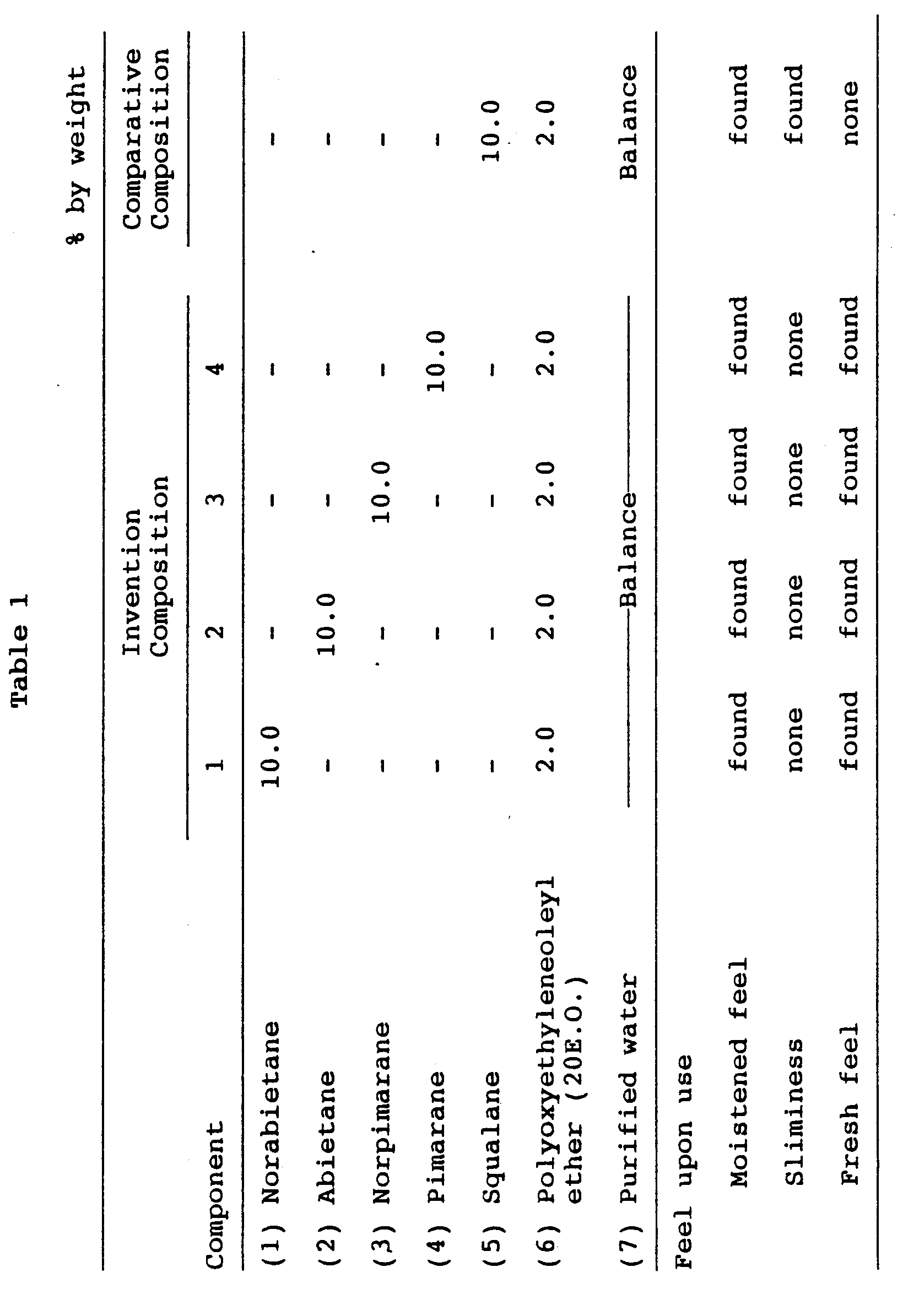
- Emulsion cosmetics having the formulation shown in Table 1 were prepared according to the preparation method explained below, and the feeling upon use were sensuously evaluated by expert panelists. The results are shown in Table 1.
- a moisturizing lotion having the following formulation was prepared according to the process explained below.
- the moisturizing lotion thus obtained exhibited excellent moistened and decent feel without sliminess, providing an excellent moisture-retention effect and fresh feel upon use.
- a milky lotion having the following formulation were prepared according to the process explained below.
- Components (1)-(5) were mixed and dissolved by heating and kept at 70°C.
- Components (6)-(10) and (12) were also mixed and dissolved by heating at 70°C.
- the former mixture was added to the latter and emulsified using an emulsification apparatus.
- An emulsion obtained was cooled to 40°C while stirring.
- Component (11) was added to the emulsion and homogeneously mixed.
- the mixture was cooled by a heat-exchanger finally to 30°C to prepare a milky lotion.
- the milky lotion thus obtained exhibited excellent moistened and decent feel without sliminess, providing an excellent moisture-retention effect and fresh feel upon use.
- a moisturizing cream having the following formulation was prepared according to the process explained below.
- Components (1)-(9) were dissolved with heating and kept at 70°C.
- Components (10)-(13) and (15) were also mixed with heating at 70°C.
- the former mixture was added to the latter and the mixture was emulsified using an emulsification apparatus.
- An emulsion obtained was cooled to 40°C while stirring.
- Component (14) was added to the emulsion and homogeneously mixed.
- the mixture was cooled by a heat-exchanger finally to 30°C to prepare a moisturizing cream.
- the moisturizing cream thus obtained exhibited excellent moistened feel without sliminess. providing an excellent moisture-retention effect and fresh feel upon use.
- a cold cream having the following formulation was prepared according to the process explained below.
- Components (1)-(8) were dissolved with heating and kept at 70°C.
- Components (9)-(12) and (14) were also mixed with heating at 70°C.
- the former mixture was added to the latter and the mixture was emulsified using an emulsification apparatus.
- An emulsion obtained was cooled to 40°C while stirring.
- Component (13) was added to the emulsion and homogeneously mixed.
- the mixture was cooled by a heat-exchanger finally to 30°C to prepare a cold cream.
- the cold cream thus obtained exhibited excellent moistened and decent feel without sliminess, providing an excellent moisture-retention effect and fresh feel upon use.
- Cream-type moisturizing foundation
- a cream-type moisturizing foundation having the following formulation was prepared according to the process explained below.
- components (11)-(16) were dispersed. To this mixture was gradually added a homogeneous mixture of components (7)-(10) and (18) while stirring to prepare an emulsion. The emulsion was cooled with stirring to 40°C, component (17) was added at that temperature and further cooled with stirring to room temperature to obtain a creamy foundation.
- the creamy foundation exhibited excellent moistened and decent feel without sliminess, providing an excellent moisture-retention effect and fresh feel upon use.
- a lipstick having the following formulation was prepared according to the process explained below.
- component (11) was added dropwise with stirring and components (13)-(18) dispersed in component (9) were further added.
- the mixture was homogeneously mixed with stirring and charged into a mold followed by cooling to prepare a lipstick.
- the lipstick exhibited excellent moistened feel without sliminess, providing an excellent moisture-retention effect and fresh feel upon use.
- a nailenamel remover having the following formulation was prepared according to the process explained below.
- Components (1)-(7) were homogeneously mixed to prepare a nailenamel remover.
- the nailenamel remover had an excellent feel upon use.
Landscapes
- Health & Medical Sciences (AREA)
- Life Sciences & Earth Sciences (AREA)
- Animal Behavior & Ethology (AREA)
- General Health & Medical Sciences (AREA)
- Public Health (AREA)
- Veterinary Medicine (AREA)
- Birds (AREA)
- Epidemiology (AREA)
- Dermatology (AREA)
- Cosmetics (AREA)
- Medicinal Preparation (AREA)
Description
- This invention relates to a composition for external application, for example, a skin and hair cosmetic composition and a external medical composition, and more particularly, to a composition for external application exhibiting an excellent moisture-retention effect and imparting moistened feel without sliminess and irritation to the skin.
- A proper amount of water generally contained in the outermost crust of the skin and hair is indispensable for maintaining flexibility, softness, protective functions of the skin and hair. When the water content in the skin decreases, for example, the skin turns into, namely, dry skin, in which its flexibility and protective function are lost, resulting in a cause of various troubles. Whereas, sebum is known to have an important function to prevent the excessive loss of water from the outermost crust of the skin and hair and consequently can avoid the above-mentioned troubles.
- In this regard, various oils including squalane which is a component involved in the skin, have conventionally been used as a component for cosmetics and the like to prevent the skin and hair from excessive drying.
- FR-A-907 457 discloses an oily composition containing a product which is obtained by decarboxylation of oils of rosin.
- FR-A-996 017 describes cosmetic compositions which contain as an oily component a colophony oil . According to the reference, the colophony oil provides advantages over a mineral oil with respect to viscosity, applicability and stability of the composition.
- However, external compositions containing these oils, e.g. cosmetics and the like, have disadvantages that they generally exhibit high sliminess when applied and give unacceptable feel upon use. On the other hand, hydrocarbons of low melting points are known as a less slimy oil component, however, they inevitably impart irritation to the skin under closed conditions.
- Compositions for external application exhibiting an excellent moisture-retention effect without sliminess and irritation to the skin have therefore been desired.
- In view of this situation, the present inventors have undertaken extensive studies to solve the above-mentioned problems. As a result, the inventors have found that a composition for external application comprising a specific tricyclic saturated hydrocarbon could exhibit an excellent moisture-retention effect, impart moistened feel, and have high safety without sliminess and irritation to the skin. This finding has led to the completion of the invention.
- Accordingly, an object of this invention is to provide a composition for external application comprising 1 to 80% by weight of a tricyclic saturated hydrocarbon represented by the following formula (I):

wherein R¹ and R² may be the same or different and independently represents a hydrogen atom or a methyl group and R³ represents an alkyl group having 2-3 carbon atoms. - Since the compound of formula (I) is contained in rosin and the like in a small amount, it is not impossible to obtain the substance from rosin or the like by isolation and refining. It is, however, desirable to synthesize the compound of formula (I) from abietic acid, pimaric acid, or the like according to a conventional method [J. Org. Chem., 34(6), 1562, (1962); Sb. Vys. Sk. Chem.-Technol. Praze, Technol. Paliv, D44, 125, (1981); Tetrahedron, 25, 1335, (1969)]. A exemplary method for synthesizing the compound of formula (I) will now be explained using preferable examples of the compound of formula (I); abietane, pimarane, norabietane, and norpimarane.


Specifically, abietane and pimarane can be produced by the Wolff-Kishner reduction of tetrahydroabietoaldehyde and of tetrahydropimaraldehyde, respectively. Norabietane and norpimarane can be produce by hydrocracking of abietic acid and pimaric acid, respectively, in the presence of a hydrogenation catalyst such as Raney nickel or the like. - The tricyclic saturated hydrocarbons of formula (I) thus obtained are a liquid having relatively low viscosity at normal temperature, and have good chemical stability and low irritation to the skin. They are thus useful as an oil component of composition for external application. The amount of the compound of formula (I) to be formulated in the composition is determined depending on a kind of products, e.g. medicines for external application, cosmetics, or the like. The compound of formula (I) is incorporated in the composition in a amount of 1-80% by weight,
Any carriers acceptable for external application which are ordinarily used in cosmetics or medicines can be used in the composition of the present invention as a vehicle of the above-mentioned essential components. Such carriers include, for example, water, medical components, various kinds of cosmetic oils, surface active agents, humectants, UV-absorbers, chelating agents, pH adjusting agents, antiseptics, thickeners, pigments, perfumes, and the like. - The compositions of the present invention can be formulated into any forms of preparations such as oil-type, water-type, emulsion-type or the like, and are particularly suitable for the skin or hair cosmetics which require a moisture-retention effect to care chapped skin or damaged hair.
- The compositions for external application of the present invention exhibit an excellent moisture-retention effect and impart moistened feel without sliminess and irritation to the skin. They are thus useful as skin cosmetics, hair cosmetics, medical compositions for external application, and the like.
- Other features of the invention will become apparent in the course of the following description of the exemplary embodiments which are given for illustration of the invention and are not intended to be limiting thereof.
- 45 g (0.15 mol) of abietic acid, 100 ml of cyclohexane, and 5 g of Raney nickel as a catalyst were charged in a 500 ml revolving autoclave and reacted at 270°C under a hydrogen pressure of 150 Kg/cm² for 7 hours. After the reaction, the catalyst was removed from the reaction mixture by filtration and the filtrate was distilled under reduced pressure to obtain 20 g of target norabietane (yield: 51%).
Boiling Point: 135-145°C/0.05 Torr
MS: M⁺ 262 - Norpimarane was produced in the same manner as in Synthetic Example 1 except that pimaric acid was used instead of abietic acid (yield: 45%).
Boiling Point: 140-145°C/0.05 Torr
MS: M⁺ 262 - 36 g (0.125 mol) of tetrahydroabietoaldehyde, 1 litter of triethylene glycol, 500 ml of anhydrous NH₂NH₂, and 150 g of NH₂NH₂·2HCl were charged into a 3 l flask equipped with a stirrer and agitated at 120-140°C for 14 hours. After having been cooled to room temperature, the mixture to which 200 g of KOH had been added was heated to 200°C over 3 hours. The mixture was further kept heated with stirring at this temperature for 3 hours. To the reaction mixture was added saline followed by extracting with hexane and distilling under reduced pressure to produce 26 g of target abietane (yield: 75%).
Boiling Point: 148-152°C/0.05 Torr
MS: M⁺ 276 - Pimarane was produced in the same manner as in Synthesis Example 3 except that tetrahydropimaraldehyde was used instead of tetrahydroabietoaldehyde (yield: 68%).
Boiling Point: 150-156°C/0.05 Torr
MS: M⁺ 276 - Emulsion cosmetics having the formulation shown in Table 1 were prepared according to the preparation method explained below, and the feeling upon use were sensuously evaluated by expert panelists. The results are shown in Table 1.
- Components (1)-(6) in Table 1 were mixed and heated, and then component (7) was added under stirring. The mixture was cooled with stirring to obtain a cosmetic composition.
- 10% by weight of the tricyclic saturated hydrocarbon of the present invention to be used for Invention Compositions 1-4 was dissolved in a liquid paraffin to prepare a test sample. The test sample was applied to a clipped and shaved lateral region of white Hartley guinea pigs (5 pigs per one group) once in a day for four consecutive days. A cutireaction of the lateral region was observed one day after the final application of the test sample and evaluated by the following criteria. The results are shown in Table 2.
-
- point 0:
- no reaction
- point 1:
- slight or disseminated erythema was observed
- point 2:
- clear erythema was observed
- point 3:
- erythema with edema was observed
- point 4:
- scabrities or cutaneous necrosis was observed
-
Table 2 Test sample Average evaluation point Norabietane 0 Abietane 0 Norpimarane 0.2 Primarane 0 Invention Composition No. 1 0 No. 2 0 No. 3 0 No. 4 0 Liquid paraffin (reagent) 0.2 n-dodecane 2.8 Pristane 3.0 - A moisturizing lotion having the following formulation was prepared according to the process explained below.
-
% by weight (1) Abietane 1.0 (2) Polyoxyethyleneoleyl ether (20E.O.) 1.5 (3) Glycerol 5.0 (4) 1,3-butanediol 5.0 (5) Polyethylene glycol 1500 1.5 (6) Ethanol 10.0 (7) Methyl parabene 0.1 (8) Perfume q.s. (9) Citric acid q.s. (10) Sodium citrate q.s. (11) Purified water Balance Total 100.0 - To components (1), (2), (6), and (8) which had been homogeneously mixed, a mixture of components (3)-(5), (7), and (9)-(11) was added and stirred to prepare an almost homogeneous solution.
- The moisturizing lotion thus obtained exhibited excellent moistened and decent feel without sliminess, providing an excellent moisture-retention effect and fresh feel upon use.
- A milky lotion having the following formulation were prepared according to the process explained below.
-
% by weight (1) Norabietane 10.0 (2) Cethanol 0.5 (3) Vaseline 1.0 (4) Polyoxyethyleneoleyl ether (20E.O.) 2.0 (5) Stearic acid 2.0 (6) Glycerol 3.0 (7) Dipropylene glycol 5.0 (8) Triethanolamine 1.0 (9) Ethyl parabene 0.1 (10) Methyl parabene 0.2 (11) Perfume q.s. (12) Purified water Balance Total 100.0 - Components (1)-(5) were mixed and dissolved by heating and kept at 70°C. Components (6)-(10) and (12) were also mixed and dissolved by heating at 70°C. The former mixture was added to the latter and emulsified using an emulsification apparatus. An emulsion obtained was cooled to 40°C while stirring. Component (11) was added to the emulsion and homogeneously mixed. The mixture was cooled by a heat-exchanger finally to 30°C to prepare a milky lotion.
- The milky lotion thus obtained exhibited excellent moistened and decent feel without sliminess, providing an excellent moisture-retention effect and fresh feel upon use.
- A moisturizing cream having the following formulation was prepared according to the process explained below.
-
% by weight (1) Norabietane 8.0 (2) Norpimarane 2.0 (3) Paraffin wax 2.0 (4) Cetyl 2-ethylhexanoate 5.0 (5) Lanolin 5.0 (6) Bees wax 2.0 (7) Stearyl alcohol 4.0 (8) Glycerol monostearate (autoemulsion-type) 1.5 (9) Polyoxyethylenesorbitan monoolate (20E.O.) 1.0 (10) Glycerol 5.0 (11) 70% aqueous sorbitol 10.0 (12) Ethyl parabene q.s. (13) Methyl parabene q.s. (14) Perfume q.s. (15) Purified water Balance Total 100.0 - Components (1)-(9) were dissolved with heating and kept at 70°C. Components (10)-(13) and (15) were also mixed with heating at 70°C. The former mixture was added to the latter and the mixture was emulsified using an emulsification apparatus. An emulsion obtained was cooled to 40°C while stirring. Component (14) was added to the emulsion and homogeneously mixed. The mixture was cooled by a heat-exchanger finally to 30°C to prepare a moisturizing cream.
- The moisturizing cream thus obtained exhibited excellent moistened feel without sliminess. providing an excellent moisture-retention effect and fresh feel upon use.
- A cold cream having the following formulation was prepared according to the process explained below.
-
% by weight (1) Norabietane 28.0 (2) Pimarane 2.0 (3) Bees wax 5.0 (4) Cetaceum 3.0 (5) Cetyl 2-ethylhexanoic acid 10.0 (6) Cetanol 1.0 (7) Glycerol monostearate (autoemulsion-type) 7.0 (8) Polyoxyethylenesorbitan monoolate (20E.O.) 2.0 (9) Glycerol 5.0 (10) Triethanolamine 0.3 (11) Ethyl parabene q.s. (12) Methyl parabene q.s. (13) Perfume q.s. (14) Purified water Balance Total 100.0 - Components (1)-(8) were dissolved with heating and kept at 70°C. Components (9)-(12) and (14) were also mixed with heating at 70°C. The former mixture was added to the latter and the mixture was emulsified using an emulsification apparatus. An emulsion obtained was cooled to 40°C while stirring. Component (13) was added to the emulsion and homogeneously mixed. The mixture was cooled by a heat-exchanger finally to 30°C to prepare a cold cream.
- The cold cream thus obtained exhibited excellent moistened and decent feel without sliminess, providing an excellent moisture-retention effect and fresh feel upon use.
- A cream-type moisturizing foundation having the following formulation was prepared according to the process explained below.
-
% by weight (1) Abietane 10.0 (2) Liquid paraffin 8.0 (3) Squalane 8.0 (4) Neopentyl glycol dioctanate 3.0 (5) Sorbitan sesquiisostearate 7.0 (6) Aluminum distearate 0.2 (7) Magnesium sulfate 0.7 (8) Maltitol 2.0 (9) Glycerol 3.0 (10) Ethyl parabene 0.1 (11) Titanium oxide 8.0 (12) Talc 5.0 (13) Sericite 2.0 (14) Red iron 0.4 (15) Yellow iron 0.7 (16) Black iron 0.1 (17) Perfume q.s. (18) Purified water Balance Total 100.0 - Into components (1)-(6) heated to 70°C and homogeneously mixed, components (11)-(16) were dispersed. To this mixture was gradually added a homogeneous mixture of components (7)-(10) and (18) while stirring to prepare an emulsion. The emulsion was cooled with stirring to 40°C, component (17) was added at that temperature and further cooled with stirring to room temperature to obtain a creamy foundation.
- The creamy foundation exhibited excellent moistened and decent feel without sliminess, providing an excellent moisture-retention effect and fresh feel upon use.
- A lipstick having the following formulation was prepared according to the process explained below.
-
% by weight (1) Norabietane 20.0 (2) Abietane 5.0 (3) Carnauba wax 2.0 (4) Ceresine 4.0 (5) Candelilla wax 5.0 (6) Microcrystalline wax 2.0 (7) Bees wax 5.0 (8) Lanolin 4.0 (9) Castor oil 20.0 (10) Hexadecyl alcohol 20.0 (11) Glycerol 3.0 (12) Glycerol monostearate 2.0 (13) Titanium oxide 2.0 (14) Pigment (Red No. 202) 2.0 (15) Pigment (Red No. 204) 1.0 (16) Pigment (Yellow No. 4 A1 lake) 3.0 (17) Antioxidant q.s. (18) Perfume q.s. Total 100.0 - To components (1)-(8), (10), and (12) dissolved with heating, component (11) was added dropwise with stirring and components (13)-(18) dispersed in component (9) were further added. The mixture was homogeneously mixed with stirring and charged into a mold followed by cooling to prepare a lipstick.
- The lipstick exhibited excellent moistened feel without sliminess, providing an excellent moisture-retention effect and fresh feel upon use.
- A nailenamel remover having the following formulation was prepared according to the process explained below.
-
% by weight (1) Acetone 60.0 (2) Butyl acetate 30.0 (3) 1,3-butanediol 2.0 (4) Norabietane 1.0 (5) Dye q.s. (6) Perfume q.s. (7) Purified water Balance Total 100.0 - Components (1)-(7) were homogeneously mixed to prepare a nailenamel remover.
- The nailenamel remover had an excellent feel upon use.
Claims (1)
- An oily composition for external application comprising 1 to 80% by weight of a tricyclic saturated hydrocarbon represented by the following formula (I):

Applications Claiming Priority (2)
| Application Number | Priority Date | Filing Date | Title |
|---|---|---|---|
| JP238066/89 | 1989-09-13 | ||
| JP1238066A JP2739246B2 (en) | 1989-09-13 | 1989-09-13 | External composition |
Publications (3)
| Publication Number | Publication Date |
|---|---|
| EP0417772A2 EP0417772A2 (en) | 1991-03-20 |
| EP0417772A3 EP0417772A3 (en) | 1991-05-22 |
| EP0417772B1 true EP0417772B1 (en) | 1994-11-30 |
Family
ID=17024649
Family Applications (1)
| Application Number | Title | Priority Date | Filing Date |
|---|---|---|---|
| EP90117591A Expired - Lifetime EP0417772B1 (en) | 1989-09-13 | 1990-09-12 | Composition for external application |
Country Status (5)
| Country | Link |
|---|---|
| US (1) | US5064642A (en) |
| EP (1) | EP0417772B1 (en) |
| JP (1) | JP2739246B2 (en) |
| DE (1) | DE69014506T2 (en) |
| ES (1) | ES2067611T3 (en) |
Families Citing this family (2)
| Publication number | Priority date | Publication date | Assignee | Title |
|---|---|---|---|---|
| ZA201007910B (en) * | 2008-05-02 | 2012-02-29 | Amyris Inc | Fuel compositions comprising an amorphane or a stereoisomer thereof and methods of making and using same |
| KR101608258B1 (en) * | 2009-02-27 | 2016-04-04 | (주)아모레퍼시픽 | Moisturizing cosmetic composition containing the rosin, the needles of red pine and the root of the red pine |
Family Cites Families (4)
| Publication number | Priority date | Publication date | Assignee | Title |
|---|---|---|---|---|
| US2070915A (en) * | 1934-11-17 | 1937-02-16 | Mckesson & Robbins Inc | Therapeutical compounds containing metal abietates |
| FR907457A (en) * | 1944-04-20 | 1946-03-13 | Vitex Sa | Artificial petroleum jelly |
| FR996017A (en) * | 1945-04-10 | 1951-12-12 | Rosin oil product and manufacturing process | |
| US4740370A (en) * | 1984-03-16 | 1988-04-26 | Faryniarz Joseph R | Process for preparing nail coating compositions |
-
1989
- 1989-09-13 JP JP1238066A patent/JP2739246B2/en not_active Expired - Lifetime
-
1990
- 1990-09-12 ES ES90117591T patent/ES2067611T3/en not_active Expired - Lifetime
- 1990-09-12 EP EP90117591A patent/EP0417772B1/en not_active Expired - Lifetime
- 1990-09-12 DE DE69014506T patent/DE69014506T2/en not_active Expired - Fee Related
- 1990-09-13 US US07/582,150 patent/US5064642A/en not_active Expired - Fee Related
Non-Patent Citations (1)
| Title |
|---|
| Römpp Chemie Lexikon, Georg Thieme Verlag Stuttgart - New York, pages 2305 and 2306. * |
Also Published As
| Publication number | Publication date |
|---|---|
| JP2739246B2 (en) | 1998-04-15 |
| ES2067611T3 (en) | 1995-04-01 |
| EP0417772A2 (en) | 1991-03-20 |
| DE69014506T2 (en) | 1995-06-14 |
| JPH03101607A (en) | 1991-04-26 |
| EP0417772A3 (en) | 1991-05-22 |
| DE69014506D1 (en) | 1995-01-12 |
| US5064642A (en) | 1991-11-12 |
Similar Documents
| Publication | Publication Date | Title |
|---|---|---|
| DE69317044T2 (en) | MEANS FOR REGULATING THE SKIN FATIGUE LEVEL | |
| DE69611754T2 (en) | HYDROCHAL CONDIVATIVES, CONTAINING COSMETIC COMPOSITIONS, AND METHOD FOR THE PRODUCTION OF BOTH | |
| JP3696271B2 (en) | Whitening cosmetics | |
| GB2141122A (en) | Hydroxyl derivatives of dibenzoylmethane and their use in protecting the skin against ultraviolet rays | |
| DE69416091T2 (en) | Benzophenone derivative and a UV light absorber and an endermatic ointment | |
| JPH06199646A (en) | Skin beautifying cosmetic | |
| JPH11255638A (en) | Tyrosinase activity inhibitor and cosmetic | |
| JP3470806B2 (en) | Cosmetic compositions containing furannaphthoquinone derivatives, their use as colorants, and derivatives | |
| JPH11255639A (en) | Tyrosinase activity inhibitor and cosmetic | |
| JPH11255637A (en) | Tyrosinase activity inhibitor and cosmetic | |
| EP0242611B1 (en) | Long wave uv-ray absorber | |
| DE68905152T2 (en) | USE OF MODIFIED DIORGANOPOLYSILOXANES AS ANTIOXYDANTS IN COSMETICS AND DERMATOLOGY. | |
| US5064642A (en) | Composition for external application | |
| JP2711782B2 (en) | Whitening cosmetics | |
| JP2931763B2 (en) | Novel lysine derivative, method for producing the same and cosmetic composition containing the same | |
| TW531421B (en) | Depigmenting composition | |
| DE60210313T2 (en) | USE OF DATE CORE EXTRACT TO REDUCE THE INDICATIONS OF SKIN AGING | |
| JP2006124358A (en) | 4-alkylresorcinol derivative and bleaching agent containing the same as active ingredient | |
| JP2006124357A (en) | 4-alkylresorcinol derivative and bleaching agent containing the same as active ingredient | |
| JPH1036216A (en) | Skin cosmetic | |
| JPH0733634A (en) | Whitening cosmetics | |
| US6395896B2 (en) | Pyridazine derivatives, manufacturing method and related composition | |
| JPH025770B2 (en) | ||
| JP3167423B2 (en) | Water repellent / oil repellent cosmetic powder and cosmetic containing the powder | |
| JPH0563450B2 (en) |
Legal Events
| Date | Code | Title | Description |
|---|---|---|---|
| PUAI | Public reference made under article 153(3) epc to a published international application that has entered the european phase |
Free format text: ORIGINAL CODE: 0009012 |
|
| AK | Designated contracting states |
Kind code of ref document: A2 Designated state(s): DE ES FR |
|
| PUAL | Search report despatched |
Free format text: ORIGINAL CODE: 0009013 |
|
| AK | Designated contracting states |
Kind code of ref document: A3 Designated state(s): DE ES FR |
|
| 17P | Request for examination filed |
Effective date: 19910625 |
|
| 17Q | First examination report despatched |
Effective date: 19920508 |
|
| GRAA | (expected) grant |
Free format text: ORIGINAL CODE: 0009210 |
|
| AK | Designated contracting states |
Kind code of ref document: B1 Designated state(s): DE ES FR |
|
| REF | Corresponds to: |
Ref document number: 69014506 Country of ref document: DE Date of ref document: 19950112 |
|
| ET | Fr: translation filed | ||
| REG | Reference to a national code |
Ref country code: ES Ref legal event code: FG2A Ref document number: 2067611 Country of ref document: ES Kind code of ref document: T3 |
|
| PG25 | Lapsed in a contracting state [announced via postgrant information from national office to epo] |
Ref country code: ES Free format text: LAPSE BECAUSE OF THE APPLICANT RENOUNCES Effective date: 19950913 |
|
| PLBE | No opposition filed within time limit |
Free format text: ORIGINAL CODE: 0009261 |
|
| STAA | Information on the status of an ep patent application or granted ep patent |
Free format text: STATUS: NO OPPOSITION FILED WITHIN TIME LIMIT |
|
| 26N | No opposition filed | ||
| PG25 | Lapsed in a contracting state [announced via postgrant information from national office to epo] |
Ref country code: FR Effective date: 19960531 |
|
| PG25 | Lapsed in a contracting state [announced via postgrant information from national office to epo] |
Ref country code: DE Effective date: 19960601 |
|
| REG | Reference to a national code |
Ref country code: FR Ref legal event code: ST |
|
| REG | Reference to a national code |
Ref country code: ES Ref legal event code: FD2A Effective date: 20001102 |