EP0416640A2 - Method of fabrication of a fused optical coupler and coupler manufactured accordingly - Google Patents
Method of fabrication of a fused optical coupler and coupler manufactured accordingly Download PDFInfo
- Publication number
- EP0416640A2 EP0416640A2 EP19900117241 EP90117241A EP0416640A2 EP 0416640 A2 EP0416640 A2 EP 0416640A2 EP 19900117241 EP19900117241 EP 19900117241 EP 90117241 A EP90117241 A EP 90117241A EP 0416640 A2 EP0416640 A2 EP 0416640A2
- Authority
- EP
- European Patent Office
- Prior art keywords
- fibers
- coupler
- polarization
- fusion
- input
- Prior art date
- Legal status (The legal status is an assumption and is not a legal conclusion. Google has not performed a legal analysis and makes no representation as to the accuracy of the status listed.)
- Granted
Links
Images

Classifications
-
- G—PHYSICS
- G02—OPTICS
- G02B—OPTICAL ELEMENTS, SYSTEMS OR APPARATUS
- G02B6/00—Light guides; Structural details of arrangements comprising light guides and other optical elements, e.g. couplings
- G02B6/24—Coupling light guides
- G02B6/26—Optical coupling means
- G02B6/28—Optical coupling means having data bus means, i.e. plural waveguides interconnected and providing an inherently bidirectional system by mixing and splitting signals
- G02B6/293—Optical coupling means having data bus means, i.e. plural waveguides interconnected and providing an inherently bidirectional system by mixing and splitting signals with wavelength selective means
- G02B6/29331—Optical coupling means having data bus means, i.e. plural waveguides interconnected and providing an inherently bidirectional system by mixing and splitting signals with wavelength selective means operating by evanescent wave coupling
- G02B6/29332—Wavelength selective couplers, i.e. based on evanescent coupling between light guides, e.g. fused fibre couplers with transverse coupling between fibres having different propagation constant wavelength dependency
-
- G—PHYSICS
- G02—OPTICS
- G02B—OPTICAL ELEMENTS, SYSTEMS OR APPARATUS
- G02B6/00—Light guides; Structural details of arrangements comprising light guides and other optical elements, e.g. couplings
- G02B6/24—Coupling light guides
- G02B6/26—Optical coupling means
- G02B6/28—Optical coupling means having data bus means, i.e. plural waveguides interconnected and providing an inherently bidirectional system by mixing and splitting signals
- G02B6/2804—Optical coupling means having data bus means, i.e. plural waveguides interconnected and providing an inherently bidirectional system by mixing and splitting signals forming multipart couplers without wavelength selective elements, e.g. "T" couplers, star couplers
- G02B6/2821—Optical coupling means having data bus means, i.e. plural waveguides interconnected and providing an inherently bidirectional system by mixing and splitting signals forming multipart couplers without wavelength selective elements, e.g. "T" couplers, star couplers using lateral coupling between contiguous fibres to split or combine optical signals
- G02B6/2835—Optical coupling means having data bus means, i.e. plural waveguides interconnected and providing an inherently bidirectional system by mixing and splitting signals forming multipart couplers without wavelength selective elements, e.g. "T" couplers, star couplers using lateral coupling between contiguous fibres to split or combine optical signals formed or shaped by thermal treatment, e.g. couplers
-
- G—PHYSICS
- G02—OPTICS
- G02B—OPTICAL ELEMENTS, SYSTEMS OR APPARATUS
- G02B6/00—Light guides; Structural details of arrangements comprising light guides and other optical elements, e.g. couplings
- G02B6/24—Coupling light guides
- G02B6/26—Optical coupling means
- G02B6/28—Optical coupling means having data bus means, i.e. plural waveguides interconnected and providing an inherently bidirectional system by mixing and splitting signals
- G02B6/2804—Optical coupling means having data bus means, i.e. plural waveguides interconnected and providing an inherently bidirectional system by mixing and splitting signals forming multipart couplers without wavelength selective elements, e.g. "T" couplers, star couplers
- G02B6/2821—Optical coupling means having data bus means, i.e. plural waveguides interconnected and providing an inherently bidirectional system by mixing and splitting signals forming multipart couplers without wavelength selective elements, e.g. "T" couplers, star couplers using lateral coupling between contiguous fibres to split or combine optical signals
- G02B6/2843—Optical coupling means having data bus means, i.e. plural waveguides interconnected and providing an inherently bidirectional system by mixing and splitting signals forming multipart couplers without wavelength selective elements, e.g. "T" couplers, star couplers using lateral coupling between contiguous fibres to split or combine optical signals the couplers having polarisation maintaining or holding properties
Definitions
- the invention relates to a method for producing an optical fusion coupler according to the preamble of claim 1.
- Such couplers are used in systems of optical communication technology.
- the solution found has the advantage, among other things, that the fusion area of the coupler has only a short pulling length. It is therefore handy and relatively insensitive to damage even before it is embedded in a protective housing. It is also easier to manufacture, which saves time and money. Further advantages are mentioned in the description.
- the input fibers of the fusion coupler 1 to be manufactured are referred to as couplers 2 in the following.
- couplers 2 are polarization-maintaining single-mode fibers, the ends of which end with a normal, non-birefringent one Single mode matched cladding type fibers are connected by splicing.
- the splices are preferably connections which are produced in a known manner by integrally fusing the fiber ends.
- the non-birefringent single-mode fibers form the output fibers 3 after the manufacture of the coupler, which at the same time represent the connecting fibers.
- the pair of fibers is fixed in a pulling device (not shown) in such a way that the main optical axes of the polarization-maintaining single-mode fibers (input fibers 2) are parallel and perpendicular to the coupler axis and the non-birefringent single-mode fibers (output fibers 3) are in an area that is one has a relatively short distance to the splice connections 4 lying parallel to one another, the fibers being unchanged in cross section.
- light is coupled into one of the input fibers 2 and detected at the end of both output fibers 3.
- the non-birefringent single-mode fibers are then fused together at the contact point 5 (FIG.
- a drawing length of 10 mm to 15 mm is sufficient.
- the drawing length is preferably approximately 11 mm to 13 mm. The drawing length is thus advantageously only insignificantly longer than that of wavelength-selective fusion couplers.
- the coupler 1 (FIG. 4b), which is preferably manufactured with an average degree of fusion, shows the wavelength dependence of a wavelength-selective fusion coupler for linearly polarized light (perpendicular or parallel to the coupler plane). There is a phase shift of 180 ° in the wavelength dependence of the two polarization directions.
- the crosstalk attenuation between the two polarization directions (perpendicular and parallel to the coupler plane) is approximately 19 dB to 25 dB in a relatively large usable wavelength range, while the degree of polarization in the outgoing fibers (output fibers 3) is also very high and Absorbance values of approx. 25 dB to 30 dB reached.
- This coupler 1 with non-birefringent single-mode fibers thus combines the properties of two couplers, as have been proposed in DE-OS 37 16 247.0 by K. Pedestrian for a transmission system with wavelength and polarization multiplex.
- the wavelength spacing of adjacent channels in the coupler 1 is approximately 50 nm. At the 3dB point, at which the same amount of light is present in both channels, the coupler 1 shows no polarization selectivity. 25 nm further, at larger or smaller wavelengths, there is maximum polarization selectivity. This is used to optimize the polarization-selective coupler 1. If the coupler 1 is required, for example, at a wavelength of 1530 nm, then linearly polarized light of the wavelength 1505 nm is coupled into an input fiber 2. The melting process is initiated by the application of heat. During the fusion process, the light couples over to the other fiber during the drawing process, then back again, etc., the light coupling less and less completely as the drawing length increases.
- the pulling process is stopped when the mutual coupling stagnates and thus the same amount of light is present in both channels.
- the light and heat sources are switched off, the coupler 1 with the connecting fibers is removed from the pulling device and then fastened mechanically protected in a housing. This is preferably done in such a way that the fibers leading from the fusion region 6 to a connecting fiber, including the splice connections 4, lie curvature-free in the coupler housing and are fixed therein. In this way, the connection fibers (input / output fibers 2, 3) are kept strain relieved.
Landscapes
- Physics & Mathematics (AREA)
- General Physics & Mathematics (AREA)
- Optics & Photonics (AREA)
- Optical Couplings Of Light Guides (AREA)
- Mechanical Coupling Of Light Guides (AREA)
- Optical Fibers, Optical Fiber Cores, And Optical Fiber Bundles (AREA)
- Glass Compositions (AREA)
- Optical Communication System (AREA)
- Joining Of Glass To Other Materials (AREA)
Abstract
Bei dem Herstellungsverfahren für polarisationsselektive optische Verschmelzkoppler (1), die mehrere Eingangs- sowie Ausgangsfasern haben und in der Koppelregion (Verschmelzbereich 6) aus parallel verlaufenden, nicht doppelbrechenden Einmodenfasern vom Typ matched cladding bestehen, wird vor dem Verschmelzen der Fasern linear polarisiertes Licht mit einer ausgewählten Wellenlänge in eine der Eingangsfasern (2) eingespeist und an den Enden der beiden Ausgangsfasern (3) detektiert. Danach werden die Fasern miteinander verschmolzen und der Koppler (1) dabei soweit ausgezogen, bis das wechselseitige Überkoppeln zwischen den beiden Fasern stagniert. Dann wird die Wärmequelle abgeschaltet.In the manufacturing process for polarization-selective optical fusion couplers (1), which have several input and output fibers and consist of parallel, non-birefringent single-mode fibers of the matched cladding type in the coupling region (fusion region 6), linearly polarized light with a Selected wavelength fed into one of the input fibers (2) and detected at the ends of the two output fibers (3). The fibers are then fused together and the coupler (1) is pulled out until the mutual coupling between the two fibers stagnates. Then the heat source is switched off.
Mit dem Verfahren sind Schmelzkoppler (1) herstellbar, deren Ziehlängen nur ca. 10 mm bis 15 mm betragen. 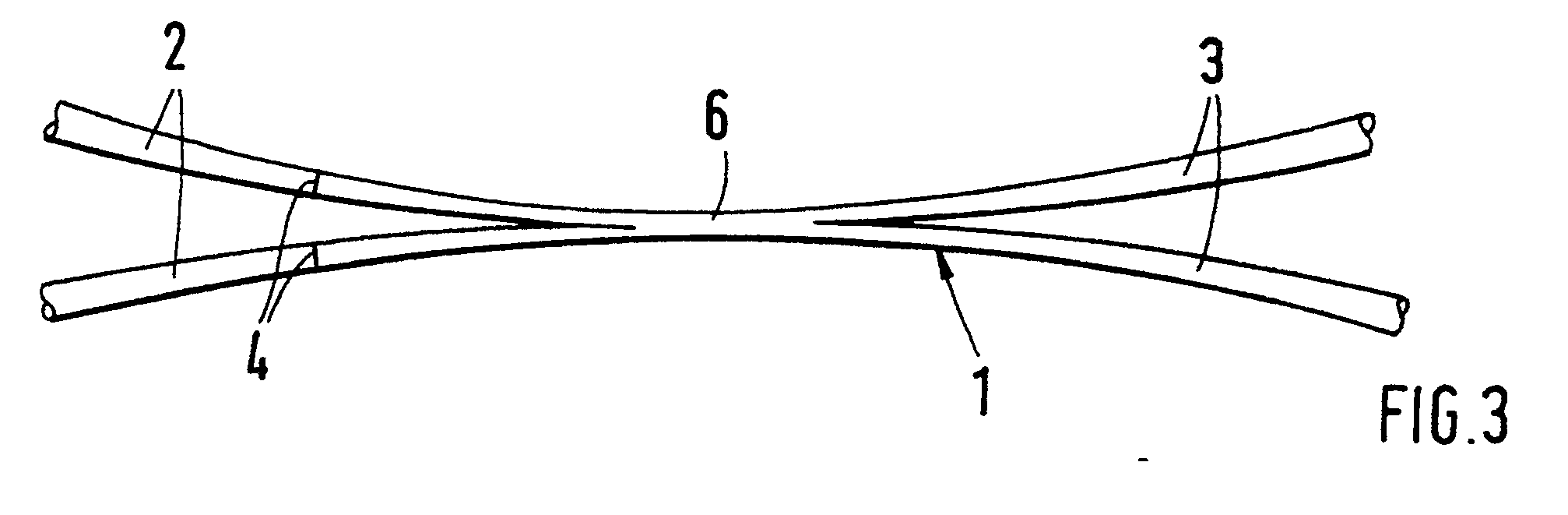
Description
Die Erfindung betrifft ein Verfahren zur Herstellung eines optischen Verschmelzkopplers nach dem Oberbegriff des Anspruchs 1. Derartige Koppler werden in Systemen der optischen Nachrichtentechnik verwendet.The invention relates to a method for producing an optical fusion coupler according to the preamble of
In der Druckschrift "ELEKTRONICS LETTERS vom 14.03.1985, Band 21, Nr. 6, Seiten 249 bis 251" wird von M.S. Yataki, D.N. Payne und M.P. Varnham unter dem Titel "ALL- FIBRE POLARISING BEAMSPLITTER" ein polarisationsselektiver optischer Verschmelzkoppler beschrieben, der aus nicht doppelbrechenden Einmodenfasern mit matched cladding hergestellt wurde. Dabei hat sich gezeigt, daß Verschmelzkoppler mit solchen Einmodenfasern zur Erzielung der polarisationselektiven Eigenschaft sehr lang ausgezogen werden müssen, etwa 10 cm bis 30 cm. Die Fasern werden dabei sehr dünn, sind deshalb empfindlich und schwierig handhabbar. Außerdem ist ein derartiger Verschmelzkoppler wegen der bei dieser Länge stattfindenden hohen Anzahl von Überkopplungen stark wellen längenselektiv, wodurch die Herstellung für eine bestimmte Wellenlänge erschwert wird, weil die Laser dann ausgesucht und gegebenenfalls noch in der Wellenlänge stabilisiert werden müssen.In the publication "ELEKTRONICS LETTERS dated March 14, 1985, Volume 21, No. 6, pages 249 to 251", a polarization-selective optical fusion coupler is described by MS Yataki, DN Payne and MP Varnham under the title "ALL-FIBER POLARISING BEAMSPLITTER" made from non-birefringent single-mode fibers with matched cladding. It has been shown that fusion couplers with such single-mode fibers have to be pulled out very long to achieve the polarization-selective property, approximately 10 cm to 30 cm. The fibers become very thin, making them sensitive and difficult to handle. In addition, such a fusion coupler is due to its length occurring high number of overcouplings strongly wavelength-selective, which makes production for a certain wavelength difficult because the lasers must then be selected and, if necessary, stabilized in the wavelength.
Aus der Druckschrift "ELECTRONICS LETTERS vom 09.05.1985, Band 21, Nr. 10, Seiten 415 und 416" ist dem Artikel "FIBRE-OPTIC POLARISING BEAM SPLITTER EMPLOYING BIREFRINGENT-FIBRE COUPLER" von 1. Yokohama, K. Okamoto und J. Noda entnehmbar, daß bei Verwendung von polarisationserhaltenden Fasern polarisationsselektive Verschmelzkoppler mit wesentlich kürzerer Ziehlänge herstellbar sind. Hierfür können jedoch nur spezielle, nicht handelsübliche Fasertypen, wie z.B. mit im Brechungsindex angepaßten spannungserzeugenden Elementen (SAP, stress-applying parts) verwendet werden, die aber nur schwer erhältlich und sehr teuer sind.From the publication "ELECTRONICS LETTERS of May 9, 1985, Volume 21, No. 10, pages 415 and 416" is the article "FIBER-OPTIC POLARIZING BEAM SPLITTER EMPLOYING BIREFRINGENT-FIBER COUPLER" by 1. Yokohama, K. Okamoto and J. It can be seen that when using polarization-maintaining fibers, polarization-selective fusion couplers with a significantly shorter drawing length can be produced. However, only special types of fibers that are not commercially available, such as can be used with stress-generating parts (SAP, stress-applying parts) which are adapted in the refractive index, but which are difficult to obtain and very expensive.
Der Erfindung liegt die Aufgabe zugrunde, ein Verfahren zur Herstellung eines polarisationsselektiven optischen Verschmelzkopplers mit kurzer Ziehlänge und einen danach herstellten Schmelzkoppler anzugeben, der aus nicht doppelbrechenden Einmodenfasern mit matched cladding besteht und der einfacher sowie kostengünstiger herstellbar ist als die vergleichbaren bekannten Verschmelzkoppler. Diese Aufgabe wird erfindungsgemäß durch die in den Ansprüchen 1 und 3 angegebenen Merkmale gelöst. Vorteilhafte Verfahrensschritte und Ausbildungen des Verschmelzkopplers sind den Unteransprüchen zu entnehmen.The invention has for its object to provide a method for producing a polarization-selective optical fusion coupler with a short drawing length and a fusion coupler produced thereafter, which consists of non-birefringent single-mode fibers with matched cladding and which is easier and cheaper to produce than the comparable known fusion couplers. This object is achieved by the features specified in
Die gefundene Lösung hat unter anderem den Vorteil, daß der Verschmelzbereich des Kopplers nur eine kurze Zieh länge hat. Daher ist er handlich und bereits vor der schützenden Einbettung in ein Gehäuse gegen Beschädigungen relativ unempfindlich. Außerdem ist die Herstellung einfacher, wodurch eine Zeit- und Kostenersparnis erzielt wird. Weitere Vorteile sind in der Beschreibung genannt.The solution found has the advantage, among other things, that the fusion area of the coupler has only a short pulling length. It is therefore handy and relatively insensitive to damage even before it is embedded in a protective housing. It is also easier to manufacture, which saves time and money. Further advantages are mentioned in the description.
Die Erfindung wird anhand eines in einer Zeichnung dargestellten Ausführungsbeispieles wie folgt näher beschrieben. Es zeigen:
- Fig. 1 zwei parallel nebeneinander liegende polarisationserhaltende Faserenden, die mit je einem Faserende von zwei nicht doppelbrechenden Einmodenfasern verspleißt sind, vor der Herstellung des Verschmelzkopplers;
- Fig. 2 die Fasern der Fig. 1, während der Herstellung des Verschmelzkopplers;
- Fig. 3 die Fasern der Fig. 2, nach der Herstellung des Verschmelzkopplers;
- Fig. 4a bis Fig. 4b mehrere Querschnittskonfigurationen des Verschmelzbereiches verschiedener Koppler.
- Figure 1 shows two parallel polarization-maintaining fiber ends, which are spliced to one fiber end of two non-birefringent single-mode fibers, before the fusion coupler is manufactured;
- Fig. 2 shows the fibers of Fig. 1 during the manufacture of the fusion coupler;
- Fig. 3 shows the fibers of Fig. 2 after the fusion coupler has been manufactured;
- 4a to 4b show several cross-sectional configurations of the fusion area of different couplers.
In Fig. 1 sind die Eingangsfasern des herzustellenden Verschmelzkopplers 1 im folgenden kurz Koppler genannt mit 2 bezeichnet. Es handelt sich um polarisationserhaltende Einmodenfasern, deren Enden mit je einem Ende einer normalen, nicht doppelbrechenden Einmodenfaser vom Typ matched cladding durch Spleißen verbunden sind. Bei den Spleißen handelt es sich vorzugsweise um Verbindungen, die in bekannter Weise durch stoffschlüssiges Verschmelzen der Faserenden hergestellt werden. Die nicht doppelbrechenden Einmodenfasern bilden nach der Herstellung des Kopplers die Ausgangsfasern 3, welche zugleich die Anschlußfasern darstellen. Nach Herstellung der Spleißverbindungen 4 wird das Faserpaar so in einer Ziehvorrichtung (nicht dargestellt) fixiert, daß die optischen Hauptachsen der polarisationserhaltenden Einmodenfasern (Eingangsfasern 2) parallel und senkrecht zur Kopplerachse liegen und die nicht doppelbrechenden Einmodenfasern (Ausgangsfasern 3) in einem Bereich, der einen relativ kurzen Abstand zu den Spleißverbindungen 4 hat parallel aneinanderliegen, wobei die Fasern im Querschnitt unverändert sind. Anschließend wird in eine der Eingangsfasern 2 Licht eingekoppelt und am Ende beider Ausgangsfasern 3 detektiert. Danach werden die nicht doppelbrechenden Einmodenfasern an der Berührungsstelle 5 (Fig. 2) miteinander verschmolzen und der Koppler 1 gleichzeitig in axialer Richtung ausgezogen, wobei die Fasern bikonisch getapert werden. Dabei erfolgt das Überkoppeln des Lichtes schon bei kurzen Ziehlängen. Um eine hohe Trennung der Polarisationsrichtungen zu erhalten, genügt bereits eine Ziehlänge von 10 mm bis 15 mm. Vorzugsweise beträgt die Ziehlänge ca. 11 mm bis 13 mm. Die Ziehlänge ist damit in vorteilhafter Weise nur unwesentlich länger als die von wellenlängenselektiven Schmelzkopplern.In Fig. 1, the input fibers of the
Fig. 3 zeigt den fertig ausgezogenen Koppler 1 mit dem erstarrten Verschmelzbereich 6, der aus den miteinander verschmolzenen Teilstücken der Ausgangsfasern 3 besteht und der die optischen Eigenschaften des Kopplers bestimmt. Je nach den gewünschten Eigenschaften wird vom Ausgangsquerschnitt der Einmodenfasern gemäß Fig. 4 her ein Schmelzbereich 6 geschaffen, der entsprechend
- Fig. 4a einen geringen Verschmelzungsgrad aufweist, bei dem die Mantelflächen der nicht doppelbrechenden Einmodenfasern nur linienförmig miteinander verbunden sind;
- Fig. 4b einen mittleren Verschmelzungsgrad aufweist, bei dem die Mantelflächen zwischen den nicht doppelbrechenden Einmodenfasern nur noch eine geringe Einschnürung haben;
- Fig. 4c einen hohen Verschmelzungsgrad mit elliptischem Querschnitt aufweist;
- Fig. 4d einen extremen Verschmelzungsgrad mit annähernd kreisrundem Querschnitt aufweist.
- 4a has a low degree of fusion, in which the outer surfaces of the non-birefringent single-mode fibers are connected to one another only in a linear manner;
- 4b has an average degree of fusion, in which the lateral surfaces between the non-birefringent single-mode fibers have only a slight constriction;
- 4c has a high degree of fusion with an elliptical cross section;
- 4d has an extreme degree of fusion with an approximately circular cross section.
Der vorzugsweise mit einem mittleren Verschmelzungsgrad hergestellte Koppler 1 (Fig. 4b) zeigt für linear polarisiertes Licht (senkrecht oder parallel zur Kopplerebene) die Wellenlängenabhängigkeit eines wellenlängenselektiven Verschmelzkopplers. In der Wellenlängenabhängigkeit der beiden Polarisationsrichtungen besteht eine Phasenverschiebung von 180°. Die Übersprechdämpfung zwischen den beiden Polarisationsrichtungen (senkrecht und parallel zur Kopplerebene) beträgt in einem relativ großen nutzbaren Wellenlängenbereich ca. 19 dB bis 25 dB, während der Polarisationsgrad in den abgehenden Fasern (Ausgangsfasern 3) ebenfalls sehr hoch ist und Extinktionswerte von ca. 25 dB bis 30 dB erreicht. Dieser Koppler 1 mit nicht doppelbrechenden Einmodenfasern vereinigt somit die Eigenschaften von zwei Kopplern, wie sie in der DE-OS 37 16 247.0 von K. Fußgänger für ein Übertragungssystem mit Wellenlängen- und Polarisations-Multiplex vorgeschlagen worden sind.The coupler 1 (FIG. 4b), which is preferably manufactured with an average degree of fusion, shows the wavelength dependence of a wavelength-selective fusion coupler for linearly polarized light (perpendicular or parallel to the coupler plane). There is a phase shift of 180 ° in the wavelength dependence of the two polarization directions. The crosstalk attenuation between the two polarization directions (perpendicular and parallel to the coupler plane) is approximately 19 dB to 25 dB in a relatively large usable wavelength range, while the degree of polarization in the outgoing fibers (output fibers 3) is also very high and Absorbance values of approx. 25 dB to 30 dB reached. This
Der Wellenlängenabstand benachbarter Kanäle beträgt bei dem Koppler 1 etwa 50 nm. Am 3dB-Punkt, bei dem in beiden Kanälen gleich viel Licht vorhanden ist, zeigt der Koppler 1 keine Polarisationsselektivität. 25 nm weiter, bei größerer oder kleinerer Wellenlänge, ist maximale Polariationsselektivität vorhanden. Dies wird dazu benutzt, um den polarisationsselektiven Koppler 1 zu optimieren. Wird der Koppler 1 z.B. bei einer Wellenlänge von 1530 nm benötigt, dann wird linear polarisiertes Licht von der Wellenlänge 1505 nm in eine Eingangsfaser 2 eingekoppelt. Durch Zufuhr von Wärme wird der Schmelzvorgang eingeleitet. Beim Verschmelzvorgang koppelt das Licht während des Ziehens zur anderen Faser über, dann wieder zurück, usw., wobei mit zunehmender Ziehlänge das Licht immer weniger vollständig überkoppelt. Der Ziehprozeß wird dann gestoppt, wenn das wechselseitige Überkoppeln stagniert und damit in beiden Kanälen gleichviel Licht vorhanden ist. Die Licht- und Wärmequellen werden den abgeschaltet, der Koppler 1 mit den Anschlußfasern aus der Ziehvorrichtung genommen und anschließend in einem Gehäuse mechanisch geschützt befestigt. Dies geschieht vorzugsweise so, daß die vom Verschmelzbereich 6 zu einer Anschlußfaser führenden Fasern unter Einschluß der Spleißverbindungen 4 krümmungsfrei im Kopplergehäuse liegen und darin festgelegt sind. Auf diese Weise sind die Anschlußfasern (Eingangs-/Ausgangsfasern 2, 3) zugentlastet gehalten.The wavelength spacing of adjacent channels in the
Der so angefertigte polarisationsselektive Koppler 1 hat sehr gute Eigenschaften. Außer einer relativ kurzen Baulänge zeichnet er sich durch sehr geringe Einfügeverluste aus, die weniger als 0,5 dB betragen. Er kann verwendet werden, um zwei Laser gleicher Wellenlänge an eine Faser anzukoppeln ("Laserredundanz", z .B. bei Unterwasserverstärkern) . Dazu wird das polarisierte Licht des einen Lasers parallel, das des anderen senkrecht zur Kopplerebene eingekoppelt. In diesem Fall erfolgt im Koppler eine Zusammenführung des Laserlichtes auf eine Standard-Einmodenfaser. Um dies zu gewährleisten, werden zwischen Laser und Koppler 1 die polarisationserhaltenden Fasern (Eingangsfasern 2) verwendet. Andernfalls wären Intensitätsschwankungen vorhanden, die zu einem Rauschen führen würden ("Polarisationsrauschen"). Die Aufteilung des ankommenden Laserlichtes in zueinander senkrechte Komponenten gestattet es, den Koppler für den Polarisationsdiversity-Empfang zu benutzen.The polarization-
Bei verschiedener Wellenlänge und unterschiedlicher Polarisation wird im Koppler 1 sowohl die Wellenlänge als auch die Polarisation aufgeteilt, wodurch eine hohe Fernnebensprechdämpfung gewährleistet wird.In the case of different wavelengths and different polarizations, both the wavelength and the polarization are divided in
Claims (10)
Applications Claiming Priority (2)
| Application Number | Priority Date | Filing Date | Title |
|---|---|---|---|
| DE3930035A DE3930035A1 (en) | 1989-09-08 | 1989-09-08 | METHOD FOR PRODUCING AN OPTICAL FUSION COUPLER AND COUPLER THEREFORE PRODUCED |
| DE3930035 | 1989-09-08 |
Publications (3)
| Publication Number | Publication Date |
|---|---|
| EP0416640A2 true EP0416640A2 (en) | 1991-03-13 |
| EP0416640A3 EP0416640A3 (en) | 1992-01-22 |
| EP0416640B1 EP0416640B1 (en) | 1996-11-27 |
Family
ID=6389005
Family Applications (1)
| Application Number | Title | Priority Date | Filing Date |
|---|---|---|---|
| EP90117241A Expired - Lifetime EP0416640B1 (en) | 1989-09-08 | 1990-09-07 | Method of fabrication of a fused optical coupler and coupler manufactured accordingly |
Country Status (8)
| Country | Link |
|---|---|
| US (1) | US5064267A (en) |
| EP (1) | EP0416640B1 (en) |
| JP (1) | JPH03100604A (en) |
| AT (1) | ATE145636T1 (en) |
| AU (1) | AU632359B2 (en) |
| DE (2) | DE3930035A1 (en) |
| DK (1) | DK0416640T3 (en) |
| ES (1) | ES2097123T3 (en) |
Cited By (1)
| Publication number | Priority date | Publication date | Assignee | Title |
|---|---|---|---|---|
| EP0505828A1 (en) * | 1991-03-27 | 1992-09-30 | Alcatel SEL Aktiengesellschaft | Method for the fabrication of an optical fusion-coupler |
Families Citing this family (10)
| Publication number | Priority date | Publication date | Assignee | Title |
|---|---|---|---|---|
| DE3930029A1 (en) * | 1989-09-08 | 1991-03-21 | Standard Elektrik Lorenz Ag | METHOD FOR PRODUCING AN OPTICAL FUSION COUPLER |
| US6701046B1 (en) * | 1999-09-30 | 2004-03-02 | Corning O.T.I. Spa | Method for producing an optical coupler for extracting a signal from a polarization maintaining optical fiber, and corresponding coupler |
| CA2289962C (en) * | 1999-11-17 | 2006-01-17 | Itf Optical Technologies Inc.-Technologies Optiques Itf Inc. | Fabrication of multiplexing and demultiplexing single-mode fiber optic couplers |
| KR100358418B1 (en) * | 2000-02-28 | 2002-10-25 | 한국과학기술원 | Method of fabricating fused-type mode selective coupler |
| US6813414B1 (en) * | 2000-07-17 | 2004-11-02 | Finisar Corporation | Fiber optical pigtail geometry for improved extinction ratio of polarization maintaining fibers |
| CA2354903C (en) | 2001-08-08 | 2008-10-14 | Itf Technologies Optiques Inc./Itf Optical Technologies Inc. | Polarization-combining fused-fiber optical coupler and method of producing the same |
| CA2465602C (en) * | 2003-09-29 | 2009-09-22 | Accelink Technologies Co., Ltd. | Variable polarization independent optical power splitter |
| JP2008076685A (en) * | 2006-09-20 | 2008-04-03 | National Institute Of Advanced Industrial & Technology | End-face proximity multicore optical fiber and manufacturing method thereof |
| DE102012110203A1 (en) * | 2012-10-25 | 2014-04-30 | Deutsches Zentrum für Luft- und Raumfahrt e.V. | Method for manufacturing optical cable having several glass fiber strands, involves adding supplementary glass fiber strands by local melting of surface layers close to second portions of arranged glass fiber strands |
| CN104749988B (en) * | 2013-12-26 | 2017-12-05 | 同方威视技术股份有限公司 | Optoelectronic switch for object detection |
Family Cites Families (11)
| Publication number | Priority date | Publication date | Assignee | Title |
|---|---|---|---|---|
| US4360248A (en) * | 1979-04-18 | 1982-11-23 | International Telephone And Telegraph Corporation | Multiport optical communication system and optical star structure therefor |
| US4737005A (en) * | 1982-12-17 | 1988-04-12 | The United States Of America As Represented By The Secretary Of The Navy | Method for eliminating birefringence in a fiber optic coupler and a coupler polarization corrector |
| USRE33296E (en) * | 1983-05-26 | 1990-08-14 | Gould Inc. | Method of making a polarization-insensitive, evanescent-wave, fused coupler with minimal environmental sensitivity |
| US4743497A (en) * | 1985-08-08 | 1988-05-10 | Phillips Petroleum Company | Laminated puncture sealing composite and preparation thereof |
| US4834481A (en) * | 1985-11-12 | 1989-05-30 | Gould Inc. | In-line single-mode fiber optic multiplexer/demultiplexer |
| GB2190762B (en) * | 1986-05-23 | 1989-12-13 | Stc Plc | Directional coupler |
| JPS63175812A (en) * | 1987-01-17 | 1988-07-20 | Nippon Telegr & Teleph Corp <Ntt> | Production of optical fiber coupler |
| DE3716247C2 (en) * | 1987-05-15 | 1994-04-28 | Sel Alcatel Ag | Optical communication system with wavelength and polarization multiplex |
| US4906068A (en) * | 1988-09-01 | 1990-03-06 | Minnesota Mining And Manufacturing Company | Polarization-maintaining optical fibers for coupler fabrication |
| US4932740A (en) * | 1989-06-05 | 1990-06-12 | Corning Incorporated | Method of making polarization retaining optical fiber coupler |
| DE3930029A1 (en) * | 1989-09-08 | 1991-03-21 | Standard Elektrik Lorenz Ag | METHOD FOR PRODUCING AN OPTICAL FUSION COUPLER |
-
1989
- 1989-09-08 DE DE3930035A patent/DE3930035A1/en not_active Withdrawn
-
1990
- 1990-08-31 AU AU62031/90A patent/AU632359B2/en not_active Ceased
- 1990-09-07 DE DE59010579T patent/DE59010579D1/en not_active Expired - Fee Related
- 1990-09-07 ES ES90117241T patent/ES2097123T3/en not_active Expired - Lifetime
- 1990-09-07 EP EP90117241A patent/EP0416640B1/en not_active Expired - Lifetime
- 1990-09-07 DK DK90117241.1T patent/DK0416640T3/en active
- 1990-09-07 AT AT90117241T patent/ATE145636T1/en not_active IP Right Cessation
- 1990-09-10 JP JP2239780A patent/JPH03100604A/en active Pending
- 1990-09-10 US US07/580,920 patent/US5064267A/en not_active Expired - Fee Related
Cited By (1)
| Publication number | Priority date | Publication date | Assignee | Title |
|---|---|---|---|---|
| EP0505828A1 (en) * | 1991-03-27 | 1992-09-30 | Alcatel SEL Aktiengesellschaft | Method for the fabrication of an optical fusion-coupler |
Also Published As
| Publication number | Publication date |
|---|---|
| AU6203190A (en) | 1991-03-14 |
| DE59010579D1 (en) | 1997-01-09 |
| DK0416640T3 (en) | 1997-04-28 |
| JPH03100604A (en) | 1991-04-25 |
| ATE145636T1 (en) | 1996-12-15 |
| ES2097123T3 (en) | 1997-04-01 |
| DE3930035A1 (en) | 1991-03-21 |
| EP0416640B1 (en) | 1996-11-27 |
| US5064267A (en) | 1991-11-12 |
| AU632359B2 (en) | 1992-12-24 |
| EP0416640A3 (en) | 1992-01-22 |
Similar Documents
| Publication | Publication Date | Title |
|---|---|---|
| DE69800007T2 (en) | Device with cascaded Raman fiber laser | |
| DE112004002202B4 (en) | Optical fiber pumping multiplexer | |
| DE69132794T2 (en) | Optical communication systems with coaxial coupler | |
| DE69414139T2 (en) | COUPLING ARRANGEMENT BETWEEN A MULTIMODAL LIGHT SOURCE AND AN OPTICAL FIBER BY MEANS OF A FIBER INTERFACE | |
| DE69120402T2 (en) | Fiber optic amplifier with filter | |
| DE69404110T2 (en) | Amplifier with fiber filter pump system | |
| DE69131615T2 (en) | MINIATURE FIBER OPTICAL BENDING DEVICE AND METHOD | |
| DE69027378T2 (en) | Optical transmission system | |
| EP0012189B1 (en) | Coupling device for separating a fraction of light from an optical waveguide comprising a jacketed core | |
| DE2745940A1 (en) | OPTICAL CIRCUIT ELEMENT | |
| CH644975A5 (en) | OPTICAL FIBER DIRECTIONAL COUPLER AND THEIR USE IN A TRANSMITTER / RECEIVER. | |
| DE2729008A1 (en) | OPTICAL WAVE CONDUCTOR ARRANGEMENT | |
| EP0265918B1 (en) | Optical broad band communication transmission system, especially in the subscriber access area | |
| DE2851667C2 (en) | ||
| EP0622649A1 (en) | Optical coupler with tap | |
| DE3221836C2 (en) | SINGLE FASHION FIBER | |
| DE19700682C2 (en) | Optical add / drop circuit with fiber optic grating | |
| EP0416640B1 (en) | Method of fabrication of a fused optical coupler and coupler manufactured accordingly | |
| EP0216211A2 (en) | Multiplex component for an optical netwoork with a monomode transmission fibre | |
| DE69122766T2 (en) | OPTICAL NETWORK | |
| DE69014493T2 (en) | Fiber optic coupler. | |
| DE69900660T2 (en) | Device with a dispersive fiber optic tap | |
| EP0505828A1 (en) | Method for the fabrication of an optical fusion-coupler | |
| DE3741284C2 (en) | Fiber optic multiple coupler | |
| DE60001825T2 (en) | OPTICAL DEVICE WITH POLARIZATION-MAINTAINING FIBER |
Legal Events
| Date | Code | Title | Description |
|---|---|---|---|
| PUAI | Public reference made under article 153(3) epc to a published international application that has entered the european phase |
Free format text: ORIGINAL CODE: 0009012 |
|
| AK | Designated contracting states |
Kind code of ref document: A2 Designated state(s): AT BE CH DE DK ES FR GB IT LI NL SE |
|
| PUAL | Search report despatched |
Free format text: ORIGINAL CODE: 0009013 |
|
| AK | Designated contracting states |
Kind code of ref document: A3 Designated state(s): AT BE CH DE DK ES FR GB IT LI NL SE |
|
| 17P | Request for examination filed |
Effective date: 19920613 |
|
| RAP3 | Party data changed (applicant data changed or rights of an application transferred) |
Owner name: ALCATEL N.V. Owner name: ALCATEL SEL AKTIENGESELLSCHAFT |
|
| 17Q | First examination report despatched |
Effective date: 19940816 |
|
| GRAG | Despatch of communication of intention to grant |
Free format text: ORIGINAL CODE: EPIDOS AGRA |
|
| GRAH | Despatch of communication of intention to grant a patent |
Free format text: ORIGINAL CODE: EPIDOS IGRA |
|
| GRAH | Despatch of communication of intention to grant a patent |
Free format text: ORIGINAL CODE: EPIDOS IGRA |
|
| GRAA | (expected) grant |
Free format text: ORIGINAL CODE: 0009210 |
|
| AK | Designated contracting states |
Kind code of ref document: B1 Designated state(s): AT BE CH DE DK ES FR GB IT LI NL SE |
|
| REF | Corresponds to: |
Ref document number: 145636 Country of ref document: AT Date of ref document: 19961215 Kind code of ref document: T |
|
| REG | Reference to a national code |
Ref country code: CH Ref legal event code: NV Representative=s name: JUERG ULRICH C/O ALCATEL STR AG |
|
| GBT | Gb: translation of ep patent filed (gb section 77(6)(a)/1977) |
Effective date: 19961127 |
|
| ITF | It: translation for a ep patent filed | ||
| REF | Corresponds to: |
Ref document number: 59010579 Country of ref document: DE Date of ref document: 19970109 |
|
| ET | Fr: translation filed | ||
| REG | Reference to a national code |
Ref country code: ES Ref legal event code: FG2A Ref document number: 2097123 Country of ref document: ES Kind code of ref document: T3 |
|
| REG | Reference to a national code |
Ref country code: DK Ref legal event code: T3 |
|
| PGFP | Annual fee paid to national office [announced via postgrant information from national office to epo] |
Ref country code: GB Payment date: 19970811 Year of fee payment: 8 |
|
| PGFP | Annual fee paid to national office [announced via postgrant information from national office to epo] |
Ref country code: SE Payment date: 19970820 Year of fee payment: 8 Ref country code: FR Payment date: 19970820 Year of fee payment: 8 Ref country code: DK Payment date: 19970820 Year of fee payment: 8 |
|
| PGFP | Annual fee paid to national office [announced via postgrant information from national office to epo] |
Ref country code: NL Payment date: 19970821 Year of fee payment: 8 Ref country code: DE Payment date: 19970821 Year of fee payment: 8 |
|
| PGFP | Annual fee paid to national office [announced via postgrant information from national office to epo] |
Ref country code: AT Payment date: 19970822 Year of fee payment: 8 |
|
| PGFP | Annual fee paid to national office [announced via postgrant information from national office to epo] |
Ref country code: CH Payment date: 19970828 Year of fee payment: 8 Ref country code: BE Payment date: 19970828 Year of fee payment: 8 |
|
| PGFP | Annual fee paid to national office [announced via postgrant information from national office to epo] |
Ref country code: ES Payment date: 19970926 Year of fee payment: 8 |
|
| PLBE | No opposition filed within time limit |
Free format text: ORIGINAL CODE: 0009261 |
|
| STAA | Information on the status of an ep patent application or granted ep patent |
Free format text: STATUS: NO OPPOSITION FILED WITHIN TIME LIMIT |
|
| 26N | No opposition filed | ||
| PG25 | Lapsed in a contracting state [announced via postgrant information from national office to epo] |
Ref country code: GB Free format text: LAPSE BECAUSE OF NON-PAYMENT OF DUE FEES Effective date: 19980907 Ref country code: DK Free format text: LAPSE BECAUSE OF NON-PAYMENT OF DUE FEES Effective date: 19980907 Ref country code: AT Free format text: LAPSE BECAUSE OF NON-PAYMENT OF DUE FEES Effective date: 19980907 |
|
| PG25 | Lapsed in a contracting state [announced via postgrant information from national office to epo] |
Ref country code: SE Free format text: LAPSE BECAUSE OF NON-PAYMENT OF DUE FEES Effective date: 19980908 Ref country code: ES Free format text: LAPSE BECAUSE OF EXPIRATION OF PROTECTION Effective date: 19980908 |
|
| PG25 | Lapsed in a contracting state [announced via postgrant information from national office to epo] |
Ref country code: LI Free format text: LAPSE BECAUSE OF NON-PAYMENT OF DUE FEES Effective date: 19980930 Ref country code: CH Free format text: LAPSE BECAUSE OF NON-PAYMENT OF DUE FEES Effective date: 19980930 Ref country code: BE Free format text: LAPSE BECAUSE OF NON-PAYMENT OF DUE FEES Effective date: 19980930 |
|
| BERE | Be: lapsed |
Owner name: ALCATEL N.V. Effective date: 19980930 |
|
| PG25 | Lapsed in a contracting state [announced via postgrant information from national office to epo] |
Ref country code: NL Free format text: LAPSE BECAUSE OF NON-PAYMENT OF DUE FEES Effective date: 19990401 |
|
| GBPC | Gb: european patent ceased through non-payment of renewal fee |
Effective date: 19980907 |
|
| REG | Reference to a national code |
Ref country code: CH Ref legal event code: PL |
|
| EUG | Se: european patent has lapsed |
Ref document number: 90117241.1 |
|
| PG25 | Lapsed in a contracting state [announced via postgrant information from national office to epo] |
Ref country code: FR Free format text: LAPSE BECAUSE OF NON-PAYMENT OF DUE FEES Effective date: 19990531 |
|
| NLV4 | Nl: lapsed or anulled due to non-payment of the annual fee |
Effective date: 19990401 |
|
| PG25 | Lapsed in a contracting state [announced via postgrant information from national office to epo] |
Ref country code: DE Free format text: LAPSE BECAUSE OF NON-PAYMENT OF DUE FEES Effective date: 19990701 |
|
| REG | Reference to a national code |
Ref country code: FR Ref legal event code: ST |
|
| REG | Reference to a national code |
Ref country code: DK Ref legal event code: EBP |
|
| REG | Reference to a national code |
Ref country code: ES Ref legal event code: FD2A Effective date: 20010201 |
|
| PG25 | Lapsed in a contracting state [announced via postgrant information from national office to epo] |
Ref country code: IT Free format text: LAPSE BECAUSE OF NON-PAYMENT OF DUE FEES;WARNING: LAPSES OF ITALIAN PATENTS WITH EFFECTIVE DATE BEFORE 2007 MAY HAVE OCCURRED AT ANY TIME BEFORE 2007. THE CORRECT EFFECTIVE DATE MAY BE DIFFERENT FROM THE ONE RECORDED. Effective date: 20050907 |