EP0407964A2 - High strength magnesium-based alloys - Google Patents
High strength magnesium-based alloys Download PDFInfo
- Publication number
- EP0407964A2 EP0407964A2 EP90113151A EP90113151A EP0407964A2 EP 0407964 A2 EP0407964 A2 EP 0407964A2 EP 90113151 A EP90113151 A EP 90113151A EP 90113151 A EP90113151 A EP 90113151A EP 0407964 A2 EP0407964 A2 EP 0407964A2
- Authority
- EP
- European Patent Office
- Prior art keywords
- group
- magnesium
- elements selected
- based alloys
- alloys
- Prior art date
- Legal status (The legal status is an assumption and is not a legal conclusion. Google has not performed a legal analysis and makes no representation as to the accuracy of the status listed.)
- Granted
Links
Images
Classifications
-
- C—CHEMISTRY; METALLURGY
- C22—METALLURGY; FERROUS OR NON-FERROUS ALLOYS; TREATMENT OF ALLOYS OR NON-FERROUS METALS
- C22C—ALLOYS
- C22C23/00—Alloys based on magnesium
-
- C—CHEMISTRY; METALLURGY
- C22—METALLURGY; FERROUS OR NON-FERROUS ALLOYS; TREATMENT OF ALLOYS OR NON-FERROUS METALS
- C22C—ALLOYS
- C22C45/00—Amorphous alloys
- C22C45/005—Amorphous alloys with Mg as the major constituent
Definitions
- the present invention relates to magnesium-based alloys which have a superior combination of high hardness and high strength and are useful in various industrial applications.
- magnesium-based alloys there have been known Mg-Al, Mg-Al-Zn, Mg-Th-Zr, Mg-Th-Zn-Zr, Mg-Zn-Zr, Mg-Zn-Zr-RE (rare earth element), etc. and these known alloys have been extensively used in a wide variety of applications, for example, as lightweight structural component materials for aircrafts and automobiles or the like, cell materials and sacrificial anode materials, according to their properties.
- the conventional magnesium-based alloys as set forth above are low in hardness and strength and also poor in corrosion resistance.
- fine crystalline structure is used herein to mean an alloy structure consisting of a supersaturated solid solution, a stable or metastable intermetallic phase or mixed phases thereof.
- La, Ce, Nd and/or Sm may be replaced with a misch metal (Mm) which is a composite containing those rare earth elements as main components.
- Mm misch metal
- the Mm used herein consists of 40 to 50 atomic % Ce and 20 to 25 atomic % La with other rare earth elments and acceptable levels of impurities (Mg, Al, Si, Fe, etc).
- Mm may be replaced for the other Ln elements in an about 1 : 1 ratio (by atomic %) and provides an economically advantageous effect as a practical source of the Ln element because of its low cost.
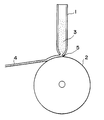
- the single figure is a schematic illustration of a single-roller melt-spinning apparatus employed to prepare thin ribbons from the alloys of the present invention by a rapid solidification process.
- the magnesium-based alloys of the present invention can be obtained by rapidly solidifying a melt of an alloy having the composition as specified above by means of liquid quenching techniques.
- the liquid quenching techniques involve rapidly cooling a molten alloy and, particularly, single-roller melt-spinning technique, twin-roller melt-spinning technique and in-rotating-water melt-spinning technique are mentioned as especially effective examples of such techniques. In these techniques, a cooling rate of about 103 to 105 K/sec can be obtained.
- the molten alloy is ejected from the opening of a nozzle to a roll of, for example, copper or steel, with a diameter of about 30 - 3000 mm, which is rotating at a constant rate of about 300 - 10000 rpm.
- a roll of, for example, copper or steel with a diameter of about 30 - 3000 mm, which is rotating at a constant rate of about 300 - 10000 rpm.
- a jet of the molten alloy is directed, under application of the back pressure of argon gas, through a nozzle into a liquid refrigerant layer with a depth of about 1 to 10 cm which is held by centrifugal force in a drum rotating at a rate of about 50 to 500 rpm.
- fine wire materials can be readily obtained.
- the angle between the molten alloy ejecting from the nozzle and the liquid refrigerant surfaces is preferably in the range of about 60° to 90° and the ratio of the relative velocity of the ejecting molten alloy to the liquid refrigerant surface is preferably in the range of about 0.7 to 0.9.
- the alloys of the present invention is prepared with a cooling rate of the order of about 103 to 105 K/sec.
- a cooling rate of the order of about 103 to 105 K/sec.
- the cooling rate is lower than 103 K/sec, it is impossible to obtain the fine crystalline structure alloys having the properties contemplated by the present invention.
- cooling rates exceeding 105 K/sec provides an amorphous structure or a composite structure of an amorphous phase and a fine crystalline phase.
- the above specified cooling rate is employed in the present invention.
- the fine crystalline structure alloy of the present invention may be also prepared by forming first an amorphous alloy in the same procedure as described above, except employing the cooling rates of 104 to 106 K/sec, and, then, heating the amorphous alloy in the vicinity of the crystallization temperature (crystallization temperature ⁇ 100 °C), thereby causing crystallization.
- the intended fine crystalline structure alloys can be produced at temperatures lower than the temperature of crystallization temperature - 100 °C.
- the alloy of the present invention can be also obtained in the form of a thin film by a sputtering process. Further, rapidly solidified powder of the alloy composition of the present invention can be obtained by various atomizing processes, for example, high pressure gas atomizing process or spray deposition process.
- a is limited to the range of 40 to 95 atomic % and b is limited to the range of 5 to 60 atomic %.
- the reason for such limitations is that when the content of Mg is lower than the specified lower limit, it is difficult to form a supersaturated solid solution containing solutes in amounts exceeding their solid solubility limits. Therefore, the fine crystalline structure alloys having the properties contemplated by the present invention can not be obtained by industrial rapid cooling techniques using the above-mentioned liquid quenching, etc. On the other hand, if the content of Mg exceeds the specified upper limit, it is impossible to obtain the fine crystalline structure alloys having the properties intended by the present invention.
- a, c and d are limited to the ranges of 40 to 95 atomic %, 1 to 35 atomic % and 1 to 25 atomic %, respectively.
- the reason for such limitations is that when the content of Mg is lower than the specified lower limit, it becomes difficult to form the supersaturated solid solution with solutes dissolved in amounts exceeding solid solubility limits. Therefore, the fine crystalline structure alloys having the properties contemplated by the present invention can not be obtained by industrial rapid cooling techniques using the above-mentioned liquid quenching, etc. On the other hand, if the content of Mg exceeds the specified upper limit, it is impossible to obtain the fine crystalline structure alloys having the properties intended by the present invention.
- a is limited to the range of 40 to 95 atomic %
- c is limited to the range of 1 to 35 atomic %
- e is limited to the range of 3 to 25 atomic %.
- the reason for such limitations is that when the content of Mg is lower than the specified lower limit, it becomes difficult to form the supersaturated solid solution with solutes dissolved in amounts exceeding their solid solubility limits. Therefore, the fine crystalline alloys having the properties contemplated by the present invention can not be obtained by industrial rapid cooling techniques using the above-mentioned liquid quenching, etc. On the other hand, if the content of Mg exceeds the specified upper limit, it is impossible to obtain the fine crystalline structure alloys having the properties intended by the present invention.
- a, c, d and e should be limited within the ranges of 40 to 95 atomic %, 1 to 35 atomic %, 1 to 25 atomic % and 3 to 25 atomic %, respectively.
- the reason for such limitations is, as described above, that when the content of Mg is lower than the specified lower limit, it becomes difficult to form the supersaturated solid solution with solutes dissolved in amounts exceeding their solid solubility limits. Therefore, the fine crystalline structure alloys having the properties contemplated by the present invention can not be obtained by industrial rapid cooling techniques using the above-mentioned liquid quenching, etc. On the other hand, if the content of Mg exceeds the specified upper limit, it is impossible to obtain the fine crystalline structure alloys having the properties intended by the present invention.
- the X element is one or more elements selected from the group consisting of Cu, Ni, Sn and Zn and these elements provide a superior effect in stabilizing the resulting crystalline phase, under the conditions of the preparation of the fine crystalline structure alloys, and improve the strength while retaining the ductility.
- the M element is one or more elements selected from the group consisting of Al, Si and Ca and forms stable or metastable intermetallic compounds in combination with magnesium and other additive elements under the production conditions of the fine crystalline structure alloys.
- the formed intermetallic compounds are uniformly distributed throughout in a magnesium matrix ( ⁇ -phase) and thereby considerably improve the hardness and strength of the resultant alloys.
- the M element prevents coarsening of the fine crystalline structure at high temperatures and provides a good heat resistance.
- Al element and Ca element have an effect of improving the corrosion resistance and Si element improves the fluidity of the molten alloy.
- the Ln element is one or more elements selected from the group consisting of Y, La, Ce, Nd and Sm or a misch metal (Mm) consisting of said rare earth elements and the Ln element is effective to provide a more stable fine crystalline structure, when it is added to Mg-X system or Mg-X-M system. Further, the Ln element provides a greatly improved hardness.
- magnesium-based alloys of the present invention show superplasticity in a high temperature range permitting the presence of a stable fine crystalline phase, they can be readily subjected to extrusion, press working, hot forging, etc.
- the magnesium-based alloys of the present invention obtained in the form of thin ribbon, wire, sheet or powder can be successfully consolidated into bulk materials by way of extrusion, press working, hot-forging, etc., at the high temperature range for a stable fine crystalline phase. Further, some of the magnesium-based alloys of the present invention are sufficiently ductile to permit a high degree of bending.
- Molten alloy 3 having a predetermined composition was prepared using a high-frequency melting furnace and was charged into a quartz tube 1 having a small opening 5 (diameter: 0.5 mm) at the tip thereof, as shown in the drawing. After heating to melt the alloy 3, the quartz tube 1 was disposed right above a copper roll 2. Then, the molten alloy 3 contained in the quartz tube 1 was ejected from the small opening 5 of the quartz tube 1 under the application of an argon gas pressure of 0.7 kg/cm2 and brought into contact with the surface of the copper roll 2 rapidly rotating at a rate of 5,000 rpm. The molten alloy 3 was rapidly solidified and an alloy thin ribbon 4 was obtained.
- the hardness (Hv) is indicated by values (DPN) measured using a Vickers micro hardness tester under load of 25 g.
- test specimens showed a high level of hardness Hv (DPN) of at least 240 which is about 2.5 to 4.0 times the hardness Hv (DPN), i.e., 60 - 90, of the conventional magnesium-based alloys. Further, the test specimens of the present invention all exhibited a high tensile-strength level of not less than 850 MPa and such a high strength level is approximately 2 times the highest strength level of 400 MPa achieved in known magnesium-based alloys. It can be seen from such results that the alloy materials of the present invention are superior in hardness and strength.
- specimen Nos. 3, 7 and 12 shown in the table showed a superior ductility permitting a large degree of bending and a good formability.
- Table No. Specimen Hv(DPN) ⁇ f (MPa) 1. Mg65Ni25La10 325 1150 2. Mg90Ni5La5 295 1010 3. Mg90Ni5Ce5 249 920 4. Mg75Ni10Y15 346 1280 5. Mg75Ni10Si5Ce10 302 1100 6. Mg75Ni10Mm15 295 1120 7. Mg90Ni5Mm5 270 920 8. Mg60Ni20Mm20 357 1150 9. Mg70Ni10Ca5Mm15 313 1180 10.
- Mg70Ni5Al5Mm20 346 1260 11.
- Mg55Ni20Sn10Y15 355 1215 12.
- Mg90Cu5La5 246 872 13.
- Mg80Cu10La10 266 935 14.
- Mg50Cu20La10Ce20 327 1160
- Mg75Cu10Zn5La10 346 1195
- Mg75Cu15Mm10 265 877 17.
- Mg80Cu10Y10 274 901 18.
- Mg75Cu10Sn5Y10 352 1150 19.
- Mg70Cu12Al8Y10 307 1180 20.
- Mg70Zn15La10Ce5 304 1125 1125
- the magnesium-based alloys of the present invention have a high hardness and a high strength which are respectively, at least 2.5 times and at least 2 times in comparison with those of a similar type of magnesium-based alloy which has been heretofore evaluated as the most superior alloy and have a good processability permitting extrusion or similar operations. Therefore, the alloys of the present invention exhibit advantageous effects in a wide variety of industrial applications.
Landscapes
- Chemical & Material Sciences (AREA)
- Engineering & Computer Science (AREA)
- Materials Engineering (AREA)
- Mechanical Engineering (AREA)
- Metallurgy (AREA)
- Organic Chemistry (AREA)
- Continuous Casting (AREA)
- Powder Metallurgy (AREA)
- Manufacture And Refinement Of Metals (AREA)
Abstract
Description
- The present invention relates to magnesium-based alloys which have a superior combination of high hardness and high strength and are useful in various industrial applications.
- As conventional magnesium-based alloys, there have been known Mg-Al, Mg-Al-Zn, Mg-Th-Zr, Mg-Th-Zn-Zr, Mg-Zn-Zr, Mg-Zn-Zr-RE (rare earth element), etc. and these known alloys have been extensively used in a wide variety of applications, for example, as lightweight structural component materials for aircrafts and automobiles or the like, cell materials and sacrificial anode materials, according to their properties.
- However, the conventional magnesium-based alloys as set forth above are low in hardness and strength and also poor in corrosion resistance.
- In view of the foregoing, it is an object of the present invention to provide novel magnesium-based alloys at a relatively low cost which have an advantageous combination of properties of high hardness and high strength and which are readily processable, for example, by extrusion.
- According to the present invention, there are provided the following high strength magnesium-based alloys:
- (1) High strength magnesium-based alloys which are composed of a fine crystalline structure, the magnesium based alloys having a composition represented by the general formula (I):
MgaXb (I)
wherein:
X is at least two elements selected from the group consisting of Cu, Ni, Sn and Zn; and
a and b are atomic percentages falling within the following ranges:
40 ≦ a ≦ 95 and 5 ≦ b ≦ 60. - (2) High strength magnesium-based alloys which are composed of a fine crystalline structure, the magnesium-based alloys having a composition represented by the general formula (II):
MgaXcMd (II)
wherein:
X is one or more elements selected from the group consisting of Cu, Ni, Sn and Zn; M is one or more elements selected from the group consisting of Al, Si and Ca; and
a, c and d are atomic percentages falling within the following ranges:
40 ≦ a ≦ 95, 1 ≦ c ≦ 35 and 1 ≦ d ≦ 25. - (3) High strength magnesium-based alloys which are composed of a fine crystalline structure, the magnesium-based alloys having a composition represented by the general formula (III):
MgaxcLne (III)
wherein:
X is one or more elements selected from the group consisting of Cu, Ni, Sn and Zn; Ln is one or more elements selected from the group consisting of Y, La, Ce, Nd and Sm or a misch metal (Mm) which is a combination of rare earth elements; and
a, c and e are atomic percentages falling within the following ranges:
40 ≦ a ≦ 95, 1 ≦ c ≦ 35 and 3 ≦ e ≦ 25. - (4) High strength magnesium-based alloys which are composed of a fine crystalline structure, the magnesium-based alloys having a composition represented by the general formula (IV);
MgaXcMdLne (IV)
wherein:
X is one or more elements selected from the group consisting of Cu, Ni, Sn and Zn;
M is one or more elements selected from the group consisting of Al, Si and Ca;
Ln is one or more elements selected from the group consisting of Y, La, Ce, Nd and Sm or a misch metal (Mm) which is a combination of rare earth elements; and
a, c, d and e are atomic percentages falling within the following ranges:
40 ≦ a ≦ 95, 1 ≦ c ≦ 35, 1 ≦ d ≦ 25 and 3 ≦ e ≦ 25. - The expression "fine crystalline structure" is used herein to mean an alloy structure consisting of a supersaturated solid solution, a stable or metastable intermetallic phase or mixed phases thereof.
- Among the elements included in the above-defined alloy compositions, La, Ce, Nd and/or Sm may be replaced with a misch metal (Mm) which is a composite containing those rare earth elements as main components. The Mm used herein consists of 40 to 50 atomic % Ce and 20 to 25 atomic % La with other rare earth elments and acceptable levels of impurities (Mg, Al, Si, Fe, etc). Mm may be replaced for the other Ln elements in an about 1 : 1 ratio (by atomic %) and provides an economically advantageous effect as a practical source of the Ln element because of its low cost.
- The single figure is a schematic illustration of a single-roller melt-spinning apparatus employed to prepare thin ribbons from the alloys of the present invention by a rapid solidification process.
- The magnesium-based alloys of the present invention can be obtained by rapidly solidifying a melt of an alloy having the composition as specified above by means of liquid quenching techniques. The liquid quenching techniques involve rapidly cooling a molten alloy and, particularly, single-roller melt-spinning technique, twin-roller melt-spinning technique and in-rotating-water melt-spinning technique are mentioned as especially effective examples of such techniques. In these techniques, a cooling rate of about 10³ to 10⁵ K/sec can be obtained. In order to produce thin ribbon materials by the single-roller melt-spinning technique, twin-roller melt-spinning technique or the like, the molten alloy is ejected from the opening of a nozzle to a roll of, for example, copper or steel, with a diameter of about 30 - 3000 mm, which is rotating at a constant rate of about 300 - 10000 rpm. In these techniques, various thin ribbon materials with a width of about 1 - 300 mm and a thickness of about 5 - 500 µm can be readily obtained. Alternatively, in order to produce fine wire materials by the in-rotating-water melt-spinning technique, a jet of the molten alloy is directed, under application of the back pressure of argon gas, through a nozzle into a liquid refrigerant layer with a depth of about 1 to 10 cm which is held by centrifugal force in a drum rotating at a rate of about 50 to 500 rpm. In such a manner, fine wire materials can be readily obtained. In this technique, the angle between the molten alloy ejecting from the nozzle and the liquid refrigerant surfaces is preferably in the range of about 60° to 90° and the ratio of the relative velocity of the ejecting molten alloy to the liquid refrigerant surface is preferably in the range of about 0.7 to 0.9.
- The alloys of the present invention is prepared with a cooling rate of the order of about 10³ to 10⁵ K/sec. When the cooling rate is lower than 10³ K/sec, it is impossible to obtain the fine crystalline structure alloys having the properties contemplated by the present invention. On the other hand, cooling rates exceeding 10⁵ K/sec provides an amorphous structure or a composite structure of an amorphous phase and a fine crystalline phase. For this, the above specified cooling rate is employed in the present invention.
- However, the fine crystalline structure alloy of the present invention may be also prepared by forming first an amorphous alloy in the same procedure as described above, except employing the cooling rates of 10⁴ to 10⁶ K/sec, and, then, heating the amorphous alloy in the vicinity of the crystallization temperature (crystallization temperature ± 100 °C), thereby causing crystallization. In some alloy compositions, the intended fine crystalline structure alloys can be produced at temperatures lower than the temperature of crystallization temperature - 100 °C.
- Besides the above techniques, the alloy of the present invention can be also obtained in the form of a thin film by a sputtering process. Further, rapidly solidified powder of the alloy composition of the present invention can be obtained by various atomizing processes, for example, high pressure gas atomizing process or spray deposition process.
- In the magnesium-based alloys of the present invention represented by the above general formula (I), a is limited to the range of 40 to 95 atomic % and b is limited to the range of 5 to 60 atomic %. The reason for such limitations is that when the content of Mg is lower than the specified lower limit, it is difficult to form a supersaturated solid solution containing solutes in amounts exceeding their solid solubility limits. Therefore, the fine crystalline structure alloys having the properties contemplated by the present invention can not be obtained by industrial rapid cooling techniques using the above-mentioned liquid quenching, etc. On the other hand, if the content of Mg exceeds the specified upper limit, it is impossible to obtain the fine crystalline structure alloys having the properties intended by the present invention.
- In the magnesium-based alloys of the present invention represented by the above general formula (II), a, c and d are limited to the ranges of 40 to 95 atomic %, 1 to 35 atomic % and 1 to 25 atomic %, respectively. The reason for such limitations is that when the content of Mg is lower than the specified lower limit, it becomes difficult to form the supersaturated solid solution with solutes dissolved in amounts exceeding solid solubility limits. Therefore, the fine crystalline structure alloys having the properties contemplated by the present invention can not be obtained by industrial rapid cooling techniques using the above-mentioned liquid quenching, etc. On the other hand, if the content of Mg exceeds the specified upper limit, it is impossible to obtain the fine crystalline structure alloys having the properties intended by the present invention.
- In the magnesium-based alloys of the present invention represented by the above general formula (III), a is limited to the range of 40 to 95 atomic %, c is limited to the range of 1 to 35 atomic % and e is limited to the range of 3 to 25 atomic %. As described above, the reason for such limitations is that when the content of Mg is lower than the specified lower limit, it becomes difficult to form the supersaturated solid solution with solutes dissolved in amounts exceeding their solid solubility limits. Therefore, the fine crystalline alloys having the properties contemplated by the present invention can not be obtained by industrial rapid cooling techniques using the above-mentioned liquid quenching, etc. On the other hand, if the content of Mg exceeds the specified upper limit, it is impossible to obtain the fine crystalline structure alloys having the properties intended by the present invention.
- Further, in the magnesium-based alloys of the present invention represented by the above general formula (IV), a, c, d and e should be limited within the ranges of 40 to 95 atomic %, 1 to 35 atomic %, 1 to 25 atomic % and 3 to 25 atomic %, respectively. The reason for such limitations is, as described above, that when the content of Mg is lower than the specified lower limit, it becomes difficult to form the supersaturated solid solution with solutes dissolved in amounts exceeding their solid solubility limits. Therefore, the fine crystalline structure alloys having the properties contemplated by the present invention can not be obtained by industrial rapid cooling techniques using the above-mentioned liquid quenching, etc. On the other hand, if the content of Mg exceeds the specified upper limit, it is impossible to obtain the fine crystalline structure alloys having the properties intended by the present invention.
- The X element is one or more elements selected from the group consisting of Cu, Ni, Sn and Zn and these elements provide a superior effect in stabilizing the resulting crystalline phase, under the conditions of the preparation of the fine crystalline structure alloys, and improve the strength while retaining the ductility.
- The M element is one or more elements selected from the group consisting of Al, Si and Ca and forms stable or metastable intermetallic compounds in combination with magnesium and other additive elements under the production conditions of the fine crystalline structure alloys. The formed intermetallic compounds are uniformly distributed throughout in a magnesium matrix (α-phase) and thereby considerably improve the hardness and strength of the resultant alloys. Further, the M element prevents coarsening of the fine crystalline structure at high temperatures and provides a good heat resistance. Among the above elements, Al element and Ca element have an effect of improving the corrosion resistance and Si element improves the fluidity of the molten alloy.
- The Ln element is one or more elements selected from the group consisting of Y, La, Ce, Nd and Sm or a misch metal (Mm) consisting of said rare earth elements and the Ln element is effective to provide a more stable fine crystalline structure, when it is added to Mg-X system or Mg-X-M system. Further, the Ln element provides a greatly improved hardness.
- Further, since the magnesium-based alloys of the present invention show superplasticity in a high temperature range permitting the presence of a stable fine crystalline phase, they can be readily subjected to extrusion, press working, hot forging, etc.
- Therefore, the magnesium-based alloys of the present invention obtained in the form of thin ribbon, wire, sheet or powder can be successfully consolidated into bulk materials by way of extrusion, press working, hot-forging, etc., at the high temperature range for a stable fine crystalline phase. Further, some of the magnesium-based alloys of the present invention are sufficiently ductile to permit a high degree of bending.
-
Molten alloy 3 having a predetermined composition was prepared using a high-frequency melting furnace and was charged into a quartz tube 1 having a small opening 5 (diameter: 0.5 mm) at the tip thereof, as shown in the drawing. After heating to melt thealloy 3, the quartz tube 1 was disposed right above a copper roll 2. Then, themolten alloy 3 contained in the quartz tube 1 was ejected from the small opening 5 of the quartz tube 1 under the application of an argon gas pressure of 0.7 kg/cm² and brought into contact with the surface of the copper roll 2 rapidly rotating at a rate of 5,000 rpm. Themolten alloy 3 was rapidly solidified and an alloy thin ribbon 4 was obtained. - According to the processing conditions as described above, there were obtained 21 different alloy thin ribbons (width: 1 mm, thickness: 20 µm) having the compositions (by at.%) as shown in Table. Hardness (Hv) and tensile strength were measured for each test specimen of the thin ribbons and the results are shown in a right column of the table.
- The hardness (Hv) is indicated by values (DPN) measured using a Vickers micro hardness tester under load of 25 g.
- As shown in the table, all test specimens showed a high level of hardness Hv (DPN) of at least 240 which is about 2.5 to 4.0 times the hardness Hv (DPN), i.e., 60 - 90, of the conventional magnesium-based alloys. Further, the test specimens of the present invention all exhibited a high tensile-strength level of not less than 850 MPa and such a high strength level is approximately 2 times the highest strength level of 400 MPa achieved in known magnesium-based alloys. It can be seen from such results that the alloy materials of the present invention are superior in hardness and strength.
- In addition, for example, specimen Nos. 3, 7 and 12 shown in the table showed a superior ductility permitting a large degree of bending and a good formability.
Table No. Specimen Hv(DPN) δf (MPa) 1. Mg₆₅Ni₂₅La₁₀ 325 1150 2. Mg₉₀Ni₅La₅ 295 1010 3. Mg₉₀Ni₅Ce₅ 249 920 4. Mg₇₅Ni₁₀Y₁₅ 346 1280 5. Mg₇₅Ni₁₀Si₅Ce₁₀ 302 1100 6. Mg₇₅Ni₁₀Mm₁₅ 295 1120 7. Mg₉₀Ni₅Mm₅ 270 920 8. Mg₆₀Ni₂₀Mm₂₀ 357 1150 9. Mg₇₀Ni₁₀Ca₅Mm₁₅ 313 1180 10. Mg₇₀Ni₅Al₅Mm₂₀ 346 1260 11. Mg₅₅Ni₂₀Sn₁₀Y₁₅ 355 1215 12. Mg₉₀Cu₅La₅ 246 872 13. Mg₈₀Cu₁₀La₁₀ 266 935 14. Mg₅₀Cu₂₀La₁₀Ce₂₀ 327 1160 15. Mg₇₅Cu₁₀Zn₅La₁₀ 346 1195 16. Mg₇₅Cu₁₅Mm₁₀ 265 877 17. Mg₈₀Cu₁₀Y₁₀ 274 901 18. Mg₇₅Cu₁₀Sn₅Y₁₀ 352 1150 19. Mg₇₀Cu₁₂Al₈Y₁₀ 307 1180 20. Mg₈₀Sn₁₀La₁₀ 291 1087 21. Mg₇₀Zn₁₅La₁₀Ce₅ 304 1125 - As described above, the magnesium-based alloys of the present invention have a high hardness and a high strength which are respectively, at least 2.5 times and at least 2 times in comparison with those of a similar type of magnesium-based alloy which has been heretofore evaluated as the most superior alloy and have a good processability permitting extrusion or similar operations. Therefore, the alloys of the present invention exhibit advantageous effects in a wide variety of industrial applications.
Claims (1)
MgaXb (I)
wherein:
X is at least two elements selected from the group consisting of Cu, Ni, Sn and Zn; and
a and b are atomic percentages falling within the following ranges:
40 ≦ a ≦ 95 and 5 ≦ b ≦ 60;
MgaXcMd (II)
wherein:
X is one or more elements selected from the group consisting of Cu, Ni, Sn and Zn;
M is one or more elements selected from the group consisting of Al, Si and Ca; and
a, c and d are atomic percentages falling within the following ranges:
40 ≦ a ≦ 95, 1 ≦ c ≦ 35 and 1 ≦ d ≦ 25;
MgaXcLne (III)
wherein:
X is one or more elements selected from the group consisting of Cu, Ni, Sn and Zn;
Ln is one or more elements selected from the group consisting of Y, La, Ce, Nd and Sm or a misch metal (Mm) which is a combination of rare earth elements; and
a, c and e are atomic percentages falling within the following ranges: 40 ≦ a ≦ 95, 1 ≦ c ≦ 35 and 3 ≦ e ≦ 25; and
MgaXcMdLne (IV)
wherein:
X is one or more elements selected from the group consisting of Cu, Ni, Sn and Zn;
M is one or more elements selected from the group consisting of Al, Si and Ca;
Ln is one or more elements selected from the group consisting of Y, La, Ce, Nd and Sm or a misch metal (Mm) which is a combination of rare earth elements; and
a, c, d and e are atomic percentages falling within the following ranges:
40 ≦ a ≦ 95, 1 ≦ c ≦ 35, 1 ≦ d ≦ 25 and 3 ≦ e ≦ 25.
Applications Claiming Priority (2)
| Application Number | Priority Date | Filing Date | Title |
|---|---|---|---|
| JP1179139A JP2511526B2 (en) | 1989-07-13 | 1989-07-13 | High strength magnesium base alloy |
| JP179139/89 | 1989-07-13 |
Publications (3)
| Publication Number | Publication Date |
|---|---|
| EP0407964A2 true EP0407964A2 (en) | 1991-01-16 |
| EP0407964A3 EP0407964A3 (en) | 1994-01-26 |
| EP0407964B1 EP0407964B1 (en) | 1996-08-07 |
Family
ID=16060661
Family Applications (1)
| Application Number | Title | Priority Date | Filing Date |
|---|---|---|---|
| EP90113151A Expired - Lifetime EP0407964B1 (en) | 1989-07-13 | 1990-07-10 | High strength magnesium-based alloys |
Country Status (7)
| Country | Link |
|---|---|
| US (1) | US5304260A (en) |
| EP (1) | EP0407964B1 (en) |
| JP (1) | JP2511526B2 (en) |
| AU (1) | AU618487B2 (en) |
| CA (1) | CA2020484C (en) |
| DE (1) | DE69028009T2 (en) |
| NO (1) | NO178795C (en) |
Cited By (8)
| Publication number | Priority date | Publication date | Assignee | Title |
|---|---|---|---|---|
| EP0470599A1 (en) * | 1990-08-09 | 1992-02-12 | Ykk Corporation | High strength magnesium-based alloys |
| EP0531165A1 (en) * | 1991-09-06 | 1993-03-10 | Tsuyoshi Masumoto | High-strength amorphous magnesium alloy and method for producing the same |
| WO1993019216A1 (en) * | 1992-03-17 | 1993-09-30 | Metallgesellschaft Aktiengesellschaft | Machine component |
| EP1033767A4 (en) * | 1998-09-18 | 2004-09-01 | Canon Kk | Electrode material for negative pole of lithium secondary cell, electrode structure using said electrode material, lithium secondary cell using said electrode structure, and method for manufacturing said electrode structure and said lithium secondary cell |
| GB2410033A (en) * | 2001-08-13 | 2005-07-20 | Honda Motor Co Ltd | Magnesium alloy |
| EP1840235A1 (en) | 2006-03-31 | 2007-10-03 | BIOTRONIK VI Patent AG | Magnesium alloy and corresponding production method |
| CN103131925A (en) * | 2013-03-14 | 2013-06-05 | 河南科技大学 | High-strength heat-resisting composite rare earth magnesium alloy |
| CN109022981A (en) * | 2018-09-27 | 2018-12-18 | 中北大学 | A kind of preparation method of high-strength casting magnesium-zinc alloy ingot |
Families Citing this family (65)
| Publication number | Priority date | Publication date | Assignee | Title |
|---|---|---|---|---|
| JP2937518B2 (en) * | 1991-03-07 | 1999-08-23 | 健 増本 | Materials for sacrificial electrodes for corrosion protection with excellent corrosion resistance |
| US5552110A (en) * | 1991-07-26 | 1996-09-03 | Toyota Jidosha Kabushiki Kaisha | Heat resistant magnesium alloy |
| JP3110117B2 (en) * | 1991-12-26 | 2000-11-20 | 健 増本 | High strength magnesium based alloy |
| JP2725112B2 (en) * | 1992-03-25 | 1998-03-09 | 三井金属鉱業株式会社 | High strength magnesium alloy |
| JP2741642B2 (en) * | 1992-03-25 | 1998-04-22 | 三井金属鉱業株式会社 | High strength magnesium alloy |
| JP2807374B2 (en) * | 1992-04-30 | 1998-10-08 | ワイケイケイ株式会社 | High-strength magnesium-based alloy and its solidified material |
| CA2144421A1 (en) | 1992-09-11 | 1994-03-31 | Tadayoshi Nakamura | Refined magnesium material and method for producing the same |
| JP2730847B2 (en) * | 1993-06-28 | 1998-03-25 | 宇部興産株式会社 | Magnesium alloy for castings with excellent high temperature creep strength |
| JP2807400B2 (en) * | 1993-08-04 | 1998-10-08 | ワイケイケイ株式会社 | High strength magnesium-based alloy material and method of manufacturing the same |
| US5494538A (en) * | 1994-01-14 | 1996-02-27 | Magnic International, Inc. | Magnesium alloy for hydrogen production |
| AU3708495A (en) * | 1994-08-01 | 1996-03-04 | Franz Hehmann | Selected processing for non-equilibrium light alloys and products |
| JP3098705B2 (en) * | 1995-10-02 | 2000-10-16 | トヨタ自動車株式会社 | Surface nitriding method of aluminum material and nitriding aid |
| US5855697A (en) * | 1997-05-21 | 1999-01-05 | Imra America, Inc. | Magnesium alloy having superior elevated-temperature properties and die castability |
| KR100385132B1 (en) * | 1998-02-27 | 2003-08-14 | 신광선 | METHOD FOR IMPROVING STRENGTH OF Mg-Zn ALLOY |
| JP5161414B2 (en) * | 2001-01-26 | 2013-03-13 | 能人 河村 | High strength magnesium alloy |
| US9682425B2 (en) | 2009-12-08 | 2017-06-20 | Baker Hughes Incorporated | Coated metallic powder and method of making the same |
| US9101978B2 (en) | 2002-12-08 | 2015-08-11 | Baker Hughes Incorporated | Nanomatrix powder metal compact |
| US9079246B2 (en) | 2009-12-08 | 2015-07-14 | Baker Hughes Incorporated | Method of making a nanomatrix powder metal compact |
| US8403037B2 (en) | 2009-12-08 | 2013-03-26 | Baker Hughes Incorporated | Dissolvable tool and method |
| US9109429B2 (en) | 2002-12-08 | 2015-08-18 | Baker Hughes Incorporated | Engineered powder compact composite material |
| US7029626B2 (en) * | 2003-11-25 | 2006-04-18 | Daimlerchrysler Corporation | Creep resistant magnesium alloy |
| KR100701028B1 (en) | 2004-06-14 | 2007-03-29 | 연세대학교 산학협력단 | Magnesium-based amorphous alloy with excellent amorphous forming ability |
| KR100701029B1 (en) | 2005-06-14 | 2007-03-29 | 연세대학교 산학협력단 | Highly ductile magnesium-based amorphous alloy |
| CN100398688C (en) * | 2005-10-21 | 2008-07-02 | 中国科学院物理研究所 | A mixed rare earth-based amorphous metal plastic |
| JP5239022B2 (en) * | 2006-03-20 | 2013-07-17 | 国立大学法人 熊本大学 | High strength and high toughness magnesium alloy and method for producing the same |
| KR100860091B1 (en) * | 2007-04-05 | 2008-09-25 | 주식회사 지알로이테크놀로지 | Magnesium alloy with reduced axial ratio and plate production method of magnesium alloy |
| US20090196787A1 (en) * | 2008-01-31 | 2009-08-06 | Beals Randy S | Magnesium alloy |
| JP5894079B2 (en) * | 2009-12-07 | 2016-03-23 | ユー アンド アイ コーポレーション | Magnesium alloy |
| US9243475B2 (en) | 2009-12-08 | 2016-01-26 | Baker Hughes Incorporated | Extruded powder metal compact |
| US9127515B2 (en) | 2010-10-27 | 2015-09-08 | Baker Hughes Incorporated | Nanomatrix carbon composite |
| US10240419B2 (en) | 2009-12-08 | 2019-03-26 | Baker Hughes, A Ge Company, Llc | Downhole flow inhibition tool and method of unplugging a seat |
| JP5548578B2 (en) * | 2010-10-15 | 2014-07-16 | 日本発條株式会社 | High strength magnesium alloy wire and manufacturing method thereof, high strength magnesium alloy component, and high strength magnesium alloy spring |
| US9090955B2 (en) | 2010-10-27 | 2015-07-28 | Baker Hughes Incorporated | Nanomatrix powder metal composite |
| US8631876B2 (en) | 2011-04-28 | 2014-01-21 | Baker Hughes Incorporated | Method of making and using a functionally gradient composite tool |
| US9080098B2 (en) | 2011-04-28 | 2015-07-14 | Baker Hughes Incorporated | Functionally gradient composite article |
| US9139928B2 (en) | 2011-06-17 | 2015-09-22 | Baker Hughes Incorporated | Corrodible downhole article and method of removing the article from downhole environment |
| US9707739B2 (en) | 2011-07-22 | 2017-07-18 | Baker Hughes Incorporated | Intermetallic metallic composite, method of manufacture thereof and articles comprising the same |
| US9643250B2 (en) | 2011-07-29 | 2017-05-09 | Baker Hughes Incorporated | Method of controlling the corrosion rate of alloy particles, alloy particle with controlled corrosion rate, and articles comprising the particle |
| US9833838B2 (en) | 2011-07-29 | 2017-12-05 | Baker Hughes, A Ge Company, Llc | Method of controlling the corrosion rate of alloy particles, alloy particle with controlled corrosion rate, and articles comprising the particle |
| US9057242B2 (en) | 2011-08-05 | 2015-06-16 | Baker Hughes Incorporated | Method of controlling corrosion rate in downhole article, and downhole article having controlled corrosion rate |
| US9033055B2 (en) | 2011-08-17 | 2015-05-19 | Baker Hughes Incorporated | Selectively degradable passage restriction and method |
| US9109269B2 (en) | 2011-08-30 | 2015-08-18 | Baker Hughes Incorporated | Magnesium alloy powder metal compact |
| US9856547B2 (en) | 2011-08-30 | 2018-01-02 | Bakers Hughes, A Ge Company, Llc | Nanostructured powder metal compact |
| US9090956B2 (en) | 2011-08-30 | 2015-07-28 | Baker Hughes Incorporated | Aluminum alloy powder metal compact |
| US9643144B2 (en) | 2011-09-02 | 2017-05-09 | Baker Hughes Incorporated | Method to generate and disperse nanostructures in a composite material |
| US9187990B2 (en) | 2011-09-03 | 2015-11-17 | Baker Hughes Incorporated | Method of using a degradable shaped charge and perforating gun system |
| US9133695B2 (en) | 2011-09-03 | 2015-09-15 | Baker Hughes Incorporated | Degradable shaped charge and perforating gun system |
| US9347119B2 (en) | 2011-09-03 | 2016-05-24 | Baker Hughes Incorporated | Degradable high shock impedance material |
| KR101342582B1 (en) * | 2011-10-20 | 2013-12-17 | 포항공과대학교 산학협력단 | Non heat treatable magnesium alloy sheet having less segregation and improved room temperature formability |
| US9010416B2 (en) | 2012-01-25 | 2015-04-21 | Baker Hughes Incorporated | Tubular anchoring system and a seat for use in the same |
| US9068428B2 (en) | 2012-02-13 | 2015-06-30 | Baker Hughes Incorporated | Selectively corrodible downhole article and method of use |
| JP5948124B2 (en) * | 2012-04-18 | 2016-07-06 | 日本発條株式会社 | Magnesium alloy member and manufacturing method thereof |
| US9605508B2 (en) | 2012-05-08 | 2017-03-28 | Baker Hughes Incorporated | Disintegrable and conformable metallic seal, and method of making the same |
| US9816339B2 (en) | 2013-09-03 | 2017-11-14 | Baker Hughes, A Ge Company, Llc | Plug reception assembly and method of reducing restriction in a borehole |
| CN103526141B (en) * | 2013-09-05 | 2015-03-11 | 华南理工大学 | Magnesium-based hydrogen storage material and preparation method thereof |
| US11167343B2 (en) | 2014-02-21 | 2021-11-09 | Terves, Llc | Galvanically-active in situ formed particles for controlled rate dissolving tools |
| US10689740B2 (en) | 2014-04-18 | 2020-06-23 | Terves, LLCq | Galvanically-active in situ formed particles for controlled rate dissolving tools |
| US10150713B2 (en) | 2014-02-21 | 2018-12-11 | Terves, Inc. | Fluid activated disintegrating metal system |
| US9910026B2 (en) | 2015-01-21 | 2018-03-06 | Baker Hughes, A Ge Company, Llc | High temperature tracers for downhole detection of produced water |
| US10378303B2 (en) | 2015-03-05 | 2019-08-13 | Baker Hughes, A Ge Company, Llc | Downhole tool and method of forming the same |
| US10221637B2 (en) | 2015-08-11 | 2019-03-05 | Baker Hughes, A Ge Company, Llc | Methods of manufacturing dissolvable tools via liquid-solid state molding |
| US10016810B2 (en) | 2015-12-14 | 2018-07-10 | Baker Hughes, A Ge Company, Llc | Methods of manufacturing degradable tools using a galvanic carrier and tools manufactured thereof |
| CA3012511A1 (en) | 2017-07-27 | 2019-01-27 | Terves Inc. | Degradable metal matrix composite |
| JP7315941B2 (en) * | 2018-10-03 | 2023-07-27 | 地方独立行政法人東京都立産業技術研究センター | POWDER MATERIAL AND MANUFACTURING METHOD OF MAGNESIUM ALLOY MEMBER |
| CN119243000B (en) * | 2024-12-06 | 2025-04-18 | 上海交通大学 | High-heat-conductivity high-corrosion-resistance magnesium alloy suitable for mobile phone middle plate and preparation method and application thereof |
Family Cites Families (23)
| Publication number | Priority date | Publication date | Assignee | Title |
|---|---|---|---|---|
| US3147156A (en) * | 1960-05-13 | 1964-09-01 | Dow Chemical Co | Method of extrusion and extrusion billet therefor |
| US3183083A (en) * | 1961-02-24 | 1965-05-11 | Dow Chemical Co | Magnesium-base alloy |
| US3131095A (en) * | 1961-04-10 | 1964-04-28 | Dow Chemical Co | Magnesium-base alloy |
| JPS5270916A (en) * | 1975-11-07 | 1977-06-13 | Hitachi Ltd | Metal materials for hydrogen storage |
| FR2430458A1 (en) * | 1978-07-07 | 1980-02-01 | Anvar | NEW MAGNESIUM METAL ALLOYS, THEIR PREPARATION AND THEIR APPLICATION, PARTICULARLY TO HYDROGEN STORAGE |
| CA1177624A (en) * | 1980-04-03 | 1984-11-13 | Hee M. Lee | Hydrogen storage |
| AU544762B2 (en) * | 1981-03-25 | 1985-06-13 | Luxfer Group Limited | Magnesium base rare earth alloy |
| JPS5911652B2 (en) * | 1982-03-15 | 1984-03-16 | 工業技術院長 | Alloy for hydrogen storage |
| ZA832570B (en) * | 1982-04-28 | 1984-01-25 | Energy Conversion Devices Inc | Improved rechargeable battery and electrode used therein |
| US4675157A (en) * | 1984-06-07 | 1987-06-23 | Allied Corporation | High strength rapidly solidified magnesium base metal alloys |
| US4857109A (en) * | 1985-09-30 | 1989-08-15 | Allied-Signal Inc. | Rapidly solidified high strength, corrosion resistant magnesium base metal alloys |
| US4853035A (en) * | 1985-09-30 | 1989-08-01 | Allied-Signal Inc. | Rapidly solidified high strength, corrosion resistant magnesium base metal alloys |
| US4765954A (en) * | 1985-09-30 | 1988-08-23 | Allied Corporation | Rapidly solidified high strength, corrosion resistant magnesium base metal alloys |
| GB2196986B (en) * | 1986-11-04 | 1990-12-12 | Geoffrey Allan Chadwick | Magnesium alloy |
| GB8626276D0 (en) * | 1986-11-04 | 1986-12-31 | Chadwick G A | Magnesium alloy |
| US4770850A (en) * | 1987-10-01 | 1988-09-13 | The United States Of America As Represented By The Secretary Of The Air Force | Magnesium-calcium-nickel/copper alloys and articles |
| FR2642439B2 (en) * | 1988-02-26 | 1993-04-16 | Pechiney Electrometallurgie | |
| US4908181A (en) * | 1988-03-07 | 1990-03-13 | Allied-Signal Inc. | Ingot cast magnesium alloys with improved corrosion resistance |
| US4938809A (en) * | 1988-05-23 | 1990-07-03 | Allied-Signal Inc. | Superplastic forming consolidated rapidly solidified, magnestum base metal alloy powder |
| NZ230311A (en) * | 1988-09-05 | 1990-09-26 | Masumoto Tsuyoshi | High strength magnesium based alloy |
| FR2651244B1 (en) * | 1989-08-24 | 1993-03-26 | Pechiney Recherche | PROCESS FOR OBTAINING MAGNESIUM ALLOYS BY SPUTTERING. |
| US5078807A (en) * | 1990-09-21 | 1992-01-07 | Allied-Signal, Inc. | Rapidly solidified magnesium base alloy sheet |
| US5087304A (en) * | 1990-09-21 | 1992-02-11 | Allied-Signal Inc. | Hot rolled sheet of rapidly solidified magnesium base alloy |
-
1989
- 1989-07-13 JP JP1179139A patent/JP2511526B2/en not_active Expired - Fee Related
-
1990
- 1990-06-28 AU AU58006/90A patent/AU618487B2/en not_active Ceased
- 1990-07-05 CA CA002020484A patent/CA2020484C/en not_active Expired - Fee Related
- 1990-07-10 DE DE69028009T patent/DE69028009T2/en not_active Expired - Fee Related
- 1990-07-10 EP EP90113151A patent/EP0407964B1/en not_active Expired - Lifetime
- 1990-07-12 NO NO903122A patent/NO178795C/en not_active IP Right Cessation
-
1992
- 1992-08-17 US US07/931,655 patent/US5304260A/en not_active Expired - Fee Related
Cited By (13)
| Publication number | Priority date | Publication date | Assignee | Title |
|---|---|---|---|---|
| EP0470599A1 (en) * | 1990-08-09 | 1992-02-12 | Ykk Corporation | High strength magnesium-based alloys |
| EP0531165A1 (en) * | 1991-09-06 | 1993-03-10 | Tsuyoshi Masumoto | High-strength amorphous magnesium alloy and method for producing the same |
| US5348591A (en) * | 1991-09-06 | 1994-09-20 | Tsuyoshi Masumoto | High-strength amorphous magnesium alloy |
| WO1993019216A1 (en) * | 1992-03-17 | 1993-09-30 | Metallgesellschaft Aktiengesellschaft | Machine component |
| EP1033767A4 (en) * | 1998-09-18 | 2004-09-01 | Canon Kk | Electrode material for negative pole of lithium secondary cell, electrode structure using said electrode material, lithium secondary cell using said electrode structure, and method for manufacturing said electrode structure and said lithium secondary cell |
| GB2410033B (en) * | 2001-08-13 | 2005-09-07 | Honda Motor Co Ltd | Magnesium alloy |
| GB2410033A (en) * | 2001-08-13 | 2005-07-20 | Honda Motor Co Ltd | Magnesium alloy |
| EP1840235A1 (en) | 2006-03-31 | 2007-10-03 | BIOTRONIK VI Patent AG | Magnesium alloy and corresponding production method |
| US8293031B2 (en) | 2006-03-31 | 2012-10-23 | Biotronik Vi Patent Ag | Magnesium alloy and the respective manufacturing method |
| US9074269B2 (en) | 2006-03-31 | 2015-07-07 | Biotronik Vi Patent Ag | Magnesium alloy |
| CN103131925A (en) * | 2013-03-14 | 2013-06-05 | 河南科技大学 | High-strength heat-resisting composite rare earth magnesium alloy |
| CN103131925B (en) * | 2013-03-14 | 2015-07-15 | 河南科技大学 | High-strength heat-resisting composite rare earth magnesium alloy |
| CN109022981A (en) * | 2018-09-27 | 2018-12-18 | 中北大学 | A kind of preparation method of high-strength casting magnesium-zinc alloy ingot |
Also Published As
| Publication number | Publication date |
|---|---|
| AU5800690A (en) | 1991-02-28 |
| JP2511526B2 (en) | 1996-06-26 |
| NO903122D0 (en) | 1990-07-12 |
| DE69028009D1 (en) | 1996-09-12 |
| JPH0347941A (en) | 1991-02-28 |
| EP0407964B1 (en) | 1996-08-07 |
| CA2020484A1 (en) | 1991-01-14 |
| AU618487B2 (en) | 1991-12-19 |
| NO178795B (en) | 1996-02-26 |
| NO178795C (en) | 1996-06-05 |
| NO903122L (en) | 1991-01-14 |
| US5304260A (en) | 1994-04-19 |
| DE69028009T2 (en) | 1997-03-06 |
| EP0407964A3 (en) | 1994-01-26 |
| CA2020484C (en) | 1999-07-20 |
Similar Documents
| Publication | Publication Date | Title |
|---|---|---|
| EP0407964B1 (en) | High strength magnesium-based alloys | |
| EP0361136B1 (en) | High strength magnesium-based alloys | |
| EP0339676B1 (en) | High strength, heat resistant aluminum-based alloys | |
| KR930000846B1 (en) | High strength magnesium-based alloy | |
| EP0303100B1 (en) | High strength, heat resistant aluminum alloys and method of preparing wrought article therefrom | |
| US5509978A (en) | High strength and anti-corrosive aluminum-based alloy | |
| EP0470599A1 (en) | High strength magnesium-based alloys | |
| EP0333216B1 (en) | High strength, heat resistant aluminum-based alloys | |
| EP0445684A1 (en) | High strength, heat resistant aluminum-based alloys | |
| EP0584596A2 (en) | High strength and anti-corrosive aluminum-based alloy | |
| EP0475101B1 (en) | High strength aluminum-based alloys | |
| EP0461633B1 (en) | High strength magnesium-based alloys | |
| EP0819778B1 (en) | High-strength aluminium-based alloy | |
| EP0564814B1 (en) | Compacted and consolidated material of a high-strength, heat-resistant aluminum-based alloy and process for producing the same | |
| JP2807374B2 (en) | High-strength magnesium-based alloy and its solidified material | |
| US5221376A (en) | High strength magnesium-based alloys | |
| JP3346861B2 (en) | High strength copper alloy | |
| EP0577944B1 (en) | High-strength aluminum-based alloy, and compacted and consolidated material thereof | |
| JP2583718B2 (en) | High strength corrosion resistant aluminum base alloy | |
| US4404028A (en) | Nickel base alloys which contain boron and have been processed by rapid solidification process | |
| JP3485961B2 (en) | High strength aluminum base alloy | |
| JPH06256877A (en) | High strength and high corrosion resistant aluminum base alloy | |
| JPH06256878A (en) | High tensile strength and heat resistant aluminum base alloy |
Legal Events
| Date | Code | Title | Description |
|---|---|---|---|
| PUAI | Public reference made under article 153(3) epc to a published international application that has entered the european phase |
Free format text: ORIGINAL CODE: 0009012 |
|
| 17P | Request for examination filed |
Effective date: 19900710 |
|
| AK | Designated contracting states |
Kind code of ref document: A2 Designated state(s): DE FR GB |
|
| PUAL | Search report despatched |
Free format text: ORIGINAL CODE: 0009013 |
|
| AK | Designated contracting states |
Kind code of ref document: A3 Designated state(s): DE FR GB |
|
| 17Q | First examination report despatched |
Effective date: 19940722 |
|
| RAP1 | Party data changed (applicant data changed or rights of an application transferred) |
Owner name: YKK CORPORATION |
|
| GRAH | Despatch of communication of intention to grant a patent |
Free format text: ORIGINAL CODE: EPIDOS IGRA |
|
| GRAH | Despatch of communication of intention to grant a patent |
Free format text: ORIGINAL CODE: EPIDOS IGRA |
|
| GRAA | (expected) grant |
Free format text: ORIGINAL CODE: 0009210 |
|
| AK | Designated contracting states |
Kind code of ref document: B1 Designated state(s): DE FR GB |
|
| ET | Fr: translation filed | ||
| REF | Corresponds to: |
Ref document number: 69028009 Country of ref document: DE Date of ref document: 19960912 |
|
| PLBE | No opposition filed within time limit |
Free format text: ORIGINAL CODE: 0009261 |
|
| STAA | Information on the status of an ep patent application or granted ep patent |
Free format text: STATUS: NO OPPOSITION FILED WITHIN TIME LIMIT |
|
| 26N | No opposition filed | ||
| K2C3 | Correction of patent specification (complete document) published |
Effective date: 19960807 |
|
| ET1 | Fr: translation filed ** revision of the translation of the patent or the claims | ||
| PGFP | Annual fee paid to national office [announced via postgrant information from national office to epo] |
Ref country code: FR Payment date: 20010411 Year of fee payment: 12 |
|
| PGFP | Annual fee paid to national office [announced via postgrant information from national office to epo] |
Ref country code: GB Payment date: 20010704 Year of fee payment: 12 |
|
| REG | Reference to a national code |
Ref country code: GB Ref legal event code: IF02 |
|
| PG25 | Lapsed in a contracting state [announced via postgrant information from national office to epo] |
Ref country code: GB Free format text: LAPSE BECAUSE OF NON-PAYMENT OF DUE FEES Effective date: 20020710 |
|
| PGFP | Annual fee paid to national office [announced via postgrant information from national office to epo] |
Ref country code: DE Payment date: 20020717 Year of fee payment: 13 |
|
| GBPC | Gb: european patent ceased through non-payment of renewal fee |
Effective date: 20020710 |
|
| PG25 | Lapsed in a contracting state [announced via postgrant information from national office to epo] |
Ref country code: FR Free format text: LAPSE BECAUSE OF NON-PAYMENT OF DUE FEES Effective date: 20030331 |
|
| REG | Reference to a national code |
Ref country code: FR Ref legal event code: ST |
|
| PG25 | Lapsed in a contracting state [announced via postgrant information from national office to epo] |
Ref country code: DE Free format text: LAPSE BECAUSE OF NON-PAYMENT OF DUE FEES Effective date: 20040203 |