EP0402338A1 - Verfahren und Gerät zur Neutralisation von elektrostatischen Ladungen bei beweglichen Bahnen - Google Patents
Verfahren und Gerät zur Neutralisation von elektrostatischen Ladungen bei beweglichen Bahnen Download PDFInfo
- Publication number
- EP0402338A1 EP0402338A1 EP19900850222 EP90850222A EP0402338A1 EP 0402338 A1 EP0402338 A1 EP 0402338A1 EP 19900850222 EP19900850222 EP 19900850222 EP 90850222 A EP90850222 A EP 90850222A EP 0402338 A1 EP0402338 A1 EP 0402338A1
- Authority
- EP
- European Patent Office
- Prior art keywords
- brush
- web
- voltage
- neutralising
- electrostatic charges
- Prior art date
- Legal status (The legal status is an assumption and is not a legal conclusion. Google has not performed a legal analysis and makes no representation as to the accuracy of the status listed.)
- Ceased
Links
- 230000003472 neutralizing effect Effects 0.000 title claims description 9
- 238000000034 method Methods 0.000 title claims description 7
- 239000000835 fiber Substances 0.000 claims description 2
- 230000000694 effects Effects 0.000 description 7
- 238000006386 neutralization reaction Methods 0.000 description 6
- 239000004020 conductor Substances 0.000 description 5
- 238000002474 experimental method Methods 0.000 description 5
- 239000000463 material Substances 0.000 description 4
- 238000004804 winding Methods 0.000 description 3
- 238000012544 monitoring process Methods 0.000 description 2
- 239000004033 plastic Substances 0.000 description 2
- RYGMFSIKBFXOCR-UHFFFAOYSA-N Copper Chemical compound [Cu] RYGMFSIKBFXOCR-UHFFFAOYSA-N 0.000 description 1
- 239000004411 aluminium Substances 0.000 description 1
- 229910052782 aluminium Inorganic materials 0.000 description 1
- XAGFODPZIPBFFR-UHFFFAOYSA-N aluminium Chemical compound [Al] XAGFODPZIPBFFR-UHFFFAOYSA-N 0.000 description 1
- 230000000052 comparative effect Effects 0.000 description 1
- 229910052802 copper Inorganic materials 0.000 description 1
- 239000010949 copper Substances 0.000 description 1
- 230000007423 decrease Effects 0.000 description 1
- 238000004519 manufacturing process Methods 0.000 description 1
- 238000005259 measurement Methods 0.000 description 1
- 239000002923 metal particle Substances 0.000 description 1
- 230000007935 neutral effect Effects 0.000 description 1
- 239000003973 paint Substances 0.000 description 1
- 239000000123 paper Substances 0.000 description 1
- 229920003023 plastic Polymers 0.000 description 1
- QHGVXILFMXYDRS-UHFFFAOYSA-N pyraclofos Chemical compound C1=C(OP(=O)(OCC)SCCC)C=NN1C1=CC=C(Cl)C=C1 QHGVXILFMXYDRS-UHFFFAOYSA-N 0.000 description 1
- 239000005060 rubber Substances 0.000 description 1
- 230000003068 static effect Effects 0.000 description 1
- 230000009466 transformation Effects 0.000 description 1
Images

Classifications
-
- H—ELECTRICITY
- H05—ELECTRIC TECHNIQUES NOT OTHERWISE PROVIDED FOR
- H05F—STATIC ELECTRICITY; NATURALLY-OCCURRING ELECTRICITY
- H05F3/00—Carrying-off electrostatic charges
- H05F3/04—Carrying-off electrostatic charges by means of spark gaps or other discharge devices
Definitions
- the present invention relates to a method for neutralising electrostatic charges on a movable web.
- the invention also relates to an apparatus for carrying out the method, which apparatus comprises a conductive brush disposed adjacent said web, and means for supplying a high-tension alternating voltage to said brush.
- a web which is coloured with a paint containing metal particles and which risks being unevenly coloured if the web has a varying electrostatic charge.
- a web which is rolled on a core and which may accumulate such high an electrostatic charge that anyone who touches the roll risks getting heavy electric shocks.
- Neutralisation can be effected either by means of a passive device, for instance grounded conductor means disposed in the vicinity of the web, or by means of an active device emitting or collecting electrons for neutralising the charges on the web.
- a passive device for instance grounded conductor means disposed in the vicinity of the web, or by means of an active device emitting or collecting electrons for neutralising the charges on the web.
- US 4,502,091 describes an active device comprising a bar along which two conductors are arranged. A number of needles have been pressed into each conductor. In operation, a positive high direct voltage is supplied to one conductor and a negative high direct voltage is supplied to the other conductor. By a "point effect", electrons will be collected and emitted, respectively, from the needles for neutralising the charges on the web.
- US 4,486,808 describes another active device for neutralising random electrostatic charges on a movable web, which simultaneously leaves the web with a uniform, positive, negative or neutral charge.
- the device comprises a bar spaced from the web and extending transversely thereof. The bar is supplied both with high-voltage direct current and with alternating current superimposed on the direct current. The frequency of the alternating current is stated to be 600 Hz for both low and high web speeds.
- the device comprises a conductive brush arranged in contact with the web.
- the object of the present invention thus is to provide a method and an apparatus ensuring satisfactory neutralisation of electrostatic charges on the web at both low and high web speeds and for all types of webs.
- This object is achieved by a method which is characterised in that the brush is supplied with an alternating voltage exceeding about 10,000 V and having a frequency exceeding about 1000 Hz.
- the inventive object is further achieved by means of an apparatus of the type described in the introduction to this specification, which is characterised in that the brush is arranged at a distance from the web and that the means for supplying a high-tension alternating voltage to the brush are adapted to supply the brush with an alternating voltage exceeding about 10,000 V and having a frequency exceeding about 1000 Hz.
- the apparatus of the invention can be used also for wet webs and webs which must not be touched.
- the apparatus further has means adapted to sense the current in the high-voltage circuit of the apparatus and to interrupt the supply to the brush if current above a predetermined limit value is sensed.
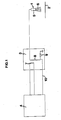
- An apparatus for deionising a web or neutralising static charges on the web comprises, as appears from Fig. 1, a brush 1 arranged transversely of a movable web 2 at a distance of about 10-15 mm therefrom, a voltage transformer 3 and a generator unit 4.
- the brush 1 is of a known type which is commercially available and which comprises an aluminium section 5 to which a multitude of bristles 6 are attached.
- the number of bristles may amount to about 3000/cm2.
- the brush 1 may preferably be a carbon-fibre brush and should be designed in such a manner that the different bristles remain isolated from each other.
- Each separate bristle 6 forms a tip, and the tips together produce a powerful "point effect" which contributes to improve neutralisation.
- the voltage transformer 3 has a primary winding 7 and a secondary winding 8 which is connected to the brush 1 and coupled in series with a resistor 9, in turn connected to ground.
- the transformation ratio of the transformer is of the order of 1:1000, and the resistor is of the order of 10 k ⁇ .
- the point of junction between the secondary winding 8 and the resistor 9 is connected by a line 10 to the generator unit 4. This comprises, in addition to the voltage generator itself, circuits for monitoring ground errors in the high-voltage or secondary circuit.
- the voltage generator 4 supplies a 12 V alternating voltage of a frequency of 1000 Hz to the transformer 3 stepping up the voltage to 10 kV.
- this high voltage is applied to the brush, this will emit electrons, by a "point effect", during the negative half period of the alternating voltage. These electrons can then neutralise any positive charges on the web 2 which is travelling past the brush 1.
- the brush will collect electrons, also by a "point effect”, during the positive half period of the alternating voltage, whereby negative charges on the web are eliminated.
- Fig. 2 shows a graph illustrating the result of an experiment in which alternating voltage of different magnitude and frequency was supplied to the apparatus according to the present invention.
- the ordinate represents the potential the web had after deionisation.
- the potential is the measure of the residual charge on the web.
- the abscissa represents the frequency of the alternating voltage supplied to the brush.
- the graph contains four curves A-D. Curve A was measured at an alternating voltage equal to 2500 V, curve B at 5000 V, curve C at 10,000 V, and curve D at 14,000 V. The measurements were made at a web speed of 800 m/min.
- the curves in the graph show that when the frequency is increased from about 50 Hz to about 400 Hz, the deionisation of the web was improved.
- a further increase of the frequency from about 400 Hz to about 800 Hz gives no further improvement of the deionisation.
- the residual charge on the web decreases slightly at 2500 V and 5000 V, but yet remains on a relatively high level.
- voltages equal to or above 10,000 V and frequencies above 800 Hz a very substantial improvement of the deionisation is however obtained.
- the residual charge is very small, and above 1200 Hz it is so small that it cannot be measured.
- one or more brushes may also be arranged at the underside of the web.
Landscapes
- Elimination Of Static Electricity (AREA)
- Preliminary Treatment Of Fibers (AREA)
Applications Claiming Priority (2)
| Application Number | Priority Date | Filing Date | Title |
|---|---|---|---|
| SE8902025A SE462412B (sv) | 1989-06-05 | 1989-06-05 | Saett att neutralisera elektrostatiska laddningar paa en roerlig bana samt anordning foer utfoerande av saettet |
| SE8902025 | 1989-06-05 |
Publications (1)
| Publication Number | Publication Date |
|---|---|
| EP0402338A1 true EP0402338A1 (de) | 1990-12-12 |
Family
ID=20376181
Family Applications (1)
| Application Number | Title | Priority Date | Filing Date |
|---|---|---|---|
| EP19900850222 Ceased EP0402338A1 (de) | 1989-06-05 | 1990-06-05 | Verfahren und Gerät zur Neutralisation von elektrostatischen Ladungen bei beweglichen Bahnen |
Country Status (2)
| Country | Link |
|---|---|
| EP (1) | EP0402338A1 (de) |
| SE (1) | SE462412B (de) |
Cited By (3)
| Publication number | Priority date | Publication date | Assignee | Title |
|---|---|---|---|---|
| DE4224698A1 (de) * | 1992-07-25 | 1994-01-27 | Kodak Ag | Verfahren zur Messung und kontrollierten Neutralisierung von Oberflächenladungen auf Gegenständen |
| US5377069A (en) * | 1989-04-07 | 1994-12-27 | Andreasson; Tomas | Oscillating circuit for the elimination/reduction of static electricity |
| CN102510651A (zh) * | 2011-11-09 | 2012-06-20 | 中国乐凯胶片集团公司 | 一种在薄膜制备中导出薄膜表面静电的方法 |
Citations (4)
| Publication number | Priority date | Publication date | Assignee | Title |
|---|---|---|---|---|
| US3634726A (en) * | 1969-06-03 | 1972-01-11 | Progil | Process and device to remove static electricity from plastic films |
| US4336565A (en) * | 1980-08-04 | 1982-06-22 | Xerox Corporation | Charge process with a carbon fiber brush electrode |
| USRE31382E (en) * | 1977-03-10 | 1983-09-13 | E. I. Du Pont De Nemours And Company | Static charge neutralizer and process |
| US4486808A (en) * | 1982-12-03 | 1984-12-04 | Polaroid Corporation | Apparatus for controlling random charges on a moving web |
-
1989
- 1989-06-05 SE SE8902025A patent/SE462412B/sv not_active IP Right Cessation
-
1990
- 1990-06-05 EP EP19900850222 patent/EP0402338A1/de not_active Ceased
Patent Citations (4)
| Publication number | Priority date | Publication date | Assignee | Title |
|---|---|---|---|---|
| US3634726A (en) * | 1969-06-03 | 1972-01-11 | Progil | Process and device to remove static electricity from plastic films |
| USRE31382E (en) * | 1977-03-10 | 1983-09-13 | E. I. Du Pont De Nemours And Company | Static charge neutralizer and process |
| US4336565A (en) * | 1980-08-04 | 1982-06-22 | Xerox Corporation | Charge process with a carbon fiber brush electrode |
| US4486808A (en) * | 1982-12-03 | 1984-12-04 | Polaroid Corporation | Apparatus for controlling random charges on a moving web |
Cited By (3)
| Publication number | Priority date | Publication date | Assignee | Title |
|---|---|---|---|---|
| US5377069A (en) * | 1989-04-07 | 1994-12-27 | Andreasson; Tomas | Oscillating circuit for the elimination/reduction of static electricity |
| DE4224698A1 (de) * | 1992-07-25 | 1994-01-27 | Kodak Ag | Verfahren zur Messung und kontrollierten Neutralisierung von Oberflächenladungen auf Gegenständen |
| CN102510651A (zh) * | 2011-11-09 | 2012-06-20 | 中国乐凯胶片集团公司 | 一种在薄膜制备中导出薄膜表面静电的方法 |
Also Published As
| Publication number | Publication date |
|---|---|
| SE8902025D0 (sv) | 1989-06-05 |
| SE462412B (sv) | 1990-06-18 |
Similar Documents
| Publication | Publication Date | Title |
|---|---|---|
| US6259591B1 (en) | Apparatus and method for monitoring of air ionization | |
| KR100571621B1 (ko) | 정전기 제거장치 | |
| KR0121433B1 (ko) | 아크억제기를 가지는 전자총 | |
| EP0564553B1 (de) | System und verfahren zum elektrostatischen entladen eines bandes | |
| JPS6232468B2 (de) | ||
| CN101873760A (zh) | 除电装置 | |
| JP4818093B2 (ja) | 除電装置 | |
| EP0402338A1 (de) | Verfahren und Gerät zur Neutralisation von elektrostatischen Ladungen bei beweglichen Bahnen | |
| JPH06168794A (ja) | 物体の表面電荷の中和を制御する方法 | |
| US4854948A (en) | Supply circuit for electrostatic dust separator | |
| US6159555A (en) | Method and device for electrostatic charging | |
| JPH0547490A (ja) | 除電装置 | |
| US3921037A (en) | Moving web energized static eliminator and method | |
| US2303321A (en) | Method and apparatus for discharging electricity | |
| US3742237A (en) | A. c. corona charging apparatus | |
| US4110810A (en) | Static charge neutralizer and process | |
| EP1175643B1 (de) | Wechselstrom corona-aufladungsvorrichtung | |
| US4476387A (en) | Corona charging apparatus | |
| US20030142455A1 (en) | Air ionization device | |
| KR100234086B1 (ko) | 공기청정장치 | |
| USRE31382E (en) | Static charge neutralizer and process | |
| KR100205392B1 (ko) | 공기조화기의 전기집진장치 | |
| GB2308925A (en) | Static electricity remover | |
| CN2051032U (zh) | 感应式静电消除器 | |
| JP3511613B2 (ja) | 電気集塵装置 |
Legal Events
| Date | Code | Title | Description |
|---|---|---|---|
| PUAI | Public reference made under article 153(3) epc to a published international application that has entered the european phase |
Free format text: ORIGINAL CODE: 0009012 |
|
| AK | Designated contracting states |
Kind code of ref document: A1 Designated state(s): AT BE CH DE DK ES FR GB GR IT LI LU NL SE |
|
| 17P | Request for examination filed |
Effective date: 19910611 |
|
| 17Q | First examination report despatched |
Effective date: 19930309 |
|
| STAA | Information on the status of an ep patent application or granted ep patent |
Free format text: STATUS: THE APPLICATION HAS BEEN REFUSED |
|
| 18R | Application refused |
Effective date: 19930902 |