EP0402016B1 - Codage/décodage pour la décomposition et la recomposition d'une image haute-résolution - Google Patents
Codage/décodage pour la décomposition et la recomposition d'une image haute-résolution Download PDFInfo
- Publication number
- EP0402016B1 EP0402016B1 EP90305710A EP90305710A EP0402016B1 EP 0402016 B1 EP0402016 B1 EP 0402016B1 EP 90305710 A EP90305710 A EP 90305710A EP 90305710 A EP90305710 A EP 90305710A EP 0402016 B1 EP0402016 B1 EP 0402016B1
- Authority
- EP
- European Patent Office
- Prior art keywords
- pixels
- low resolution
- cluster
- high resolution
- pixel
- Prior art date
- Legal status (The legal status is an assumption and is not a legal conclusion. Google has not performed a legal analysis and makes no representation as to the accuracy of the status listed.)
- Expired - Lifetime
Links
Images






Classifications
-
- H—ELECTRICITY
- H03—ELECTRONIC CIRCUITRY
- H03M—CODING; DECODING; CODE CONVERSION IN GENERAL
- H03M7/00—Conversion of a code where information is represented by a given sequence or number of digits to a code where the same, similar or subset of information is represented by a different sequence or number of digits
-
- G—PHYSICS
- G06—COMPUTING OR CALCULATING; COUNTING
- G06T—IMAGE DATA PROCESSING OR GENERATION, IN GENERAL
- G06T3/00—Geometric image transformations in the plane of the image
- G06T3/40—Scaling of whole images or parts thereof, e.g. expanding or contracting
-
- H—ELECTRICITY
- H04—ELECTRIC COMMUNICATION TECHNIQUE
- H04N—PICTORIAL COMMUNICATION, e.g. TELEVISION
- H04N1/00—Scanning, transmission or reproduction of documents or the like, e.g. facsimile transmission; Details thereof
- H04N1/41—Bandwidth or redundancy reduction
- H04N1/411—Bandwidth or redundancy reduction for the transmission or storage or reproduction of two-tone pictures, e.g. black and white pictures
- H04N1/413—Systems or arrangements allowing the picture to be reproduced without loss or modification of picture-information
- H04N1/417—Systems or arrangements allowing the picture to be reproduced without loss or modification of picture-information using predictive or differential encoding
- H04N1/4172—Progressive encoding, i.e. by decomposition into high and low resolution components
-
- H—ELECTRICITY
- H04—ELECTRIC COMMUNICATION TECHNIQUE
- H04N—PICTORIAL COMMUNICATION, e.g. TELEVISION
- H04N19/00—Methods or arrangements for coding, decoding, compressing or decompressing digital video signals
- H04N19/60—Methods or arrangements for coding, decoding, compressing or decompressing digital video signals using transform coding
- H04N19/63—Methods or arrangements for coding, decoding, compressing or decompressing digital video signals using transform coding using sub-band based transform, e.g. wavelets
Definitions
- supplemental information was generated only for pixels (picture elements) determined to be in a predetermined relation with their neighboring pixels, i. e., at an edge. Pixels that no not satisfy the above condition but that were determined to require supplemental information were forced to satisfy the above condition by modifying the image reduction rules. That is, the reduction rules were modified to force a pixel to satisfy the above condition whenever the prediction rules would cause a decoder to otherwise improperly recompose the high resolution image. See, for example, our United States patent US-A-4,870,497 issued September 26, 1989 for one such prior arrangement.
- a cluster including at least one so-called typically predictable pixel identified as an exception to the general prediction rules is classified as having a first classification and is identified as such by an accompanying first classification flag.
- a cluster including typically predictable pixels with no exception and/or non-typically predictable pixels is classified as having a second classification and is identified as such by an accompanying second classification flag.
- Supplemental information is generated for all pixels in clusters having the first classification. Otherwise, supplemental information is only generated for non-typically predictable pixels.
- clusters of pixels and a grouping of pixels employed to determine if pixels are typically predictable or non-typically predictable are also shown in FIG. 2 .
- the clusters comprise a number of rows of pixels in the high resolution image and a corresponding appropriate number of rows of pixels in the low resolution replica. It will be apparent that other cluster configurations could also be used in practicing aspects of the invention.
- the high resolution pixels are supplied from image source 101 to transmitter 102 and, therein, to decomposition processor 106-1.
- Decomposition processor 106-1 operates, as described below, to generate a low resolution replica I1 of the high resolution image, also shown in FIG. 2.
- the high resolution image I0 is decomposed into low resolution replica I1 having M1 rows and N1 columns plus supplemental information SI1 and classification flag F1.
- M1 M0/2
- N1 M0/2
- the resolution of low resolution replica I1 is 200 dots/inch.
- the pixels in the imaginary reference column and row are chosen to be white.
- the decomposition from high resolution image I0 to low resolution replica I1 is realized by replacing every super pixel including high resolution pixels h0(m,n), h0(m+1,n), h0(m,n+1) and h0(m+1,n+1) in image I0 with a single low resolution pixel L1(k,l).
- the difference between the original high resolution image I0 and the low resolution replica I1 is the supplemental information SI1 required to upgrade the lower resolution replica into a higher resolution image.
- the supplemental information for low resolution pixels is generated, in accordance with an aspect of the invention, for all low resolution pixels in a cluster classified as being in the first classification and for non-typically predictable pixels in a cluster classified as being in the second classification. Generation of the supplemental information is described below with respect to the decomposition process.
- Transmitter 102 includes a number of decomposition processors, in this example, decomposition processors 106-1, 106-2 and 106-3. Although three decomposition processors are shown, in this example, it will be apparent that any desired number may he employed depending on the particular application. Indeed, a single decomposition process 106-1 could be employed, if desired.
- Each of decomposition processors 106-1 through 106-3 decomposes a 'high" resolution image into a "low” resolution replica. As described above, FIG. 2 illustrates the relationship between the high resolution image I0 and the low resolution replica I1 generated by decomposition processor 106-1.
- the "high" resolution image supplied to decomposition processor 106-2 is low resolution replica I1 from decomposition processor 106-1.
- decomposition processor 106-2 generates low resolution replica I2 which, in turn, is supplied to decomposition processor 106-3 as its "high" resolution image.
- Decomposition processor 106-3 generates a so-called basic low resolution replica I3.
- the relationship between the pixels in each "high" resolution image and "low” resolution replica is identical to the relationship between pixels in I0 and I1 as shown in FIG. 2 and described above. That is, in this example, there is a 2 to 1 reduction in dots/inch and a 4 to 1 reduction in pixels for each decomposition generated by decomposition processors 106-1 through 106-3.
- the resolution of the basic low resolution replica I3, in this example, generated by decomposition processor 106-3 is 50 dots/inch.
- the pixels L3(l,k) of the basic low resolution replica I3 are supplied to encoder 107.
- Encoder 107 encodes the pixels L3(l,k) in well-known fashion. Specifically, any one of several known CCITT or other standard encoding techniques may be employed.
- One CCITT encoding technique is described in INTERNATIONAL TELEPHONE AND TELEGRAPH CONSUTATIVE COMMITTEE ( CCITT ), "Facsimile Coding Schemes and Coding Control Functions for Group IV Facsimile Apparatus", Redbook, Facsimile VII.3, Rec.T.8, 1984, pages 40-48.
- the encoded pixel information is supplied to multiplexer (MUX) 108.
- MUX 108 supplies to each of decomposition processors 106-1,106-2 and 106-3, namely, encoded supplemental information SI1,SI2 and SI3, respectively, and encoded classification flags F1, F2 and F3, respectively.
- MUX 108 combines the encoded basic pixel information, the encoded supplemental information and the encoded classification flags, in well known fashion, for transmission and/or storage. To this end, it is noted that for transmission applications the encoded supplemental information SI1,SI2 and SI3 and the encoded classification flags, F1, F2 and F3 are multiplexed in reverse sequential order. This is necessary because the lower resolution supplemental information and the classification flags, namely, SI3 and F3, in this example, are required first in recomposing to the original high resolution image.
- the multiplexed signal is supplied to interface 109 which interfaces to transmission network and/or storage unit 103.
- interface 109 interfaces to transmission network and/or storage unit 103.
- the configuration of interface 109 is dependent on the particular transmission network and/or storage unit being employed. Such arrangements are known in the art.
- the encoded image information is transmitted via a transmission network or obtained as desired from a storage unit and supplied to receiver 104 and therein via an appropriate interface 110 to demultiplexer (DMUX) 111.
- DMUX 111 demultiplexes, in well known fashion, the encoded basic low resolution pixel information, the encoded supplemental information and the encoded classification flags.
- the encoded basic low resolution pixel information is supplied to decoder 112, which decodes it in known fashion. Decoder 112 must be compatible with encoder 107 and one such decoder is described in the article entitled "Facsimile Coding Schemes and Coding Control Functions for Group IV Facsimile Apparatus", cited above.
- the decoded pixel information for I3 is supplied to recomposition processor 113-3 and to image output unit 105. Also supplied to recomposition processor 113-3 are the encoded supplemental information SI3 and encoded classification flag F3.
- Recomposition processor 113-3 is responsive to the basic low resolution pixel information for I3, the supplementary information SI3 and classification flag F3 to recompose a "high" resolution image I2.
- the relationship of low resolution replica I3 to "high" resolution image I2 is identical, to I0 and I1, as shown in FIG. 2 and described above. Pixels of the recomposed "high" resolution image I2 are supplied to image output unit 105 and to recomposition processor 113-2.
- Recomposition processor 113-2 is responsive to the supplied low resolution pixel information for I2, supplemental information SI2 and classification flag F2 to generate pixels forming "high" resolution image I1, in a manner identical to that employed in recomposition processor 113-3.
- the pixel information for image I1 is supplied to image output unit 105 and to recomposition processor 113-1.
- Recomposition processor 113-1 is responsive to the supplied pixel information for I1, supplemental information SI1 and classification flag F1 to generate pixels forming the original high resolution image I0.
- the structure and operation of recomposition processor 113-1 and is identical to recomposition processors 113-2 and 113-3 and is described below. Pixels forming image I0 are supplied to image output unit 105.
- any one of the resolution levels can be selected, as desired, and the recomposition process can be stopped when an acceptable or desired resolution has been obtained.
- FIG. 3 shows, in simplified block diagram form, details of decomposition processor 106-1. Since the operation and structure of each of decomposition processors 106-1 through 106-3 is identical only decomposition processor 106-1 will be described in detail. Accordingly, decomposition processor 106-1 includes reduction processor 301, cluster classifier (CC) 302, supplemental information (SI) encoder 303 and classification flag encoder 304. High resolution pixels from an image, in this example I0, are supplied to reduction processor 301, CC 302 and SI encoder 303. Reduction processor 301 yields low resolution pixels L1(k,l) of low resolution replica I1 from the supplied high resolution pixels. To this end, reduction processor 301 may employ any desired set of reduction rules.
- reduction processor 301 may employ any desired set of reduction rules.
- SI encoder 303 and flag encoder 304 may be any of known encoders.
- the encoders are of the arithmetic type which are known in the art.
- CC 302 is employed, in accordance with an aspect of the invention, to classify the clusters of pixels as being one of a plurality of classifications.
- each cluster is classified as being in either a first classification or a second classification.
- the first classification is defined as a cluster having at least one pixel that is typically predictable and is an exception to the general prediction rules.
- the second classification is defined as a cluster including typically predictable pixels with no exceptions and/or non-typically predictable pixels.
- Flag encoder 304 generates an appropriate classification flag F1 indicating the classification of the corresponding cluster. In this example, classification flag F1 being a logical "1" indicates the first classification and classification flag F1 being a logical "0" indicates the second classification.
- CC 302 generates a signal for enabling SI encoder 303 to encode the corresponding supplemental information for all pixels in a cluster classified as the first classification and for non-typically predictable pixels in a cluster classified as the second classification.
- the supplemental information to be encoded includes, in this example, the colors of the high resolution pixels s1, s2, s3 and s4.
- the prediction rules employed in this embodiment include the use of a first group of pixels, in conjunction with a current low resolution pixel L1(k,l), to determine if the corresponding high resolution pixels to be recomposed are typically predictable, non-typically predictable or typically predictable which are exceptions to the general prediction rules.
- the group of pixels assigned, in this example is graphically illustrated in FIG. 4.
- the row and column locations of the pixels of the assigned group in the low resolution replica and the super pixel assignments in the high resolution image are shown in FIG. 5.
- the group includes low resolution pixels labelled U, A, D, P, N, K, B and L surrounding the current low resolution pixel L1(k,l) labelled S.
- high resolution image I0 the pixels are, in this example, the high resolution pixels forming the high resolution super pixel being decomposed into the current low resolution pixel labelled S, namely, s1, s2, s3 and s4.
- the prediction rules are as follows:
- the color of the high and low resolution pixels is assumed to be either white represented by a logical "0" or black represented by a logical "1". It will be apparent that any other desired colors could equally be employed. Additionally, all the high resolution pixels are available, in this example, from an image source 101 and all the low resolution pixels are available from reduction processor 301. For subsequent ones of decomposition processors 106, the high resolution pixels are available from the prior one of decomposition processors 106.
- FIG. 6 is a flow chart illustrating the generic operation of cluster classifier 302.
- the classification process is entered via start step 601.
- operational block 602 reads the image parameters, for example, the size of the image, i. e., the number of rows M and columns N to be obtained from image source 101 or from a prior one of decomposition processors 106, the number of clusters and the size, i. e., the configuration, of the cluster.
- operational block 603 causes the next cluster of pixels to be read.
- the clusters could include pixels in any desired configuration.
- One advantageous configuration is one row of pixels in the low resolution replica which corresponds to two rows of high resolution pixels in the high resolution image.
- Operational block 604 calls subroutine CC-TG, shown in FIG. 7.
- subroutine CC-TG classifies the particular cluster, causes the pixels to be appropriately encoded and generates the appropriate classification flag for the classified cluster.
- Conditional branch point 605 tests to determine if the image has been completed, i. e., if all the clusters have been read, classified and appropriately encoded. If the test result is NO, steps 603 through 605 are repeated until step 605 yields a YES result. Then, the process is ended via step 606.
- step 703 If the test result in step 703 is YES, the cluster is a classification Y type cluster and operational block 706 causes the classification flag for cluster type Y to be sent. If the test result in step 705 is NO, the cluster is a classification Y+1 type cluster and step 706 causes the classification flag for cluster type Y+1 to be sent. here Y+1 is the total number of possible cluster classifications. Operational block 707 causes the pixels of the cluster to be encoded via the appropriate technique assigned to the classification of the cluster. Thereafter, control is returned to the main routine of FIG. 6 via step 708.
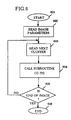
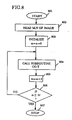
- Fig. 8 is a flow chart illustrating operation of decomposition processor 106-1 of FIG. 3 for an embodiment of the invention.
- image parameters i. e., the numbers of rows M and the number of columns N.
- Operational block 804 causes subroutine CC-T to be called.
- Subroutine CC-T causes the particular clusters to be classified, the appropriate classification flag to be sent and the encoding of the pixels in the cluster according to the technique assigned to the cluster classification. Details of subroutine CC-T are described below.
- subroutine CC-T is entered via step 901.
- Conditional branch point 904 tests to determine if the current low resolution pixel L0(k,l) being processed is typically predictable in accordance with the general prediction rules described above. If the test result in step 904 is YES, the current low resolution pixel is typically predictable and conditional branch point 905 tests to determine if it is an exception to the general prediction rules.
- step 905 if the test result is NO, the pixel is typically predictable and not an exception to the general prediction rules, as described above.
- subroutine CC-T controls the encoding of the pixels, i. e., whether or not supplemental information needs to be encoded for the pixels.
- SI1 Supplemental information
- supplemental information is representative of the colors of the high resolution pixels s1, s2, s3, and s4. Since it is assumed, in this example, that each high resolution pixel can be either black or white, there are sixteen possible combinations of colors for the high resolution pixels.
- FIG. 11 shows, in simplified block diagram form, details of recomposition processor 113-1. Since the operation and structure of each of recomposition processors 113-1 through 113-3 is identical, only recomposition processor 113-1 will be described in detail. Accordingly, recomposition processor 113-1 includes cluster classifier (CC) 1101, supplemental information (SI) decoder 1102 and flag decoder 1103. Low resolution pixels representative of low resolution replica I1 are, in this example, supplied to decomposition processor 113-1 from prior recomposition processor 113-2. If the particular one of recomposition processors 113 is the first or an only one in a series, the low resolution pixels are obtained from transmission network and/or storage unit 103 (FIG.
- CC cluster classifier
- SI supplemental information
- SI decoder 1102 must be compatible with SI encoder 303 employed in decomposition processors 106.
- flag decoder 1103 must be compatible with flag encoder 304 also used in decomposition processors 106.
- decoders 1102 and 1103 are of the arithmetic type which are known in the art.
- CC 1101 is employed, in accordance with an aspect of the invention, to determine the classifications of the clusters and, in turn, which pixels in the classified clusters require supplemental information to properly recompose the high resolution pixels. It is noted that for certain cluster classifications supplemental information is required to recompose all of the pixels therein. To this end, decoded flag F1 is supplied from flag decoder 1103 and decoded supplemental information SI1 is supplied from SI decoder 1102 to cluster classifier 1101.
- CC 1101 Operation of CC 1101, in accordance with an aspect of the invention, is described below.
- all the low resolution pixels L1(k,l) for low resolution replica I1 are available and that all high resolution pixels h0(m,n) recomposed prior to the current high resolution pixel being recomposed are available.
- FIG. 12 is a flow chart of the generic operational steps of recomposer processor 113-1 of FIG. 1. Accordingly, the operation of CC 1101 is begun via start step 1201. Then, operational block 1202 obtains the parameters of the image to be recomposed, for example, the size of the image, i. e., the number of rows M and columns N of the high resolution image I0 being recomposed, which is to be obtained from a prior one of recomposition processors 113 or from decoder 103, the number of clusters in the image and the size, i. e., the configuration of the individual clusters. Operational block 1203 causes the next cluster of pixels to be read. Operational block 1204 causes subroutine CC-RG to be called. Subroutine CC-RG is a generic subroutine which determines the classification of the cluster and, accordingly, decodes the pixels in the cluster according to the classification.
- the parameters of the image to be recomposed for example, the size of the image, i.
- step 1301 there is shown a flow chart of subroutine CC-RG.
- the process is entered via step 1301.
- operational block 1302 causes the flag associated with the cluster to be read.
- Operational block 1303 causes the pixels in the cluster to be recomposed, i. e., decoded according to the classification of the cluster.
- control is returned to the main routine of FIG. 12.
- conditional branch point 1205 tests to determine if the image has been completed. If the test result is NO, steps 1203 through 1205 are repeated until step 1205 yields a YES result. Then, the process is ended via step 1206.
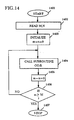
- FIG. 14 is a flow chart illustrating operation of recomposition processor 113-1 of FIG. 11 for an embodiment of the invention.
- Operational block 1404 calls subroutine CC-R which is employed, in accordance with an aspect of the invention, to classify and decode the clusters of pixels to recompose the high resolution image.
- Subroutine CC-R is described below.
- Conditional branch point 1406 tests to determine if the image has been completed, namely, if m ⁇ M. If the test result is NO, steps 1404 through 1406 are repeated until step 1406 yields a YES result. Then, the process is ended via step 1407.
- Conditional branch point 1510 tests to determine if the cluster has been completed, namely, if n ⁇ N. If the test result is NO, the cluster has not been completed and appropriate ones of steps 1504 through 1510 are repeated until step 1510 yields a YES result. Then, control is returned to the main routine of FIG. 14 via step 1511.
Landscapes
- Engineering & Computer Science (AREA)
- Multimedia (AREA)
- Signal Processing (AREA)
- Theoretical Computer Science (AREA)
- Physics & Mathematics (AREA)
- General Physics & Mathematics (AREA)
- Compression Or Coding Systems Of Tv Signals (AREA)
- Image Processing (AREA)
- Compression Of Band Width Or Redundancy In Fax (AREA)
- Compression, Expansion, Code Conversion, And Decoders (AREA)
Claims (7)
- Système (102) pour coder des pixels dans la décomposition d'une image à haute résolution en une réplique à basse résolution et une information supplémentaire pour la transmission ou le stockage, comprenant :
un appareil (109) pour réaliser l'interface entre une sortie du système et un support de transmission ou une unité de stockage (105) ;
un appareil (106-1, 106-2 ou 106-3) processeur de décomposition pour produire des pixels à basse résolution à partir des pixels à haute résolution fournis par une source d'image (101) afin d'obtenir la réplique à basse résolution;
l'appareil processeur de décomposition étant caractérisé par :
un appareil (301) pour déduire une pluralité de pixels à basse résolution pour la réplique à basse résolution, qui sont regroupés en un amas prédéterminé;
un appareil (302) pour déduire une pluralité de pixels à haute résolution à partir de l'image à haute résolution, qui correspondent aux pixels à basse résolution de l'amas;
un appareil (302) pour déduire un groupe de pixels à des positions prédéterminées par rapport à un pixel à basse résolution sélectionné dans l'amas;
un appareil (302) pour utiliser les pixels du groupe et ceux qui sont sélectionnés des pixels à haute résolution déduits, pour déterminer, en conformité avec des régles de prévision prédéterminées, si un ou plusieurs pixels à haute résolution à recomposer dans un décodeur correspondant pour le pixel sélectionné à basse résolution, sont non typiquement prévisibles, typiquement prévisibles et ne constituant pas une exception, ou typiquenent prévisibles et constituant une exception;
un appareil (302) pour classer l'amas comme appartenant à une première classe si les pixels à haute résolution à recomposer dans le décodeur correspondant pour le pixel sélectionné à basse résolution, sont déterminés comme étant typiquement prévisibles et constituant une exception, selon les règles de prévision prédéterminées, pour produire une indication de classe représentative de la première classe, et pour produire une information supplémentaire représentative des couleurs de tous les pixels à haute résolution correspondant aux pixels à basse résolution de l'amas;
un appareil (303) pour produire une information supplémentaire représentative des couleurs de l'un ou plusieurs des pixels à haute résolution pour le pixel sélectionné à basse résolution si le ou les pixel(s) à haute résolution devant être recomposé(s) dans le décodeur correspondant pour le pixel selectionné à basse résolution, est (sont) déterminé(s) comme étant non typiquement prévisible(s) selon les règles de prévision prédéterminées;
un appareil (304) pour classer ledit amas comme appartenant à une deuxième classe si aucun des pixels à haute résolution devant être recomposés dans le décodeur correspondant pour les pixels à basse résolution de l'amas, n'est déterminé comme étant typiquement prévisible et constituant une exception selon les règles de prévision prédéterminées, pour produire une indication de classe représentative de la deuxième classe et pour produire une information supplémentaire représentative des couleurs du ou des pixel(s) à haute résolution devant être recomposé(s) dans le décodeur correspondant pour le pixel à basse résolution de l'amas déterminé comme étant non typiquement prévisible selon les règles de prévision prédéterminées; et
un appareil (304, 303) pour fournir en tant que sortie l'indication de classe et l'éventuelle information supplémentaire. - Système selon la revendication 1, caractérisé par:
une pluralité (106-1 - 106-3) d'appareils processeurs de décomposition connectés en série, un premier (106-1) des appareils processeurs de décomposition de la série recevant des pixels à haute résolution de la source d'image (101) et au moins un (106-3) des appareils processeurs de décomposition de la série fournissant en tant que sortie des pixels à basse résolution fondamentaux représentatifs d'une réplique fondamentale à basse résolution, certains individuels des appareils processeurs de décomposition autres que le premier, recevant des pixels à haute résolution de l'un précédent des appareils processeurs de décomposition de la série, c'est-à-dire que le pixel à basse résolution sortant de l'un précédent des appareils processeurs de décomposition est un pixel à haute résolution fourni en entrée au suivant des appareils processeurs de décomposition de la série; et
un appareil (301, 304, 303) pour fournir en tant que sortie des représentations (F1, F2, F3) des indications de type de classe d'amas provenant de chacun de la pluralité d'appareils processeurs de décomposition (106-1, 106-2, 106-3), des représentations (SI1, SI2, SI3) de l'information supplémentaire provenant de chacun des appareils processeurs de décomposition (106-1, 106-2, 106-3) et des représentations de pixels fondamentaux à basse résolution (I3) de l'image ayant été progressivement décomposée par la pluralité d'appareils de décomposition (106-1 - 106-3) en tant que sortie pour une transmission ou un stockage. - Système (104) pour décoder des pixels dans la recomposition d'une image à haute résolution à partir d'une réplique à basse résolution et d'une information supplémentaire provenant d'une transmission ou d'un stockage, comprenant :
un appareil (110) pour réaliser l'interface entre l'appareil et un support de transmission ou une unité de stockage;
un appareil (111, 112) pour déduire une information de réplique à basse résolution et une information supplémentaire dudit appareil d'interface;
un appareil (113-1, 113-2 ou 113-3) processeur de recomposition auquel sont fournies l'information de réplique à basse résolution et l'information supplémentaire pour produire l'image à haute résolution,
l'appareil processeur de recomposition étant caractérisé par :
un appareil (1101) pour déduire une pluralité de pixels à basse résolution de l'information de réplique à basse résolution fournie, qui sont regroupés en un amas prédéterminé;
un appareil (1103) pour décoder une indication de classe pour l'amas déduit reçue et pour déterminer si la classe est une première classe ou une deuxième classe;
un appareil (1101) pour sélectionner un pixel à basse résolution dans l'amas à traiter;
un appareil (1102) pour décoder l'information supplémentaire reçue représentative des couleurs de pixels pour le pixel sélectionné à basse résolution;
un appareil (1101) répondant à la détermination d'une première classe en utilisant l'information supplémentaire afin de fournir en sortie les pixels à haute résolution correspondant au pixel sélectionné à basse résolution ayant des couleurs indiquées par l'information supplémentaire correspondante, et à la détermination d'une deuxième classe en déterminant si des pixels à haute résolution à recomposer pour le pixel à basse résolution sélectionné sont typiquement prévisibles selon des règles de prévision prédéterminées;
un appareil (1101) pour fournir en tant que sortie des représentations des pixels à haute résolution à recomposer selon les règles de prévision prédéterminées, si le pixel sélectionné à basse résolution appartient à un amas de la seconde classe et est typiquement prévisible d'après les règles de prévision prédéterminées, et pour fournir en sortie des pixels à haute résolution ayant des couleurs indiquées par l'information supplémentaire si le pixel sélectionné à basse résolution appartient à un amas de la deuxième classe et est non typiquement prévisible, comme cela est déterminé d'après les règles de prévision prédéterminées. - Système selon la revendication 3, caractérisé par:
le fait que l'information de réplique à basse résolution comprend des pixels fondamentaux basse résolution pour une image à recomposer progressivement;
une pluralité des appareils processeurs (113-1 - 113-3) processeurs de recomposition connectés en série, un premier des appareils (113-1) processeurs de recomposition de la série recevant les pixels fondamentaux à basse résolution et au moins l'un des appareils (113-3) processeurs de recomposition de la série fournissant à sa sortie des pixels à haute résolution de l'image à haute résolution, certains individuels des appareils processeurs de recomposition autres que le premier, obtenant des pixels à basse résolution de l'un précédent des appareils processeurs de recomposition de la série, c'est-à-dire que le pixel à haute résolution sortant de l'un précédent des appareils processeurs de recomposition de la série est l'entrée de pixel à basse résolution du suivant des appareils processeurs de recomposition de la série;
un appareil (112) pour fournir des représentations (I3) des pixels fondamentaux à basse résolution en tant que sortie; et
un appareil (1101) pour fournir en sortie des représentations (I0, I1, I2) des pixels à haute résolution à partir de chacun de la pluralité de processeurs de recomposition (113-1, 113-2, 113-3). - Procédé pour coder des pixels dans la décomposition d'une image à haute résolution en une réplique à basse résolution et une information supplémentaire, comprenant les étapes de :
réception (601) de pixels d'une source d'image (101);
fourniture (par l'intermédiaire de 107) en sortie des versions codées de pixels de la réplique à basse résolution;
d'établissement d'une interface (par l'intermédiaire de 109) avec un support de transmission ou une unité de stockage;
le procédé étant caractérisé par :a. la déduction (603) d'une pluralité de pixels à basse résolution pour la réplique à basse résolution, qui sont regroupés en un amas prédéterminé;b. la déduction (603) d'une pluralité de pixels à haute résolution à partir de l'image à haute résolution, qui correspondent aux pixels à basse résolution de l'amas;c. la déduction (603) d'un groupe de pixels à des positions prédéterminées par rapport à un pixel sélectionné à basse résolution dans l'amas;d. l'utilisation (904, 905, 913, 915) de pixels du groupe et de certains sélectionnés des pixels à haute résolution déduits, pour déterminer selon des règles de prévision prédéterminées, si un ou plusieurs pixels à haute résolution à recomposer dans un décodeur correspondant pour le pixel sélectionné à basse résolution, sont non typiquement prévisibles, typiquement prévisibles et ne constituant pas d'exception, ou typiquement prévisibles et constituant une exception;e. la classification (904, 905) de l'amas comme appartenant à une première classe si les pixels à haute résolution recomposés dans le décodeur correspondant pour le pixel sélectionné à basse résolution sont déterminés comme étant typiquement prévisibles et constituant une exception selon les règles de prévision prédéterminées, la production (906) d'une indication de classe représentative de la première classe, et la production d'une information supplémentaire (par l'intermédiaire de 302) représentative des couleurs de tous les pixels à haute résolution correspondant aux pixels sélectionnés à basse résolution dans l'amas;f. la production d'une information supplémentaire (914) représentative des couleurs du ou des pixels à haute résolution pour le pixel sélectionné à basse résolution si le ou les pixels à haute résolution devant être recomposés dans le décodeur correspondant pour le pixel sélectionné à basse résolution sont déterminés (904, 913, 915) comme étant non typiquement prévisibles selon les règles de prévision prédéterminées;g. la détermination (802) d'un groupe suivant de pixels à des positions prédéterminées par rapport à un pixel sélectionné à basse résolution suivant devant être traité dans l'amas comme à l'étape (c);h. la répétition des étapes (d) à (g) jusqu'à ce que soit la totalité des pixels à haute résolution de l'amas ont été déterminés comme étant non typiquement prévisibles et/ou typiquement prévisibles et ne constituant pas une exception, soit qu'au moins un pixel à haute résolution de l'amas ait été déterminé comme étant typiquement prévisible et constituant une exception selon les règles de prévision prédéterminées;i. la classification (904, 910, 913, 915) de l'amas comme appartenant à la seconde classe si aucun des pixels à haute résolution de l'amas n'est déterminé comme étant typiquement prévisible et constituant une exception selon les règles de précision prédéterminées, la production d'une indication de classe représentative de la seconde classe et la production d'une information supplémentaire représentative des couleurs du ou des pixels à haute résolution de l'amas déterminés comme étant non typiquement prévisibles selon les règles de prévision prédéterminées;j. la fourniture (907) en sortie de l'indication de classe et de l'éventuelle information supplémentaire;k. la détermination (603) d'une pluralité de pixels à basse résolution à partir de la réplique à basse résolution, qui sont regroupés pour former un amas prédéterminé suivant; etl. la répétition des étapes (b à k) jusqu'à ce que tous les amas de la réplique à basse résolution aient été traités. - Procédé selon la revendication 5, dans lequel l'étape d'utilisation comprend les étapes :m. de détermination (904, 905) du fait que le ou les pixel(s) à haute résolution devant être recomposés à partir du pixel courant à basse résolution sont typiquement prévisibles et ne constituent pas des exceptions selon les régles de prévision prédéterminées si la couleur de chaque pixel à basse résolution du groupe et la couleur de chacun des pixels à haute résolution, sont identiques à la couleur du pixel sélectionné à basse résolution;n. de détermination (904, 905) du fait que le ou les pixels à haute résolution à recomposer pour le pixel sélectionné à basse résolution sont typiquement prévisibles et constituent des exceptions selon les règles de prévision prédéterminées, si la totalité des pixels à basse résolution du groupe ont la même couleur que le pixel courant à basse résolution et si au moins l'un des pixels à haute résolution de cette pluralité a une couleur différente de celle du pixel courant à basse résolution;o. de détermination (904) du fait que le ou les pixels à haute résolution en cours de recomposition pour le pixel courant à basse résolution sont non typiquement prévisibles selon les règles de prévision prédéterminées si l'un quelconque des pixel à basse résolution du groupe a une couleur différente de celle du pixel courant à basse résolution.
- Procédé pour décoder des pixels dans la recomposition d'une image à haute résolution à partir d'une réplique fondamentale à basse résolution et d'une information supplémentaire, comprenant les étapes :
d'établissement d'une interface (par l'intermédiaire de 110) avec un support de transmission ou une unité de stockage;
de déduction (par l'intermédiaire de 110, 111) de pixels codés dans la réplique à basse résolution et d'une information supplémentaire à partir du support de transmission ou de l'unité de stockage;
de fourniture (par l'intermédiaire de 111) en sortie de pixels décodés à une unité de sortie d'image;
le procédé étant caractérisé par :a. la déduction (1203) d'un amas contenant une pluralité de pixels à basse résolution qui sont regroupés en un amas prédéterminé;b. le décodage (1302) d'une indication de classe reçue pour l'amas;c. la sélection (1504) d'un pixel à basse résolution dans l'amas à traiter;d. le décodage (à partir de 111) de de l'information supplémentaire représentative des couleurs de pixels, pour l'éventuel pixel sélectionné à basse résolution;e. la détermination (1303) de la classe de l'amas à partir de l'indication de classe;f. si l'amas appartient à une première classe (1505), la fourniture en sortie (1506) des pixels à haute résolution en cours de recomposition pour le pixel sélectionné à basse résolution ayant des couleurs indiquées par l'information supplémentaire pour le pixel sélectionné à basse résolution;g. si l'amas appartient à la seconde classe (1505), la détermination (1507) du fait qu'un ou plusieurs pixels à haute résolution en cours de recomposition pour le pixel courant à basse résolution sont typiquement prévisibles selon les règles de prévision prédéterminées;h. si le résultat de l'étape (g) est NON, la fourniture en sortie (1506) des pixels à haute résolution en cours de recomposition pour le pixel sélectionné à basse résolution ayant des couleurs indiquées par l'information supplémentaire pour le pixel sélectionné à basse résolution;i. si le résultat de l'étape (g) est OUI (1507), la fourniture (1508) d'une sortie pour les pixels à haute résolution en cours de recomposition pour le pixel courant à basse résolution selon les régles de prévision prédéterminées;j. la répétition des étapes (c) à (i) jusqu'à ce que tous les pixels à basse résolution de l'amas aient été traités;k. la déduction (1203) d'un amas suivant contenant la pluralité de pixels à basse résolution regroupés en l'amas prédéterminé comme indiqué à l'étape (a); etl. la répétition des étapes (b) à (k) jusqu'à ce que tous les amas de la réplique à basse résolution aient été traités.
Applications Claiming Priority (2)
| Application Number | Priority Date | Filing Date | Title |
|---|---|---|---|
| US359910 | 1989-06-01 | ||
| US07/359,910 US5031053A (en) | 1989-06-01 | 1989-06-01 | Efficient encoding/decoding in the decomposition and recomposition of a high resolution image utilizing pixel clusters |
Publications (3)
| Publication Number | Publication Date |
|---|---|
| EP0402016A2 EP0402016A2 (fr) | 1990-12-12 |
| EP0402016A3 EP0402016A3 (fr) | 1991-04-03 |
| EP0402016B1 true EP0402016B1 (fr) | 1995-01-18 |
Family
ID=23415792
Family Applications (1)
| Application Number | Title | Priority Date | Filing Date |
|---|---|---|---|
| EP90305710A Expired - Lifetime EP0402016B1 (fr) | 1989-06-01 | 1990-05-25 | Codage/décodage pour la décomposition et la recomposition d'une image haute-résolution |
Country Status (6)
| Country | Link |
|---|---|
| US (1) | US5031053A (fr) |
| EP (1) | EP0402016B1 (fr) |
| JP (1) | JP2552018B2 (fr) |
| KR (1) | KR940003200B1 (fr) |
| CA (1) | CA2014936C (fr) |
| DE (1) | DE69016101T2 (fr) |
Cited By (1)
| Publication number | Priority date | Publication date | Assignee | Title |
|---|---|---|---|---|
| US9197767B2 (en) | 1997-07-15 | 2015-11-24 | Google Inc. | Digital camera having image processor and printer |
Families Citing this family (38)
| Publication number | Priority date | Publication date | Assignee | Title |
|---|---|---|---|---|
| US5255105A (en) * | 1990-03-17 | 1993-10-19 | International Computers Limited | Encoding image data |
| JPH0492551A (ja) * | 1990-08-08 | 1992-03-25 | Minolta Camera Co Ltd | ファクシミリ装置におけるエラーチェック方式 |
| US5440401A (en) * | 1990-09-14 | 1995-08-08 | Eastman Kodak Company | Image database incorporating low resolution index image data |
| US5148272A (en) * | 1991-02-27 | 1992-09-15 | Rca Thomson Licensing Corporation | Apparatus for recombining prioritized video data |
| US5414469A (en) * | 1991-10-31 | 1995-05-09 | International Business Machines Corporation | Motion video compression system with multiresolution features |
| US5262854A (en) * | 1992-02-21 | 1993-11-16 | Rca Thomson Licensing Corporation | Lower resolution HDTV receivers |
| US5321520A (en) * | 1992-07-20 | 1994-06-14 | Automated Medical Access Corporation | Automated high definition/resolution image storage, retrieval and transmission system |
| US5655032A (en) * | 1992-08-20 | 1997-08-05 | Canon Kabushiki Kaisha | Coding method and apparatus therefor |
| US5473385A (en) * | 1994-06-07 | 1995-12-05 | Tv/Com Technologies, Inc. | Clock correction in a video data decoder using video synchronization signals |
| MX9700385A (es) | 1994-07-14 | 1998-05-31 | Johnson Grace Company | Metodo y aparato para comprimir imagenes. |
| US5805735A (en) * | 1995-03-02 | 1998-09-08 | Apple Computer, Inc. | Method and apparatus for compression of digitized image data using variable color fidelity |
| AU6251496A (en) * | 1995-06-05 | 1996-12-24 | Apple Computer, Inc. | Block classification for accelerating image data compression |
| US5764921A (en) * | 1995-10-26 | 1998-06-09 | Motorola | Method, device and microprocessor for selectively compressing video frames of a motion compensated prediction-based video codec |
| US6055338A (en) * | 1996-08-22 | 2000-04-25 | Sumitomo Metal Industries Limited | Bi-level adaptive coding using a dual port memory and a context comparator |
| US6058216A (en) * | 1996-09-03 | 2000-05-02 | Sumitomo Metal Industries Limited | Apparatus for encoding image data |
| US6269190B1 (en) * | 1996-09-24 | 2001-07-31 | Electronics For Imaging, Inc. | Computer system for processing images using a virtual frame buffer |
| WO1998013788A1 (fr) * | 1996-09-24 | 1998-04-02 | Colorage, Inc. | Systeme de traitement d'images et procede utilisant des techniques de personnalisation |
| US5995724A (en) * | 1996-11-01 | 1999-11-30 | Mikkelsen; Carl | Image process system and process using personalization techniques |
| JP3408094B2 (ja) * | 1997-02-05 | 2003-05-19 | キヤノン株式会社 | 画像処理装置及びその方法 |
| US6786420B1 (en) | 1997-07-15 | 2004-09-07 | Silverbrook Research Pty. Ltd. | Data distribution mechanism in the form of ink dots on cards |
| JPH10257502A (ja) * | 1997-03-17 | 1998-09-25 | Matsushita Electric Ind Co Ltd | 階層画像符号化方法、階層画像多重化方法、階層画像復号方法及び装置 |
| US6618117B2 (en) | 1997-07-12 | 2003-09-09 | Silverbrook Research Pty Ltd | Image sensing apparatus including a microcontroller |
| US6690419B1 (en) | 1997-07-15 | 2004-02-10 | Silverbrook Research Pty Ltd | Utilising eye detection methods for image processing in a digital image camera |
| US6948794B2 (en) | 1997-07-15 | 2005-09-27 | Silverbrook Reserach Pty Ltd | Printhead re-capping assembly for a print and demand digital camera system |
| US7110024B1 (en) | 1997-07-15 | 2006-09-19 | Silverbrook Research Pty Ltd | Digital camera system having motion deblurring means |
| US6624848B1 (en) | 1997-07-15 | 2003-09-23 | Silverbrook Research Pty Ltd | Cascading image modification using multiple digital cameras incorporating image processing |
| AUPP702098A0 (en) | 1998-11-09 | 1998-12-03 | Silverbrook Research Pty Ltd | Image creation method and apparatus (ART73) |
| US6625319B1 (en) * | 1999-03-30 | 2003-09-23 | Koninklijke Philips Electronics N.V. | Image compression using content-based image similarity |
| AUPQ056099A0 (en) | 1999-05-25 | 1999-06-17 | Silverbrook Research Pty Ltd | A method and apparatus (pprint01) |
| US7453936B2 (en) * | 2001-11-09 | 2008-11-18 | Sony Corporation | Transmitting apparatus and method, receiving apparatus and method, program and recording medium, and transmitting/receiving system |
| KR100460947B1 (ko) * | 2002-01-16 | 2004-12-09 | 삼성전자주식회사 | 영상신호 처리장치 및 방법 |
| US7230616B2 (en) * | 2002-07-31 | 2007-06-12 | International Business Machines Corporation | Bi-level iso-surface compression |
| US8368950B2 (en) | 2003-10-06 | 2013-02-05 | Marvell International Technology Ltd. | Method of pre-processing data on a host machine for a host-based print system |
| US8176155B2 (en) * | 2003-11-26 | 2012-05-08 | Riip, Inc. | Remote network management system |
| US20070109568A1 (en) * | 2005-11-17 | 2007-05-17 | Keithley Douglas G | Method and apparatus for printing an image |
| JP5089214B2 (ja) * | 2007-03-27 | 2012-12-05 | キヤノン株式会社 | 画像処理方法及びその装置、コンピュータプログラム及び記憶媒体 |
| TWI372561B (en) * | 2009-04-07 | 2012-09-11 | Univ Nat Taiwan | Method for decomposition and rending of video content and user interface operating the method thereof |
| KR102753402B1 (ko) * | 2023-10-16 | 2025-01-09 | 박형규 | 해조류 신선도 유지제 및 이를 이용한 해조류 신선도 유지방법 |
Family Cites Families (9)
| Publication number | Priority date | Publication date | Assignee | Title |
|---|---|---|---|---|
| JPS55602A (en) * | 1978-03-22 | 1980-01-07 | Ricoh Co Ltd | Predictive restoration method for high-density picture element |
| JPS54126415A (en) * | 1978-03-24 | 1979-10-01 | Ricoh Co Ltd | High-density picture element forecasting-restoring method |
| JPS54150022A (en) * | 1978-05-18 | 1979-11-24 | Ricoh Co Ltd | Method and apparatus for picture encoding reproduction |
| US4261018A (en) * | 1979-06-18 | 1981-04-07 | Bell Telephone Laboratories, Incorporated | Progressive image transmission |
| JPS5666971A (en) * | 1979-11-05 | 1981-06-05 | Dainippon Screen Mfg Co Ltd | Picture data compressing method |
| JPS59178077A (ja) * | 1983-03-28 | 1984-10-09 | Dainippon Screen Mfg Co Ltd | 2値画像のデ−タ圧縮方法 |
| GB2190560B (en) * | 1986-05-08 | 1990-06-20 | Gen Electric Plc | Data compression |
| US4870497A (en) * | 1988-01-22 | 1989-09-26 | American Telephone And Telegraph Company | Progressive transmission of high resolution two-tone facsimile images |
| US4873577A (en) * | 1988-01-22 | 1989-10-10 | American Telephone And Telegraph Company | Edge decomposition for the transmission of high resolution facsimile images |
-
1989
- 1989-06-01 US US07/359,910 patent/US5031053A/en not_active Expired - Lifetime
-
1990
- 1990-04-19 CA CA002014936A patent/CA2014936C/fr not_active Expired - Lifetime
- 1990-05-25 DE DE69016101T patent/DE69016101T2/de not_active Expired - Lifetime
- 1990-05-25 EP EP90305710A patent/EP0402016B1/fr not_active Expired - Lifetime
- 1990-05-30 KR KR1019900007823A patent/KR940003200B1/ko not_active Expired - Lifetime
- 1990-05-31 JP JP2140161A patent/JP2552018B2/ja not_active Expired - Lifetime
Cited By (1)
| Publication number | Priority date | Publication date | Assignee | Title |
|---|---|---|---|---|
| US9197767B2 (en) | 1997-07-15 | 2015-11-24 | Google Inc. | Digital camera having image processor and printer |
Also Published As
| Publication number | Publication date |
|---|---|
| CA2014936C (fr) | 1993-11-30 |
| KR910002142A (ko) | 1991-01-31 |
| KR940003200B1 (ko) | 1994-04-15 |
| DE69016101T2 (de) | 1996-09-19 |
| US5031053A (en) | 1991-07-09 |
| JP2552018B2 (ja) | 1996-11-06 |
| CA2014936A1 (fr) | 1990-12-01 |
| DE69016101D1 (de) | 1995-03-02 |
| JPH0323773A (ja) | 1991-01-31 |
| EP0402016A2 (fr) | 1990-12-12 |
| EP0402016A3 (fr) | 1991-04-03 |
Similar Documents
| Publication | Publication Date | Title |
|---|---|---|
| US5031053A (en) | Efficient encoding/decoding in the decomposition and recomposition of a high resolution image utilizing pixel clusters | |
| EP0400240B1 (fr) | Codage/décodage efficace dans la décomposition et la recomposition d'une image à haute résolution en utilisant sa réplique à basse résolution | |
| US4873577A (en) | Edge decomposition for the transmission of high resolution facsimile images | |
| US4870497A (en) | Progressive transmission of high resolution two-tone facsimile images | |
| EP0130415B1 (fr) | Compression de données pour images graphiques | |
| EP0776569B1 (fr) | Procede et systeme de codage/decodage de donnees d'images | |
| US5109437A (en) | Method for compressing digital data | |
| US5113457A (en) | Image information code processing system | |
| GB1595004A (en) | Apparatus for and methods of copying documents | |
| US5805226A (en) | Method and apparatus for encoding a video signal by using a block truncation coding method | |
| GB2143102A (en) | Image processing apparatus which discriminates between different image data | |
| US5428458A (en) | Image communicating apparatus | |
| EP0105085B1 (fr) | Procédé et appareil de filtrage de données d'image à échelle de gris | |
| EP0288219B1 (fr) | nppareil pour le décodage de données codées facsimilé en données d'image | |
| EP0703549A2 (fr) | Méthode et système à deux dimensions pour la compression d'images à deux niveaux | |
| JPH07320067A (ja) | 情報損失を伴わないセグメント化画像符号化装置およびセグメント化画像符号化方法 | |
| EP0205751B1 (fr) | Procédé et appareil destinés à la réduction de données d'image | |
| JPH04270564A (ja) | カラー情報を有するシリアル画像データ圧縮方式 | |
| US5802209A (en) | Apparatus and method for compressing and restoring binary image having multitone | |
| EP0768002B1 (fr) | Algorithme a pertes pour compression et expansion de donnees de representation d'image | |
| JP2000217003A (ja) | 符号化装置および復号化装置 | |
| JPS63182973A (ja) | フアクシミリ装置の擬似中間調画像伝送方法 | |
| Usubuchi et al. | Adaptive predictive coding for newspaper facsimile | |
| JPS592483A (ja) | 画像領域分離方式 | |
| JPS61136378A (ja) | 符号化方式 |
Legal Events
| Date | Code | Title | Description |
|---|---|---|---|
| PUAI | Public reference made under article 153(3) epc to a published international application that has entered the european phase |
Free format text: ORIGINAL CODE: 0009012 |
|
| AK | Designated contracting states |
Kind code of ref document: A2 Designated state(s): DE FR GB IT NL |
|
| PUAL | Search report despatched |
Free format text: ORIGINAL CODE: 0009013 |
|
| AK | Designated contracting states |
Kind code of ref document: A3 Designated state(s): DE FR GB IT NL |
|
| 17P | Request for examination filed |
Effective date: 19910926 |
|
| 17Q | First examination report despatched |
Effective date: 19930723 |
|
| RAP3 | Party data changed (applicant data changed or rights of an application transferred) |
Owner name: AT&T CORP. |
|
| GRAA | (expected) grant |
Free format text: ORIGINAL CODE: 0009210 |
|
| AK | Designated contracting states |
Kind code of ref document: B1 Designated state(s): DE FR GB IT NL |
|
| REF | Corresponds to: |
Ref document number: 69016101 Country of ref document: DE Date of ref document: 19950302 |
|
| ET | Fr: translation filed | ||
| ITF | It: translation for a ep patent filed | ||
| PLBE | No opposition filed within time limit |
Free format text: ORIGINAL CODE: 0009261 |
|
| STAA | Information on the status of an ep patent application or granted ep patent |
Free format text: STATUS: NO OPPOSITION FILED WITHIN TIME LIMIT |
|
| 26N | No opposition filed | ||
| REG | Reference to a national code |
Ref country code: GB Ref legal event code: IF02 |
|
| PGFP | Annual fee paid to national office [announced via postgrant information from national office to epo] |
Ref country code: NL Payment date: 20090527 Year of fee payment: 20 |
|
| PGFP | Annual fee paid to national office [announced via postgrant information from national office to epo] |
Ref country code: DE Payment date: 20090525 Year of fee payment: 20 Ref country code: IT Payment date: 20090527 Year of fee payment: 20 Ref country code: FR Payment date: 20090513 Year of fee payment: 20 |
|
| PGFP | Annual fee paid to national office [announced via postgrant information from national office to epo] |
Ref country code: GB Payment date: 20090522 Year of fee payment: 20 |
|
| REG | Reference to a national code |
Ref country code: NL Ref legal event code: V4 Effective date: 20100525 |
|
| PG25 | Lapsed in a contracting state [announced via postgrant information from national office to epo] |
Ref country code: NL Free format text: LAPSE BECAUSE OF EXPIRATION OF PROTECTION Effective date: 20100525 |
|
| PG25 | Lapsed in a contracting state [announced via postgrant information from national office to epo] |
Ref country code: GB Free format text: LAPSE BECAUSE OF EXPIRATION OF PROTECTION Effective date: 20100524 |
|
| PG25 | Lapsed in a contracting state [announced via postgrant information from national office to epo] |
Ref country code: DE Free format text: LAPSE BECAUSE OF EXPIRATION OF PROTECTION Effective date: 20100525 |