EP0401430B1 - Device for separating liquids and/or solids from a high-pressure gas stream - Google Patents
Device for separating liquids and/or solids from a high-pressure gas stream Download PDFInfo
- Publication number
- EP0401430B1 EP0401430B1 EP89203119A EP89203119A EP0401430B1 EP 0401430 B1 EP0401430 B1 EP 0401430B1 EP 89203119 A EP89203119 A EP 89203119A EP 89203119 A EP89203119 A EP 89203119A EP 0401430 B1 EP0401430 B1 EP 0401430B1
- Authority
- EP
- European Patent Office
- Prior art keywords
- wall
- vessel
- discharge pipe
- gas
- blades
- Prior art date
- Legal status (The legal status is an assumption and is not a legal conclusion. Google has not performed a legal analysis and makes no representation as to the accuracy of the status listed.)
- Expired - Lifetime
Links
- 239000007788 liquid Substances 0.000 title claims abstract description 21
- 239000007787 solid Substances 0.000 title claims abstract description 13
- 238000000926 separation method Methods 0.000 claims abstract description 8
- 239000007789 gas Substances 0.000 description 52
- VNWKTOKETHGBQD-UHFFFAOYSA-N methane Chemical compound C VNWKTOKETHGBQD-UHFFFAOYSA-N 0.000 description 4
- 230000000694 effects Effects 0.000 description 3
- 230000001133 acceleration Effects 0.000 description 2
- 239000003345 natural gas Substances 0.000 description 2
- 230000002411 adverse Effects 0.000 description 1
- 238000000889 atomisation Methods 0.000 description 1
- 230000002349 favourable effect Effects 0.000 description 1
- 230000005484 gravity Effects 0.000 description 1
- 238000004519 manufacturing process Methods 0.000 description 1
- 239000000463 material Substances 0.000 description 1
- 238000005201 scrubbing Methods 0.000 description 1
- 239000000126 substance Substances 0.000 description 1
Images

Classifications
-
- B—PERFORMING OPERATIONS; TRANSPORTING
- B01—PHYSICAL OR CHEMICAL PROCESSES OR APPARATUS IN GENERAL
- B01D—SEPARATION
- B01D45/00—Separating dispersed particles from gases or vapours by gravity, inertia, or centrifugal forces
- B01D45/12—Separating dispersed particles from gases or vapours by gravity, inertia, or centrifugal forces by centrifugal forces
- B01D45/16—Separating dispersed particles from gases or vapours by gravity, inertia, or centrifugal forces by centrifugal forces generated by the winding course of the gas stream, the centrifugal forces being generated solely or partly by mechanical means, e.g. fixed swirl vanes
-
- B—PERFORMING OPERATIONS; TRANSPORTING
- B04—CENTRIFUGAL APPARATUS OR MACHINES FOR CARRYING-OUT PHYSICAL OR CHEMICAL PROCESSES
- B04C—APPARATUS USING FREE VORTEX FLOW, e.g. CYCLONES
- B04C5/00—Apparatus in which the axial direction of the vortex is reversed
- B04C5/02—Construction of inlets by which the vortex flow is generated, e.g. tangential admission, the fluid flow being forced to follow a downward path by spirally wound bulkheads, or with slightly downwardly-directed tangential admission
-
- B—PERFORMING OPERATIONS; TRANSPORTING
- B04—CENTRIFUGAL APPARATUS OR MACHINES FOR CARRYING-OUT PHYSICAL OR CHEMICAL PROCESSES
- B04C—APPARATUS USING FREE VORTEX FLOW, e.g. CYCLONES
- B04C5/00—Apparatus in which the axial direction of the vortex is reversed
- B04C5/08—Vortex chamber constructions
- B04C5/103—Bodies or members, e.g. bulkheads, guides, in the vortex chamber
Definitions
- the invention relates to a device for separating liquids and/or solids from a high-pressure gas stream, comprising a cylindrical vessel with a virtually vertically set axis fitted with: a top compartment to which the gas stream is fed; a middle compartment comprising a number of blades shaped helicoidally around the axis; a bottom compartment for the separation of the gas and the liquid and/or solids and a coaxial gas discharge pipe projecting upwards from the bottom compartment through the middle and top compartments, around which helicoidal blades have been provided.
- Such a device is known from the United States patent 3,988,132.
- the gas is caused to rotate by the helicoidal blades.
- the separation of liquids and/or solids from the gas stream is the result of the centrifugal effects created in the gas stream, causing the heavier parts to move to the outside of the curved gas stream and accumulate against the inner wall of the vessel, after which they are discharged to a reservoir at the bottom of the vessel as a result of gravity.
- the gas density is a very important quantity with regard to the performance of a centrifugal gas separator.
- the collection efficiency and also the pressure drop of a centrifugal separator attain the most favourable values when the flow through the separator is an ideally ordered centrifugal flow, on which no other flows such as turbulences and secondary flows are superimposed.
- the aim of the invention is to provide a device as mentioned in the preamble which is suitable for separating liquids and/or solids from a high-pressure gas stream, said device having been furnished with means that greatly reduce undesired lateral flows, as a result of which, at unchanged gas flow rate, mass density and vessel dimensions, the collection efficiency is substantially improved and the pressure drop is minimized with respect to similar separators without these means.
- each helicoidal blade is composed of a bottom part with a constant pitch and a part with a pitch which gradually increases in upward direction. This results in a gradual acceleration when the gas is caused to rotate, which leads to a smaller pressure drop of the gas.
- the constant pitch of the blades lies between 5 and 20 degrees and increases gradually in upward direction to a maximum of 60 degrees.
- the constant pitch lies between 10 and 15 degrees and increases in upward direction to a maximum of 45 degrees.
- baffles have been provided between the helicoidal blades, which, viewed in the flow direction of the gas, extend from the outer wall of the gas discharge pipe towards the inner wall of the vessel.
- These baffles are shaped like flat planes, which are by preference not curved but straight. This is done from the point of view for easier manufacturing.
- the length of the straight, flat planes is 0.2 to 0.9 of the distance between the gas discharge pipe and the inner wall of the vessel.
- the baffles and the inner wall of the cylindrical vessel together constitute a gradually narrowing cross section for the gas stream.
- the flat baffles run parallel to the axis of the cylindrical vessel.
- the free ends of the flat baffles are sharp according to the invention.
- the result of this is that the liquid adhering to the baffle and moving towards the free end is not forced round this end to the back of the baffle, as is observed with rounded free ends, but is thrown off the end.
- the liquid was found to be atomized into fine droplets that cannot be collected, which effect increases with the gas pressure.
- At least one conical sleeve section has been installed in the separation section of the cylindrical vessel, on the outside of the gas discharge pipe.
- sleeve sections serve as so-called anti-film skirts, that is, any liquid adhering to the outer wall of the gas discharge pipe is discharged along these conical sleeve sections in the direction of the wall of the cylindrical vessel and does not move towards the outlet of the separator.
- the angle between the sleeve sections and the centre line of the vessel lies between 15 and 45 degrees.
- the distance between the free end of the sleeve sections and the inner wall of the vessel is between 0.25 and 0.70 and by preference between 0.3 and 0.6 of the distance between the outer wall of the gas discharge pipe and the inner wall of the cylindrical vessel.
- the collection efficiency obtained for liquids and/or solids with the means according to the invention amounts to 99.5-100% and a decrease in pressure drop is obtained of approx. 22% with respect to a gas scrubber without these means.
- the gas to be scrubbed is fed into the top compartment 1 of the separator via the pipe nozzle 3.
- the blades 5 present in the middle compartment 4 cause the gas to rotate in order to convert the flow energy of the gas into a centrifugal force, required for the separation.
- the liquid and/or solid matter separated off accumulates on the inner wall of the vessel 2 and then moves downwards and is caused to settle by the plates 7, 8 and 9.
- the material separated off is discharged via pipe 10 and valve 11.
- the scrubbed gas is discharged via gas discharge pipe 12, which is mounted coaxially with the vessel 2 and projects upwards from the bottom compartment 6 through the middle compartment 4 and the top compartment 1.
- the helicoidal blades 5 are fixed to the gas discharge pipe 12 at some distance from one another and partially overlap one another, thus creating the desired curved channel.
- Each helicoidal blade 5 is composed of a bottom section 13 with a constant pitch and a section 14 with a pitch that gradually increases in upward direction. This causes a gradual acceleration of the gas fed into the separator 2, which results in a smaller pressure drop when the gas is caused to rotate.
- the constant pitch of the blades 5 lies between 5 and 20 ⁇ , preferably between 10 and 15 ⁇ , and increases to at most 60 ⁇ , preferably at most 45 ⁇ , near the gas inlet section.
- Between the blades 5 are vertical baffles 15, which, viewed in the flow direction of the gas, extend from the gas discharge tube 12 in the direction of the inner wall of the vessel 2. These baffles 15 are shaped like flat planes. These baffles improve the liquid separating capacity. This is improved even more when the free ends of the baffles are sharp, as is shown in fig. 3.
- the device according to the invention can be used to purify gases under high pressure, that is, pressures of more than 8 bar up to even 100 bar or more. This has been demonstrated in recent tests with natural gas at pressures of 150 bar.
Landscapes
- Chemical & Material Sciences (AREA)
- Chemical Kinetics & Catalysis (AREA)
- Physics & Mathematics (AREA)
- Fluid Mechanics (AREA)
- Separating Particles In Gases By Inertia (AREA)
- Physical Or Chemical Processes And Apparatus (AREA)
- Organic Low-Molecular-Weight Compounds And Preparation Thereof (AREA)
- Gas Separation By Absorption (AREA)
- Centrifugal Separators (AREA)
Abstract
Description
- The invention relates to a device for separating liquids and/or solids from a high-pressure gas stream, comprising a cylindrical vessel with a virtually vertically set axis fitted with:
a top compartment to which the gas stream is fed;
a middle compartment comprising a number of blades shaped helicoidally around the axis;
a bottom compartment for the separation of the gas and the liquid and/or solids and a coaxial gas discharge pipe projecting upwards from the bottom compartment through the middle and top compartments, around which helicoidal blades have been provided. - Such a device is known from the United States patent 3,988,132.
In this device the gas is caused to rotate by the helicoidal blades. The separation of liquids and/or solids from the gas stream is the result of the centrifugal effects created in the gas stream, causing the heavier parts to move to the outside of the curved gas stream and accumulate against the inner wall of the vessel, after which they are discharged to a reservoir at the bottom of the vessel as a result of gravity. - It has been found that poor results are obtained with such a device when the pressure of the gas stream is considerably higher than atmospheric pressure, particularly when the pressure exceeds 8 bar. The effectiveness of the performance of such a device is substantially characterised by the following factors: the efficiency of the collection of liquids and/or solids as a function of the flow rate and the density of the gas; the pressure drop as a function of the flow rate and the density of the gas.
- The gas density is a very important quantity with regard to the performance of a centrifugal gas separator. In general, the collection efficiency and also the pressure drop of a centrifugal separator attain the most favourable values when the flow through the separator is an ideally ordered centrifugal flow, on which no other flows such as turbulences and secondary flows are superimposed.
- The superimposed flows mentioned above are undesirable because they cause a loss of energy and thus increase the pressure drop over the separator and contribute nothing to the scrubbing process, which they, on the contrary, hinder. These undesired flows are partly aimed at the centre of the vessel, as a result of which a portion of the substances to be separated off is transported, counter to the intentions, to this centre of the vessel, which has an adverse effect on the collection efficiency. In addition, turbulences in the gas stream may cause atomization of liquid into droplets that are so small that they are not separated from the gas stream.
- The aim of the invention is to provide a device as mentioned in the preamble which is suitable for separating liquids and/or solids from a high-pressure gas stream, said device having been furnished with means that greatly reduce undesired lateral flows, as a result of which, at unchanged gas flow rate, mass density and vessel dimensions, the collection efficiency is substantially improved and the pressure drop is minimized with respect to similar separators without these means.
- According to the invention this is achieved because each helicoidal blade is composed of a bottom part with a constant pitch and a part with a pitch which gradually increases in upward direction. This results in a gradual acceleration when the gas is caused to rotate, which leads to a smaller pressure drop of the gas.
- According to the invention the constant pitch of the blades lies between 5 and 20 degrees and increases gradually in upward direction to a maximum of 60 degrees.
Preferably, the constant pitch lies between 10 and 15 degrees and increases in upward direction to a maximum of 45 degrees. - In addition, vertical baffles have been provided between the helicoidal blades, which, viewed in the flow direction of the gas, extend from the outer wall of the gas discharge pipe towards the inner wall of the vessel. These baffles are shaped like flat planes, which are by preference not curved but straight. This is done from the point of view for easier manufacturing. The length of the straight, flat planes is 0.2 to 0.9 of the distance between the gas discharge pipe and the inner wall of the vessel.
- Viewed in the flow direction of the gas stream, the baffles and the inner wall of the cylindrical vessel together constitute a gradually narrowing cross section for the gas stream. The flat baffles run parallel to the axis of the cylindrical vessel. These baffles improve the capacity for separating liquids and/or solids from the gas because a higher centrifugal gas velocity is obtained, without an increase in the pressure drop.
- The free ends of the flat baffles are sharp according to the invention. The result of this is that the liquid adhering to the baffle and moving towards the free end is not forced round this end to the back of the baffle, as is observed with rounded free ends, but is thrown off the end. In the case of the rounded embodiment the liquid was found to be atomized into fine droplets that cannot be collected, which effect increases with the gas pressure. To further improve the separation of liquids from the gas at least one conical sleeve section has been installed in the separation section of the cylindrical vessel, on the outside of the gas discharge pipe. These sleeve sections serve as so-called anti-film skirts, that is, any liquid adhering to the outer wall of the gas discharge pipe is discharged along these conical sleeve sections in the direction of the wall of the cylindrical vessel and does not move towards the outlet of the separator. The angle between the sleeve sections and the centre line of the vessel lies between 15 and 45 degrees. The distance between the free end of the sleeve sections and the inner wall of the vessel is between 0.25 and 0.70 and by preference between 0.3 and 0.6 of the distance between the outer wall of the gas discharge pipe and the inner wall of the cylindrical vessel.
- The collection efficiency obtained for liquids and/or solids with the means according to the invention amounts to 99.5-100% and a decrease in pressure drop is obtained of approx. 22% with respect to a gas scrubber without these means.
- The following table shows the results of tests carried out with a high-pressure gas scrubber furnished with the means according to the invention and with a similar high-pressure gas scrubber without the means according to the invention.
- The tests were carried out with natural gas with a mass density of 32 kg/m³ (34-36 bar).

- Other characteristics and advantages will become apparent from the following description, in which reference is made to the appended drawings. In these:
- Fig. 1 is a cut-away vertical view of the inside of a separator according to the invention;
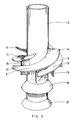
- Fig. 2 is a perspective representation of the gas discharge pipe, showing blades, baffles and sleeve sections, and
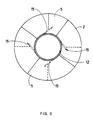
- Fig. 3 is a top view of a cross section of the gas discharge pipe at the height of the baffles.
- The gas to be scrubbed is fed into the
top compartment 1 of the separator via thepipe nozzle 3. Theblades 5 present in themiddle compartment 4 cause the gas to rotate in order to convert the flow energy of the gas into a centrifugal force, required for the separation. The liquid and/or solid matter separated off accumulates on the inner wall of thevessel 2 and then moves downwards and is caused to settle by theplates pipe 10 andvalve 11.
The scrubbed gas is discharged viagas discharge pipe 12, which is mounted coaxially with thevessel 2 and projects upwards from thebottom compartment 6 through themiddle compartment 4 and thetop compartment 1. Thehelicoidal blades 5 are fixed to thegas discharge pipe 12 at some distance from one another and partially overlap one another, thus creating the desired curved channel. Eachhelicoidal blade 5 is composed of abottom section 13 with a constant pitch and asection 14 with a pitch that gradually increases in upward direction. This causes a gradual acceleration of the gas fed into theseparator 2, which results in a smaller pressure drop when the gas is caused to rotate.
The constant pitch of theblades 5 lies between 5 and 20◊, preferably between 10 and 15◊, and increases to at most 60◊, preferably at most 45◊, near the gas inlet section.
Between theblades 5 arevertical baffles 15, which, viewed in the flow direction of the gas, extend from thegas discharge tube 12 in the direction of the inner wall of thevessel 2. Thesebaffles 15 are shaped like flat planes. These baffles improve the liquid separating capacity. This is improved even more when the free ends of the baffles are sharp, as is shown in fig. 3. - To further improve the separation of the liquids from the gas
conical sleeve sections gas discharge pipe 12 in thebottom compartment 6 of thevessel 2. These sleeve sections serve as so-called anti-film skirts, that is, liquid adhering to the outer wall of thegas discharge pipe 12 is guided along these conical sleeve sections in the direction of the wall of thevessel 2. The angle between thesleeve sections vessel 2 lies between 15 and 45 degrees. The distance between the free end of thesleeve sections vessel 2 is between 0.25 and 0.70 and by preference between 0.3 and 0.6 of the distance between the outer wall of thegas discharge tube 12 and the inner wall of thevessel 2. - The device according to the invention can be used to purify gases under high pressure, that is, pressures of more than 8 bar up to even 100 bar or more. This has been demonstrated in recent tests with natural gas at pressures of 150 bar.
Claims (11)
- Device for separating liquids and/or solids from a high-pressure gas stream, comprising a cylindrical vessel (2) with a virtually vertically set axis fitted with:
a top compartment (1) to which the gas stream is fed;
a middle compartment (4) comprising a number of blades (5) shaped helicoidally around the axis;
a bottom compartment (6) for the separation of the gas and the liquid and/or solids and a coaxial gas discharge pipe (12) projecting upwards from the bottom compartment through the middle and top compartments, characterized in that each helicoidal blade is fixed around said gas discharge pipe and consists of a bottom part with a constant pitch and a part with a pitch that gradually increases in upward direction. - Device according to claim 1, characterized in that the constant pitch of the blades is between 5 and 20 degrees and gradually increases in upward direction to at most 60 degrees.
- Device according to claims 1 and 2, characterized in that the constant pitch of the blades is between 10 and 15 degrees and increases in upward direction to at most 45 degrees.
- Device according to any one of claims 1-3, characterized in that vertical baffles (15) are provided between the helicoidal blades (5), which baffles, run parallel to the vertical axis of the cylindrical vessel (2) and extend from the discharge pipe (12) in the direction of the inner wall of the vessel.
- Device according to claim 4, characterized in that the baffles (15) are manufactured as flat, straight planes.
- Device according to one of the claims 4-5, characterized in that said straight, flat baffles extend 0.2 to 0.9 of the distance between the gas discharge pipe (12) and the inner wall of the vessel (2).
- Device according to any one of claims 4-6, characterized in that the free ends of the baffles (15) are sharp.
- Device according to any one of claims 1-7, characterized in that at least one conical sleeve section (16,17) with its larger base facing downward is provided at the outer wall of the gas discharge pipe, in the bottom compartment (6) of the device.
- Device according to claim 8, characterized in that the angle between the sleeve sections and the vertical axis of the vessel is between 15 and 45 degrees.
- Device according to any one of claims 8-9, characterized in that the distance between the free end of the sleeve sections (16,17) and the inner wall of the vessel is between 0.25 and 0.70 of the distance between the outer wall of the gas discharge pipe (12) and the inner wall of the cylindrical vessel (2).
- Device according to any one of the claims 8-10, characterized in that the distance between the free end of the sleeve sections (16,17) and the inner wall of the vessel is between 0.3 and 0.6 of the distance between the outer wall of the gas discharge pipe (12) and the inner wall of the vessel (2).
Priority Applications (1)
| Application Number | Priority Date | Filing Date | Title |
|---|---|---|---|
| AT89203119T ATE86512T1 (en) | 1989-06-06 | 1989-12-08 | DEVICE FOR SEPARATING LIQUIDS AND/OR SOLIDS FROM A HIGH PRESSURE GAS FLOW. |
Applications Claiming Priority (2)
| Application Number | Priority Date | Filing Date | Title |
|---|---|---|---|
| NL8901429 | 1989-06-06 | ||
| NL8901429A NL8901429A (en) | 1989-06-06 | 1989-06-06 | DEVICE FOR SEPARATING LIQUIDS AND / OR SOLIDS FROM A HIGH-PRESSURE GAS FLOW. |
Publications (2)
| Publication Number | Publication Date |
|---|---|
| EP0401430A1 EP0401430A1 (en) | 1990-12-12 |
| EP0401430B1 true EP0401430B1 (en) | 1993-03-10 |
Family
ID=19854781
Family Applications (1)
| Application Number | Title | Priority Date | Filing Date |
|---|---|---|---|
| EP89203119A Expired - Lifetime EP0401430B1 (en) | 1989-06-06 | 1989-12-08 | Device for separating liquids and/or solids from a high-pressure gas stream |
Country Status (7)
| Country | Link |
|---|---|
| US (1) | US5224976A (en) |
| EP (1) | EP0401430B1 (en) |
| AT (1) | ATE86512T1 (en) |
| CA (1) | CA2018251C (en) |
| DE (1) | DE68905334D1 (en) |
| NL (1) | NL8901429A (en) |
| NO (1) | NO176309C (en) |
Families Citing this family (14)
| Publication number | Priority date | Publication date | Assignee | Title |
|---|---|---|---|---|
| GB2299076A (en) * | 1995-03-09 | 1996-09-25 | Mass Transfer International Lt | Packing elements |
| EP1208897A1 (en) * | 2000-11-21 | 2002-05-29 | Epcon Norge AS | Combined degassing and flotation tank |
| NO320957B1 (en) * | 2002-10-02 | 2006-02-20 | Statoil Asa | Scrubber |
| NL1026268C2 (en) * | 2004-05-26 | 2005-11-30 | Flash Technologies N V | In-line cyclone separator. |
| KR20070101056A (en) * | 2006-04-10 | 2007-10-16 | 삼성전자주식회사 | Cyclone and Cyclone Air Purifier |
| JP2011016095A (en) * | 2009-07-09 | 2011-01-27 | Sumco Techxiv株式会社 | Cyclone device |
| EA201390989A1 (en) * | 2010-12-30 | 2014-06-30 | Айванхо Энерджи Инк. | METHOD, SYSTEM AND DEVICE FOR SEPARATION IN TREATMENT OF INITIAL RAW MATERIALS |
| US8973215B2 (en) * | 2012-07-18 | 2015-03-10 | Techtronic Floor Care Technology Limited | Cyclonic vacuum cleaner and dirt separator |
| US8997310B2 (en) | 2012-10-12 | 2015-04-07 | Electrolux Home Care Products, Inc. | Vacuum cleaner cyclone with helical cyclone expansion region |
| USD689658S1 (en) * | 2012-12-12 | 2013-09-10 | Electrolux Home Care Products, Inc. | Exterior surface of a cyclone receptacle |
| CA2844330C (en) | 2013-02-25 | 2019-10-15 | Bruce Lyon | Sand separator |
| RU2545277C1 (en) * | 2014-01-17 | 2015-03-27 | Роман Борисович Филиппов | Method for separation of inhomogeneous mixtures in centrifugal field |
| WO2019221884A1 (en) * | 2018-05-18 | 2019-11-21 | Donaldson Company, Inc. | Precleaner arrangement for use in air filtration and methods |
| US11154873B2 (en) * | 2019-09-19 | 2021-10-26 | X'pole Precision Tools Inc. | Multi-cyclonic dust filter device |
Family Cites Families (14)
| Publication number | Priority date | Publication date | Assignee | Title |
|---|---|---|---|---|
| US1573135A (en) * | 1926-02-16 | Dust collector | ||
| US1565318A (en) * | 1925-04-06 | 1925-12-15 | Ernest F Fisher | Separator |
| US2045503A (en) * | 1935-01-17 | 1936-06-23 | Bartlett Hayward Co | Dust collector |
| US2692655A (en) * | 1951-12-28 | 1954-10-26 | Vilbiss Co | Air cleaner |
| US3169842A (en) * | 1962-04-16 | 1965-02-16 | Coopers Mech Joints | Cyclones for removing solids from gas |
| DE1236121B (en) * | 1962-08-09 | 1967-03-09 | Lorch Ges & Co K G J | Separator for liquid and solid foreign matter from compressed air |
| FR1504489A (en) * | 1966-05-18 | 1967-12-08 | Condensate tank | |
| US3386588A (en) * | 1966-10-14 | 1968-06-04 | Sundstrand Corp | Coolant filter |
| US3590558A (en) * | 1968-11-15 | 1971-07-06 | Combustion Eng | Particle-from-fluid separator |
| US3771295A (en) * | 1969-07-31 | 1973-11-13 | H Wheeler | Separater apparatus for handling compressed air |
| US3822533A (en) * | 1972-03-04 | 1974-07-09 | Nederlandse Gasunie Nv | Device for removing impurities from gases |
| NL177187C (en) * | 1974-01-16 | 1985-08-16 | Nederlandse Gasunie Nv | DEVICE FOR SEPARATING POLLUTANTS FROM GASES. |
| DE2909318A1 (en) * | 1979-03-09 | 1980-09-11 | Ktd Verfahrenstech | Separator for removing solids and liq. from gas stream - includes sepn. chamber contg. tangential baffles and creating centrifugal sepn. forces |
| SE440978B (en) * | 1983-08-25 | 1985-09-02 | Tetra Pak Int | DEVICE FOR SEPARATION OF GAS PARTICULARS, SPECIFICALLY IN THE MANUFACTURE OF ASEPTIC PACKAGING CONTAINERS |
-
1989
- 1989-06-06 NL NL8901429A patent/NL8901429A/en not_active Application Discontinuation
- 1989-12-08 EP EP89203119A patent/EP0401430B1/en not_active Expired - Lifetime
- 1989-12-08 DE DE8989203119T patent/DE68905334D1/en not_active Expired - Lifetime
- 1989-12-08 AT AT89203119T patent/ATE86512T1/en not_active IP Right Cessation
- 1989-12-11 US US07/488,296 patent/US5224976A/en not_active Expired - Lifetime
-
1990
- 1990-06-05 NO NO902481A patent/NO176309C/en not_active IP Right Cessation
- 1990-06-05 CA CA002018251A patent/CA2018251C/en not_active Expired - Lifetime
Also Published As
| Publication number | Publication date |
|---|---|
| NL8901429A (en) | 1991-01-02 |
| CA2018251C (en) | 2000-05-02 |
| US5224976A (en) | 1993-07-06 |
| CA2018251A1 (en) | 1990-12-06 |
| NO902481L (en) | 1990-12-07 |
| NO176309B (en) | 1994-12-05 |
| ATE86512T1 (en) | 1993-03-15 |
| DE68905334D1 (en) | 1993-04-15 |
| NO176309C (en) | 1995-03-15 |
| NO902481D0 (en) | 1990-06-05 |
| EP0401430A1 (en) | 1990-12-12 |
Similar Documents
| Publication | Publication Date | Title |
|---|---|---|
| EP0401430B1 (en) | Device for separating liquids and/or solids from a high-pressure gas stream | |
| CA2031327C (en) | Device for separating liquids and/or solids from a gas stream | |
| US7025890B2 (en) | Dual stage centrifugal liquid-solids separator | |
| CN102725070B (en) | Separation plant with gravity pre-separator followed by centrifugal separator | |
| US6270544B1 (en) | Cyclone separator having a tubular member with slit-like openings surrounding a central outlet pipe | |
| US4187089A (en) | Horizontal vapor-liquid separator | |
| CN101949380B (en) | Foam remover of compressor separator | |
| US4731228A (en) | Reactor and horizontal cyclone separator with primary mass flow and secondary centrifugal separation of solid and fluid phases | |
| US20020162806A1 (en) | Inclined free water knockout (IFWKO) | |
| EP1218091B1 (en) | A compact cascade scrubber for scrubbing exhaust gas | |
| US5743926A (en) | Apparatus for separation of liquid and vapor in distillation/flashing process | |
| CN120393602A (en) | Gas-liquid separation device and gas-liquid separation method | |
| SU1301459A1 (en) | Separator for cleaning gases and vapours | |
| US5279727A (en) | Open-bottomed cyclone with solids separation tube and method | |
| US5228890A (en) | Cyclone separator | |
| CN220633425U (en) | Centrifugal oil-gas separation device | |
| WO2002020137A2 (en) | Water trap | |
| CN212119425U (en) | High-efficient coalescence defogging device | |
| CN2212455Y (en) | Efficient gas-liquid separator | |
| CA1136071A (en) | Horizontal vapor-liquid separator | |
| SU1648536A1 (en) | Centrifugal separator | |
| SU904792A1 (en) | Vortex separator | |
| RU19270U1 (en) | CYCLONE | |
| SU1066629A1 (en) | Separator | |
| Wenten et al. | Improving mist eliminator performance in gas-liquid separators |
Legal Events
| Date | Code | Title | Description |
|---|---|---|---|
| PUAI | Public reference made under article 153(3) epc to a published international application that has entered the european phase |
Free format text: ORIGINAL CODE: 0009012 |
|
| AK | Designated contracting states |
Kind code of ref document: A1 Designated state(s): AT BE CH DE ES FR GB GR IT LI LU NL SE |
|
| 17P | Request for examination filed |
Effective date: 19910516 |
|
| 17Q | First examination report despatched |
Effective date: 19920515 |
|
| GRAA | (expected) grant |
Free format text: ORIGINAL CODE: 0009210 |
|
| AK | Designated contracting states |
Kind code of ref document: B1 Designated state(s): AT BE CH DE ES FR GB GR IT LI LU NL SE |
|
| PG25 | Lapsed in a contracting state [announced via postgrant information from national office to epo] |
Ref country code: GR Free format text: LAPSE BECAUSE OF FAILURE TO SUBMIT A TRANSLATION OF THE DESCRIPTION OR TO PAY THE FEE WITHIN THE PRESCRIBED TIME-LIMIT Effective date: 19930310 Ref country code: DE Effective date: 19930310 Ref country code: ES Free format text: THE PATENT HAS BEEN ANNULLED BY A DECISION OF A NATIONAL AUTHORITY Effective date: 19930310 Ref country code: AT Effective date: 19930310 |
|
| REF | Corresponds to: |
Ref document number: 86512 Country of ref document: AT Date of ref document: 19930315 Kind code of ref document: T |
|
| REF | Corresponds to: |
Ref document number: 68905334 Country of ref document: DE Date of ref document: 19930415 |
|
| ITF | It: translation for a ep patent filed | ||
| ET | Fr: translation filed | ||
| PG25 | Lapsed in a contracting state [announced via postgrant information from national office to epo] |
Ref country code: CH Effective date: 19931231 Ref country code: LU Free format text: LAPSE BECAUSE OF NON-PAYMENT OF DUE FEES Effective date: 19931231 Ref country code: LI Effective date: 19931231 |
|
| PLBE | No opposition filed within time limit |
Free format text: ORIGINAL CODE: 0009261 |
|
| STAA | Information on the status of an ep patent application or granted ep patent |
Free format text: STATUS: NO OPPOSITION FILED WITHIN TIME LIMIT |
|
| 26N | No opposition filed | ||
| REG | Reference to a national code |
Ref country code: CH Ref legal event code: PL |
|
| ITTA | It: last paid annual fee | ||
| EAL | Se: european patent in force in sweden |
Ref document number: 89203119.6 |
|
| REG | Reference to a national code |
Ref country code: GB Ref legal event code: IF02 |
|
| PGFP | Annual fee paid to national office [announced via postgrant information from national office to epo] |
Ref country code: NL Payment date: 20081219 Year of fee payment: 20 |
|
| PGFP | Annual fee paid to national office [announced via postgrant information from national office to epo] |
Ref country code: IT Payment date: 20081211 Year of fee payment: 20 Ref country code: SE Payment date: 20081211 Year of fee payment: 20 |
|
| PGFP | Annual fee paid to national office [announced via postgrant information from national office to epo] |
Ref country code: GB Payment date: 20081218 Year of fee payment: 20 |
|
| PGFP | Annual fee paid to national office [announced via postgrant information from national office to epo] |
Ref country code: BE Payment date: 20090119 Year of fee payment: 20 |
|
| PGFP | Annual fee paid to national office [announced via postgrant information from national office to epo] |
Ref country code: FR Payment date: 20081215 Year of fee payment: 20 |
|
| REG | Reference to a national code |
Ref country code: GB Ref legal event code: PE20 Expiry date: 20091207 |
|
| BE20 | Be: patent expired |
Owner name: NEDERLANDSE *GASUNIE N.V. Effective date: 20091208 |
|
| NLV7 | Nl: ceased due to reaching the maximum lifetime of a patent |
Effective date: 20091208 |
|
| PG25 | Lapsed in a contracting state [announced via postgrant information from national office to epo] |
Ref country code: NL Free format text: LAPSE BECAUSE OF EXPIRATION OF PROTECTION Effective date: 20091208 |
|
| PG25 | Lapsed in a contracting state [announced via postgrant information from national office to epo] |
Ref country code: GB Free format text: LAPSE BECAUSE OF EXPIRATION OF PROTECTION Effective date: 20091207 |