EP0399786A2 - Feuerfeste Auskleidungen, beständig gegen Natrium und Natriumsalze - Google Patents
Feuerfeste Auskleidungen, beständig gegen Natrium und Natriumsalze Download PDFInfo
- Publication number
- EP0399786A2 EP0399786A2 EP90305549A EP90305549A EP0399786A2 EP 0399786 A2 EP0399786 A2 EP 0399786A2 EP 90305549 A EP90305549 A EP 90305549A EP 90305549 A EP90305549 A EP 90305549A EP 0399786 A2 EP0399786 A2 EP 0399786A2
- Authority
- EP
- European Patent Office
- Prior art keywords
- red mud
- layer
- refractory
- sodium
- alumina
- Prior art date
- Legal status (The legal status is an assumption and is not a legal conclusion. Google has not performed a legal analysis and makes no representation as to the accuracy of the status listed.)
- Withdrawn
Links
Images

Classifications
-
- F—MECHANICAL ENGINEERING; LIGHTING; HEATING; WEAPONS; BLASTING
- F27—FURNACES; KILNS; OVENS; RETORTS
- F27D—DETAILS OR ACCESSORIES OF FURNACES, KILNS, OVENS OR RETORTS, IN SO FAR AS THEY ARE OF KINDS OCCURRING IN MORE THAN ONE KIND OF FURNACE
- F27D1/00—Casings; Linings; Walls; Roofs
- F27D1/0003—Linings or walls
- F27D1/0006—Linings or walls formed from bricks or layers with a particular composition or specific characteristics
-
- B—PERFORMING OPERATIONS; TRANSPORTING
- B32—LAYERED PRODUCTS
- B32B—LAYERED PRODUCTS, i.e. PRODUCTS BUILT-UP OF STRATA OF FLAT OR NON-FLAT, e.g. CELLULAR OR HONEYCOMB, FORM
- B32B18/00—Layered products essentially comprising ceramics, e.g. refractory products
-
- C—CHEMISTRY; METALLURGY
- C04—CEMENTS; CONCRETE; ARTIFICIAL STONE; CERAMICS; REFRACTORIES
- C04B—LIME, MAGNESIA; SLAG; CEMENTS; COMPOSITIONS THEREOF, e.g. MORTARS, CONCRETE OR LIKE BUILDING MATERIALS; ARTIFICIAL STONE; CERAMICS; REFRACTORIES; TREATMENT OF NATURAL STONE
- C04B35/00—Shaped ceramic products characterised by their composition; Ceramics compositions; Processing powders of inorganic compounds preparatory to the manufacturing of ceramic products
- C04B35/66—Monolithic refractories or refractory mortars, including those whether or not containing clay
-
- C—CHEMISTRY; METALLURGY
- C25—ELECTROLYTIC OR ELECTROPHORETIC PROCESSES; APPARATUS THEREFOR
- C25C—PROCESSES FOR THE ELECTROLYTIC PRODUCTION, RECOVERY OR REFINING OF METALS; APPARATUS THEREFOR
- C25C3/00—Electrolytic production, recovery or refining of metals by electrolysis of melts
- C25C3/06—Electrolytic production, recovery or refining of metals by electrolysis of melts of aluminium
- C25C3/08—Cell construction, e.g. bottoms, walls, cathodes
- C25C3/085—Cell construction, e.g. bottoms, walls, cathodes characterised by its non electrically conducting heat insulating parts
-
- C—CHEMISTRY; METALLURGY
- C25—ELECTROLYTIC OR ELECTROPHORETIC PROCESSES; APPARATUS THEREFOR
- C25C—PROCESSES FOR THE ELECTROLYTIC PRODUCTION, RECOVERY OR REFINING OF METALS; APPARATUS THEREFOR
- C25C7/00—Constructional parts, or assemblies thereof, of cells; Servicing or operating of cells
- C25C7/005—Constructional parts, or assemblies thereof, of cells; Servicing or operating of cells of cells for the electrolysis of melts
-
- C—CHEMISTRY; METALLURGY
- C04—CEMENTS; CONCRETE; ARTIFICIAL STONE; CERAMICS; REFRACTORIES
- C04B—LIME, MAGNESIA; SLAG; CEMENTS; COMPOSITIONS THEREOF, e.g. MORTARS, CONCRETE OR LIKE BUILDING MATERIALS; ARTIFICIAL STONE; CERAMICS; REFRACTORIES; TREATMENT OF NATURAL STONE
- C04B2111/00—Mortars, concrete or artificial stone or mixtures to prepare them, characterised by specific function, property or use
- C04B2111/00474—Uses not provided for elsewhere in C04B2111/00
- C04B2111/00612—Uses not provided for elsewhere in C04B2111/00 as one or more layers of a layered structure
-
- C—CHEMISTRY; METALLURGY
- C04—CEMENTS; CONCRETE; ARTIFICIAL STONE; CERAMICS; REFRACTORIES
- C04B—LIME, MAGNESIA; SLAG; CEMENTS; COMPOSITIONS THEREOF, e.g. MORTARS, CONCRETE OR LIKE BUILDING MATERIALS; ARTIFICIAL STONE; CERAMICS; REFRACTORIES; TREATMENT OF NATURAL STONE
- C04B2235/00—Aspects relating to ceramic starting mixtures or sintered ceramic products
- C04B2235/02—Composition of constituents of the starting material or of secondary phases of the final product
- C04B2235/30—Constituents and secondary phases not being of a fibrous nature
- C04B2235/32—Metal oxides, mixed metal oxides, or oxide-forming salts thereof, e.g. carbonates, nitrates, (oxy)hydroxides, chlorides
- C04B2235/3201—Alkali metal oxides or oxide-forming salts thereof
-
- C—CHEMISTRY; METALLURGY
- C04—CEMENTS; CONCRETE; ARTIFICIAL STONE; CERAMICS; REFRACTORIES
- C04B—LIME, MAGNESIA; SLAG; CEMENTS; COMPOSITIONS THEREOF, e.g. MORTARS, CONCRETE OR LIKE BUILDING MATERIALS; ARTIFICIAL STONE; CERAMICS; REFRACTORIES; TREATMENT OF NATURAL STONE
- C04B2235/00—Aspects relating to ceramic starting mixtures or sintered ceramic products
- C04B2235/02—Composition of constituents of the starting material or of secondary phases of the final product
- C04B2235/30—Constituents and secondary phases not being of a fibrous nature
- C04B2235/34—Non-metal oxides, non-metal mixed oxides, or salts thereof that form the non-metal oxides upon heating, e.g. carbonates, nitrates, (oxy)hydroxides, chlorides
- C04B2235/3427—Silicates other than clay, e.g. water glass
- C04B2235/3463—Alumino-silicates other than clay, e.g. mullite
- C04B2235/3472—Alkali metal alumino-silicates other than clay, e.g. spodumene, alkali feldspars such as albite or orthoclase, micas such as muscovite, zeolites such as natrolite
-
- Y—GENERAL TAGGING OF NEW TECHNOLOGICAL DEVELOPMENTS; GENERAL TAGGING OF CROSS-SECTIONAL TECHNOLOGIES SPANNING OVER SEVERAL SECTIONS OF THE IPC; TECHNICAL SUBJECTS COVERED BY FORMER USPC CROSS-REFERENCE ART COLLECTIONS [XRACs] AND DIGESTS
- Y02—TECHNOLOGIES OR APPLICATIONS FOR MITIGATION OR ADAPTATION AGAINST CLIMATE CHANGE
- Y02P—CLIMATE CHANGE MITIGATION TECHNOLOGIES IN THE PRODUCTION OR PROCESSING OF GOODS
- Y02P10/00—Technologies related to metal processing
- Y02P10/25—Process efficiency
Definitions
- This invention relates to refractory linings capable of resisting both high temperatures and exposure to sodium or sodium salts. More particularly, although not exclusively, the invention relates to refractory linings suitable for aluminum reduction cells and other similar containers.
- Aluminum reduction cells usually consist of a shallow container for holding a molten electrolyte (normally a mixture of cryolite and alumina) while current is passed through the electrolyte to liberate metallic aluminum.
- the cell is provided with an electrically conductive lining (usually made of amorphous carbon or graphite) which acts as the cathode and with carbon anodes which dip into the bath of electrolyte from above.
- One or more layers of refractory materials are normally provided between the cathode and the wall of the container (the outer shell) in order both to protect the outer shell from attack by the cell contents and to provide thermal insulation.
- the refractory lining consists of two distinct regions.
- One or more layers of highly insulating refractories are provided adjacent to the outer shell in order to provide the required thermal resistance.
- the insulating refractories are highly porous and are subject to rapid attack by the cell contents if the molten contents penetrate into this region.
- the refractory materials used for the protective parts of the cell lining should be resistant to attack by the cell contents at the elevated operating temperatures (generally 900-950°C immediately below the cathode) in order to reduce the frequency of lining replacement and thus to increase the operational life of the cell.
- the most common lining structure consists of one or more layers of medium duty firebricks immediately beneath the cathode, one or more layers of insulating bricks next to the medium duty firebricks and possibly a highly insulating (often fibrous) slab next to the cell outer shell.
- Medium duty firebricks are aluminosilicate refractories having an alumina to silica ratio of about 0.67 and a relatively low porosity usually below 25%. These low porosity firebricks serve as the protective layer to prevent penetration of the molten cell contents into the more porous and more highly insulating underlying layers that are subject to rapid attack by the cell contents.
- the porosity of the protective refractory layer may not be the most critical factor for a durable refractory lining. This appears to be the case because even the lowest porosity conventional aluminosilicate refractories seem to lose their high temperature resistance after a period of operation and parts of the lining begin to deform or melt. We believe that this is due to absorption of sodium and/or sodium salts into the crystalline structure of the refractory (by diffusion through the carbon cathode) to produce eutectics having melting points below the operating temperatures of the cell linings. In aluminum reduction cells, the molten electrolyte contains NaF (cryolite) and by reaction with the aluminium metal pad this salt may partially be reduced to metallic sodium, which is especially aggressive.
- an object of the present invention is to provide a refractory lining for a container subject to high temperatures and exposure to sodium or sodium salts, which lining is capable of providing good resistance to attack by the sodium or sodium salts, while also having desirable physical and thermal characteristics.
- Another object of the invention is to provide novel refractory materials suitable for use in the linings as mentioned above, and processes for producing such materials.
- the present invention is based, at least in part, on the finding that aluminosilicate refractories having alumina to silica ratios of 0.85 or higher do not form low melting eutectic mixtures or compositions when exposed to sodium or sodium salts (particularly NaF) and thus do not melt or deform when exposed to such materials at high operating temperatures (e.g. up to about 915°C). Consequently, refractories of this type are much more durable than conventional materials when used as the outer parts of linings for aluminum reduction cells and in similar applications.
- a container having an internal volume for containing molten sodium or sodium salts at high temperature, said container comprising an outer wall and a refractory lining separating said internal volume from said outer wall, wherein said refractory lining comprises a first layer of an aluminosilicate refractory material having an alumina:silica ratio of at least 0.85 by weight and a porosity of 25% or less, a second layer of an aluminosilicate refractory material having an alumina:silica ratio of at least 0.85 by weight and a porosity of about 25-50%, said second layer lying beneath said first layer closer to said outer wall, and a third layer of insulating refractory material beneath said second layer closer to said outer wall, said insulating layer having a porosity of more than about 50%.
- aluminosilicate refractory material as used herein is intended to include so-called “pure” alumina refractories.
- Commercial grade alumina always has a small amount of SiO2 as an impurity and it is common practice in the art to include “pure” Al2O3 with aluminosilicates.
- refractory material may be provided, if desired, but the three layers mentioned above are preferably used alone beneath a conductive carbonaceous layer (if required). If other refractory layers are present, they should not disrupt the intended function of the three basic layers, i.e. the three basic layers should be positioned within the parts of the cell lining which expose them to the temperatures at which and environments in which they are intended to function, as will be more apparent from the description provided later.
- the alumina:silica ratios of the refractories used for the first and second layers are preferably at least 1.2 by weight, at least in some forms of the invention.
- aluminosilicate aggregates having the required high alumina to silica ratios for use in the first and second layers mentioned above can be produced from red mud (the byproduct produced by the extraction of alumina from bauxite according to the Bayer process) and that such materials not only form durable potlinings and the like, but can also be produced inexpensively since red mud is often discarded as waste, thus overcoming the disadvantage of the high cost of known aluminosilicate refractories of high alumina content.
- a process for producing a particulate refractory aluminosilicate material having an alumina:silica ratio of at least 0.85 by weight comprises drying red mud derived from the Bayer process of extracting alumina from bauxite, calcining said red mud and crushing the calcined product to form particles.
- the invention also relates to the refractories produced by this process and to containers lined with such refractories.
- aluminosilicate materials having alumina to silica ratios below 0.85 are extremely useful as highly insulating refractories for use in the highly insulating (third) layers of the linings of the present invention. While these materials have low resistance to corrosion by sodium and sodium salts, they can be positioned within the parts of the cell lining that are not subject to such attack (e.g. the parts of the lining that are beneath dense protecting layers and subject to temperatures below about 700°C).
- the preferred materials are compressible fibre-based or mica-based materials that, although they are of low density, have relatively little change of thermal insulation value when compressed. A procedure for identifying such materials has been devised.
- a process for selecting an insulating refractory material for use in a lining for a container for containing sodium or sodium salts at high temperature comprising the steps of: (a) selecting a range of product thermal conductivities having a 20% variation of the values in each range; (b) identifying different insulating products whose room temperature thermal conductivities fall within one of said selected ranges; (c) measuring the percentage loss of room temperature thermal conductivity of all said identified products after compression at 40% of their initial thickness, (d) rejecting all products having a change of thermal conductivity at 40% compression that is higher than a minimum value of said products by at least 20% leaving remaining products, and (e) using one of said remaining products as said insulating refractory material.
- the shaded area shows those compositions which result in the formation of eutectic compounds having melting points above about 700°C (theoretically above 732°C).
- the unshaded areas represent compounds that do not melt at temperatures up to at least about 915°C. From the diagram, it can be seen that compositions having an alumina:silica ratio of 0.85 (as indicated by the dotted line) and higher do not form low melting eutectic compounds at any Na2O content and thus remain solid during the operation of a reduction cell even if sodium is absorbed into the crystal structure.
- compounds having a lower alumina:silica ratio e.g.
- medium duty firebrick as indicated by the chain-dot line) used in conventional cell linings remain solid as sodium is absorbed only until the shaded region is reached whereupon the compounds subject to temperatures above about 700°C begin to melt.
- the lower layers e.g. the insulating bricks
- silica content lower alumina:silica ratio
- the liquid phases continue to move downwardly until the approximately 700°C isotherm is reached whereupon the liquid phases solidify, but not before the lining has been subjected to considerable deformation and damage so that hot spots may develop.
- Solid diffusion of sodium and/or salts into the lower refractories may also take place in those regions of the refractory lining subject to temperatures above 700°C. If this takes place, the lower refractory layers may themselves begin to melt even before they are contacted by the liquid phases from the upper layers and thus lining failure occurs even more rapidly.
- aluminosilicate refractories having the high alumina:silica ratio required for sodium resistance are used for different parts of the cell linings according to their porosities.
- Refractories having porosities of less than about 25% are used as protective layers (to be used immediately beneath the cathode, if present, to prevent the penetration of cell contents).
- Refractories of this porosity do not have particularly good thermal resistance, so the layers should preferably be no thicker than required to produce the desired protection from the liquid cell contents. This thickness will vary from cell to cell and according to the conditions of use of any particular cell, but can easily be found by simple trial and experimentation.
- Refractories having porosities in the range of 25-50% can be considered “intermediate” in that they represent a compromise between good resistance to penetration and good thermal insulation characteristics. These intermediate refractories can be used to prevent lower insulating layers from being subjected to temperatures above about 700°C and from being contacted by liquid cell contents, without unduly increasing the necessary thickness of the cell lining. A layer of such material is thus positioned between the dense protective layers and the highly insulating layers.
- Aluminosilicate refractories with porosities higher than about 50% are considered to be insulating refractories and although they have good thermal insulation, they have poor resistance to the penetration of cell contents because of their high porosities. Furthermore, these materials almost always have alumina to silica ratios below 0.85 and thus have poor resistance to sodium and sodium salts. They should therefore only be used in parts of the refractory linings where they are subject to temperatures below about 700°C (e.g. adjacent to the outer shell of a reduction cell).
- a preferred refractory lining structure consists of a layer of dense ( ⁇ 25% porosity) aluminosilicate material having an alumina to silica ratio of at least 0.85 by weight beneath the cathode of a reduction cell, a layer of intermediate porosity (25-50%) aluminosilicate material having an alumina to silica ratio of at least 0.85 by weight beneath the dense layer spanning the 700°C isotherm, and a highly porous (>50% porosity) insulating layer of aluminosilicate refractory having an alumina to silica ratio of less than 0.85 beneath the intermediate porosity layer to provide the desired thermal insulation of the cell wall.
- the various layers used in the refractory linings may be either castable (where possible) or non-castable.
- Castable linings involve an aggregate, a binder and some water.
- Non-castable materials generally consist of an aggregate only (no binder or water). It has been found that the water content of refractories must always be less than 5% by weight for safety before contact with molten aluminum takes place. If castable refractories are used, and if they contain more than 5% of water, drying to reduce the water content to below 5% must take place. This can be done prior to placement of the refractory in the reduction cell (or other container) or after prior to start-up (i.e. introduction of molten Al). To avoid in-cell drying, castable refractories may be preformed into bricks, tiles or other suitable shapes and treated to remove moisture to below 5% by drying or calcining prior to installation in the cell lining.
- a number of known refractories have been evaluated for their suitability for use in the various parts of the linings of aluminum reduction cells or other containers exposed to similar harsh environments.
- aluminosilicate refractories having alumina to silica ratios of 0.85 or more were identified and then classified according to their porosities as suitable for use as protective (first) layers or as the intermediate (second) layers. While a large number of suitable known refractories exist, representative examples having suitable properties are shown in Tables 1 and 2 below.
- the refractories shown in Tables 1 and 2 all have alumina to silica ratios greater than 0.85 by weight and can thus be used in those parts of the cell lining which are subject to attack by sodium or sodium salts, i.e. the parts of the lining which are exposed to temperatures above about 700°C.
- All the refractories shown in Table 1 are castable.
- the A, B, and C materials have water contents below 5% and are thus suitable for use as castable (cast-in-place) shapes in a cell lining without treatment to remove water.
- the D material has a water content above 5%, hence precast shapes would need further drying or calcining to reduce the water content to below this level prior to installation in the lining.
- Nepheline ore (a material generally used for glass making) in the parts of the lining subject to temperatures above 700°C.
- Nepheline ore has an alumina to silica ratio of at least 0.85 and is thus resistant to degradation.
- the main criterion is the thermal insulation value of the material since there is no degradation of the material provided it is not subject to temperatures above 700°C.
- Various insulating materials are known. These generally fall into the categories of non-compressible materials (e.g. diatomite and perlite based products) and compressible materials (e.g. fibre and mica based products). The latter are desirable, but the operational cell life can be shortened if the thermal insulation value of the refractory is significantly decreased as the materials compress during use.
- the first step involved is the selection of a range of product thermal conductivity, with respect to the specific pot cell (or other container) insulation required.
- Table 3 lists the various possible ranges of room temperature thermal conductivity that should be considered. In each range, the extent of variation between the values is limited to less than 20%.
- ⁇ th (40%) typically contraction of such products in a cell could generally fall between 25 to 50%.
- non compressible materials tend to crush under the effect of compressive stress without decreasing their insulating characteristic.
- That measurement should preferably be made on 4 x 21 ⁇ 2 x 1 inches samples, and the value of ⁇ th (40%) can be collected from a curve fitting of data corresponding to different contraction levels, varying from 0 to 50%.
- the last step involved is to reject all products of the group whose value of ⁇ th (40%) is higher than the minimum value obtained in that group by at least 20%.
- Two products having their value of ⁇ th (40%) not differing by more than 20% (based on the smaller number) should be considered technically equivalent. That limit is used because it corresponds to the extent of variation in the thermal conductivity ranges involved in the first step.
- products A and B, and products C and D respectively fall in the ranges of 0.070 ⁇ ⁇ th ⁇ 0.080 and 0.095 ⁇ ⁇ ⁇ 0.110 (in W/m°K).
- the two products can be compared based on their ⁇ th (40%) values.
- product B should be rejected because its ⁇ th (40%) value is higher than that of product A, by more than 20%. If these two products were the only identified materials for that particular application, product A would be the material to use.
- products C and D should be considered as equivalent materials because their value of ⁇ th (40%) do not differ by more than 20% (based on the value of product C).
- product E cannot be compared to any of the other products because it is associated with a different range of thermal conductivity.
- the limit to use for rejecting the products from a selected group should also be proportionally increased. For example, if products falling in the range of 0.06 ⁇ ⁇ ⁇ 0.08 (in W/m°K) are considered as possibly equivalent materials, the corresponding rejecting limit to use should be 40% instead of 20%.
- the above description relates to ways in which known or conventional materials can be selected for use in particular parts of the refractory linings of the present invention.
- the following description relates to novel aluminosilicate refractories having the desired alumina to silica ratio of 0.85 or greater which can be used in the high temperature parts of the lining structure and which can generally be produced less expensively than conventional high alumina materials.
- red mud which is the well-known byproduct of the Bayer extraction of alumina from bauxite.
- the composition of red mud varies depending on the source of the bauxite and the processing conditions but red muds from all origins have alumina:silica ratios greater than 0.85 (and more usually >1) and can be used to form refractories if subjected to an appropriate conversion process explained below.
- calcination In order to form a suitable refractory material from red mud, particular process steps are carried out, including calcination, but the precise nature of these steps depends on the type of refractory material to be produced. After cooling, the calcined product is normally broken up into small pieces (if necessary) and the product is used as a non-castable refractory aggregate rather than a cast body or castable refractory.
- Components in red mud include alumina, silica and soluble materials (expressed as Na2O) such as NaOH, Na2CO3 and Na2SO4 which together are capable of forming a variety of complex compounds when the red mud is calcined.
- the relative proportions of these components can be changed by washing the red mud to remove soluble caustic compounds, by filtering the red mud to remove sand (particles of high silica content having a size greater than 65 Tyler mesh), or by adding various components (e.g. alumina or silica) usually in the form of -65 Tyler mesh particles.
- Different products can also be formed by varying the calcination temperature in conjunction with particular pre-treatment steps.
- One of the main objectives of the treatment steps for the production of a first type of red mud refractory is to ensure that the components in the red mud react during the calcination step to produce primarily nepheline (NaAlSiO4) as the major silicate compound since this material has an alumina silica ratio of 0.85 (according to its phase diagram). This can be achieved by adjusting (if necessary) the relative amounts of Na2O, Al2O3 and SiO2 in the red mud prior to the calcination step and by carrying out the calcination at a temperature above about 950°C to a maximum of about 1350°C.
- washing or addition can be carried out prior to calcination to ensure that the ingredients of the red mud correspond to the stoichiometry of nepheline.
- the refractory product has even better high temperature resistance to sodium compounds if it contains nepheline in the presence of excess alumina to the extent that the alumina:silica ratio exceeds 1.2.
- red mud has an alumina:silica ratio less than 1.2, sand may be removed prior to the calcination step, if this seems desirable.
- calcined red mud has the ability to self-densify when exposed to sodium salts at high temperatures (greater than about 830°C) if the Na2O:SiO2 ratio falls within a certain range. Self-densification appears to result from a filling of the pores of the product by sodium components. These sodium components then appear to become linked to the nepheline (NaAlSiO4) matrix of the product and thus increase the density without causing any shrinkage.
- Self-densification properties are extremely desirable for refractories used as the protective parts of cell linings, but are not so desirable for the insulating (intermediate) parts. For this reason, the ratio of Na2O to SiO2 can be varied prior to the calcination step in order to produce either a self-densifiable product or a non self-densifiable product, as required.
- SSA specific surface area
- the amount of SiO2 and/or the amount of Na2O can be varied in the red mud before calcination. This can normally be done by:
- the Na2O component of interest in red mud comes from the caustic content of the mud (i.e. the quantity of soluble sodiumbased materials, usually forming up to 10% by weight of the red mud on a dry basis, contributing to material basicity).
- the caustic content can be represented by the total titrable soda (TTS) in the red mud.
- TTS total titrable soda
- the amount of Na2O in the calcined product is about 0.8 x TTS (i.e. 2.5% TTS gives a calcined product containing about 2.0% Na2O).
- the amount of silica should be greater than 0.8 x TTS or otherwise the value of R will be equal to or greater than 1.
- Free silica should thus be removed (as sand) from the red mud prior to calcination (if necessary at all) only to such an extent that the free silica content is still greater than 0.8 x TTS in those cases where a self-densifiable product is desired.
- the TTS could be decreased by washing the red mud to remove caustic sodium compounds from the red mud.
- silica-bearing additives are silica fumes, quartz dust, material sand, etc. This addition is preferably made before liquor removal and the size of the added particles should preferably be -65 Tyler mesh.
- High efficiency sand removal can be achieved, for example, with a cyclone or a sand box separation device.
- Lower efficiency sand removal can be achieved, for example, by the use of screens having opening sizes in the range of around -20 +35 Tyler mesh and higher depending on the granulometry of the sand in the red mud.
- a typical granulometric distribution of sand in red mud is shown in Table 6 below, and appropriate screen sizes can be devised from this to give any desired efficiency of sand removal.
- the sand content of the mud should normally be reduced to less than about 5% on a dry basis (red mud normally contains 3-22% by weight of sand on a dry basis) to produce calcined red mud aggregates which will not self-densify at temperatures above 830°C.
- the maximum amount of tolerated sand in red mud after partial sand removal should be such that the overall Al2O3 to SiO2 ratio is greater than 0.85:1 and preferably greater than 1.2:1.
- Red mud with a sand content between about 5 wt % and the maximum value achieving an Al2O3:SiO2 ratio of about 0.85:1 will exhibit good chemical resistance and self-densification after calcination when exposed to sodium compounds at temperatures above about 830°C.
- red muds already have a composition which, upon calcination, gives a self-densifiable product having an alumina:silica ratio of 0.85 or more, in which case prior treatment of the red mud to remove sand or caustic materials will not be necessary if a self densifiable product is required.
- Other muds may have compositions suitable for the formation of non self-densifiable products without prior treatments.
- a chemical analysis of a red mud prior to use in order to determine its caustic and free silica contents will thus indicate what, if any, treatments are required prior to calcination.
- non self-densifiable products can be produced by making R less than 0.05, i.e. about 0. This can be achieved by limiting the red mud calcination temperature to a maximum of 950°C, and preferably to a maximum of 925°C to form a second type of red mud refractory.
- the soluble salts present in the original red mud such as NaOH, Na2CO3 and Na2SO4, do not decompose significantly during the calcination step, so that the Na2O in the expression for R takes on a value of 0.
- No nepheline is formed in the calcined material, but sodalite ((NaAlSiO 4. xH2O)(Na2CO3, Na2SO4)) is formed instead and this material is as resistant to sodium and sodium salts as nepheline since the basic nepheline structure (NaAlSiO4) is still present.
- the resulting refractories are non-densifiable (i.e.
- the sand content in the original red mud does not necessarily have to be reduced to less than 5% by weight to achieve non-densifiable aggregates.
- the resulting products should preferably, however, not be used in applications where the temperature exceeds about 950°C.
- the preferred calcination temperature is 850 to 925°C. At temperatures above 850°C, the combined water in the red mud is totally removed so the resulting refractory is suitable for use in reduction cells. However, it has been found that lower calcination temperatures can be employed, if desired, for the production of aggregates having good thermal insulation properties and non-densification properties. Calcination at any temperature below 850°C, after complete drying at about 100°C (preferably between 110 and 120°C) results in suitable products.
- the uncombined water in the mud is completely removed after drying, and the calcined product contains an acceptable fraction of the original combined water content of the mud (generally up to 15-20%, on a dry basis, and more usually less than 10%), varying from 1 to 0% as the calcination temperature is raised from 100 to 850°C.
- the calcination step is carried out, following initial drying, at a temperature of approximately 950-1350°C (although temperatures as low as 850°C may sometimes be suitable) for a period of time sufficient to convert the mud to a suitable refractory crystalline structure (usually a minimum of 5 to 10 hours and often much longer, e.g. 30 hours or more).
- the calcination results in the removal of combined water from the red mud solids and the modification of the Bayer Sodalite (the compounds of Al2O3, SiO2 and Na2O) to produce mainly nepheline.
- the calcination temperature is between 1000-1200°C in order to develop adequate strength levels to achieve, upon crushing, aggregates involving a sufficient amount of coarse particles and minimum amounts of fines (to minimize problems of handling dust).
- higher calcination temperatures achieve higher densification levels.
- densification levels increase for aggregates made from red mud containing higher caustic (TTS) contents.
- TTS caustic
- exposure of densifiable red mud aggregates to sodium compounds at temperatures above 830°C will induce higher densification levels if it takes place under an oxidizing atmosphere (e.g. air).
- the product is normally subjected to gentle crushing to produce an aggregate having particles of preferably -0.25 Tyler mesh and more preferably of -4 Tyler mesh, although other particle sizes and combination of size ranges could be employed.
- a mixture of the following fractions is particularly preferred for the protective layer, namely -4 +10, -10 +28, -28 +65, and -65 Tyler mesh.
- the particles should preferably be of such a size and shape that a dense bed of minimum intergranular porosity can be produced by compacting a layer of the particles.
- the effect of the granulometric distribution of the non self-densifiable red mud aggregates (normally used as the intermediate and/or insulating layer) on their thermal conductivity is negligible because the grains themselves are highly porous and thus most of the free space is formed by the pores in the grains rather than the spaces between the grains. For example, after calcination at 1100°C, the porosity of the grains is around 30-40%.
- red mud refractories of the present invention are self-densifiable, it is possible initially to provide a cell (or other container) with a two-layer lining comprising a highly insulating layer of greater than 50% porosity adjacent to the outer shell and a medium density (25-50% porosity) self-densifiable red mud refractory layer adjacent to the interior of the cell.
- the outer region of the medium density layer self-densifies to produce a high density layer (less than 25% porosity). If the medium density layer is sufficiently thick to avoid all of the layer becoming self-densified, the result is a three layer structure required by the present invention.
- the 830°C isotherm forms the dividing line between the high density layer and the medium density red mud layer of the red mud refractory because self-densification does not take place below 830°C. Such an arrangement forms part of this invention.
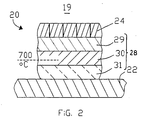
- FIG. 2 The structure of a typical cell lining according to the present invention is shown in Fig. 2.
- the structure shown in Fig. 2 consists of a carbonaceous cathode 24 and an outer shell 22 separated by a refractory lining (28) made up of layers.
- the refractory layer 29 immediately beneath the cathode 24 is a low porosity (less than 25%) aluminosilicate material having an alumina to silica ratio of greater than 0.85.
- the refractory layer 30 is a medium porosity (25-50%) alumino-silicate material having an alumina to silica ratio greater than 0.85.
- the lowermost layer 31 is a compressible aluminosilicate insulating refractory having a low alumina:silica ratio and a low change of thermal conductivity with compression chosen according to the procedure mentioned above.
- the 700°C isotherm passes through layer 30 so that the insulating material of layer 31 is subjected to temperatures below 700°C and is therefore not degraded by the sodium compounds.
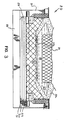
- Fig. 3 shows a cross-section of a typical reduction cell used for the manufacture of aluminum having a lining similar to that shown in Fig. 2.
- the cell 20 has an outer shell 21, including a bottom wall 22, a carbon anode 23 and a carbon cathode 24.
- the cell has an internal volume 19 which contains a molten electrolyte 25 (cryolite) which freezes at the sides and top of the cell to form a solid crust 26.
- a molten aluminum pad 27 forms on the cell floor as the electrolysis progresses.
- the refractory structure 28 comprises at least one layer 29 of high alumina content (alumina:silica ratio >0.85) and one or more other layers 30 and 31, e.g. forming a structure according to Fig. 2.
- refractory structures in aluminum reduction cells.
- the same refractory structures are useful in any containers that have interior walls likely to come into contact with molten sodium or sodium salts at temperatures in the range of 700 - 950°C.
- the refractory structures can be used as linings for various furnaces and other types of reduction cells.
- This Example shows that conventional potlining refractories (those having an Al2O3 to SiO2 below 0.85 (in wt.) convert to glassy (or liquid) phases at above about 700°C by the action of sodium diffusing compounds in an alumina reduction cell.
- the composition of the corroded sample falls in the Na2SiO3 - NaAlSiO4 - SiO2 subtriangle which involves eutectic compounds melting at above 732°C. This is confirmed by the presence of NaAlSiO4 and amorphous compounds in that sample, which were detected from XRD analysis. The powder used for that analysis was finally put into a furnace to determine the melting point. Results confirm the low melting point of that corrosion product between 700 and 800°C.
- This Example shows that the conditions for transforming conventional potlining refractories into glassy phases (or liquid) are achieved, with time, irrespectively of the cells amperage.
- the composition of the corroded sample also falls in the Na2SiO3 - NaAlSiO4 - SiO2 sub-triangle where the low melting point eutectic compounds (> about 700°C) are present.
- the corroded sample of the insulating bricks in Comparative Example 3 was tested for its room temperature thermal conductivity. Based on the value obtained from the unused material, the thermal conductivity of the corroded insulating bricks had increased by at least 6 times.
- This Example shows that refractories having an Al2O3 to SiO2 ratio higher than 0.85 (by wt.) do not convert to glassy phases at normal potlining cells temperature (between 900-950°C below the cathode blocks), when exposed to sodium compounds.
- This Example shows the effect of caustic content (TTS) and temperature of calcination on the specific surface area (S.S.A.) of red mud aggregates.
- TTS caustic content
- S.S.A. specific surface area
- TTS content gives higher S.S.A. values. However, the increasement is much more pronounced when decreasing the temperature of calcination. Thus lower TTS contents and temperatures of calcination contribute to increase the red mud aggregate porosity and thus to reduce their thermal conductivity.
- This Example shows that pure calcined red mud, if submitted prior to calcination to high efficiency sand removal, to reduce its sand content to less than around 5 wt % (on a dry basis) does not exhibit self-densification during exposure to sodium compounds.
- Red mud containing around 15 wt % of sand (on a dry basis) was sand removed at an efficiency of more than 75%, and then washed to obtain around 0.5 wt % TTS (on a dry basis).
- This Example is to show that pure calcined red mud, if submitted prior to calcination to partial sand removal, to fix its sand content at more than 5 wt % (on a dry basis) can self-densify when exposed to sodium compounds.
- This Example is to show the effect of TTS content and temperature of calcination on the self-densification property of pure calcined red mud aggregates whose sand content after partial sand removal prior to calcination was above 5 wt % (on a dry basis).
- This Example shows the dependence of the extent of self-densification of calcined red mud aggregates (containing above around 5 wt % of sand) on the atmosphere present during densification.
- the red mud aggregates produced as described in Example 5 were also tested, according to the procedure described earlier, under air and argon. The results are given in Table 15.
- the densification in order to proceed required oxygen and/or nitrogen from the surrounding atmosphere. An oxidizing atmosphere constitutes the best conditions. Under argon, densification does not proceed.
- TABLE 15 EFFECT OF THE ATMOSPHERE NATURE DURING SELF-DENSIFICATION OF CALCINED RED MUD AGGREGATES (AT 1100°C X 40 HOURS) Nature of the atmosphere % loss of porosity after densification (at 917-938°C X 24 hours) Argon ⁇ 2 Nitrogen 55 Air 73
- This Example is to show that non-densifiable high insulating red mud aggregates can be made by limiting the temperature during the calcination step of the process to a value in the range of 850 to 950°C, irrespective of the sand and TTS contents of the mud prior to calcination.
- red mud with a relatively high sand content prior to calcination, was converted to non-densifiable aggregates (% loss of porosity ⁇ 10 %) having a thermal conductivity of around 0.10 W/m°C, irrespectively of the TTS content.
- This Example is to show that equivalent high thermal insulating aggregates can be produced from red mud, irrespectively of the temperature at which the later is calcined, in the range between around 100 to 850°C.
Landscapes
- Chemical & Material Sciences (AREA)
- Engineering & Computer Science (AREA)
- Materials Engineering (AREA)
- Organic Chemistry (AREA)
- Ceramic Engineering (AREA)
- Chemical Kinetics & Catalysis (AREA)
- Electrochemistry (AREA)
- Metallurgy (AREA)
- General Engineering & Computer Science (AREA)
- Mechanical Engineering (AREA)
- Manufacturing & Machinery (AREA)
- Structural Engineering (AREA)
- Compositions Of Oxide Ceramics (AREA)
Applications Claiming Priority (2)
| Application Number | Priority Date | Filing Date | Title |
|---|---|---|---|
| CA600673 | 1989-05-25 | ||
| CA600673 | 1989-05-25 |
Publications (2)
| Publication Number | Publication Date |
|---|---|
| EP0399786A2 true EP0399786A2 (de) | 1990-11-28 |
| EP0399786A3 EP0399786A3 (de) | 1992-05-27 |
Family
ID=4140099
Family Applications (1)
| Application Number | Title | Priority Date | Filing Date |
|---|---|---|---|
| EP19900305549 Withdrawn EP0399786A3 (de) | 1989-05-25 | 1990-05-22 | Feuerfeste Auskleidungen, beständig gegen Natrium und Natriumsalze |
Country Status (4)
| Country | Link |
|---|---|
| EP (1) | EP0399786A3 (de) |
| AU (1) | AU633918B2 (de) |
| BR (1) | BR9002477A (de) |
| NO (1) | NO902285L (de) |
Cited By (18)
| Publication number | Priority date | Publication date | Assignee | Title |
|---|---|---|---|---|
| GB2244850A (en) * | 1990-05-16 | 1991-12-11 | Programme 3 Patent Holdings | Solid electrolyte separator for electrochemical cell |
| FR2671796A1 (fr) * | 1991-01-17 | 1992-07-24 | Vesuvius France Sa | Materiau refractaire monolithe isolant - procede de realisation et piece selon le procede . |
| WO1993004010A1 (de) * | 1991-08-12 | 1993-03-04 | Hüls Troisdorf Aktiengesellschaft | Ofen mit wärmeisolierung und verfahren zu seiner herstellung |
| US5314599A (en) * | 1992-07-28 | 1994-05-24 | Alcan International Limited | Barrier layer against fluoride diffusion in linings of aluminum reduction cells |
| WO1996009999A1 (en) * | 1994-09-26 | 1996-04-04 | Saint-Gobain/Norton Industrial Ceramics Corporation | Cryolite resistant refractory |
| WO1996023745A1 (fr) * | 1995-02-03 | 1996-08-08 | Aluminium Pechiney | Composition pour un revetement de produits carbones et ce revetement |
| US5763117A (en) * | 1995-06-26 | 1998-06-09 | Electro Chemical Holdings Societe Anonyme | Electrochemical cell |
| US6007943A (en) * | 1997-02-06 | 1999-12-28 | Electro Chemical Holdings Societe Anonyme | High temperature electrochemical cell with molten alkali metal anode |
| CN102741640A (zh) * | 2010-01-15 | 2012-10-17 | 捷恩智株式会社 | 融液保持容器 |
| WO2016001743A1 (fr) * | 2014-07-04 | 2016-01-07 | Rio Tinto Alcan International Limited | Revêtement latéral d'isolation pour cuve d'électrolyse |
| US9945009B2 (en) | 2011-03-18 | 2018-04-17 | Orbite Technologies Inc. | Processes for recovering rare earth elements from aluminum-bearing materials |
| CN108751958A (zh) * | 2018-07-10 | 2018-11-06 | 武汉科技大学 | 一种微-纳米复合孔矾土熟料及其制备方法 |
| US10174402B2 (en) | 2011-09-16 | 2019-01-08 | Orbite Technologies Inc. | Processes for preparing alumina and various other products |
| WO2020048972A1 (en) | 2018-09-04 | 2020-03-12 | Norsk Hydro Asa | Method for providing a cathode lining barrier layer in an electrolysis cell and a material for same |
| CN115977805A (zh) * | 2022-12-14 | 2023-04-18 | 上海电气燃气轮机有限公司 | 一种ebc涂层结构、热防护材料、以及燃气轮机 |
| CN116514529A (zh) * | 2023-04-25 | 2023-08-01 | 中铝郑州有色金属研究院有限公司 | 高强耐磨绝缘板及其制备方法、电解槽 |
| CN118281193A (zh) * | 2024-04-03 | 2024-07-02 | 合肥禾电科技有限责任公司 | 一种钠离子电池正极材料及其制备方法 |
| CN118405929A (zh) * | 2024-04-26 | 2024-07-30 | 济源市涟源炉业有限公司 | 一种电解槽用复合蛭石保温砖及其制备方法 |
Families Citing this family (7)
| Publication number | Priority date | Publication date | Assignee | Title |
|---|---|---|---|---|
| WO2012149642A1 (en) | 2011-05-04 | 2012-11-08 | Orbite Aluminae Inc. | Processes for recovering rare earth elements from various ores |
| RU2013157943A (ru) | 2011-06-03 | 2015-07-20 | Орбит Элюминэ Инк. | Способ получения гематита |
| AU2013202318B2 (en) | 2012-01-10 | 2015-11-05 | Aem Technologies Inc. | Processes for treating red mud |
| CA2862307C (en) | 2012-03-29 | 2015-12-01 | Orbite Aluminae Inc. | Processes for treating fly ashes |
| RU2597096C2 (ru) | 2012-07-12 | 2016-09-10 | Орбит Алюминэ Инк. | Способы получения оксида титана и различных других продуктов |
| BR112015006536A2 (pt) | 2012-09-26 | 2017-08-08 | Orbite Aluminae Inc | processos para preparar alumina e cloreto de magnésio por lixiviação com hcl de vários materiais. |
| US9534274B2 (en) | 2012-11-14 | 2017-01-03 | Orbite Technologies Inc. | Methods for purifying aluminium ions |
Family Cites Families (8)
| Publication number | Priority date | Publication date | Assignee | Title |
|---|---|---|---|---|
| LU71573A1 (de) * | 1974-12-30 | 1976-11-11 | ||
| US4160715A (en) * | 1978-06-28 | 1979-07-10 | Aluminum Company Of America | Electrolytic furnace lining |
| US4411758A (en) * | 1981-09-02 | 1983-10-25 | Kaiser Aluminum & Chemical Corporation | Electrolytic reduction cell |
| NO150007C (no) * | 1982-03-05 | 1984-08-01 | Sintef | Sperreskikt for aluminiumelektrolyseovner. |
| GB8316058D0 (en) * | 1983-06-13 | 1983-07-20 | Alcan Int Ltd | Aluminium electrolytic reduction cell linings |
| FR2585273B1 (fr) * | 1985-07-24 | 1988-05-13 | Daussan & Co | Revetement pour proteger l'interieur d'un recipient metallurgique et procede pour realiser ce revetement |
| GB8522138D0 (en) * | 1985-09-06 | 1985-10-09 | Alcan Int Ltd | Linings for aluminium reduction cells |
| CA1270863A (en) * | 1987-11-26 | 1990-06-26 | Claude Allaire | Refractory material produced from red mud |
-
1990
- 1990-05-22 EP EP19900305549 patent/EP0399786A3/de not_active Withdrawn
- 1990-05-23 AU AU55824/90A patent/AU633918B2/en not_active Ceased
- 1990-05-23 NO NO90902285A patent/NO902285L/no unknown
- 1990-05-25 BR BR909002477A patent/BR9002477A/pt not_active Application Discontinuation
Cited By (32)
| Publication number | Priority date | Publication date | Assignee | Title |
|---|---|---|---|---|
| GB2244850A (en) * | 1990-05-16 | 1991-12-11 | Programme 3 Patent Holdings | Solid electrolyte separator for electrochemical cell |
| US5219682A (en) * | 1990-05-16 | 1993-06-15 | Programme 3 Patent Holdings | Method of making a solid electrolyte separator |
| FR2671796A1 (fr) * | 1991-01-17 | 1992-07-24 | Vesuvius France Sa | Materiau refractaire monolithe isolant - procede de realisation et piece selon le procede . |
| EP0496251A1 (de) * | 1991-01-17 | 1992-07-29 | Vesuvius France S.A. | Isolierendes monolithisches Feuerfest-Material |
| US5350609A (en) * | 1991-01-17 | 1994-09-27 | Vesuvius Crucible Company | Insulating monolithic refractory material, manufacturing process and article according to the process |
| WO1993004010A1 (de) * | 1991-08-12 | 1993-03-04 | Hüls Troisdorf Aktiengesellschaft | Ofen mit wärmeisolierung und verfahren zu seiner herstellung |
| US5485986A (en) * | 1991-08-12 | 1996-01-23 | Huls Troisdorf Ag | Furnace with in situ foamed insulation and process for its manufacture |
| US5314599A (en) * | 1992-07-28 | 1994-05-24 | Alcan International Limited | Barrier layer against fluoride diffusion in linings of aluminum reduction cells |
| CN1083814C (zh) * | 1994-09-26 | 2002-05-01 | 圣戈本陶瓷及塑料股份有限公司 | 抗冰晶石侵蚀的耐火材料 |
| US5556817A (en) * | 1994-09-26 | 1996-09-17 | Saint Gobain/Norton Industrial Ceramics Corp. | Cryolite resistant refractory |
| AU693266B2 (en) * | 1994-09-26 | 1998-06-25 | Saint-Gobain/Norton Industrial Ceramics Corporation | Cryolite resistant refractory |
| WO1996009999A1 (en) * | 1994-09-26 | 1996-04-04 | Saint-Gobain/Norton Industrial Ceramics Corporation | Cryolite resistant refractory |
| FR2730227A1 (fr) * | 1995-02-03 | 1996-08-09 | Pechiney Recherche | Composition pour un revetement de produits carbones et ce revetement |
| US5851677A (en) * | 1995-02-03 | 1998-12-22 | Carbone Savoie | Coating composition for carbon-containing products and said coating |
| WO1996023745A1 (fr) * | 1995-02-03 | 1996-08-08 | Aluminium Pechiney | Composition pour un revetement de produits carbones et ce revetement |
| US5763117A (en) * | 1995-06-26 | 1998-06-09 | Electro Chemical Holdings Societe Anonyme | Electrochemical cell |
| US6007943A (en) * | 1997-02-06 | 1999-12-28 | Electro Chemical Holdings Societe Anonyme | High temperature electrochemical cell with molten alkali metal anode |
| CN102741640A (zh) * | 2010-01-15 | 2012-10-17 | 捷恩智株式会社 | 融液保持容器 |
| US9945009B2 (en) | 2011-03-18 | 2018-04-17 | Orbite Technologies Inc. | Processes for recovering rare earth elements from aluminum-bearing materials |
| US10174402B2 (en) | 2011-09-16 | 2019-01-08 | Orbite Technologies Inc. | Processes for preparing alumina and various other products |
| CN106661747A (zh) * | 2014-07-04 | 2017-05-10 | 力拓艾尔坎国际有限公司 | 用于电解池的侧向绝缘衬里 |
| CN106661747B (zh) * | 2014-07-04 | 2018-08-07 | 力拓艾尔坎国际有限公司 | 用于电解池的侧向绝缘衬里 |
| WO2016001743A1 (fr) * | 2014-07-04 | 2016-01-07 | Rio Tinto Alcan International Limited | Revêtement latéral d'isolation pour cuve d'électrolyse |
| AU2015282394B2 (en) * | 2014-07-04 | 2019-03-07 | Rio Tinto Alcan International Limited | Side Insulation Lining for an Electrolytic Cell |
| CN108751958A (zh) * | 2018-07-10 | 2018-11-06 | 武汉科技大学 | 一种微-纳米复合孔矾土熟料及其制备方法 |
| CN108751958B (zh) * | 2018-07-10 | 2021-03-16 | 武汉科技大学 | 一种微-纳米复合孔矾土熟料及其制备方法 |
| WO2020048972A1 (en) | 2018-09-04 | 2020-03-12 | Norsk Hydro Asa | Method for providing a cathode lining barrier layer in an electrolysis cell and a material for same |
| US11466377B2 (en) | 2018-09-04 | 2022-10-11 | Norsk Hydro Asa | Method for providing a cathode lining barrier layer in an electrolysis cell and a material for same |
| CN115977805A (zh) * | 2022-12-14 | 2023-04-18 | 上海电气燃气轮机有限公司 | 一种ebc涂层结构、热防护材料、以及燃气轮机 |
| CN116514529A (zh) * | 2023-04-25 | 2023-08-01 | 中铝郑州有色金属研究院有限公司 | 高强耐磨绝缘板及其制备方法、电解槽 |
| CN118281193A (zh) * | 2024-04-03 | 2024-07-02 | 合肥禾电科技有限责任公司 | 一种钠离子电池正极材料及其制备方法 |
| CN118405929A (zh) * | 2024-04-26 | 2024-07-30 | 济源市涟源炉业有限公司 | 一种电解槽用复合蛭石保温砖及其制备方法 |
Also Published As
| Publication number | Publication date |
|---|---|
| BR9002477A (pt) | 1991-08-13 |
| AU5582490A (en) | 1990-11-29 |
| EP0399786A3 (de) | 1992-05-27 |
| AU633918B2 (en) | 1993-02-11 |
| NO902285D0 (no) | 1990-05-23 |
| NO902285L (no) | 1990-11-26 |
Similar Documents
| Publication | Publication Date | Title |
|---|---|---|
| EP0318305B1 (de) | Feuerfestes Material, hergestellt aus Rotschlamm | |
| CA2000193C (en) | Low cement refractory | |
| US5314599A (en) | Barrier layer against fluoride diffusion in linings of aluminum reduction cells | |
| CA2070977C (en) | Refractory material for electrolytic cells, method for the manufacture and use of the refractory material | |
| AU721113B2 (en) | Improved refractory compositions suitable for use in fluid bed chlorinators | |
| WO1998028242A9 (en) | Improved refractory compositions suitable for use in fluid bed chlorinators | |
| US5149412A (en) | Electrolysis cell and refractory material therefor | |
| RU2403228C2 (ru) | Способ организации химического защитного слоя в реакторе газификации щелока натронной варки, химический реактор газификации, защитный слой реактора и способ изготовления структурного элемента для такого защитного слоя | |
| GB2147893A (en) | Method of manufacturing refractory bodies or compositions | |
| EP0783468B1 (de) | Gegen kryolith beständiger, feuerfester werkstoff | |
| CA2238913C (en) | Bottom lining for electrolytic cells and process for its manufacture | |
| Hubble | Steel plant refractories | |
| CA2017297A1 (en) | Refractory linings capable of resisting sodium and sodium salts | |
| Schroeder et al. | Extremely high strength porcelain. Final report. Research Project 427-1 | |
| MacZura | Production processes, properties, and applications of tabular alumina refractory aggregates | |
| KR100328048B1 (ko) | 염기성 댐블록 내화조성물 | |
| WO2026046546A1 (de) | Recycling von feuerfesten silika-steinen und herstellung eines feuerfesten silika-alumina-steines | |
| WO2025049455A1 (en) | Methods of producing refractory brick | |
| EP1347080A1 (de) | Metallisches Silizium enthaltende Auskleidung | |
| Al-Douri | Phase Studies and Evaluation of Properties in the Alumina-Baria Systems | |
| Proshkin et al. | State of the art and trends in the development of base plate materials for aluminum electrolysis cells | |
| Ebadian et al. | Microwave combustion and sintering without isostatic pressure | |
| O'Brien | Investigation of rare earth alumino-silicate refractories for molten aluminum alloy containment |
Legal Events
| Date | Code | Title | Description |
|---|---|---|---|
| PUAI | Public reference made under article 153(3) epc to a published international application that has entered the european phase |
Free format text: ORIGINAL CODE: 0009012 |
|
| AK | Designated contracting states |
Kind code of ref document: A2 Designated state(s): DE ES FR GB IT |
|
| PUAL | Search report despatched |
Free format text: ORIGINAL CODE: 0009013 |
|
| AK | Designated contracting states |
Kind code of ref document: A3 Designated state(s): DE ES FR GB IT |
|
| 17P | Request for examination filed |
Effective date: 19921126 |
|
| 17Q | First examination report despatched |
Effective date: 19940503 |
|
| STAA | Information on the status of an ep patent application or granted ep patent |
Free format text: STATUS: THE APPLICATION IS DEEMED TO BE WITHDRAWN |
|
| 18D | Application deemed to be withdrawn |
Effective date: 19940906 |