EP0397992A2 - "Unbekannt"-Antwortverarbeitung in einem Expertendiagnosesystem - Google Patents
"Unbekannt"-Antwortverarbeitung in einem Expertendiagnosesystem Download PDFInfo
- Publication number
- EP0397992A2 EP0397992A2 EP90105344A EP90105344A EP0397992A2 EP 0397992 A2 EP0397992 A2 EP 0397992A2 EP 90105344 A EP90105344 A EP 90105344A EP 90105344 A EP90105344 A EP 90105344A EP 0397992 A2 EP0397992 A2 EP 0397992A2
- Authority
- EP
- European Patent Office
- Prior art keywords
- node
- daughter
- nodes
- decision factor
- list
- Prior art date
- Legal status (The legal status is an assumption and is not a legal conclusion. Google has not performed a legal analysis and makes no representation as to the accuracy of the status listed.)
- Granted
Links
Images



Classifications
-
- G—PHYSICS
- G06—COMPUTING OR CALCULATING; COUNTING
- G06F—ELECTRIC DIGITAL DATA PROCESSING
- G06F11/00—Error detection; Error correction; Monitoring
- G06F11/22—Detection or location of defective computer hardware by testing during standby operation or during idle time, e.g. start-up testing
- G06F11/2257—Detection or location of defective computer hardware by testing during standby operation or during idle time, e.g. start-up testing using expert systems
-
- G—PHYSICS
- G06—COMPUTING OR CALCULATING; COUNTING
- G06N—COMPUTING ARRANGEMENTS BASED ON SPECIFIC COMPUTATIONAL MODELS
- G06N5/00—Computing arrangements using knowledge-based models
- G06N5/04—Inference or reasoning models
Definitions
- This invention relates to the art of computer programming and, more particularly, to a diagnostic expert system which incorporates procedures for processing an "unknown" response to questions posed during a consultation session.
- An important class of expert systems is that of diagnostic systems which is characterized by an interactive "consultation" between a user and the system in order to determine the cause of one or more problems associated with a given subject.
- the system poses a series of questions to the user, these questions typically requiring yes/no responses or responses (such as test values) which the user has determined by observing the subject of the consultation.
- a diagnostic expert system incorporating a cause-effect graph in which "yes", “no” and “unknown” are valid possible responses to a query.
- Each node in the cause-effect graph is assigned a local decision factor based on its desirability for selection during best-first search of the cause-effect graph and a collapsed decision factor based on the average values of the local decision factors for all the node's daughter nodes.
- a list of all its daughter nodes is obtained and examined to remove all daughter nodes that have been visited before in the current transition and all daughter nodes which have prerequisites that are not met. Then, the daughter node with the largest local decision factor is selected, and its test function is executed.
- the chosen daughter node is made the current node, and a list of its daughter nodes is obtained to continue the process. If the user response is "no”, the daughter node is added to the closed list, and the process continues with the current node, its next eligible daughter node being selected. If the user response is "unknown”, the daughter node's collapsed decision factor is compared with the local decision factors for all the other daughter nodes of the current node which are not on the closed list and which have their prerequisites met.
- the daughter node is made the current node to continue the process whereas, if the collapsed decision factor is not larger, then the daughter node with the largest local decision factor is selected, and its test function is executed to continue the process.
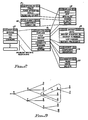
- the fundamental architecture of the illustrative diagnostic expert system is symbolized in the block diagram of FIG. 1.
- the component knowledge base 1, kernel knowledge base 2, predictive knowledge base 3 and recovery knowledge base 4 are the four components which contain the domain knowledge that is required to perform each of the major system functions.
- the component knowledge base 1 and the kernel knowledge base 2 are implemented as directed acyclic graphs (DAGs) while the predictive knowledge base 3 is implemented using rules, and the recovery knowledge base is procedural and relies on the use of script-like structures.
- DAGs directed acyclic graphs
- each knowledge base is maintained as a separate entity, it is possible that the activity that occurs during any given consultation may require the use of knowledge from more than one knowledge base as the activity moves from one major function to another. For example, a user may begin by performing troubleshooting activities and then move into a system recovery phase after a problem has been detected and corrected.
- the kernel inference engine 5 is one of the mechanisms used to apply the appropriate knowledge to a problem situation.
- the knowledge supplied to the kernel inference engine 5 will come from either the kernel knowledge base 2 or the predictive knowledge base 3.
- the inference strategy is goal-directed search that operates by attempting to prove a selected hypothesis.
- the data-directed inference engine 6 is similar to the kernel inference engine 5 except that its inference strategy is forward-directed based on data interpretation. Rather than attempting to prove a selected hypothesis, it undertakes to establish all possible reasonable interpretations of a given set of data.
- the knowledge used by the data-directed inference engine 6 comes from the predictive knowledge base 3.
- the explanation facility 7 describes the system's reasoning process to the user.
- the user interface 8 is generally interactive and menu-driven; it provides information to the user, receives responses from the user and allows the user to "back up” the process when required.
- the overall supervisor 9 provides overall coordinating for the system. It decides which knowledge base(s) and engine(s) should be used for any given situation and coordinates the flow of information to and from the explanation facility 7 and the user interface 8.
- the communications software component 10 allows a remote user to access the system through an appropriate terminal and communications system.
- the corrective procedures module 11 is a general collection of the detailed procedures that are required to recover from specified problems. The information contained in this module is used to repair faults rather than to recover from fault-induced media or file problems.
- the knowledge update facility 12 assists in the process of revising the knowledge bases. It provides a powerful editing and analysis capability which permits an expert to update the knowledge base without the help of a knowledge engineer.
- the expert system illustrated in FIG. 1 performs several diagnostic functions. In keeping with other hardware diagnostic expert systems employed in the information processing industry, it assists maintenance personnel in three general areas: predictive maintenance, media and file recovery and troubleshooting. In each of these areas, there are a limited number of experts who, through study and experience, have developed extensive knowledge regarding the particular piece of equipment with which the expert system is to be associated in its diagnostic function. A significant part of this specialized knowledge is captured, articulated and stored in a usable form in the illustrative expert system; however, the subject invention is particularly employed in the troubleshooting facility of which it is a very powerful tool.
- the troubleshooting facility of the exemplary expert system has been invoked by the user and that the user interfaces with the menu set graphically illustrated in FIG. 2.
- the user will usually be interfacing with the main troubleshooting menu 15 which offers the following choices: OPTIONS which brings up the secondary option menu 16 which will be discussed below; YES which means that the user is reasonably sure that the answer to a question posed by the expert system is "yes”; NO which means that the user is reasonably sure that the answer to a question posed by the expert system is "no"; UNKNOWN which indicates that the user is unable to answer the question posed by the expert system; and PROBLEM SPECIFIC RESPONSES which allow the user to provide information that is unique to the problem that is being analyzed; for example, "flickering" is a possible response to the question: "Is the LED lit?"
- the secondary options menu 16 with its selections appears at the user interface for the choice of the user. These selections include: EXPLAIN which calls the explain submenu 17 by the use of which an explanation of what the system is doing and why it is doing it may be obtained; HELP which provides the user with assistance in gathering information that has been requested by the system; BACKUP which calls the backup submenu 18 by the use of which the user may return to a previous question and begin processing from that point; ASSERT which calls the assert submenu 19 by the use of which a user may initiate processing by asserting unrequested information in order to allow mixed-initiative interaction which consequently permits the user to start processing in "mid-stream” rather than following the system-prescribed sequence of questions; COMMENTS which calls the comments submenu 20 by the use of which the user may read, write or delete any desired freeform comments such as suggestions, criticisms and additional diagnostic information; SUSPEND which allows the user to suspend a consultation in a
- the explain submenu 17 includes SPECIALIST and CLARIFY choices which respectively call a specialist submenu 21 and a clarify submenu 22.
- the facilities accessible through the specialist submenu 21 provide more in-depth use of the system than is ordinarily available, and are intended for use only by users who understand the systems goal-stack and chronological backtracing strategy. These facilities include: TRACE which provides a listing of the trace of activity that has occurred during the current consultation; FIXES ATTEMPTED provides a listing of the repair actions that have been attempted during the current consultation; GOALS provides a listing of all the goals on the goal stack and symptoms on the symptom list; and REJECTED CAUSES provides a list of those potential causes that have been investigated and rejected.
- the clarify submenu 22 provides a more detailed description of the COMPONENT names or CONDITION s (states) that are used in the consultation questions. This facility is provided to help overcome any difficulty that might arise from the lack of a common vocabulary.
- the fault resolution kernel employed in the exemplary system is based on the concept of abductive reasoning. Unlike deduction (where given the rule A -> B, B is deduced by observing A) it is (perhaps dangerously) concluded that A is true by observing B. Thus, unlike deduction, abduction is a form of plausible inference and is not sound in that it is quite possible to draw invalid conclusions based on abduction. (As an example, while it is likely that an armed person running from a bank is a bank robber, it is certainly not an absolute fact.) Given A-> B, upon observing B, it can be hypothesized that A is true as a way of explaining the situation that has been observed. Tied into this concept is the notion of causality: A is believed to be true because it is known that A causes B. This concept is applied operationally by using an approach that is analogous to the scientific method.
- FIG. 3 shows a simple associative network composed of "cause of” and "is a" relationships for three different faults (spindle problem, loss of air pressure, electrical power failure) that can cause a "2/10" console error message (a user visible effect).
- a characteristic of most diagnostic domains is the occurrence of "cascading errors" in which the effect of the primary fault is to cause some intermediate problem which in turn causes another intermediate problem until visible symptoms are eventually produced. For example, a "2/10" error message is displayed if there is a problem with the main spindle in the drive unit.
- a spindle problem is the effect of an intermittent loss of spindle speed or the fact that the spindle has stopped turning. The spindle can stop turning for many different reasons including the failure of the spindle drive motor.
- the kernel knowledge base 2 (FIG. 1) is composed of two segments: the classification segment that breaks down general error classes (e.g., "error message”) and the cause-effect segment which is based on the cause-effect analysis described above.
- FIG. 4 shows an example of the classification segment. This portion of the network is used to collect the initial problem symptoms. There is no form of "search” conducted for this part of the graph; the user is simply asked to identify the symptoms using the menus described above.
- FIG. 5 shows a section of the cause-effect graph for a "2/10" error message in exactly the form that it is presented by the kernel knowledge base editor. It is important to remember that the kernel knowledge base is, in general, a graph since any given cause can have many effects and any given effect can have many causes.
- the kernel knowledge base implementation consists of the following components:
- the network is implemented as a class-lattice structure using object-oriented programming. Each node is represented physically as a class in the lattice.
- the "test procedure” is a function that describes the actions to be taken to establish the truth value of the corresponding node. This procedure requests the user to take various actions and enter the results. These actions may include such things as executing tests, contacting the owner of the equipment for information, making observations, etc.
- Each attribute frame includes a number of "slots" that contain information that is either local to the particular frame or inherited from a higher frame. These slots include: A) Name of Creator Expert ; B) Date and Time of Creation ; C) Date and Time of Last Modification ; D) Local State Description - A formal logic representation of the state represented by this node; E) Local State Value - The value for the state represented by this node is established through the execution of test procedures that evaluate the value of the predicates in the formulas contained in the local state description; values can be true, false or not determined; they can also be established by inference from other formulas; the initial inherited default value is not yet determined; Test Impact Factor (TIF) - This is an integer value, with a range of 0 - 10, that describes the potential negative impact of the testing required to establish the truth value of this node; impact, in this sense,can include such things as the time required to run the test, the cost of materials consumed by the test (i.e., replacing parts) or the requirement that the disc system under
- Version control is a classical problem in software engineering and, more particularly, in software systems that address hardware as a target application.
- the functionality of the subject system i.e., the specific tests and repair actions that are recommended, vary depending on the version of the mass storage hardware, the version of the test and diagnostic procedures that are available, and the version of the operating system employed.
- Version control is accomplished by using different instances of cause-effect nodes to represent the knowledge associated with different configurations of hardware, test software and operating system software.
- An example is shown in FIG. 6.
- the class nodes represent the test and repair knowledge that applies to the "base version configuration" (the collection of hardware/T & D/operating system versions that occurs most commonly in the field). Instances of a given node are created whenever the value of any slot in the node depends on the version configuration that is being used at the subject site. Default values for the slots in the instance frame are inherited from the class frame, and exception conditions for the particular version-configuration are stored in the instance.
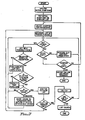
- FIG. 7 A flowchart of the inference activity for the problem resolution kernel is shown in FIG. 7. The process begins with the collection of initial symptoms which can be either error messages or observed problems. The user selects any number of symptoms from these two categories using symptom menus.
- the initial symptoms are then evaluated to select one primary symptom that will be the starting node for the search process.
- This selection process operates by first identifying the most probable cause of all the observed symptoms. This cause is identified as the cause that is a potential source of the greatest number of symptoms.
- the symptom that is selected as the start symptom is any symptom that is an effect of the most probable cause.
- the remaining symptoms are placed on a "symptom list" ordered by their CDFs. Ties that occur anywhere in this process are broken by arbitrary selection.
- the process is based on the systematic selection and test of possible causes for a given effect. Once the cause of a given effect is identified, the process "moves" to the new cause and is recursively restarted with the newly identified cause being treated as an effect.
- Multiple original symptoms are used in only two ways during the search process: 1) during the selection of the best candidate node for expansion, those nodes that relate to multiple observed symptoms are preferred; and 2) when the search process that emanated from the original primary symptom fails, a new primary symptom is selected from the symptom list (without further user interaction).
- the selection process that is conducted after the primary symptom is identified is based on depth-first search of the cause-effect graph. In the selection of the "best" node to analyze at any given point, those causes that connect to multiple symptoms are preferred. When “multiple-symptom” causes are not present (or to choose between several “multiple-symptom” causes), selection is based on a comparison of decision factors that are generated for each node through the use of heuristic evaluation functions described previously.
- LDFs are used to represent nodes when possible.
- CDFs are used to estimate the desirability of collection nodes, nodes that have no test procedure and nodes that are marked as "unknown” because a previous execution of the test procedure (during the current consultation) produced a result of "unknown”.
- the best candidate cause After the best candidate cause is processed, it is either accepted (in which case the search process moves to the new node and recursively restarts itself) or is rejected (in which case the next candidate cause is investigated. Nodes are accepted based on positive definitive test results or based on an unsupported assumption (e.g., the system may decide that the best move is to "guess" when no test is available or the user answers "unknown” in response to a test query).
- entry is at point "1" at which a list of all daughter nodes for the current node is obtained. If there are no daughter nodes for the current node, the flow moves to point "5", and the "fix" function for the current node is tried. If it is successful, a trace of the nested nodes is printed for documentation, and a determination is made as to whether or not there are any secondary problems. If not, an exit is made. If problems remain, the symptoms are entered, and the flow returns to point "1".
- the closed list is examined, and any daughter nodes appearing in the closed list are eliminated. Similarly, any daughter nodes which don't have all their prerequisites met are eliminated. If there are no daughter nodes remaining, flow is transferred to point "6" in which the node present at the top of the stack is examined to see if it is on the closed list. If it is, the system has failed to identify the cause of the problem, and the flow moves to point "8" to print a message to that effect and exit.
- the node present at the top of the stack is not on the closed list, it becomes the current node, a list of its daughter nodes is obtained, and flow is transferred to point "7" to check this new list of daughter nodes, and those on the closed list and those whose prerequisites have not been met are eliminated as previously described.
- the daughter node with the largest local decision factor (LDF) is selected, and its test function is executed with three responses possible: “yes”, "no” and "unknown”.
- each node is important considerations in the operation of the system when handling processing of "unknown" responses as set forth above.
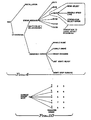
- the calculation process for obtaining each node's CDF is illustrated in FIG. 9.
- the LDFs for each node a function of the certainty and the impact, are assigned as previously described.
- the CDFs for terminal nodes are the same as their LDFs.
- the CDF is the average of the CDFs for all its daughter nodes.
- the CDF is ((6 + 4 + 2)/3) --> 4.
- the CDF calculations proceed from the bottom of the graph to the top. At any given node, the CDF gives the expected value of the graph below it.
- FIG. 10 illustrates a single transition example of a network search.
- the sequence in which the daughter nodes will be visited during the search is: d, b, e, c and a; i.e., according to their respective LDFs..
- node b will be visited in place of node d since node b's LDF is larger than node d's CDF. Node d will be visited again later if necessary.
Landscapes
- Engineering & Computer Science (AREA)
- Theoretical Computer Science (AREA)
- General Engineering & Computer Science (AREA)
- General Physics & Mathematics (AREA)
- Physics & Mathematics (AREA)
- Computational Linguistics (AREA)
- Quality & Reliability (AREA)
- Artificial Intelligence (AREA)
- Computer Hardware Design (AREA)
- Data Mining & Analysis (AREA)
- Evolutionary Computation (AREA)
- Computing Systems (AREA)
- Mathematical Physics (AREA)
- Software Systems (AREA)
- Test And Diagnosis Of Digital Computers (AREA)
- Devices For Executing Special Programs (AREA)
- Information Retrieval, Db Structures And Fs Structures Therefor (AREA)
- Small-Scale Networks (AREA)
Applications Claiming Priority (2)
| Application Number | Priority Date | Filing Date | Title |
|---|---|---|---|
| US07/328,380 US5018075A (en) | 1989-03-24 | 1989-03-24 | Unknown response processing in a diagnostic expert system |
| US328380 | 1989-03-24 |
Publications (3)
| Publication Number | Publication Date |
|---|---|
| EP0397992A2 true EP0397992A2 (de) | 1990-11-22 |
| EP0397992A3 EP0397992A3 (de) | 1992-05-13 |
| EP0397992B1 EP0397992B1 (de) | 1995-11-08 |
Family
ID=23280763
Family Applications (1)
| Application Number | Title | Priority Date | Filing Date |
|---|---|---|---|
| EP90105344A Expired - Lifetime EP0397992B1 (de) | 1989-03-24 | 1990-03-21 | "Unbekannt"-Antwortverarbeitung in einem Expertendiagnosesystem |
Country Status (6)
| Country | Link |
|---|---|
| US (1) | US5018075A (de) |
| EP (1) | EP0397992B1 (de) |
| JP (1) | JPH0769828B2 (de) |
| AU (1) | AU622782B2 (de) |
| CA (1) | CA2012907A1 (de) |
| DE (1) | DE69023389T2 (de) |
Cited By (2)
| Publication number | Priority date | Publication date | Assignee | Title |
|---|---|---|---|---|
| US6151585A (en) * | 1998-04-24 | 2000-11-21 | Microsoft Corporation | Methods and apparatus for determining or inferring influential rumormongers from resource usage data |
| US7739217B2 (en) | 2006-01-24 | 2010-06-15 | Exxonmobil Chemical Patents Inc. | Monitoring polyethylene polymerization system utilizing the method for message suppression in rule based expert system |
Families Citing this family (23)
| Publication number | Priority date | Publication date | Assignee | Title |
|---|---|---|---|---|
| US5488697A (en) * | 1988-01-12 | 1996-01-30 | Honeywell Inc. | Problem state monitoring system |
| JPH03164832A (ja) * | 1989-11-22 | 1991-07-16 | Toshiba Corp | フレーム構造を有する推論システムにおける継承情報の格納方法 |
| EP0458495A3 (en) * | 1990-05-21 | 1993-04-14 | Texas Instruments Incorporated | Apparatus and method for managing versions and configurations of persistent and transient objects |
| US5479560A (en) * | 1992-10-30 | 1995-12-26 | Technology Research Association Of Medical And Welfare Apparatus | Formant detecting device and speech processing apparatus |
| GB2278467B (en) * | 1993-05-20 | 1998-04-01 | Canon Res Ct Europe Ltd | Apparatus and method for data processing and/or for control |
| CA2097232C (en) * | 1993-05-28 | 1999-01-19 | Phillip J. Beaudet | Displaying partial graphs by expanding and collapsing nodes |
| US5712960A (en) * | 1993-07-02 | 1998-01-27 | Cv Soft, S.R.L. | System and methods for intelligent database management using abductive reasoning |
| US5797135A (en) * | 1996-05-01 | 1998-08-18 | Serviceware, Inc. | Software structure for data delivery on multiple engines |
| US5845272A (en) * | 1996-11-29 | 1998-12-01 | General Electric Company | System and method for isolating failures in a locomotive |
| US6018734A (en) * | 1997-09-29 | 2000-01-25 | Triada, Ltd. | Multi-dimensional pattern analysis |
| US6208955B1 (en) * | 1998-06-12 | 2001-03-27 | Rockwell Science Center, Llc | Distributed maintenance system based on causal networks |
| JP3436180B2 (ja) * | 1999-04-15 | 2003-08-11 | 日本電気株式会社 | 事例分類装置、およびプログラム記録媒体 |
| US6494617B1 (en) | 1999-04-30 | 2002-12-17 | General Electric Company | Status detection apparatus and method for fluid-filled electrical equipment |
| US6665866B1 (en) * | 1999-05-28 | 2003-12-16 | Microsoft Corporation | Extensible compiler utilizing a plurality of question handlers |
| US6493869B1 (en) | 1999-05-28 | 2002-12-10 | Microsoft Corporation | Inheriting code in a transformational programming system |
| US6941234B2 (en) * | 2001-10-17 | 2005-09-06 | Midtronics, Inc. | Query based electronic battery tester |
| US20040243532A1 (en) * | 2002-10-03 | 2004-12-02 | Problematics Llc | Method and apparatus/software to assist persons in complex cause-and-effect reasoning |
| US7454391B2 (en) * | 2004-06-22 | 2008-11-18 | Iwint International Holdings Inc. | System for problem statement reformulation |
| US20070078668A1 (en) * | 2005-09-30 | 2007-04-05 | Dimpy Pathria | Authentication ID interview method and apparatus |
| CN102033880A (zh) * | 2009-09-29 | 2011-04-27 | 国际商业机器公司 | 基于结构化数据集合的标注方法和装置 |
| DE102011079034A1 (de) | 2011-07-12 | 2013-01-17 | Siemens Aktiengesellschaft | Ansteuerung eines technischen Systems |
| US20140052647A1 (en) * | 2012-08-17 | 2014-02-20 | Truth Seal Corporation | System and Method for Promoting Truth in Public Discourse |
| US11086708B2 (en) * | 2018-06-04 | 2021-08-10 | International Business Machines Corporation | Automated cognitive multi-component problem management |
Family Cites Families (4)
| Publication number | Priority date | Publication date | Assignee | Title |
|---|---|---|---|---|
| US4967368A (en) * | 1985-08-16 | 1990-10-30 | Wang Laboratories, Inc. | Expert system with knowledge base having term definition hierarchy |
| US4860214A (en) * | 1987-01-22 | 1989-08-22 | Ricoh Company, Ltd. | Inference system |
| US4860213A (en) * | 1987-10-01 | 1989-08-22 | General Electric Company | Reasoning system for reasoning with uncertainty |
| US4912648A (en) * | 1988-03-25 | 1990-03-27 | International Business Machines Corporation | Expert system inference engine |
-
1989
- 1989-03-24 US US07/328,380 patent/US5018075A/en not_active Expired - Lifetime
-
1990
- 1990-03-21 EP EP90105344A patent/EP0397992B1/de not_active Expired - Lifetime
- 1990-03-21 AU AU52132/90A patent/AU622782B2/en not_active Ceased
- 1990-03-21 DE DE69023389T patent/DE69023389T2/de not_active Expired - Fee Related
- 1990-03-23 CA CA002012907A patent/CA2012907A1/en not_active Abandoned
- 1990-03-26 JP JP2076546A patent/JPH0769828B2/ja not_active Expired - Fee Related
Non-Patent Citations (3)
| Title |
|---|
| Autotestcon '87, San Fransisco, USA, Nov 3-5, 1987, P. M. MCCOWN, D. B. LEWY: 'A Diagnostic Expert System using Heuristic and Causal Reasoning', pp371-376 * |
| The 3rd Conference on Artificial Intelligence Applications, Hyatt Orlando, USA, Feb 23-27 1987 D. W. ROLSTON: 'A Multiparadigm Knowledge-Based System for Diagnosis of Large Mainframe Peripherals', pp150-155, * |
| The Int'l Workshop on Artificial Intelligence for Industrial Applications, Hitachi City, JAPAN May 25-27, 1988, G. ARMANO, M. SOLIMANO: 'Empirical and Functional Knowledge in an Expert System for Fault Analysis', pp109-114 * |
Cited By (2)
| Publication number | Priority date | Publication date | Assignee | Title |
|---|---|---|---|---|
| US6151585A (en) * | 1998-04-24 | 2000-11-21 | Microsoft Corporation | Methods and apparatus for determining or inferring influential rumormongers from resource usage data |
| US7739217B2 (en) | 2006-01-24 | 2010-06-15 | Exxonmobil Chemical Patents Inc. | Monitoring polyethylene polymerization system utilizing the method for message suppression in rule based expert system |
Also Published As
| Publication number | Publication date |
|---|---|
| JPH02291022A (ja) | 1990-11-30 |
| US5018075A (en) | 1991-05-21 |
| JPH0769828B2 (ja) | 1995-07-31 |
| CA2012907A1 (en) | 1990-09-24 |
| EP0397992A3 (de) | 1992-05-13 |
| EP0397992B1 (de) | 1995-11-08 |
| AU622782B2 (en) | 1992-04-16 |
| DE69023389D1 (de) | 1995-12-14 |
| AU5213290A (en) | 1990-09-27 |
| DE69023389T2 (de) | 1996-07-11 |
Similar Documents
| Publication | Publication Date | Title |
|---|---|---|
| US5018075A (en) | Unknown response processing in a diagnostic expert system | |
| US4847795A (en) | System for diagnosing defects in electronic assemblies | |
| US4964125A (en) | Method and apparatus for diagnosing faults | |
| KR950012221B1 (ko) | 고장수리 시스템 및 그 수리방법 | |
| US5488697A (en) | Problem state monitoring system | |
| US5193143A (en) | Problem state monitoring | |
| CA2387929C (en) | Method and apparatus for diagnosing difficult to diagnose faults in a complex system | |
| US5629878A (en) | Test planning and execution models for generating non-redundant test modules for testing a computer system | |
| EP0616288A2 (de) | Automatisches Aufrufen von Rechnermitteln ohne Bedienereingriff | |
| US6820072B1 (en) | Validation of probabilistic troubleshooters and diagnostic system | |
| US5307446A (en) | Knowledge acquisition system | |
| PERKINS et al. | Knowledge base verification | |
| Hofmann et al. | Building expert systems for repair domains | |
| Delic et al. | Formalising a software safety case via belief networks | |
| US6662171B1 (en) | Automated diagnostic metric loop | |
| Hale et al. | Towards a model of programmers' cognitive processes in software maintenance: A structural learning theory approach for debugging | |
| von Wangenheim et al. | Goal-oriented and similarity-based retrieval of software engineering experienceware | |
| Frakes et al. | CEST: An expert system function library and workbench for unix® System/C language | |
| EP0733966B1 (de) | Verfahren und Anlage zur Ereignisüberwachung und Korrekturaktionsimplementierung in einem Rechnersystem | |
| Rymon et al. | Towards goal-directed diagnosis (preliminary report) | |
| Rodi et al. | Putting the expert in charge: Graphical knowledge acquisition for fault diagnosis and repair | |
| Sierra et al. | An intelligent maintenance system for earth-based failure analysis and self-repairing of microsatellites | |
| Kalagnanam et al. | Learning to diagnose by doing | |
| Kalmus et al. | BUILDING A PROTOTYPE EXPERT-SYSTEMS | |
| Cheng et al. | Expert's Toolkit: An Expert System Shell For Building Diagnostic Systems |
Legal Events
| Date | Code | Title | Description |
|---|---|---|---|
| PUAI | Public reference made under article 153(3) epc to a published international application that has entered the european phase |
Free format text: ORIGINAL CODE: 0009012 |
|
| AK | Designated contracting states |
Kind code of ref document: A2 Designated state(s): BE CH DE FR GB IT LI |
|
| PUAL | Search report despatched |
Free format text: ORIGINAL CODE: 0009013 |
|
| AK | Designated contracting states |
Kind code of ref document: A3 Designated state(s): BE CH DE FR GB IT LI |
|
| 17P | Request for examination filed |
Effective date: 19921027 |
|
| 17Q | First examination report despatched |
Effective date: 19940330 |
|
| RAP1 | Party data changed (applicant data changed or rights of an application transferred) |
Owner name: BULL HN INFORMATION SYSTEMS INC. |
|
| RBV | Designated contracting states (corrected) |
Designated state(s): DE FR GB IT |
|
| RAP1 | Party data changed (applicant data changed or rights of an application transferred) |
Owner name: BULL HN INFORMATION SYSTEMS INC. |
|
| GRAA | (expected) grant |
Free format text: ORIGINAL CODE: 0009210 |
|
| AK | Designated contracting states |
Kind code of ref document: B1 Designated state(s): DE FR GB IT |
|
| REF | Corresponds to: |
Ref document number: 69023389 Country of ref document: DE Date of ref document: 19951214 |
|
| ITF | It: translation for a ep patent filed | ||
| ET | Fr: translation filed | ||
| PLBE | No opposition filed within time limit |
Free format text: ORIGINAL CODE: 0009261 |
|
| STAA | Information on the status of an ep patent application or granted ep patent |
Free format text: STATUS: NO OPPOSITION FILED WITHIN TIME LIMIT |
|
| 26N | No opposition filed | ||
| REG | Reference to a national code |
Ref country code: GB Ref legal event code: IF02 |
|
| PGFP | Annual fee paid to national office [announced via postgrant information from national office to epo] |
Ref country code: GB Payment date: 20050225 Year of fee payment: 16 Ref country code: DE Payment date: 20050225 Year of fee payment: 16 |
|
| PG25 | Lapsed in a contracting state [announced via postgrant information from national office to epo] |
Ref country code: IT Free format text: LAPSE BECAUSE OF NON-PAYMENT OF DUE FEES Effective date: 20050321 |
|
| PG25 | Lapsed in a contracting state [announced via postgrant information from national office to epo] |
Ref country code: GB Free format text: LAPSE BECAUSE OF NON-PAYMENT OF DUE FEES Effective date: 20060321 |
|
| PGFP | Annual fee paid to national office [announced via postgrant information from national office to epo] |
Ref country code: FR Payment date: 20060329 Year of fee payment: 17 |
|
| PG25 | Lapsed in a contracting state [announced via postgrant information from national office to epo] |
Ref country code: DE Free format text: LAPSE BECAUSE OF NON-PAYMENT OF DUE FEES Effective date: 20061003 |
|
| GBPC | Gb: european patent ceased through non-payment of renewal fee |
Effective date: 20060321 |
|
| REG | Reference to a national code |
Ref country code: FR Ref legal event code: ST Effective date: 20071130 |
|
| PG25 | Lapsed in a contracting state [announced via postgrant information from national office to epo] |
Ref country code: FR Free format text: LAPSE BECAUSE OF NON-PAYMENT OF DUE FEES Effective date: 20070402 |