EP0397331A2 - Laminated fabric suitable for use in automotive interior applications - Google Patents
Laminated fabric suitable for use in automotive interior applications Download PDFInfo
- Publication number
- EP0397331A2 EP0397331A2 EP90304069A EP90304069A EP0397331A2 EP 0397331 A2 EP0397331 A2 EP 0397331A2 EP 90304069 A EP90304069 A EP 90304069A EP 90304069 A EP90304069 A EP 90304069A EP 0397331 A2 EP0397331 A2 EP 0397331A2
- Authority
- EP
- European Patent Office
- Prior art keywords
- fabric
- polyester
- laminate
- film
- textile
- Prior art date
- Legal status (The legal status is an assumption and is not a legal conclusion. Google has not performed a legal analysis and makes no representation as to the accuracy of the status listed.)
- Withdrawn
Links
Images
Classifications
-
- B—PERFORMING OPERATIONS; TRANSPORTING
- B32—LAYERED PRODUCTS
- B32B—LAYERED PRODUCTS, i.e. PRODUCTS BUILT-UP OF STRATA OF FLAT OR NON-FLAT, e.g. CELLULAR OR HONEYCOMB, FORM
- B32B27/00—Layered products comprising a layer of synthetic resin
- B32B27/12—Layered products comprising a layer of synthetic resin next to a fibrous or filamentary layer
-
- B—PERFORMING OPERATIONS; TRANSPORTING
- B32—LAYERED PRODUCTS
- B32B—LAYERED PRODUCTS, i.e. PRODUCTS BUILT-UP OF STRATA OF FLAT OR NON-FLAT, e.g. CELLULAR OR HONEYCOMB, FORM
- B32B27/00—Layered products comprising a layer of synthetic resin
- B32B27/36—Layered products comprising a layer of synthetic resin comprising polyesters
-
- B—PERFORMING OPERATIONS; TRANSPORTING
- B32—LAYERED PRODUCTS
- B32B—LAYERED PRODUCTS, i.e. PRODUCTS BUILT-UP OF STRATA OF FLAT OR NON-FLAT, e.g. CELLULAR OR HONEYCOMB, FORM
- B32B27/00—Layered products comprising a layer of synthetic resin
- B32B27/40—Layered products comprising a layer of synthetic resin comprising polyurethanes
-
- B—PERFORMING OPERATIONS; TRANSPORTING
- B32—LAYERED PRODUCTS
- B32B—LAYERED PRODUCTS, i.e. PRODUCTS BUILT-UP OF STRATA OF FLAT OR NON-FLAT, e.g. CELLULAR OR HONEYCOMB, FORM
- B32B37/00—Methods or apparatus for laminating, e.g. by curing or by ultrasonic bonding
- B32B37/04—Methods or apparatus for laminating, e.g. by curing or by ultrasonic bonding characterised by the partial melting of at least one layer
-
- B—PERFORMING OPERATIONS; TRANSPORTING
- B32—LAYERED PRODUCTS
- B32B—LAYERED PRODUCTS, i.e. PRODUCTS BUILT-UP OF STRATA OF FLAT OR NON-FLAT, e.g. CELLULAR OR HONEYCOMB, FORM
- B32B37/00—Methods or apparatus for laminating, e.g. by curing or by ultrasonic bonding
- B32B37/06—Methods or apparatus for laminating, e.g. by curing or by ultrasonic bonding characterised by the heating method
-
- B—PERFORMING OPERATIONS; TRANSPORTING
- B32—LAYERED PRODUCTS
- B32B—LAYERED PRODUCTS, i.e. PRODUCTS BUILT-UP OF STRATA OF FLAT OR NON-FLAT, e.g. CELLULAR OR HONEYCOMB, FORM
- B32B5/00—Layered products characterised by the non- homogeneity or physical structure, i.e. comprising a fibrous, filamentary, particulate or foam layer; Layered products characterised by having a layer differing constitutionally or physically in different parts
- B32B5/02—Layered products characterised by the non- homogeneity or physical structure, i.e. comprising a fibrous, filamentary, particulate or foam layer; Layered products characterised by having a layer differing constitutionally or physically in different parts characterised by structural features of a fibrous or filamentary layer
- B32B5/024—Woven fabric
-
- B—PERFORMING OPERATIONS; TRANSPORTING
- B29—WORKING OF PLASTICS; WORKING OF SUBSTANCES IN A PLASTIC STATE IN GENERAL
- B29C—SHAPING OR JOINING OF PLASTICS; SHAPING OF MATERIAL IN A PLASTIC STATE, NOT OTHERWISE PROVIDED FOR; AFTER-TREATMENT OF THE SHAPED PRODUCTS, e.g. REPAIRING
- B29C35/00—Heating, cooling or curing, e.g. crosslinking or vulcanising; Apparatus therefor
- B29C35/02—Heating or curing, e.g. crosslinking or vulcanizing during moulding, e.g. in a mould
- B29C35/12—Dielectric heating
-
- B—PERFORMING OPERATIONS; TRANSPORTING
- B29—WORKING OF PLASTICS; WORKING OF SUBSTANCES IN A PLASTIC STATE IN GENERAL
- B29L—INDEXING SCHEME ASSOCIATED WITH SUBCLASS B29C, RELATING TO PARTICULAR ARTICLES
- B29L2031/00—Other particular articles
- B29L2031/30—Vehicles, e.g. ships or aircraft, or body parts thereof
- B29L2031/3005—Body finishings
-
- B—PERFORMING OPERATIONS; TRANSPORTING
- B32—LAYERED PRODUCTS
- B32B—LAYERED PRODUCTS, i.e. PRODUCTS BUILT-UP OF STRATA OF FLAT OR NON-FLAT, e.g. CELLULAR OR HONEYCOMB, FORM
- B32B2262/00—Composition or structural features of fibres which form a fibrous or filamentary layer or are present as additives
- B32B2262/02—Synthetic macromolecular fibres
- B32B2262/0261—Polyamide fibres
-
- B—PERFORMING OPERATIONS; TRANSPORTING
- B32—LAYERED PRODUCTS
- B32B—LAYERED PRODUCTS, i.e. PRODUCTS BUILT-UP OF STRATA OF FLAT OR NON-FLAT, e.g. CELLULAR OR HONEYCOMB, FORM
- B32B2262/00—Composition or structural features of fibres which form a fibrous or filamentary layer or are present as additives
- B32B2262/02—Synthetic macromolecular fibres
- B32B2262/0276—Polyester fibres
-
- B—PERFORMING OPERATIONS; TRANSPORTING
- B32—LAYERED PRODUCTS
- B32B—LAYERED PRODUCTS, i.e. PRODUCTS BUILT-UP OF STRATA OF FLAT OR NON-FLAT, e.g. CELLULAR OR HONEYCOMB, FORM
- B32B2309/00—Parameters for the laminating or treatment process; Apparatus details
- B32B2309/08—Dimensions, e.g. volume
- B32B2309/10—Dimensions, e.g. volume linear, e.g. length, distance, width
- B32B2309/105—Thickness
-
- B—PERFORMING OPERATIONS; TRANSPORTING
- B32—LAYERED PRODUCTS
- B32B—LAYERED PRODUCTS, i.e. PRODUCTS BUILT-UP OF STRATA OF FLAT OR NON-FLAT, e.g. CELLULAR OR HONEYCOMB, FORM
- B32B2605/00—Vehicles
- B32B2605/003—Interior finishings
-
- B—PERFORMING OPERATIONS; TRANSPORTING
- B60—VEHICLES IN GENERAL
- B60R—VEHICLES, VEHICLE FITTINGS, OR VEHICLE PARTS, NOT OTHERWISE PROVIDED FOR
- B60R13/00—Elements for body-finishing, identifying, or decorating; Arrangements or adaptations for advertising purposes
- B60R13/02—Internal Trim mouldings ; Internal Ledges; Wall liners for passenger compartments; Roof liners
Definitions
- a liminate is provided which is suitable for use in automotive interior applications. More particularly, a laminated fabric is provided which is especially useful for the manufacture of decorative, upholstered panels and seats which may be formed by heat bonding using dielectric bonding techniques.
- a backcoated, woven or knitted fabric is bonded to a nonwoven plumper fabric or wadding and the other surface of the wadding is bonded to a rigid polymer-coated fiberboard or paperboard sidewall door paneling. Both bonding operations are accomplished by means of a rapid, one step dielectric bonding operation.
- the dielectric bonding technique involves the use of a high frequency electromagnetic field to cause rapid and uniform heating of a relatively nonconductive material to bond two or more layers of the material together. If the electromagnetic force applied (measured in volts) is too intense, arcing may occur which will cause the fabric to char, making it unusable. Most manufacturers currently require the composite to withstand the application of at least 3,000 volts without arcing in order to achieve a properly and permanently bonded composite.
- the laminates of the present invention accordingly may exhibit enhanced resistance to the arcing voltages required for dielectric bonding procedures typically employed in the manufacture of decorative, upholstered products for automobiles such as door panels and seats. Furthermore, a laminate is provided which may be formed by dielectric bonding techniques and which resists delamination and which is, accordingly, quite desirable for automotive interior applications.
- the laminates of the present invention satisfy the flammability requirements for interior automotive parts which have been imposed by the United States Department of Transportation as well as other requirements which have been imposed by the automobile manufactures themselves.
- the laminates also exhibit quite desirable aesthetic properties such as hand characteristics and stretchability, the latter of which in particular, assists the molding and forming of interior parts such as seats, door panels, arm rests and other parts.
- the laminates lastly, are relatively non-porous to air, as contrasted to conventionally backcoated fabrics, and, therefore, they may advantageously be processed into automotive parts by means of vacuum forming operations which are commonly employed in the manufacture of automotive interior parts.
- a laminate which is suitable for use in the manufacture of interior automotive parts, which comprises a surface layer of a textile fabric weighing from about 6 ounces per square yard to about 24 ounces per square yard said fabric being comprised of fibers made at least predominately (that is containing at least 80 percent) from a synthetic thermoplastic polymer selected from nylon or polyester; and a layer of polyester-polyurethane film having a thickness of from about 0.5 mil to about 20 mils said film having been heat bonded to said textile fabric.
- the invention relates to a method for dielectric bonding which comprises heat bonding a textile fabric weighing from about 6 to about 24 ounces per square yard to a polyester-polyurethane film having a film thickness of from about .2 mil to about 20 mils to form a laminate; bring said laminate into contact with a plumper fabric which plumper fabric is in turn in contact with a backing board; and thereafter dielectrically bonding said laminate, plumper fabric and backing board together to form an automotive part at a voltage of at least about 3,000 volts for at least about 10 seconds.
- the fabrics of the present invention include a wide variety of fabrics made predominately from nylon fibers or polyester fibers.
- Such fabrics may include wovens such as flat wovens, napped wovens, woven stretch velours, woven stretch fabrics containing some Lycra; knits such as Raschel knits, and napped Raschel knits; double needle bar fabrics; weft insertion fabrics; and double knits.
- non-woven fabrics may be envisioned for use in connection with the present invention, especially fabrics currently employed as automotive interior face fabrics, e.g. non-woven needle punch fabrics, which currently find desirable applications as door panel fabrics and as automotive carpeting.
- the fabrics broadly speaking, may weigh from about 6 to about 24 ounces per square yard, preferably from about 10 to about 20 ounces per square yard.
- the film material employed in connection with the present invention is a polyester-polyurethane film.
- Such films have been found to be particularly desirable because of flammability characteristics imparted to the laminate, general overall toughness of the film, and excellent flex characteristics even in cold weather which is essential for automobile interiors that are frequently subjected to low temperatures.
- the film material employed furthermore, results in laminates having excellent drape and soft hand. All of these characteristics are, of course, desirable in laminates used to make automotive interior parts.
- the laminates of the present invention because of their improved stretch, hand and drape characteristics may be employed to manufacture rather more complex parts for automotive and other applications than have heretofore been available.
- the laminates of the present invention are relatively impervious to air as contrasted to conventionally back-coated fabrics. Therefore, as is the case with door panels where the back of the molded product may be exposed, even indirectly, to the outside environment, airbound dust and other dirt particles are prevented from passing through the laminate to cause soiling of the face fabric.
- polyester-polyurethanes must be used because, for instance, other films which might be otherwise desirable such as polyether-polyurethane and polyethylene do not satisfy the flammability requirements demanded in automotive applications.
- the polyester-polyurethanes may be employed without the necessity of adding flame retardants either to the film or the fabric or both which is not desired from the standpoint of cost, and also because such materials tend to retard adhesion and are frequently undesirable from an environmental standpoint. Additional flame retardants may, of course, be used if desired.
- the laminates of the present invention may conveniently be manufactured by means of a conventional steam rolling and laminating machine which continuously brings a selected fabric 10 into intimate contact with film 20.
- the film is heated in contact with the fabric by means of, for instance, a steam-heated rotating cylinder 30 to a temperature of at least about 250°F, preferably 275°F depending upon the particular film selected.
- the fabric 10 is maintained with slight pressure in contact with film 20 for a predetermined period of time, say from about 5 seconds to about two minutes or even longer as it rotates around a second, larger steam roll 40 heated to from about 275°F to 350°F. Thereupon the fabric is allowed to cool while undisturbed.
- fabric 10 is simply brought into contact with film 20 between oil filled roll 60 heated to from about 350°F to about 400°F and water cooled roll 70.
- the fabric is allowed to cool by contact with ambient atmosphere and is stored on pickup roll 80.
- a suitable textile fabric is brought into intimate contact between a rubber roll and steam can heated to a temperature of from about 225 to 275°F with a polyester-polyurethane film having a film thickness of about 1.5 mils. The film is thus tacked or adhered to the fabric. Then the composite proceeds to a large steam heated cylinder heated to a temperature of from about 275 to 320°F. On the cylinder the composite is provided with sufficient dwell time, from about one to about three minutes, to fully adhere and bond the film to the fabric.
- Another method for better adhesion is to bring a suitable textile fabric into intimate contact with a polyester polyurethane film between a heated hot oil roll to a temperature from about 350 to about 425°F and a cold roll (water) cooled to 5 seconds to 1 minute to sufficiently bond the laminate to prevent the removal of the film during wear and/or during testing. It is also observed that the yarns, tufts, and fibers are adhered to one another to minimize or prevent removal during wear and testing.
- Dielectric bonding or heating is the process by which a high frequency high energy electrical field is used to induce heat in an electrical insulating material.
- the electrical field generates heat directly in the materials and, therefore, does not force external heat into the materials or pass an electrical current through them.
- dielectric heat sealing makes use of the dielectric strength of the material which can be generally defined as its ability to withstand an increase in voltage without arcing.
- Nylon fibers are more polar than polyester or polypropylene fibers and hence heat up more rapidly in a dielectric field with a greater susceptibility to premature arcing.
- nylon has far greater moisture pick-up and retained moisture can lead to rapid heating and early arcing.
- Arcing occurs when a current applied, during dielectric heat sealing, finds a path of lesser resistance than that between the electrodes of a heat sealer. As a consequence, voltage is concentrated near the seal line and particularly the sharp edges of the die. Fabrics, plumper, or backing or all three are burned or discolored.
- a conditioned sample is placed on top of a previously dried backer board (one hour at 85°C) followed by an arc test plate obtained from Fisher Body.
- This sandwich construction is placed in a dielectric press at a die force of 2000 pounds in a total heating cycle of ten seconds.
- Arc resistance is determined by subjecting a conditioned uncoated fabric sample to a particular voltage to just cause arcing. Then backcoated samples or fabric film laminates are subjected to the identical voltage settings. If no arcing occurs, voltage setting are increased until arc failure is obtained. The sample is sealed in a dielectric press and monitored by sizzling sounds, sudden increases or decreases in the press meter at 2900 to 3000 volts, arcing, and burnthrough. Fisher Body specifies that the laminate samples have a pass voltage in the arc resistance test of at least 3000 volts.
- Another test for dielectric sealing determines the bond strength during heating. After conditioning, a composite sandwich, where the laminate of fabric and film is assembled with the upholstered fabric (wear surface side against the die), is layered with the padding, followed by a backing panel which has previously been prepared with a vinyl coating and foam riser pads. This sandwich is dielectrically sealed under voltage conditions to provide between 150 to 163°C (specifically 156°C) for ten seconds heating cycle and an additional hold time of ten seconds at a die force of 2000 pounds.
- the sealed composite is placed in an oven heated to about 85°C for four hours after which lifting of the fabric from the board is checked by observation or peel strength. This strength stimulates the ability of the stressed bond to withstand the heat experienced when the car may be subsequently repainted and for when it has been left in the sun on a hot day for an extended period of time.
- the combination of the arc test and bond test are used to approved materials for dielectric bonding operations typically employed in the automotive industry.
- Example 1 failed at 2700 volts.
- Example 2 also failed at 2700 volts while the same fabric construction laminated to the polyester polyurethane film to form a laminate passed at 3300 volts and did not, in fact, fail until 3500 volts were applied.
- TABLE I Arc Test Fabric Pass Fail Bond Test 1. 75% Polyester 25% Nylon Flatwoven (Unbackcoated) 2600 volts 2700 volts Satisfactory 2.
- Test 302 This is a horizontal test in which a flame such as flame from a bunsen burner is placed in contact with the fabric (face down) for 15 seconds. The fabric is then removed from the flame. Timing begins when the leading flame front from the burning fabric specimen reaches the first scribed line placed 1 1/2 inches from the open end of the fabric specimen. The time that it takes the flame to progress to the second scribed line placed 1 1/2 inches from the clamped end of the fabric specimen is then measured. If the fabric extinguishes itself before reaching the second scribed line, its progress to the point where flaming stops is timed and the distance burned is measured.
- Examples 4-7 summarized below a 100% polyester stretch woven velour fabric is formed into a laminate using the general procedure set forth above and is bonded in Examples 4 and 5 to a polyester polyurethane film (purchased from Deerfield Urethanes, Inc.) having film thicknesses of 2 and 4 mils respectively.
- a polyester polyurethane film purchased from Deerfield Urethanes, Inc.
- polyether-polyurethane films were used (also from Deerfield having film thicknesses of 1.5 and 3 mils respectively).
- Examples 8-11 in Table III below a polyester nylon flatwoven fabric is formed into a laminate using the general procedure set forth above and is bonded in Examples 8 and 9 to a polyester polyurethane film (purchased from Deerfield Urethanes, Inc.) having film thicknesses of 2 and 4 mils respectively.
- a polyester polyurethane film purchased from Deerfield Urethanes, Inc.
- polyether-polyurethane films were used (also from Deerfield) having film thicknesses of 1.5 and 3 mils respectively.
- the laminates also exhibit quite desirable aesthetic properties such as hand characteristics and stretchability, the latter of which in particular, assits the molding and forming of interior parts such as seats, door panels, arm rests and other parts.
- the laminates are relatively non-porous to air as contrasted to conventionally backcoated fabrics and may be processed into automotive parts by means of vacuum forming operations. Also as in the case with door panels the back of the product may be exposed to the outside environment. Dust and other dirt particles are prevented from passing through the laminate to cause soiling of the face fabric.
- Table V the air porosity of the film laminate is measured vs. an unbackcoated fabric.
Landscapes
- Engineering & Computer Science (AREA)
- Textile Engineering (AREA)
- Laminated Bodies (AREA)
- Vehicle Interior And Exterior Ornaments, Soundproofing, And Insulation (AREA)
- Manufacture Of Macromolecular Shaped Articles (AREA)
- Lining Or Joining Of Plastics Or The Like (AREA)
Abstract
Description
- A liminate is provided which is suitable for use in automotive interior applications. More particularly, a laminated fabric is provided which is especially useful for the manufacture of decorative, upholstered panels and seats which may be formed by heat bonding using dielectric bonding techniques.
- In a typical automotive interior construction, such as a door panel, a backcoated, woven or knitted fabric is bonded to a nonwoven plumper fabric or wadding and the other surface of the wadding is bonded to a rigid polymer-coated fiberboard or paperboard sidewall door paneling. Both bonding operations are accomplished by means of a rapid, one step dielectric bonding operation.
- The dielectric bonding technique involves the use of a high frequency electromagnetic field to cause rapid and uniform heating of a relatively nonconductive material to bond two or more layers of the material together. If the electromagnetic force applied (measured in volts) is too intense, arcing may occur which will cause the fabric to char, making it unusable. Most manufacturers currently require the composite to withstand the application of at least 3,000 volts without arcing in order to achieve a properly and permanently bonded composite.
- Unfortunately, certain fabrics, typically those made entirely or predominately from nylon (both spun and filament) tend to become charred by this arcing phenomenon at less than the 3,000 volt level required by manufacturers to produce an acceptable upholstered panel. Nylon fabrics backcoated with conventional backcoating compositions, such as acrylic latex polymers which are widely used on fabrics used for automotive interior trim applications, tend to be even more susceptible to this undesirable arcing phenomenon. The presence of flame retardants in the backcoating, which frequently are required to satisfy United States government-mandated flammability standards, may result in even greater arcing propensity.
- With regard to fabrics made predominantly from polyester fibers, such fabrics are relatively "non-polar" as compared to nylon and are, hence, quite nonconductive. Therefore, they may tend to bond poorly to many substrates resulting in a tendency to delaminate which is unacceptable in automotive and many other applications.
- The laminates of the present invention, accordingly may exhibit enhanced resistance to the arcing voltages required for dielectric bonding procedures typically employed in the manufacture of decorative, upholstered products for automobiles such as door panels and seats. Furthermore, a laminate is provided which may be formed by dielectric bonding techniques and which resists delamination and which is, accordingly, quite desirable for automotive interior applications.
- Furthermore, the laminates of the present invention satisfy the flammability requirements for interior automotive parts which have been imposed by the United States Department of Transportation as well as other requirements which have been imposed by the automobile manufactures themselves.
- The laminates also exhibit quite desirable aesthetic properties such as hand characteristics and stretchability, the latter of which in particular, assists the molding and forming of interior parts such as seats, door panels, arm rests and other parts.
- The laminates, lastly, are relatively non-porous to air, as contrasted to conventionally backcoated fabrics, and, therefore, they may advantageously be processed into automotive parts by means of vacuum forming operations which are commonly employed in the manufacture of automotive interior parts.
- According to the present invention, a laminate is provided which is suitable for use in the manufacture of interior automotive parts, which comprises a surface layer of a textile fabric weighing from about 6 ounces per square yard to about 24 ounces per square yard said fabric being comprised of fibers made at least predominately (that is containing at least 80 percent) from a synthetic thermoplastic polymer selected from nylon or polyester; and a layer of polyester-polyurethane film having a thickness of from about 0.5 mil to about 20 mils said film having been heat bonded to said textile fabric.
- According to another embodiment, the invention relates to a method for dielectric bonding which comprises heat bonding a textile fabric weighing from about 6 to about 24 ounces per square yard to a polyester-polyurethane film having a film thickness of from about .2 mil to about 20 mils to form a laminate; bring said laminate into contact with a plumper fabric which plumper fabric is in turn in contact with a backing board; and thereafter dielectrically bonding said laminate, plumper fabric and backing board together to form an automotive part at a voltage of at least about 3,000 volts for at least about 10 seconds.
- As mentioned above the fabrics of the present invention include a wide variety of fabrics made predominately from nylon fibers or polyester fibers. Such fabrics may include wovens such as flat wovens, napped wovens, woven stretch velours, woven stretch fabrics containing some Lycra; knits such as Raschel knits, and napped Raschel knits; double needle bar fabrics; weft insertion fabrics; and double knits. Even non-woven fabrics may be envisioned for use in connection with the present invention, especially fabrics currently employed as automotive interior face fabrics, e.g. non-woven needle punch fabrics, which currently find desirable applications as door panel fabrics and as automotive carpeting. The fabrics, broadly speaking, may weigh from about 6 to about 24 ounces per square yard, preferably from about 10 to about 20 ounces per square yard.
- While fabrics, typically used to manufacture automotive interior parts generally have desirable stretch characteristics, conventional backcoating compositions tend to severely restrict stretch and make the composite rather stiff or rigid. Such composites are more difficult to conform to a shaped substrate and are generally less aesthetically pleasing. The films employed to manufacture the laminates of the present invention result in products having quite desirable stretch characteristics, e.g., from about 1 percent to about 40 percent depending upon the stretch of the fabric employed, and they are therefore easier to process into a final product and are more aesthetically pleasing than conventionally back-coated laminates.
- The film material employed in connection with the present invention is a polyester-polyurethane film. Such films have been found to be particularly desirable because of flammability characteristics imparted to the laminate, general overall toughness of the film, and excellent flex characteristics even in cold weather which is essential for automobile interiors that are frequently subjected to low temperatures. The film material employed, furthermore, results in laminates having excellent drape and soft hand. All of these characteristics are, of course, desirable in laminates used to make automotive interior parts. Significantly, however, the laminates of the present invention, because of their improved stretch, hand and drape characteristics may be employed to manufacture rather more complex parts for automotive and other applications than have heretofore been available.
- Furthermore, the laminates of the present invention are relatively impervious to air as contrasted to conventionally back-coated fabrics. Therefore, as is the case with door panels where the back of the molded product may be exposed, even indirectly, to the outside environment, airbound dust and other dirt particles are prevented from passing through the laminate to cause soiling of the face fabric.
- With regard to the film, it has been found that polyester-polyurethanes must be used because, for instance, other films which might be otherwise desirable such as polyether-polyurethane and polyethylene do not satisfy the flammability requirements demanded in automotive applications. The polyester-polyurethanes, furthermore, may be employed without the necessity of adding flame retardants either to the film or the fabric or both which is not desired from the standpoint of cost, and also because such materials tend to retard adhesion and are frequently undesirable from an environmental standpoint. Additional flame retardants may, of course, be used if desired.
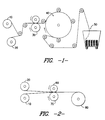
- Referring now to the drawings and in particular to Figure 1, the laminates of the present invention may conveniently be manufactured by means of a conventional steam rolling and laminating machine which continuously brings a selected
fabric 10 into intimate contact withfilm 20. The film is heated in contact with the fabric by means of, for instance, a steam-heated rotatingcylinder 30 to a temperature of at least about 250°F, preferably 275°F depending upon the particular film selected. Thefabric 10 is maintained with slight pressure in contact withfilm 20 for a predetermined period of time, say from about 5 seconds to about two minutes or even longer as it rotates around a second,larger steam roll 40 heated to from about 275°F to 350°F. Thereupon the fabric is allowed to cool while undisturbed. While passive cooling, that is simple exposure to ambient air, may be employed and is in fact preferred, application of positive cooling means such as a cooled roll (not shown) may be used. At this point the laminate may be stored for future use as instorage bin 50 or it may be further processed immediately by, for instance, cutting it into desired shapes for the particular application desired. - Referring now to Figure 2,
fabric 10 is simply brought into contact withfilm 20 between oil filledroll 60 heated to from about 350°F to about 400°F and water cooledroll 70. The fabric is allowed to cool by contact with ambient atmosphere and is stored onpickup roll 80. - The invention may be further understood by reference to the following examples which are not to be construed as limiting the invention as defined in the claims appended hereto.
- A suitable textile fabric is brought into intimate contact between a rubber roll and steam can heated to a temperature of from about 225 to 275°F with a polyester-polyurethane film having a film thickness of about 1.5 mils. The film is thus tacked or adhered to the fabric. Then the composite proceeds to a large steam heated cylinder heated to a temperature of from about 275 to 320°F. On the cylinder the composite is provided with sufficient dwell time, from about one to about three minutes, to fully adhere and bond the film to the fabric.
- Another method for better adhesion is to bring a suitable textile fabric into intimate contact with a polyester polyurethane film between a heated hot oil roll to a temperature from about 350 to about 425°F and a cold roll (water) cooled to 5 seconds to 1 minute to sufficiently bond the laminate to prevent the removal of the film during wear and/or during testing. It is also observed that the yarns, tufts, and fibers are adhered to one another to minimize or prevent removal during wear and testing.
- Dielectric bonding or heating is the process by which a high frequency high energy electrical field is used to induce heat in an electrical insulating material. The electrical field generates heat directly in the materials and, therefore, does not force external heat into the materials or pass an electrical current through them.
- For this dielectric bonding procedure a 14 Megahertz Test Press was employed of the type used for testing the dielectric bonding performance of laminates proposed for use in the automotive industry. This test press was developed by the Fisher Textile lab and is very similar to actual production equipment but is smaller all owing for easier installation and widespread use.
- In general, automotive door panel constructions are made using dielectric heat sealing which makes use of the dielectric strength of the material which can be generally defined as its ability to withstand an increase in voltage without arcing. Nylon fibers are more polar than polyester or polypropylene fibers and hence heat up more rapidly in a dielectric field with a greater susceptibility to premature arcing. Also, nylon has far greater moisture pick-up and retained moisture can lead to rapid heating and early arcing. Arcing occurs when a current applied, during dielectric heat sealing, finds a path of lesser resistance than that between the electrodes of a heat sealer. As a consequence, voltage is concentrated near the seal line and particularly the sharp edges of the die. Fabrics, plumper, or backing or all three are burned or discolored.
- We evaluate arc resistance following a Fisher Body specified procedure, GM9144P.
- A conditioned sample is placed on top of a previously dried backer board (one hour at 85°C) followed by an arc test plate obtained from Fisher Body. This sandwich construction is placed in a dielectric press at a die force of 2000 pounds in a total heating cycle of ten seconds.
- Arc resistance is determined by subjecting a conditioned uncoated fabric sample to a particular voltage to just cause arcing. Then backcoated samples or fabric film laminates are subjected to the identical voltage settings. If no arcing occurs, voltage setting are increased until arc failure is obtained. The sample is sealed in a dielectric press and monitored by sizzling sounds, sudden increases or decreases in the press meter at 2900 to 3000 volts, arcing, and burnthrough. Fisher Body specifies that the laminate samples have a pass voltage in the arc resistance test of at least 3000 volts.
- Another test for dielectric sealing determines the bond strength during heating. After conditioning, a composite sandwich, where the laminate of fabric and film is assembled with the upholstered fabric (wear surface side against the die), is layered with the padding, followed by a backing panel which has previously been prepared with a vinyl coating and foam riser pads. This sandwich is dielectrically sealed under voltage conditions to provide between 150 to 163°C (specifically 156°C) for ten seconds heating cycle and an additional hold time of ten seconds at a die force of 2000 pounds.
- Strength of the bond between the fabric and standard padding is measured using the bond test.
- After the textile laminate has been dielectrically sealed, the sealed composite is placed in an oven heated to about 85°C for four hours after which lifting of the fabric from the board is checked by observation or peel strength. This strength stimulates the ability of the stressed bond to withstand the heat experienced when the car may be subsequently repainted and for when it has been left in the sun on a hot day for an extended period of time.
- The combination of the arc test and bond test are used to approved materials for dielectric bonding operations typically employed in the automotive industry.
- In examples 1-3 summarized in Table I below, a series of fabric constructions were subjected to the dielectric arcing-bonding test. As can be seen by reference to Table I, the unbackcoated constructions, Example 1, failed at 2700 volts. The conventionally backcoated, Example 2, also failed at 2700 volts while the same fabric construction laminated to the polyester polyurethane film to form a laminate passed at 3300 volts and did not, in fact, fail until 3500 volts were applied.
TABLE I Arc Test Fabric Pass Fail Bond Test 1. 75% Polyester 25% Nylon Flatwoven (Unbackcoated) 2600 volts 2700 volts Satisfactory 2. 75% Polyester 25% Nylon Flatwoven (Flame Retardant-Acrylic Backcoating) 2500 volts 2700 volts Satisfactory 3. 75% Polyester 25% Nylon Flatwoven (Polyester Polyurethane Film) 3300 volts 3500 volts Satisfactory - Fabrics that are used for the interior of automobiles in the United States including door panel fabrics, headliners and upholstery fabrics must all pass the Federal Motor Vehicle Safety Standard Test 302 (hereinafter Test 302). This is a horizontal test in which a flame such as flame from a bunsen burner is placed in contact with the fabric (face down) for 15 seconds. The fabric is then removed from the flame. Timing begins when the leading flame front from the burning fabric specimen reaches the first scribed line placed 1 1/2 inches from the open end of the fabric specimen. The time that it takes the flame to progress to the second scribed line placed 1 1/2 inches from the clamped end of the fabric specimen is then measured. If the fabric extinguishes itself before reaching the second scribed line, its progress to the point where flaming stops is timed and the distance burned is measured.
- The following definitions are used to report the flammability results summarized in Table II:
- A. Does not ignite (D.N.I.) - The material does not support combustion following the 15 second ignition (no calculation required).
- B. Self-extinguishing (S.E.) - Material ignites on either surface, but the flame extinguishes itself before reaching the first scribed line (no calculation required).
- C. Self-extinguishing/no burn rate (S.E./N.B.R.) - The material stops burning before it has burned for 60 seconds from the start of timing, and has not burned more than 2 inches from the point where timing was started (no calculation required).
- D. Burn Rate (B.R.) - When the leading flame front on either surface progresses beyond the first scribed line, its progress is timed and measured to the furthest point where burning stops or 10 inches from the first scribed line. If the burn distance exceeds 2 inches or the burn time is 60 seconds or greater the result is calculated and reported as summarized below:
B = 60 x
where
B = burn rate time in inches per minute.
D = length the flame travels in inches and
T = time in seconds for the flame to travel D inches - In Examples 4-7 summarized below a 100% polyester stretch woven velour fabric is formed into a laminate using the general procedure set forth above and is bonded in Examples 4 and 5 to a polyester polyurethane film (purchased from Deerfield Urethanes, Inc.) having film thicknesses of 2 and 4 mils respectively. In Examples 6 and 7 polyether-polyurethane films were used (also from Deerfield having film thicknesses of 1.5 and 3 mils respectively). These laminates were then tested pursuant to Federal Motor Vehicle Safety Standard Test 302 and the results for both warp and fill are summarized in Table II. As can be seen from Table II the polyester polyurethanes had no burn rates whereas the polyether-polyurethanes both burned.
TABLE II Federal Motor Vehicle Safety Standard 302 Flammability Results Inches/Minute Fabric Film Film Thickness Warp Fill 4. 100% Polyester Stretch Woven Velour Polyester/Polyurethane 2 mils SE/NBR SE/NBR 5. 100% Polyester Stretch Woven Velour Polyester/Polyurethane 4 mils SE/ NBR SE 6. 100% Polyester Stretch Woven Velour Polyether/Polyurethane 1.5 mils 3.06 1.77 7. 100% Polyester Stretch Woven Velour Polyether/Polyurethane 3 mils 3.11 1.86 - In Examples 8-11 in Table III below a polyester nylon flatwoven fabric is formed into a laminate using the general procedure set forth above and is bonded in Examples 8 and 9 to a polyester polyurethane film (purchased from Deerfield Urethanes, Inc.) having film thicknesses of 2 and 4 mils respectively. In Examples 10 and 11 polyether-polyurethane films were used (also from Deerfield) having film thicknesses of 1.5 and 3 mils respectively. These laminates were then tested pursuant to the Federal Motor Vehicle Safety Standard Test 302 and the results for both warp and fill are summarized in Table III. As can be seen from Table III, the polyester polyurethane had no burn rates whereas the polyether-polyurethanes both burned.
TABLE III Federal Motor Vehicle Safety Standard 302 Flammability Results Inches/Minute Fabric Film Film Thickness Warp Fill 8. 75% Polyester/25% Nylon Flatwoven Polyester/Polyurethane 2 mils SE SE 9. 75% Polyester/25% Nylon Flatwoven Polyester/Polyurethane 4 mils SE SE/ NBR 10. 75% Polyester/25% Nylon Flatwoven Polyether/Polyurethane 1.5 mils 2.99 4.36 11. 75% Polyester/25% Nylon Flatwoven Polyether/Polyurethane 3 mils 1.57 4.65 - The laminates also exhibit quite desirable aesthetic properties such as hand characteristics and stretchability, the latter of which in particular, assits the molding and forming of interior parts such as seats, door panels, arm rests and other parts.
- Using the general procedure for textile laminates set forth above a series of three laminates were prepared using a polyester polyurethane film. Since the film has an elongation of over 300 percent, the fabric is totally unrestricted whereas fabric coated with an acrylic backcoating with flame retardant is totally restricted.
TABLE IV Fabric Stretch Fabric Fiber Content Polyester Polyurethanes Laminate Flame Retardant Backcoating Compound 12. Flatwoven 75% Polyester 25% Nylon 3 0 13. Flatwoven 100 % Polyester 20 2 14. Stretch Velour 100 % Polyester 10 0 - The laminates are relatively non-porous to air as contrasted to conventionally backcoated fabrics and may be processed into automotive parts by means of vacuum forming operations. Also as in the case with door panels the back of the product may be exposed to the outside environment. Dust and other dirt particles are prevented from passing through the laminate to cause soiling of the face fabric. In Table V the air porosity of the film laminate is measured vs. an unbackcoated fabric.
TABLE V Air Permeability Fabric Fiber Content Film Laminate (Cubic feed/minute/square foot) Unbackcoated Fabric 15. Flatwoven 75% Polyester 25% Nylon 13.07 129.0 16. Flatwoven 100% Polyester 0.10 50.9
Claims (3)
Applications Claiming Priority (2)
| Application Number | Priority Date | Filing Date | Title |
|---|---|---|---|
| US34937289A | 1989-05-08 | 1989-05-08 | |
| US349372 | 1989-05-08 |
Publications (2)
| Publication Number | Publication Date |
|---|---|
| EP0397331A2 true EP0397331A2 (en) | 1990-11-14 |
| EP0397331A3 EP0397331A3 (en) | 1991-05-02 |
Family
ID=23372125
Family Applications (1)
| Application Number | Title | Priority Date | Filing Date |
|---|---|---|---|
| EP19900304069 Withdrawn EP0397331A3 (en) | 1989-05-08 | 1990-04-17 | Laminated fabric suitable for use in automotive interior applications |
Country Status (5)
| Country | Link |
|---|---|
| EP (1) | EP0397331A3 (en) |
| JP (1) | JPH0363132A (en) |
| AU (1) | AU632804B2 (en) |
| CA (1) | CA2015017A1 (en) |
| NZ (1) | NZ233583A (en) |
Cited By (4)
| Publication number | Priority date | Publication date | Assignee | Title |
|---|---|---|---|---|
| US5902753A (en) * | 1997-06-11 | 1999-05-11 | Milliken & Company | Barrier fabric composite and its method of preparation |
| ES2197753A1 (en) * | 2000-05-19 | 2004-01-01 | Thamert Orthopadische Hilfsmit | Soft elastic cushion |
| EP1693502A1 (en) * | 2005-02-19 | 2006-08-23 | Strähle & Hess GmbH & Co. KG | Structural element laminated with a textile |
| CN120886534A (en) * | 2025-09-30 | 2025-11-04 | 河北铁科翼辰新材科技有限公司 | A high cold-resistant waterproof membrane for tunnels and its preparation method |
Families Citing this family (2)
| Publication number | Priority date | Publication date | Assignee | Title |
|---|---|---|---|---|
| US6833335B2 (en) * | 2002-11-27 | 2004-12-21 | Milliken & Company | Barrier fabric |
| JP2017094814A (en) * | 2015-11-20 | 2017-06-01 | 住江織物株式会社 | Vehicle interior skin material |
Family Cites Families (4)
| Publication number | Priority date | Publication date | Assignee | Title |
|---|---|---|---|---|
| US3244571A (en) * | 1963-05-02 | 1966-04-05 | Weisman Morey | Process for dielectrically embossing polyurethane foam assemblies |
| GB1101549A (en) * | 1965-08-26 | 1968-01-31 | Du Pont | Fabric laminate |
| DE2928941A1 (en) * | 1979-07-18 | 1981-02-05 | Walter Dr Koecher | COMPOSITE, METHOD FOR THE PRODUCTION THEREOF AND DEVICE FOR IMPLEMENTING THE METHOD |
| US4305988A (en) * | 1979-03-29 | 1981-12-15 | Koecher Walter | Composite material comprising ultrasonically welded seams which combine strands, method for its manufacture, and apparatus for the carrying out of the method |
-
1990
- 1990-04-17 EP EP19900304069 patent/EP0397331A3/en not_active Withdrawn
- 1990-04-20 CA CA002015017A patent/CA2015017A1/en not_active Abandoned
- 1990-04-27 JP JP2110710A patent/JPH0363132A/en active Pending
- 1990-04-27 AU AU54527/90A patent/AU632804B2/en not_active Ceased
- 1990-05-07 NZ NZ233583A patent/NZ233583A/en unknown
Cited By (4)
| Publication number | Priority date | Publication date | Assignee | Title |
|---|---|---|---|---|
| US5902753A (en) * | 1997-06-11 | 1999-05-11 | Milliken & Company | Barrier fabric composite and its method of preparation |
| ES2197753A1 (en) * | 2000-05-19 | 2004-01-01 | Thamert Orthopadische Hilfsmit | Soft elastic cushion |
| EP1693502A1 (en) * | 2005-02-19 | 2006-08-23 | Strähle & Hess GmbH & Co. KG | Structural element laminated with a textile |
| CN120886534A (en) * | 2025-09-30 | 2025-11-04 | 河北铁科翼辰新材科技有限公司 | A high cold-resistant waterproof membrane for tunnels and its preparation method |
Also Published As
| Publication number | Publication date |
|---|---|
| NZ233583A (en) | 1993-01-27 |
| CA2015017A1 (en) | 1990-11-08 |
| AU5452790A (en) | 1990-11-08 |
| JPH0363132A (en) | 1991-03-19 |
| EP0397331A3 (en) | 1991-05-02 |
| AU632804B2 (en) | 1993-01-14 |
Similar Documents
| Publication | Publication Date | Title |
|---|---|---|
| US10906275B2 (en) | Wood sheet and method for manufacturing the same | |
| CA1052680A (en) | Process for the production of a multi-layer sheet structure or shaped element | |
| US6793747B2 (en) | Method and apparatus for fabricating chopped fiberglass laminate for automotive headliners | |
| US5514458A (en) | Large-size panel of thermoplastic synthetic resin for automotive vehicle interior, and process for the production thereof | |
| US6695939B1 (en) | Method of producing interior trim material | |
| CA2366113C (en) | Method for manufacturing a sound insulating structure and the structure produced thereby | |
| US5902753A (en) | Barrier fabric composite and its method of preparation | |
| EP0397331A2 (en) | Laminated fabric suitable for use in automotive interior applications | |
| US11732122B2 (en) | Modified polyvinyl butyral material, and preparation and applications thereof | |
| US6436854B1 (en) | Chopped fiberglass laminate for automotive headliners and method of fabrication | |
| US3814658A (en) | Composite laminate | |
| KR101836369B1 (en) | Vehicle rear seat back mounting molding non-woven fabric and a method of manufacturing the back | |
| EP1263573B1 (en) | Composite for use in the manufacture of transportation vehicle seating trim | |
| EP0786333B1 (en) | Method for the manufacture of molded articles coated with a microfibrous material | |
| US3514365A (en) | Formable coated sheet materials | |
| US20030141005A1 (en) | Vehicle headliner including a polyurethane substrate and multi-layered laminate, and method of making the same | |
| EP0488038A2 (en) | Composite film structures and articles made therefrom | |
| US20240286397A1 (en) | Method for producing sound insulation | |
| CA2265701A1 (en) | Method of fabricating a cushion assembly | |
| JPS63162236A (en) | Laminate sheet for thermoforming and manufacture thereof | |
| US3759776A (en) | Process of forming upholstery | |
| US20210154970A1 (en) | Discontinuous thermoformable composite products | |
| KR101919351B1 (en) | Fabric for automobile interior materials containing cork | |
| US20230031664A1 (en) | Automotive crash pad and manufacturing method thereof | |
| KR100658397B1 (en) | Method for manufacturing reinforcing layer of base material for automobile interior and reinforcing layer for base material for automobile interior manufactured by this method |
Legal Events
| Date | Code | Title | Description |
|---|---|---|---|
| PUAI | Public reference made under article 153(3) epc to a published international application that has entered the european phase |
Free format text: ORIGINAL CODE: 0009012 |
|
| AK | Designated contracting states |
Kind code of ref document: A2 Designated state(s): AT BE CH DE DK ES FR GB GR IT LI LU NL SE |
|
| PUAL | Search report despatched |
Free format text: ORIGINAL CODE: 0009013 |
|
| AK | Designated contracting states |
Kind code of ref document: A3 Designated state(s): AT BE CH DE DK ES FR GB GR IT LI LU NL SE |
|
| 17P | Request for examination filed |
Effective date: 19910528 |
|
| STAA | Information on the status of an ep patent application or granted ep patent |
Free format text: STATUS: THE APPLICATION IS DEEMED TO BE WITHDRAWN |
|
| 18D | Application deemed to be withdrawn |
Effective date: 19931103 |