EP0393604B1 - 6,11-Dihydro-5H-pyrido(2,3-b)(1,5,)benzodiazepin-5-ones and thiones and their use in the prevention or treatment of AIDS - Google Patents
6,11-Dihydro-5H-pyrido(2,3-b)(1,5,)benzodiazepin-5-ones and thiones and their use in the prevention or treatment of AIDS Download PDFInfo
- Publication number
- EP0393604B1 EP0393604B1 EP90107293A EP90107293A EP0393604B1 EP 0393604 B1 EP0393604 B1 EP 0393604B1 EP 90107293 A EP90107293 A EP 90107293A EP 90107293 A EP90107293 A EP 90107293A EP 0393604 B1 EP0393604 B1 EP 0393604B1
- Authority
- EP
- European Patent Office
- Prior art keywords
- carbon atoms
- dihydro
- pyrido
- benzodiazepin
- methyl
- Prior art date
- Legal status (The legal status is an assumption and is not a legal conclusion. Google has not performed a legal analysis and makes no representation as to the accuracy of the status listed.)
- Expired - Lifetime
Links
- 238000011282 treatment Methods 0.000 title claims abstract description 9
- 230000002265 prevention Effects 0.000 title claims description 6
- 208000030507 AIDS Diseases 0.000 title abstract description 6
- 241001061127 Thione Species 0.000 title 1
- 150000001875 compounds Chemical class 0.000 claims abstract description 108
- 239000001257 hydrogen Substances 0.000 claims abstract description 61
- 229910052739 hydrogen Inorganic materials 0.000 claims abstract description 61
- 125000000217 alkyl group Chemical group 0.000 claims abstract description 46
- -1 2-halo-propen-1-yl Chemical group 0.000 claims abstract description 37
- 125000001589 carboacyl group Chemical group 0.000 claims abstract description 22
- QVGXLLKOCUKJST-UHFFFAOYSA-N atomic oxygen Chemical compound [O] QVGXLLKOCUKJST-UHFFFAOYSA-N 0.000 claims abstract description 21
- 125000004435 hydrogen atom Chemical class [H]* 0.000 claims abstract description 21
- 229910052760 oxygen Inorganic materials 0.000 claims abstract description 21
- 239000001301 oxygen Substances 0.000 claims abstract description 21
- SFRAVXBSPHJEBZ-UHFFFAOYSA-N 6,11-dihydropyrido[3,2-c][1,5]benzodiazepin-5-one Chemical class O=C1NC2=CC=CC=C2NC2=NC=CC=C12 SFRAVXBSPHJEBZ-UHFFFAOYSA-N 0.000 claims abstract description 15
- 125000002768 hydroxyalkyl group Chemical group 0.000 claims abstract description 15
- 125000001997 phenyl group Chemical group [H]C1=C([H])C([H])=C(*)C([H])=C1[H] 0.000 claims abstract description 15
- 125000004183 alkoxy alkyl group Chemical group 0.000 claims abstract description 14
- 125000006350 alkyl thio alkyl group Chemical group 0.000 claims abstract description 14
- 125000003342 alkenyl group Chemical group 0.000 claims abstract description 12
- 125000000304 alkynyl group Chemical group 0.000 claims abstract description 12
- 125000003118 aryl group Chemical group 0.000 claims abstract description 12
- 208000031886 HIV Infections Diseases 0.000 claims abstract description 11
- 125000001544 thienyl group Chemical group 0.000 claims abstract description 11
- NINIDFKCEFEMDL-UHFFFAOYSA-N Sulfur Chemical compound [S] NINIDFKCEFEMDL-UHFFFAOYSA-N 0.000 claims abstract description 10
- 125000005002 aryl methyl group Chemical group 0.000 claims abstract description 10
- 229910052717 sulfur Inorganic materials 0.000 claims abstract description 10
- 239000011593 sulfur Substances 0.000 claims abstract description 10
- 125000005079 alkoxycarbonylmethyl group Chemical group 0.000 claims abstract description 7
- 125000000753 cycloalkyl group Chemical group 0.000 claims abstract description 7
- 125000003709 fluoroalkyl group Chemical group 0.000 claims abstract description 6
- 125000002541 furyl group Chemical group 0.000 claims abstract description 6
- 125000001559 cyclopropyl group Chemical group [H]C1([H])C([H])([H])C1([H])* 0.000 claims abstract description 5
- 125000004432 carbon atom Chemical group C* 0.000 claims description 152
- 125000002496 methyl group Chemical group [H]C([H])([H])* 0.000 claims description 60
- 238000000034 method Methods 0.000 claims description 52
- 125000003545 alkoxy group Chemical group 0.000 claims description 26
- 229910052736 halogen Chemical group 0.000 claims description 26
- 150000002367 halogens Chemical group 0.000 claims description 26
- 150000002431 hydrogen Chemical group 0.000 claims description 22
- UFHFLCQGNIYNRP-UHFFFAOYSA-N Hydrogen Chemical compound [H][H] UFHFLCQGNIYNRP-UHFFFAOYSA-N 0.000 claims description 19
- 125000001424 substituent group Chemical group 0.000 claims description 19
- 150000003839 salts Chemical class 0.000 claims description 13
- ONUDKSCEPDVUPP-UHFFFAOYSA-N 6-methyl-11h-pyrido[3,2-c][1,5]benzodiazepin-5-one Chemical compound O=C1N(C)C2=CC=CC=C2NC2=NC=CC=C21 ONUDKSCEPDVUPP-UHFFFAOYSA-N 0.000 claims description 12
- 239000002253 acid Substances 0.000 claims description 12
- 125000002887 hydroxy group Chemical group [H]O* 0.000 claims description 12
- 125000005236 alkanoylamino group Chemical group 0.000 claims description 11
- 125000004453 alkoxycarbonyl group Chemical group 0.000 claims description 10
- 150000001339 alkali metal compounds Chemical class 0.000 claims description 8
- 125000004103 aminoalkyl group Chemical group 0.000 claims description 8
- 125000005078 alkoxycarbonylalkyl group Chemical group 0.000 claims description 7
- 125000001495 ethyl group Chemical group [H]C([H])([H])C([H])([H])* 0.000 claims description 7
- QIBWCUCLHZVYNL-UHFFFAOYSA-N 11-ethyl-6-methylpyrido[3,2-c][1,5]benzodiazepin-5-one Chemical compound CN1C(=O)C2=CC=CN=C2N(CC)C2=CC=CC=C21 QIBWCUCLHZVYNL-UHFFFAOYSA-N 0.000 claims description 6
- 125000004644 alkyl sulfinyl group Chemical group 0.000 claims description 6
- 125000004390 alkyl sulfonyl group Chemical group 0.000 claims description 6
- 125000004414 alkyl thio group Chemical group 0.000 claims description 6
- 239000000825 pharmaceutical preparation Substances 0.000 claims description 6
- 125000002023 trifluoromethyl group Chemical group FC(F)(F)* 0.000 claims description 6
- HFZKSKRXGCRCKY-UHFFFAOYSA-N 6,8,9-trimethyl-11h-pyrido[3,2-c][1,5]benzodiazepin-5-one Chemical compound O=C1N(C)C2=CC(C)=C(C)C=C2NC2=NC=CC=C21 HFZKSKRXGCRCKY-UHFFFAOYSA-N 0.000 claims description 5
- 125000004423 acyloxy group Chemical group 0.000 claims description 5
- 229910052740 iodine Inorganic materials 0.000 claims description 5
- 125000000956 methoxy group Chemical group [H]C([H])([H])O* 0.000 claims description 5
- 125000002924 primary amino group Chemical group [H]N([H])* 0.000 claims description 5
- SPOQZHUHKOITFT-UHFFFAOYSA-N 11-ethyl-6h-pyrido[3,2-c][1,5]benzodiazepine-5-thione Chemical compound N1C(=S)C2=CC=CN=C2N(CC)C2=CC=CC=C21 SPOQZHUHKOITFT-UHFFFAOYSA-N 0.000 claims description 4
- IXGFGZWPXIITDU-UHFFFAOYSA-N 11-methyl-6-propylpyrido[3,2-c][1,5]benzodiazepin-5-one Chemical compound O=C1N(CCC)C2=CC=CC=C2N(C)C2=NC=CC=C21 IXGFGZWPXIITDU-UHFFFAOYSA-N 0.000 claims description 4
- 125000003903 2-propenyl group Chemical group [H]C([*])([H])C([H])=C([H])[H] 0.000 claims description 4
- 125000003668 acetyloxy group Chemical group [H]C([H])([H])C(=O)O[*] 0.000 claims description 4
- 125000000852 azido group Chemical group *N=[N+]=[N-] 0.000 claims description 4
- 125000000484 butyl group Chemical group [H]C([*])([H])C([H])([H])C([H])([H])C([H])([H])[H] 0.000 claims description 4
- 125000003917 carbamoyl group Chemical group [H]N([H])C(*)=O 0.000 claims description 4
- 125000004181 carboxyalkyl group Chemical group 0.000 claims description 4
- 239000003795 chemical substances by application Substances 0.000 claims description 4
- 125000004093 cyano group Chemical group *C#N 0.000 claims description 4
- WAYZVDZHFWJQLW-UHFFFAOYSA-N methyl 11-ethyl-6-methyl-5-oxopyrido[3,2-c][1,5]benzodiazepine-8-carboxylate Chemical compound CN1C(=O)C2=CC=CN=C2N(CC)C2=CC=C(C(=O)OC)C=C21 WAYZVDZHFWJQLW-UHFFFAOYSA-N 0.000 claims description 4
- 239000008194 pharmaceutical composition Substances 0.000 claims description 4
- 238000002360 preparation method Methods 0.000 claims description 4
- 125000004953 trihalomethyl group Chemical group 0.000 claims description 4
- QVBCGVSBAZFFCX-UHFFFAOYSA-N 11-ethyl-6,8,9-trimethylpyrido[3,2-c][1,5]benzodiazepin-5-one Chemical compound CN1C(=O)C2=CC=CN=C2N(CC)C2=CC(C)=C(C)C=C21 QVBCGVSBAZFFCX-UHFFFAOYSA-N 0.000 claims description 3
- CRAIICFGDIPWGD-UHFFFAOYSA-N 11-ethyl-6h-pyrido[3,2-c][1,5]benzodiazepin-5-one Chemical compound N1C(=O)C2=CC=CN=C2N(CC)C2=CC=CC=C21 CRAIICFGDIPWGD-UHFFFAOYSA-N 0.000 claims description 3
- SOAULLVLPRWSST-UHFFFAOYSA-N 2-ethyl-6,11-dimethylpyrido[3,2-c][1,5]benzodiazepin-5-one Chemical compound CN1C2=CC=CC=C2N(C)C(=O)C2=CC=C(CC)N=C21 SOAULLVLPRWSST-UHFFFAOYSA-N 0.000 claims description 3
- JZGLJGTWTZGRIN-UHFFFAOYSA-N 6,8,9,11-tetramethylpyrido[3,2-c][1,5]benzodiazepin-5-one Chemical compound CN1C(=O)C2=CC=CN=C2N(C)C2=CC(C)=C(C)C=C21 JZGLJGTWTZGRIN-UHFFFAOYSA-N 0.000 claims description 3
- ZPTZQHRWXFSZOJ-UHFFFAOYSA-N 6-ethyl-11-methylpyrido[3,2-c][1,5]benzodiazepin-5-one Chemical compound O=C1N(CC)C2=CC=CC=C2N(C)C2=NC=CC=C21 ZPTZQHRWXFSZOJ-UHFFFAOYSA-N 0.000 claims description 3
- OXERMLHLBWPCON-UHFFFAOYSA-N 6-methyl-11-propylpyrido[3,2-c][1,5]benzodiazepin-5-one Chemical compound CN1C(=O)C2=CC=CN=C2N(CCC)C2=CC=CC=C21 OXERMLHLBWPCON-UHFFFAOYSA-N 0.000 claims description 3
- 239000003937 drug carrier Substances 0.000 claims description 3
- CYQOCCBFPKGCKI-UHFFFAOYSA-N 11-(2-fluoroethyl)-6-methylpyrido[3,2-c][1,5]benzodiazepin-5-one Chemical compound O=C1N(C)C2=CC=CC=C2N(CCF)C2=NC=CC=C21 CYQOCCBFPKGCKI-UHFFFAOYSA-N 0.000 claims description 2
- TUQHQPVULWJHQZ-UHFFFAOYSA-N 6,11-diethylpyrido[3,2-c][1,5]benzodiazepin-5-one Chemical compound CCN1C(=O)C2=CC=CN=C2N(CC)C2=CC=CC=C21 TUQHQPVULWJHQZ-UHFFFAOYSA-N 0.000 claims description 2
- VYLLJAKCYFLTGT-UHFFFAOYSA-N 6-(2-methylpropyl)-11h-pyrido[3,2-c][1,5]benzodiazepin-5-one Chemical compound O=C1N(CC(C)C)C2=CC=CC=C2NC2=NC=CC=C21 VYLLJAKCYFLTGT-UHFFFAOYSA-N 0.000 claims description 2
- NJFAYUFRHYLWIF-UHFFFAOYSA-N 6-ethyl-11h-pyrido[3,2-c][1,5]benzodiazepin-5-one Chemical compound O=C1N(CC)C2=CC=CC=C2NC2=NC=CC=C21 NJFAYUFRHYLWIF-UHFFFAOYSA-N 0.000 claims description 2
- PQZHKFKUVHBMTM-UHFFFAOYSA-N 6-ethyl-8,9-dimethyl-11h-pyrido[3,2-c][1,5]benzodiazepin-5-one Chemical compound O=C1N(CC)C2=CC(C)=C(C)C=C2NC2=NC=CC=C21 PQZHKFKUVHBMTM-UHFFFAOYSA-N 0.000 claims description 2
- HEWXTOJENWMMMO-UHFFFAOYSA-N 6-ethyl-9-methyl-11h-pyrido[3,2-c][1,5]benzodiazepin-5-one Chemical compound O=C1N(CC)C2=CC=C(C)C=C2NC2=NC=CC=C21 HEWXTOJENWMMMO-UHFFFAOYSA-N 0.000 claims description 2
- 125000001309 chloro group Chemical group Cl* 0.000 claims description 2
- 125000000623 heterocyclic group Chemical group 0.000 claims description 2
- 230000003301 hydrolyzing effect Effects 0.000 claims description 2
- 238000002156 mixing Methods 0.000 claims description 2
- 239000000546 pharmaceutical excipient Substances 0.000 claims description 2
- 125000001436 propyl group Chemical group [H]C([*])([H])C([H])([H])C([H])([H])[H] 0.000 claims description 2
- HRMSQZIXPLDFIM-UHFFFAOYSA-N 6,11-dihydropyrido[3,2-c][1,5]benzodiazepine-5-thione Chemical compound S=C1NC2=CC=CC=C2NC2=NC=CC=C12 HRMSQZIXPLDFIM-UHFFFAOYSA-N 0.000 claims 7
- 241000713772 Human immunodeficiency virus 1 Species 0.000 claims 2
- 238000004519 manufacturing process Methods 0.000 claims 2
- 238000011321 prophylaxis Methods 0.000 claims 2
- STMKMKZWVDRNOV-UHFFFAOYSA-N 2,4,6,8-tetramethyl-11h-pyrido[3,2-c][1,5]benzodiazepine-5-thione Chemical compound S=C1N(C)C2=CC(C)=CC=C2NC2=NC(C)=CC(C)=C21 STMKMKZWVDRNOV-UHFFFAOYSA-N 0.000 claims 1
- RKTPIZGRBBOTJO-UHFFFAOYSA-N 6,8,9-trimethyl-11h-pyrido[3,2-c][1,5]benzodiazepine-5-thione Chemical compound S=C1N(C)C2=CC(C)=C(C)C=C2NC2=NC=CC=C21 RKTPIZGRBBOTJO-UHFFFAOYSA-N 0.000 claims 1
- BHGKEFKXTSZYAU-UHFFFAOYSA-N 6-(2-methylpropyl)-11h-pyrido[3,2-c][1,5]benzodiazepine-5-thione Chemical compound S=C1N(CC(C)C)C2=CC=CC=C2NC2=NC=CC=C21 BHGKEFKXTSZYAU-UHFFFAOYSA-N 0.000 claims 1
- MJISFXMTUJWWJI-UHFFFAOYSA-N 6-ethyl-11h-pyrido[3,2-c][1,5]benzodiazepine-5-thione Chemical compound S=C1N(CC)C2=CC=CC=C2NC2=NC=CC=C21 MJISFXMTUJWWJI-UHFFFAOYSA-N 0.000 claims 1
- LYGQARRKPWBBBH-UHFFFAOYSA-N 6-ethyl-8,9-dimethyl-11h-pyrido[3,2-c][1,5]benzodiazepine-5-thione Chemical compound S=C1N(CC)C2=CC(C)=C(C)C=C2NC2=NC=CC=C21 LYGQARRKPWBBBH-UHFFFAOYSA-N 0.000 claims 1
- IJUPYUUJWQZQGF-UHFFFAOYSA-N 6-ethyl-9-methyl-11h-pyrido[3,2-c][1,5]benzodiazepine-5-thione Chemical compound S=C1N(CC)C2=CC=C(C)C=C2NC2=NC=CC=C21 IJUPYUUJWQZQGF-UHFFFAOYSA-N 0.000 claims 1
- OBSLCUOFEMPFIA-UHFFFAOYSA-N 6-methyl-11h-pyrido[3,2-c][1,5]benzodiazepine-5-thione Chemical compound S=C1N(C)C2=CC=CC=C2NC2=NC=CC=C21 OBSLCUOFEMPFIA-UHFFFAOYSA-N 0.000 claims 1
- OKTJSMMVPCPJKN-UHFFFAOYSA-N Carbon Chemical compound [C] OKTJSMMVPCPJKN-UHFFFAOYSA-N 0.000 claims 1
- 229910052799 carbon Inorganic materials 0.000 claims 1
- 208000037265 diseases, disorders, signs and symptoms Diseases 0.000 abstract description 3
- 208000037357 HIV infectious disease Diseases 0.000 abstract description 2
- 208000033519 human immunodeficiency virus infectious disease Diseases 0.000 abstract description 2
- LFQSCWFLJHTTHZ-UHFFFAOYSA-N Ethanol Chemical compound CCO LFQSCWFLJHTTHZ-UHFFFAOYSA-N 0.000 description 61
- 239000000203 mixture Substances 0.000 description 41
- ZMXDDKWLCZADIW-UHFFFAOYSA-N N,N-Dimethylformamide Chemical compound CN(C)C=O ZMXDDKWLCZADIW-UHFFFAOYSA-N 0.000 description 38
- YMWUJEATGCHHMB-UHFFFAOYSA-N Dichloromethane Chemical compound ClCCl YMWUJEATGCHHMB-UHFFFAOYSA-N 0.000 description 36
- 108010092799 RNA-directed DNA polymerase Proteins 0.000 description 30
- 241000725303 Human immunodeficiency virus Species 0.000 description 28
- XEKOWRVHYACXOJ-UHFFFAOYSA-N Ethyl acetate Chemical compound CCOC(C)=O XEKOWRVHYACXOJ-UHFFFAOYSA-N 0.000 description 27
- 102100034343 Integrase Human genes 0.000 description 27
- 239000000243 solution Substances 0.000 description 27
- RTZKZFJDLAIYFH-UHFFFAOYSA-N Diethyl ether Chemical compound CCOCC RTZKZFJDLAIYFH-UHFFFAOYSA-N 0.000 description 25
- XLYOFNOQVPJJNP-UHFFFAOYSA-N water Substances O XLYOFNOQVPJJNP-UHFFFAOYSA-N 0.000 description 25
- 239000011541 reaction mixture Substances 0.000 description 24
- OKKJLVBELUTLKV-UHFFFAOYSA-N Methanol Chemical compound OC OKKJLVBELUTLKV-UHFFFAOYSA-N 0.000 description 21
- IAZDPXIOMUYVGZ-UHFFFAOYSA-N Dimethylsulphoxide Chemical compound CS(C)=O IAZDPXIOMUYVGZ-UHFFFAOYSA-N 0.000 description 19
- 238000003556 assay Methods 0.000 description 19
- 210000004027 cell Anatomy 0.000 description 18
- INQOMBQAUSQDDS-UHFFFAOYSA-N iodomethane Chemical compound IC INQOMBQAUSQDDS-UHFFFAOYSA-N 0.000 description 17
- 229910000104 sodium hydride Inorganic materials 0.000 description 17
- 108020004414 DNA Proteins 0.000 description 15
- KEAYESYHFKHZAL-UHFFFAOYSA-N Sodium Chemical compound [Na] KEAYESYHFKHZAL-UHFFFAOYSA-N 0.000 description 15
- 239000012312 sodium hydride Substances 0.000 description 15
- 239000002904 solvent Substances 0.000 description 15
- 239000000047 product Substances 0.000 description 14
- 238000006243 chemical reaction Methods 0.000 description 13
- VYPSYNLAJGMNEJ-UHFFFAOYSA-N Silicium dioxide Chemical compound O=[Si]=O VYPSYNLAJGMNEJ-UHFFFAOYSA-N 0.000 description 12
- YXFVVABEGXRONW-UHFFFAOYSA-N Toluene Chemical compound CC1=CC=CC=C1 YXFVVABEGXRONW-UHFFFAOYSA-N 0.000 description 12
- 239000007787 solid Substances 0.000 description 12
- 239000000725 suspension Substances 0.000 description 12
- 238000012360 testing method Methods 0.000 description 12
- IJGRMHOSHXDMSA-UHFFFAOYSA-N Atomic nitrogen Chemical compound N#N IJGRMHOSHXDMSA-UHFFFAOYSA-N 0.000 description 10
- VEXZGXHMUGYJMC-UHFFFAOYSA-N Hydrochloric acid Chemical compound Cl VEXZGXHMUGYJMC-UHFFFAOYSA-N 0.000 description 10
- WYURNTSHIVDZCO-UHFFFAOYSA-N Tetrahydrofuran Chemical compound C1CCOC1 WYURNTSHIVDZCO-UHFFFAOYSA-N 0.000 description 10
- UHOVQNZJYSORNB-UHFFFAOYSA-N Benzene Chemical compound C1=CC=CC=C1 UHOVQNZJYSORNB-UHFFFAOYSA-N 0.000 description 9
- 229940093499 ethyl acetate Drugs 0.000 description 9
- 235000019439 ethyl acetate Nutrition 0.000 description 9
- VLKZOEOYAKHREP-UHFFFAOYSA-N n-Hexane Chemical compound CCCCCC VLKZOEOYAKHREP-UHFFFAOYSA-N 0.000 description 9
- 239000003921 oil Substances 0.000 description 9
- 235000019198 oils Nutrition 0.000 description 9
- HEMHJVSKTPXQMS-UHFFFAOYSA-M sodium hydroxide Inorganic materials [OH-].[Na+] HEMHJVSKTPXQMS-UHFFFAOYSA-M 0.000 description 9
- HEDRZPFGACZZDS-UHFFFAOYSA-N Chloroform Chemical compound ClC(Cl)Cl HEDRZPFGACZZDS-UHFFFAOYSA-N 0.000 description 8
- XDTMQSROBMDMFD-UHFFFAOYSA-N Cyclohexane Chemical compound C1CCCCC1 XDTMQSROBMDMFD-UHFFFAOYSA-N 0.000 description 8
- 102000004190 Enzymes Human genes 0.000 description 8
- 108090000790 Enzymes Proteins 0.000 description 8
- CSNNHWWHGAXBCP-UHFFFAOYSA-L Magnesium sulfate Chemical compound [Mg+2].[O-][S+2]([O-])([O-])[O-] CSNNHWWHGAXBCP-UHFFFAOYSA-L 0.000 description 8
- FAPWRFPIFSIZLT-UHFFFAOYSA-M Sodium chloride Chemical compound [Na+].[Cl-] FAPWRFPIFSIZLT-UHFFFAOYSA-M 0.000 description 8
- 238000009835 boiling Methods 0.000 description 8
- 229940088598 enzyme Drugs 0.000 description 8
- 239000000741 silica gel Substances 0.000 description 8
- 229910002027 silica gel Inorganic materials 0.000 description 8
- 238000004440 column chromatography Methods 0.000 description 7
- 239000000706 filtrate Substances 0.000 description 7
- HVTICUPFWKNHNG-UHFFFAOYSA-N iodoethane Chemical compound CCI HVTICUPFWKNHNG-UHFFFAOYSA-N 0.000 description 7
- 239000003208 petroleum Substances 0.000 description 7
- QTBSBXVTEAMEQO-UHFFFAOYSA-N Acetic acid Chemical compound CC(O)=O QTBSBXVTEAMEQO-UHFFFAOYSA-N 0.000 description 6
- KCXVZYZYPLLWCC-UHFFFAOYSA-N EDTA Chemical compound OC(=O)CN(CC(O)=O)CCN(CC(O)=O)CC(O)=O KCXVZYZYPLLWCC-UHFFFAOYSA-N 0.000 description 6
- DNIAPMSPPWPWGF-UHFFFAOYSA-N Propylene glycol Chemical compound CC(O)CO DNIAPMSPPWPWGF-UHFFFAOYSA-N 0.000 description 6
- QAOWNCQODCNURD-UHFFFAOYSA-N Sulfuric acid Chemical compound OS(O)(=O)=O QAOWNCQODCNURD-UHFFFAOYSA-N 0.000 description 6
- 239000013078 crystal Substances 0.000 description 6
- 230000002401 inhibitory effect Effects 0.000 description 6
- 230000005764 inhibitory process Effects 0.000 description 6
- 229910052744 lithium Inorganic materials 0.000 description 6
- 239000002244 precipitate Substances 0.000 description 6
- 238000005987 sulfurization reaction Methods 0.000 description 6
- 102000053602 DNA Human genes 0.000 description 5
- PEDCQBHIVMGVHV-UHFFFAOYSA-N Glycerine Chemical compound OCC(O)CO PEDCQBHIVMGVHV-UHFFFAOYSA-N 0.000 description 5
- WHXSMMKQMYFTQS-UHFFFAOYSA-N Lithium Chemical compound [Li] WHXSMMKQMYFTQS-UHFFFAOYSA-N 0.000 description 5
- 239000007983 Tris buffer Substances 0.000 description 5
- 241000700605 Viruses Species 0.000 description 5
- 229910052783 alkali metal Inorganic materials 0.000 description 5
- 230000015572 biosynthetic process Effects 0.000 description 5
- 239000000872 buffer Substances 0.000 description 5
- 230000000694 effects Effects 0.000 description 5
- 229910052757 nitrogen Inorganic materials 0.000 description 5
- 239000003755 preservative agent Substances 0.000 description 5
- 239000007858 starting material Substances 0.000 description 5
- LENZDBCJOHFCAS-UHFFFAOYSA-N tris Chemical compound OCC(N)(CO)CO LENZDBCJOHFCAS-UHFFFAOYSA-N 0.000 description 5
- RYHBNJHYFVUHQT-UHFFFAOYSA-N 1,4-Dioxane Chemical compound C1COCCO1 RYHBNJHYFVUHQT-UHFFFAOYSA-N 0.000 description 4
- IBRSSZOHCGUTHI-UHFFFAOYSA-N 2-chloropyridine-3-carboxylic acid Chemical compound OC(=O)C1=CC=CN=C1Cl IBRSSZOHCGUTHI-UHFFFAOYSA-N 0.000 description 4
- 0 Cc1c(N)nc2Nc3c(*)c(*)c(*=C)c(*)c3N(*)C3OC3c2c1* Chemical compound Cc1c(N)nc2Nc3c(*)c(*)c(*=C)c(*)c3N(*)C3OC3c2c1* 0.000 description 4
- DGAQECJNVWCQMB-PUAWFVPOSA-M Ilexoside XXIX Chemical compound C[C@@H]1CC[C@@]2(CC[C@@]3(C(=CC[C@H]4[C@]3(CC[C@@H]5[C@@]4(CC[C@@H](C5(C)C)OS(=O)(=O)[O-])C)C)[C@@H]2[C@]1(C)O)C)C(=O)O[C@H]6[C@@H]([C@H]([C@@H]([C@H](O6)CO)O)O)O.[Na+] DGAQECJNVWCQMB-PUAWFVPOSA-M 0.000 description 4
- PMZURENOXWZQFD-UHFFFAOYSA-L Sodium Sulfate Chemical compound [Na+].[Na+].[O-]S([O-])(=O)=O PMZURENOXWZQFD-UHFFFAOYSA-L 0.000 description 4
- 210000001744 T-lymphocyte Anatomy 0.000 description 4
- 230000010933 acylation Effects 0.000 description 4
- 238000005917 acylation reaction Methods 0.000 description 4
- 239000012876 carrier material Substances 0.000 description 4
- 239000000460 chlorine Substances 0.000 description 4
- 239000012043 crude product Substances 0.000 description 4
- 239000006185 dispersion Substances 0.000 description 4
- 239000003480 eluent Substances 0.000 description 4
- 239000004615 ingredient Substances 0.000 description 4
- CFHGBZLNZZVTAY-UHFFFAOYSA-N lawesson's reagent Chemical compound C1=CC(OC)=CC=C1P1(=S)SP(=S)(C=2C=CC(OC)=CC=2)S1 CFHGBZLNZZVTAY-UHFFFAOYSA-N 0.000 description 4
- HQKMJHAJHXVSDF-UHFFFAOYSA-L magnesium stearate Chemical compound [Mg+2].CCCCCCCCCCCCCCCCCC([O-])=O.CCCCCCCCCCCCCCCCCC([O-])=O HQKMJHAJHXVSDF-UHFFFAOYSA-L 0.000 description 4
- 229910052943 magnesium sulfate Inorganic materials 0.000 description 4
- 239000000463 material Substances 0.000 description 4
- 239000002480 mineral oil Substances 0.000 description 4
- 235000010446 mineral oil Nutrition 0.000 description 4
- 125000000449 nitro group Chemical group [O-][N+](*)=O 0.000 description 4
- 108090000623 proteins and genes Proteins 0.000 description 4
- 102000004169 proteins and genes Human genes 0.000 description 4
- 239000011780 sodium chloride Substances 0.000 description 4
- JAZJMDYVHIJMJH-UHFFFAOYSA-N 11-methyl-6h-pyrido[3,2-c][1,5]benzodiazepin-5-one Chemical compound N1C(=O)C2=CC=CN=C2N(C)C2=CC=CC=C21 JAZJMDYVHIJMJH-UHFFFAOYSA-N 0.000 description 3
- IOOBORPWTJVVCP-UHFFFAOYSA-N 6,11-dimethyl-9-(trifluoromethyl)pyrido[3,2-c][1,5]benzodiazepin-5-one Chemical compound CN1C(=O)C2=CC=CN=C2N(C)C2=CC(C(F)(F)F)=CC=C21 IOOBORPWTJVVCP-UHFFFAOYSA-N 0.000 description 3
- ZCJZTIZJQMWURO-UHFFFAOYSA-N 6-(fluoromethyl)-11h-pyrido[3,2-c][1,5]benzodiazepin-5-one Chemical compound O=C1N(CF)C2=CC=CC=C2NC2=NC=CC=C21 ZCJZTIZJQMWURO-UHFFFAOYSA-N 0.000 description 3
- GXHCCZBZTJWGDT-UHFFFAOYSA-N 7-methyl-6,11-dihydropyrido[3,2-c][1,5]benzodiazepin-5-one Chemical compound N1C2=NC=CC=C2C(=O)NC2=C1C=CC=C2C GXHCCZBZTJWGDT-UHFFFAOYSA-N 0.000 description 3
- CSCPPACGZOOCGX-UHFFFAOYSA-N Acetone Chemical compound CC(C)=O CSCPPACGZOOCGX-UHFFFAOYSA-N 0.000 description 3
- WEVYAHXRMPXWCK-UHFFFAOYSA-N Acetonitrile Chemical compound CC#N WEVYAHXRMPXWCK-UHFFFAOYSA-N 0.000 description 3
- 108010014303 DNA-directed DNA polymerase Proteins 0.000 description 3
- 102000016928 DNA-directed DNA polymerase Human genes 0.000 description 3
- 101900297506 Human immunodeficiency virus type 1 group M subtype B Reverse transcriptase/ribonuclease H Proteins 0.000 description 3
- KFZMGEQAYNKOFK-UHFFFAOYSA-N Isopropanol Chemical compound CC(C)O KFZMGEQAYNKOFK-UHFFFAOYSA-N 0.000 description 3
- AFVFQIVMOAPDHO-UHFFFAOYSA-N Methanesulfonic acid Chemical compound CS(O)(=O)=O AFVFQIVMOAPDHO-UHFFFAOYSA-N 0.000 description 3
- IMNFDUFMRHMDMM-UHFFFAOYSA-N N-Heptane Chemical compound CCCCCCC IMNFDUFMRHMDMM-UHFFFAOYSA-N 0.000 description 3
- KWYUFKZDYYNOTN-UHFFFAOYSA-M Potassium hydroxide Chemical compound [OH-].[K+] KWYUFKZDYYNOTN-UHFFFAOYSA-M 0.000 description 3
- 239000012980 RPMI-1640 medium Substances 0.000 description 3
- 229920002472 Starch Polymers 0.000 description 3
- ZMANZCXQSJIPKH-UHFFFAOYSA-N Triethylamine Chemical compound CCN(CC)CC ZMANZCXQSJIPKH-UHFFFAOYSA-N 0.000 description 3
- 108020000999 Viral RNA Proteins 0.000 description 3
- 229910000102 alkali metal hydride Inorganic materials 0.000 description 3
- 150000008046 alkali metal hydrides Chemical class 0.000 description 3
- 150000008044 alkali metal hydroxides Chemical class 0.000 description 3
- 239000003963 antioxidant agent Substances 0.000 description 3
- 235000006708 antioxidants Nutrition 0.000 description 3
- 238000004113 cell culture Methods 0.000 description 3
- 239000001913 cellulose Substances 0.000 description 3
- 235000010980 cellulose Nutrition 0.000 description 3
- 229920002678 cellulose Polymers 0.000 description 3
- 239000003610 charcoal Substances 0.000 description 3
- KRKNYBCHXYNGOX-UHFFFAOYSA-N citric acid Chemical compound OC(=O)CC(O)(C(O)=O)CC(O)=O KRKNYBCHXYNGOX-UHFFFAOYSA-N 0.000 description 3
- 239000007788 liquid Substances 0.000 description 3
- WMFOQBRAJBCJND-UHFFFAOYSA-M lithium hydroxide Inorganic materials [Li+].[OH-] WMFOQBRAJBCJND-UHFFFAOYSA-M 0.000 description 3
- 239000002609 medium Substances 0.000 description 3
- 230000008018 melting Effects 0.000 description 3
- 238000002844 melting Methods 0.000 description 3
- 238000006263 metalation reaction Methods 0.000 description 3
- PTDSQXZRRKMKBD-UHFFFAOYSA-N methyl 6-methyl-5-oxo-11h-pyrido[3,2-c][1,5]benzodiazepine-8-carboxylate Chemical compound O=C1N(C)C2=CC(C(=O)OC)=CC=C2NC2=NC=CC=C21 PTDSQXZRRKMKBD-UHFFFAOYSA-N 0.000 description 3
- 239000012074 organic phase Substances 0.000 description 3
- 239000003960 organic solvent Substances 0.000 description 3
- NLKNQRATVPKPDG-UHFFFAOYSA-M potassium iodide Chemical compound [K+].[I-] NLKNQRATVPKPDG-UHFFFAOYSA-M 0.000 description 3
- 238000001953 recrystallisation Methods 0.000 description 3
- 230000010076 replication Effects 0.000 description 3
- 239000011734 sodium Substances 0.000 description 3
- 239000011343 solid material Substances 0.000 description 3
- 239000008107 starch Substances 0.000 description 3
- 229940032147 starch Drugs 0.000 description 3
- 235000019698 starch Nutrition 0.000 description 3
- 238000003756 stirring Methods 0.000 description 3
- LMBFAGIMSUYTBN-MPZNNTNKSA-N teixobactin Chemical compound C([C@H](C(=O)N[C@@H]([C@@H](C)CC)C(=O)N[C@@H](CO)C(=O)N[C@H](CCC(N)=O)C(=O)N[C@H]([C@@H](C)CC)C(=O)N[C@@H]([C@@H](C)CC)C(=O)N[C@@H](CO)C(=O)N[C@H]1C(N[C@@H](C)C(=O)N[C@@H](C[C@@H]2NC(=N)NC2)C(=O)N[C@H](C(=O)O[C@H]1C)[C@@H](C)CC)=O)NC)C1=CC=CC=C1 LMBFAGIMSUYTBN-MPZNNTNKSA-N 0.000 description 3
- YLQBMQCUIZJEEH-UHFFFAOYSA-N tetrahydrofuran Natural products C=1C=COC=1 YLQBMQCUIZJEEH-UHFFFAOYSA-N 0.000 description 3
- YNJBWRMUSHSURL-UHFFFAOYSA-N trichloroacetic acid Chemical compound OC(=O)C(Cl)(Cl)Cl YNJBWRMUSHSURL-UHFFFAOYSA-N 0.000 description 3
- 229960004319 trichloroacetic acid Drugs 0.000 description 3
- JHECFKBIUJRHFY-UHFFFAOYSA-N 11-acetyl-6,8,9-trimethylpyrido[3,2-c][1,5]benzodiazepin-5-one Chemical compound O=C1N(C)C2=CC(C)=C(C)C=C2N(C(C)=O)C2=NC=CC=C21 JHECFKBIUJRHFY-UHFFFAOYSA-N 0.000 description 2
- UHNISJATCMSSOQ-UHFFFAOYSA-N 11-acetyl-6-methylpyrido[3,2-c][1,5]benzodiazepin-5-one Chemical compound O=C1N(C)C2=CC=CC=C2N(C(C)=O)C2=NC=CC=C21 UHNISJATCMSSOQ-UHFFFAOYSA-N 0.000 description 2
- PGMDQXYPQSTTCJ-UHFFFAOYSA-N 11-benzyl-6-methylpyrido[3,2-c][1,5]benzodiazepin-5-one Chemical compound C12=NC=CC=C2C(=O)N(C)C2=CC=CC=C2N1CC1=CC=CC=C1 PGMDQXYPQSTTCJ-UHFFFAOYSA-N 0.000 description 2
- AVXBKVJHVBCJBB-UHFFFAOYSA-N 11-butyl-6-methylpyrido[3,2-c][1,5]benzodiazepin-5-one Chemical compound CN1C(=O)C2=CC=CN=C2N(CCCC)C2=CC=CC=C21 AVXBKVJHVBCJBB-UHFFFAOYSA-N 0.000 description 2
- VROVGMGODBOTLK-UHFFFAOYSA-N 11-ethyl-6-(fluoromethyl)pyrido[3,2-c][1,5]benzodiazepin-5-one Chemical compound FCN1C(=O)C2=CC=CN=C2N(CC)C2=CC=CC=C21 VROVGMGODBOTLK-UHFFFAOYSA-N 0.000 description 2
- MDAJCDQWLUTSBT-UHFFFAOYSA-N 2,4,6,8,9,11-hexamethylpyrido[3,2-c][1,5]benzodiazepin-5-one Chemical compound CN1C(=O)C2=C(C)C=C(C)N=C2N(C)C2=CC(C)=C(C)C=C21 MDAJCDQWLUTSBT-UHFFFAOYSA-N 0.000 description 2
- USJLIOULUMRQML-UHFFFAOYSA-N 2,4,6,9,11-pentamethylpyrido[3,2-c][1,5]benzodiazepin-5-one Chemical compound CN1C(=O)C2=C(C)C=C(C)N=C2N(C)C2=CC(C)=CC=C21 USJLIOULUMRQML-UHFFFAOYSA-N 0.000 description 2
- MBCCTJUHHJOTJD-UHFFFAOYSA-N 2,6,8,9,11-pentamethylpyrido[3,2-c][1,5]benzodiazepin-5-one Chemical compound CN1C(=O)C2=CC=C(C)N=C2N(C)C2=CC(C)=C(C)C=C21 MBCCTJUHHJOTJD-UHFFFAOYSA-N 0.000 description 2
- WRMNZCZEMHIOCP-UHFFFAOYSA-N 2-phenylethanol Chemical compound OCCC1=CC=CC=C1 WRMNZCZEMHIOCP-UHFFFAOYSA-N 0.000 description 2
- BMYNFMYTOJXKLE-UHFFFAOYSA-N 3-azaniumyl-2-hydroxypropanoate Chemical compound NCC(O)C(O)=O BMYNFMYTOJXKLE-UHFFFAOYSA-N 0.000 description 2
- YCFJZPGDTZVVSM-UHFFFAOYSA-N 6,11-dihydro-11-ethyl-6-methyl-9-nitro-5h-pyrido[2,3-b][1,5]benzodiazepin-5-one Chemical compound CN1C(=O)C2=CC=CN=C2N(CC)C2=CC([N+]([O-])=O)=CC=C21 YCFJZPGDTZVVSM-UHFFFAOYSA-N 0.000 description 2
- DCVSTZXAGIGNMQ-UHFFFAOYSA-N 6,11-dimethylpyrido[3,2-c][1,5]benzodiazepin-5-one Chemical compound CN1C(=O)C2=CC=CN=C2N(C)C2=CC=CC=C21 DCVSTZXAGIGNMQ-UHFFFAOYSA-N 0.000 description 2
- GXRHFOMKBPETNB-UHFFFAOYSA-N 6-benzoyl-11-methylpyrido[3,2-c][1,5]benzodiazepin-5-one Chemical compound O=C1C2=CC=CN=C2N(C)C2=CC=CC=C2N1C(=O)C1=CC=CC=C1 GXRHFOMKBPETNB-UHFFFAOYSA-N 0.000 description 2
- WYCKMEFZTLTYEZ-UHFFFAOYSA-N 6-benzoyl-11h-pyrido[3,2-c][1,5]benzodiazepin-5-one Chemical compound C12=CC=CC=C2NC2=NC=CC=C2C(=O)N1C(=O)C1=CC=CC=C1 WYCKMEFZTLTYEZ-UHFFFAOYSA-N 0.000 description 2
- URTPIAOYMBFZKH-UHFFFAOYSA-N 6-butyl-11-methylpyrido[3,2-c][1,5]benzodiazepin-5-one Chemical compound O=C1N(CCCC)C2=CC=CC=C2N(C)C2=NC=CC=C21 URTPIAOYMBFZKH-UHFFFAOYSA-N 0.000 description 2
- WQRNHQZYPBSMEA-UHFFFAOYSA-N 6-ethyl-7-methyl-11h-pyrido[3,2-c][1,5]benzodiazepin-5-one Chemical compound O=C1N(CC)C2=C(C)C=CC=C2NC2=NC=CC=C21 WQRNHQZYPBSMEA-UHFFFAOYSA-N 0.000 description 2
- ZJQIIGWZFIGXGH-UHFFFAOYSA-N 8-chloro-6,11-dimethylpyrido[3,2-c][1,5]benzodiazepin-5-one Chemical compound CN1C(=O)C2=CC=CN=C2N(C)C2=CC=C(Cl)C=C21 ZJQIIGWZFIGXGH-UHFFFAOYSA-N 0.000 description 2
- ZUKYCLFDJPLTJI-UHFFFAOYSA-N 9-amino-11-ethyl-6-methylpyrido[3,2-c][1,5]benzodiazepin-5-one Chemical compound CN1C(=O)C2=CC=CN=C2N(CC)C2=CC(N)=CC=C21 ZUKYCLFDJPLTJI-UHFFFAOYSA-N 0.000 description 2
- OQAWBEQUZWZSTP-UHFFFAOYSA-N 9-chloro-6,11-bis(methylsulfanylmethyl)pyrido[3,2-c][1,5]benzodiazepin-5-one Chemical compound CSCN1C(=O)C2=CC=CN=C2N(CSC)C2=CC(Cl)=CC=C21 OQAWBEQUZWZSTP-UHFFFAOYSA-N 0.000 description 2
- 108091003079 Bovine Serum Albumin Proteins 0.000 description 2
- WKBOTKDWSSQWDR-UHFFFAOYSA-N Bromine atom Chemical compound [Br] WKBOTKDWSSQWDR-UHFFFAOYSA-N 0.000 description 2
- ZAMOUSCENKQFHK-UHFFFAOYSA-N Chlorine atom Chemical compound [Cl] ZAMOUSCENKQFHK-UHFFFAOYSA-N 0.000 description 2
- FEWJPZIEWOKRBE-JCYAYHJZSA-N Dextrotartaric acid Chemical compound OC(=O)[C@H](O)[C@@H](O)C(O)=O FEWJPZIEWOKRBE-JCYAYHJZSA-N 0.000 description 2
- 206010025323 Lymphomas Diseases 0.000 description 2
- MZRVEZGGRBJDDB-UHFFFAOYSA-N N-Butyllithium Chemical compound [Li]CCCC MZRVEZGGRBJDDB-UHFFFAOYSA-N 0.000 description 2
- CTQNGGLPUBDAKN-UHFFFAOYSA-N O-Xylene Chemical compound CC1=CC=CC=C1C CTQNGGLPUBDAKN-UHFFFAOYSA-N 0.000 description 2
- NBIIXXVUZAFLBC-UHFFFAOYSA-N Phosphoric acid Chemical compound OP(O)(O)=O NBIIXXVUZAFLBC-UHFFFAOYSA-N 0.000 description 2
- 239000002202 Polyethylene glycol Substances 0.000 description 2
- 108010083644 Ribonucleases Proteins 0.000 description 2
- 102000006382 Ribonucleases Human genes 0.000 description 2
- CDBYLPFSWZWCQE-UHFFFAOYSA-L Sodium Carbonate Chemical compound [Na+].[Na+].[O-]C([O-])=O CDBYLPFSWZWCQE-UHFFFAOYSA-L 0.000 description 2
- WETWJCDKMRHUPV-UHFFFAOYSA-N acetyl chloride Chemical compound CC(Cl)=O WETWJCDKMRHUPV-UHFFFAOYSA-N 0.000 description 2
- 239000012346 acetyl chloride Substances 0.000 description 2
- 239000003377 acid catalyst Substances 0.000 description 2
- 150000007513 acids Chemical class 0.000 description 2
- 239000000654 additive Substances 0.000 description 2
- 150000001298 alcohols Chemical class 0.000 description 2
- 150000001340 alkali metals Chemical group 0.000 description 2
- 230000002152 alkylating effect Effects 0.000 description 2
- 150000001412 amines Chemical group 0.000 description 2
- AVKUERGKIZMTKX-NJBDSQKTSA-N ampicillin Chemical compound C1([C@@H](N)C(=O)N[C@H]2[C@H]3SC([C@@H](N3C2=O)C(O)=O)(C)C)=CC=CC=C1 AVKUERGKIZMTKX-NJBDSQKTSA-N 0.000 description 2
- 229960000723 ampicillin Drugs 0.000 description 2
- 229960000686 benzalkonium chloride Drugs 0.000 description 2
- WPYMKLBDIGXBTP-UHFFFAOYSA-N benzoic acid Chemical compound OC(=O)C1=CC=CC=C1 WPYMKLBDIGXBTP-UHFFFAOYSA-N 0.000 description 2
- CADWTSSKOVRVJC-UHFFFAOYSA-N benzyl(dimethyl)azanium;chloride Chemical compound [Cl-].C[NH+](C)CC1=CC=CC=C1 CADWTSSKOVRVJC-UHFFFAOYSA-N 0.000 description 2
- GDTBXPJZTBHREO-UHFFFAOYSA-N bromine Substances BrBr GDTBXPJZTBHREO-UHFFFAOYSA-N 0.000 description 2
- 229910052794 bromium Inorganic materials 0.000 description 2
- 239000002775 capsule Substances 0.000 description 2
- 230000005889 cellular cytotoxicity Effects 0.000 description 2
- 229910052801 chlorine Inorganic materials 0.000 description 2
- OSASVXMJTNOKOY-UHFFFAOYSA-N chlorobutanol Chemical compound CC(C)(O)C(Cl)(Cl)Cl OSASVXMJTNOKOY-UHFFFAOYSA-N 0.000 description 2
- 239000008119 colloidal silica Substances 0.000 description 2
- 238000002784 cytotoxicity assay Methods 0.000 description 2
- 231100000263 cytotoxicity test Toxicity 0.000 description 2
- 230000001419 dependent effect Effects 0.000 description 2
- 238000010790 dilution Methods 0.000 description 2
- 239000012895 dilution Substances 0.000 description 2
- 238000004821 distillation Methods 0.000 description 2
- 239000002552 dosage form Substances 0.000 description 2
- 239000003814 drug Substances 0.000 description 2
- 239000000839 emulsion Substances 0.000 description 2
- 230000009088 enzymatic function Effects 0.000 description 2
- 238000001952 enzyme assay Methods 0.000 description 2
- NLFBCYMMUAKCPC-KQQUZDAGSA-N ethyl (e)-3-[3-amino-2-cyano-1-[(e)-3-ethoxy-3-oxoprop-1-enyl]sulfanyl-3-oxoprop-1-enyl]sulfanylprop-2-enoate Chemical compound CCOC(=O)\C=C\SC(=C(C#N)C(N)=O)S\C=C\C(=O)OCC NLFBCYMMUAKCPC-KQQUZDAGSA-N 0.000 description 2
- AASJIDSEQRFGHQ-UHFFFAOYSA-N ethyl 2-(6-methyl-5-oxopyrido[3,2-c][1,5]benzodiazepin-11-yl)acetate Chemical compound CN1C(=O)C2=CC=CN=C2N(CC(=O)OCC)C2=CC=CC=C21 AASJIDSEQRFGHQ-UHFFFAOYSA-N 0.000 description 2
- 238000001704 evaporation Methods 0.000 description 2
- 230000008020 evaporation Effects 0.000 description 2
- 239000012091 fetal bovine serum Substances 0.000 description 2
- 238000009472 formulation Methods 0.000 description 2
- 235000011187 glycerol Nutrition 0.000 description 2
- 150000004795 grignard reagents Chemical class 0.000 description 2
- 229920006158 high molecular weight polymer Polymers 0.000 description 2
- 230000007062 hydrolysis Effects 0.000 description 2
- 238000006460 hydrolysis reaction Methods 0.000 description 2
- 238000011534 incubation Methods 0.000 description 2
- 239000003112 inhibitor Substances 0.000 description 2
- 238000002955 isolation Methods 0.000 description 2
- ZCSHNCUQKCANBX-UHFFFAOYSA-N lithium diisopropylamide Chemical compound [Li+].CC(C)[N-]C(C)C ZCSHNCUQKCANBX-UHFFFAOYSA-N 0.000 description 2
- 235000019359 magnesium stearate Nutrition 0.000 description 2
- VNWKTOKETHGBQD-UHFFFAOYSA-N methane Natural products C VNWKTOKETHGBQD-UHFFFAOYSA-N 0.000 description 2
- CHARQHUOSBOGPB-UHFFFAOYSA-N methyl 5-oxo-6,11-dihydropyrido[3,2-c][1,5]benzodiazepine-8-carboxylate Chemical compound O=C1NC2=CC(C(=O)OC)=CC=C2NC2=NC=CC=C21 CHARQHUOSBOGPB-UHFFFAOYSA-N 0.000 description 2
- 230000000813 microbial effect Effects 0.000 description 2
- 150000002828 nitro derivatives Chemical class 0.000 description 2
- 231100000252 nontoxic Toxicity 0.000 description 2
- 230000003000 nontoxic effect Effects 0.000 description 2
- 230000000269 nucleophilic effect Effects 0.000 description 2
- 229920001223 polyethylene glycol Polymers 0.000 description 2
- NTTOTNSKUYCDAV-UHFFFAOYSA-N potassium hydride Chemical compound [KH] NTTOTNSKUYCDAV-UHFFFAOYSA-N 0.000 description 2
- 229910000105 potassium hydride Inorganic materials 0.000 description 2
- BDERNNFJNOPAEC-UHFFFAOYSA-N propan-1-ol Chemical compound CCCO BDERNNFJNOPAEC-UHFFFAOYSA-N 0.000 description 2
- QELSKZZBTMNZEB-UHFFFAOYSA-N propylparaben Chemical compound CCCOC(=O)C1=CC=C(O)C=C1 QELSKZZBTMNZEB-UHFFFAOYSA-N 0.000 description 2
- 230000009467 reduction Effects 0.000 description 2
- FQENQNTWSFEDLI-UHFFFAOYSA-J sodium diphosphate Chemical compound [Na+].[Na+].[Na+].[Na+].[O-]P([O-])(=O)OP([O-])([O-])=O FQENQNTWSFEDLI-UHFFFAOYSA-J 0.000 description 2
- 229940048086 sodium pyrophosphate Drugs 0.000 description 2
- 239000000758 substrate Substances 0.000 description 2
- 239000003826 tablet Substances 0.000 description 2
- 239000000454 talc Substances 0.000 description 2
- 229910052623 talc Inorganic materials 0.000 description 2
- 235000012222 talc Nutrition 0.000 description 2
- NLYXSYJBSDBVBO-UHFFFAOYSA-N tert-butyl 2-(6-methyl-5-oxopyrido[3,2-c][1,5]benzodiazepin-11-yl)acetate Chemical compound O=C1N(C)C2=CC=CC=C2N(CC(=O)OC(C)(C)C)C2=NC=CC=C21 NLYXSYJBSDBVBO-UHFFFAOYSA-N 0.000 description 2
- 235000019818 tetrasodium diphosphate Nutrition 0.000 description 2
- 239000001577 tetrasodium phosphonato phosphate Substances 0.000 description 2
- JOXIMZWYDAKGHI-UHFFFAOYSA-N toluene-4-sulfonic acid Chemical compound CC1=CC=C(S(O)(=O)=O)C=C1 JOXIMZWYDAKGHI-UHFFFAOYSA-N 0.000 description 2
- 239000003981 vehicle Substances 0.000 description 2
- 210000002845 virion Anatomy 0.000 description 2
- 239000008096 xylene Substances 0.000 description 2
- WSLDOOZREJYCGB-UHFFFAOYSA-N 1,2-Dichloroethane Chemical compound ClCCCl WSLDOOZREJYCGB-UHFFFAOYSA-N 0.000 description 1
- GEYOCULIXLDCMW-UHFFFAOYSA-N 1,2-phenylenediamine Chemical compound NC1=CC=CC=C1N GEYOCULIXLDCMW-UHFFFAOYSA-N 0.000 description 1
- CYSGHNMQYZDMIA-UHFFFAOYSA-N 1,3-Dimethyl-2-imidazolidinon Chemical compound CN1CCN(C)C1=O CYSGHNMQYZDMIA-UHFFFAOYSA-N 0.000 description 1
- JTLAIKFGRHDNQM-UHFFFAOYSA-N 1-bromo-2-fluoroethane Chemical compound FCCBr JTLAIKFGRHDNQM-UHFFFAOYSA-N 0.000 description 1
- WMKDCDDFJCFMMJ-UHFFFAOYSA-N 11-(2-hydroxyethyl)-6-methylpyrido[3,2-c][1,5]benzodiazepin-5-one Chemical compound O=C1N(C)C2=CC=CC=C2N(CCO)C2=NC=CC=C21 WMKDCDDFJCFMMJ-UHFFFAOYSA-N 0.000 description 1
- ZSLBEMKAJDJVND-UHFFFAOYSA-N 11-ethyl-6-methylpyrido[3,2-c][1,5]benzodiazepine-5-thione Chemical compound CN1C(=S)C2=CC=CN=C2N(CC)C2=CC=CC=C21 ZSLBEMKAJDJVND-UHFFFAOYSA-N 0.000 description 1
- OBRLXGSJHWKQIK-UHFFFAOYSA-N 11-methyl-6-propan-2-ylpyrido[3,2-c][1,5]benzodiazepin-5-one Chemical compound O=C1N(C(C)C)C2=CC=CC=C2N(C)C2=NC=CC=C21 OBRLXGSJHWKQIK-UHFFFAOYSA-N 0.000 description 1
- VYYHOKXRBADNNS-UHFFFAOYSA-N 2,4,6,8,9-pentamethyl-11h-pyrido[3,2-c][1,5]benzodiazepin-5-one Chemical compound O=C1N(C)C2=CC(C)=C(C)C=C2NC2=NC(C)=CC(C)=C21 VYYHOKXRBADNNS-UHFFFAOYSA-N 0.000 description 1
- GFQWMYCMBRBKFM-UHFFFAOYSA-N 2,4,6,8-tetramethyl-11h-pyrido[3,2-c][1,5]benzodiazepin-5-one Chemical compound O=C1N(C)C2=CC(C)=CC=C2NC2=NC(C)=CC(C)=C21 GFQWMYCMBRBKFM-UHFFFAOYSA-N 0.000 description 1
- SMPQKIUMYCKMRV-UHFFFAOYSA-N 2,4,6,9-tetramethyl-11h-pyrido[3,2-c][1,5]benzodiazepin-5-one Chemical compound O=C1N(C)C2=CC=C(C)C=C2NC2=NC(C)=CC(C)=C21 SMPQKIUMYCKMRV-UHFFFAOYSA-N 0.000 description 1
- NSIJWDPKRHIMPI-UHFFFAOYSA-N 2,6,8,9-tetramethyl-11h-pyrido[3,2-c][1,5]benzodiazepin-5-one Chemical compound O=C1N(C)C2=CC(C)=C(C)C=C2NC2=NC(C)=CC=C21 NSIJWDPKRHIMPI-UHFFFAOYSA-N 0.000 description 1
- ZVVQFPGYDBUGQB-UHFFFAOYSA-N 2-(2-chloroethoxy)oxane Chemical compound ClCCOC1CCCCO1 ZVVQFPGYDBUGQB-UHFFFAOYSA-N 0.000 description 1
- NAMYKGVDVNBCFQ-UHFFFAOYSA-N 2-bromopropane Chemical compound CC(C)Br NAMYKGVDVNBCFQ-UHFFFAOYSA-N 0.000 description 1
- POAOYUHQDCAZBD-UHFFFAOYSA-N 2-butoxyethanol Chemical compound CCCCOCCO POAOYUHQDCAZBD-UHFFFAOYSA-N 0.000 description 1
- QGZCUOLOTMJILH-UHFFFAOYSA-N 2h-tetrazol-2-ium;bromide Chemical compound [Br-].C1=N[NH+]=NN1 QGZCUOLOTMJILH-UHFFFAOYSA-N 0.000 description 1
- AZKSAVLVSZKNRD-UHFFFAOYSA-M 3-(4,5-dimethylthiazol-2-yl)-2,5-diphenyltetrazolium bromide Chemical compound [Br-].S1C(C)=C(C)N=C1[N+]1=NC(C=2C=CC=CC=2)=NN1C1=CC=CC=C1 AZKSAVLVSZKNRD-UHFFFAOYSA-M 0.000 description 1
- AXNUJYHFQHQZBE-UHFFFAOYSA-N 3-methylbenzene-1,2-diamine Chemical compound CC1=CC=CC(N)=C1N AXNUJYHFQHQZBE-UHFFFAOYSA-N 0.000 description 1
- 125000004800 4-bromophenyl group Chemical group [H]C1=C([H])C(*)=C([H])C([H])=C1Br 0.000 description 1
- RAUWPNXIALNKQM-UHFFFAOYSA-N 4-nitro-1,2-phenylenediamine Chemical compound NC1=CC=C([N+]([O-])=O)C=C1N RAUWPNXIALNKQM-UHFFFAOYSA-N 0.000 description 1
- PMGWNLZGUAHQLT-UHFFFAOYSA-N 6-butyl-11h-pyrido[3,2-c][1,5]benzodiazepin-5-one Chemical compound O=C1N(CCCC)C2=CC=CC=C2NC2=NC=CC=C21 PMGWNLZGUAHQLT-UHFFFAOYSA-N 0.000 description 1
- IVSBQFBFLZMSQS-UHFFFAOYSA-N 6-methyl-11-[2-(oxan-2-yloxy)ethyl]pyrido[3,2-c][1,5]benzodiazepin-5-one Chemical compound C12=NC=CC=C2C(=O)N(C)C2=CC=CC=C2N1CCOC1CCCCO1 IVSBQFBFLZMSQS-UHFFFAOYSA-N 0.000 description 1
- LYAZZAPFCMSYCJ-UHFFFAOYSA-N 6-methyl-11-propan-2-ylpyrido[3,2-c][1,5]benzodiazepin-5-one Chemical compound CN1C(=O)C2=CC=CN=C2N(C(C)C)C2=CC=CC=C21 LYAZZAPFCMSYCJ-UHFFFAOYSA-N 0.000 description 1
- OTRSGBPLZIENBH-UHFFFAOYSA-N 6-methyl-9-(trifluoromethyl)-11h-pyrido[3,2-c][1,5]benzodiazepin-5-one Chemical compound O=C1N(C)C2=CC=C(C(F)(F)F)C=C2NC2=NC=CC=C21 OTRSGBPLZIENBH-UHFFFAOYSA-N 0.000 description 1
- ULPLNWQVVYPHEX-UHFFFAOYSA-N 6-methyl-9-nitro-11h-pyrido[3,2-c][1,5]benzodiazepin-5-one Chemical compound O=C1N(C)C2=CC=C([N+]([O-])=O)C=C2NC2=NC=CC=C21 ULPLNWQVVYPHEX-UHFFFAOYSA-N 0.000 description 1
- RLILTWNFAGDDHT-UHFFFAOYSA-N 6-propyl-11h-pyrido[3,2-c][1,5]benzodiazepin-5-one Chemical compound O=C1N(CCC)C2=CC=CC=C2NC2=NC=CC=C21 RLILTWNFAGDDHT-UHFFFAOYSA-N 0.000 description 1
- ZCYVEMRRCGMTRW-UHFFFAOYSA-N 7553-56-2 Chemical compound [I] ZCYVEMRRCGMTRW-UHFFFAOYSA-N 0.000 description 1
- ALHDIIHLTBMNOM-UHFFFAOYSA-N 8,9-dimethyl-6,11-dihydropyrido[3,2-c][1,5]benzodiazepin-5-one Chemical compound N1C2=NC=CC=C2C(=O)NC2=C1C=C(C)C(C)=C2 ALHDIIHLTBMNOM-UHFFFAOYSA-N 0.000 description 1
- GMAVPVPJJBZSMQ-UHFFFAOYSA-N 8-chloro-6-methyl-11h-pyrido[3,2-c][1,5]benzodiazepin-5-one Chemical compound O=C1N(C)C2=CC(Cl)=CC=C2NC2=NC=CC=C21 GMAVPVPJJBZSMQ-UHFFFAOYSA-N 0.000 description 1
- FCTMRHQZSVVZEZ-UHFFFAOYSA-N 9-(trifluoromethyl)-6,11-dihydropyrido[3,2-c][1,5]benzodiazepin-5-one Chemical compound N1C(=O)C2=CC=CN=C2NC2=CC(C(F)(F)F)=CC=C21 FCTMRHQZSVVZEZ-UHFFFAOYSA-N 0.000 description 1
- GDIUSLSVDGHIBT-UHFFFAOYSA-N 9-chloro-6,11-dihydropyrido[3,2-c][1,5]benzodiazepin-5-one Chemical compound N1C(=O)C2=CC=CN=C2NC2=CC(Cl)=CC=C21 GDIUSLSVDGHIBT-UHFFFAOYSA-N 0.000 description 1
- RBUPFFAVYCVKEW-UHFFFAOYSA-N 9-nitro-6,11-dihydropyrido[3,2-c][1,5]benzodiazepin-5-one Chemical compound N1C(=O)C2=CC=CN=C2NC2=CC([N+](=O)[O-])=CC=C21 RBUPFFAVYCVKEW-UHFFFAOYSA-N 0.000 description 1
- GUBGYTABKSRVRQ-XLOQQCSPSA-N Alpha-Lactose Chemical compound O[C@@H]1[C@@H](O)[C@@H](O)[C@@H](CO)O[C@H]1O[C@@H]1[C@@H](CO)O[C@H](O)[C@H](O)[C@H]1O GUBGYTABKSRVRQ-XLOQQCSPSA-N 0.000 description 1
- VHUUQVKOLVNVRT-UHFFFAOYSA-N Ammonium hydroxide Chemical compound [NH4+].[OH-] VHUUQVKOLVNVRT-UHFFFAOYSA-N 0.000 description 1
- CIWBSHSKHKDKBQ-JLAZNSOCSA-N Ascorbic acid Natural products OC[C@H](O)[C@H]1OC(=O)C(O)=C1O CIWBSHSKHKDKBQ-JLAZNSOCSA-N 0.000 description 1
- 241000894006 Bacteria Species 0.000 description 1
- 239000005711 Benzoic acid Substances 0.000 description 1
- 210000004366 CD4-positive T-lymphocyte Anatomy 0.000 description 1
- OYPRJOBELJOOCE-UHFFFAOYSA-N Calcium Chemical compound [Ca] OYPRJOBELJOOCE-UHFFFAOYSA-N 0.000 description 1
- PTHCMJGKKRQCBF-UHFFFAOYSA-N Cellulose, microcrystalline Chemical compound OC1C(O)C(OC)OC(CO)C1OC1C(O)C(O)C(OC)C(CO)O1 PTHCMJGKKRQCBF-UHFFFAOYSA-N 0.000 description 1
- VEXZGXHMUGYJMC-UHFFFAOYSA-M Chloride anion Chemical compound [Cl-] VEXZGXHMUGYJMC-UHFFFAOYSA-M 0.000 description 1
- KRKNYBCHXYNGOX-UHFFFAOYSA-K Citrate Chemical compound [O-]C(=O)CC(O)(CC([O-])=O)C([O-])=O KRKNYBCHXYNGOX-UHFFFAOYSA-K 0.000 description 1
- FBPFZTCFMRRESA-KVTDHHQDSA-N D-Mannitol Chemical compound OC[C@@H](O)[C@@H](O)[C@H](O)[C@H](O)CO FBPFZTCFMRRESA-KVTDHHQDSA-N 0.000 description 1
- 235000019739 Dicalciumphosphate Nutrition 0.000 description 1
- 108010010803 Gelatin Proteins 0.000 description 1
- 229920000084 Gum arabic Polymers 0.000 description 1
- 108010061833 Integrases Proteins 0.000 description 1
- GUBGYTABKSRVRQ-QKKXKWKRSA-N Lactose Natural products OC[C@H]1O[C@@H](O[C@H]2[C@H](O)[C@@H](O)C(O)O[C@@H]2CO)[C@H](O)[C@@H](O)[C@H]1O GUBGYTABKSRVRQ-QKKXKWKRSA-N 0.000 description 1
- 239000002841 Lewis acid Substances 0.000 description 1
- 229930195725 Mannitol Natural products 0.000 description 1
- 241001465754 Metazoa Species 0.000 description 1
- 229920000168 Microcrystalline cellulose Polymers 0.000 description 1
- 102000016943 Muramidase Human genes 0.000 description 1
- 108010014251 Muramidase Proteins 0.000 description 1
- KWYHDKDOAIKMQN-UHFFFAOYSA-N N,N,N',N'-tetramethylethylenediamine Chemical compound CN(C)CCN(C)C KWYHDKDOAIKMQN-UHFFFAOYSA-N 0.000 description 1
- FXHOOIRPVKKKFG-UHFFFAOYSA-N N,N-Dimethylacetamide Chemical compound CN(C)C(C)=O FXHOOIRPVKKKFG-UHFFFAOYSA-N 0.000 description 1
- 108010062010 N-Acetylmuramoyl-L-alanine Amidase Proteins 0.000 description 1
- GRYLNZFGIOXLOG-UHFFFAOYSA-N Nitric acid Chemical compound O[N+]([O-])=O GRYLNZFGIOXLOG-UHFFFAOYSA-N 0.000 description 1
- 229920003171 Poly (ethylene oxide) Polymers 0.000 description 1
- 239000004698 Polyethylene Substances 0.000 description 1
- 239000004372 Polyvinyl alcohol Substances 0.000 description 1
- ZLMJMSJWJFRBEC-UHFFFAOYSA-N Potassium Chemical compound [K] ZLMJMSJWJFRBEC-UHFFFAOYSA-N 0.000 description 1
- 241000978776 Senegalia senegal Species 0.000 description 1
- 108020004682 Single-Stranded DNA Proteins 0.000 description 1
- UIIMBOGNXHQVGW-UHFFFAOYSA-M Sodium bicarbonate Chemical class [Na+].OC([O-])=O UIIMBOGNXHQVGW-UHFFFAOYSA-M 0.000 description 1
- DWAQJAXMDSEUJJ-UHFFFAOYSA-M Sodium bisulfite Chemical compound [Na+].OS([O-])=O DWAQJAXMDSEUJJ-UHFFFAOYSA-M 0.000 description 1
- 101710172711 Structural protein Proteins 0.000 description 1
- FEWJPZIEWOKRBE-UHFFFAOYSA-N Tartaric acid Natural products [H+].[H+].[O-]C(=O)C(O)C(O)C([O-])=O FEWJPZIEWOKRBE-UHFFFAOYSA-N 0.000 description 1
- DKGAVHZHDRPRBM-UHFFFAOYSA-N Tert-Butanol Chemical compound CC(C)(C)O DKGAVHZHDRPRBM-UHFFFAOYSA-N 0.000 description 1
- JZRWCGZRTZMZEH-UHFFFAOYSA-N Thiamine Natural products CC1=C(CCO)SC=[N+]1CC1=CN=C(C)N=C1N JZRWCGZRTZMZEH-UHFFFAOYSA-N 0.000 description 1
- ATJFFYVFTNAWJD-UHFFFAOYSA-N Tin Chemical class [Sn] ATJFFYVFTNAWJD-UHFFFAOYSA-N 0.000 description 1
- 108010067390 Viral Proteins Proteins 0.000 description 1
- 239000002250 absorbent Substances 0.000 description 1
- 230000002745 absorbent Effects 0.000 description 1
- 239000000205 acacia gum Substances 0.000 description 1
- 235000010489 acacia gum Nutrition 0.000 description 1
- 239000008351 acetate buffer Substances 0.000 description 1
- 230000009471 action Effects 0.000 description 1
- 239000004480 active ingredient Substances 0.000 description 1
- 239000002671 adjuvant Substances 0.000 description 1
- 125000001931 aliphatic group Chemical group 0.000 description 1
- 150000001338 aliphatic hydrocarbons Chemical class 0.000 description 1
- PNEYBMLMFCGWSK-UHFFFAOYSA-N aluminium oxide Inorganic materials [O-2].[O-2].[O-2].[Al+3].[Al+3] PNEYBMLMFCGWSK-UHFFFAOYSA-N 0.000 description 1
- 229910000147 aluminium phosphate Inorganic materials 0.000 description 1
- QGZKDVFQNNGYKY-UHFFFAOYSA-N ammonia Natural products N QGZKDVFQNNGYKY-UHFFFAOYSA-N 0.000 description 1
- BFNBIHQBYMNNAN-UHFFFAOYSA-N ammonium sulfate Chemical class N.N.OS(O)(=O)=O BFNBIHQBYMNNAN-UHFFFAOYSA-N 0.000 description 1
- 239000008346 aqueous phase Substances 0.000 description 1
- 239000007864 aqueous solution Substances 0.000 description 1
- 239000007900 aqueous suspension Substances 0.000 description 1
- 239000008135 aqueous vehicle Substances 0.000 description 1
- 150000004945 aromatic hydrocarbons Chemical class 0.000 description 1
- 235000010323 ascorbic acid Nutrition 0.000 description 1
- 229960005070 ascorbic acid Drugs 0.000 description 1
- 239000011668 ascorbic acid Substances 0.000 description 1
- 230000001580 bacterial effect Effects 0.000 description 1
- 239000000022 bacteriostatic agent Substances 0.000 description 1
- RQPZNWPYLFFXCP-UHFFFAOYSA-L barium dihydroxide Chemical compound [OH-].[OH-].[Ba+2] RQPZNWPYLFFXCP-UHFFFAOYSA-L 0.000 description 1
- 229910001863 barium hydroxide Inorganic materials 0.000 description 1
- 239000002585 base Substances 0.000 description 1
- 238000010923 batch production Methods 0.000 description 1
- 235000010233 benzoic acid Nutrition 0.000 description 1
- 229960004365 benzoic acid Drugs 0.000 description 1
- PASDCCFISLVPSO-UHFFFAOYSA-N benzoyl chloride Chemical compound ClC(=O)C1=CC=CC=C1 PASDCCFISLVPSO-UHFFFAOYSA-N 0.000 description 1
- AGEZXYOZHKGVCM-UHFFFAOYSA-N benzyl bromide Chemical compound BrCC1=CC=CC=C1 AGEZXYOZHKGVCM-UHFFFAOYSA-N 0.000 description 1
- 230000033228 biological regulation Effects 0.000 description 1
- 230000001851 biosynthetic effect Effects 0.000 description 1
- RLECCBFNWDXKPK-UHFFFAOYSA-N bis(trimethylsilyl)sulfide Chemical compound C[Si](C)(C)S[Si](C)(C)C RLECCBFNWDXKPK-UHFFFAOYSA-N 0.000 description 1
- 210000004369 blood Anatomy 0.000 description 1
- 239000008280 blood Substances 0.000 description 1
- LHMHCLYDBQOYTO-UHFFFAOYSA-N bromofluoromethane Chemical compound FCBr LHMHCLYDBQOYTO-UHFFFAOYSA-N 0.000 description 1
- 230000005587 bubbling Effects 0.000 description 1
- KMGBZBJJOKUPIA-UHFFFAOYSA-N butyl iodide Chemical compound CCCCI KMGBZBJJOKUPIA-UHFFFAOYSA-N 0.000 description 1
- 239000011575 calcium Substances 0.000 description 1
- FUFJGUQYACFECW-UHFFFAOYSA-L calcium hydrogenphosphate Chemical compound [Ca+2].OP([O-])([O-])=O FUFJGUQYACFECW-UHFFFAOYSA-L 0.000 description 1
- 229910001861 calcium hydroxide Inorganic materials 0.000 description 1
- 239000001506 calcium phosphate Substances 0.000 description 1
- 238000004364 calculation method Methods 0.000 description 1
- QGJOPFRUJISHPQ-NJFSPNSNSA-N carbon disulfide-14c Chemical compound S=[14C]=S QGJOPFRUJISHPQ-NJFSPNSNSA-N 0.000 description 1
- 125000002915 carbonyl group Chemical group [*:2]C([*:1])=O 0.000 description 1
- 239000003054 catalyst Substances 0.000 description 1
- 239000012532 cell-free culture fluid Substances 0.000 description 1
- 238000005119 centrifugation Methods 0.000 description 1
- 239000007795 chemical reaction product Substances 0.000 description 1
- 239000003153 chemical reaction reagent Substances 0.000 description 1
- JWMLCCRPDOIBAV-UHFFFAOYSA-N chloro(methylsulfanyl)methane Chemical compound CSCCl JWMLCCRPDOIBAV-UHFFFAOYSA-N 0.000 description 1
- 229960004926 chlorobutanol Drugs 0.000 description 1
- 239000007979 citrate buffer Substances 0.000 description 1
- 238000003776 cleavage reaction Methods 0.000 description 1
- 230000000295 complement effect Effects 0.000 description 1
- 238000012790 confirmation Methods 0.000 description 1
- 238000007796 conventional method Methods 0.000 description 1
- 231100000135 cytotoxicity Toxicity 0.000 description 1
- 230000003013 cytotoxicity Effects 0.000 description 1
- 238000010511 deprotection reaction Methods 0.000 description 1
- 238000011161 development Methods 0.000 description 1
- NEFBYIFKOOEVPA-UHFFFAOYSA-K dicalcium phosphate Chemical compound [Ca+2].[Ca+2].[O-]P([O-])([O-])=O NEFBYIFKOOEVPA-UHFFFAOYSA-K 0.000 description 1
- 229910000390 dicalcium phosphate Inorganic materials 0.000 description 1
- 235000019700 dicalcium phosphate Nutrition 0.000 description 1
- 229940038472 dicalcium phosphate Drugs 0.000 description 1
- 229940095079 dicalcium phosphate anhydrous Drugs 0.000 description 1
- FHHZOYXKOICLGH-UHFFFAOYSA-N dichloromethane;ethanol Chemical compound CCO.ClCCl FHHZOYXKOICLGH-UHFFFAOYSA-N 0.000 description 1
- HSUGRBWQSSZJOP-RTWAWAEBSA-N diltiazem Chemical compound C1=CC(OC)=CC=C1[C@H]1[C@@H](OC(C)=O)C(=O)N(CCN(C)C)C2=CC=CC=C2S1 HSUGRBWQSSZJOP-RTWAWAEBSA-N 0.000 description 1
- 201000010099 disease Diseases 0.000 description 1
- 238000004090 dissolution Methods 0.000 description 1
- VHJLVAABSRFDPM-QWWZWVQMSA-N dithiothreitol Chemical compound SC[C@@H](O)[C@H](O)CS VHJLVAABSRFDPM-QWWZWVQMSA-N 0.000 description 1
- 239000008298 dragée Substances 0.000 description 1
- 229940079593 drug Drugs 0.000 description 1
- 238000010828 elution Methods 0.000 description 1
- 239000003995 emulsifying agent Substances 0.000 description 1
- 230000002255 enzymatic effect Effects 0.000 description 1
- 239000012259 ether extract Substances 0.000 description 1
- 150000002170 ethers Chemical class 0.000 description 1
- PQJJJMRNHATNKG-UHFFFAOYSA-N ethyl bromoacetate Chemical compound CCOC(=O)CBr PQJJJMRNHATNKG-UHFFFAOYSA-N 0.000 description 1
- 239000013604 expression vector Substances 0.000 description 1
- 238000001914 filtration Methods 0.000 description 1
- 239000012467 final product Substances 0.000 description 1
- 239000008273 gelatin Substances 0.000 description 1
- 229920000159 gelatin Polymers 0.000 description 1
- 235000019322 gelatine Nutrition 0.000 description 1
- 235000011852 gelatine desserts Nutrition 0.000 description 1
- 239000003365 glass fiber Substances 0.000 description 1
- 239000001963 growth medium Substances 0.000 description 1
- 229940093915 gynecological organic acid Drugs 0.000 description 1
- 238000003306 harvesting Methods 0.000 description 1
- 238000000338 in vitro Methods 0.000 description 1
- 238000011065 in-situ storage Methods 0.000 description 1
- 230000006698 induction Effects 0.000 description 1
- 208000015181 infectious disease Diseases 0.000 description 1
- 230000002458 infectious effect Effects 0.000 description 1
- 229910052500 inorganic mineral Inorganic materials 0.000 description 1
- PNDPGZBMCMUPRI-UHFFFAOYSA-N iodine Chemical compound II PNDPGZBMCMUPRI-UHFFFAOYSA-N 0.000 description 1
- 239000011630 iodine Substances 0.000 description 1
- 125000000959 isobutyl group Chemical group [H]C([H])([H])C([H])(C([H])([H])[H])C([H])([H])* 0.000 description 1
- BPHPUYQFMNQIOC-NXRLNHOXSA-N isopropyl beta-D-thiogalactopyranoside Chemical compound CC(C)S[C@@H]1O[C@H](CO)[C@H](O)[C@H](O)[C@H]1O BPHPUYQFMNQIOC-NXRLNHOXSA-N 0.000 description 1
- 125000001449 isopropyl group Chemical group [H]C([H])([H])C([H])(*)C([H])([H])[H] 0.000 description 1
- TYQCGQRIZGCHNB-JLAZNSOCSA-N l-ascorbic acid Chemical compound OC[C@H](O)[C@H]1OC(O)=C(O)C1=O TYQCGQRIZGCHNB-JLAZNSOCSA-N 0.000 description 1
- 239000008101 lactose Substances 0.000 description 1
- 150000007517 lewis acids Chemical class 0.000 description 1
- 239000008297 liquid dosage form Substances 0.000 description 1
- 229910000103 lithium hydride Inorganic materials 0.000 description 1
- UBJFKNSINUCEAL-UHFFFAOYSA-N lithium;2-methylpropane Chemical compound [Li+].C[C-](C)C UBJFKNSINUCEAL-UHFFFAOYSA-N 0.000 description 1
- UPRXAOPZPSAYHF-UHFFFAOYSA-N lithium;cyclohexyl(propan-2-yl)azanide Chemical compound CC(C)N([Li])C1CCCCC1 UPRXAOPZPSAYHF-UHFFFAOYSA-N 0.000 description 1
- 239000004325 lysozyme Substances 0.000 description 1
- 235000010335 lysozyme Nutrition 0.000 description 1
- 229960000274 lysozyme Drugs 0.000 description 1
- VXWPONVCMVLXBW-UHFFFAOYSA-M magnesium;carbanide;iodide Chemical compound [CH3-].[Mg+2].[I-] VXWPONVCMVLXBW-UHFFFAOYSA-M 0.000 description 1
- FRIJBUGBVQZNTB-UHFFFAOYSA-M magnesium;ethane;bromide Chemical compound [Mg+2].[Br-].[CH2-]C FRIJBUGBVQZNTB-UHFFFAOYSA-M 0.000 description 1
- 239000000594 mannitol Substances 0.000 description 1
- 235000010355 mannitol Nutrition 0.000 description 1
- 229940098779 methanesulfonic acid Drugs 0.000 description 1
- IOPLHGOSNCJOOO-UHFFFAOYSA-N methyl 3,4-diaminobenzoate Chemical compound COC(=O)C1=CC=C(N)C(N)=C1 IOPLHGOSNCJOOO-UHFFFAOYSA-N 0.000 description 1
- 229920000609 methyl cellulose Polymers 0.000 description 1
- 235000010270 methyl p-hydroxybenzoate Nutrition 0.000 description 1
- 239000004292 methyl p-hydroxybenzoate Substances 0.000 description 1
- 239000001923 methylcellulose Substances 0.000 description 1
- 235000010981 methylcellulose Nutrition 0.000 description 1
- 229960002216 methylparaben Drugs 0.000 description 1
- 239000008108 microcrystalline cellulose Substances 0.000 description 1
- 229940016286 microcrystalline cellulose Drugs 0.000 description 1
- 235000019813 microcrystalline cellulose Nutrition 0.000 description 1
- 235000010755 mineral Nutrition 0.000 description 1
- 239000011707 mineral Substances 0.000 description 1
- 150000007522 mineralic acids Chemical class 0.000 description 1
- 230000004048 modification Effects 0.000 description 1
- 238000012986 modification Methods 0.000 description 1
- PVWOIHVRPOBWPI-UHFFFAOYSA-N n-propyl iodide Chemical compound CCCI PVWOIHVRPOBWPI-UHFFFAOYSA-N 0.000 description 1
- 229910017604 nitric acid Inorganic materials 0.000 description 1
- 229920002113 octoxynol Polymers 0.000 description 1
- 150000007524 organic acids Chemical class 0.000 description 1
- 235000005985 organic acids Nutrition 0.000 description 1
- 230000003204 osmotic effect Effects 0.000 description 1
- LXCFILQKKLGQFO-UHFFFAOYSA-N p-hydroxybenzoic acid methyl ester Natural products COC(=O)C1=CC=C(O)C=C1 LXCFILQKKLGQFO-UHFFFAOYSA-N 0.000 description 1
- 239000003182 parenteral nutrition solution Substances 0.000 description 1
- 239000002245 particle Substances 0.000 description 1
- 229940112041 peripherally acting muscle relaxants other quaternary ammonium compound in atc Drugs 0.000 description 1
- 235000019271 petrolatum Nutrition 0.000 description 1
- 239000012071 phase Substances 0.000 description 1
- 229940067107 phenylethyl alcohol Drugs 0.000 description 1
- NHKJPPKXDNZFBJ-UHFFFAOYSA-N phenyllithium Chemical compound [Li]C1=CC=CC=C1 NHKJPPKXDNZFBJ-UHFFFAOYSA-N 0.000 description 1
- ANRQGKOBLBYXFM-UHFFFAOYSA-M phenylmagnesium bromide Chemical compound Br[Mg]C1=CC=CC=C1 ANRQGKOBLBYXFM-UHFFFAOYSA-M 0.000 description 1
- CYQAYERJWZKYML-UHFFFAOYSA-N phosphorus pentasulfide Chemical compound S1P(S2)(=S)SP3(=S)SP1(=S)SP2(=S)S3 CYQAYERJWZKYML-UHFFFAOYSA-N 0.000 description 1
- 229920001515 polyalkylene glycol Polymers 0.000 description 1
- 229920000573 polyethylene Polymers 0.000 description 1
- 238000006116 polymerization reaction Methods 0.000 description 1
- 229920000136 polysorbate Polymers 0.000 description 1
- 229940068965 polysorbates Drugs 0.000 description 1
- 229920002451 polyvinyl alcohol Polymers 0.000 description 1
- 239000001267 polyvinylpyrrolidone Substances 0.000 description 1
- 229920000036 polyvinylpyrrolidone Polymers 0.000 description 1
- 235000013855 polyvinylpyrrolidone Nutrition 0.000 description 1
- 239000011591 potassium Substances 0.000 description 1
- 229910052700 potassium Inorganic materials 0.000 description 1
- FEMRXDWBWXQOGV-UHFFFAOYSA-N potassium amide Chemical class [NH2-].[K+] FEMRXDWBWXQOGV-UHFFFAOYSA-N 0.000 description 1
- LPNYRYFBWFDTMA-UHFFFAOYSA-N potassium tert-butoxide Chemical compound [K+].CC(C)(C)[O-] LPNYRYFBWFDTMA-UHFFFAOYSA-N 0.000 description 1
- 230000001376 precipitating effect Effects 0.000 description 1
- 235000010232 propyl p-hydroxybenzoate Nutrition 0.000 description 1
- 239000004405 propyl p-hydroxybenzoate Substances 0.000 description 1
- 229960003415 propylparaben Drugs 0.000 description 1
- 125000006239 protecting group Chemical group 0.000 description 1
- 238000000746 purification Methods 0.000 description 1
- 150000003254 radicals Chemical class 0.000 description 1
- 239000002994 raw material Substances 0.000 description 1
- 239000012429 reaction media Substances 0.000 description 1
- 238000010992 reflux Methods 0.000 description 1
- 238000000611 regression analysis Methods 0.000 description 1
- BOLDJAUMGUJJKM-LSDHHAIUSA-N renifolin D Natural products CC(=C)[C@@H]1Cc2c(O)c(O)ccc2[C@H]1CC(=O)c3ccc(O)cc3O BOLDJAUMGUJJKM-LSDHHAIUSA-N 0.000 description 1
- 230000004044 response Effects 0.000 description 1
- 238000010839 reverse transcription Methods 0.000 description 1
- 230000007017 scission Effects 0.000 description 1
- 238000010898 silica gel chromatography Methods 0.000 description 1
- 239000000377 silicon dioxide Substances 0.000 description 1
- FGEJJBGRIFKJTB-UHFFFAOYSA-N silylsulfanylsilane Chemical class [SiH3]S[SiH3] FGEJJBGRIFKJTB-UHFFFAOYSA-N 0.000 description 1
- 239000002002 slurry Substances 0.000 description 1
- 229910052708 sodium Inorganic materials 0.000 description 1
- 229940001607 sodium bisulfite Drugs 0.000 description 1
- 229910000029 sodium carbonate Inorganic materials 0.000 description 1
- HRZFUMHJMZEROT-UHFFFAOYSA-L sodium disulfite Chemical compound [Na+].[Na+].[O-]S(=O)S([O-])(=O)=O HRZFUMHJMZEROT-UHFFFAOYSA-L 0.000 description 1
- 235000010267 sodium hydrogen sulphite Nutrition 0.000 description 1
- 229940001584 sodium metabisulfite Drugs 0.000 description 1
- 235000010262 sodium metabisulphite Nutrition 0.000 description 1
- 229940080313 sodium starch Drugs 0.000 description 1
- 229940079832 sodium starch glycolate Drugs 0.000 description 1
- 229920003109 sodium starch glycolate Polymers 0.000 description 1
- 239000008109 sodium starch glycolate Substances 0.000 description 1
- 229910052938 sodium sulfate Inorganic materials 0.000 description 1
- 235000011152 sodium sulphate Nutrition 0.000 description 1
- 239000007909 solid dosage form Substances 0.000 description 1
- 230000007928 solubilization Effects 0.000 description 1
- 238000005063 solubilization Methods 0.000 description 1
- 239000011877 solvent mixture Substances 0.000 description 1
- 239000003381 stabilizer Substances 0.000 description 1
- 230000001954 sterilising effect Effects 0.000 description 1
- 238000004659 sterilization and disinfection Methods 0.000 description 1
- 239000012258 stirred mixture Substances 0.000 description 1
- HXJUTPCZVOIRIF-UHFFFAOYSA-N sulfolane Chemical compound O=S1(=O)CCCC1 HXJUTPCZVOIRIF-UHFFFAOYSA-N 0.000 description 1
- 239000000829 suppository Substances 0.000 description 1
- 239000000375 suspending agent Substances 0.000 description 1
- 208000011580 syndromic disease Diseases 0.000 description 1
- 239000011975 tartaric acid Substances 0.000 description 1
- 235000002906 tartaric acid Nutrition 0.000 description 1
- 229940095064 tartrate Drugs 0.000 description 1
- BNWCETAHAJSBFG-UHFFFAOYSA-N tert-butyl 2-bromoacetate Chemical compound CC(C)(C)OC(=O)CBr BNWCETAHAJSBFG-UHFFFAOYSA-N 0.000 description 1
- KYMBYSLLVAOCFI-UHFFFAOYSA-N thiamine Chemical compound CC1=C(CCO)SCN1CC1=CN=C(C)N=C1N KYMBYSLLVAOCFI-UHFFFAOYSA-N 0.000 description 1
- 229960003495 thiamine Drugs 0.000 description 1
- 235000019157 thiamine Nutrition 0.000 description 1
- 239000011721 thiamine Substances 0.000 description 1
- 239000002562 thickening agent Substances 0.000 description 1
- RTKIYNMVFMVABJ-UHFFFAOYSA-L thimerosal Chemical compound [Na+].CC[Hg]SC1=CC=CC=C1C([O-])=O RTKIYNMVFMVABJ-UHFFFAOYSA-L 0.000 description 1
- 229940033663 thimerosal Drugs 0.000 description 1
- 238000004809 thin layer chromatography Methods 0.000 description 1
- FWPIDFUJEMBDLS-UHFFFAOYSA-L tin(II) chloride dihydrate Chemical compound O.O.Cl[Sn]Cl FWPIDFUJEMBDLS-UHFFFAOYSA-L 0.000 description 1
- 238000011200 topical administration Methods 0.000 description 1
- 230000000699 topical effect Effects 0.000 description 1
- BDIWFCKBPZPBQT-UHFFFAOYSA-N tributyl(tributylstannylsulfanyl)stannane Chemical compound CCCC[Sn](CCCC)(CCCC)S[Sn](CCCC)(CCCC)CCCC BDIWFCKBPZPBQT-UHFFFAOYSA-N 0.000 description 1
- FAQYAMRNWDIXMY-UHFFFAOYSA-N trichloroborane Chemical compound ClB(Cl)Cl FAQYAMRNWDIXMY-UHFFFAOYSA-N 0.000 description 1
- NBTHYJWPOYZDHL-UHFFFAOYSA-N tricyclohexyl(tricyclohexylstannylsulfanyl)stannane Chemical compound C1CCCCC1[Sn](C1CCCCC1)(C1CCCCC1)S[Sn](C1CCCCC1)(C1CCCCC1)C1CCCCC1 NBTHYJWPOYZDHL-UHFFFAOYSA-N 0.000 description 1
- NTCQOKPUDSWFJF-UHFFFAOYSA-N triphenyl(triphenylstannylsulfanyl)stannane Chemical compound C=1C=CC=CC=1[Sn](C=1C=CC=CC=1)(C=1C=CC=CC=1)S[Sn](C=1C=CC=CC=1)(C=1C=CC=CC=1)C1=CC=CC=C1 NTCQOKPUDSWFJF-UHFFFAOYSA-N 0.000 description 1
- 238000001665 trituration Methods 0.000 description 1
- 241001430294 unidentified retrovirus Species 0.000 description 1
- 235000015112 vegetable and seed oil Nutrition 0.000 description 1
- 239000008158 vegetable oil Substances 0.000 description 1
- 230000029812 viral genome replication Effects 0.000 description 1
- 230000003612 virological effect Effects 0.000 description 1
- 238000005406 washing Methods 0.000 description 1
- 239000008215 water for injection Substances 0.000 description 1
- 239000000080 wetting agent Substances 0.000 description 1
Classifications
-
- C—CHEMISTRY; METALLURGY
- C07—ORGANIC CHEMISTRY
- C07D—HETEROCYCLIC COMPOUNDS
- C07D471/00—Heterocyclic compounds containing nitrogen atoms as the only ring hetero atoms in the condensed system, at least one ring being a six-membered ring with one nitrogen atom, not provided for by groups C07D451/00 - C07D463/00
- C07D471/02—Heterocyclic compounds containing nitrogen atoms as the only ring hetero atoms in the condensed system, at least one ring being a six-membered ring with one nitrogen atom, not provided for by groups C07D451/00 - C07D463/00 in which the condensed system contains two hetero rings
- C07D471/04—Ortho-condensed systems
-
- A—HUMAN NECESSITIES
- A61—MEDICAL OR VETERINARY SCIENCE; HYGIENE
- A61P—SPECIFIC THERAPEUTIC ACTIVITY OF CHEMICAL COMPOUNDS OR MEDICINAL PREPARATIONS
- A61P31/00—Antiinfectives, i.e. antibiotics, antiseptics, chemotherapeutics
- A61P31/12—Antivirals
-
- A—HUMAN NECESSITIES
- A61—MEDICAL OR VETERINARY SCIENCE; HYGIENE
- A61P—SPECIFIC THERAPEUTIC ACTIVITY OF CHEMICAL COMPOUNDS OR MEDICINAL PREPARATIONS
- A61P31/00—Antiinfectives, i.e. antibiotics, antiseptics, chemotherapeutics
- A61P31/12—Antivirals
- A61P31/14—Antivirals for RNA viruses
- A61P31/18—Antivirals for RNA viruses for HIV
-
- A—HUMAN NECESSITIES
- A61—MEDICAL OR VETERINARY SCIENCE; HYGIENE
- A61P—SPECIFIC THERAPEUTIC ACTIVITY OF CHEMICAL COMPOUNDS OR MEDICINAL PREPARATIONS
- A61P37/00—Drugs for immunological or allergic disorders
- A61P37/02—Immunomodulators
- A61P37/04—Immunostimulants
Definitions
- the invention relates to novel 6,11-dihydro-5H-pyrido[2,3-b]-[1,5]benzodiazepin-5-ones and -thiones, methods for preparing these compounds, the use of these and related but known compounds in the prevention or treatment of AIDS, and to pharmaceutical compositions containing these compounds.
- HIV Human Immunodeficiency Virus
- HIV-1 cannot replicate without commandeering the biosynthetic apparatus of the host cell it infects. It causes this apparatus to produce the structural proteins which make up the viral progeny. These proteins are coded for by the genetic material contained within the infecting virus particle, or virion. Being a retrovirus, however, the genetic material of HIV is RNA, not DNA as in the host cell's genome. Accordingly, the viral RNA must first be converted into DNA, and then integrated into the host cell's genome, in order for the host cell to produce the required viral proteins.
- RNA-dependent DNA polymerase acts as an RNA-dependent DNA polymerase, as a ribonuclease, and as a DNA-dependent DNA polymerase. Acting first as a RNA-dependent DNA polymerase, RT makes a single-stranded DNA copy of the viral RNA. Next, acting as a ribonuclease, RT frees the DNA just produced from the original viral RNA and then destroys the original RNA.
- RT makes a second complementary, DNA strand, using the first DNA strand as a template.
- the two strands form double-stranded DNA, the form of DNA found in the host cell's genome, which is integrated into the host cell's genome by another enzyme, called an integrase.
- HIV-1 reverse transcriptase Compounds which inhibit the enzymatic functions of HIV-1 reverse transcriptase will inhibit replication of HIV-1 in infected cells. Such compounds are useful in the prevention or treatment of HIV-1 infection in human subjects.
- a first aspect of the invention comprises novel 6,11-dihydro-5H-pyrido[2,3-b][1,5]benzodiazepin-5-ones and -thiones. These possess inhibitory activity against HIV-1 RT.
- a second aspect of the invention comprises methods for making these novel compounds.
- a third aspect of the invention is a method for preventing or treating HIV-1 infection which comprises administering, to a human being exposed to or infected by HIV-1, a prophylactically or therapeutically effective amount of one of the above-mentioned novel compounds.
- a fourth aspect of the invention is a method for preventing or treating HIV-1 infection which comprises administering certain known 6,11-dihydro-5Hpyrido[2,3-b][1,5]-benzodiazepin-5-ones.
- Fifth and sixth aspects of the invention comprise novel 5-thione analogues of the above-mentioned known 5-ones, and a method for their preparation.
- a seventh aspect of the invention comprises a method for preventing or treating HIV-1 infection which comprises administering one or more of these novel 5-thione analogues.
- a final aspect of the invention comprises pharmaceutical compositions suitable for the prevention or treatment of HIV-1 infection comprising the above-mentioned compounds, both novel and known.
- the invention comprises 6,11-dihydro-5H-pyrido[2,3-b][1,5]benzodiazepin-5-ones and -thiones of the formula 1 wherein, Z is oxygen or sulfur;
- a subgeneric aspect of the invention comprises compounds of formula I, wherein, Z is oxygen or sulfur;
- R 1 is hydrogen, alkyl of 1 to 4 carbon atoms, alkenyl or alkynyl of 2 to 4 carbon atoms, 2-halo-propen-1-yl, or alkoxyalkyl or alkylthioalkyl of 2 to 3 carbon atoms;
- R 2 is alkyl of 1 to 4 carbon atoms, cycloalkyl of 3 to 4 carbon atoms, alkenyl or alkynyl of 2 to 4 carbon atoms, alkoxyalkyl or alkylthioalkyl of 2 to 4 carbon atoms, alkanoyl of 2 to 3 carbon atoms, hydroxyalkyl of 2 to 4 carbon atoms, arylmethyl (wherein the aryl moiety is phenyl or thienyl, which is either unsubstituted or substituted by methyl, methoxy, hydroxyl or halogen),
- a further subgeneric aspect of the invention comprises compounds of formula I, wherein, Z is oxygen or sulfur;
- R 1 is hydrogen, alkyl of 1 to 3 carbon atoms, 2-halo-2-propen-1-yl, or alkoxyalkyl or alkylthioalkyl of two to three carbon atoms;
- R 2 is alkyl of 1 to 4 carbon atoms, cycloalkyl of 3 to 4 carbon atoms, alkenyl or alkynyl of 2 to 4 carbon atoms, alkyloxyalkyl or alkylthioalkyl of 2 to 3 carbon atoms, alkanoyl of 2 to 3 carbon atoms, hydroxyalkyl of 2 to 4 carbon atoms, arylmethyl (wherein the aryl moiety is phenyl or thienyl, which is either unsubstituted or substituted by methyl, methoxy or halogen) or alkoxycarbonylmethyl wherein the alkoxy moiety contains 1 to 5
- a more particular subgeneric aspect of the invention comprises compounds of formula I wherein, Z is oxygen or sulfur; R 1 is hydrogen, alkyl of 1 to 2 carbon atoms or allyl; R 2 is alkyl of 2 to 3 carbon atoms, cyclopropyl or allyl; and R 3 through R 9 are each hydrogen, or R 7 and R 8 are both methyl or chloro and R 3 , R 4 , R 5 , R 6 and R 9 are each hydrogen.
- Compounds of Formula I may, if desired, be converted into their non-toxic, pharmaceutically acceptable acid addition salts by conventional methods; for example, by dissolving a compound of formula I in a suitable solvent and acidifying the solution with one of more molar equivalents of the desired acid.
- the invention also comprises such salts. Salt formation at any of R 3 through R 9 , when any of these are basic amine functions, is preferred.
- inorganic and organic acids which may form nontoxic, pharmaceutically acceptable acid addition salts with a compound of formula I are the following: hydrochloric acid, hydrobromic acid , sulfuric acid, phosphoric acid, nitric acid, tartaric acid, citric acid, methanesulfonic acid and the like.
- Compounds of the formula I usually form acid addition salts with one molar equivalent of the acid.
- the compounds of Formula I can be prepared by known methods or obvious modifications thereof. Methods A, B and C described below, are illustrative of the methods for preparing the compounds.
- a compound of Formula 1, wherein Z is oxygen and both R 1 and R 2 and other than hydrogen is prepared by converting a 6,11-dihydro-5H-pyrido[2,3-b][1,5]benzodiazepin-5-one of the formula wherein R 1 , R 3 through R 9 have the same meanings set forth with respect to Formula I but R 1 is other than H, into the corresponding 11-alkali metal compound, and the alkali metal compound is subsequently reacted with a compound of the formula R 2 X (III) wherein R 2 has the same meanings set forth with respect to formula I but is other than hydrogen, and X is a suitable leaving group such as chlorine, bromine or iodine, an appropriate radical of sulfuric acid, an aliphatic or aromatic sulfonic acid ester, or acyloxy.
- the reaction is conveniently carried out as a one-batch process, wherein the alkali-metal salts obtained from a compound of formula II are not isolated from the reaction mixture but produced in situ , and, once formed, are reacted further in the same reaction medium.
- the conversion of a compound of general formula II into the corresponding alkali metal compound may be effected by reacting a compound of formula II with a lithium alkyl (e.g. n-butyl lithium, or t-butyl lithium), optionally in the presence of tetramethylethylenediamine, a lithium dialkylamide, (e.g. lithium diisopropylamide, lithium dicyclohexylamide and lithium isopropylcyclohexylamide), a lithium aryl (e.g. phenyl lithium), alkali metal hydroxides (e.g. lithium, sodium or potassium hydroxide), alkali metal hydrides (e.g.
- a lithium alkyl e.g. n-butyl lithium, or t-butyl lithium
- a lithium dialkylamide e.g. lithium diisopropylamide, lithium dicyclohexylamide and lithium isopropylcyclohexylamide
- metallation is conveniently carried out in an inert organic solvent at temperatures of between -100°C and the boiling point of the reaction mixture in question.
- the preferred solvents are ethers such as tetrahydrofuran, diethyl ether or dioxan, optionally in a mixture with aliphatic or aromatic hydrocarbons, such as hexane or benzene, and the operation is carried out at temperatures of between -20 and +80°C.
- the solution or suspension of the alkali metal compound is reacted directly, i.e. without isolation of the reaction product with a compound of formula III at room or elevated temperatures, preferably at the boiling point of the solvent or suspension medium or at the boiling point of the compound III, whichever is lower.
- nucleophilic substituents in the compounds of formula II may require the use of an intermediate of formula II having substituents which are, other than the 11-position nitrogen, not nucleophilic but which can be derivatized to yield the required group.
- amino or monoalkylamino substituents at any of R 3 through R 9 are preferably obtained by alkylating or acylating an intermediate of formula II having a nitro group at any of R 3 through R 9 , and subsequently reducing the nitro group, and alkylating, if appropriate, to yield the final product.
- a compound of formula I wherein Z is oxygen and R 1 is hydrogen, is obtained by hydrolyzing a compound of formula IV wherein the groups R 2 through R 9 are as hereinbefore defined and Ar is an aromatic or heterocyclic group consisting of one or two nuclei which is or are optionally substituted by halogen, methyl or methoxy, e.g. phenyl, 4-bromophenyl, 1-naphthyl- or 4-pyridinyl.
- the hydrolysis is carried out by the action of water or low molecular weight alcohols such as methanol, ethanol, 2-propanol, optionally in the presence of protic or aprotic co-solvents being miscible therein, such as tetrahydrofuran, 1,4-dioxane, dimethylformamide, dimethylacetamide, sulfolane, 1,3-dimethyl-2-imidazolidinone and, where appropriate, in the presence of alkaline or acid catalysts, at temperatures between 0°C and the boiling point of the solvent mixture.
- protic or aprotic co-solvents being miscible therein, such as tetrahydrofuran, 1,4-dioxane, dimethylformamide, dimethylacetamide, sulfolane, 1,3-dimethyl-2-imidazolidinone and, where appropriate, in the presence of alkaline or acid catalysts, at temperatures between 0°C and the boiling point of the solvent mixture.
- alkali metal hydroxides such as lithium, sodium, calcium and barium hydroxide have proved to be suitable
- acid catalysts mineral acids, such as aqueous hydrochloric acid, hydrobromic acid, sulfuric acid or also methansulfonic acid or p-toluenesulfonic acid are preferred.
- Starting materials of formula IV can be prepared by converting a 6-aroyl-6,11-dihydro-5H-pyrido[2,3-b][1,5]benzodiazepin-5-one of the formula wherein Ar and R 3 through R 9 have the same meanings set forth with respect to formula IV, into the corresponding 11-alkali metal compound and reacting the alkali metal compound thus obtained with a compound of formula III.
- the conversion of the compound of formula V into the corresponding alkali metal compound may be effected by reacting a compound of formula V with an alkali metal hydride, preferably lithium hydride, sodium hydride or potassium hydride.
- the reaction is preferably carried out at elevated temperatures and in the presence of an inert organic solvent such as absolute tetrahydrofuran or dimethylformamide.
- the solution or suspension of the alkali metal compound is reacted directly, i.e., without isolation, with a compound of formula III at room or elevated temperatures, preferably at the boiling point of the solvent or of compound III.
- Starting materials of formula V may be obtained by converting a compound of formula II wherein R 1 and R 2 are hydrogen atoms to its monosodium compound, preferably by reaction with 1 equivalent of sodium hydride in dimethylformamide, and reacting the alkali metal compound thus formed with an aroyl halide of the formula ArCOHal (VI) wherein Ar has the same meanings as in compounds of formula IV, and Hal is chlorine, bromine or iodine.
- any of R 3 through R 9 are alkanoylamino, for example, it is preferable to carry out the hydrolysis (and subsequent acylation) on the corresponding nitro derivative, and then reduce the nitro moiety to the amine, followed by acylation to yield the desired product.
- a compound of Formula I, wherein Z is sulfur is obtained by reacting a compound of formula I, wherein Z is oxygen, with a sulfurating agent, such as 2,4-bis(4-methoxyphenyl)-1,3-dithia-2,4-diphosphetane-2,4-disulfide; bis(tricyclohexyltin)sulfide; bis(tri-n-butyltin)sulfide; bis(triphenyltin)sulfide; bis(trimethylsilyl)sulfide or phosphorous pentasulfide.
- a sulfurating agent such as 2,4-bis(4-methoxyphenyl)-1,3-dithia-2,4-diphosphetane-2,4-disulfide; bis(tricyclohexyltin)sulfide; bis(tri-n-butyltin)sulfide; bis(triphenyltin)sulfide;
- the reaction is carried out in an inert organic solvent such as carbon disulfide, benzene or toluene, at room temperature or higher, preferably an elevated temperature up to the boiling point of the reaction mixture, and preferably under anhydrous conditions.
- an inert organic solvent such as carbon disulfide, benzene or toluene
- Another aspect of the invention is a method for preventing or treating HIV-1 infection which comprises administering to a human being, exposed to or infected by HIV-1, a prophylactically or therapeutically effective amount of a novel compound of Formula I, as described above.
- Yet another aspect of the invention comprises a method for preventing or treating HIV-1 infection which comprises administering, to a human being exposed to or infected by HIV-1, a prophylactically or therapeutically effective amount of one of the following known 6,11-dihydro-5H-pyrido[2,3-b][1,5]benzodiazepin-5-ones of the formula wherein,
- HIV-1 reverse transcriptase HIV-1 reverse transcriptase
- a further aspect of the invention comprises the novel 5-thione analogues of the above-mentioned known compounds of formula IA.
- These 5-thione analogues can be prepared from the known 5-ones using the sulfurization reaction described in Method C, above.
- These analogues also inhibit HIV-1 RT and the invention further comprises a method for preventing or treating HIV-1 infection which comprises administering, to a human being exposed to or infected by HIV-1, a prophylactically or therapeutically effective amount of one or more of these 5-thione analogues.
- the above described compounds of formulas I and IA, and the 5-thione analogues of the compounds of formula IA may be administered in single or divided doses by the oral, parenteral or topical routes.
- a suitable oral dosage for such compounds would be in the range of about 10 to 500 mg per day.
- a suitable dosage unit may contain from about 1 to 50 mg of said compounds, whereas for topical administration, formulations containing about 0.01 to 1% active ingredient are preferred. It should be understood, however, that the dosage administration from patient to patient will vary and the dosage for any particular patient will depend upon the clinician's judgement, who will use as criteria for fixing a proper dosage the size and condition of the patient as well as the patient's response to the drug.
- the compounds of formulas I, IA, or the 5-thione analogues of the compounds of formula IA are to be administered by the oral route, they may be administered as medicaments in the form of pharmaceutical preparations which contain them in association with a compatible pharmaceutical carrier material.
- a compatible pharmaceutical carrier material can be an inert organic or inorganic carrier material suitable for oral administration. Examples of such carrier materials are water, gelatin, talc, starch, magnesium stearate, gum arabic, vegetable oils, polyalkylene-glycols, petroleum jelly and the like.
- the pharmaceutical preparations can be prepared in a conventional manner and finished dosage forms can be solid dosage forms, for example, tablets, dragees, capsules, and the like, or liquid dosage forms, for example, solutions, suspensions, emulsions and the like.
- the pharmaceutical preparations may be subjected to conventional pharmaceutical operations such as sterilization. Further, the pharmaceutical preparations may contain conventional adjuvants such as preservatives, stabilizers, emulsifiers, flavor-improvers, wetting agents, buffers, salts for varying the osmotic pressure and the like.
- Solid carrier material which can be used include, for example, starch, lactose, mannitol, methyl cellulose, microcrystalline cellulose, talc, silica, dibasic calcium phosphate, and high molecular weight polymers (such as polyethylene glycol).
- a compound of formula I or IA, or a 5-thione analogue of a compound of formula IA can be administered in an aqueous or non-aqueous solution, suspension or emulsion in a pharmaceutically acceptable oil or a mixture of liquids, which may contain bacteriostatic agents, antioxidants, preservatives, buffers or other solutes to render the solution isotonic with the blood, thickening agents, suspending agents or other pharmaceutically acceptable additives.
- Additives of this type include, for example, tartrate, citrate and acetate buffers, ethanol, propylene glycol, polyethylene glycol, complex formers (such as EDTA), antioxidants (such as sodium bisulfite, sodium metabisulfite, and ascorbic acid), high molecular weight polymers (such as liquid polyethylene oxides) for viscosity regulation and polyethylene derivatives of sorbitol anhydrides.
- complex formers such as EDTA
- antioxidants such as sodium bisulfite, sodium metabisulfite, and ascorbic acid
- high molecular weight polymers such as liquid polyethylene oxides for viscosity regulation and polyethylene derivatives of sorbitol anhydrides.
- Preservatives may also be added if necessary, such as benzoic acid, methyl or propyl paraben, benzalkonium chloride and other quaternary ammonium compounds.
- the compounds of formulas I and IA and the 5-thione analogues of the compounds IA may also be administered as solutions for nasal application and may contain in addition to the compounds of this invention suitable buffers, tonicity adjusters, microbial preservatives, antioxidants and viscosity-increasing agents in an aqueous vehicle.
- suitable buffers tonicity adjusters
- microbial preservatives antioxidants
- viscosity-increasing agents in an aqueous vehicle.
- agents used to increase viscosity are polyvinyl alcohol, cellulose derivatives, polyvinylpyrrolidone, polysorbates or glycerin.
- Microbial preservatives added may include benzalkonium chloride, thimerosal, chlorobutanol or phenylethyl alcohol.
- the compounds of formulas I and IA and the 5-thiones analogues of the compounds of formula IA can be administered by suppository.
- the above described compounds of formulas I and IA and the 5-thione analogues of the compounds of formula IA inhibit the enzymatic activity of HIV-1 RT. Based upon testing of these compounds, as described below, it is known that they inhibit the RNA-dependent DNA polymerase activity of HIV-1 RT. Based upon other testing, not described herein, it is believed that they also inhibit the DNA polymerase activity of HIV-1 RT.
- RT Reverse Transcriptase
- HIV-1 Human Immunodeficiency Virus
- a reverse transcriptase (1) so-named because it transcribes a DNA copy from an RNA template.
- This activity can be quantitatively measured in a cell-free enzyme assay which has been previously described (2), and is based upon the observation that reverse transcriptase is able to use a synthetic template [poly r(C) primed with oligo d(G)] to transcribe a radio-labelled, acid-precipitable DNA strand utilizing 3 H-dGTP as a substrate.
- An overnight culture grown in 2XYT medium (37°C, 225 rpm) (5) supplemented with 100 ⁇ g/ml ampicillin for positive selection is inoculated at a 1:40 dilution into M9 medium supplemented with 10 ⁇ g/ml thiamine, 0.5% casamino acids, and 50 ⁇ g/ml ampicillin (5).
- the culture is incubated (37°C, 225 rpm) until it reaches an OD540 of 0.3-0.4.
- IPTG isopropyl b-D-thiogalactopyranoside
- Bacteria are pelleted, resuspended in a 50mM Tris, 0.6mM EDTA, 0.375M NaCl buffer and digested by the addition of lysozyme (1mg/ml) for 30 minutes on ice.
- the cells are lysed by the addition of 0.2% NP-40 and brought to 1M NaCl.
- the protein is precipitated by the addition of 3 volumes of water-saturated ammonium sulfate.
- the enzyme is pelleted, resuspended in RT buffer (50mM Tris pH 7.5. 1mM EDTA, 5mM DTT, 0.1% NP-40, 0.1M NaCl, and 50% glycerol), and stored at -70°C for further use.
- the 2X concentrated stock reaction mixture is aliquoted and stored at -20°C. The mixture is stable and thawed for use in each assay.
- This enzyme assay has been adapted to a 96 well microtiter plate system, and has been previously described (6). Tris buffer (50 mM, pH 7.4), vehicle (solvent diluted to match the compound dilution), or compounds in vehicle are dispensed into 96-well microtiter plates (10 ⁇ l/well: 3 wells/compound).
- the HIV-1 RT enzyme is thawed and diluted in 50mM Tris pH 7.4 so that fifteen ⁇ l of diluted enzyme contain 0.001 Unit (one unit is that amount of enzyme to transform 1 micromole of substrate per minute at 25°C) and 15 ⁇ l are dispensed per well.
- Twenty ⁇ l of 0.12 - 0.5M EDTA are added to the first three wells of the microtiter plate. EDTA chelates the Mg ++ present and prevents reverse transcription. This group serves as background polymerization which is subtracted from all other groups. Twenty-five ul of the 2X reaction mixture are added to all wells and the assay is allowed to incubate at room temperature for 60 minutes.
- the assay is terminated by precipitating the DNA in each well with 50 ⁇ l of trichloracetic acid (TCA) (10% w/v) in sodium pyrophosphate (1% w/v).
- TCA trichloracetic acid
- the microtiter plate is incubated for 15 minutes at 4°C and the precipitate is fixed onto #30 glass fiber paper (Schleicher & Schuell) using a Skatron semi-automatic harvester.
- the filters are then washed with additional TCA (5%) containing sodium pyrophosphate (1%), rinsed with aqueous ethanol (70%), dried, and transferred to scintillation vials (6). Each vial receives 2 mls of scintillation cocktail and is counted in a Beckman beta counter.
- Formation of syncytia is a feature of in vitro cultures of CD4+ T-cells infected with HIV-1.
- T-cells are treated with a putative replication inhibiting compound and then infected with HIV-1. After incubation the culture is checked for the formation of syncytia. The absence or reduction is the number of syncytia is used as a measure of the test compound's ability to inhibit HIV replication.
- the target cells are a subclone of human lymphoma cells of T-cell origin and are established at an initial density of 5x10 4 per 100 ul in RPMI 1640 (+ 10% fetal bovine serum) culture medium in 96 well flat bottom plates. A selected amount of test compound, dissolved in DMSO is included. After 24 hours, 50-100 TCID 50's (the dose that results in induced effect in 50% of test cultures) of the HTLV-IIIB strain of HIV-1 (2) are innoculated into each culture. Control cultures receive compound or virus only. Four days after virus challenge, cultures are visually examined for the frequency and distribution of virus-induced giant cell syncytia. The percent inhibition by the test compound is determined by comparison with control values. Confirmation of the presence or absence of virus replication is accomplished by harvesting the cell free culture fluids from all experimental groups to determine the present or absence of infectious progeny through the induction of syncytia formation in secondary human T-cell cultures after 3 days.
- the MTT [3-(4,5-dimethylthiazol-2yl)-2,5-diphenyl tetrazolium bromide) assay is based on cleavage of tetrazolium bromide by metabolically active cells, resulting in a highly quantitative blue color. This assay has been previously described (1) but has been optimized for the purposes of the testing reported herein.
- the H9 cell line (2) an established human lymphoma suspension cell line grown in RPMI 1640 supplemented with 10% fetal bovine serum is used as the target cell line in the assay.
- Cells (100 ⁇ l) are plated in microtest plate wells at a concentration of 10 5 cells per ml in the presence of varying concentrations of inhibitor. The cells are incubated at 37°C in a humidified CO 2 incubator. Five days later 20 ⁇ l of MTT (5mg/ml in RPMI 1640, sonicated, 0.2 micron filtered, and stored at 4°C) is added to each well.
- Triton-X is added to each well and thoroughly mixed to aid the solubilization of the crystals.
- Absolute ethanol (5 ⁇ l) is added to each well and the resulting mixture is incubated for 30 minutes at 60°C and immediately read on a plate reader (Dynatech) at a wavelength of 570nm.
- the residue was washed with water, dissolved in hot ethanol and the resulting solution was treated with charcoal and filtered while hot. The filtrate was set aside at room temperature for several hours, and the resulting precipitate was filtered by suction.
- the product had a m.p. of 181-183°C and was identified as 6-benzoyl-6,11-dihydro-11-methyl-5H-pyrido-[2,3-b][1,5]benzodiazepin-5-one. The yield was 12.54 g (63% of theory).
- the raw material thus obtained was dissolved in a mixture of 500 ml ethanol and 100 ml of concentrated aqueous hydrochloric acid. After having been refluxed for two hours, the reaction mixture was evaporated in vacuo . The residue was triturated with ethanol, the precipitated crystals were filtered off and the solvent was removed from the filtrate by distillation in vacuo . The residue was purified by column chromatography on silica gel (0.2-0.5 mm) using chloroform/ethylacetate/methanol 5/5/1 (v/v/v) as an eluent. Colorless crystals of m.p. 133-134°C (after recrystallization from xylene) were obtained in a yield of 9.0 g (33% of theory).
- 11H-Pyrido[2,3-b][1,5]benzodiazepin-5-one 46g of o-phenylenediamine (0,43 mol) and 46g of 2-chloronicotinic acid (0.29 mol) were mixed and heated to between 110 and 120°C. The mixture melted and an exothermic reaction ensued. The reaction mixture was thereafter heated for two hours at 120°C, cooled and then washed with ethanol. The crude product was crystallized from acetic acid to yield 11H-pyrido[2,3-b][1,5] benzodiazepin-5-one as a yellow solid (449), m.p. 280-285°C.
- the excipient materials are mixed and thereafter the compound of Example 2 is added and mixing is continued until the solution is clear.
- the water is added and the resulting solution is then filtered into the appropriate vials or ampoules.
Landscapes
- Health & Medical Sciences (AREA)
- Chemical & Material Sciences (AREA)
- Life Sciences & Earth Sciences (AREA)
- Organic Chemistry (AREA)
- Animal Behavior & Ethology (AREA)
- General Health & Medical Sciences (AREA)
- Chemical Kinetics & Catalysis (AREA)
- General Chemical & Material Sciences (AREA)
- Medicinal Chemistry (AREA)
- Nuclear Medicine, Radiotherapy & Molecular Imaging (AREA)
- Immunology (AREA)
- Pharmacology & Pharmacy (AREA)
- Virology (AREA)
- Veterinary Medicine (AREA)
- Public Health (AREA)
- Oncology (AREA)
- Communicable Diseases (AREA)
- AIDS & HIV (AREA)
- Tropical Medicine & Parasitology (AREA)
- Molecular Biology (AREA)
- Engineering & Computer Science (AREA)
- Bioinformatics & Cheminformatics (AREA)
- Pharmaceuticals Containing Other Organic And Inorganic Compounds (AREA)
- Nitrogen Condensed Heterocyclic Rings (AREA)
Abstract
Description
- The invention relates to novel 6,11-dihydro-5H-pyrido[2,3-b]-[1,5]benzodiazepin-5-ones and -thiones, methods for preparing these compounds, the use of these and related but known compounds in the prevention or treatment of AIDS, and to pharmaceutical compositions containing these compounds.
- The human disease, Acquired Immune Deficiency Syndrome (AIDS), is caused by the Human Immunodeficiency Virus (HIV), particularly the strain known as HIV-1.
- Like other viruses, HIV-1 cannot replicate without commandeering the biosynthetic apparatus of the host cell it infects. It causes this apparatus to produce the structural proteins which make up the viral progeny. These proteins are coded for by the genetic material contained within the infecting virus particle, or virion. Being a retrovirus, however, the genetic material of HIV is RNA, not DNA as in the host cell's genome. Accordingly, the viral RNA must first be converted into DNA, and then integrated into the host cell's genome, in order for the host cell to produce the required viral proteins.
- The conversion of the RNA to DNA is accomplished through the use of the enzyme reverse transcriptase (RT), which is included within the infecting virion along with the RNA. Reverse transcriptase has three enzymatic functions; it acts as an RNA-dependent DNA polymerase, as a ribonuclease, and as a DNA-dependent DNA polymerase. Acting first as a RNA-dependent DNA polymerase, RT makes a single-stranded DNA copy of the viral RNA. Next, acting as a ribonuclease, RT frees the DNA just produced from the original viral RNA and then destroys the original RNA. Finally, acting as a DNA-dependent DNA polymerase, RT makes a second complementary, DNA strand, using the first DNA strand as a template. The two strands form double-stranded DNA, the form of DNA found in the host cell's genome, which is integrated into the host cell's genome by another enzyme, called an integrase.
- Compounds which inhibit the enzymatic functions of HIV-1 reverse transcriptase will inhibit replication of HIV-1 in infected cells. Such compounds are useful in the prevention or treatment of HIV-1 infection in human subjects.
- A first aspect of the invention comprises novel 6,11-dihydro-5H-pyrido[2,3-b][1,5]benzodiazepin-5-ones and -thiones. These possess inhibitory activity against HIV-1 RT. A second aspect of the invention comprises methods for making these novel compounds. A third aspect of the invention is a method for preventing or treating HIV-1 infection which comprises administering, to a human being exposed to or infected by HIV-1, a prophylactically or therapeutically effective amount of one of the above-mentioned novel compounds. A fourth aspect of the invention is a method for preventing or treating HIV-1 infection which comprises administering certain known 6,11-dihydro-5Hpyrido[2,3-b][1,5]-benzodiazepin-5-ones. These compounds also possess inhibitory activity against HIV-1 RT. Fifth and sixth aspects of the invention comprise novel 5-thione analogues of the above-mentioned known 5-ones, and a method for their preparation. A seventh aspect of the invention comprises a method for preventing or treating HIV-1 infection which comprises administering one or more of these novel 5-thione analogues. A final aspect of the invention comprises pharmaceutical compositions suitable for the prevention or treatment of HIV-1 infection comprising the above-mentioned compounds, both novel and known.
- In one of its composition of matter aspects, the invention comprises 6,11-dihydro-5H-pyrido[2,3-b][1,5]benzodiazepin-5-ones and -thiones of the formula 1

Z is oxygen or sulfur;
- R1 is hydrogen, alkyl or fluoroalkyl of 1 to 5 carbon atoms, cyclopropyl, alkenyl or alkynyl of 2 to 5 carbon atoms, 2-halo-propen-1-yl, arylmethyl (wherein the aryl moiety is thienyl, thienyl or furanyl, which is either unsubstituted or substituted by methyl, methoxy or halogen), alkanoyl of 2 to 3 carbon atoms, or alkoxyalkyl or alkylthioalkyl of 2 to 4 carbon atoms;
- R2 is alkyl or fluoroalkyl of 1 to 5 carbon atoms, cycloalkyl of 3 to 5 carbon atoms, alkenyl or alkynyl of 2 to 5 carbon atoms, alkoxyalkyl or alkylthioalkyl of 2 to 4 carbon atoms, alkanoyl of 2 to 4 carbon atoms, hydroxyalkyl of 2 to 5 carbon atoms, arylmethyl (wherein the aryl moiety is phenyl, thienyl or furanyl, which is either unsubstituted or substituted by alkyl or alkoxy of 1 to 3 carbon atoms, hydroxyl, or halogen), phenyl (which is either unsubstituted or substituted by alkyl or alkoxy of 1 to 3 carbon atoms, halogen or hydroxyl) or alkoxy-carbonylmethyl wherein the alkoxy moiety contains 1 to 5 carbon atoms;
- R3, R4, and R5 are each independently hydrogen or alkyl of 1 to 3 carbon atoms, with the proviso that at least one of these substituents is hydrogen; or,
- one of R3, R4 and R5 is butyl, alkanoyl of 1 to 3 carbon atoms, hydroxyalkyl of 1 to 4 carbon atoms, alkoxycarbonyl of 2 to 3 carbon atoms, alkoxycarbonylalkyl wherein both the alkoxy and alkyl moieties contain 1 to 2 carbon atoms, halogen, trihalomethyl, hydroxyl, alkoxy of 1 to 3 carbon atoms, alkythio of 1 to 3 carbon atoms, alkanoyloxy of 2 to 3 carbon atoms, alkanoylamino of 1 to 3 carbon atoms, aminoalkyl of 1 to 3 carbon atoms, mono- or di-alkylamino wherein each alkyl moiety contains 1 to 2 carbon atoms, carboxyalkyl of 2 to 3 carbon atoms, cyano, nitro, carboxyl, carbamyl, amino, azido or mono- or di-alkylaminoalkyl wherein the alkyl moieties each contain 1 to 2 carbon atoms, and the remaining two substituents are hydrogen or methyl; or,
when Z is oxygen, one of R3, R4 and R5 is alkylsulfinyl or alkylsulfonyl of 1 to 3 carbon atoms, with the proviso that the remaining two substituents are hydrogrogen or methyl; and,
R6, R7, R8 and R9 are each hydrogen; or,
one of R6, R7, R8 and R9 is alkyl of 1 to 4 carbon atoms, alkanoyl of 1 to 3 carbon atoms, alkoxycarbonyl of 2 to 3 carbon atoms, hydroxyalkyl of 1 to 4 carbon atoms, alkoxycarbonylalkyl wherein both the alkoxy and alkyl moieties contain 1 to 2 carbon atoms, halogen, trihalomethyl, hydroxyl, alkoxy of 1 to 3 carbon atoms, alkylthio of 1 to 3 carbon atoms, alkanoyloxy of 2 to 3 carbon atoms, alkanoylamino of 1 to 3 carbon atoms, aminoalkyl of 1 to 3 carbon atoms, mono- or di-alkylamino wherein each alkyl moiety contains 1 to 2 carbon atoms, carboxylalkyl of 2 to 3 carbon atoms, cyano, nitro, carboxyl, carbamyl, amino, azido or mono- or di-alkylaminoalkyl wherein each alkyl moiety contains 1 to 2 carbon atoms, and the remaining three substituents are hydrogen or two of the remaining three substituents are hydrogen and one is methyl, ethyl or halogen. - A subgeneric aspect of the invention comprises compounds of formula I, wherein,
Z is oxygen or sulfur;
R1 is hydrogen, alkyl of 1 to 4 carbon atoms, alkenyl or alkynyl of 2 to 4 carbon atoms, 2-halo-propen-1-yl, or alkoxyalkyl or alkylthioalkyl of 2 to 3 carbon atoms;
R2 is alkyl of 1 to 4 carbon atoms, cycloalkyl of 3 to 4 carbon atoms, alkenyl or alkynyl of 2 to 4 carbon atoms, alkoxyalkyl or alkylthioalkyl of 2 to 4 carbon atoms, alkanoyl of 2 to 3 carbon atoms, hydroxyalkyl of 2 to 4 carbon atoms, arylmethyl (wherein the aryl moiety is phenyl or thienyl, which is either unsubstituted or substituted by methyl, methoxy, hydroxyl or halogen), phenyl (which is either unsubstituted or substituted by methyl, methoxy, hydroxyl or halogen) or alkoxycarbonylmethyl wherein the alkoxy moiety contains 1 to 5 carbon atoms;
R3, R4, and R5 are each independently hydrogen or methyl, with the proviso that at least one of these substituents is hydrogen, or R5 is ethyl, propyl or butyl with the other two substituents being hydrogen;
R6 is hydrogen, methyl or ethyl with the proviso that R7 is hydrogen or methyl;
R7 is alkyl of 1 to 3 carbon atoms, alkanoyl of 1 to 3 carbon atoms, alkoxycarbonyl of 1 to 3 carbon atoms, hydroxyalkyl of 1 to 3 carbon atoms, alkoxycarbonylalkyl wherein the alkoxy and alkyl moieties each contain 1 to 2 carbon atoms, halogen, trifluoromethyl, hydroxyl, alkoxy or alkylthio of 1 to 2 carbon atoms, acetyloxy, alkanoylamino or aminoalkyl of 1 to 2 carbon atoms, cyano, nitro, amino, or mono- or di-methyl or -ethylamino, with the proviso that R8 is hydrogen;
R8 is alkyl of 1 to 3 carbon atoms, alkanoyl of 1 to 3 carbon atoms, alkoxycarbonyl of 1 to 3 carbon atoms, hydroxyalkyl of 1 to 3 carbon atoms, alkoxycarbonylalkyl wherein the alkoxy and alkyl moieties each contain 1 to 3 carbon atoms, halogen, trifluoromethyl, hydroxyl, alkoxy or alkylthio of 1 to 2 carbon atoms, acetyloxy, alkanoylamino or aminoalkyl of 1 to 2 carbon atoms, cyano, nitro, amino, or mono- or di-methyl or -ethylamino with the proviso that R7 is hydrogen; or,
when Z is oxygen and R8 is hydrogen or methyl, R7 may additionally be alkylsulfinyl or alkylsulfonyl of 1 to 2 carbon atoms, and when Z is oxygen and R7 is hydrogen or methyl, R8 may additionally be alkylsulfinyl or alkylsulfonyl of 1 to 2 carbon atoms; or,
R7 and R8 are both hydrogen, methyl or halogen; and,
R9 is hydrogen or methyl with the proviso that R8 is hydrogen or methyl. - A further subgeneric aspect of the invention comprises compounds of formula I, wherein,
Z is oxygen or sulfur;
R1 is hydrogen, alkyl of 1 to 3 carbon atoms, 2-halo-2-propen-1-yl, or alkoxyalkyl or alkylthioalkyl of two to three carbon atoms;
R2 is alkyl of 1 to 4 carbon atoms, cycloalkyl of 3 to 4 carbon atoms, alkenyl or alkynyl of 2 to 4 carbon atoms, alkyloxyalkyl or alkylthioalkyl of 2 to 3 carbon atoms, alkanoyl of 2 to 3 carbon atoms, hydroxyalkyl of 2 to 4 carbon atoms, arylmethyl (wherein the aryl moiety is phenyl or thienyl, which is either unsubstituted or substituted by methyl, methoxy or halogen) or alkoxycarbonylmethyl wherein the alkoxy moiety contains 1 to 5 carbon atoms; and,
R3 through R9 are as set forth below in Table A.TABLE A R3 R4 R5 R6 R7 R8 R9 a H H H H H CF3 H b H H H H Cl H H c H H H H CH3 CH3 H d CH3 H H H CH3 CH3 H e CH3 CH3 H H CH3 CH3 H f H H H H CH3 CH3 H g H H H H H Cl H h H H H H H H H i H H H CH3 H H H j H H H H CH3O2C- H H k H H H H C2H5O2C- H H l H H H H NC- H H m H H H H CH3CO- H H n H H H H H CH3O2C- H o H H H H H C2H5O2C- H p H H H H H NC- H q H H H H H CH3CO- H - A more particular subgeneric aspect of the invention comprises compounds of formula I wherein,
Z is oxygen or sulfur;
R1 is hydrogen, alkyl of 1 to 2 carbon atoms or allyl;
R2 is alkyl of 2 to 3 carbon atoms, cyclopropyl or allyl; and
R3 through R9 are each hydrogen, or R7 and R8 are both methyl or chloro and R3, R4, R5, R6 and R9 are each hydrogen. - Compounds of Formula I may, if desired, be converted into their non-toxic, pharmaceutically acceptable acid addition salts by conventional methods; for example, by dissolving a compound of formula I in a suitable solvent and acidifying the solution with one of more molar equivalents of the desired acid. The invention also comprises such salts. Salt formation at any of R3 through R9, when any of these are basic amine functions, is preferred.
- Examples of inorganic and organic acids which may form nontoxic, pharmaceutically acceptable acid addition salts with a compound of formula I are the following: hydrochloric acid, hydrobromic acid , sulfuric acid, phosphoric acid, nitric acid, tartaric acid, citric acid, methanesulfonic acid and the like. Compounds of the formula I usually form acid addition salts with one molar equivalent of the acid.
- The compounds of Formula I can be prepared by known methods or obvious modifications thereof. Methods A, B and C described below, are illustrative of the methods for preparing the compounds.
- In Method A, a compound of Formula 1, wherein Z is oxygen and both R1 and R2 and other than hydrogen, is prepared by converting a 6,11-dihydro-5H-pyrido[2,3-b][1,5]benzodiazepin-5-one of the formula
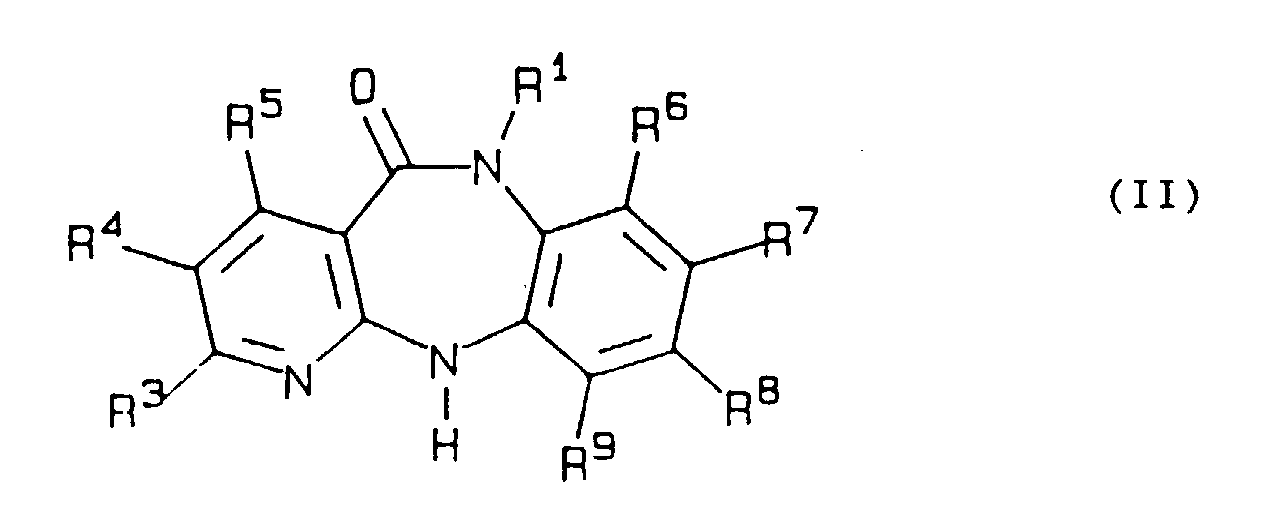
R2X (III)
wherein R2 has the same meanings set forth with respect to formula I but is other than hydrogen, and X is a suitable leaving group such as chlorine, bromine or iodine, an appropriate radical of sulfuric acid, an aliphatic or aromatic sulfonic acid ester, or acyloxy. - The reaction is conveniently carried out as a one-batch process, wherein the alkali-metal salts obtained from a compound of formula II are not isolated from the reaction mixture but produced in situ, and, once formed, are reacted further in the same reaction medium.
- The conversion of a compound of general formula II into the corresponding alkali metal compound may be effected by reacting a compound of formula II with a lithium alkyl (e.g. n-butyl lithium, or t-butyl lithium), optionally in the presence of tetramethylethylenediamine, a lithium dialkylamide, (e.g. lithium diisopropylamide, lithium dicyclohexylamide and lithium isopropylcyclohexylamide), a lithium aryl (e.g. phenyl lithium), alkali metal hydroxides (e.g. lithium, sodium or potassium hydroxide), alkali metal hydrides (e.g. sodium or potassium hydride) or alkali metal amides (e.g. sodium or potassium amides), or Grignard reagents (e.g. methyl magnesium iodide, ethyl magnesium bromide or phenyl magnesium bromide). The metallation is conveniently carried out in an inert organic solvent at temperatures of between -100°C and the boiling point of the reaction mixture in question. If lithium alkyls, lithium aryls, lithium dialkylamides or Grignard reagents are used for the metallation, the preferred solvents are ethers such as tetrahydrofuran, diethyl ether or dioxan, optionally in a mixture with aliphatic or aromatic hydrocarbons, such as hexane or benzene, and the operation is carried out at temperatures of between -20 and +80°C. When metallation is effected with alkali metal hydrides and alkali metal amides, in addition to the solvents mentioned hereinbefore it is also possible to use xylene, toluene, acetonitrile, dimethylformamide and dimethylsulfoxide, while if alkali metal hydroxides are used it is also possible to use alcohols such as ethanol, methanol and aliphatic ketones such as acetone, as well as mixtures of these solvents with water.
- For conversion of the alkali metal substituted 6,11-dihydro-5H-pyrido[2,3-b][1,5]benzodiazepin-5-one thus obtained into a compound of formula I, the solution or suspension of the alkali metal compound is reacted directly, i.e. without isolation of the reaction product with a compound of formula III at room or elevated temperatures, preferably at the boiling point of the solvent or suspension medium or at the boiling point of the compound III, whichever is lower.
- It will be obvious to those skilled in the art that the presence of nucleophilic substituents in the compounds of formula II may require the use of an intermediate of formula II having substituents which are, other than the 11-position nitrogen, not nucleophilic but which can be derivatized to yield the required group. For example, amino or monoalkylamino substituents at any of R3 through R9 are preferably obtained by alkylating or acylating an intermediate of formula II having a nitro group at any of R3 through R9, and subsequently reducing the nitro group, and alkylating, if appropriate, to yield the final product.
- In Method B, a compound of formula I, wherein Z is oxygen and R1 is hydrogen, is obtained by hydrolyzing a compound of formula IV

- The hydrolysis is carried out by the action of water or low molecular weight alcohols such as methanol, ethanol, 2-propanol, optionally in the presence of protic or aprotic co-solvents being miscible therein, such as tetrahydrofuran, 1,4-dioxane, dimethylformamide, dimethylacetamide, sulfolane, 1,3-dimethyl-2-imidazolidinone and, where appropriate, in the presence of alkaline or acid catalysts, at temperatures between 0°C and the boiling point of the solvent mixture. As alkaline catalysts, alkali metal hydroxides such as lithium, sodium, calcium and barium hydroxide have proved to be suitable, as acid catalysts, mineral acids, such as aqueous hydrochloric acid, hydrobromic acid, sulfuric acid or also methansulfonic acid or p-toluenesulfonic acid are preferred.
- The 6,11-dihydro-5H-pyrido[2,3-b][1,5]benzodiazepin-5-ones of formula II, which are used as starting materials are either specifically described in U.S. patents 3,316,251 or 3,326,900, can be prepared according to general procedures described therein.
- Starting materials of formula IV can be prepared by converting a 6-aroyl-6,11-dihydro-5H-pyrido[2,3-b][1,5]benzodiazepin-5-one of the formula

- The conversion of the compound of formula V into the corresponding alkali metal compound may be effected by reacting a compound of formula V with an alkali metal hydride, preferably lithium hydride, sodium hydride or potassium hydride. The reaction is preferably carried out at elevated temperatures and in the presence of an inert organic solvent such as absolute tetrahydrofuran or dimethylformamide.
- For conversion of the alkali metal substituted 6-aroyl-6,11-dihydro-5H-pyrido[2,3-b][1,5]benzodiazepin-5-one thus obtained into a compound of formula IV, the solution or suspension of the alkali metal compound is reacted directly, i.e., without isolation, with a compound of formula III at room or elevated temperatures, preferably at the boiling point of the solvent or of compound III.
- Starting materials of formula V may be obtained by converting a compound of formula II wherein R1 and R2 are hydrogen atoms to its monosodium compound, preferably by reaction with 1 equivalent of sodium hydride in dimethylformamide, and reacting the alkali metal compound thus formed with an aroyl halide of the formula
ArCOHal (VI)
wherein Ar has the same meanings as in compounds of formula IV, and Hal is chlorine, bromine or iodine. - It will be obvious to those skilled in the art that this method is not prefered in those cases wherein any of R2 through R9 are readily hydrolyzable substituents, for example, wherein R2 is alkanoyl or any of R3 through R9 are alkanoylamino or alkoxycarbonyl. In cases wherein R2 is alkanoyl or any of R3 through R9 are alkoxycarbonyl, for example, it is preferable to utilize method A described above; when R1 is hydrogen two equivalents of base must be used. In cases wherein any of R3 through R9 are alkanoylamino, for example, it is preferable to carry out the hydrolysis (and subsequent acylation) on the corresponding nitro derivative, and then reduce the nitro moiety to the amine, followed by acylation to yield the desired product.
- In Method C, a compound of Formula I, wherein Z is sulfur, is obtained by reacting a compound of formula I, wherein Z is oxygen, with a sulfurating agent, such as 2,4-bis(4-methoxyphenyl)-1,3-dithia-2,4-diphosphetane-2,4-disulfide; bis(tricyclohexyltin)sulfide; bis(tri-n-butyltin)sulfide; bis(triphenyltin)sulfide; bis(trimethylsilyl)sulfide or phosphorous pentasulfide. The reaction is carried out in an inert organic solvent such as carbon disulfide, benzene or toluene, at room temperature or higher, preferably an elevated temperature up to the boiling point of the reaction mixture, and preferably under anhydrous conditions. When using the above mentioned tin or silyl sulfide, it is preferable to carry out the sulfurization reaction in the presence of a Lewis acid such as boron trichloride.
- It will be obvious to those skilled in the art that the presence of another carbonyl moiety in a compound of formula I, for example, a compound wherein Z is oxygen and any of R3 through R9 is alkanoyl, will require that the ketone carbonyl be protected via known methods by a suitable protecting group prior to the sulfurization reaction; deprotection subsequent to the sulfurization reaction provides the desired compound. Similarly, in cases wherein R2 is, for example, alkanoyl, it will be obvious that the sulfurization reaction should be performed prior to the acylation of the 11-position nitrogen. In those cases wherein the substituents at any of R3 through R9 can be derived from nitro, for example, alkanoylamino, the sulfurization reaction can be performed on the corresponding nitro derivative, followed by an appropriate (known) reduction and finally acylation to yield the desired product.
- The above-described compounds of Formula I, and their salts, possess inhibitory activity against HIV-1 reverse transcriptase. When administered in suitable dosage forms, they are useful in the prevention or treatment of AIDS, ARC and related disorders associated with HIV infection. Another aspect of the invention, therefore, is a method for preventing or treating HIV-1 infection which comprises administering to a human being, exposed to or infected by HIV-1, a prophylactically or therapeutically effective amount of a novel compound of Formula I, as described above.
- Yet another aspect of the invention comprises a method for preventing or treating HIV-1 infection which comprises administering, to a human being exposed to or infected by HIV-1, a prophylactically or therapeutically effective amount of one of the following known 6,11-dihydro-5H-pyrido[2,3-b][1,5]benzodiazepin-5-ones of the formula

- R1 is hydrogen, methyl, ethyl or isobutyl; and
- X1, X2, Y1 and Y2 are each hydrogen or methyl:
- a) 2,4,6,8-tetramethyl-6,11-dihydro-5H-pyrido[2,3-b][1,5]benzodiazepin-5-one;
- b) 6-methyl-6,11-dihydro-5H-pyrido[2,3-b][1,5]benzodiazepin-5-one;
- c) 6,11-dihydro-5H-pyrido[2,3-b][1,5]benzodiazepin-5-one;
- d) 6-ethy-6,11-dihydro-5H-pyrido[2,3-b][1,5]benzodiazepin-5-one;
- e) 6,8,9-trimethyl-6,11-dihydro-5H-pyrido[2,3-b][1,5]benzodiazepin-5-one;
- f) 6-ethyl-8,9-dimethyl-6,11-dihydro-5H-pyrido[2,3-b][1,5]benzodiazepin-5-one;
- g) 6-isobutyl-6,11-dihydro-5H-pyrido[2,3-b][1,5]benzodiazepin-5-one; and,
- Ii) 6-ethyl-9-methyl-6,11-dihydro-5H-pyrido[2,3-b][1,5]benzodiazepin-5-one.
- The above described compounds of formula 1A also inhibit HIV-1 reverse transcriptase (HIV-1 RT).
- Said compounds are known from US patents Nos. 3,316,251; 3,326.900 and 4,167,570.
- A further aspect of the invention comprises the novel 5-thione analogues of the above-mentioned known compounds of formula IA. These 5-thione analogues can be prepared from the known 5-ones using the sulfurization reaction described in Method C, above. These analogues also inhibit HIV-1 RT and the invention further comprises a method for preventing or treating HIV-1 infection which comprises administering, to a human being exposed to or infected by HIV-1, a prophylactically or therapeutically effective amount of one or more of these 5-thione analogues.
- The above described compounds of formulas I and IA, and the 5-thione analogues of the compounds of formula IA may be administered in single or divided doses by the oral, parenteral or topical routes. A suitable oral dosage for such compounds would be in the range of about 10 to 500 mg per day. In parenteral formulations, a suitable dosage unit may contain from about 1 to 50 mg of said compounds, whereas for topical administration, formulations containing about 0.01 to 1% active ingredient are preferred. It should be understood, however, that the dosage administration from patient to patient will vary and the dosage for any particular patient will depend upon the clinician's judgement, who will use as criteria for fixing a proper dosage the size and condition of the patient as well as the patient's response to the drug.
- When the compounds of formulas I, IA, or the 5-thione analogues of the compounds of formula IA are to be administered by the oral route, they may be administered as medicaments in the form of pharmaceutical preparations which contain them in association with a compatible pharmaceutical carrier material. Such carrier material can be an inert organic or inorganic carrier material suitable for oral administration. Examples of such carrier materials are water, gelatin, talc, starch, magnesium stearate, gum arabic, vegetable oils, polyalkylene-glycols, petroleum jelly and the like. The pharmaceutical preparations can be prepared in a conventional manner and finished dosage forms can be solid dosage forms, for example, tablets, dragees, capsules, and the like, or liquid dosage forms, for example, solutions, suspensions, emulsions and the like. The pharmaceutical preparations may be subjected to conventional pharmaceutical operations such as sterilization. Further, the pharmaceutical preparations may contain conventional adjuvants such as preservatives, stabilizers, emulsifiers, flavor-improvers, wetting agents, buffers, salts for varying the osmotic pressure and the like. Solid carrier material which can be used include, for example, starch, lactose, mannitol, methyl cellulose, microcrystalline cellulose, talc, silica, dibasic calcium phosphate, and high molecular weight polymers (such as polyethylene glycol).
- For parenteral use, a compound of formula I or IA, or a 5-thione analogue of a compound of formula IA can be administered in an aqueous or non-aqueous solution, suspension or emulsion in a pharmaceutically acceptable oil or a mixture of liquids, which may contain bacteriostatic agents, antioxidants, preservatives, buffers or other solutes to render the solution isotonic with the blood, thickening agents, suspending agents or other pharmaceutically acceptable additives. Additives of this type include, for example, tartrate, citrate and acetate buffers, ethanol, propylene glycol, polyethylene glycol, complex formers (such as EDTA), antioxidants (such as sodium bisulfite, sodium metabisulfite, and ascorbic acid), high molecular weight polymers (such as liquid polyethylene oxides) for viscosity regulation and polyethylene derivatives of sorbitol anhydrides. Preservatives may also be added if necessary, such as benzoic acid, methyl or propyl paraben, benzalkonium chloride and other quaternary ammonium compounds.
- The compounds of formulas I and IA and the 5-thione analogues of the compounds IA may also be administered as solutions for nasal application and may contain in addition to the compounds of this invention suitable buffers, tonicity adjusters, microbial preservatives, antioxidants and viscosity-increasing agents in an aqueous vehicle. Examples of agents used to increase viscosity are polyvinyl alcohol, cellulose derivatives, polyvinylpyrrolidone, polysorbates or glycerin. Microbial preservatives added may include benzalkonium chloride, thimerosal, chlorobutanol or phenylethyl alcohol.
- Additionally, the compounds of formulas I and IA and the 5-thiones analogues of the compounds of formula IA can be administered by suppository.
- As stated before, the above described compounds of formulas I and IA and the 5-thione analogues of the compounds of formula IA inhibit the enzymatic activity of HIV-1 RT. Based upon testing of these compounds, as described below, it is known that they inhibit the RNA-dependent DNA polymerase activity of HIV-1 RT. Based upon other testing, not described herein, it is believed that they also inhibit the DNA polymerase activity of HIV-1 RT.
- Utilizing the Reverse Transcriptase (RT) Assay descibed below, compounds can be tested for their ability to inhibit the RNA-dependent DNA polymerase activity of HIV-1 RT. Certain specific compounds of formula I described in the Examples which appear below, were so tested. The results of this testing appear in Table I, below. The above-described compounds of formula IA were also so tested. The results of this testing appear in Table II, below.
- Among the enzymes for which Human Immunodeficiency Virus (HIV-1) encodes is a reverse transcriptase (1), so-named because it transcribes a DNA copy from an RNA template. This activity can be quantitatively measured in a cell-free enzyme assay which has been previously described (2), and is based upon the observation that reverse transcriptase is able to use a synthetic template [poly r(C) primed with oligo d(G)] to transcribe a radio-labelled, acid-precipitable DNA strand utilizing 3H-dGTP as a substrate.
- Reverse transcriptase enzyme from the LAV strain of Human Immunodeficiency Virus (HIV-1) (1) was isolated from the bacterial strain JM109 (3) expressing the DNA clone pBRTprt1+ (2) which is under the control of the lac promoter in the expression vector pIBI21 (4). An overnight culture grown in 2XYT medium (37°C, 225 rpm) (5) supplemented with 100 µg/ml ampicillin for positive selection is inoculated at a 1:40 dilution into M9 medium supplemented with 10µg/ml thiamine, 0.5% casamino acids, and 50 µg/ml ampicillin (5). The culture is incubated (37°C, 225 rpm) until it reaches an OD540 of 0.3-0.4. At that time the repressor inhibitor IPTG (isopropyl b-D-thiogalactopyranoside) is added to 0.5mM and the mixture is incubated for 2 additional hours. Bacteria are pelleted, resuspended in a 50mM Tris, 0.6mM EDTA, 0.375M NaCl buffer and digested by the addition of lysozyme (1mg/ml) for 30 minutes on ice. The cells are lysed by the addition of 0.2% NP-40 and brought to 1M NaCl.
- After removal of the insoluble debris by centrifugation, the protein is precipitated by the addition of 3 volumes of water-saturated ammonium sulfate. The enzyme is pelleted, resuspended in RT buffer (50mM Tris pH 7.5. 1mM EDTA, 5mM DTT, 0.1% NP-40, 0.1M NaCl, and 50% glycerol), and stored at -70°C for further use.
-
Stock Reagent 2X Mix Concentrtation 1M Tris pH 7.4 100mM 1M Dithiothreitol 40mM 1M NaCl 120mM 1% Nonidet P-40 0.1% 1M MgCl 4mM [poly r(C)/oligo d(G)](5:1) 2µg/ml 3H-dGTP (81µM) 0.6µM - The 2X concentrated stock reaction mixture is aliquoted and stored at -20°C. The mixture is stable and thawed for use in each assay. This enzyme assay has been adapted to a 96 well microtiter plate system, and has been previously described (6). Tris buffer (50 mM, pH 7.4), vehicle (solvent diluted to match the compound dilution), or compounds in vehicle are dispensed into 96-well microtiter plates (10µl/well: 3 wells/compound). The HIV-1 RT enzyme is thawed and diluted in 50mM Tris pH 7.4 so that fifteen µl of diluted enzyme contain 0.001 Unit (one unit is that amount of enzyme to transform 1 micromole of substrate per minute at 25°C) and 15µl are dispensed per well. Twenty µl of 0.12 - 0.5M EDTA are added to the first three wells of the microtiter plate. EDTA chelates the Mg++ present and prevents reverse transcription. This group serves as background polymerization which is subtracted from all other groups. Twenty-five ul of the 2X reaction mixture are added to all wells and the assay is allowed to incubate at room temperature for 60 minutes. The assay is terminated by precipitating the DNA in each well with 50µl of trichloracetic acid (TCA) (10% w/v) in sodium pyrophosphate (1% w/v). The microtiter plate is incubated for 15 minutes at 4°C and the precipitate is fixed onto #30 glass fiber paper (Schleicher & Schuell) using a Skatron semi-automatic harvester. The filters are then washed with additional TCA (5%) containing sodium pyrophosphate (1%), rinsed with aqueous ethanol (70%), dried, and transferred to scintillation vials (6). Each vial receives 2 mls of scintillation cocktail and is counted in a Beckman beta counter.
- The calculation for percent inhibition is as follows:

-
- 1. Benn, S., et al., SCIENCE 230:949, 1985
- 2. Farmerie, W.G. et. al., SCIENCE 236:305, 1987
- 3. Yanisch-Perron, C., Viera, J., and Messing, J., GENE 33:103, 1985
- 4. International Biotechnologies, Inc., P.O. Box 9558, New Haven, CT 06535
- 5. Maniatis, T, Fritsch, E.F., and J. Sambrook, eds. MOLECULAR CLONING: A LABORATORY MANUAL, Cold Spring Harbor Laboratory, 1982
- 6. Spira, T., et. al., J. Clinical Microbiology, 25:97, 1987.
- In order to confirm that compounds which are active in the RT Assay also have the ability to inhibit HIV-1 replication in a living system, several compounds of formula I were also tested in the Human T-Cell Culture Assay described below. The results of this testing appear in Table I.
- Formation of syncytia is a feature of in vitro cultures of CD4+ T-cells infected with HIV-1. In this assay, T-cells are treated with a putative replication inhibiting compound and then infected with HIV-1. After incubation the culture is checked for the formation of syncytia. The absence or reduction is the number of syncytia is used as a measure of the test compound's ability to inhibit HIV replication.
- The target cells, designated c8166, are a subclone of human lymphoma cells of T-cell origin and are established at an initial density of 5x10⁴ per 100 ul in RPMI 1640 (+ 10% fetal bovine serum) culture medium in 96 well flat bottom plates. A selected amount of test compound, dissolved in DMSO is included. After 24 hours, 50-100 TCID50's (the dose that results in induced effect in 50% of test cultures) of the HTLV-IIIB strain of HIV-1 (2) are innoculated into each culture. Control cultures receive compound or virus only. Four days after virus challenge, cultures are visually examined for the frequency and distribution of virus-induced giant cell syncytia. The percent inhibition by the test compound is determined by comparison with control values. Confirmation of the presence or absence of virus replication is accomplished by harvesting the cell free culture fluids from all experimental groups to determine the present or absence of infectious progeny through the induction of syncytia formation in secondary human T-cell cultures after 3 days.
-
- (1) M. Somasundaran and H.L. Robinson, Science 242, 1554 (1998)
- (2) G.M. Shaw, R.H. Hahn, S.K. Arya, J.E. Groopman, R.C. Gallo and F. Wong-Staal, Science 226, 1165 (1984)
- In order to assess the specificity of the enzyme inhibitory activity of the above described compounds, a few were tested, using known per se assay methods, for their ability to inhibit Feline Leukemia Virus-derived reverse transcriptase and Galf Thymus-derived DNA alpha-polymerase. None of the compounds so tested was observed to possess significant inhibitory activity against these enzymes. These results indicate that the enzyme inhibitory activity of the above described compounds is directed rather specifically against HIV-1 RT.
- In order to roughly assess the cytotoxicity of the compounds of formula 1, several such compounds were tested in the MTT Cellular Cytotoxicity Assay described below. The results of this testing are reported in Table I, below. Compounds having a relatively high EC50 are preferred.
- The MTT [3-(4,5-dimethylthiazol-2yl)-2,5-diphenyl tetrazolium bromide) assay is based on cleavage of tetrazolium bromide by metabolically active cells, resulting in a highly quantitative blue color. This assay has been previously described (1) but has been optimized for the purposes of the testing reported herein.
- The H9 cell line (2), an established human lymphoma suspension cell line grown in RPMI 1640 supplemented with 10% fetal bovine serum is used as the target cell line in the assay. Cells (100µl) are plated in microtest plate wells at a concentration of 105 cells per ml in the presence of varying concentrations of inhibitor. The cells are incubated at 37°C in a humidified CO2 incubator. Five days later 20µl of MTT (5mg/ml in RPMI 1640, sonicated, 0.2 micron filtered, and stored at 4°C) is added to each well. After 4 hours additional incubation at 37°C, 60µl of Triton-X is added to each well and thoroughly mixed to aid the solubilization of the crystals. Absolute ethanol (5µl) is added to each well and the resulting mixture is incubated for 30 minutes at 60°C and immediately read on a plate reader (Dynatech) at a wavelength of 570nm.
- Data from this assay are used to generate a nonlinear regression analysis, which yields the EC50.
-
- 1. Mosmann, Tim, J. Immunol. Methods, 65:55, 1983.
- 2. Jacobs, J.P., J. Natl. Cancer Inst., 34:231, 1965.
- The following examples further illustrate the present invention and will enable others skilled in the art to understand the invention more completely. It should be understood, however, that the invention is not limited to the particulars given in the examples.
- A suspension of 14.8 g (0.07 mol) of 6,11-dihydro-5H-pyrido[2,3-b]1,5]benzodiazepin-5-one in 200 ml dimethylformamide was heated to 120°C, cooled down to 80° after complete dissolution, whereupon 2.2g (0.074 mol) of an 80% dispersion of sodium hydride in mineral oil were added. Thereafter, the mixture was stirred at 60°C for 45 minutes, 8.6 ml (0.075 mol) of benzoyl chloride were dropped in and the reaction mixture was stirred at the same temperature for a further 15 minutes. The mixture was cooled to room temperature and after being stirred for two hours was set aside overnight. The resulting precipitate, mostly consisting of starting material, was filtered off. The filtrate was then evaporated in vacuo, the residue was admixed with 100 ml of water and 100 ml of dichloromethane and filtered again. The organic phase was separated and evaporated in vacuo. The oily residue was recrystallized from chloroform/ethylacetate 1/1 (v/v) yielding slightly yellowish crystals of m.p. 198-201°C which were identified as 6-benzoyl-6,11-dihydro-5H-pyrido[2,3-b][1,5]benzodiazepin-5-one. The yield was 3.5g (16% of theory).
- 12.67 g (0.06 mol) of the product obtained in step a) were dissolved in 190 ml of absolute dimethylformamide and the resulting solution was admixed with 1.95 g (0.065 mol) of an 80% dispersion of sodium hydride in mineral oil, whereupon hydrogen evolved and the mixture became reddish and slightly warm. The mixture was stirred at room temperature for 15 minutes, then cooled to +10°C and admixed with 4.38 ml (0.07 mol) of methyl iodide and subsequently was stirred at room temperature for a further 45 minutes. The solvent was removed by distillation in vacuo. The residue was washed with water, dissolved in hot ethanol and the resulting solution was treated with charcoal and filtered while hot. The filtrate was set aside at room temperature for several hours, and the resulting precipitate was filtered by suction. The product had a m.p. of 181-183°C and was identified as 6-benzoyl-6,11-dihydro-11-methyl-5H-pyrido-[2,3-b][1,5]benzodiazepin-5-one. The yield was 12.54 g (63% of theory).
- A mixture of 9.4 g (0.0285 mol) of the product obtained in step b, 150 ml ethanol and 5 ml concentrated aqueous hydrochloric acid was refluxed for five hours while stirring. The clear yellowish solution that had been formed was set aside overnight. The resulting precipitate was collected by filtration and thoroughly washed with diluted aqueous ammonia. The product was dried overnight in a stream of nitrogen at room temperature and thereafter was recrystallized from n-propanol. The colorless product had a m.p. of 235-237°C and was identified as 6,11-dihydro-11-methyl-5H-pyrido-[2,3-b]-[1,5]benzodiazepin-5-one. The yield was 3.3 g (51% of theory).
- Under nitrogen cover, 7.90 g (0.035 mol) of 6,11-dihydro-6-methyl-5H-pyrido[2,3-b][1,5]benzodiazepin-5-one were suspended in 79 ml of anhydrous dimethylformamide. To this suspension 1.25 g (0.052 mol) of sodium hydride were added in small portions within 10 minutes. The temperature arose to 60°C with development of hydrogen. Stirring was continued for a further 45 minutes at the same temperature. Afterwards, the batch was left to cool to ambient temperature. Ethyl iodide (3.38 ml; 6.534 g, 0.0419 mol) was dropped in within about 10 minutes. The batch was stirred for further 15 minutes at ambient temperature. After this time no starting material was found in the reaction mixture by thin-layer-chromatography.
- In order to destroy still present sodium hydride, 1 ml of methanol was added. The reaction mixture was evaporated in vacuo, and the residue was distributed between 100 ml of chloroform and 100 ml of water, the red organic phase was dried over sodium sulfate, 1 g of charcoal was stirred in, the batch was filtered and the filtrate was evaporated to dryness in vacuo. The high viscous red oil obtained was purified by column chromatography using 300 g of silica gel (0.2-0.5 mm) and as eluent chloroform/ethyl acetate 1/1 (v/v). By evaporation of the fraction containing the compound, 7.0 g of a slightly red colored product were obtained, which was recrystallized with cyclohexane, yielding 5 g (56% of theory) of 6,11-Dihydro-11-ethyl-6-methyl-5H- pyrido[2,3-b][1,5]benzodiazepin-5-one as colorless crystals of m.p. 106-111°C.
- Using a procedure analogous to that described in Example 2 6,11-dihydro-6-methyl-11-propyl-5H-pyrido[2,3-b][1,5]benzodiazepin-5-one, m.p. 96-98°C (recrystallized from petroleum ether) was prepared from 6,11-dihydro-6-methyl-5H-pyrido[2,3-b]-[1,5]benzodiazepin-5-one and 1-iodopropane. The yield was 36% of theory.
- 13.26 g (0.475 mol) of 6,11-dihydro-9-(trifluoromethyl)-5H-pyrido[2,3-b][1,5]benzodiazepin-5-one were dissolved in a mixture consisting of 40 ml of a potassium tert. butoxide solution (from 2.14 g of potassium and 40 ml of tert. butanol) and 100 ml of absolute dioxane, and the resulting solution was refluxed for two hours. Thereafter, 14.2 g (0.1 mol) of methyliodide were added and the mixture was refluxed for four hours. The reaction mixture was then filtered to remove the precipitated potassium iodide, and the filtrate was evaporated in vacuo. The residue was recrystallized from ethanol, yielding a compound having a melting point of 169-172°C which was identified to be 6,11-dihydro-6-methyl-9-(trifluoromethyl)-5H-pyrido[2,3-b][1,5]benzodiazepin-5-one. The yield was 26% of theory.
- Using a procedure analogous so that described in Example 2, 6,11-dihydro-6,11-dimethyl-9-(trifluoromethyl)-5H-pyrido-[2,3-b][1,5]-benzodiazepin-5-one, m.p. 142-145°C (recrystallized from ethanol) was prepared from the product of step a) and methyl iodide. The yield was 48% of theory.
- Using a procedure analogous to that described in Example 2, 6,11-Dihydro-6-methyl-11-isopropyl-5H-pyrido[2,3-b][1,5]benzodiazepin-5-one, m.p. 144-147°C (recrystallized from cyclohexane) was prepared from 6,11-Dihydro-6-methyl-5H-pyrido[2,3-b][1,5]benzodiazepin-5-one and 2-bromopropane. The yield was 17% of theory.
- Using a procedure analogous to that described in Example 2, 11-butyl-6,11-dihydro-6-methyl-5H-pyrido[2,3-b][1,5]benzodiazepin-5-one, m.p. 56-58°C (recrystallized from petroleum ether) was prepared from 6,11-dihydro-6-methyl-5H-pyrido[2,3-b[1,5]benzodiazepin-5-one, and 1-iodobutane. The yield was 40% of theory.
- Using a procedure analogous to that described in Example 2, 22.52g (0.1 mol) of 6,11-dihydro-6-methyl-5H-pyrido[2,3-b][1,5]benzodiazepin-5-one were converted to 6,11-dihydro-6-methyl-11-[2-[(2-tetrahydropyranyl)oxy]ethyl]-5H-pyrido-[2,3-b][1,5]benzodiazepin-5-one by reaction with 21.8g (0.132 mol) of 1-chloro-2-[(2-tetrahydropyranyl)-oxy]-ethane. The raw material thus obtained was dissolved in a mixture of 500 ml ethanol and 100 ml of concentrated aqueous hydrochloric acid. After having been refluxed for two hours, the reaction mixture was evaporated in vacuo. The residue was triturated with ethanol, the precipitated crystals were filtered off and the solvent was removed from the filtrate by distillation in vacuo. The residue was purified by column chromatography on silica gel (0.2-0.5 mm) using chloroform/ethylacetate/methanol 5/5/1 (v/v/v) as an eluent. Colorless crystals of m.p. 133-134°C (after recrystallization from xylene) were obtained in a yield of 9.0 g (33% of theory).
- Using a procedure analogous to that described in Example 2, 8-chloro-6,11-dihydro-6,11-dimethyl-5H-pyrido[2,3-b][1,5]benzodiazepin-5-one, m.p. 188-189°C (recrystallized from ethanol) was prepared from 8-chloro-6,11-dihydro-6-methyl-5H-pyrido[2,3-b][1,5]benzodiazepin-5-one and methyl iodide. The yield was 33% theory.
- Using a procedure analogous to that described in Example 2, 6,11-dihydro-6,8,9,11-tetramethyl-5H-pyrido[2,3-b][1,5]benzodiazepin5-one, m.p. 189-192°C (recrystallized twice from ethanol) was prepared from 6,11-dihydro-6,8,9-trimethyl-5H-pyrido 2,3-b][1,5]benzodiazepin-5-one and methyl iodide. The yield was 47% of theory.
- Using a procedure analogous to that described in Example 2, 6,11-dihydro-6,11-dimethyl-5H-pyrido[2,3-b][1,5]benzodiazepin-5-one, m.p. 126-128°C (recrystallized from cyclohexane) was prepared from 6,11-dihydro-6-methyl-5H-pyrido[2,3-b][1,5]benzodiazepin-5-one and methyl iodide. The yield was 53% of theory.
- Using a procedure analogous to that described in Example 2, 6,11-dihydro-6-ethyl-11-methyl-5H-pyrido[2,3-b][1,5]-benzodiazepin-5-one, m.p. 118-119°C (recrystallized twice from cyclohexane) was prepared from 6,11-dihydro-6-ethyl-5H-pyrido- [2,3-b][1,5]benzodiazepin-5-one and methyl iodide. The yield was 53% of theory.
- Using a procedure analogous to that described in Example 2, 6,11-dihydro-11-methyl-6-propyl-5H-pyrido[2,3-b][1,5]benzodiazepin-5-one, m.p. 95.5-97.5°C (recrystallized from petroleum ether) was prepared from 6,11-dihydro-6-propyl-5H-pyrido[2,3-b][1,5]benzodiazepin-5-one and methyl iodide. The yield was 71% of theory.
- Using a procedure analogous to that described in Example 2, 6,11-dihydro-11-methyl-6-isopropyl-5H-pyrido[2,3-b][1,5]-benzodiazepin-5-one, m.p. 98-100°C (recrystallized from petroleum ether) was prepared from 6,11-dihydro-6-5H-pyrido[2,3-b][1,5]-benzodiazepin-5-one and methyl iodide. The yield was 61% of theory.
- Using a procedure analogous to that described in Example 2, 6-butyl-6,11-dihydro-11-methyl-5H-pyrido[2,3-b][1,5]benzodiazepin-5-one, a colorless, viscous liquid of b.p. 150-152°C (0.03 mm Hg) was prepared from 6-butyl-6,11-dihydro-5H-pyrido[2,3-b][1,5]-benzodiazepin-5-one and methyl iodide. The yield was 57% of theory.
- Using a procedure analogous to that described in Example 2, 6,11-dihydro-2,6,8,9,11-pentamethyl-5H-pyrido[2,3-b][1,5]benzodiazepin-5-one, m.p. 143-145°C (recrystallized from methanol) was prepared from 6,11-dihydro-2,6,8,9-tetramethyl-5H-pyrido[2,3-b][1,5]benzodiazepin-5-one and methyl iodide. The yield was 13% of theory.
- Using a procedure analogous to that described in Example 2, 6,11-dihydro-2,4,6,8,9,11-hexamethyl-5H-pyrido[2,3-b][1,5]-benzodiazepin-5-one, m.p. 148-151°C (recrystallized from ligroin, b.p. 100-140°C) was prepared from 6,11-Dihydro-2,4,6,8,9-pentamethyl-5H-pyrido-[2,3-b][1,5]benzodiazepin-5-one and methyl iodide. The yield was 44% of theory.
- Using a procedure analogous to that described in Example 2, a mixture of 6,11-dihydro-2,4,6,8,11- and 6,11-dihydro-2,4,6,9,11-pentamethyl-5H- pyrido[2,3-b][1,5]benzodiazepin-5-one, m.p. 174-176°C (recrystallized from ligroin, b.p. 100-140°C) was prepared from a mixture of 6,11-dihydro-2,4,6,8 and 6,11-dihydro-2,4,6,9-tetramethyl- 5H-pyrido[2,3-b][1,5]benzodiazepin-5-one and methyl iodide. The yield was 12% of theory.
- 5.0 g (0.0222 mol) of 6,11-dihydro-6-methyl-5H-pyrido-[2,3-b][1,5]-benzodiazepin-5-one were suspended in a mixture consisting of 2.0 g (0.0255 mol) of acetyl chloride, 10 ml benzene and 2.2g (0.022 mol) of triethylamine and the resulting suspension was refluxed for 7 hours while stirred. The reaction mixture was filtered while hot, and the filtrate was evaporated in vacuo. The residue was twice recrystallized from cyclohexane using animal charcoal as an absorbent, yielding a colorless compound having a melting point of 140-142°C, which was identified as 11-acetyl-6,11-dihydro-6-methyl-5H-pyrido[2,3-b][1,5]benzodiazepin-5-one. The yield was 59% of theory.
- Using a procedure analogous to that described in Example 20, 11-acetyl-6,11-dihydro-6,8,9-trimethyl-5H-pyrido[2,3-b][1,5]benzodiazepin-5-one, m.p. 168-170°C (recrystallized from cyclohexane) was prepared from 6,11-dihydro-6,8,9-trimethyl-5H-pyrido[2,3-b][1,5]benzodiazepin-5-one and acetyl chloride. The yield was 43% of theory.
- Using a procedure analogous to that described in Example 2, 6,11-bis-(methylthiomethyl)-9-chloro-6,11-dihydro-5H-pyrido-[2,3-b][1,5]benzodiazepin-5-one, m.p. 181-182°C (recrystallized from 1,2-dichloroethane) was prepared from 9-chloro-6,11-dihydro-5H-pyrido[2,3-b][1,5]benzodiazepin-5-one and 2 equivalents of methylthiomethyl chloride. The yield was 31% of theory.
- 11H-Pyrido[2,3-b][1,5]benzodiazepin-5-one 46g of o-phenylenediamine (0,43 mol) and 46g of 2-chloronicotinic acid (0.29 mol) were mixed and heated to between 110 and 120°C. The mixture melted and an exothermic reaction ensued. The reaction mixture was thereafter heated for two hours at 120°C, cooled and then washed with ethanol. The crude product was crystallized from acetic acid to yield 11H-pyrido[2,3-b][1,5] benzodiazepin-5-one as a yellow solid (449), m.p. 280-285°C.
- 5g of the compound prepared above (0.024 mol) and 1.2g of sodium hydride (0.05 mol) were heated in dry dimethylformamide (100ml) for two hours. Ethyl iodide ((7.48g; 0.048 mole) was then added dropwise over 10 minutes while maintaining the temperature at 35-40°C. The reaction mixture was stirred overnight at room temperature and then poured into cold water. The resulting mixture was extracted with ether, the ether extract dried over anhydrous sodium sulfate, filtered and evaporated to dryness. The resulting oil was purified through silica gel chromatography, and crystallized from n-heptane to yield the title compound (2.3g), m.p. 108-110°C.
- A mixture of 4.00 (0.016 mol) of 6,11-dihydro-11-ethyl-6-methyl-5H-pyrido[2,3-b][1,5]benzodiazepin-5-one, prepared as in Example 2, and 3.2g (0.008 mol) of Lawesson's reagent [2,4-bis(4-methoxyphenyl)-1,3-dithia-2,4-diphosphetane-2,4-disulfide] in 50 ml of toluene was refluxed for 2 1/2 hr. The solvent was then removed in vacuo and the residue purified on a silica gel column using methylene chloride. Removal of the solvent in vacuo gave 3.2g (75%) of yellow oil. The oil was dissolved in cyclohexane and after standing at room temperature a yellow solid resulted. Recrystallization from cyclohexane gave 2.1g (49% theory), of yellow needles, m.p. 103-106°C, which was identified to be 5,11-dihydro-11-ethyl-6-methyl-5H-pyrido[3,2-b][1,5]diazepin-5-thione.
- A mixture of 15g of 6,11-dihydro-5H-pyrido[2,3-b][1,5]benzodiazepin-5-one and 150 ml DMF was heated to 50°C. To the slurry was added 7.5 g (2 equiv) of 50% sodium hydride in mineral oil dispersion, during which time the temperature rose to 65°C. The mixture was cooled to 40°C and then 6.0 ml of iodoethane was added. The resulting mixture was stirred at room temperature overnight, then poured into 700 ml of water and extracted with 700 ml of ether. The other phase was dried (MgSO4) and concentrated to dryness. The crude product was purified by column chromatography on basic alumina to yield 3.6g (21% of theory) of 6,11-dihydro-11-ethyl-5-pyrido[2,3-b][1,5]benzodiazepin-5-one, m.p. 210-220°C.
- To 2.2g of 6,11-dihydro-11-ethyl-5H-pyrido[2,3-b][1,5]benzodiazepin-5-one, prepared as in Example 21, was added 1.9g of Lawesson's Reagent and 50 ml of toluene. The mixture was heated to reflux for 2 1/2 hours and then cooled to room temperature. The reaction mixture was concentrated in vacuo and the solid residue was dissolved in methylene chloride. The resulting solid was filtered and recrystallized from ethyl acetate to yield 0.66g (28% of theory) of 6,11-dihydro-11-ethyl-5H-pyrido [2,3-b][1,5]benzodiazepin-5-thione, m.p. 194-196°C.
- To a mixture of 4.0g of 6,11-dihydro-6-methyl-5H-pyrido[2,3-b] [1,5]benzodiazepin-5-one and 100 ml of dry DMF was added 1.2g of 50% NaH in mineral oil. The resulting solution was heated to 60°C for one hour. The dark red solution was cooled to 30°C and 2.5 ml of benzyl bromide was added and stirred overnight under nitrogen. Methanol was added slowly until bubbling ceased, and the reaction mixture was then poured into 400 ml of water. The product was extracted with ether, dried over MgSO4, then concentrated and purified by column chromatography over silica gel. Elution of the material with 2% ethyl acetate/methylene chloride gave a white solid, which was recrystallized from methylene chloride/ether/petroleum ether to give 2.2g (39% of theory) of 6,11-dihydro-11-benzyl-6-methyl-5H-pyrido[2,3-b][1,5]benzodiazepin-5-one, m.p. 168-170°C.
- To 0.8g (3.5 mmoles) of 6,11-dihydro-6-methyl-5H-pyrido[2,3-b] [1,5]benzodiazepin-5-one in 75 ml of dimethylformamide was added 0.2g (4.0 mmol) of 50% sodium hydride in oil, and the reaction mixture was stirred at 60°C for 2h. It was then cooled to room temperature and 0.78g (4.0 mmoles) of t-butyl bromoacetate was added dropwise, and the reaction mixture was allowed to stir overnight. Excess sodium hydride was carefully quenched with water and the solvent was evaporated. The residue was dissolved in methylene chloride, washed with water and dried over anhydrous sodium sulfate. Evaporation of the solvent gave 2.0g of crude product. Purification by column chromatography (silica gel) using 10% ethyl acetate/methylene chloride afforded 0.52g of pure 6,11-Dihydro-11-(t-butoxycarbonyl)methyl-6-methyl-5H-pyrido [2,3-b][1,5]benzodiazepin-5-one, m.p. 64-65°C.
- To 1.0g (4.4mmoles) of 6,11-dihydro-6-methyl-5H-pyrido[2,3-b][1,5] benzodiazepin-5-one in 50 ml of dimethylformamide was added 0.25g (5 mmol) of 50% sodium hydride in oil. The reaction mixture was then stirred at 50°C for an additional 2h and then 0.6 ml (5mmol) of ethyl bromoacetate was added. The reaction mixture was then stirred at 50°C for an additional 3h. It was then cooled to room temperature and the solvent was evaporated. The residue was dissolved in methylene chloride, washed with water, dried over anhydrous sodium sulfate and evaporated to obtain 2.0g of the crude product. It was further purified by column chromatography (silica gel) using 10% ethyl acetate/methylene chloride as eluent to obtain 250mg of pure 6,11-dihydro-11-(ethoxy-carbonyl)methyl-6-methyl-5H-pyrido[2,3-b][1,5]benzodiazepin-5-one, m.p. 99-100°C.
- To a stirred suspension of 4.55 (0.202m) of 6,11-dihydro-8,9-dimethyl-5H-pyrido[2,3-b][1,5]benzodiazepin-5-one in 40ml of dimethylsulfoxide was added 3.0ml of a 30% NaOH solution (0.022mol). After two hours at room temperature 5.0 ml (0.08mol) of methyl iodide was added and the mixture stirred at room temperature overnight. It was then poured into water, the resulting precipitate collected, washed, dried and crystallized from ethanol to yield 3.3g (69% of theory) of a crystallized solid melting at 206-209°C.
- Using a procedure analogous to that described in Example 2, 6,11-dihydro-11-ethyl 6,8,9-trimethyl-5H-pyrido[2,3-b][1,5]benzodiazepin-5-one, m.p. 140-144°C (crystallized from petroleum ether) was prepared from 6,11-dihydro-6,8,9-trimethyl-5H-pyrido[2,3-b][1,5]benzodiazepin-5-one, prepared as in Example 28, and methyl iodide. The yield was 41% of the theory.
- A stirred mixture of 1.66g (0.010mol) of 4-methoxycarbonyl-o-phenylenediamine and 1.58g (0.010mol) of 2-chloronicotinic acid in 5ml of 2-butoxyethanol was heated to 140°C for 2h during which time a dark solution, followed by formation of a green solid, was observed. The reaction mixture was poured into 50ml of water and the solid collected and stirred in 10% sodium carbonate solution for 1h. The resulting solid was collected, washed thoroughly with water, dried and crystallized from DMF to yield 1.1g (40% of theory) of a beige crystalline product, m.p. 344-349°C.
- Using a procedure analogous to that described in Example 28 6,11-dihydro-8-methoxycarbonyl-6-methyl-5H-pyrido[2,3-b][1,5]benzodiazepin-5-one, m.p. 273-276°C (after trituration with ethanol) was prepared from 6,11-dihydro-8-methoxycarbonyl-5H-pyrido[2,3-b][1,5]benzodiazepin-5-one and methyl iodide. The yield was 74% of theory.
- Using a procedure analogous to that described in Example 28 6,11-dihydro-8-methoxycarbonyl-11-ethyl-6-methyl-5H-pyrido[2,3-b] [1,5]benzodiazepin-5-one, m.p. 137-140°C (crystallized from petroleum ether, (60-90°) was prepared from 6,11-dihydro-8-methoxycarbonyl- 6-methyl-5H-pyrido[2,3-b][1,5]benzodiazepin-5-one and ethyl iodide. The yield was 32% of theory.
- To a stirred suspension of 1.1g (5mmol) 6,11-dihydro-7-methyl-5H-pyrido [2,3-b][1,5]benzodiazepin-5-one in 20ml of dry DMF 0.13g (5.5mmol) of sodium hydride was added portionwise at room temperature. Once the evolution of hydrogen had ceased, the mixture was heated to 60°C for 2h, cooled to 10°C, and then 0.86g (5.5mmol) of ethyl iodide was added. The reaction mixture was stirred at room temperature overnight and then concentrated. The residue was poured into water, the solid collected, washed, dried and column chromatographed on 60g of dry silica gel. The product (second fraction) was eluted with methylene chloride and methylene chloride/methanol 99/1 to give 0.6g (80% of theory) of 6,11-Dihydro-6-ethyl-7-methyl-5H-pyrido[2,3-b][1,5]benzodiazepin-5-one m.p. 186-188°C.
- Using a procedure analogous to that described in Example 30, 6,11-dihydro-7-methyl-5H-pyrido[2,3-b][1,5]benzodiazepin-5-one, m.p. 233-235°C (crystallized from dioxane/water) was prepared from 3-methyl-o-phenylenediamine and 2-chloronicotinic acid. The yield was 35% of theory.
- Using a procedure analogous to that described in Example 2, 6,11- dihydro-11-(2-fluoroethyl)-6-methyl-5H-pyrido[2,3-b][1,5]benzodiazepin- 5-one, m.p. 118-120°C, was obtained (87% of theory) from 6,11-dihydro- 6-methyl-5H-pyrido[2,3-b][1,5]benzodiazepin-5-one and 1-bromo-2-fluoroethane.
-
- a) 6,11-Dihydro-6-fluoromethyl-5H-pyrido[2,3-b][1,5]benzodiazepin-5-one Using a procedure analogous to that described in Example 2, 6,11-dihydro- 6-fluoromethyl-5H-pyrido[2,3-b][1,5]benzodiazepin-5-one, m.p. 108-110°C, was obtained (3% of theory) from 6,11-dihydro-5H-pyrido[2,3-b][1,5] benzodiazepin-5-one and bromofluoromethane.
- b) 6-11-Dihydro-11-ethyl-6-fluoromethyl-5H-pyrido[2,3-b][1,5]benzo- diazepin-5-one
Using a procedure analogous to that described in Example 2, 6,11-dihydro- 11-ethyl-6-fluoromethyl-5H-pyrido[2,3-b][1,5]benzodiazepin-5-one, m.p. 113-116°C, was obtained (69% of theory) from 6,11-dihydro-6- fluoromethyl-5H-pyrido[2,3-b][1,5]benzodiazepin-5-one and ethyl iodide. -
- a) A mixture of 2-chloronicotinic acid (15.7g, 0.1 mol) and 4-nitrophenylene diamine (15.3g, 0.1 mol) was heated in sulfonane (100ml) at 170°C for 5 hrs. The reaction mixture was then cooled and left standing overnight. The solid material was filtered and taken up in boiling ethanol. The solid was filtered again an dried giving 21g (82% theory) of 6,11-dihydro-9-nitro-5H-pyrido[2,3-b][1,5]benzodiazepin-5-one suitable for use in the next reaction.
- b) Sodium hydride (50% dispersion in oil, 4.0g, 83 mmoles) was placed in a 3-neck round bottom flask. After washing the sodium hydride three times with hexane, DMSO (200 mL) was added. The mixture was heated to 50°C until a clear solution was obtained and 21g of the product obtained in step a) was added as a solution/suspension in DMSO (100mL). The mixture was stirred for 1 hour at which time methyl iodide (12g, 80 mmoles) was added, and the mixture was stirred at room temperature overnight. Water (200mL) was added to the reaction mixture and the precipitate filtered. The solid material was treated twice with 300mL portions of boiling ethanol for one hour and the combined filtrates were left standing at room temperature. Three crops of crystals were deposited over 4 days yielding 6.7g (25% of theory) of 6,11-dihydro-6-methyl-9-nitro-5H-pyrido[2,3-b][1,5]benzodiazepin-5-one m.p. 275-278°C.
- c) To sodium hydride (50% in oil, 0.27g, 5.6 mmoles) was added THF 1mL. The mixture was swirled, the THF removed by pipette. DMSO (5mL) was added and the mixture stirred and heated at 50° C for 30 min. The product obtained in step b) (1.5g, 5.5 mmoles) was added as a solution/suspension in DMSO (5 mL) and stirred for 20 min. Ethyl iodide (0.98g, 6.3 mmoles) was added and the mixture was stirred an additional 30 min. The reaction was quenched with water (100 mL) and extracted with methylene chloride. The organic phase was washed with water three times, dried (MgSO4), filtered and concentrated in vacuo. Column chromatography over silica gel (Eluent methylene chloride ethanol:99/1) gave 0.5g (30% of theory) of 6-11-dihydro-11-ethyl-6-methyl-9-nitro-5H-pyrido[2,3-b][1,5]benzodiazepin-5-one m.p. 179-180.5, after recrystallization from ethanol/hexane.
- To a solution of 0.3g (1mmol) of 6,11-dihydro-11-ethyl-6-methyl-9-nitro-5H-pyrido[2,3-b][1,5]benzodiazepin-5-one in acetic acid (5mL) was added a solution of SnCl2.2H2O (1.7g) in concentrated hydrochloric acid (2.2 ml). The mixture was stirred at room temperature for 6 hours, and then poured into a saturated sodium bicarbonate solution and basified with aqueous sodium hydroxide. The aqueous phase was then extracted with ethyl acetate, dried (MgSO4), filtered and concentrated in vacuo. The solid material obtained was recrystallized from ethyl acetate to give 0.12g (44% of theory) of 6,11-dihydro-9-amino-11-ethyl-6-methyl-5Hpyrido[2,3-b][1,5]benzodiazepin-5-one, m.p. 193-195°C.
EXAMPLE A Capsules or Tablets A-1 A-2 Ingredients Quantity Ingredients Quantity Compound of Example 2 50 mg Compound of Example 2 50 mg Starch 160 mg Dicalcium Phosphate 160 mg Microcrys, Cellulose 90 mg Microcrys. Cellulose 90 mg Sodium Starch Gluctate 10 mg Steeric acid 5 mg Magnesium Stearate 2 mg Sodium Starch Glycolate 10 mg Fumed colloidal silica 1 mg Fumed colloidal silica 1 mg EXAMPLE B Parenteral Solutions Ingredients Quantity Compounds of Example 2 500mg Ethanol 25ml Water for injection q.s. to 100ml - Compound of Example 2 is added to the ethanol and mixed until the solution is clear. Water is added and the resulting solution is then filtered into the appropriate vials or ampoules and sterilized by autoclaving.
EXAMPLE C Nasal Solutions Ingredients Quantity Compound of Example 2 500mg Propylene glycol 30ml Benzalkoniujm chloride 200mg EDTA 200mg Water q.s. to 100ml - The excipient materials are mixed and thereafter the compound of Example 2 is added and mixing is continued until the solution is clear. The water is added and the resulting solution is then filtered into the appropriate vials or ampoules.
| Compound of Example No. | RT Inhibition % @ 10µg/ml | T-Cell Culture Assay(%inhibition) | Cytotoxity Assay (EC50) |
| 1 | 37 | NT | NT |
| 2 | 97 | 100%@ 4µM | 80µM |
| 3 | 92 | NT | NT |
| 4 | 79 | " | 49µM |
| 5 | 94 | 100%@19µM | 50µM |
| 6 | 46 | NT | NT |
| 7 | 50 | " | " |
| 8 | 55 | " | 37µM |
| 9 | 92 | " | 4µM |
| 10 | 68 | " | NT |
| 11 | 88 | " | " |
| 12 | 89 | " | " |
| 13 | 91 | " | " |
| 14 | 75 | " | " |
| 15 | 39 | " | 18 |
| 16 | 44 | " | NT |
| 17 | 49 | " | 9 |
| 18 | 29 | " | NT |
| 19 | 90 | " | 85 |
| 20 | 69 | " | NT |
| 21 | 96 | " | " |
| 22 | 100 | 100%@3µM | " |
| 23 | 100 | NT | " |
| 24 | 100 | " | " |
| 25 | 73 | " | " |
| 26 | 81 | " | " |
| 27 | 64 | " | " |
| 28 | 65 | " | " |
| 29 | 99 | " | " |
| 30 | 94 | " | " |
| 31 | 92 | " | " |
| 32 | 51 | " | " |
| 33 | 97 | " | " |
| 34 | 85 | " | " |
| Note: NT = not tested | |||
| Compound of Formula IA | RT Inhibition % @ 10µg/ml |
| a | 58 |
| b | 43 |
| c | 22 |
| d | 69 |
| e | 65 |
| f | 95 |
| g | 33 |
| h | 78 |
Claims (12)
- A compound of the formula I
 Z is oxygen or sulfur;R1 is hydrogen, alkyl or fluoroalkyl of 1 to 5 carbon atoms, cyclopropyl, alkenyl or alkynyl of 2 to 5 carbon atoms, 2-halo-propen-1-yl, arylmethyl (wherein the aryl moiety is phenyl, thienyl or furanyl, which is either unsubstituted or substituted by methyl methoxy or halogen), alkanoyl of 2 to 3 carbon atoms, or alkoxyalkyl or alkylthioalkyl of 2 to 4 carbon atoms;R2 is alkyl or fluoroalkyl of 1 to 5 carbon atoms, cycloalkyl of 3 to 5 carbon atoms, alkenyl or alkynyl of 2 to 5 carbon atoms, alkoxyalkyl or alkylthioalkyl of 2 to 4 carbon atoms, alkanoyl of 2 to 4 carbon atoms, hydroxyalkyl of 2 to 5 carbon atoms, arylmethyl (wherein the aryl moiety is phenyl, thienyl or furanyl, which is either unsubstituted or substituted by alkyl or alkoxy of 1 to 3 carbon atoms, hydroxyl, or halogen), phenyl (which is either unsubstituted or substituted by alkyl or alkoxy of 1 to 3 carbon atoms, halogen or hydroxyl) or alkoxycarbonylmethyl wherein the alkoxy moiety contains 1 to 5 carbon atoms;R3, R4, and R5 are each independently hydrogen or alkyl of 1 to 3 carbon atoms, with the proviso that at least one of these substituents is hydrogen; or,one of R3, R4 and R5 is butyl, alkanoyl of 1 to 3 carbon atoms, hydroxyalkyl of 1 to 4 carbon atoms, alkoxycarbonyl of 2 to 3 carbon atoms, alkoxycarbonylalkyl wherein both the alkoxy and alkyl moieties contain 1 to 2 carbon atoms, halogen, trihalomethyl, hydroxyl, alkoxy of 1 to 3 carbon atoms, alkythio of 1 to 3 carbon atoms, alkanoyloxy of 2 to 3 carbon atoms, alkanoylamino of 1 to 3 carbon atoms, aminoalkyl of 1 to 3 carbon atoms, mono- or di-alkylamino wherein each alkyl moiety contains 1 to 2 carbon atoms, carboxyalkyl of 2 to 3 carbon atoms, cyano, nitro, carboxyl, carbamyl, amino, azido or mono- or di-alkylaminoalkyl wherein the alkyl moieties each contain 1 to 2 carbon atoms, and the remaining two substituents are hydrogen or methyl; or,when Z is oxygen, one of R3, R4 and R5 is alkylsulfinyl or alkylsulfonyl of 1 to 3 carbon atoms, with the proviso that the remaining two substituents are hydrogrogen or methyl; andR6, R7, R8 and R9 are each hydrogen; or,one of R6, R7, R8 and R9 is alkyl of 1 to 4 carbon atoms, alkanoyl of 1 to 3 carbon atoms, alkoxycarbonyl of 2 to 3 carbon atoms, hydroxyalkyl of 1 to 4 carbon atoms alkoxycarbonylalkyl wherein both the alkoxy and alkyl moieties contain 1 to 2 carbon atoms, halogen, trihalomethyl, hydroxyl, alkoxy of 1 to 3 carbon atoms, alkylthio of 1 to 3 carbon atoms, alkanoyloxy of 2 to 3 carbon atoms, alkanoylamino of 1 to 3 carbon atoms, aminoalkyl of 1 to 3 carbon atoms, mono- or di-alkylamino wherein each alkyl moiety contains 1 to 2 carbon atoms, carboxyalkyl of 2 to 3 carbon atoms, cyano, nitro, carboxyl, carbamyl, amino, azido or mono- or di-alkylaminoalkyl wherein each alkyl moiety contains 1 to 2 carbon atoms, and the remaining three substituents are hydrogen or two of the remaining three substituents are hydrogen and one is methyl, ethyl or halogen;or a pharmaceuticall acceptable acid addition salt thereof.
 - A compound of formula I, as set forth in claim 1, wherein,Z is oxygen or sulfur;R1 is hydrogen, alkyl of 1 to 4 carbon atoms, alkenyl or alkynyl of 2 to 4 carbon atoms, 2-halo-propen-1-yl, or alkoxyalkyl or alkylthioalkyl of 2 to 3 carbon atoms;R2 is alkyl of 1 to 4 carbon atoms, cycloalkyl of 3 to 4 carbon atoms, alkenyl or alkynyl of 2 to 4 carbon atoms, alkoxyalkyl or alkylthioalkyl of 2 to 4 carbon atoms, alkanoyl of 2 to 3 carbon atoms, hydroxyalkyl of 2 to 4 carbon atoms, arylmethyl (wherein the aryl moiety is phenyl or thienyl, which is either unsubstituted or substituted by methyl, methoxy, hydroxyl or halogen), phenyl (which is either unsubstituted or substituted with methyl, methoxy, hydroxyl or halogen) or alkoxycarbonylmethyl wherein the alkoxy moiety contains 1 to 5 carbon atoms;R3, R4, and R5 are each independently hydrogen or methyl, with the proviso that at least one of these substituents is hydrogen, or R5 is ethyl, propyl, or butyl with the other two substituents being hydrogen;R6 is hydrogen, methyl or ethyl with the proviso that R7 is hydrogen or methyl;R7 is alkyl of 1 to 3 carbon atoms, alkanoyl of 1 to 3 carbon atoms, alkoxycarbonyl of 1 to 3 carbon stoms, hydroxyalkyl of 1 to 3 carbon atoms, alkoxycarbonylalkyl wherein the alkoxy and alkyl moieties each contain 1 to 2 carbon atoms, halogen, trifluoromethyl, hydroxyl, alkoxy or alkylthio of 1 to 2 carbon atoms, acetyloxy, alkanoylamino or aminoalkyl of 1 to 2 carbon atoms, cyano, nitro, amino, or mono- or di-methyl or -ethylamino, with the proviso that R8 is hydrogen;R8 is alkyl of 1 to 3 carbon atoms, alkanoyl of 1 to 3 carbon atoms, alkoxycarbonyl of 1 to 3 carbon atoms, hydroxyalkyl of 1 to 3 carbon atoms, alkoxycarbonylalkyl wherein the alkoxy and alkyl moieties each contain 1 to 3 carbon atoms, halogen, trifluoromethyl, hydroxyl, alkoxy or alkylthio of 1 to 2 carbon atoms, acetyloxy, alkanoylamino or aminoalkyl of 1 to 2 carbon atoms, cyano, nitro, amino, or mono- or di-methyl or -ethylamino with the proviso that R7 is hydrogen; or,when Z is oxygen and R8 is hydrogen or methyl, R7 may additionally be alkylsulfinyl or alkylsulfonyl of 1 to 2 carbon atoms, and when Z is oxygen and R7 is hydrogen or methyl, R8 may additionally be alkylsulfinyl or alkylsulfonyl of 1 to 2 carbon atoms; or,R7 and R8 are both hydrogen, methyl or halogen; and,R9 is hydrogen or methyl with the proviso that R8 is hydrogen or methyl:or a pharmaceutically acceptable acid addition salt thereof.
- A compound of formula 1, as set forth in claim 1, wherein,Z is oxygen or sulfur;R1 is hydrogen, alkyl of 1 to 3 carbon atoms, 2-halo-2-propen-1-yl, or alkoxyalkyl or alkylthioalkyl of two to three carbon atoms;R2 is alkyl of 1 to 4 carbon atoms, cycloalkyl of 3 to 4 carbon atoms, alkenyl or alkynyl of 2 to 4 carbon atoms, alkyloxyalkyl or alkylthioalkyl of 2 to 3 carbon atoms, alkanoyl of 2 to 3 carbon atoms, hydroxyalkyl of 2 to 4 carbon atoms, arylmethyl (wherein the aryl moiety is phenyl or thienyl, which is either unsubstituted or substituted by methyl, methoxy or halogen) or alkoxycarbonylmethyl wherein the alkoxy moiety contains 1 to 5 carbon atoms; and,R3 through R9 are as set forth belox in Table A;or a pharmaceutically acceptable acid addition salt thereof,
TABLE A R3 R4 R5 R6 R7 R8 R9 a H H H H H CF3 H b H H H H Cl H H c H H H H CH3 CH3 H d CH3 H H H CH3 CH3 H e CH3 CH3 H H CH3 CH3 H f H H H H CH3 CH3 H g H H H H H Cl H h H H H H H H H i H H H CH3 H H H j H H H H CH3O2C- H H k H H H H C2H5O2C- H H l H H H H NC- H H m H H H H CH3CO- H H n H H H H H CH3O2C- H o H H H H H C2H5O2C- H p H H H H H NC- H q H H H H H CH3CO- H - A compound of formula I, as set forth in claim 1, wherein,Z is oxygen or sulfur;R1 is hydrogen, alkyl of 1 to 2 carbon atoms or allyl;R2 is alkyl of 2 to 3 carbon atoms, cyclopropyl or allyl; andR3 through R9 are each hydrogen or R7 and R8 are both methyl or chloro and R3, R4, R5, R6 and R9 are each hydrogen;or a pharmaceutically acceptable salt thereof.
- A compound of formula I, in accordance with claim 1, selected from the group consisting of the following:a) 6,11-dihydro-11-ethyl-6-methyl-5H-pyrido[2,3-b][1,5]benzodiazepin-5-one,b) 6,11-dihydro-6-methyl-11-propyl-5H-pyrido[2,3-b][1,5]benzodiazepin-5-one;c) 6,11-dihydro-6-methyl-11-methylethyl-5H-pyrido[2,3-b][1,5]benzodiazepin-5-one;d) 6,11-dihydro-11-ethyl-6-methyl-5H-pyrido[2,3-b][1,5]benzodiazepin-5-one;e) 6,11-dihydro-11-ethyl-5H-pyrido[2,3-b][1,5]benzodiazepin-5-one;f) 6,11-dihydro-11-ethyl-5H-pyrido[2,3-b][1,5]benzodiazepin-5-thione;g) 6,11-dihydro-6,8,9,11-tetramethyl-5H-pyrido[2,3-b][1,5]benzodiazepin-5-one;h) 6,11-dihydro-6-ethyl-11-methyl-5H-pyrido[2,3-b][1,5]benzodiazepin-5-one;i) 6,11-dihydro-6-n-propyl-11-methyl-5H-pyrido[2,3-b][1,5]benzodiazepin-5-one;j) 6,11-dihydro-6-i-propyl-11-methyl-5H-pyrido[2,3-b][1,5]benzodiazepin-5-one;k) 6,11-dihydro-6,11-diethyl-5H-pyrido[2,3-b][1,5]benzodiazepin-5-one;l) 6,11-dihydro-11-ethyl-5H-pyrido[2,3-b][1,5]benzodiazepin-5-thione;m) 6,11-dihydro-11-ethyl-6,8,9-trimethyl-5H-pyrido[2,3-b][1,5]benzodiazepin-5-one;n) 6,11-dihydro-8-methoxycarbonyl-11-ethyl-6-methyl-5H-pyrido[2,3-b][1,5]benzodiazepin-5-one; and,o) 6,11-dihydro-11-fluoroethyl-6-methyl-5H-pyrido[2,3-b][1,5]benzodiazepin-5-one.
- 6,11-dihydro-11-ethyl-6-methyl-5H-pyrido[2,3-b][1,5] benzodiazepin-5-one.
- The use of a compound according to claims 1, 2, 3, 4, 5 or 6 in the manufacture of a pharmaceutical preparation for the prophylaxis or treatment of a human exposed to or infected by HIV-1.
- A pharmaceutical composition for the prevention or treatment of HIV-1 infection comprising a compound according to anyone of claims 1, 2, 3, 4, 5 or 6 and a pharmaceutically acceptable carrier.
- The use of a compound selected from the group consisting of:a) 2,4,6,8 tetramethyl-6-11-dihydro-5H-pyrido[2,3-b] [1,5]-benzodiazepin-5-one or -thione;b) 6-methyl-6,11-dihydro-5H-pyrido[2,3-b][1,5]benzodiazepin-5-one or -thione;c) 6-11-dihydro-5H-pyrido[2,3-b][1,5]benzodiazepin-5-one or -thione;d) 6-ethyl-6,11-dihydro-5H-pyrido[2,3-b][1,5]benzodiazepin-5-one or -thione;e) 6,8,9-trimethyl-6,11-dihydro-5H-pyrido[2,3-b][1,5]benzodiazepin-5-one or -thione;f) 6-ethyl-8,9-dimethyl-6,11-dihydro-5H-pyrido[2,3-b] [1,5]-benzodiazepin-5-one or -thione;g) 6-isobutyl-6,11-dihydro-5H-pyrido[2,3-b][1,5]benzodiazepin-5-one or -thione;and
h) 6-ethyl-9-methyl-6,11-dihydro-5H-pyrido[2,3-b][1,5]benzodiazepin-5-one or -thione
in the manufacture of a pharmaceutical preparation for the prophylaxis or treatment of a human exposed to or infected by HIV-1. - A compound selected from the group consisting of the following:a) 2,4,6,8 tetramethyl-6,11-dihydro-5H-pyrido[2,3-b] [1,5]-benzodiazepin-5-thione;b) 6-methyl-6,11-dihydro-5H-pyrido[2,3-b][1,5]benzodiazepin-5-thione;c) 6,11-dihydro-5H-pyrido[2,3-b][1,5]benzodiazepin-5-thione;d) 6-ethyl-6,11-dihydro-5H-pyrido[2,3-b][1,5]benzodiazepin-5-thione;e) 6,8,9-trimethyl-6,11-dihydro-5H-pyrido[2,3-b][1,5]benzodiazepin-5-thione;f) 6-ethyl-8,9-dimethyl-6,11-dihydro-5H-pyrido[2,3-b] [1,5]-benzodiazepin-5-thione;g) 6-isobutyl-6,11-dihydro-5H-pyrido[2,3-b] [1,5]benzodiazepin-5-thione;and
h) 6-ethyl-9-methyl-6,11-dihydro-5H-pyrido[2,3-b][1,5]benzodiazepin-5-thione;
and pharmaceutically acceptable salts thereof. - A method for the preparation of a compound as defined in Claim 1 or Claim 10, comprising one of the following methods,A) for preparing a compound of formula 1 wherein Z is oxygen and both R1 and R2 are other than hydrogen, converting a 6,11-dihydro-5H-pyrido[2,3-b][1,5]benzodiazepin-5-one of the formula II

R2X III
wherein R2 has the same meanings set forth with respect to Formula 1 but is other than hydrogen, and X is a suitable leaving group,B) for preparing a compound of Formula 1 wherein Z is oxygen and R1 is hydrogen, hydrolysing a compound of Formula IV C) for preparing a compound of Claim 10 or a 5-thione of Formula I, by reacting a 5-one compound corresponding to the desired compound of Claim 11, or a 5-one compound of Formula I, with a sulfurating agent,and thereafter isolating the resulting 5-one or 5-thione obtained from method A, B or C as such or as an acid addition salt.
 - A method for the preparation of a pharmaceutical composition which comprises mixing a compound according to Claim 1 or Claim 10 with a pharmaceutically acceptable carrier or excipient.
Applications Claiming Priority (6)
| Application Number | Priority Date | Filing Date | Title |
|---|---|---|---|
| US34097389A | 1989-04-20 | 1989-04-20 | |
| US37273289A | 1989-06-28 | 1989-06-28 | |
| US372732 | 1989-06-28 | ||
| US43857089A | 1989-11-17 | 1989-11-17 | |
| US438570 | 1989-11-17 | ||
| US340973 | 2006-01-27 |
Publications (3)
| Publication Number | Publication Date |
|---|---|
| EP0393604A2 EP0393604A2 (en) | 1990-10-24 |
| EP0393604A3 EP0393604A3 (en) | 1991-09-11 |
| EP0393604B1 true EP0393604B1 (en) | 1997-12-29 |
Family
ID=27407436
Family Applications (1)
| Application Number | Title | Priority Date | Filing Date |
|---|---|---|---|
| EP90107293A Expired - Lifetime EP0393604B1 (en) | 1989-04-20 | 1990-04-18 | 6,11-Dihydro-5H-pyrido(2,3-b)(1,5,)benzodiazepin-5-ones and thiones and their use in the prevention or treatment of AIDS |
Country Status (5)
| Country | Link |
|---|---|
| EP (1) | EP0393604B1 (en) |
| JP (1) | JP2656133B2 (en) |
| AT (1) | ATE161535T1 (en) |
| CA (1) | CA2014885C (en) |
| DE (1) | DE69031845T2 (en) |
Families Citing this family (12)
| Publication number | Priority date | Publication date | Assignee | Title |
|---|---|---|---|---|
| US5366972A (en) * | 1989-04-20 | 1994-11-22 | Boehringer Ingelheim Pharmaceuticals, Inc. | 5,11-dihydro-6H-dipyrido(3,2-B:2',3'-E)(1,4)diazepines and their use in the prevention or treatment of HIV infection |
| CA2030056C (en) * | 1989-11-17 | 1995-10-17 | Karl D. Hargrave | 5,11-dihydro-6h-dipyrido[3,2-b:2',3'-e][1,4]diazepines and their use in the prevention or treatment of hiv infection |
| EP0475231A1 (en) * | 1990-09-10 | 1992-03-18 | F. Hoffmann-La Roche Ag | Benzodiazepines |
| ATE143018T1 (en) * | 1991-02-07 | 1996-10-15 | Boehringer Ingelheim Pharma | PYRIDOBENZODIAZEPINES, DIPYRIDO-(3,2-B:2',3'-3> (1,4>-DIAZEPINES AND THEIR USE IN THE PREVENTION AND TREATMENT OF AIDS |
| GB9109557D0 (en) * | 1991-05-02 | 1991-06-26 | Wellcome Found | Chemical compounds |
| US6177435B1 (en) | 1992-05-13 | 2001-01-23 | Glaxo Wellcome Inc. | Therapeutic combinations |
| WO1994017075A1 (en) * | 1993-01-20 | 1994-08-04 | A. Menarini Industrie Farmaceutiche Riunite S.R.L. | Diazepin derivatives and antiviral compositions |
| WO1996013488A1 (en) * | 1994-10-31 | 1996-05-09 | Yamanouchi Pharmaceutical Co., Ltd. | Novel benzodiazepinone derivative and medicinal composition thereof |
| US6593337B1 (en) * | 1999-10-19 | 2003-07-15 | Bristol-Myers Squibb Pharma Company | Tricyclic compounds useful as HIV reverse transcriptase inhibitors |
| FR2850654A1 (en) * | 2003-02-03 | 2004-08-06 | Servier Lab | NOVEL TRICYCLIC AZEPINE DERIVATIVES, PROCESS FOR PREPARING THEM AND PHARMACEUTICAL COMPOSITIONS CONTAINING THEM |
| JP2017535573A (en) | 2014-11-25 | 2017-11-30 | バイエル ファーマ アクチエンゲゼルシャフト | Substituted pyridobenzodiazepinone derivatives and uses thereof |
| CN110818710B (en) * | 2019-12-04 | 2021-02-09 | 石河子大学 | Benzodiazepine compound and preparation method thereof |
Family Cites Families (3)
| Publication number | Priority date | Publication date | Assignee | Title |
|---|---|---|---|---|
| DE2424811C3 (en) * | 1974-05-22 | 1981-08-20 | Dr. Karl Thomae Gmbh, 7950 Biberach | Pyrido-benzodiazepinones, process for their preparation and medicaments containing them |
| DE2644121A1 (en) * | 1976-09-30 | 1978-04-06 | Thomae Gmbh Dr K | NEW PYRIDOBENZODIAZEPINONE, METHOD FOR THE PRODUCTION THEREOF AND MEDICINAL PRODUCTS CONTAINING IT |
| DE3818299A1 (en) * | 1988-05-30 | 1989-12-07 | Thomae Gmbh Dr K | NEW CONDENSED DIAZEPINONE, PROCESS FOR THEIR MANUFACTURE AND MEDICAMENTS CONTAINING THESE COMPOUNDS |
-
1990
- 1990-04-18 DE DE69031845T patent/DE69031845T2/en not_active Expired - Fee Related
- 1990-04-18 AT AT90107293T patent/ATE161535T1/en not_active IP Right Cessation
- 1990-04-18 EP EP90107293A patent/EP0393604B1/en not_active Expired - Lifetime
- 1990-04-19 CA CA002014885A patent/CA2014885C/en not_active Expired - Fee Related
- 1990-04-20 JP JP2105098A patent/JP2656133B2/en not_active Expired - Lifetime
Also Published As
| Publication number | Publication date |
|---|---|
| CA2014885C (en) | 2000-12-26 |
| JP2656133B2 (en) | 1997-09-24 |
| EP0393604A3 (en) | 1991-09-11 |
| DE69031845T2 (en) | 1998-05-07 |
| DE69031845D1 (en) | 1998-02-05 |
| EP0393604A2 (en) | 1990-10-24 |
| CA2014885A1 (en) | 1990-10-20 |
| JPH0363274A (en) | 1991-03-19 |
| ATE161535T1 (en) | 1998-01-15 |
Similar Documents
| Publication | Publication Date | Title |
|---|---|---|
| US5571809A (en) | The treatment of HIV-1 infection using certain pyridodiazepines | |
| EP0429987B1 (en) | 5,11-Dihydro-6H-dipyrido[3,2-b:2',3'-e] [1,4]diazepines and their use in the prevention or treatment of HIV infection | |
| EP0410148B1 (en) | Novel 5,11-dihydro-6H-dipyrido[3,2-b:2',3'-e][1,4]diazepin-6-ones and thiones and their use in the prevention or treatment of AIDS | |
| CA2014885C (en) | 6,11-dihydro-5h-pyrido[2,3-b][1,5]benzodiazepin-5-ones and thiones and their use in the prevention or treatment of aids | |
| EP0393529B1 (en) | 5,11-dihydro-6H-dipyrido [3,2-b:2',3'-e][1,4]diazepin-6-ones and their use in the prevention or treatment of AIDS | |
| US5087625A (en) | Pyridodiazepines and their use in the prevention or treatment of HIV infection | |
| EP0419861B1 (en) | Use of dibenz[b,f][1,4]oxazepin (and thiazepin)-11(10H)-ones and -thiones in the preparation of a pharmaceutical composition for the prevention or treatment of aids | |
| EP0745083B1 (en) | 2-HETEROARYL-5,11-DIHYDRO-6H-DIPYRIDO [3,2-b:2',3'-e][1,4]DIAZEPINES AND THEIR USE IN THE PREVENTION OR TREATMENT OF HIV INFECTION | |
| EP0393530B1 (en) | 5,11-dihydro-6H-pyrido[2,3,-b][1,4]benzodiazepin-6-ones and -thiones and their use in the prevention or treatment of AIDS | |
| US5837704A (en) | 2-heteroaryl-5,11-dihydro-6H-dipyrido 3,2-B:2',3'-E! 1,4!diazepines and their use in the prevention or treatment of HIV infection | |
| EP0415303B1 (en) | Pyrido [2,3-b][1,5]benzoxazepin (and thiazepin)-5(6H)-ones and -thiones and their use in the prevention or treatment of HIV infection | |
| US5547951A (en) | Pyrido[2,3-b][1,4]benzoxazepin (and thiazepin)-6(5H)-ones and -thiones and their use in the prevention or treatment of HIV-1 infection | |
| US5550122A (en) | Pyrido[2,3-b][1,5]benzoxazepin (and thiazepin)-5(6H)-ones and thiones and their use on the treatment of HIV infection | |
| CA2024071C (en) | Pyrido [2, 3-b] [1,5]benzoxazepin (and thiazepin)-5 (6h)-ones and-thiones and their use in prevention or treatment of hiv infection | |
| US5550117A (en) | Dipyrido[3,2-B:2 ',3'-E][1,4]Diaqzepines and their use in the treatment of HIV infection | |
| EP0415304A2 (en) | Dipyrido[3,2-b:2',3'-e][1,4]oxazepin (and thiazepin)-6(5H)-ones and their use in the prevention or treatment of aids | |
| HK1011025B (en) | 5,11-dihydro-6h-dipyrido[3,2-b:2',3'-e][1,4]diazepines and their use in the preventionor treatment of hiv infection |
Legal Events
| Date | Code | Title | Description |
|---|---|---|---|
| PUAI | Public reference made under article 153(3) epc to a published international application that has entered the european phase |
Free format text: ORIGINAL CODE: 0009012 |
|
| AK | Designated contracting states |
Kind code of ref document: A2 Designated state(s): AT BE CH DE DK ES FR GB GR IT LI LU NL SE |
|
| RIN1 | Information on inventor provided before grant (corrected) |
Inventor name: EBERLEIN, WOLFGANG, DR. Inventor name: TRUMMLITZ, GUENTER, DR. Inventor name: ENGEL, WOLLFHARD, DR. Inventor name: SCHMIDT, GUENTHER, DR. Inventor name: HARGRAVE, KARL D., DR. |
|
| PUAL | Search report despatched |
Free format text: ORIGINAL CODE: 0009013 |
|
| AK | Designated contracting states |
Kind code of ref document: A3 Designated state(s): AT BE CH DE DK ES FR GB GR IT LI LU NL SE |
|
| 17P | Request for examination filed |
Effective date: 19910927 |
|
| 17Q | First examination report despatched |
Effective date: 19930521 |
|
| RAP1 | Party data changed (applicant data changed or rights of an application transferred) |
Owner name: DR. KARL THOMAE GMBH Owner name: BOEHRINGER INGELHEIM PHARMACEUTICALS INC. |
|
| GRAG | Despatch of communication of intention to grant |
Free format text: ORIGINAL CODE: EPIDOS AGRA |
|
| GRAG | Despatch of communication of intention to grant |
Free format text: ORIGINAL CODE: EPIDOS AGRA |
|
| GRAH | Despatch of communication of intention to grant a patent |
Free format text: ORIGINAL CODE: EPIDOS IGRA |
|
| GRAH | Despatch of communication of intention to grant a patent |
Free format text: ORIGINAL CODE: EPIDOS IGRA |
|
| GRAA | (expected) grant |
Free format text: ORIGINAL CODE: 0009210 |
|
| AK | Designated contracting states |
Kind code of ref document: B1 Designated state(s): AT BE CH DE DK ES FR GB GR IT LI LU NL SE |
|
| PG25 | Lapsed in a contracting state [announced via postgrant information from national office to epo] |
Ref country code: NL Free format text: LAPSE BECAUSE OF FAILURE TO SUBMIT A TRANSLATION OF THE DESCRIPTION OR TO PAY THE FEE WITHIN THE PRESCRIBED TIME-LIMIT Effective date: 19971229 Ref country code: GR Free format text: LAPSE BECAUSE OF FAILURE TO SUBMIT A TRANSLATION OF THE DESCRIPTION OR TO PAY THE FEE WITHIN THE PRESCRIBED TIME-LIMIT Effective date: 19971229 Ref country code: ES Free format text: THE PATENT HAS BEEN ANNULLED BY A DECISION OF A NATIONAL AUTHORITY Effective date: 19971229 Ref country code: DK Free format text: LAPSE BECAUSE OF NON-PAYMENT OF DUE FEES Effective date: 19971229 Ref country code: BE Free format text: LAPSE BECAUSE OF FAILURE TO SUBMIT A TRANSLATION OF THE DESCRIPTION OR TO PAY THE FEE WITHIN THE PRESCRIBED TIME-LIMIT Effective date: 19971229 Ref country code: AT Free format text: LAPSE BECAUSE OF FAILURE TO SUBMIT A TRANSLATION OF THE DESCRIPTION OR TO PAY THE FEE WITHIN THE PRESCRIBED TIME-LIMIT Effective date: 19971229 |
|
| REF | Corresponds to: |
Ref document number: 161535 Country of ref document: AT Date of ref document: 19980115 Kind code of ref document: T |
|
| REG | Reference to a national code |
Ref country code: CH Ref legal event code: EP |
|
| REG | Reference to a national code |
Ref country code: CH Ref legal event code: NV Representative=s name: SCHMAUDER & WANN PATENTANWALTSBUERO, INHABER KLAUS |
|
| REF | Corresponds to: |
Ref document number: 69031845 Country of ref document: DE Date of ref document: 19980205 |
|
| ITF | It: translation for a ep patent filed | ||
| ET | Fr: translation filed | ||
| PG25 | Lapsed in a contracting state [announced via postgrant information from national office to epo] |
Ref country code: SE Free format text: LAPSE BECAUSE OF FAILURE TO SUBMIT A TRANSLATION OF THE DESCRIPTION OR TO PAY THE FEE WITHIN THE PRESCRIBED TIME-LIMIT Effective date: 19980329 |
|
| PG25 | Lapsed in a contracting state [announced via postgrant information from national office to epo] |
Ref country code: LU Free format text: LAPSE BECAUSE OF NON-PAYMENT OF DUE FEES Effective date: 19980418 |
|
| NLV1 | Nl: lapsed or annulled due to failure to fulfill the requirements of art. 29p and 29m of the patents act | ||
| PLBE | No opposition filed within time limit |
Free format text: ORIGINAL CODE: 0009261 |
|
| STAA | Information on the status of an ep patent application or granted ep patent |
Free format text: STATUS: NO OPPOSITION FILED WITHIN TIME LIMIT |
|
| 26N | No opposition filed | ||
| REG | Reference to a national code |
Ref country code: GB Ref legal event code: IF02 |
|
| PGFP | Annual fee paid to national office [announced via postgrant information from national office to epo] |
Ref country code: CH Payment date: 20020319 Year of fee payment: 13 |
|
| PGFP | Annual fee paid to national office [announced via postgrant information from national office to epo] |
Ref country code: GB Payment date: 20020402 Year of fee payment: 13 |
|
| PGFP | Annual fee paid to national office [announced via postgrant information from national office to epo] |
Ref country code: FR Payment date: 20020416 Year of fee payment: 13 |
|
| PGFP | Annual fee paid to national office [announced via postgrant information from national office to epo] |
Ref country code: DE Payment date: 20020418 Year of fee payment: 13 |
|
| PG25 | Lapsed in a contracting state [announced via postgrant information from national office to epo] |
Ref country code: GB Free format text: LAPSE BECAUSE OF NON-PAYMENT OF DUE FEES Effective date: 20030418 |
|
| PG25 | Lapsed in a contracting state [announced via postgrant information from national office to epo] |
Ref country code: LI Free format text: LAPSE BECAUSE OF NON-PAYMENT OF DUE FEES Effective date: 20030430 Ref country code: CH Free format text: LAPSE BECAUSE OF NON-PAYMENT OF DUE FEES Effective date: 20030430 |
|
| PG25 | Lapsed in a contracting state [announced via postgrant information from national office to epo] |
Ref country code: DE Free format text: LAPSE BECAUSE OF NON-PAYMENT OF DUE FEES Effective date: 20031101 |
|
| GBPC | Gb: european patent ceased through non-payment of renewal fee |
Effective date: 20030418 |
|
| REG | Reference to a national code |
Ref country code: CH Ref legal event code: PL |
|
| PG25 | Lapsed in a contracting state [announced via postgrant information from national office to epo] |
Ref country code: FR Free format text: LAPSE BECAUSE OF NON-PAYMENT OF DUE FEES Effective date: 20031231 |
|
| REG | Reference to a national code |
Ref country code: FR Ref legal event code: ST |
|
| PG25 | Lapsed in a contracting state [announced via postgrant information from national office to epo] |
Ref country code: IT Free format text: LAPSE BECAUSE OF NON-PAYMENT OF DUE FEES Effective date: 20050418 |