EP0392960B1 - A breast prosthesis aggregate - Google Patents
A breast prosthesis aggregate Download PDFInfo
- Publication number
- EP0392960B1 EP0392960B1 EP90610023A EP90610023A EP0392960B1 EP 0392960 B1 EP0392960 B1 EP 0392960B1 EP 90610023 A EP90610023 A EP 90610023A EP 90610023 A EP90610023 A EP 90610023A EP 0392960 B1 EP0392960 B1 EP 0392960B1
- Authority
- EP
- European Patent Office
- Prior art keywords
- prosthesis
- ledge
- slab
- attachment members
- skin
- Prior art date
- Legal status (The legal status is an assumption and is not a legal conclusion. Google has not performed a legal analysis and makes no representation as to the accuracy of the status listed.)
- Expired - Lifetime
Links
Images
Classifications
-
- A—HUMAN NECESSITIES
- A61—MEDICAL OR VETERINARY SCIENCE; HYGIENE
- A61F—FILTERS IMPLANTABLE INTO BLOOD VESSELS; PROSTHESES; DEVICES PROVIDING PATENCY TO, OR PREVENTING COLLAPSING OF, TUBULAR STRUCTURES OF THE BODY, e.g. STENTS; ORTHOPAEDIC, NURSING OR CONTRACEPTIVE DEVICES; FOMENTATION; TREATMENT OR PROTECTION OF EYES OR EARS; BANDAGES, DRESSINGS OR ABSORBENT PADS; FIRST-AID KITS
- A61F2/00—Filters implantable into blood vessels; Prostheses, i.e. artificial substitutes or replacements for parts of the body; Appliances for connecting them with the body; Devices providing patency to, or preventing collapsing of, tubular structures of the body, e.g. stents
- A61F2/50—Prostheses not implantable in the body
- A61F2/52—Mammary prostheses
-
- A—HUMAN NECESSITIES
- A61—MEDICAL OR VETERINARY SCIENCE; HYGIENE
- A61F—FILTERS IMPLANTABLE INTO BLOOD VESSELS; PROSTHESES; DEVICES PROVIDING PATENCY TO, OR PREVENTING COLLAPSING OF, TUBULAR STRUCTURES OF THE BODY, e.g. STENTS; ORTHOPAEDIC, NURSING OR CONTRACEPTIVE DEVICES; FOMENTATION; TREATMENT OR PROTECTION OF EYES OR EARS; BANDAGES, DRESSINGS OR ABSORBENT PADS; FIRST-AID KITS
- A61F2/00—Filters implantable into blood vessels; Prostheses, i.e. artificial substitutes or replacements for parts of the body; Appliances for connecting them with the body; Devices providing patency to, or preventing collapsing of, tubular structures of the body, e.g. stents
- A61F2/50—Prostheses not implantable in the body
- A61F2002/5007—Prostheses not implantable in the body having elastic means different from springs, e.g. including an elastomeric insert
-
- A—HUMAN NECESSITIES
- A61—MEDICAL OR VETERINARY SCIENCE; HYGIENE
- A61F—FILTERS IMPLANTABLE INTO BLOOD VESSELS; PROSTHESES; DEVICES PROVIDING PATENCY TO, OR PREVENTING COLLAPSING OF, TUBULAR STRUCTURES OF THE BODY, e.g. STENTS; ORTHOPAEDIC, NURSING OR CONTRACEPTIVE DEVICES; FOMENTATION; TREATMENT OR PROTECTION OF EYES OR EARS; BANDAGES, DRESSINGS OR ABSORBENT PADS; FIRST-AID KITS
- A61F2/00—Filters implantable into blood vessels; Prostheses, i.e. artificial substitutes or replacements for parts of the body; Appliances for connecting them with the body; Devices providing patency to, or preventing collapsing of, tubular structures of the body, e.g. stents
- A61F2/50—Prostheses not implantable in the body
- A61F2/78—Means for protecting prostheses or for attaching them to the body, e.g. bandages, harnesses, straps or stockings for the limb stump
- A61F2002/7806—Means for protecting prostheses or for attaching them to the body, e.g. bandages, harnesses, straps or stockings for the limb stump using adhesive means
-
- A—HUMAN NECESSITIES
- A61—MEDICAL OR VETERINARY SCIENCE; HYGIENE
- A61F—FILTERS IMPLANTABLE INTO BLOOD VESSELS; PROSTHESES; DEVICES PROVIDING PATENCY TO, OR PREVENTING COLLAPSING OF, TUBULAR STRUCTURES OF THE BODY, e.g. STENTS; ORTHOPAEDIC, NURSING OR CONTRACEPTIVE DEVICES; FOMENTATION; TREATMENT OR PROTECTION OF EYES OR EARS; BANDAGES, DRESSINGS OR ABSORBENT PADS; FIRST-AID KITS
- A61F2/00—Filters implantable into blood vessels; Prostheses, i.e. artificial substitutes or replacements for parts of the body; Appliances for connecting them with the body; Devices providing patency to, or preventing collapsing of, tubular structures of the body, e.g. stents
- A61F2/50—Prostheses not implantable in the body
- A61F2/78—Means for protecting prostheses or for attaching them to the body, e.g. bandages, harnesses, straps or stockings for the limb stump
- A61F2002/7881—Means for protecting prostheses or for attaching them to the body, e.g. bandages, harnesses, straps or stockings for the limb stump using hook and loop-type fasteners
Definitions
- the present invention relates to a breast prosthesis aggregate according to the preamble of claim 1.
- a breast prosthesis is known from DE-A-2 742 394.
- the prosthesis itself is normally made from a silicone rubber because silicone rubbers are flexible and have a resiliency and a density which closely resemble those of a natural breast.
- the silicone rubber is normally enclosed in a tight cover of thin plastic foil material such as a polyurethane or polyethylene. By adhesive attachment this cover may cause problems because it can be torn by frequent mounting and removal.
- a breast prosthesis normally lasts one to two years.
- a skin barrier normally lasts from about 3 days up to about a week before it has to be changed, depending on the degree of transpiration etc.
- the cooperating attaching means may for instance be snap fasteners; they may be an annular hook-and-loop fastener in which one part has a large number of small loops and the other part has small hooks engaging the loops; or they may be an annular spring lock in which the back of the prosthesis is provided with an annular groove with a projection having T-shaped cross section and adapted to engage a corresponding recess in an annular projection on the adhesive plate.
- Some of the embodiments shown in this publication have an obliquely backward facing lip-like border which is intended to cover the attaching members and which will be suitable for bearing against the skin of the wearer.
- this known breast prosthesis is adhered indirectly to parts of the skin placed directly above one another (seen in the upright position of the wearer). This may cause a sensation of inconvenience in the skin since it has been found that by far the majority of relative displacements of parties of the skin are vertical by movement of the arms. By such displacements, tensions will arise between adhesive sites above one another and the adhesive tapes or an adhesive disc will try to counteract the skin movements. This leads to a tautening, unpleasant sensation.
- the back of the prosthesis is not movable relative to the adhesive tapes or disc and will contribute to the resistance of the adhesive against skin-movements.
- a breast prosthesis known from European patent specification No. 54197 is placed on the skin of the wearer by the adhesion of a solid of revolution having a large adhesive area compared to the area of the back of the prosthesis.
- the prosthesis has a circular recess with a marginal profile corresponding to the margin of the solid of revolution. After having been positioned, the prosthesis can therefore easily turn relative to the skin, and because of the large area of adhesive the same tensions as mentioned above may arise with consequent discomfort to the skin.
- the tensions of the skin referred to above will not cause discomfort because each slab is following them and because each of the areas of attachment members is so small that it will not significantly hamper the movements of the skin, whereby the tensions will be avoided or at least minimized. Since moreover the attachment members on the back of the prosthesis are correspondingly small, and since the prosthesis (the silicone rubber) is also resilient at least to some degree, the prosthesis will also be able to follow the stretch movements between the individual attachment members on the prosthesis and thereby counteract discomfort due to stretch in the skin areas.
- a recess or cavity may according to the invention extend from the ledge towards the front of the prosthesis.
- the prosthesis here claimed will normally be made of a material known for the purpose, notably a silicone rubber with a thin cover of, e.g.,polyurethane or polyethylene film.
- the fastening means may be one comparatively large slab or a number of smaller slabs, e.g. each corresponding to one area of attachment members at the ledge.
- the slab or slabs have to be flexible so as to be able to follow the movements of the skin.
- the adhesive part is for instance 1 to 3 mm thick, in practice often 1.1 mm thick.
- the adhesive expediently has the ability to absorb water and aqueous fluids. Thereby it can absorb sweat.
- a gel-like, resilient, adhesive material which is a mixture of (I) a continuous phase of (a) at least one physically cross-linked elastomer, preferably a styreneisoprene-styrene block copolymer, (b) at least one tackifier resin in the form af a polymer or copolymer of for instance cyclopentadiene or pinene, (c) a plasticizer for the elastomer and optionally an oily extender; and (II) a discontinuous phase of at least one hydrocolloid which is swellable in water and is evenly dispersed in the continuous phase.
- the adhesive at one face has an elastic, non-adhesive water-impervious film, e.g. consisting of a polyurethane, and on its back (the side to be adhered to the skin) a detachable protective cover of for instance silicone treated paper.
- a skin barrier may be used for up to a week after which it has to be changed, i.a. because of absorption of sweat.
- the attachment members are preferably the loop parts and the hook parts, respectively, of a hook-and-loop closure (a closure of the "Velcro" (R) type; a Klett horr).
- attachment members may be applied. They may e.g. consist of a number of snap fasteners where the male part is preferably positioned on the prosthesis and the female part preferably on the slab or slabs;spring lock members; hooks and eyes where the hooks are preferably placed on the prosthesis and the eyes on the slab (slabs); sealing separate parts (having less adhesive power than has the sealing agent of the basis plate) to cooperate with the non-adhesive front side of the slab; interacting magnetic sheets, e.g. consisting of a rubber-like or other polymer material in which a great number of magnetic powder particles have been incorporated and placed so that the sheets on the slab or slabs has a polarity opposite to that of the sheets placed on the prosthesis.
- a magnetic closure may also be attained by incorporating a number of small permanent magnets in the ledge of the prosthesis to cooperate with a number of thin sheets of magnetic metal, alloys or sheets as mentioned above attached to the slab or slabs.
- the prosthesis of the aggregate is preferably unsymmetrical, imitating a natural left or right breast (preferably symmetrical with each other about a vertical plane) whereby the prosthesis in projection on its base surface advantageously is a right-angled to obtuse-angled triangle having strongly rounded angles and straight to curved sides, the larger angle being turned upwards, at least the lower side being faintly curved and having in use a mainly horizontal chord,and the shortest side of the triangle being adapted to be positioned medially in use.
- the prosthesis is adapted to be secured by means of one fastening slab which has the shape of an angle and has attachment members on its front side, whereas the attachment members on the prosthesis are positioned partly (a) in an arched to angled pattern on the upper part of the ledge and extend to approximately a line containing the point of gravity of the prosthesis on the base surface when the prosthesis is lying thereon, and (b) partly below said line near the lower portions of the lip adjacent the two lower angles.
- the areas of attachment members on the slab may expediently be placed as a pattern substantially corresponding to the pattern on the ledge, i.e. being complementary thereto when the slab is seen from the front and the prosthesis from the rear.
- the ledge is oblique relative to the base surface and has its greateat distance therefrom at the upper part of the prosthesis.
- the ledge may in its entirety be positioned at a distance from the base surface, defined by the periphery of the lip-like border area, of at least 10 mm including the total thickness of the interacting attachment members in locked position.
- the ledge may at least in the upper portion of the prosthesis have a distance from said base surface of at least 10 mm plus the total thickness of the interacting attachment member in the locked position.
- the prosthesis may according to the invention have a recess or cavity extending from its ledge towards its front.
- the inner surface of the lip may be coated with a soft textile material.
- this is a non-woven textile.
- the areas of hooks will normally be placed on the ledge of the prosthesis and the loops on the slab or slabs.
- the areas of loops may be expediently arranged in a pattern complementary to the pattern of the hook areas on the ledge as defined hereinbefore. This is especially the case when the areas of hooks and especially the areas of loops are cut from commercial sheets thereof.
- Such a slab may merely consist of a suitably shaped piece of "Curagard” having the textile adhesively bonded to the front side.
- each slab has an area as or slightly larger than an area of hooks on the ledge and has the loops on at least a part of the front.
- the areas of hooks on the prosthesis are of a uniform shape and size so as to facilitate the positioning of the slabs on the skin.
- a prosthesis 10 (Fig. 1) is made of a well-known kind of material suited for the purpose, viz. a silicone rubber with an appropriate density and consistency to imitate a natural breast. It is flexible and to a certain degree resiliently extensible in the various spatial directions.
- the silicone rubber is covered with a closely fitting cover of a thin plastic film, e.g. polyethylene or as in the embodiment shown a polyurethane.
- the primary purpose of the film is to prevent the mechanically weak silicone rubber from being torn apart.
- the prosthesis might as well be made of a system of small cells filled with a liquid.
- the prosthesis 10 is adapted be detachably attached to the body of the wearer by means of a slab 12 (Fig. 3) provided with a skin-friendly, i.e. hypoallergenic or especially non-allergenic adhesive, preferably "Curagard” as described hereinbefore, which adheres well to the skin and to a certain degree is capable of absorbing aqueous liquids (sweat).
- a skin-friendly, i.e. hypoallergenic or especially non-allergenic adhesive preferably "Curagard” as described hereinbefore, which adheres well to the skin and to a certain degree is capable of absorbing aqueous liquids (sweat).
- the prosthesis can be releasably secured to the slab 12 by means of a number of areas 20 of attachment members disposed at a mutual distance, here in the form of small areas of hook parts of the hook-and-loop closures, positioned on the prosthesis.
- a great number of small elastic hooks are placed on a textile-like or plastics material.
- areas 34 of the loop part of the closure are places; they consist of a textile-like material having a great number of loops to which the hooks can engage, and attached to a tightly woven support or layer of plastic sheet material.
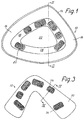
- the breast prosthesis 10 seen from the back (the proximal side) in Figs. 1-2 is unsymmetrical and intended for the left side; a corresponding right breast prosthesis would be symmetrical thereto.
- the prosthesis 10 is shaped approximately as an obtuse-angled triangle with the obtuse angle turning upwards, all angles being rounded and the sides being faintly convex.
- the polyurethane cover has been extended so as to form a narrow flap 14 consisting of two layers glued and/or welded together in order to prevent the cover from being torn adjacent the edge.
- the peripheral portion of the prosthesis 10 is a lip 16 constituting (except for the flap 14) the entire border area of the prosthesis.
- the prosthesis may have a ventilation, not shown, to interchange air between that part of the body covered by the prosthesis and surroundings without provoking unpleasant sounds.
- the ventilation is preferably placed in the laterally outermost part of the prosthesis.
- the lip 16 is adapted to bear tightly in its entirety against the skin of the wearer, especially along the upper side of the prosthesis. This is attained partly by virtue of the flexibility of the prosthesis material and partly because the areas 20 of attachment members for attaching the prosthesis to the slab are situated at a certain distance from a base surface defined by the outer periphery of the lip 16 (or flap 14). This base surface may be plane but is preferably faintly curved corresponding to the curvature of the human body in the sternum area.
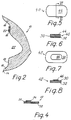
- the areas 20 of attachment members are, e.g. by sealing with a strong sealant, placed on a surface hereinafter called ledge 18, which in the embodiment shown is positioned approximately 15 mm from the above mentioned base surface in the upper part of the prosthesis and approximately 10 mm from there in the lower part of the prosthesis, see Fig. 2.
- the ledge 18 is annular and encircles a cavity 22; but especially in small prostheses it is preferably an uninterrupted plane surface so that the prosthesis is solid between the ledge and its front side.
- the ledge may be oblique relative to said base surface but it may also be parallel thereto. The distance of the ledge from the base surface and hence the width of the lip 16 depends, i.a., on the size of the prosthesis and the kind of attachment members, but should ensure a certain pre-stressing of the lip when the attachment members are engaging each other.
- the distance of the ledge to the base surface must be at least 5 mm and, at least in the upper part, preferably at least 10 mm, in both cases plus the total thickness of the attachment members in their locked position.
- the combination of the distance of the ledge from the base surface and the resiliency of the lip will ensure that there will occur no gap between the prosthesis and the body of the wearer during movements of the body and arms.
- the attachment members are areas 20 with hooks of the hook-and-loop type closure, in the embodiment shown in Fig. 1 six areas, arranged at a mutual distance in an arcuate pattern on the ledge 18 near its transition into the lip 16; seen as a whole they are mainly parallel to the sides forming the obtuse angle.
- the distance between the individual pieces of closure needs only be a few mm but should preferably be at least 7 mm; thereby the ability of the prosthesis (the silicone rubber) to yield between the unelastic and non-stretchable (but bendable) pieces of hook-and-loop type closure will prevent unpleasant feelings of stretching and tension in the skin, e.g. due to vigorous upwards or backwards movements in the shoulder since, as explained above, the prosthesis is resiliently stretchable.
- the number of attachment areas 20 depends on the size and weight of the prosthesis and of the size of the areas 20.
- the areas 20 are preferably at most 2.8 cm long and 1.8 cm wide so as to allow for the necessary mutual distance, especially at the upper part of a small prosthesis.
- a preferred size of areas 20 of hooks may be about 1.5x1.5 cm to about 1.5x2.5 cm.
- Horizontally placed closure areas 20 may, however, have a length of up to 4 cm.
- the slab 12 for attachment of the prosthesis shown in Figs. 1-2 is shown from the front in Fig. 3 and in section in Fig. 4 (where the thickness is exaggerated relative to the other dimensions). It consists of a skin flange 30 having a detachable protective cover 32 on the back thereof and a number of areas 34 of loops of a hook-and-loop closure on the front thereof.
- the skin flange 30 is made from
- the skin flange 30 is somewhat bigger than necessary to accomodate the attachment members, viz. to ensure a sufficiently large sealing area.
- the areas 20 and 34 of the closure do not need to be rectangular as shown in Figs. 1 and 3; they might as well be, e.g., elliptical or circular.
- each small slab 40,42 corresponds to an area 20 of hook part of the hook-and-loop closure.
- the small slabs 40 and 42 are placed by the wearer in a pattern corresponding to that of the areas 20. They are shown as being elliptical, which would be suitable for use for a prosthesis with areas 20 as shown in Fig. 1, but it is obvious for those skilled in the art to decide which shape and size to select for use in combination with any given embodiment of a prosthesis made according to the present invention.
- the small slab 40 is rectangular (with rounded angles) to elliptical and consists (see Fig. 6) of a piece of "Curagard” or other skin-barrier material provided at the back side with a protective cover 32 and at the entire front side with a layer of textile material 44, e.g. flannel, serving as the loop part of the hook-and-loop closure.
- a piece of "Curagard” or other skin-barrier material provided at the back side with a protective cover 32 and at the entire front side with a layer of textile material 44, e.g. flannel, serving as the loop part of the hook-and-loop closure.
- the small slab 42 has a similar shape but differs from the slab 40 in that a layer of textile material 46 does not cover the entire front side of the skin-barrier but only the middle part thereof.
- the areas of skin-barrier not covered by the textile material is protected by an elastic, non-adhesive water-impervious film as referred to earlier. If the skin-barrier used is adhesive on both sides (ignoring the protective cover 32) the areas of skin-barrier not covered by the textile material 46 may be protected by a protective cover similar to that on the back side.
- the hooks of the closure on the prosthesis and the loops on the slab or slabs in order to prevent the hooks from being caught in underwear or bed linen when the prosthesis is dismounted and the slab(s) remain on the body. If the prosthesis is very small and the distance between the slab(s) and the ledge 18 minimal, the hooks might cause discomfort by coming into contact with the skin. If so, the arrangement might be opposite but then it will be most expedient to protect the skin with a special plaster or to enlarge the total slab area.
Landscapes
- Health & Medical Sciences (AREA)
- Cardiology (AREA)
- Oral & Maxillofacial Surgery (AREA)
- Transplantation (AREA)
- Engineering & Computer Science (AREA)
- Biomedical Technology (AREA)
- Heart & Thoracic Surgery (AREA)
- Vascular Medicine (AREA)
- Life Sciences & Earth Sciences (AREA)
- Animal Behavior & Ethology (AREA)
- General Health & Medical Sciences (AREA)
- Public Health (AREA)
- Veterinary Medicine (AREA)
- Prostheses (AREA)
- Corsets Or Brassieres (AREA)
Applications Claiming Priority (2)
| Application Number | Priority Date | Filing Date | Title |
|---|---|---|---|
| DK177289A DK177289D0 (da) | 1989-04-13 | 1989-04-13 | Brystprotese |
| DK1772/89 | 1989-04-13 |
Publications (2)
| Publication Number | Publication Date |
|---|---|
| EP0392960A1 EP0392960A1 (en) | 1990-10-17 |
| EP0392960B1 true EP0392960B1 (en) | 1993-08-11 |
Family
ID=8107941
Family Applications (1)
| Application Number | Title | Priority Date | Filing Date |
|---|---|---|---|
| EP90610023A Expired - Lifetime EP0392960B1 (en) | 1989-04-13 | 1990-04-05 | A breast prosthesis aggregate |
Country Status (7)
| Country | Link |
|---|---|
| US (1) | US5071433A (enExample) |
| EP (1) | EP0392960B1 (enExample) |
| JP (1) | JP2993999B2 (enExample) |
| AT (1) | ATE92741T1 (enExample) |
| DE (1) | DE69002671T2 (enExample) |
| DK (2) | DK177289D0 (enExample) |
| ES (1) | ES2045874T3 (enExample) |
Cited By (1)
| Publication number | Priority date | Publication date | Assignee | Title |
|---|---|---|---|---|
| CN105982371A (zh) * | 2015-02-13 | 2016-10-05 | 维珍妮国际(集团)有限公司 | 胸罩罩杯 |
Families Citing this family (62)
| Publication number | Priority date | Publication date | Assignee | Title |
|---|---|---|---|---|
| US6131575A (en) * | 1991-01-10 | 2000-10-17 | The Procter & Gamble Company | Urinary incontinence device |
| US5421831A (en) * | 1991-04-19 | 1995-06-06 | Giampapa; Vincent C. | Sub-malar facial implant |
| FR2682284A1 (fr) * | 1991-10-14 | 1993-04-16 | Dessapt Bernard | Prothese mammaire. |
| DE9114512U1 (de) * | 1991-11-14 | 1993-01-14 | "Amoena" Medizin-Orthopädie-Technik GmbH, 83064 Raubling | Brustprothese |
| ATE153846T1 (de) * | 1991-11-14 | 1997-06-15 | Amoena Med Orthopaedie Tech | Verfahren zum herstellen einer brustprothese |
| EP0588756A3 (en) * | 1992-09-17 | 1994-08-24 | Euromail Ltd | Attachment of a breast prosthesis |
| DK9493D0 (da) * | 1993-01-27 | 1993-01-27 | Euromed I S | Fixating of a breast prosthesis of mammary prosthesis to af thoracic surface |
| US5370688A (en) * | 1993-03-30 | 1994-12-06 | Spenco Medical Corporation | Encapsulated gel breast prosthesis and method of making |
| DE9306572U1 (de) * | 1993-04-30 | 1993-12-02 | "Amoena" Medizin-Orthopädie-Technik GmbH, 83064 Raubling | Brustprothese |
| DE4421516C1 (de) * | 1994-06-20 | 1995-07-27 | Helbig Gmbh & Co Orthopaedisch | Brustprothese für brustamputierte Frauen und Verfahren zu deren Herstellung |
| USD378132S (en) * | 1994-11-08 | 1997-02-18 | Strain Robert I | Breast form |
| USD383541S (en) * | 1994-11-08 | 1997-09-09 | Strain Robert I | Breast form |
| US5746222A (en) * | 1995-12-14 | 1998-05-05 | Uromed Corporation | Urinary continence device for men and method of controlling urinary incontinence by using same |
| EP0791345A1 (en) * | 1996-02-23 | 1997-08-27 | Coloplast Corporation | Attachable two-chamber breast prosthesis |
| DE29607969U1 (de) * | 1996-05-02 | 1996-06-20 | "Amoena" Medizin-Orthopädie-Technik GmbH, 83064 Raubling | Brustprothese |
| US5855606A (en) * | 1996-07-18 | 1999-01-05 | Board Of Trustees Of The University Of Arkansas | Breast prosthesis |
| US5700288A (en) * | 1996-07-18 | 1997-12-23 | The Board Of Trustees Of The University Of Arkansas | Breast prosthesis |
| USD400337S (en) | 1996-09-13 | 1998-11-03 | Spenco Medical Corporation | Breast enhancer |
| US7070620B2 (en) * | 1997-03-10 | 2006-07-04 | Miller Judith F | Hook and loop system for attaching a breast form prostheses to garments with built-in cups |
| DE29712015U1 (de) * | 1997-07-08 | 1998-11-05 | AMOENA Medizin-Orthopädie-Technik GmbH & Co., 83064 Raubling | Brustprothese |
| US6156065A (en) * | 1997-09-10 | 2000-12-05 | Board Of Trustees Of The University Of Arkansas | Natural fixation of breast prosthesis |
| US6257951B1 (en) | 1998-01-22 | 2001-07-10 | Demarco Jill R. | Reusable strapless backless bra |
| US6162250A (en) * | 1998-03-12 | 2000-12-19 | Coloplast Corporation | Self-forming partial breast prosthesis with encapsulated catalyst and a method of making the same |
| US6443986B1 (en) | 1998-03-12 | 2002-09-03 | Coloplast Corp | Self-forming prosthetic device and method of making the same |
| DE19817769A1 (de) | 1998-04-21 | 1999-11-04 | Amoena Med Orthopaedie Tech | Verfahren zum Aufbringen einer dauernd klebrig bleibenden Schicht auf die Innenseite einer Brustprothese |
| DE19838428B4 (de) * | 1998-08-24 | 2005-09-15 | F+E Gesellschaft für Bekleidungsinnovation mbH & Co. KG | Brustprothese zum Tragen in einer Büstenhaltevorrichtung |
| US6074420A (en) * | 1999-01-08 | 2000-06-13 | Board Of Trustees Of The University Of Arkansas | Flexible exint retention fixation for external breast prosthesis |
| US6283998B1 (en) * | 1999-05-13 | 2001-09-04 | Board Of Trustees Of The University Of Arkansas | Alloplastic vertebral disk replacement |
| US6203570B1 (en) * | 1999-11-24 | 2001-03-20 | John L. Baeke | Breast implant with position lock |
| CA2291332A1 (en) | 1999-12-01 | 2001-06-01 | Danny R. Pace | An external breast prosthesis support |
| US6520989B1 (en) | 2000-01-18 | 2003-02-18 | Board Of Trustees Of The University Of Arkansas | Extreme volume flexible integrity prosthesis |
| US6565604B2 (en) | 2000-12-05 | 2003-05-20 | F & E Gesellschaft Fur Bekleidungs-Innovation Gmbh & Co. Kg | Symmetrical breast prosthesis |
| DE20101174U1 (de) * | 2001-01-23 | 2002-05-29 | AMOENA Medizin-Orthopädie-Technik GmbH & Co., 83064 Raubling | Brustprothese |
| US7575596B2 (en) * | 2001-02-21 | 2009-08-18 | Amoena Medizin-Orthopädie-Technik GmbH | Two-layer external breast prosthesis with self-shaping feature and process for the manufacture thereof |
| US20070050883A1 (en) * | 2002-01-18 | 2007-03-08 | Matich Ronald D | Face mask with seal and neutralizer |
| US6755789B2 (en) * | 2002-02-05 | 2004-06-29 | Inceptio Medical Technologies, Llc | Ultrasonic vascular imaging system and method of blood vessel cannulation |
| US7806828B2 (en) * | 2002-02-05 | 2010-10-05 | Inceptio Medical Technologies, Lc | Multiplanar ultrasonic vascular sensor assembly and apparatus for movably affixing a sensor assembly to a body |
| US6857932B2 (en) * | 2002-02-14 | 2005-02-22 | Bragel International, Inc. | Breast form encased with fabric laminated thermoplastic film |
| US20040010311A1 (en) * | 2002-07-15 | 2004-01-15 | Reynolds Lora B. | Customizable integrated prosthetic nipple and areola, processes for the manufacture thereof, and breast prostheses comprising same |
| DE20215801U1 (de) | 2002-10-15 | 2003-01-16 | Thämert Orthopädische Hilfsmittel GmbH & Co. KG, 30938 Burgwedel | Brustprothese mit einer Haftschicht |
| US6875233B1 (en) * | 2003-06-10 | 2005-04-05 | Hinging breast implant | |
| US20050005345A1 (en) * | 2003-07-07 | 2005-01-13 | Hui-Mei Chen | Bra cup padding structure |
| CN1679422A (zh) * | 2004-04-07 | 2005-10-12 | 特利布兰茨公司 | 无束带胸托的连接系统 |
| DE202004007921U1 (de) | 2004-05-17 | 2005-09-22 | Amoena Medizin-Orthopädie-Technik GmbH | Brustprothese |
| DE202004011988U1 (de) * | 2004-07-30 | 2005-12-08 | Amoena Medizin-Orthopädie-Technik GmbH | Brustprothese |
| DE202005007677U1 (de) * | 2005-05-17 | 2006-09-28 | Amoena Medizin-Orthopädie-Technik GmbH | Brustprothese |
| US7914578B2 (en) * | 2005-10-24 | 2011-03-29 | Gil Vardi | Method and apparatus for expanding tissue |
| USD605767S1 (en) * | 2007-01-24 | 2009-12-08 | Dessington de Beer | Mammary prosthesis |
| CA124999S (en) * | 2007-09-07 | 2009-11-02 | Gary Pierre Lauryssen | Mammary prosthesis |
| USD604849S1 (en) * | 2007-12-06 | 2009-11-24 | Gary Pierre Lauryssen | Mammary prosthesis |
| US7753954B2 (en) * | 2008-04-11 | 2010-07-13 | American Breast Care LP | Breast prosthesis for patients with edema |
| DE202009007115U1 (de) | 2009-05-18 | 2010-06-02 | Amoena Medizin-Orthopädie-Technik GmbH | Brustprothese |
| US20110106249A1 (en) * | 2009-09-02 | 2011-05-05 | Hilton Becker | Self supporting and forming breast implant and method for forming and supporting an implant in a human body |
| US8562679B2 (en) | 2010-09-16 | 2013-10-22 | American Breat Care, LP | Three layer breast prosthesis |
| ES2409691B1 (es) * | 2012-11-16 | 2013-11-21 | Federico MAYO MARTIN | Implante mamario |
| JP2016073579A (ja) * | 2014-10-02 | 2016-05-12 | 幹矢 五十嵐 | 男性器代用器 |
| EP3085337B1 (en) | 2015-04-24 | 2022-09-14 | Sofradim Production | Prosthesis for supporting a breast structure |
| EP3398554B1 (en) | 2017-05-02 | 2025-06-25 | Sofradim Production | Prosthesis for inguinal hernia repair |
| BR102018072311A2 (pt) * | 2018-10-30 | 2020-05-26 | Pedro Alexandre Da Motta Martins | Disposição aplicada em prótese de silicone dotada de elementos de fixação |
| CN110037836B (zh) * | 2019-04-22 | 2020-05-05 | 张妙玲 | 一种贴肤仿生义乳及其制备方法 |
| US12213895B2 (en) * | 2019-10-18 | 2025-02-04 | Natural Beauty Breast Prosthesis, LLC | Breast prothesis |
| US12064330B2 (en) | 2020-04-28 | 2024-08-20 | Covidien Lp | Implantable prothesis for minimally invasive hernia repair |
Family Cites Families (6)
| Publication number | Priority date | Publication date | Assignee | Title |
|---|---|---|---|---|
| US4100621A (en) * | 1975-08-11 | 1978-07-18 | Marion Carol Ettipio | Artificial breast and nightgown incorporating same |
| DE2742394A1 (de) * | 1977-09-21 | 1979-03-29 | Maria Lohse | Brustprothese |
| JPS5716901A (en) * | 1980-06-26 | 1982-01-28 | Nitsukou Kakouzai Kk | Underwear for breast |
| DE3031223A1 (de) * | 1980-08-19 | 1982-04-01 | Bodo 3204 Nordstemmen Knoche | Brustprothese und verfahren zu ihrer herstellung |
| DE3171145D1 (en) * | 1980-12-12 | 1985-08-01 | Beiersdorf Ag | Mammary prosthesis |
| GB2202745A (en) * | 1987-03-30 | 1988-10-05 | Craig Med Prod Ltd | Attachment of external prosthesis |
-
1989
- 1989-04-13 DK DK177289A patent/DK177289D0/da not_active Application Discontinuation
-
1990
- 1990-04-05 AT AT90610023T patent/ATE92741T1/de not_active IP Right Cessation
- 1990-04-05 ES ES90610023T patent/ES2045874T3/es not_active Expired - Lifetime
- 1990-04-05 EP EP90610023A patent/EP0392960B1/en not_active Expired - Lifetime
- 1990-04-05 DK DK90610023.5T patent/DK0392960T3/da active
- 1990-04-05 DE DE90610023T patent/DE69002671T2/de not_active Expired - Fee Related
- 1990-04-12 JP JP2097430A patent/JP2993999B2/ja not_active Expired - Fee Related
- 1990-04-16 US US07/509,975 patent/US5071433A/en not_active Expired - Lifetime
Cited By (1)
| Publication number | Priority date | Publication date | Assignee | Title |
|---|---|---|---|---|
| CN105982371A (zh) * | 2015-02-13 | 2016-10-05 | 维珍妮国际(集团)有限公司 | 胸罩罩杯 |
Also Published As
| Publication number | Publication date |
|---|---|
| ATE92741T1 (de) | 1993-08-15 |
| EP0392960A1 (en) | 1990-10-17 |
| DE69002671D1 (de) | 1993-09-16 |
| DK177289D0 (da) | 1989-04-13 |
| JP2993999B2 (ja) | 1999-12-27 |
| US5071433A (en) | 1991-12-10 |
| DE69002671T2 (de) | 1993-11-25 |
| JPH02291856A (ja) | 1990-12-03 |
| ES2045874T3 (es) | 1994-01-16 |
| DK0392960T3 (da) | 1993-12-20 |
Similar Documents
| Publication | Publication Date | Title |
|---|---|---|
| US5071433A (en) | Breast prosthesis aggregate | |
| US6206864B1 (en) | Ostomy appliance with inverted triangular faceplate and non-protruding pull tabs | |
| JP3068166B2 (ja) | 人工肛門用具の凸面状アダプタ | |
| US4834731A (en) | Ostomy appliance and convex pressure ring assembly therefor | |
| US6293930B1 (en) | Low-profile ostomy faceplate with recessed coupling ring | |
| US5730736A (en) | Ostomy appliance and contoured adhesive wafer therefor | |
| US5811116A (en) | Adhesive wafer with embossed skin-contacting surface | |
| EP0790048B1 (en) | One-piece ostomy appliance with pouch and faceplate integrating convex pressure ring | |
| EP0276043B1 (en) | Ostomy appliance | |
| US5626570A (en) | Ostomy appliance belt | |
| JP4580026B2 (ja) | 瘻孔用収集容器用フランジ、瘻孔用収集容器及び瘻孔用器具 | |
| AU700851B2 (en) | Self-aligning ostomy device | |
| JPH0571260B2 (enExample) | ||
| JPH0399660A (ja) | オストミー器具 | |
| US5000748A (en) | Ostomy drainage receptacle | |
| EP0228191B1 (en) | Ostomy drainage receptacle | |
| US3495592A (en) | Enterostomy means | |
| AU712350B2 (en) | Self-supporting ostomy pouch | |
| JPH09248316A (ja) | 使い捨ておむつ | |
| US3344788A (en) | Disposable surgical drainage pouch | |
| HK1041801A1 (zh) | 用於造瘻袋的粘性襯墊 | |
| JP2020036662A (ja) | ストーマキャップ装着具 | |
| GB2388781A (en) | Restraint for use in attaching drip |
Legal Events
| Date | Code | Title | Description |
|---|---|---|---|
| PUAI | Public reference made under article 153(3) epc to a published international application that has entered the european phase |
Free format text: ORIGINAL CODE: 0009012 |
|
| AK | Designated contracting states |
Kind code of ref document: A1 Designated state(s): AT BE CH DE DK ES FR GB GR IT LI LU NL SE |
|
| 17P | Request for examination filed |
Effective date: 19910307 |
|
| 17Q | First examination report despatched |
Effective date: 19920602 |
|
| GRAA | (expected) grant |
Free format text: ORIGINAL CODE: 0009210 |
|
| AK | Designated contracting states |
Kind code of ref document: B1 Designated state(s): AT BE CH DE DK ES FR GB GR IT LI LU NL SE |
|
| REF | Corresponds to: |
Ref document number: 92741 Country of ref document: AT Date of ref document: 19930815 Kind code of ref document: T |
|
| REF | Corresponds to: |
Ref document number: 69002671 Country of ref document: DE Date of ref document: 19930916 |
|
| ITF | It: translation for a ep patent filed | ||
| ET | Fr: translation filed | ||
| REG | Reference to a national code |
Ref country code: DK Ref legal event code: T3 |
|
| REG | Reference to a national code |
Ref country code: GR Ref legal event code: FG4A Free format text: 3009512 |
|
| REG | Reference to a national code |
Ref country code: ES Ref legal event code: FG2A Ref document number: 2045874 Country of ref document: ES Kind code of ref document: T3 |
|
| EPTA | Lu: last paid annual fee | ||
| PLBE | No opposition filed within time limit |
Free format text: ORIGINAL CODE: 0009261 |
|
| STAA | Information on the status of an ep patent application or granted ep patent |
Free format text: STATUS: NO OPPOSITION FILED WITHIN TIME LIMIT |
|
| 26N | No opposition filed | ||
| EAL | Se: european patent in force in sweden |
Ref document number: 90610023.5 |
|
| ITTA | It: last paid annual fee | ||
| PGFP | Annual fee paid to national office [announced via postgrant information from national office to epo] |
Ref country code: SE Payment date: 19980416 Year of fee payment: 9 |
|
| PGFP | Annual fee paid to national office [announced via postgrant information from national office to epo] |
Ref country code: ES Payment date: 19980428 Year of fee payment: 9 Ref country code: NL Payment date: 19980428 Year of fee payment: 9 |
|
| PGFP | Annual fee paid to national office [announced via postgrant information from national office to epo] |
Ref country code: GR Payment date: 19980430 Year of fee payment: 9 |
|
| PGFP | Annual fee paid to national office [announced via postgrant information from national office to epo] |
Ref country code: CH Payment date: 19980501 Year of fee payment: 9 |
|
| PGFP | Annual fee paid to national office [announced via postgrant information from national office to epo] |
Ref country code: LU Payment date: 19980504 Year of fee payment: 9 |
|
| PGFP | Annual fee paid to national office [announced via postgrant information from national office to epo] |
Ref country code: BE Payment date: 19980609 Year of fee payment: 9 |
|
| PG25 | Lapsed in a contracting state [announced via postgrant information from national office to epo] |
Ref country code: LU Free format text: LAPSE BECAUSE OF NON-PAYMENT OF DUE FEES Effective date: 19990405 |
|
| PG25 | Lapsed in a contracting state [announced via postgrant information from national office to epo] |
Ref country code: ES Free format text: THE PATENT HAS BEEN ANNULLED BY A DECISION OF A NATIONAL AUTHORITY Effective date: 19990406 Ref country code: SE Free format text: LAPSE BECAUSE OF NON-PAYMENT OF DUE FEES Effective date: 19990406 |
|
| PG25 | Lapsed in a contracting state [announced via postgrant information from national office to epo] |
Ref country code: GR Free format text: LAPSE BECAUSE OF NON-PAYMENT OF DUE FEES Effective date: 19990430 Ref country code: CH Free format text: LAPSE BECAUSE OF NON-PAYMENT OF DUE FEES Effective date: 19990430 Ref country code: LI Free format text: LAPSE BECAUSE OF NON-PAYMENT OF DUE FEES Effective date: 19990430 Ref country code: BE Free format text: LAPSE BECAUSE OF NON-PAYMENT OF DUE FEES Effective date: 19990430 |
|
| BERE | Be: lapsed |
Owner name: COLOPLAST A/S Effective date: 19990430 |
|
| PG25 | Lapsed in a contracting state [announced via postgrant information from national office to epo] |
Ref country code: NL Free format text: LAPSE BECAUSE OF NON-PAYMENT OF DUE FEES Effective date: 19991101 |
|
| REG | Reference to a national code |
Ref country code: CH Ref legal event code: PL |
|
| NLV4 | Nl: lapsed or anulled due to non-payment of the annual fee |
Effective date: 19991101 |
|
| EUG | Se: european patent has lapsed |
Ref document number: 90610023.5 |
|
| REG | Reference to a national code |
Ref country code: GB Ref legal event code: IF02 |
|
| REG | Reference to a national code |
Ref country code: ES Ref legal event code: FD2A Effective date: 20020204 |
|
| PG25 | Lapsed in a contracting state [announced via postgrant information from national office to epo] |
Ref country code: IT Free format text: LAPSE BECAUSE OF NON-PAYMENT OF DUE FEES Effective date: 20050405 |
|
| REG | Reference to a national code |
Ref country code: GB Ref legal event code: 732E |
|
| REG | Reference to a national code |
Ref country code: FR Ref legal event code: TP |
|
| PGFP | Annual fee paid to national office [announced via postgrant information from national office to epo] |
Ref country code: DE Payment date: 20070601 Year of fee payment: 18 |
|
| PGFP | Annual fee paid to national office [announced via postgrant information from national office to epo] |
Ref country code: DK Payment date: 20070731 Year of fee payment: 18 |
|
| PGFP | Annual fee paid to national office [announced via postgrant information from national office to epo] |
Ref country code: AT Payment date: 20070731 Year of fee payment: 18 |
|
| PGFP | Annual fee paid to national office [announced via postgrant information from national office to epo] |
Ref country code: GB Payment date: 20070727 Year of fee payment: 18 |
|
| PGFP | Annual fee paid to national office [announced via postgrant information from national office to epo] |
Ref country code: FR Payment date: 20070726 Year of fee payment: 18 |
|
| REG | Reference to a national code |
Ref country code: DK Ref legal event code: EBP |
|
| GBPC | Gb: european patent ceased through non-payment of renewal fee |
Effective date: 20080405 |
|
| PG25 | Lapsed in a contracting state [announced via postgrant information from national office to epo] |
Ref country code: DE Free format text: LAPSE BECAUSE OF NON-PAYMENT OF DUE FEES Effective date: 20081101 |
|
| REG | Reference to a national code |
Ref country code: FR Ref legal event code: ST Effective date: 20081231 |
|
| PG25 | Lapsed in a contracting state [announced via postgrant information from national office to epo] |
Ref country code: AT Free format text: LAPSE BECAUSE OF NON-PAYMENT OF DUE FEES Effective date: 20080405 |
|
| PG25 | Lapsed in a contracting state [announced via postgrant information from national office to epo] |
Ref country code: DK Free format text: LAPSE BECAUSE OF NON-PAYMENT OF DUE FEES Effective date: 20080430 Ref country code: FR Free format text: LAPSE BECAUSE OF NON-PAYMENT OF DUE FEES Effective date: 20080430 |
|
| PG25 | Lapsed in a contracting state [announced via postgrant information from national office to epo] |
Ref country code: GB Free format text: LAPSE BECAUSE OF NON-PAYMENT OF DUE FEES Effective date: 20080405 |