EP0390293B1 - A process of treating metal chloride wastes - Google Patents
A process of treating metal chloride wastes Download PDFInfo
- Publication number
- EP0390293B1 EP0390293B1 EP19900200761 EP90200761A EP0390293B1 EP 0390293 B1 EP0390293 B1 EP 0390293B1 EP 19900200761 EP19900200761 EP 19900200761 EP 90200761 A EP90200761 A EP 90200761A EP 0390293 B1 EP0390293 B1 EP 0390293B1
- Authority
- EP
- European Patent Office
- Prior art keywords
- carried out
- foregoing
- range
- residue
- metals
- Prior art date
- Legal status (The legal status is an assumption and is not a legal conclusion. Google has not performed a legal analysis and makes no representation as to the accuracy of the status listed.)
- Expired - Lifetime
Links
- 238000000034 method Methods 0.000 title claims description 33
- 239000002699 waste material Substances 0.000 title claims description 31
- 229910001510 metal chloride Inorganic materials 0.000 title claims description 12
- VEXZGXHMUGYJMC-UHFFFAOYSA-N Hydrochloric acid Chemical compound Cl VEXZGXHMUGYJMC-UHFFFAOYSA-N 0.000 claims description 30
- 229910052751 metal Inorganic materials 0.000 claims description 17
- 239000002184 metal Substances 0.000 claims description 17
- 150000002739 metals Chemical class 0.000 claims description 16
- 239000007787 solid Substances 0.000 claims description 14
- 239000007788 liquid Substances 0.000 claims description 13
- VYPSYNLAJGMNEJ-UHFFFAOYSA-N Silicium dioxide Chemical compound O=[Si]=O VYPSYNLAJGMNEJ-UHFFFAOYSA-N 0.000 claims description 12
- 239000000571 coke Substances 0.000 claims description 10
- RTAQQCXQSZGOHL-UHFFFAOYSA-N Titanium Chemical compound [Ti] RTAQQCXQSZGOHL-UHFFFAOYSA-N 0.000 claims description 7
- 239000010936 titanium Substances 0.000 claims description 7
- 229910052719 titanium Inorganic materials 0.000 claims description 7
- 235000008733 Citrus aurantifolia Nutrition 0.000 claims description 6
- 235000011941 Tilia x europaea Nutrition 0.000 claims description 6
- 238000005660 chlorination reaction Methods 0.000 claims description 6
- 239000004571 lime Substances 0.000 claims description 6
- 239000002244 precipitate Substances 0.000 claims description 6
- 238000000926 separation method Methods 0.000 claims description 6
- 239000002002 slurry Substances 0.000 claims description 6
- 238000002386 leaching Methods 0.000 claims description 5
- 230000003472 neutralizing effect Effects 0.000 claims description 5
- 239000000377 silicon dioxide Substances 0.000 claims description 5
- 239000003795 chemical substances by application Substances 0.000 claims description 4
- 230000001376 precipitating effect Effects 0.000 claims description 4
- 238000001914 filtration Methods 0.000 claims description 3
- 150000004679 hydroxides Chemical class 0.000 claims description 3
- 238000001354 calcination Methods 0.000 claims description 2
- 238000001704 evaporation Methods 0.000 claims description 2
- 230000008020 evaporation Effects 0.000 claims description 2
- 229910000000 metal hydroxide Inorganic materials 0.000 claims description 2
- 150000004692 metal hydroxides Chemical class 0.000 claims description 2
- 238000006386 neutralization reaction Methods 0.000 claims description 2
- 239000000243 solution Substances 0.000 description 19
- XEEYBQQBJWHFJM-UHFFFAOYSA-N iron Substances [Fe] XEEYBQQBJWHFJM-UHFFFAOYSA-N 0.000 description 12
- GWEVSGVZZGPLCZ-UHFFFAOYSA-N Titan oxide Chemical compound O=[Ti]=O GWEVSGVZZGPLCZ-UHFFFAOYSA-N 0.000 description 10
- ODINCKMPIJJUCX-UHFFFAOYSA-N Calcium oxide Chemical compound [Ca]=O ODINCKMPIJJUCX-UHFFFAOYSA-N 0.000 description 8
- 229910052742 iron Inorganic materials 0.000 description 7
- 229910001385 heavy metal Inorganic materials 0.000 description 5
- 239000000292 calcium oxide Substances 0.000 description 4
- 235000012255 calcium oxide Nutrition 0.000 description 4
- 229910052804 chromium Inorganic materials 0.000 description 4
- 239000011651 chromium Substances 0.000 description 4
- 229910052758 niobium Inorganic materials 0.000 description 4
- 239000010955 niobium Substances 0.000 description 4
- 229910052720 vanadium Inorganic materials 0.000 description 4
- 229910052726 zirconium Inorganic materials 0.000 description 4
- CWYNVVGOOAEACU-UHFFFAOYSA-N Fe2+ Chemical compound [Fe+2] CWYNVVGOOAEACU-UHFFFAOYSA-N 0.000 description 3
- 239000012535 impurity Substances 0.000 description 3
- 229910052748 manganese Inorganic materials 0.000 description 3
- 239000011572 manganese Substances 0.000 description 3
- 238000001556 precipitation Methods 0.000 description 3
- VEXZGXHMUGYJMC-UHFFFAOYSA-M Chloride anion Chemical compound [Cl-] VEXZGXHMUGYJMC-UHFFFAOYSA-M 0.000 description 2
- ZAMOUSCENKQFHK-UHFFFAOYSA-N Chlorine atom Chemical compound [Cl] ZAMOUSCENKQFHK-UHFFFAOYSA-N 0.000 description 2
- 235000019738 Limestone Nutrition 0.000 description 2
- 239000003929 acidic solution Substances 0.000 description 2
- 238000006243 chemical reaction Methods 0.000 description 2
- 239000002894 chemical waste Substances 0.000 description 2
- 229910052801 chlorine Inorganic materials 0.000 description 2
- 239000000460 chlorine Substances 0.000 description 2
- 239000010459 dolomite Substances 0.000 description 2
- 229910000514 dolomite Inorganic materials 0.000 description 2
- 238000002474 experimental method Methods 0.000 description 2
- 239000000706 filtrate Substances 0.000 description 2
- 238000005188 flotation Methods 0.000 description 2
- FBAFATDZDUQKNH-UHFFFAOYSA-M iron chloride Chemical compound [Cl-].[Fe] FBAFATDZDUQKNH-UHFFFAOYSA-M 0.000 description 2
- 238000005304 joining Methods 0.000 description 2
- 239000006028 limestone Substances 0.000 description 2
- 229910052749 magnesium Inorganic materials 0.000 description 2
- 239000004408 titanium dioxide Substances 0.000 description 2
- 238000005406 washing Methods 0.000 description 2
- VYZAMTAEIAYCRO-UHFFFAOYSA-N Chromium Chemical compound [Cr] VYZAMTAEIAYCRO-UHFFFAOYSA-N 0.000 description 1
- 229910021577 Iron(II) chloride Inorganic materials 0.000 description 1
- 229910010066 TiC14 Inorganic materials 0.000 description 1
- 229910003074 TiCl4 Inorganic materials 0.000 description 1
- QCWXUUIWCKQGHC-UHFFFAOYSA-N Zirconium Chemical compound [Zr] QCWXUUIWCKQGHC-UHFFFAOYSA-N 0.000 description 1
- 230000002378 acidificating effect Effects 0.000 description 1
- QVGXLLKOCUKJST-UHFFFAOYSA-N atomic oxygen Chemical compound [O] QVGXLLKOCUKJST-UHFFFAOYSA-N 0.000 description 1
- 238000011021 bench scale process Methods 0.000 description 1
- 229910000019 calcium carbonate Inorganic materials 0.000 description 1
- 150000001805 chlorine compounds Chemical class 0.000 description 1
- 239000004927 clay Substances 0.000 description 1
- 229910052681 coesite Inorganic materials 0.000 description 1
- 239000012141 concentrate Substances 0.000 description 1
- 238000001816 cooling Methods 0.000 description 1
- 229910052906 cristobalite Inorganic materials 0.000 description 1
- 239000002283 diesel fuel Substances 0.000 description 1
- 238000010790 dilution Methods 0.000 description 1
- 239000012895 dilution Substances 0.000 description 1
- 238000004090 dissolution Methods 0.000 description 1
- 230000000694 effects Effects 0.000 description 1
- 239000012065 filter cake Substances 0.000 description 1
- 238000010438 heat treatment Methods 0.000 description 1
- 239000004615 ingredient Substances 0.000 description 1
- NMCUIPGRVMDVDB-UHFFFAOYSA-L iron dichloride Chemical compound Cl[Fe]Cl NMCUIPGRVMDVDB-UHFFFAOYSA-L 0.000 description 1
- UQSXHKLRYXJYBZ-UHFFFAOYSA-N iron oxide Inorganic materials [Fe]=O UQSXHKLRYXJYBZ-UHFFFAOYSA-N 0.000 description 1
- 235000013980 iron oxide Nutrition 0.000 description 1
- VBMVTYDPPZVILR-UHFFFAOYSA-N iron(2+);oxygen(2-) Chemical class [O-2].[Fe+2] VBMVTYDPPZVILR-UHFFFAOYSA-N 0.000 description 1
- 239000011777 magnesium Substances 0.000 description 1
- 229910000021 magnesium carbonate Inorganic materials 0.000 description 1
- 150000002697 manganese compounds Chemical class 0.000 description 1
- 238000004519 manufacturing process Methods 0.000 description 1
- 239000000463 material Substances 0.000 description 1
- 238000005259 measurement Methods 0.000 description 1
- 150000002736 metal compounds Chemical class 0.000 description 1
- 239000010814 metallic waste Substances 0.000 description 1
- 239000000203 mixture Substances 0.000 description 1
- GUCVJGMIXFAOAE-UHFFFAOYSA-N niobium atom Chemical compound [Nb] GUCVJGMIXFAOAE-UHFFFAOYSA-N 0.000 description 1
- 229910052760 oxygen Inorganic materials 0.000 description 1
- 239000001301 oxygen Substances 0.000 description 1
- 239000000047 product Substances 0.000 description 1
- 238000000746 purification Methods 0.000 description 1
- 238000010791 quenching Methods 0.000 description 1
- 230000000171 quenching effect Effects 0.000 description 1
- 150000003839 salts Chemical class 0.000 description 1
- 238000005070 sampling Methods 0.000 description 1
- 239000011343 solid material Substances 0.000 description 1
- 239000002910 solid waste Substances 0.000 description 1
- 229910052682 stishovite Inorganic materials 0.000 description 1
- 239000000126 substance Substances 0.000 description 1
- XJDNKRIXUMDJCW-UHFFFAOYSA-J titanium tetrachloride Chemical compound Cl[Ti](Cl)(Cl)Cl XJDNKRIXUMDJCW-UHFFFAOYSA-J 0.000 description 1
- 229910052905 tridymite Inorganic materials 0.000 description 1
- GPPXJZIENCGNKB-UHFFFAOYSA-N vanadium Chemical compound [V]#[V] GPPXJZIENCGNKB-UHFFFAOYSA-N 0.000 description 1
- XLYOFNOQVPJJNP-UHFFFAOYSA-N water Substances O XLYOFNOQVPJJNP-UHFFFAOYSA-N 0.000 description 1
Images
Classifications
-
- C—CHEMISTRY; METALLURGY
- C22—METALLURGY; FERROUS OR NON-FERROUS ALLOYS; TREATMENT OF ALLOYS OR NON-FERROUS METALS
- C22B—PRODUCTION AND REFINING OF METALS; PRETREATMENT OF RAW MATERIALS
- C22B7/00—Working up raw materials other than ores, e.g. scrap, to produce non-ferrous metals and compounds thereof; Methods of a general interest or applied to the winning of more than two metals
- C22B7/02—Working-up flue dust
-
- Y—GENERAL TAGGING OF NEW TECHNOLOGICAL DEVELOPMENTS; GENERAL TAGGING OF CROSS-SECTIONAL TECHNOLOGIES SPANNING OVER SEVERAL SECTIONS OF THE IPC; TECHNICAL SUBJECTS COVERED BY FORMER USPC CROSS-REFERENCE ART COLLECTIONS [XRACs] AND DIGESTS
- Y02—TECHNOLOGIES OR APPLICATIONS FOR MITIGATION OR ADAPTATION AGAINST CLIMATE CHANGE
- Y02P—CLIMATE CHANGE MITIGATION TECHNOLOGIES IN THE PRODUCTION OR PROCESSING OF GOODS
- Y02P10/00—Technologies related to metal processing
- Y02P10/20—Recycling
Definitions
- the present invention relates to a process of treating metal chloride wastes produced by chlorination of titanium ore.
- the present invention relates to a process of treating metal chloride wastes which are produced as chlorinator blow-over from carbo-chlorination of titanium dioxide ore in a fluidized bed.
- said chlorinator blow-over will comprise chlorides of several heavy metals such as Cr, V, Nb and Zr.
- Usually other metals like AI, Mn and Fe are present as well.
- iron chloride is the main metal chloride component and it is predominantly present as FeCl 2 .
- Treating of said waste comprises contacting the waste with neutralizing agents such as limestone, dolomite limestone, dolomite, CaC0 3 or MgC0 3 at a relatively high temperature of more than 100 °C wherein the treatment reaction is carried out in a molten bath of CaC1 2 .xH 2 0 (x ranges from 3 to 6). Finally the resulting iron oxides are separated from the CaCI 2 .xH 2 0. Moreover a stable non-leaching material is obtained which is less water permeable than clay and can be placed in a land-fill.
- neutralizing agents such as limestone, dolomite limestone, dolomite, CaC0 3 or MgC0 3
- the invention therefore provides a process of treating metal chloride wastes produced by chlorination of titanium ore, comprising the steps of:
- the process step (c) in accordance with the invention is carried out at a pH in the range of from 3 to 8, particularly 3.5 to 4, at a temperature in the range of from 60 to 80 °C, and by adding a lime slurry.
- step (a) is carried out at a temperature in the range of from 65 to 95 °C and at a HCI-concentration in the range of from 2 to 60 g/I.
- spent scrubber liquors generated in the titanium dioxide process can be employed, i.e. spent HCI to leach the blow-over and spent lime to neutralize the leach liquor.
- step (b) Another advantage lies in separating by filtrating, to be carried out respectively in step (b) and step (d).
- the invention further provides an additional step wherein the residue obtained in step (b) is treated, resulting in a separation of coke from ore and silica.
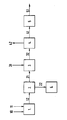
- blocks 1 to 6 represent subsequent process steps as carried out in the process in accordance with the invention and arrows 10 to 51 represent streams previous or subsequent to the above steps.
- titanium ore Prior to the process of treating metal chloride wastes in accordance with the invention titanium ore is carbo- chlorinated in a fluidized bed with coke and chlorine to give TiCl 4 : Most impurities in the ore are also chlorinated to a large extent. In the second stage TiC1 4 , after purification, is oxidized with oxygen to give raw Ti0 2 and chlorine:
- the main waste stream to be treated is the so-called blow-over from the chlorinator, which contains fine ore (mainly Ti0 2 and Si0 2 ), coke and condensed impurity metal chlorides.
- Iron is the main impurity, but heavy metals such as chromium, vanadium, niobium and zirconium are also present to a significant extent.
- said waste stream together with a hydrochloric acid solution stream are supplied to a tank for leaching said waste stream in a leaching step (a) schematically shown by block 1 in the figure.
- a solution containing solids and dissolved metals is obtained. It has appeared that a solution well adapted for further treatment is obtained when the chlorinator blow over waste stream and said hydrochloric acid solution both at their own temperatures are joined, thereby quenching said waste stream 10 resulting in a temperature equilibrium regime, and eliminating the need for cooling or heating.
- step (a) substantially all metal compounds are leached.
- spent scrubber liquor might be used advantageously, both saving on fresh hydrochloric acid and further treating an additional waste stream generated in the Ti0 2 -production, containing heavy metals.
- step (b) The solution obtained in the above step (a) is supplied to a solid/liquid separator, e.g. a filter arrangement, as indicated by an arrow 12.
- a solid/liquid separator e.g. a filter arrangement
- step (b) consequently comprises separating said dissolved metals from solids, present in the said solution, resulting in a separated liquid stream 21 and a residue stream 22.
- Said stream 21 is an acidic solution of the above metals while the solid residue stream 22 comprising coke, ore and silica can be further treated in a step represented by means of block 6.
- step (c) for precipitating the plurality of the said metals which had been dissolved by adding a neutralizing agent to said acidic solution from step (b), said step (c) being represented by means of block 3 in the figure.
- a basic slurry or solution 31 e.g. a lime slurry
- the slurry advantageously comprises quicklime resulting ultimately in neutralizing all free HCI.
- a precipitation of the bulk of the metals in the form of hydroxides of said metals is obtained.
- Particularly joining of the lime stream 31 and the liquid stream 21 in a solution with predetermined pH-value has resulted in well filterable precipitates 32.
- Step (d) results on the one side in an effluent stream 42, comprising i.a. Ca, Mg and Mn salts and a portion of the iron content (as Fe(II)) originally present in the ore to be treated, and on the other side in a solid material 41, e.g. obtained as a filter cake if step (d) is a filtrating process.
- Said cake 41 is dewatered in a next step (e) and the dewatered residue stream could be stored for example in a chemical waste dump.
- Step (e) and said residue stream are represented in the figure as block 5 and stream 51.
- said dewatering is carried out by evaporation or by calcination.
- both separation steps (b) and (d) can be supplied with washing operations, thereby respectively further separating leavings of solid coke, ore and silica compounds, and further separating earthalkaline and manganese compounds.
- example 1 results are shown which illustrate the leach efficiency of an exemplifying hydrochloric acid solution.
- table I analysis results of leach step (a) are shown for a waste sample containing pro rate a great amount of titanium ore.
- stream 11 usually being a continuous spent liquor, was a 50 g/I HCI solution.
- Aleaching period of 1 hour and an operating temperature of 80 °C were used, the latter being a suitable average resulting from joining the high temperature blow-over and the supplied HCI solution with respective solid/liquid ratio of 1:4 (m/m) in a 0.5 I reaction vessel.
- Example 2 results are shown which illustrate the precipitation efficiency as resulting from step (c).
- Table II gives the chemical composition of two samples used which represent usual chloride solutions, as obtained by chlorinating a synthetic rutile containing 92.5% Ti0 2 and a natural rutile containing 95.2% Ti0 2 .
- a 12% (m/m) quicklime stream, a pH-value of 3.75, an operating temperature of 70 °C and a residence time of 1 hour were used in a 10 I continuous stirred tank reactor (CSTR).
- CSTR continuous stirred tank reactor
- Example 3 results are shown which illustrate another aspect of the precipitating efficiency as resulting from step (c) for the case the precipitate is filtrated.
- table III metal removal efficiencies are compared for filtrates obtained from solutions treated at different pH-values.
- the starting chloride solutions as used were obtained from a 92.0% (m/m) Ti0 2 -ore with 80% of the iron added as Fe(II).
- Step (c) was carried out at an operating temperature of 70 °C over an average residence time of 0.5 hour and pH control with a 12% (m/m) quicklime slurry. The experiments were carried out in a 0.5 I CSTR.
- step (a) in a spent liquor comprising solids in a range of from 4 to 30% (m/m).
- step (a) is carried out advantageously at a temperature of 80 °C in a 50 g/I HCI solution comprising 20% (m/m) solids.
- step (c) is carried out advantageously by adding a 12% (m/m) quicklime stream at pH-values between 3.5 and 4 and a temperature of 70 °C.
- the residence times as disclosed are only indicative since the process in accordance with the invention is carried out continuously.
- the said solid residue stream 22, comprising mainly coke and ore, and in the remaining part a minor portion of silica, is treated further in a flotation step carried out in flotation cells having volumes up to 2.5 I.
- a coke concentrate can be floated off thereby separating and recovering substantially all the coke.
- step (d) the previous neutralization has to involve the creation of a precipitate with a good filterability. Besides the selection of the advantageous pH-values also settling rates are of great importance.
- step (b) and/or step (d) could further improve the overall removal results and concentration of metals in the final residue.
Landscapes
- Engineering & Computer Science (AREA)
- Chemical & Material Sciences (AREA)
- Geology (AREA)
- Life Sciences & Earth Sciences (AREA)
- General Life Sciences & Earth Sciences (AREA)
- Manufacturing & Machinery (AREA)
- Environmental & Geological Engineering (AREA)
- Materials Engineering (AREA)
- Mechanical Engineering (AREA)
- Metallurgy (AREA)
- Organic Chemistry (AREA)
- Manufacture And Refinement Of Metals (AREA)
- Processing Of Solid Wastes (AREA)
Description
- The present invention relates to a process of treating metal chloride wastes produced by chlorination of titanium ore.
- Particularly the present invention relates to a process of treating metal chloride wastes which are produced as chlorinator blow-over from carbo-chlorination of titanium dioxide ore in a fluidized bed. Generally said chlorinator blow-over will comprise chlorides of several heavy metals such as Cr, V, Nb and Zr. Usually other metals like AI, Mn and Fe are present as well. In most practical cases iron chloride is the main metal chloride component and it is predominantly present as FeCl2.
- It will be clear that effluent waste streams composed as mentioned above are a serious threat to the natural environment if disposed as such. Therefore such waste streams have to be treated carefully.
- In this technical field a process of treating iron chloride waste, as produced by chlorination of titanium ore, is known. Treating of said waste comprises contacting the waste with neutralizing agents such as limestone, dolomite limestone, dolomite, CaC03 or MgC03 at a relatively high temperature of more than 100 °C wherein the treatment reaction is carried out in a molten bath of CaC12.xH20 (x ranges from 3 to 6). Finally the resulting iron oxides are separated from the CaCI2.xH20. Moreover a stable non-leaching material is obtained which is less water permeable than clay and can be placed in a land-fill.
- However, many problems remain. As mentioned above not only iron waste could be expected. Furthermore legal land fill regulations tend to be tightened up thereby also necessitating treating processes which involve removal of several waste products.
- Thus, it is an object of the invention to improve such a waste treating process, resulting in a minimal solid waste quantity by selectively concentrating said heavy metals, further to be dumped on a chemical waste site.
- It is a further object of the invention to accomplish a waste treating process adapted to treat multi metal chloride wastes.
- It is another object of the invention to accomplish a process of treating metal chloride wastes which can be carried out more economically in process steps which only require moderate thermal conditions.
- The invention therefore provides a process of treating metal chloride wastes produced by chlorination of titanium ore, comprising the steps of:
- (a) leaching said metal chloride wastes in a hydrochloric acid (HCI)-containing solution to obtain a solution containing solids and dissolved metals,
- (b) separating said dissolved metals from said solids present in the solution obtained in step (a) to obtain a liquid and a residue,
- (c) selectively precipitating the metals as their hydroxides by adding a neutralizing agent to the liquid obtained in step (b),
- (d) separating the precipitate of metal hydroxides obtained in step (c) from the liquid to obtain a residue, and
- (e) dewatering the residue obtained in step (d).
- Advantageously the process step (c) in accordance with the invention is carried out at a pH in the range of from 3 to 8, particularly 3.5 to 4, at a temperature in the range of from 60 to 80 °C, and by adding a lime slurry.
- Furthermore it is advantageous that step (a) is carried out at a temperature in the range of from 65 to 95 °C and at a HCI-concentration in the range of from 2 to 60 g/I.
- Moreover, spent scrubber liquors generated in the titanium dioxide process can be employed, i.e. spent HCI to leach the blow-over and spent lime to neutralize the leach liquor.
- Another advantage lies in separating by filtrating, to be carried out respectively in step (b) and step (d). The invention further provides an additional step wherein the residue obtained in step (b) is treated, resulting in a separation of coke from ore and silica.
- The invention will now be described by way of example in more detail with reference to the accompanying drawing wherein the only figure shows a scheme of the process in accordance with the invention.
- Referring to the
above figure blocks 1 to 6 represent subsequent process steps as carried out in the process in accordance with the invention andarrows 10 to 51 represent streams previous or subsequent to the above steps. - Prior to the process of treating metal chloride wastes in accordance with the invention titanium ore is carbo- chlorinated in a fluidized bed with coke and chlorine to give TiCl4:


- The main waste stream to be treated is the so-called blow-over from the chlorinator, which contains fine ore (mainly Ti02 and Si02), coke and condensed impurity metal chlorides. Iron is the main impurity, but heavy metals such as chromium, vanadium, niobium and zirconium are also present to a significant extent.
- In accordance with the invention said waste stream together with a hydrochloric acid solution stream, respectively referenced by
arrows block 1 in the figure. Thereby a solution containing solids and dissolved metals is obtained. It has appeared that a solution well adapted for further treatment is obtained when the chlorinator blow over waste stream and said hydrochloric acid solution both at their own temperatures are joined, thereby quenching saidwaste stream 10 resulting in a temperature equilibrium regime, and eliminating the need for cooling or heating. In said step (a) substantially all metal compounds are leached. - In an alternative embodiment instead of said hydrochloric acid (HCI)-containing solution spent scrubber liquor might be used advantageously, both saving on fresh hydrochloric acid and further treating an additional waste stream generated in the Ti02-production, containing heavy metals.
- The solution obtained in the above step (a) is supplied to a solid/liquid separator, e.g. a filter arrangement, as indicated by an
arrow 12. The next step (b), represented byblock 2 in the figure, consequently comprises separating said dissolved metals from solids, present in the said solution, resulting in a separatedliquid stream 21 and aresidue stream 22. - Said
stream 21 is an acidic solution of the above metals while thesolid residue stream 22 comprising coke, ore and silica can be further treated in a step represented by means ofblock 6. - Next said
liquid stream 21 is subjected to a step (c) for precipitating the plurality of the said metals which had been dissolved by adding a neutralizing agent to said acidic solution from step (b), said step (c) being represented by means ofblock 3 in the figure. - Particularly in step (c) a basic slurry or
solution 31, e.g. a lime slurry, is added to saidliquid stream 21. The slurry advantageously comprises quicklime resulting ultimately in neutralizing all free HCI. Thereby a precipitation of the bulk of the metals in the form of hydroxides of said metals is obtained. Particularly joining of thelime stream 31 and theliquid stream 21 in a solution with predetermined pH-value has resulted in wellfilterable precipitates 32. - After the separation from the liquid said
precipitate stream 32 is processed in a next step (d) represented byblock 4 in the figure. Step (d) results on the one side in aneffluent stream 42, comprising i.a. Ca, Mg and Mn salts and a portion of the iron content (as Fe(II)) originally present in the ore to be treated, and on the other side in asolid material 41, e.g. obtained as a filter cake if step (d) is a filtrating process. Saidcake 41 is dewatered in a next step (e) and the dewatered residue stream could be stored for example in a chemical waste dump. Step (e) and said residue stream are represented in the figure asblock 5 andstream 51. Advantageously said dewatering is carried out by evaporation or by calcination. - In a further embodiment of the above waste treatment process both separation steps (b) and (d) can be supplied with washing operations, thereby respectively further separating leavings of solid coke, ore and silica compounds, and further separating earthalkaline and manganese compounds.
- To further elucidate the above processes three examples will be shown, which result from bench scale experiments.
- In example 1 results are shown which illustrate the leach efficiency of an exemplifying hydrochloric acid solution. In table I analysis results of leach step (a) are shown for a waste sample containing pro rate a great amount of titanium ore. In this
case stream 11, usually being a continuous spent liquor, was a 50 g/I HCI solution. Aleaching period of 1 hour and an operating temperature of 80 °C were used, the latter being a suitable average resulting from joining the high temperature blow-over and the supplied HCI solution with respective solid/liquid ratio of 1:4 (m/m) in a 0.5 I reaction vessel.
- The above results clearly show that coke, ore and silica were not leached at all. It has to be noticed that the negative numbers are due to calibration and accuracy effects in the sampling and measurement practice as employed. The dissolution of AI, Cr, Fe, Mg, Mn and V can be considered as complete or almost complete, while Nb and Zr were not entirely leached.
- In example 2 results are shown which illustrate the precipitation efficiency as resulting from step (c). Table II gives the chemical composition of two samples used which represent usual chloride solutions, as obtained by chlorinating a synthetic rutile containing 92.5% Ti02 and a natural rutile containing 95.2% Ti02. A 12% (m/m) quicklime stream, a pH-value of 3.75, an operating temperature of 70 °C and a residence time of 1 hour were used in a 10 I continuous stirred tank reactor (CSTR). As a detail it may be noticed that 80% of the iron was added as Fe(II) and that the dilution factor caused by the lime addition was 0.73.
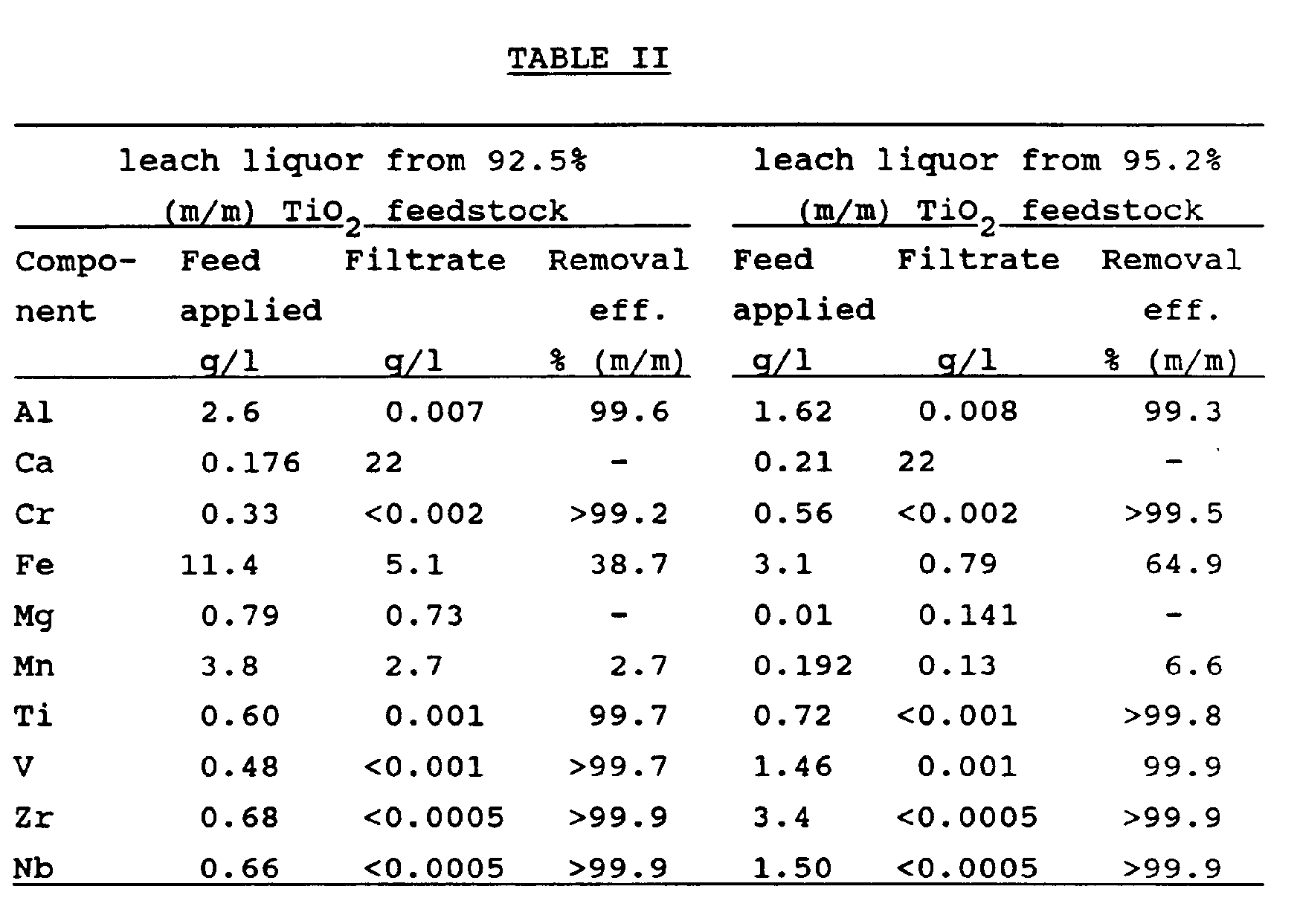
- The above results clearly show a selective removal of the vast majority of in particular the heavy waste metals Cr, V, Nb and Zr as present in the blow-over waste stream.
- In example 3 results are shown which illustrate another aspect of the precipitating efficiency as resulting from step (c) for the case the precipitate is filtrated. In table III metal removal efficiencies are compared for filtrates obtained from solutions treated at different pH-values. The starting chloride solutions as used were obtained from a 92.0% (m/m) Ti02-ore with 80% of the iron added as Fe(II). Step (c) was carried out at an operating temperature of 70 °C over an average residence time of 0.5 hour and pH control with a 12% (m/m) quicklime slurry. The experiments were carried out in a 0.5 I CSTR.

- The above results show filtrates containing less heavy metals at increasing pH-values. In accordance with example 2 the majority of the heavy waste metals is separated from the waste stream as produced by chlorination of the above-mentioned titanium ore.
- From the above findings it can be concluded that for satisfactory treatment of said metal wastes optimal conditions and operating ranges for the subsequent steps have to be selected as disclosed above. For example, it is preferred to carry out step (a) in a spent liquor comprising solids in a range of from 4 to 30% (m/m). The above examples reveal that step (a) is carried out advantageously at a temperature of 80 °C in a 50 g/I HCI solution comprising 20% (m/m) solids. The crucial precipitation in step (c) is carried out advantageously by adding a 12% (m/m) quicklime stream at pH-values between 3.5 and 4 and a temperature of 70 °C. The residence times as disclosed are only indicative since the process in accordance with the invention is carried out continuously.
- In a further embodiment the said
solid residue stream 22, comprising mainly coke and ore, and in the remaining part a minor portion of silica, is treated further in a flotation step carried out in flotation cells having volumes up to 2.5 I. By conventionally using a frother component and diesel oil as collector in a slightly acidic pulp feed containing said ingredients, a coke concentrate can be floated off thereby separating and recovering substantially all the coke. - It will be clear to skilled persons that in the case of the filtration in step (d) the previous neutralization has to involve the creation of a precipitate with a good filterability. Besides the selection of the advantageous pH-values also settling rates are of great importance.
- Moreover an additional washing step included in step (b) and/or step (d) could further improve the overall removal results and concentration of metals in the final residue.
Claims (13)
Applications Claiming Priority (2)
| Application Number | Priority Date | Filing Date | Title |
|---|---|---|---|
| GB8907163 | 1989-03-30 | ||
| GB8907163A GB8907163D0 (en) | 1989-03-30 | 1989-03-30 | A process of treating metal chloride wastes |
Publications (3)
| Publication Number | Publication Date |
|---|---|
| EP0390293A1 EP0390293A1 (en) | 1990-10-03 |
| EP0390293B1 true EP0390293B1 (en) | 1993-08-11 |
| EP0390293B2 EP0390293B2 (en) | 2000-08-30 |
Family
ID=10654172
Family Applications (1)
| Application Number | Title | Priority Date | Filing Date |
|---|---|---|---|
| EP19900200761 Expired - Lifetime EP0390293B2 (en) | 1989-03-30 | 1990-03-28 | A process of treating metal chloride wastes |
Country Status (7)
| Country | Link |
|---|---|
| US (1) | US5271910A (en) |
| EP (1) | EP0390293B2 (en) |
| JP (1) | JP2848664B2 (en) |
| AU (1) | AU624691B2 (en) |
| CA (1) | CA2011855C (en) |
| DE (1) | DE69002664T3 (en) |
| GB (1) | GB8907163D0 (en) |
Families Citing this family (16)
| Publication number | Priority date | Publication date | Assignee | Title |
|---|---|---|---|---|
| US5558847A (en) * | 1991-02-05 | 1996-09-24 | Kaaber; Henning | Process for recovering aluminium and fluorine from fluorine containing waste materials |
| DE4131577C2 (en) * | 1991-09-23 | 1999-11-25 | Kronos Titan Gmbh | Process for producing landfill-capable products from metal chlorides without inert components |
| DE4243559A1 (en) * | 1992-12-22 | 1994-06-23 | Kronos Titan Gmbh | Process for the purification of a technical iron chloride solution by selective precipitation |
| US5494648A (en) * | 1994-01-31 | 1996-02-27 | The United States Of America As Represented By The Secretary Of The Interior | Process for removing thorium and recovering vanadium from titanium chlorinator waste |
| US5571489A (en) * | 1995-01-27 | 1996-11-05 | Illinois Institute Of Technology | Process for chromium recovery from aqueous solutions |
| US6328938B1 (en) * | 1996-06-03 | 2001-12-11 | Timothy L. Taylor | Manufacture of titanium dioxide with recycle of waste metal chloride stream |
| DE10111895A1 (en) * | 2001-03-13 | 2002-09-19 | Kronos Titan Gmbh & Co Ohg | Process for increasing the dry residue in processed cyclone dust |
| DE10346339A1 (en) * | 2003-10-06 | 2005-05-04 | Kerr Mcgee Pigments Gmbh | Process for working up metal chloride residues |
| RU2258752C2 (en) * | 2003-11-04 | 2005-08-20 | ООО Научно-производственная экологическая фирма "ЭКО-технология" | Method of a complex processing of a metallurgical scrap |
| US20050147472A1 (en) * | 2003-12-29 | 2005-07-07 | Alexander Samuel R. | Disposal of accumulated waste solids from processing of titanium-bearing ores |
| US7943103B2 (en) * | 2006-04-27 | 2011-05-17 | Tronox Llc | Waste solids handling |
| US20080102007A1 (en) * | 2006-10-26 | 2008-05-01 | Melville Jason P | Process for treating iron-containing waste streams |
| US20090148364A1 (en) * | 2007-12-05 | 2009-06-11 | Heiko Frahm | Method for Increasing the Yield When Chlorinating Titaniferous Raw Materials |
| DE102008014722A1 (en) * | 2007-12-05 | 2009-07-30 | Kronos International, Inc. | Recovering coke and titanium dioxide from cyclone dust from the carbochlorination of titanium materials comprises two-stage flotation |
| JP6682349B2 (en) * | 2016-05-16 | 2020-04-15 | Jx金属株式会社 | How to collect coke |
| CN115415291B (en) * | 2022-07-06 | 2024-04-19 | 宜宾天原海丰和泰有限公司 | Treatment method of titanium dioxide chloride slag by chlorination process |
Family Cites Families (11)
| Publication number | Priority date | Publication date | Assignee | Title |
|---|---|---|---|---|
| US3016286A (en) * | 1960-02-29 | 1962-01-09 | Ishihara Sangyo Kaisha | Method for the treatment of waste acid resulting from titanium dioxide production |
| US3975495A (en) * | 1974-05-24 | 1976-08-17 | Kerr-Mcgee Chemical Corporation | Metals recovery from hydrochloric acid solutions |
| NZ181123A (en) * | 1975-06-30 | 1979-12-11 | Univ Melbourne | Treatment of mineralcontaining materials with an acid in the presence of fluoride ion |
| FR2336484A1 (en) * | 1975-12-23 | 1977-07-22 | Von Roll Ag | PROCESS AND DEVICE FOR SEPARATING IRON, ZINC AND LEAD FROM GUEULARD DUST OR GUEULARD SLUDGE |
| GB1474152A (en) * | 1976-04-09 | 1977-05-18 | British Aluminium Co Ltd | Leaching process for separation of calcium and vanadium oxides |
| US4100252A (en) * | 1976-04-26 | 1978-07-11 | Engelhard Minerals & Chemicals Corporation | Metal extraction process |
| FI58349C (en) * | 1978-04-04 | 1981-01-12 | Outokumpu Oy | FOERFARANDE FOER BEHANDLING AV METALLHALTIGA STOFT OCH AVFALL FRAON METALLURGISK INDUSTRI |
| US4532113A (en) * | 1983-05-26 | 1985-07-30 | E. I. Du Pont De Nemours And Company | Iron chloride waste treatment in molten salt |
| DE3574165D1 (en) * | 1984-01-12 | 1989-12-14 | Pelt & Hooykaas | A method of processing waste materials, particularly a sludge containing noxious metals |
| NL8400107A (en) * | 1984-01-12 | 1985-08-01 | Pelt & Hooykaas | METHOD FOR PROCESSING SLUDGE, IN PARTICULAR SLUDGE OBTAINED FROM DREDGING, AND PARTICULATES, AND METHOD FOR PROCESSING SLUDGE USING A HEAVY METAL ION ABSORBING AGENT. |
| US5039336A (en) * | 1988-12-30 | 1991-08-13 | Westinghouse Electric Corp. | Recovery of scandium, yttrium and lanthanides from zircon sand |
-
1989
- 1989-03-30 GB GB8907163A patent/GB8907163D0/en active Pending
-
1990
- 1990-03-09 CA CA 2011855 patent/CA2011855C/en not_active Expired - Fee Related
- 1990-03-13 US US07/492,857 patent/US5271910A/en not_active Expired - Lifetime
- 1990-03-26 AU AU52240/90A patent/AU624691B2/en not_active Ceased
- 1990-03-28 EP EP19900200761 patent/EP0390293B2/en not_active Expired - Lifetime
- 1990-03-28 DE DE69002664T patent/DE69002664T3/en not_active Expired - Fee Related
- 1990-03-30 JP JP8475990A patent/JP2848664B2/en not_active Expired - Fee Related
Also Published As
| Publication number | Publication date |
|---|---|
| US5271910A (en) | 1993-12-21 |
| CA2011855C (en) | 2001-05-01 |
| DE69002664T2 (en) | 1993-12-02 |
| EP0390293B2 (en) | 2000-08-30 |
| EP0390293A1 (en) | 1990-10-03 |
| AU5224090A (en) | 1990-10-04 |
| JPH02285038A (en) | 1990-11-22 |
| DE69002664D1 (en) | 1993-09-16 |
| CA2011855A1 (en) | 1990-09-30 |
| DE69002664T3 (en) | 2001-02-01 |
| JP2848664B2 (en) | 1999-01-20 |
| AU624691B2 (en) | 1992-06-18 |
| GB8907163D0 (en) | 1989-05-10 |
Similar Documents
| Publication | Publication Date | Title |
|---|---|---|
| EP0390293B2 (en) | A process of treating metal chloride wastes | |
| Dean et al. | Removing heavy metals from waste water | |
| US5102556A (en) | Method for rendering ferric hydroxide sludges recyclable | |
| AU633908B2 (en) | Process for reducing the level of soluble arsenic contaminants in an aqueous solution | |
| KR20090082925A (en) | Purified molybdenum technical oxide from molybdenite | |
| CA2677939C (en) | Method and system for removing manganese from waste liquors | |
| US5254153A (en) | Cyanide recycling process | |
| NZ200320A (en) | Reducing iron content of aluminous material by leaching with hydrochloric acid | |
| JP3825537B2 (en) | Treatment method for wastewater containing As | |
| US5314527A (en) | Mercury contaminated mud treatment | |
| US3655344A (en) | Treatment of titanium tetrachloride drier residue | |
| US5078977A (en) | Cyanide recovery process | |
| KR100227519B1 (en) | Hydrometallurgical treatment for the purification of waelz oxides through lixiviation with sodium carbonate | |
| WO2005068358A1 (en) | Production of 'useful material(s)' from waste acid issued from the production of titanium dioxyde | |
| RU2353679C2 (en) | Metals extraction from sulfide materials | |
| JPH0310576B2 (en) | ||
| AU626332B2 (en) | Cyanide recovery process | |
| RU2175358C1 (en) | Method of vanadium middlings processing | |
| US5336475A (en) | Process for chromium removal using an inorganic sulfur compound | |
| US3476663A (en) | Process for deriving precious metal values from sea water environments | |
| US4482377A (en) | Separation of zinc from a zinc-copper alloy | |
| RU2811021C1 (en) | Method for processing spent melt titanium chlorinator | |
| SU973479A1 (en) | Process for purifying effluents from arsenic | |
| WO2008057670A2 (en) | Process for treating iron-containing waste streams | |
| SU861337A1 (en) | Method of waste water purification from mercury |
Legal Events
| Date | Code | Title | Description |
|---|---|---|---|
| PUAI | Public reference made under article 153(3) epc to a published international application that has entered the european phase |
Free format text: ORIGINAL CODE: 0009012 |
|
| AK | Designated contracting states |
Kind code of ref document: A1 Designated state(s): BE DE FR GB NL |
|
| 17P | Request for examination filed |
Effective date: 19901220 |
|
| 17Q | First examination report despatched |
Effective date: 19920724 |
|
| GRAA | (expected) grant |
Free format text: ORIGINAL CODE: 0009210 |
|
| AK | Designated contracting states |
Kind code of ref document: B1 Designated state(s): BE DE FR GB NL |
|
| REF | Corresponds to: |
Ref document number: 69002664 Country of ref document: DE Date of ref document: 19930916 |
|
| ET | Fr: translation filed | ||
| PLBI | Opposition filed |
Free format text: ORIGINAL CODE: 0009260 |
|
| PLBI | Opposition filed |
Free format text: ORIGINAL CODE: 0009260 |
|
| 26 | Opposition filed |
Opponent name: TIOXIDE GROUP LIMITED Effective date: 19940509 Opponent name: KRONOS INTERNATIONAL, INC. Effective date: 19940506 |
|
| 26 | Opposition filed |
Opponent name: INDUSTRIE AUTOMATION SONDERTECHNIK GMBH & CO. Effective date: 19940511 Opponent name: TIOXIDE GROUP LIMITED Effective date: 19940509 Opponent name: KRONOS INTERNATIONAL, INC. Effective date: 19940506 |
|
| NLR1 | Nl: opposition has been filed with the epo |
Opponent name: TIOXIDE GROUP LIMITED Opponent name: KRONOS INTERNATIONAL, INC. |
|
| NLR1 | Nl: opposition has been filed with the epo |
Opponent name: INDUSTRIE AUTOMATION SONDERTECHNIK GMBH & CO. |
|
| RAP2 | Party data changed (patent owner data changed or rights of a patent transferred) |
Owner name: KEMIRA PIGMENTS B.V. |
|
| APAA | Appeal reference recorded |
Free format text: ORIGINAL CODE: EPIDOS REFN |
|
| NLT2 | Nl: modifications (of names), taken from the european patent patent bulletin |
Owner name: KEMIRA PIGMENTS B.V. |
|
| APAC | Appeal dossier modified |
Free format text: ORIGINAL CODE: EPIDOS NOAPO |
|
| APAC | Appeal dossier modified |
Free format text: ORIGINAL CODE: EPIDOS NOAPO |
|
| APAC | Appeal dossier modified |
Free format text: ORIGINAL CODE: EPIDOS NOAPO |
|
| PLAW | Interlocutory decision in opposition |
Free format text: ORIGINAL CODE: EPIDOS IDOP |
|
| PUAH | Patent maintained in amended form |
Free format text: ORIGINAL CODE: 0009272 |
|
| STAA | Information on the status of an ep patent application or granted ep patent |
Free format text: STATUS: PATENT MAINTAINED AS AMENDED |
|
| 27A | Patent maintained in amended form |
Effective date: 20000830 |
|
| AK | Designated contracting states |
Kind code of ref document: B2 Designated state(s): BE DE FR GB NL |
|
| NLR2 | Nl: decision of opposition | ||
| NLS | Nl: assignments of ep-patents |
Owner name: KEMIRA PIGMENTS B.V. |
|
| NLT1 | Nl: modifications of names registered in virtue of documents presented to the patent office pursuant to art. 16 a, paragraph 1 |
Owner name: KERR-MCGEE PIGMENTS (HOLLAND) B.V. |
|
| BECA | Be: change of holder's address |
Free format text: 20000921 *KERR-MCGEE PIGMENTS (HOLLAND) B.V.:PROFESSOR GERBRANDYWEG 2, 3197 KK ROTTERDAM |
|
| BECN | Be: change of holder's name |
Effective date: 20000921 |
|
| NLR3 | Nl: receipt of modified translations in the netherlands language after an opposition procedure | ||
| ET3 | Fr: translation filed ** decision concerning opposition | ||
| REG | Reference to a national code |
Ref country code: DE Ref legal event code: 8570 |
|
| REG | Reference to a national code |
Ref country code: GB Ref legal event code: IF02 |
|
| REG | Reference to a national code |
Ref country code: FR Ref legal event code: TP Ref country code: FR Ref legal event code: CD |
|
| PGFP | Annual fee paid to national office [announced via postgrant information from national office to epo] |
Ref country code: GB Payment date: 20050323 Year of fee payment: 16 |
|
| PGFP | Annual fee paid to national office [announced via postgrant information from national office to epo] |
Ref country code: FR Payment date: 20050329 Year of fee payment: 16 |
|
| PGFP | Annual fee paid to national office [announced via postgrant information from national office to epo] |
Ref country code: NL Payment date: 20050331 Year of fee payment: 16 |
|
| PGFP | Annual fee paid to national office [announced via postgrant information from national office to epo] |
Ref country code: BE Payment date: 20050412 Year of fee payment: 16 |
|
| PGFP | Annual fee paid to national office [announced via postgrant information from national office to epo] |
Ref country code: DE Payment date: 20050530 Year of fee payment: 16 |
|
| APAH | Appeal reference modified |
Free format text: ORIGINAL CODE: EPIDOSCREFNO |
|
| PG25 | Lapsed in a contracting state [announced via postgrant information from national office to epo] |
Ref country code: GB Free format text: LAPSE BECAUSE OF NON-PAYMENT OF DUE FEES Effective date: 20060328 |
|
| PG25 | Lapsed in a contracting state [announced via postgrant information from national office to epo] |
Ref country code: BE Free format text: LAPSE BECAUSE OF NON-PAYMENT OF DUE FEES Effective date: 20060331 |
|
| PG25 | Lapsed in a contracting state [announced via postgrant information from national office to epo] |
Ref country code: NL Free format text: LAPSE BECAUSE OF NON-PAYMENT OF DUE FEES Effective date: 20061001 |
|
| PG25 | Lapsed in a contracting state [announced via postgrant information from national office to epo] |
Ref country code: DE Free format text: LAPSE BECAUSE OF NON-PAYMENT OF DUE FEES Effective date: 20061003 |
|
| GBPC | Gb: european patent ceased through non-payment of renewal fee |
Effective date: 20060328 |
|
| NLV4 | Nl: lapsed or anulled due to non-payment of the annual fee |
Effective date: 20061001 |
|
| REG | Reference to a national code |
Ref country code: FR Ref legal event code: ST Effective date: 20061130 |
|
| BERE | Be: lapsed |
Owner name: *KERR-MCGEE PIGMENTS (HOLLAND) B.V. Effective date: 20060331 |
|
| PG25 | Lapsed in a contracting state [announced via postgrant information from national office to epo] |
Ref country code: FR Free format text: LAPSE BECAUSE OF NON-PAYMENT OF DUE FEES Effective date: 20060331 |