EP0380306B1 - Microwavable containers useful for controlled heating - Google Patents
Microwavable containers useful for controlled heating Download PDFInfo
- Publication number
- EP0380306B1 EP0380306B1 EP90300710A EP90300710A EP0380306B1 EP 0380306 B1 EP0380306 B1 EP 0380306B1 EP 90300710 A EP90300710 A EP 90300710A EP 90300710 A EP90300710 A EP 90300710A EP 0380306 B1 EP0380306 B1 EP 0380306B1
- Authority
- EP
- European Patent Office
- Prior art keywords
- film
- substrate
- foods
- container
- container according
- Prior art date
- Legal status (The legal status is an assumption and is not a legal conclusion. Google has not performed a legal analysis and makes no representation as to the accuracy of the status listed.)
- Expired - Lifetime
Links
- 238000010438 heat treatment Methods 0.000 title claims abstract description 14
- 235000013305 food Nutrition 0.000 claims abstract description 33
- 239000000758 substrate Substances 0.000 claims abstract description 31
- NRTOMJZYCJJWKI-UHFFFAOYSA-N Titanium nitride Chemical compound [Ti]#N NRTOMJZYCJJWKI-UHFFFAOYSA-N 0.000 claims abstract description 15
- 230000008018 melting Effects 0.000 claims description 10
- 238000002844 melting Methods 0.000 claims description 10
- 239000000123 paper Substances 0.000 claims description 8
- 239000004033 plastic Substances 0.000 claims description 7
- 229920003023 plastic Polymers 0.000 claims description 7
- 239000002131 composite material Substances 0.000 claims description 4
- -1 polyethylene terephthalate Polymers 0.000 claims description 4
- 229920000139 polyethylene terephthalate Polymers 0.000 claims description 4
- 239000005020 polyethylene terephthalate Substances 0.000 claims description 4
- 229910010421 TiNx Inorganic materials 0.000 claims description 3
- 239000010408 film Substances 0.000 description 40
- IJGRMHOSHXDMSA-UHFFFAOYSA-N Atomic nitrogen Chemical compound N#N IJGRMHOSHXDMSA-UHFFFAOYSA-N 0.000 description 11
- 238000000151 deposition Methods 0.000 description 9
- 230000008021 deposition Effects 0.000 description 9
- 239000007789 gas Substances 0.000 description 9
- 239000010936 titanium Substances 0.000 description 7
- 239000011521 glass Substances 0.000 description 6
- RTAQQCXQSZGOHL-UHFFFAOYSA-N Titanium Chemical compound [Ti] RTAQQCXQSZGOHL-UHFFFAOYSA-N 0.000 description 5
- 238000000576 coating method Methods 0.000 description 5
- 239000000463 material Substances 0.000 description 5
- 239000000203 mixture Substances 0.000 description 5
- 229910052757 nitrogen Inorganic materials 0.000 description 5
- 238000004544 sputter deposition Methods 0.000 description 5
- 229910052719 titanium Inorganic materials 0.000 description 5
- 239000011248 coating agent Substances 0.000 description 4
- 239000004411 aluminium Substances 0.000 description 3
- 229910052782 aluminium Inorganic materials 0.000 description 3
- XAGFODPZIPBFFR-UHFFFAOYSA-N aluminium Chemical compound [Al] XAGFODPZIPBFFR-UHFFFAOYSA-N 0.000 description 3
- 229910052786 argon Inorganic materials 0.000 description 3
- 238000000034 method Methods 0.000 description 3
- 235000013311 vegetables Nutrition 0.000 description 3
- 238000003855 Adhesive Lamination Methods 0.000 description 2
- 229920006384 Airco Polymers 0.000 description 2
- XKRFYHLGVUSROY-UHFFFAOYSA-N Argon Chemical compound [Ar] XKRFYHLGVUSROY-UHFFFAOYSA-N 0.000 description 2
- 238000010521 absorption reaction Methods 0.000 description 2
- 238000009833 condensation Methods 0.000 description 2
- 230000005494 condensation Effects 0.000 description 2
- 239000004020 conductor Substances 0.000 description 2
- 238000005516 engineering process Methods 0.000 description 2
- 239000012212 insulator Substances 0.000 description 2
- 238000001755 magnetron sputter deposition Methods 0.000 description 2
- 230000000873 masking effect Effects 0.000 description 2
- 239000011087 paperboard Substances 0.000 description 2
- 229920006267 polyester film Polymers 0.000 description 2
- 229910001220 stainless steel Inorganic materials 0.000 description 2
- 239000010935 stainless steel Substances 0.000 description 2
- 239000010409 thin film Substances 0.000 description 2
- XLYOFNOQVPJJNP-UHFFFAOYSA-N water Substances O XLYOFNOQVPJJNP-UHFFFAOYSA-N 0.000 description 2
- 235000013194 Lyophyllum decastes Nutrition 0.000 description 1
- 240000005856 Lyophyllum decastes Species 0.000 description 1
- 239000000853 adhesive Substances 0.000 description 1
- 230000001070 adhesive effect Effects 0.000 description 1
- 239000000470 constituent Substances 0.000 description 1
- 238000005137 deposition process Methods 0.000 description 1
- 238000009792 diffusion process Methods 0.000 description 1
- 229910001873 dinitrogen Inorganic materials 0.000 description 1
- 230000009977 dual effect Effects 0.000 description 1
- 239000011888 foil Substances 0.000 description 1
- 235000012020 french fries Nutrition 0.000 description 1
- 239000011261 inert gas Substances 0.000 description 1
- 150000002500 ions Chemical class 0.000 description 1
- 239000007788 liquid Substances 0.000 description 1
- 229910052751 metal Inorganic materials 0.000 description 1
- 239000002184 metal Substances 0.000 description 1
- 239000011104 metalized film Substances 0.000 description 1
- 239000011140 metalized polyester Substances 0.000 description 1
- 239000012811 non-conductive material Substances 0.000 description 1
- 238000010943 off-gassing Methods 0.000 description 1
- 238000013021 overheating Methods 0.000 description 1
- 235000013550 pizza Nutrition 0.000 description 1
- 229920000728 polyester Polymers 0.000 description 1
- 238000002360 preparation method Methods 0.000 description 1
- 230000005855 radiation Effects 0.000 description 1
- 238000005546 reactive sputtering Methods 0.000 description 1
- 238000000926 separation method Methods 0.000 description 1
- 235000019640 taste Nutrition 0.000 description 1
- 238000001931 thermography Methods 0.000 description 1
Images
Classifications
-
- F—MECHANICAL ENGINEERING; LIGHTING; HEATING; WEAPONS; BLASTING
- F24—HEATING; RANGES; VENTILATING
- F24C—DOMESTIC STOVES OR RANGES ; DETAILS OF DOMESTIC STOVES OR RANGES, OF GENERAL APPLICATION
- F24C7/00—Stoves or ranges heated by electric energy
- F24C7/02—Stoves or ranges heated by electric energy using microwaves
-
- B—PERFORMING OPERATIONS; TRANSPORTING
- B65—CONVEYING; PACKING; STORING; HANDLING THIN OR FILAMENTARY MATERIAL
- B65D—CONTAINERS FOR STORAGE OR TRANSPORT OF ARTICLES OR MATERIALS, e.g. BAGS, BARRELS, BOTTLES, BOXES, CANS, CARTONS, CRATES, DRUMS, JARS, TANKS, HOPPERS, FORWARDING CONTAINERS; ACCESSORIES, CLOSURES, OR FITTINGS THEREFOR; PACKAGING ELEMENTS; PACKAGES
- B65D81/00—Containers, packaging elements, or packages, for contents presenting particular transport or storage problems, or adapted to be used for non-packaging purposes after removal of contents
- B65D81/34—Containers, packaging elements, or packages, for contents presenting particular transport or storage problems, or adapted to be used for non-packaging purposes after removal of contents for packaging foodstuffs or other articles intended to be cooked or heated within the package
- B65D81/3446—Containers, packaging elements, or packages, for contents presenting particular transport or storage problems, or adapted to be used for non-packaging purposes after removal of contents for packaging foodstuffs or other articles intended to be cooked or heated within the package specially adapted to be heated by microwaves
- B65D81/3453—Rigid containers, e.g. trays, bottles, boxes, cups
-
- A—HUMAN NECESSITIES
- A47—FURNITURE; DOMESTIC ARTICLES OR APPLIANCES; COFFEE MILLS; SPICE MILLS; SUCTION CLEANERS IN GENERAL
- A47J—KITCHEN EQUIPMENT; COFFEE MILLS; SPICE MILLS; APPARATUS FOR MAKING BEVERAGES
- A47J36/00—Parts, details or accessories of cooking-vessels
- A47J36/02—Selection of specific materials, e.g. heavy bottoms with copper inlay or with insulating inlay
- A47J36/027—Cooking- or baking-vessels specially adapted for use in microwave ovens; Accessories therefor
-
- B—PERFORMING OPERATIONS; TRANSPORTING
- B65—CONVEYING; PACKING; STORING; HANDLING THIN OR FILAMENTARY MATERIAL
- B65D—CONTAINERS FOR STORAGE OR TRANSPORT OF ARTICLES OR MATERIALS, e.g. BAGS, BARRELS, BOTTLES, BOXES, CANS, CARTONS, CRATES, DRUMS, JARS, TANKS, HOPPERS, FORWARDING CONTAINERS; ACCESSORIES, CLOSURES, OR FITTINGS THEREFOR; PACKAGING ELEMENTS; PACKAGES
- B65D2581/00—Containers, packaging elements, or packages, for contents presenting particular transport or storage problems, or adapted to be used for non-packaging purposes after removal of contents
- B65D2581/34—Containers, packaging elements, or packages, for contents presenting particular transport or storage problems, or adapted to be used for non-packaging purposes after removal of contents for packaging foodstuffs or other articles intended to be cooked or heated within
- B65D2581/3437—Containers, packaging elements, or packages, for contents presenting particular transport or storage problems, or adapted to be used for non-packaging purposes after removal of contents for packaging foodstuffs or other articles intended to be cooked or heated within specially adapted to be heated by microwaves
- B65D2581/3471—Microwave reactive substances present in the packaging material
- B65D2581/3474—Titanium or compounds thereof
- B65D2581/3475—Titanium nitride
-
- B—PERFORMING OPERATIONS; TRANSPORTING
- B65—CONVEYING; PACKING; STORING; HANDLING THIN OR FILAMENTARY MATERIAL
- B65D—CONTAINERS FOR STORAGE OR TRANSPORT OF ARTICLES OR MATERIALS, e.g. BAGS, BARRELS, BOTTLES, BOXES, CANS, CARTONS, CRATES, DRUMS, JARS, TANKS, HOPPERS, FORWARDING CONTAINERS; ACCESSORIES, CLOSURES, OR FITTINGS THEREFOR; PACKAGING ELEMENTS; PACKAGES
- B65D2581/00—Containers, packaging elements, or packages, for contents presenting particular transport or storage problems, or adapted to be used for non-packaging purposes after removal of contents
- B65D2581/34—Containers, packaging elements, or packages, for contents presenting particular transport or storage problems, or adapted to be used for non-packaging purposes after removal of contents for packaging foodstuffs or other articles intended to be cooked or heated within
- B65D2581/3437—Containers, packaging elements, or packages, for contents presenting particular transport or storage problems, or adapted to be used for non-packaging purposes after removal of contents for packaging foodstuffs or other articles intended to be cooked or heated within specially adapted to be heated by microwaves
- B65D2581/3486—Dielectric characteristics of microwave reactive packaging
- B65D2581/3494—Microwave susceptor
-
- Y—GENERAL TAGGING OF NEW TECHNOLOGICAL DEVELOPMENTS; GENERAL TAGGING OF CROSS-SECTIONAL TECHNOLOGIES SPANNING OVER SEVERAL SECTIONS OF THE IPC; TECHNICAL SUBJECTS COVERED BY FORMER USPC CROSS-REFERENCE ART COLLECTIONS [XRACs] AND DIGESTS
- Y10—TECHNICAL SUBJECTS COVERED BY FORMER USPC
- Y10S—TECHNICAL SUBJECTS COVERED BY FORMER USPC CROSS-REFERENCE ART COLLECTIONS [XRACs] AND DIGESTS
- Y10S99/00—Foods and beverages: apparatus
- Y10S99/14—Induction heating
Definitions
- the present invention relates to microwavable containers, according to the preamble of claim 1.
- Such containers are known from document FR-A1-2 451 182.
- Non-conductive materials such as paper, plastic and glass
- metallized polyester films have been developed as susceptors (thin films of a conductive material designed to absorb microwave energy) in order to heat food adjacent the metallized film area by conduction and radiation. The metallized area, because of its low heat mass, heats quickly and transfers the heat for browning and crisping. Thus, susceptors assist in heating food surfaces to prevent water vapour condensation and soggy food surfaces.
- the present invention is concerned with the provision of microwave susceptor films that absorb and reflect on organic substrates, yet which maintain a temperature less than that of the organic substrate during normal microwave heating.
- a container for use in microwave heating of foods comprising: a substrate comprising a plastic, paper or plastic/paper composite and being substantially microwave transparent and having a determinable melting or scorching temperature; and, a film on at least a portion of the substrate, the film being adapted to absorb microwave energy, to become heated and to transfer heat to foods carried by the container, characterized in that the film is a titanium nitride film.
- containers can in general be heated in conventional microwave ovens (such as having an incident power of about 1600 watts at 2450MHz) for crisp heating of foods, yet without causing tray melting.
- the foods carried by the container will be adjacent the film and may, if necessary be in a wrapped, for example foil or other material, or unwrapped state.
- the invention can provide in particular, a container in which the film becomes heated to a temperature less than the substrate melting or scorching temperature when the container is exposed to microwave energy of up to about 1600W at 2450 MHz for up to about 6 minutes.
- the film of the container has a resistivity (sheet) of between about 40 to about 1000 ohms/square or most preferably between 200 and 900 ohms/square.
- a preferred substrate is or comprises crystallised polyethylene terephthalate, which has a melting point between 190 and 280 o C.
- the film of the container is or comprises TiN x where x is between about 0.8 and about 1.3.
- the food receiving cavity is preferably formed of, or comprises, crystallised polyethylene terephthalate.
- the tray defines a first and a second food receiving cavity, the thin film being adhered to the first cavity and adapted to transfer heat to foods when placed therein, the second cavity being substantially microwave transparent.
- Containers of the invention comprise a substrate that is substantially microwave transparent and has a determinable melting or scorching temperature.
- substrates formed of crystallized polyethylene terephthalate (CPET) have a melting or scorching temperature between about 198 o C and 218 o C, while paperboard and plastic/paper composite substrates typically have a heat resistance up to about 205 o C.
- CPET crystallized polyethylene terephthalate
- Such plastic, paper and composite substrates are suitable for use as substrates of the present invention, although CPET is particularly preferred due to an attractive, table-ready appearance. It should be understood, however, that a wide variety of relatively heat stable, but organic, substrates are suitable.
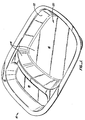
- a container 10 useful in microwave heating of foods, comprises a substrate 12 with a titanium nitride film 14 on at least a portion of the substrate 12.
- the substrate 12 may be formed as a tray with a first food receiving cavity 16 and a second food receiving cavity 18.
- the film 14 may be adhered to a base portion 20 of the cavity 16 so that when foods are placed within the cavity 16, the film 14 absorbs microwave energy, becomes heated, and transfers heat to the foods.
- the base portion 20 can be substantially flat, as illustrated, or may be formed in various configurations (such as corrugations) to facilitate liquid separation from the foods as they cook, for decorative purposes or the like. If desired, the film 14 may be additionally coated onto a wall 22 of the food receiving cavity 16.
- the film 14 will be quite thin, preferably on the order of about 75 to about 400 angstroms, most preferably about 100 to about 200 angstroms. As will be more fully described hereinafter, films can be chosen with significantly different film thicknesses, yet with similar absorptive or reflective properties.
- the titanium nitride film is preferably deposited onto the selected substrate by a magnetron sputtering process in which a titanium target is sputtered in an atmosphere that includes at least some nitrogen gas.
- Sputtering is a well-known technique for forming a layer of material on a substrate.
- Reactive sputtering is where one constituent is sputtered in the presence of a gas of another.
- a DC potential is used.
- the material to be sputtered is an insulator, it is preferred to use an RF potential in order to eliminate the build-up of surface charges on the insulator and the resulting loss in accelerating potential.
- the sputtering rate can be greatly increased by confining the plasma to a region adjacent to the target. Such confinement intensifies the plasma and increases both the probability of gas atom-electron collisions and the probability that the ions thus formed will strike the cathode.
- a magnetic field the plasma can be confined to a region which is only slightly separated from the cathode.
- One such device is the planar magnetron sputtering cathode.
- the stoichiometry of titanium nitride films of the invention can vary.
- the films may be represented as TiN x , where x is ideally between about 0.8 to about 1.3.
- x is ideally between about 0.8 to about 1.3.
- the titanium target is sputtered in the presence of a gas that is all nitrogen, then x will be greater than 1, usually in the order of about 1.1 to about 1.3.
- the titanium target is sputtered in a gas mixture reduced in the amount of nitrogen (for example, to include an inert gas and nitrogen)
- x will normally be less than 1.
- a gas mixture that is 70 wt.% argon and 30 wt.% nitrogen then x will typically be about 0.8.
- Films of the invention preferably have a sheet resistivity of between about 40 to about 1000 ohms/sq., more preferably from about 200 to 900 ohms/sq., and most preferably (for a CPET substrate) between about 500-800 ohms/sq.
- Table I illustrates data taken of titanium nitride films on CPET substrates with varying film thicknesses. The targets used were all titanium.
- the final temperature data of Table I was taken after six minutes exposure of the containers of the invention in a 1600W microwave oven set on high at 2450MHz. The microwave absorption was measured at 2450MHz and 0.1 mW incident power. As can be seen, the data of Table I shows that similar resistivities, absorbed power and final temperatures can be obtained with varying film thicknesses and different gas mixtures during the deposition process to vary stoichiometry.
- Titanium nitride films of the invention are durable and provide rapid, uniform heating.
- Table III illustrates data showing film heating as a function of time from microwave heating. The heat produced was measured using infra-red thermography. TABLE III Temperature ( o C) Time (Seconds) 140 10 157 20 158 30 156 40 155 50 156 60 155 70 156 80 152 90 155 100 154 110 155 120
- the data of Table III shows the films can reach about 150-160 o C in 20 seconds and substantially uniformly maintain that temperature.
- the substrates of Table III were CPET trays.
- CPET trays were coated with stainless steel.
- the stainless steel coated trays reached only about 85 o C after 2 minutes heating.
- containers of the invention define one food receiving cavity with a film of the invention and another cavity that is substantially microwave transparent, then the microwave transparent cavity should be masked during deposition of the film.
- Dual cavity containers were prepared where one cavity was coated with titanium nitride and the other cavity was masked by nesting a conforming CPET component in the non-coated cavity.
- the depositions were uniform using this method of masking and were repeatable.
- Containers of the invention were then tested by placing on a sheet of 3mm glass in a microwave oven and run for 45 seconds at high power. The containers were measured on the side next to the non-coated cavity as close the the bottom as possible.
- the data of Table IV illustrates the temperatures after 45 seconds, the film thicknesses and the sheet resistances.
- the containers had some evidence of melting on the upper edge, or lip, of the cavities. This slight edge melting can be eliminated by masking the top lip of the containers during deposition.
- TABLE IV Temperature ( o C) Thickness ( ⁇ ) Ohm/sq. 93 100 738 127 154 670 143 162 586
- Example I specifically describes the preparation of preferred embodiment containers.
- the vacuum system used to deposit titanium nitride on CPET trays was an Airco Coating Technology G-series system (G-6), single-ended with two deposition zones each containing two planar magnetron cathodes.
- G-6 Airco Coating Technology G-series system
- the single-ended system has a mechanically pumped entry and exit lock which can be evacuated to 50 microns pressure.
- This is followed by the deposition zones which can be evacuated via diffusion pumps to 1 x 10 ⁇ 6 torr.
- the deposition zones can be filled to the 1 x 10 ⁇ 3 torr range with inert or reactive gases. Deposition occurs by conveying the substrate back and forth under the cathode until the desired film thickness is achieved.
- the coated uses Airco Coating Technology HRC-3000 cathodes capable of uniformly coating a maximum substrate size of 40" x 60" (1016 mm x 1524 mm).
- One coat was used with two titanium targets.
- the Ti was sputtered in 100% nitrogen using an MKS gas flow control system to regulate N2 flow at 888 sccm for a sputtering pressure of 1.5 x 10 ⁇ 3 torr.
- Two Ti cathodes were run at a constant power of 20 kW each.
- the conveyor line speed was 200" (5080 mm) per minute.
- the coating was deposited in two passes under the cathode.
- Each deposition run was made with five trays on a 2' x 3' (610 mm x 914 mm) glass carrier. A tray was placed in each corner and one in the middle. Two of these trays were used as test samples with a glass microscope slide placed in the tray. The slide was used to measure film thickness and sheet resistance.
- the trays had two food receiving cavities.
- One of the cavities was intended for foods not desired to be crisp cooked (such as various vegetables).
- the second food receiving cavity was corrugated and was coated with the titanium nitride film on the corrugated bottom and along the surrounding wall.
- the one cavity intended for vegetables was masked by nesting another CPET vegetable cavity tray into the one cavity.
Landscapes
- Engineering & Computer Science (AREA)
- Food Science & Technology (AREA)
- Mechanical Engineering (AREA)
- Life Sciences & Earth Sciences (AREA)
- Chemical & Material Sciences (AREA)
- Combustion & Propulsion (AREA)
- General Engineering & Computer Science (AREA)
- Cookers (AREA)
- Constitution Of High-Frequency Heating (AREA)
- Electric Ovens (AREA)
- General Preparation And Processing Of Foods (AREA)
- Package Specialized In Special Use (AREA)
- Control Of High-Frequency Heating Circuits (AREA)
- Surface Treatment Of Glass (AREA)
- Physical Vapour Deposition (AREA)
- Jellies, Jams, And Syrups (AREA)
- Seasonings (AREA)
Abstract
Description
- The present invention relates to microwavable containers, according to the preamble of claim 1. Such containers are known from document FR-A1-2 451 182.
- Non-conductive materials, such as paper, plastic and glass, are substantially microwave transparent as they neither reflect nor absorb microwaves. While containers for some foods in these "transparent" materials are acceptable when the foods are heated, surfaces of foods heated in a microwave oven tend to become soggy due to condensation of water vapour on the food surface. This is a problem for foods that are desirably crisp - such as fried chicken, french fries, pizza and the like. As a consequence, metallized polyester films have been developed as susceptors (thin films of a conductive material designed to absorb microwave energy) in order to heat food adjacent the metallized film area by conduction and radiation. The metallized area, because of its low heat mass, heats quickly and transfers the heat for browning and crisping. Thus, susceptors assist in heating food surfaces to prevent water vapour condensation and soggy food surfaces.
- Thin coatings of aluminium on polyester film are known and used as such susceptors by adhesive lamination to paper or paperboard. However, aluminium oxidizes over time, thus losing its conductivity, and aluminium also continues to absorb microwave energy. This creates the possibility of overheating. Controlling the amount of metal deposited on the polyester is also difficult. The adhesive lamination can pose problems due to outgassing from the adhesive during heating which causes odours and undesirable tastes.
- The present invention is concerned with the provision of microwave susceptor films that absorb and reflect on organic substrates, yet which maintain a temperature less than that of the organic substrate during normal microwave heating.
- In accordance with the invention, there is provided a container for use in microwave heating of foods, comprising:
a substrate comprising a plastic, paper or plastic/paper composite and being substantially microwave transparent and having a determinable melting or scorching temperature; and,
a film on at least a portion of the substrate, the film being adapted to absorb microwave energy, to become heated and to transfer heat to foods carried by the container,
characterized in that the film is a titanium nitride film. - With titanium nitride films of the invention, containers can in general be heated in conventional microwave ovens (such as having an incident power of about 1600 watts at 2450MHz) for crisp heating of foods, yet without causing tray melting. Preferably, the foods carried by the container will be adjacent the film and may, if necessary be in a wrapped, for example foil or other material, or unwrapped state.
- The invention can provide in particular, a container in which the film becomes heated to a temperature less than the substrate melting or scorching temperature when the container is exposed to microwave energy of up to about 1600W at 2450 MHz for up to about 6 minutes.
- Preferably, the film of the container has a resistivity (sheet) of between about 40 to about 1000 ohms/square or most preferably between 200 and 900 ohms/square.
- A preferred substrate is or comprises crystallised polyethylene terephthalate, which has a melting point between 190 and 280oC.
- Ideally, the film of the container is or comprises TiNx where x is between about 0.8 and about 1.3.
- The food receiving cavity is preferably formed of, or comprises, crystallised polyethylene terephthalate.
- Preferably, the tray defines a first and a second food receiving cavity, the thin film being adhered to the first cavity and adapted to transfer heat to foods when placed therein, the second cavity being substantially microwave transparent.
- Containers of the invention comprise a substrate that is substantially microwave transparent and has a determinable melting or scorching temperature. For example, substrates formed of crystallized polyethylene terephthalate (CPET) have a melting or scorching temperature between about 198oC and 218oC, while paperboard and plastic/paper composite substrates typically have a heat resistance up to about 205oC. Such plastic, paper and composite substrates are suitable for use as substrates of the present invention, although CPET is particularly preferred due to an attractive, table-ready appearance. It should be understood, however, that a wide variety of relatively heat stable, but organic, substrates are suitable.
- Reference is now made, by way of exemplification only, to the accompanying Figure 1 which shows a perspective view of a container of the invention.
- With respect to Figure 1, a container 10, useful in microwave heating of foods, comprises a
substrate 12 with atitanium nitride film 14 on at least a portion of thesubstrate 12. As shown, thesubstrate 12 may be formed as a tray with a firstfood receiving cavity 16 and a secondfood receiving cavity 18. Thefilm 14 may be adhered to abase portion 20 of thecavity 16 so that when foods are placed within thecavity 16, thefilm 14 absorbs microwave energy, becomes heated, and transfers heat to the foods. - The
base portion 20 can be substantially flat, as illustrated, or may be formed in various configurations (such as corrugations) to facilitate liquid separation from the foods as they cook, for decorative purposes or the like. If desired, thefilm 14 may be additionally coated onto awall 22 of thefood receiving cavity 16. - The
film 14 will be quite thin, preferably on the order of about 75 to about 400 angstroms, most preferably about 100 to about 200 angstroms. As will be more fully described hereinafter, films can be chosen with significantly different film thicknesses, yet with similar absorptive or reflective properties. - The titanium nitride film is preferably deposited onto the selected substrate by a magnetron sputtering process in which a titanium target is sputtered in an atmosphere that includes at least some nitrogen gas.
- Sputtering is a well-known technique for forming a layer of material on a substrate. Reactive sputtering is where one constituent is sputtered in the presence of a gas of another. When the material to be sputtered is an electrical conductor, a DC potential is used. When the material to be sputtered is an insulator, it is preferred to use an RF potential in order to eliminate the build-up of surface charges on the insulator and the resulting loss in accelerating potential. The sputtering rate can be greatly increased by confining the plasma to a region adjacent to the target. Such confinement intensifies the plasma and increases both the probability of gas atom-electron collisions and the probability that the ions thus formed will strike the cathode. By use of a magnetic field, the plasma can be confined to a region which is only slightly separated from the cathode. One such device is the planar magnetron sputtering cathode.
- The stoichiometry of titanium nitride films of the invention can vary. Thus, the films may be represented as TiNx, where x is ideally between about 0.8 to about 1.3. Where, for example, the titanium target is sputtered in the presence of a gas that is all nitrogen, then x will be greater than 1, usually in the order of about 1.1 to about 1.3. Where the titanium target is sputtered in a gas mixture reduced in the amount of nitrogen (for example, to include an inert gas and nitrogen), then x will normally be less than 1. With, for example, a gas mixture that is 70 wt.% argon and 30 wt.% nitrogen, then x will typically be about 0.8.
- Films of the invention preferably have a sheet resistivity of between about 40 to about 1000 ohms/sq., more preferably from about 200 to 900 ohms/sq., and most preferably (for a CPET substrate) between about 500-800 ohms/sq. Table I illustrates data taken of titanium nitride films on CPET substrates with varying film thicknesses. The targets used were all titanium.
TABLE 1 Gas Composition During Sputtering Sheet Resistivity (ohms/sq.) Film Thickness (Å) Percentage Absorbed Power Final Temp. (oC.) 100% N₂ 586 162 15 200 100% N₂ 635 104 9 207 70%Ar/30%N₂ 565 109 16 218 70%Ar/30%N₂ 640 93 14 201 - The final temperature data of Table I was taken after six minutes exposure of the containers of the invention in a 1600W microwave oven set on high at 2450MHz. The microwave absorption was measured at 2450MHz and 0.1 mW incident power. As can be seen, the data of Table I shows that similar resistivities, absorbed power and final temperatures can be obtained with varying film thicknesses and different gas mixtures during the deposition process to vary stoichiometry.
- The relationship between sheet resistivity, absorbed power, transmitted power, and reflected power is illustrated by the data of Table II, which was taken from titanium nitride films on a flat pane of glass.
TABLE II Gas Composition During Sputtering Sheet Resistivity (ohms/sq.) Percentage Absorbed Power Percentage Transmitted Power Percentage Reflected Power 100% N₂ 340 36 34 30 100% N₂ 390 41 36 23 100% N₂ 445 42 36 22 100% N₂ 570 34 43 23 100% N₂ 960 21 56 22 Control Substrate (uncoated) 1 79 20 - For the same film stoichiometry, lower sheet resistivities indicate thicker films while higher sheet resistivities indicate thinner films. As can be seen from the data of Table II, one can have comparable absorption with different film thicknesses (as seen by the 340 and 570 ohm/sq. values). While the data of Table II is for films coated into flat planes of glass, analogous results and relationships are obtained with substrates of the invention.
- Titanium nitride films of the invention are durable and provide rapid, uniform heating. Table III illustrates data showing film heating as a function of time from microwave heating. The heat produced was measured using infra-red thermography.
TABLE III Temperature (oC) Time (Seconds) 140 10 157 20 158 30 156 40 155 50 156 60 155 70 156 80 152 90 155 100 154 110 155 120 - The data of Table III shows the films can reach about 150-160oC in 20 seconds and substantially uniformly maintain that temperature. The substrates of Table III were CPET trays. For comparison, CPET trays were coated with stainless steel. The stainless steel coated trays reached only about 85oC after 2 minutes heating.
- Where containers of the invention define one food receiving cavity with a film of the invention and another cavity that is substantially microwave transparent, then the microwave transparent cavity should be masked during deposition of the film.
- Dual cavity containers were prepared where one cavity was coated with titanium nitride and the other cavity was masked by nesting a conforming CPET component in the non-coated cavity. The depositions were uniform using this method of masking and were repeatable. Containers of the invention were then tested by placing on a sheet of 3mm glass in a microwave oven and run for 45 seconds at high power. The containers were measured on the side next to the non-coated cavity as close the the bottom as possible. The data of Table IV illustrates the temperatures after 45 seconds, the film thicknesses and the sheet resistances. The containers had some evidence of melting on the upper edge, or lip, of the cavities. This slight edge melting can be eliminated by masking the top lip of the containers during deposition.
TABLE IV Temperature (oC) Thickness (Å) Ohm/sq. 93 100 738 127 154 670 143 162 586 - Example I specifically describes the preparation of preferred embodiment containers. The vacuum system used to deposit titanium nitride on CPET trays was an Airco Coating Technology G-series system (G-6), single-ended with two deposition zones each containing two planar magnetron cathodes.
- The single-ended system has a mechanically pumped entry and exit lock which can be evacuated to 50 microns pressure. This is followed by the deposition zones which can be evacuated via diffusion pumps to 1 x 10⁻⁶ torr. For deposition purposes, the deposition zones can be filled to the 1 x 10⁻³ torr range with inert or reactive gases. Deposition occurs by conveying the substrate back and forth under the cathode until the desired film thickness is achieved. The coated uses Airco Coating Technology HRC-3000 cathodes capable of uniformly coating a maximum substrate size of 40" x 60" (1016 mm x 1524 mm).
- One coat was used with two titanium targets. The Ti was sputtered in 100% nitrogen using an MKS gas flow control system to regulate N₂ flow at 888 sccm for a sputtering pressure of 1.5 x 10⁻³ torr. Two Ti cathodes were run at a constant power of 20 kW each. The conveyor line speed was 200" (5080 mm) per minute. The coating was deposited in two passes under the cathode. Each deposition run was made with five trays on a 2' x 3' (610 mm x 914 mm) glass carrier. A tray was placed in each corner and one in the middle. Two of these trays were used as test samples with a glass microscope slide placed in the tray. The slide was used to measure film thickness and sheet resistance.
- The trays had two food receiving cavities. One of the cavities was intended for foods not desired to be crisp cooked (such as various vegetables). The second food receiving cavity was corrugated and was coated with the titanium nitride film on the corrugated bottom and along the surrounding wall. The one cavity intended for vegetables was masked by nesting another CPET vegetable cavity tray into the one cavity.
- As may be seen by the data of Table V, containers coated within each run showed excellent sheet resistance uniformity and comparison between runs shows good reproducibility.


Claims (8)
- A container (10) for use in microwave heating of foods, comprising:
a substrate (12) comprising a plastic, paper or plastic/paper composite and being substantially microwave transparent and having a determinable melting or scorching temperature; and,
a film (14) on at least a portion of the substrate, the film being adapted to absorb microwave energy, to become heated and to transfer heat to foods carried by the container,
characterized in that the film (14) is a titanium nitride film. - A container according to Claim 1 in which the film (14) becomes heated to a temperature less than the substrate melting or scorching temperature when the container is exposed to microwave energy of up to about 1600W at 2450 MHz for up to about 6 minutes.
- A container according to Claim 1 or Claim 2 in which the film (14) has a sheet resistivity of between about 40 to about 1000 ohms/square.
- A container according to Claim 3 in which the film (14) has a sheet resistivity of between 200 and 900 ohms/square.
- A container according to any preceding claim in which the substrate comprises crystallized polyethylene terephthalate.
- A container according to any preceding claim in which the film comprises TiNx where x is between about 0.8 and about 1.3.
- A container according to any preceding claim in which the film (14) has a thickness between about 75 to about 400 angstroms.
- A container according to any preceding claim in the form of a tray which defines a first and a second food receiving cavity, the titanium nitride film (14) being adhered to the first cavity (16) and adapted to transfer heat to foods when placed therein and the second cavity (18) being substantially microwave transparent.
Applications Claiming Priority (2)
| Application Number | Priority Date | Filing Date | Title |
|---|---|---|---|
| US301516 | 1989-01-24 | ||
| US07/301,516 US4866235A (en) | 1989-01-24 | 1989-01-24 | Microwavable containers useful for controlled heating |
Publications (3)
| Publication Number | Publication Date |
|---|---|
| EP0380306A2 EP0380306A2 (en) | 1990-08-01 |
| EP0380306A3 EP0380306A3 (en) | 1992-01-15 |
| EP0380306B1 true EP0380306B1 (en) | 1995-11-08 |
Family
ID=23163723
Family Applications (1)
| Application Number | Title | Priority Date | Filing Date |
|---|---|---|---|
| EP90300710A Expired - Lifetime EP0380306B1 (en) | 1989-01-24 | 1990-01-23 | Microwavable containers useful for controlled heating |
Country Status (15)
| Country | Link |
|---|---|
| US (1) | US4866235A (en) |
| EP (1) | EP0380306B1 (en) |
| JP (1) | JPH02203121A (en) |
| KR (1) | KR900011649A (en) |
| CN (1) | CN1026057C (en) |
| AT (1) | ATE129979T1 (en) |
| AU (1) | AU595151B1 (en) |
| CA (1) | CA1326792C (en) |
| DE (1) | DE69023360T2 (en) |
| DK (2) | DK18490A (en) |
| ES (1) | ES2078938T3 (en) |
| MX (1) | MX171517B (en) |
| NO (1) | NO175582C (en) |
| RU (1) | RU2018250C1 (en) |
| ZA (1) | ZA896296B (en) |
Families Citing this family (19)
| Publication number | Priority date | Publication date | Assignee | Title |
|---|---|---|---|---|
| JP2634771B2 (en) * | 1993-06-16 | 1997-07-30 | 日本冶金工業株式会社 | Container for electromagnetic cooker and method of manufacturing the same |
| US5632924A (en) * | 1994-10-26 | 1997-05-27 | H.J. Heinz Company | Muffin tray and process for baking muffins |
| US5519196A (en) * | 1995-06-01 | 1996-05-21 | Xu; Liming | Material for converting microwave energy into thermal energy, and a cooking receptacle fabricated from that material |
| RU2131682C1 (en) * | 1998-04-28 | 1999-06-20 | Смирнов Игорь Ричардович | Food product prepare method |
| US6313451B1 (en) | 1998-07-01 | 2001-11-06 | Hanover Direct, Inc. | Microwave heated serving utensil |
| US6188046B1 (en) | 1999-05-18 | 2001-02-13 | The Rival Company | Food-heating appliance and method of using same |
| US20070092609A1 (en) * | 2005-10-26 | 2007-04-26 | H. J. Heinz Company | Food container |
| JP5250621B2 (en) * | 2007-05-15 | 2013-07-31 | グラフィック パッケージング インターナショナル インコーポレイテッド | Microwave structure with undulating heated surface |
| US9284108B2 (en) | 2009-02-23 | 2016-03-15 | Graphic Packaging International, Inc. | Plasma treated susceptor films |
| BR112015008243A2 (en) * | 2012-10-12 | 2017-07-04 | Gen Mills Inc | microwave food packaging and related products and methods. |
| MX2015012426A (en) * | 2013-03-14 | 2016-01-12 | Graphic Packaging Int Inc | Low crystallinity susceptor films. |
| FR3020754A1 (en) * | 2014-05-06 | 2015-11-13 | Jean Jacques Grand | FROZEN OR FRESH MEAL TRAYS CAN BE DEFROSTED AND REHEATED IN A SINGLE PASS IN THE MICROWAVE OVEN SO THAT EACH ELEMENT OF THE MEAL IS AT THE RIGHT CONSUMPTION TEMPERATURE |
| RU2646645C1 (en) * | 2017-01-19 | 2018-03-06 | Федеральное государственное казенное военное образовательное учреждение высшего образования "Военная академия материально-технического обеспечения имени генерала армии А.В. Хрулёва" Министерства обороны Российской Федерации | Portable cuisine |
| USD823700S1 (en) * | 2017-08-16 | 2018-07-24 | Target Brands, Inc. | Compartmented container |
| USD823698S1 (en) * | 2017-08-16 | 2018-07-24 | Target Brands, Inc. | Compartmented container |
| USD823699S1 (en) * | 2017-08-16 | 2018-07-24 | Target Brands, Inc. | Compartmented container |
| CN109469927A (en) * | 2018-10-19 | 2019-03-15 | 广东美的厨房电器制造有限公司 | Heating device and microwave oven having the same |
| CN116249235B (en) * | 2021-12-08 | 2026-06-19 | 惠而浦公司 | Heat-resistant heating plate for microwave appliance |
| USD1088901S1 (en) * | 2023-05-25 | 2025-08-19 | Changzhou Huisu Qinye Import & Export Co., Ltd. | Dual compartment food container |
Family Cites Families (13)
| Publication number | Priority date | Publication date | Assignee | Title |
|---|---|---|---|---|
| US2856497A (en) * | 1954-04-29 | 1958-10-14 | Raytheon Mfg Co | Dielectric matching devices |
| DE1621011A1 (en) * | 1967-04-13 | 1971-04-29 | Telefunken Patent | Process for surface treatment of components |
| JPS513419A (en) * | 1974-06-29 | 1976-01-12 | Kenzo Nakamura | ATSURYOKUHAIKANROHASONJIJIDOHEISHIBEN |
| JPS5912642B2 (en) * | 1974-07-12 | 1984-03-24 | 保土谷化学工業株式会社 | Method for side chain chlorination of aromatic compounds |
| US4190757A (en) * | 1976-10-08 | 1980-02-26 | The Pillsbury Company | Microwave heating package and method |
| CA1153069A (en) * | 1979-03-16 | 1983-08-30 | Oscar E. Seiferth | Food receptacle for microwave cooking |
| US4434197A (en) * | 1982-08-25 | 1984-02-28 | N. F. Industries, Inc. | Non-stick energy-modifying cooking liner and method of making same |
| US4559429A (en) * | 1984-11-29 | 1985-12-17 | The United States Of America As Represented By The United States Department Of Energy | Microwave coupler and method |
| US4721738A (en) * | 1985-10-07 | 1988-01-26 | Occidental Research Corporation | Polymeric compositions including microwave energy sensitizing additives |
| JPS62110287A (en) * | 1985-11-08 | 1987-05-21 | 導電性無機化合物技術研究組合 | Microwave oven |
| EP0244179B1 (en) * | 1986-04-28 | 1991-12-18 | Toyo Seikan Kaisha Limited | Heat-resistant paper container and process for preparation thereof |
| US4751358A (en) * | 1986-05-21 | 1988-06-14 | Verrerie Cristallerie D'arques J.G. Durand & Cie | Cooking container having a browning coating for microwave ovens and a method of forming the coating |
| JPH01182275A (en) * | 1987-12-25 | 1989-07-20 | Toyo Seikan Kaisha Ltd | Reheatable sealed laminated container |
-
1989
- 1989-01-24 US US07/301,516 patent/US4866235A/en not_active Expired - Fee Related
- 1989-08-15 CA CA000608357A patent/CA1326792C/en not_active Expired - Fee Related
- 1989-08-16 AU AU39924/89A patent/AU595151B1/en not_active Ceased
- 1989-08-17 ZA ZA896296A patent/ZA896296B/en unknown
- 1989-08-21 MX MX017261A patent/MX171517B/en unknown
- 1989-09-04 NO NO893538A patent/NO175582C/en unknown
- 1989-09-07 KR KR1019890013031A patent/KR900011649A/en not_active Ceased
- 1989-10-11 CN CN89107898A patent/CN1026057C/en not_active Expired - Fee Related
- 1989-10-18 JP JP1271432A patent/JPH02203121A/en active Pending
- 1989-11-01 RU SU894742307A patent/RU2018250C1/en active
-
1990
- 1990-01-23 DK DK018490A patent/DK18490A/en not_active Application Discontinuation
- 1990-01-23 ES ES90300710T patent/ES2078938T3/en not_active Expired - Lifetime
- 1990-01-23 DE DE69023360T patent/DE69023360T2/en not_active Expired - Fee Related
- 1990-01-23 AT AT90300710T patent/ATE129979T1/en not_active IP Right Cessation
- 1990-01-23 DK DK90300710.2T patent/DK0380306T3/en active
- 1990-01-23 EP EP90300710A patent/EP0380306B1/en not_active Expired - Lifetime
Non-Patent Citations (2)
| Title |
|---|
| WORLD PATENTS INDEX LATEST Section Ch, Week 8851, Derwent Publications Ltd., London, GB; Class L, AW 88-364679 & JP-A-63 274 673 (NEC CORP.) 11 November 1989 * |
| WORLD PATENTS INDEX LATEST Section Ch, Week 8916 Derwnt Publications Ltd., London, GB, Class A, AN 89-118577 & JP-A-1 064 398 (UBE INDUSTRIES KK) 10 March 1989 * |
Also Published As
| Publication number | Publication date |
|---|---|
| EP0380306A3 (en) | 1992-01-15 |
| AU595151B1 (en) | 1990-03-22 |
| NO893538D0 (en) | 1989-09-04 |
| NO175582C (en) | 1994-11-02 |
| US4866235A (en) | 1989-09-12 |
| MX171517B (en) | 1993-11-03 |
| DE69023360T2 (en) | 1996-07-11 |
| ES2078938T3 (en) | 1996-01-01 |
| CN1044394A (en) | 1990-08-08 |
| NO175582B (en) | 1994-07-25 |
| DK0380306T3 (en) | 1995-12-11 |
| CA1326792C (en) | 1994-02-08 |
| DK18490D0 (en) | 1990-01-23 |
| ZA896296B (en) | 1990-05-30 |
| DK18490A (en) | 1990-07-25 |
| CN1026057C (en) | 1994-10-05 |
| ATE129979T1 (en) | 1995-11-15 |
| RU2018250C1 (en) | 1994-08-30 |
| EP0380306A2 (en) | 1990-08-01 |
| KR900011649A (en) | 1990-08-01 |
| NO893538L (en) | 1990-07-25 |
| DE69023360D1 (en) | 1995-12-14 |
| JPH02203121A (en) | 1990-08-13 |
Similar Documents
| Publication | Publication Date | Title |
|---|---|---|
| US4866235A (en) | Microwavable containers useful for controlled heating | |
| US4962293A (en) | Microwave susceptor film to control the temperature of cooking foods | |
| EP0451144B1 (en) | Shrinkable, conformable microwave wrap | |
| US5300746A (en) | Metallized microwave diffuser films | |
| US5185506A (en) | Selectively microwave-permeable membrane susceptor systems | |
| EP0320294B1 (en) | Microwave cooking package | |
| US5254821A (en) | Selectively microwave-permeable membrane susceptor systems | |
| CA1316992C (en) | Susceptors for heating in a microwave oven having metallized layer deposited on paper | |
| EP0356825B1 (en) | Microwave interactive heating element | |
| US3853612A (en) | Method for making coated receptacle for microwave cooking of food | |
| US5614259A (en) | Microwave interactive susceptors and methods of producing the same | |
| CA1153069A (en) | Food receptacle for microwave cooking | |
| US5126519A (en) | Method and apparatus for producing microwave susceptor sheet material | |
| EP0310656B1 (en) | Surface treatment of polymers | |
| EP0487166A1 (en) | A layered low temperature susceptor | |
| EP1920637A1 (en) | Microwave susceptor incorporating heat stabilized polyester | |
| EP0642989B1 (en) | The use of microwave interactive barrier films for heating and browning | |
| GB2207589A (en) | Microwave cooking | |
| JPH0468758B2 (en) | ||
| GB2236278A (en) | Microwave interactive barrier packaging material | |
| EP0344574A1 (en) | Susceptor for heating foods in a microwave oven having metallized layer deposited on paper | |
| KR102843897B1 (en) | Cooking liner sheet for microwave | |
| JPH02184430A (en) | Heat sensitive material | |
| MXPA05007116A (en) | Microwave susceptor packaging material. | |
| JPH07207447A (en) | Method for manufacturing laminated body |
Legal Events
| Date | Code | Title | Description |
|---|---|---|---|
| PUAI | Public reference made under article 153(3) epc to a published international application that has entered the european phase |
Free format text: ORIGINAL CODE: 0009012 |
|
| AK | Designated contracting states |
Kind code of ref document: A2 Designated state(s): AT BE CH DE DK ES FR GB GR IT LI NL SE |
|
| PUAL | Search report despatched |
Free format text: ORIGINAL CODE: 0009013 |
|
| AK | Designated contracting states |
Kind code of ref document: A3 Designated state(s): AT BE CH DE DK ES FR GB GR IT LI NL SE |
|
| 17P | Request for examination filed |
Effective date: 19920706 |
|
| 17Q | First examination report despatched |
Effective date: 19940608 |
|
| GRAA | (expected) grant |
Free format text: ORIGINAL CODE: 0009210 |
|
| ITF | It: translation for a ep patent filed | ||
| AK | Designated contracting states |
Kind code of ref document: B1 Designated state(s): AT BE CH DE DK ES FR GB GR IT LI NL SE |
|
| PG25 | Lapsed in a contracting state [announced via postgrant information from national office to epo] |
Ref country code: GR Free format text: LAPSE BECAUSE OF FAILURE TO SUBMIT A TRANSLATION OF THE DESCRIPTION OR TO PAY THE FEE WITHIN THE PRESCRIBED TIME-LIMIT Effective date: 19951108 |
|
| REF | Corresponds to: |
Ref document number: 129979 Country of ref document: AT Date of ref document: 19951115 Kind code of ref document: T |
|
| ET | Fr: translation filed | ||
| REG | Reference to a national code |
Ref country code: DK Ref legal event code: T3 |
|
| PGFP | Annual fee paid to national office [announced via postgrant information from national office to epo] |
Ref country code: FR Payment date: 19951213 Year of fee payment: 7 |
|
| REF | Corresponds to: |
Ref document number: 69023360 Country of ref document: DE Date of ref document: 19951214 |
|
| PGFP | Annual fee paid to national office [announced via postgrant information from national office to epo] |
Ref country code: SE Payment date: 19951215 Year of fee payment: 7 |
|
| PGFP | Annual fee paid to national office [announced via postgrant information from national office to epo] |
Ref country code: NL Payment date: 19951218 Year of fee payment: 7 |
|
| PGFP | Annual fee paid to national office [announced via postgrant information from national office to epo] |
Ref country code: AT Payment date: 19951219 Year of fee payment: 7 |
|
| PGFP | Annual fee paid to national office [announced via postgrant information from national office to epo] |
Ref country code: GB Payment date: 19951228 Year of fee payment: 7 Ref country code: DE Payment date: 19951228 Year of fee payment: 7 |
|
| PGFP | Annual fee paid to national office [announced via postgrant information from national office to epo] |
Ref country code: BE Payment date: 19951229 Year of fee payment: 7 |
|
| REG | Reference to a national code |
Ref country code: ES Ref legal event code: FG2A Ref document number: 2078938 Country of ref document: ES Kind code of ref document: T3 |
|
| PGFP | Annual fee paid to national office [announced via postgrant information from national office to epo] |
Ref country code: DK Payment date: 19960102 Year of fee payment: 7 |
|
| PGFP | Annual fee paid to national office [announced via postgrant information from national office to epo] |
Ref country code: ES Payment date: 19960119 Year of fee payment: 7 |
|
| PGFP | Annual fee paid to national office [announced via postgrant information from national office to epo] |
Ref country code: CH Payment date: 19960123 Year of fee payment: 7 |
|
| REG | Reference to a national code |
Ref country code: CH Ref legal event code: NV Representative=s name: DR. CONRAD A. RIEDERER PATENTANWALT |
|
| PLBE | No opposition filed within time limit |
Free format text: ORIGINAL CODE: 0009261 |
|
| STAA | Information on the status of an ep patent application or granted ep patent |
Free format text: STATUS: NO OPPOSITION FILED WITHIN TIME LIMIT |
|
| 26N | No opposition filed | ||
| PG25 | Lapsed in a contracting state [announced via postgrant information from national office to epo] |
Ref country code: GB Effective date: 19970123 Ref country code: DK Effective date: 19970123 Ref country code: AT Effective date: 19970123 |
|
| REG | Reference to a national code |
Ref country code: DK Ref legal event code: EBP |
|
| PG25 | Lapsed in a contracting state [announced via postgrant information from national office to epo] |
Ref country code: SE Effective date: 19970124 Ref country code: ES Free format text: LAPSE BECAUSE OF NON-PAYMENT OF DUE FEES Effective date: 19970124 |
|
| PG25 | Lapsed in a contracting state [announced via postgrant information from national office to epo] |
Ref country code: LI Effective date: 19970131 Ref country code: CH Effective date: 19970131 Ref country code: BE Effective date: 19970131 |
|
| BERE | Be: lapsed |
Owner name: THE BOC GROUP INC. Effective date: 19970131 |
|
| PG25 | Lapsed in a contracting state [announced via postgrant information from national office to epo] |
Ref country code: NL Effective date: 19970801 |
|
| GBPC | Gb: european patent ceased through non-payment of renewal fee |
Effective date: 19970123 |
|
| REG | Reference to a national code |
Ref country code: CH Ref legal event code: PL |
|
| PG25 | Lapsed in a contracting state [announced via postgrant information from national office to epo] |
Ref country code: FR Effective date: 19970930 |
|
| NLV4 | Nl: lapsed or anulled due to non-payment of the annual fee |
Effective date: 19970801 |
|
| PG25 | Lapsed in a contracting state [announced via postgrant information from national office to epo] |
Ref country code: DE Effective date: 19971001 |
|
| EUG | Se: european patent has lapsed |
Ref document number: 90300710.2 |
|
| REG | Reference to a national code |
Ref country code: FR Ref legal event code: ST |
|
| REG | Reference to a national code |
Ref country code: ES Ref legal event code: FD2A Effective date: 19990301 |
|
| PG25 | Lapsed in a contracting state [announced via postgrant information from national office to epo] |
Ref country code: IT Free format text: LAPSE BECAUSE OF NON-PAYMENT OF DUE FEES;WARNING: LAPSES OF ITALIAN PATENTS WITH EFFECTIVE DATE BEFORE 2007 MAY HAVE OCCURRED AT ANY TIME BEFORE 2007. THE CORRECT EFFECTIVE DATE MAY BE DIFFERENT FROM THE ONE RECORDED. Effective date: 20050123 |