EP0374013B1 - Herstellungsverfahren von Kompositstrukturen zum Absorbieren von Lärm und mit diesem Verfahren hergestellte Kompositstrukturen - Google Patents
Herstellungsverfahren von Kompositstrukturen zum Absorbieren von Lärm und mit diesem Verfahren hergestellte Kompositstrukturen Download PDFInfo
- Publication number
- EP0374013B1 EP0374013B1 EP89403388A EP89403388A EP0374013B1 EP 0374013 B1 EP0374013 B1 EP 0374013B1 EP 89403388 A EP89403388 A EP 89403388A EP 89403388 A EP89403388 A EP 89403388A EP 0374013 B1 EP0374013 B1 EP 0374013B1
- Authority
- EP
- European Patent Office
- Prior art keywords
- sand
- core
- plates
- woven
- microspheres
- Prior art date
- Legal status (The legal status is an assumption and is not a legal conclusion. Google has not performed a legal analysis and makes no representation as to the accuracy of the status listed.)
- Expired - Lifetime
Links
- 239000002131 composite material Substances 0.000 title claims abstract description 46
- 238000000034 method Methods 0.000 title claims abstract description 23
- 238000010521 absorption reaction Methods 0.000 title claims abstract description 17
- VYPSYNLAJGMNEJ-UHFFFAOYSA-N Silicium dioxide Chemical compound O=[Si]=O VYPSYNLAJGMNEJ-UHFFFAOYSA-N 0.000 claims abstract description 87
- 239000000377 silicon dioxide Substances 0.000 claims abstract description 21
- 239000004576 sand Substances 0.000 claims description 37
- 239000011521 glass Substances 0.000 claims description 26
- 229920002994 synthetic fiber Polymers 0.000 claims description 21
- 229920005989 resin Polymers 0.000 claims description 18
- 239000011347 resin Substances 0.000 claims description 18
- 239000000463 material Substances 0.000 claims description 7
- 239000003973 paint Substances 0.000 claims description 7
- 229920000728 polyester Polymers 0.000 claims description 7
- 230000000737 periodic effect Effects 0.000 claims description 6
- 229920003002 synthetic resin Polymers 0.000 claims description 4
- 239000000057 synthetic resin Substances 0.000 claims description 4
- 239000004020 conductor Substances 0.000 claims description 3
- 238000002791 soaking Methods 0.000 claims description 3
- OKTJSMMVPCPJKN-UHFFFAOYSA-N Carbon Chemical compound [C] OKTJSMMVPCPJKN-UHFFFAOYSA-N 0.000 claims description 2
- 229910052799 carbon Inorganic materials 0.000 claims description 2
- 238000001035 drying Methods 0.000 claims description 2
- 239000004005 microsphere Substances 0.000 claims 15
- 239000002184 metal Substances 0.000 claims 4
- 238000001033 granulometry Methods 0.000 claims 1
- 238000009941 weaving Methods 0.000 description 27
- 239000011325 microbead Substances 0.000 description 22
- 239000012209 synthetic fiber Substances 0.000 description 12
- 238000000576 coating method Methods 0.000 description 10
- 239000011248 coating agent Substances 0.000 description 9
- 239000000835 fiber Substances 0.000 description 9
- 238000004519 manufacturing process Methods 0.000 description 6
- 241001508691 Martes zibellina Species 0.000 description 5
- 241001639412 Verres Species 0.000 description 4
- 239000000203 mixture Substances 0.000 description 3
- 239000002245 particle Substances 0.000 description 3
- 229920000049 Carbon (fiber) Polymers 0.000 description 2
- 239000004917 carbon fiber Substances 0.000 description 2
- RYGMFSIKBFXOCR-UHFFFAOYSA-N Copper Chemical compound [Cu] RYGMFSIKBFXOCR-UHFFFAOYSA-N 0.000 description 1
- BQCADISMDOOEFD-UHFFFAOYSA-N Silver Chemical compound [Ag] BQCADISMDOOEFD-UHFFFAOYSA-N 0.000 description 1
- 241001080024 Telles Species 0.000 description 1
- XAGFODPZIPBFFR-UHFFFAOYSA-N aluminium Chemical compound [Al] XAGFODPZIPBFFR-UHFFFAOYSA-N 0.000 description 1
- 229910052782 aluminium Inorganic materials 0.000 description 1
- 239000011324 bead Substances 0.000 description 1
- 125000000484 butyl group Chemical group [H]C([*])([H])C([H])([H])C([H])([H])C([H])([H])[H] 0.000 description 1
- 229910052802 copper Inorganic materials 0.000 description 1
- 239000010949 copper Substances 0.000 description 1
- 238000001514 detection method Methods 0.000 description 1
- 230000006866 deterioration Effects 0.000 description 1
- 238000006073 displacement reaction Methods 0.000 description 1
- 239000002657 fibrous material Substances 0.000 description 1
- 238000011049 filling Methods 0.000 description 1
- 238000001914 filtration Methods 0.000 description 1
- 239000006260 foam Substances 0.000 description 1
- 239000000295 fuel oil Substances 0.000 description 1
- 239000003921 oil Substances 0.000 description 1
- 229920001296 polysiloxane Polymers 0.000 description 1
- 239000011148 porous material Substances 0.000 description 1
- 230000000644 propagated effect Effects 0.000 description 1
- 229920006395 saturated elastomer Polymers 0.000 description 1
- 229910052709 silver Inorganic materials 0.000 description 1
- 239000004332 silver Substances 0.000 description 1
Images
Classifications
-
- G—PHYSICS
- G10—MUSICAL INSTRUMENTS; ACOUSTICS
- G10K—SOUND-PRODUCING DEVICES; METHODS OR DEVICES FOR PROTECTING AGAINST, OR FOR DAMPING, NOISE OR OTHER ACOUSTIC WAVES IN GENERAL; ACOUSTICS NOT OTHERWISE PROVIDED FOR
- G10K11/00—Methods or devices for transmitting, conducting or directing sound in general; Methods or devices for protecting against, or for damping, noise or other acoustic waves in general
- G10K11/16—Methods or devices for protecting against, or for damping, noise or other acoustic waves in general
- G10K11/162—Selection of materials
- G10K11/165—Particles in a matrix
Definitions
- the subject of the present invention is a method of manufacturing composite structures for the absorption of noise and of composite structures obtained by said method.
- the technical sector of the invention is that of the means used and finding their application in the absorption of noise and more particularly of noises produced by mechanical devices, in particular vehicles operating in an aquatic environment, such as surface ships or submarines.
- GB-A-2200591 describes the manufacture of a composite structure for noise absorption, this structure comprising at least three-dimensional weaving made from synthetic fibers and it is wrapped in an impermeable covering skin.
- FR-A-2501749 describes a soundproofing veil consisting of a flexible layer formed of a material comprising open pores which are filled with particles of density greater than that of said material.
- such materials are used inside the noise-generating enclosure and thus cover the internal face of the compartments in which there are particularly noisy machines such as, for example, air compressor units and Diesel engines.
- Such coatings are more particularly used on machines operating in the atmosphere and even in this application, they have the disadvantage of being subject to soiling and to some deterioration due to splashes of oil and / or fuel oil or diesel.
- thermal and phonic insulating means are widely used in the building sector and because of their rigid state and the very nature of their components, they are absolutely not suitable for industrial or marine applications such as those which have been given. above.
- the mechanical quadrupole has been defined as a linear viscoleastic system comprising four "inputs", two of which are displacements and two of which are forces.
- E E - E1.
- the objective of the present invention is to produce, from specific materials, composite structures whose assembly is homogeneous and capable of being exposed to the weather or immersed at great depths while retaining their properties of acoustic and / or heat filter.
- a core is made up consisting of a layer of synthetic texture capable of undergoing permanent deformation and is applied and secured to each of the faces of this core at least one closed and sealed composite plate comprising a three-dimensional weaving filled with microbeads of glass or sand rich in silica surrounded by a skin of coating of elastomeric resin.
- the said symmetrical structure is placed in an enclosure and a vacuum is created to both dry the structure and reduce its compressibility in order to improve the granular "coordination" of the glass microbeads or of the grains sand.
- metallic conductive threads extending at least from one side to the other are inserted into the three-dimensional weaving. Another of said plates to obtain, in addition to the absorption of noise, the dissipation of heat through the plates by thermal conduction.
- a composite structure capable of absorbing noise from at least three-dimensional weaving made from synthetic fibers, which structure is composed of at least one plate covered with a skin. of impermeable coating which tightly envelops said structure, the structure being characterized in that it comprises, in addition to said weaving and until saturation, a plurality of microbeads of glass or sand which occupy all of the spaces existing between the fibers weaving.
- these are made from silica and have a diameter of between 20 and 80 micrometers.
- the plates which contain silica-rich sand has a particle size between 80 and 1000 micrometers.
- a structure according to the invention consists of a core constituted by a fibrous synthetic texture capable of undergoing permanent deformation and on each of the faces of which is secured a closed and sealed composite plate comprising a filled three-dimensional weaving glass or silica-rich sand microbeads, which plate has an impermeable coating skin of elastomeric resin.
- said composite structure consists of a core and on either side thereof, several of said closed and sealed composite plates superimposed, the core and the plates being secured to each other using synthetic resin.
- Such a structure can consist of said core and on either side of the same number of composite plates to form a symmetrical periodic and anechoic structure.
- such a composite structure according to the invention is in a compressed state. In this state, the synthetic texture core is permanently deformed.
- the three-dimensional weaving comprises, in addition to said synthetic fibers, metallic conductive threads which extend at least from one face to the other. of said plates.
- the glass microbeads or the grains of sand are covered with a conductive metallic paint.
- said core consists of a texture of carbon fibers or polyester fibers.
- the result of the present invention is the production from said materials, the nature of which has just been given, of composite structures whose assembly is of great homogeneity, such structures being liable to be exposed in an aggressive medium, weathering or even submerged at great depths while retaining their acoustic and / or heat filtering properties.
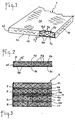
- FIG. 1 represents a composite structure according to the invention taking the form of a plate 1.
- At least one three-dimensional structure 2 is produced, delimiting spaces 2f between its components; said spaces are filled with a plurality of volumes rich in silica 3 and said structure 2 and said volumes 3 are surrounded by a flexible covering skin 1a to 1e capable of undergoing high elongations of the order of 200%.
- the product obtained by said process is thus a flexible plate comprising a closed and sealed envelope and which can be used alone for example to cover the internal faces of an engine compartment or of an air compressor or even to enter into the composition of 'A complex structure comprising for example four superposed plates 1 integral in pairs and fixed on either side of a core of fibrous texture as illustrated in Figure 3, such a structure can for example be used to cover outside, the hull of a surface ship or submarine operating in an aquatic environment at great depths to protect it from sonar sound wave detection devices.
- the three-dimensional structure is constituted by a weaving produced by means of deformable synthetic fibers, for example polyester.
- the waterproof coating skin which constitutes the formed and waterproof envelope is produced from an elastomeric resin, for example chosen from the family of butyls or silicones;
- a three-dimensional weaving 2 is used, made of synthetic fibers, for example polyester, and comprising a weft 2a formed of fibers extending in a regularly sinuous fashion to form vertices 2b / 2c coming substantially facing each other and a warp 2d, formed from fibers of the same kind and extending substantially perpendicular to the weft 2a.
- Said weaving 2 also includes a third fiber thread 2e which connects the tops 2b / 2c of weft threads.
- the upper face of the weaving 2 is coated with a layer of elastomeric resin so as to produce an impermeable covering skin which constitutes the upper face 1a of the plate 1.
- the underside of said weaving 2 is also coated with a layer of elastomeric resin in order to produce a skin of waterproof coating which constitutes the lower face 1b of said plate.
- the diameter of said microbeads is between 20 and 80 micrometers
- the sand is, for example, of a particle size between 80 and 1000 micrometers.
- Figure 2 of the drawing gives in section the composition of the plate of Figure 1, which thus consists of a three-dimensional weaving 2, as described above, and whose spaces 2f, delimited by the son of polyester fibers are filled to saturation with glass or silica-rich sand 3.
- the weaving 2 and the microbeads or the sand 3 are closely surrounded by an envelope and skin of closed and waterproof coating 1a / 1b / 1d of elastomeric resin.
- a composite structure according to the invention 4 is shown in cross section in FIG. 3 comprising several plates 5/6/7/8, identical to that which has just been described with reference to FIGS. 1 and 2.
- a core 9 is first produced consisting of a layer of a texture comprising synthetic fibers capable of undergoing permanent deformation.
- the core 9 is made from carbon fibers or polyester fibers.
- a first plate 5 is applied and secured or by means of a synthetic resin on the upper face 9a of the core 9 and on the upper face 9b, another first plate 6.
- Said first plates 5 and 6 are identical to plate 1 in Figures 1 and 2 and are for example filled to saturation with glass microbeads.
- a second composite plate 7/8 is applied and secured by means of synthetic resin, identical to plate 1 in FIGS. 1 and 2, which plates 7 and 8 are by example saturated with silica-rich sand.
- such a structure may comprise only two 5/6 plates, for example fixed on either side of the core 9 or even be composed of several superimposed plates and assembled on either side of the core 9, the number of these plates thus being greater than four to take as a reference the example illustrated in FIG. 3.
- the plate 1 or the complex 4 is placed in an enclosure and a depression is created therein for both drying said plate 1 or said complex 4, and to reduce its compressibility.
- the core 9 is permanently deformed due to its composition from synthetic fibers, for example carbon or polyester.
- the weaving is inserted three-dimensional 2/10 metallic conductor wires, for example copper or aluminum.
- Such threads are associated with synthetic fiber threads which make up the three-dimensional weavings and more particularly with threads 2e which connect the tops 2b / 2c of said weavings.
- said glass beads or the grains of sand are covered with a conductive metallic paint.
- This operation is for example carried out by soaking the microbeads or sand in a bath of metallic paint, preferably but not limited to a silver-based paint.
Landscapes
- Physics & Mathematics (AREA)
- Engineering & Computer Science (AREA)
- Acoustics & Sound (AREA)
- Multimedia (AREA)
- Laminated Bodies (AREA)
- Chemical Or Physical Treatment Of Fibers (AREA)
- Soundproofing, Sound Blocking, And Sound Damping (AREA)
- Solid-Sorbent Or Filter-Aiding Compositions (AREA)
Claims (21)
- Verfahren zur Herstellung einer Verbundstruktur (1/4) zur Absorption von Geräuschen, wobei- mindestens eine räumliche Struktur (2/10) erstellt wird, die aus einem Gewebe (2) aus synthetischem Faser-material besteht, das zwischen seinen Bestandteilen Hohlräume (2f) umschließt,
dadurch gekennzeichnet,- daß die Hohlräume (2f) mit einer Vielzahl von Glaskügelchen oder Körnern aus siliziumreichem Sand (3) gefüllt werden, und- daß die Struktur (2/10) und die Kügelchen (3) mit einer weichen Aussenhaut (1a bis 1e) umhüllt werden, die Längenänderungen im Bereich von 200% unterliegen kann, wodurch eine verformbare oder warmformbare Struktur (1/4) mit konstantem Volumen entsteht. - Verfahren nach Anspruch 1, wobei die räumliche Struktur durch ein Gewebe (2) aus synthetischen Fasern gebildet wird,
gekennzeichnet durch
folgende Verfahrensschritte:- Beschichten mindestens einer Seite des Gewebes (2) mit einer Schicht aus einem Elastomerharz (1a), um eine undurchlässige Aussenhaut zu erhalten;- Füllen des Gewebes (2) bis zur Sättigung mit Glaskügelchen oder siliziumreichem Sand (3), so daß die Kügelchen oder Sandkörner sämtliche Hohlräume (2f) zwischen den Fasern des Gewebes (2) ausfüllen; und- Beschichten der übrigen Seiten des Gewebes mit einer Schicht aus Elastomerharz (1a bis 1e), um so eine geschlossene und dichte Verbundplatte (1) zu erhalten. - Verfahren nach Anspruch 1 oder 2 zur Herstellung von mindestens zwei räumlichen Gewebestrukturen (2) aus synthetischen Fasern,
gekennzeichnet durch
folgende Verfahrensschritte:- Herstellung eines Kerns (9) aus einer Schicht einer synthetischen Textur, die dauerhaft verformbar ist, und- Anbringen und Befestigen mindestens einer geschlossenen und dichten Verbundplatte (5/6) auf jeder Seite (9a/9b) des Kerns, wobei die Verbundplatte ein räumliches Gewebe (2) aufweist, das mit Glaskügelchen oder siliziumreichem Sand (3) gefüllt ist und mit einer Aussenhaut (1a bis 1e) aus einem Elastomerharz umhüllt ist. - Verfahren nach Anspruch 1 oder 2 zur Herstellung von mindestens vier räumlichen Gewebestrukturen (2) aus synthetischen Fasern,
gekennzeichnet durch
folgende Verfahrensschritte:- Herstellung eines Kerns (9) aus einer Schicht einer faserigen Textur aus sysnthetischem Material, die dauerhaft verformbar ist,- Anbringen und Befestigen einer ersten geschlossenen und dichten Verbundplatte (5/6) auf jeder Seite (9a/9b) des Kerns (9), wobei die Verbundplatte ein räumliches Gewebe (2) aufweist, das mit Glaskügelchen oder siliziumreichem Sand (3) gefüllt ist und mit einer Aussenhaut aus Elastomerharz umhüllt ist; und- Anbringen und Befestigen einer zweiten geschlossenen und dichten Verbundplatte (7/8) auf der Aussenseite (5a/6a) jeder ersten Platte (5/6), wobei die zweite Verbundplatte ein räumliches Gewebe (2) aufweist, das mit Glaskügelchen oder siliziumreichem Sand (3) gefüllt ist und mit einer Aussenhaut aus einem Elastomerharz umhüllt ist. - Verfahren nach Anspruch 3 oder 4,
dadurch gekennzeichnet,
daß mehrere der geschlossenen und dichten Verbundplatten (1/5/6/7/8) stapelartig übereinander angeordnet und an beiden Seite mit dem Kern (9) verbunden werden. - Verfahren nach Anspruch 5,
dadurch gekennzeichnet,
daß jeweils auf beiden Seiten des Kerns (9) die gleiche Anzahl von Verbundplatten (5/6-7/8) stapelartig übereinander angeordnet angeordnet und mit diesem verbunden werden, um eine symmetrische, periodische und reflexionsfreie Struktur (4) zu erhalten. - Verfahren nach einem der Ansprüche 1 bis 6,
dadurch gekennzeichnet,
daß die symmetrische Struktur (4) nach ihrer Herstellung in eine Kammer gegeben und ein Unterdruck erzeugt wird, um gleichzeitig die Struktur zu trocknen und ihre Kompressibilität zu verringern, mir dem Ziel, die granulare "Kordinationszahl" der Glaskügelchen oder der Sandkörner (3) zu erhöhen. - Verfahren nach einem der Ansprüche 1 bis 7,
dadurch gekennzeichnet,
daß in das räumliche Gewebe (2) leitfähige Metallfäden eingelegt werden, die sich mindestens von einer Seite (1a) der platten zur anderen Seite (1b) erstrecken, um neben der Geräuschabsorbierung eine Abführung der Wärme durch thermische Leitung durch die platten zu erzielen. - Verfahren nach einem der Ansprüche 1 bis 7,
dadurch gekennzeichnet,
daß man durch Tauchen die Glaskügelchen oder die Sandkörner (3) mit einem leitfähigen metallischen Auftrag beschichtet, um neben der Geräuschabsorbierung eine Abführung der Wärme durch thermische Leitung durch die platten (1/5/6/7/8) zu erzielen. - Verbundstruktur zur Absorption von Geräuschen, mit mindestens einer räumlichen Gewebestruktur (2) aus synthetischen Fasern, mit mindestens einer Platte (1), die mit einer undurchlässigen Aussenhaut (1a bis 1e) bedeckt ist, die die Struktur dichtend umhüllt,
dadurch gekennzeichnet,
daß die Struktur eine Vielzahl von Glaskügelchen oder Sandkörnern aufweist, die die gesamten Hohlräume (2f) zwischen den Fasern des Gewebes besetzen. - Struktur nach Anspruch 10,
dadurch gekennzeichnet,
daß die Kügelchen (3) aus einem Siliziumgrundmaterial bestehen und einen Durchmesser zwischen 20 und 80 Mikrometer aufweisen. - Struktur nach Anspruch 10,
dadurch gekennzeichnet,
daß der Sand siliziumreich ist und eine Körnung zwischen 80 und 1000 Mikrometer aufweist. - Struktur nach einem der Ansprüche 10 bis 12,
dadurch gekennzeichnet,
daß die Aussenhaut (1a bis 1e), die das Gewebe (2) und die Kügelchen oder die Sandkörner (3) umhüllt, aus einem Elastomerharz besteht. - Struktur nach einem der Ansprüche 10 bis 13,
gekennzeichnet durch
einen Kern (9) aus einer Textur aus synthetischen Fasern, die dauerhaft verformbar ist, wobei auf jeder Seite (9a/9b) des Kerns eine geschlossene und dichte Verbundplatte (5/6) befestigt ist, die ein räumliches Gewebe (2) aufweist, das mit Glaskügelchen oder siliziumreichem Sand (3) gefüllt ist, wobei die platte (5/6) eine undurchlässige Aussenhaut aus einem Elastomerharz aufweist. - Struktur nach einem der Ansprüch 10 bis 13,
gekennzeichnet durch
den Kern (9) und auf beiden Seiten (9a/9b) des Kerns mehrere stapelartig übereinander angeordnete geschlossene und dichte Verbundplatten (5/7-6/8), wobei die Platten (5 bis 8) durch eine synthetisches Harz miteinander verbunden sind. - Struktur nach Anspruch 15,
dadurch gekennzeichnet,
daß jeweils die gleiche Anzahl von Verbundplatten (5/6-7/8) auf beiden Seiten des Kerns (9) angeordnet ist, um eine symmetrische, periodische und reflexionsfreie Struktur (4) zu erhalten. - Struktur nach einem der Ansprüche 10 bis 16,
dadurch gekennzeichnet,
daß sie sich in einem komprimierten Zustand befindet, um die granulare "Kordinationszahl" der Glaskügelchen oder der Sandkörner (3) zu erhöhen. - Struktur nach einem der Ansprüche 14 bis 17,
dadurch gekennzeichnet,
daß im komprimierten Zustand der Struktur (4) der Kern (9) aus einer synthetischen Textur dauerhaft verformt ist. - Struktur nach einem der Ansprüche 10 bis 18,
dadurch gekennzeichnet,
daß das räumliche Gewebe (2) neben den synthetischen Fasern (2a/2d/2e) leitfähige Metallfäden aufweist, die sich mindestens von einer Seite (1a) der Platten zur anderen Seite (1b) erstrecken, um ausser der Geräuschabsorbierung eine Abführung der Wärme durch thermische Leitung durch die Platten zu erzielen. - Struktur nach einem der Ansprüche 10 bis 18,
dadurch gekennzeichnet,
daß die Glaskügelchen oder die Sandkörner (3) mit einem leitfähigen metallischen Auftrag beschichtet sind, um ausser der Geräuschabsorbierung eine Abführung der Wärme durch thermische Leitung durch die Platten zu erzielen. - Struktur nach einem der Ansprüche 14 bis 16 und 18,
dadurch gekennzeichnet,
daß der Kern (9) aus einer Textur aus Karbon- oder Polyesterfasern besteht.
Priority Applications (1)
| Application Number | Priority Date | Filing Date | Title |
|---|---|---|---|
| AT89403388T ATE90804T1 (de) | 1988-12-07 | 1989-12-06 | Herstellungsverfahren von kompositstrukturen zum absorbieren von laerm und mit diesem verfahren hergestellte kompositstrukturen. |
Applications Claiming Priority (2)
| Application Number | Priority Date | Filing Date | Title |
|---|---|---|---|
| FR8816698 | 1988-12-07 | ||
| FR8816698A FR2640068B1 (fr) | 1988-12-07 | 1988-12-07 | Procede de fabrication de structures composites pour l'absorption du bruit et structures composites obtenues par ledit procede |
Publications (2)
| Publication Number | Publication Date |
|---|---|
| EP0374013A1 EP0374013A1 (de) | 1990-06-20 |
| EP0374013B1 true EP0374013B1 (de) | 1993-06-16 |
Family
ID=9373072
Family Applications (1)
| Application Number | Title | Priority Date | Filing Date |
|---|---|---|---|
| EP89403388A Expired - Lifetime EP0374013B1 (de) | 1988-12-07 | 1989-12-06 | Herstellungsverfahren von Kompositstrukturen zum Absorbieren von Lärm und mit diesem Verfahren hergestellte Kompositstrukturen |
Country Status (4)
| Country | Link |
|---|---|
| EP (1) | EP0374013B1 (de) |
| AT (1) | ATE90804T1 (de) |
| DE (1) | DE68907187D1 (de) |
| FR (1) | FR2640068B1 (de) |
Families Citing this family (2)
| Publication number | Priority date | Publication date | Assignee | Title |
|---|---|---|---|---|
| DE4408782A1 (de) * | 1994-03-15 | 1995-09-21 | Fraunhofer Ges Forschung | Folien-Schallabsorber |
| CN117141068B (zh) * | 2023-08-28 | 2025-06-24 | 西安国器材料科技有限公司 | 一种热熔胶膜多层空心玻璃微珠声反射布及其制造方法 |
Family Cites Families (4)
| Publication number | Priority date | Publication date | Assignee | Title |
|---|---|---|---|---|
| US3515910A (en) * | 1968-11-12 | 1970-06-02 | Us Navy | Acoustic absorbing material |
| US3923118A (en) * | 1972-06-19 | 1975-12-02 | Us Navy | Acoustic baffle for deep submergence |
| FR2501749A1 (fr) * | 1981-03-13 | 1982-09-17 | Gadde V | Voile ou mat d'insonorisation |
| GB8702127D0 (en) * | 1987-01-30 | 1987-03-04 | Salex Acoustic Materials Ltd | Acoustic attenuating material |
-
1988
- 1988-12-07 FR FR8816698A patent/FR2640068B1/fr not_active Expired - Lifetime
-
1989
- 1989-12-06 AT AT89403388T patent/ATE90804T1/de not_active IP Right Cessation
- 1989-12-06 EP EP89403388A patent/EP0374013B1/de not_active Expired - Lifetime
- 1989-12-06 DE DE8989403388T patent/DE68907187D1/de not_active Expired - Lifetime
Also Published As
| Publication number | Publication date |
|---|---|
| FR2640068B1 (fr) | 1991-01-25 |
| DE68907187D1 (de) | 1993-07-22 |
| EP0374013A1 (de) | 1990-06-20 |
| ATE90804T1 (de) | 1993-07-15 |
| FR2640068A1 (fr) | 1990-06-08 |
Similar Documents
| Publication | Publication Date | Title |
|---|---|---|
| CA2178148C (fr) | Procede de fabrication d'un panneau ou analogue a proprietes structurale et acoustique et panneau ainsi obtenu | |
| EP2071561B1 (de) | Schallabsorptionsstruktur zum Dämpfen von Geräuschen, die hauptsächlich durch einen Rotor erzeugt werden, und eine solche Struktur umfassende Verkleidung | |
| CA2441477C (fr) | Panneau d'attenuation acoustique comportant une couche resistive a composante structurale renforcee | |
| EP1213703B1 (de) | Akustische Platte mit Sandwichaufbau | |
| CA2365100C (fr) | Procede de fabrication d'un panneau d'attenuation acoustique a couche resistive a propriete structurale et panneau ainsi obtenu | |
| FR2767411A1 (fr) | Couche acoustiquement resistive, procede de fabrication de cette couche et panneau acoustiquement absorbant muni d'au moins une telle couche | |
| FR2888386A1 (fr) | Ensemble a mousse de tortuosite elevee, et application de celle-ci a l'insonorisation d'espaces clos | |
| CA2848248A1 (fr) | Panneau d'attenuation acoustique structural | |
| EP0161458A1 (de) | Akustische Wellen dämpfende Wandbedeckung | |
| EP0374013A1 (de) | Herstellungsverfahren von Kompositstrukturen zum Absorbieren von Lärm und mit diesem Verfahren hergestellte Kompositstrukturen | |
| FR2660787A1 (fr) | Ecran anechouide. | |
| CA2209302C (fr) | Structures d'absorption de bruit et parois constituees de ces structures | |
| EP0755775B1 (de) | Wahrnehmbar steifes, thermisch isolierendes Paneel, sowie Verfahren zu seiner Herstellung | |
| FR2656971A1 (fr) | Hydrophone basse frequence et antenne sonar comportant de tels hydrophones. | |
| CA1280503C (fr) | Dome pour sonar | |
| EP0881001A1 (de) | Elektrodynamischer Wandler für Unterwasser-Akustik | |
| EP0441703A1 (de) | Flexibler und druckdurchlässiger Wärmeschutz | |
| EP3440965B1 (de) | Schalldämmender verbundvorhang | |
| FR2683969A1 (fr) | Membrane d'etancheite pour dispositif immerge, notamment pour dispositif acoustique sous-marin, et dispositif comprenant une telle membrane. | |
| US6224982B1 (en) | Normal incidence multi-layer elastomeric radar absorber | |
| EP0491034A1 (de) | Vorrichtung zur dämpfung akustischer energie in einem rumpf eines schiffes, und bausteinfoermiger akustischer schirm einer deratiger vorrichtung | |
| EP3963571A1 (de) | Oberflächenverkleidungselement zur erzeugung einer akustischen dämpfung | |
| FR2818421A1 (fr) | Panneau acoustique sandwich a plusieurs degres de liberte | |
| WO1992001599A1 (fr) | Revetement anechoide, en particulier pour coques de navires ou de sous-marins | |
| EP0740287A1 (de) | Werkstoff zur Schalldämpfung, insbesondere für Unterwasseranwendungen |
Legal Events
| Date | Code | Title | Description |
|---|---|---|---|
| PUAI | Public reference made under article 153(3) epc to a published international application that has entered the european phase |
Free format text: ORIGINAL CODE: 0009012 |
|
| AK | Designated contracting states |
Kind code of ref document: A1 Designated state(s): AT BE CH DE ES FR GB GR IT LI LU NL SE |
|
| 17P | Request for examination filed |
Effective date: 19901211 |
|
| 17Q | First examination report despatched |
Effective date: 19920708 |
|
| GRAA | (expected) grant |
Free format text: ORIGINAL CODE: 0009210 |
|
| AK | Designated contracting states |
Kind code of ref document: B1 Designated state(s): AT BE CH DE ES FR GB GR IT LI LU NL SE |
|
| PG25 | Lapsed in a contracting state [announced via postgrant information from national office to epo] |
Ref country code: IT Free format text: LAPSE BECAUSE OF FAILURE TO SUBMIT A TRANSLATION OF THE DESCRIPTION OR TO PAY THE FEE WITHIN THE PRE;WARNING: LAPSES OF ITALIAN PATENTS WITH EFFECTIVE DATE BEFORE 2007 MAY HAVE OCCURRED AT ANY TIME BEFORE 2007. THE CORRECT EFFECTIVE DATE MAY BE DIFFERENT FROM THE ONE RECORDED.SCRIBED TIME-LIMIT Effective date: 19930616 Ref country code: GB Effective date: 19930616 Ref country code: DE Effective date: 19930616 Ref country code: NL Effective date: 19930616 Ref country code: GR Free format text: LAPSE BECAUSE OF FAILURE TO SUBMIT A TRANSLATION OF THE DESCRIPTION OR TO PAY THE FEE WITHIN THE PRESCRIBED TIME-LIMIT Effective date: 19930616 Ref country code: SE Effective date: 19930616 Ref country code: AT Effective date: 19930616 Ref country code: ES Free format text: THE PATENT HAS BEEN ANNULLED BY A DECISION OF A NATIONAL AUTHORITY Effective date: 19930616 |
|
| REF | Corresponds to: |
Ref document number: 90804 Country of ref document: AT Date of ref document: 19930715 Kind code of ref document: T |
|
| REF | Corresponds to: |
Ref document number: 68907187 Country of ref document: DE Date of ref document: 19930722 |
|
| NLV1 | Nl: lapsed or annulled due to failure to fulfill the requirements of art. 29p and 29m of the patents act | ||
| GBV | Gb: ep patent (uk) treated as always having been void in accordance with gb section 77(7)/1977 [no translation filed] |
Effective date: 19930616 |
|
| PG25 | Lapsed in a contracting state [announced via postgrant information from national office to epo] |
Ref country code: CH Effective date: 19931231 Ref country code: BE Effective date: 19931231 Ref country code: LU Free format text: LAPSE BECAUSE OF NON-PAYMENT OF DUE FEES Effective date: 19931231 Ref country code: LI Effective date: 19931231 |
|
| PLBE | No opposition filed within time limit |
Free format text: ORIGINAL CODE: 0009261 |
|
| STAA | Information on the status of an ep patent application or granted ep patent |
Free format text: STATUS: NO OPPOSITION FILED WITHIN TIME LIMIT |
|
| 26N | No opposition filed | ||
| BERE | Be: lapsed |
Owner name: CONSTRUCTIONS INDUSTRIELLES DE LA MEDITERRANEE- C Effective date: 19931231 |
|
| REG | Reference to a national code |
Ref country code: CH Ref legal event code: PL |
|
| PGFP | Annual fee paid to national office [announced via postgrant information from national office to epo] |
Ref country code: FR Payment date: 19941221 Year of fee payment: 6 |
|
| PG25 | Lapsed in a contracting state [announced via postgrant information from national office to epo] |
Ref country code: FR Effective date: 19960830 |
|
| REG | Reference to a national code |
Ref country code: FR Ref legal event code: ST |