EP0373003A2 - Surface-mounted component's contact having a soldering portion - Google Patents
Surface-mounted component's contact having a soldering portion Download PDFInfo
- Publication number
- EP0373003A2 EP0373003A2 EP89312876A EP89312876A EP0373003A2 EP 0373003 A2 EP0373003 A2 EP 0373003A2 EP 89312876 A EP89312876 A EP 89312876A EP 89312876 A EP89312876 A EP 89312876A EP 0373003 A2 EP0373003 A2 EP 0373003A2
- Authority
- EP
- European Patent Office
- Prior art keywords
- soldering
- contact
- foot
- leg
- soldering portion
- Prior art date
- Legal status (The legal status is an assumption and is not a legal conclusion. Google has not performed a legal analysis and makes no representation as to the accuracy of the status listed.)
- Granted
Links
Images


Classifications
-
- H—ELECTRICITY
- H01—ELECTRIC ELEMENTS
- H01R—ELECTRICALLY-CONDUCTIVE CONNECTIONS; STRUCTURAL ASSOCIATIONS OF A PLURALITY OF MUTUALLY-INSULATED ELECTRICAL CONNECTING ELEMENTS; COUPLING DEVICES; CURRENT COLLECTORS
- H01R12/00—Structural associations of a plurality of mutually-insulated electrical connecting elements, specially adapted for printed circuits, e.g. printed circuit boards [PCB], flat or ribbon cables, or like generally planar structures, e.g. terminal strips, terminal blocks; Coupling devices specially adapted for printed circuits, flat or ribbon cables, or like generally planar structures; Terminals specially adapted for contact with, or insertion into, printed circuits, flat or ribbon cables, or like generally planar structures
- H01R12/50—Fixed connections
- H01R12/51—Fixed connections for rigid printed circuits or like structures
- H01R12/55—Fixed connections for rigid printed circuits or like structures characterised by the terminals
- H01R12/57—Fixed connections for rigid printed circuits or like structures characterised by the terminals surface mounting terminals
-
- H—ELECTRICITY
- H01—ELECTRIC ELEMENTS
- H01R—ELECTRICALLY-CONDUCTIVE CONNECTIONS; STRUCTURAL ASSOCIATIONS OF A PLURALITY OF MUTUALLY-INSULATED ELECTRICAL CONNECTING ELEMENTS; COUPLING DEVICES; CURRENT COLLECTORS
- H01R4/00—Electrically-conductive connections between two or more conductive members in direct contact, i.e. touching one another; Means for effecting or maintaining such contact; Electrically-conductive connections having two or more spaced connecting locations for conductors and using contact members penetrating insulation
- H01R4/02—Soldered or welded connections
-
- H—ELECTRICITY
- H05—ELECTRIC TECHNIQUES NOT OTHERWISE PROVIDED FOR
- H05K—PRINTED CIRCUITS; CASINGS OR CONSTRUCTIONAL DETAILS OF ELECTRIC APPARATUS; MANUFACTURE OF ASSEMBLAGES OF ELECTRICAL COMPONENTS
- H05K3/00—Apparatus or processes for manufacturing printed circuits
- H05K3/30—Assembling printed circuits with electric components, e.g. with resistors
- H05K3/32—Assembling printed circuits with electric components, e.g. with resistors electrically connecting electric components or wires to printed circuits
- H05K3/34—Assembling printed circuits with electric components, e.g. with resistors electrically connecting electric components or wires to printed circuits by soldering
- H05K3/341—Surface mounted components
- H05K3/3421—Leaded components
- H05K3/3426—Leaded components characterised by the leads
-
- H—ELECTRICITY
- H01—ELECTRIC ELEMENTS
- H01R—ELECTRICALLY-CONDUCTIVE CONNECTIONS; STRUCTURAL ASSOCIATIONS OF A PLURALITY OF MUTUALLY-INSULATED ELECTRICAL CONNECTING ELEMENTS; COUPLING DEVICES; CURRENT COLLECTORS
- H01R12/00—Structural associations of a plurality of mutually-insulated electrical connecting elements, specially adapted for printed circuits, e.g. printed circuit boards [PCB], flat or ribbon cables, or like generally planar structures, e.g. terminal strips, terminal blocks; Coupling devices specially adapted for printed circuits, flat or ribbon cables, or like generally planar structures; Terminals specially adapted for contact with, or insertion into, printed circuits, flat or ribbon cables, or like generally planar structures
- H01R12/70—Coupling devices
- H01R12/71—Coupling devices for rigid printing circuits or like structures
- H01R12/72—Coupling devices for rigid printing circuits or like structures coupling with the edge of the rigid printed circuits or like structures
- H01R12/73—Coupling devices for rigid printing circuits or like structures coupling with the edge of the rigid printed circuits or like structures connecting to other rigid printed circuits or like structures
- H01R12/735—Printed circuits including an angle between each other
- H01R12/737—Printed circuits being substantially perpendicular to each other
-
- H—ELECTRICITY
- H05—ELECTRIC TECHNIQUES NOT OTHERWISE PROVIDED FOR
- H05K—PRINTED CIRCUITS; CASINGS OR CONSTRUCTIONAL DETAILS OF ELECTRIC APPARATUS; MANUFACTURE OF ASSEMBLAGES OF ELECTRICAL COMPONENTS
- H05K2201/00—Indexing scheme relating to printed circuits covered by H05K1/00
- H05K2201/10—Details of components or other objects attached to or integrated in a printed circuit board
- H05K2201/10613—Details of electrical connections of non-printed components, e.g. special leads
- H05K2201/10742—Details of leads
- H05K2201/1075—Shape details
- H05K2201/10818—Flat leads
-
- Y—GENERAL TAGGING OF NEW TECHNOLOGICAL DEVELOPMENTS; GENERAL TAGGING OF CROSS-SECTIONAL TECHNOLOGIES SPANNING OVER SEVERAL SECTIONS OF THE IPC; TECHNICAL SUBJECTS COVERED BY FORMER USPC CROSS-REFERENCE ART COLLECTIONS [XRACs] AND DIGESTS
- Y02—TECHNOLOGIES OR APPLICATIONS FOR MITIGATION OR ADAPTATION AGAINST CLIMATE CHANGE
- Y02P—CLIMATE CHANGE MITIGATION TECHNOLOGIES IN THE PRODUCTION OR PROCESSING OF GOODS
- Y02P70/00—Climate change mitigation technologies in the production process for final industrial or consumer products
- Y02P70/50—Manufacturing or production processes characterised by the final manufactured product
Definitions
- the present invention relates to an electrical contact of an electric component to be mounted to a printed circuit board, such as electrical connector, carrier chip, switch, capacitor, electrical connection member or any other electrical part, and more particularly to an improved shape of the soldering portion of an electrical contact of such surface-mounted component.
- a printed circuit board such as electrical connector, carrier chip, switch, capacitor, electrical connection member or any other electrical part
- a conventional lead wire terminal is shown in Fig. 8.
- the soldering portion 2′ of the terminal 1′ is of rod shape.
- the end surface 3′ of the rod-shaped soldering portion 2′ is put on a conductor, and then its surface is joined to the surface of the conductor as indicated at 4′.
- the soldering skirts the lead wire terminal.
- the rod-shape of this lead wire terminal soldering portion 2′ makes it easy to produce a lot of such metal pieces by stamping metal sheets.
- the soldering skirt 4′ will be loaded from the soldering portion 2′.
- the load per unit soldering area will be great because of the relatively small contact area between the rod-shaped soldering portion 2′ and the surrounding soldering skirt 4′, and therefore, the soldering portion 2′ is liable to be removed from the conductor.
- Fig. 9 shows another conventional lead wire terminal 11′ having an "L"-shaped soldering portion 12′. It is composed of a horizontal foot 13′. As shown, the end surface 14′ of the foot 13′ of the "L"-shaped soldering portion 12′ is put on the conductor, and then the surface of the soldering portion 12′ is joined to the surface of the conductor as indicated at 15′.
- the jointing strength between the soldering and the conductor results only from the soldering around the bent portion of the "L"-shaped lead wire terminal.
- the remaining contact area of the "L"-shaped piece even though it is relatively large in area, has little effect of increasing the jointing strength.
- the object of the present invention is to provide a surface-mounted component's contact having an improved soldering portion which is capable of preventing localized concentration of force in the soldering portion as is the case with a conventional "L"-shaped contact when pulled up, and is capable of minimizing the load per unit soldering area upon application of undesired external force to the contact, thereby preventing the fatigue failure or removal of the contact from the conductor, and assuring that sufficient jointing strength to the conductor is maintained at all times and that good electrical contact is kept at all times.
- a surface-mounted component's contact having a soldering portion which contact is to be mounted to the surface of a printed circuit board and is to be electrically connected to a conductor on said printed circuit board by soldering its soldering portion to said conductor, is improved according to the present invention in that said soldering portion comprises a flat foot and a leg, which is integrally connected to and rising from the midportion of said foot, thus generally shaped in the form of inverted "T", said soldering portion being a metal piece made, e.g. by stamping a metal blank.
- the soldering portion of the contact has an extensive foot, and the soldering material will be applied over this extensive foot.
- the force will be distributed evenly over the extensive area of the contact foot, thus reducing the load per unit soldering area to possible minimum.
- the force will be transmitted to the horizontal foot via the joint between the horizontal foot and the vertical leg of the contact, and will be evenly distributed in the surrounding soldering skirt in all directions thanks to the location of the joint in the midpoint of the foot.
- the inverted "T"-shape of the contact piece has the effect of holding the joint strength and electrical contact in good, reliable condition.
- the inverted "T"-shape of the contact piece permits the stamping-out of the contact from metal sheets. This assures that a metal piece has a strong joint between horizontal and vertical portions.
- Figs. 1-5 show an electrical contact assembly having an array of terminal structures according to the present invention.
- the electrical connector 1 comprises an elongated body 4 having extensions 2 and 3 integrally connected to the opposite ends of the elongated body 4.
- a plurality of terminals 11 according to the present invention are fixed to the elongated body 4 at regular intervals.
- each terminal 11 is integrally jointed to a counter terminal 11, and is fixed to the elongated body 4 to face the counter terminal 11.
- each terminal 11 comprises an inverted "T"-shaped soldering connecting portion 12, a trunk 13 integrally connected to the soldering connecting portion 12 and having an extended arm 16 to be inserted in a selected slot 15 of the elongated body 4 and a contact piece 14 integrally connected to the trunk 13.
- the terminal pair is a metal piece which is stamped out from a metal sheet.
- the inverted "T"-shaped soldering connecting portion 12 comprises a relatively large foot 17 and a leg 18 integrally connected to the foot 17 as indicated at 19 and rising from the foot 17.
- the foot 17 of each terminal 11 When in use, the foot 17 of each terminal 11 is soldered to a conductor on a printed circuit board 6 to joint the surface of the foot 17 to the surface of the conductor, as indicated at 21.
- the soldering metal is melted and is allowed to invade somewhat the gap remaining between the end surface 20 of the foot 17 and the conductor surface.
- each terminal 11 When another circuit board 8 is inserted between the opposite extensions 2 and 3 of the elongated body 4, the contact 14 of each terminal 11 will be resiliently put in contact with a selected conductor on the printed circuit board 8. Likewise, the contact 14 of the counter terminal 11 will be sandwiched between these contacts 14.
- the foot 17 has a relatively large area. Assume that an undesired exterior force is applied to the contact 14 of the terminal 11 and that the force is transmitted to the soldering skirt 21 via the leg 18, thereby loading the soldering skirt 21. The load per soldering unit area of the foot will not be great because of the increased soldering area which surrounds the relatively large foot 17.
- the terminal 11 is a metal piece stamped out from a metal sheet and therefore the foot-and-leg joint has an increased strength, compared with the one in which a separate leg is integrally connected to a separate foot.
- the inverted "T"-shaped soldering portion of a terminal has a leg and a relatively large foot integrally connected to the center of the leg, thereby causing substantial reduction of load per unit soldering area upon application of an undesired force to the terminal, and increasing the resistivity of the soldering against removal from the conductor on a printed circuit board.
- the leg is integrally connected to the center of the foot, and therefore, an undesired external force when applied to the terminal will be transmitted to the foot and the surrounding soldering skirt so that the foot and the surrounding soldering skirt are evenly stressed, not localizing the force to particular points. Thus, the soldering strength will not be lowered, and the electrical connection will be kept in good condition.
- the terminal is a metal piece which is stamped out from a metal sheet. Therefore, the joint between the foot and the leg has an increased strength. This contributes the solidity with which the soldering portion of the terminal is fixed to the conductor on a printed circuit board.
Landscapes
- Engineering & Computer Science (AREA)
- Manufacturing & Machinery (AREA)
- Microelectronics & Electronic Packaging (AREA)
- Multi-Conductor Connections (AREA)
- Coupling Device And Connection With Printed Circuit (AREA)
- Connecting Device With Holders (AREA)
- Structures For Mounting Electric Components On Printed Circuit Boards (AREA)
Abstract
Description
- The present invention relates to an electrical contact of an electric component to be mounted to a printed circuit board, such as electrical connector, carrier chip, switch, capacitor, electrical connection member or any other electrical part, and more particularly to an improved shape of the soldering portion of an electrical contact of such surface-mounted component.
- As is well known, a variety of electric components are mounted to a printed circuit board by soldering the lead wire terminals of such electrical components to the surface of the printed circuit or by connecting them to the surface of the printed circuit with the aid of lead-less means. In the former the strength with which the lead wire terminals are fixed to the surface of the printed circuit, and the quality with which the lead wire terminals are electrically connected to the surface of the printed circuit, depends on the shape of the lead wire terminal, and on the soldering condition resulting from the particular shape of the lead wire terminal. Therefore, the lead wire terminal shape and the soldering strength attained thereby have been studied, and these factors are taken into consideration in designing lead wire terminals.
- A conventional lead wire terminal is shown in Fig. 8. As shown, the soldering
portion 2′ of the terminal 1′ is of rod shape. The end surface 3′ of the rod-shaped soldering portion 2′ is put on a conductor, and then its surface is joined to the surface of the conductor as indicated at 4′. As shown, the soldering skirts the lead wire terminal. - Advantageously, the rod-shape of this lead wire terminal soldering
portion 2′ makes it easy to produce a lot of such metal pieces by stamping metal sheets. When an exterior force is applied to the terminal 1′, the solderingskirt 4′ will be loaded from thesoldering portion 2′. Disadvantageously, the load per unit soldering area will be great because of the relatively small contact area between the rod-shaped soldering portion 2′ and the surrounding solderingskirt 4′, and therefore, the solderingportion 2′ is liable to be removed from the conductor. - Fig. 9 shows another conventional
lead wire terminal 11′ having an "L"-shaped soldering portion 12′. It is composed of ahorizontal foot 13′. As shown, theend surface 14′ of thefoot 13′ of the "L"-shaped soldering portion 12′ is put on the conductor, and then the surface of the solderingportion 12′ is joined to the surface of the conductor as indicated at 15′. - When an undesired exterior force is applied to the
lead wire terminal 11′, the load per unit area on the solderingskirt 15′ will be relatively small because theend surface area 14′ is relatively large, accordingly increasing the resistance of the soldering portion against the exterior force to remove thelead wire terminal 11′ from the underlying conductor. In case that a strong pull is applied to thevertical leg 16′ of thelead wire terminal 11′, the pulling force is liable to concentrate to the bent portion "P" of the "L"-shaped soldering portion 12′. As a result a fatigue failure is liable to appear at this bent portion, allowing the soldering portion to be removed from the conductor. The jointing strength between the soldering and the conductor results only from the soldering around the bent portion of the "L"-shaped lead wire terminal. The remaining contact area of the "L"-shaped piece even though it is relatively large in area, has little effect of increasing the jointing strength. - With the above in mind, the object of the present invention is to provide a surface-mounted component's contact having an improved soldering portion which is capable of preventing localized concentration of force in the soldering portion as is the case with a conventional "L"-shaped contact when pulled up, and is capable of minimizing the load per unit soldering area upon application of undesired external force to the contact, thereby preventing the fatigue failure or removal of the contact from the conductor, and assuring that sufficient jointing strength to the conductor is maintained at all times and that good electrical contact is kept at all times.
- To attain this object a surface-mounted component's contact having a soldering portion, which contact is to be mounted to the surface of a printed circuit board and is to be electrically connected to a conductor on said printed circuit board by soldering its soldering portion to said conductor, is improved according to the present invention in that said soldering portion comprises a flat foot and a leg, which is integrally connected to and rising from the midportion of said foot, thus generally shaped in the form of inverted "T", said soldering portion being a metal piece made, e.g. by stamping a metal blank.
- The soldering portion of the contact has an extensive foot, and the soldering material will be applied over this extensive foot. When an undesired external force is applied to the contact, and hence the soldering skirt, the force will be distributed evenly over the extensive area of the contact foot, thus reducing the load per unit soldering area to possible minimum.
- In case that a strong pull is applied to the contact to raise it apart from the conductor, the force will be transmitted to the horizontal foot via the joint between the horizontal foot and the vertical leg of the contact, and will be evenly distributed in the surrounding soldering skirt in all directions thanks to the location of the joint in the midpoint of the foot. Thus, no fatigue failure will be caused in the soldering skirt, and the peeling-off of soldering material will be prevented. The inverted "T"-shape of the contact piece has the effect of holding the joint strength and electrical contact in good, reliable condition.
- The inverted "T"-shape of the contact piece permits the stamping-out of the contact from metal sheets. This assures that a metal piece has a strong joint between horizontal and vertical portions.
- One way of carrying out the present invention will now be described in detail by way of example with reference to drawings which show one specific embodiment. In the drawings:
- FIG. 1 is a plan view of an electrical contact assembly having an array of terminal structures according to the present invention;
- FIG. 2 is a front view of the electrical contact assembly;
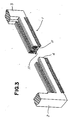
- FIG. 3 is a perspective view of the electrical contact assembly with its midlength eliminated;
- FIG. 4 is an enlarged view of the portion of the contact assembly encircled and indicated by line A in Fig. 2;
- FIG. 5 is an enlarged sectional view of the portion of the contact assembly taken along the line B-B in Fig. 2 and seen from the direction as indicated by arrows;
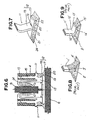
- FIG. 6 is a sectional view showing the contact piece pair with its feet soldered to a conductor on a printed circuit board, said contact piece pair receiving and resiliently holding and contacting another printed circuit board between its contact arms;
- FIG. 7 is a perspective view of the portion at which the contact piece is soldered to a conductor;
- FIG. 8 is a similar perspective view, but showing the soldering of a conventional contact piece; and
- FIG. 9 is a similar perspective view, showing the soldering of another conventional contact piece.
- The present invention is described as being applied to an electrical connector. Figs. 1-5 show an electrical contact assembly having an array of terminal structures according to the present invention.
- As shown in these drawings, the electrical connector 1 comprises an
elongated body 4 havingextensions 2 and 3 integrally connected to the opposite ends of theelongated body 4. A plurality ofterminals 11 according to the present invention are fixed to theelongated body 4 at regular intervals. As best seen from Fig. 5, eachterminal 11 is integrally jointed to acounter terminal 11, and is fixed to theelongated body 4 to face thecounter terminal 11. - Particularly, referring to Figs. 5, 6 and 7, each
terminal 11 comprises an inverted "T"-shaped soldering connectingportion 12, atrunk 13 integrally connected to the soldering connectingportion 12 and having an extendedarm 16 to be inserted in a selectedslot 15 of theelongated body 4 and acontact piece 14 integrally connected to thetrunk 13. The terminal pair is a metal piece which is stamped out from a metal sheet. - The inverted "T"-shaped
soldering connecting portion 12 comprises a relatively large foot 17 and aleg 18 integrally connected to the foot 17 as indicated at 19 and rising from the foot 17. - When in use, the foot 17 of each
terminal 11 is soldered to a conductor on a printedcircuit board 6 to joint the surface of the foot 17 to the surface of the conductor, as indicated at 21. The soldering metal is melted and is allowed to invade somewhat the gap remaining between theend surface 20 of the foot 17 and the conductor surface. - When another
circuit board 8 is inserted between theopposite extensions 2 and 3 of theelongated body 4, thecontact 14 of eachterminal 11 will be resiliently put in contact with a selected conductor on the printedcircuit board 8. Likewise, thecontact 14 of thecounter terminal 11 will be sandwiched between thesecontacts 14. - As already described, the foot 17 has a relatively large area. Assume that an undesired exterior force is applied to the
contact 14 of theterminal 11 and that the force is transmitted to the solderingskirt 21 via theleg 18, thereby loading the solderingskirt 21. The load per soldering unit area of the foot will not be great because of the increased soldering area which surrounds the relatively large foot 17. - When a printed
circuit board 8 is inserted and then pulled up from the electrical connector 1, a raising force will be applied to theleg 18 of eachterminal 11, and this force will be transmitted to thejoint 19 between theleg 18 and the foot 17. The force will be distributed all the way from the mid-joint to eachend whole soldering skirt 21. This is because theleg 18 rises from thecenter 22 of the foot 17. The force cannot be localized to the portion of the solderingskirt 21 around thejoint 19. The even distribution of an undesired force prevents fatigue failure of soldering at a localized point, and assures good mechanical and electrical connection. - As described earlier, the
terminal 11 is a metal piece stamped out from a metal sheet and therefore the foot-and-leg joint has an increased strength, compared with the one in which a separate leg is integrally connected to a separate foot. - This particular embodiment is described as being applied to an electrical connector terminal but it should be understood that the present invention can be equally applied to lead wire terminals for carrier chips, switches, capacitors, resistors and any other components to be mounted to a printed circuit board.
- As may be understood from the above, the inverted "T"-shaped soldering portion of a terminal according to the present invention has a leg and a relatively large foot integrally connected to the center of the leg, thereby causing substantial reduction of load per unit soldering area upon application of an undesired force to the terminal, and increasing the resistivity of the soldering against removal from the conductor on a printed circuit board.
- The leg is integrally connected to the center of the foot, and therefore, an undesired external force when applied to the terminal will be transmitted to the foot and the surrounding soldering skirt so that the foot and the surrounding soldering skirt are evenly stressed, not localizing the force to particular points. Thus, the soldering strength will not be lowered, and the electrical connection will be kept in good condition.
- The terminal is a metal piece which is stamped out from a metal sheet. Therefore, the joint between the foot and the leg has an increased strength. This contributes the solidity with which the soldering portion of the terminal is fixed to the conductor on a printed circuit board.
Claims (6)
Applications Claiming Priority (2)
| Application Number | Priority Date | Filing Date | Title |
|---|---|---|---|
| JP160024/88U | 1988-12-09 | ||
| JP1988160024U JPH0424612Y2 (en) | 1988-12-09 | 1988-12-09 |
Publications (3)
| Publication Number | Publication Date |
|---|---|
| EP0373003A2 true EP0373003A2 (en) | 1990-06-13 |
| EP0373003A3 EP0373003A3 (en) | 1990-12-19 |
| EP0373003B1 EP0373003B1 (en) | 1994-09-21 |
Family
ID=15706317
Family Applications (1)
| Application Number | Title | Priority Date | Filing Date |
|---|---|---|---|
| EP89312876A Expired - Lifetime EP0373003B1 (en) | 1988-12-09 | 1989-12-11 | Surface-mounted component's contact having a soldering portion |
Country Status (4)
| Country | Link |
|---|---|
| US (1) | US4955820A (en) |
| EP (1) | EP0373003B1 (en) |
| JP (1) | JPH0424612Y2 (en) |
| DE (1) | DE68918415T2 (en) |
Cited By (12)
| Publication number | Priority date | Publication date | Assignee | Title |
|---|---|---|---|---|
| FR2669149A1 (en) * | 1990-11-12 | 1992-05-15 | Souriau & Cie | Intermediate connector between a printed circuit card and a substrate with active electronic circuits |
| EP0475067A3 (en) * | 1990-09-10 | 1992-09-16 | Molex Incorporated | Electrical connector and terminal thereof |
| EP0510995A3 (en) * | 1991-04-26 | 1993-04-28 | Amp Incorporated | Electrical connector having reliable terminals |
| EP0594762A4 (en) * | 1991-07-16 | 1997-01-02 | Du Pont | Low profile, surface-mounted connector having curved cantilevered spring contacts |
| EP0774808A1 (en) * | 1995-11-16 | 1997-05-21 | Molex Incorporated | Right-angle board to board connector with anti-wicking characteristics and terminal for same |
| WO1997045900A1 (en) * | 1996-05-31 | 1997-12-04 | The Whitaker Corporation | Rechargeable battery connector |
| WO1998006149A1 (en) * | 1996-08-05 | 1998-02-12 | The Whitaker Corporation | Electrical connector having thin contacts with surface mount edges |
| US6113440A (en) * | 1997-12-22 | 2000-09-05 | The Whitaker Corporation | Arrangement for resilient contacting |
| WO2004070887A1 (en) * | 2003-02-06 | 2004-08-19 | Siemens Aktiengesellschaft | Smt-enabled component and circuit board |
| US7005311B2 (en) | 1993-09-30 | 2006-02-28 | Osram Gmbh | Two-pole SMT miniature housing for semiconductor components and method for the manufacture thereof |
| US7102215B2 (en) | 1997-07-29 | 2006-09-05 | Osram Gmbh | Surface-mountable light-emitting diode structural element |
| WO2014100391A1 (en) * | 2012-12-21 | 2014-06-26 | Continental Automotive Systems, Inc. | Dynamically stable surface mount post header |
Families Citing this family (19)
| Publication number | Priority date | Publication date | Assignee | Title |
|---|---|---|---|---|
| JPH0628791Y2 (en) * | 1990-03-20 | 1994-08-03 | モレックス インコーポレーテッド | Terminal in electrical connector |
| US5052936A (en) * | 1990-10-26 | 1991-10-01 | Amp Incroporated | High density electrical connector |
| US5188534A (en) * | 1992-03-19 | 1993-02-23 | Molex Incorporated | Surface mount connector with clip engaging contacts |
| JPH065137U (en) * | 1992-06-19 | 1994-01-21 | モレックス インコーポレーテッド | Terminals in surface mount electrical connectors |
| US5310357A (en) * | 1993-02-22 | 1994-05-10 | Berg Technology, Inc. | Blade-like terminal having a passive latch |
| JPH06310197A (en) * | 1993-04-23 | 1994-11-04 | Matsushita Electric Works Ltd | connector |
| US5451174A (en) * | 1993-06-29 | 1995-09-19 | Autosplice Systems, Inc. | Surface mounted pins for printed circuit boards |
| US5409386A (en) * | 1993-08-18 | 1995-04-25 | Molex Incorporated | Surface mount electrical connector and terminal therefor |
| US5471887A (en) * | 1994-02-01 | 1995-12-05 | The Whitaker Corporation | Removable sensor assembly |
| US5496180A (en) * | 1994-04-06 | 1996-03-05 | The Whitaker Corporation | Surface mountable card edge connector |
| TW280041B (en) * | 1995-10-24 | 1996-07-01 | Connector Systems Tech Nv | Electrical connector with stress isolating solder tail |
| JP3028199B2 (en) * | 1996-03-14 | 2000-04-04 | モレックス インコーポレーテッド | Electrical connector terminal |
| US5931705A (en) * | 1996-09-11 | 1999-08-03 | Thomas & Betts International | Surface mount wire connector |
| US6095827A (en) * | 1996-10-24 | 2000-08-01 | Berg Technology, Inc. | Electrical connector with stress isolating solder tail |
| US20050101190A1 (en) * | 2003-11-12 | 2005-05-12 | Ong Mei L. | Terminal with flexible tail |
| US7484971B2 (en) * | 2005-11-29 | 2009-02-03 | Amphenol Corporation | Electronic component with high density, low cost attachment |
| US7748994B1 (en) * | 2009-05-13 | 2010-07-06 | Cheng Uei Precision Industry Co., Ltd. | Board-to-board connector assembly |
| US10027046B1 (en) * | 2017-05-23 | 2018-07-17 | Te Connectivity Corporation | Receptacle connector with stub-less contacts |
| US11233348B2 (en) * | 2020-04-24 | 2022-01-25 | Intel Corporation | Structural optimization of contact geometry for high performance connector |
Family Cites Families (8)
| Publication number | Priority date | Publication date | Assignee | Title |
|---|---|---|---|---|
| JPS6270431U (en) * | 1985-10-21 | 1987-05-02 | ||
| JPH0436069Y2 (en) * | 1986-08-29 | 1992-08-26 | ||
| JPS6385838U (en) * | 1986-11-26 | 1988-06-04 | ||
| US4826442A (en) * | 1986-12-19 | 1989-05-02 | Amp Incorporated | Solderable connector retention feature |
| WO1988005612A1 (en) * | 1987-01-23 | 1988-07-28 | Amp Incorporated | High density circuit panel socket |
| US4713013A (en) * | 1987-01-30 | 1987-12-15 | Molex Incorporated | Compliant high density edge card connector with contact locating features |
| JPH0346469Y2 (en) * | 1987-02-26 | 1991-10-01 | ||
| US4802860A (en) * | 1987-03-04 | 1989-02-07 | Hirose Electric Co., Ltd. | Surface mount type electrical connector |
-
1988
- 1988-12-09 JP JP1988160024U patent/JPH0424612Y2/ja not_active Expired
-
1989
- 1989-12-07 US US07/447,350 patent/US4955820A/en not_active Expired - Lifetime
- 1989-12-11 EP EP89312876A patent/EP0373003B1/en not_active Expired - Lifetime
- 1989-12-11 DE DE68918415T patent/DE68918415T2/en not_active Expired - Fee Related
Cited By (19)
| Publication number | Priority date | Publication date | Assignee | Title |
|---|---|---|---|---|
| EP0475067A3 (en) * | 1990-09-10 | 1992-09-16 | Molex Incorporated | Electrical connector and terminal thereof |
| FR2669149A1 (en) * | 1990-11-12 | 1992-05-15 | Souriau & Cie | Intermediate connector between a printed circuit card and a substrate with active electronic circuits |
| US5152694A (en) * | 1990-11-12 | 1992-10-06 | Souriau Et Cie | Intermediate connector between printed-circuit board and substrate having active electronic circuits |
| EP0510995A3 (en) * | 1991-04-26 | 1993-04-28 | Amp Incorporated | Electrical connector having reliable terminals |
| EP0594762A4 (en) * | 1991-07-16 | 1997-01-02 | Du Pont | Low profile, surface-mounted connector having curved cantilevered spring contacts |
| US7102212B2 (en) | 1993-09-30 | 2006-09-05 | Osram Gmbh | Two-pole SMT miniature housing for semiconductor components and method for the manufacture thereof |
| US7005311B2 (en) | 1993-09-30 | 2006-02-28 | Osram Gmbh | Two-pole SMT miniature housing for semiconductor components and method for the manufacture thereof |
| US7288831B2 (en) | 1993-09-30 | 2007-10-30 | Osram Gmbh | Two-pole SMT miniature housing for semiconductor components and method for the manufacture thereof |
| EP0774808A1 (en) * | 1995-11-16 | 1997-05-21 | Molex Incorporated | Right-angle board to board connector with anti-wicking characteristics and terminal for same |
| WO1997045900A1 (en) * | 1996-05-31 | 1997-12-04 | The Whitaker Corporation | Rechargeable battery connector |
| US5823801A (en) * | 1996-08-05 | 1998-10-20 | The Whitaker Corporation | Electrical connector having thin contacts with surface mount edges |
| WO1998006149A1 (en) * | 1996-08-05 | 1998-02-12 | The Whitaker Corporation | Electrical connector having thin contacts with surface mount edges |
| US7102215B2 (en) | 1997-07-29 | 2006-09-05 | Osram Gmbh | Surface-mountable light-emitting diode structural element |
| US7183632B2 (en) | 1997-07-29 | 2007-02-27 | Osram Gmbh | Surface-mountable light-emitting diode structural element |
| US7508002B2 (en) | 1997-07-29 | 2009-03-24 | Osram Gmbh | Surface-mountable light-emitting diode structural element |
| US6113440A (en) * | 1997-12-22 | 2000-09-05 | The Whitaker Corporation | Arrangement for resilient contacting |
| WO2004070887A1 (en) * | 2003-02-06 | 2004-08-19 | Siemens Aktiengesellschaft | Smt-enabled component and circuit board |
| WO2014100391A1 (en) * | 2012-12-21 | 2014-06-26 | Continental Automotive Systems, Inc. | Dynamically stable surface mount post header |
| US9276337B2 (en) | 2012-12-21 | 2016-03-01 | Continental Automotive Systems, Inc. | Dynamically stable surface mount post header |
Also Published As
| Publication number | Publication date |
|---|---|
| JPH0280970U (en) | 1990-06-21 |
| JPH0424612Y2 (en) | 1992-06-10 |
| EP0373003A3 (en) | 1990-12-19 |
| US4955820A (en) | 1990-09-11 |
| DE68918415T2 (en) | 1995-03-16 |
| EP0373003B1 (en) | 1994-09-21 |
| DE68918415D1 (en) | 1994-10-27 |
Similar Documents
| Publication | Publication Date | Title |
|---|---|---|
| EP0373003B1 (en) | Surface-mounted component's contact having a soldering portion | |
| KR970000291Y1 (en) | Surface mount electrical connector assembly | |
| US4621880A (en) | Electrical contact elements, connectors and assemblies | |
| US4009921A (en) | Electrical contact and support means therefor | |
| US4353609A (en) | Terminal for printed circuit boards | |
| EP0475067B1 (en) | Electrical connector and terminal therefor | |
| US7430801B2 (en) | Connector assembly | |
| EP0564955A2 (en) | Edge connector for a printed circuit board | |
| JPH0754720B2 (en) | Electrical connection terminals for flexible printed circuit boards | |
| JPH0631088U (en) | Edge connector and contactor used for it | |
| KR920007828B1 (en) | Socket for mounting an ic chip package on a printed circuit board | |
| EP0838101A1 (en) | Electrical connectors | |
| JPS6229084A (en) | Contactor and manufacture thereof | |
| JP3148855B2 (en) | Electrical connector | |
| US4638406A (en) | Discrete component mounting assembly | |
| KR980007880A (en) | Electrical conductor | |
| EP0724782B1 (en) | Gang modular jack | |
| US5160282A (en) | High density connector module | |
| US5141450A (en) | Tape carrier type electrical connector | |
| US4681391A (en) | Electric connector | |
| US3264596A (en) | Printed circuit board connector | |
| US4922380A (en) | Junction box containing a printed circuit board | |
| JPH09155U (en) | Edge connector | |
| JPH0348635B2 (en) | ||
| KR960001307Y1 (en) | Female electrical contact device |
Legal Events
| Date | Code | Title | Description |
|---|---|---|---|
| PUAI | Public reference made under article 153(3) epc to a published international application that has entered the european phase |
Free format text: ORIGINAL CODE: 0009012 |
|
| AK | Designated contracting states |
Kind code of ref document: A2 Designated state(s): DE FR GB |
|
| PUAL | Search report despatched |
Free format text: ORIGINAL CODE: 0009013 |
|
| AK | Designated contracting states |
Kind code of ref document: A3 Designated state(s): DE FR GB |
|
| 17P | Request for examination filed |
Effective date: 19910528 |
|
| 17Q | First examination report despatched |
Effective date: 19930524 |
|
| GRAA | (expected) grant |
Free format text: ORIGINAL CODE: 0009210 |
|
| AK | Designated contracting states |
Kind code of ref document: B1 Designated state(s): DE FR GB |
|
| REF | Corresponds to: |
Ref document number: 68918415 Country of ref document: DE Date of ref document: 19941027 |
|
| ET | Fr: translation filed | ||
| PLBE | No opposition filed within time limit |
Free format text: ORIGINAL CODE: 0009261 |
|
| STAA | Information on the status of an ep patent application or granted ep patent |
Free format text: STATUS: NO OPPOSITION FILED WITHIN TIME LIMIT |
|
| 26N | No opposition filed | ||
| REG | Reference to a national code |
Ref country code: GB Ref legal event code: IF02 |
|
| PGFP | Annual fee paid to national office [announced via postgrant information from national office to epo] |
Ref country code: GB Payment date: 20021104 Year of fee payment: 14 |
|
| PGFP | Annual fee paid to national office [announced via postgrant information from national office to epo] |
Ref country code: DE Payment date: 20021230 Year of fee payment: 14 |
|
| PGFP | Annual fee paid to national office [announced via postgrant information from national office to epo] |
Ref country code: FR Payment date: 20031201 Year of fee payment: 15 |
|
| PG25 | Lapsed in a contracting state [announced via postgrant information from national office to epo] |
Ref country code: GB Free format text: LAPSE BECAUSE OF NON-PAYMENT OF DUE FEES Effective date: 20031211 |
|
| PG25 | Lapsed in a contracting state [announced via postgrant information from national office to epo] |
Ref country code: DE Free format text: LAPSE BECAUSE OF NON-PAYMENT OF DUE FEES Effective date: 20040701 |
|
| GBPC | Gb: european patent ceased through non-payment of renewal fee |
Effective date: 20031211 |
|
| PG25 | Lapsed in a contracting state [announced via postgrant information from national office to epo] |
Ref country code: FR Free format text: LAPSE BECAUSE OF NON-PAYMENT OF DUE FEES Effective date: 20050831 |
|
| REG | Reference to a national code |
Ref country code: FR Ref legal event code: ST |