EP0371684A2 - Interstitielle Dotierung in III-V Halbleitermaterialien, um die Bildung von DX-Zentren zu vermeiden oder zu beseitigen - Google Patents
Interstitielle Dotierung in III-V Halbleitermaterialien, um die Bildung von DX-Zentren zu vermeiden oder zu beseitigen Download PDFInfo
- Publication number
- EP0371684A2 EP0371684A2 EP89312111A EP89312111A EP0371684A2 EP 0371684 A2 EP0371684 A2 EP 0371684A2 EP 89312111 A EP89312111 A EP 89312111A EP 89312111 A EP89312111 A EP 89312111A EP 0371684 A2 EP0371684 A2 EP 0371684A2
- Authority
- EP
- European Patent Office
- Prior art keywords
- interstitial
- semiconductor
- group iii
- group
- gaas
- Prior art date
- Legal status (The legal status is an assumption and is not a legal conclusion. Google has not performed a legal analysis and makes no representation as to the accuracy of the status listed.)
- Granted
Links
Images




Classifications
-
- H10P14/2911—
-
- H10P30/206—
-
- H—ELECTRICITY
- H10—SEMICONDUCTOR DEVICES; ELECTRIC SOLID-STATE DEVICES NOT OTHERWISE PROVIDED FOR
- H10D—INORGANIC ELECTRIC SEMICONDUCTOR DEVICES
- H10D62/00—Semiconductor bodies, or regions thereof, of devices having potential barriers
- H10D62/80—Semiconductor bodies, or regions thereof, of devices having potential barriers characterised by the materials
- H10D62/82—Heterojunctions
- H10D62/824—Heterojunctions comprising only Group III-V materials heterojunctions, e.g. GaN/AlGaN heterojunctions
-
- H—ELECTRICITY
- H10—SEMICONDUCTOR DEVICES; ELECTRIC SOLID-STATE DEVICES NOT OTHERWISE PROVIDED FOR
- H10D—INORGANIC ELECTRIC SEMICONDUCTOR DEVICES
- H10D62/00—Semiconductor bodies, or regions thereof, of devices having potential barriers
- H10D62/80—Semiconductor bodies, or regions thereof, of devices having potential barriers characterised by the materials
- H10D62/85—Semiconductor bodies, or regions thereof, of devices having potential barriers characterised by the materials being Group III-V materials, e.g. GaAs
- H10D62/854—Semiconductor bodies, or regions thereof, of devices having potential barriers characterised by the materials being Group III-V materials, e.g. GaAs further characterised by the dopants
-
- H10P14/3221—
-
- H10P14/3421—
-
- H10P14/3441—
-
- H10P14/3442—
-
- H10P30/208—
-
- H10P30/21—
Definitions
- This invention relates to the elimination or suppression of deep trap centers in III-V semiconductors and in particular the suppression of deep donor states or DX centers in III-V semiconductors, such as GaAs, and AIGaAs alloys, and GaAsP GaAsSb, AIGaAsP, and GalnAsP alloys.
- Group III-V alloys such as Al x Ga 1-x As
- HEMT high electron mobility transistors
- Group IV or Group VI n-type dopants simultaneously provide a shallow donor near the conduction band and a deep donor level, which acts as an electron trap state and has been associated with a defect center labeled as DX.
- the DX center arises when Al x Ga 1-x As alloys are doped with either group IV or group VI atoms which preferentially substitute for Ga (or Al) and As atoms, respectively, i.e., substitutional doping occurs, which to those skilled in the art is the common and preferred manner of doping in most III-V semiconductors, vis a vis interstitial doping, which is not regarded as being as stable, suitable or, defect free.
- the DX center is also present as a metastable center in n-type GaAs. Its density, for example, in GaAs can be increased in various ways, e.g., through: (1) application of pressures in excess of 20 kbars (See, for example, M. Mizuta et al., "Direct Evidence for the DX Center Being a Substitutional Donor in AIGaAs Alloy System", Japanese Journal of Applied Physics, Vol. 24, p. L143 et seq., 1985; N. Lifshitz et al., "Pressure and Compositional Dependence of the Hall Coefficient in Al x Ga 1-x As and Their Significance" Physical Review B, Vol. 21, pp.
- the DX center exhibits a very large Stokes shift of approximately 1 eV between its thermal and optical ionization energies.
- Lang employed a simple configuration coordinate diagram to show that the large optical gap was consistent with the measured emission and capture barriers for this center.
- K41-K45 found that the free electron concentration in n-type Al x GA 1-x As increased dramatically under high As/(Ga + Al) ratios of 95 and growth temperatures of 950 C in metalorganic vapor phase epitaxy. This change was attributed to the increase in growth temperature that possibly brought about a greater solubility of shallow donors, or possibly a decrease in the number of deep donor levels, or possibly by an unknown change in the nature of the deep donor levels.
- the present inventor has confirmed that the deep donor level or DX center comes directly from the substitutional donor itself, that there is, in reality, no unknown or unidentified defect (X).
- the most important new idea to emerge from this study is that past thinking is incorrect relative to the ineffectiveness and undesirability of interstitial doping and that substitutional donor type dopants are the root cause of the DX center in AIGaAs alloys having an AI concentration greater than 22% (atomic, on cation lattice).
- Interstitial incorporation of Group V or Group III dopants such as As, Sb, P, Ga, Al, In or B, in a III-V semiconductor, such as GaAs or Al x Ga 1 .
- the inventor has discovered that not only does the DX center arise from the use of substitutional group IV and group VI dopants in GaAs and Al x Ga 1 . x As but that also these centers can be suppressed, if not eliminated, by employing Group III and Group V interstitial dopants, while avoiding group IV and group VI substitutional dopants.
- Group V and Group III dopants may be incorporated in the crystal lattice and function as interstitial shallow donors and not as deep level acceptors as might be expected for Group III dopants.
- the present invention accordingly provides means for doping a Group III-V semiconductor without creating deep donor levels or DX centers and comprising interstitial donor atoms in said III-V semiconductor.
- the present invention provides means for avoiding or suppressing DX center formation in a Group III-V semiconductor comprising the incorporation of a dopant at interstitial sites in the crystal lattice of said semiconductor providing shallow donor levels having structural stability that prevents their conversion into DX centers.
- the present invention also provides, in a Group III-V semiconductor, means to suppress deep trap formation in said III-V semiconductor comprising the interstitial incorporation of a Group III or Group V dopant interstitially in the absence of any Group III or Group V dopant, said Group III or Group V dopant functioning as shallow donors in said Group III-V semiconductor.
- the present invention also provides means for doping Group III-V semiconductors without creating deep donor levels or DX centers and comprising the interstitial incorporation of Group III or Group V dopants in the lattice of said Group III-V semiconductor in absence of any Group IV or Group VI type dopant.
- the present invention further provides in a Group III-V semiconductor material, Group III or Group V elements formed as interstitial donors in said Group III-V semiconductor without the formation of deep donor levels or DX centers.
- a method of avoiding or suppressing the DX center formation in a Group III-V semi-conductor comprises the steps of doping said Group III-V semiconductor with a Group III or Group V dopant, said doping characterized by the atoms of said dopant substantially forming at interstitial sites of the lattice structure of said Group III-V semiconductor rather than forming substitutional sites of the lattice structure of said Group III-V semiconductor.
- the invention also provides a method of avoiding or suppressing the DX center formation in a Group III-V semiconductor comprising the step of introducing doping atoms at interstitial sites in the crystal lattice of said Group III-V semiconductor providing shallow donor levels with sufficient structural stability to not form deep levels in said crystal lattice.
- the step of introducing doping atoms may comprise introducing said interstitial doping atoms under the influence of a high overpressure during chemical vapor deposition of said Group III-V semiconductor.
- the step of introducing doping atoms may compromise the implanting of said interstitial doping atoms after the growth of said Group III-V semiconductor.
- the Group III-V semiconductor may comprise GaAs or Al x Ga 1 . x As wherein X is equal to or greater than 22% and said interstitial doping atoms comprise As, Sb, Ga, AI or B.
- the present invention accordingly also provides means for substantially suppressing the formation of DX centers in a GaAs semiconductor or Al x Ga 1-x As semiconductor alloy where x is approximately x a 22%, said means comprising the interstitial doping of said semiconductor with atoms preferably selected from the group consisting of As, Sb, Ga, AI and B.
- DX center is a defect associated with all donors in AIGaAs and other III-V alloys. This idea has become widespread and has had experimental support whenever donor type dopants from Group IV and Group VI dopants, have been used in GaAs or Al x Ga 1-x As alloys. The implicit assumption has been that the DX center will always appear in these n-type doped samples. The studies and work of the present inventor indicate that the DX center is associated with a substitutional type of donor per se and not with nonsubstitutional or interstitial donors.
- Part II herein consists of a physical and mathematical analysis of the origin of the DX center via structured models comprising Si and S induced DX centers in GaAs and includes an examination also of the energetics of DX formation and its electronic structure.
- the results were also extended to Al x Ga 1-x As alloys via a simple theoretical model which is found to lead to results in impressive agreement with experiment for the binding energy of the DX center as a function of alloying.
- the conclusions reached from this analysis are that: (i) The DX center is a highly localized and negatively charged center resulting from the reaction, 2do - d + DX-, where d O and d + represent neutral and ionized fourfold coordinated substitutional donors from the Group IV and Vi elements.
- a Group IV dopant such as Si
- a group VI dopant such as S
- the bond breaking and lattice relaxation would not result if the doping were carried out interstitially rather than substitutionally. That is, if the atoms are introduced interstitially, i.e., between the other lattice atoms in the crystal, and not substitutionally for crystal atoms, there is an avoidance or significant suppression of the formation of the DX center or deep donor levels. This is because these interstitial atoms do not undergo the same lattice distortions as substitutional atoms and have no energy or motivation to transfer to a deep level, i.e., they are structurally stable. Interstitially they are shallow donors and remain shallow donors.
- interstitial doping There are several types of impurities that are possible for interstitial doping and the simplest form for interstitial donors would be Group V and Group III atoms. It is widely believed by those skilled in the art that group III dopants will create acceptors but as supported by the calculations in Part II, interstitial incorporation of Group III atoms will behave as a donor and not an acceptor.
- Interstitial Group V dopants preferably As and Sb, and possibly P and N, are particularly suitable since these dopants are always donors, whether incorporated interstitially or substitutionally into the lattice.
- a Group V dopant incorporated substitutionally on the wrong lattice site still functions as a donor.
- An example is As occupying a Ga site (called an As antisite), which is also known as an EL2 center. See, D.J. Chadi et al. "Metastability of the Isolated Arsenic-Antisite Defect in GaAs", Physical Review Letters, Vol. 60, pp. 2187-2190, 1988.
- Interstitial Group III dopants preferably Ga Al, and B, are also suitable.
- Interstitial Group III dopants have three valence electrons two of which are in low energy s-states and would lie below the valence band in Al x Ga 1-x As alloys and are electronically inactive.
- the remaining p-electron has an energy that, in the limit of weak interactions with neighboring atoms, falls very near or above the conduction band, for B, Ga and Al.
- the Group III atoms, particularly Ga and Al may be ideally suited for doping when introduced into interstitial sites.
- a potential problem, however, in introducing these Group III atoms into the lattice is the possibility of forming substitutional cation antisites which will behave as double acceptors thereby compensating the donor electrons arising from the interstitially introduced atoms. This problem is reduced to acceptable levels if Group III atoms are maximized for interstitial incorporation rather than substitutional incorporation in the lattice.
- Ga antisites will be statistically balanced by other donor type defects when Ga is introduced via ion implantation For example, the creation of an As-interstitial, As-vacancy pair will lead to n-type behavior since the As interstitial and As vacancy defects are individually donor type defects.
- a specific example B is incorporated in GaAs wherein, besides being incorporated interstitially, it may also incorporate on a Ga site, which results in an isovalent impurity. However, B on a As site provides a double acceptor and effectively neutralizes two donor electrons at separate interstitial As sites in the lattice.
- This electronic level structure provides an explanation as to why the isolated As interstitial, if present in GaAs, has not been detected via electron-spin-resonance experiments.
- the presence of As interstitials provides a plausible explanation for the large enhancement in the room temperature free carrier density in a limited AI concentration range observed by Basmaji et al., supra, in Al x Ga 1-x As alloys grown by metalorganic vapor phase epitaxy (MOVPE) under a high As/(Ga + Al) ratio of 95 and at a high growth temperature of 950 ° C.
- MOVPE metalorganic vapor phase epitaxy
- the samples in the Basmaji et al. experiment were doped with Sn in Group IV during growth.
- experiments herein were conducted which clearly demonstrate the detrimental effects of Group IV dopants and which provide clear indication for the feasibility and utility of interstitial doping.
- Group V dopants As is an excellent choice in the case of high electron mobility transistors (HEMT).
- HEMT high electron mobility transistors
- the incorporation of As as a dopant has three possible choices of incorporation: (1) As substituted at an As site, which is fine; (2) As substituted at an Ga site, which is a deep donor and not desirable but fine, and, (3) As incorporated interstitially in the lattice behaving as a shallow donor, which is preferred.
- All three possibilities for As are good because As substitutionally on its own site or interstitially are fine and the substitution at Ga sites forming As antisites gives rise to a deep donor and not a deep acceptor.
- the deep donor is also referred to as an EL2 center in GaAs and as a deep donor, it does not interfere with the n-type doping resulting from interstitial As atoms. Deep acceptors, if present to an appreciable extent, would compensate shallow donors provided by interstitial As sites and render the material useless. The density of shallow donor electrons close to the conduction band provided by interstitial As sites is quite adequate for HEMT applications.
- n-type interstitial doping of III-V alloys There are many other possible candidates for n-type interstitial doping of III-V alloys. Lithium, for example, should lead to a shallow donor state, however, its mobility may be too high and it may gradually diffuse out of the sample. Calcium is another possibility and it should also lead to shallow donor states.
- Another possible candidate for an interstitial donor is Cu. It is known that Cu goes into GaAs interstitially and gives a shallow donor level. The problem with Cu appears to be that it tends to form defect complexes and its suitability for doping of high or moderate AI content Al x Ga 1-x As alloys requires further examination.
- III-V semiconductors acceptable for interstitial doping as taught herein include GaAsP, GaAsSb and AIGaAsP, AIGaSb and GalnAsP alloys.
- Group III or Group V dopants in III-V semiconductors may be accomplished by several methods, such as high overpressure of the group III or Group V dopant in its gaseous form during MOVPE or MBE growth of the III-V semiconductor, ion implantation after crystal growth, and excess group V (or III) atoms in the melt during crystal growth.
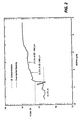
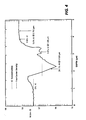
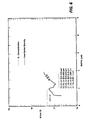
- three different samples 10, 20 and 30 were prepared in a conventional MOCVD growth system comprising an Al x Ga 1-x As overlayer 16, 26 and 36 grown at a temperature of 820 C on an intermediate Al y Ga 1-y As layer 14, 24 and 34 with either a comparatively higher or significantly lower AI concentration, which, itself, was epitaxially deposited on a GaAs substrate 12, 22 and 32 at a temperature of 820 C.
- a high pressure ratio between 80-90 of As/(AI + Ga) was used during the growth of both layers for each sample.
- Si was introduced into the MOCVD reactor for incorporation into these two consecutively deposited layers.
- underlayer 14 contain approximately 22% AI while overlayer 16 contained approximately 31% Al.
- underlayer 24 contain approximately 24% AI while overlayer 26 contained no Al, i.e., was deposited as GaAs.
- underlayer 34 contain approximately 21% AI while overlayer 36 contained approximately 52% Al.
- Free electron concentrations on both the Al xG a 1 . x As layers 16, 26 and 36 and AlyGa i .yAs layers 14, 24, and 34 were determined as a function of sample depth and a SIMS analysis was done to test any possible correlation of the free electron density with the concentration of Si impurities which were intentionally introduced during the growth phase.
- the results for each of the three samples 10, 20 and 30 is respectively disclosed in the graphs of Figures 2, 4 and 6 in solid line and dotted line.
- the concentration of free carriers as well as Si impurity is set forth on the same abscissa.
- the growth geometry permitted testing of interstitial doping hypothesis and its effect on the free carrier concentration.
- the variation of the free carrier concentration between the two different AI containing layers 14, 16; 24,26; and 34,36 cannot be explained by the Si content in these two different regions. More importantly, the free carrier concentrations predicted in one region by using the data in the other region are found to be consistent with the experimentally determined values. The prediction is based on the assumption of an equal concentration of As interstitial dopants in the two regions which is very reasonable because of the high growth temperature and the high mobility of As interstitial atoms at these temperatures.
- the free carrier concentration is predicted to be the difference between the As interstitial and Si concentrations since the Si atoms give rise to DX centers and trap the electrons supplied by the interstitial As atoms.
- the free carrier concentration is equal to the sum of the concentrations of the Si and the As interstitial atoms. Since the Si concentration is known from SIMS and the free electron concentrations were determined via polaron doping profile measurements, the only unknown is the As interstitial concentration. From the foregoing, the experimental data may be used to determine the As concentration in one region and, then, since this interstitial concentration is the same in the other region, the carrier concentration in the latter region could be predicted and compared to the experimental value.
- the free carrier concentration in region 26 is nearly equal to the Si concentration. Since the AI concentration is zero in this region, there should be no deep trap states and the prediction that the free carrier concentrations should be equal to the Si plus the interstitial densities indicates that there are very few As interstitials in this sample. This leads to the prediction that the free carrier concentration in region 26 where the AI concentration is 26 should be very small because there are few As interstitials and because all the donor electrons from Si will be trapped on DX centers. The experiments verify this prediction and show a large drop in the free carrier density in region 26.
- the free carrier density is approximately 10 17 cm- 3 in region 36 where the Al concentration is high. This is about one third of the Si density.
- the carrier density is significantly larger than the Si density because of the presence of As interstitials.
- the As interstitial density is predicated to be larger by at least 10 17 cm- 3 than the Si concentration in region 36, to give the observed free carrier density. This implies that the As interstitial density in region 36 (and, therefore, region 34) is about 3-4x 10 17 .
- the carrier density is nevertheless quite high.
- the theory predicts that the carrier density in this region should be equal to the As interstitial density in region 36 which is assumed to be the same as in region 34 plus the Si density in region 34. The experimental result confirm this prediction.
- Section B the structural, energetic, and electronic aspects of Si and S induced DX centers in GaAs is addressed using an ab initio self-consistent pseudopotential approach.
- the results of these calculations indicate that DX is a strongly localized and negatively charged defect which behaves as a negative-U center.
- the calculated atomic structure for DX is shown to be characterized by a very large dopant- dependant lattice relaxation.
- the large Stokes shift between the thermal and optical binding energies, and the barriers for electron capture and emission are shown to be properly accounted for by the predicted structural models for Si and S induced DX centers.
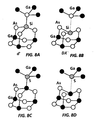
- DX denotes the broken bond configurations shown in Figures 7A and 7B
- e denotes a free electron in the conduction band
- the superscripts specify the charge states.
- the neutral donors in Eq. (3) are not necessarily in close spatial proximity of each other to form DX-. Equation (3) indicates that the density of DX centers should, at most, equal one half the density of the donor atoms. This will hold if there is no other shallow donor which is itself stable against a DX-like transformation but which can act as a reservoir to supply the free electrons needed to drive the donors in Eq. (3) into the DX state.
- DX formation may occur from the capture of two electrons by an ion: d + + 2e ⁇ DX • (4)
- DX The atomic distortions responsible for the formation of DX involve a large lattice displacement which leads to the breaking of a donor-lattice bond.
- the notation DX is used e to refer to the broken-bond configurations disclosed in Figures 8A-8D.
- Eqs. (l)-(4) for the properties of DX centers are analyzed in the following sections. The dependence of the binding energy of DX centers on alloy composition, pressure, and dopant concentration as a function of its charge state is examined below.
- E ⁇ B is the BZ-averaged energy of the first conduction band and U is the perturbation potential introduced by the impurity. Since ⁇ DX is very localized, the last term in Eq. (9) is a measure of the central cell contribution to the energy of DX. The consistency of Eqs. (6) and (9) requires that the variation of this term with alloying should be small.
- the BZ average of the conduction band energy needed to determine ⁇ E CB in Eq. (6) can be carried out in a number of ways. The most direct method is to use a fine mesh of points in reciprocal space for the averaging. A much simpler approach is to use the "special points" approach which relies on a few well chosen representative points.
- the hierarchy of the special point sets for fcc Bravais lattices appropriate for GaAs and AIGaAs alloys has been previously determined.
- the desired average can be determined with high accuracy as the number of special points used in the sampling is increased.
- a zeroth order approximation to the average energy is ⁇ E CB ⁇ E(L).
- Equations (11)-(13) show that the CBM is at r for x ⁇ 0.46 and at the X point of the BZ for x>0.46. Equations (5)-(14) therefore predict: and,
- the 0.7 eV prefactor in Eqs. (15) for x ⁇ 0.46 is nearly identical with the 707 meV value obtained by Chand et al. from a best fit to their data.
- Equations (6), (13), and (14) show that the thermal occupancy level E Dx relative to the VBM varies as if it is tied to the L point of the conduction band.
- the derivation of this result makes it clear, however, that:
- the L-like variation of the DX energy can be explained without the assumption that it is an L-derived effective mass level.
- the r, X, and L averaging scheme can also be used to determine the temperature dependence of the DX binding energy since the shifts of the energies of the band edge states with temperature are well known, particularly for GaAs.
- the temperature shifts of the r, X, and L conduction states with respect to the VBM have the same sign and are nearly equal to each other in GaAs. This implies that Eo(DXD) in GaAs should be approximately temperature independent.
- Equation (21) predicts that DX is unbound or metastable) by 0.15(1 + q) eV in GaAs. From Eqs. (5) and (17) a charge state independent increase of 0.15 eV to 0.17 eV (depending on the extrapolation used) in (E CBM -E CB ) is needed to stabilize DX in GaAs.
- One method for inducing this increase is through the application of pressure.
- the pressure dependence of EoDX) can be easily calculated under the assumption that the contribution of the last term in Eq. (9) to the pressure coefficient is small.
- the pressure coefficients of the conduction band states at the r, X, and L points for GaAs are well known and, in meV/kbar, are equal to: and, therefore, the pressure dependence of E CB evaluated using Eq. (10) is and
- E F is the Fermi energy.
- ⁇ (E DX o-E) »1 the stabilization of DX 0 , relative to free electrons at E F , would require a rise in E of approximately 0.15 eV relative to the CBM in GaAs, according to Eq. (21).
- the DX centers would in fact lead to a pinning of the Fermi energy at 0.15 eV above the CBM because they would become energetically as favorable as the free electron states at this value of E F .
- the energy of the DX resonance above the CBM is experimentally observed to increase slightly with dopant density in the high doping regime in GaAs.
- the shifting of E DX with respect to the CBM is mainly due to band gap renormalization in heavily doped semiconductors resulting from the Coulombic interactions between the electrons.
- the first term in Eq. (29) g ives a downward shift of the conduction band of about 68 meV while the other terms in the bracket give an upward shift of 11 meV.
- the total shift of 57 meV provides a partial explanation for why the measured pinning position of the Fermi level in GaAs is at a higher energy than the 0.15 eV value extrapolated from the binding energy in AIGaAs alloys.
- Another factor affecting how high E F can be raised without creating DX centers is the attractive interaction of the ionized d + impurity centers with the conduction electrons which lowers the energy of these centers.
- the three corrections: 57 meV from the lowering of the conduction band energy, 28 meV from the electron-impurity and impurity-impurity potentials, and 46 meV from the DX ⁇ conduction electron interaction, together amount to 130 meV which is sufficient to provide an explanation for why the observed Fermi level pinning position with respect to the CBM in heavily doped GaAs samples is 0.14 eV higher than the 0.15 eV value expected from an extrapolation of the DXbinding energy in AIGaAs alloys to GaAs. For a neutral DX center, the pinning position would be only 0.57 + 28 or 88 meV higher than the expected 0.15 eV above the CBM.
- the bonding configuration for the Si atom changes from S p 3 to S p 2 as a result of the relaxation. This is best seen by the 118.4 angles about the Si atom in the interstitial configuration.
- the threefold coordinated As atom resulting from the Si displacement relaxes outward, reducing its angles from 109 47 to 106.5 Electronic charge is transferred from the Si atom to the As atom in this process.
- Maximal bond-length changes of -2.4% between Ga and As atoms near the Si donor are found.
- For a S donor one of the nearest-neighbor Ga (or Al) atoms of the S dopant moves by 1.13 A into an interstitial position. A sulfur-gallium bond is broken as a result of this relaxation.
- the bond angles about the threefold coordinated Ga (or AI) atom are calculated to be 118.3 * and those around S about 112°. Maximal bond-length changes of +2.8% between Ga and As atoms are found for this case.
- the valence electron charge density for a Si induced DX- center is shown in Figure 9.
- the atomic distortions in Figure 10 are nearly identical to those predicted to occur in the metastable state of the EL2 related As Ga antisite defect in GaAs.
- the reaction represented by Eq. (3) is calculated to be energetically unfavorable by 0.22 ⁇ 0.1 eV for both Si and S donors in GaAs.
- the charge of the DX- center is changed to DX 0 or DX the interstitial atomic configuration is found to be highly unstable with respect to the ordinary fourfold coordinated substitutional geometry and there is no barrier for the transformations to this geometry.
- the experimental results indicate that donors not susceptible to DX like instabilities, which arise from As interstitials, can be introduced into AIGaAs alloys with a high AI content with densities of about 2-3x1017 cm 3 .
- the free carrier density is observed to decrease with increasing Si impurity content in AIGaAs alloys with high AI densities and to increase with it when the AI content is low.
- the use of a high As flux during growth can lead to the formation of As antisites in addition to As interstitials.
- the As antisite defect is known to be a (deep) donor so it should not interfere with the n-type doping resulting from interstitial arsenic atoms.
- Interstitial group III dopants have three valence electrons two of which are in low energy s-states and would lie below the VBM in AIGaAs alloys and the other is a p-electron with an energy that, in the limit of weak interactions with neighboring atoms, should fall several eV above the CBM, for Ga and AI and near the CBM of GaAs for B.
- An interstitial atom is, in general, strongly interacting with its neighbours.
- These group III atoms particularly Ga and Al, would be, therefore, ideally suited for n-type doping if they can be in some manner introduced into interstitial sites.
- a potential problem with trying to incorporate these atoms into the lattice via ion implantation is the possibility of forming substitutional cation antisites which will behave as double acceptors in n-type materials thereby compensating the donor electrons arising from the interstitial atoms.
- Ga antisites should be statistically balanced by other donor type defects. For example, the creation of an As-interstitial, As-vacancy pair will lead to n-type behavior since the As interstitial and As vacancy defects are individually donor type defects.
- a Ga vacancy defect would be an acceptor and it would have a high probability of annealing out as a result of recombination with either Ga or As interstitial atoms.
- the formation of energies for these defects is very sensitive to Ep with acceptor-like defects becoming energetically more favorable in n-type samples and vice versa.
- acceptor-like defects becoming energetically more favorable in n-type samples and vice versa.
- the inventor has done self-consistent pseudo-potential calculations on interstitial B in pure GaAs and has tested two different interstitial positions for which the nearest neighbours of B are either all Ga (T di ) or all As atoms (T d2 ).
- the inventor has found that for the relaxed structures the most stable site for B, in either neutral or negative charge states, is at the T d2 site whereas for a positive charge state it is at the T d1 site.
- the energy differences between the two sites are nearly 0.22 eV for B°, 0.4 eV for B-, and 0.2 eV for B ⁇ .
Landscapes
- Crystals, And After-Treatments Of Crystals (AREA)
- Junction Field-Effect Transistors (AREA)
Applications Claiming Priority (2)
| Application Number | Priority Date | Filing Date | Title |
|---|---|---|---|
| US27682488A | 1988-11-28 | 1988-11-28 | |
| US276824 | 1999-03-26 |
Publications (3)
| Publication Number | Publication Date |
|---|---|
| EP0371684A2 true EP0371684A2 (de) | 1990-06-06 |
| EP0371684A3 EP0371684A3 (de) | 1991-01-23 |
| EP0371684B1 EP0371684B1 (de) | 1996-03-13 |
Family
ID=23058208
Family Applications (1)
| Application Number | Title | Priority Date | Filing Date |
|---|---|---|---|
| EP89312111A Expired - Lifetime EP0371684B1 (de) | 1988-11-28 | 1989-11-22 | Interstitielle Dotierung in III-V Halbleitermaterialien, um die Bildung von DX-Zentren zu vermeiden oder zu beseitigen |
Country Status (3)
| Country | Link |
|---|---|
| EP (1) | EP0371684B1 (de) |
| JP (1) | JPH02188932A (de) |
| DE (1) | DE68925944T2 (de) |
Cited By (1)
| Publication number | Priority date | Publication date | Assignee | Title |
|---|---|---|---|---|
| US11305664B2 (en) * | 2017-10-17 | 2022-04-19 | Easelink Gmbh | Ground contact unit for a vehicle battery charging system and method for switching a contact area of a ground contact unit |
-
1989
- 1989-11-21 JP JP1303043A patent/JPH02188932A/ja active Pending
- 1989-11-22 EP EP89312111A patent/EP0371684B1/de not_active Expired - Lifetime
- 1989-11-22 DE DE68925944T patent/DE68925944T2/de not_active Expired - Fee Related
Non-Patent Citations (5)
| Title |
|---|
| APPLIED PHYSICS LETTERS, vol. 53, no. 26, 26th December 1988, pages 2653-2655; M.K. LEE et al.: "Isoelectronic doping in GaAs epilayers grown by molecular beam epitaxy" * |
| JOURNAL OF VACUUM SCIENCE & TECHNOLOGY B, vol. 4, no. 2, March/April 1986, pages 521-523; T.M. KERR et al.: "Summary abstract: State-of-the-art AlGaAs alloys by antimony doping" * |
| PHYSICA STATUS SOLIDI (a), vol. 100, pp. K41-K45 (1987) * |
| PHYSICAL REVIEW B, vol. 39, no. 14, 15th may 1989, pages 10063-10074; D.J. CHADI et al.: "Energetics of DX-center formation in GaAs and AlxGa1-xas alloys" * |
| PHYSICAL REVIEW LETTERS, vol. 55, 1985, pages 1327-1330; G.A. BARAFF et al.: "Electronic structure, total energies, and abundances of the elementary point defect in GaAs" * |
Cited By (1)
| Publication number | Priority date | Publication date | Assignee | Title |
|---|---|---|---|---|
| US11305664B2 (en) * | 2017-10-17 | 2022-04-19 | Easelink Gmbh | Ground contact unit for a vehicle battery charging system and method for switching a contact area of a ground contact unit |
Also Published As
| Publication number | Publication date |
|---|---|
| DE68925944T2 (de) | 1996-11-14 |
| EP0371684B1 (de) | 1996-03-13 |
| JPH02188932A (ja) | 1990-07-25 |
| DE68925944D1 (de) | 1996-04-18 |
| EP0371684A3 (de) | 1991-01-23 |
Similar Documents
| Publication | Publication Date | Title |
|---|---|---|
| Walukiewicz | Intrinsic limitations to the doping of wide-gap semiconductors | |
| Bhat et al. | Growth of GaAsN/GaAs, GaInAsN/GaAs and GaInAsN/GaAs quantum wells by low-pressure organometallic chemical vapor deposition | |
| Stampfl et al. | Native defects and impurities in InN: First-principles studies using the local-density approximation and self-interaction and relaxation-corrected pseudopotentials | |
| Laks et al. | Role of native defects in wide-band-gap semiconductors | |
| Bogusławski et al. | Doping properties of C, Si, and Ge impurities in GaN and AlN | |
| Wang et al. | Phosphorus and sulphur doping of diamond | |
| Shan et al. | Band anticrossing in dilute nitrides | |
| Deppe et al. | Impurity diffusion and layer interdiffusion in Al x Ga1− x As‐GaAs heterostructures | |
| Deppe et al. | Layer interdiffusion in Se‐doped Al x Ga1− x As‐GaAs superlattices | |
| Wager | Energetics of self‐diffusion in GaAs | |
| Suski et al. | High pressure and DX centers in heavily doped bulk GaAs | |
| Bracht et al. | Enhanced and retarded Ga self-diffusion in Si and Be doped GaAs isotope heterostructures | |
| Neugebauer et al. | Native defects and impurities in cubic and wurtzite GaN | |
| US5139960A (en) | Interstitital doping in III-V semiconductors to avoid or suppress DX center formation | |
| Uedono et al. | Electron capture by vacancy-type defects in carbon-doped GaN studied using monoenergetic positron beams | |
| EP0371684B1 (de) | Interstitielle Dotierung in III-V Halbleitermaterialien, um die Bildung von DX-Zentren zu vermeiden oder zu beseitigen | |
| Bonapasta et al. | Effects of strain and local charge on the formation of deep defects in III-V ternary alloys | |
| Barcz et al. | Channels of Cd diffusion and stoichiometry in CdTe grown by molecular beam epitaxy | |
| Fujiwara et al. | Carrier transport properties of iodine‐doped (ZnS) 3 (ZnSe) 42 ordered alloys grown by atomic layer epitaxy | |
| Wang et al. | On the physical origins of the EL2 center in GaAs | |
| Du | Defects in AlSb: A density functional study | |
| Hamoudi et al. | Cation interdiffusion in InGaAsP/InGaAsP multiple quantum wells with constant P/As ratio | |
| Bougrioua et al. | Mobility Collapse in Undoped and Si‐Doped GaN Grown by LP‐MOVPE | |
| Masek et al. | Correlated doping in semiconductors: The role of donors in III-V diluted magnetic semiconductors | |
| Fushimi et al. | Carbon-related defects in carbon-doped GaAs by high-temperature annealing |
Legal Events
| Date | Code | Title | Description |
|---|---|---|---|
| PUAI | Public reference made under article 153(3) epc to a published international application that has entered the european phase |
Free format text: ORIGINAL CODE: 0009012 |
|
| AK | Designated contracting states |
Kind code of ref document: A2 Designated state(s): DE FR GB |
|
| PUAL | Search report despatched |
Free format text: ORIGINAL CODE: 0009013 |
|
| AK | Designated contracting states |
Kind code of ref document: A3 Designated state(s): DE FR GB |
|
| 17P | Request for examination filed |
Effective date: 19910701 |
|
| 17Q | First examination report despatched |
Effective date: 19930630 |
|
| GRAA | (expected) grant |
Free format text: ORIGINAL CODE: 0009210 |
|
| AK | Designated contracting states |
Kind code of ref document: B1 Designated state(s): DE FR GB |
|
| REF | Corresponds to: |
Ref document number: 68925944 Country of ref document: DE Date of ref document: 19960418 |
|
| ET | Fr: translation filed | ||
| PGFP | Annual fee paid to national office [announced via postgrant information from national office to epo] |
Ref country code: FR Payment date: 19961111 Year of fee payment: 8 |
|
| PGFP | Annual fee paid to national office [announced via postgrant information from national office to epo] |
Ref country code: GB Payment date: 19961113 Year of fee payment: 8 |
|
| PGFP | Annual fee paid to national office [announced via postgrant information from national office to epo] |
Ref country code: DE Payment date: 19961202 Year of fee payment: 8 |
|
| PLBE | No opposition filed within time limit |
Free format text: ORIGINAL CODE: 0009261 |
|
| STAA | Information on the status of an ep patent application or granted ep patent |
Free format text: STATUS: NO OPPOSITION FILED WITHIN TIME LIMIT |
|
| 26N | No opposition filed | ||
| PG25 | Lapsed in a contracting state [announced via postgrant information from national office to epo] |
Ref country code: GB Free format text: LAPSE BECAUSE OF NON-PAYMENT OF DUE FEES Effective date: 19971122 |
|
| PG25 | Lapsed in a contracting state [announced via postgrant information from national office to epo] |
Ref country code: FR Free format text: THE PATENT HAS BEEN ANNULLED BY A DECISION OF A NATIONAL AUTHORITY Effective date: 19971130 |
|
| GBPC | Gb: european patent ceased through non-payment of renewal fee |
Effective date: 19971122 |
|
| PG25 | Lapsed in a contracting state [announced via postgrant information from national office to epo] |
Ref country code: DE Free format text: LAPSE BECAUSE OF NON-PAYMENT OF DUE FEES Effective date: 19980801 |
|
| REG | Reference to a national code |
Ref country code: FR Ref legal event code: ST |