EP0370285B1 - Improved process for delayed cooking of coking feedstocks - Google Patents
Improved process for delayed cooking of coking feedstocks Download PDFInfo
- Publication number
- EP0370285B1 EP0370285B1 EP89120294A EP89120294A EP0370285B1 EP 0370285 B1 EP0370285 B1 EP 0370285B1 EP 89120294 A EP89120294 A EP 89120294A EP 89120294 A EP89120294 A EP 89120294A EP 0370285 B1 EP0370285 B1 EP 0370285B1
- Authority
- EP
- European Patent Office
- Prior art keywords
- coking
- coker
- feed
- line
- fraction
- Prior art date
- Legal status (The legal status is an assumption and is not a legal conclusion. Google has not performed a legal analysis and makes no representation as to the accuracy of the status listed.)
- Expired - Lifetime
Links
- 238000004939 coking Methods 0.000 title claims description 84
- 238000000034 method Methods 0.000 title claims description 25
- 230000003111 delayed effect Effects 0.000 title claims description 16
- 238000010411 cooking Methods 0.000 title 1
- 239000003921 oil Substances 0.000 claims description 18
- 238000009835 boiling Methods 0.000 claims description 16
- 238000010438 heat treatment Methods 0.000 claims description 10
- 239000000463 material Substances 0.000 claims description 7
- 239000000284 extract Substances 0.000 claims description 5
- 239000003245 coal Substances 0.000 claims description 4
- 239000010687 lubricating oil Substances 0.000 claims description 4
- 238000000197 pyrolysis Methods 0.000 claims description 4
- 230000003197 catalytic effect Effects 0.000 claims description 2
- 239000000295 fuel oil Substances 0.000 claims description 2
- 239000011269 tar Substances 0.000 claims description 2
- 239000000571 coke Substances 0.000 description 63
- 239000007789 gas Substances 0.000 description 20
- NINIDFKCEFEMDL-UHFFFAOYSA-N Sulfur Chemical compound [S] NINIDFKCEFEMDL-UHFFFAOYSA-N 0.000 description 6
- 230000015572 biosynthetic process Effects 0.000 description 6
- 239000000203 mixture Substances 0.000 description 6
- 229910052717 sulfur Inorganic materials 0.000 description 6
- 239000011593 sulfur Substances 0.000 description 6
- 238000002791 soaking Methods 0.000 description 5
- 238000005336 cracking Methods 0.000 description 4
- 238000004821 distillation Methods 0.000 description 2
- 238000004519 manufacturing process Methods 0.000 description 2
- 239000003208 petroleum Substances 0.000 description 2
- 239000002904 solvent Substances 0.000 description 2
- 238000004227 thermal cracking Methods 0.000 description 2
- 239000004215 Carbon black (E152) Substances 0.000 description 1
- 239000008186 active pharmaceutical agent Substances 0.000 description 1
- 150000001336 alkenes Chemical class 0.000 description 1
- 238000004140 cleaning Methods 0.000 description 1
- 239000011300 coal pitch Substances 0.000 description 1
- 239000011280 coal tar Substances 0.000 description 1
- 239000010779 crude oil Substances 0.000 description 1
- 238000005194 fractionation Methods 0.000 description 1
- 239000003502 gasoline Substances 0.000 description 1
- 230000005484 gravity Effects 0.000 description 1
- 229930195733 hydrocarbon Natural products 0.000 description 1
- 150000002430 hydrocarbons Chemical class 0.000 description 1
- 239000007788 liquid Substances 0.000 description 1
- 230000000737 periodic effect Effects 0.000 description 1
- 230000000379 polymerizing effect Effects 0.000 description 1
- 239000000047 product Substances 0.000 description 1
- 239000011819 refractory material Substances 0.000 description 1
- 238000000926 separation method Methods 0.000 description 1
Images


Classifications
-
- C—CHEMISTRY; METALLURGY
- C10—PETROLEUM, GAS OR COKE INDUSTRIES; TECHNICAL GASES CONTAINING CARBON MONOXIDE; FUELS; LUBRICANTS; PEAT
- C10B—DESTRUCTIVE DISTILLATION OF CARBONACEOUS MATERIALS FOR PRODUCTION OF GAS, COKE, TAR, OR SIMILAR MATERIALS
- C10B55/00—Coking mineral oils, bitumen, tar, and the like or mixtures thereof with solid carbonaceous material
-
- C—CHEMISTRY; METALLURGY
- C10—PETROLEUM, GAS OR COKE INDUSTRIES; TECHNICAL GASES CONTAINING CARBON MONOXIDE; FUELS; LUBRICANTS; PEAT
- C10B—DESTRUCTIVE DISTILLATION OF CARBONACEOUS MATERIALS FOR PRODUCTION OF GAS, COKE, TAR, OR SIMILAR MATERIALS
- C10B57/00—Other carbonising or coking processes; Features of destructive distillation processes in general
- C10B57/04—Other carbonising or coking processes; Features of destructive distillation processes in general using charges of special composition
- C10B57/045—Other carbonising or coking processes; Features of destructive distillation processes in general using charges of special composition containing mineral oils, bitumen, tar or the like or mixtures thereof
Definitions
- This invention relates to improvements in the delayed coking of a coking feedstock. More particularly, this invention relates to an improvement in heating a feedstock to a coke drum, said feedstock comprising a fresh stream and a recycle stream.
- a fresh, or uncoked, feedstock is combined with a recycle stream, prior to the introduction of the fresh feedstock and the recycle stream to a coking heater.
- a recycle stream prior to the introduction of the fresh feedstock and the recycle stream to a coking heater.
- Examples of such an embodiment are disclosed in U.S. Patent Nos. 4,216,074, issued to Simone, and 4,326,853, issued to Sze, et al.
- coal is liquefied in the presence of a liquefaction solvent.
- An ash-containing liquefaction product is separated from an ash-free product.
- the ash-containing fraction is combined with the bottoms of a coker combination tower prior to introduction of the ash-containing fraction to a coker heater, which heats the ash-containing fraction to coking temperatures so as to produce ashy coke.
- Coke drum vapors from the production of the ashy coke are recycled to the combination tower.
- a bottoms fraction withdrawn from the combination tower is then passed to the ash-containing fraction as described above as recycle.
- British Patent Specification 874,440 discloses a process for producing coke where the entire feed is heated in a pipe still before being fed to the coking chamber.
- the residence time must be sufficiently short.
- a process for producing coke from a combined feed which comprises initially providing the combined feed as a first portion which contains easily cokable components and as a second portion which is essentially free of easily cokable components.
- the first portion is then heated to temperatures lower than those normally employed in a coking heater in a delayed coking process. In general, such temperatures do not exceed 482°C (900°F), and preferably do not exceed 454°C (850°F).
- the second portion is heated to a temperature at which a combination of the first and second portions provides a combined feed which is at coking temperatures.
- the combined feed is then coked at coking conditions.
- the first portion is comprised of a fresh feed and the second portion is comprised of recycle from the coke drum.
- a fresh feed and a coker recycle are combined and fractionated to produce the first portion and second portion.
- the first portion includes easily cokable components which are those which boil above a temperature of about 482°C (900°F), preferably those which boil above about 538°C (1,000°F), whereas the second portion is essentially free of such easily cokable components.
- easily cokable components which are those which boil above a temperature of about 482°C (900°F), preferably those which boil above about 538°C (1,000°F)
- the second portion is essentially free of such easily cokable components.
- the first portion which contains easily cokable components, is heated to a temperature which is lower than typical coking temperatures.
- the second portion which is essentially free of easily cokable components, is heated to a temperature such that, when the second portion is combined with the first portion to form the combined feed, the combined feed will attain coking temperatures as a result of an exchange of heat between the first portion and the second portion.
- Applicant has found therefore, that, in accordance with this preferred embodiment, that by heating the first portion, which contains easily cokable components, to a temperature which is less than typical coking temperatures, and by heating the second portion, which is essentially free of easily cokable components, to a temperature such that when the first portion and the second portion are combined, the combined feed will be at coking temperatures, the combined feed attains coking temperatures without the formation of coke deposits within the coils of the coking heater.
- the first and second portions may be combined in a feed line to the coke drum or within the coke drum.
- a fresh feed, before being passed to a coker heater, may have been treated by various means which are well known in the art, depending on the type of feedstock employed.
- the feed for example may be treated by soaking the feed in sulfur.
- the feed is usually soaked in the presence of at least 30 parts per million of sulfur and no greater than 200 parts per million of sulfur.
- the soaking is generally effected for at least 5 minutes to 120 minutes, and at a temperature of from 230°C to 315°C. It is believed that the soaking step improves the overall operation by polymerizing polymerizable components.
- the fresh petroleum feed may be subjected to thermal cracking.
- Typical cracking conditions are at an outlet temperature of from about 450°C to 595°C, and at a pressure of from 392 to 4903 kilopascals gauge (4 to 50 kg/cm2G).
- the cracking of the feed increases the aromaticity and reduces the API gravity of the feed.
- the feed may then be fractionated in a coker combination tower, whereby products such as heavy coker gas oil, light coker gas oil, and coker naphtha may be removed.
- the bottoms from such a combination tower may then be passed to a coker heater to prepare the feedstock for coking.
- the bottoms may be heated in the coker heater so as to provide coke drum temperatures of from 415°C to 455°C.
- Typical feeds which are generally employed in the process disclosed in the Sze patent are heavy feedstocks, such as a distillation residue derived from a crude oil, lube oil extract and hydrodesulfurized lube extract, a cracking residue or a hydrodesulfurized product of a residue from the distillation or cracking of petroleum.
- Preferred feedstocks are the so-called pyrolysis fuel oils or black oils which are the residual heavy black oils boiling above pyrolysis gasoline; i.e., boiling above 187°C to 218°C which are produced together with olefins in the pyrolysis of liquid hydrocarbon feeds, catalytic cracker decant oils, thermally cracked tar, lube oil extract and its hydrodesulfurization product, coal tar or pitch and the like.
- Applicant has overcome this problem of the formation of coke deposits in the coke heater by, in one embodiment, fractionating the combination of coker recycle and fresh feed into a first portion which contains easily cokable materials and a second portion essentially free of easily cokable materials
- the first portion is heated to temperatures lower than those normally employed by a coking heater in a delayed coking process, preferably not exceeding 482°C (900°F), most preferably not exceeding 454°C (850°F), and the second portion is heated to a temperature at which a combination of the first portion and the second portion provides a combined feed at coking temperatures.
- the coking vapors may be separated into a heavy fraction and a light fraction.
- the light fraction is combined with a fresh feed and fractionated to obtain the first portion, which is heated to temperatures lower than those normally employed by a coking heater in a delayed coking process, preferably not exceeding 900°F, most preferably not exceeding 850°F.
- the heavy fraction recovered from the coke drum vapors in this embodiment forms the second portion of the combined feed.
- both the light and heavy fractions recovered from the coke drum vapors are essentially free of easily cokable components.
- the light fraction may be directly recovered and not combined with the fresh feed for fractionation.
- a fresh feed or a portion of a fresh feed may not be sent to a combination tower prior to being heated in a coker heater.
- a combination tower may, however, be used to fractionate coker recycle in the form of overhead vapors from the coke drum.
- the fresh feed which is the first portion of the combined feed is heated to temperatures lower than those normally employed by a coking heater in a delayed coking process. As described above, such temperatures generally do not exceed 482°C (900°F), and most preferably do not exceed 454°C (850°F).
- the bottoms from the combination tower which is a coker recycle is the second portion of the combined feed and is heated to a temperature at which the combination of the first and second portions provides a combined stream at coking temperatures.
- Examples of such fresh feeds include coal liquefaction products which comprise coal dissolved in a liquefaction solvent, although the scope of the invention is not to be limited to such feeds.
- a feedstock in line 1 is passed through heating coil 3 of thermal cracker 2.
- Thermal cracking conditions may be as hereinabove described.
- the feed Prior to the introduction of the feed into thermal cracker 2, the feed may undergo pretreatment by various means known in the art.
- One example of a pretreatment of a feedstock is to soak the feedstock in sulfur as described above.
- the thermally cracked feedstock is then withdrawn from thermal cracker 2 through line 4 and passed to vacuum flash tower 5.
- Flashing conditions in the flash tower 5 may be at a temperature of from about 380°C to about 510°C, and at a pressure of from about 392 to 4903 kilopascals gauge (4 kg/cm2G to about 50 kg/cm2G).
- a heavy pitch-like bottoms may be withdrawn from flash tower 5 through line 6, a light gas oil may be recovered through line 7, and naphtha and lighter gases may be removed through line 8.
- a preconditioned coking feedstock is then withdrawn from flash tower 5 through line 10 and passed to coker combination tower 12.
- the feedstock is fractionated into products which will not be subjected to the coking process, and into a bottoms fraction which is withdrawn through line 16. Products which will not be subjected to coking are then recovered from combination tower 12.
- Coker naphtha and gases are recovered through line 13
- a light coker gas oil is recovered through line 14
- a heavy coker gas oil is recovered through line 15.
- all or a portion of the heavy coker gas oil may be withdrawn through line 16 as part of the bottoms fraction.
- the coker combination tower 12 is operated as is known in the art. Specific operating conditions depend upon the feedstock employed.
- the bottoms fraction in line 16 is passed to coil 19 of coker heater 18.
- coker heater 18 heats the bottoms fraction to temperatures lower than those normally employed by a coking heater in a delayed coking process. Such temperatures generally do not exceed 482°C (900°F), and preferably do not exceed 454°C (850°F).
- the bottoms fraction after being heated in coker heater 18, is then passed to line 22.
- a coker recycle stream from line 27 enters line 22 to combine with the heated bottoms fraction.
- the recycle stream has been heated to a temperature at which, when the recycle stream is introduced into line 22, there is provided a combined stream at coking temperatures.
- the entry of recycle stream into line 22 serves to heat the bottoms fraction from the combination tower 12, said bottoms fraction being a fresh, uncoked feed, to a desired coking temperature.
- the combined stream of the bottoms fraction and the recycle stream is then passed to coke drum 24.
- Coke drum 24 is operated at a temperature of from about 415°C to about 510°C, preferably from about 430°C to about 475°C, and at a pressure of from about 196 kilopascals gauge (2 kg/cm2G) to about 981 kilopascals gauge (10 kg/cm2G), preferably from about 294 kilopascals gauge (3 kg/cm2G) to about 588 kilopascals gauge (6 kg/cm2G).
- the combined stream is thus converted into coke, with overhead vapors being withdrawn from coke drum 24 through line 23.
- the vapors withdrawn through line 23 are passed to separator 26.
- the vapors map be comprised mainly of refractory materials which do not tend to form coke deposits if reheated.
- Separator 26 serves to separate the vapors into a light fraction and a heavy fraction.
- the light fraction comprised of materials boiling below a temperature in the range of from about 260°C (500°F) to about 343°C (650°F), is withdrawn through line 28 and passed to coker combination tower 12, whereby the light fraction may be mixed with a fresh feedstock introduced into combination tower through line 10 to recover the various fractions therefrom.
- the light fraction may be recovered directly and not passed to combination tower 12.
- the heavy fraction which is comprised of materials boiling above a temperature in the range of from about 260°C (500°F) to about 343°C (650°F), is withdrawn from separator 26 through line 25 and passed to coil 21 of coker heater 20.
- the temperature of operation of coker heater 20 depends mainly on the temperature of operation of coker heater 18, and the volume of heavy fraction being heated in that one wishes to provide a combined feed of the heavy fraction and the bottoms fraction from combination tower 12 at coking temperatures.
- the heavy fraction upon being heated in coker heater 20, is withdrawn as a coker recycle stream through line 27, and combined with the bottoms fraction in line 22 to form a combined stream of the bottoms fraction, comprised of a fresh, uncoked feedstock, and a recycle stream in line 22.
- the recycle stream Upon contact of the recycle stream with the bottoms fraction in line 22, the recycle stream serves to heat the bottoms fraction to a desired coking temperature through a heat exchange between the bottoms fraction and the recycle stream. The heating of the bottoms fraction to a desired coking temperature is thereby completed in line 22 as opposed to coker heater 18. The combined stream is then fed to coke drum 24. In this way, deposits of coke in coil 19 of heater 18 is therefore prevented.
- the fresh feedstock in line 22 and the recycle stream in line 27 may be fed separately to coke drum 24, thereby being admixed in the coke drum 24, said mixture attaining a desired coking temperature in coke drum 24.
- a feed is introduced through line 1′ into coil 3′ of thermal cracker 2′.
- the feed Prior to the introduction of the feed into thermal cracker 2′, the feed may be pretreated, such as by soaking the feed in sulfur, as described above.
- Thermal cracker 2′ is operated as hereinabove described.
- the cracked feedstock is then withdrawn from thermal cracker 2′ through line 4′ and passed to flash tower 5′. Flash tower 5′ is operated as hereinabove described.
- a heavy pitch-like bottoms may be recovered through line 6′, a light gas oil may be recovered through line 7′, and naphtha and lighter gases may be recovered through line 8′.
- a preconditioned coking feedstock is withdrawn through line 10′ and passed to combination tower 12′. Vapors from coke drum 24′ may also be introduced into combination tower 12′ through line 38.
- the fresh feed and coking vapors are fractionated into a first portion, or high-boiling fraction, containing easily cokable components, and a second portion, or low-boiling fraction, which is essentially free of easily cokable components.
- Coker naphtha and gas oils are also recovered.
- Coker naphtha and gases art recovered through line 13′ a light coker gas oil is recovered through line 14′, and a heavy coker gas oil is recovered through line 15′. Alternatively, all or a portion of the heavy coker gas oil may be sent for further processing.
- a first fraction which includes easily cokable components having boiling points above 482°C (900°F), preferably above 538°C (1,000°F), is withdrawn from combination tower 12′ through line 32, and a second fraction, which is essentially free of easily cokable components, is withdrawn from combination tower 12′ through line 30.
- the first fraction is passed through line 32 and introduced into coil 19′ of coker heater 18′.
- Coker heater 18′ is operated at temperatures lower than those normally employed by a coking heater in a delayed coking process, preferably no greater than 482°C (900°F), most preferably no greater than 454°C (850°F). This heating prevents the formation of coke deposits within coil 19′ of coker heater 18′.
- the first fraction is withdrawn through line 36.
- the second fraction is passed through line 30 to coil 21′ of coker heater 20′.
- the second fraction above, is heated such that, when admixed with the heated first fraction, a combined feed at coking temperatures will be formed.
- the second fraction is heated in coker heater 20′, it is withdrawn through line 34, and is passed to line 36, whereby the heated second fraction will be admixed with the first fraction to form a combined feed at coking temperature.
- the heated second fraction is introduced into line 36 from line 34, whereby the first and second fractions become admixed with each other.
- a heat exchange results between the fractions and the high-boiling fraction, whereby the mixture of the low-boiling fraction and the high-boiling fraction attains coking temperatures.
- Preferred coking temperatures are from about 416°C (780°F) to about 510°C (950°F).
- the mixture of the first and second fractions is then passed through line 36 and introduced into coke drum 24′.
- first fraction in line 36 and the second fraction in line 34 may be introduced separately into coke drum 24′, whereby the fractions are combined within coke drum 24′ to form a mixture at coking temperatures.
- coking of the mixture takes place at a temperature of from about 415°C to about 510°C, and at pressure of from about 191 kilopascals gauge (2 kg/cm2G) to about 981 kilopascals gauge (10 kg/cm2G).
- Vapors are withdrawn from coke drum 24′ through line 38.
- the vapors are passed through line 38 and introduced into combination tower 12′, wherein the vapors may be mixed with the fresh feedstock introduced through line 10′.
- FIG. 3 Another embodiment in accordance with the present invention is depicted in Figure 3.
- a fresh feedstock which has not been subject to coking is not sent to a coker combination tower before being introduced to a coker heater and a coke drum for coking.
- a fresh feedstock is introduced into coil 19 ⁇ of coker heater 18 ⁇ through line 10 ⁇ .
- the feedstock Prior to introduction of the fresh feedstock into the coker heater 18 ⁇ , the feedstock may be treated and/or processed by various means known in the art, e.g., as hereinabove described.
- Coker heater 18 ⁇ is operated at temperatures which are lower than those normally employed by a coking heater in a delayed coking process. Such temperatures generally do not exceed 482°C (900°F) and preferably do not exceed 454°C (850°F), as hereinabove described. Coker heater 18 ⁇ is thus maintained at a temperature low enough so as to prevent the deposit of coke in coil 19 ⁇ .
- the feedstock, after being heated in coker heater 18 ⁇ , is withdrawn from coker heater 18 ⁇ through line 40.
- the feed is then combined with a coker recycle stream introduced into line 40′ through line 42.
- the recycle stream is at a temperature which is higher than normal coking temperatures.
- the recycle stream thereby serves to heat the feedstock to a desired coking temperature.
- the combined stream of feedstock and the recycle stream is then introduced through line 40 into coke drum 24 ⁇ .
- coke drum 24 ⁇ coking of the combined stream takes place at a temperature of from about 415°C to about 510°C, and a pressure of from about 196 kilopascals gauge (2kg/cm2G) to about 981 kilopascals gauge (10kg/cm2G), whereby coke is formed from the combined stream within coke drum 24 ⁇ .
- Overhead vapors from coke drum 24 ⁇ are then withdrawn through line 44.
- the overhead vapors are passed through line 44 into coker combination tower 12 ⁇ .
- the coker combination tower 12 ⁇ is operated under conditions which are known to one of ordinary,skill in the art.
- the overhead vapors are fractionated into various usable products.
- Coker naphtha and gases are recovered through line 13 ⁇ , a light coker gas oil is recovered through line 14 ⁇ , and a heavy coker gas oil is recovered through line 15 ⁇ .
- all or a portion of the heavy coker gas oil may be withdrawn as part of a bottoms fraction.
- a bottoms fraction is withdrawn through line 46, and becomes a coker recycle stream to coke drum 24 ⁇ .
- the bottoms fraction, or recycle stream passes through line 46 and enters coil 21 ⁇ of coker heater 20 ⁇ .
- Coker heater 20 ⁇ is operated at a temperature to provide a heated recycle which provides a combined feed at coking temperatures.
- the bottoms fraction, or recycle stream is withdrawn from coker heater 20 ⁇ through line 42.
- the recycle stream then contacts the fresh feedstock in line 40.
- the recycle stream serves to heat the fresh feedstock so as to provide a combined feed of the fresh feedstock and coker recycle at coking temperatures. A heat exchange thus occurs between the fresh feedstock and the recycle stream in line 40.
- the result is the formation of a combined stream of fresh feedstock and recycle in line 40, said combined stream being at a desired coking temperature.
- the combined stream is then fed to coke drum 24 ⁇ as described above.
- the fresh feedstock in line 40 and the recycle stream in line 42 may be fed separately to coke drum 24 ⁇ , thereby being admixed in coke drum 24 ⁇ , said mixture attaining a desired coking temperature in coke drum 24 ⁇ .
- Advantages of the present invention include the ability to heat a fresh feed to a desired coking temperature, while reducing the tendency to deposit coke in the coils of the coking heater. This is accomplished by a partial heating of the fresh feed or a high-boiling fraction of a fresh feed, in a coker heater, whereby the feedstock or high-boiling fraction is heated to temperatures lower than those normally employed by a coking heater in a delayed coking process. This reduces the deposit of coke in the coils of the heater, thus preventing periodic shutdowns of the coking apparatus so that the coking heater may be cleaned or replaced.
- the final heating of the fresh feedstock to a desired coking temperature is accomplished by contact of the fresh feed in a feed line to a coke drum, or within the coke drum, by a heated recycle stream essentially free of easily cokable components. In this manner, a fresh feedstock or high-boiling fraction, may be heated to a desired coking temperature without the deposit of coke in the coils of the coker heater.
Landscapes
- Chemical & Material Sciences (AREA)
- Engineering & Computer Science (AREA)
- Oil, Petroleum & Natural Gas (AREA)
- Materials Engineering (AREA)
- Organic Chemistry (AREA)
- Chemical Kinetics & Catalysis (AREA)
- General Chemical & Material Sciences (AREA)
- Coke Industry (AREA)
- Production Of Liquid Hydrocarbon Mixture For Refining Petroleum (AREA)
Description
- This invention relates to improvements in the delayed coking of a coking feedstock. More particularly, this invention relates to an improvement in heating a feedstock to a coke drum, said feedstock comprising a fresh stream and a recycle stream.
- In an embodiment of a delayed coking process, a fresh, or uncoked, feedstock is combined with a recycle stream, prior to the introduction of the fresh feedstock and the recycle stream to a coking heater. Examples of such an embodiment are disclosed in U.S. Patent Nos. 4,216,074, issued to Simone, and 4,326,853, issued to Sze, et al. In U.S. Patent No. 4,216, 074, coal is liquefied in the presence of a liquefaction solvent. An ash-containing liquefaction product is separated from an ash-free product. The ash-containing fraction is combined with the bottoms of a coker combination tower prior to introduction of the ash-containing fraction to a coker heater, which heats the ash-containing fraction to coking temperatures so as to produce ashy coke. Coke drum vapors from the production of the ashy coke are recycled to the combination tower. A bottoms fraction withdrawn from the combination tower is then passed to the ash-containing fraction as described above as recycle.
- In U.S. Patent No. 4,326,853, both the ash-containing fraction and the ash-free fraction, obtained as a result of ash separation from a cola liquefaction product, are combined with separate recycle streams obtained from bottoms fractions of a coker combination tower, prior to the introduction of each fraction into separate coking heaters, which heat each fraction to coking temperatures in separate coke drums. Vapors from each coke drum are sent to separate stages of a combination tower. A bottoms fraction is then withdrawn from each respective stage of the combination tower and then admixed with the respective ash-free or ash-containing fraction.
- Applicant has found that although such combined streams, depending on the feeds employed, may be suitable for the production of quality coke, the combined stream may tend to deposit coke in the coking heater coil as the stream is passing through the coking heater. The coke deposits are in most instances derived from high-boiling materials in the fresh, or uncoked, feed. The coke build-up restricts the flow of the feed to the coking heater and eventually necessitates shutdown of the coking apparatus for the cleaning of coke from or replacement of the coking heater.
- British Patent Specification 874,440, discloses a process for producing coke where the entire feed is heated in a pipe still before being fed to the coking chamber. However, in order to avoid coke deposits in the pipe still, the residence time must be sufficiently short.
- In accordance with an aspect of the present invention, there is provided a process for producing coke from a combined feed which comprises initially providing the combined feed as a first portion which contains easily cokable components and as a second portion which is essentially free of easily cokable components. The first portion is then heated to temperatures lower than those normally employed in a coking heater in a delayed coking process. In general, such temperatures do not exceed 482°C (900°F), and preferably do not exceed 454°C (850°F). The second portion is heated to a temperature at which a combination of the first and second portions provides a combined feed which is at coking temperatures. The combined feed is then coked at coking conditions. In one embodiment, the first portion is comprised of a fresh feed and the second portion is comprised of recycle from the coke drum.
- In one embodiment in accordance with the present invention, a fresh feed and a coker recycle are combined and fractionated to produce the first portion and second portion.
- In a preferred embodiment, the first portion includes easily cokable components which are those which boil above a temperature of about 482°C (900°F), preferably those which boil above about 538°C (1,000°F), whereas the second portion is essentially free of such easily cokable components. The selection of such components which are preferably excluded from the second portion is within the skill of the art from the teachings herein.
- In a most preferred embodiment, the first portion, which contains easily cokable components, is heated to a temperature which is lower than typical coking temperatures. The second portion, which is essentially free of easily cokable components, is heated to a temperature such that, when the second portion is combined with the first portion to form the combined feed, the combined feed will attain coking temperatures as a result of an exchange of heat between the first portion and the second portion. Applicant has found therefore, that, in accordance with this preferred embodiment, that by heating the first portion, which contains easily cokable components, to a temperature which is less than typical coking temperatures, and by heating the second portion, which is essentially free of easily cokable components, to a temperature such that when the first portion and the second portion are combined, the combined feed will be at coking temperatures, the combined feed attains coking temperatures without the formation of coke deposits within the coils of the coking heater. The first and second portions may be combined in a feed line to the coke drum or within the coke drum.
- A fresh feed, before being passed to a coker heater, may have been treated by various means which are well known in the art, depending on the type of feedstock employed. The feed, for example may be treated by soaking the feed in sulfur. The feed is usually soaked in the presence of at least 30 parts per million of sulfur and no greater than 200 parts per million of sulfur. The soaking is generally effected for at least 5 minutes to 120 minutes, and at a temperature of from 230°C to 315°C. It is believed that the soaking step improves the overall operation by polymerizing polymerizable components.
- Subsequent to the sulfur soaking, the fresh petroleum feed may be subjected to thermal cracking. Typical cracking conditions are at an outlet temperature of from about 450°C to 595°C, and at a pressure of from 392 to 4903 kilopascals gauge (4 to 50 kg/cm²G). The cracking of the feed increases the aromaticity and reduces the API gravity of the feed. After the feed is thermally cracked, it may be flashed so as to remove naphtha and lighter gases. Flashing may take place at a temperature of from 380°C to 510°C, and at a pressure of from 9.8 to 196 kilopascals gauge (0.1 kg cm²/G to 2.0 kg cm²/G). Subsequent to flashing, the feed may then be fractionated in a coker combination tower, whereby products such as heavy coker gas oil, light coker gas oil, and coker naphtha may be removed. The bottoms from such a combination tower may then be passed to a coker heater to prepare the feedstock for coking. The bottoms may be heated in the coker heater so as to provide coke drum temperatures of from 415°C to 455°C. Such a method of processing a coking feed is disclosed, for example, in U.S. Patent no. 4,547,284, issued to Sze, et al.
- Typical feeds which are generally employed in the process disclosed in the Sze patent are heavy feedstocks, such as a distillation residue derived from a crude oil, lube oil extract and hydrodesulfurized lube extract, a cracking residue or a hydrodesulfurized product of a residue from the distillation or cracking of petroleum. Preferred feedstocks are the so-called pyrolysis fuel oils or black oils which are the residual heavy black oils boiling above pyrolysis gasoline; i.e., boiling above 187°C to 218°C which are produced together with olefins in the pyrolysis of liquid hydrocarbon feeds, catalytic cracker decant oils, thermally cracked tar, lube oil extract and its hydrodesulfurization product, coal tar or pitch and the like.
- In the Sze patent, coker recycle in the form of overhead vapors withdraw from the coke drum are passed to the combination tower. The coke drum vapors then become admixed with the fresh feed in the combination tower. The bottoms fraction, therefore, is derived from a coke drum vapor stream and a fresh feed. Applicant has found that the feeding of the bottoms fraction from a combination tower to a coker heater, may, over a period of time, result in the formation of coke deposits in the coker heater.
- Applicant has overcome this problem of the formation of coke deposits in the coke heater by, in one embodiment, fractionating the combination of coker recycle and fresh feed into a first portion which contains easily cokable materials and a second portion essentially free of easily cokable materials As described above, the first portion is heated to temperatures lower than those normally employed by a coking heater in a delayed coking process, preferably not exceeding 482°C (900°F), most preferably not exceeding 454°C (850°F), and the second portion is heated to a temperature at which a combination of the first portion and the second portion provides a combined feed at coking temperatures.
- In an alternative embodiment, the coking vapors may be separated into a heavy fraction and a light fraction. The light fraction is combined with a fresh feed and fractionated to obtain the first portion, which is heated to temperatures lower than those normally employed by a coking heater in a delayed coking process, preferably not exceeding 900°F, most preferably not exceeding 850°F. The heavy fraction recovered from the coke drum vapors, in this embodiment forms the second portion of the combined feed. In this embodiment, both the light and heavy fractions recovered from the coke drum vapors are essentially free of easily cokable components. Alternatively, the light fraction may be directly recovered and not combined with the fresh feed for fractionation.
- In some instances, a fresh feed or a portion of a fresh feed may not be sent to a combination tower prior to being heated in a coker heater. A combination tower may, however, be used to fractionate coker recycle in the form of overhead vapors from the coke drum. In such a case, the fresh feed which is the first portion of the combined feed, is heated to temperatures lower than those normally employed by a coking heater in a delayed coking process. As described above, such temperatures generally do not exceed 482°C (900°F), and most preferably do not exceed 454°C (850°F). The bottoms from the combination tower which is a coker recycle is the second portion of the combined feed and is heated to a temperature at which the combination of the first and second portions provides a combined stream at coking temperatures. Examples of such fresh feeds include coal liquefaction products which comprise coal dissolved in a liquefaction solvent, although the scope of the invention is not to be limited to such feeds.
- The invention will now be described with respect to the drawings wherein:
- Figure 1 is a schematic of a first embodiment of a delayed coking process in accordance with the present invention;
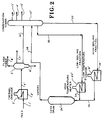
- Figure 2 is a schematic of second embodiment of a delayed coking process in accordance with the present invention; and
- Figure 3 is a schematic of third embodiment of a delayed coking process in accordance with the present invention.
- As shown in Figure 1, a feedstock in line 1 is passed through
heating coil 3 ofthermal cracker 2. Thermal cracking conditions may be as hereinabove described. Prior to the introduction of the feed intothermal cracker 2, the feed may undergo pretreatment by various means known in the art. One example of a pretreatment of a feedstock is to soak the feedstock in sulfur as described above. - The thermally cracked feedstock is then withdrawn from
thermal cracker 2 through line 4 and passed to vacuum flash tower 5. Flashing conditions in the flash tower 5 may be at a temperature of from about 380°C to about 510°C, and at a pressure of from about 392 to 4903 kilopascals gauge (4 kg/cm²G to about 50 kg/cm²G). - A heavy pitch-like bottoms may be withdrawn from flash tower 5 through line 6, a light gas oil may be recovered through line 7, and naphtha and lighter gases may be removed through
line 8. A preconditioned coking feedstock is then withdrawn from flash tower 5 throughline 10 and passed tocoker combination tower 12. - In the
coker combination tower 12, the feedstock is fractionated into products which will not be subjected to the coking process, and into a bottoms fraction which is withdrawn throughline 16. Products which will not be subjected to coking are then recovered fromcombination tower 12. Coker naphtha and gases are recovered throughline 13, a light coker gas oil is recovered throughline 14, and a heavy coker gas oil is recovered throughline 15. Alternatively, all or a portion of the heavy coker gas oil may be withdrawn throughline 16 as part of the bottoms fraction. Thecoker combination tower 12 is operated as is known in the art. Specific operating conditions depend upon the feedstock employed. - The bottoms fraction in
line 16 is passed tocoil 19 ofcoker heater 18. In order to prevent the formation of coke deposits withincoil 19,coker heater 18 heats the bottoms fraction to temperatures lower than those normally employed by a coking heater in a delayed coking process. Such temperatures generally do not exceed 482°C (900°F), and preferably do not exceed 454°C (850°F). - The bottoms fraction, after being heated in
coker heater 18, is then passed toline 22. A coker recycle stream fromline 27 entersline 22 to combine with the heated bottoms fraction. The recycle stream has been heated to a temperature at which, when the recycle stream is introduced intoline 22, there is provided a combined stream at coking temperatures. The entry of recycle stream intoline 22 serves to heat the bottoms fraction from thecombination tower 12, said bottoms fraction being a fresh, uncoked feed, to a desired coking temperature. The combined stream of the bottoms fraction and the recycle stream is then passed tocoke drum 24. -
Coke drum 24 is operated at a temperature of from about 415°C to about 510°C, preferably from about 430°C to about 475°C, and at a pressure of from about 196 kilopascals gauge (2 kg/cm²G) to about 981 kilopascals gauge (10 kg/cm²G), preferably from about 294 kilopascals gauge (3 kg/cm²G) to about 588 kilopascals gauge (6 kg/cm²G). The combined stream is thus converted into coke, with overhead vapors being withdrawn fromcoke drum 24 through line 23. - The vapors withdrawn through line 23 are passed to
separator 26. The vapors map be comprised mainly of refractory materials which do not tend to form coke deposits if reheated.Separator 26 serves to separate the vapors into a light fraction and a heavy fraction. The light fraction, comprised of materials boiling below a temperature in the range of from about 260°C (500°F) to about 343°C (650°F), is withdrawn through line 28 and passed tocoker combination tower 12, whereby the light fraction may be mixed with a fresh feedstock introduced into combination tower throughline 10 to recover the various fractions therefrom. - Alternatively, the light fraction may be recovered directly and not passed to
combination tower 12. - The heavy fraction, which is comprised of materials boiling above a temperature in the range of from about 260°C (500°F) to about 343°C (650°F), is withdrawn from
separator 26 throughline 25 and passed tocoil 21 ofcoker heater 20. The temperature of operation ofcoker heater 20 depends mainly on the temperature of operation ofcoker heater 18, and the volume of heavy fraction being heated in that one wishes to provide a combined feed of the heavy fraction and the bottoms fraction fromcombination tower 12 at coking temperatures. The heavy fraction, upon being heated incoker heater 20, is withdrawn as a coker recycle stream throughline 27, and combined with the bottoms fraction inline 22 to form a combined stream of the bottoms fraction, comprised of a fresh, uncoked feedstock, and a recycle stream inline 22. Upon contact of the recycle stream with the bottoms fraction inline 22, the recycle stream serves to heat the bottoms fraction to a desired coking temperature through a heat exchange between the bottoms fraction and the recycle stream. The heating of the bottoms fraction to a desired coking temperature is thereby completed inline 22 as opposed tocoker heater 18. The combined stream is then fed tocoke drum 24. In this way, deposits of coke incoil 19 ofheater 18 is therefore prevented. - Alternatively, the fresh feedstock in
line 22 and the recycle stream inline 27 may be fed separately tocoke drum 24, thereby being admixed in thecoke drum 24, said mixture attaining a desired coking temperature incoke drum 24. - Referring now to Figure 2, which depicts a second embodiment in accordance with the present invention, a feed is introduced through line 1′ into
coil 3′ ofthermal cracker 2′. Prior to the introduction of the feed intothermal cracker 2′, the feed may be pretreated, such as by soaking the feed in sulfur, as described above.Thermal cracker 2′ is operated as hereinabove described. The cracked feedstock is then withdrawn fromthermal cracker 2′ through line 4′ and passed to flash tower 5′. Flash tower 5′ is operated as hereinabove described. - A heavy pitch-like bottoms may be recovered through line 6′, a light gas oil may be recovered through line 7′, and naphtha and lighter gases may be recovered through
line 8′. A preconditioned coking feedstock is withdrawn throughline 10′ and passed to combination tower 12′. Vapors fromcoke drum 24′ may also be introduced intocombination tower 12′ throughline 38. Incoker combination tower 12′, the fresh feed and coking vapors are fractionated into a first portion, or high-boiling fraction, containing easily cokable components, and a second portion, or low-boiling fraction, which is essentially free of easily cokable components. Coker naphtha and gas oils are also recovered. Coker naphtha and gases art recovered throughline 13′, a light coker gas oil is recovered throughline 14′, and a heavy coker gas oil is recovered throughline 15′. Alternatively, all or a portion of the heavy coker gas oil may be sent for further processing. - A first fraction, which includes easily cokable components having boiling points above 482°C (900°F), preferably above 538°C (1,000°F), is withdrawn from
combination tower 12′ throughline 32, and a second fraction, which is essentially free of easily cokable components, is withdrawn fromcombination tower 12′ throughline 30. - The first fraction is passed through
line 32 and introduced intocoil 19′ ofcoker heater 18′.Coker heater 18′ is operated at temperatures lower than those normally employed by a coking heater in a delayed coking process, preferably no greater than 482°C (900°F), most preferably no greater than 454°C (850°F). This heating prevents the formation of coke deposits withincoil 19′ ofcoker heater 18′. After being heated withincoker heater 18′, the first fraction is withdrawn throughline 36. - The second fraction is passed through
line 30 tocoil 21′ ofcoker heater 20′. The second fraction, above, is heated such that, when admixed with the heated first fraction, a combined feed at coking temperatures will be formed. After the second fraction is heated incoker heater 20′, it is withdrawn throughline 34, and is passed toline 36, whereby the heated second fraction will be admixed with the first fraction to form a combined feed at coking temperature. - As the first fraction is being passed through
line 36, the heated second fraction is introduced intoline 36 fromline 34, whereby the first and second fractions become admixed with each other. A heat exchange results between the fractions and the high-boiling fraction, whereby the mixture of the low-boiling fraction and the high-boiling fraction attains coking temperatures. Preferred coking temperatures are from about 416°C (780°F) to about 510°C (950°F). The mixture of the first and second fractions is then passed throughline 36 and introduced intocoke drum 24′. - As an alternative, the first fraction in
line 36 and the second fraction inline 34 may be introduced separately intocoke drum 24′, whereby the fractions are combined withincoke drum 24′ to form a mixture at coking temperatures. - In
coke drum 24′, coking of the mixture takes place at a temperature of from about 415°C to about 510°C, and at pressure of from about 191 kilopascals gauge (2 kg/cm²G) to about 981 kilopascals gauge (10 kg/cm²G). Vapors are withdrawn fromcoke drum 24′ throughline 38. The vapors are passed throughline 38 and introduced intocombination tower 12′, wherein the vapors may be mixed with the fresh feedstock introduced throughline 10′. - Another embodiment in accordance with the present invention is depicted in Figure 3. In this embodiment, a fresh feedstock which has not been subject to coking, is not sent to a coker combination tower before being introduced to a coker heater and a coke drum for coking. In the embodiment shown, a fresh feedstock is introduced into
coil 19˝ ofcoker heater 18˝ throughline 10˝. Prior to introduction of the fresh feedstock into thecoker heater 18˝, the feedstock may be treated and/or processed by various means known in the art, e.g., as hereinabove described. -
Coker heater 18˝ is operated at temperatures which are lower than those normally employed by a coking heater in a delayed coking process. Such temperatures generally do not exceed 482°C (900°F) and preferably do not exceed 454°C (850°F), as hereinabove described.Coker heater 18˝ is thus maintained at a temperature low enough so as to prevent the deposit of coke incoil 19˝. The feedstock, after being heated incoker heater 18˝, is withdrawn fromcoker heater 18˝ throughline 40. The feed is then combined with a coker recycle stream introduced intoline 40′ throughline 42. The recycle stream is at a temperature which is higher than normal coking temperatures. The recycle stream thereby serves to heat the feedstock to a desired coking temperature. The combined stream of feedstock and the recycle stream is then introduced throughline 40 intocoke drum 24˝. Incoke drum 24˝, coking of the combined stream takes place at a temperature of from about 415°C to about 510°C, and a pressure of from about 196 kilopascals gauge (2kg/cm²G) to about 981 kilopascals gauge (10kg/cm²G), whereby coke is formed from the combined stream withincoke drum 24˝. Overhead vapors fromcoke drum 24˝ are then withdrawn through line 44. - The overhead vapors are passed through line 44 into
coker combination tower 12˝. Thecoker combination tower 12˝ is operated under conditions which are known to one of ordinary,skill in the art. The overhead vapors are fractionated into various usable products. - Coker naphtha and gases are recovered through
line 13˝, a light coker gas oil is recovered throughline 14˝, and a heavy coker gas oil is recovered throughline 15˝. Alternatively, all or a portion of the heavy coker gas oil may be withdrawn as part of a bottoms fraction. A bottoms fraction is withdrawn throughline 46, and becomes a coker recycle stream tocoke drum 24˝. The bottoms fraction, or recycle stream, passes throughline 46 and enterscoil 21˝ ofcoker heater 20˝.Coker heater 20˝ is operated at a temperature to provide a heated recycle which provides a combined feed at coking temperatures. - After being heated in
coker heater 20˝, the bottoms fraction, or recycle stream, is withdrawn fromcoker heater 20˝ throughline 42. The recycle stream then contacts the fresh feedstock inline 40. The recycle stream serves to heat the fresh feedstock so as to provide a combined feed of the fresh feedstock and coker recycle at coking temperatures. A heat exchange thus occurs between the fresh feedstock and the recycle stream inline 40. The result is the formation of a combined stream of fresh feedstock and recycle inline 40, said combined stream being at a desired coking temperature. The combined stream is then fed tocoke drum 24˝ as described above. - Alternatively, the fresh feedstock in
line 40 and the recycle stream inline 42 may be fed separately tocoke drum 24˝, thereby being admixed incoke drum 24˝, said mixture attaining a desired coking temperature incoke drum 24˝. - Advantages of the present invention include the ability to heat a fresh feed to a desired coking temperature, while reducing the tendency to deposit coke in the coils of the coking heater. This is accomplished by a partial heating of the fresh feed or a high-boiling fraction of a fresh feed, in a coker heater, whereby the feedstock or high-boiling fraction is heated to temperatures lower than those normally employed by a coking heater in a delayed coking process. This reduces the deposit of coke in the coils of the heater, thus preventing periodic shutdowns of the coking apparatus so that the coking heater may be cleaned or replaced. The final heating of the fresh feedstock to a desired coking temperature is accomplished by contact of the fresh feed in a feed line to a coke drum, or within the coke drum, by a heated recycle stream essentially free of easily cokable components. In this manner, a fresh feedstock or high-boiling fraction, may be heated to a desired coking temperature without the deposit of coke in the coils of the coker heater.
- It is to be understood, however, that the scope of the present invention is not to be limited to the specific embodiments described above. The invention may be practiced other than as particularly described and still be within the scope of the accompanying claims.
Claims (6)
- A delayed coking process comprising separating a coker feed into a first cokable portion containing easily cokable components and a second portion essentially free of easily cokable components;
heating the first cokable portion to a temperature below that normally employed by a coking heater in a delayed coking process;
heating the second cokable portion to a higher temperature so that a combination of the first portion and the second portion provides a combined feed which is at coking temperatures of from 415°C (780°F) to 510°C (950°F); and
coking the combined feed at the coking temperature. - The process of claim 1 wherein the first portion is heated to a temperature which does not exceed 454°C (850°F).
- The process of claim 1 wherein said first portion is comprised of a fresh feed and said second portion is comprised of a coker recycle.
- The process of claim 1 wherein a fresh feed and a coker recycle are combined and fractionated to produce said first portion and said second portion.
- The process of claim 1 wherein a coker recycle is separated into a light fraction containing material boiling below a selected temperature in the range of 260°C (500°F) to 343°C (650°F) and into a heavy fraction containing materials boiling above the selected temperature and wherein the light fraction is combined with fresh feed to produce the first portion and the heavy fraction is used as the second portion.
- The process of claim 1 wherein said fresh feed is selected from the group consisting of coal liquefaction products, pyrolysis fuel oils, lube oil extracts, hydrodesulfarized lube oil extracts, catalytic cracker decant oils, and thermally cracked tars.
Applications Claiming Priority (2)
| Application Number | Priority Date | Filing Date | Title |
|---|---|---|---|
| US07/274,401 US4983272A (en) | 1988-11-21 | 1988-11-21 | Process for delayed coking of coking feedstocks |
| US274401 | 1988-11-21 |
Publications (3)
| Publication Number | Publication Date |
|---|---|
| EP0370285A2 EP0370285A2 (en) | 1990-05-30 |
| EP0370285A3 EP0370285A3 (en) | 1990-09-26 |
| EP0370285B1 true EP0370285B1 (en) | 1993-03-10 |
Family
ID=23048028
Family Applications (1)
| Application Number | Title | Priority Date | Filing Date |
|---|---|---|---|
| EP89120294A Expired - Lifetime EP0370285B1 (en) | 1988-11-21 | 1989-11-02 | Improved process for delayed cooking of coking feedstocks |
Country Status (4)
| Country | Link |
|---|---|
| US (1) | US4983272A (en) |
| EP (1) | EP0370285B1 (en) |
| JP (1) | JP2566168B2 (en) |
| CA (1) | CA2002587C (en) |
Families Citing this family (11)
| Publication number | Priority date | Publication date | Assignee | Title |
|---|---|---|---|---|
| US5160602A (en) * | 1991-09-27 | 1992-11-03 | Conoco Inc. | Process for producing isotropic coke |
| US6048448A (en) * | 1997-07-01 | 2000-04-11 | The Coastal Corporation | Delayed coking process and method of formulating delayed coking feed charge |
| US6245218B1 (en) * | 1999-08-31 | 2001-06-12 | Petro-Chem Development Co. Inc. | System and method to effectuate and control coker charge heater process fluid temperature |
| US7371317B2 (en) | 2001-08-24 | 2008-05-13 | Conocophillips.Company | Process for producing coke |
| US20040060951A1 (en) * | 2002-09-26 | 2004-04-01 | Charles Kelly | Cushioning shoulder strap |
| RU2437915C1 (en) * | 2010-06-01 | 2011-12-27 | Общество С Ограниченной Ответственностью "Проминтех" | Procedure for production of coke additive by delayed coking |
| WO2013015899A1 (en) | 2011-07-27 | 2013-01-31 | Saudi Arabian Oil Company | Process for the gasification of heavy residual oil with particulate coke from a delayed coking unit |
| KR101844111B1 (en) | 2011-07-29 | 2018-05-14 | 사우디 아라비안 오일 컴퍼니 | Solvent-assisted delayed coking process |
| WO2019096143A1 (en) * | 2017-11-14 | 2019-05-23 | 中国石油化工股份有限公司 | Coking system and coking method |
| EP3765579A4 (en) * | 2018-03-13 | 2021-11-17 | Lummus Technology LLC | IN-SITU COOKING OF HEAVY DUTY AND OTHER RAW MATERIALS WITH HIGH POLLUTION |
| CN116120957B (en) * | 2023-03-15 | 2025-08-01 | 中钢集团鞍山热能研究院有限公司 | Method for preparing high-performance coal-based needle coke by thermal cracking |
Family Cites Families (9)
| Publication number | Priority date | Publication date | Assignee | Title |
|---|---|---|---|---|
| US2626892A (en) * | 1950-12-09 | 1953-01-27 | Standard Oil Dev Co | Cracking residual fractions containing salts |
| US2963416A (en) * | 1957-10-09 | 1960-12-06 | Gen Carbon And Chemical Corp | Coke production from petroleum stocks |
| DE1253230B (en) * | 1958-09-03 | 1967-11-02 | Shell Int Research | Process for the production of petroleum coke with moderating properties |
| US3617515A (en) * | 1969-05-26 | 1971-11-02 | Lummus Co | Production of needle coke from coal for pitch |
| US3956101A (en) * | 1970-10-09 | 1976-05-11 | Kureha Kagaku Kogyo Kabushiki Kaisha | Production of cokes |
| US4326853A (en) * | 1978-09-13 | 1982-04-27 | The Lummus Company | Coke production from liquid derived from sub-bituminous and/or lignitic coal |
| US4518486A (en) * | 1980-12-24 | 1985-05-21 | The Standard Oil Company | Concurrent production of two grades of coke using a single fractionator |
| US4501654A (en) * | 1983-11-17 | 1985-02-26 | Exxon Research & Engineering Co. | Delayed coking process with split fresh feed and top feeding |
| CA1279838C (en) * | 1986-06-09 | 1991-02-05 | Michael J. Mcgrath | Delayed coking |
-
1988
- 1988-11-21 US US07/274,401 patent/US4983272A/en not_active Expired - Lifetime
-
1989
- 1989-11-02 EP EP89120294A patent/EP0370285B1/en not_active Expired - Lifetime
- 1989-11-09 CA CA002002587A patent/CA2002587C/en not_active Expired - Fee Related
- 1989-11-21 JP JP1300932A patent/JP2566168B2/en not_active Expired - Lifetime
Also Published As
| Publication number | Publication date |
|---|---|
| EP0370285A3 (en) | 1990-09-26 |
| CA2002587A1 (en) | 1990-05-21 |
| JP2566168B2 (en) | 1996-12-25 |
| EP0370285A2 (en) | 1990-05-30 |
| CA2002587C (en) | 1996-08-20 |
| US4983272A (en) | 1991-01-08 |
| JPH02185592A (en) | 1990-07-19 |
Similar Documents
| Publication | Publication Date | Title |
|---|---|---|
| US4518487A (en) | Process for improving product yields from delayed coking | |
| US5258115A (en) | Delayed coking with refinery caustic | |
| JPS6345438B2 (en) | ||
| CA1210355A (en) | Low severity delayed coking | |
| US4983272A (en) | Process for delayed coking of coking feedstocks | |
| US4534854A (en) | Delayed coking with solvent separation of recycle oil | |
| US7604731B2 (en) | Process for the production of needle coke | |
| US4604186A (en) | Process for upgrading residuums by combined donor visbreaking and coking | |
| US4521277A (en) | Apparatus for upgrading heavy hydrocarbons employing a diluent | |
| US4822479A (en) | Method for improving the properties of premium coke | |
| US4477334A (en) | Thermal cracking of heavy hydrocarbon oils | |
| US4501654A (en) | Delayed coking process with split fresh feed and top feeding | |
| US4492625A (en) | Delayed coking process with split fresh feed | |
| US4487686A (en) | Process of thermally cracking heavy hydrocarbon oils | |
| CA1226839A (en) | Process and facility for making coke suitable for metallurgical purposes | |
| US4497705A (en) | Fluid coking with solvent separation of recycle oil | |
| US4326853A (en) | Coke production from liquid derived from sub-bituminous and/or lignitic coal | |
| US4455221A (en) | Process for upgrading heavy hydrocarbons employing a diluent | |
| EP0090897B1 (en) | Delayed coking of a heat-treated ethylene tar | |
| US5658455A (en) | Fluidized bed coking process | |
| EP0156614B1 (en) | Coking residuum in the presence of hydrogen donor | |
| JPS6410560B2 (en) | ||
| GB2138840A (en) | Thermal cracking of heavy hydrocarbon oils | |
| CA1245998A (en) | Process for improving product yields from delayed coking | |
| GB2134920A (en) | Upgrading heavy hydrocarbons employing a diluant |
Legal Events
| Date | Code | Title | Description |
|---|---|---|---|
| PUAI | Public reference made under article 153(3) epc to a published international application that has entered the european phase |
Free format text: ORIGINAL CODE: 0009012 |
|
| AK | Designated contracting states |
Kind code of ref document: A2 Designated state(s): BE FR IT |
|
| PUAL | Search report despatched |
Free format text: ORIGINAL CODE: 0009013 |
|
| AK | Designated contracting states |
Kind code of ref document: A3 Designated state(s): BE FR IT |
|
| 17P | Request for examination filed |
Effective date: 19901129 |
|
| RAP1 | Party data changed (applicant data changed or rights of an application transferred) |
Owner name: ABB LUMMUS CREST INC. |
|
| 17Q | First examination report despatched |
Effective date: 19911118 |
|
| GRAA | (expected) grant |
Free format text: ORIGINAL CODE: 0009210 |
|
| AK | Designated contracting states |
Kind code of ref document: B1 Designated state(s): BE FR IT |
|
| PG25 | Lapsed in a contracting state [announced via postgrant information from national office to epo] |
Ref country code: FR Effective date: 19930310 Ref country code: BE Effective date: 19930310 |
|
| ITF | It: translation for a ep patent filed | ||
| EN | Fr: translation not filed | ||
| PLBE | No opposition filed within time limit |
Free format text: ORIGINAL CODE: 0009261 |
|
| STAA | Information on the status of an ep patent application or granted ep patent |
Free format text: STATUS: NO OPPOSITION FILED WITHIN TIME LIMIT |
|
| 26N | No opposition filed | ||
| PG25 | Lapsed in a contracting state [announced via postgrant information from national office to epo] |
Ref country code: IT Free format text: LAPSE BECAUSE OF NON-PAYMENT OF DUE FEES;WARNING: LAPSES OF ITALIAN PATENTS WITH EFFECTIVE DATE BEFORE 2007 MAY HAVE OCCURRED AT ANY TIME BEFORE 2007. THE CORRECT EFFECTIVE DATE MAY BE DIFFERENT FROM THE ONE RECORDED. Effective date: 20051102 |