EP0369819B1 - Desk top calculator - Google Patents
Desk top calculator Download PDFInfo
- Publication number
- EP0369819B1 EP0369819B1 EP89311953A EP89311953A EP0369819B1 EP 0369819 B1 EP0369819 B1 EP 0369819B1 EP 89311953 A EP89311953 A EP 89311953A EP 89311953 A EP89311953 A EP 89311953A EP 0369819 B1 EP0369819 B1 EP 0369819B1
- Authority
- EP
- European Patent Office
- Prior art keywords
- constant
- accessing
- calculator
- accessed
- memory
- Prior art date
- Legal status (The legal status is an assumption and is not a legal conclusion. Google has not performed a legal analysis and makes no representation as to the accuracy of the status listed.)
- Expired - Lifetime
Links
Images


Classifications
-
- G—PHYSICS
- G06—COMPUTING OR CALCULATING; COUNTING
- G06F—ELECTRIC DIGITAL DATA PROCESSING
- G06F3/00—Input arrangements for transferring data to be processed into a form capable of being handled by the computer; Output arrangements for transferring data from processing unit to output unit, e.g. interface arrangements
- G06F3/01—Input arrangements or combined input and output arrangements for interaction between user and computer
- G06F3/048—Interaction techniques based on graphical user interfaces [GUI]
- G06F3/0487—Interaction techniques based on graphical user interfaces [GUI] using specific features provided by the input device, e.g. functions controlled by the rotation of a mouse with dual sensing arrangements, or of the nature of the input device, e.g. tap gestures based on pressure sensed by a digitiser
- G06F3/0489—Interaction techniques based on graphical user interfaces [GUI] using specific features provided by the input device, e.g. functions controlled by the rotation of a mouse with dual sensing arrangements, or of the nature of the input device, e.g. tap gestures based on pressure sensed by a digitiser using dedicated keyboard keys or combinations thereof
-
- G—PHYSICS
- G06—COMPUTING OR CALCULATING; COUNTING
- G06F—ELECTRIC DIGITAL DATA PROCESSING
- G06F15/00—Digital computers in general; Data processing equipment in general
- G06F15/02—Digital computers in general; Data processing equipment in general manually operated with input through keyboard and computation using a built-in program, e.g. pocket calculators
- G06F15/0225—User interface arrangements, e.g. keyboard, display; Interfaces to other computer systems
Definitions
- the present invention relates to a desk-top calculator, such as a scientific electronic calculator, having a function for accessing constants stored anteriorly for calculation uses.
- Some of the conventional desk-top calculators for example a scientific electronic calculator for scientific calculations, are arranged such that constants stored anteriorly, universal gravitation constant, gas constant and the like, may be accessed for calculation uses whenever occasion calls.
- Such a desk-top calculator is provided for example with a CNST key, as a constant access key.
- a CNST key as a constant access key.
- the different types of constants stored in the desk-top calculator are accessed successively and displayed, as shown in the following Table 1. That is to say the desired constant is accessed by operating the CNST key an appropriate number of times.
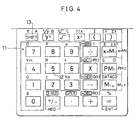
- some of the conventional desk-top calculators are arranged such that, they are provided with a shift key 13, and use the numeric keys 11 both as keys for entering numeric values and as keys for accessing constants.
- the desired constant is accessed by operating the shift key 13 and a numeric key 11 in combination.
- the gas constant R is accessed by operating the shift key 13 and the key 12 of the numeric value "5", successively.
- the CNST key in order to access a constant, the CNST key always needs to be operated a predetermined number of times corresponding to the particular constant.
- two keys i.e. the shift key 13 and a numeric key 11, need to be operated each time a constant is being accessed.
- a conventional desk-top calculator presents the problem that its operation tends to be complicated. Especially when accessing constants frequently, the operational efficiency of a conventional desk-top calculator is extremely low.
- the object of the present invention is thus to improve the operational efficiency of a desk-top calculator when it is being used to access constants frequently.
- the present invention provides a calculator having memory means in which a plurality of numerical constants for use in calculations is pre-stored, and accessing means for successively accessing in a predetermined sequence each of said numerical constants in response to repeated successive operations of the accessing means until a required constant is accessed, characterised in that the accessing means is arranged to re-access directly the most recently accessed one of said numerical constants in response to the first operation of the accessing means after an intervening operation has been performed.
- the present invention provides a method of operating a calculator, for accessing one of a plurality of numerical constants which are pre-stored in memory means of the calculator and are ordinarily accessible in a predetermined sequence only in response to repeated successive operation of a constant access key thereof, characterised by the steps of determining if a key of the calculator other than the constant access key has been operated after the constant access key was last operated, and in that case accessing directly the constant accessed by that last operation of the constant access key, when the constant access key is next operated.
- the constant accessed previously is accessed directly.
- a constant which has been accessed once can be generally regarded as having a high possibility of being accessed again consecutively.
- the constant access key needs to be operated only once, operation of the desk-top calculator is greatly simplified.
- FIG. 1 to Figure 3 show an embodiment of the present invention.
- Figure 1 is a flow chart illustrating the operation in a CPU.
- Figure 2 is a block diagram illustrating the composition of a control unit.
- Figure 3 is a front view showing the composition of a scientific electronic calculator.
- Figure 4 is a partial enlarged front view showing the composition of a conventional desk-top calculator.
- the scientific electronic calculator 21 is provided with an LCD display section 22 which displays numeric values, characters and the like.
- This LCD display section 22 is composed of the character display section 22a, which displays characters according to the dot matrix, and of the numeric value display section 22b, which displays essentially numeric values according to the 7-segment display.
- This function keys group 23 used for calculating the values of the functions y X , sin, cos and the like.
- This function keys group 23 includes the CNST key 24, which is the constant access key for accessing the constants stored anteriorly in a ROM 33 described later, the ON/C key 25 to clear the display of the LCD display section 22, and the like.
- numeric value keys group 26 to enter numeric values
- operation keys group 27 to effect arithmetic calculations
- numeric value memory keys group 28 for the use of the numeric value memory.
- control unit 31 as access sequence control means, which is composed like the example shown in Figure 2.
- This control unit 31 is composed of a CPU 32, which performs the control of the whole scientific electronic calculator 21, the ROM 33 in which the program to be executed by the CPU 32 is stored, a RAM 34 used, for instance as work area comprising an access pointer DISPP, a storage pointer CNSTP and the like, during the program execution of the CPU 32, and as numeric value memory, the key matrix section 35 which detects which key of the function keys group 23 and the like has been operated, and the LCD driving circuit 36 which drives the LCD display section 22.
- the above CPU 32 accesses successively the different types of constants stored in the ROM 33 each time the CNST key 24 is operated consecutively.
- the CPU 32 also functions so that, after one of the constants has been accessed through the operation of the CNST key 24, when another key is operated and the CNST key 24 operated again thereafter, the constant accessed previously is accessed first.
- the ROM 33 functions also, for example as shown in the following Table 2, as constant storage means, in which different types of constants, the light velocity, the universal gravitation constant and the like, are stored anteriorly on and after the address shown by CNSTADRS.
- the RAM 34 is connected with a battery backup unit so that, even when the scientific electronic calculator is in the OFF state or when the calculation mode has been changed, the values stored therein are preserved.
- the program moves on to S2.
- the CNSTADRS the first address of the region in which the constants are stored in the ROM 33, is written in the access pointer DISPP which accesses the constants, and the program moves on to S3.
- the constant stored in the address of the value written in the access pointer DISPP is accessed and displayed in the LCD display section 22 (S4).
- the LCD display section 22 is composed of the character display section 22a and the numeric value display section 22b and in the example described, together with the constant value, a character identifying that value, is displayed. But it is not intended to limit the invention to the precise forms disclosed.
- the different types of constants are accessed in the order of the storage in the ROM 33. But this not exhaustive, and for example the desk-top calculator may be arranged such that the constants are accessed according to their frequency in access.
- the constant access key when accessing again a constant accessed once through the operation of the access key, the constant access key needs to be operated only once and not successively. Therefore the operation is simplified and especially when accessing constants frequently, the operational efficiency is sharply improved.
Landscapes
- Engineering & Computer Science (AREA)
- General Engineering & Computer Science (AREA)
- Theoretical Computer Science (AREA)
- Computer Hardware Design (AREA)
- Computing Systems (AREA)
- Human Computer Interaction (AREA)
- Physics & Mathematics (AREA)
- General Physics & Mathematics (AREA)
- Calculators And Similar Devices (AREA)
Description
- The present invention relates to a desk-top calculator, such as a scientific electronic calculator, having a function for accessing constants stored anteriorly for calculation uses.
- Some of the conventional desk-top calculators, for example a scientific electronic calculator for scientific calculations, are arranged such that constants stored anteriorly, universal gravitation constant, gas constant and the like, may be accessed for calculation uses whenever occasion calls.
- Such a desk-top calculator is provided for example with a CNST key, as a constant access key. Each time the CNST key is operated, the different types of constants stored in the desk-top calculator are accessed successively and displayed, as shown in the following Table 1. That is to say the desired constant is accessed by operating the CNST key an appropriate number of times.

- Also, some of the conventional desk-top calculators, for example as shown in Fig. 4, are arranged such that, they are provided with a
shift key 13, and use thenumeric keys 11 both as keys for entering numeric values and as keys for accessing constants. Thus the desired constant is accessed by operating theshift key 13 and a numeric key 11 in combination. - In this type of desk-top calculator, for example the gas constant R is accessed by operating the
shift key 13 and the key 12 of the numeric value "5", successively. - However, in the conventional desk-top calculator provided with a CNST key described above, in order to access a constant, the CNST key always needs to be operated a predetermined number of times corresponding to the particular constant.
- Also, in the desk-top calculator provided with the
shift key 13, two keys, i.e. theshift key 13 and a numeric key 11, need to be operated each time a constant is being accessed. - Accordingly, a conventional desk-top calculator presents the problem that its operation tends to be complicated. Especially when accessing constants frequently, the operational efficiency of a conventional desk-top calculator is extremely low.
- The object of the present invention is thus to improve the operational efficiency of a desk-top calculator when it is being used to access constants frequently.
- In one aspect, the present invention provides a calculator having memory means in which a plurality of numerical constants for use in calculations is pre-stored, and accessing means for successively accessing in a predetermined sequence each of said numerical constants in response to repeated successive operations of the accessing means until a required constant is accessed, characterised in that the accessing means is arranged to re-access directly the most recently accessed one of said numerical constants in response to the first operation of the accessing means after an intervening operation has been performed.
- In another aspect, the present invention provides a method of operating a calculator, for accessing one of a plurality of numerical constants which are pre-stored in memory means of the calculator and are ordinarily accessible in a predetermined sequence only in response to repeated successive operation of a constant access key thereof, characterised by the steps of determining if a key of the calculator other than the constant access key has been operated after the constant access key was last operated, and in that case accessing directly the constant accessed by that last operation of the constant access key, when the constant access key is next operated.
- According to the present invention, after one of the constants has been accessed through the operation of a constant access key, when another key is operated and the constant access key operated again thereafter, the constant accessed previously is accessed directly. A constant which has been accessed once can be generally regarded as having a high possibility of being accessed again consecutively. In this case, with the present invention, since the constant access key needs to be operated only once, operation of the desk-top calculator is greatly simplified.
- Figure 1 to Figure 3 show an embodiment of the present invention.
- Figure 1 is a flow chart illustrating the operation in a CPU.
- Figure 2 is a block diagram illustrating the composition of a control unit.
- Figure 3 is a front view showing the composition of a scientific electronic calculator.
- Figure 4 is a partial enlarged front view showing the composition of a conventional desk-top calculator.
- The following description will discuss as an embodiment of the present invention the example of a scientific electronic calculator for scientific calculations with reference to Figures 1 to 3.
- As shown in Figure 3, the scientific
electronic calculator 21 is provided with anLCD display section 22 which displays numeric values, characters and the like. ThisLCD display section 22 is composed of thecharacter display section 22a, which displays characters according to the dot matrix, and of the numericvalue display section 22b, which displays essentially numeric values according to the 7-segment display. - Below the
LCD display section 22 there is installed thefunction keys group 23 used for calculating the values of the functions yX , sin, cos and the like. Thisfunction keys group 23 includes theCNST key 24, which is the constant access key for accessing the constants stored anteriorly in aROM 33 described later, the ON/C key 25 to clear the display of theLCD display section 22, and the like. - Below the
function keys group 23 there are installed, the numericvalue keys group 26 to enter numeric values, theoperation keys group 27 to effect arithmetic calculations and the numeric valuememory keys group 28 for the use of the numeric value memory. - Inside of the scientific
electronic calculator 21 there is provided acontrol unit 31, as access sequence control means, which is composed like the example shown in Figure 2. - This
control unit 31 is composed of aCPU 32, which performs the control of the whole scientificelectronic calculator 21, theROM 33 in which the program to be executed by theCPU 32 is stored, aRAM 34 used, for instance as work area comprising an access pointer DISPP, a storage pointer CNSTP and the like, during the program execution of theCPU 32, and as numeric value memory, thekey matrix section 35 which detects which key of thefunction keys group 23 and the like has been operated, and theLCD driving circuit 36 which drives theLCD display section 22. - The
above CPU 32 accesses successively the different types of constants stored in theROM 33 each time theCNST key 24 is operated consecutively. TheCPU 32 also functions so that, after one of the constants has been accessed through the operation of theCNST key 24, when another key is operated and theCNST key 24 operated again thereafter, the constant accessed previously is accessed first. - The
ROM 33 functions also, for example as shown in the following Table 2, as constant storage means, in which different types of constants, the light velocity, the universal gravitation constant and the like, are stored anteriorly on and after the address shown by CNSTADRS. - On the other hand, the
RAM 34 is connected with a battery backup unit so that, even when the scientific electronic calculator is in the OFF state or when the calculation mode has been changed, the values stored therein are preserved.
- The following is a description with reference to the flow chart shown in Figure 1, of the program execution in the
CPU 32 when theCNST key 24 is operated in the above arrangement. - First, when the CNST 24 key is operated, it is determined whether the scientific
electronic calculator 21 is in the initial state, that is, in a state where theCNST key 24 is operated for the first time, or not (S1). - When it is determined in S1 that the scientific
electronic calculator 21 is in the initial state, the program moves on to S2. The CNSTADRS, the first address of the region in which the constants are stored in theROM 33, is written in the access pointer DISPP which accesses the constants, and the program moves on to S3. - In S3, the value written in the access pointer DISPP is written in the storage pointer CNSTP, in order to store which of the constants is accessed.
- Then in the
ROM 33 the constant stored in the address of the value written in the access pointer DISPP is accessed and displayed in the LCD display section 22 (S4). - On the other hand, when it is determined in the above S1 that the scientific electronic calculator is not in the initial state, the program moves on to S5. In S5 it is determined whether the CNST
key 24 is operated consecutively that is whether the key operated just before is also theCNST key 24, or not. - When it is determined in S5 that the
CNST key 24 is being operated consecutively, the program moves on to S7. In other words, as shown in the following Table 3, when theCNST key 24 is operated consecutively, each time theCNST key 24 is operated, an increment is added to the value of the access pointer DISPP, in order to access successively the different types of constants stored in theROM 33, and the program moves on to S3. - Then, as described above, in S3 the value of the access pointer DISPP is written in the storage pointer CNSTP, in order to store which of the constants is newly accessed.
- In the
ROM 33 the constant stored in the address of the value written in the access pointer DISPP is accessed and displayed in the LCD display section 22 (S4).
- In S5, when it is determined, for example as shown in Table 3 above, that the
CNST key 24 has been operated subsequently to the ON/C key 25 and thus that the CNST key is not being operated consecutively the program moves on to S6. In S6, the value CNSTADRS+m is written in the access pointer DISPP. The value CNSTADRS+m is the value of the storage pointer CNSTP wherein is written the value of the address in which the constant previously accessed, i.e gas constant R, is stored. Then the program moves on to S3. In other words, by operating theCNST key 24 only once, the gas constant R accessed previously is accessed in the first place and displayed. - Thus, each time the
CNST key 24 is operated consecutively the different types of constants stored in theROM 33 are accessed successively. Also, after one of the constants has been accessed through the operation of theCNST key 24, when the ON/C key or another key is operated and the CNST key operated again thereafter, the constant accessed previously is accessed first. - Further, in the present embodiment the
LCD display section 22 is composed of thecharacter display section 22a and the numericvalue display section 22b and in the example described, together with the constant value, a character identifying that value, is displayed. But it is not intended to limit the invention to the precise forms disclosed. - Also, in the example described when the
CNST key 24 is operated consecutively, the different types of constants are accessed in the order of the storage in theROM 33. But this not exhaustive, and for example the desk-top calculator may be arranged such that the constants are accessed according to their frequency in access. - According to the above-described embodiment, when accessing again a constant accessed once through the operation of the access key, the constant access key needs to be operated only once and not successively. Therefore the operation is simplified and especially when accessing constants frequently, the operational efficiency is sharply improved.
- The invention may be embodied in other specific forms without departing from the scope thereof as defined by the claims.
Claims (13)
- A calculator having memory means (33) in which a plurality of numerical constants for use in calculations is pre-stored, and accessing means (32,34,35) for successively accessing in a predetermined sequence each of said numerical constants in response to repeated successive operations of the accessing means until a required constant is accessed, characterised in that the accessing means (32,34,35) is arranged to re-access directly the most recently accessed one of said numerical constants in response to the first operation of the accessing means after an intervening operation has been performed.
- A calculator according to claim 1, wherein the accessing means includes an address memory (34,DISPP) whose content is determined by the operation of a constant access key (24) and is used to address said memory means (33) for accessing said numerical constants, and an additional memory (34,CNSTP) arranged to store the content of the address memory while said intervening operation is performed, the content of the additional memory being transferred to the address memory to access said most recently accessed constant from said memory means (33) when the constant access key (24) is next operated.
- A calculator according to claim 1 or claim 2, wherein said memory means comprises a read only memory [ROM] (33) .
- A calculator according to claim 3, wherein said accessing means comprises:a key matrix section (35) for detecting which of a plurality of keys has been operated;a CPU (32) for conducting control over the entirety of the calculator; anda random access memory [RAM] (34) for use as work area during the operation of said CPU and as numeric value memory.
- A calculator according to any of claims 1 to 4, wherein said predetermined sequence corresponds to the order in which said numerical constants are stored in said memory means (33).
- A calculator according to any of claims 1 to 4, wherein said predetermined sequence corresponds to an order of decreasing frequency in which said numerical constants are normally required to be accessed.
- A calculator according to any preceding claim, including an LCD display section (22) comprising:a character display section (22a) for displaying characters and the like; anda numeric value display section (22b) for displaying essentially numeric values.
- A calculator according to claim 7, wherein said numeric value display section (22b) includes a 7-segment display.
- A calculator according to claim 7 or claim 8, wherein said character display section (22a) includes a dot matrix-type liquid crystal display.
- A calculator according to claim 4, including a battery back-up unit for preserving the information stored in said RAM (34).
- A calculator according to claim 4, wherein said RAM (34) includes:an access pointer (DISPP) forming the storage region wherein the address of a said constant to be accessed is stored; anda storage pointer (CNSTP) forming the storage region wherein the address of the accessed constant is stored.
- A method of operating a calculator, for accessing one of a plurality of numerical constants which are pre-stored in memory means of the calculator and are ordinarily accessible in a predetermined sequence only in response to repeated successive operation of a constant access key thereof, characterised by the steps of determining if a key of the calculator other than the constant access key has been operated after the constant access key was last operated, and in that case accessing directly the constant accessed by that last operation of the constant access key, when the constant access key is next operated.
- A method of operating a calculator according to claim 12, comprising storing the address of said memory means which corresponds to the constant accessed in said last operation, and wherein the accessing step comprises accessing said constant in the memory means using the stored address.
Applications Claiming Priority (2)
| Application Number | Priority Date | Filing Date | Title |
|---|---|---|---|
| JP63293019A JPH02138653A (en) | 1988-11-18 | 1988-11-18 | Electronic desk calculator |
| JP293019/88 | 1988-11-18 |
Publications (3)
| Publication Number | Publication Date |
|---|---|
| EP0369819A2 EP0369819A2 (en) | 1990-05-23 |
| EP0369819A3 EP0369819A3 (en) | 1991-10-30 |
| EP0369819B1 true EP0369819B1 (en) | 1996-03-13 |
Family
ID=17789430
Family Applications (1)
| Application Number | Title | Priority Date | Filing Date |
|---|---|---|---|
| EP89311953A Expired - Lifetime EP0369819B1 (en) | 1988-11-18 | 1989-11-17 | Desk top calculator |
Country Status (4)
| Country | Link |
|---|---|
| US (1) | US5065359A (en) |
| EP (1) | EP0369819B1 (en) |
| JP (1) | JPH02138653A (en) |
| DE (1) | DE68925943T2 (en) |
Families Citing this family (2)
| Publication number | Priority date | Publication date | Assignee | Title |
|---|---|---|---|---|
| EP0816988B1 (en) * | 1992-09-14 | 2001-08-16 | Sony Corporation | Information processing apparatus |
| CN1949204A (en) * | 2005-10-13 | 2007-04-18 | 信利电子有限公司 | calculator |
Family Cites Families (8)
| Publication number | Priority date | Publication date | Assignee | Title |
|---|---|---|---|---|
| US3760370A (en) * | 1971-04-26 | 1973-09-18 | Tektronix Inc | Calculator with a number processing system |
| US4107782A (en) * | 1975-10-10 | 1978-08-15 | Texas Instruments Incorporated | Prompting programmable calculator |
| GB2111266B (en) * | 1981-11-18 | 1986-06-25 | Sharp Kk | Programmable electronic calculator |
| US4713749A (en) * | 1985-02-12 | 1987-12-15 | Texas Instruments Incorporated | Microprocessor with repeat instruction |
| JPS61250768A (en) * | 1985-04-30 | 1986-11-07 | Casio Comput Co Ltd | Device for updating conversion dictionary |
| JPS63159963A (en) * | 1986-12-23 | 1988-07-02 | Sharp Corp | Electronic computer |
| JPS6418356U (en) * | 1987-07-21 | 1989-01-30 | ||
| FR2619460B1 (en) * | 1987-08-13 | 1994-03-25 | Texas Instruments France | EDUCATIONAL CALCULATING MACHINE, ESPECIALLY FOR PRIMARY CLASS STUDENTS |
-
1988
- 1988-11-18 JP JP63293019A patent/JPH02138653A/en active Pending
-
1989
- 1989-11-15 US US07/436,905 patent/US5065359A/en not_active Expired - Lifetime
- 1989-11-17 DE DE68925943T patent/DE68925943T2/en not_active Expired - Lifetime
- 1989-11-17 EP EP89311953A patent/EP0369819B1/en not_active Expired - Lifetime
Also Published As
| Publication number | Publication date |
|---|---|
| EP0369819A2 (en) | 1990-05-23 |
| DE68925943T2 (en) | 1996-08-22 |
| US5065359A (en) | 1991-11-12 |
| JPH02138653A (en) | 1990-05-28 |
| EP0369819A3 (en) | 1991-10-30 |
| DE68925943D1 (en) | 1996-04-18 |
Similar Documents
| Publication | Publication Date | Title |
|---|---|---|
| US5990888A (en) | Method and system for manipulating graphical objects | |
| EP0369829B1 (en) | Information searching apparatus | |
| US4811257A (en) | Electronic calculator having means for directly inputting variables into a prestored and displayed equation | |
| US4947370A (en) | Word processor for simultaneously displaying and scrolling documents and the corresponding titles | |
| US5539428A (en) | Video font cache | |
| US5020012A (en) | Method and apparatus for matching menu labels with keys | |
| KR880001872B1 (en) | Memory circuit for generating liquid crystal display characters | |
| US4755814A (en) | Attribute control method and apparatus | |
| US4317183A (en) | Unused program number indicating system for a small program type electronic calculator | |
| EP0313207A2 (en) | Method and apparatus for inputting characters | |
| US5065359A (en) | Desk top calculator with access sequence control system for various constants | |
| US4208720A (en) | Calculator with algebraic operating system | |
| JPH0150929B2 (en) | ||
| US5150316A (en) | Electronic apparatus | |
| US4831569A (en) | Display system for indicating standby operations of electronic data processing apparatus | |
| US4864530A (en) | Display system for a compact electronic apparatus | |
| EP0405504B1 (en) | Information display system suitable for compact electronic appliances having different display sizes | |
| WO1988006766A1 (en) | Electronic business terminal | |
| US5218675A (en) | Information display system suitable for compact electronic appliances having different display sizes | |
| KR950009762B1 (en) | Memory function key data display method of electronic calculator | |
| KR930005809B1 (en) | Display system for compact electronic apparatus | |
| EP0352065A2 (en) | Text editing device | |
| JPH0715623B2 (en) | Display device | |
| JPS5931745B2 (en) | Unused program number display method | |
| JP3498323B2 (en) | Electronic calculator and arithmetic processing method |
Legal Events
| Date | Code | Title | Description |
|---|---|---|---|
| PUAI | Public reference made under article 153(3) epc to a published international application that has entered the european phase |
Free format text: ORIGINAL CODE: 0009012 |
|
| 17P | Request for examination filed |
Effective date: 19891208 |
|
| AK | Designated contracting states |
Kind code of ref document: A2 Designated state(s): DE FR GB |
|
| PUAL | Search report despatched |
Free format text: ORIGINAL CODE: 0009013 |
|
| AK | Designated contracting states |
Kind code of ref document: A3 Designated state(s): DE FR GB |
|
| 17Q | First examination report despatched |
Effective date: 19940422 |
|
| GRAH | Despatch of communication of intention to grant a patent |
Free format text: ORIGINAL CODE: EPIDOS IGRA |
|
| GRAA | (expected) grant |
Free format text: ORIGINAL CODE: 0009210 |
|
| AK | Designated contracting states |
Kind code of ref document: B1 Designated state(s): DE FR GB |
|
| REF | Corresponds to: |
Ref document number: 68925943 Country of ref document: DE Date of ref document: 19960418 |
|
| ET | Fr: translation filed | ||
| PLBE | No opposition filed within time limit |
Free format text: ORIGINAL CODE: 0009261 |
|
| STAA | Information on the status of an ep patent application or granted ep patent |
Free format text: STATUS: NO OPPOSITION FILED WITHIN TIME LIMIT |
|
| 26N | No opposition filed | ||
| REG | Reference to a national code |
Ref country code: GB Ref legal event code: IF02 |
|
| PGFP | Annual fee paid to national office [announced via postgrant information from national office to epo] |
Ref country code: DE Payment date: 20081114 Year of fee payment: 20 |
|
| PGFP | Annual fee paid to national office [announced via postgrant information from national office to epo] |
Ref country code: FR Payment date: 20081112 Year of fee payment: 20 |
|
| PGFP | Annual fee paid to national office [announced via postgrant information from national office to epo] |
Ref country code: GB Payment date: 20081112 Year of fee payment: 20 |
|
| REG | Reference to a national code |
Ref country code: GB Ref legal event code: PE20 Expiry date: 20091116 |
|
| PG25 | Lapsed in a contracting state [announced via postgrant information from national office to epo] |
Ref country code: GB Free format text: LAPSE BECAUSE OF EXPIRATION OF PROTECTION Effective date: 20091116 |