EP0366222B1 - Cartridge reloading device - Google Patents
Cartridge reloading device Download PDFInfo
- Publication number
- EP0366222B1 EP0366222B1 EP89304654A EP89304654A EP0366222B1 EP 0366222 B1 EP0366222 B1 EP 0366222B1 EP 89304654 A EP89304654 A EP 89304654A EP 89304654 A EP89304654 A EP 89304654A EP 0366222 B1 EP0366222 B1 EP 0366222B1
- Authority
- EP
- European Patent Office
- Prior art keywords
- turret
- plunger
- bushing
- die holder
- reloader
- Prior art date
- Legal status (The legal status is an assumption and is not a legal conclusion. Google has not performed a legal analysis and makes no representation as to the accuracy of the status listed.)
- Expired - Lifetime
Links
- 230000007246 mechanism Effects 0.000 claims description 14
- 238000006243 chemical reaction Methods 0.000 claims description 3
- 238000009420 retrofitting Methods 0.000 abstract 2
- 238000003825 pressing Methods 0.000 description 4
- 230000009471 action Effects 0.000 description 2
- 230000000694 effects Effects 0.000 description 2
- 238000000034 method Methods 0.000 description 2
- 230000008569 process Effects 0.000 description 2
- 239000004698 Polyethylene Substances 0.000 description 1
- 230000008901 benefit Effects 0.000 description 1
- 239000002783 friction material Substances 0.000 description 1
- 238000004519 manufacturing process Methods 0.000 description 1
- -1 polyethylene Polymers 0.000 description 1
- 229920000573 polyethylene Polymers 0.000 description 1
- 239000000843 powder Substances 0.000 description 1
Images
Classifications
-
- F—MECHANICAL ENGINEERING; LIGHTING; HEATING; WEAPONS; BLASTING
- F42—AMMUNITION; BLASTING
- F42B—EXPLOSIVE CHARGES, e.g. FOR BLASTING, FIREWORKS, AMMUNITION
- F42B33/00—Manufacture of ammunition; Dismantling of ammunition; Apparatus therefor
- F42B33/004—Cartridge loaders of the rotatable-turret type
-
- Y—GENERAL TAGGING OF NEW TECHNOLOGICAL DEVELOPMENTS; GENERAL TAGGING OF CROSS-SECTIONAL TECHNOLOGIES SPANNING OVER SEVERAL SECTIONS OF THE IPC; TECHNICAL SUBJECTS COVERED BY FORMER USPC CROSS-REFERENCE ART COLLECTIONS [XRACs] AND DIGESTS
- Y10—TECHNICAL SUBJECTS COVERED BY FORMER USPC
- Y10T—TECHNICAL SUBJECTS COVERED BY FORMER US CLASSIFICATION
- Y10T29/00—Metal working
- Y10T29/51—Plural diverse manufacturing apparatus including means for metal shaping or assembling
- Y10T29/5152—Plural diverse manufacturing apparatus including means for metal shaping or assembling with turret mechanism
- Y10T29/5165—Plural diverse manufacturing apparatus including means for metal shaping or assembling with turret mechanism including rotating and/or locking means
-
- Y—GENERAL TAGGING OF NEW TECHNOLOGICAL DEVELOPMENTS; GENERAL TAGGING OF CROSS-SECTIONAL TECHNOLOGIES SPANNING OVER SEVERAL SECTIONS OF THE IPC; TECHNICAL SUBJECTS COVERED BY FORMER USPC CROSS-REFERENCE ART COLLECTIONS [XRACs] AND DIGESTS
- Y10—TECHNICAL SUBJECTS COVERED BY FORMER USPC
- Y10T—TECHNICAL SUBJECTS COVERED BY FORMER US CLASSIFICATION
- Y10T29/00—Metal working
- Y10T29/53—Means to assemble or disassemble
- Y10T29/53313—Means to interrelatedly feed plural work parts from plural sources without manual intervention
- Y10T29/53374—Means to interrelatedly feed plural work parts from plural sources without manual intervention including turret-type conveyor
-
- Y—GENERAL TAGGING OF NEW TECHNOLOGICAL DEVELOPMENTS; GENERAL TAGGING OF CROSS-SECTIONAL TECHNOLOGIES SPANNING OVER SEVERAL SECTIONS OF THE IPC; TECHNICAL SUBJECTS COVERED BY FORMER USPC CROSS-REFERENCE ART COLLECTIONS [XRACs] AND DIGESTS
- Y10—TECHNICAL SUBJECTS COVERED BY FORMER USPC
- Y10T—TECHNICAL SUBJECTS COVERED BY FORMER US CLASSIFICATION
- Y10T74/00—Machine element or mechanism
- Y10T74/14—Rotary member or shaft indexing, e.g., tool or work turret
-
- Y—GENERAL TAGGING OF NEW TECHNOLOGICAL DEVELOPMENTS; GENERAL TAGGING OF CROSS-SECTIONAL TECHNOLOGIES SPANNING OVER SEVERAL SECTIONS OF THE IPC; TECHNICAL SUBJECTS COVERED BY FORMER USPC CROSS-REFERENCE ART COLLECTIONS [XRACs] AND DIGESTS
- Y10—TECHNICAL SUBJECTS COVERED BY FORMER USPC
- Y10T—TECHNICAL SUBJECTS COVERED BY FORMER US CLASSIFICATION
- Y10T74/00—Machine element or mechanism
- Y10T74/14—Rotary member or shaft indexing, e.g., tool or work turret
- Y10T74/1418—Preselected indexed position
-
- Y—GENERAL TAGGING OF NEW TECHNOLOGICAL DEVELOPMENTS; GENERAL TAGGING OF CROSS-SECTIONAL TECHNOLOGIES SPANNING OVER SEVERAL SECTIONS OF THE IPC; TECHNICAL SUBJECTS COVERED BY FORMER USPC CROSS-REFERENCE ART COLLECTIONS [XRACs] AND DIGESTS
- Y10—TECHNICAL SUBJECTS COVERED BY FORMER USPC
- Y10T—TECHNICAL SUBJECTS COVERED BY FORMER US CLASSIFICATION
- Y10T74/00—Machine element or mechanism
- Y10T74/14—Rotary member or shaft indexing, e.g., tool or work turret
- Y10T74/1418—Preselected indexed position
- Y10T74/1424—Sequential
Definitions
- This invention relates to cartridge reloading devices used to reload spent cartridge cases.
- a single station reloading tool or device typically includes a fixture that is secured to a workbench.
- the fixture include a guide for a plunger and a mechanism for manually moving the plunger up and down in the guide.
- the top of the plunger is designed to receive a cartridge case.
- the fixture also includes a die holding plate aligned above the plunger.
- Various dies are provided for sequential interchangeable mounting in the die holding plate. The cartridges are individually positioned on the plunger and pressed into the first die. The die is replaced and the process repeated as many times as required for completion of the reloading process.
- a single station reloading tool is known from US-A-3 259 007.
- dies may be positioned in a circular pattern, and cartridge cases are loaded in sequence on an indexable rotatable turret, the cartridge cases being operated on in sequence at the multiple stations. For example, if there are four reloading stations, the first cartridge case is placed on the turret and the plunger is activated to perform the first step. The turret is then indexed to place the cartridge in line with the next die station and a second cartridge is placed on the turret in line with the first die station. The plunger is activated to accomplish two independent reloading die functions. Third and fourth cartridges are added in sequence until four reloading steps are simultaneously performed on different cartridges.
- Multi-station reloading tools are known from US-A-3 483 792 and US-A-4 515 063.
- multi-station reloading is that all of the reloading operations accomplished by a single stage reloader by the use of a sequence of replaceable dies are accomplished in a single pressing operation.
- Each cartridge must of course go through the multiple pressing stages, so that for each cartridge, the device must be operated the same number of times.
- the advantage resides in the fact that for example four different functions are being performed on four different cartridges with a single stroke of the reloader device.
- a multi-station reloading device is substantially more expensive than a single station device and it would accordingly be advantageous to provide a kit permitting owners of a single station device to convert it to a multi-station device.
- the invention accordingly provides an apparatus for converting, to a multiple station reloader, a single station cartridge reloader having a reciprocable cartridge holding plunger aligned with an opening of a die holder arranged for receiving a reloading die, the apparatus comprising a plunger extension arranged to be coupled to the plunger to protrude through the die holder opening, a turret mounted on the plunger extension to reciprocate therewith, a secondary die holder arranged to be fixedly mounted to the single station cartridge reloader in spaced relation to the turret, a plurality of cartridge holding stations on the turret arranged symmetrically around an upright axis, a corresponding plurality of die receiving stations on the secondary die holder similarly arranged around the upright axis, whereby cartridges placed in the cartridge receiving stations are aligned with dies positioned in the die receiving stations, the turret being rotatable about the axis for indexing the cartridges relative to the dies positioned in the die receiving stations.
- the invention relates also to a multiple station reloader as defined in claim 4.
- Figs. 1 and 2 illustrate a cartridge reloading device 10 including a support structure having a flange 14 and support posts 18 and 20 integral therewith.
- Bolts 16 extend through the flange 14 to secure the reloading device to a table 12.
- the support posts 18 and 20 support an overhead die holder 22, ada plunger guide 24 depends from the flange 14.
- a plunger 26 is guided for vertical, reciprocal sliding movement through the guide 24 as indicated by arrows 28.
- An L-shaped pivotal bracket 30 has one end pivotally attached at a pivot 32 to the bottom of the plunger 26 and the other end pivotally attached at a pivot 34 to the lower ends of a pair of parallel arms 36.
- the upper ends of the arms 36 are pivotally attached at a pivot 38 to the support structure, specifically, to the plunger guide 24 and the flange 14.
- An elongate handle bar 42 mounts a handle 40 and is attached to the pivotal bracket 30.
- the handle bar 42 extends through the pivotal bracket 30 and has a nut 44 screwed onto its protruding end. Pulling the handle as indicated by arrow 46 effects rotation of the pivotal bracket 30 about pivot 34 as indicated by arrow 48, which in turn effects upward movement of the plunger 26.
- a cartridge holder of the device comprises a rotatable turret 50 having provision for holding a plurality of cartridges in a circular pattern symmetrically positioned around its axis of rotation and the axis of the plunger 26.
- a mounting mechanism 52 for mounting the turret 50 to the plunger 26 provides for rotative movement of the turret relative to the plunger 26.
- the die holder 22 is provided with a plurality of dies 54 arranged in the same circular symmetrical pattern as the cartridges in the turret 50. The two circular patterns are in line with the plunger movement so that the turret 50 can be rotated to place the cartridges in line with the dies 54.
- a cartridge case or cartridge 52 is placed in the turret 50 under the first die and the press is operated to perform the first die operation.
- the cartridge is indexed successively to the second, third and fourth die positions and the second, third and fourth die operations are accomplished.
- Mechanism 71 functions to seat a primer in the cartridge between the first and second die operations.
- the cartridge is removed and a new one inserted into the turret in its place. It will be appreciated that a completed cartridge is removed and a new cartridge is inserted after each pressing operation, so that there are four cartridges in the turret, each at a different stage of completion and going through the die operations in sequence.
- the mounting mechanism 52 as best seen in Fig. 5 includes a base plate 58 integral with a collar 56 that is fixedly clamped to the top of the plunger 26 by a lock screw 57, so as to be non-rotatable relative to the plunger.
- the turret 50 is rotatably mounted to the base plate 58 and has configured U-shaped cut outs 51 at four cartridge receiving positions. Each U-shaped cut out 51 is designed for receiving the rim 55 of a cartridge 53 which is slid into the cut out.
- the tubular casing that projects from the rim of the cartridge is nested in the U-shaped cut out and projects upwardly from the turret 50. As the turret is rotated about its rotatable mounting to the base plate 58, the cartridges slide around the base plate through the different die stations.
- a shaft 60 Projecting upwardly from the turret 50 along the rotatable axis thereof is a shaft 60.
- the shaft 60 is fixed to the turret 50 so that the shaft and turret rotate together.
- the shaft projects up through the die holder 22 of the support structure, specifically, it projects through a bushing 63 in a centre opening in the die holder. Rotation of the bushing 63 is controlled in part by a one-way clutch mechanism 62.
- the opening in the die holder and thus the axis of the bushing 63 is located centrally of the circular pattern of the dies 54.
- the bushing 63 has an inner configuration that fits the cross section of the shaft 60 which, as illustrated, is a hexagon. The fit as between the shaft and the bushing is designed to allow vertical sliding of the shaft 60 through the bushing 63.
- the bushing is preferably of a low friction material such a polyethylene or it may be a ball type bushing of the kind used as a component of a roller clutch bushing.
- An acceptable roller clutch bushing is available from The Torrington Company of Torrington, Connecticut, a specific roller clutch used in actual production of the device being identified by catalog No. RC-0061008. In any event, rotation of the bushing 63 is permitted by the clutch in one direction and not in the other. Numerous types of mechanisms are available for performing this one-way clutch function and further description is deemed unnecessary.
- the shaft 60 is twisted on its axis over a portion 64 near the top of the shaft.
- the angular offset of the twist is 90° corresponding to one-quarter of a complete turn of 360°.
- the shaft 60 is forced up and down through the bushing 63, by operation of the handle 40 to force reciprocating moving of the plunger 26, and as the twist portion 64 passes through the bushing 63, the bushing is urged to rotate a corresponding quarter turn relative to the shaft.
- the arrangement of the twist on the shaft 60 and the bushing 63 is such that the bushing can turn within the one-way clutch mechanism 62 in the direction in which it is urged when the shaft 60 is forced upwards through the die holder portion 22, but the bushing is prevented from turning in the direction in which it is urged when the shaft is moved downwardly.
- the turret is fixed to the shaft 60 by a bracket 66 best seen in Fig. 5, and thus turning of the shaft turns the turret 50.
- Form Fig. 5 it will be seen that the underside of the turret 50 is provided with alignment detents 68. These detents are located at four positions around the turret. A spring-urged ball 70 projected from the base plate 58, is aligned for seating in the detents 68 at each of the four positions in which the cartridges in the turret 50 are aligned with the dies 54 in the die holder 22.
- FIG. 6 A reloading device in accordance with the invention is shown in Fig. 6 in which parts identical or similar to parts of the device of Figures 1-5 are indicated by the same reference numerals which are however primed.
- the basic structure of the device is designed for single station reloading.
- a centre opening 72 in the die holder section 22′ is arranged for receiving a replaceable die.
- the plunger 26′ is arranged to receive a cartridge holder aligned with the opening 72 and thus with a die mounted in the opening.
- the operation of a single station reloading apparatus has been previously explained.
- such a single station reloading device is converted as illustrated in Fig. 6 to a multiple station reloader having features similar to those of the reloading device of Figs. 1-5.
- An adapter kit including the components for converting the one-station reloader includes a support plate 74 that is secured to the die holder plate 22' by a mounting nut 76 screwed through plate 74 and into the threaded die opening 72.
- a secondary die holder 78 is suspended over support plate 74 by posts 80.
- the die holder 78 is similar to the die holder 22 of Figs 1-5 in having a centre opening that contains a bushing 63' with a one-way clutch mechanism 62', together with dies 54' arranged in a symmetrical circular pattern around the bushing.
- a plunger extension member 82 is mounted to the plunger 26' by means of an adapter 83 and extends upwardly through a centre opening in the mounting nut 76.
- a turret 50' again similar to that of Fig. 1, is carried on a base plate 58' which is mounted by a collar 56' to the plunger extension member 82.
- a shaft 60' extends up from the turret through the bushing 63'. The turret is indexed relative to the base plate by the action of the shaft 60' forced through the bushing, all in the manner previously explained with reference to Figs. 1-5.
Landscapes
- Engineering & Computer Science (AREA)
- Manufacturing & Machinery (AREA)
- General Engineering & Computer Science (AREA)
- Punching Or Piercing (AREA)
- Machine Tool Positioning Apparatuses (AREA)
- Water Treatment By Sorption (AREA)
- Valve Device For Special Equipments (AREA)
- Valve-Gear Or Valve Arrangements (AREA)
Abstract
Description
- This invention relates to cartridge reloading devices used to reload spent cartridge cases.
- It is common for active shooters of hand guns and rifles to reload their spent cartridges. A cartridge that is purchased new can be repeatedly fired and reloaded, perhaps five or six times, before the case is considered to be non-reloadable. The savings to the shooter can be substantial and it is just as important to many hobbyists that the cartridges can be custom tailored to fit the shooter's concept of the ideal cartridge case for his particular.
- Several operations have to be performed in reloading a cartridge. The spent primer cap must be removed, the case must be resized, a new primer cap and powder must be inserted, a bullet must be seated in the casing's mouth and the casing mouth needs to be crimped. Certain combinations of these operations may be accompanied by a single die but, in any event, between four and six reloading dies are employed and four or six reloading steps have to be performed correspondingly. For each step, a cartridge case is seated on a reloading ram or plunger and the case is forced by the plunger into or onto an appropriate die.
- Typically a single station reloading tool or device includes a fixture that is secured to a workbench. The fixture include a guide for a plunger and a mechanism for manually moving the plunger up and down in the guide. The top of the plunger is designed to receive a cartridge case. The fixture also includes a die holding plate aligned above the plunger. Various dies are provided for sequential interchangeable mounting in the die holding plate. The cartridges are individually positioned on the plunger and pressed into the first die. The die is replaced and the process repeated as many times as required for completion of the reloading process. A single station reloading tool is known from US-A-3 259 007.
- In a multi-station device, dies may be positioned in a circular pattern, and cartridge cases are loaded in sequence on an indexable rotatable turret, the cartridge cases being operated on in sequence at the multiple stations. For example, if there are four reloading stations, the first cartridge case is placed on the turret and the plunger is activated to perform the first step. The turret is then indexed to place the cartridge in line with the next die station and a second cartridge is placed on the turret in line with the first die station. The plunger is activated to accomplish two independent reloading die functions. Third and fourth cartridges are added in sequence until four reloading steps are simultaneously performed on different cartridges. Thereafter a completed reloading cartridge is removed and a new cartridge added to the turret in its place so that each plunger action performs four reloading steps on four separate cartridges. Multi-station reloading tools are known from US-A-3 483 792 and US-A-4 515 063.
- It will be appreciated that the concept of multi-station reloading is that all of the reloading operations accomplished by a single stage reloader by the use of a sequence of replaceable dies are accomplished in a single pressing operation. Each cartridge must of course go through the multiple pressing stages, so that for each cartridge, the device must be operated the same number of times. The advantage resides in the fact that for example four different functions are being performed on four different cartridges with a single stroke of the reloader device.
- A multi-station reloading device is substantially more expensive than a single station device and it would accordingly be advantageous to provide a kit permitting owners of a single station device to convert it to a multi-station device.
- The invention accordingly provides an apparatus for converting, to a multiple station reloader, a single station cartridge reloader having a reciprocable cartridge holding plunger aligned with an opening of a die holder arranged for receiving a reloading die, the apparatus comprising a plunger extension arranged to be coupled to the plunger to protrude through the die holder opening, a turret mounted on the plunger extension to reciprocate therewith, a secondary die holder arranged to be fixedly mounted to the single station cartridge reloader in spaced relation to the turret, a plurality of cartridge holding stations on the turret arranged symmetrically around an upright axis, a corresponding plurality of die receiving stations on the secondary die holder similarly arranged around the upright axis, whereby cartridges placed in the cartridge receiving stations are aligned with dies positioned in the die receiving stations, the turret being rotatable about the axis for indexing the cartridges relative to the dies positioned in the die receiving stations.
- The invention relates also to a multiple station reloader as defined in
claim 4. - The invention will be better understood from the following illustrative description and the accompanying drawings in which:
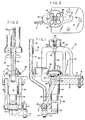
- Fig. 1 is a side view of a multi-station cartridge reloading device which illustrates the operation of a single station device after conversion to a multi-station device in accordance with the invention;
- Fig. 2 is a front view of the device of Fig. 1;
- Fig. 3 is a top view of the device of Fig. 1;
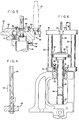
- Fig. 4 is an enlarged side view of an indexing shaft of the device of Fig. 1 removed from surrounding structure;
- Fig. 5 is a sectional side view of a mounting mechanism of the device of Fig. 1; and
- Fig. 6 is a side view of a single station reloading device which has been converted to multi-station operation in accordance with the invention.
- Figs. 1 and 2 illustrate a
cartridge reloading device 10 including a support structure having aflange 14 andsupport posts Bolts 16 extend through theflange 14 to secure the reloading device to a table 12. Thesupport posts overhead die holder 22, adaplunger guide 24 depends from theflange 14. Aplunger 26 is guided for vertical, reciprocal sliding movement through theguide 24 as indicated byarrows 28. An L-shapedpivotal bracket 30 has one end pivotally attached at apivot 32 to the bottom of theplunger 26 and the other end pivotally attached at apivot 34 to the lower ends of a pair ofparallel arms 36. The upper ends of thearms 36 are pivotally attached at a pivot 38 to the support structure, specifically, to theplunger guide 24 and theflange 14. - An
elongate handle bar 42 mounts ahandle 40 and is attached to thepivotal bracket 30. Thehandle bar 42 extends through thepivotal bracket 30 and has anut 44 screwed onto its protruding end. Pulling the handle as indicated byarrow 46 effects rotation of thepivotal bracket 30 aboutpivot 34 as indicated byarrow 48, which in turn effects upward movement of theplunger 26. - A cartridge holder of the device comprises a
rotatable turret 50 having provision for holding a plurality of cartridges in a circular pattern symmetrically positioned around its axis of rotation and the axis of theplunger 26. Amounting mechanism 52 for mounting theturret 50 to theplunger 26 provides for rotative movement of the turret relative to theplunger 26. The dieholder 22 is provided with a plurality ofdies 54 arranged in the same circular symmetrical pattern as the cartridges in theturret 50. The two circular patterns are in line with the plunger movement so that theturret 50 can be rotated to place the cartridges in line with thedies 54. - Four
dies 54 are provided in thedie holder 22 and thus for the reloading operation to which thereloader device 10 is being applied, four pressing stages are required to complete the reloading of acartridge 53. A cartridge case orcartridge 52 is placed in theturret 50 under the first die and the press is operated to perform the first die operation. The cartridge is indexed successively to the second, third and fourth die positions and the second, third and fourth die operations are accomplished.Mechanism 71, as shown in the drawings, functions to seat a primer in the cartridge between the first and second die operations. Upon completion of the fourth die operation, the cartridge is removed and a new one inserted into the turret in its place. It will be appreciated that a completed cartridge is removed and a new cartridge is inserted after each pressing operation, so that there are four cartridges in the turret, each at a different stage of completion and going through the die operations in sequence. - The
mounting mechanism 52 as best seen in Fig. 5 includes abase plate 58 integral with acollar 56 that is fixedly clamped to the top of theplunger 26 by alock screw 57, so as to be non-rotatable relative to the plunger. Theturret 50 is rotatably mounted to thebase plate 58 and has configured U-shapedcut outs 51 at four cartridge receiving positions. Each U-shaped cut out 51 is designed for receiving therim 55 of acartridge 53 which is slid into the cut out. The tubular casing that projects from the rim of the cartridge is nested in the U-shaped cut out and projects upwardly from theturret 50. As the turret is rotated about its rotatable mounting to thebase plate 58, the cartridges slide around the base plate through the different die stations. - Projecting upwardly from the
turret 50 along the rotatable axis thereof is ashaft 60. Theshaft 60 is fixed to theturret 50 so that the shaft and turret rotate together. The shaft projects up through thedie holder 22 of the support structure, specifically, it projects through a bushing 63 in a centre opening in the die holder. Rotation of thebushing 63 is controlled in part by a one-way clutch mechanism 62. The opening in the die holder and thus the axis of thebushing 63 is located centrally of the circular pattern of thedies 54. - The
bushing 63 has an inner configuration that fits the cross section of theshaft 60 which, as illustrated, is a hexagon. The fit as between the shaft and the bushing is designed to allow vertical sliding of theshaft 60 through thebushing 63. The bushing is preferably of a low friction material such a polyethylene or it may be a ball type bushing of the kind used as a component of a roller clutch bushing. An acceptable roller clutch bushing is available from The Torrington Company of Torrington, Connecticut, a specific roller clutch used in actual production of the device being identified by catalog No. RC-0061008. In any event, rotation of thebushing 63 is permitted by the clutch in one direction and not in the other. Numerous types of mechanisms are available for performing this one-way clutch function and further description is deemed unnecessary. - As shown in Figs. 1 and 4, the
shaft 60 is twisted on its axis over aportion 64 near the top of the shaft. The angular offset of the twist is 90° corresponding to one-quarter of a complete turn of 360°. In use, theshaft 60 is forced up and down through thebushing 63, by operation of thehandle 40 to force reciprocating moving of theplunger 26, and as thetwist portion 64 passes through thebushing 63, the bushing is urged to rotate a corresponding quarter turn relative to the shaft. - The arrangement of the twist on the
shaft 60 and thebushing 63 is such that the bushing can turn within the one-wayclutch mechanism 62 in the direction in which it is urged when theshaft 60 is forced upwards through thedie holder portion 22, but the bushing is prevented from turning in the direction in which it is urged when the shaft is moved downwardly. Thus, in the downward stroke theshaft 60 has to turn. The turret is fixed to theshaft 60 by abracket 66 best seen in Fig. 5, and thus turning of the shaft turns theturret 50. - Form Fig. 5, it will be seen that the underside of the
turret 50 is provided withalignment detents 68. These detents are located at four positions around the turret. A spring-urgedball 70 projected from thebase plate 58, is aligned for seating in thedetents 68 at each of the four positions in which the cartridges in theturret 50 are aligned with the dies 54 in thedie holder 22. - Turning of the
turret 50 relative to thebase plate 58 is resisted but not prevented by the seating of the spring-urgedball 70 in adetent 68. This resistance is sufficient to force turning of thebushing 63 in the direction that is permitted by the one-wayclutch mechanism 62. Thus, when thetwist section 64 of theshaft 60 is forced upwardly through thebushing 63, the bushing turns and theshaft 60 andturret 50 do not turn. The spring-urgedball 70 is readily unseated fromdetent 68 to permit turning of theshaft 60 andturret 50 when the twist section of the shaft is forced downwardly through thebushing 63. In this downward movement of theshaft 60, the bushing is prevented from turning. - A reloading device in accordance with the invention is shown in Fig. 6 in which parts identical or similar to parts of the device of Figures 1-5 are indicated by the same reference numerals which are however primed. The basic structure of the device is designed for single station reloading. A
centre opening 72 in thedie holder section 22′ is arranged for receiving a replaceable die. Theplunger 26′ is arranged to receive a cartridge holder aligned with theopening 72 and thus with a die mounted in the opening. The operation of a single station reloading apparatus has been previously explained. - In accordance with the present invention such a single station reloading device is converted as illustrated in Fig. 6 to a multiple station reloader having features similar to those of the reloading device of Figs. 1-5.
- An adapter kit including the components for converting the one-station reloader includes a
support plate 74 that is secured to the die holder plate 22' by a mountingnut 76 screwed throughplate 74 and into the threadeddie opening 72. Asecondary die holder 78 is suspended oversupport plate 74 byposts 80. Thedie holder 78 is similar to thedie holder 22 of Figs 1-5 in having a centre opening that contains a bushing 63' with a one-way clutch mechanism 62', together with dies 54' arranged in a symmetrical circular pattern around the bushing. - A
plunger extension member 82 is mounted to the plunger 26' by means of anadapter 83 and extends upwardly through a centre opening in the mountingnut 76. A turret 50', again similar to that of Fig. 1, is carried on a base plate 58' which is mounted by a collar 56' to theplunger extension member 82. A shaft 60' extends up from the turret through the bushing 63'. The turret is indexed relative to the base plate by the action of the shaft 60' forced through the bushing, all in the manner previously explained with reference to Figs. 1-5.
Claims (11)
- An apparatus for converting, to a multiple station reloader, a single station cartridge reloader having a reciprocable cartridge holding plunger (26) aligned with an opening of a die holder (22) arranged for receiving a reloading die, the apparatus comprising:
a plunger extension (82) arranged to be coupled to the plunger to protrude through the die holder opening, a turret (50) mounted on the plunger extension to reciprocate therewith, a secondary die holder (78) arranged to be fixedly mounted to the single station cartridge reloader in spaced relation to the turret, a plurality of cartridge holding stations on the turret arranged symmetrically around an upright axis, a corresponding plurality of die receiving stations on the secondary die holder similarly arranged around the upright axis, whereby cartridges (53) placed in the cartridge receiving stations are aligned with dies (54) positioned in the die receiving stations, the turret being rotatable about the axis for indexing the cartridges relative to the dies positioned in the die receiving stations. - An apparatus as claimed in claim 1 having a secondary support (74) for supporting the secondary die holder (78) in spaced relationship, and a mounting member (76) secured to the secondary support and threadably receivable in the opening of the die holder (22) of the single station reloader, the mounting member having a guide opening through which the plunger extension (82) is slidably guided.
- An apparatus as claimed in claim 1 or 2 having indexing means (62) responsive to reciprocation of the plunger extension (82) for automatic indexing of the turret (50) on reciprocation of the plunger (26).
- A multiple station cartridge reloader comprising a single station cartridge reloader and a conversion apparatus, wherein the single station cartridge reloader comprises a plunger (26) able to support a cartridge and slidably mounted by a support for reciprocal up and down movement relative to the support, and an overhead die holder (22) fixedly mounted to the support and having an opening for receiving a die in alignment with the plunger, and wherein the conversion apparatus comprises a plunger extension (82) coupled to the plunger and protruding through the overhead die holder opening, a turret (50) rotatably mounted on the plunger extension for reciprocation up and down with reciprocation of the plunger, a secondary die holder (78) fixedly mounted on the support in spaced overhead relation to the turret, a plurality of cartridge holding stations on the turret arranged symmetrically around an upright axis, a corresponding plurality of die receiving stations on the secondary die holder similarly arranged around the upright axis, whereby cartridges (53) placed in the cartridge receiving stations are aligned with dies (54) positioned in the die receiving stations, and indexing means (62) permitting indexing of the turret to successive angular positions of alignment.
- A reloader as claimed in claim 4 wherein the indexing means comprises a bushing (63) rotatably positioned in a central opening in the secondary die holder (78), a one-way clutch mechanism (62) permitting rotation of the bushing in one direction and preventing rotation thereof in the other direction, and an indexing shaft (60) fixedly attached to the turret (50) and extending therefrom through the bushing, the shaft and the bushing having complimentary cross-sectional configurations which allow sliding movement of the shaft through the bushing but prevent relative rotation of the shaft and the bushing, a portion of the shaft being twisted spirally so that movement of the shaft position through the bushing in one direction causes rotation thereof in the direction permitted by the one-way clutch mechanism and the movement of the shaft portion in the other direction causes rotational indexing of the shaft and the turret.
- A reloader as claimed in claim 5 wherein the one-way clutch mechanism (62) permits rotation of the bushing (63) on upward movement of the plunger (26) whereby rotative indexing of the turret (50) occurs on a downward stroke of the plunger.
- A reloader as claimed in claim 5 or 6 wherein the shaft configuration is a multi-sided symmetrical polygon and the twist portion thereof angularly displaces the polygon configuration by the same angle as exists between the reloader dies in the secondary die holder (78).
- A reloader as claimed in claim 5, 6 or 7 having alignment means (68,70) resisting but permitting rotative turning of the turret (50) at the angular positions at which the cartridges in the turret (50) and the dies in the secondary die holder (78) are in alignment, the alignment means sufficiently resisting turning of the turret to force rotation of the bushing (63) as permitted by the one-way clutch mechanism (62).
- A reloader as claimed in claim 8 having a base plate (58) for securement to the plunger extension (82) and on which the turret (50) is rotatably supported, and wherein the alignment means comprises a spring-biassed ball (70) and a detent recess (68) operative between the turret and the base plate.
- A reloader as claimed in any one of claims 4-9 wherein the mounting means comprises a mounting nut (76) arranged for reception in the die holder (22) to mount the auxiliary support structure, the mounting nut being apertured to receive the plunger extension member (82) therethrough.
- A reloader as claimed in any one of claims 4-10 having a secondary support (74) supporting the secondary die holder (78) in overhead spaced relationship, and a mounting member (76) secured to the secondary support and threadably secured in the opening of the overhead die holder (22), the mounting member having a guide opening through which the plunger extension is slidably guided.
Priority Applications (1)
| Application Number | Priority Date | Filing Date | Title |
|---|---|---|---|
| AT89304654T ATE101917T1 (en) | 1988-10-24 | 1989-05-09 | CARTRIDGE RELOADER. |
Applications Claiming Priority (2)
| Application Number | Priority Date | Filing Date | Title |
|---|---|---|---|
| US261273 | 1988-10-24 | ||
| US07/261,273 US4841831A (en) | 1988-10-24 | 1988-10-24 | Indexing reloader of cartridges |
Publications (2)
| Publication Number | Publication Date |
|---|---|
| EP0366222A1 EP0366222A1 (en) | 1990-05-02 |
| EP0366222B1 true EP0366222B1 (en) | 1994-02-23 |
Family
ID=22992588
Family Applications (1)
| Application Number | Title | Priority Date | Filing Date |
|---|---|---|---|
| EP89304654A Expired - Lifetime EP0366222B1 (en) | 1988-10-24 | 1989-05-09 | Cartridge reloading device |
Country Status (5)
| Country | Link |
|---|---|
| US (2) | US4841831A (en) |
| EP (1) | EP0366222B1 (en) |
| AT (1) | ATE101917T1 (en) |
| AU (1) | AU607865B2 (en) |
| DE (1) | DE68913266D1 (en) |
Families Citing this family (14)
| Publication number | Priority date | Publication date | Assignee | Title |
|---|---|---|---|---|
| US5040449A (en) * | 1990-11-30 | 1991-08-20 | Lee Richard J | Shotgun shell reloader |
| US5202529A (en) * | 1991-12-16 | 1993-04-13 | Blount, Inc. | Convertible ammunition reloading press |
| US5239923A (en) * | 1992-03-01 | 1993-08-31 | Harco Graphic Products, Inc. | Screen printer |
| US5693905A (en) * | 1996-09-16 | 1997-12-02 | Blount, Inc. | Primer loading tool |
| US5831197A (en) * | 1997-05-05 | 1998-11-03 | Blount, Inc. | Primer strip loading tool |
| US5900574A (en) | 1997-09-19 | 1999-05-04 | Hart; Larry L. | Reloading apparatus which automatically sets a bullet into the mouth of a casing |
| DE19840739A1 (en) * | 1998-09-08 | 2000-03-09 | Zimbo Fleisch Und Wurstwaren G | Meat product containing less than 0.5% fat by weight |
| US6260463B1 (en) | 1999-08-11 | 2001-07-17 | Blount, Inc. | Hand-held primer loading tool |
| US6233799B1 (en) * | 2000-01-26 | 2001-05-22 | Ronald B. Bennett | Cylinder sizer and method thereof |
| US6772668B2 (en) | 2002-08-07 | 2004-08-10 | Alliant Techsystems, Inc. | Ammunition reloading apparatus with feed mechanism |
| US6826865B2 (en) | 2003-02-10 | 2004-12-07 | Clymer Manufacturing Co. | Gun chambering device |
| WO2014150007A1 (en) | 2013-03-15 | 2014-09-25 | Alliant Techsystems Inc. | Reloading kit with lead free bullet composition |
| USD721159S1 (en) | 2013-06-14 | 2015-01-13 | Raymond Paul Reneau | Equipment support |
| US10318904B2 (en) | 2016-05-06 | 2019-06-11 | General Electric Company | Computing system to control the use of physical state attainment of assets to meet temporal performance criteria |
Family Cites Families (14)
| Publication number | Priority date | Publication date | Assignee | Title |
|---|---|---|---|---|
| US2854861A (en) * | 1941-10-31 | 1958-10-07 | Milford G Loder | Advancing and locking mechanism |
| US2967440A (en) * | 1959-05-11 | 1961-01-10 | Pettibone Mulliken Corp | Hydraulic indexing mechanism for foundry turntables |
| US3157086A (en) * | 1962-01-18 | 1964-11-17 | Theodore J Bachhuber | Shotgun shell reloader |
| US3259007A (en) * | 1964-07-21 | 1966-07-05 | Emhart Corp | Cartridge reloading tool with improved primer insertion and extractor means |
| US3483792A (en) * | 1968-01-23 | 1969-12-16 | Charles F Williams | Automatic cartridge reloader |
| US3771411A (en) * | 1972-07-03 | 1973-11-13 | Ponsness Warren | Shotgun cartridge loading machine |
| US4031804A (en) * | 1975-06-16 | 1977-06-28 | Pacific Gunsight Company | Rotary shot shell reloader |
| US4163410A (en) * | 1977-11-07 | 1979-08-07 | Dillon Michael J | Shell reloading machine |
| US4287748A (en) * | 1979-09-28 | 1981-09-08 | Stewart Stamping Corp. | Rotary transfer press apparatus |
| US4343222A (en) * | 1980-10-16 | 1982-08-10 | Dillon Michael J | Shell reloading machine |
| US4393744A (en) * | 1981-07-06 | 1983-07-19 | Lee Richard J | Press for reloading rifle and pistol cartridges |
| US4515063A (en) * | 1983-08-22 | 1985-05-07 | Lee Richard J | Turret press for reloading rifle and pistol cartridges |
| US4526084A (en) * | 1983-09-23 | 1985-07-02 | Hornady Manufacturing Co. | Shell loader |
| US4817491A (en) * | 1988-07-28 | 1989-04-04 | Arthur Fenton | Apparatus for a firearm ammunition hand loader |
-
1988
- 1988-10-24 US US07/261,273 patent/US4841831A/en not_active Ceased
-
1989
- 1989-05-09 DE DE89304654T patent/DE68913266D1/en not_active Expired - Lifetime
- 1989-05-09 AT AT89304654T patent/ATE101917T1/en not_active IP Right Cessation
- 1989-05-09 EP EP89304654A patent/EP0366222B1/en not_active Expired - Lifetime
- 1989-08-04 AU AU39317/89A patent/AU607865B2/en not_active Ceased
-
1990
- 1990-06-05 US US07/533,527 patent/USRE34612E/en not_active Expired - Lifetime
Also Published As
| Publication number | Publication date |
|---|---|
| US4841831A (en) | 1989-06-27 |
| DE68913266D1 (en) | 1994-03-31 |
| USRE34612E (en) | 1994-05-24 |
| EP0366222A1 (en) | 1990-05-02 |
| AU607865B2 (en) | 1991-03-14 |
| AU3931789A (en) | 1990-04-26 |
| ATE101917T1 (en) | 1994-03-15 |
Similar Documents
| Publication | Publication Date | Title |
|---|---|---|
| EP0366222B1 (en) | Cartridge reloading device | |
| US4526084A (en) | Shell loader | |
| US4163410A (en) | Shell reloading machine | |
| US3157086A (en) | Shotgun shell reloader | |
| US4515063A (en) | Turret press for reloading rifle and pistol cartridges | |
| US4331063A (en) | Cartridge reloading press | |
| US4241496A (en) | Blade storage and selectable force impact termination tool | |
| US4343222A (en) | Shell reloading machine | |
| US5202529A (en) | Convertible ammunition reloading press | |
| US4558500A (en) | Spring compressor for MacPherson strut suspension assemblies | |
| US4766798A (en) | Shell loader | |
| US4393744A (en) | Press for reloading rifle and pistol cartridges | |
| US3956801A (en) | Adjustable staking tool | |
| US2906011A (en) | Machine for assembling a valve core, washer and spring | |
| US3450000A (en) | Apparatus for reconditioning and reloading shotgun shells | |
| US4620472A (en) | Shell reloading machine with safety features | |
| US4625539A (en) | Automatic crimper and crimping die | |
| US3857319A (en) | Small arms cartridge reloader press | |
| US5024135A (en) | Multi-station cartridge reloading press with controlled powder dispensing | |
| US5198606A (en) | Ammunition primer handling and shell reloading system | |
| US4005519A (en) | Apparatus for setting blind rivets | |
| US4817491A (en) | Apparatus for a firearm ammunition hand loader | |
| US4781055A (en) | Crimping machine | |
| US3313201A (en) | Controlled depth primer tool | |
| US5040449A (en) | Shotgun shell reloader |
Legal Events
| Date | Code | Title | Description |
|---|---|---|---|
| PUAI | Public reference made under article 153(3) epc to a published international application that has entered the european phase |
Free format text: ORIGINAL CODE: 0009012 |
|
| AK | Designated contracting states |
Kind code of ref document: A1 Designated state(s): AT BE CH DE ES FR GB GR IT LI LU NL SE |
|
| 17P | Request for examination filed |
Effective date: 19901009 |
|
| 17Q | First examination report despatched |
Effective date: 19920323 |
|
| GRAA | (expected) grant |
Free format text: ORIGINAL CODE: 0009210 |
|
| AK | Designated contracting states |
Kind code of ref document: B1 Designated state(s): AT BE CH DE ES FR GB GR IT LI LU NL SE |
|
| PG25 | Lapsed in a contracting state [announced via postgrant information from national office to epo] |
Ref country code: IT Free format text: LAPSE BECAUSE OF FAILURE TO SUBMIT A TRANSLATION OF THE DESCRIPTION OR TO PAY THE FEE WITHIN THE PRE;WARNING: LAPSES OF ITALIAN PATENTS WITH EFFECTIVE DATE BEFORE 2007 MAY HAVE OCCURRED AT ANY TIME BEFORE 2007. THE CORRECT EFFECTIVE DATE MAY BE DIFFERENT FROM THE ONE RECORDED.SCRIBED TIME-LIMIT Effective date: 19940223 Ref country code: AT Effective date: 19940223 Ref country code: LI Effective date: 19940223 Ref country code: BE Effective date: 19940223 Ref country code: SE Effective date: 19940223 Ref country code: DE Effective date: 19940223 Ref country code: GR Free format text: LAPSE BECAUSE OF FAILURE TO SUBMIT A TRANSLATION OF THE DESCRIPTION OR TO PAY THE FEE WITHIN THE PRESCRIBED TIME-LIMIT Effective date: 19940223 Ref country code: FR Free format text: THE PATENT HAS BEEN ANNULLED BY A DECISION OF A NATIONAL AUTHORITY Effective date: 19940223 Ref country code: ES Free format text: THE PATENT HAS BEEN ANNULLED BY A DECISION OF A NATIONAL AUTHORITY Effective date: 19940223 Ref country code: NL Effective date: 19940223 Ref country code: CH Effective date: 19940223 |
|
| REF | Corresponds to: |
Ref document number: 101917 Country of ref document: AT Date of ref document: 19940315 Kind code of ref document: T |
|
| REF | Corresponds to: |
Ref document number: 68913266 Country of ref document: DE Date of ref document: 19940331 |
|
| PG25 | Lapsed in a contracting state [announced via postgrant information from national office to epo] |
Ref country code: LU Free format text: LAPSE BECAUSE OF NON-PAYMENT OF DUE FEES Effective date: 19940531 |
|
| REG | Reference to a national code |
Ref country code: CH Ref legal event code: PL |
|
| EN | Fr: translation not filed | ||
| NLV1 | Nl: lapsed or annulled due to failure to fulfill the requirements of art. 29p and 29m of the patents act | ||
| PLBE | No opposition filed within time limit |
Free format text: ORIGINAL CODE: 0009261 |
|
| STAA | Information on the status of an ep patent application or granted ep patent |
Free format text: STATUS: NO OPPOSITION FILED WITHIN TIME LIMIT |
|
| 26N | No opposition filed | ||
| PGFP | Annual fee paid to national office [announced via postgrant information from national office to epo] |
Ref country code: GB Payment date: 20000503 Year of fee payment: 12 |
|
| PG25 | Lapsed in a contracting state [announced via postgrant information from national office to epo] |
Ref country code: GB Free format text: LAPSE BECAUSE OF NON-PAYMENT OF DUE FEES Effective date: 20010509 |
|
| GBPC | Gb: european patent ceased through non-payment of renewal fee |
Effective date: 20010509 |