EP0365984A2 - Storage stable and rapid curing one-component epoxy resin composition - Google Patents
Storage stable and rapid curing one-component epoxy resin composition Download PDFInfo
- Publication number
- EP0365984A2 EP0365984A2 EP89119304A EP89119304A EP0365984A2 EP 0365984 A2 EP0365984 A2 EP 0365984A2 EP 89119304 A EP89119304 A EP 89119304A EP 89119304 A EP89119304 A EP 89119304A EP 0365984 A2 EP0365984 A2 EP 0365984A2
- Authority
- EP
- European Patent Office
- Prior art keywords
- anhydride
- epoxy resin
- epoxy
- polyamine
- composition according
- Prior art date
- Legal status (The legal status is an assumption and is not a legal conclusion. Google has not performed a legal analysis and makes no representation as to the accuracy of the status listed.)
- Withdrawn
Links
- 239000000203 mixture Substances 0.000 title claims abstract description 40
- 229920000647 polyepoxide Polymers 0.000 title claims abstract description 36
- 239000003822 epoxy resin Substances 0.000 title claims abstract description 31
- 150000008064 anhydrides Chemical class 0.000 claims abstract description 31
- 229920000768 polyamine Polymers 0.000 claims abstract description 20
- 238000000034 method Methods 0.000 claims abstract 2
- 239000004593 Epoxy Substances 0.000 claims description 23
- GYZLOYUZLJXAJU-UHFFFAOYSA-N diglycidyl ether Chemical compound C1OC1COCC1CO1 GYZLOYUZLJXAJU-UHFFFAOYSA-N 0.000 claims description 18
- 239000004841 bisphenol A epoxy resin Substances 0.000 claims description 14
- IISBACLAFKSPIT-UHFFFAOYSA-N bisphenol A Chemical compound C=1C=C(O)C=CC=1C(C)(C)C1=CC=C(O)C=C1 IISBACLAFKSPIT-UHFFFAOYSA-N 0.000 claims description 10
- VYKXQOYUCMREIS-UHFFFAOYSA-N methylhexahydrophthalic anhydride Chemical group C1CCCC2C(=O)OC(=O)C21C VYKXQOYUCMREIS-UHFFFAOYSA-N 0.000 claims description 10
- VYPSYNLAJGMNEJ-UHFFFAOYSA-N Silicium dioxide Chemical compound O=[Si]=O VYPSYNLAJGMNEJ-UHFFFAOYSA-N 0.000 claims description 9
- 229910021485 fumed silica Inorganic materials 0.000 claims description 9
- BPSIOYPQMFLKFR-UHFFFAOYSA-N trimethoxy-[3-(oxiran-2-ylmethoxy)propyl]silane Chemical compound CO[Si](OC)(OC)CCCOCC1CO1 BPSIOYPQMFLKFR-UHFFFAOYSA-N 0.000 claims description 7
- ISWSIDIOOBJBQZ-UHFFFAOYSA-N Phenol Chemical compound OC1=CC=CC=C1 ISWSIDIOOBJBQZ-UHFFFAOYSA-N 0.000 claims description 6
- PNEYBMLMFCGWSK-UHFFFAOYSA-N aluminium oxide Inorganic materials [O-2].[O-2].[O-2].[Al+3].[Al+3] PNEYBMLMFCGWSK-UHFFFAOYSA-N 0.000 claims description 6
- 229910000410 antimony oxide Inorganic materials 0.000 claims description 6
- 239000004843 novolac epoxy resin Substances 0.000 claims description 6
- VTRUBDSFZJNXHI-UHFFFAOYSA-N oxoantimony Chemical compound [Sb]=O VTRUBDSFZJNXHI-UHFFFAOYSA-N 0.000 claims description 6
- 150000004684 trihydrates Chemical class 0.000 claims description 6
- 229920005989 resin Polymers 0.000 claims description 5
- 239000011347 resin Substances 0.000 claims description 5
- 229940106691 bisphenol a Drugs 0.000 claims description 4
- 238000005538 encapsulation Methods 0.000 abstract description 2
- LNEPOXFFQSENCJ-UHFFFAOYSA-N haloperidol Chemical compound C1CC(O)(C=2C=CC(Cl)=CC=2)CCN1CCCC(=O)C1=CC=C(F)C=C1 LNEPOXFFQSENCJ-UHFFFAOYSA-N 0.000 description 13
- XLYOFNOQVPJJNP-UHFFFAOYSA-N water Substances O XLYOFNOQVPJJNP-UHFFFAOYSA-N 0.000 description 13
- 229920001944 Plastisol Polymers 0.000 description 6
- 238000010521 absorption reaction Methods 0.000 description 6
- 239000002318 adhesion promoter Substances 0.000 description 6
- 238000009835 boiling Methods 0.000 description 6
- 229920003986 novolac Polymers 0.000 description 6
- 239000004999 plastisol Substances 0.000 description 6
- 229920002732 Polyanhydride Polymers 0.000 description 5
- BLRPTPMANUNPDV-UHFFFAOYSA-N Silane Chemical compound [SiH4] BLRPTPMANUNPDV-UHFFFAOYSA-N 0.000 description 5
- FPYJFEHAWHCUMM-UHFFFAOYSA-N maleic anhydride Chemical compound O=C1OC(=O)C=C1 FPYJFEHAWHCUMM-UHFFFAOYSA-N 0.000 description 5
- 229920000915 polyvinyl chloride Polymers 0.000 description 5
- 229910000077 silane Inorganic materials 0.000 description 5
- -1 thixotropic aids Substances 0.000 description 5
- KUBDPQJOLOUJRM-UHFFFAOYSA-N 2-(chloromethyl)oxirane;4-[2-(4-hydroxyphenyl)propan-2-yl]phenol Chemical compound ClCC1CO1.C=1C=C(O)C=CC=1C(C)(C)C1=CC=C(O)C=C1 KUBDPQJOLOUJRM-UHFFFAOYSA-N 0.000 description 4
- 239000004800 polyvinyl chloride Substances 0.000 description 4
- 0 Cc1c(*)cccc1 Chemical compound Cc1c(*)cccc1 0.000 description 3
- 125000003118 aryl group Chemical group 0.000 description 3
- 239000003795 chemical substances by application Substances 0.000 description 3
- 150000001875 compounds Chemical class 0.000 description 3
- 229920001577 copolymer Polymers 0.000 description 3
- 125000003700 epoxy group Chemical group 0.000 description 3
- 238000010438 heat treatment Methods 0.000 description 3
- 239000000463 material Substances 0.000 description 3
- KMOUUZVZFBCRAM-OLQVQODUSA-N (3as,7ar)-3a,4,7,7a-tetrahydro-2-benzofuran-1,3-dione Chemical compound C1C=CC[C@@H]2C(=O)OC(=O)[C@@H]21 KMOUUZVZFBCRAM-OLQVQODUSA-N 0.000 description 2
- OECTYKWYRCHAKR-UHFFFAOYSA-N 4-vinylcyclohexene dioxide Chemical compound C1OC1C1CC2OC2CC1 OECTYKWYRCHAKR-UHFFFAOYSA-N 0.000 description 2
- MWSKJDNQKGCKPA-UHFFFAOYSA-N 6-methyl-3a,4,5,7a-tetrahydro-2-benzofuran-1,3-dione Chemical group C1CC(C)=CC2C(=O)OC(=O)C12 MWSKJDNQKGCKPA-UHFFFAOYSA-N 0.000 description 2
- YXALYBMHAYZKAP-UHFFFAOYSA-N 7-oxabicyclo[4.1.0]heptan-4-ylmethyl 7-oxabicyclo[4.1.0]heptane-4-carboxylate Chemical compound C1CC2OC2CC1C(=O)OCC1CC2OC2CC1 YXALYBMHAYZKAP-UHFFFAOYSA-N 0.000 description 2
- RTZKZFJDLAIYFH-UHFFFAOYSA-N Diethyl ether Chemical compound CCOCC RTZKZFJDLAIYFH-UHFFFAOYSA-N 0.000 description 2
- QIGBRXMKCJKVMJ-UHFFFAOYSA-N Hydroquinone Chemical compound OC1=CC=C(O)C=C1 QIGBRXMKCJKVMJ-UHFFFAOYSA-N 0.000 description 2
- 125000001931 aliphatic group Chemical group 0.000 description 2
- PXKLMJQFEQBVLD-UHFFFAOYSA-N bisphenol F Chemical compound C1=CC(O)=CC=C1CC1=CC=C(O)C=C1 PXKLMJQFEQBVLD-UHFFFAOYSA-N 0.000 description 2
- 239000003054 catalyst Substances 0.000 description 2
- 150000002118 epoxides Chemical group 0.000 description 2
- 239000000945 filler Substances 0.000 description 2
- 239000004615 ingredient Substances 0.000 description 2
- 229920000642 polymer Polymers 0.000 description 2
- 238000004382 potting Methods 0.000 description 2
- GHMLBKRAJCXXBS-UHFFFAOYSA-N resorcinol Chemical compound OC1=CC=CC(O)=C1 GHMLBKRAJCXXBS-UHFFFAOYSA-N 0.000 description 2
- 239000000126 substance Substances 0.000 description 2
- 238000012360 testing method Methods 0.000 description 2
- MUTGBJKUEZFXGO-OLQVQODUSA-N (3as,7ar)-3a,4,5,6,7,7a-hexahydro-2-benzofuran-1,3-dione Chemical compound C1CCC[C@@H]2C(=O)OC(=O)[C@@H]21 MUTGBJKUEZFXGO-OLQVQODUSA-N 0.000 description 1
- VOCDJQSAMZARGX-UHFFFAOYSA-N 1-ethenylpyrrolidine-2,5-dione Chemical compound C=CN1C(=O)CCC1=O VOCDJQSAMZARGX-UHFFFAOYSA-N 0.000 description 1
- FALRKNHUBBKYCC-UHFFFAOYSA-N 2-(chloromethyl)pyridine-3-carbonitrile Chemical compound ClCC1=NC=CC=C1C#N FALRKNHUBBKYCC-UHFFFAOYSA-N 0.000 description 1
- PYSRRFNXTXNWCD-UHFFFAOYSA-N 3-(2-phenylethenyl)furan-2,5-dione Chemical compound O=C1OC(=O)C(C=CC=2C=CC=CC=2)=C1 PYSRRFNXTXNWCD-UHFFFAOYSA-N 0.000 description 1
- RNLHGQLZWXBQNY-UHFFFAOYSA-N 3-(aminomethyl)-3,5,5-trimethylcyclohexan-1-amine Chemical group CC1(C)CC(N)CC(C)(CN)C1 RNLHGQLZWXBQNY-UHFFFAOYSA-N 0.000 description 1
- WVRNUXJQQFPNMN-VAWYXSNFSA-N 3-[(e)-dodec-1-enyl]oxolane-2,5-dione Chemical compound CCCCCCCCCC\C=C\C1CC(=O)OC1=O WVRNUXJQQFPNMN-VAWYXSNFSA-N 0.000 description 1
- AYKYXWQEBUNJCN-UHFFFAOYSA-N 3-methylfuran-2,5-dione Chemical compound CC1=CC(=O)OC1=O AYKYXWQEBUNJCN-UHFFFAOYSA-N 0.000 description 1
- OFNISBHGPNMTMS-UHFFFAOYSA-N 3-methylideneoxolane-2,5-dione Chemical compound C=C1CC(=O)OC1=O OFNISBHGPNMTMS-UHFFFAOYSA-N 0.000 description 1
- DFATXMYLKPCSCX-UHFFFAOYSA-N 3-methylsuccinic anhydride Chemical compound CC1CC(=O)OC1=O DFATXMYLKPCSCX-UHFFFAOYSA-N 0.000 description 1
- VQVIHDPBMFABCQ-UHFFFAOYSA-N 5-(1,3-dioxo-2-benzofuran-5-carbonyl)-2-benzofuran-1,3-dione Chemical compound C1=C2C(=O)OC(=O)C2=CC(C(C=2C=C3C(=O)OC(=O)C3=CC=2)=O)=C1 VQVIHDPBMFABCQ-UHFFFAOYSA-N 0.000 description 1
- OYHQOLUKZRVURQ-HZJYTTRNSA-N Linoleic acid Chemical compound CCCCC\C=C/C\C=C/CCCCCCCC(O)=O OYHQOLUKZRVURQ-HZJYTTRNSA-N 0.000 description 1
- LGRFSURHDFAFJT-UHFFFAOYSA-N Phthalic anhydride Natural products C1=CC=C2C(=O)OC(=O)C2=C1 LGRFSURHDFAFJT-UHFFFAOYSA-N 0.000 description 1
- 239000005062 Polybutadiene Substances 0.000 description 1
- 229920000147 Styrene maleic anhydride Polymers 0.000 description 1
- BZHJMEDXRYGGRV-UHFFFAOYSA-N Vinyl chloride Chemical compound ClC=C BZHJMEDXRYGGRV-UHFFFAOYSA-N 0.000 description 1
- 239000000654 additive Substances 0.000 description 1
- 239000000853 adhesive Substances 0.000 description 1
- 230000001070 adhesive effect Effects 0.000 description 1
- 230000002411 adverse Effects 0.000 description 1
- 125000002723 alicyclic group Chemical group 0.000 description 1
- ADCOVFLJGNWWNZ-UHFFFAOYSA-N antimony trioxide Inorganic materials O=[Sb]O[Sb]=O ADCOVFLJGNWWNZ-UHFFFAOYSA-N 0.000 description 1
- DJUWPHRCMMMSCV-UHFFFAOYSA-N bis(7-oxabicyclo[4.1.0]heptan-4-ylmethyl) hexanedioate Chemical compound C1CC2OC2CC1COC(=O)CCCCC(=O)OCC1CC2OC2CC1 DJUWPHRCMMMSCV-UHFFFAOYSA-N 0.000 description 1
- XFUOBHWPTSIEOV-UHFFFAOYSA-N bis(oxiran-2-ylmethyl) cyclohexane-1,2-dicarboxylate Chemical compound C1CCCC(C(=O)OCC2OC2)C1C(=O)OCC1CO1 XFUOBHWPTSIEOV-UHFFFAOYSA-N 0.000 description 1
- JHIWVOJDXOSYLW-UHFFFAOYSA-N butyl 2,2-difluorocyclopropane-1-carboxylate Chemical compound CCCCOC(=O)C1CC1(F)F JHIWVOJDXOSYLW-UHFFFAOYSA-N 0.000 description 1
- 239000000919 ceramic Substances 0.000 description 1
- 238000006243 chemical reaction Methods 0.000 description 1
- 238000003426 chemical strengthening reaction Methods 0.000 description 1
- 239000011353 cycloaliphatic epoxy resin Substances 0.000 description 1
- 150000001993 dienes Chemical class 0.000 description 1
- 239000003085 diluting agent Substances 0.000 description 1
- 239000006185 dispersion Substances 0.000 description 1
- 239000003063 flame retardant Substances 0.000 description 1
- SLGWESQGEUXWJQ-UHFFFAOYSA-N formaldehyde;phenol Chemical compound O=C.OC1=CC=CC=C1 SLGWESQGEUXWJQ-UHFFFAOYSA-N 0.000 description 1
- ANSXAPJVJOKRDJ-UHFFFAOYSA-N furo[3,4-f][2]benzofuran-1,3,5,7-tetrone Chemical compound C1=C2C(=O)OC(=O)C2=CC2=C1C(=O)OC2=O ANSXAPJVJOKRDJ-UHFFFAOYSA-N 0.000 description 1
- 150000002391 heterocyclic compounds Chemical class 0.000 description 1
- LSACYLWPPQLVSM-UHFFFAOYSA-N isobutyric acid anhydride Chemical compound CC(C)C(=O)OC(=O)C(C)C LSACYLWPPQLVSM-UHFFFAOYSA-N 0.000 description 1
- OYHQOLUKZRVURQ-IXWMQOLASA-N linoleic acid Natural products CCCCC\C=C/C\C=C\CCCCCCCC(O)=O OYHQOLUKZRVURQ-IXWMQOLASA-N 0.000 description 1
- 235000020778 linoleic acid Nutrition 0.000 description 1
- 239000000944 linseed oil Substances 0.000 description 1
- 235000021388 linseed oil Nutrition 0.000 description 1
- 150000001247 metal acetylides Chemical class 0.000 description 1
- 239000000178 monomer Substances 0.000 description 1
- 229920001568 phenolic resin Polymers 0.000 description 1
- 150000002989 phenols Chemical class 0.000 description 1
- 239000000049 pigment Substances 0.000 description 1
- 239000004014 plasticizer Substances 0.000 description 1
- 229920002857 polybutadiene Polymers 0.000 description 1
- 229920006395 saturated elastomer Polymers 0.000 description 1
- 239000000565 sealant Substances 0.000 description 1
- 239000003549 soybean oil Substances 0.000 description 1
- 235000012424 soybean oil Nutrition 0.000 description 1
- 238000013112 stability test Methods 0.000 description 1
- 229940014800 succinic anhydride Drugs 0.000 description 1
- 238000001308 synthesis method Methods 0.000 description 1
- YEAUATLBSVJFOY-UHFFFAOYSA-N tetraantimony hexaoxide Chemical compound O1[Sb](O2)O[Sb]3O[Sb]1O[Sb]2O3 YEAUATLBSVJFOY-UHFFFAOYSA-N 0.000 description 1
- 229920001187 thermosetting polymer Polymers 0.000 description 1
- 239000013008 thixotropic agent Substances 0.000 description 1
- 230000009974 thixotropic effect Effects 0.000 description 1
- 229920002554 vinyl polymer Polymers 0.000 description 1
Classifications
-
- C—CHEMISTRY; METALLURGY
- C08—ORGANIC MACROMOLECULAR COMPOUNDS; THEIR PREPARATION OR CHEMICAL WORKING-UP; COMPOSITIONS BASED THEREON
- C08G—MACROMOLECULAR COMPOUNDS OBTAINED OTHERWISE THAN BY REACTIONS ONLY INVOLVING UNSATURATED CARBON-TO-CARBON BONDS
- C08G59/00—Polycondensates containing more than one epoxy group per molecule; Macromolecules obtained by polymerising compounds containing more than one epoxy group per molecule using curing agents or catalysts which react with the epoxy groups
- C08G59/18—Macromolecules obtained by polymerising compounds containing more than one epoxy group per molecule using curing agents or catalysts which react with the epoxy groups ; e.g. general methods of curing
- C08G59/40—Macromolecules obtained by polymerising compounds containing more than one epoxy group per molecule using curing agents or catalysts which react with the epoxy groups ; e.g. general methods of curing characterised by the curing agents used
- C08G59/50—Amines
- C08G59/56—Amines together with other curing agents
- C08G59/58—Amines together with other curing agents with polycarboxylic acids or with anhydrides, halides, or low-molecular-weight esters thereof
Definitions
- the invention relates to epoxy resins.
- the invention involves novel one-component epoxy resin compositions comprising epoxy resin(s), organic anhydride, and a polyamine of the structure K-C(CH3)2-K, where K is and R is about 70 mole % -NHCH2CH2CH2N(C2H5)2 and about 30 mole % (Hereinafter, "Polyamine” refers to a compound of the above structure.)
- compositions are storage-stable and cure rapidly on heating, e.g., at about 120 to 135°C for about 20 - 90 minutes.
- Epoxy resins are well-known as adhesives, sealants, potting compounds, and the like. There are two basic types, (1) two-component systems, where the epoxy and curing catalyst are kept in separate packages until just before mixing for use; and (2) one-component systems, where the resin is pre-mixed with and stored with the curing catalyst, and curing is initiated by heating. The instant compositions are in the latter category.
- compositions of this invention comprise three essential ingredients:
- the composition may also contain conventional epoxy resin additives, such as fillers, thixotropic aids, diluents, pigments, etc.
- epoxy resin used herein contemplates any of the conventional saturated or unsaturated, aromatic, aliphatic, cycloaliphatic and heterocyclic compounds containing the epoxide group, i.e.; They can be monomeric, dimeric, oligomeric or polymeric epoxies.
- aromatic epoxy resins include, for example, the glycidyl ether derivatives of dihydric phenols such as bisphenol-A, bisphenol-F, resorcinol, hydroquinone and the like.
- Commercially available epoxy resins of the above type are some of Shell Co's "EPON" resins such as Epon 828, Epon 826, or DOW Chem. Co.'s Dow Epoxy Resins DER 332, DER 324, DER 325 or DER 331; or Ciba-Geigy's Araldite 6010; or the polyglycidyl ether of phenol-formaldehyde novolac resins such as DOW Epoxy Novolacs DEN 431 or DEN 438.
- epoxies include the cycloaliphatic epoxy resins such as Union Carbide's ERL-4221 or Ciba-Geigy's CY 179 (3,4-epoxycyclohexylmethyl-3,4-epoxycyclohexane carboxylate), Union Carbides's ERL-4299 (Bis(3,4-Epoxy cyclohexylmethyl)adipate), Union Carbide's ERL-4206 (Vinylcyclohexene dioxide), Union Carbide's ERL-4234 (2-(3,4-Epoxycyclohexyl-5,5-spiro- 3,4-epoxy)cyclohexane-meta-dioxane) or Ciba-Geigy's CY 184 (Diglycidyl ester of hexahydrophthalic acid).
- cycloaliphatic epoxy resins such as Union Carbide's ERL-
- epoxy resins are the acyclic aliphatic epoxies such as epoxidized linseed oil, epoxidized soybean oil or epoxidized diene polymers such as epoxidized polybutadiene.
- Anhydrides useful herein include alicyclic, aliphatic, cycloaliphatic, aromatic and polyanhydrides or mixtures thereof.
- operable alicyclic anhydrides include, but are not limited to, succinic anhydride, maleic anhydride, citraconic anhydride, itaconic anhydride, alkenyl anhydride, dodecenylsuccinic anhydride, tricarballic anhydride.
- Cycloaliphatic anhydrides applicable in this invention include: hexahydrophthalic anhydride, methylhexahydrophthalic anhydride, tetrahydrophthalic anhydride, methyltetrahydrophthalic anhydride, linoleic acid adduct of maleic anhydride, maleic anhydride adduct of methylcyclopentatiene, and alkylated endoalkylene tetrahydrophthalic anhydride.
- Useful aromatic anhydrides include, but are not limited to, phthalic anhydride, pyromellitic anhydride, and benzophenonetetracarboxylic dianhydride.
- Polyanhydrides such as polyadipic polyanhydride, polyazelaic polyanhydride, and polysebacic polyanhydride are also applicable.
- Anhydride containing copolymers such as styrene-maleic anhydride copolymer, maleic anhydride-vinyl ether copolymer or maleic anhydride copolymer with octodecene-1 can also be used.
- Gamma-glycidoxypropyltrimethoxysilane is D-CH2CH2CH2Si(OCH3)3, where D is
- Diglycidyl ether of bis-phenol A is Q-C(CH2)2-Q where Q is
- Phenol epoxy novolac resin is where n is about 0 - 3.0.
- Brominated diglycidyl ether of bisphenol A is G-C(CH3)2-G, where G is
- Polyamine can be made by conventional synthesis methods, e.g., by reaction of the diglycidyl ether of bisphenol-A with a 70:30 mixture of H2NCH2CH2CH2N(C2H5)2 and Also, it is available commercially as Ancamine® 2014A and Ancamine® 2014AS from Pacific Anchor Chemical Corporation, Los Angeles, CA.
- Example 1 is simplest, using only epoxy, anhydride, and Polyamine.
- Example 2 is like Example 1, but adds fumed silica as a dispersion aid for the Polyamine.
- Example 3 is like Example 2, but further increases the anhydride/epoxy ratio, with consequent higher T g .
- Examples 4 and 5 use a second epoxy, a novolac epoxy resin, with a functionality of 2.2. When using novolac epoxies in our compositions, the novolac functionality must be kept in the range of about 2 - 2.7. Otherwise the final resin will not meet our standards for storage stability, as elsewhere herein discussed. In this regard, compare Example 7, using a novolac epoxy with a functionality of 3.6. The composition failed our storage stability test.
- Example 8 is a control, showing an epoxy resin similar to ours, except that a commercially available curing agent, MY-24, was used instead of our Polyamine. We found the result not to be storage stable.
- a mixture containing 10 g of diglycidyl ether of bisphenol-A epoxy resin, 10 g of methylhexahydrophthalic anhydride (anhydride/epoxy equivalent ratio of 1.12), 0.4 g of Polyamine, and 0.3 g of fumed silica was passed through a three-roll mill for uniform mixing. The sample was cured at 135°C for 90 minutes and showed a T g of 95°C and water absorption of 1.8% after 24 hours in boiling water.
- a mixture containing 10 g of diglycidyl ether of bisphenol-A epoxy resin, 12 g of methylhexahydrophthalic anhydride (anhydride/epoxy equivalent ratio of 1.35), 0.4 g of Polyamine, and 0.3 g of fumed silica was passed through a three-roll mill for uniform mixing. The sample was cured at 135°C for 90 minutes and showed a T g of 106°C and water absorption of 2.4% after 24 hours in boiling water.
- the viscosity of the sample showed an average increase of 60% after it was kept at 40°C for 3 days. It was cured at 135°C for 90 minutes.
- the cured product showed a T g of 107°C, water absorption of 1.1% after 24 hours in boiling water, a Shore D hardness of 88, a dielectric constant of 3.5, a loss tangent of 0.0092, a volume resistivity of 1.6 x 10¹⁶ ohm-cm, a dielectric strength of 41 KV/mm and a lap shear of 1900 psi. Similar material was tested for volume resistivity after the sample was immersed in water for 10 days. There was no change in resistivity, indicating electrical properties were not adversely affected by humidity.
- the viscosity of the sample showed an average increase of 70% after it was kept at 40°C for 3 days. It was cured at 135°C for 90 minutes.
- the cured product showed a T g of 103°C, water absorption of 1.2% after 24 hours in boiling water, a Shore D hardness of 89, a dielectric constant of 3.5, a loss tangent of 0.0109, a volume resistivity of 2.2 x 10¹⁶ ohm-cm, a dielectric strength of 54 KV/mm and a lap shear of 2300 psi.
- the viscosity of the sample showed an average increase of 100% after it was kept at 40°C for 3 days. It was cured at 135°C for 90 minutes. The cured product showed a T g of 103°C, water absorption of 1.2% after 24 hours in boiling water, a Shore D hardness of 92.
- compositions have the same general uses as conventional one-component epoxy resins, and are especially useful in electronic encapsulation (potting) applications.
- an integrated circuit within an electronic package comprising ceramic base, frame, and seal ring can be coated with the composition of Example 1, followed by heating.
Landscapes
- Chemical & Material Sciences (AREA)
- Health & Medical Sciences (AREA)
- Chemical Kinetics & Catalysis (AREA)
- Medicinal Chemistry (AREA)
- Polymers & Plastics (AREA)
- Organic Chemistry (AREA)
- Epoxy Resins (AREA)
- Compositions Of Macromolecular Compounds (AREA)
Abstract
A composition comprising (a) epoxy resin; (b) organic anhydride; and (c) polyamine of the structure K-C(CH3)2-K, where K is <CHEM> and R is about 70 weight % -NHCH2CH2CH2N(C2H5)2 and about 30 weight % <CHEM> as well as a process for producing the same is disclosed. The composition is especially useful in electronic encapsulation applications.
Description
- U.S.S.N. 196703 filed May 20, 1988, Huynh-Tran, is directed to filled PVC plastisol compositions containing epoxy resins and anhydrides.
- The invention relates to epoxy resins.
- The invention involves novel one-component epoxy resin compositions comprising epoxy resin(s), organic anhydride, and a polyamine of the structure K-C(CH₃)₂-K, where K is
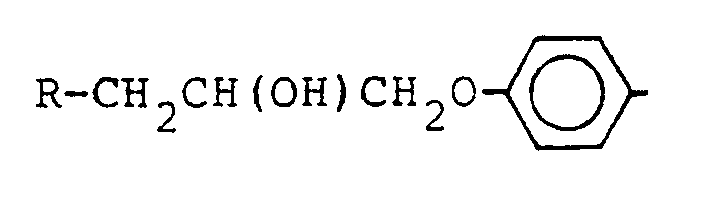

- The invention compositions are storage-stable and cure rapidly on heating, e.g., at about 120 to 135°C for about 20 - 90 minutes.
- Epoxy resins are well-known as adhesives, sealants, potting compounds, and the like. There are two basic types, (1) two-component systems, where the epoxy and curing catalyst are kept in separate packages until just before mixing for use; and (2) one-component systems, where the resin is pre-mixed with and stored with the curing catalyst, and curing is initiated by heating. The instant compositions are in the latter category.
- Combinations of epoxy resins with anhydrides are known. See, e.g.:
Chem. Abs. 68 (4):13705n, "Polyvinyl chloride) Plastisols," (Matsubara), disclosing epoxidized plasticizers for chloroethylene polymers, crosslinked with isobutyric anhydride and methylsuccinic anhydride for mechanical improvement;
Chem. Abs. 92 (4):23407b, "Setting of Epoxy Resins by Complexes based on Maleic Anhydride and N-Vinyl Monomers," (Vashevko et al), describing a complex of maleic anhydride with N-vinyl succinimide, used in thermosetting compositions of epoxy resins;
Chem. Abs. 101 (8): 56095f, "Vinyl Chloride Polymer Plastisols," (Eroskey) describing PVC plastisol with "small amounts of epoxy resins and anhydride curing agents"; and
Chem. Abs. 105 (2): 8054c, "Chemical Strengthening Plastisols", (Krejci et al) describing PVC plastisols modified with isophorone diamine, methyltetrahydrophthalic anhydride and 3 percent epoxy resin. - Also, use of Polyamine as a latent curing agent for epoxide resins is known. See Technical Data Sheet of Pacific Anchor Chemical Corporation (undated).
- However, so far as we are aware, the combination of epoxy resin, anhydride, and Polyamine was not known prior to our invention.
- The compositions of this invention comprise three essential ingredients:
- (1) an epoxy resin (or mixture of epoxy resins);
- (2) an organic anhydride (or mixture of anhydrides);
- (3) Polyamine.
- In addition to these three ingredients, the composition may also contain conventional epoxy resin additives, such as fillers, thixotropic aids, diluents, pigments, etc.
- The proportions of materials that are useful in the compositions in accordance with this invention are set forth in Table I.
Table I Epoxy Resin Compositions Component Parts by Weight Broad Range Preferred Range Epoxy resin 30 - 36 32 - 34 Anhydride 29 - 35 31 - 33 Polyamine 1.2 - 2.0 1.4 - 1.8 Filler 0 - 40 26 - 30 Adhesion promoter 0 - 0.25 0.18 - 0.22 Fire retardant, Sb₂O₃ 0 - 3.2 1.2 - 1.6 Thixotropic agent 0 - 2.0 1.2 - 1.6 Anhydride/epoxy equivalent ratio (1) 0.8 - 1.3 1.1 - 1.2 (1) Number of moles of anhydride divided by number of moles of epoxide groups in the epoxy resin(s). - Materials in the compositions are further described as follows:
- The type of epoxy resin used herein contemplates any of the conventional saturated or unsaturated, aromatic, aliphatic, cycloaliphatic and heterocyclic compounds containing the epoxide group, i.e.;

- Examples of aromatic epoxy resins include, for example, the glycidyl ether derivatives of dihydric phenols such as bisphenol-A, bisphenol-F, resorcinol, hydroquinone and the like. Commercially available epoxy resins of the above type are some of Shell Co's "EPON" resins such as Epon 828, Epon 826, or DOW Chem. Co.'s Dow Epoxy Resins DER 332, DER 324, DER 325 or DER 331; or Ciba-Geigy's Araldite 6010; or the polyglycidyl ether of phenol-formaldehyde novolac resins such as DOW Epoxy Novolacs DEN 431 or DEN 438.
- Other suitable commercially available epoxies include the cycloaliphatic epoxy resins such as Union Carbide's ERL-4221 or Ciba-Geigy's CY 179 (3,4-epoxycyclohexylmethyl-3,4-epoxycyclohexane carboxylate), Union Carbides's ERL-4299 (Bis(3,4-Epoxy cyclohexylmethyl)adipate), Union Carbide's ERL-4206 (Vinylcyclohexene dioxide), Union Carbide's ERL-4234 (2-(3,4-Epoxycyclohexyl-5,5-spiro- 3,4-epoxy)cyclohexane-meta-dioxane) or Ciba-Geigy's CY 184 (Diglycidyl ester of hexahydrophthalic acid).
- Other applicable epoxy resins are the acyclic aliphatic epoxies such as epoxidized linseed oil, epoxidized soybean oil or epoxidized diene polymers such as epoxidized polybutadiene.
- Anhydrides useful herein include alicyclic, aliphatic, cycloaliphatic, aromatic and polyanhydrides or mixtures thereof. Examples of operable alicyclic anhydrides include, but are not limited to, succinic anhydride, maleic anhydride, citraconic anhydride, itaconic anhydride, alkenyl anhydride, dodecenylsuccinic anhydride, tricarballic anhydride. Cycloaliphatic anhydrides applicable in this invention include: hexahydrophthalic anhydride, methylhexahydrophthalic anhydride, tetrahydrophthalic anhydride, methyltetrahydrophthalic anhydride, linoleic acid adduct of maleic anhydride, maleic anhydride adduct of methylcyclopentatiene, and alkylated endoalkylene tetrahydrophthalic anhydride.
- Useful aromatic anhydrides include, but are not limited to, phthalic anhydride, pyromellitic anhydride, and benzophenonetetracarboxylic dianhydride.
- Polyanhydrides such as polyadipic polyanhydride, polyazelaic polyanhydride, and polysebacic polyanhydride are also applicable.
- Anhydride containing copolymers such as styrene-maleic anhydride copolymer, maleic anhydride-vinyl ether copolymer or maleic anhydride copolymer with octodecene-1 can also be used.
- Certain of the individual compounds used in the example are identified as follows:
- Gamma-glycidoxypropyltrimethoxysilane is D-CH₂CH₂CH₂Si(OCH₃)₃, where D is

- Diglycidyl ether of bis-phenol A is Q-C(CH₂)₂-Q where Q is

- Phenol epoxy novolac resin is

- Brominated diglycidyl ether of bisphenol A is G-C(CH₃)₂-G, where G is

- Polyamine can be made by conventional synthesis methods, e.g., by reaction of the diglycidyl ether of bisphenol-A with a 70:30 mixture of H₂NCH₂CH₂CH₂N(C₂H₅)₂ and

- The following Examples illustrate without limiting the invention.
- As will be noted, Example 1 is simplest, using only epoxy, anhydride, and Polyamine. Example 2 is like Example 1, but adds fumed silica as a dispersion aid for the Polyamine. Example 3 is like Example 2, but further increases the anhydride/epoxy ratio, with consequent higher Tg. Examples 4 and 5 use a second epoxy, a novolac epoxy resin, with a functionality of 2.2. When using novolac epoxies in our compositions, the novolac functionality must be kept in the range of about 2 - 2.7. Otherwise the final resin will not meet our standards for storage stability, as elsewhere herein discussed. In this regard, compare Example 7, using a novolac epoxy with a functionality of 3.6. The composition failed our storage stability test. Example 8 is a control, showing an epoxy resin similar to ours, except that a commercially available curing agent, MY-24, was used instead of our Polyamine. We found the result not to be storage stable.
- A mixture containing 10 g of diglycidyl ether of bisphenol-A epoxy resin, 9 g methylhexahydrophthalic anhydride (anhydride/epoxy equivalent ratio 1.0) and 0.4 g of Polyamine was passed through a three-roll mill for uniform mixing. The sample as cured at 135°C for 90 minutes and showed a Tg of 82°C.
- A mixture containing 10 g of diglycidyl ether of bisphenol-A epoxy resin, 10 g of methylhexahydrophthalic anhydride (anhydride/epoxy equivalent ratio of 1.12), 0.4 g of Polyamine, and 0.3 g of fumed silica was passed through a three-roll mill for uniform mixing. The sample was cured at 135°C for 90 minutes and showed a Tg of 95°C and water absorption of 1.8% after 24 hours in boiling water.
- A mixture containing 10 g of diglycidyl ether of bisphenol-A epoxy resin, 12 g of methylhexahydrophthalic anhydride (anhydride/epoxy equivalent ratio of 1.35), 0.4 g of Polyamine, and 0.3 g of fumed silica was passed through a three-roll mill for uniform mixing. The sample was cured at 135°C for 90 minutes and showed a Tg of 106°C and water absorption of 2.4% after 24 hours in boiling water.
- A mixture containing 10 g of diglycidyl ether of bisphenol-A epoxy resin, 17 g of phenol novolac epoxy resin (functionality 2.2), 9.5 g of brominated diglycidyl ether of bisphenol-A epoxy resin, 26.7 g of methylhexahydrophthalic anhydride (anhydride/epoxy equivalent ratio of 1.12), 1.35 of Polyamine, 1.0 g of fumed silica, 2.5 g of antimony oxide, 0.16 g of gamma-glycidoxypropyltrimethoxysilane (silane adhesion promoter), and 24 g of alumina trihydrate (Al₂O₃.3H₂O) was passed through a three-roll mill for uniform mixing. The viscosity of the sample showed an average increase of 60% after it was kept at 40°C for 3 days. It was cured at 135°C for 90 minutes. The cured product showed a Tg of 107°C, water absorption of 1.1% after 24 hours in boiling water, a Shore D hardness of 88, a dielectric constant of 3.5, a loss tangent of 0.0092, a volume resistivity of 1.6 x 10¹⁶ ohm-cm, a dielectric strength of 41 KV/mm and a lap shear of 1900 psi. Similar material was tested for volume resistivity after the sample was immersed in water for 10 days. There was no change in resistivity, indicating electrical properties were not adversely affected by humidity.
- A mixture containing 42 g of diglycidyl ether of bisphenol-A epoxy resin, 238 g of phenol novolac epoxy resin (functionality 2.2), 133 g of brominated diglycidyl ether of bisphenol-A epoxy resin, 374 g of methylhexahydrophthalic anhydride (anhydride/epoxy equivalent ratio of 1.12), 19 g of Polyamine, 14 g of fumed silica, 35 g of antimony oxide, 2.24 g of gamma-glycidoxypropyltrimethoxysilane (silane adhesion promoter), and 336 g of alumina trihydrate was passed through a three-roll mill for uniform mixing. The viscosity of the sample showed an average increase of 70% after it was kept at 40°C for 3 days. It was cured at 135°C for 90 minutes. The cured product showed a Tg of 103°C, water absorption of 1.2% after 24 hours in boiling water, a Shore D hardness of 89, a dielectric constant of 3.5, a loss tangent of 0.0109, a volume resistivity of 2.2 x 10¹⁶ ohm-cm, a dielectric strength of 54 KV/mm and a lap shear of 2300 psi.
- A mixture containing 20 g of a diglycidyl ether of bisphenol-A epoxy resin, 9.0 g brominated diglycidyl ether of bisphenol-A epoxy resin, 28.4 of methylhexahydrophthalic anhydride (anhydride/epoxy equivalent ratio of 1.35), 1.19 g of polyamine, 1.0 g of fumed silica, 2.5 g of antimony oxide, 0.16 of gamma glycidoxypropyltrimethoxysilane (silane adhesion promoter), and 24 g of alumina trihydrate was passed through a three-roll mill for uniform mixing. The viscosity of the sample showed an average increase of 60% after it was kept at 40°C for 3 days. It was cured at 135°C for 90 minutes. The cured product showed a Tg of 103°C, water absorption of 1.4% after 24 hours in boiling water, a Shore D hardness of 90.
- A mixture containing 10 g of diglycidyl ether of bisphenol-A epoxy resin, 10 g of phenol novolac epoxy resin (functionality 3.6), 9.5 g of brominated diglycidyl ether of bisphenol-A epoxy resin, 25.9 g of methylhexahydrophthalic anhydride (anhydride/epoxy equivalent ratio of 1.12), 1.31 g of Polyamine, 1.2 g of fumed silica, 2.5 g of antimony oxide, 0.16 g of gamma-glycidoxypropyltrimethoxysilane (silane adhesion promoter), and 24 g of alumina trihydrate was passed through a three-roll mill for uniform mixing. The viscosity of the sample showed an average increase of 100% after it was kept at 40°C for 3 days. It was cured at 135°C for 90 minutes. The cured product showed a Tg of 103°C, water absorption of 1.2% after 24 hours in boiling water, a Shore D hardness of 92.
- A mixture containing 3 g of diglycidyl ether of bisphenol-A epoxy resin, 17 g of phenol novolac epoxy resin (functionality 2.2), 9.5 g of brominated diglycidyl ether of bisphenol-A epoxy resin, 26.7 g of methylhexahydrophthalic anhydride (anhydride/epoxy equivalent ratio of 1.12), 1.16 g of MY-24 (latent accelerator for anhydride/epoxy from Ajinomoto), 1.0 g of fumed silica, 2.5 g of antimony oxide, 0.16 g of gamma-glycidoxypropyltrimethoxysilane (silane adhesion promoter), and 24 g of alumina trihydrate was passed through a three-roll mill for uniform mixing. The viscosity of the sample showed an average increase of 100% after it was kept at 40°C for 3 days. It was cured at 135°C for 90 minutes. The cured product showed a Tg of 102°C.
- To test storage stability we used accelerated conditions, viz., a temperature of 40°C for 3 days. We determined viscosity of the mixture before and after the test. An increase in viscosity less than 100% was taken as showing acceptable stability. All of the invention compositions met this standard.
- Storage stability is of course irrelevant when the epoxy resin is made up for immediate on-site use - in which case, however, the rationale for a one-component resin is lost.
- The invention compositions have the same general uses as conventional one-component epoxy resins, and are especially useful in electronic encapsulation (potting) applications.
- For example, an integrated circuit, within an electronic package comprising ceramic base, frame, and seal ring can be coated with the composition of Example 1, followed by heating.
Claims (8)
1. Composition comprising
(a) epoxy resin;
(b) organic anhydride; and
(c) polyamine of the structure K-C(CH₃)₂-K, where K is

and R is about 70 weight % -NHCH₂CH₂CH₂N(C₂H₅)₂ and about 30 weight %

2. Composition according to claim 1, additionally containing fumed silica, antimony oxide, alumina trihydrate and/or gamma-glycidoxypropyltrimethoxysilane.
3. Composition according to claims 1 or 2 wherein the epoxy resin comprises diglycidyl ether of bisphenol-A, phenol novolac epoxy resin having a functionality of about 2-2.7, and/or brominated bisphenol-A epoxy resin.
4. Composition according to any of the preceding claims wherein the anhydride is methylhexahydrophthalic anhydride.
5. Composition according to any of the preceding claims comprising, in parts by weight,
(a) epoxy resin, 30 - 36;
(b) anhydride, 29 - 35; and
(c) Polyamine, 1.2 - 2.0
6. Composition according to any of the preceding claims, wherein the anhydride/epoxy equivalent ratio is about 1.1-1.2.
7. Process for producing the composition according to any preceding claim comprising mixing together the components of the composition.
8. An electronic package encapsulated with resin comprising the composition according to any of the claims 1 to 6.
Applications Claiming Priority (2)
| Application Number | Priority Date | Filing Date | Title |
|---|---|---|---|
| US26236888A | 1988-10-25 | 1988-10-25 | |
| US262368 | 1988-10-25 |
Publications (2)
| Publication Number | Publication Date |
|---|---|
| EP0365984A2 true EP0365984A2 (en) | 1990-05-02 |
| EP0365984A3 EP0365984A3 (en) | 1991-08-14 |
Family
ID=22997199
Family Applications (1)
| Application Number | Title | Priority Date | Filing Date |
|---|---|---|---|
| EP19890119304 Withdrawn EP0365984A3 (en) | 1988-10-25 | 1989-10-18 | Storage stable and rapid curing one-component epoxy resin composition |
Country Status (2)
| Country | Link |
|---|---|
| EP (1) | EP0365984A3 (en) |
| JP (1) | JPH02158619A (en) |
Cited By (6)
| Publication number | Priority date | Publication date | Assignee | Title |
|---|---|---|---|---|
| DE4132982A1 (en) * | 1991-10-04 | 1993-04-08 | Grundfos Int | Additives improving elasticity and strength of epoxy] resins for stators - comprising polyoxyalkylene amine(s) and opt. also poly:alkylene glycol(s) and/or thermoplastic phenoxy] resins |
| US5656350A (en) * | 1989-02-21 | 1997-08-12 | Hitachi, Ltd. | Coil impregnant of epoxy resin from polyhydric phenol mixture |
| US20170062386A1 (en) * | 2015-08-31 | 2017-03-02 | Delta Electronics (Shanghai) Co., Ltd | Power package module of multiple power chips and method of manufacturing power chip unit |
| US20190287943A1 (en) * | 2015-08-31 | 2019-09-19 | Delta Electronics (Shanghai) Co., Ltd | Power package module of multiple power chips and method of manufacturing power chip unit |
| WO2022117576A1 (en) | 2020-12-04 | 2022-06-09 | Sika Technology Ag | Heat-curable polyurethane compositions |
| EP4361190A1 (en) | 2022-10-26 | 2024-05-01 | Sika Technology AG | Wide temperature window thermosetting polyurethane compositions |
Family Cites Families (3)
| Publication number | Priority date | Publication date | Assignee | Title |
|---|---|---|---|---|
| US4152285A (en) * | 1974-05-28 | 1979-05-01 | Thomassen Ivar P | Curing agent for water-based epoxy resins |
| DE2602412A1 (en) * | 1976-01-23 | 1977-07-28 | Bayer Ag | Hardenable epoxy resin compsns. - prepd. by adding polyamine hardener to mixt. of epoxy cpd. and acid anhydride |
| US4176221A (en) * | 1978-07-14 | 1979-11-27 | Celanese Polymer Specialties Company | Soluble resinous products of polyepoxide-amine adducts and cyclic dicarboxylic acid anhydrides |
-
1989
- 1989-10-18 EP EP19890119304 patent/EP0365984A3/en not_active Withdrawn
- 1989-10-25 JP JP27617689A patent/JPH02158619A/en active Pending
Cited By (8)
| Publication number | Priority date | Publication date | Assignee | Title |
|---|---|---|---|---|
| US5656350A (en) * | 1989-02-21 | 1997-08-12 | Hitachi, Ltd. | Coil impregnant of epoxy resin from polyhydric phenol mixture |
| DE4132982A1 (en) * | 1991-10-04 | 1993-04-08 | Grundfos Int | Additives improving elasticity and strength of epoxy] resins for stators - comprising polyoxyalkylene amine(s) and opt. also poly:alkylene glycol(s) and/or thermoplastic phenoxy] resins |
| US20170062386A1 (en) * | 2015-08-31 | 2017-03-02 | Delta Electronics (Shanghai) Co., Ltd | Power package module of multiple power chips and method of manufacturing power chip unit |
| US10347533B2 (en) * | 2015-08-31 | 2019-07-09 | Delta Electronics (Shanghai) Co., Ltd | Power package module of multiple power chips and method of manufacturing power chip unit |
| US20190287943A1 (en) * | 2015-08-31 | 2019-09-19 | Delta Electronics (Shanghai) Co., Ltd | Power package module of multiple power chips and method of manufacturing power chip unit |
| WO2022117576A1 (en) | 2020-12-04 | 2022-06-09 | Sika Technology Ag | Heat-curable polyurethane compositions |
| EP4361190A1 (en) | 2022-10-26 | 2024-05-01 | Sika Technology AG | Wide temperature window thermosetting polyurethane compositions |
| WO2024089087A1 (en) | 2022-10-26 | 2024-05-02 | Sika Technology Ag | Heat-curable polyurethane compositions with wide temperature window |
Also Published As
| Publication number | Publication date |
|---|---|
| EP0365984A3 (en) | 1991-08-14 |
| JPH02158619A (en) | 1990-06-19 |
Similar Documents
| Publication | Publication Date | Title |
|---|---|---|
| DE69921991T2 (en) | RESIN COMPOSITIONS | |
| DE60301926T2 (en) | epoxy resin | |
| JPS6230215B2 (en) | ||
| US4663190A (en) | Process for producing semiconductor element | |
| JPS62201923A (en) | Epoxy resin composition | |
| JPH02158619A (en) | Storage-stable, rapidly curing | |
| JPH0627183B2 (en) | Liquid epoxy resin composition | |
| US4346207A (en) | Flowable, curable epoxy resin mixture | |
| US3728306A (en) | Composition comprising an epoxy resin with an organostannoic acid-carboxylic acid anhydride reaction product | |
| JPH04304227A (en) | Epoxy resin composition and material for sealing electronic part | |
| JPH02117913A (en) | epoxy resin composition | |
| JP2001098049A (en) | Liquid epoxy resin composition for semiconductor encapsulation | |
| JPS62260820A (en) | Polymerizable composition | |
| JPS63130620A (en) | Epoxy resin composition | |
| US3366603A (en) | Epoxy resinous compositions | |
| JPS59174618A (en) | Epoxy resin composition for photo-semiconductor sealant having excellent moisture resistance | |
| JPS58206622A (en) | One-pack type epoxy resin composition | |
| JPH06128352A (en) | Epoxy resin composition | |
| JPS6316412B2 (en) | ||
| JPS6253009B2 (en) | ||
| JPH09272787A (en) | Liquid epoxy resin composition | |
| JPH0288622A (en) | Epoxy resin composition of low dielectric constant | |
| JP2003128882A (en) | Liquid epoxy resin mixture, epoxy resin composition and its cured product | |
| JPS61246227A (en) | Epoxy resin composition | |
| JPH02283719A (en) | Epoxy resin composition |
Legal Events
| Date | Code | Title | Description |
|---|---|---|---|
| PUAI | Public reference made under article 153(3) epc to a published international application that has entered the european phase |
Free format text: ORIGINAL CODE: 0009012 |
|
| AK | Designated contracting states |
Kind code of ref document: A2 Designated state(s): AT BE CH DE ES FR GB GR IT LI LU NL SE |
|
| PUAL | Search report despatched |
Free format text: ORIGINAL CODE: 0009013 |
|
| AK | Designated contracting states |
Kind code of ref document: A3 Designated state(s): AT BE CH DE ES FR GB GR IT LI LU NL SE |
|
| STAA | Information on the status of an ep patent application or granted ep patent |
Free format text: STATUS: THE APPLICATION IS DEEMED TO BE WITHDRAWN |
|
| 18D | Application deemed to be withdrawn |
Effective date: 19920215 |