EP0363390B1 - Coated near alpha titanium articles - Google Patents
Coated near alpha titanium articlesInfo
- Publication number
- EP0363390B1 EP0363390B1 EP88904413A EP88904413A EP0363390B1 EP 0363390 B1 EP0363390 B1 EP 0363390B1 EP 88904413 A EP88904413 A EP 88904413A EP 88904413 A EP88904413 A EP 88904413A EP 0363390 B1 EP0363390 B1 EP 0363390B1
- Authority
- EP
- European Patent Office
- Prior art keywords
- nickel
- coating
- chromium
- weight
- article
- Prior art date
- Legal status (The legal status is an assumption and is not a legal conclusion. Google has not performed a legal analysis and makes no representation as to the accuracy of the status listed.)
- Expired - Lifetime
Links
- RTAQQCXQSZGOHL-UHFFFAOYSA-N Titanium Chemical compound [Ti] RTAQQCXQSZGOHL-UHFFFAOYSA-N 0.000 title claims abstract description 21
- 229910052719 titanium Inorganic materials 0.000 title claims abstract description 21
- 239000010936 titanium Substances 0.000 title claims abstract description 21
- 238000000576 coating method Methods 0.000 claims abstract description 50
- 239000011248 coating agent Substances 0.000 claims abstract description 40
- PXHVJJICTQNCMI-UHFFFAOYSA-N Nickel Chemical compound [Ni] PXHVJJICTQNCMI-UHFFFAOYSA-N 0.000 claims abstract description 31
- 229910045601 alloy Inorganic materials 0.000 claims abstract description 28
- 239000000956 alloy Substances 0.000 claims abstract description 28
- 229910052759 nickel Inorganic materials 0.000 claims abstract description 15
- 229910018487 Ni—Cr Inorganic materials 0.000 claims abstract description 11
- VNNRSPGTAMTISX-UHFFFAOYSA-N chromium nickel Chemical compound [Cr].[Ni] VNNRSPGTAMTISX-UHFFFAOYSA-N 0.000 claims abstract description 11
- VYZAMTAEIAYCRO-UHFFFAOYSA-N Chromium Chemical compound [Cr] VYZAMTAEIAYCRO-UHFFFAOYSA-N 0.000 claims abstract description 9
- 229910052804 chromium Inorganic materials 0.000 claims abstract description 9
- 239000011651 chromium Substances 0.000 claims abstract description 9
- 230000003647 oxidation Effects 0.000 claims description 33
- 238000007254 oxidation reaction Methods 0.000 claims description 33
- BASFCYQUMIYNBI-UHFFFAOYSA-N platinum Chemical compound [Pt] BASFCYQUMIYNBI-UHFFFAOYSA-N 0.000 claims description 16
- 238000005260 corrosion Methods 0.000 claims description 10
- 230000007797 corrosion Effects 0.000 claims description 10
- 229910052697 platinum Inorganic materials 0.000 claims description 8
- XEEYBQQBJWHFJM-UHFFFAOYSA-N Iron Chemical compound [Fe] XEEYBQQBJWHFJM-UHFFFAOYSA-N 0.000 claims description 5
- 239000004411 aluminium Substances 0.000 claims description 3
- 229910052782 aluminium Inorganic materials 0.000 claims description 3
- XAGFODPZIPBFFR-UHFFFAOYSA-N aluminium Chemical compound [Al] XAGFODPZIPBFFR-UHFFFAOYSA-N 0.000 claims description 3
- 229910052710 silicon Inorganic materials 0.000 claims description 3
- 239000010703 silicon Substances 0.000 claims description 3
- ZOXJGFHDIHLPTG-UHFFFAOYSA-N Boron Chemical compound [B] ZOXJGFHDIHLPTG-UHFFFAOYSA-N 0.000 claims description 2
- 229910052684 Cerium Inorganic materials 0.000 claims description 2
- BQCADISMDOOEFD-UHFFFAOYSA-N Silver Chemical compound [Ag] BQCADISMDOOEFD-UHFFFAOYSA-N 0.000 claims description 2
- 229910052796 boron Inorganic materials 0.000 claims description 2
- 229910052742 iron Inorganic materials 0.000 claims description 2
- 229910052746 lanthanum Inorganic materials 0.000 claims description 2
- FZLIPJUXYLNCLC-UHFFFAOYSA-N lanthanum atom Chemical compound [La] FZLIPJUXYLNCLC-UHFFFAOYSA-N 0.000 claims description 2
- 239000010970 precious metal Substances 0.000 claims description 2
- 229910052761 rare earth metal Inorganic materials 0.000 claims description 2
- 229910052703 rhodium Inorganic materials 0.000 claims description 2
- 239000010948 rhodium Substances 0.000 claims description 2
- MHOVAHRLVXNVSD-UHFFFAOYSA-N rhodium atom Chemical compound [Rh] MHOVAHRLVXNVSD-UHFFFAOYSA-N 0.000 claims description 2
- 229910052709 silver Inorganic materials 0.000 claims description 2
- 239000004332 silver Substances 0.000 claims description 2
- 229910052727 yttrium Inorganic materials 0.000 claims description 2
- VWQVUPCCIRVNHF-UHFFFAOYSA-N yttrium atom Chemical compound [Y] VWQVUPCCIRVNHF-UHFFFAOYSA-N 0.000 claims description 2
- 230000000063 preceeding effect Effects 0.000 claims 5
- GWXLDORMOJMVQZ-UHFFFAOYSA-N cerium Chemical compound [Ce] GWXLDORMOJMVQZ-UHFFFAOYSA-N 0.000 claims 1
- 238000000034 method Methods 0.000 abstract description 13
- 239000000463 material Substances 0.000 abstract description 9
- 230000015572 biosynthetic process Effects 0.000 abstract description 8
- 238000011109 contamination Methods 0.000 abstract description 8
- 238000007733 ion plating Methods 0.000 abstract description 7
- 229910001235 nimonic Inorganic materials 0.000 abstract description 6
- 238000007747 plating Methods 0.000 abstract description 3
- 239000008199 coating composition Substances 0.000 abstract 1
- 238000012360 testing method Methods 0.000 description 27
- 229910001069 Ti alloy Inorganic materials 0.000 description 24
- QVGXLLKOCUKJST-UHFFFAOYSA-N atomic oxygen Chemical compound [O] QVGXLLKOCUKJST-UHFFFAOYSA-N 0.000 description 11
- 239000001301 oxygen Substances 0.000 description 11
- 229910052760 oxygen Inorganic materials 0.000 description 11
- 125000004122 cyclic group Chemical group 0.000 description 10
- 230000008569 process Effects 0.000 description 10
- 239000000758 substrate Substances 0.000 description 9
- 239000007789 gas Substances 0.000 description 8
- 239000000203 mixture Substances 0.000 description 8
- IJGRMHOSHXDMSA-UHFFFAOYSA-N Atomic nitrogen Chemical compound N#N IJGRMHOSHXDMSA-UHFFFAOYSA-N 0.000 description 6
- 238000000151 deposition Methods 0.000 description 6
- 230000008021 deposition Effects 0.000 description 6
- 238000005259 measurement Methods 0.000 description 6
- 230000004048 modification Effects 0.000 description 6
- 238000012986 modification Methods 0.000 description 6
- 230000006872 improvement Effects 0.000 description 5
- 229910000601 superalloy Inorganic materials 0.000 description 5
- 230000008859 change Effects 0.000 description 4
- 238000005229 chemical vapour deposition Methods 0.000 description 4
- 230000000694 effects Effects 0.000 description 4
- 229910052751 metal Inorganic materials 0.000 description 4
- 239000002184 metal Substances 0.000 description 4
- 239000011253 protective coating Substances 0.000 description 4
- PNEYBMLMFCGWSK-UHFFFAOYSA-N Alumina Chemical compound [O-2].[O-2].[O-2].[Al+3].[Al+3] PNEYBMLMFCGWSK-UHFFFAOYSA-N 0.000 description 3
- 229910001040 Beta-titanium Inorganic materials 0.000 description 3
- 238000007792 addition Methods 0.000 description 3
- 230000001627 detrimental effect Effects 0.000 description 3
- 238000010438 heat treatment Methods 0.000 description 3
- 229910052757 nitrogen Inorganic materials 0.000 description 3
- 238000004544 sputter deposition Methods 0.000 description 3
- XKRFYHLGVUSROY-UHFFFAOYSA-N Argon Chemical compound [Ar] XKRFYHLGVUSROY-UHFFFAOYSA-N 0.000 description 2
- XUIMIQQOPSSXEZ-UHFFFAOYSA-N Silicon Chemical compound [Si] XUIMIQQOPSSXEZ-UHFFFAOYSA-N 0.000 description 2
- 239000002585 base Substances 0.000 description 2
- 230000003749 cleanliness Effects 0.000 description 2
- 238000006731 degradation reaction Methods 0.000 description 2
- 238000005516 engineering process Methods 0.000 description 2
- 230000003628 erosive effect Effects 0.000 description 2
- 150000004820 halides Chemical class 0.000 description 2
- 230000035515 penetration Effects 0.000 description 2
- 238000005240 physical vapour deposition Methods 0.000 description 2
- 238000007750 plasma spraying Methods 0.000 description 2
- 239000000126 substance Substances 0.000 description 2
- 230000009466 transformation Effects 0.000 description 2
- 230000004584 weight gain Effects 0.000 description 2
- 235000019786 weight gain Nutrition 0.000 description 2
- 241000478345 Afer Species 0.000 description 1
- 229910000951 Aluminide Inorganic materials 0.000 description 1
- 229910000831 Steel Inorganic materials 0.000 description 1
- ATJFFYVFTNAWJD-UHFFFAOYSA-N Tin Chemical compound [Sn] ATJFFYVFTNAWJD-UHFFFAOYSA-N 0.000 description 1
- QCWXUUIWCKQGHC-UHFFFAOYSA-N Zirconium Chemical compound [Zr] QCWXUUIWCKQGHC-UHFFFAOYSA-N 0.000 description 1
- HZEWFHLRYVTOIW-UHFFFAOYSA-N [Ti].[Ni] Chemical compound [Ti].[Ni] HZEWFHLRYVTOIW-UHFFFAOYSA-N 0.000 description 1
- 230000001464 adherent effect Effects 0.000 description 1
- 229910052783 alkali metal Inorganic materials 0.000 description 1
- -1 alkali metal salt Chemical class 0.000 description 1
- 238000005275 alloying Methods 0.000 description 1
- 238000013459 approach Methods 0.000 description 1
- 229910052786 argon Inorganic materials 0.000 description 1
- 125000002915 carbonyl group Chemical group [*:2]C([*:1])=O 0.000 description 1
- 230000015556 catabolic process Effects 0.000 description 1
- ZMIGMASIKSOYAM-UHFFFAOYSA-N cerium Chemical compound [Ce][Ce][Ce][Ce][Ce][Ce][Ce][Ce][Ce][Ce][Ce][Ce][Ce][Ce][Ce][Ce][Ce][Ce][Ce][Ce][Ce][Ce][Ce][Ce][Ce][Ce][Ce][Ce][Ce][Ce][Ce][Ce][Ce][Ce][Ce][Ce][Ce][Ce] ZMIGMASIKSOYAM-UHFFFAOYSA-N 0.000 description 1
- 238000006243 chemical reaction Methods 0.000 description 1
- 230000002860 competitive effect Effects 0.000 description 1
- 239000000356 contaminant Substances 0.000 description 1
- 238000005336 cracking Methods 0.000 description 1
- 230000002950 deficient Effects 0.000 description 1
- 238000009792 diffusion process Methods 0.000 description 1
- 238000009826 distribution Methods 0.000 description 1
- 238000005530 etching Methods 0.000 description 1
- 238000002474 experimental method Methods 0.000 description 1
- 238000009661 fatigue test Methods 0.000 description 1
- PCHJSUWPFVWCPO-UHFFFAOYSA-N gold Chemical compound [Au] PCHJSUWPFVWCPO-UHFFFAOYSA-N 0.000 description 1
- 229910052737 gold Inorganic materials 0.000 description 1
- 239000010931 gold Substances 0.000 description 1
- 229910052735 hafnium Inorganic materials 0.000 description 1
- VBJZVLUMGGDVMO-UHFFFAOYSA-N hafnium atom Chemical compound [Hf] VBJZVLUMGGDVMO-UHFFFAOYSA-N 0.000 description 1
- 239000004615 ingredient Substances 0.000 description 1
- 229910000765 intermetallic Inorganic materials 0.000 description 1
- 238000010849 ion bombardment Methods 0.000 description 1
- 230000000670 limiting effect Effects 0.000 description 1
- 230000008018 melting Effects 0.000 description 1
- 238000002844 melting Methods 0.000 description 1
- 239000011156 metal matrix composite Substances 0.000 description 1
- 150000002739 metals Chemical class 0.000 description 1
- 230000035699 permeability Effects 0.000 description 1
- 230000002035 prolonged effect Effects 0.000 description 1
- 230000009467 reduction Effects 0.000 description 1
- 230000002441 reversible effect Effects 0.000 description 1
- 150000003839 salts Chemical class 0.000 description 1
- 239000007787 solid Substances 0.000 description 1
- 239000006104 solid solution Substances 0.000 description 1
- 230000003019 stabilising effect Effects 0.000 description 1
- 239000010959 steel Substances 0.000 description 1
- 238000005382 thermal cycling Methods 0.000 description 1
- 238000011282 treatment Methods 0.000 description 1
- 229910052726 zirconium Inorganic materials 0.000 description 1
Images



Classifications
-
- C—CHEMISTRY; METALLURGY
- C23—COATING METALLIC MATERIAL; COATING MATERIAL WITH METALLIC MATERIAL; CHEMICAL SURFACE TREATMENT; DIFFUSION TREATMENT OF METALLIC MATERIAL; COATING BY VACUUM EVAPORATION, BY SPUTTERING, BY ION IMPLANTATION OR BY CHEMICAL VAPOUR DEPOSITION, IN GENERAL; INHIBITING CORROSION OF METALLIC MATERIAL OR INCRUSTATION IN GENERAL
- C23C—COATING METALLIC MATERIAL; COATING MATERIAL WITH METALLIC MATERIAL; SURFACE TREATMENT OF METALLIC MATERIAL BY DIFFUSION INTO THE SURFACE, BY CHEMICAL CONVERSION OR SUBSTITUTION; COATING BY VACUUM EVAPORATION, BY SPUTTERING, BY ION IMPLANTATION OR BY CHEMICAL VAPOUR DEPOSITION, IN GENERAL
- C23C30/00—Coating with metallic material characterised only by the composition of the metallic material, i.e. not characterised by the coating process
-
- C—CHEMISTRY; METALLURGY
- C23—COATING METALLIC MATERIAL; COATING MATERIAL WITH METALLIC MATERIAL; CHEMICAL SURFACE TREATMENT; DIFFUSION TREATMENT OF METALLIC MATERIAL; COATING BY VACUUM EVAPORATION, BY SPUTTERING, BY ION IMPLANTATION OR BY CHEMICAL VAPOUR DEPOSITION, IN GENERAL; INHIBITING CORROSION OF METALLIC MATERIAL OR INCRUSTATION IN GENERAL
- C23C—COATING METALLIC MATERIAL; COATING MATERIAL WITH METALLIC MATERIAL; SURFACE TREATMENT OF METALLIC MATERIAL BY DIFFUSION INTO THE SURFACE, BY CHEMICAL CONVERSION OR SUBSTITUTION; COATING BY VACUUM EVAPORATION, BY SPUTTERING, BY ION IMPLANTATION OR BY CHEMICAL VAPOUR DEPOSITION, IN GENERAL
- C23C14/00—Coating by vacuum evaporation, by sputtering or by ion implantation of the coating forming material
- C23C14/06—Coating by vacuum evaporation, by sputtering or by ion implantation of the coating forming material characterised by the coating material
- C23C14/14—Metallic material, boron or silicon
- C23C14/16—Metallic material, boron or silicon on metallic substrates or on substrates of boron or silicon
- C23C14/165—Metallic material, boron or silicon on metallic substrates or on substrates of boron or silicon by cathodic sputtering
-
- Y—GENERAL TAGGING OF NEW TECHNOLOGICAL DEVELOPMENTS; GENERAL TAGGING OF CROSS-SECTIONAL TECHNOLOGIES SPANNING OVER SEVERAL SECTIONS OF THE IPC; TECHNICAL SUBJECTS COVERED BY FORMER USPC CROSS-REFERENCE ART COLLECTIONS [XRACs] AND DIGESTS
- Y10—TECHNICAL SUBJECTS COVERED BY FORMER USPC
- Y10T—TECHNICAL SUBJECTS COVERED BY FORMER US CLASSIFICATION
- Y10T428/00—Stock material or miscellaneous articles
- Y10T428/12—All metal or with adjacent metals
- Y10T428/12493—Composite; i.e., plural, adjacent, spatially distinct metal components [e.g., layers, joint, etc.]
- Y10T428/12771—Transition metal-base component
- Y10T428/12806—Refractory [Group IVB, VB, or VIB] metal-base component
-
- Y—GENERAL TAGGING OF NEW TECHNOLOGICAL DEVELOPMENTS; GENERAL TAGGING OF CROSS-SECTIONAL TECHNOLOGIES SPANNING OVER SEVERAL SECTIONS OF THE IPC; TECHNICAL SUBJECTS COVERED BY FORMER USPC CROSS-REFERENCE ART COLLECTIONS [XRACs] AND DIGESTS
- Y10—TECHNICAL SUBJECTS COVERED BY FORMER USPC
- Y10T—TECHNICAL SUBJECTS COVERED BY FORMER US CLASSIFICATION
- Y10T428/00—Stock material or miscellaneous articles
- Y10T428/12—All metal or with adjacent metals
- Y10T428/12493—Composite; i.e., plural, adjacent, spatially distinct metal components [e.g., layers, joint, etc.]
- Y10T428/12771—Transition metal-base component
- Y10T428/12861—Group VIII or IB metal-base component
- Y10T428/12944—Ni-base component
Definitions
- Approximately 30 atomic percent may be dissolved in the titanium.
- the dissolved oxygen creates in the affected region a hard brittle zone.
- the affected zone is called the alpha case and its formation can substantially degrade the structural integrity of the affected article by loss of tensile ductility and of fatigue resistance even though the interior of the article is not subject to structural modification.
- Nitrogen plays some part in the degradation process which occurs but the predominant factors in alpha case formation are the presence of oxygen, the exposure time and the temperature.
- the terms "oxidation”, “oxidation resistance” and related terms are hereinafter intended to encompass both oxygen and nitrogen effects; the terms being used to distinguish these effects from other forms of attack both chemical-such as aqueous corrosion and high temperature sulphidation or alkali metal salt corrosion and non-chemical attack by erosion. Corrosion can be a life limiting factor under some circumstances for example gas turbine components for aircraft that fly at low altitudes across the sea in high salt environments. It is desirable therefore, that a coating can also convey some degree of protection against corrosion attack
- a physical vapour deposition technique such as ion plating, sputter plating or sputter ion plating.
- ion plating sputter plating
- sputter ion plating sputter ion plating
- the aim of this invention is to provide an oxidation resistant coating for the protection of near - ⁇ titanium alloys to increase the temperature to which such alloys suitably coated can be operational in gas turbine engine compressor applications.
- a coating must protect the substrate against the loss of fatigue resistance, toughness and ductility due to oxidation that will prevent near - ⁇ titanium alloys being used for components with an operational temperature much in excess of 600°C.
- near - ⁇ titanium alloys exhibit the creep resistance and structural stability necessary to withstand repeated excursions to well above 600°C.
- Suitable coatings to protect components such as gas turbine engine compressor components from oxidation and/or corrosion would enable the high temperature mechanical properties of near - ⁇ titanium alloys to be utilised by increasing operational temperatures to well above 600°C.
- Cylindrical test pins of IMI829 alloy were coated using sputter ion plating process from targets having the composition by weight of Ni-35Cr-8Al-8Si.
- the process used was as described by J.E. Restall and J.P. Coad at page 499 et seq in Metals Technology 9, 1982 save that the test pins were subject to an alternating positive/negative bias voltage for better control of coating distribution and microstructure.
- the depth of coating was approximately 50 ⁇ m which is too great to be representative of perceived gas turbine compressor coating needs so detailed results are not presented here.
Landscapes
- Chemical & Material Sciences (AREA)
- Chemical Kinetics & Catalysis (AREA)
- Engineering & Computer Science (AREA)
- Materials Engineering (AREA)
- Mechanical Engineering (AREA)
- Metallurgy (AREA)
- Organic Chemistry (AREA)
- Physical Vapour Deposition (AREA)
- Turbine Rotor Nozzle Sealing (AREA)
- Other Surface Treatments For Metallic Materials (AREA)
Abstract
Description
- This invention relates to protective coatings for articles of near -α titanium based alloys. It is particularly concerned with coatings for gas turbine engine compressor stage components formed in near -α titanium based alloys suitable to convey at least high temperature oxidation resistance and preferably also high temperature corrosion resistance to these components.
- Pure titanium undergoes an allotropic transformation at 882°C from the lower temperature phase, designated the α phase, which has a hexagonal close-packed (hcp) structure to a higher temperature phase, designated the β phase, which is stable up to the melting temperature and had a body centre cubic structure. Titanium alloys are conventionally categorised as α-type alloys, β-type alloys or α + β alloys by virtue of the nature and level of the alloying additions they contain. Near -α titanium alloys are titanium based with additions of, amongst other things, α-stabilising elements such as aluminium and tin that promote the hexagonal close packed structure of the α-phase. The α-phase has very good high temperature creep properties and in near -α titanium alloys these good creep properties are achieved while still maintaining adequate low temperature strength and forgeability.
- This excellent balance of strength, ductility, microstructural stability and oxidation/corrosion resistance as compared with competitive materials such as steels or nickel based superalloys has resulted in near -α titanium alloys becoming increasingly important as constructional material for compressor components in advanced gas turbine engines.
- A wide variety of these high strength near -α titanium alloys have been developed commercially to tolerate operating conditions involving prolonged exposure to air at temperatures up to 500°C. The following commercial alloys of IMI Titanium Ltd (identified by their commercial designation and nominal composition in weight percent) are typical of the current generation of titanium alloys suitable for gas turbine compressor applications. These are: IMI 550 (Ti-4A1-2Sn-4Mo-0.5Si); IMI 679 (Ti-11Sn-2.25A1-5Zr-1Mo-0.25Si); IMI 685 (Ti-6Al-5Zr-0.5Mo-0.25Si); IMI 829 (Ti-5.5A1-3.5Sn-3Zr-0.250-0.3Si) and IMI 834 (Ti-5.8Al-4.0Sn-3.5Zr-0.7Nb-0.5Mo-0-35Si-0.06C-0.090).
- There is continuing commercial interest in increasing the temperature tolerance of near -α titanium alloys in order that gas turbine engine cycle temperatures can be raised to increase engine efficiency without recourse to other materials. There is also the possibility that an increase in temperature tolerance might permit these titanium alloys to be used for components currently made of say nickel-based superalloys with consequent reduction in component weight. Some of the conventional near -α titanium alloys exhibit excellent creep resistance and good structural stability at temperatures significantly above the 500°C mentioned earlier ― say to 650°C. However, when such alloys are exposed to air at temperatures approaching 600°C they are subject to significant and detrimental surface modification. The principal factor involved in this surface modification is the uptake of oxygen into solid solution by the titanium. At these temperatues the reaction kinetics ensure rapid diffusion of oxygen into the region adjacent the exposed surface. Approximately 30 atomic percent may be dissolved in the titanium. The dissolved oxygen creates in the affected region a hard brittle zone. The affected zone is called the alpha case and its formation can substantially degrade the structural integrity of the affected article by loss of tensile ductility and of fatigue resistance even though the interior of the article is not subject to structural modification. Nitrogen plays some part in the degradation process which occurs but the predominant factors in alpha case formation are the presence of oxygen, the exposure time and the temperature. The terms "oxidation", "oxidation resistance" and related terms are hereinafter intended to encompass both oxygen and nitrogen effects; the terms being used to distinguish these effects from other forms of attack both chemical-such as aqueous corrosion and high temperature sulphidation or alkali metal salt corrosion and non-chemical attack by erosion. Corrosion can be a life limiting factor under some circumstances for example gas turbine components for aircraft that fly at low altitudes across the sea in high salt environments. It is desirable therefore, that a coating can also convey some degree of protection against corrosion attack.
- The phenomenon of high temperature oxidation in titanium and titanium based alloys is not new-found and attempts have already been made to overcome this. One approach to this is to vary the alloy composition in such a way as to convey adequate intrinsic resistance. However, all alloy compositions represent an optimisation of conflicting requirements and it is quite likely that such titanium alloy compositions as could be produced to solve the oxidation problem would be deficient in other respects. The aforementioned present generation titanium alloys especially IMI 829, IMI 834 and other near -α titanium alloys are well established in the art and would be suitable for higher temperature applications if adequately protected against high temperature oxidation.
- Although protective coatings are well established and widely used for the corrosion/oxidation protection of the nickel-based superalloys used in the hot sections of the turbine stage, oxidation protective coatings are not yet well established for titanium compressor components.
- There are special difficulties involved in providing a coating that is resistant to high temperature degradation, impervious to oxygen, adheres securely to the near -α titanium substrate and can be deposited by a process that does not impair the properties of the substrate.
- Plasma spraying conventionally used in coating a wide variety of materials such as nickel based superalloys, deposits coatings that are characteristically porous and internally stressed and consequently require substantial post deposition treatment to form an oxidation resistant coating. The heat treatments necessarily involved will often be at temperatures that reverse properties carefully secured in the near -α titanium alloys through prior heat treatment at temperatures typically in the region of 1000-1100°C. We believe plasma spraying will be inappropriate for coating near -α titanium alloy substrates for this reason.
- It is known that surface enrichment of α/β titanium alloys with platinum improves the oxidation resistance (as measured by fatigue properties) at temperatures up to 450°C but the published work on this does not suggest any improvement in oxidation resistance at higher temperatures nor is such an improvement suggested by the Applicant's experiments with platinum enrichment. The Applicant has found also that only marginal improvement in high temperature oxidation resistance is secured by coating with gold, or nickel, or chromium or platinum overlaid with nickel, these being deposited by a sputter ion plating method.
- Furthermore, it is known from the work of Fujishiro, Eylon and Gehring reported in Thin Solid Films, Vol 63, No 1 (1979) at pages 55 to 60 that α/β and α- titanium alloys which have been investigated for improvements in their creep properties as a result of platinum ion plating show enhanced creep resistance only for the platinum coated α/β- titanium alloy. In titanium alloys containing only α- phase no such platinum coating effect is observed. The paper speculates that this difference is attributable to the powerful α- phase stabilising effect of oxygen and suggests that internal stress may be caused by oxygen penetration into the α/β- titanium alloy which leads to a degree of β- to α- phase transformation. Improved resistance to oxidation may therefore be inferred from the observed improvement in creep properties.
- Aluminide coatings and chromised coatings are well known in the protection of nickel based superalloys. These are produced either by deposition of pure metal by cementation or chemical vapour deposition followed by heat treatment to form the intermetallic compound, or alternatively by physical vapour deposition of the intermetallic. Such coatings are not suitable for conveying high temperature oxidation resistance to titanium or titanium alloy as they form brittle intermetallic phases at the interface with the parent material which renders the coating susceptible to spallation damage, particularly when subject to thermal cycling. Moreover the deposition temperature of 750°C or more required for cementation or chemical vapour deposition processes would unacceptably degrade the properties of a near -α titanium alloy component.
- Chemical routes generally such as chemical vapour deposition tend not to be suitable for coating near -α titanium alloys, as surface cleanliness and contamination are very important. Both halide and carbonyl atmospheres used in such processes, along with the temperatures needed for deposition make it difficult to clean the surface to prevent contaminants being introduced that can impair adhesion. Contamination at the coating stage can also lead to the formation of an embrittled layer within the substrate below the coating which is detrimental to the substrate in itself and is detrimental also to the durability of the coating. Halide contamination can lead to the formation of such embrittled layers as well as oxygen contamination which is a particular problem because of the high solubility of oxygen in titanium.
- In order to avoid the difficulties of contamination associated with chemical vapour deposition processes and also to ensure good adhesion between the coating and the substrate it is preferred to use a physical vapour deposition technique such as ion plating, sputter plating or sputter ion plating. These methods of deposition are all sub-atmospheric pressure processes which can be performed under argon cover so as to minimise the possibilities for contamination during coating. Moreover, with each of these it is possible to pre-clean the substrate by ion bombardment then move directly to the deposition stage. These plating processes are well-established in the art so no further description of them is offered here.
- The aim of this invention is to provide an oxidation resistant coating for the protection of near -α titanium alloys to increase the temperature to which such alloys suitably coated can be operational in gas turbine engine compressor applications. To achieve this aim a coating must protect the substrate against the loss of fatigue resistance, toughness and ductility due to oxidation that will prevent near -α titanium alloys being used for components with an operational temperature much in excess of 600°C. As recently developed near -α titanium alloys exhibit the creep resistance and structural stability necessary to withstand repeated excursions to well above 600°C. Suitable coatings to protect components such as gas turbine engine compressor components from oxidation and/or corrosion would enable the high temperature mechanical properties of near -α titanium alloys to be utilised by increasing operational temperatures to well above 600°C.
- The invention is an article comprising a coated near -α titanium based alloy, characterised in that it is coated with a high temperature oxidation and/or corrosion resistant coating, said coating comprising a nickel-chromium based alloy wherein the nickel and chromium in combination constitute at least 75% by weight of the applied coating with a ratio of nickel to chromium in the range 18: 1 to 1.5: 1 by weight. This corresponds to a chromium range of 5 to 40 weight percent in the binary material.
- The article may be wholly metal or a reinforced metal such as a metal matrix composite. The coatings of this invention possess good intrinsic resistance to high temperature oxidation and low permeability to oxygen and nitrogen whilst possessing other attributes which are desirable such as resistance to spallation when thermally cycled, and interface ductility consequent upon the formation of ductile titanium-nickel intermetallic phases. There is some mismatch between the coefficient of expansion of the coating and titanium based substrates but this is not so great as to present a problem.
- The coating may contain other elements in additon to the nickel-chromium base, but preferably retains a nickel to chromium ratio within the aforementioned range. To promote a film of stable aluminium oxide at the exposed surface of the coating aluminium may be included, preferably 2-12 percent by weight. Silicon may also be included to provide a harder, more erosion resistant surface. A preferable range for the silicon addition is 2-12 percent by weight. The coating may include one or more of the following ingredients in minor proportions: yttrium; boron; a precious metal (platinum, rhodium or silver); a rare earth element (lanthanum or cerium); and reactive elements such as hafnium, titanium or zirconium.
- The coating may contain a minor proportion of other elements such as up to 10% iron by weight which do not contribute significantly to the effectiveness of the coating, but which might be found in commercially available materials.
- Specific examples of coated titanium based components according to the invention are described below. Reference is made to uncoated titanium based components of coated and uncoated specimens is made with reference to the accompanying drawings of which:
- Figure 1 is a microsection of a coated specimen in the as-coated condition;
- Figure 2 is a microsection of a coated specimen which has been subjected to cyclic oxidation testing;
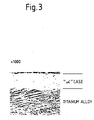
- Figure 3 is a microsection of an uncoated specimen which has been subjected to cyclic oxidation testing;
- Figure 4 is a graph depicting microstructural modification consequent upon oxidation testing, as measured by microhardness measurements on a traverse through the surface regions showing coated and uncoated specimens.
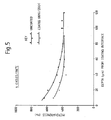
- Figure 5 is a graph depicting a like comparison to that of Figure 4 but showing measurements made afer a more severe oxidation test.
- Figure 6 is a graph depicting low cycle fatigue data on uncoated specimens and coated specimens which have been subjected to 1000 h exposure at 580°C in air prior to testing.
- Cylindrical test pins of IMI829 alloy were coated to a depth of approximately 5 µm by means of a hot rod target sputtering process using targets of Nimonic 75 alloy. Nimonic 75 is a trade designation of International Nickel for an alloy with the composition of weight percent of: 0.08-0.15 C; 0.1 (max) Si; 0.5 (max) Cu; 5.0 (max) Fe; 0.2-0.6Ti; 18-21Cr; Ni balance. The sputtering process was of the type described by R.G. Duckworth in Proc. Int. Conf. on Thin and Thick Film Technology, Ausberg, 1977, NTG70, VDE, Berlin 1977 pp 83-87. There are no significant differences between the sputtering coefficients of the elements in the Nimonic 75 target so the coating produced should have the same composition as the target. This composition was confirmed by microprobe analysis of the coatings.
- Figure 1 shows a microsection at × 1000 magnification of an IMI 829 test pin which has been coated as described above. It will be seen that the coating is dense and adherent. A traverse of microhardness measurements across a section as shown reveals no significant variation in hardness as would be indicative of surface contamination in the coating process.
- The Nimonic 75 coated test pins were subjected to cyclic oxidation testing by exposure to air in an open furnace at a furnace temperature of 650°C. Each cycle consisted of 24 hours in furnace and 1 hour out of furnace. The specimens were weighed to assess weight gain and optically examined to assess the coating condition. These tests were continued for accummulated times of several hundreds of hours. Like tests were also performed on further specimens using a furnace temperature of 700°C for accummulated times up to 100 hours. It was found that, providing sufficient care was taken to ensure surface cleanliness at the coating stage, the adherence of the protective coating was excellent with no spallation or cracking damage at the cessation of the cyclic oxidation tests. No significant weight gain was observed. The formation of alpha case in titanium alloys is detectable by strain etching (because of changed microstructure) and also by microhardness measurements (because the alpha case is harder than the base material). Figure 2 shows a microsection (at × 1000 magnification) of a coated specimen after 150 hours of cyclic oxidation testing at a furnace temperature of 650°C. It will be seen that this microsection displays no significant change with respect to the pre-test specimen microsection shown in Figure 1. Figure 3 shows a × 1000 microsection of an uncoated IMI 829 control specimen after the same cyclic oxidation test of 150 hours at a furnace temperature of 650°C. The difference between the microsections of the coated and uncoated specimens is immediately apparent there being a significant alpha case layer present in the uncoated specimen which is absent from the coated specimen.
- Figure 4 compares microhardness measurements of coated and uncoated specimens after 150 hours of cyclic oxidation testing at a furnace temperature of 650°C. The uncoated specimen exhibits increased microhardness consequent upon alpha case formation to a depth of at least 60 µm. The coated specimen exhibits only a very minor change in microhardness and even this is confined to the first 20 µm. Figure 5 gives a similar comparison of microhardness measurements but for specimens subjected to 100 hours cyclic oxidation testing at a furnace temperature of 700°C. After such testing the uncoated specimen exhibits a similar change of surface hardness to that for the longer, lower temperature test but the hardness at sub-surface positions is much increased and the hardness modification penetrates deeper into the specimen to at least 70 µm. The coated specimen shows greater microstructural change than in the previous test but the depth of penetration is no more than 20 µm and the degree of hardness modification even in this near-surface band is much less than the uncoated specimen exhibits.
- Figure 6 compares fatigue properties of an IMI829 test pin coated as described with those of an uncoated IMI829 control specimen. Each specimen was subjected to 1000 hour exposure at 580°C in air prior to fatigue testing to breaking point at room temperature. The coated test pieces clearly show a considerably improved performance relative to the uncoated test pieces.
- Cylindrical test pins of IMI829 alloy were coated using sputter ion plating process from targets having the composition by weight of Ni-35Cr-8Al-8Si. The process used was as described by J.E. Restall and J.P. Coad at page 499 et seq in Metals Technology 9, 1982 save that the test pins were subject to an alternating positive/negative bias voltage for better control of coating distribution and microstructure. The depth of coating was approximately 50 µm which is too great to be representative of perceived gas turbine compressor coating needs so detailed results are not presented here. However, the density and adherence of the coatings prior to cyclic oxidation testing were comparable to those found for the Nimonic 75 coated documented in Example 1 and also the specimens when subjected to cyclic oxidation testing in the regime mentioned earlier showed no untoward effects.
Claims (8)
Applications Claiming Priority (2)
| Application Number | Priority Date | Filing Date | Title |
|---|---|---|---|
| GB8711698 | 1987-05-18 | ||
| GB878711698A GB8711698D0 (en) | 1987-05-18 | 1987-05-18 | Coated titanium articles(i) |
Publications (2)
| Publication Number | Publication Date |
|---|---|
| EP0363390A1 EP0363390A1 (en) | 1990-04-18 |
| EP0363390B1 true EP0363390B1 (en) | 1991-07-24 |
Family
ID=10617518
Family Applications (1)
| Application Number | Title | Priority Date | Filing Date |
|---|---|---|---|
| EP88904413A Expired - Lifetime EP0363390B1 (en) | 1987-05-18 | 1988-05-17 | Coated near alpha titanium articles |
Country Status (5)
| Country | Link |
|---|---|
| US (1) | US5126213A (en) |
| EP (1) | EP0363390B1 (en) |
| JP (1) | JPH02503576A (en) |
| GB (1) | GB8711698D0 (en) |
| WO (1) | WO1988009397A1 (en) |
Families Citing this family (13)
| Publication number | Priority date | Publication date | Assignee | Title |
|---|---|---|---|---|
| US5098540A (en) * | 1990-02-12 | 1992-03-24 | General Electric Company | Method for depositing chromium coatings for titanium oxidation protection |
| US5077140A (en) * | 1990-04-17 | 1991-12-31 | General Electric Company | Coating systems for titanium oxidation protection |
| GB2249558B (en) * | 1990-09-14 | 1994-02-16 | Martin John Michael Murphy | Metal matrix composite component |
| FR2672906A1 (en) * | 1991-02-19 | 1992-08-21 | Grumman Aerospace Corp | DIFFUSION BARRIER COATING FOR TITANIUM ALLOYS. |
| US5292596A (en) * | 1991-05-13 | 1994-03-08 | United Technologies Corporation | Force-transmitting surfaces of titanium protected from pretting fatigue by a coating of Co-Ni-Fe |
| US5455079A (en) * | 1991-07-26 | 1995-10-03 | The United States Of America As Represented By The Secretary Of The Interior | Surface hardening of titanium alloys with melting depth controlled by heat sink |
| US5660886A (en) * | 1995-04-24 | 1997-08-26 | Mc Donnell Douglas Corp | Method for forming in situ diffusion barrier while diffusing aluminum through nickel-boron |
| GB2314854A (en) * | 1996-07-02 | 1998-01-14 | Gkn Westland Helicopters Ltd | Assembling a hardened metallic component in an opening in a composite structure |
| GB9904804D0 (en) | 1999-03-02 | 1999-04-28 | King S College London | Identification of bacteria |
| WO2009109199A1 (en) * | 2008-03-04 | 2009-09-11 | Siemens Aktiengesellschaft | Alloy, high-temperature corrosion protection layer and layer system |
| WO2015088876A1 (en) | 2013-12-10 | 2015-06-18 | Lei Chen | Nickel-chromium-aluminum composite by electrodeposition |
| EP3080321B1 (en) * | 2013-12-10 | 2019-07-31 | United Technologies Corporation | Method for electrodepositing a nickel-chromium alloy |
| WO2015088861A1 (en) | 2013-12-11 | 2015-06-18 | Lei Chen | Electroformed nickel-chromium alloy |
Family Cites Families (28)
| Publication number | Priority date | Publication date | Assignee | Title |
|---|---|---|---|---|
| GB749365A (en) * | 1953-01-22 | 1956-05-23 | Rolls Royce | Improvements in or relating to the hot working of titanium and titanium base alloy materials |
| US2858600A (en) * | 1954-02-19 | 1958-11-04 | Gen Motors Corp | Surface hardening of titanium |
| US2900715A (en) * | 1956-05-28 | 1959-08-25 | Steel Improvement & Forge Co | Protection of titanium |
| US3268306A (en) * | 1962-03-28 | 1966-08-23 | Trw Inc | Titanium pretreatment for protective coating of refractory alloys |
| US3471342A (en) * | 1966-07-29 | 1969-10-07 | Ibm | Wear-resistant titanium and titanium alloys and method for producing same |
| US3560274A (en) * | 1969-10-10 | 1971-02-02 | Ibm | Wear-resistant titanium and titanium alloys and method for producing same |
| US3713901A (en) * | 1970-04-20 | 1973-01-30 | Trw Inc | Oxidation resistant refractory alloys |
| US3754903A (en) * | 1970-09-15 | 1973-08-28 | United Aircraft Corp | High temperature oxidation resistant coating alloy |
| US3691029A (en) * | 1971-03-05 | 1972-09-12 | Superior Plating Co | Chrome plating of titanium |
| US3813258A (en) * | 1972-04-27 | 1974-05-28 | Ver Flugtechnische Werke | Method for evaporating silver on titanium and its alloys |
| US3756193A (en) * | 1972-05-01 | 1973-09-04 | Battelle Memorial Institute | Coating apparatus |
| US3918139A (en) * | 1974-07-10 | 1975-11-11 | United Technologies Corp | MCrAlY type coating alloy |
| GB1498866A (en) * | 1975-06-11 | 1978-01-25 | Cabot Corp | Protective nickel or chromium base alloy coatings |
| US4034142A (en) * | 1975-12-31 | 1977-07-05 | United Technologies Corporation | Superalloy base having a coating containing silicon for corrosion/oxidation protection |
| US4137370A (en) * | 1977-08-16 | 1979-01-30 | The United States Of America As Represented By The Secretary Of The Air Force | Titanium and titanium alloys ion plated with noble metals and their alloys |
| US4273824A (en) * | 1979-05-11 | 1981-06-16 | United Technologies Corporation | Ceramic faced structures and methods for manufacture thereof |
| JPS5672167A (en) * | 1979-11-19 | 1981-06-16 | Hitachi Ltd | Heat resisting alloy |
| JPS5681665A (en) * | 1979-12-04 | 1981-07-03 | Natl Res Inst For Metals | Surface hardening process for titanium |
| US4305998A (en) * | 1980-02-04 | 1981-12-15 | The United States Of America As Represented By The Secretary Of The Navy | Protective coating |
| US4496635A (en) * | 1980-04-09 | 1985-01-29 | The United States Of America As Represented By The United States Department Of Energy | Amorphous metal alloy and composite |
| JPS5837144A (en) * | 1981-08-28 | 1983-03-04 | Hitachi Ltd | Member having corrosion resistant coating layer |
| JPS5842255A (en) * | 1981-09-07 | 1983-03-11 | Mitsubishi Electric Corp | Semiconductor mounting substrate having multilayer wiring and manufacture thereof |
| JPS5877586A (en) * | 1981-10-30 | 1983-05-10 | Sumitomo Electric Ind Ltd | Electrode and its manufacturing method |
| DE3148198A1 (en) * | 1981-12-05 | 1983-06-09 | Brown, Boveri & Cie Ag, 6800 Mannheim | "HIGH TEMPERATURE PROTECTIVE LAYER" |
| JPS58111917A (en) * | 1982-12-03 | 1983-07-04 | Seiko Epson Corp | Frame for spectacles |
| EP0188057A1 (en) * | 1984-11-19 | 1986-07-23 | Avco Corporation | Erosion resistant coatings |
| GB8516580D0 (en) * | 1985-07-01 | 1985-08-07 | Atomic Energy Authority Uk | Coating improvements |
| EP0207768A3 (en) * | 1985-07-01 | 1987-08-05 | United Kingdom Atomic Energy Authority | Coating improvements |
-
1987
- 1987-05-18 GB GB878711698A patent/GB8711698D0/en active Pending
-
1988
- 1988-05-17 WO PCT/GB1988/000390 patent/WO1988009397A1/en not_active Ceased
- 1988-05-17 JP JP88504116A patent/JPH02503576A/en active Pending
- 1988-05-17 EP EP88904413A patent/EP0363390B1/en not_active Expired - Lifetime
- 1988-05-17 US US07/435,399 patent/US5126213A/en not_active Expired - Lifetime
Non-Patent Citations (2)
| Title |
|---|
| Thin Solid Films, vol. 45, 1977 * |
| Thin Solid Films, vol. 63, no. 1, October 1979 - * |
Also Published As
| Publication number | Publication date |
|---|---|
| WO1988009397A1 (en) | 1988-12-01 |
| EP0363390A1 (en) | 1990-04-18 |
| GB8711698D0 (en) | 1987-06-24 |
| JPH02503576A (en) | 1990-10-25 |
| US5126213A (en) | 1992-06-30 |
Similar Documents
| Publication | Publication Date | Title |
|---|---|---|
| AU2004242104B8 (en) | High-temperature coatings with Pt metal modifed gamma-Ni+gamma'-Ni3Al alloy compositions | |
| US6291084B1 (en) | Nickel aluminide coating and coating systems formed therewith | |
| US4761346A (en) | Erosion-resistant coating system | |
| US5498484A (en) | Thermal barrier coating system with hardenable bond coat | |
| Tang et al. | Effect of a sputtered TiAlCr coating on the oxidation resistance of TiAl intermetallic compound | |
| US6964791B2 (en) | High-temperature articles and method for making | |
| US5126213A (en) | Coated near-alpha titanium articles | |
| US4919773A (en) | Method for imparting erosion-resistance to metallic substrates | |
| GB2095700A (en) | Superalloy coating compositions | |
| CA2034336A1 (en) | Coating systems for titanium oxidation protection | |
| EP0284793B1 (en) | Oxidation-and hot corrosion-resistant nickel-base alloy coatings and claddings for industrial and marine gas turbine hot section components and resulting composite articles | |
| EP1493834B1 (en) | Heat-resistant ti alloy material excellent in resistance to corrosion at high temperature and to oxidation | |
| EP1784517B1 (en) | HIGH-TEMPERATURE COATINGS AND BULK -Ni+ '-Ni3Al ALLOYS MODIFIED WITH PT GROUP METALS HAVING HOT-CORROSION RESISTANCE | |
| EP0358685B1 (en) | Coated near -alpha titanium articles | |
| EP1329536B1 (en) | Nickel aluminide coating containing hafnium and coating systems formed therewith | |
| Strang et al. | Effect of coatings on the mechanical properties of superalloys | |
| US5049418A (en) | Barrier coatings for oxidation protection incorporating compatibility layer | |
| Swadzba et al. | Modified heat–resistance for protective coatings for nickle–based superalloys |
Legal Events
| Date | Code | Title | Description |
|---|---|---|---|
| PUAI | Public reference made under article 153(3) epc to a published international application that has entered the european phase |
Free format text: ORIGINAL CODE: 0009012 |
|
| 17P | Request for examination filed |
Effective date: 19891102 |
|
| AK | Designated contracting states |
Kind code of ref document: A1 Designated state(s): DE FR GB IT NL SE |
|
| 17Q | First examination report despatched |
Effective date: 19900806 |
|
| GRAA | (expected) grant |
Free format text: ORIGINAL CODE: 0009210 |
|
| ITF | It: translation for a ep patent filed | ||
| AK | Designated contracting states |
Kind code of ref document: B1 Designated state(s): DE FR GB IT NL SE |
|
| REF | Corresponds to: |
Ref document number: 3863926 Country of ref document: DE Date of ref document: 19910829 |
|
| ET | Fr: translation filed | ||
| PLBE | No opposition filed within time limit |
Free format text: ORIGINAL CODE: 0009261 |
|
| STAA | Information on the status of an ep patent application or granted ep patent |
Free format text: STATUS: NO OPPOSITION FILED WITHIN TIME LIMIT |
|
| 26N | No opposition filed | ||
| EAL | Se: european patent in force in sweden |
Ref document number: 88904413.7 |
|
| PGFP | Annual fee paid to national office [announced via postgrant information from national office to epo] |
Ref country code: SE Payment date: 19970416 Year of fee payment: 10 |
|
| PGFP | Annual fee paid to national office [announced via postgrant information from national office to epo] |
Ref country code: NL Payment date: 19970428 Year of fee payment: 10 |
|
| PG25 | Lapsed in a contracting state [announced via postgrant information from national office to epo] |
Ref country code: SE Free format text: LAPSE BECAUSE OF NON-PAYMENT OF DUE FEES Effective date: 19980518 |
|
| PG25 | Lapsed in a contracting state [announced via postgrant information from national office to epo] |
Ref country code: NL Free format text: LAPSE BECAUSE OF NON-PAYMENT OF DUE FEES Effective date: 19981201 |
|
| EUG | Se: european patent has lapsed |
Ref document number: 88904413.7 |
|
| NLV4 | Nl: lapsed or anulled due to non-payment of the annual fee |
Effective date: 19981201 |
|
| REG | Reference to a national code |
Ref country code: GB Ref legal event code: 732E |
|
| REG | Reference to a national code |
Ref country code: GB Ref legal event code: IF02 |
|
| REG | Reference to a national code |
Ref country code: FR Ref legal event code: TP |
|
| PG25 | Lapsed in a contracting state [announced via postgrant information from national office to epo] |
Ref country code: IT Free format text: LAPSE BECAUSE OF NON-PAYMENT OF DUE FEES Effective date: 20050517 |
|
| PGFP | Annual fee paid to national office [announced via postgrant information from national office to epo] |
Ref country code: DE Payment date: 20070425 Year of fee payment: 20 |
|
| PGFP | Annual fee paid to national office [announced via postgrant information from national office to epo] |
Ref country code: GB Payment date: 20070412 Year of fee payment: 20 |
|
| PGFP | Annual fee paid to national office [announced via postgrant information from national office to epo] |
Ref country code: FR Payment date: 20070411 Year of fee payment: 20 |
|
| REG | Reference to a national code |
Ref country code: GB Ref legal event code: PE20 Expiry date: 20080516 |
|
| PG25 | Lapsed in a contracting state [announced via postgrant information from national office to epo] |
Ref country code: GB Free format text: LAPSE BECAUSE OF EXPIRATION OF PROTECTION Effective date: 20080516 |