EP0359752B1 - Physiotherapievorrichtung - Google Patents
Physiotherapievorrichtung Download PDFInfo
- Publication number
- EP0359752B1 EP0359752B1 EP88903331A EP88903331A EP0359752B1 EP 0359752 B1 EP0359752 B1 EP 0359752B1 EP 88903331 A EP88903331 A EP 88903331A EP 88903331 A EP88903331 A EP 88903331A EP 0359752 B1 EP0359752 B1 EP 0359752B1
- Authority
- EP
- European Patent Office
- Prior art keywords
- actuators
- feet
- physiotherapy device
- vertebrae
- pair
- Prior art date
- Legal status (The legal status is an assumption and is not a legal conclusion. Google has not performed a legal analysis and makes no representation as to the accuracy of the status listed.)
- Expired
Links
- 238000000554 physical therapy Methods 0.000 title claims abstract description 13
- 238000000034 method Methods 0.000 claims abstract description 11
- 230000008569 process Effects 0.000 claims abstract description 8
- 239000012530 fluid Substances 0.000 claims description 3
- 230000007246 mechanism Effects 0.000 claims 3
- 230000033001 locomotion Effects 0.000 abstract description 13
- 230000011514 reflex Effects 0.000 abstract description 11
- 230000002159 abnormal effect Effects 0.000 abstract description 7
- 208000020307 Spinal disease Diseases 0.000 abstract description 2
- 208000037265 diseases, disorders, signs and symptoms Diseases 0.000 description 5
- 208000035475 disorder Diseases 0.000 description 5
- 210000001032 spinal nerve Anatomy 0.000 description 5
- 230000008859 change Effects 0.000 description 4
- 230000006835 compression Effects 0.000 description 4
- 238000007906 compression Methods 0.000 description 4
- 208000008035 Back Pain Diseases 0.000 description 2
- 230000009471 action Effects 0.000 description 2
- 230000008602 contraction Effects 0.000 description 2
- 230000001276 controlling effect Effects 0.000 description 2
- 230000000694 effects Effects 0.000 description 2
- 230000006872 improvement Effects 0.000 description 2
- 230000000750 progressive effect Effects 0.000 description 2
- 230000004044 response Effects 0.000 description 2
- 210000004872 soft tissue Anatomy 0.000 description 2
- 238000011282 treatment Methods 0.000 description 2
- 241001269524 Dura Species 0.000 description 1
- 206010028836 Neck pain Diseases 0.000 description 1
- 230000008901 benefit Effects 0.000 description 1
- 210000004556 brain Anatomy 0.000 description 1
- 230000009514 concussion Effects 0.000 description 1
- 238000010276 construction Methods 0.000 description 1
- 230000000881 depressing effect Effects 0.000 description 1
- 238000006073 displacement reaction Methods 0.000 description 1
- 230000005713 exacerbation Effects 0.000 description 1
- 230000003993 interaction Effects 0.000 description 1
- 230000007794 irritation Effects 0.000 description 1
- 230000036244 malformation Effects 0.000 description 1
- 230000007257 malfunction Effects 0.000 description 1
- 210000003205 muscle Anatomy 0.000 description 1
- 230000004118 muscle contraction Effects 0.000 description 1
- 230000001537 neural effect Effects 0.000 description 1
- 230000010355 oscillation Effects 0.000 description 1
- 229920003023 plastic Polymers 0.000 description 1
- 239000004033 plastic Substances 0.000 description 1
- 238000003825 pressing Methods 0.000 description 1
- 230000001105 regulatory effect Effects 0.000 description 1
- 230000002040 relaxant effect Effects 0.000 description 1
- 230000000246 remedial effect Effects 0.000 description 1
- 230000000638 stimulation Effects 0.000 description 1
- 230000001360 synchronised effect Effects 0.000 description 1
- 230000000451 tissue damage Effects 0.000 description 1
- 231100000827 tissue damage Toxicity 0.000 description 1
- 230000001960 triggered effect Effects 0.000 description 1
Images

Classifications
-
- A—HUMAN NECESSITIES
- A61—MEDICAL OR VETERINARY SCIENCE; HYGIENE
- A61H—PHYSICAL THERAPY APPARATUS, e.g. DEVICES FOR LOCATING OR STIMULATING REFLEX POINTS IN THE BODY; ARTIFICIAL RESPIRATION; MASSAGE; BATHING DEVICES FOR SPECIAL THERAPEUTIC OR HYGIENIC PURPOSES OR SPECIFIC PARTS OF THE BODY
- A61H1/00—Apparatus for passive exercising; Vibrating apparatus; Chiropractic devices, e.g. body impacting devices, external devices for briefly extending or aligning unbroken bones
- A61H1/008—Apparatus for applying pressure or blows almost perpendicular to the body or limb axis, e.g. chiropractic devices for repositioning vertebrae, correcting deformation
-
- A—HUMAN NECESSITIES
- A61—MEDICAL OR VETERINARY SCIENCE; HYGIENE
- A61H—PHYSICAL THERAPY APPARATUS, e.g. DEVICES FOR LOCATING OR STIMULATING REFLEX POINTS IN THE BODY; ARTIFICIAL RESPIRATION; MASSAGE; BATHING DEVICES FOR SPECIAL THERAPEUTIC OR HYGIENIC PURPOSES OR SPECIFIC PARTS OF THE BODY
- A61H23/00—Percussion or vibration massage, e.g. using supersonic vibration; Suction-vibration massage; Massage with moving diaphragms
- A61H23/04—Percussion or vibration massage, e.g. using supersonic vibration; Suction-vibration massage; Massage with moving diaphragms with hydraulic or pneumatic drive
Definitions
- the invention relates to apparatus designed to correct mechanical disorders of the spine.
- the backbone is a complex structure and misuse of the body can result in spinal disorders producing various types of back or neck pain.
- the precise mechanical disorder is often difficult to diagnose, and even if the source of a malfunction can be determined, the correction of the disorder is far from easy as interactions between vertebrae are incredibly complex, and thus correction of a fault in one area can lead to transference of the problem, possibly in a modified form to another area. Attempted correction of the transferred problem can then lead to the reappearance of the original problem.
- a further type of disorder results from loss of mobility of the joints of the dorsal spine. Consequently remedial manipulation applied to a vertebra will result in movement of adjacent ones and it is difficult to increase the intravertebral mobility other than over a substantial period of treatments, using conventional manipulative techniques.
- the invention aims to provide apparatus which enables a physiotherapist to achieve substantial improvements to the conditions referred to above in a relatively short time in the majority of cases.
- this invention provides a physiotherapy device as defined in Claim 1.
- the reciprocating actuators cause rotational displacement of a vertebra with respect to the adjacent one.
- the body will include fixed feet positioned to rest on transverse processes of adjacent vertebrae.
- the actuators will be controlled by at least one reciprocatory operating member.
- the device can be constructed so that one operating member controls operation of a linkage to act against a bias member which biases one foot into an extended condition, so as to cause the other foot to be extended.
- the device may be such that each actuator is or incorporates an operating member, the set of operating members being mutually operated by a control circuit.
- the reciprocatory operating members will comprise pneumatic or hydraulic rams operated by a fluid logic control circuit, or solenoids operated by an electrical control circuit. Where a control circuit is present it is desirable that it should include adjustment means to enable the speed and force of operation of the actuators to be varied.
- Figure 1 shows two vertebrae 1 with an intermediate intervertebral disc 2.
- a spinal nerve 3 projects through spaces defined by semi-circular notches in adjacent vertebrae. Misalignment of one of the vertebrae 1 can then cause compression of the spinal nerve in the area 4.
- Momentary closure will be sufficient to cause irritation in the spinal nerve and sensitive dura.
- root compression will commonly occur during light tasks well within the range of normal activity. The patient tends to adopt a distorted posture in order to alleviate this root compression, and this tends to reinforce or exacerbate the existing malformation of the spinal column.
- a joint is an inert as distinct from a contractile structure. Therefore, the disposition of a joint must be an expression of the forces acting on it. In other words, if a normal joint adopts an abnormal position then it must be abnormally stressed. Similarly, if a structurally normal spine adopts abnormal curvatures, then it must be abnormally stressed. The segments of the spine are designed to move in a co-ordinated fashion. Abnormal stressing and abnormal performance imply loss of proper co-ordination. In man, coordination of movement is achieved by a mass of interacting reflex responses which are automatic and do not require detailed instruction from the brain. The principal component is the stretch reflex.
- the stretch reflex involves a relatively simple nervous circuit which causes a muscle to contract automatically in response to being stretched.
- a further objective is to use the device to alleviate a common complicating disorder involving loss of mobility in the joints of the dorsal spine. If the dorsal spine is immobile, then any movement which should involve the dorsal spine, will cause abnormal stressing and abnormal performance of the lumbar and cervical spines. Not surprisingly, violent or forceful mobilization is of little benefit and continues the cycle of soft tissue damage, inflamation, and exacerbation. Exercise is of limited value and may aggravate the back pain.
- the current design of manipulation tool is a pneumatic hand-held device.
- the patient lies face down while the device is run up and down the length of the spine. It operates pads which cause the vertebrae to be rocked back and forth in a see-saw motion.
- the rocking motion is produced by applying pressure alternately to the lateral ends of the transverse processes 5 (see Figure 2).
- the current design employs four pads operated by four double acting actuators controlled by logic gates which, in turn, are sensitive to supply and exhaust pressures.
- FIG. 2 illustrates an adjacent pair of vertebrae.
- A, B, C and D represent the four pads.
- Pads A and D apply pressure simultaneously causing the two vertebrae to be rocked in opposite directions.
- the cycle is then reversed; pads A and D are withdrawn automatically and pads B and C apply pressure.
- the two vertebrae are rocked back and forth in counter rotation.
- the device applies a predetermined pressure to the transverse process.
- the condition of the joints will determine how much a vertebra moves in response to the pressure. Alternating pressures gently tease movement in the joint. At first, the movement may be imperceptible. As the joints are exercised and become more supple, so the amplitude increases automatically.
- the amount of pressure applied to the transverse processes is predetermined by controlling the supply pressure to the actuators of the device.
- the speed of operation is controlled by regulating the exhaust pressure.
- the tool comprises of a plastics housing 6 which incorporates four double acting cylinders 7, a supply fitting 8, an on/off pilot valve 9, a restrictor valve 10, and control valves 11,12,13 (see also Figure 6). It is powered by compressed air, the regulation of which determines the force produced by the cylinders on pistons 14 leading to four feet 15. By depressing the pilot valve 9, compressed air is supplied to the three pneumatic logic valves 11 to 13.
- These control valves consist of a flip flop valve 11, and two NOT gates 12,13.
- the flip flop valve 11 will change the polarity of flow when signalled to do so by a pilot signal from either NOT gate.
- the NOT gates 12,13 will give output signals to the flip flop valve only when they sense no pressure in their corresponding circuits.
- the circuit is so designed that the pistons 14 of two cylinders 7 will be on a downward stroke while two will be on an upward stroke, each pair of diagonally opposed pistons being in sequence with one another.
- the circuit from the control valves to the cylinders can be visualised as being in two parts. Whilst one side is supplying, the other is exhausting and vice versa depending on the orientation of the flip flop valve 11. For simplicity we can call these side A and side B. As the compressed air is fed via the flip flop valve to side A of the cylinders the pistons force the air on side B of the cylinders to atmosphere through the restrictor valve 10.
- the feet 15 of the tool push against the patient's body until the resistance is equal to the force pre-set by the supply pressure.
- the pistons then cease to progress down the cylinders and this causes a rapid drop in pressure in the exhausting side of the circuit and in turn a change of cycle.
- the length of stroke is governed by the suppleness of the patient and the way in which the operator uses the tool.
- the device fits neatly into the palm of the hand and is easy to operate. The action of the device is tolerable, relaxing, even pleasant.
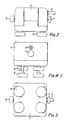
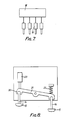
- Figure 7 illustrates an electronic control circuit 18 which controls the required sequential operation of four solenoids 19 which act on the shafts 14 leading to the feet 15 illustrated in Figures 3 to 5.
- FIG 8 Another form of construction is illustrated in Figure 8, wherein a pair of feet 15 are connected to shafts 14 which are held in pivot arrangements 20 at the ends of a pivoted lever 21.
- a spring 22 biases one end of the lever 21 in a downward direction and a ram or solenoid actuator 23 can be operated against the bias of the spring 22 to reverse the attitudes of the two feet 15.
Landscapes
- Health & Medical Sciences (AREA)
- Epidemiology (AREA)
- Pain & Pain Management (AREA)
- Physical Education & Sports Medicine (AREA)
- Rehabilitation Therapy (AREA)
- Life Sciences & Earth Sciences (AREA)
- Animal Behavior & Ethology (AREA)
- General Health & Medical Sciences (AREA)
- Public Health (AREA)
- Veterinary Medicine (AREA)
- Orthopedics, Nursing, And Contraception (AREA)
- Pharmaceuticals Containing Other Organic And Inorganic Compounds (AREA)
- Medicines Containing Material From Animals Or Micro-Organisms (AREA)
- Steroid Compounds (AREA)
- Prostheses (AREA)
Claims (7)
- Eine physiotherapeutische Vorrichtung mit einem Körper (6) einer solchen Größe, daß es von einem Physiotherapeuten mit der Hand ergriffen und am Rückgrat eines Patienten entlang nach oben und unten bewegt werden kann, dadurch gekennzeichnet, daß der Körper (6) zwei Paar hin-und herbewegbare Betätigungsglieder (14) aufnimmt, die in Füßen (15) enden und in derselben Richtung vom Körper (6) abstehen, wobei die Betätigungsglieder (14) so beabstandet sind, daß die Füße (15) auf den zwei Paaren von Querfortsätzen an einem benachbarten Wirbelpaar ruhen, und daß Mittel für Hin- und Herbewegung der Betätigungsglieder (14) so vorgesehen sind, daß jedes diagonale Paar von Betätigungsgliedern (14) im Gleichlauf aber in einander entgegengesetzten Richtungen zum anderen diagonalen Paar von Betätigungsgliedern (14) wirkt.
- Physiotherapeutische Vorrichtung nach Anspruch 1, dadurch gekennzeichnet, daß jedes Betätigungsglied (14) ein Funktionsglied ist oder enthält, wobei der Satz von Funktionsgliedern durch eine Steuerschaltung betrieben wird.
- Eine physiotherapeutische Vorrichtung nach Anspruch 2, dadurch gekennzeichnet, daß die Funktionsglieder durch eine logische Flüssigkeitssteuerschaltung betriebene pneumatische oder hydraulische Kolben umfassen.
- Physiotherapeutische Vorrichtung nach Anspruch 3, dadurch gekennzeichnet, daß die Steuerschaltung Einstellmittel (10) enthält, damit die Betriebsgeschwindigkeit und -kraft der Betätigungsglieder (14) verändert werden kann.
- Physiotherapeutische Vorrichtung nach Anspruch 1, dadurch gekennzeichnet, daß die Betätigungsglieder Kolben (14) von pneumatischen Kolben-und-Zylinder-Mechanismen (14, 7) sind und die Füße (15) an den Enden der Kolben (14) angebracht sind.
- Physiotherapeutische Vorrichtung nach Anspruch 5, dadurch gekennzeichnet, daß der aufeinanderfolgende Betrieb der Kolben-und-Zylinder-Mechanismen (14, 7) durch eine Steuerschaltung gesteuert wird, die ein Zweipunkt-Ventil (11) enthält.
- Physiotherapeutische Vorrichtung nach Anspruch 6, dadurch gekennzeichnet, daß ein verstellbares Drosselventil (10) zum Einstellen der Geschwindigkeit, mit der Luft aus den Zylindern (7) der besagten Kolben-und- Zylinder-Mechanismen (14, 7) ausgelassen werden kann, vorgesehen ist.
Priority Applications (1)
| Application Number | Priority Date | Filing Date | Title |
|---|---|---|---|
| AT88903331T ATE81278T1 (de) | 1987-04-27 | 1988-04-27 | Physiotherapievorrichtung. |
Applications Claiming Priority (2)
| Application Number | Priority Date | Filing Date | Title |
|---|---|---|---|
| GB8709940 | 1987-04-27 | ||
| GB878709940A GB8709940D0 (en) | 1987-04-27 | 1987-04-27 | Correcting mechanical disorders of spine |
Publications (2)
| Publication Number | Publication Date |
|---|---|
| EP0359752A1 EP0359752A1 (de) | 1990-03-28 |
| EP0359752B1 true EP0359752B1 (de) | 1992-10-07 |
Family
ID=10616429
Family Applications (1)
| Application Number | Title | Priority Date | Filing Date |
|---|---|---|---|
| EP88903331A Expired EP0359752B1 (de) | 1987-04-27 | 1988-04-27 | Physiotherapievorrichtung |
Country Status (6)
| Country | Link |
|---|---|
| US (1) | US5092316A (de) |
| EP (1) | EP0359752B1 (de) |
| AT (1) | ATE81278T1 (de) |
| DE (1) | DE3875248D1 (de) |
| GB (2) | GB8709940D0 (de) |
| WO (1) | WO1988008290A1 (de) |
Families Citing this family (13)
| Publication number | Priority date | Publication date | Assignee | Title |
|---|---|---|---|---|
| AU623937B2 (en) * | 1988-12-28 | 1992-05-28 | Bio Pit Co., Ltd. | A massager |
| GB8908881D0 (en) * | 1989-04-19 | 1989-06-07 | Taylor Alan R G | Physiotherapy device |
| US5192304A (en) * | 1991-06-17 | 1993-03-09 | Rassman William R | Apparatus for manipulating back muscles |
| US5279284A (en) * | 1991-10-11 | 1994-01-18 | Frontier, Inc. | Skin stimulation device |
| CN2138494Y (zh) * | 1991-12-19 | 1993-07-21 | 上海英特电器厂 | 捶击式按摩软靠垫 |
| AT401724B (de) * | 1994-12-23 | 1996-11-25 | Bumba Walter Ing | Fussreflexzonenmassagevorrichtung |
| JP3953585B2 (ja) * | 1997-07-08 | 2007-08-08 | ファミリー株式会社 | 椅子型マッサージ機 |
| US8357108B2 (en) * | 2006-01-13 | 2013-01-22 | Advanced Therapy Systems Llc | Physical therapy tool |
| GB2436064A (en) * | 2006-03-14 | 2007-09-19 | Matthew Stobart | Remote controls for back treatment device |
| BE1020090A5 (fr) * | 2012-01-20 | 2013-04-02 | M D Concept | Appareil pour le traitement extracorporel par ondes de choc. |
| GB201605197D0 (en) * | 2016-03-29 | 2016-05-11 | Pacla Medical Ltd | Back therapy apparatus |
| US12326742B2 (en) | 2022-12-22 | 2025-06-10 | Lear Corporation | Valve and actuator assembly for a fluid system in a vehicle seat assembly |
| US12337738B2 (en) | 2022-11-09 | 2025-06-24 | Lear Corporation | Fluid system for a vehicle seat assembly |
Family Cites Families (9)
| Publication number | Priority date | Publication date | Assignee | Title |
|---|---|---|---|---|
| DE650683C (de) * | 1935-02-24 | 1937-09-29 | Eugen Bittera | Massier- bzw. Stampfvorrichtung |
| US2193882A (en) * | 1937-10-15 | 1940-03-19 | Henry O Petersen | Massaging table |
| US2664882A (en) * | 1950-07-11 | 1954-01-05 | Thomas M Parker | Spinal massage apparatus |
| US2672860A (en) * | 1950-11-28 | 1954-03-23 | William H Badger | Spinal manipulation and relaxation device |
| US2773498A (en) * | 1953-07-31 | 1956-12-11 | Louis F Himmelman | Kinesitherapy device |
| FR1129437A (fr) * | 1955-01-31 | 1957-01-21 | Appareil électro-pneumo-mécanique de thérapeutique | |
| US3656190A (en) * | 1969-10-16 | 1972-04-18 | John J Regan | Body support |
| GB1359485A (en) * | 1970-06-16 | 1974-07-10 | Nat Res Dev | Physiotherapy apparatus |
| JPS6024841A (ja) * | 1983-07-20 | 1985-02-07 | 松下電工株式会社 | マツサ−ジ機 |
-
1987
- 1987-04-27 GB GB878709940A patent/GB8709940D0/en active Pending
-
1988
- 1988-04-27 AT AT88903331T patent/ATE81278T1/de not_active IP Right Cessation
- 1988-04-27 GB GB8923542A patent/GB2223175B/en not_active Expired - Lifetime
- 1988-04-27 US US07/424,279 patent/US5092316A/en not_active Expired - Lifetime
- 1988-04-27 EP EP88903331A patent/EP0359752B1/de not_active Expired
- 1988-04-27 DE DE8888903331T patent/DE3875248D1/de not_active Expired - Lifetime
- 1988-04-27 WO PCT/GB1988/000324 patent/WO1988008290A1/en not_active Ceased
Also Published As
| Publication number | Publication date |
|---|---|
| ATE81278T1 (de) | 1992-10-15 |
| GB8923542D0 (en) | 1989-12-06 |
| GB2223175A (en) | 1990-04-04 |
| EP0359752A1 (de) | 1990-03-28 |
| US5092316A (en) | 1992-03-03 |
| GB2223175B (en) | 1991-07-03 |
| WO1988008290A1 (en) | 1988-11-03 |
| GB8709940D0 (en) | 1987-06-03 |
| DE3875248D1 (de) | 1992-11-12 |
Similar Documents
| Publication | Publication Date | Title |
|---|---|---|
| EP0359752B1 (de) | Physiotherapievorrichtung | |
| KR100966084B1 (ko) | 경추용 교정장치 | |
| DE69322846T2 (de) | Gerät für Physiotherapie und für Körpertraining | |
| DE69434390T2 (de) | Übungsvorrichtung sowie technik | |
| US11298283B2 (en) | Back therapy apparatus | |
| KR200438814Y1 (ko) | 척추교정기 | |
| US5103808A (en) | Device for manipulating the spine | |
| WO2011128182A2 (de) | Gerät zur massage beziehungsweise behandlung der rücken- und nackenmuskulatur | |
| KR200275193Y1 (ko) | 척추교정용 물리치료기 | |
| KR100469862B1 (ko) | 척추교정용 견인장치 | |
| KR20080042427A (ko) | 척추 교정 및 스트레칭을 위한 장치 | |
| DE10053976A1 (de) | Armtrainer | |
| CN113018101B (zh) | 一种用于神经内科的肩周颈椎辅助治疗方法 | |
| KR100367725B1 (ko) | 부하기구 및 이를 이용한 허리운동시스템 | |
| US3742940A (en) | Impact pressure therapy apparatus | |
| CN117357391A (zh) | 一种腰椎间盘突出患者护理装置 | |
| CN119113476A (zh) | 一种腰部康复训练装置及其训练方法 | |
| CN114903671A (zh) | 一种脊柱治疗用的穿戴装置和方法 | |
| KR200292050Y1 (ko) | 경부 물리 운동장치 | |
| CN1203820C (zh) | 脊椎间盘突出复位治疗机 | |
| KR100966085B1 (ko) | 경추용 교정장치 | |
| RU232702U1 (ru) | Коррекционное устройство для позвоночной декомпрессии | |
| KR20210132831A (ko) | 경추의 견인운동을 통한 마사지장치 | |
| DE1243327B (de) | Geraet zur Behandlung der Wirbelsaeule | |
| EP1959909A1 (de) | Vorrichtung zur bewegung von gliedmassen |
Legal Events
| Date | Code | Title | Description |
|---|---|---|---|
| PUAI | Public reference made under article 153(3) epc to a published international application that has entered the european phase |
Free format text: ORIGINAL CODE: 0009012 |
|
| 17P | Request for examination filed |
Effective date: 19891026 |
|
| AK | Designated contracting states |
Kind code of ref document: A1 Designated state(s): AT BE DE FR IT LU NL SE |
|
| 17Q | First examination report despatched |
Effective date: 19910604 |
|
| GRAA | (expected) grant |
Free format text: ORIGINAL CODE: 0009210 |
|
| AK | Designated contracting states |
Kind code of ref document: B1 Designated state(s): AT BE DE FR IT LU NL SE |
|
| PG25 | Lapsed in a contracting state [announced via postgrant information from national office to epo] |
Ref country code: IT Free format text: LAPSE BECAUSE OF FAILURE TO SUBMIT A TRANSLATION OF THE DESCRIPTION OR TO PAY THE FEE WITHIN THE PRE;WARNING: LAPSES OF ITALIAN PATENTS WITH EFFECTIVE DATE BEFORE 2007 MAY HAVE OCCURRED AT ANY TIME BEFORE 2007. THE CORRECT EFFECTIVE DATE MAY BE DIFFERENT FROM THE ONE RECORDED.SCRIBED TIME-LIMIT Effective date: 19921007 Ref country code: SE Effective date: 19921007 Ref country code: DE Effective date: 19921007 Ref country code: NL Effective date: 19921007 Ref country code: AT Effective date: 19921007 Ref country code: FR Effective date: 19921007 Ref country code: BE Effective date: 19921007 |
|
| REF | Corresponds to: |
Ref document number: 81278 Country of ref document: AT Date of ref document: 19921015 Kind code of ref document: T |
|
| REF | Corresponds to: |
Ref document number: 3875248 Country of ref document: DE Date of ref document: 19921112 |
|
| K2C2 | Correction of patent specification (partial reprint) published |
Effective date: 19921007 |
|
| EN | Fr: translation not filed | ||
| NLV1 | Nl: lapsed or annulled due to failure to fulfill the requirements of art. 29p and 29m of the patents act | ||
| PG25 | Lapsed in a contracting state [announced via postgrant information from national office to epo] |
Ref country code: LU Free format text: LAPSE BECAUSE OF NON-PAYMENT OF DUE FEES Effective date: 19930430 |
|
| PLBE | No opposition filed within time limit |
Free format text: ORIGINAL CODE: 0009261 |
|
| STAA | Information on the status of an ep patent application or granted ep patent |
Free format text: STATUS: NO OPPOSITION FILED WITHIN TIME LIMIT |
|
| 26N | No opposition filed |