EP0355152B1 - Topical metronidazole formulations and therapeutic uses thereof - Google Patents
Topical metronidazole formulations and therapeutic uses thereof Download PDFInfo
- Publication number
- EP0355152B1 EP0355152B1 EP89902117A EP89902117A EP0355152B1 EP 0355152 B1 EP0355152 B1 EP 0355152B1 EP 89902117 A EP89902117 A EP 89902117A EP 89902117 A EP89902117 A EP 89902117A EP 0355152 B1 EP0355152 B1 EP 0355152B1
- Authority
- EP
- European Patent Office
- Prior art keywords
- metronidazole
- composition
- weight percent
- compositions
- acne
- Prior art date
- Legal status (The legal status is an assumption and is not a legal conclusion. Google has not performed a legal analysis and makes no representation as to the accuracy of the status listed.)
- Expired - Lifetime
Links
- 239000000203 mixture Substances 0.000 title claims abstract description 108
- VAOCPAMSLUNLGC-UHFFFAOYSA-N metronidazole Chemical compound CC1=NC=C([N+]([O-])=O)N1CCO VAOCPAMSLUNLGC-UHFFFAOYSA-N 0.000 title claims abstract description 79
- 229960000282 metronidazole Drugs 0.000 title claims abstract description 75
- 230000000699 topical effect Effects 0.000 title abstract description 14
- 230000001225 therapeutic effect Effects 0.000 title description 10
- 238000009472 formulation Methods 0.000 title description 8
- 201000004700 rosacea Diseases 0.000 claims abstract description 16
- 241001303601 Rosacea Species 0.000 claims abstract description 13
- 201000004624 Dermatitis Diseases 0.000 claims abstract description 9
- DNIAPMSPPWPWGF-UHFFFAOYSA-N Propylene glycol Chemical compound CC(O)CO DNIAPMSPPWPWGF-UHFFFAOYSA-N 0.000 claims description 30
- 229920000642 polymer Polymers 0.000 claims description 19
- 208000017520 skin disease Diseases 0.000 claims description 14
- XLYOFNOQVPJJNP-UHFFFAOYSA-N water Substances O XLYOFNOQVPJJNP-UHFFFAOYSA-N 0.000 claims description 12
- LXCFILQKKLGQFO-UHFFFAOYSA-N methylparaben Chemical compound COC(=O)C1=CC=C(O)C=C1 LXCFILQKKLGQFO-UHFFFAOYSA-N 0.000 claims description 11
- QELSKZZBTMNZEB-UHFFFAOYSA-N propylparaben Chemical compound CCCOC(=O)C1=CC=C(O)C=C1 QELSKZZBTMNZEB-UHFFFAOYSA-N 0.000 claims description 11
- 206010000496 acne Diseases 0.000 claims description 9
- 208000002874 Acne Vulgaris Diseases 0.000 claims description 6
- 235000010270 methyl p-hydroxybenzoate Nutrition 0.000 claims description 6
- 239000004292 methyl p-hydroxybenzoate Substances 0.000 claims description 6
- 229960002216 methylparaben Drugs 0.000 claims description 6
- 235000010232 propyl p-hydroxybenzoate Nutrition 0.000 claims description 6
- 239000004405 propyl p-hydroxybenzoate Substances 0.000 claims description 6
- 229960003415 propylparaben Drugs 0.000 claims description 6
- 208000009675 Perioral Dermatitis Diseases 0.000 claims description 5
- 206010000501 Acne conglobata Diseases 0.000 claims description 3
- 206010039793 Seborrhoeic dermatitis Diseases 0.000 claims description 3
- 208000008742 seborrheic dermatitis Diseases 0.000 claims description 3
- 239000002904 solvent Substances 0.000 claims description 3
- BDOYKFSQFYNPKF-UHFFFAOYSA-N 2-[2-[bis(carboxymethyl)amino]ethyl-(carboxymethyl)amino]acetic acid;sodium Chemical compound [Na].[Na].OC(=O)CN(CC(O)=O)CCN(CC(O)=O)CC(O)=O BDOYKFSQFYNPKF-UHFFFAOYSA-N 0.000 claims 2
- 238000011200 topical administration Methods 0.000 claims 2
- 125000003178 carboxy group Chemical group [H]OC(*)=O 0.000 claims 1
- 230000000694 effects Effects 0.000 abstract description 12
- 238000001035 drying Methods 0.000 abstract description 3
- 231100000344 non-irritating Toxicity 0.000 abstract description 3
- 229940079593 drug Drugs 0.000 description 36
- 239000003814 drug Substances 0.000 description 36
- 239000000499 gel Substances 0.000 description 29
- HEMHJVSKTPXQMS-UHFFFAOYSA-M Sodium hydroxide Chemical compound [OH-].[Na+] HEMHJVSKTPXQMS-UHFFFAOYSA-M 0.000 description 27
- 229940068196 placebo Drugs 0.000 description 19
- 239000000902 placebo Substances 0.000 description 19
- 239000003981 vehicle Substances 0.000 description 13
- 239000006071 cream Substances 0.000 description 11
- 238000002360 preparation method Methods 0.000 description 10
- 210000003491 skin Anatomy 0.000 description 9
- KCXVZYZYPLLWCC-UHFFFAOYSA-N EDTA Chemical compound OC(=O)CN(CC(O)=O)CCN(CC(O)=O)CC(O)=O KCXVZYZYPLLWCC-UHFFFAOYSA-N 0.000 description 8
- 239000007864 aqueous solution Substances 0.000 description 8
- 229920002125 Sokalan® Polymers 0.000 description 7
- 239000004615 ingredient Substances 0.000 description 7
- 239000000243 solution Substances 0.000 description 7
- 238000000338 in vitro Methods 0.000 description 6
- 239000012528 membrane Substances 0.000 description 6
- 239000003921 oil Substances 0.000 description 6
- 206010015150 Erythema Diseases 0.000 description 5
- 208000002193 Pain Diseases 0.000 description 5
- 231100000321 erythema Toxicity 0.000 description 5
- 230000002757 inflammatory effect Effects 0.000 description 5
- 230000003902 lesion Effects 0.000 description 5
- 230000035515 penetration Effects 0.000 description 5
- 230000009467 reduction Effects 0.000 description 5
- IAZDPXIOMUYVGZ-UHFFFAOYSA-N Dimethylsulphoxide Chemical compound CS(C)=O IAZDPXIOMUYVGZ-UHFFFAOYSA-N 0.000 description 4
- 208000037265 diseases, disorders, signs and symptoms Diseases 0.000 description 4
- 239000012153 distilled water Substances 0.000 description 4
- 230000006872 improvement Effects 0.000 description 4
- 230000002459 sustained effect Effects 0.000 description 4
- 210000001519 tissue Anatomy 0.000 description 4
- 206010033733 Papule Diseases 0.000 description 3
- 208000004210 Pressure Ulcer Diseases 0.000 description 3
- 208000003251 Pruritus Diseases 0.000 description 3
- 206010037888 Rash pustular Diseases 0.000 description 3
- 230000002378 acidificating effect Effects 0.000 description 3
- 210000000170 cell membrane Anatomy 0.000 description 3
- 208000035475 disorder Diseases 0.000 description 3
- 230000007803 itching Effects 0.000 description 3
- 239000003883 ointment base Substances 0.000 description 3
- 239000003961 penetration enhancing agent Substances 0.000 description 3
- 238000011176 pooling Methods 0.000 description 3
- 239000003755 preservative agent Substances 0.000 description 3
- 208000029561 pustule Diseases 0.000 description 3
- CSCPPACGZOOCGX-UHFFFAOYSA-N Acetone Chemical compound CC(C)=O CSCPPACGZOOCGX-UHFFFAOYSA-N 0.000 description 2
- NIXOWILDQLNWCW-UHFFFAOYSA-N Acrylic acid Chemical compound OC(=O)C=C NIXOWILDQLNWCW-UHFFFAOYSA-N 0.000 description 2
- QGZKDVFQNNGYKY-UHFFFAOYSA-N Ammonia Chemical compound N QGZKDVFQNNGYKY-UHFFFAOYSA-N 0.000 description 2
- QUSNBJAOOMFDIB-UHFFFAOYSA-N Ethylamine Chemical compound CCN QUSNBJAOOMFDIB-UHFFFAOYSA-N 0.000 description 2
- BAVYZALUXZFZLV-UHFFFAOYSA-N Methylamine Chemical compound NC BAVYZALUXZFZLV-UHFFFAOYSA-N 0.000 description 2
- 210000004027 cell Anatomy 0.000 description 2
- 230000006870 function Effects 0.000 description 2
- BXWNKGSJHAJOGX-UHFFFAOYSA-N hexadecan-1-ol Chemical compound CCCCCCCCCCCCCCCCO BXWNKGSJHAJOGX-UHFFFAOYSA-N 0.000 description 2
- 208000015181 infectious disease Diseases 0.000 description 2
- 230000007794 irritation Effects 0.000 description 2
- JVTAAEKCZFNVCJ-UHFFFAOYSA-N lactic acid Chemical compound CC(O)C(O)=O JVTAAEKCZFNVCJ-UHFFFAOYSA-N 0.000 description 2
- 229910052751 metal Inorganic materials 0.000 description 2
- 239000002184 metal Substances 0.000 description 2
- 238000000034 method Methods 0.000 description 2
- 230000002335 preservative effect Effects 0.000 description 2
- 230000000069 prophylactic effect Effects 0.000 description 2
- 238000012546 transfer Methods 0.000 description 2
- 229920002554 vinyl polymer Polymers 0.000 description 2
- JVTIXNMXDLQEJE-UHFFFAOYSA-N 2-decanoyloxypropyl decanoate 2-octanoyloxypropyl octanoate Chemical compound C(CCCCCCC)(=O)OCC(C)OC(CCCCCCC)=O.C(=O)(CCCCCCCCC)OCC(C)OC(=O)CCCCCCCCC JVTIXNMXDLQEJE-UHFFFAOYSA-N 0.000 description 1
- WLAMNBDJUVNPJU-UHFFFAOYSA-N 2-methylbutyric acid Chemical compound CCC(C)C(O)=O WLAMNBDJUVNPJU-UHFFFAOYSA-N 0.000 description 1
- 206010067484 Adverse reaction Diseases 0.000 description 1
- 208000017667 Chronic Disease Diseases 0.000 description 1
- 206010011985 Decubitus ulcer Diseases 0.000 description 1
- 208000008960 Diabetic foot Diseases 0.000 description 1
- 239000003109 Disodium ethylene diamine tetraacetate Substances 0.000 description 1
- 241000224432 Entamoeba histolytica Species 0.000 description 1
- 239000004677 Nylon Substances 0.000 description 1
- XMEKHKCRNHDFOW-UHFFFAOYSA-N O.O.[Na].[Na] Chemical compound O.O.[Na].[Na] XMEKHKCRNHDFOW-UHFFFAOYSA-N 0.000 description 1
- 239000004721 Polyphenylene oxide Substances 0.000 description 1
- 208000003493 Rhinophyma Diseases 0.000 description 1
- 240000004808 Saccharomyces cerevisiae Species 0.000 description 1
- 206010070834 Sensitisation Diseases 0.000 description 1
- 206010040047 Sepsis Diseases 0.000 description 1
- DBMJMQXJHONAFJ-UHFFFAOYSA-M Sodium laurylsulphate Chemical compound [Na+].CCCCCCCCCCCCOS([O-])(=O)=O DBMJMQXJHONAFJ-UHFFFAOYSA-M 0.000 description 1
- 241000224527 Trichomonas vaginalis Species 0.000 description 1
- 208000025865 Ulcer Diseases 0.000 description 1
- 206010046914 Vaginal infection Diseases 0.000 description 1
- 201000008100 Vaginitis Diseases 0.000 description 1
- 208000000558 Varicose Ulcer Diseases 0.000 description 1
- 238000002835 absorbance Methods 0.000 description 1
- 239000008351 acetate buffer Substances 0.000 description 1
- 230000002333 acnegenic effect Effects 0.000 description 1
- 230000006838 adverse reaction Effects 0.000 description 1
- 150000001298 alcohols Chemical class 0.000 description 1
- 150000003973 alkyl amines Chemical class 0.000 description 1
- 150000001412 amines Chemical class 0.000 description 1
- 229910021529 ammonia Inorganic materials 0.000 description 1
- 238000013459 approach Methods 0.000 description 1
- 235000013405 beer Nutrition 0.000 description 1
- 230000003115 biocidal effect Effects 0.000 description 1
- 239000000872 buffer Substances 0.000 description 1
- 229960000541 cetyl alcohol Drugs 0.000 description 1
- 239000003795 chemical substances by application Substances 0.000 description 1
- 230000001684 chronic effect Effects 0.000 description 1
- 239000003086 colorant Substances 0.000 description 1
- 238000013329 compounding Methods 0.000 description 1
- 238000007796 conventional method Methods 0.000 description 1
- 238000011161 development Methods 0.000 description 1
- 125000005265 dialkylamine group Chemical group 0.000 description 1
- 238000009792 diffusion process Methods 0.000 description 1
- 201000010099 disease Diseases 0.000 description 1
- 235000019301 disodium ethylene diamine tetraacetate Nutrition 0.000 description 1
- 238000004090 dissolution Methods 0.000 description 1
- 238000012377 drug delivery Methods 0.000 description 1
- -1 e.g. Chemical class 0.000 description 1
- 239000003995 emulsifying agent Substances 0.000 description 1
- 239000000839 emulsion Substances 0.000 description 1
- 239000003623 enhancer Substances 0.000 description 1
- 229940007078 entamoeba histolytica Drugs 0.000 description 1
- 210000001339 epidermal cell Anatomy 0.000 description 1
- 230000005713 exacerbation Effects 0.000 description 1
- 238000002474 experimental method Methods 0.000 description 1
- 210000000887 face Anatomy 0.000 description 1
- 230000001815 facial effect Effects 0.000 description 1
- 210000001061 forehead Anatomy 0.000 description 1
- 230000002496 gastric effect Effects 0.000 description 1
- 150000008282 halocarbons Chemical class 0.000 description 1
- 239000012535 impurity Substances 0.000 description 1
- 230000002401 inhibitory effect Effects 0.000 description 1
- 230000005764 inhibitory process Effects 0.000 description 1
- 150000007529 inorganic bases Chemical class 0.000 description 1
- 230000000622 irritating effect Effects 0.000 description 1
- 239000004310 lactic acid Substances 0.000 description 1
- 235000014655 lactic acid Nutrition 0.000 description 1
- 230000007774 longterm Effects 0.000 description 1
- 238000012423 maintenance Methods 0.000 description 1
- 239000000463 material Substances 0.000 description 1
- 150000002739 metals Chemical class 0.000 description 1
- 230000000813 microbial effect Effects 0.000 description 1
- 230000000116 mitigating effect Effects 0.000 description 1
- 229920001778 nylon Polymers 0.000 description 1
- 239000002674 ointment Substances 0.000 description 1
- 210000004789 organ system Anatomy 0.000 description 1
- 244000045947 parasite Species 0.000 description 1
- 230000008447 perception Effects 0.000 description 1
- 235000019271 petrolatum Nutrition 0.000 description 1
- 229920000570 polyether Polymers 0.000 description 1
- 230000002980 postoperative effect Effects 0.000 description 1
- 230000002829 reductive effect Effects 0.000 description 1
- 238000011160 research Methods 0.000 description 1
- 150000003839 salts Chemical class 0.000 description 1
- 230000035807 sensation Effects 0.000 description 1
- 230000008313 sensitization Effects 0.000 description 1
- 230000005808 skin problem Effects 0.000 description 1
- 235000019333 sodium laurylsulphate Nutrition 0.000 description 1
- 239000007787 solid Substances 0.000 description 1
- 238000001228 spectrum Methods 0.000 description 1
- 238000003892 spreading Methods 0.000 description 1
- 230000007480 spreading Effects 0.000 description 1
- 238000003860 storage Methods 0.000 description 1
- 210000000434 stratum corneum Anatomy 0.000 description 1
- 230000000475 sunscreen effect Effects 0.000 description 1
- 239000000516 sunscreening agent Substances 0.000 description 1
- 239000004094 surface-active agent Substances 0.000 description 1
- 208000024891 symptom Diseases 0.000 description 1
- 230000009885 systemic effect Effects 0.000 description 1
- 238000002560 therapeutic procedure Methods 0.000 description 1
- 239000012049 topical pharmaceutical composition Substances 0.000 description 1
- 125000005270 trialkylamine group Chemical group 0.000 description 1
- 230000002963 trichomonacidal effect Effects 0.000 description 1
- 231100000397 ulcer Toxicity 0.000 description 1
- 241001148471 unidentified anaerobic bacterium Species 0.000 description 1
- 238000009827 uniform distribution Methods 0.000 description 1
Images


Classifications
-
- A—HUMAN NECESSITIES
- A61—MEDICAL OR VETERINARY SCIENCE; HYGIENE
- A61K—PREPARATIONS FOR MEDICAL, DENTAL OR TOILETRY PURPOSES
- A61K8/00—Cosmetics or similar toiletry preparations
- A61K8/18—Cosmetics or similar toiletry preparations characterised by the composition
- A61K8/30—Cosmetics or similar toiletry preparations characterised by the composition containing organic compounds
- A61K8/49—Cosmetics or similar toiletry preparations characterised by the composition containing organic compounds containing heterocyclic compounds
- A61K8/494—Cosmetics or similar toiletry preparations characterised by the composition containing organic compounds containing heterocyclic compounds with more than one nitrogen as the only hetero atom
- A61K8/4946—Imidazoles or their condensed derivatives, e.g. benzimidazoles
-
- A—HUMAN NECESSITIES
- A61—MEDICAL OR VETERINARY SCIENCE; HYGIENE
- A61K—PREPARATIONS FOR MEDICAL, DENTAL OR TOILETRY PURPOSES
- A61K31/00—Medicinal preparations containing organic active ingredients
- A61K31/33—Heterocyclic compounds
- A61K31/395—Heterocyclic compounds having nitrogen as a ring hetero atom, e.g. guanethidine or rifamycins
- A61K31/41—Heterocyclic compounds having nitrogen as a ring hetero atom, e.g. guanethidine or rifamycins having five-membered rings with two or more ring hetero atoms, at least one of which being nitrogen, e.g. tetrazole
- A61K31/415—1,2-Diazoles
-
- A—HUMAN NECESSITIES
- A61—MEDICAL OR VETERINARY SCIENCE; HYGIENE
- A61K—PREPARATIONS FOR MEDICAL, DENTAL OR TOILETRY PURPOSES
- A61K31/00—Medicinal preparations containing organic active ingredients
- A61K31/74—Synthetic polymeric materials
- A61K31/765—Polymers containing oxygen
- A61K31/78—Polymers containing oxygen of acrylic acid or derivatives thereof
-
- A—HUMAN NECESSITIES
- A61—MEDICAL OR VETERINARY SCIENCE; HYGIENE
- A61K—PREPARATIONS FOR MEDICAL, DENTAL OR TOILETRY PURPOSES
- A61K47/00—Medicinal preparations characterised by the non-active ingredients used, e.g. carriers or inert additives; Targeting or modifying agents chemically bound to the active ingredient
- A61K47/30—Macromolecular organic or inorganic compounds, e.g. inorganic polyphosphates
- A61K47/32—Macromolecular compounds obtained by reactions only involving carbon-to-carbon unsaturated bonds, e.g. carbomers, poly(meth)acrylates, or polyvinyl pyrrolidone
-
- A—HUMAN NECESSITIES
- A61—MEDICAL OR VETERINARY SCIENCE; HYGIENE
- A61K—PREPARATIONS FOR MEDICAL, DENTAL OR TOILETRY PURPOSES
- A61K9/00—Medicinal preparations characterised by special physical form
- A61K9/0012—Galenical forms characterised by the site of application
- A61K9/0014—Skin, i.e. galenical aspects of topical compositions
-
- A—HUMAN NECESSITIES
- A61—MEDICAL OR VETERINARY SCIENCE; HYGIENE
- A61P—SPECIFIC THERAPEUTIC ACTIVITY OF CHEMICAL COMPOUNDS OR MEDICINAL PREPARATIONS
- A61P17/00—Drugs for dermatological disorders
-
- A—HUMAN NECESSITIES
- A61—MEDICAL OR VETERINARY SCIENCE; HYGIENE
- A61Q—SPECIFIC USE OF COSMETICS OR SIMILAR TOILETRY PREPARATIONS
- A61Q19/00—Preparations for care of the skin
Definitions
- This invention relates to novel topical compositions containing metronidazole.
- Metronidazole 1-(2-hydroxyethyl)-2-methyl-5-nitroimidazole
- the drug has direct trichomonacidal and amebacidal activity against Trichomonas vaginalis and Entamoeba histolytica , and is useful in combatting infections caused by those microbial parasites.
- Metronidazole has also been reported to be effective (via both oral and topical application) in treating skin disorders such as rosacea, ulcers infected with anaerobic bacteria, including decubitus ulcers (bed or pressure sores), venous ulcers, and diabetic foot ulcers, and other anaerobic infections such as post operative sepsis. There have also been reports that metronidazole is effective against perioral dermatitis.
- thermodynamic activity of the drug in the base material vehicle i.e., the affinity of drug to the vehicle, the release rate of the drug from the vehicle, the type and status of the skin, and the sensitization and irritation potential of components
- thermodynamic activity of the drug in the base material vehicle i.e., the affinity of drug to the vehicle, the release rate of the drug from the vehicle, the type and status of the skin, and the sensitization and irritation potential of components
- thermodynamic activity of the drug in the base material vehicle i.e., the affinity of drug to the vehicle, the release rate of the drug from the vehicle, the type and status of the skin, and the sensitization and irritation potential of components
- the drug in the base material vehicle i.e., the affinity of drug to the vehicle, the release rate of the drug from the vehicle, the type and status of the skin, and the sensitization and irritation potential of components
- the release rate of the drug from the vehicle generally is rate-determining for penetration into a patient's cells. Therefore, vehicles which dissolve the drug and have a low diffusional resistance are preferred.
- drug concentration in the vehicle and thus the degree of saturation, is considered to be a key formulation factor when optimizing topical delivery for maximum bioavailability.
- Rosacea formerly called Acne rosacea
- Rosacea is a chronic skin disease primarily affecting adults, with recurring symptoms that include erythema, papules, pustules, rhinophyma, and telangiectses, primarily in the region of the nose, cheeks, and forehead.
- topical treatment compositions are usually applied to both unafflicted and diseased areas. It is therefore desirable that a treatment have a mitigating effect on the diseased tissue and a prophylactic effect to prevent extension of involvement to the unafflicted tissue.
- the preferred vehicles, and hence compositions, to obtain these desirable effects should contain metronidazole in a high thermodynamic activity and with a fast rate of release from the vehicle.
- Aqueous compositions of metronidazole would appear to meet the above criteria.
- the low solubility of metronidazole in water and several other solvents inhibits the preparation of an aqueous compositions. This has resulted in the development of oil-based, rather than aqueous, metronidazole compositions.
- compositions generally are creams (oil in water emulsions) or ointments (petroleum jelly based compositions) with metronidazole being dissolved in the oil phase.
- the oils, certain surfactants and emulsifiers, and/or other ingredients utilized in the compositions have been found to be comedogenic, acnegenic, and/or irritating to the skin. See Fulton et al., Amer. Acad. of Dermatology 10 (1):96-105, (Jan. 1984). Patients treated with such compositions therefore often experience skin problems which include irritation, uncomfortable drying of the skin, and "stinging" or "burning" sensations.
- the drug is generally dissolved or dispersed in the oil phase of such preparations, which reduces the specific activity of the drug due to inhibition of drug transfer across the cell membrane. See “Treatment Of Rosacea With 1% Metronidazole Cream. A Double-Blind Study", Nielsen, P., British J. of Dermatology 108 :327-332 (1983).
- compositions are single-phase aqueous gels that provide a relatively high specific activity of metronidazole as compared to prior art oil-based compositions and provide increased bioavailability of the metronidazole.
- the present compositions are constituted by substantially non-comedogenic, non-irritating ingredients and thus avoid problems associated with the use of prior art formulations in the treatment of skin diseases.
- the gel-form compositons of the present invention minimize "pooling" and “running” of the contained medication, e.g., pooling into facial creases, which sometimes occurs with dermatological cream preparations.
- the resulting local excesses of the creams may contribute to problematic erythema or stinging.
- the gel-form compositions of the present invention afford more control in application, and better maintenance of a uniform distribution of the drug over the area to be treated, than would generally be expected if the drug were applied as a cream or in an aqueous solution.
- the gel advantageously functions as a "sustained delivery" system for the metronidazole, in which the drug continuously is delivered to the cells at, or slightly above, a minimum therapeutically effective level which is sustained over a period of time.
- This mode of drug release from the vehicle is preferred over vehicles which release the drug at levels much higher than the necessary therapeutic level shortly after application to the skin, followed by a sharp decrease to a level which is not therapeutically effective.
- the aqueous gel compositions of the present invention function as sustained delivery systems, whereas prior art formulations generally do not provide sustained drug delivery at a relatively constant therapeutically effective level over a period of time.
- compositions in accordance with the present invention therefore provide a means for the prophylactic or therapeutic treatment of humans afflicted with such skin disorders as rosacea, other acneform conditions, e.g., acne vulgaris, steroid acne, acne conglobata, or nodulocystic acne, or certain types of dermatitis, e.g., perioral dermatitis or seborrheic dermatitis.
- skin disorders as rosacea, other acneform conditions, e.g., acne vulgaris, steroid acne, acne conglobata, or nodulocystic acne, or certain types of dermatitis, e.g., perioral dermatitis or seborrheic dermatitis.
- metalronidazole as used in this specification and claims is meant to include not only 1-(2-hydroxyethyl)-2-methyl-5-nitroimidazole, but also those analogs and derivatives of metronidazole which are solubilized in the gel compositions described herein and which have therapeutic activity when topically applied.
- Substantially oil-free, aqueous compositions of metronidazole, in which the drug is solubilized in a single-phase aqueous gel are disclosed.
- the overall advantages of such aqueous compositions in treating skin disorders have been discussed above, and are presented in greater detail herein below.
- Metronidazole is employed in the compositions in a therapeutically effective amount.
- the actual concentration of metronidazole may vary, depending on the nature and degree of the disorders being treated, and whether the drug is being administered for therapeutic or prophylatic purposes.
- the compositions advantageously comprise at least 0.1 wt-% metronidazole, based on the total weight of the composition.
- metronidazole is present in an amount of 0.25% to 1.0%, and more preferably 0.75% by weight, based on the total weight of the composition.
- metronidazole is dissolved in an aqueous solution of a high molecular weight polycarboxylated vinyl polymer.
- the polymer imparts a desirable viscous, gelled consistency to the composition when mixed with metronidazole and water.
- the gel compositions contain at least 95% by weight water, based on the total weight of the composition, and have the requisite degree of metronidazole concentration, and hence thermodynamic activity, for effective topical delivery and bioavailability of metronidazole.
- the gel compositions of the present invention also have the requisite therapeutic activities as previously described.
- the gel-forming polymer useful in compounding the present compositions may be any suitable polymer which is hydrophilic and water-dispersible, has free carboxylic groups and relatively high base binding capacity, and forms a gel of substantially uniform consistency when neutralized with a base.
- Preferred polymers for use in the compositions of the invention are water-dispersible polycarboxylated vinyl polymers.
- Polyacrylic acid polymers are particularly preferred for the present purposes. The molecular weight of the polymer is desirably in the range of 1,250,000 to 4,000,000.
- Suitable polyacrylic acid polymers include polyacrylic acid polymers lightly crosslinked with a polyalkenyl polyether such as those commercially available from B.F. Goodrich, Cincinatti, Ohio, under the trademarks Carbopol 934, 940, and 941.
- Carbopol 940TM is a particularly preferred polymer for use in practicing this invention.
- the polymer is present in an amount sufficient to cause gelling of the composition and impart the desired viscous consistency to the topical formulation.
- the metronidazole compositions advantageously comprise 0.2% to 7.0% by weight of the polymer, preferably 0.5% to 1.5%, and most preferably 0.6% by weight of the polymer based on the total weight of the composition.
- Water-soluble bases which have been used to promote gelling of polymers such as CarbopolsTM include inorganic bases such as an aqueous solution of ammonia, NaOH, and organic amines, e.g., alkylamines such as methylamine and ethylamine, dialkylamines, trialkylamines, alkanolamines and dialkanolamines.
- the effective component of the compositions of the present invention, metronidazole is sufficiently basic to partially neutralize the acidic polymer in aqueous solution to the desired degree and to promote gelling.
- the composition may further include a "penetration enhancer", i.e., an agent that promotes penetration of the active drug into the patient's skin or tissues.
- a penetration enhancer include but are not limited to, dimethyl sulfoxide (DMSO) and propylene glycol, with the latter being preferred.
- DMSO dimethyl sulfoxide
- the composition advantageously includes 1.0% to 50%, preferably 2% to 5%, and more preferably 3% by weight of said penetration enhancer, based on the total weight of the composition.
- Preservatives are incorporated into the compositions in an amount effective for inhibiting growth of microbes such as yeast and molds in the composition during storage.
- a mixture of methyl paraben and propyl paraben has been found particularly effective as a preservative. Accordingly, the composition comprises 0.08% by weight of methyl paraben and 0.02% by weight of propyl paraben based on the total weight of the composition.
- Ethylenediaminetetraacetic acid or one of its salts is commonly added to dermatological preparations.
- EDTA chelates certain metals that may be present in the formulation, which is useful because some patients have adverse reactions to preparations containing metal impurities.
- the EDTA will also inhibit undesirable "browning" of the composition which may occur over time in compositions having a low pH value, e.g., a pH value of 3.5 to 5.4.
- the compositions of the invention further include 0.05% by weight of EDTA based on the total weight of the composition.
- the final pH value of the formulations of the invention may vary within a physiologically compatible range.
- the final pH value is a physiologically compatible, i.e., not harmful to biological tissue, acidic pH value.
- the pH value is preferably between 3 and 6.9, and most preferably between 4 and 5. Any suitable method of adjusting the pH value of aqueous solutions may be used.
- sodium hydroxide (NaOH) is added to the composition to bring the final pH value to the desired level.
- Gel compositions of the invention are more viscous at pH values that approach neutrality than at the more acidic pH values within the preferred range, i.e., viscosity increases as the polymer in the gel is neutralized to a greater degree, e.g., with NaOH.
- compositions of the invention may be combined in any order and manner that produces a composition comprising metronidazole dissolved in, and evenly dispersed throughout, a one-phase aqueous gel of the desired consistency and pH value.
- One suitable method of preparing compositions of the invention involves preparation of an aqueous solution of the polymer, which will be called "Part A”.
- this solution comprises the polymer in distilled water.
- Part B is prepared comprising metronidazole.
- Mixing of Parts A and B results in gelling of the composition.
- the optional penetration enhancer and preservative(s) are preferably included in Part B.
- EDTA is preferably included in Part A.
- the pH value may then be adjusted to the desired level, e.g., by addition of NaOH.
- the resulting homogeneous gels possess the advantageous properties described above, including utilizing non-comedogenic, non-acneogenic, and non-irritating ingredients; higher specific activity of metronidazole due to increased diffusion across membranes and release from the vehicle which results in greater therapeutic effectiveness using smaller amounts of metronidazole; and a desirable consistency that prevents undesired pooling and spreading of metronidazole.
- High concentrations of skin-drying ingredients e.g. alcohols and acetone
- Such ingredients at high concentration may excessively dry the patient's skin, causing undesirable flaking and discomfort.
- compositions of the present invention The therapeutic effectiveness of the metronidazole compositions of the present invention is demonstrated in the following examples. Additional ingredients such as coloring agents, and sunscreens, may be included in the compositions as long as the resulting composition retains the desirable properties, e.g., non-comedogenicity, and high specific activity, described above.
- a 30 kilogram batch of a composition of the present invention was prepared as follows. 180g of Carbopol 940TM (0.6% by weight of the final weight of the composition) was dissolved in 16.5 liters of distilled water containing 15 g of ethylenediaminetetraacetic acid (EDTA) disodium dihydrate. Sufficient amount of 10 wt-% sodium hydroxide (NaOH) solution was added to bring the pH value to 5. This aqueous polymer solution was called "Part A”.
- Part B was prepared by mixing 900 grams of propylene glycol (3% by weight of the final weight of the composition), 24 grams of methyl paraben (0.08% by weight of the final weight of the composition) and 6.0 g of propyl paraben (0.02% by weight of the final weight of the composition). The mixture was added to 225 g of metronidazole dispersed in 11.4 liters of distilled water maintained at 50°C. Parts A and B were then mixed thoroughly and gelling of the composition resulted. A cold aqueous solution of NaOH was then used to adjust the final pH value to 5.25. Distilled water was then added to give the desired 30 kg final weight. The NaOH and water were thoroughly mixed into the viscous gel.
- a random, double blind, placebo controlled clinical trial was conducted to demonstrate the positive clinical efficacy of the aqueous metronidazole-containing gel composition prepared in Example I in treating rosacea.
- the study included patients who had received no prior treatment for rosacea, as well as patients who had been treated by conventional methods. Patients discontinued treatment, if any, at least 21 days prior to the start of this study.
- Each patient received metronidazole in the gel composition on one side of the face and the gel composition (placebo control) without metronidazole on the other side of the face. Therefore, in this study, each patient served as their own control.
- the effectiveness of the treatment was rated, at the time points indicated in the TABLES below, in six different categories, namely, reduction in inflammatory lesions (papules and pustules), erythema, stinging, burning, itching, and dryness. The data are shown in the TABLES below.
- TABLE I-A shows the percent reduction in inflammatory lesions (papules and pustules) from baseline values for active (i.e., metronidazole-treated) and placebo-treated sides. Inflammatory lesions were progressively reduced from 46.7% to 59.9% for active-treated sides while placebo-treated sides reflected an exacerbation. There was an 82.6% difference in inflammatory lesions at the end of drug treatment on the metronidazole versus placebo-treated sides.
- TABLE I-B shows mean erythema values for active and placebo-treated sides. Statistically significant differences were found at visits 2, 3, 4 and 5 for the active sides and at visits 3 and 4 for the placebo sides, when compared to baseline values. Active and placebo-side values were significantly different from each other at visits 3, 4 and 5. A concommitant improvement in reduction of erythema was seen at the same time point on the treated side and on the placebo side.
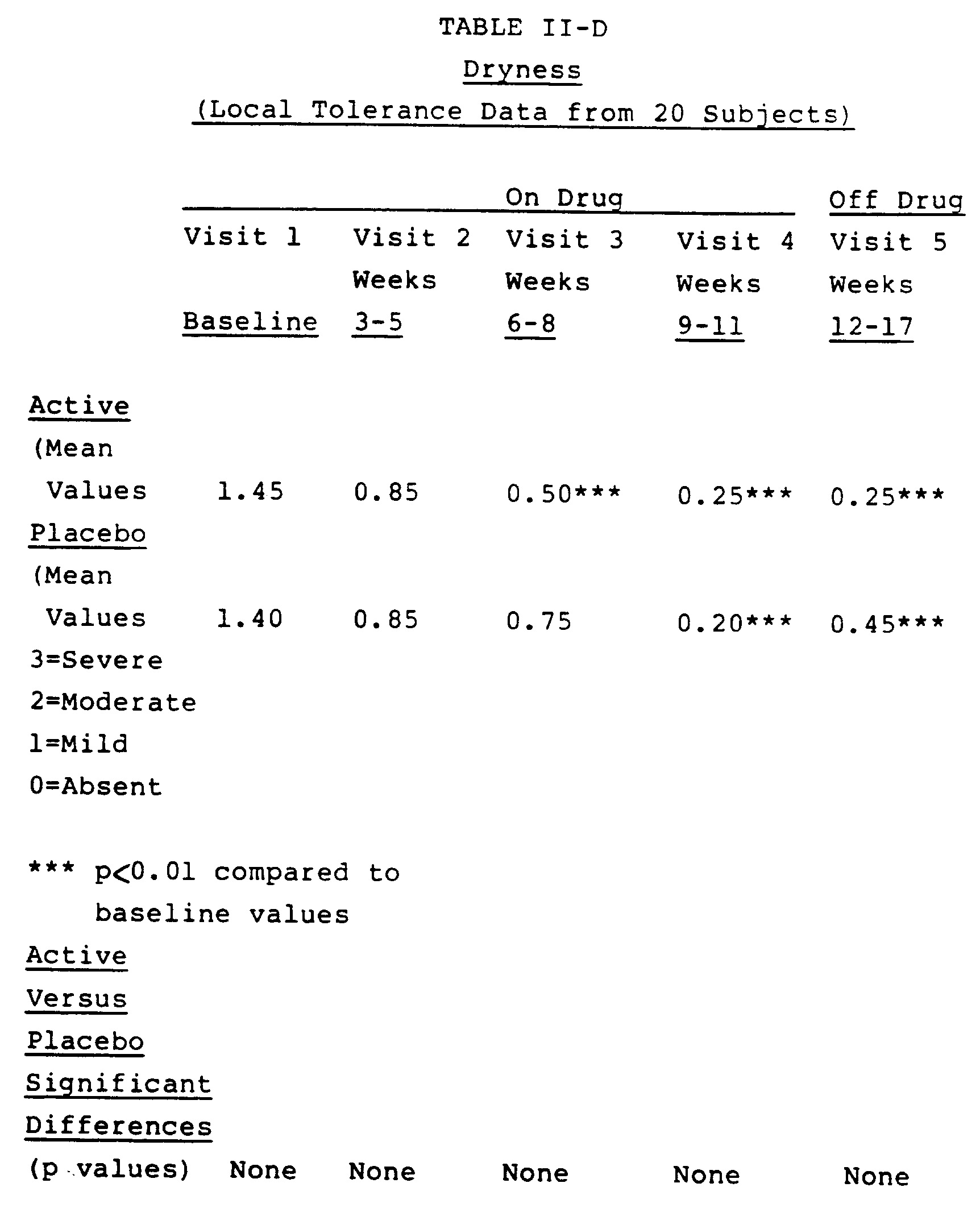
- Tables II-A, II-B, II-C, and II-D show an unexpected but dramatic improvement in local tolerance data.
- This data represents the patients' subjective assessments of stinging, burning, itching and dryness on each side of their faces before and during drug or placebo treatment.
- the data shows that there was a dramatic (highly statistically significant) improvement in the patients' perceptions of these attendant complications of the disease. Since both sides improved to the same degree, i.e., no statistically significant difference can be found, the improvement apparently comes from the gel composition per se .
- TABLE II-A shows mean stinging scores for active and placebo-treated sides. Statistically significant differences were found at visits 3, 4 and 5 for both the active and placebo sides, when compared to baseline values. Active and placebo-side values were not significantly different from one another.
- TABLE II-B shows mean burning scores for active and placebo-treated sides. Statistically significant differences were found at all visits (2, 3, 4, 5) for both the active and placebo sides, when compared to baseline values. Active and placebo-side values were not significantly different from one another.
- TABLE II-C shows mean itching scores for active and placebo-treated sides. Statistically significant differences were found at all visits (2, 3, 4, 5) for both the active and placebo sides, when Compared to baseline values. Active and placebo-side values were not significantly different from one another.
- TABLE II-D shows mean dryness scores for active and placebo-treated sides. Statistically significant differences were found at visits 3, 4 and 5 for active sides and at visits 4 and 5 for placebo sides, when compared to baseline values. Active and placebo-side values were not significantly different from one another.
- the metronidazole gel or cream was placed into a shallow well about 1 millimeter deep created by a PlexiglassTM template placed on a round 5.2 centimeter PlexiglassTM base.
- the diameter of the template into which the composition was placed was 3.0 centimeters.
- the composition was covered by a piece of SpectraporTM membrane (available from Spectrum Medical Industries, Inc., Los Angeles, CA 90054) having a molecular weight cutoff of between 12,000 and 14,000.
- the membrane had been soaked in a buffer having a pH value of 5.5 for 24 hours.
- a second template identical in size to the template forming the well was utilized to hold the membrane in place.
- the templates were secured by four nylon screws thereby creating a holder.
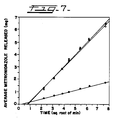
- TABLE VIII and FIGURE 7 show, for comparison Purposes, the average metronidazole released from C1 (o), C2 (x) and C3 ( ⁇ ).
- the large difference in the slopes of the plots indicate that the release rate of the gel compositions, i.e., C1 and C2, is about 3.7 times greater than that from the cream, i.e., C3.
- TABLE VIII Comparison of the Release Rates (Slopes) of the Three Compositions Composition Release Rates (mg/min (1/2) ) C1 0.9166 ⁇ 0.0492 C2 0.9465 ⁇ 0.0349 C3 0.2505 ⁇ 0.0071
- the in-vitro release of metronidazole from the gel formulations with or without propylene glycol is either 3.66 or 3.78 times faster, respectively, than that of the metronidazole from the cream formulation C3.
Landscapes
- Health & Medical Sciences (AREA)
- Life Sciences & Earth Sciences (AREA)
- Veterinary Medicine (AREA)
- Public Health (AREA)
- General Health & Medical Sciences (AREA)
- Animal Behavior & Ethology (AREA)
- Chemical & Material Sciences (AREA)
- Epidemiology (AREA)
- Pharmacology & Pharmacy (AREA)
- Medicinal Chemistry (AREA)
- Dermatology (AREA)
- Birds (AREA)
- Inorganic Chemistry (AREA)
- Organic Chemistry (AREA)
- Nuclear Medicine, Radiotherapy & Molecular Imaging (AREA)
- General Chemical & Material Sciences (AREA)
- Chemical Kinetics & Catalysis (AREA)
- Bioinformatics & Cheminformatics (AREA)
- Engineering & Computer Science (AREA)
- Pharmaceuticals Containing Other Organic And Inorganic Compounds (AREA)
- Medicinal Preparation (AREA)
Abstract
Description
- This invention relates to novel topical compositions containing metronidazole.
- Metronidazole, 1-(2-hydroxyethyl)-2-methyl-5-nitroimidazole, is a drug known to be effective in treating a variety of disorders. For example, the drug has direct trichomonacidal and amebacidal activity against Trichomonas vaginalis and Entamoeba histolytica, and is useful in combatting infections caused by those microbial parasites. Metronidazole has also been reported to be effective (via both oral and topical application) in treating skin disorders such as rosacea, ulcers infected with anaerobic bacteria, including decubitus ulcers (bed or pressure sores), venous ulcers, and diabetic foot ulcers, and other anaerobic infections such as post operative sepsis. There have also been reports that metronidazole is effective against perioral dermatitis.
- Although oral administration of the drug has been employed for the treatment of certain disorders, long-term oral administration of the drug in cases of chronic disorders such as rosacea may be associated with certain unwanted side effects, and subjects all organ systems needlessly to high drug concentrations. Well-known problems associated with systemic antibiotic therapy include gastro-intestinal intolerance and vaginitis. Thus, topical compositions are generally preferred for dermatological applications. See, for example, "Practical Advice Offered On Rosacea", Dermatology News, (April, 1985).
- When formulating topical compositions for application to diseased skin, different aspects, such as thermodynamic activity of the drug in the base material vehicle, i.e., the affinity of drug to the vehicle, the release rate of the drug from the vehicle, the type and status of the skin, and the sensitization and irritation potential of components, are factors that can affect the therapeutic effectiveness of topical dermatological preparations. In the case of non-diseased skin with its intact stratum corneum, cell membrane-controlled penetration of the drug occurs. Therefore, a high thermodynamic activity of the drug in the vehicle is desirable, i.e., the drug has a low affinity to the vehicle, and therefore has a high rate of cell membrane penetration to promote transfer of the drug across the epidermal cell membranes. With diseased skin, the release rate of the drug from the vehicle generally is rate-determining for penetration into a patient's cells. Therefore, vehicles which dissolve the drug and have a low diffusional resistance are preferred. In general, drug concentration in the vehicle, and thus the degree of saturation, is considered to be a key formulation factor when optimizing topical delivery for maximum bioavailability.
- Rosacea, formerly called Acne rosacea, is a chronic skin disease primarily affecting adults, with recurring symptoms that include erythema, papules, pustules, rhinophyma, and telangiectses, primarily in the region of the nose, cheeks, and forehead. In rosacea, other acneform conditions, and certain types of dermatitis, topical treatment compositions are usually applied to both unafflicted and diseased areas. It is therefore desirable that a treatment have a mitigating effect on the diseased tissue and a prophylactic effect to prevent extension of involvement to the unafflicted tissue. Therefore, the preferred vehicles, and hence compositions, to obtain these desirable effects should contain metronidazole in a high thermodynamic activity and with a fast rate of release from the vehicle. Aqueous compositions of metronidazole would appear to meet the above criteria. However, the low solubility of metronidazole in water and several other solvents inhibits the preparation of an aqueous compositions. This has resulted in the development of oil-based, rather than aqueous, metronidazole compositions.
- These current topical compositions generally are creams (oil in water emulsions) or ointments (petroleum jelly based compositions) with metronidazole being dissolved in the oil phase. The oils, certain surfactants and emulsifiers, and/or other ingredients utilized in the compositions have been found to be comedogenic, acnegenic, and/or irritating to the skin. See Fulton et al., Amer. Acad. of Dermatology 10(1):96-105, (Jan. 1984). Patients treated with such compositions therefore often experience skin problems which include irritation, uncomfortable drying of the skin, and "stinging" or "burning" sensations. In addition, the drug is generally dissolved or dispersed in the oil phase of such preparations, which reduces the specific activity of the drug due to inhibition of drug transfer across the cell membrane. See "Treatment Of Rosacea With 1% Metronidazole Cream. A Double-Blind Study", Nielsen, P., British J. of Dermatology 108:327-332 (1983).
- Thus, a need remains for metronidazole-containing dermatological preparations suitable for topical use which avoid the problems of current compositions. Such dermatological preparations would be useful for treating skin disorders such as rosacea and certain types of dermatitis, including perioral dermatitis.
- In accordance with the present invention, the above need is met by the composition set forth in
claim 1. - Such compositions are single-phase aqueous gels that provide a relatively high specific activity of metronidazole as compared to prior art oil-based compositions and provide increased bioavailability of the metronidazole. The present compositions are constituted by substantially non-comedogenic, non-irritating ingredients and thus avoid problems associated with the use of prior art formulations in the treatment of skin diseases.
- The gel-form compositons of the present invention minimize "pooling" and "running" of the contained medication, e.g., pooling into facial creases, which sometimes occurs with dermatological cream preparations. The resulting local excesses of the creams may contribute to problematic erythema or stinging. The gel-form compositions of the present invention afford more control in application, and better maintenance of a uniform distribution of the drug over the area to be treated, than would generally be expected if the drug were applied as a cream or in an aqueous solution.
- The gel advantageously functions as a "sustained delivery" system for the metronidazole, in which the drug continuously is delivered to the cells at, or slightly above, a minimum therapeutically effective level which is sustained over a period of time. This mode of drug release from the vehicle is preferred over vehicles which release the drug at levels much higher than the necessary therapeutic level shortly after application to the skin, followed by a sharp decrease to a level which is not therapeutically effective. The aqueous gel compositions of the present invention function as sustained delivery systems, whereas prior art formulations generally do not provide sustained drug delivery at a relatively constant therapeutically effective level over a period of time.
- Compositions in accordance with the present invention therefore provide a means for the prophylactic or therapeutic treatment of humans afflicted with such skin disorders as rosacea, other acneform conditions, e.g., acne vulgaris, steroid acne, acne conglobata, or nodulocystic acne, or certain types of dermatitis, e.g., perioral dermatitis or seborrheic dermatitis.
- Numerous other advantages and features of the present invention will become readily apparent from the following description of the preferred embodiments of the invention, the accompanying examples, the drawings and the appended claims.
- In the figures forming a part of the disclosure;
- FIGURE 1 is a graph illustrating the in-vitro release of metronidazole from a gel composition (0.75 wt-% metronidazole; contains propylene glycol; pH 5.8) over a 60-minute time period. Data points for Trial One are designated by (o), for Trial Two (●) and for Trial Three by (x);
- FIGURE 2 is a graph illustrating the average release of metronidazole for the three trials shown in FIGURE 1;
- FIGURE 3 is a graph illustrating the in-vitro release of metronidazole from another gel composition (0.75 wt-% metronidazole; no propylene glycol; pH 5.8) over a 60-minute time period. Data points for Trial One are designated by (o), for Trial Two by (●) and for Trial Three by (x);
- FIGURE 4 is a graph illustrating the average release of metronidazole for the three trials shown in FIGURE 3;
- FIGURE 5 is a graph illustrating the in-vitro release of metronidazole from a cream composition (1.0 wt-% metronidazole; pH 3.2) over a 60-minute time period. Data points for Trial One are designated by (o), for Trial Two by (●) and for Trial Three by (x);
- FIGURE 6 is a graph illustrating the average release of metronidazole for the tree trials shown in FIGURE 5;
- FIGURE 7 is a graph illustrating the average in-vitro release of metronidazole over a 60-minute time period. Data points for a gel composition (0.75 wt-% metronidazole containing propylene glycol; pH 5.8) are designated by (o), for another gel composition (0.75 wt-% metronidazole; no propylene glycol; pH 5.8) by (x) and for a cream composition (1.0 wt-% metronidazole; pH 3.2) by (●).
- While this invention is susceptible to embodiment in many different forms, there are shown in the drawings and will be described in detail, preferred embodiments of the invention.
- The drug 1-(2-hydroxyethyl)-2-methyl-5-nitroimidazole and varous derivatives thereof are described in U.S. Patent No. 2,944,061, to Jacob et al.
- The term "metronidazole" as used in this specification and claims is meant to include not only 1-(2-hydroxyethyl)-2-methyl-5-nitroimidazole, but also those analogs and derivatives of metronidazole which are solubilized in the gel compositions described herein and which have therapeutic activity when topically applied.
- Substantially oil-free, aqueous compositions of metronidazole, in which the drug is solubilized in a single-phase aqueous gel, are disclosed. The overall advantages of such aqueous compositions in treating skin disorders have been discussed above, and are presented in greater detail herein below.
- Metronidazole is employed in the compositions in a therapeutically effective amount. The actual concentration of metronidazole may vary, depending on the nature and degree of the disorders being treated, and whether the drug is being administered for therapeutic or prophylatic purposes. The compositions advantageously comprise at least 0.1 wt-% metronidazole, based on the total weight of the composition. Preferably metronidazole is present in an amount of 0.25% to 1.0%, and more preferably 0.75% by weight, based on the total weight of the composition.
- In the compositions of the present invention, metronidazole is dissolved in an aqueous solution of a high molecular weight polycarboxylated vinyl polymer. The polymer imparts a desirable viscous, gelled consistency to the composition when mixed with metronidazole and water. The gel compositions contain at least 95% by weight water, based on the total weight of the composition, and have the requisite degree of metronidazole concentration, and hence thermodynamic activity, for effective topical delivery and bioavailability of metronidazole. The gel compositions of the present invention also have the requisite therapeutic activities as previously described.
- The gel-forming polymer useful in compounding the present compositions may be any suitable polymer which is hydrophilic and water-dispersible, has free carboxylic groups and relatively high base binding capacity, and forms a gel of substantially uniform consistency when neutralized with a base. Preferred polymers for use in the compositions of the invention are water-dispersible polycarboxylated vinyl polymers. Polyacrylic acid polymers are particularly preferred for the present purposes. The molecular weight of the polymer is desirably in the range of 1,250,000 to 4,000,000. Suitable polyacrylic acid polymers include polyacrylic acid polymers lightly crosslinked with a polyalkenyl polyether such as those commercially available from B.F. Goodrich, Cincinatti, Ohio, under the trademarks Carbopol 934, 940, and 941. Carbopol 940™ is a particularly preferred polymer for use in practicing this invention.
- The polymer is present in an amount sufficient to cause gelling of the composition and impart the desired viscous consistency to the topical formulation. The metronidazole compositions advantageously comprise 0.2% to 7.0% by weight of the polymer, preferably 0.5% to 1.5%, and most preferably 0.6% by weight of the polymer based on the total weight of the composition.
- Aqueous solutions of these polymers form gels when neutralized with a base. Water-soluble bases which have been used to promote gelling of polymers such as Carbopols™ include inorganic bases such as an aqueous solution of ammonia, NaOH, and organic amines, e.g., alkylamines such as methylamine and ethylamine, dialkylamines, trialkylamines, alkanolamines and dialkanolamines. The effective component of the compositions of the present invention, metronidazole, is sufficiently basic to partially neutralize the acidic polymer in aqueous solution to the desired degree and to promote gelling.
- Optionally, the composition may further include a "penetration enhancer", i.e., an agent that promotes penetration of the active drug into the patient's skin or tissues. Such penetration enhancers include but are not limited to, dimethyl sulfoxide (DMSO) and propylene glycol, with the latter being preferred. The composition advantageously includes 1.0% to 50%, preferably 2% to 5%, and more preferably 3% by weight of said penetration enhancer, based on the total weight of the composition.
- Preservatives are incorporated into the compositions in an amount effective for inhibiting growth of microbes such as yeast and molds in the composition during storage. A mixture of methyl paraben and propyl paraben has been found particularly effective as a preservative. Accordingly, the composition comprises 0.08% by weight of methyl paraben and 0.02% by weight of propyl paraben based on the total weight of the composition.
- Ethylenediaminetetraacetic acid (EDTA) or one of its salts is commonly added to dermatological preparations. EDTA chelates certain metals that may be present in the formulation, which is useful because some patients have adverse reactions to preparations containing metal impurities. The EDTA will also inhibit undesirable "browning" of the composition which may occur over time in compositions having a low pH value, e.g., a pH value of 3.5 to 5.4. Accordingly, the compositions of the invention further include 0.05% by weight of EDTA based on the total weight of the composition.
- The final pH value of the formulations of the invention may vary within a physiologically compatible range. Advantageously, the final pH value is a physiologically compatible, i.e., not harmful to biological tissue, acidic pH value. The pH value is preferably between 3 and 6.9, and most preferably between 4 and 5. Any suitable method of adjusting the pH value of aqueous solutions may be used. Advantageously, sodium hydroxide (NaOH) is added to the composition to bring the final pH value to the desired level. Gel compositions of the invention are more viscous at pH values that approach neutrality than at the more acidic pH values within the preferred range, i.e., viscosity increases as the polymer in the gel is neutralized to a greater degree, e.g., with NaOH.
- The ingredients listed above may be combined in any order and manner that produces a composition comprising metronidazole dissolved in, and evenly dispersed throughout, a one-phase aqueous gel of the desired consistency and pH value. One suitable method of preparing compositions of the invention involves preparation of an aqueous solution of the polymer, which will be called "Part A". Advantageously, this solution comprises the polymer in distilled water. A "Part B" is prepared comprising metronidazole. Mixing of Parts A and B results in gelling of the composition. The optional penetration enhancer and preservative(s) are preferably included in Part B. EDTA is preferably included in Part A. The pH value may then be adjusted to the desired level, e.g., by addition of NaOH.
- The resulting homogeneous gels possess the advantageous properties described above, including utilizing non-comedogenic, non-acneogenic, and non-irritating ingredients; higher specific activity of metronidazole due to increased diffusion across membranes and release from the vehicle which results in greater therapeutic effectiveness using smaller amounts of metronidazole; and a desirable consistency that prevents undesired pooling and spreading of metronidazole. High concentrations of skin-drying ingredients (e.g. alcohols and acetone), which are found in some dermatological preparations to promote drug solubility, are also avoided. Such ingredients at high concentration may excessively dry the patient's skin, causing undesirable flaking and discomfort.
- The therapeutic effectiveness of the metronidazole compositions of the present invention is demonstrated in the following examples. Additional ingredients such as coloring agents, and sunscreens, may be included in the compositions as long as the resulting composition retains the desirable properties, e.g., non-comedogenicity, and high specific activity, described above.
- A 30 kilogram batch of a composition of the present invention was prepared as follows. 180g of Carbopol 940™ (0.6% by weight of the final weight of the composition) was dissolved in 16.5 liters of distilled water containing 15 g of ethylenediaminetetraacetic acid (EDTA) disodium dihydrate. Sufficient amount of 10 wt-% sodium hydroxide (NaOH) solution was added to bring the pH value to 5. This aqueous polymer solution was called "Part A". "Part B" was prepared by mixing 900 grams of propylene glycol (3% by weight of the final weight of the composition), 24 grams of methyl paraben (0.08% by weight of the final weight of the composition) and 6.0 g of propyl paraben (0.02% by weight of the final weight of the composition). The mixture was added to 225 g of metronidazole dispersed in 11.4 liters of distilled water maintained at 50°C. Parts A and B were then mixed thoroughly and gelling of the composition resulted. A cold aqueous solution of NaOH was then used to adjust the final pH value to 5.25. Distilled water was then added to give the desired 30 kg final weight. The NaOH and water were thoroughly mixed into the viscous gel.
- A random, double blind, placebo controlled clinical trial was conducted to demonstrate the positive clinical efficacy of the aqueous metronidazole-containing gel composition prepared in Example I in treating rosacea. The study included patients who had received no prior treatment for rosacea, as well as patients who had been treated by conventional methods. Patients discontinued treatment, if any, at least 21 days prior to the start of this study. Each patient received metronidazole in the gel composition on one side of the face and the gel composition (placebo control) without metronidazole on the other side of the face. Therefore, in this study, each patient served as their own control.
- The effectiveness of the treatment was rated, at the time points indicated in the TABLES below, in six different categories, namely, reduction in inflammatory lesions (papules and pustules), erythema, stinging, burning, itching, and dryness. The data are shown in the TABLES below.
- TABLE I-A shows the percent reduction in inflammatory lesions (papules and pustules) from baseline values for active (i.e., metronidazole-treated) and placebo-treated sides. Inflammatory lesions were progressively reduced from 46.7% to 59.9% for active-treated sides while placebo-treated sides reflected an exacerbation. There was an 82.6% difference in inflammatory lesions at the end of drug treatment on the metronidazole versus placebo-treated sides.
- TABLE I-B shows mean erythema values for active and placebo-treated sides. Statistically significant differences were found at
visits visits visits - Tables II-A, II-B, II-C, and II-D show an unexpected but dramatic improvement in local tolerance data. This data represents the patients' subjective assessments of stinging, burning, itching and dryness on each side of their faces before and during drug or placebo treatment. The data shows that there was a dramatic (highly statistically significant) improvement in the patients' perceptions of these attendant complications of the disease. Since both sides improved to the same degree, i.e., no statistically significant difference can be found, the improvement apparently comes from the gel composition per se.
- TABLE II-A shows mean stinging scores for active and placebo-treated sides. Statistically significant differences were found at
visits - TABLE II-B shows mean burning scores for active and placebo-treated sides. Statistically significant differences were found at all visits (2, 3, 4, 5) for both the active and placebo sides, when compared to baseline values. Active and placebo-side values were not significantly different from one another.
- TABLE II-C shows mean itching scores for active and placebo-treated sides. Statistically significant differences were found at all visits (2, 3, 4, 5) for both the active and placebo sides, when Compared to baseline values. Active and placebo-side values were not significantly different from one another.
- TABLE II-D shows mean dryness scores for active and placebo-treated sides. Statistically significant differences were found at
visits visits - This data confirms the effectiveness of metronidazole in the gel composition for treatment of rosacea and also demonstrates the unique therapeutic effects of the gel composition.
TABLE I-A Inflammatory Lesions (Efficacy Data From 20 Subjects) On Drug Off Drug Visit 2 Weeks 3-5 Visit 3 Weeks 6-8Visit 4 Weeks 9-11Visit 5 Weeks 12-17Active (Percent Reduction from Baseline) 46.7 55.1 59.9 41.6 Placebo (Percent Reduction from Baseline) -22.5 -4.2 -22.7 -46.8 Difference (Active-Placebo Percent Difference) 69.2 59.3 82.6 88.4 


- A study was conducted to determine differences in the in-vitro release characteristics of metronidazole from various topical compositions using the following experimental procedure.
- The metronidazole gel or cream was placed into a shallow well about 1 millimeter deep created by a Plexiglass™ template placed on a round 5.2 centimeter Plexiglass™ base. The diameter of the template into which the composition was placed was 3.0 centimeters. The composition was covered by a piece of Spectrapor™ membrane (available from Spectrum Medical Industries, Inc., Los Angeles, CA 90054) having a molecular weight cutoff of between 12,000 and 14,000. The membrane had been soaked in a buffer having a pH value of 5.5 for 24 hours. A second template identical in size to the template forming the well was utilized to hold the membrane in place. The templates were secured by four nylon screws thereby creating a holder. 400 Cubic centimeters of an acetate buffer solution having a pH value of 5.5 was placed in a round bottom dissolution flask (available from Hanson Research Corporation, Northridge, CA 91324) and the temperature of the solution was equilibrated to 32°C. A solid halogenated hydrocarbon polymer-coated stirrer was lowered into a position 2.54 centimeters above the membrane surface. The solution was stirred at 50 RPM. Five cubic centimeter samples were removed at 5, 10, 15, 20, 30, 40, and 60 minutes. The volume of the sample was replaced each time with fresh solution. The samples were analyzed at 319 nanometers on a spectrophotometer (Model 8450A, Hewlett-Packard, Palo Alto, CA 94303).
- After absorbance was converted to concentration using a Beer's Law plot, the total milligrams of metronidazole released at each time point was calculated from the following equation:

Additional compositions that have been studied are shown in TABLE III, below. These compositions were prepared in substantially the same manner as described in Example I, above.TABLE III Compositions, in wt. % Components C1 C2 C3 Metronidazole 0.75 0.75 1.00 Propylene Glycol 3.00 - - Polyacrylic Acid Polymer ¹0.60 0.60 - Methyl Paraben 0.08 0.08 - Propyl Paraben 0.02 0.02 - Disodium EDTA 0.05 0.05 - Cetylane - - 5.00 Cetyl Alcohol - - 15.00 Sodium Lauryl Sulfate - - 1.50 Lactic Acid - - 1.50 Water, q.s. ad 100.00 100.00 100.00 ¹ Carbopol 940 from B.F. Goodrich Company, a commercially available polyacrylic acid polymer. - Data from three trials for the release of metronidazole from C1, a gel composition, (0.75 wt-% metronidazole; pH value 5.8) are presented in TABLE IV and are plotted in FIGURE 1. In FIGURE 1, Trial One is denoted by (o), Trial Two by (●) and Trial Three by (x). The average data for the three trials is presented in TABLE VII and is plotted in FIGURE 2. Traditional linear plots for release of drugs from ointment bases are obtained by plotting amount released vs. the square root of time.
TABLE IV Release of Metronidazole from C1 (mg) Time (Min) Trial One Trial Two Trial Three 0 0 0 0 5 1.37 1.26 1.33 10 2.09 2.14 2.14 15 2.96 2.86 2.86 20 3.54 3.47 3.44 30 4.50 4.54 4.38 40 5.19 5.34 5.10 60 6.16 6.53 6.09 - Data from three trials for the release of metronidazole from C2, another gel composition, (0.75 wt-% metronidazole, without propylene glycol; pH value 5.8) are presented in TABLE V and are plotted in FIGURE 3. In FIGURE 3, Trial One is denoted by (o), Trial Two by (●) and Trial Three by (x). The average data for the three trials is presented in TABLE VII and are plotted in FIGURE 4. Again, traditional linear plots for release of drugs from ointment bases are obtained by plotting amount released vs. the square root of time.
TABLE V Release of Metronidazole from C2 (mg) Time (Min) Trial One Trial Two Trial Three 0 0 0 0 5 1.21 1.27 1.39 10 2.02 2.18 2.29 15 2.70 2.95 3.04 20 3.29 3.89 3.67 30 4.30 4.62 4.75 40 5.02 5.32 5.57 60 6.15 6.41 6.69 - Data from three trials for the release of the metronidazole from C3, a cream composition, (1.0 wt-% metronidazole; pH value 3.2) are presented in TABLE VI and are plotted in FIGURE 5. In FIGURE 5, Trial One is denoted by (o), Trial Two by (●) and Trial Three by (x). The average data for the three trials are presented in TABLE VII and are plotted in FIGURE 6. Again, traditional linear plots for release of drugs from ointment bases are obtained by plotting amount released vs. the square root of time.
TABLE VI Release of Metronidazole from C3 (mg) Time (Min) Trial One Trial Two Trial Three 0 0 0 0 5 0.56 0.42 0.46 10 0.78 0.67 0.66 15 0.94 0.85 0.82 20 1.09 0.98 - 30 1.32 1.25 1.29 40 1.53 1.54 1.63 60 1.94 1.82 1.69 TABLE VII Average Release of Metronidazole (mg) Time (Min) C1 C2 C3 0 0 0 0 5 1.32 ± 0.06 1.29 ± 0.09 0.48 ± 0.07 10 2.12 ± 0.03 2.16 ± 0.14 0.70 ± 0.07 15 2.89 ± 0.06 2.90 ± 0.18 0.87 ± 0.06 20 3.48 ± 0.05 3.62 ± 0.30 1.04 ± 0.08 30 4.47 ± 0.08 4.56 ± 0.23 1.29 ± 0.04 40 5.21 ± 0.12 5.30 ± 0.28 1.57 ± 0.06 60 6.26 ± 0.24 6.42 ± 0.27 1.82 ± 0.13 - TABLE VIII and FIGURE 7 show, for comparison Purposes, the average metronidazole released from C1 (o), C2 (x) and C3 (●). The large difference in the slopes of the plots indicate that the release rate of the gel compositions, i.e., C1 and C2, is about 3.7 times greater than that from the cream, i.e., C3.
TABLE VIII Comparison of the Release Rates (Slopes) of the Three Compositions Composition Release Rates (mg/min(1/2)) C1 0.9166 ± 0.0492 C2 0.9465 ± 0.0349 C3 0.2505 ± 0.0071 - The in-vitro release of metronidazole from the gel formulations with or without propylene glycol is either 3.66 or 3.78 times faster, respectively, than that of the metronidazole from the cream formulation C3.
Claims (8)
- A composition in gel form for use in the treatment of skin disorders by topical administration, comprising :
0.75 weight percent metronidazole;
0.6 weight percent of a gelled, hydrophilic and water-dispersible polymer having free carboxylic groups;
0.08 weight percent of methyl paraben;
0.02 weight percent of propyl paraben;
0.05 weight percent of disodium ethylene diamine tetraacetic acid; and
water as solvent for the metronidazole. - A composition as claimed in claim 1, wherein the skin disorder is rosacea.
- A composition as claimed in claim 1, wherein the skin disorder is acne vulgaris.
- A composition as claimed in claim 1, wherein the skin disorder is one from the group comprising steroid acne, acne conglobata, nodulocystic acne, perioral dermatitis, and seborrheic dermatitis.
- A composition in gel form for use in the treatment of skin disorders by topical administration, comprising :
0.75 weight percent metronidazole;
0.6 weight percent of a gelled, hydrophilic and water-dispersible polymer having free carboxyl groups and having a molecular weight in the range of 1,250,000 to 4,000,000 daltons;
0.08 weight percent of methyl paraben;
0.02 weight percent of propyl paraben;
0.05 weight percent of disodium ethylene diamine tetraacetic acid;
3 weight percent of propylene glycol; and
water as solvent for the metronidazole. - A composition as claimed in claim 5, wherein the skin disorder is rosacea.
- A composition as claimed in claim 5, wherein the skin disorder is acne vulgaris.
- A composition as claimed in claim 5, wherein the skin disorder is one from the group comprising steroid acne, acne conglobata, nodulocystic acne, perioral dermatitis, and seborrheic dermatitis.
Priority Applications (1)
| Application Number | Priority Date | Filing Date | Title |
|---|---|---|---|
| AT89902117T ATE103813T1 (en) | 1988-01-15 | 1989-01-12 | TOPICAL METRONIDAZOLE FORMULATIONS AND THEIR USE AS MEDICATIONS. |
Applications Claiming Priority (3)
| Application Number | Priority Date | Filing Date | Title |
|---|---|---|---|
| US07/144,252 US4837378A (en) | 1986-01-15 | 1988-01-15 | Topical metronidazole formulations and therapeutic uses thereof |
| US144252 | 1988-01-15 | ||
| PCT/US1989/000116 WO1989006537A1 (en) | 1988-01-15 | 1989-01-12 | Topical metronidazole formulations and therapeutic uses thereof |
Publications (3)
| Publication Number | Publication Date |
|---|---|
| EP0355152A1 EP0355152A1 (en) | 1990-02-28 |
| EP0355152A4 EP0355152A4 (en) | 1990-06-27 |
| EP0355152B1 true EP0355152B1 (en) | 1994-04-06 |
Family
ID=22507764
Family Applications (1)
| Application Number | Title | Priority Date | Filing Date |
|---|---|---|---|
| EP89902117A Expired - Lifetime EP0355152B1 (en) | 1988-01-15 | 1989-01-12 | Topical metronidazole formulations and therapeutic uses thereof |
Country Status (11)
| Country | Link |
|---|---|
| US (1) | US4837378A (en) |
| EP (1) | EP0355152B1 (en) |
| JP (1) | JP2714464B2 (en) |
| KR (1) | KR0135313B1 (en) |
| CN (1) | CN1032900C (en) |
| AT (1) | ATE103813T1 (en) |
| AU (1) | AU621589B2 (en) |
| CA (1) | CA1297029C (en) |
| DE (1) | DE68914365T2 (en) |
| WO (1) | WO1989006537A1 (en) |
| ZA (1) | ZA89233B (en) |
Families Citing this family (114)
| Publication number | Priority date | Publication date | Assignee | Title |
|---|---|---|---|---|
| US5536743A (en) * | 1988-01-15 | 1996-07-16 | Curatek Pharmaceuticals Limited Partnership | Intravaginal treatment of vaginal infections with buffered metronidazole compositions |
| US5614545A (en) * | 1988-06-09 | 1997-03-25 | Leonard Bloom | Topical composition for treatment of blepharitis |
| CA1337279C (en) * | 1989-06-06 | 1995-10-10 | Robert J. Borgman | Intravaginal treatment of vaginal infections with buffered metronidazole compositions |
| ATE135227T1 (en) * | 1990-07-20 | 1996-03-15 | Slagel David | PRODUCTS AND METHODS FOR TREATING THE DIGESTIVE CANAL |
| EP0543811B1 (en) * | 1990-08-16 | 2000-07-12 | Bloom, Leonard | Topical treatment of blepharitis |
| GB9114346D0 (en) * | 1991-07-03 | 1991-08-21 | Dow Corning Sa | A method of accelerating drug permeation |
| US5505948A (en) * | 1993-06-01 | 1996-04-09 | Dermatology Home Products, Inc. | Home skin peel composition for producing healthy and attractive skin |
| US5592949A (en) * | 1994-06-29 | 1997-01-14 | Moench; Thomas R. | Device for acidic buffering and method for inactivation of pathogens |
| FR2722098B1 (en) * | 1994-07-06 | 1996-08-23 | Cird Galderma | NEW MEDICINES BASED ON METRO-NIDAZOLE OR A SYNERGETIC MIXTURE OF METRONIDAZOLE AND CLINDAMYCIN |
| WO1997047300A1 (en) * | 1996-06-14 | 1997-12-18 | Stiefel Laboratories, Inc. | Antimycotics with metronidazole for treatment of skin disorders |
| IT1284874B1 (en) | 1996-08-02 | 1998-05-22 | Farmigea Spa | BIOADHESIVE COMPLEXES OF POLYCARBOPHIL AND AZOLIC ANTIFUNGAL OR ANTIPROTOZOAR DRUGS |
| AU8588898A (en) * | 1997-07-28 | 1999-02-16 | Mary L. Redmond | Composition and process for the treatment of epidermal traumas such as decubitusulcers |
| WO1999039356A1 (en) | 1998-01-30 | 1999-08-05 | Hitachi, Ltd. | Solid material melting apparatus |
| US5972993A (en) * | 1998-03-20 | 1999-10-26 | Avon Products, Inc. | Composition and method for treating rosacea and sensitive skin with free radical scavengers |
| US6150381A (en) | 1998-06-09 | 2000-11-21 | R.J. Reynolds Tobacco Company | Methods of treating microbial infection and therapeutic formulations therefor |
| US7402559B2 (en) * | 1999-03-24 | 2008-07-22 | Msh Pharma, Incorporated | Composition and method of treatment for urogenital conditions |
| US6800291B1 (en) * | 1999-03-24 | 2004-10-05 | Zengen, Inc. | Uro-genital condition treatment system |
| CN1304001C (en) * | 1999-07-16 | 2007-03-14 | 株式会社昭荣 | Nitroimidazole external preparations for dermatosis |
| US8512718B2 (en) | 2000-07-03 | 2013-08-20 | Foamix Ltd. | Pharmaceutical composition for topical application |
| US6468989B1 (en) * | 2000-07-13 | 2002-10-22 | Dow Pharmaceutical Sciences | Gel compositions containing metronidazole |
| WO2002094179A2 (en) * | 2001-05-23 | 2002-11-28 | J.B. Chemicals & Pharmaceuticals Ltd. | Novel topical microbicidal compositions |
| US6881726B2 (en) * | 2001-12-24 | 2005-04-19 | Dow Pharmaceutical Sciences | Aqueous compositions containing metronidazole |
| IL152486A0 (en) | 2002-10-25 | 2003-05-29 | Meir Eini | Alcohol-free cosmetic and pharmaceutical foam carrier |
| US8486376B2 (en) | 2002-10-25 | 2013-07-16 | Foamix Ltd. | Moisturizing foam containing lanolin |
| US7704518B2 (en) | 2003-08-04 | 2010-04-27 | Foamix, Ltd. | Foamable vehicle and pharmaceutical compositions thereof |
| ES2532906T5 (en) | 2002-10-25 | 2022-03-23 | Foamix Pharmaceuticals Ltd | Cosmetic and pharmaceutical foam |
| US20050186142A1 (en) * | 2002-10-25 | 2005-08-25 | Foamix Ltd. | Kit and composition of imidazole with enhanced bioavailability |
| US9265725B2 (en) | 2002-10-25 | 2016-02-23 | Foamix Pharmaceuticals Ltd. | Dicarboxylic acid foamable vehicle and pharmaceutical compositions thereof |
| US9668972B2 (en) * | 2002-10-25 | 2017-06-06 | Foamix Pharmaceuticals Ltd. | Nonsteroidal immunomodulating kit and composition and uses thereof |
| US8119150B2 (en) * | 2002-10-25 | 2012-02-21 | Foamix Ltd. | Non-flammable insecticide composition and uses thereof |
| US10117812B2 (en) | 2002-10-25 | 2018-11-06 | Foamix Pharmaceuticals Ltd. | Foamable composition combining a polar solvent and a hydrophobic carrier |
| US8119109B2 (en) | 2002-10-25 | 2012-02-21 | Foamix Ltd. | Foamable compositions, kits and methods for hyperhidrosis |
| US7820145B2 (en) | 2003-08-04 | 2010-10-26 | Foamix Ltd. | Oleaginous pharmaceutical and cosmetic foam |
| US8900554B2 (en) | 2002-10-25 | 2014-12-02 | Foamix Pharmaceuticals Ltd. | Foamable composition and uses thereof |
| US20080138296A1 (en) | 2002-10-25 | 2008-06-12 | Foamix Ltd. | Foam prepared from nanoemulsions and uses |
| US9211259B2 (en) | 2002-11-29 | 2015-12-15 | Foamix Pharmaceuticals Ltd. | Antibiotic kit and composition and uses thereof |
| US7700076B2 (en) | 2002-10-25 | 2010-04-20 | Foamix, Ltd. | Penetrating pharmaceutical foam |
| US7575739B2 (en) | 2003-04-28 | 2009-08-18 | Foamix Ltd. | Foamable iodine composition |
| DE502004004660D1 (en) * | 2003-06-10 | 2007-09-27 | Intendis Gmbh | COMPOSITION OF ALKANIC ACIDS AND A PHARMACEUTICAL ACTIVE |
| FR2856300A1 (en) * | 2003-06-18 | 2004-12-24 | Galderma Res & Dev | Topical composition for treating dermatological disorders especially rosaceae, contains metronidazole and at least one colorant to mask visible symptoms |
| EP1643990B8 (en) * | 2003-06-18 | 2007-05-09 | Galderma S.A. | Metronidazole-based green tinted topical pharmaceutical composition |
| US8486374B2 (en) | 2003-08-04 | 2013-07-16 | Foamix Ltd. | Hydrophilic, non-aqueous pharmaceutical carriers and compositions and uses |
| US8795693B2 (en) | 2003-08-04 | 2014-08-05 | Foamix Ltd. | Compositions with modulating agents |
| MXPA06001669A (en) | 2003-08-12 | 2006-04-28 | 3M Innovative Properties Co | Oxime substituted imidazo-containing compounds. |
| NZ545412A (en) | 2003-08-27 | 2008-12-24 | Coley Pharm Group Inc | Aryloxy and arylalkyleneoxy substituted imidazoquinolines |
| JP2007504269A (en) | 2003-09-05 | 2007-03-01 | スリーエム イノベイティブ プロパティズ カンパニー | Method for treating CD5 + B cell lymphoma |
| US7205006B2 (en) | 2003-09-25 | 2007-04-17 | Prime Pharmaceutical Corporation | Mahonia aquifolium extract, extraction process and pharmaceutical composition containing the same |
| US7456207B2 (en) * | 2003-09-25 | 2008-11-25 | Teva Pharmaceuticals Usa, Inc. | Vaginal pharmaceutical compositions and methods for preparing them |
| US7544697B2 (en) | 2003-10-03 | 2009-06-09 | Coley Pharmaceutical Group, Inc. | Pyrazolopyridines and analogs thereof |
| EP1673087B1 (en) | 2003-10-03 | 2015-05-13 | 3M Innovative Properties Company | Alkoxy substituted imidazoquinolines |
| CN1906192A (en) | 2003-11-14 | 2007-01-31 | 3M创新有限公司 | Hydroxylamine substituted imidazo ring compounds |
| WO2005048933A2 (en) | 2003-11-14 | 2005-06-02 | 3M Innovative Properties Company | Oxime substituted imidazo ring compounds |
| AU2004293078B2 (en) | 2003-11-25 | 2012-01-19 | 3M Innovative Properties Company | Substituted imidazo ring systems and methods |
| JP2007517035A (en) | 2003-12-29 | 2007-06-28 | スリーエム イノベイティブ プロパティズ カンパニー | Arylalkenyl and arylalkynyl substituted imidazoquinolines |
| EP1699788A2 (en) | 2003-12-30 | 2006-09-13 | 3M Innovative Properties Company | Imidazoquinolinyl, imidazopyridinyl and imidazonaphthyridinyl sulfonamides |
| ES2238924B1 (en) * | 2004-02-17 | 2006-12-01 | Investread Europa, S.L. | USE OF 2,5-DIHYDROXIBENCENOSULFONIC ACID, IN THE MANUFACTURE OF APPLICATION MEDICINES IN THE TREATMENT OF ANGIODEPENDENT DISEASES. |
| US20080125485A1 (en) * | 2004-02-17 | 2008-05-29 | Action Medicines | Use of 2,5-Dihydroxybenzene Derivatives for Treating Actinic Keratosis |
| US20070149618A1 (en) | 2004-02-17 | 2007-06-28 | Action Medicines, S.L. | Methods of use for 2,5-dihydroxybenzene sulfonic acid compounds for the treatment of cancer, rosacea and psoriasis |
| FR2866568B1 (en) * | 2004-02-20 | 2007-08-24 | Galderma Res & Dev | USE OF THE METRONIDAZOLE FOR THE PREPARATION OF A PHARMACEUTICAL COMPOSITION FOR TREATING A DISORDER OF SKIN VASCULARIZATION |
| FR2866570B1 (en) * | 2004-02-20 | 2007-08-24 | Galderma Res & Dev | USE OF THE METRONIDAZOLE FOR THE PREPARATION OF A PHARMACEUTICAL COMPOSITION FOR TREATING SKIN INFLAMMATION |
| FR2866569B1 (en) * | 2004-02-20 | 2007-08-24 | Galderma Res & Dev | USE OF THE METRONIDAZOLE FOR THE PREPARATION OF A PHARMACEUTICAL COMPOSITION FOR TREATING PATHOLOGIES ASSOCIATED WITH THE INTERLEUKINE 8 TYPE B RECEPTOR AND / OR THE PACAP TYPE 1 RECEPTOR |
| US8697873B2 (en) | 2004-03-24 | 2014-04-15 | 3M Innovative Properties Company | Amide substituted imidazopyridines, imidazoquinolines, and imidazonaphthyridines |
| US8017779B2 (en) | 2004-06-15 | 2011-09-13 | 3M Innovative Properties Company | Nitrogen containing heterocyclyl substituted imidazoquinolines and imidazonaphthyridines |
| FR2887149B1 (en) | 2005-06-17 | 2007-08-03 | Galderma Sa | PROCESS FOR SOLUBILIZING THE METRONIDAZOLE |
| WO2006009826A1 (en) | 2004-06-18 | 2006-01-26 | 3M Innovative Properties Company | Aryloxy and arylalkyleneoxy substituted thiazoloquinolines and thiazolonaphthyridines |
| WO2006038923A2 (en) | 2004-06-18 | 2006-04-13 | 3M Innovative Properties Company | Aryl substituted imidazonaphthyridines |
| US7915281B2 (en) | 2004-06-18 | 2011-03-29 | 3M Innovative Properties Company | Isoxazole, dihydroisoxazole, and oxadiazole substituted imidazo ring compounds and method |
| WO2006009832A1 (en) * | 2004-06-18 | 2006-01-26 | 3M Innovative Properties Company | Substituted imidazo ring systems and methods |
| US20060057075A1 (en) * | 2004-08-02 | 2006-03-16 | Moshe Arkin | Pharmaceutical and cosmeceutical wash-off mousse shampoo compositions, processes for preparing the same and uses thereof |
| US20060024243A1 (en) * | 2004-08-02 | 2006-02-02 | Agis Industries (1983) Ltd. | Foamable compositions containing nitro-imidazoles, processes for preparing same and methods of treatment utilizing same |
| US20060034779A1 (en) * | 2004-08-02 | 2006-02-16 | Agis Industries (1983) Ltd. | Foamable compositions containing vitamin D3 analogues, processes for preparing same and methods of treatment utilizng same |
| US20060093675A1 (en) * | 2004-10-29 | 2006-05-04 | Mathew Ebmeier | Intravaginal treatment of vaginal infections with metronidazole compositions |
| JP5313502B2 (en) | 2004-12-30 | 2013-10-09 | スリーエム イノベイティブ プロパティズ カンパニー | Substituted chiral condensed [1,2] imidazo [4,5-c] cyclic compounds |
| CA2592904C (en) | 2004-12-30 | 2015-04-07 | 3M Innovative Properties Company | Chiral fused [1,2]imidazo[4,5-c] ring compounds |
| JP2008530022A (en) | 2005-02-04 | 2008-08-07 | コーリー ファーマシューティカル グループ,インコーポレイテッド | Aqueous gel formulation containing immune response modifier |
| EP1846405A2 (en) | 2005-02-11 | 2007-10-24 | 3M Innovative Properties Company | Oxime and hydroxylamine substituted imidazo 4,5-c ring compounds and methods |
| FR2882552B1 (en) * | 2005-02-25 | 2008-12-26 | Galderma Sa | AQUEOUS GEL OF HIGH STABILITY BASED ON METRONIDAZOLE AND PROCESSES FOR THEIR PREPARATION |
| CA2602683A1 (en) | 2005-04-01 | 2006-10-12 | Coley Pharmaceutical Group, Inc. | Pyrazolopyridine-1,4-diamines and analogs thereof |
| CA2602590A1 (en) | 2005-04-01 | 2006-10-12 | Coley Pharmaceutical Group, Inc. | 1-substituted pyrazolo (3,4-c) ring compounds as modulators of cytokine biosynthesis for the treatment of viral infections and neoplastic diseases |
| AU2006298442A1 (en) | 2005-05-09 | 2007-04-12 | Foamix Ltd. | Saccharide foamable compositions |
| US20060286054A1 (en) * | 2005-06-15 | 2006-12-21 | Apollo Pharmaceutical, Inc. | Pharmaceutical compositions for the treatment of psoriasis |
| WO2007002447A2 (en) * | 2005-06-23 | 2007-01-04 | Bioform Medical, Inc. | Compositions for treating rosacea |
| FR2889662B1 (en) * | 2005-08-11 | 2011-01-14 | Galderma Res & Dev | OIL-IN-WATER EMULSION FOR TOPICAL APPLICATION IN DERMATOLOGY |
| FR2890559B1 (en) * | 2005-09-13 | 2011-06-24 | Galderma Sa | DERMATOLOGICAL FOAMS BASED ON METRONIDAZOLE AND EMULSIONS FOR PREPARATION |
| FR2890560B1 (en) * | 2005-09-13 | 2011-06-24 | Galderma Sa | METRONIDAZOLE DERMATOLOGICAL FOAMS AND EMULSIONS FOR THEIR PREPARATION |
| WO2008008432A2 (en) | 2006-07-12 | 2008-01-17 | Coley Pharmaceutical Group, Inc. | Substituted chiral fused( 1,2) imidazo (4,5-c) ring compounds and methods |
| WO2008020026A1 (en) | 2006-08-16 | 2008-02-21 | Action Medicines, S.L. | Use of 2,5-dihydroxybenzene derivatives for treating dermatitis |
| US8541467B2 (en) | 2006-08-16 | 2013-09-24 | Action Medicines, S.L. | Use of 2,5-dihydroxybenzene compounds and derivatives for the treatment of hematological dyscrasias and cancer of an organ |
| US8258164B2 (en) * | 2006-09-12 | 2012-09-04 | Curatek Pharmaceuticals Holding, Inc. | Nitroimidazole composition and method |
| US20080260655A1 (en) | 2006-11-14 | 2008-10-23 | Dov Tamarkin | Substantially non-aqueous foamable petrolatum based pharmaceutical and cosmetic compositions and their uses |
| WO2008067991A2 (en) * | 2006-12-08 | 2008-06-12 | Antares Pharma Ipl Ag | Skin-friendly drug complexes for transdermal administration |
| US8636982B2 (en) | 2007-08-07 | 2014-01-28 | Foamix Ltd. | Wax foamable vehicle and pharmaceutical compositions thereof |
| US9439857B2 (en) | 2007-11-30 | 2016-09-13 | Foamix Pharmaceuticals Ltd. | Foam containing benzoyl peroxide |
| WO2009090495A2 (en) | 2007-12-07 | 2009-07-23 | Foamix Ltd. | Oil and liquid silicone foamable carriers and formulations |
| US8518376B2 (en) | 2007-12-07 | 2013-08-27 | Foamix Ltd. | Oil-based foamable carriers and formulations |
| EP2242476A2 (en) | 2008-01-14 | 2010-10-27 | Foamix Ltd. | Poloxamer foamable pharmaceutical compositions with active agents and/or therapeutic cells and uses |
| WO2010047831A1 (en) * | 2008-10-23 | 2010-04-29 | Nycomed Us Inc. | Stable metronidazole gel formulations |
| WO2010125470A2 (en) | 2009-04-28 | 2010-11-04 | Foamix Ltd. | Foamable vehicle and pharmaceutical compositions comprising aprotic polar solvents and uses thereof |
| CA2769625C (en) | 2009-07-29 | 2017-04-11 | Foamix Ltd. | Non surfactant hydro-alcoholic foamable compositions, breakable foams and their uses |
| WO2011013008A2 (en) | 2009-07-29 | 2011-02-03 | Foamix Ltd. | Non surface active agent non polymeric agent hydro-alcoholic foamable compositions, breakable foams and their uses |
| EP2482788B1 (en) | 2009-10-02 | 2022-12-14 | Journey Medical Corporation | Topical tetracycline compositions |
| US9849142B2 (en) | 2009-10-02 | 2017-12-26 | Foamix Pharmaceuticals Ltd. | Methods for accelerated return of skin integrity and for the treatment of impetigo |
| US8174881B2 (en) | 2009-11-24 | 2012-05-08 | Micron Technology, Inc. | Techniques for reducing disturbance in a semiconductor device |
| JP5986632B2 (en) | 2011-06-28 | 2016-09-06 | メディシス ファーマシューティカル コーポレイション | High-dose mucoadhesive metronidazole aqueous gel formulations and their use to treat bacterial vaginitis |
| US9452173B2 (en) | 2013-01-31 | 2016-09-27 | Merz Pharmaceuticals, Llc | Topical compositions and methods for making and using same |
| US8778365B1 (en) | 2013-01-31 | 2014-07-15 | Merz Pharmaceuticals, Llc | Topical compositions and methods for making and using same |
| US9433680B2 (en) * | 2013-01-31 | 2016-09-06 | Merz Pharmaceuticals, Llc | Topical compositions and methods for making and using same |
| US9446131B2 (en) | 2013-01-31 | 2016-09-20 | Merz Pharmaceuticals, Llc | Topical compositions and methods for making and using same |
| EP3013368A1 (en) | 2013-06-25 | 2016-05-04 | Mission Pharmacal Company | Novel formulations for the treatment of vaginal disorders |
| WO2017192928A1 (en) | 2016-05-06 | 2017-11-09 | Albany Medical College | Treatment of rosacea with p38 and erk kinase pathway inhibitors |
| CA2978573A1 (en) | 2016-09-08 | 2018-03-08 | Foamix Pharmaceuticals Ltd. | Compositions and methods for treating rosacea and acne |
| US11529346B2 (en) * | 2020-06-18 | 2022-12-20 | National Medical Supply, LLC | Vaginal gel |
| WO2022269665A1 (en) * | 2021-06-21 | 2022-12-29 | マルホ株式会社 | External preparation |
| CN113476397B (en) * | 2021-07-12 | 2022-11-18 | 海南海神同洲制药有限公司 | Metronidazole gel and preparation method thereof |
Family Cites Families (11)
| Publication number | Priority date | Publication date | Assignee | Title |
|---|---|---|---|---|
| US2944061A (en) * | 1957-09-20 | 1960-07-05 | Acyl derivatives and process | |
| US3883661A (en) * | 1971-11-09 | 1975-05-13 | Syntex Inc | Acne treatment |
| JPS56161323A (en) * | 1980-05-14 | 1981-12-11 | Hisamitsu Pharmaceut Co Inc | Anti-inflammatory and pain-killing gel |
| US4491588A (en) * | 1982-03-31 | 1985-01-01 | University Of Tennessee Research Corporation | Treatment of psoriasis and seborrheic dermatitis with imidazole antibiotics |
| JPS5970613A (en) * | 1982-10-14 | 1984-04-21 | Kiyuushin Seiyaku Kk | Antifungal ointment |
| DE3244027A1 (en) * | 1982-11-27 | 1984-05-30 | Bayer Ag, 5090 Leverkusen | ANTIMYCOTIC AGENTS WITH HIGH ACTIVE SUBSTANCE RELEASE IN THE FORM OF GEL SYSTEMS |
| JPS6136219A (en) * | 1984-07-27 | 1986-02-20 | Shiseido Co Ltd | External drug for skin |
| DE3340872A1 (en) * | 1983-11-11 | 1985-05-23 | Theodor Prof Dr Eckert | Production of absorption-promoting aqueous ointment gels from polyacrylic acid or methacrylic acid copolymers using urea as gel former |
| GB8607159D0 (en) * | 1986-03-22 | 1986-04-30 | Smith & Nephew Ass | Pharmaceutical composition |
| WO1988006888A1 (en) * | 1987-03-20 | 1988-09-22 | Curatek Pharmaceuticals, Inc. | Novel topical metronidazole formulations and therapeutic uses thereof |
| US5013545A (en) * | 1987-12-09 | 1991-05-07 | Thames Pharmacal Co., Inc. | Aqueous gels containing topical medicaments |
-
1988
- 1988-01-15 US US07/144,252 patent/US4837378A/en not_active Expired - Lifetime
-
1989
- 1989-01-11 ZA ZA89233A patent/ZA89233B/en unknown
- 1989-01-12 KR KR1019890701701A patent/KR0135313B1/en not_active Expired - Lifetime
- 1989-01-12 AT AT89902117T patent/ATE103813T1/en not_active IP Right Cessation
- 1989-01-12 DE DE68914365T patent/DE68914365T2/en not_active Expired - Lifetime
- 1989-01-12 WO PCT/US1989/000116 patent/WO1989006537A1/en not_active Ceased
- 1989-01-12 JP JP1501968A patent/JP2714464B2/en not_active Expired - Lifetime
- 1989-01-12 EP EP89902117A patent/EP0355152B1/en not_active Expired - Lifetime
- 1989-01-12 AU AU30432/89A patent/AU621589B2/en not_active Expired
- 1989-01-13 CA CA000588268A patent/CA1297029C/en not_active Expired - Lifetime
- 1989-01-13 CN CN89100974A patent/CN1032900C/en not_active Expired - Lifetime
Non-Patent Citations (1)
| Title |
|---|
| British J. of Dermatology, vol. 109, 1983, pp. 63-65, Nielsen * |
Also Published As
| Publication number | Publication date |
|---|---|
| ZA89233B (en) | 1990-09-26 |
| CA1297029C (en) | 1992-03-10 |
| EP0355152A4 (en) | 1990-06-27 |
| KR900700099A (en) | 1990-08-11 |
| KR0135313B1 (en) | 1998-04-23 |
| AU621589B2 (en) | 1992-03-19 |
| JP2714464B2 (en) | 1998-02-16 |
| ATE103813T1 (en) | 1994-04-15 |
| DE68914365T2 (en) | 1994-08-11 |
| EP0355152A1 (en) | 1990-02-28 |
| US4837378A (en) | 1989-06-06 |
| CN1032900C (en) | 1996-10-02 |
| DE68914365D1 (en) | 1994-05-11 |
| WO1989006537A1 (en) | 1989-07-27 |
| CN1035435A (en) | 1989-09-13 |
| JPH02503004A (en) | 1990-09-20 |
| AU3043289A (en) | 1989-08-11 |
Similar Documents
| Publication | Publication Date | Title |
|---|---|---|
| US4837378A (en) | Topical metronidazole formulations and therapeutic uses thereof | |
| EP0305380B1 (en) | Novel topical metronidazole formulations | |
| US10881640B2 (en) | Topical pharmaceutical compositions for treatment of pilonidal sinus wounds | |
| AU747041B2 (en) | Penetration enhancing and irritation reducing systems | |
| US5110809A (en) | Antifungal gel formulations | |
| JPH04124134A (en) | Antifungal gel composition | |
| CN1714869A (en) | topical anhydrous skin preparation | |
| KR20070008690A (en) | Penetration enhancing composition for anticholinergic agents | |
| EP0513832A1 (en) | Use of dibutyl adipate and isopropyl myristate in topical and transdermal products | |
| EP1467744A4 (en) | Aqueous compositions containing metronidazole | |
| EP0421333A1 (en) | Tretinoin emulsified cream formulations of improved stability | |
| EP0408370B1 (en) | Stable tretinoin emulsified cream formulations | |
| US9308268B2 (en) | Solubilized benzoyl peroxyde acne | |
| EP1588697A1 (en) | Emulsion gel for topical application of pharmaceuticals | |
| EP0524602A2 (en) | Compositions for the treatment of inflammations of the skin | |
| CA1297028C (en) | Topical metronidazole formulations and therapeutic uses thereof | |
| JP3193028B2 (en) | External preparation for treating atopic dermatitis containing nitroimidazole compound | |
| KR930000050B1 (en) | Antibacterial Gel Blend | |
| GB2140298A (en) | Topical betamethasone dipropionate composition |
Legal Events
| Date | Code | Title | Description |
|---|---|---|---|
| PUAI | Public reference made under article 153(3) epc to a published international application that has entered the european phase |
Free format text: ORIGINAL CODE: 0009012 |
|
| 17P | Request for examination filed |
Effective date: 19890918 |
|
| AK | Designated contracting states |
Kind code of ref document: A1 Designated state(s): AT BE CH DE FR GB IT LI LU NL SE |
|
| A4 | Supplementary search report drawn up and despatched |
Effective date: 19900627 |
|
| 17Q | First examination report despatched |
Effective date: 19910531 |
|
| ITF | It: translation for a ep patent filed | ||
| RAP1 | Party data changed (applicant data changed or rights of an application transferred) |
Owner name: GALDERMA S.A. |
|
| GRAA | (expected) grant |
Free format text: ORIGINAL CODE: 0009210 |
|
| AK | Designated contracting states |
Kind code of ref document: B1 Designated state(s): AT BE CH DE FR GB IT LI LU NL SE |
|
| REF | Corresponds to: |
Ref document number: 103813 Country of ref document: AT Date of ref document: 19940415 Kind code of ref document: T |
|
| REF | Corresponds to: |
Ref document number: 68914365 Country of ref document: DE Date of ref document: 19940511 |
|
| ET | Fr: translation filed | ||
| EAL | Se: european patent in force in sweden |
Ref document number: 89902117.4 |
|
| PLBE | No opposition filed within time limit |
Free format text: ORIGINAL CODE: 0009261 |
|
| STAA | Information on the status of an ep patent application or granted ep patent |
Free format text: STATUS: NO OPPOSITION FILED WITHIN TIME LIMIT |
|
| 26N | No opposition filed | ||
| REG | Reference to a national code |
Ref country code: GB Ref legal event code: IF02 |
|
| PGFP | Annual fee paid to national office [announced via postgrant information from national office to epo] |
Ref country code: CH Payment date: 20080116 Year of fee payment: 20 |
|
| PGFP | Annual fee paid to national office [announced via postgrant information from national office to epo] |
Ref country code: DE Payment date: 20080110 Year of fee payment: 20 Ref country code: GB Payment date: 20080109 Year of fee payment: 20 Ref country code: SE Payment date: 20080104 Year of fee payment: 20 Ref country code: NL Payment date: 20071219 Year of fee payment: 20 Ref country code: LU Payment date: 20080114 Year of fee payment: 20 Ref country code: IT Payment date: 20080128 Year of fee payment: 20 |
|
| PGFP | Annual fee paid to national office [announced via postgrant information from national office to epo] |
Ref country code: AT Payment date: 20080114 Year of fee payment: 20 |
|
| PGFP | Annual fee paid to national office [announced via postgrant information from national office to epo] |
Ref country code: FR Payment date: 20080108 Year of fee payment: 20 |
|
| PGFP | Annual fee paid to national office [announced via postgrant information from national office to epo] |
Ref country code: BE Payment date: 20080403 Year of fee payment: 20 |
|
| REG | Reference to a national code |
Ref country code: CH Ref legal event code: PL |
|
| REG | Reference to a national code |
Ref country code: GB Ref legal event code: PE20 Expiry date: 20090111 |
|
| NLV7 | Nl: ceased due to reaching the maximum lifetime of a patent |
Effective date: 20090112 |
|
| EUG | Se: european patent has lapsed | ||
| PG25 | Lapsed in a contracting state [announced via postgrant information from national office to epo] |
Ref country code: NL Free format text: LAPSE BECAUSE OF EXPIRATION OF PROTECTION Effective date: 20090112 |
|
| PG25 | Lapsed in a contracting state [announced via postgrant information from national office to epo] |
Ref country code: GB Free format text: LAPSE BECAUSE OF EXPIRATION OF PROTECTION Effective date: 20090111 |