EP0354792B1 - A fill or effect material - Google Patents
A fill or effect material Download PDFInfo
- Publication number
- EP0354792B1 EP0354792B1 EP89308140A EP89308140A EP0354792B1 EP 0354792 B1 EP0354792 B1 EP 0354792B1 EP 89308140 A EP89308140 A EP 89308140A EP 89308140 A EP89308140 A EP 89308140A EP 0354792 B1 EP0354792 B1 EP 0354792B1
- Authority
- EP
- European Patent Office
- Prior art keywords
- housing
- teeth
- feed rollers
- rollers
- main rotor
- Prior art date
- Legal status (The legal status is an assumption and is not a legal conclusion. Google has not performed a legal analysis and makes no representation as to the accuracy of the status listed.)
- Expired - Lifetime
Links
Images
Classifications
-
- D—TEXTILES; PAPER
- D01—NATURAL OR MAN-MADE THREADS OR FIBRES; SPINNING
- D01G—PRELIMINARY TREATMENT OF FIBRES, e.g. FOR SPINNING
- D01G15/00—Carding machines or accessories; Card clothing; Burr-crushing or removing arrangements associated with carding or other preliminary-treatment machines
- D01G15/02—Carding machines
- D01G15/70—Arrangements for producing decorative or fancy effects in products
-
- D—TEXTILES; PAPER
- D01—NATURAL OR MAN-MADE THREADS OR FIBRES; SPINNING
- D01G—PRELIMINARY TREATMENT OF FIBRES, e.g. FOR SPINNING
- D01G9/00—Opening or cleaning fibres, e.g. scutching cotton
Definitions
- This invention relates to the production of a fill or effect material and more particularly to an apparatus for producing a fill or effect material.
- the fill or effect materials are long tailed neps and these have been manufactured in the mechanism described in European patent specification No. 0 234 110.
- the fill or effect material is sold by the applicants licensees under the trade mark "soft knops".
- the mechanism described in European patent specification No. 0 234 110 is a modified woollen opening mechanism and although the material can be produced satisfactorily on this type of machine there is a need in the market place for a purpose built machine for producing in bulk the long tailed neps.
- An object of the present invention is therefore to provide an apparatus for producing in bulk long tailed neps.
- an apparatus for producing, in bulk, long tailed neps including a housing supporting a main rotor the periphery of which has a plurality of teeth and beaters which co-operate with teeth on a set of feed rollers mounted in the housing alongside the periphery of the main rotor, the housing having an intake chute and a closeable discharge door, the arrangement being such that, in use, a synthetic or natural fibrous material fed to the intake chute, while the discharge door is closed, is fed into the housing by the feed rollers, the fibrous material being removed by the beaters and teeth of the rotor from the feed rollers, the fibrous material being spun in the housing and the interaction between the teeth and the beaters of the main rotor and the teeth of the feed rollers causing the fibrous material to be entangled and felted to form a plurality of long tailed neps which are discharged from the housing when the discharge door is opened.
- the size of the long tailed neps depends on the degree of mesh of the cooperating teeth and their relative spacing.
- the feed rollers can be a set of worker and stripper rollers.
- One of the stripper rollers can be fluted.
- the main rotor is adapted to remove the fibrous material from the feed rollers by providing teeth and flexible beaters on the periphery of the rotor, the teeth and beaters in operation ensure that most of the fibrous material on the worker roller is removed and formed in the housing into the long tailed neps.
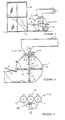
- FIG. 1 to 3 an apparatus according to the invention which includes a housing 1 which is cylindrical and mounted with its longitudinal axis horizontal.
- the housing 1 has mounted across its top an inlet 2 which extends across the full width of the housing 1.
- the inlet 2 has an intake chute portion 3 at the housing end of which is mounted a set of worker/stripper feed rollers generally indicated by arrow 4 ( Figures 2 and 3).
- the housing 1 has a discharge door 5 which is connected to an outlet chute 6 an open end 7 of which is directed toward a collection cage 8.
- a set of three rollers forms the worker/stripper feed rollers 4.
- the rollers 4 are mounted with their axes horizontal and two of the rollers are stripper rollers 9 between which is a single centrally mounted worker roller 10.
- the teeth on the rollers 9 and 10 can be hook shaped inside elevation as shown in Figure 3 and are mounted in parallel rows.
- the teeth on the rollers 9 and 10 are preferably spaced apart so that the rotating stripper rollers 9 remove fibres from the worker roller 10. Some of the fibres drop into the housing 1.
- the feed roller 9 on the discharge door side of the housing 1 is a fluted roller.
- the housing 1 has mounted therein a main rotor 11 driven by motor 12.
- the rotor 11 has a high rotational speed relative to that of the worker and stripper feed rollers.
- the rotor 11 is preferably driven at about 900 rpm but this depends on the diameter of the rotor or housing and the rotational speed can be varied to suit the end product produced by providing for variations in the rotational speed of the motor 12.
- the worker and stripper rollers 10 and 9 respectively rotate at a slow speed and speed thereof is advantageously controlled automatically to ensure an even input of fibres from the intake chute 3 to the housing 1 to ensure that the motor 12 is not overloaded.
- the main rotor 11 has a plurality teeth 13 which interact with the teeth on the worker roller 10 to remove during processing some of the fibres .
- the main rotor 11 also includes a series of beaters 14 on the trailing edges 15 of the arm 16.
- the beaters are preferably constructed from a flexible material, for example, strips of leather.
- the fibrous material to be formed into long tailed neps is fed by a conveyer system or the like to the inlet 2 while the discharge door 5 is in its closed position.
- the material is fed by the feed rollers 4 into the housing 1.
- the speed of the feed rollers 4 being adjusted to ensure an even flow and input time which depends on the volume of fibrous material being processed and is ideally over 10 to 20 secs.
- the main rotor 11 is operated for a preselected time chosen to suit the type of fibres and volume being processed.
- the processing time can be from one minute upward.
- the particular type of long tailed neps to be produced also has a bearing on the process time.
- the rotor 11 While the rotor 11 is operating with the door 5 closed the fibres are continuously caught by the teeth on the rotor 11 and removed thereform by the worker roller 10. The remaining fibres are stripped from the worker 10 by being beaten therefrom by the beaters 14.
- the door 5 is opened and the rotation of the rotor 11 throws the formed long tailed neps through the door 5 into the cage 8.
- the processing can include the addition of a lubricant like water to the housing.
- This water or lubricant can be sprayed into the housing by a boom 16 which extends across the housing 1.
Landscapes
- Engineering & Computer Science (AREA)
- Textile Engineering (AREA)
- Preliminary Treatment Of Fibers (AREA)
Description
- This invention relates to the production of a fill or effect material and more particularly to an apparatus for producing a fill or effect material.
- The fill or effect materials are long tailed neps and these have been manufactured in the mechanism described in European patent specification No. 0 234 110. The fill or effect material is sold by the applicants licensees under the trade mark "soft knops". The mechanism described in European patent specification No. 0 234 110 is a modified woollen opening mechanism and although the material can be produced satisfactorily on this type of machine there is a need in the market place for a purpose built machine for producing in bulk the long tailed neps.
- An object of the present invention is therefore to provide an apparatus for producing in bulk long tailed neps.
- Further objects and advantages of the present invention will become apparant from the following description which is given by way of example only.
- According to a broadest aspect of the invention there is provided an apparatus for producing, in bulk, long tailed neps, the apparatus including a housing supporting a main rotor the periphery of which has a plurality of teeth and beaters which co-operate with teeth on a set of feed rollers mounted in the housing alongside the periphery of the main rotor, the housing having an intake chute and a closeable discharge door, the arrangement being such that, in use, a synthetic or natural fibrous material fed to the intake chute, while the discharge door is closed, is fed into the housing by the feed rollers, the fibrous material being removed by the beaters and teeth of the rotor from the feed rollers, the fibrous material being spun in the housing and the interaction between the teeth and the beaters of the main rotor and the teeth of the feed rollers causing the fibrous material to be entangled and felted to form a plurality of long tailed neps which are discharged from the housing when the discharge door is opened.
- The size of the long tailed neps depends on the degree of mesh of the cooperating teeth and their relative spacing.
- The feed rollers can be a set of worker and stripper rollers. One of the stripper rollers can be fluted.
- The main rotor is adapted to remove the fibrous material from the feed rollers by providing teeth and flexible beaters on the periphery of the rotor, the teeth and beaters in operation ensure that most of the fibrous material on the worker roller is removed and formed in the housing into the long tailed neps.
- Further aspects of the invention which should be considered in all its novel aspects will become apparent from the following description which is given by way of example only.
- An example of the invention will now be described with reference to the accompanying drawing in which:
- Figure 1 shows in side elevation an apparatus according to the present invention;
- Figure 2 shows a typical section through part of the apparatus shown in Figure 1; and
- Figure 3 shows a detail on an enlarged scale of the worker and stripper feed rollers interacting with the main rotor.
- The example of the invention will now be described with reference to the production of long tailed neps of the type shown in Figure 5 of European patent specification No. 0 234 110.
- In the accompanying Figures 1 to 3 is shown an apparatus according to the invention which includes a housing 1 which is cylindrical and mounted with its longitudinal axis horizontal.
- The housing 1 has mounted across its top an
inlet 2 which extends across the full width of the housing 1. Theinlet 2 has anintake chute portion 3 at the housing end of which is mounted a set of worker/stripper feed rollers generally indicated by arrow 4 (Figures 2 and 3). - The housing 1 has a discharge door 5 which is connected to an
outlet chute 6 an open end 7 of which is directed toward acollection cage 8. - In the example a set of three rollers forms the worker/
stripper feed rollers 4. Therollers 4 are mounted with their axes horizontal and two of the rollers arestripper rollers 9 between which is a single centrally mountedworker roller 10. The teeth on therollers rollers stripper rollers 9 remove fibres from theworker roller 10. Some of the fibres drop into the housing 1. - In an alternative construction (not shown) the
feed roller 9 on the discharge door side of the housing 1 is a fluted roller. - The housing 1 has mounted therein a main rotor 11 driven by
motor 12. The rotor 11 has a high rotational speed relative to that of the worker and stripper feed rollers. The rotor 11 is preferably driven at about 900 rpm but this depends on the diameter of the rotor or housing and the rotational speed can be varied to suit the end product produced by providing for variations in the rotational speed of themotor 12. - The worker and
stripper rollers intake chute 3 to the housing 1 to ensure that themotor 12 is not overloaded. - The main rotor 11 has a
plurality teeth 13 which interact with the teeth on theworker roller 10 to remove during processing some of the fibres . - The main rotor 11 also includes a series of
beaters 14 on the trailing edges 15 of thearm 16. The beaters are preferably constructed from a flexible material, for example, strips of leather. - In use the fibrous material to be formed into long tailed neps is fed by a conveyer system or the like to the
inlet 2 while the discharge door 5 is in its closed position. The material is fed by thefeed rollers 4 into the housing 1. The speed of thefeed rollers 4 being adjusted to ensure an even flow and input time which depends on the volume of fibrous material being processed and is ideally over 10 to 20 secs. - The main rotor 11 is operated for a preselected time chosen to suit the type of fibres and volume being processed. The processing time can be from one minute upward. The particular type of long tailed neps to be produced also has a bearing on the process time. While the rotor 11 is operating with the door 5 closed the fibres are continuously caught by the teeth on the rotor 11 and removed thereform by the
worker roller 10. The remaining fibres are stripped from theworker 10 by being beaten therefrom by thebeaters 14. At the end of the preselected processing time the door 5 is opened and the rotation of the rotor 11 throws the formed long tailed neps through the door 5 into thecage 8. - If desired the processing can include the addition of a lubricant like water to the housing. This water or lubricant can be sprayed into the housing by a
boom 16 which extends across the housing 1. - Thus by this invention there is provided an apparatus for producing in bulk long tailed neps.
- A particular example of the invention has been described and it is envisaged that improvements and modifications can take place without departing from the scope of the appended claims.
Claims (10)
- Apparatus for producing, in bulk, long tailed neps, the apparatus including a housing (1) supporting a main rotor (11), the periphery of which has a plurality of teeth (13) which co-operate with teeth on a set of feed rollers (9, 10) mounted in the housing (1) alongside the periphery of the main rotor, the housing (1) having an intake chute (3) and a closeable discharge door (5), characterised in that the periphery of the main rotor (11) has a plurality of beaters (14) which co-operate with the teeth on the set of feed rollers (9,10), the arrangement being such that, in use, a synthetic or natural fibrous material, fed to the intake chute (3) while the discharge door (5) is closed, is fed into the housing (1) by the feed rollers (9,10), the fibrous material being removed by the beaters (14) and teeth (13) of the rotor (11) from the feed rollers (9,10), the fibrous material being spun in the housing (1) and the interaction between the teeth (13) and the beaters (14) of the main rotor and the teeth of the feed rollers (9,10) causing the fibrous material to be entangled and felted to form a plurality of long tailed neps which are discharged from the housing (1) when the discharge door (5) is opened.
- Apparatus according to claim 1 wherein the size of the long tailed neps depends on the degree of mesh of the co-operating teeth (13) and their relative spacing.
- Apparatus according to claim 1 or claim 2 wherein the feed rollers are a set of worker (10) and stripper (9) rollers.
- Apparatus according to claim 3 wherein one of the stripper rollers (9) is fluted.
- Apparatus according to any preceding claim wherein the housing (1) is cylindrical and is mounted with its longitudinal axis horizontal.
- Apparatus according to claim 5 wherein the housing (1) has mounted across its top a full width inlet (2) having the intake chute (3) at its base, the set of feed rollers (9,10) being mounted in the intake chute.
- Apparatus according to any preceding claim wherein the set of feed rollers (9,10) comprises a pair of horizontally mounted stripper rollers (9) between which is a single centrally mounted worker roller (10).
- Apparatus according to claim 7 wherein the teeth on the feed rollers (9,10) are hook shaped in side elevation and are mounted in parallel rows.
- Apparatus according to any preceding claim wherein the worker roller (10) and stripper (9) rollers are rotated at a slow speed relative to that of the main rotor (11).
- Apparatus according to any preceding claim wherein the beaters (14) are constructed from a flexible material.
Applications Claiming Priority (2)
| Application Number | Priority Date | Filing Date | Title |
|---|---|---|---|
| NZ225818 | 1988-08-12 | ||
| NZ225818A NZ225818A (en) | 1988-08-12 | 1988-08-12 | Apparatus which produces long tailed neps of fibrous material |
Publications (2)
| Publication Number | Publication Date |
|---|---|
| EP0354792A1 EP0354792A1 (en) | 1990-02-14 |
| EP0354792B1 true EP0354792B1 (en) | 1994-02-02 |
Family
ID=19922558
Family Applications (1)
| Application Number | Title | Priority Date | Filing Date |
|---|---|---|---|
| EP89308140A Expired - Lifetime EP0354792B1 (en) | 1988-08-12 | 1989-08-10 | A fill or effect material |
Country Status (6)
| Country | Link |
|---|---|
| US (1) | US4972550A (en) |
| EP (1) | EP0354792B1 (en) |
| JP (1) | JPH0274624A (en) |
| CA (1) | CA1319244C (en) |
| DE (1) | DE68912847D1 (en) |
| NZ (1) | NZ225818A (en) |
Families Citing this family (2)
| Publication number | Priority date | Publication date | Assignee | Title |
|---|---|---|---|---|
| US5050740A (en) * | 1990-08-28 | 1991-09-24 | Eli Lucero | Hard case for chess equipment |
| BR112013012904A2 (en) * | 2010-11-25 | 2017-06-27 | Trueringisches Inst Fuer Textil Und Kunststoff Forschung E V | device for the dismantling of textile fiber assemblies |
Family Cites Families (11)
| Publication number | Priority date | Publication date | Assignee | Title |
|---|---|---|---|---|
| BE348437A (en) * | ||||
| US466669A (en) * | 1892-01-05 | faulkner | ||
| US1180135A (en) * | 1911-07-07 | 1916-04-18 | Garner Regin Machinery Company | Cotton opener and cleaner. |
| US1971124A (en) * | 1930-01-17 | 1934-08-21 | Tudor Ivan | Apparatus for treating fibrous material |
| US1973761A (en) * | 1931-05-08 | 1934-09-18 | Hill George | Means and method for oiling and moistening cotton |
| US2373768A (en) * | 1942-02-07 | 1945-04-17 | Benjamin F Mccreery | Method and mechanism for treating filaments or fibers |
| US2420367A (en) * | 1943-11-09 | 1947-05-13 | Celanese Corp | Fluffing up artificial staple fibers |
| DE906787C (en) * | 1952-06-21 | 1954-03-18 | Huettenwerk Eisengiesserei & M | Knob spreader |
| GB993503A (en) * | 1963-02-20 | 1965-05-26 | G & H Roberts Ltd | Improvements in or relating to fancy rollers for textile carding machines |
| SU1301881A1 (en) * | 1985-04-03 | 1987-04-07 | Институт механики и сейсмостойкости сооружений им.М.Т.Уразбаева | Feeder to machines for primary treatment of raw cotton |
| NZ217094A (en) * | 1985-12-13 | 1989-07-27 | Wool Res Organisation | Apparatus for and method of manufacturing long tailed neps |
-
1988
- 1988-08-12 NZ NZ225818A patent/NZ225818A/en unknown
-
1989
- 1989-08-10 EP EP89308140A patent/EP0354792B1/en not_active Expired - Lifetime
- 1989-08-10 DE DE89308140T patent/DE68912847D1/en not_active Expired - Lifetime
- 1989-08-11 JP JP1209512A patent/JPH0274624A/en active Pending
- 1989-08-11 CA CA000608138A patent/CA1319244C/en not_active Expired - Fee Related
- 1989-08-11 US US07/392,457 patent/US4972550A/en not_active Expired - Fee Related
Also Published As
| Publication number | Publication date |
|---|---|
| CA1319244C (en) | 1993-06-22 |
| US4972550A (en) | 1990-11-27 |
| DE68912847D1 (en) | 1994-03-17 |
| JPH0274624A (en) | 1990-03-14 |
| EP0354792A1 (en) | 1990-02-14 |
| NZ225818A (en) | 1992-01-29 |
Similar Documents
| Publication | Publication Date | Title |
|---|---|---|
| EP1262580B1 (en) | Opening machine and opening method for fibre material | |
| US4135276A (en) | Apparatus for removing impurities from fibrous material | |
| KR910002547B1 (en) | Method and apparatus for manufacturing uniform fibrous web at high speed | |
| EP0398421A1 (en) | Apparatus for processing flax straw, and also flax straw opener and drum therefor | |
| WO1999063135A1 (en) | Apparatus for cleaning fibers | |
| EA001245B1 (en) | Device for fiber production | |
| US4586218A (en) | Chute feed apparatus for a carding machine | |
| GB2108543A (en) | Apparatus for opening and cleaning cotton waste | |
| US4972550A (en) | Fill or effect material | |
| EP0234110B1 (en) | A fill or effect material | |
| US6061875A (en) | Powered roll gin stand | |
| US6539586B2 (en) | Trash removal assembly in a fiber processing machine | |
| US4797976A (en) | Textile fiber tuft cleaning apparatus | |
| US4433454A (en) | Saw type gin stand with seed removal tube | |
| US2505690A (en) | Textile fiber opening apparatus | |
| US5010623A (en) | Textile fibre mixing apparatus | |
| US6058569A (en) | Unit for opening and separation of the impurities, for machines for opening or carding of flock textile material | |
| EP0892095A1 (en) | A method for the roller air suspending carding and a specific animal fine hair combined carding machine | |
| CN206352178U (en) | It is a kind of to be used for the opener of carbon fiber and glass fibre | |
| US3080617A (en) | Fiber proportioning, blending and preparation method, system and apparatus | |
| US3014247A (en) | Lint cotton cleaner | |
| GB2254625A (en) | Apparatus for cleaning and opening fibre material | |
| US4453676A (en) | Shredding machine with washer and drier | |
| US3802031A (en) | Apparatus for treating cotton to reduce the byssinotic effect thereof | |
| US2977641A (en) | Lint cotton opener and cleaner |
Legal Events
| Date | Code | Title | Description |
|---|---|---|---|
| PUAI | Public reference made under article 153(3) epc to a published international application that has entered the european phase |
Free format text: ORIGINAL CODE: 0009012 |
|
| AK | Designated contracting states |
Kind code of ref document: A1 Designated state(s): DE GB IT |
|
| 17P | Request for examination filed |
Effective date: 19900716 |
|
| 17Q | First examination report despatched |
Effective date: 19911205 |
|
| GRAA | (expected) grant |
Free format text: ORIGINAL CODE: 0009210 |
|
| AK | Designated contracting states |
Kind code of ref document: B1 Designated state(s): DE GB IT |
|
| PG25 | Lapsed in a contracting state [announced via postgrant information from national office to epo] |
Ref country code: IT Free format text: LAPSE BECAUSE OF FAILURE TO SUBMIT A TRANSLATION OF THE DESCRIPTION OR TO PAY THE FEE WITHIN THE PRE;WARNING: LAPSES OF ITALIAN PATENTS WITH EFFECTIVE DATE BEFORE 2007 MAY HAVE OCCURRED AT ANY TIME BEFORE 2007. THE CORRECT EFFECTIVE DATE MAY BE DIFFERENT FROM THE ONE RECORDED.SCRIBED TIME-LIMIT Effective date: 19940202 Ref country code: DE Effective date: 19940202 |
|
| REF | Corresponds to: |
Ref document number: 68912847 Country of ref document: DE Date of ref document: 19940317 |
|
| PG25 | Lapsed in a contracting state [announced via postgrant information from national office to epo] |
Ref country code: GB Effective date: 19940810 |
|
| PLBE | No opposition filed within time limit |
Free format text: ORIGINAL CODE: 0009261 |
|
| STAA | Information on the status of an ep patent application or granted ep patent |
Free format text: STATUS: NO OPPOSITION FILED WITHIN TIME LIMIT |
|
| 26N | No opposition filed | ||
| GBPC | Gb: european patent ceased through non-payment of renewal fee |
Effective date: 19940810 |