EP0352894A2 - Herstellung einer kosmetischen oder pharmazeutischen Zusammensetzung - Google Patents
Herstellung einer kosmetischen oder pharmazeutischen Zusammensetzung Download PDFInfo
- Publication number
- EP0352894A2 EP0352894A2 EP19890306057 EP89306057A EP0352894A2 EP 0352894 A2 EP0352894 A2 EP 0352894A2 EP 19890306057 EP19890306057 EP 19890306057 EP 89306057 A EP89306057 A EP 89306057A EP 0352894 A2 EP0352894 A2 EP 0352894A2
- Authority
- EP
- European Patent Office
- Prior art keywords
- cells
- hair growth
- dermal papillae
- growth promoter
- gene
- Prior art date
- Legal status (The legal status is an assumption and is not a legal conclusion. Google has not performed a legal analysis and makes no representation as to the accuracy of the status listed.)
- Ceased
Links
- 238000004519 manufacturing process Methods 0.000 title claims description 10
- 239000002537 cosmetic Substances 0.000 title claims description 3
- 239000008194 pharmaceutical composition Substances 0.000 title description 2
- 230000002500 effect on skin Effects 0.000 claims abstract description 31
- 230000003779 hair growth Effects 0.000 claims abstract description 27
- 239000007952 growth promoter Substances 0.000 claims abstract description 21
- 239000000203 mixture Substances 0.000 claims abstract description 19
- 210000004027 cell Anatomy 0.000 claims description 97
- 108090000623 proteins and genes Proteins 0.000 claims description 24
- 238000000034 method Methods 0.000 claims description 23
- 241000700605 Viruses Species 0.000 claims description 17
- 239000013598 vector Substances 0.000 claims description 14
- 210000001519 tissue Anatomy 0.000 claims description 13
- 239000012228 culture supernatant Substances 0.000 claims description 7
- 210000002966 serum Anatomy 0.000 claims description 7
- 241001430294 unidentified retrovirus Species 0.000 claims description 7
- 241001505332 Polyomavirus sp. Species 0.000 claims description 4
- 230000002068 genetic effect Effects 0.000 claims description 4
- 108020004511 Recombinant DNA Proteins 0.000 claims description 3
- 238000012258 culturing Methods 0.000 claims description 3
- 210000003780 hair follicle Anatomy 0.000 claims description 3
- 238000010348 incorporation Methods 0.000 claims description 3
- 231100000590 oncogenic Toxicity 0.000 claims description 3
- 230000002246 oncogenic effect Effects 0.000 claims description 3
- 230000006820 DNA synthesis Effects 0.000 claims description 2
- KCXVZYZYPLLWCC-UHFFFAOYSA-N EDTA Chemical compound OC(=O)CN(CC(O)=O)CCN(CC(O)=O)CC(O)=O KCXVZYZYPLLWCC-UHFFFAOYSA-N 0.000 claims description 2
- 238000005516 engineering process Methods 0.000 claims description 2
- PEDCQBHIVMGVHV-UHFFFAOYSA-N Glycerine Chemical compound OCC(O)CO PEDCQBHIVMGVHV-UHFFFAOYSA-N 0.000 claims 3
- 229960003632 minoxidil Drugs 0.000 claims 3
- 239000003623 enhancer Substances 0.000 claims 2
- 229940124563 hair growth stimulant Drugs 0.000 claims 2
- -1 minoxidil glucuronides Chemical class 0.000 claims 2
- 235000018102 proteins Nutrition 0.000 claims 2
- 102000004169 proteins and genes Human genes 0.000 claims 2
- 239000003381 stabilizer Substances 0.000 claims 2
- 102100033312 Alpha-2-macroglobulin Human genes 0.000 claims 1
- XUJNEKJLAYXESH-REOHCLBHSA-N L-Cysteine Chemical compound SC[C@H](N)C(O)=O XUJNEKJLAYXESH-REOHCLBHSA-N 0.000 claims 1
- ZFMITUMMTDLWHR-UHFFFAOYSA-N Minoxidil Chemical compound NC1=[N+]([O-])C(N)=CC(N2CCCCC2)=N1 ZFMITUMMTDLWHR-UHFFFAOYSA-N 0.000 claims 1
- 108010015078 Pregnancy-Associated alpha 2-Macroglobulins Proteins 0.000 claims 1
- 210000004748 cultured cell Anatomy 0.000 claims 1
- XUJNEKJLAYXESH-UHFFFAOYSA-N cysteine Natural products SCC(N)C(O)=O XUJNEKJLAYXESH-UHFFFAOYSA-N 0.000 claims 1
- 235000018417 cysteine Nutrition 0.000 claims 1
- 230000000694 effects Effects 0.000 claims 1
- 229930182480 glucuronide Natural products 0.000 claims 1
- 230000001939 inductive effect Effects 0.000 claims 1
- 230000035515 penetration Effects 0.000 claims 1
- 239000002609 medium Substances 0.000 description 28
- 239000013612 plasmid Substances 0.000 description 11
- 101150072261 large T gene Proteins 0.000 description 9
- 239000012737 fresh medium Substances 0.000 description 8
- 239000002245 particle Substances 0.000 description 6
- 229910000389 calcium phosphate Inorganic materials 0.000 description 4
- 239000001506 calcium phosphate Substances 0.000 description 4
- 235000011010 calcium phosphates Nutrition 0.000 description 4
- 230000002950 deficient Effects 0.000 description 4
- 239000000463 material Substances 0.000 description 4
- 238000004806 packaging method and process Methods 0.000 description 4
- 230000001177 retroviral effect Effects 0.000 description 4
- UCSJYZPVAKXKNQ-HZYVHMACSA-N streptomycin Chemical compound CN[C@H]1[C@H](O)[C@@H](O)[C@H](CO)O[C@H]1O[C@@H]1[C@](C=O)(O)[C@H](C)O[C@H]1O[C@@H]1[C@@H](NC(N)=N)[C@H](O)[C@@H](NC(N)=N)[C@H](O)[C@H]1O UCSJYZPVAKXKNQ-HZYVHMACSA-N 0.000 description 4
- 238000012546 transfer Methods 0.000 description 4
- QORWJWZARLRLPR-UHFFFAOYSA-H tricalcium bis(phosphate) Chemical compound [Ca+2].[Ca+2].[Ca+2].[O-]P([O-])([O-])=O.[O-]P([O-])([O-])=O QORWJWZARLRLPR-UHFFFAOYSA-H 0.000 description 4
- 229920000209 Hexadimethrine bromide Polymers 0.000 description 3
- OKKJLVBELUTLKV-UHFFFAOYSA-N Methanol Chemical compound OC OKKJLVBELUTLKV-UHFFFAOYSA-N 0.000 description 3
- 238000010790 dilution Methods 0.000 description 3
- 239000012895 dilution Substances 0.000 description 3
- 239000012634 fragment Substances 0.000 description 3
- 239000001963 growth medium Substances 0.000 description 3
- 238000011534 incubation Methods 0.000 description 3
- 229930027917 kanamycin Natural products 0.000 description 3
- 229960000318 kanamycin Drugs 0.000 description 3
- SBUJHOSQTJFQJX-NOAMYHISSA-N kanamycin Chemical compound O[C@@H]1[C@@H](O)[C@H](O)[C@@H](CN)O[C@@H]1O[C@H]1[C@H](O)[C@@H](O[C@@H]2[C@@H]([C@@H](N)[C@H](O)[C@@H](CO)O2)O)[C@H](N)C[C@@H]1N SBUJHOSQTJFQJX-NOAMYHISSA-N 0.000 description 3
- 229930182823 kanamycin A Natural products 0.000 description 3
- 230000003612 virological effect Effects 0.000 description 3
- BRZYSWJRSDMWLG-DJWUNRQOSA-N (2r,3r,4r,5r)-2-[(1s,2s,3r,4s,6r)-4,6-diamino-3-[(2s,3r,4r,5s,6r)-3-amino-4,5-dihydroxy-6-[(1r)-1-hydroxyethyl]oxan-2-yl]oxy-2-hydroxycyclohexyl]oxy-5-methyl-4-(methylamino)oxane-3,5-diol Chemical compound O1C[C@@](O)(C)[C@H](NC)[C@@H](O)[C@H]1O[C@@H]1[C@@H](O)[C@H](O[C@@H]2[C@@H]([C@@H](O)[C@H](O)[C@@H]([C@@H](C)O)O2)N)[C@@H](N)C[C@H]1N BRZYSWJRSDMWLG-DJWUNRQOSA-N 0.000 description 2
- IJGRMHOSHXDMSA-UHFFFAOYSA-N Atomic nitrogen Chemical compound N#N IJGRMHOSHXDMSA-UHFFFAOYSA-N 0.000 description 2
- 108020004414 DNA Proteins 0.000 description 2
- 229930182555 Penicillin Natural products 0.000 description 2
- JGSARLDLIJGVTE-MBNYWOFBSA-N Penicillin G Chemical compound N([C@H]1[C@H]2SC([C@@H](N2C1=O)C(O)=O)(C)C)C(=O)CC1=CC=CC=C1 JGSARLDLIJGVTE-MBNYWOFBSA-N 0.000 description 2
- 101100289792 Squirrel monkey polyomavirus large T gene Proteins 0.000 description 2
- 238000004458 analytical method Methods 0.000 description 2
- 210000004102 animal cell Anatomy 0.000 description 2
- 244000309466 calf Species 0.000 description 2
- 239000000470 constituent Substances 0.000 description 2
- 238000010276 construction Methods 0.000 description 2
- 210000002950 fibroblast Anatomy 0.000 description 2
- 208000015181 infectious disease Diseases 0.000 description 2
- 238000002955 isolation Methods 0.000 description 2
- 229940049954 penicillin Drugs 0.000 description 2
- 239000000523 sample Substances 0.000 description 2
- 239000006152 selective media Substances 0.000 description 2
- 238000003860 storage Methods 0.000 description 2
- 229960005322 streptomycin Drugs 0.000 description 2
- 238000001890 transfection Methods 0.000 description 2
- 102000016928 DNA-directed DNA polymerase Human genes 0.000 description 1
- 108010014303 DNA-directed DNA polymerase Proteins 0.000 description 1
- IAZDPXIOMUYVGZ-UHFFFAOYSA-N Dimethylsulphoxide Chemical compound CS(C)=O IAZDPXIOMUYVGZ-UHFFFAOYSA-N 0.000 description 1
- 241001131785 Escherichia coli HB101 Species 0.000 description 1
- SXRSQZLOMIGNAQ-UHFFFAOYSA-N Glutaraldehyde Chemical compound O=CCCCC=O SXRSQZLOMIGNAQ-UHFFFAOYSA-N 0.000 description 1
- 241001529936 Murinae Species 0.000 description 1
- 241000829388 Mus musculus polyomavirus 1 Species 0.000 description 1
- FAPWRFPIFSIZLT-UHFFFAOYSA-M Sodium chloride Chemical compound [Na+].[Cl-] FAPWRFPIFSIZLT-UHFFFAOYSA-M 0.000 description 1
- 238000002105 Southern blotting Methods 0.000 description 1
- 102000004142 Trypsin Human genes 0.000 description 1
- 108090000631 Trypsin Proteins 0.000 description 1
- 108010087302 Viral Structural Proteins Proteins 0.000 description 1
- 230000000692 anti-sense effect Effects 0.000 description 1
- 230000001580 bacterial effect Effects 0.000 description 1
- 230000001413 cellular effect Effects 0.000 description 1
- 238000003776 cleavage reaction Methods 0.000 description 1
- 238000010367 cloning Methods 0.000 description 1
- 238000000975 co-precipitation Methods 0.000 description 1
- 230000001332 colony forming effect Effects 0.000 description 1
- 238000011109 contamination Methods 0.000 description 1
- 238000005138 cryopreservation Methods 0.000 description 1
- 238000012136 culture method Methods 0.000 description 1
- 238000012217 deletion Methods 0.000 description 1
- 230000037430 deletion Effects 0.000 description 1
- 238000010586 diagram Methods 0.000 description 1
- 229960001760 dimethyl sulfoxide Drugs 0.000 description 1
- 238000002224 dissection Methods 0.000 description 1
- 238000000605 extraction Methods 0.000 description 1
- 238000007667 floating Methods 0.000 description 1
- 238000004108 freeze drying Methods 0.000 description 1
- 238000003125 immunofluorescent labeling Methods 0.000 description 1
- 238000003780 insertion Methods 0.000 description 1
- 230000037431 insertion Effects 0.000 description 1
- 208000032839 leukemia Diseases 0.000 description 1
- 239000007788 liquid Substances 0.000 description 1
- 238000012423 maintenance Methods 0.000 description 1
- 239000003550 marker Substances 0.000 description 1
- 238000001531 micro-dissection Methods 0.000 description 1
- 238000012986 modification Methods 0.000 description 1
- 230000004048 modification Effects 0.000 description 1
- 238000010369 molecular cloning Methods 0.000 description 1
- 229910052757 nitrogen Inorganic materials 0.000 description 1
- 235000015097 nutrients Nutrition 0.000 description 1
- 239000002244 precipitate Substances 0.000 description 1
- 239000003755 preservative agent Substances 0.000 description 1
- 230000002335 preservative effect Effects 0.000 description 1
- 230000001566 pro-viral effect Effects 0.000 description 1
- 230000001737 promoting effect Effects 0.000 description 1
- 108091008146 restriction endonucleases Proteins 0.000 description 1
- 230000007017 scission Effects 0.000 description 1
- 210000003491 skin Anatomy 0.000 description 1
- 239000000243 solution Substances 0.000 description 1
- 238000010186 staining Methods 0.000 description 1
- 238000010561 standard procedure Methods 0.000 description 1
- 239000006228 supernatant Substances 0.000 description 1
- 230000000699 topical effect Effects 0.000 description 1
- 238000013518 transcription Methods 0.000 description 1
- 230000035897 transcription Effects 0.000 description 1
- 230000001131 transforming effect Effects 0.000 description 1
- 239000003656 tris buffered saline Substances 0.000 description 1
- 239000012588 trypsin Substances 0.000 description 1
- 238000000108 ultra-filtration Methods 0.000 description 1
Images


Classifications
-
- C—CHEMISTRY; METALLURGY
- C12—BIOCHEMISTRY; BEER; SPIRITS; WINE; VINEGAR; MICROBIOLOGY; ENZYMOLOGY; MUTATION OR GENETIC ENGINEERING
- C12N—MICROORGANISMS OR ENZYMES; COMPOSITIONS THEREOF; PROPAGATING, PRESERVING, OR MAINTAINING MICROORGANISMS; MUTATION OR GENETIC ENGINEERING; CULTURE MEDIA
- C12N15/00—Mutation or genetic engineering; DNA or RNA concerning genetic engineering, vectors, e.g. plasmids, or their isolation, preparation or purification; Use of hosts therefor
- C12N15/09—Recombinant DNA-technology
- C12N15/63—Introduction of foreign genetic material using vectors; Vectors; Use of hosts therefor; Regulation of expression
- C12N15/79—Vectors or expression systems specially adapted for eukaryotic hosts
- C12N15/85—Vectors or expression systems specially adapted for eukaryotic hosts for animal cells
- C12N15/86—Viral vectors
-
- A—HUMAN NECESSITIES
- A61—MEDICAL OR VETERINARY SCIENCE; HYGIENE
- A61K—PREPARATIONS FOR MEDICAL, DENTAL OR TOILETRY PURPOSES
- A61K8/00—Cosmetics or similar toiletry preparations
- A61K8/18—Cosmetics or similar toiletry preparations characterised by the composition
- A61K8/30—Cosmetics or similar toiletry preparations characterised by the composition containing organic compounds
- A61K8/49—Cosmetics or similar toiletry preparations characterised by the composition containing organic compounds containing heterocyclic compounds
- A61K8/494—Cosmetics or similar toiletry preparations characterised by the composition containing organic compounds containing heterocyclic compounds with more than one nitrogen as the only hetero atom
- A61K8/4953—Cosmetics or similar toiletry preparations characterised by the composition containing organic compounds containing heterocyclic compounds with more than one nitrogen as the only hetero atom containing pyrimidine ring derivatives, e.g. minoxidil
-
- A—HUMAN NECESSITIES
- A61—MEDICAL OR VETERINARY SCIENCE; HYGIENE
- A61Q—SPECIFIC USE OF COSMETICS OR SIMILAR TOILETRY PREPARATIONS
- A61Q7/00—Preparations for affecting hair growth
-
- C—CHEMISTRY; METALLURGY
- C07—ORGANIC CHEMISTRY
- C07K—PEPTIDES
- C07K14/00—Peptides having more than 20 amino acids; Gastrins; Somatostatins; Melanotropins; Derivatives thereof
- C07K14/005—Peptides having more than 20 amino acids; Gastrins; Somatostatins; Melanotropins; Derivatives thereof from viruses
-
- C—CHEMISTRY; METALLURGY
- C12—BIOCHEMISTRY; BEER; SPIRITS; WINE; VINEGAR; MICROBIOLOGY; ENZYMOLOGY; MUTATION OR GENETIC ENGINEERING
- C12N—MICROORGANISMS OR ENZYMES; COMPOSITIONS THEREOF; PROPAGATING, PRESERVING, OR MAINTAINING MICROORGANISMS; MUTATION OR GENETIC ENGINEERING; CULTURE MEDIA
- C12N5/00—Undifferentiated human, animal or plant cells, e.g. cell lines; Tissues; Cultivation or maintenance thereof; Culture media therefor
- C12N5/06—Animal cells or tissues; Human cells or tissues
- C12N5/0602—Vertebrate cells
- C12N5/0625—Epidermal cells, skin cells; Cells of the oral mucosa
- C12N5/0627—Hair cells
-
- A—HUMAN NECESSITIES
- A61—MEDICAL OR VETERINARY SCIENCE; HYGIENE
- A61K—PREPARATIONS FOR MEDICAL, DENTAL OR TOILETRY PURPOSES
- A61K2800/00—Properties of cosmetic compositions or active ingredients thereof or formulation aids used therein and process related aspects
- A61K2800/80—Process related aspects concerning the preparation of the cosmetic composition or the storage or application thereof
- A61K2800/86—Products or compounds obtained by genetic engineering
-
- C—CHEMISTRY; METALLURGY
- C12—BIOCHEMISTRY; BEER; SPIRITS; WINE; VINEGAR; MICROBIOLOGY; ENZYMOLOGY; MUTATION OR GENETIC ENGINEERING
- C12N—MICROORGANISMS OR ENZYMES; COMPOSITIONS THEREOF; PROPAGATING, PRESERVING, OR MAINTAINING MICROORGANISMS; MUTATION OR GENETIC ENGINEERING; CULTURE MEDIA
- C12N2510/00—Genetically modified cells
- C12N2510/04—Immortalised cells
-
- C—CHEMISTRY; METALLURGY
- C12—BIOCHEMISTRY; BEER; SPIRITS; WINE; VINEGAR; MICROBIOLOGY; ENZYMOLOGY; MUTATION OR GENETIC ENGINEERING
- C12N—MICROORGANISMS OR ENZYMES; COMPOSITIONS THEREOF; PROPAGATING, PRESERVING, OR MAINTAINING MICROORGANISMS; MUTATION OR GENETIC ENGINEERING; CULTURE MEDIA
- C12N2710/00—MICROORGANISMS OR ENZYMES; COMPOSITIONS THEREOF; PROPAGATING, PRESERVING, OR MAINTAINING MICROORGANISMS; MUTATION OR GENETIC ENGINEERING; CULTURE MEDIA dsDNA viruses
- C12N2710/00011—Details
- C12N2710/22011—Polyomaviridae, e.g. polyoma, SV40, JC
- C12N2710/22022—New viral proteins or individual genes, new structural or functional aspects of known viral proteins or genes
-
- C—CHEMISTRY; METALLURGY
- C12—BIOCHEMISTRY; BEER; SPIRITS; WINE; VINEGAR; MICROBIOLOGY; ENZYMOLOGY; MUTATION OR GENETIC ENGINEERING
- C12N—MICROORGANISMS OR ENZYMES; COMPOSITIONS THEREOF; PROPAGATING, PRESERVING, OR MAINTAINING MICROORGANISMS; MUTATION OR GENETIC ENGINEERING; CULTURE MEDIA
- C12N2740/00—Reverse transcribing RNA viruses
- C12N2740/00011—Details
- C12N2740/10011—Retroviridae
- C12N2740/13011—Gammaretrovirus, e.g. murine leukeamia virus
- C12N2740/13041—Use of virus, viral particle or viral elements as a vector
- C12N2740/13043—Use of virus, viral particle or viral elements as a vector viral genome or elements thereof as genetic vector
Definitions
- This invention relates to a cosmetic or pharmaceutical composition for topical application to mammalian skin, and to the means for producing a constituent of such composition.
- This constituent is a hair growth promoter (which may be a mixture of materials) capable of promoting hair growth.
- This hair growth promoter intended to be incorporated in a composition applied topically to increase human hair growth.
- This hair growth promoter can be obtained from a cell-free supernatant of cultured dermal papillae fibroblasts; it is able to promote hair growth in the rat, is proteinaceous, and is further characterised by:
- dermal papillae cells can be transformed (transfected) by recombinant DNA techniques to render them immortal, allowing unlimited growth potential in culture, while retaining the desired cell phenotype.
- the consequence is that it is practical to allow the cells to reproduce more times than would otherwise be possible - perhaps more than 10 times - while retaining desired phenotype.
- Such cells can be utilised to produce hair growth promoter, which may possibly be a mixture of materials and desirably is or includes the material according to our European application mentioned above.
- this invention provides dermal papillae cells transformed (transfected) by incorporation of an immortalizing gene into the genetic information of the cells.
- the immortalizing gene may come from an oncogenic virus, such as polyoma virus, although other sources of immortalizing gene are not excluded.
- the invention provides a method of making immortalized dermal papillae cells which comprises transforming (transfecting) the cells by recombinant DNA technology to incorporate an immortalizing gene into the genetic information of the cells.
- this invention provides the production of hair growth promoter by means of immortalized dermal papillae cells.
- This production will generally amount to a method of making hair growth promoter by culturing dermal papillae cells according to the first aspect of this invention, or obtained by the method of the second aspect, under conditions for the cells to produce hair growth promoter.
- the invention also includes culture supernatant, and compositions, which contain the hair growth promoter.
- This method describes the immortalization of specialised primary cells, namely dermal papillae cells, with an immortalizing gene, which is the polyoma virus large T gene. High frequencies of gene transfer are achieved using recombinant defective retroviruses.
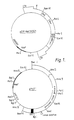
- a known vector which contained retroviral control sequences, a viral packaging signal, a unique cloning site for foreign gene insertion (BamHI) and a selectable dominant marker (resistance to the antibiotic G418).
- This vector was modified to incorporate the large T gene and the modified vector was then used in conjunction with a cell line (the ⁇ 2 cell line) which contains a packaging mutant Moloney murine leukaemia virus in its proviral state. This virus contained all of the retroviral structural genes but no packaging information.
- the modified vector was cloned and introduced into the ⁇ 2 cell line by calcium phosphate coprecipitation and as a result of its packaging signal was able to make use of the viral structural proteins to produce defective retroviruses.
- Virus particles were harvested and used to infect dermal papillae cells, resulting in high frequencies of gene transfer.
- the large T gene of murine polyoma virus has been reported to exhibit immortalizing properties: Rassoulzadegan et al Proc. Natl. Acad. Sci. USA 80 4354-8 (1983).
- the pZIP-Neo SV(X)1 plasmid is described in Cepko et al , Cell 37 1053-62 (1984).
- the 2491 base pair fragment was treated with T4 DNA polymerase to provide blunt ends, ligated to linkers and cloned into BamHI - linearised pUC8.
- Transformants were screened for insert-containing clones by plasmid isolation and restriction analysis. Three were found, and one designated pUCLT6 was used further.
- the recombinant plasmid pUCLT6 was cleaved with BamHI to generate both the large T gene and the pUC vector, and this mixture cloned into pZIP-Neo SV(X)1, with transformants being selected for kanamycin resistance to prevent pUC8 recombinants occurring.
- Insert-containing clones were initially screened by Southern blotting of transformant DNA (colony blotting), using as probe a 32 P nick-translated BglI - EcoRI fragment of large T. This was followed by plasmid isolation and restriction analysis of "positive" colonies.
- pZIT1 was introduced into the ⁇ 2 cell line using a calcium phosphate copreoipitation technique as described in Wigler et al . Proc. Natl. Acad. Sci. USA 76 1373-6 (1979). The 2 cell line is described in Mann et al Cell 33 153-9 (1983). This introduction of pZIT1 produced a cell line ⁇ 2:ZIT. To carry this out ⁇ 2 cells were maintained in Dulbecco's modification of Eagle's Medium supplemented with 5% Foetal Calf Serum. 24h prior to transfection 2 x 10⁵ ⁇ 2 cells were seeded in 25cm2 tissue culture flasks. 3h prior to transfection the cells were given 5ml fresh medium per flask.
- 10 ⁇ g pZIT1 was coprecipitated with calcium phosphate in a volume of 1ml and 500 ⁇ l was added to each flask. After 4h incubation the cells were washed with tris buffered saline before incubating for a further 24h with fresh non-selective medium. The cultures were then trypsinised and 1 x 10⁵ cells were seeded in 75cm2 tissue culture flasks with medium containing 750 ⁇ g/ml G418.
- the pZIT1 plasmid contains sequences derived from transposon Tn5 which encodes G418 resistance in animal cells and, after 10 days in selective medium, flasks of cells that had been transfected with plasmid DNA contained more than 100 clones. The clones in each individual flask were pooled and expanded into a cell line. ⁇ 2:ZIT was one such cell line. In contrast, there were no live cells remaining in control flasks which contained cells that had only been treated with calcium phosphate precipitate.
- ⁇ 2 cells that carry a vector based on pZIP-Neo SV(X)1 put recombinant defective retrovirus directly into the growth medium.
- the cells were grown in antibiotic-free medium and, 24h before they reached confluence, the medium was replaced with 25ml fresh medium/175cm2 tissue culture flask. After 24h incubation at 37°C the growth medium, which contained viral particles, was collected and passed through a 0.45 ⁇ m filter to remove all cellular material before storage at -70°C.
- the titres of virus stocks were determined using the following method. 4 x 10⁵ 3T6 cells (a mouse fibroblast line) were seeded in 100mm tissue culture dishes. 24h later tenfold and hundredfold dilutions of each virus stock were prepared in complete medium and polybrene added to a final concentration of 8 ⁇ g/ml. The medium was removed from the cells and 2ml virus dilution was added to each dish with each dilution done in duplicate. The dishes were incubated for 2h 30min at 37°C in an atmosphere of 5% CO2 in air; the dishes were gently rocked every 30 min. 10ml fresh medium was then added to each dish.
- 2 x 10⁵ cells from each dish were transferred into duplicate dishes with medium containing 750 ⁇ g/ml G418. After 10 to 14 days, clones were visible in dishes that had been infected with medium containing virus particles, but no live cells were left in dishes that had only been treated with growth medium or medium from ⁇ 2 cells. After fixation with 1% glutaraldehyde, extraction with 100% methanol and staining with Giemsa, the clones were counted and titres calculated. ⁇ 2:ZIT cells were found to produce viral particles at a titre of about 1 x 10⁴ colony forming units per ml.
- Dermal papillae were isolated by microdissection from rat hair follicles.
- the isolated papillae were maintained in a medium containing 15% by volume Foetal Calf Serum (FCS), the cells and medium being kept at 37°C in an atmosphere of 5% CO2/95% air, in order to maintain a suitable pH value of from 6.5 to 7.5.
- FCS Foetal Calf Serum
- the medium employed was Dulbeccos' modified Eagle's Medium (DMEM) supplemented with 15% by volume FCS, as well as penicillin, streptomycin and kanamycin to reduce the risk of bacterial contamination.
- DMEM Dulbeccos' modified Eagle's Medium
- Sparse cultures of dermal papillae cells prepared by the culture method detailed above were allowed to expand into subconfluent monolayers in 24-well tissue culture plates.
- the cells are subconfluent and exposed to virus about 48 hours after the sparce cultures are prepared.
- the medium was then removed and 1ml undiluted virus stock containing 8 ⁇ g/ml polybrene was added to each well.
- the plates were incubated for 2h 30mins at 37°C in an atmosphere of 5% CO2 in air and the plates were gently rocked every 30min.
- the virus stock containing polybrene was then replaced with a fresh 0.5ml sample of virus stock diluted with 0.5ml fresh medium and the infection period continued for an additional 24 hours.
- the medium containing virus was then removed and the cells were incubated in fresh medium until they approached confluence.
- the cells from each well were harvested, split into several fresh wells and incubated as described above until subconfluent monolayers had formed when they were transferred to medium containing 200 ⁇ g/ml G418. After several weeks (with regular changes of medium) clones were visible in wells where the cells had been infected with medium containing virus particles, but no live cells were left in wells that had been treated with medium from ⁇ 2 cells.
- ⁇ PyLT-1 Indirect immunofluorescence staining with a rat monoclonal anti-large T, ⁇ PyLT-1 confirmed that the large T protein was expressed by cells infected with virus particles produced by ⁇ 2:ZIT cells.
- DMEM Dulbeccos' modified Eagle's Medium
- the dermal papillae cell lines were frozen in medium containing serum and a preservative such as 10 to 15% dimethyl sulphoxide, stored in liquid nitrogen and recovered from storage as described by Freshney in Culture of Animal Cells: A Manual of Basic Technique, Alan R. Liss, Inc, New York 190-198 (1983).
- the concentrated, dialysed culture supernatant containing the hair growth promoter can then be used in preparing a composition for promotion of hair growth as explained in our pending European application 87.311316. It can be used as such or it can be dried, for example, by freeze drying before dispersing in the vehicle.
Landscapes
- Health & Medical Sciences (AREA)
- Life Sciences & Earth Sciences (AREA)
- Genetics & Genomics (AREA)
- Engineering & Computer Science (AREA)
- Chemical & Material Sciences (AREA)
- Organic Chemistry (AREA)
- Biomedical Technology (AREA)
- Biotechnology (AREA)
- General Health & Medical Sciences (AREA)
- Bioinformatics & Cheminformatics (AREA)
- Wood Science & Technology (AREA)
- Zoology (AREA)
- General Engineering & Computer Science (AREA)
- Biochemistry (AREA)
- Molecular Biology (AREA)
- Biophysics (AREA)
- Microbiology (AREA)
- Virology (AREA)
- Dermatology (AREA)
- Physics & Mathematics (AREA)
- Plant Pathology (AREA)
- Animal Behavior & Ethology (AREA)
- Public Health (AREA)
- Veterinary Medicine (AREA)
- Medicinal Chemistry (AREA)
- Gastroenterology & Hepatology (AREA)
- Proteomics, Peptides & Aminoacids (AREA)
- Cell Biology (AREA)
- Birds (AREA)
- Epidemiology (AREA)
- Micro-Organisms Or Cultivation Processes Thereof (AREA)
- Medicines Containing Material From Animals Or Micro-Organisms (AREA)
- Cosmetics (AREA)
Applications Claiming Priority (2)
| Application Number | Priority Date | Filing Date | Title |
|---|---|---|---|
| GB8814476 | 1988-06-17 | ||
| GB888814476A GB8814476D0 (en) | 1988-06-17 | 1988-06-17 | Production of cosmetic/pharmaceutical composition |
Publications (2)
| Publication Number | Publication Date |
|---|---|
| EP0352894A2 true EP0352894A2 (de) | 1990-01-31 |
| EP0352894A3 EP0352894A3 (de) | 1990-07-11 |
Family
ID=10638904
Family Applications (1)
| Application Number | Title | Priority Date | Filing Date |
|---|---|---|---|
| EP89306057A Ceased EP0352894A3 (de) | 1988-06-17 | 1989-06-15 | Herstellung einer kosmetischen oder pharmazeutischen Zusammensetzung |
Country Status (3)
| Country | Link |
|---|---|
| EP (1) | EP0352894A3 (de) |
| JP (1) | JPH0242979A (de) |
| GB (1) | GB8814476D0 (de) |
Cited By (4)
| Publication number | Priority date | Publication date | Assignee | Title |
|---|---|---|---|---|
| EP0405656A1 (de) * | 1989-06-29 | 1991-01-02 | University Of Dundee | Haarwuchsmittel |
| US5068315A (en) * | 1990-04-12 | 1991-11-26 | University Of Dundee | Composition for the regulation of hair growth |
| US5130142A (en) * | 1990-10-31 | 1992-07-14 | The Practer & Gamble Company | Hair growth regulating composition comprising epithelium cell supernatant-derived growth factor |
| EP1608765A4 (de) * | 2003-02-24 | 2006-10-18 | New England Biolabs Inc | Überexpression, reinigung und charakterisierung einer thermolabilen phosphatase |
Family Cites Families (1)
| Publication number | Priority date | Publication date | Assignee | Title |
|---|---|---|---|---|
| GB8630720D0 (en) * | 1986-12-23 | 1987-02-04 | Unilever Plc | Cosmetic compositions |
-
1988
- 1988-06-17 GB GB888814476A patent/GB8814476D0/en active Pending
-
1989
- 1989-06-15 EP EP89306057A patent/EP0352894A3/de not_active Ceased
- 1989-06-16 JP JP1154375A patent/JPH0242979A/ja active Pending
Cited By (5)
| Publication number | Priority date | Publication date | Assignee | Title |
|---|---|---|---|---|
| EP0405656A1 (de) * | 1989-06-29 | 1991-01-02 | University Of Dundee | Haarwuchsmittel |
| US5068315A (en) * | 1990-04-12 | 1991-11-26 | University Of Dundee | Composition for the regulation of hair growth |
| US5130142A (en) * | 1990-10-31 | 1992-07-14 | The Practer & Gamble Company | Hair growth regulating composition comprising epithelium cell supernatant-derived growth factor |
| EP1608765A4 (de) * | 2003-02-24 | 2006-10-18 | New England Biolabs Inc | Überexpression, reinigung und charakterisierung einer thermolabilen phosphatase |
| US7319014B2 (en) | 2003-02-24 | 2008-01-15 | New England Biolabs, Inc. | Overexpression, purification and characterization of a thermolabile phosphatase |
Also Published As
| Publication number | Publication date |
|---|---|
| EP0352894A3 (de) | 1990-07-11 |
| GB8814476D0 (en) | 1988-07-20 |
| JPH0242979A (ja) | 1990-02-13 |
Similar Documents
| Publication | Publication Date | Title |
|---|---|---|
| Messenger | The culture of dermal papilla cells from human hair follicles | |
| EP0228458B1 (de) | Expression von fremdem genetischem material in epithelzellen | |
| US4980286A (en) | In vivo introduction and expression of foreign genetic material in epithelial cells | |
| Nelson et al. | The 50-and 58-kdalton keratin classes as molecular markers for stratified squamous epithelia: cell culture studies. | |
| Woodley et al. | Normal and gene-corrected dystrophic epidermolysis bullosa fibroblasts alone can produce type VII collagen at the basement membrane zone | |
| Lundberg et al. | Generation of DOPA-Producing Astrocytes by Retroviral Transduction of the Human Tyrosine Hydroxylase Gene: In VitroCharacterization andin VivoEffects in the Rat Parkinson Model | |
| Boyce et al. | Calcium-regulated differentiation of normal human epidermal keratinocytes in chemically defined clonal culture and serum-free serial culture | |
| Hager et al. | Long-term culture of murine epidermal keratinocytes | |
| KR100616028B1 (ko) | 인자 ⅷ을 위한 발현 시스템 | |
| WO1988000241A1 (en) | Human erythropoietin gene: high level expression in stably transfected mammalian cells | |
| Barrandon et al. | Restoration of growth potential in paraclones of human keratinocytes by a viral oncogene. | |
| US5614381A (en) | Method for the inducible production of proteins in genetically modified eukaryotic host-cells multiplied in vivo | |
| US5891429A (en) | Recombinant human granulocyte-macrophage-colony stimulating factor (GM-CSF) | |
| Beug et al. | Characterization of hematopoietic cells transformed in vitro by AEV-H, a v-erb B-containing avian erythroblastosis virus | |
| EP0352894A2 (de) | Herstellung einer kosmetischen oder pharmazeutischen Zusammensetzung | |
| JPH04228066A (ja) | 外来遺伝子発現用培養細胞 | |
| KR960007195B1 (ko) | 이종유전자의 발현을 증대시킬 수 있는 재조합 플라스미드 및 형질전환세포의 제조방법, 및 그 형질전환 세포를 이용한 펩타이드의 제조방법 | |
| EP0527814B1 (de) | Immortalisierte primate hepatozyte zellinie | |
| Frampton et al. | Changes in minor transcripts from the α1 and β maj globin and glutathione peroxidase genes during erythropoiesis | |
| Valentich et al. | An established cell line from mouse kidney medullary thick ascending limb. I. Cell culture techniques, morphology, and antigenic expression | |
| Bernstam et al. | Stratified cornified primary cultures of human keratinocytes grown on microporous membranes at the air-liquid interface | |
| JP5097387B2 (ja) | 人工皮膚 | |
| Kajigaya et al. | Establishment of megakaryoblastic cell lines by coinfection of abelson murine leukemia virus and recombinant SV40‐retrovirus | |
| Dreano et al. | Production of secretable proteins using the passage in vivo as tumours of cells carrying heat-inducible expression constructs | |
| Nakamigawa et al. | Generation of human myogenic cell lines by the transformation of primary culture with origin-defective SV40 DNA |
Legal Events
| Date | Code | Title | Description |
|---|---|---|---|
| PUAI | Public reference made under article 153(3) epc to a published international application that has entered the european phase |
Free format text: ORIGINAL CODE: 0009012 |
|
| AK | Designated contracting states |
Kind code of ref document: A2 Designated state(s): AT BE CH DE ES FR GB GR IT LI NL SE |
|
| PUAL | Search report despatched |
Free format text: ORIGINAL CODE: 0009013 |
|
| AK | Designated contracting states |
Kind code of ref document: A3 Designated state(s): AT BE CH DE ES FR GB GR IT LI NL SE |
|
| 17P | Request for examination filed |
Effective date: 19901208 |
|
| RAP3 | Party data changed (applicant data changed or rights of an application transferred) |
Owner name: UNILEVER N.V. Owner name: UNILEVER PLC |
|
| 17Q | First examination report despatched |
Effective date: 19930430 |
|
| STAA | Information on the status of an ep patent application or granted ep patent |
Free format text: STATUS: THE APPLICATION HAS BEEN REFUSED |
|
| 18R | Application refused |
Effective date: 19941024 |