EP0350618B1 - Trägerharz für Pigmentpasten, seine Herstellung und Verwendung - Google Patents
Trägerharz für Pigmentpasten, seine Herstellung und Verwendung Download PDFInfo
- Publication number
- EP0350618B1 EP0350618B1 EP89110249A EP89110249A EP0350618B1 EP 0350618 B1 EP0350618 B1 EP 0350618B1 EP 89110249 A EP89110249 A EP 89110249A EP 89110249 A EP89110249 A EP 89110249A EP 0350618 B1 EP0350618 B1 EP 0350618B1
- Authority
- EP
- European Patent Office
- Prior art keywords
- paste
- groups
- pigment
- resin
- paste resin
- Prior art date
- Legal status (The legal status is an assumption and is not a legal conclusion. Google has not performed a legal analysis and makes no representation as to the accuracy of the status listed.)
- Expired - Lifetime
Links
- 239000011347 resin Substances 0.000 title claims abstract description 66
- 229920005989 resin Polymers 0.000 title claims abstract description 66
- 239000000049 pigment Substances 0.000 title claims abstract description 61
- 238000002360 preparation method Methods 0.000 title claims abstract description 7
- 125000004432 carbon atom Chemical group C* 0.000 claims abstract description 29
- 125000002887 hydroxy group Chemical group [H]O* 0.000 claims abstract description 21
- 239000012948 isocyanate Substances 0.000 claims abstract description 21
- 125000001453 quaternary ammonium group Chemical group 0.000 claims abstract description 7
- 239000004215 Carbon black (E152) Substances 0.000 claims abstract description 6
- 229930195733 hydrocarbon Natural products 0.000 claims abstract description 6
- 239000001257 hydrogen Substances 0.000 claims abstract description 5
- 229910052739 hydrogen Inorganic materials 0.000 claims abstract description 5
- 150000001875 compounds Chemical class 0.000 claims description 31
- 238000006243 chemical reaction Methods 0.000 claims description 26
- 229920000768 polyamine Polymers 0.000 claims description 21
- 239000007795 chemical reaction product Substances 0.000 claims description 15
- 239000005056 polyisocyanate Substances 0.000 claims description 15
- 229920001228 polyisocyanate Polymers 0.000 claims description 15
- 125000002924 primary amino group Chemical group [H]N([H])* 0.000 claims description 12
- 150000005676 cyclic carbonates Chemical group 0.000 claims description 11
- 239000002253 acid Substances 0.000 claims description 10
- IQPQWNKOIGAROB-UHFFFAOYSA-N isocyanate group Chemical group [N-]=C=O IQPQWNKOIGAROB-UHFFFAOYSA-N 0.000 claims description 10
- 239000003973 paint Substances 0.000 claims description 10
- 229920000570 polyether Polymers 0.000 claims description 10
- 238000005956 quaternization reaction Methods 0.000 claims description 9
- 125000000217 alkyl group Chemical group 0.000 claims description 8
- 125000003277 amino group Chemical group 0.000 claims description 8
- 239000004721 Polyphenylene oxide Substances 0.000 claims description 7
- 229910052757 nitrogen Inorganic materials 0.000 claims description 6
- IJGRMHOSHXDMSA-UHFFFAOYSA-N nitrogen Substances N#N IJGRMHOSHXDMSA-UHFFFAOYSA-N 0.000 claims description 6
- 229920005862 polyol Polymers 0.000 claims description 6
- 150000003077 polyols Chemical class 0.000 claims description 6
- 125000000467 secondary amino group Chemical group [H]N([*:1])[*:2] 0.000 claims description 6
- 150000007513 acids Chemical class 0.000 claims description 5
- 150000004985 diamines Chemical class 0.000 claims description 5
- 229920000728 polyester Polymers 0.000 claims description 5
- 125000001302 tertiary amino group Chemical group 0.000 claims description 5
- 125000004435 hydrogen atom Chemical group [H]* 0.000 claims description 4
- 101150020251 NR13 gene Proteins 0.000 claims description 3
- 125000003055 glycidyl group Chemical group C(C1CO1)* 0.000 claims description 3
- 125000002768 hydroxyalkyl group Chemical group 0.000 claims description 3
- 229920001610 polycaprolactone Polymers 0.000 claims description 3
- 239000004632 polycaprolactone Substances 0.000 claims description 3
- 229920005906 polyester polyol Polymers 0.000 claims description 3
- 229920000151 polyglycol Polymers 0.000 claims description 3
- 239000010695 polyglycol Substances 0.000 claims description 3
- QJGQUHMNIGDVPM-UHFFFAOYSA-N nitrogen group Chemical group [N] QJGQUHMNIGDVPM-UHFFFAOYSA-N 0.000 claims description 2
- 239000003921 oil Substances 0.000 claims description 2
- 229920000909 polytetrahydrofuran Polymers 0.000 claims description 2
- 125000003178 carboxy group Chemical group [H]OC(*)=O 0.000 claims 1
- 238000000576 coating method Methods 0.000 abstract description 17
- 239000011248 coating agent Substances 0.000 abstract description 11
- 239000000758 substrate Substances 0.000 abstract description 6
- UFHFLCQGNIYNRP-UHFFFAOYSA-N Hydrogen Chemical compound [H][H] UFHFLCQGNIYNRP-UHFFFAOYSA-N 0.000 abstract description 3
- 238000004070 electrodeposition Methods 0.000 abstract 1
- -1 hydrocarbon radical Chemical class 0.000 description 30
- 239000011230 binding agent Substances 0.000 description 29
- 239000000203 mixture Substances 0.000 description 27
- XLYOFNOQVPJJNP-UHFFFAOYSA-N water Substances O XLYOFNOQVPJJNP-UHFFFAOYSA-N 0.000 description 24
- YXFVVABEGXRONW-UHFFFAOYSA-N Toluene Chemical compound CC1=CC=CC=C1 YXFVVABEGXRONW-UHFFFAOYSA-N 0.000 description 22
- KWYUFKZDYYNOTN-UHFFFAOYSA-M Potassium hydroxide Chemical compound [OH-].[K+] KWYUFKZDYYNOTN-UHFFFAOYSA-M 0.000 description 19
- 150000002513 isocyanates Chemical class 0.000 description 19
- 239000007787 solid Substances 0.000 description 19
- 229910001868 water Inorganic materials 0.000 description 19
- 150000001412 amines Chemical class 0.000 description 18
- 239000006185 dispersion Substances 0.000 description 12
- SECXISVLQFMRJM-UHFFFAOYSA-N N-Methylpyrrolidone Chemical compound CN1CCCC1=O SECXISVLQFMRJM-UHFFFAOYSA-N 0.000 description 11
- JVTAAEKCZFNVCJ-UHFFFAOYSA-N lactic acid Chemical compound CC(O)C(O)=O JVTAAEKCZFNVCJ-UHFFFAOYSA-N 0.000 description 10
- BDAGIHXWWSANSR-UHFFFAOYSA-N methanoic acid Natural products OC=O BDAGIHXWWSANSR-UHFFFAOYSA-N 0.000 description 10
- 239000003054 catalyst Substances 0.000 description 9
- 235000019441 ethanol Nutrition 0.000 description 9
- 239000011541 reaction mixture Substances 0.000 description 9
- 239000002904 solvent Substances 0.000 description 8
- POAOYUHQDCAZBD-UHFFFAOYSA-N 2-butoxyethanol Chemical compound CCCCOCCO POAOYUHQDCAZBD-UHFFFAOYSA-N 0.000 description 7
- 239000004593 Epoxy Substances 0.000 description 7
- 125000001931 aliphatic group Chemical group 0.000 description 7
- 230000008021 deposition Effects 0.000 description 7
- 238000000227 grinding Methods 0.000 description 7
- 239000004848 polyfunctional curative Substances 0.000 description 7
- 239000000047 product Substances 0.000 description 7
- 150000003254 radicals Chemical class 0.000 description 7
- IAYPIBMASNFSPL-UHFFFAOYSA-N Ethylene oxide Chemical compound C1CO1 IAYPIBMASNFSPL-UHFFFAOYSA-N 0.000 description 6
- 239000003795 chemical substances by application Substances 0.000 description 6
- RTZKZFJDLAIYFH-UHFFFAOYSA-N ether Substances CCOCC RTZKZFJDLAIYFH-UHFFFAOYSA-N 0.000 description 6
- 238000004519 manufacturing process Methods 0.000 description 6
- 238000012360 testing method Methods 0.000 description 6
- JLBXCKSMESLGTJ-UHFFFAOYSA-N 1-ethoxypropan-1-ol Chemical compound CCOC(O)CC JLBXCKSMESLGTJ-UHFFFAOYSA-N 0.000 description 5
- OSWFIVFLDKOXQC-UHFFFAOYSA-N 4-(3-methoxyphenyl)aniline Chemical compound COC1=CC=CC(C=2C=CC(N)=CC=2)=C1 OSWFIVFLDKOXQC-UHFFFAOYSA-N 0.000 description 5
- 150000001298 alcohols Chemical class 0.000 description 5
- 239000008367 deionised water Substances 0.000 description 5
- 229910021641 deionized water Inorganic materials 0.000 description 5
- 235000019253 formic acid Nutrition 0.000 description 5
- 239000004922 lacquer Substances 0.000 description 5
- 239000004310 lactic acid Substances 0.000 description 5
- 235000014655 lactic acid Nutrition 0.000 description 5
- 239000000463 material Substances 0.000 description 5
- 238000003756 stirring Methods 0.000 description 5
- 125000004169 (C1-C6) alkyl group Chemical group 0.000 description 4
- QWDQYHPOSSHSAW-UHFFFAOYSA-N 1-isocyanatooctadecane Chemical compound CCCCCCCCCCCCCCCCCCN=C=O QWDQYHPOSSHSAW-UHFFFAOYSA-N 0.000 description 4
- OAYXUHPQHDHDDZ-UHFFFAOYSA-N 2-(2-butoxyethoxy)ethanol Chemical compound CCCCOCCOCCO OAYXUHPQHDHDDZ-UHFFFAOYSA-N 0.000 description 4
- RPNUMPOLZDHAAY-UHFFFAOYSA-N Diethylenetriamine Chemical compound NCCNCCN RPNUMPOLZDHAAY-UHFFFAOYSA-N 0.000 description 4
- BPQQTUXANYXVAA-UHFFFAOYSA-N Orthosilicate Chemical compound [O-][Si]([O-])([O-])[O-] BPQQTUXANYXVAA-UHFFFAOYSA-N 0.000 description 4
- 229910000831 Steel Inorganic materials 0.000 description 4
- XLOMVQKBTHCTTD-UHFFFAOYSA-N Zinc monoxide Chemical compound [Zn]=O XLOMVQKBTHCTTD-UHFFFAOYSA-N 0.000 description 4
- IISBACLAFKSPIT-UHFFFAOYSA-N bisphenol A Chemical compound C=1C=C(O)C=CC=1C(C)(C)C1=CC=C(O)C=C1 IISBACLAFKSPIT-UHFFFAOYSA-N 0.000 description 4
- PXKLMJQFEQBVLD-UHFFFAOYSA-N bisphenol F Chemical compound C1=CC(O)=CC=C1CC1=CC=C(O)C=C1 PXKLMJQFEQBVLD-UHFFFAOYSA-N 0.000 description 4
- 239000010959 steel Substances 0.000 description 4
- JOYRKODLDBILNP-UHFFFAOYSA-N urethane group Chemical group NC(=O)OCC JOYRKODLDBILNP-UHFFFAOYSA-N 0.000 description 4
- LHENQXAPVKABON-UHFFFAOYSA-N 1-methoxypropan-1-ol Chemical compound CCC(O)OC LHENQXAPVKABON-UHFFFAOYSA-N 0.000 description 3
- BBBUAWSVILPJLL-UHFFFAOYSA-N 2-(2-ethylhexoxymethyl)oxirane Chemical compound CCCCC(CC)COCC1CO1 BBBUAWSVILPJLL-UHFFFAOYSA-N 0.000 description 3
- ZWEHNKRNPOVVGH-UHFFFAOYSA-N 2-Butanone Chemical compound CCC(C)=O ZWEHNKRNPOVVGH-UHFFFAOYSA-N 0.000 description 3
- 125000004203 4-hydroxyphenyl group Chemical group [H]OC1=C([H])C([H])=C(*)C([H])=C1[H] 0.000 description 3
- QTBSBXVTEAMEQO-UHFFFAOYSA-N Acetic acid Chemical compound CC(O)=O QTBSBXVTEAMEQO-UHFFFAOYSA-N 0.000 description 3
- CSCPPACGZOOCGX-UHFFFAOYSA-N Acetone Chemical compound CC(C)=O CSCPPACGZOOCGX-UHFFFAOYSA-N 0.000 description 3
- UHOVQNZJYSORNB-UHFFFAOYSA-N Benzene Chemical compound C1=CC=CC=C1 UHOVQNZJYSORNB-UHFFFAOYSA-N 0.000 description 3
- BVKZGUZCCUSVTD-UHFFFAOYSA-L Carbonate Chemical compound [O-]C([O-])=O BVKZGUZCCUSVTD-UHFFFAOYSA-L 0.000 description 3
- KMTRUDSVKNLOMY-UHFFFAOYSA-N Ethylene carbonate Chemical group O=C1OCCO1 KMTRUDSVKNLOMY-UHFFFAOYSA-N 0.000 description 3
- 239000005057 Hexamethylene diisocyanate Substances 0.000 description 3
- GOOHAUXETOMSMM-UHFFFAOYSA-N Propylene oxide Chemical compound CC1CO1 GOOHAUXETOMSMM-UHFFFAOYSA-N 0.000 description 3
- VYPSYNLAJGMNEJ-UHFFFAOYSA-N Silicium dioxide Chemical compound O=[Si]=O VYPSYNLAJGMNEJ-UHFFFAOYSA-N 0.000 description 3
- ZMANZCXQSJIPKH-UHFFFAOYSA-N Triethylamine Chemical compound CCN(CC)CC ZMANZCXQSJIPKH-UHFFFAOYSA-N 0.000 description 3
- 229910052782 aluminium Inorganic materials 0.000 description 3
- XAGFODPZIPBFFR-UHFFFAOYSA-N aluminium Chemical compound [Al] XAGFODPZIPBFFR-UHFFFAOYSA-N 0.000 description 3
- 125000003118 aryl group Chemical group 0.000 description 3
- 239000011324 bead Substances 0.000 description 3
- 238000001816 cooling Methods 0.000 description 3
- 125000005442 diisocyanate group Chemical group 0.000 description 3
- IUNMPGNGSSIWFP-UHFFFAOYSA-N dimethylaminopropylamine Chemical compound CN(C)CCCN IUNMPGNGSSIWFP-UHFFFAOYSA-N 0.000 description 3
- RRAMGCGOFNQTLD-UHFFFAOYSA-N hexamethylene diisocyanate Chemical compound O=C=NCCCCCCN=C=O RRAMGCGOFNQTLD-UHFFFAOYSA-N 0.000 description 3
- 238000000034 method Methods 0.000 description 3
- VLKZOEOYAKHREP-UHFFFAOYSA-N n-Hexane Chemical compound CCCCCC VLKZOEOYAKHREP-UHFFFAOYSA-N 0.000 description 3
- 239000002245 particle Substances 0.000 description 3
- 230000019612 pigmentation Effects 0.000 description 3
- 229920000647 polyepoxide Polymers 0.000 description 3
- 150000008442 polyphenolic compounds Chemical class 0.000 description 3
- 235000013824 polyphenols Nutrition 0.000 description 3
- 150000003141 primary amines Chemical class 0.000 description 3
- 239000000243 solution Substances 0.000 description 3
- 125000003837 (C1-C20) alkyl group Chemical group 0.000 description 2
- POILWHVDKZOXJZ-ARJAWSKDSA-M (z)-4-oxopent-2-en-2-olate Chemical compound C\C([O-])=C\C(C)=O POILWHVDKZOXJZ-ARJAWSKDSA-M 0.000 description 2
- NFDXQGNDWIPXQL-UHFFFAOYSA-N 1-cyclooctyldiazocane Chemical compound C1CCCCCCC1N1NCCCCCC1 NFDXQGNDWIPXQL-UHFFFAOYSA-N 0.000 description 2
- YIWUKEYIRIRTPP-UHFFFAOYSA-N 2-ethylhexan-1-ol Chemical compound CCCCC(CC)CO YIWUKEYIRIRTPP-UHFFFAOYSA-N 0.000 description 2
- JZUHIOJYCPIVLQ-UHFFFAOYSA-N 2-methylpentane-1,5-diamine Chemical compound NCC(C)CCCN JZUHIOJYCPIVLQ-UHFFFAOYSA-N 0.000 description 2
- SYBYTAAJFKOIEJ-UHFFFAOYSA-N 3-Methylbutan-2-one Chemical compound CC(C)C(C)=O SYBYTAAJFKOIEJ-UHFFFAOYSA-N 0.000 description 2
- VTYYLEPIZMXCLO-UHFFFAOYSA-L Calcium carbonate Chemical compound [Ca+2].[O-]C([O-])=O VTYYLEPIZMXCLO-UHFFFAOYSA-L 0.000 description 2
- OKTJSMMVPCPJKN-UHFFFAOYSA-N Carbon Chemical compound [C] OKTJSMMVPCPJKN-UHFFFAOYSA-N 0.000 description 2
- XTHFKEDIFFGKHM-UHFFFAOYSA-N Dimethoxyethane Chemical compound COCCOC XTHFKEDIFFGKHM-UHFFFAOYSA-N 0.000 description 2
- LFQSCWFLJHTTHZ-UHFFFAOYSA-N Ethanol Chemical compound CCO LFQSCWFLJHTTHZ-UHFFFAOYSA-N 0.000 description 2
- ZRALSGWEFCBTJO-UHFFFAOYSA-N Guanidine Chemical compound NC(N)=N ZRALSGWEFCBTJO-UHFFFAOYSA-N 0.000 description 2
- XEEYBQQBJWHFJM-UHFFFAOYSA-N Iron Chemical compound [Fe] XEEYBQQBJWHFJM-UHFFFAOYSA-N 0.000 description 2
- IMNFDUFMRHMDMM-UHFFFAOYSA-N N-Heptane Chemical compound CCCCCCC IMNFDUFMRHMDMM-UHFFFAOYSA-N 0.000 description 2
- ISWSIDIOOBJBQZ-UHFFFAOYSA-N Phenol Chemical compound OC1=CC=CC=C1 ISWSIDIOOBJBQZ-UHFFFAOYSA-N 0.000 description 2
- NBIIXXVUZAFLBC-UHFFFAOYSA-N Phosphoric acid Chemical compound OP(O)(O)=O NBIIXXVUZAFLBC-UHFFFAOYSA-N 0.000 description 2
- WYURNTSHIVDZCO-UHFFFAOYSA-N Tetrahydrofuran Chemical compound C1CCOC1 WYURNTSHIVDZCO-UHFFFAOYSA-N 0.000 description 2
- GWEVSGVZZGPLCZ-UHFFFAOYSA-N Titan oxide Chemical compound O=[Ti]=O GWEVSGVZZGPLCZ-UHFFFAOYSA-N 0.000 description 2
- MCMNRKCIXSYSNV-UHFFFAOYSA-N Zirconium dioxide Chemical compound O=[Zr]=O MCMNRKCIXSYSNV-UHFFFAOYSA-N 0.000 description 2
- 239000000654 additive Substances 0.000 description 2
- WNLRTRBMVRJNCN-UHFFFAOYSA-N adipic acid Chemical compound OC(=O)CCCCC(O)=O WNLRTRBMVRJNCN-UHFFFAOYSA-N 0.000 description 2
- XXROGKLTLUQVRX-UHFFFAOYSA-N allyl alcohol Chemical compound OCC=C XXROGKLTLUQVRX-UHFFFAOYSA-N 0.000 description 2
- LHIJANUOQQMGNT-UHFFFAOYSA-N aminoethylethanolamine Chemical compound NCCNCCO LHIJANUOQQMGNT-UHFFFAOYSA-N 0.000 description 2
- IMUDHTPIFIBORV-UHFFFAOYSA-N aminoethylpiperazine Chemical compound NCCN1CCNCC1 IMUDHTPIFIBORV-UHFFFAOYSA-N 0.000 description 2
- ADCOVFLJGNWWNZ-UHFFFAOYSA-N antimony trioxide Chemical compound O=[Sb]O[Sb]=O ADCOVFLJGNWWNZ-UHFFFAOYSA-N 0.000 description 2
- 150000004982 aromatic amines Chemical class 0.000 description 2
- 230000015572 biosynthetic process Effects 0.000 description 2
- MRNZSTMRDWRNNR-UHFFFAOYSA-N bis(hexamethylene)triamine Chemical compound NCCCCCCNCCCCCCN MRNZSTMRDWRNNR-UHFFFAOYSA-N 0.000 description 2
- OHJMTUPIZMNBFR-UHFFFAOYSA-N biuret Chemical compound NC(=O)NC(N)=O OHJMTUPIZMNBFR-UHFFFAOYSA-N 0.000 description 2
- 238000009835 boiling Methods 0.000 description 2
- 150000004649 carbonic acid derivatives Chemical class 0.000 description 2
- 230000008859 change Effects 0.000 description 2
- 230000000052 comparative effect Effects 0.000 description 2
- 229910052593 corundum Inorganic materials 0.000 description 2
- 125000004122 cyclic group Chemical group 0.000 description 2
- JHIVVAPYMSGYDF-UHFFFAOYSA-N cyclohexanone Chemical compound O=C1CCCCC1 JHIVVAPYMSGYDF-UHFFFAOYSA-N 0.000 description 2
- VEZUQRBDRNJBJY-UHFFFAOYSA-N cyclohexanone oxime Chemical compound ON=C1CCCCC1 VEZUQRBDRNJBJY-UHFFFAOYSA-N 0.000 description 2
- MWKFXSUHUHTGQN-UHFFFAOYSA-N decan-1-ol Chemical compound CCCCCCCCCCO MWKFXSUHUHTGQN-UHFFFAOYSA-N 0.000 description 2
- 230000001627 detrimental effect Effects 0.000 description 2
- 239000012973 diazabicyclooctane Substances 0.000 description 2
- JQVDAXLFBXTEQA-UHFFFAOYSA-N dibutylamine Chemical compound CCCCNCCCC JQVDAXLFBXTEQA-UHFFFAOYSA-N 0.000 description 2
- 235000014113 dietary fatty acids Nutrition 0.000 description 2
- ZBCBWPMODOFKDW-UHFFFAOYSA-N diethanolamine Chemical compound OCCNCCO ZBCBWPMODOFKDW-UHFFFAOYSA-N 0.000 description 2
- GYZLOYUZLJXAJU-UHFFFAOYSA-N diglycidyl ether Chemical class C1OC1COCC1CO1 GYZLOYUZLJXAJU-UHFFFAOYSA-N 0.000 description 2
- 238000003618 dip coating Methods 0.000 description 2
- 238000001035 drying Methods 0.000 description 2
- 150000002118 epoxides Chemical class 0.000 description 2
- JBKVHLHDHHXQEQ-UHFFFAOYSA-N epsilon-caprolactam Chemical compound O=C1CCCCCN1 JBKVHLHDHHXQEQ-UHFFFAOYSA-N 0.000 description 2
- 150000002170 ethers Chemical class 0.000 description 2
- NHWGPUVJQFTOQX-UHFFFAOYSA-N ethyl-[2-[2-[ethyl(dimethyl)azaniumyl]ethyl-methylamino]ethyl]-dimethylazanium Chemical compound CC[N+](C)(C)CCN(C)CC[N+](C)(C)CC NHWGPUVJQFTOQX-UHFFFAOYSA-N 0.000 description 2
- 238000011156 evaluation Methods 0.000 description 2
- 238000002474 experimental method Methods 0.000 description 2
- 239000000194 fatty acid Substances 0.000 description 2
- 229930195729 fatty acid Natural products 0.000 description 2
- 150000004665 fatty acids Chemical class 0.000 description 2
- 238000005227 gel permeation chromatography Methods 0.000 description 2
- 238000001879 gelation Methods 0.000 description 2
- 239000011521 glass Substances 0.000 description 2
- 125000005842 heteroatom Chemical group 0.000 description 2
- NAQMVNRVTILPCV-UHFFFAOYSA-N hexane-1,6-diamine Chemical compound NCCCCCCN NAQMVNRVTILPCV-UHFFFAOYSA-N 0.000 description 2
- 229910052751 metal Inorganic materials 0.000 description 2
- 239000002184 metal Substances 0.000 description 2
- 125000002496 methyl group Chemical group [H]C([H])([H])* 0.000 description 2
- KMBPCQSCMCEPMU-UHFFFAOYSA-N n'-(3-aminopropyl)-n'-methylpropane-1,3-diamine Chemical compound NCCCN(C)CCCN KMBPCQSCMCEPMU-UHFFFAOYSA-N 0.000 description 2
- GLDOVTGHNKAZLK-UHFFFAOYSA-N octadecan-1-ol Chemical compound CCCCCCCCCCCCCCCCCCO GLDOVTGHNKAZLK-UHFFFAOYSA-N 0.000 description 2
- 125000002347 octyl group Chemical group [H]C([*])([H])C([H])([H])C([H])([H])C([H])([H])C([H])([H])C([H])([H])C([H])([H])C([H])([H])[H] 0.000 description 2
- 150000007524 organic acids Chemical class 0.000 description 2
- 235000005985 organic acids Nutrition 0.000 description 2
- 150000002894 organic compounds Chemical class 0.000 description 2
- 125000000160 oxazolidinyl group Chemical group 0.000 description 2
- VLTRZXGMWDSKGL-UHFFFAOYSA-N perchloric acid Chemical compound OCl(=O)(=O)=O VLTRZXGMWDSKGL-UHFFFAOYSA-N 0.000 description 2
- 229920000642 polymer Polymers 0.000 description 2
- WGYKZJWCGVVSQN-UHFFFAOYSA-N propylamine Chemical compound CCCN WGYKZJWCGVVSQN-UHFFFAOYSA-N 0.000 description 2
- AOHJOMMDDJHIJH-UHFFFAOYSA-N propylenediamine Chemical compound CC(N)CN AOHJOMMDDJHIJH-UHFFFAOYSA-N 0.000 description 2
- 150000003856 quaternary ammonium compounds Chemical class 0.000 description 2
- 239000003760 tallow Substances 0.000 description 2
- VDZOOKBUILJEDG-UHFFFAOYSA-M tetrabutylammonium hydroxide Chemical compound [OH-].CCCC[N+](CCCC)(CCCC)CCCC VDZOOKBUILJEDG-UHFFFAOYSA-M 0.000 description 2
- OGIDPMRJRNCKJF-UHFFFAOYSA-N titanium oxide Inorganic materials [Ti]=O OGIDPMRJRNCKJF-UHFFFAOYSA-N 0.000 description 2
- 238000004448 titration Methods 0.000 description 2
- XSQUKJJJFZCRTK-UHFFFAOYSA-N urea group Chemical group NC(=O)N XSQUKJJJFZCRTK-UHFFFAOYSA-N 0.000 description 2
- 239000002966 varnish Substances 0.000 description 2
- 238000009736 wetting Methods 0.000 description 2
- 239000000080 wetting agent Substances 0.000 description 2
- 239000011787 zinc oxide Substances 0.000 description 2
- WHXCGIRATPOBAY-VOTSOKGWSA-N (ne)-n-hexan-2-ylidenehydroxylamine Chemical compound CCCC\C(C)=N\O WHXCGIRATPOBAY-VOTSOKGWSA-N 0.000 description 1
- WHIVNJATOVLWBW-PLNGDYQASA-N (nz)-n-butan-2-ylidenehydroxylamine Chemical compound CC\C(C)=N/O WHIVNJATOVLWBW-PLNGDYQASA-N 0.000 description 1
- FKTHNVSLHLHISI-UHFFFAOYSA-N 1,2-bis(isocyanatomethyl)benzene Chemical compound O=C=NCC1=CC=CC=C1CN=C=O FKTHNVSLHLHISI-UHFFFAOYSA-N 0.000 description 1
- RYHBNJHYFVUHQT-UHFFFAOYSA-N 1,4-Dioxane Chemical compound C1COCCO1 RYHBNJHYFVUHQT-UHFFFAOYSA-N 0.000 description 1
- FRASJONUBLZVQX-UHFFFAOYSA-N 1,4-dioxonaphthalene Natural products C1=CC=C2C(=O)C=CC(=O)C2=C1 FRASJONUBLZVQX-UHFFFAOYSA-N 0.000 description 1
- BOKGTLAJQHTOKE-UHFFFAOYSA-N 1,5-dihydroxynaphthalene Chemical compound C1=CC=C2C(O)=CC=CC2=C1O BOKGTLAJQHTOKE-UHFFFAOYSA-N 0.000 description 1
- PWGJDPKCLMLPJW-UHFFFAOYSA-N 1,8-diaminooctane Chemical compound NCCCCCCCCN PWGJDPKCLMLPJW-UHFFFAOYSA-N 0.000 description 1
- CWKVFRNCODQPDB-UHFFFAOYSA-N 1-(2-aminoethylamino)propan-2-ol Chemical compound CC(O)CNCCN CWKVFRNCODQPDB-UHFFFAOYSA-N 0.000 description 1
- ZPANWZBSGMDWON-UHFFFAOYSA-N 1-[(2-hydroxynaphthalen-1-yl)methyl]naphthalen-2-ol Chemical compound C1=CC=C2C(CC3=C4C=CC=CC4=CC=C3O)=C(O)C=CC2=C1 ZPANWZBSGMDWON-UHFFFAOYSA-N 0.000 description 1
- DURPTKYDGMDSBL-UHFFFAOYSA-N 1-butoxybutane Chemical compound CCCCOCCCC DURPTKYDGMDSBL-UHFFFAOYSA-N 0.000 description 1
- KNLSICWPDUZOAS-UHFFFAOYSA-N 1-isocyanato-2-nonylbenzene Chemical compound CCCCCCCCCC1=CC=CC=C1N=C=O KNLSICWPDUZOAS-UHFFFAOYSA-N 0.000 description 1
- VLNDSAWYJSNKOU-UHFFFAOYSA-N 1-isocyanato-4-[(4-isocyanato-3-methylcyclohexyl)methyl]-2-methylcyclohexane Chemical compound C1CC(N=C=O)C(C)CC1CC1CC(C)C(N=C=O)CC1 VLNDSAWYJSNKOU-UHFFFAOYSA-N 0.000 description 1
- LYDHLGJJJAWBDY-UHFFFAOYSA-N 1-isocyanato-4-[2-(4-isocyanatocyclohexyl)propan-2-yl]cyclohexane Chemical compound C1CC(N=C=O)CCC1C(C)(C)C1CCC(N=C=O)CC1 LYDHLGJJJAWBDY-UHFFFAOYSA-N 0.000 description 1
- YIDSTEJLDQMWBR-UHFFFAOYSA-N 1-isocyanatododecane Chemical compound CCCCCCCCCCCCN=C=O YIDSTEJLDQMWBR-UHFFFAOYSA-N 0.000 description 1
- HECLRDQVFMWTQS-RGOKHQFPSA-N 1755-01-7 Chemical compound C1[C@H]2[C@@H]3CC=C[C@@H]3[C@@H]1C=C2 HECLRDQVFMWTQS-RGOKHQFPSA-N 0.000 description 1
- VILCJCGEZXAXTO-UHFFFAOYSA-N 2,2,2-tetramine Chemical compound NCCNCCNCCN VILCJCGEZXAXTO-UHFFFAOYSA-N 0.000 description 1
- FTVFPPFZRRKJIH-UHFFFAOYSA-N 2,2,6,6-tetramethylpiperidin-4-amine Chemical compound CC1(C)CC(N)CC(C)(C)N1 FTVFPPFZRRKJIH-UHFFFAOYSA-N 0.000 description 1
- LXOFYPKXCSULTL-UHFFFAOYSA-N 2,4,7,9-tetramethyldec-5-yne-4,7-diol Chemical compound CC(C)CC(C)(O)C#CC(C)(O)CC(C)C LXOFYPKXCSULTL-UHFFFAOYSA-N 0.000 description 1
- GNDLGOZYDSQVAK-UHFFFAOYSA-N 2,7-diisocyanato-2,7-dimethyloctane Chemical compound O=C=NC(C)(C)CCCCC(C)(C)N=C=O GNDLGOZYDSQVAK-UHFFFAOYSA-N 0.000 description 1
- GIAFURWZWWWBQT-UHFFFAOYSA-N 2-(2-aminoethoxy)ethanol Chemical compound NCCOCCO GIAFURWZWWWBQT-UHFFFAOYSA-N 0.000 description 1
- KUBDPQJOLOUJRM-UHFFFAOYSA-N 2-(chloromethyl)oxirane;4-[2-(4-hydroxyphenyl)propan-2-yl]phenol Chemical compound ClCC1CO1.C=1C=C(O)C=CC=1C(C)(C)C1=CC=C(O)C=C1 KUBDPQJOLOUJRM-UHFFFAOYSA-N 0.000 description 1
- LKMJVFRMDSNFRT-UHFFFAOYSA-N 2-(methoxymethyl)oxirane Chemical compound COCC1CO1 LKMJVFRMDSNFRT-UHFFFAOYSA-N 0.000 description 1
- HZAXFHJVJLSVMW-UHFFFAOYSA-N 2-Aminoethan-1-ol Chemical compound NCCO HZAXFHJVJLSVMW-UHFFFAOYSA-N 0.000 description 1
- HVOBSBRYQIYZNY-UHFFFAOYSA-N 2-[2-(2-aminoethylamino)ethylamino]ethanol Chemical compound NCCNCCNCCO HVOBSBRYQIYZNY-UHFFFAOYSA-N 0.000 description 1
- IHEDBVUTTQXGSJ-UHFFFAOYSA-M 2-[bis(2-oxidoethyl)amino]ethanolate;titanium(4+);hydroxide Chemical compound [OH-].[Ti+4].[O-]CCN(CC[O-])CC[O-] IHEDBVUTTQXGSJ-UHFFFAOYSA-M 0.000 description 1
- BFSVOASYOCHEOV-UHFFFAOYSA-N 2-diethylaminoethanol Chemical compound CCN(CC)CCO BFSVOASYOCHEOV-UHFFFAOYSA-N 0.000 description 1
- ZNQVEEAIQZEUHB-UHFFFAOYSA-N 2-ethoxyethanol Chemical compound CCOCCO ZNQVEEAIQZEUHB-UHFFFAOYSA-N 0.000 description 1
- SVONRAPFKPVNKG-UHFFFAOYSA-N 2-ethoxyethyl acetate Chemical compound CCOCCOC(C)=O SVONRAPFKPVNKG-UHFFFAOYSA-N 0.000 description 1
- HYEOYFUOERFWIX-UHFFFAOYSA-N 3-(7-methyloctoxy)propan-1-amine Chemical compound CC(C)CCCCCCOCCCN HYEOYFUOERFWIX-UHFFFAOYSA-N 0.000 description 1
- RNLHGQLZWXBQNY-UHFFFAOYSA-N 3-(aminomethyl)-3,5,5-trimethylcyclohexan-1-amine Chemical compound CC1(C)CC(N)CC(C)(CN)C1 RNLHGQLZWXBQNY-UHFFFAOYSA-N 0.000 description 1
- POTQBGGWSWSMCX-UHFFFAOYSA-N 3-[2-(3-aminopropoxy)ethoxy]propan-1-amine Chemical compound NCCCOCCOCCCN POTQBGGWSWSMCX-UHFFFAOYSA-N 0.000 description 1
- FNVOFDGAASRDQY-UHFFFAOYSA-N 3-amino-2,2-dimethylpropan-1-ol Chemical compound NCC(C)(C)CO FNVOFDGAASRDQY-UHFFFAOYSA-N 0.000 description 1
- MFKRHJVUCZRDTF-UHFFFAOYSA-N 3-methoxy-3-methylbutan-1-ol Chemical compound COC(C)(C)CCO MFKRHJVUCZRDTF-UHFFFAOYSA-N 0.000 description 1
- CCTFMNIEFHGTDU-UHFFFAOYSA-N 3-methoxypropyl acetate Chemical compound COCCCOC(C)=O CCTFMNIEFHGTDU-UHFFFAOYSA-N 0.000 description 1
- KFIRODWJCYBBHY-UHFFFAOYSA-N 3-nitrophthalic acid Chemical compound OC(=O)C1=CC=CC([N+]([O-])=O)=C1C(O)=O KFIRODWJCYBBHY-UHFFFAOYSA-N 0.000 description 1
- RXNYJUSEXLAVNQ-UHFFFAOYSA-N 4,4'-Dihydroxybenzophenone Chemical compound C1=CC(O)=CC=C1C(=O)C1=CC=C(O)C=C1 RXNYJUSEXLAVNQ-UHFFFAOYSA-N 0.000 description 1
- UPMLOUAZCHDJJD-UHFFFAOYSA-N 4,4'-Diphenylmethane Diisocyanate Chemical compound C1=CC(N=C=O)=CC=C1CC1=CC=C(N=C=O)C=C1 UPMLOUAZCHDJJD-UHFFFAOYSA-N 0.000 description 1
- MSHFRERJPWKJFX-UHFFFAOYSA-N 4-Methoxybenzyl alcohol Chemical group COC1=CC=C(CO)C=C1 MSHFRERJPWKJFX-UHFFFAOYSA-N 0.000 description 1
- DZIHTWJGPDVSGE-UHFFFAOYSA-N 4-[(4-aminocyclohexyl)methyl]cyclohexan-1-amine Chemical compound C1CC(N)CCC1CC1CCC(N)CC1 DZIHTWJGPDVSGE-UHFFFAOYSA-N 0.000 description 1
- JKTYGPATCNUWKN-UHFFFAOYSA-N 4-nitrobenzyl alcohol Chemical compound OCC1=CC=C([N+]([O-])=O)C=C1 JKTYGPATCNUWKN-UHFFFAOYSA-N 0.000 description 1
- RGUKYNXWOWSRET-UHFFFAOYSA-N 4-pyrrolidin-1-ylpyridine Chemical compound C1CCCN1C1=CC=NC=C1 RGUKYNXWOWSRET-UHFFFAOYSA-N 0.000 description 1
- ZCYVEMRRCGMTRW-UHFFFAOYSA-N 7553-56-2 Chemical compound [I] ZCYVEMRRCGMTRW-UHFFFAOYSA-N 0.000 description 1
- 239000005725 8-Hydroxyquinoline Substances 0.000 description 1
- OAOABCKPVCUNKO-UHFFFAOYSA-N 8-methyl Nonanoic acid Chemical compound CC(C)CCCCCCC(O)=O OAOABCKPVCUNKO-UHFFFAOYSA-N 0.000 description 1
- ZOXJGFHDIHLPTG-UHFFFAOYSA-N Boron Chemical compound [B] ZOXJGFHDIHLPTG-UHFFFAOYSA-N 0.000 description 1
- DKPFZGUDAPQIHT-UHFFFAOYSA-N Butyl acetate Natural products CCCCOC(C)=O DKPFZGUDAPQIHT-UHFFFAOYSA-N 0.000 description 1
- 235000013162 Cocos nucifera Nutrition 0.000 description 1
- 244000060011 Cocos nucifera Species 0.000 description 1
- RYGMFSIKBFXOCR-UHFFFAOYSA-N Copper Chemical compound [Cu] RYGMFSIKBFXOCR-UHFFFAOYSA-N 0.000 description 1
- XDTMQSROBMDMFD-UHFFFAOYSA-N Cyclohexane Chemical compound C1CCCCC1 XDTMQSROBMDMFD-UHFFFAOYSA-N 0.000 description 1
- BRLQWZUYTZBJKN-UHFFFAOYSA-N Epichlorohydrin Chemical compound ClCC1CO1 BRLQWZUYTZBJKN-UHFFFAOYSA-N 0.000 description 1
- PIICEJLVQHRZGT-UHFFFAOYSA-N Ethylenediamine Chemical compound NCCN PIICEJLVQHRZGT-UHFFFAOYSA-N 0.000 description 1
- 239000004606 Fillers/Extenders Substances 0.000 description 1
- 229910001335 Galvanized steel Inorganic materials 0.000 description 1
- CATSNJVOTSVZJV-UHFFFAOYSA-N Heptan-2-one Natural products CCCCCC(C)=O CATSNJVOTSVZJV-UHFFFAOYSA-N 0.000 description 1
- OWIKHYCFFJSOEH-UHFFFAOYSA-N Isocyanic acid Chemical compound N=C=O OWIKHYCFFJSOEH-UHFFFAOYSA-N 0.000 description 1
- 239000005058 Isophorone diisocyanate Substances 0.000 description 1
- PWHULOQIROXLJO-UHFFFAOYSA-N Manganese Chemical compound [Mn] PWHULOQIROXLJO-UHFFFAOYSA-N 0.000 description 1
- NTIZESTWPVYFNL-UHFFFAOYSA-N Methyl isobutyl ketone Chemical compound CC(C)CC(C)=O NTIZESTWPVYFNL-UHFFFAOYSA-N 0.000 description 1
- UIHCLUNTQKBZGK-UHFFFAOYSA-N Methyl isobutyl ketone Natural products CCC(C)C(C)=O UIHCLUNTQKBZGK-UHFFFAOYSA-N 0.000 description 1
- CHJJGSNFBQVOTG-UHFFFAOYSA-N N-methyl-guanidine Natural products CNC(N)=N CHJJGSNFBQVOTG-UHFFFAOYSA-N 0.000 description 1
- OPKOKAMJFNKNAS-UHFFFAOYSA-N N-methylethanolamine Chemical compound CNCCO OPKOKAMJFNKNAS-UHFFFAOYSA-N 0.000 description 1
- QORUGOXNWQUALA-UHFFFAOYSA-N N=C=O.N=C=O.N=C=O.C1=CC=C(C(C2=CC=CC=C2)C2=CC=CC=C2)C=C1 Chemical compound N=C=O.N=C=O.N=C=O.C1=CC=C(C(C2=CC=CC=C2)C2=CC=CC=C2)C=C1 QORUGOXNWQUALA-UHFFFAOYSA-N 0.000 description 1
- 229920002292 Nylon 6 Polymers 0.000 description 1
- REYJJPSVUYRZGE-UHFFFAOYSA-N Octadecylamine Chemical compound CCCCCCCCCCCCCCCCCCN REYJJPSVUYRZGE-UHFFFAOYSA-N 0.000 description 1
- SCYYUUINVKYGRP-UHFFFAOYSA-K P(=O)([O-])([O-])[O-].[Zn+2].[Mn+2] Chemical compound P(=O)([O-])([O-])[O-].[Zn+2].[Mn+2] SCYYUUINVKYGRP-UHFFFAOYSA-K 0.000 description 1
- 229910019142 PO4 Inorganic materials 0.000 description 1
- FQYUMYWMJTYZTK-UHFFFAOYSA-N Phenyl glycidyl ether Chemical compound C1OC1COC1=CC=CC=C1 FQYUMYWMJTYZTK-UHFFFAOYSA-N 0.000 description 1
- WUGQZFFCHPXWKQ-UHFFFAOYSA-N Propanolamine Chemical compound NCCCO WUGQZFFCHPXWKQ-UHFFFAOYSA-N 0.000 description 1
- QAOWNCQODCNURD-UHFFFAOYSA-L Sulfate Chemical compound [O-]S([O-])(=O)=O QAOWNCQODCNURD-UHFFFAOYSA-L 0.000 description 1
- ATJFFYVFTNAWJD-UHFFFAOYSA-N Tin Chemical compound [Sn] ATJFFYVFTNAWJD-UHFFFAOYSA-N 0.000 description 1
- 229910000004 White lead Inorganic materials 0.000 description 1
- HCHKCACWOHOZIP-UHFFFAOYSA-N Zinc Chemical compound [Zn] HCHKCACWOHOZIP-UHFFFAOYSA-N 0.000 description 1
- FDLQZKYLHJJBHD-UHFFFAOYSA-N [3-(aminomethyl)phenyl]methanamine Chemical compound NCC1=CC=CC(CN)=C1 FDLQZKYLHJJBHD-UHFFFAOYSA-N 0.000 description 1
- YKTSYUJCYHOUJP-UHFFFAOYSA-N [O--].[Al+3].[Al+3].[O-][Si]([O-])([O-])[O-] Chemical compound [O--].[Al+3].[Al+3].[O-][Si]([O-])([O-])[O-] YKTSYUJCYHOUJP-UHFFFAOYSA-N 0.000 description 1
- 238000009825 accumulation Methods 0.000 description 1
- PXAJQJMDEXJWFB-UHFFFAOYSA-N acetone oxime Chemical compound CC(C)=NO PXAJQJMDEXJWFB-UHFFFAOYSA-N 0.000 description 1
- 239000001361 adipic acid Substances 0.000 description 1
- 235000011037 adipic acid Nutrition 0.000 description 1
- 239000000443 aerosol Substances 0.000 description 1
- 150000001338 aliphatic hydrocarbons Chemical class 0.000 description 1
- 125000003545 alkoxy group Chemical group 0.000 description 1
- 150000001350 alkyl halides Chemical class 0.000 description 1
- PNEYBMLMFCGWSK-UHFFFAOYSA-N aluminium oxide Inorganic materials [O-2].[O-2].[O-2].[Al+3].[Al+3] PNEYBMLMFCGWSK-UHFFFAOYSA-N 0.000 description 1
- 229910000147 aluminium phosphate Inorganic materials 0.000 description 1
- 150000001414 amino alcohols Chemical class 0.000 description 1
- 230000003254 anti-foaming effect Effects 0.000 description 1
- 229910000410 antimony oxide Inorganic materials 0.000 description 1
- 239000000010 aprotic solvent Substances 0.000 description 1
- 239000007864 aqueous solution Substances 0.000 description 1
- 150000004945 aromatic hydrocarbons Chemical class 0.000 description 1
- 239000003849 aromatic solvent Substances 0.000 description 1
- 125000004429 atom Chemical group 0.000 description 1
- AYJRCSIUFZENHW-DEQYMQKBSA-L barium(2+);oxomethanediolate Chemical compound [Ba+2].[O-][14C]([O-])=O AYJRCSIUFZENHW-DEQYMQKBSA-L 0.000 description 1
- 150000007514 bases Chemical class 0.000 description 1
- NDKBVBUGCNGSJJ-UHFFFAOYSA-M benzyltrimethylammonium hydroxide Chemical compound [OH-].C[N+](C)(C)CC1=CC=CC=C1 NDKBVBUGCNGSJJ-UHFFFAOYSA-M 0.000 description 1
- 239000004841 bisphenol A epoxy resin Substances 0.000 description 1
- 229910052796 boron Inorganic materials 0.000 description 1
- 125000000484 butyl group Chemical group [H]C([*])([H])C([H])([H])C([H])([H])C([H])([H])[H] 0.000 description 1
- 229910052793 cadmium Inorganic materials 0.000 description 1
- BDOSMKKIYDKNTQ-UHFFFAOYSA-N cadmium atom Chemical compound [Cd] BDOSMKKIYDKNTQ-UHFFFAOYSA-N 0.000 description 1
- 229910000019 calcium carbonate Inorganic materials 0.000 description 1
- BELZJFWUNQWBES-UHFFFAOYSA-N caldopentamine Chemical compound NCCCNCCCNCCCNCCCN BELZJFWUNQWBES-UHFFFAOYSA-N 0.000 description 1
- 235000013877 carbamide Nutrition 0.000 description 1
- VPKDCDLSJZCGKE-UHFFFAOYSA-N carbodiimide group Chemical group N=C=N VPKDCDLSJZCGKE-UHFFFAOYSA-N 0.000 description 1
- 239000006229 carbon black Substances 0.000 description 1
- 229940072282 cardura Drugs 0.000 description 1
- 238000006555 catalytic reaction Methods 0.000 description 1
- 125000002091 cationic group Chemical group 0.000 description 1
- 239000000919 ceramic Substances 0.000 description 1
- ZLFVRXUOSPRRKQ-UHFFFAOYSA-N chembl2138372 Chemical compound [O-][N+](=O)C1=CC(C)=CC=C1N=NC1=C(O)C=CC2=CC=CC=C12 ZLFVRXUOSPRRKQ-UHFFFAOYSA-N 0.000 description 1
- 239000004927 clay Substances 0.000 description 1
- 229910052570 clay Inorganic materials 0.000 description 1
- 238000003776 cleavage reaction Methods 0.000 description 1
- 239000007859 condensation product Substances 0.000 description 1
- 239000000470 constituent Substances 0.000 description 1
- 238000011109 contamination Methods 0.000 description 1
- 238000007796 conventional method Methods 0.000 description 1
- 238000007334 copolymerization reaction Methods 0.000 description 1
- 229910052802 copper Inorganic materials 0.000 description 1
- 239000010949 copper Substances 0.000 description 1
- 238000005260 corrosion Methods 0.000 description 1
- 230000007797 corrosion Effects 0.000 description 1
- 239000010431 corundum Substances 0.000 description 1
- 238000004132 cross linking Methods 0.000 description 1
- GEQHKFFSPGPGLN-UHFFFAOYSA-N cyclohexane-1,3-diamine Chemical compound NC1CCCC(N)C1 GEQHKFFSPGPGLN-UHFFFAOYSA-N 0.000 description 1
- HPXRVTGHNJAIIH-UHFFFAOYSA-N cyclohexanol Chemical compound OC1CCCCC1 HPXRVTGHNJAIIH-UHFFFAOYSA-N 0.000 description 1
- XCIXKGXIYUWCLL-UHFFFAOYSA-N cyclopentanol Chemical compound OC1CCCC1 XCIXKGXIYUWCLL-UHFFFAOYSA-N 0.000 description 1
- 150000008050 dialkyl sulfates Chemical class 0.000 description 1
- JGFBRKRYDCGYKD-UHFFFAOYSA-N dibutyl(oxo)tin Chemical compound CCCC[Sn](=O)CCCC JGFBRKRYDCGYKD-UHFFFAOYSA-N 0.000 description 1
- AYOHIQLKSOJJQH-UHFFFAOYSA-N dibutyltin Chemical compound CCCC[Sn]CCCC AYOHIQLKSOJJQH-UHFFFAOYSA-N 0.000 description 1
- 150000001991 dicarboxylic acids Chemical class 0.000 description 1
- 125000004177 diethyl group Chemical group [H]C([H])([H])C([H])([H])* 0.000 description 1
- SBZXBUIDTXKZTM-UHFFFAOYSA-N diglyme Chemical compound COCCOCCOC SBZXBUIDTXKZTM-UHFFFAOYSA-N 0.000 description 1
- SWSQBOPZIKWTGO-UHFFFAOYSA-N dimethylaminoamidine Natural products CN(C)C(N)=N SWSQBOPZIKWTGO-UHFFFAOYSA-N 0.000 description 1
- 150000002009 diols Chemical class 0.000 description 1
- 238000007598 dipping method Methods 0.000 description 1
- 238000004821 distillation Methods 0.000 description 1
- 238000009826 distribution Methods 0.000 description 1
- JRBPAEWTRLWTQC-UHFFFAOYSA-N dodecylamine Chemical compound CCCCCCCCCCCCN JRBPAEWTRLWTQC-UHFFFAOYSA-N 0.000 description 1
- RUZYUOTYCVRMRZ-UHFFFAOYSA-N doxazosin Chemical compound C1OC2=CC=CC=C2OC1C(=O)N(CC1)CCN1C1=NC(N)=C(C=C(C(OC)=C2)OC)C2=N1 RUZYUOTYCVRMRZ-UHFFFAOYSA-N 0.000 description 1
- 238000005516 engineering process Methods 0.000 description 1
- 125000003700 epoxy group Chemical group 0.000 description 1
- 239000003822 epoxy resin Substances 0.000 description 1
- 125000004185 ester group Chemical group 0.000 description 1
- 150000002148 esters Chemical class 0.000 description 1
- YZVXDGTWPRTUIB-UHFFFAOYSA-N ethane-1,2-diol;n-propylpropan-1-amine Chemical compound OCCO.CCCNCCC YZVXDGTWPRTUIB-UHFFFAOYSA-N 0.000 description 1
- ZIUSEGSNTOUIPT-UHFFFAOYSA-N ethyl 2-cyanoacetate Chemical compound CCOC(=O)CC#N ZIUSEGSNTOUIPT-UHFFFAOYSA-N 0.000 description 1
- XYIBRDXRRQCHLP-UHFFFAOYSA-N ethyl acetoacetate Chemical compound CCOC(=O)CC(C)=O XYIBRDXRRQCHLP-UHFFFAOYSA-N 0.000 description 1
- 239000000945 filler Substances 0.000 description 1
- 238000005187 foaming Methods 0.000 description 1
- 238000009472 formulation Methods 0.000 description 1
- 125000000524 functional group Chemical group 0.000 description 1
- 229920001002 functional polymer Polymers 0.000 description 1
- 239000008397 galvanized steel Substances 0.000 description 1
- 150000002334 glycols Chemical class 0.000 description 1
- 150000008282 halocarbons Chemical class 0.000 description 1
- 229910052736 halogen Inorganic materials 0.000 description 1
- LNEPOXFFQSENCJ-UHFFFAOYSA-N haloperidol Chemical group C1CC(O)(C=2C=CC(Cl)=CC=2)CCN1CCCC(=O)C1=CC=C(F)C=C1 LNEPOXFFQSENCJ-UHFFFAOYSA-N 0.000 description 1
- 125000003187 heptyl group Chemical group [H]C([*])([H])C([H])([H])C([H])([H])C([H])([H])C([H])([H])C([H])([H])C([H])([H])[H] 0.000 description 1
- FUZZWVXGSFPDMH-UHFFFAOYSA-N hexanoic acid Chemical compound CCCCCC(O)=O FUZZWVXGSFPDMH-UHFFFAOYSA-N 0.000 description 1
- 150000002430 hydrocarbons Chemical group 0.000 description 1
- 238000005984 hydrogenation reaction Methods 0.000 description 1
- CPSYWNLKRDURMG-UHFFFAOYSA-L hydron;manganese(2+);phosphate Chemical compound [Mn+2].OP([O-])([O-])=O CPSYWNLKRDURMG-UHFFFAOYSA-L 0.000 description 1
- XLYOFNOQVPJJNP-UHFFFAOYSA-M hydroxide Chemical compound [OH-] XLYOFNOQVPJJNP-UHFFFAOYSA-M 0.000 description 1
- 238000011065 in-situ storage Methods 0.000 description 1
- 238000010348 incorporation Methods 0.000 description 1
- 239000012442 inert solvent Substances 0.000 description 1
- 230000002452 interceptive effect Effects 0.000 description 1
- 150000004694 iodide salts Chemical class 0.000 description 1
- 239000011630 iodine Substances 0.000 description 1
- 229910052740 iodine Inorganic materials 0.000 description 1
- 229910052742 iron Inorganic materials 0.000 description 1
- UQSXHKLRYXJYBZ-UHFFFAOYSA-N iron oxide Inorganic materials [Fe]=O UQSXHKLRYXJYBZ-UHFFFAOYSA-N 0.000 description 1
- 235000013980 iron oxide Nutrition 0.000 description 1
- VBMVTYDPPZVILR-UHFFFAOYSA-N iron(2+);oxygen(2-) Chemical class [O-2].[Fe+2] VBMVTYDPPZVILR-UHFFFAOYSA-N 0.000 description 1
- 239000001282 iso-butane Substances 0.000 description 1
- ZFSLODLOARCGLH-UHFFFAOYSA-N isocyanuric acid Chemical group OC1=NC(O)=NC(O)=N1 ZFSLODLOARCGLH-UHFFFAOYSA-N 0.000 description 1
- NIMLQBUJDJZYEJ-UHFFFAOYSA-N isophorone diisocyanate Chemical compound CC1(C)CC(N=C=O)CC(C)(CN=C=O)C1 NIMLQBUJDJZYEJ-UHFFFAOYSA-N 0.000 description 1
- 150000002576 ketones Chemical class 0.000 description 1
- GKQPCPXONLDCMU-CCEZHUSRSA-N lacidipine Chemical compound CCOC(=O)C1=C(C)NC(C)=C(C(=O)OCC)C1C1=CC=CC=C1\C=C\C(=O)OC(C)(C)C GKQPCPXONLDCMU-CCEZHUSRSA-N 0.000 description 1
- 230000002045 lasting effect Effects 0.000 description 1
- MOUPNEIJQCETIW-UHFFFAOYSA-N lead chromate Chemical compound [Pb+2].[O-][Cr]([O-])(=O)=O MOUPNEIJQCETIW-UHFFFAOYSA-N 0.000 description 1
- JQJCSZOEVBFDKO-UHFFFAOYSA-N lead zinc Chemical class [Zn].[Pb] JQJCSZOEVBFDKO-UHFFFAOYSA-N 0.000 description 1
- RYZCLUQMCYZBJQ-UHFFFAOYSA-H lead(2+);dicarbonate;dihydroxide Chemical compound [OH-].[OH-].[Pb+2].[Pb+2].[Pb+2].[O-]C([O-])=O.[O-]C([O-])=O RYZCLUQMCYZBJQ-UHFFFAOYSA-H 0.000 description 1
- GIWKOZXJDKMGQC-UHFFFAOYSA-L lead(2+);naphthalene-2-carboxylate Chemical compound [Pb+2].C1=CC=CC2=CC(C(=O)[O-])=CC=C21.C1=CC=CC2=CC(C(=O)[O-])=CC=C21 GIWKOZXJDKMGQC-UHFFFAOYSA-L 0.000 description 1
- VQPKAMAVKYTPLB-UHFFFAOYSA-N lead;octanoic acid Chemical compound [Pb].CCCCCCCC(O)=O VQPKAMAVKYTPLB-UHFFFAOYSA-N 0.000 description 1
- ZLNQQNXFFQJAID-UHFFFAOYSA-L magnesium carbonate Chemical compound [Mg+2].[O-]C([O-])=O ZLNQQNXFFQJAID-UHFFFAOYSA-L 0.000 description 1
- 239000001095 magnesium carbonate Substances 0.000 description 1
- 229910000021 magnesium carbonate Inorganic materials 0.000 description 1
- 239000000391 magnesium silicate Substances 0.000 description 1
- 229910052919 magnesium silicate Inorganic materials 0.000 description 1
- 235000019792 magnesium silicate Nutrition 0.000 description 1
- 229910052748 manganese Inorganic materials 0.000 description 1
- 239000011572 manganese Substances 0.000 description 1
- 125000000956 methoxy group Chemical group [H]C([H])([H])O* 0.000 description 1
- AYLRODJJLADBOB-QMMMGPOBSA-N methyl (2s)-2,6-diisocyanatohexanoate Chemical compound COC(=O)[C@@H](N=C=O)CCCCN=C=O AYLRODJJLADBOB-QMMMGPOBSA-N 0.000 description 1
- 150000004702 methyl esters Chemical class 0.000 description 1
- 239000002480 mineral oil Substances 0.000 description 1
- 235000010446 mineral oil Nutrition 0.000 description 1
- 150000007522 mineralic acids Chemical class 0.000 description 1
- 238000012986 modification Methods 0.000 description 1
- 230000004048 modification Effects 0.000 description 1
- 150000002763 monocarboxylic acids Chemical class 0.000 description 1
- QOHMWDJIBGVPIF-UHFFFAOYSA-N n',n'-diethylpropane-1,3-diamine Chemical compound CCN(CC)CCCN QOHMWDJIBGVPIF-UHFFFAOYSA-N 0.000 description 1
- DILRJUIACXKSQE-UHFFFAOYSA-N n',n'-dimethylethane-1,2-diamine Chemical compound CN(C)CCN DILRJUIACXKSQE-UHFFFAOYSA-N 0.000 description 1
- KFIGICHILYTCJF-UHFFFAOYSA-N n'-methylethane-1,2-diamine Chemical compound CNCCN KFIGICHILYTCJF-UHFFFAOYSA-N 0.000 description 1
- QHJABUZHRJTCAR-UHFFFAOYSA-N n'-methylpropane-1,3-diamine Chemical compound CNCCCN QHJABUZHRJTCAR-UHFFFAOYSA-N 0.000 description 1
- ZETYUTMSJWMKNQ-UHFFFAOYSA-N n,n',n'-trimethylhexane-1,6-diamine Chemical compound CNCCCCCCN(C)C ZETYUTMSJWMKNQ-UHFFFAOYSA-N 0.000 description 1
- SWVGZFQJXVPIKM-UHFFFAOYSA-N n,n-bis(methylamino)propan-1-amine Chemical compound CCCN(NC)NC SWVGZFQJXVPIKM-UHFFFAOYSA-N 0.000 description 1
- GEMHFKXPOCTAIP-UHFFFAOYSA-N n,n-dimethyl-n'-phenylcarbamimidoyl chloride Chemical compound CN(C)C(Cl)=NC1=CC=CC=C1 GEMHFKXPOCTAIP-UHFFFAOYSA-N 0.000 description 1
- WHIVNJATOVLWBW-UHFFFAOYSA-N n-butan-2-ylidenehydroxylamine Chemical compound CCC(C)=NO WHIVNJATOVLWBW-UHFFFAOYSA-N 0.000 description 1
- LCXNVFNWQBZRHQ-UHFFFAOYSA-N n-ethyl-n',n'-dihydroxyethane-1,2-diamine Chemical compound CCNCCN(O)O LCXNVFNWQBZRHQ-UHFFFAOYSA-N 0.000 description 1
- NGTGENGUUCHSLQ-UHFFFAOYSA-N n-heptan-2-ylidenehydroxylamine Chemical compound CCCCCC(C)=NO NGTGENGUUCHSLQ-UHFFFAOYSA-N 0.000 description 1
- WHXCGIRATPOBAY-UHFFFAOYSA-N n-hexan-2-ylidenehydroxylamine Chemical compound CCCCC(C)=NO WHXCGIRATPOBAY-UHFFFAOYSA-N 0.000 description 1
- 230000007935 neutral effect Effects 0.000 description 1
- FJDUDHYHRVPMJZ-UHFFFAOYSA-N nonan-1-amine Chemical compound CCCCCCCCCN FJDUDHYHRVPMJZ-UHFFFAOYSA-N 0.000 description 1
- 229920000847 nonoxynol Polymers 0.000 description 1
- 125000001400 nonyl group Chemical group [H]C([*])([H])C([H])([H])C([H])([H])C([H])([H])C([H])([H])C([H])([H])C([H])([H])C([H])([H])C([H])([H])[H] 0.000 description 1
- SNQQPOLDUKLAAF-UHFFFAOYSA-N nonylphenol Chemical class CCCCCCCCCC1=CC=CC=C1O SNQQPOLDUKLAAF-UHFFFAOYSA-N 0.000 description 1
- 229920002113 octoxynol Polymers 0.000 description 1
- 239000003960 organic solvent Substances 0.000 description 1
- VTRUBDSFZJNXHI-UHFFFAOYSA-N oxoantimony Chemical compound [Sb]=O VTRUBDSFZJNXHI-UHFFFAOYSA-N 0.000 description 1
- 229910052760 oxygen Inorganic materials 0.000 description 1
- 229960003540 oxyquinoline Drugs 0.000 description 1
- WVDDGKGOMKODPV-ZQBYOMGUSA-N phenyl(114C)methanol Chemical compound O[14CH2]C1=CC=CC=C1 WVDDGKGOMKODPV-ZQBYOMGUSA-N 0.000 description 1
- XUEZMHGLLYOBIT-UHFFFAOYSA-N phenylmethanamine;hydrate Chemical class [OH-].[NH3+]CC1=CC=CC=C1 XUEZMHGLLYOBIT-UHFFFAOYSA-N 0.000 description 1
- 235000021317 phosphate Nutrition 0.000 description 1
- 150000003013 phosphoric acid derivatives Chemical class 0.000 description 1
- XKJCHHZQLQNZHY-UHFFFAOYSA-N phthalimide Chemical compound C1=CC=C2C(=O)NC(=O)C2=C1 XKJCHHZQLQNZHY-UHFFFAOYSA-N 0.000 description 1
- 239000004014 plasticizer Substances 0.000 description 1
- 239000002798 polar solvent Substances 0.000 description 1
- 229920006389 polyphenyl polymer Polymers 0.000 description 1
- 229920001451 polypropylene glycol Polymers 0.000 description 1
- 239000004814 polyurethane Substances 0.000 description 1
- 229920002635 polyurethane Polymers 0.000 description 1
- 239000002243 precursor Substances 0.000 description 1
- 230000008569 process Effects 0.000 description 1
- 238000012545 processing Methods 0.000 description 1
- TVDSBUOJIPERQY-UHFFFAOYSA-N prop-2-yn-1-ol Chemical compound OCC#C TVDSBUOJIPERQY-UHFFFAOYSA-N 0.000 description 1
- BDERNNFJNOPAEC-UHFFFAOYSA-N propan-1-ol Chemical compound CCCO BDERNNFJNOPAEC-UHFFFAOYSA-N 0.000 description 1
- 239000001294 propane Substances 0.000 description 1
- 125000001436 propyl group Chemical group [H]C([*])([H])C([H])([H])C([H])([H])[H] 0.000 description 1
- 239000003586 protic polar solvent Substances 0.000 description 1
- MCJGNVYPOGVAJF-UHFFFAOYSA-N quinolin-8-ol Chemical compound C1=CN=C2C(O)=CC=CC2=C1 MCJGNVYPOGVAJF-UHFFFAOYSA-N 0.000 description 1
- 230000009467 reduction Effects 0.000 description 1
- 102220007331 rs111033633 Human genes 0.000 description 1
- 150000003839 salts Chemical class 0.000 description 1
- 239000004576 sand Substances 0.000 description 1
- 230000007017 scission Effects 0.000 description 1
- 239000013049 sediment Substances 0.000 description 1
- 238000004062 sedimentation Methods 0.000 description 1
- 239000000377 silicon dioxide Substances 0.000 description 1
- 239000004071 soot Substances 0.000 description 1
- 238000004611 spectroscopical analysis Methods 0.000 description 1
- 239000007921 spray Substances 0.000 description 1
- 239000007858 starting material Substances 0.000 description 1
- 239000004575 stone Substances 0.000 description 1
- 238000003860 storage Methods 0.000 description 1
- 239000000126 substance Substances 0.000 description 1
- 239000000725 suspension Substances 0.000 description 1
- 239000000057 synthetic resin Substances 0.000 description 1
- 229920003002 synthetic resin Polymers 0.000 description 1
- 150000003512 tertiary amines Chemical class 0.000 description 1
- YLQBMQCUIZJEEH-UHFFFAOYSA-N tetrahydrofuran Natural products C=1C=COC=1 YLQBMQCUIZJEEH-UHFFFAOYSA-N 0.000 description 1
- 229910052716 thallium Inorganic materials 0.000 description 1
- BKVIYDNLLOSFOA-UHFFFAOYSA-N thallium Chemical compound [Tl] BKVIYDNLLOSFOA-UHFFFAOYSA-N 0.000 description 1
- 230000009974 thixotropic effect Effects 0.000 description 1
- DVKJHBMWWAPEIU-UHFFFAOYSA-N toluene 2,4-diisocyanate Chemical compound CC1=CC=C(N=C=O)C=C1N=C=O DVKJHBMWWAPEIU-UHFFFAOYSA-N 0.000 description 1
- RUELTTOHQODFPA-UHFFFAOYSA-N toluene 2,6-diisocyanate Chemical compound CC1=C(N=C=O)C=CC=C1N=C=O RUELTTOHQODFPA-UHFFFAOYSA-N 0.000 description 1
- 229960001124 trientine Drugs 0.000 description 1
- LENZDBCJOHFCAS-UHFFFAOYSA-N tris Chemical compound OCC(N)(CO)CO LENZDBCJOHFCAS-UHFFFAOYSA-N 0.000 description 1
- 150000003672 ureas Chemical class 0.000 description 1
- 238000005292 vacuum distillation Methods 0.000 description 1
- 235000001892 vitamin D2 Nutrition 0.000 description 1
- 239000002351 wastewater Substances 0.000 description 1
- 238000005303 weighing Methods 0.000 description 1
- 239000008096 xylene Substances 0.000 description 1
- 150000003738 xylenes Chemical class 0.000 description 1
- 229910001845 yogo sapphire Inorganic materials 0.000 description 1
- 229910052725 zinc Inorganic materials 0.000 description 1
- 239000011701 zinc Substances 0.000 description 1
- 150000003752 zinc compounds Chemical class 0.000 description 1
Classifications
-
- C—CHEMISTRY; METALLURGY
- C08—ORGANIC MACROMOLECULAR COMPOUNDS; THEIR PREPARATION OR CHEMICAL WORKING-UP; COMPOSITIONS BASED THEREON
- C08G—MACROMOLECULAR COMPOUNDS OBTAINED OTHERWISE THAN BY REACTIONS ONLY INVOLVING UNSATURATED CARBON-TO-CARBON BONDS
- C08G18/00—Polymeric products of isocyanates or isothiocyanates
- C08G18/06—Polymeric products of isocyanates or isothiocyanates with compounds having active hydrogen
- C08G18/70—Polymeric products of isocyanates or isothiocyanates with compounds having active hydrogen characterised by the isocyanates or isothiocyanates used
- C08G18/72—Polyisocyanates or polyisothiocyanates
- C08G18/80—Masked polyisocyanates
- C08G18/8061—Masked polyisocyanates masked with compounds having only one group containing active hydrogen
- C08G18/8064—Masked polyisocyanates masked with compounds having only one group containing active hydrogen with monohydroxy compounds
-
- C—CHEMISTRY; METALLURGY
- C08—ORGANIC MACROMOLECULAR COMPOUNDS; THEIR PREPARATION OR CHEMICAL WORKING-UP; COMPOSITIONS BASED THEREON
- C08G—MACROMOLECULAR COMPOUNDS OBTAINED OTHERWISE THAN BY REACTIONS ONLY INVOLVING UNSATURATED CARBON-TO-CARBON BONDS
- C08G18/00—Polymeric products of isocyanates or isothiocyanates
- C08G18/06—Polymeric products of isocyanates or isothiocyanates with compounds having active hydrogen
- C08G18/08—Processes
- C08G18/0804—Manufacture of polymers containing ionic or ionogenic groups
- C08G18/0809—Manufacture of polymers containing ionic or ionogenic groups containing cationic or cationogenic groups
- C08G18/0814—Manufacture of polymers containing ionic or ionogenic groups containing cationic or cationogenic groups containing ammonium groups or groups forming them
-
- C—CHEMISTRY; METALLURGY
- C08—ORGANIC MACROMOLECULAR COMPOUNDS; THEIR PREPARATION OR CHEMICAL WORKING-UP; COMPOSITIONS BASED THEREON
- C08G—MACROMOLECULAR COMPOUNDS OBTAINED OTHERWISE THAN BY REACTIONS ONLY INVOLVING UNSATURATED CARBON-TO-CARBON BONDS
- C08G18/00—Polymeric products of isocyanates or isothiocyanates
- C08G18/06—Polymeric products of isocyanates or isothiocyanates with compounds having active hydrogen
- C08G18/28—Polymeric products of isocyanates or isothiocyanates with compounds having active hydrogen characterised by the compounds used containing active hydrogen
- C08G18/40—High-molecular-weight compounds
- C08G18/64—Macromolecular compounds not provided for by groups C08G18/42 - C08G18/63
- C08G18/6415—Macromolecular compounds not provided for by groups C08G18/42 - C08G18/63 having nitrogen
-
- C—CHEMISTRY; METALLURGY
- C08—ORGANIC MACROMOLECULAR COMPOUNDS; THEIR PREPARATION OR CHEMICAL WORKING-UP; COMPOSITIONS BASED THEREON
- C08G—MACROMOLECULAR COMPOUNDS OBTAINED OTHERWISE THAN BY REACTIONS ONLY INVOLVING UNSATURATED CARBON-TO-CARBON BONDS
- C08G71/00—Macromolecular compounds obtained by reactions forming a ureide or urethane link, otherwise, than from isocyanate radicals in the main chain of the macromolecule
- C08G71/04—Polyurethanes
-
- C—CHEMISTRY; METALLURGY
- C09—DYES; PAINTS; POLISHES; NATURAL RESINS; ADHESIVES; COMPOSITIONS NOT OTHERWISE PROVIDED FOR; APPLICATIONS OF MATERIALS NOT OTHERWISE PROVIDED FOR
- C09D—COATING COMPOSITIONS, e.g. PAINTS, VARNISHES OR LACQUERS; FILLING PASTES; CHEMICAL PAINT OR INK REMOVERS; INKS; CORRECTING FLUIDS; WOODSTAINS; PASTES OR SOLIDS FOR COLOURING OR PRINTING; USE OF MATERIALS THEREFOR
- C09D17/00—Pigment pastes, e.g. for mixing in paints
-
- C—CHEMISTRY; METALLURGY
- C09—DYES; PAINTS; POLISHES; NATURAL RESINS; ADHESIVES; COMPOSITIONS NOT OTHERWISE PROVIDED FOR; APPLICATIONS OF MATERIALS NOT OTHERWISE PROVIDED FOR
- C09D—COATING COMPOSITIONS, e.g. PAINTS, VARNISHES OR LACQUERS; FILLING PASTES; CHEMICAL PAINT OR INK REMOVERS; INKS; CORRECTING FLUIDS; WOODSTAINS; PASTES OR SOLIDS FOR COLOURING OR PRINTING; USE OF MATERIALS THEREFOR
- C09D5/00—Coating compositions, e.g. paints, varnishes or lacquers, characterised by their physical nature or the effects produced; Filling pastes
- C09D5/44—Coating compositions, e.g. paints, varnishes or lacquers, characterised by their physical nature or the effects produced; Filling pastes for electrophoretic applications
- C09D5/4488—Cathodic paints
- C09D5/4492—Cathodic paints containing special additives, e.g. grinding agents
Definitions
- the paste resins used for such grinding pastes have to fulfill a number of properties.
- An important property is good wetting ability for the respective pigments.
- they must be well compatible with the main binder and must not significantly change the properties of the main binder in the required amount.
- these paste resins are said to have a relatively low viscosity.
- highly pigmented grinding pastes with a pigment / binder ratio (PBV) of> 2: 1, preferably of> 6: 1 and in particular of> 12: 1 should also be stable in storage, ie the pigments must not sediment or form agglomerates.
- PSV pigment / binder ratio
- the pastes should also not thicken (for example due to the build-up of intrinsic viscosity or thixotropy) because they have to remain pumpable over a longer period of time for use in practice. It is also advantageous to use binders as special paste resins which can be separated under the conditions customary for K-ETL. This prevents accumulation in the bath and thus contamination of the waste water. Paste resins deposited in this way must not be detrimental to film flow (for example due to crater formation) and hardening.
- EP laid-open publications 028 402 and 0 076 955 also disclose binders carrying oxazolidine groups; however, a PBV of 3: 1 cannot be exceeded without agglomerate formation.
- Synthetic resins are also known from EP laid-open publications 107 088, 107 089 and 107 098, which carry quaternary ammonium groups and can be used as paste resins with higher pigmentation (PBV ⁇ 20: 1).
- the disadvantage of these paste resins u. a. that, despite the same deposition conditions, different layer thicknesses and surface qualities occur on different substrates.
- the most suitable substrates are bare sheet metal, zinc-phosphated steel sheet, (fire or electro galvanic) galvanized steel sheet and aluminum. It is an essential criterion here that, in addition to trouble-free surfaces (e.g. L-sheet test; no grit; no pricking, specking, etc.), comparable layer thicknesses are also achieved. On aluminum in particular, known paste resins tend to have a thick and therefore often spongy layer.
- EP-Offenlegungsschrift 203 204 describes paste resins which are reaction products of aliphatic polyepoxides with polyether amines. Paste resins of this composition above all show good anti-foaming effects. On the other hand, very high, stable levels of pigmentation (PBV) cannot be achieved.
- the K-ETL dispersions also require special anti-cratering agents for the binder combinations mentioned.
- the invention therefore relates to pigment pastes which contain a pigment and a paste resin, the paste resin containing quaternary ammonium groups, (b) OH groups, (c) urethane residues and (d) groups of formula (I) contains in which R1 to R4 independently of one another are hydrogen or a hydrocarbon radical, preferably (cyclo) alkyl radical, having 1 to 10 C atoms, preferably 1 to 6 G atoms, and X is hydroxyl or a urethane radical, where the average molecular weight ( M n; determined by means of gel chromatography; PS standard) of these paste resins is 500 to 10,000 and the ratio of pigment: paste resin is greater than 2: 1.
- the paste resins preferably have average molecular weights ( M n ) from 1000 to 5000.
- the OH numbers are usually 10 to 200, preferably 20 to 90 mg KOH / g and the amount of quaternary nitrogen per gram is generally 0.2 to 20, preferably 0.8 to 5 milliequivalents.
- the number of groups (a) per molecule is generally between 1 to 4, preferably 2 or 3, that of (b) between 1 and 20, preferably 2 to 8, that of (c) between 1 and 6 , preferably 2 to 4, and that of (d) between 1 to 6, preferably 2 to 4.
- the urethane radicals (c) and X in formula (I) are derived primarily from the long-chain monoisocyanates (D 1) described in more detail below, ie from monoisocyanates with generally 6 to 22 carbon atoms, preferably 10 to 18 carbon atoms, which naturally only contain one isocyanate group, and or of poly (di) isocyanates with a free isocyanate group, the remaining isocyanate group (s) of which are (are) stably capped (so do not decap under the curing conditions) and whose total C number is generally 10 to 50, preferably 20 to 40.
- D 1 long-chain monoisocyanates
- the paste resins in particular if they are to be self-curing, may also contain other isocyanate residues which are derived from optionally shorter-chain, partially capped poly (di) isocyanates (D2) which decapsulate under the curing conditions.
- D2 poly (di) isocyanates
- the urethane residue here is the grouping understood, in the R5 a hydrocarbon radical, in particular aliphatic or araliphatic character with 6 to 50, preferably 10 to 40 and in particular. 10 to 30 carbon atoms, means, if appropriate, by heteroatoms (O, NH, NR) or groups such as can be interrupted.
- R5 still bears one to five, preferably one to three, capped isocyanate groups.
- this radical R5 can then also be aromatic and then usually has 6 to 25, preferably 6 to 15, carbon atoms.
- the paste resins can be prepared by first polyamines (A) with compounds (B), the at least one cyclic carbonate group (2-oxo-1,3-dioxolane group) and optionally OH groups, 1,2-epoxy groups and contain isocyanate groups, reacted so that this Reaction product (C) still has quaternizable amino groups, and this reaction product (C), optionally after prior reaction with monofunctional isocyanates (D1) / (D2), then quaternized.
- the C number of the polyamines (A) is generally 2 to 40, preferably 2 to 20.
- reaction conditions should be chosen so that no gelation occurs.
- Suitable polyamines (A) are preferably those (A1) which contain at least one free primary amino group and additionally also have secondary and / or tertiary amino groups (A1).
- Polyamines (A1) which, in addition to the primary amino functions, also contain secondary ones, can be used after the reaction with component (B) and, before the reaction with the isocyanates, for example with the mono-epoxy compounds described below (preferably ethylene oxide, propylene oxide, 2-ethylhexylglycidyl ether, versatic acid glycidyl ester) ) be converted into tertiary groups; alternatively, they can also be reacted with the isocyanates to form urea structures.
- the mono-epoxy compounds described below preferably ethylene oxide, propylene oxide, 2-ethylhexylglycidyl ether, versatic acid glycidyl ester
- polyamines and polyaminopolyols are also suitable, as are described in the publications DE-A-36 44 371, DE-A-37 26 497 and DE-A-38 09 695. Reference is hereby made to these references, including the preferred embodiments described therein.
- polyaminoamides or condensation products of diprimary amines with dicarboxylic acids such as adipic acid or dimeric fatty acid
- polyglycol polyamines or amine adducts such as amine-epoxy resin adducts
- Suitable polyamines (A) are: ethylenediamine, propylenediamine, 2-methylpentamethylenediamine, pentanethylenediamine, hexamethylenediamine, trimethylhexamethylenediamine, neopentyldiamin, octamethylenediamine, triacetonediamine, dioxadecanediamine, dioxadodecanediamine, 1,3-cyclodiamine and higher homologated diamines, such as 1,2-homodiaminic and 1,2-homologated diamines, such as 1,2-aliphatics, cyclic and 1,2-aliphatics, and 1,2-aliphatics, such as 1, 2 , 4-cyclohexanediamine; 4,4'-methylene-bis-cyclohexylamine, 4,4-isopropylene-bis-cyclohexylamine, isophoronediamine, tricyclododecenyldiamine, menthandiamine, 4,4'-diamin
- Preferred polyamines (A1) which, like the polyamines (A2), can be used in a mixture with one another are, for example: N, N-bisaminopropyl-N-methylamine, N-aminopropylmethylamine, propylamine, tallow fat propylene diamine and in particular dimethylaminopropylamine and diethylaminopropylamine.
- any materials can be used as compounds (B), provided they contain on average at least one, preferably two or three cyclic carbonate (2-oxo-1,3-dioxolane) groups per molecule and do not have any other functional groups which react could interfere with component (A).
- the molecular weight M n (number average, determined with gel chromatography, PS standard) should in general are between 100 and 10,000, preferably between 150 and 3500 and the 2-oxo-1,3-dioxolane equivalent weight is between 100 and 1250.
- the cyclic carbonate groups are preferably terminal, but in some cases compounds can also be used as component (B ) are used which contain these groups in a statistical distribution over the molecular chain and which can be prepared by copolymerization using olefinically unsaturated compounds containing these cyclic carbonate groups. Such a manufacturing process is described for example in DE-A-36 44 373.
- the index z in this formula (IV) is preferably 2 or 3, in particular 2.
- reduct in the above sense means the respective compound (e.g. polyether) minus the active H atoms of those groups which are adjacent to the CH2 group in formula (IV).
- Preferred starting materials for the preparation of the cyclic carbonates (IV) and the mixed epoxy-carbonate compounds (V) which may be used are the polyglycidyl ethers of polyphenols, for example bisphenol A or bisphenol F.
- the glycidyl ethers are obtained, for example, by reacting a polyphenol with epichlorohydrin.
- Polphenols are, for example, bis- (4-hydroxyphenyl) -2,2-propane, Bis (4-hydroxyphenyl) methane, 4,4'-dihydroxybenzophenone, bis (4-hydroxyphenyl) -1,1'-ether, bis (4-hydroxyphenyl) -1,1'-isobutane, bis (2-hydroxynaphthyl) -methane, 1,5-dihydroxynaphthalene.
- Free hydroxyl groups in addition to the epoxy groups are preferably contained in the polyglycidyl ether of the polyphenol. Diglycidyl adducts of (cyclic) ureas can also be used for this.
- component (B) additionally or optionally alone mixed epoxy carbonates, such as those of the general formula (V) in which R 12 'has the meaning of CH2-R12-CH2.
- the compounds (B) contain OH groups, they can already be partially or completely reacted with the isocyanates (D1) / (D2) at this stage. However, this is necessary if the adduct (C) described below contains free primary and / or secondary amino groups intended for quaternization, which would otherwise preferentially react with the isocyanate. Otherwise, if the adduct (C) contains only tertiary or blocked primary / secondary amino groups or there are sufficient tertiary amino groups for the quaternization so that the primary / secondary amino groups can react away, the reaction takes place with the isocyanates (D1) / (D2 ) preferred only with this adduct (C).
- Amino groups, if present in component (A), are expedient.
- Strongly basic amines for example diazabicyclooctane (DABCO), guanidine, etc., are preferred as catalysts.
- DABCO diazabicyclooctane
- guanidine guanidine
- supranucleophilic catalysts e.g. 4-pyrrolidine pyridine, poly- (N, N-dialkylaminopyridine) suitable; see. article by R.A. Vaidya et al. in Polymer Preprints, Vol. 2 (1986), pp. 101-102.
- Aprotic and optionally polar solvents are preferred as solvents for the above reaction.
- solvents for the above reaction include: halogenated hydrocarbons (less suitable when used as dip coating), N-methylpyrrolidone, ethers such as diethyl ether, 1,2-dimethoxyethane, tetrahydrofuran or dimethyl diglycol, dioxane; Ketones such as acetone, methyl ethyl ketone, methyl isopropyl ketone, methyl isobutyl ketone, cyclohexanone and the like; Esters (less suitable for use as dip coatings), such as butyl acetate, ethyl glycol acetate, methoxypropyl acetate; (Cyclo) aliphatic and / or aromatic hydrocarbons, such as hexane, heptane, cyclohexane, benzene, toluene, the various xylenes and aromatic solvents
- the amine number is determined for component (A), which can be determined in the usual way by perchloric acid titration, and for component (B) the cyclocarbonate equivalence number, which is more usual Can be determined by titration with potassium hydroxide solution.
- component (A) can be determined in the usual way by perchloric acid titration
- component (B) the cyclocarbonate equivalence number, which is more usual Can be determined by titration with potassium hydroxide solution.
- adducts (C) for the present invention are, in principle, the compounds based on reaction products of amines and cyclic carbonates according to the abovementioned patent applications and DE-A-36 44 370, provided they fall within the molecular weight range according to this invention and a contain sufficient number of quaternizable amino groups.
- the reaction of the adduct (G) with the isocyanates (D1) / (D2) takes place under the conditions customary for such reactions at 30 to 80 ° C. and in the presence of inert, preferably aprotic solvents, for example those described above. When a% NCO content of ⁇ 0.2 is reached, the reaction is stopped.
- the long-chain monoisocyanates (D1) which should give the compounds according to the invention, in addition to a certain degree of flexibility, above all a sufficient degree of lyophilic character, generally have 6 to 22 C atoms, preferably 10 to 18 C atoms; their hydrocarbon residue is preferably aliphatic or araliphatic in character. Examples include octadecyl isocyanate, dodecyl isocyanate, nonylphenyl isocyanate, etc.
- partially capped polyisocyanates which still have a free NCO group and have a total C number of 10 to 50, preferably 20 to 40, are also suitable.
- the polyisocyanates preferably diisocyanates, which can be used, for example, are those listed below under (D2).
- D2 diisocyanates
- Correspondingly longer-chain connections are suitable for capping, which normally do not split off when the paint film is hardened. Examples of these are: fatty amines, such as tallow fatty amine, octadecylamine or dodecylamine, nonylamine, isononyloxypropylamine or correspondingly derived alcohols, for example octadecyl alcohol, hexylglycol and the like.
- Special polyether alcohols such as the ethoxylated octyl or nonylphenols known as wetting agents (e.g. ®Triton-X or ®Arkopal N) can also
- the reaction product (C) or already component (B) can also be reacted with partially capped isocyanates (D2), which can also be shorter-chain and decapsulate under the curing conditions.
- Suitable polyisocyanates for this purpose are any polyisocyanates known in the polyurethane or paint field, for example aliphatic, cycloaliphatic or aromatic polyisocyanates. Typical examples of such polyisocyanates are: Xylylene diisocyanate. Diphenylmethane-4,4-diisocyanate, triphenylmethyl-4,4'-triisocyanate. Triphenylmethane triisocyanate. Polyphenyl polymethyl isocyanate. 2.2.4 (2.4.4) methylcyclohexyl diisocyanate, dicyclohexyl methyl diisocyanate, diethyl fumarhexyl isocyanate.
- polyisocyanates which have carbodiimide groups, allophonate groups, isocyanurate groups, urethane groups, acylated urea groups or biuret groups.
- suitable polyisocyanates are also the known prepolymers containing terminal isocyanate groups, as are obtainable in particular by reaction of the simple polyisocyanates mentioned above, especially diisocyanates with excess amounts of organic compounds having at least two groups which are reactive toward isocyanate groups.
- these prepolymers are preferably used as an external hardener component in the externally crosslinking systems.
- the capping agents should be such that they split off again under the usual curing temperatures of 130 to 180 ° C., if appropriate in the presence of the catalysts known for this.
- capping agents are: aliphatic, cycloaliphatic or alkyl aromatic (monohydric) alcohols, for example lower aliphatic alcohols such as Methyl, ethyl alcohol, the various propyl, butyl and hexyl alcohols, heptyl, octyl, nonyl, decyl alcohol and the like; Methoxy (1- or 2-) propanol; further unsaturated alcohols such as allyl alcohol, propargyl alcohol, cycloaliphatic alcohols such as cyclopentanol, cyclohexanol, alkyl aromatic alcohols such as benzyl alcohol, methyl and p-methoxy and p-nitrobenzyl alcohol and monoethers of glycols such as ethylene glycol monoethyl ether and mono
- decapping catalysts examples include lead octoate, lead silicate, lead naphthenate, zinc compounds according to German Offenlegungsschriften 28 07 698 and 33 06 064, zinc and zinc-lead compounds of nitrophthalic acid, complex compounds of zinc oxide and 8-hydroxyquinoline (also "in situ "applicable), antimony trioxide, manganese (II and III) acetylacetonate, manganese phosphate, manganese zinc phosphate, cobalt naphthenate, cadmium acetyl acetonate, thallium dicyclopentadiene, triethanolamine titanate or organic compounds of tin, for example dibutyltin dibutilurate and preferably.
- This quaternization is preferably carried out by reacting (C) with monoepoxide compounds, e.g. Ethylene oxide, propylene oxide, 2-ethylhexyl glycidyl ether, glycidyl versatic acid, glyidyl phthalimide, phenyl glycidyl ether, methyl glycidyl ether, phenol (EQ) 5-glycidyl ether in the presence of preferably organic acids and preferably 0.5 to 20 mol H2O mol / amino group (cf. here also Houben-Weyl, Vol. XI / 2, pp. 609 ff (1958)).
- monoepoxide compounds e.g. Ethylene oxide, propylene oxide, 2-ethylhexyl glycidyl ether, glycidyl versatic acid, glyidyl phthalimide, phenyl glycidyl ether,
- the acids used have a pK a value of ⁇ 6 and are advantageously water-miscible.
- examples include inorganic acids such as phosphoric acid; however, these are preferably organic acids, such as formic acid, acetic acid and particularly preferably lactic acid. It is also possible, for example, to carry out the reaction of (C) with the monoepoxide compound first in neutral and only then to add the acid.
- the quaternization is generally carried out at temperatures from 20 to 100 ° C., preferably 50 to 100 ° C., advantageously in the presence of an organic solvent.
- a mixture of reaction product (C) and monoepoxide compound (1 mol per Moles of tertiary amino groups or 2 moles per mole of secondary amino groups) slowly a mixture of 1 mole of lactic acid / mole of amino group to be quaternized and 0.5 to 20, preferably 2 to 10 moles of deionized water / mole of amino group to be quaternized in a protic solvent, preferably butyl glycol , Methoxypropanol and / or ethoxypropanol introduced.
- the reaction is carried out up to an acid number of ⁇ 10.
- the mixture of lactic acid, water and solvent is added first and then, with occasional cooling, the epoxy compound (ethylene oxide, propylene oxide, etc.) is introduced (pressure-safe apparatus).
- the compounds quaternized in this way are excellently suitable as paste resins for pigment pastes or pigment dispersions, pigment — paste resin ratios of 1: 1 to 40: 1, preferably 12: 1 to 20: 1, depending on the type of pigment, its primary grain size, etc. possible are.
- this pigment paste can also contain the usual additives, such as fillers, other auxiliaries customary in paint (dipping aids, wetting agents, solvents, plasticizers, defoamers, etc.) and, if appropriate, part or all of the known curing catalysts.
- Suitable pigments are the usual ones, for example: titanium oxide (usually as the main constituent), other white pigments or extenders, such as antimony oxide, zinc oxide, basic lead carbonate or silicate and / or sulfate, barium carbonate, clay , Calcium carbonate, aluminum silicate, silica, magnesium carbonate and / or silicate; also (additional) color pigments such as phthaloxyanine blue, hydrated iron oxides, chrome yellow, soot, toluidine red, brown stone.
- other white pigments or extenders such as antimony oxide, zinc oxide, basic lead carbonate or silicate and / or sulfate, barium carbonate, clay , Calcium carbonate, aluminum silicate, silica, magnesium carbonate and / or silicate
- additional color pigments such as phthaloxyanine blue, hydrated iron oxides, chrome yellow, soot, toluidine red, brown stone.
- the water content of such pigment pastes depends on the viscosity desired for processing and is preferably between 10 and 50%. If necessary, the pigment paste can also be further diluted before use.
- Such pigment pastes are produced in a known manner, as described, for example, in DE-A 37 26 497 or in DE-A-26 34 229.
- the pigment is usually comminuted in ball mills, sand mills, Cowles dissolvers or continuous grinding devices until the pigment has been comminuted to the desired particle size and has been wetted or dispersed in the carrier resin. After comminution, the particle size of the pigment should be in the range of 10 microns or smaller, preferably as small as possible. In general, the pigment is crushed to a fineness of less than 3 ⁇ m (measured with laser aerosol spectroscopy), preferably in the presence of glass beads, Al2O3 (corundum) beads or ceramic or ZrO2 beads ( ⁇ 0.5 - 3 mm ).
- the above pigment dispersions are then mixed in a customary manner and in sufficient quantity with the water-dilutable lacquer, in particular electro-dip lacquer.
- Suitable film-forming resins in these coatings are the products known for this purpose, such as those described in DE-A-36 44 371, DE-A-37 26 497.4 and DE-A-38 09 655 and in EP-A-234 395 are described.
- Other suitable resins are in the Journal of Coatings Technology, Vol. 54, No. 686, (1982), pp. 33 to 41 ("Polymer Compositions for Cationic Electodepositable Coatings"), to which reference is also made.
- the electrical deposition of the paint particles from the electrocoat materials is carried out according to known methods, to which reference is made here.
- the deposition can take place on all electrically conductive substrates, e.g. Metal such as steel, copper, aluminum and the like.
- the coating is hardened by conventional methods at elevated temperatures, which generally depend on the nature of the hardener component, temperatures from 100 to 220 ° C., preferably 130 to 180 ° C., being used.
- the coatings obtained are particularly notable for their excellent salt spray resistance (ASTM-B-117-64; 960 hours on zinc-phosphated and bare iron sheet).
- ASTM-B-117-64 960 hours on zinc-phosphated and bare iron sheet.
- the paste resins according to the invention do not provide any cleavage products which lead to chain termination due to the conversion of the quaternary ammonium structure into tertiary amine. This conversion is also associated with a reduction in the polarity of the paint film and thus an increase in water resistance.
- a zinc-phosphated steel sheet (approx. 10 x 20 cm) is bent at a right angle at the lower end (3 cm horizontal surface).
- the sheet is suspended in the coating bath so that the horizontal leg of the L is about 15 cm below the surface of the paint bath.
- the coating is carried out with the stirring turned off and with a coating time of 4 min. After the coating has ended, the sheet remains for 2 minutes. in the bathroom.
- the sheet is then removed from the bath, after a further 2 min. rinsed with water and baked. The sheet is assessed visually for its course, gloss and sedimentation.
- the binder precursors obtained under 3.) were placed in a reaction vessel designed for at least 10 bar overpressure under nitrogen.
- a mixture consisting of 102.2 T lactic acid / 90% (2 mol), 26 TE water (in total 2 mol) and x T butyl glycol was then run in for 20 min at 50 ° C. with occasional cooling.
- 10 parts of ethylene oxide (0.228 mol) were introduced into this well-homogenized mixture with nitrogen. The temperature rose. It was kept at 100 to 120 ° C by occasional cooling.
- the mixture was then cooled to 70 to 80 ° C. and the remaining amount of ethylene oxide (approx. 166 T; 3.772 mol) was passed in for 2 hours.
- pigment pastes were prepared in accordance with the formulation below according to customary standard test recipes.
- Pigment composition (including additives): A B 3,550 a) ®Surfynol 104/50% in butyl glycol 3,550 10.542 b) basic lead silicate paste / 75% in deionized water (EP 202) 10.542 1,692 c) ®Printex 25 (carbon black) 1,480 5,086 Dibutyltin oxide 14.834 79.130 d) Titanium oxide RSE 50 69,594 a) Air Products and Chemicals Inc. (USA) b) Heubach c) Degussa AG d) Bayer AG
- Pigment paste example Paste resin according to Pigment composition.
- PBV Solid (1h, 125 ° C) 6.1. 4.1.
- 4.2 A 12: 1 70% 6.3. 4.3
- a 12: 1 68% 6.4. 5 (compare)
- the paste resins were ground according to the above recipe in a manner known to the person skilled in the art on a pearl mill (see also DE patent application P 3 726 497.4) and then adjusted to solids with electric water in order to ensure appropriate handling.
- 832 T of the monocarbonate from ®Epicote 828 (diglycidyl ether of bisphenol A; 2 equiv. Epoxy), 830 T ®Capa 205 ( polycaprolactone diol with average molecular weight of 830) and 712 T toluene were mixed and at 70 to 140 ° C in the presence of about 0.3% boron trifluorodietherate reacted until an epoxide number of about 0 was reached.
- reaction mixture was then cooled to about 40 ° C., mixed with 645 parts of bishexamethylenetriamine and another 596 parts of compound I.1 at 30 to 40 ° C. for 2 to 3 hours. added and then allowed to react at 40 ° C up to a% NCO value of ⁇ 0.1%.
- the binder mixture obtained in this way was adjusted to 66% solids with 1490 T methoxypropanol, heated to approximately 70 ° C. and held until an amine number of approximately 33 (based on binder) was reached. Then was partially neutralized with 142 T formic acid (50%) to an MEQ value of approx. 30 (solid 65%, 1 hour, 125 ° C.).
- Dispersions were prepared from the binders described in II 2. (40%; 1 h, 125 ° C): Table 3 Dispersion I Dispersion II 588 T binder 2.1. (65% in toluene / methoxypropanol) 1032 T binder 2.2. (65% in ethoxypropanol) 588 T binder 2.2. (65% in ethoxypropanol) 363 T hardener 1. (65% in NMP / toluene) 506 T hardener 1.
- the binders, the hardener, the butyl diglycol and the formic acid were introduced, homogenized well and then by vacuum distillation at temperatures from 40 to 80 ° C. (jacket temperature) and pressures to a minimum of 0.02 bar in 50 min. 457 g (I) or 463 g (II) solvent removed. In order to avoid foaming, the pressure was reduced slowly. After the distillation was complete, the mixture was aerated and dispersed to 60% by weight solids content (determined at 125 ° C./1 h) with 60 ° C. warm electric water with thorough stirring. The low viscosity dispersions thus obtained were filtered at 40 ° C. through a 25 ⁇ m GAF filter. The MEQ values were approx. 30 (I) and 35 (II).
- Test combination 1 to 10 was subjected to cataphoretic deposition in an open glass vessel.
- the substrates listed served as the cathode and bare sheet steel as the anode, at a distance of 5 to 10 cm from the cathode.
- the bath temperature was 28 ° C, the deposition time was 2 min.
- the coating on the various substrates (Al, B1), B2, B3) was carried out under the same deposition conditions and must not show any differences ( ⁇ ⁇ 2 ⁇ m) in the layer thickness ( ⁇ 20 ⁇ m). The course, edge coverage and matting of the film must also be in order.
Landscapes
- Chemical & Material Sciences (AREA)
- Organic Chemistry (AREA)
- Health & Medical Sciences (AREA)
- Chemical Kinetics & Catalysis (AREA)
- Medicinal Chemistry (AREA)
- Polymers & Plastics (AREA)
- Life Sciences & Earth Sciences (AREA)
- Engineering & Computer Science (AREA)
- Materials Engineering (AREA)
- Wood Science & Technology (AREA)
- Manufacturing & Machinery (AREA)
- Molecular Biology (AREA)
- Polyurethanes Or Polyureas (AREA)
- Paints Or Removers (AREA)
- Pigments, Carbon Blacks, Or Wood Stains (AREA)
- Addition Polymer Or Copolymer, Post-Treatments, Or Chemical Modifications (AREA)
- Polymers With Sulfur, Phosphorus Or Metals In The Main Chain (AREA)
- Macromolecular Compounds Obtained By Forming Nitrogen-Containing Linkages In General (AREA)
Description
- In der Lackindustrie ist es allgmein üblich, bei der Herstellung von pigmentierten Lacken die Pigmente in einem Teil des zur Verwendung gelangenden Bindemittels oder in speziellen Bindemitteln (Pastenharzen bzw. Pigment-Trägerharzen) zu vermahlen. Diese sogenannten Mahlpasten (bzw. Pigmentpasten) werden anschließend mit dem restlichen Bindemittel "aufgelackt".
- Insbesondere werden solche Mahlpasten beim Einsatz von lösungsmittelarmen Elektrotauchlacken (K-ETL) benötigt, da
- 1. hochpigmentierte Mahlpasten mit geringem Lösemittelgehalt die Lösemittelbilanz nicht nachhaltig beeinflussen;
- 2. es sich bei dem Betrieb von K-ETL-Becken als vorteilhaft erweist, die Zugabe des Nachsetzmaterials mit zwei getrennten Komponenten, nämlich einer höherpigmentierten Farbkomponente und einer Klarlackkomponente, durchzuführen. Eine gegebenenfalls automatische Steuerung der Badführung wird dadurch wesentlich erleichtert;
- 3. Pigmente in der Regel nicht direkt in eine wäßrige Dispersion bzw. ein K-ETL-Bad eingebracht werden können. Die Gründe hierfür sind vielfältig. Zum einen tendieren (ungenügend benetzte) Pigmente in wäßrigen Systemen dazu, zu agglomerieren und entsprechend inadequate Niederschläge auf abgeschiedenen Filmen zu bilden (vor allem auf waagrechten Flächen des Werkstückes). Zum anderen müssen Pigmente sehr fein vermahlen werden (< 10 µm, vorzugsweise < 3 µm), um bei entsprechenden Benetzung stabile Pigment-Dispersionen bilden zu können.
- Die für derartige Mahlpasten eingesetzten Pastenharze müssen eine Reihe von Eigenschaften erfüllen. Eine wichtige Eigenschaft ist dabei ein gutes Benetzungsvermögen für die jeweiligen Pigmente. Daneben müssen sie mit dem Hauptbindemittel gut verträglich sein und dürfen in der erforderlichen Menge die Eigenschaften des Hauptbindemittels nicht wesentlich verändern. Überdies sollen diese Pastenharze eine relativ niedrige Viskosität aufweisen. Weiterhin sollen auch hochpigmentierte Mahlpasten mit einem Pigment/Bindemittel-verhältnis (PBV) von > 2:1, vorzugsweise von > 6:1 und inbesondere von >12:1 lagerstabil sein, d. h., die Pigmente dürfen nicht sedimentieren bzw. Agglomerate bilden. Auch sollen die Pasten nicht eindicken (zum Beispiel durch Aufbau von Strukturviskosität oder Thixotropie), da sie für den Einsatz in der Praxis über einen längeren Zeitraum hinweg pumpfähig bleiben müsssen. Weiterhin ist es vorteilhaft, als spezielle Pastenharze Bindemittel einzusetzen, die unter den für K-ETL üblichen Bedingungen abscheidbar sind. Dadurch wird eine Anreicherung im Bad und damit eine Kontamination der Abwässer vermieden. Es dürfen auch derart abgeschiedene Pastenharze nicht nachteilig für Filmverlauf (zum Beispiel durch Kraterbildung) und Härtung sein.
- In der AT-patentschrift 380 264 werden Pastenharze beschrieben, die durch gezielte Modifizierung von niedermolekularen Di- oder Polyepoxydverbindungen unter Einbau von Oxazolidingruppierungen erhalten werden. Diese Systeme zeichnen sich durch hohe Pigmentierung aus, neigen aber bei Alterung zum Aufbau von Thixotropie und Strukturviskosität.
- Die EP-Offenlegungschriften 028 402 und 0 076 955 offenbaren gleichfalls Oxazolidingruppen tragende Bindemittel; allerdings kann ein PBV von 3:1 ohne Agglomeratbildung nicht überschritten werden.
- In der US-Patentschrift 3 936 405 werden Oniumgruppen, insbesondere quaternäre Ammoniumgruppen tragende modifizierte Epoxidharze als günstige Pastenharze beschrieben. Die danach erhältlichen Mahlpasten ermöglichen ein PBV von ca. 4:1 (Beispiel XI).
- Aus den EP-Offenlegungsschriften 107 088, 107 089 und 107 098 sind ebenfalls Kunstharze bekannt, die quaternäre Ammoniumgruppen tragen und als höher pigmentierbare Pastenharze verwendet werden können (PBV ≧ 20:1). Nachteilig ist bei diesen Pastenharzen u. a., daß trotz gleicher Abscheidebedingungen unterschiedliche Schichtstärken und Oberflächenqualitäten bei verschiedenen Untergründen auftreten.
- In der Automobilindustrie kommen als Untergrunde vor allem Blankblech, zinkphosphatiertes Stahlblech, (feuer- oder eletrogalvanisch) verzinkte Stahlbleche und Aluminium in Betracht. Dabei ist es ein wesentliches Kriterium, daß neben störungsfreien Oberflächen (z.B. L-Blech-Test; keine Körnungen; keine Pieken, Stippen u. ä.) auch vergleichbare Schichtstärken erzielt werden. Insbesondere auf Aluminium neigen bekannte Pastenharze zu dicker und damit oft schwammiger Schicht.
- In der EP-Offenlegungschrift 203 204 werden schließlich Pastenharze beschrieben, die Umsetzungsprodukte von aliphatischen Polyepoxiden mit Polyetheraminen sind. Pastenharze dieser Zusammensetzung zeigen vor allem gute Antischaumwirkung. Andererseits können nicht sehr hohe, stabile Pigmentierungshöhen (PBV) erzielt werden. Auch benötigen die K-ETL-Dispersionen spezielle Antikratermittel für die angeführten Bindemittel-Kombinationen.
- Es wurde nun gefunden, daß sich vorstehende Nachteile durch Pastenharze auf Basis von modifizierten Cyclocarbonatverbindungen mit quaternären Ammoniumgruppen überraschenderweise weitgehend vermeiden lassen.
- Die Erfindung betrifft daher Pigment pasten, die ein Pigment und ein Pastenharz enthalten, wobei das Pastenharz quaternäre Ammoniumgruppen, (b) OH-Gruppen,
(c) Urethanreste und (d) Gruppen der Formel (I) enthält
in der R¹ bis R⁴ unabhängig voneinander für Wasserstoff oder einen Kohlenwasserstoffrest, vorzugsweise (Cyclo-) Alkylrest, mit 1 bis 10 C-Atomen, vorzugsweise 1 bis 6 G-Atomen, stehen und X Hydroxyl oder einen Urethanrest bedeutet,
wobei das mittlere Molekulargewicht (M n; bestimmt mittels Gelchromatographie; PS-Standard) dieser Pastenharze 500 bis 10000 beträgt und wobei das Verhältnis Pigment : Pastenharz größen als 2:1 ist. - Die Pastenharze besitzen vorzugsweise mittlere Molekulargewichte (
M n) von 1000 bis 5000. Die OH-Zahlen betragen zumeist 10 bis 200, vorzugsweise 20 bis 90 mg KOH/g und die Menge an quaternären Stickstoff pro Gramm beträgt im allgemeinen 0,2 bis 20, vorzugsweise 0,8 bis 5 Milliäquivalente. - Die Zahl der Gruppen (a) pro Molekül (statistisches Mittel) liegt im allgemeinen zwischen 1 bis 4, vorzugsweise 2 oder 3, die von (b) zwischen 1 und 20, vorzugsweise 2 bis 8, die von (c) zwischen 1 bis 6, vorzugsweise 2 bis 4, und die von (d) zwischen 1 bis 6, vorzugsweise 2 bis 4.
- Die Urethanreste (c) und X in Formel (I) leiten sich in erster Linie von den weiter unten näher beschriebenen langkettigen Monoisocyanaten (D₁) ab, d.h. von Monoisocyanaten mit in der Regel 6 bis 22 C-Atomen, vorzugsweise 10 bis 18 C-Atomen, die von Haus aus nur eine Isocyanatgruppe enthalten, und oder von Poly (Di)isocyanaten mit einer freien Isocyanatgruppe, deren restliche Isocyanatgruppe(n) stabil verkappt ist (sind) (unter den Härtungsbedingungen also nicht entkappen) und deren Gesamt-C-Zahl im allgemeinen bei 10 bis 50, vorzugsweise 20 bis 40 liegt. Daneben können die Pastenharze, insbesondere falls sie selbsthärtend sein sollen, noch andere Isocyanatreste enthalten, die sich von gegebenenfalls kürzerkettigen, teilverkappten Poly-(Di)isocyanaten (D₂) ableiten, die unter den Härtungsbedigungen entkappen. Unter Urethanrest sei hier die Gruppierung

verstanden, in der R⁵ einen Kohlenwasserstoffrest insbesondere aliphatischen oder araliphatischen Charakters mit 6 bis 50, vorzugsweise 10 bis 40 und insbesondere. 10 bis 30 C-Atomen, bedeutet, der gegebenenfalls durch Heteroatome (O, NH, NR) oder Gruppen wie
unterbrochen sein kann. - Im Falle der (teil)verkappten Polyisocyanate trägt R⁵ noch ein bis fünf, vorzugsweise ein bis drei verkappte Isocyanatgruppen. Bei dieser Variante kann dann dieser Rest R⁵ auch aromatisch sein und besitzt dann zumeist 6 bis 25, vorzugsweise 6 bis 15 C-Atome.
- Die Herstellung der Pastenharze kann in der Weise erfolgen, daß man zunächst Polyamine (A) mit Verbindungen (B), die mindestens eine cycliche Carbonatgruppe (2-Oxo-1,3-dioxolangruppe) sowie gegebenenfalls OH-Gruppen, 1,2-Epoxidgruppen und Isocyanatgruppen enthalten, so umsetzt, daß dieses Umsetzungsprodukt (C) noch quaternierbare Aminogruppen aufweist, und dieses Umsetzungsprodukt (C), gegebenfalls nach vorheriger Reaktion mit monofunktionellen Isocyanaten (D1)/(D2), dann quaterniert.
- Die C-Zahl der Polyamine (A) beträgt im allgemeinen 2 bis 40, vorzugsweise 2 bis 20.
- Falls diese Polyamine gegenüber den Verbindungen (B) mehr als difunktionell sind und letztere mindestens zwei cyclische Carbonatgruppen enthalten, sind die Reaktionsbedinungen so zu wählen, daß keine Gelierung eintritt.
- Als Polyamine (A) kommen vorzugsweise solche in Frage (A1) die mindestens eine freie primäre Aminogruppe enthalten und daneben noch zusätzlich sekundäre und/oder tertiäre Aminogruppen aufweisen (A1).
- Polyamine (A1), die neben den primären Aminofunktionen noch sekundäre enthalten, können nach der Reaktion mit der Komponente (B) und, vor der Reaktion mit den Isocyanaten beispielsweise mit den weiter unten beschriebenen MonoExpoxidverbindungen (vorzugweise Ethylenoxid, Propylenoxid, 2-Ethylhexylglycidylether, Versaticsäureglycidylester) zu tertiären Gruppen umgesetzt werden; alternativ kann man sie auch mit den Isocyanaten zu Harnstoffstrukturen reagieren lassen.
- Als Polyamine (A) sind beispielsweise auch solche geeignet, die nur primäre Aminogruppen enthalten und vorzugsweise diprimär sind (A2). Vorzugsweise werden diese Polyamine (A2) in Abmischung mit den Polyaminen (A1), insbesondere primär/tertiären Diaminen, eingesetzt. Letztere wirken bei der Reaktion mit einer mindestens difunktionellen Verbindung (B) als Kettenstopper.
Die Polyamine (A1)/(A2), können beispielsweise durch die nachstehende Formel (II) wiedergegeben werden
in der - p
- Null oder eine ganze Zahl von 1 bis 6 vorzugsweise 1 bis 4 ist,
- R₆
- einen zweiwertigen, vorzugsweise nichtaromatischen Kohlenwasserstoffrest mit 2 bis 18 C-Atomen, vorzugsweise einen verzweigten oder unverzweigten Alkylenrest mit 2 bis 10 C-Atomen, insbesondere mit 2 bis 6 C-Atomen, oder einen Cycloalkylenrest mit 5 bis 12 C-Atomen, vorzugsweise 6 bis 10 C-Atomen, oder einen Aralkylenrest mit 7 bis 12 C-Atomen, vorzugsweise 8 bis 10 C-Atomen, oder einen Polyoxalkylenrest mit 2 bis 18 C-Atomen darstellt und
- R₇, R₇′
- unabhängig voneinander für H oder

- R₈, R₉
- entweder unabhängig voneinander für H, (C₁-C₂₀)Alkyl, vorzugsweise (C₁-C₆)Alkyl, Hydroxy(C₁-C₁₆)Alkyl, vorzugsweise


- R₈ und R₉
- Teil eines 5-, 6- oder 7-gliedrigen aliphatischen Ringes sind, mit der Maßgabe, daß bei p gleich Null R7′ nicht gleich H ist.
- Weiterhin sind hier auch als Polyamine solche der Formel (III)
A-(R₆NH)p-R₆B (III)
geeignet, worin, A, B = NH₂ oder OH ist, wobei jedoch mindestens einer dieser beiden Reste für NH2 steht und R₆ sowie p die Bedeutung in Formel (II) haben. - Daneben sind beispielsweise auch die Polyamine und Polyaminopolyole geeignet wie sie in den Druckschriften DE-A- 36 44 371, DE-A- 37 26 497 und DE-A- 38 09 695 beschrieben sind. Auf diese Literaturstellen, einschließlich der darin beschriebenen bevorzugten Ausführungsformen, wird hiermit Bezug genommen, Weiterhin kommen auch Polyaminoamide oder Kondensationsprodukte von diprimären Aminen mit Dicarbonsäuren (wie Adipinsäure oder dimere Fettsäure) sowie Polyglycolpolyamine oder Amin-Addukte, wie Amin-Epoxidharz-Addukte in Betracht.
- Beispiele für geeignete Polyamine (A) sind: Ethylendiamin, Propylendiamin, 2-Methylpentamethylendiamin, Pentanethylendiamin, Hexamethylendiamin, Trimethylhexamethylendiamin, Neopentyldiamin, Octamethylendiamin, Triacetondiamin, Dioxadecandiamin, Dioxadodecandiamin und höhere Homologe, cycloaliphatische Diamine wie 1,2-, 1,3- oder 1,4-Cyclohexandiamin; 4,4'-Methylen-bis-cyclohexylamin, 4,4-Isopropylen-bis-cyclohexylamin, Isophorondiamin, Tricyclododecenyldiamin, Menthandiamin, 4,4'-Diamino-3,3'-dimethyl-di-cyclohexylmethan, 3-Aminomethyl-1-(3-aminopropyl-1-methyl)-4-methylcyclohexan, N-Methylethylendiamin, N-Aminoethylpiperazin, 2-Aminoethylpiperazin, N,N-dimethylethylendiamin, -propylendiamin, N,N-Dimethylaminopropylamin, N,N-Bisaminopropyl-N′,N′-dimethylaminopropylamin, N,N-Dihydroxyethylethylendiamin, aromatische Amine wie m-Xylylendiamin, aliphatische Poly(Tri-, Tetra-)amine wie Diethylentriamin, Dipropylentriamin, Bishexamethylentriamin, Triethylentetramin, Tetraethylenpentamin, Pentaethylenhexamin, Methyliminobispropylamin, N-Alkylaminodipropylentriamine (Alkyl = CH₃-, C₄H₅-, (CH₃)₂N-(CH₂)₃),Tetrapropylenpentamin; ferner Alkanolamine wie Monoethanolamin, Diethanolamin, Aminoethylethanolamin, N-(2-hydroxypropyl)ethylendiamin, Mono-, Di-(n oder iso)propanolamin, Ethylenglycol-bis-propylamin, Neopentanolamin, Methylethanolamin, 2-(2-Aminoethoxy)-ethanol, Hydroxyethylaminoäthylamin, Hydroxyethyldiethylentriamin, 3-Amino-propyl-trialkoxysilan (alkoxy = methoxy-, ethoxy-, tridecycloxy-), 2-Amino-2-hydroxy-methyl-1,3-propandiol Polyoxypropylendiamin (vorzugsweise mit mittlerem Molgewicht von ca. 200 bis 400) aromatische Amine wie (m)-Xylylendiamin und dergleichen.
- Bevorzugte Polyamine (A1), die wie auch die Polyamine (A2) in Mischung untereinander eingesetzt werden können, sind zum Beispiel: N,N-Bisaminopropyl-N-methylamin, N-Aminopropylmethylamin, -propylamin, Talgfettpropylendiamin und insbesondere Dimethylaminopropylamin sowie Diethylaminopropylamin.
- Als Verbindungen (B) können beliebige Materialien eingesetzt werden, sofern sie im Mittel mindestens eine, vorzugsweise zwei oder drei cyclische Carbonat (2-Oxo-1,3-dioxolan)-Gruppen pro Molekül enthalten und keine anderen funktionellen Gruppen aufweisen, welche die Reaktion mit der Komponente (A) stören könnten. Das Molekulargewicht
M n (Zahlenmittel, bestimmt mit der Gelchromatographie, PS-Standard) sollte im allgemeinen zwischen 100 und 10 000, vorzugsweise zwischen 150 und 3500 liegen und das 2-Oxo-1,3-dioxolan-Äquivalentgewicht zwischen 100 und 1250. Die cyclischen Carbonat-Gruppen sind vorzugsweise endständig, jedoch können in manchen Fällen auch Verbindungen als Komponente (B) eingesetzt werden, welche diese Gruppen in statistischer Verteilung über die Molekülkette enthalten und die durch Copolymerisation unter Verwendung von olefinisch ungesättigten, diese cyclische Carbonat-Gruppen enthaltenden Verbindungen hergestellt werden können. Ein derartiges Herstellungsverfahren ist beispielsweise in DE-A- 36 44 373 beschrieben. - Vorzugsweise besitzt die Komponente (B) die allgemeine Formel (IV)
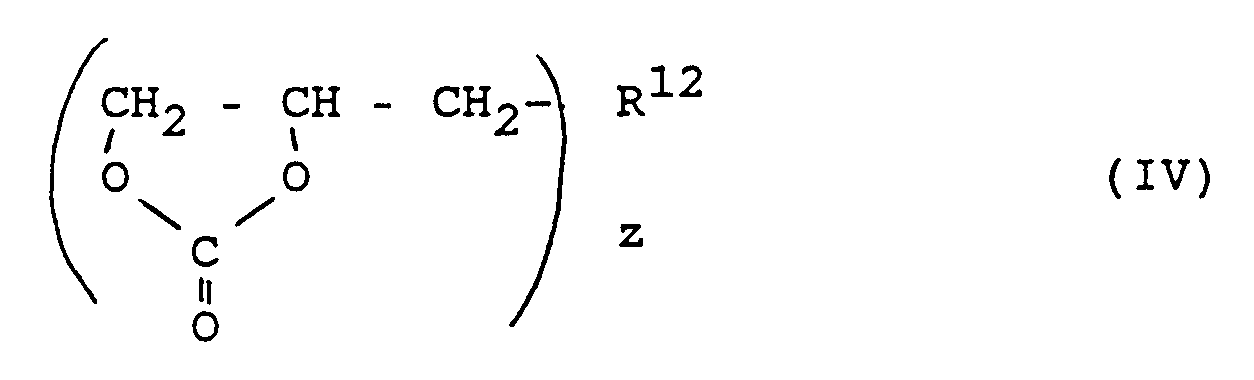
in der bedeuten - R¹² =
- z-wertiger Rest eines Polyethers, Polyetherpolyols, Polyesters, Polyesterpolyols, der gegebenenfalls auch (NR¹³)-Gruppen enthalten kann, wobei R¹³ für Wasserstoff, Alkyl mit 1 bis 14, vorzugsweise 1 bis 8 C-Atomen oder Hydroxyalkyl mit 1 bis 14 , vorzugsweise 1 bis 8 C-Atomen steht, und diese Reste im allgemeinen mittlere Molekulargewichte
M n von 200 bis 5000, vorzugsweise 200 bis 2000 aufweisen, oder einen z-wertigen Kohlenwasserstoffrest, vorzugsweise Alkylenrest mit 2 bis 18 C-Atomen, der gegebenenfalls inerte oder nichtstörende Gruppen tragen kann, oder
einen z-wertigen Poly(sek.)aminrest oder
den z-wertigen Rest eines Umsetzungsproduktes einer Epoxy-Carbonat-Verbindung mit Polyaminen, Polyolen, Polycaprolactonpolyolen, OH-gruppenhaltigen Polyestern, Polyethern, Polyglykolen, hydroxy-, carboxyl- und aminofunktionellen Polymerölen mit mittleren MolekulargewichtenM n von 800 bis 10 000, Polycarbonsäuren, hydroxy- oder aminofunktionellen Polytetrahydrofuranen oder von Umsetzungsprodukten von Polyaminen mit Glycidylestern von α,α-Dialkylalkanmonocarbonsäuren der Summenformel C12-14H₂₂₋₂₆0₃ oder mit Versaticsäureglycidylester, wobei diese Umsetzungsprodukte im allgemeinen mittlere MolekulargewichteM n von 300 bis 12000, vorzugsweise 400 bis 5000 aufweisen, - z =
- 1 bis 5.
- Der Index z steht in dieser Formel (IV) bevorzugt für 2 oder 3, insbesondere für 2.
- Unter "Rest" im vorstehenden Sinne sei hier die jeweilige Verbindung (z.B. Polyether) abzüglich der aktiven H-Atome derjenigen Gruppen verstanden, die an die CH₂-Gruppe in Formel (IV) angrenzen.
- Derartige Verbindungen und deren Herstellung sind beispielsweise in DE-A- 37 26 497 beschrieben, auf die hier Bezug genommen wird.
- Bevorzugte Ausgangstoffe zur Herstellung der cyclischen Carbonate (IV) und der gegebenenfalls eingesetzten gemischten Epoxy-Carbonat-Verbindungen (V) sind die Polyglycidylether von Polyphenolen, z.B. Bisphenol A oder Bisphenol F. Die Glycidylether erhält man beispielsweise durch Umsetzung eines Polyphenols mit Epichlorhydrin. Polphenole sind beispielsweise Bis-(4-hydroxyphenyl)-2,2-propan, Bis(4-hydroxyphenyl)-methan, 4,4′-Dihydroxybenzophenon, Bis(4-hydroxyphenyl)-1,1′-ether, Bis(4-hydroxyphenyl)-1,1′-isobutan, Bis(2-hydroxynaphthyl)-methan, 1,5-Dihydroxynaphthalin. Vorzugsweise sind zusätzlich freie Hydroxylgruppen zu den Epoxydgruppen im Polyglycidylether des Polyphenols enthalten. Auch Diglycidyladdukte von (cyclischen) Harnstoffen sind hierfür einsetzbar.
- Im manchen Fällen kann es zweckmäßig sein, als Komponente (B) zusätzlich oder gegebenenfalls alleine gemischte Epoxyd-Carbonate einzusetzen, wie solche der allgemeinen Formel (V)

in der R12′ die Bedeutung von CH₂-R¹²-CH₂ hat. - Sofern die Verbindungen (B) OH-Gruppen enthalten, könnnen diese bereits in diesem Stadium teilweise oder vollständig mit den Isocyanaten (D1)/(D2) umgesetzt werden. Dies ist jedoch dann erforderlich, wenn das weiter unten beschriebene Addukt (C) noch freie, zur Quaternisierung vorgesehene primäre und/oder sekundäre Aminogruppen enthält, die ansonsten bevorzugt mit dem Isocyanat reagieren würden. Andernfalls, wenn also das Addukt (C) nur tertiäre oder verkappte primäre/sekundäre Aminogruppen enthält oder genügend tertiäre Aminogruppen für die Quaternisierung vorhanden sind, so daß die primären/sekundären Aminogruppen wegreagieren können, erfolgt die Reaktion mit den Isocyanaten (D1)/(D2) bevorzugt erst bei diesem Addukt (C).
- Zur Herstellung dieses Adduktes (C) werden die Komponenten (A) und (B) in den erforderlichen stöchiometrischen Verhältnissen bzw. Mengen bei erhöhten Temperaturen, beispielsweise 50 bis 140°C, vorzugsweise 50 bis 100°C, und in Gegenwart gegebenenfalls von Katalysatoren und vorzugsweise inerten Lösungsmitteln umgesetzt. Die Umsetzung wird im allgemeinen so lange vorgenommen, bis z.B. eine konstante oder die theoretische Aminzahl erreicht ist. Dabei ist darauf zu achten, daß keine Gelierung eintritt. Bevorzugt werden die Komponenten (A) und (B) in solchen Mengen eingesetzt, daß 0,8 bis 1,5 Äquivalente primäre Aminogruppen auf 1 Äquivalent cyclische Carbonatgruppen kommen. Ein bevorzugtes Reaktionssystem hat beispielsweise folgende Zusammensetzung:
- (A1): 28 - 80, vorzugsweise 40 - 70 Mol-%;
- (A2): 0 - 40, vorzugsweise 0 - 30 Mol-%;
- (B): 20 - 72, vorzugsweise 30 - 60 Mol-%.
- Während für die Umsetzung der primären Aminogruppen der Komponente (A) mit den 2-Oxo-1,3-dioxolan-Gruppen der Komponente (B) im allgemeinen kein Katalysator erforderlich ist, ist eine Katalyse für die Reaktion der reaktionsträgeren sek. Aminogruppen -sofern in der Komponente (A) vorhanden- zweckmäßig. Geeignete Katalysatoren hierfür sind stark basische Verbindungen, wie quartäre Ammoniumverbindungen, beispielsweose Alkyl-, Aryl-und/oder Benzylammoniumhydroxide und -carbonate. Spezielle Vertreter für quartäre Ammoniumverbindungen sind hierbei Alkylbenzyldimethylammoniumhydroxyd (Alkyl=C₁₆-C₂₂), Benzyltrimethylammoniumhydroxyd und Tetrabutylammoniumhydroxyd.
- Bevorzugt sind als Katalysatoren stark basische Amine, beispielsweise Diazabicyclooctan (DABCO), Guanidin etc.
- Weiterhin sind hier auch sogenannte supranukleophile Katalysatoren, z.B. 4-Pyrrolidinpyridin, Poly-(N,N-Dialkylaminopyridin) geeignet; vgl. hierzu Artikel von R.A. Vaidya et al. in Polymer Preprints, Bd. 2 (1986), S. 101-102.
- Als Lösungsmittel für die obige Umsetzung kommen vorzugweise aprotische und gegebenfalls polare Lösungsmittel in Frage. Beispielsweise seien hier genannt: halogenierte Kohlenwasserstoffe (weniger geeignet bei Einsatz als Tauchlack), N-Methylpyrrolidon, Ether wie Diethylether, 1,2-Dimethoxyethan, Tetrahydrofuran oder Dimethyldiglykol, Dioxan; Ketone, wie beispielsweise Aceton, Methylethylketon, Methylisopropylketon, Methylisobutylketon, Cyclohexanon und ähnliche; Ester (weniger geeignet bei Einsatz als Tauchlack), wie Butylacetat, Ethylglykolacetat, Methoxypropylacetat; (cyclo)aliphatische und/oder aromatische Kohlenwasserstoffe, wie Hexan, Heptan, Cyclohexan, Benzol, Toluol, die verschiedenen Xylole sowie aromatische Lösemittel im Siedebereich von ca. 150 bis 180°C (höhersiedende Mineralölfraktionen, wie ®Solvesso). Die Lösemittel können dabei einzeln oder im Gemisch eingesetzt werden.
- Bei der stöchiometrischen Bewertung der Ausgangsprodukte und auch der Umsetzungprodukte bezüglich des Fortgangs der Umsetzung werden bei der Komponente (A) die Aminzahl, deren Ermittlung in üblicher Weise durch Perchlorsäuretitration erfolgen kann, und bei der Komponente (B) die Cyclocarbonat-Äquivalenzzahl, die in üblicher Weise durch Titration mit Kaliumhydroxidlösung bestimmt werden kann, zugrunde gelegt. Bezüglich weiterer Einzelheiten der Herstellung sei hier auf die bereits erwähnte DE-A- 37 26 497 sowie auf EP-A- 234 395 verwiesen.
- Als Addukte (C) für die vorliegende Erfindung sind auch grundsätzlich die Verbindungen auf Basis von Umsetzungsprodukten von Aminen und cyclischen Carbonaten gemäß den vorstehend genannten Patentanmeldungen sowie der DE-A- 36 44 370 geeignet, sofern sie in den Molekulargewichtsbereich gemäß dieser Erfindung fallen und eine ausreichende Zahl von quaternierbaren Aminogruppen enthalten.
- Die Umsetzung des Addukts (G) mit den Isocyanaten (D1)/(D2) geschieht unter den für derartige Reaktionen üblichen Bedingungen bei zwechmäßigerweise 30 bis 80°C und in Gegenwart inerter, vorzugsweise aprotischer Lösungsmittel, beispielsweise den oben beschriebenen. Bei Erreichen eines % NCO-Gehaltes von < 0,2 wird die Reaktion abgebrochen.
- Die maximale Zahl der eingesetzten Äquivalente Isocyanat richtet sich zweckmäßig nach folgende Kriterien:
- n(B) =
- Hydroxylfunktionalität der Komponente (B) pro Mol;
- n(A+B) =
- Hydroxylfunktionalität, die entsprechend der Umsetzung (A) + (B) gebildet wird pro Mol (C);
- n(D) =
- Äquivalente Isocyanat (aus D1 und D2) pro Mol (C);
- n(D) =
- n(B) + n (A + B);
- (D1) :
- 0 - 4 Äquivalente/Mol Verbindung (C), vorzugsweise 1 - 2;
- (D2) :
- 0 - 4 Äquivalente/Mol Verbindung (C), vorzugsweise 0 - 2.
- Die langkettigen Monoisocyanate (D1), die den erfindungsgemäßen Verbindungen neben einer gewissen Flexibilität vor allem ein ausreichendes Maß an lyophilem Charakter, verleihen sollen, besitzen in der Regel 6 bis 22 C-Atome, vorzugsweise 10 bis 18 C-Atomen; ihr Kohlenwassertoffrest besitzt vorzugsweise aliphatischen oder araliphatischen Charakter. Beispiele hierfür sind Octadecylisocyanat, Dodecylisocyanat, Nonylphenylisocyanat etc.
- Alternativ kommen hierfür auch teilverkappte, noch eine freie NCO-Gruppe aufweisende Polyisocyanate mit einer Gesamt-C-Zahl von 10 bis 50, vorzugsweise 20 bis 40 in Frage. Als Polyisocyanate, vorzugsweise Diisocyante, können beispielsweise die nachstehend bei (D2) aufgeführten Verwendung finden. Zur Verkappung sind entsprechend längerkettige Verbindungen geeignet die normalerweise bei der Härtung des Lackfilms nicht abgespalten werden. Beispiele hierfür sind: Fettamine, wie Talgfettamin, Octadecylamin oder Dodecylamin, Nonylamin, Isononyloxypropylamin oder entsprechend abgeleitete Alkohole,, zum Beispiel Octadecylalkohol, Hexylglykol und ähnliche. Auch spezielle Polyetheralkohole, wie zum Beispiel die als Netzmittel bekannten ethoxylierten Octyl- bzw. Nonylphenole (z.B. ®Triton-X oder ®Arkopal N) können eingesetzt werden.
- Falls die erfindungsgemäßen Pastenharze selbsthärtend sein sollen, können das Umsetzungsprodukt (C) oder bereits die Komponente (B) auch mit teilverkappten Isocyanaten (D2) umgesetzt werden, die auch kürzerkettig sein können und unter den Härtungsbedingungen entkappen.
- Hierfür geeignete Polyisocyanate sind beliebige, auf dem Polyurethan- bzw. Lackgebiet bekannte Polyisocyanate, beispielsweise aliphatische, cycloaliphatische oder aromatische Polyisocyanate. Typische Beispiele für die derartige Polyisocyanate sind:
Xylylendiisocyanat. Diphenylmethan-4,4-diisocyanat, Triphenylmethyl-4.4′-triisocyanat. Triphenylmethantriisocyanat. Polyphenyl-polymethylisocyanat. 2.2.4(2.4.4)-methylcyclohexyldiisocyanat, Dicyclohexylmethyldiisocyanat, Diethylfumarhexylisocyanat. Bis-(3-Methyl-4-isocyanatocyclo-hexyl)-methan, 2,2-Bis-(4-isocyanatcyclohexyl)-propan, der Methylester des Lysindiisocyanats, das Biuret des Hexamethylendiisocyanats, Diisocyanate dimerer Säuren,1-Methyl-benzol-2,4,5-triisocyanat, Biphenyl-2,4,4′-triisocyanat, das Triisocyanat aus 3 Mol Hexamethylendiisocyanat und 1 Mol Wasser mit 16% NCO-Gehalt und weitere, wenigstens zwei NCO-Gruppen pro Molekül enthaltende Verbindungen, vorzugsweise Isophorondiisocyanat, Hexamethylendiisocyanat sowie Tri-und Tetramethylhexamethylendiisocyanat, insbesondere aber 2,4- oder 2,6-Toluylendiisocyanat oder Gemische dieser Verbindungen. - Neben diesen einfachen Polyisocyanaten sind auch solche geeignet, die Heteroatome in dem die Isocyanatgruppen verknüpfenden Rest enthalten. Beispiele hierfür sind Polyisocyanate, die Carbodiimidgruppen, Allophonatgruppen, Isocyanuratgruppen, Urethangruppen, acylierte Harnstoffgruppen oder Biuretgruppen aufweisen.
- Geeignete Polyisocyanate sind schließlich auch die bekannten, endständige Isocyanatgruppen enthaltenden Präpolymere, wie sie insbesondere durch Umsetzung der obengenannten einfachen Polyisocyanate, vor allem Diisocyanate mit überschüssigen Mengen an organischen Verbindungen mit mindestens zwei gegenüber Isocyanatgruppen reaktionsfähigen Gruppen zugänglich sind. Bevorzugt werden diese Präpolymeren allerdings als externe Härterkomponente bei den fremdvernetzenden Systemen eingesetzt.
- Die Verkappungsmittel sollen so beschaffen sein, daß sie unter den üblichen Härtungstemperaturen von 130 bis 180°C, gegebenenfalls in Gegenwart der hierfür bekannten Katalysatoren, wieder abspalten. Beispiele für derartige Verkappungsmittel sind:
aliphatische, cycloaliphatische oder alkylaromatische (einwertige) Alkohole z.B. niedere aliphatische Alkohole wie Methyl-, Äthylalkohol, die verschiedenen Propyl-, Butyl- und Hexylalkohole, Heptyl-, Octyl-, Nonyl-, Decylalkohol und ähnliche; Methoxy (1- bzw. 2-) propanol; ferner ungesättigte Alkohole wie Allylalkohol, Propargylalkohol, cycloaliphatische Alkohole wie Cyclopentanol, Cyclohexanol, alkylaromatische Alkohole wie Benzylalkohol, Methyl- sowie p-Methoxy- und p-Nitrobenzylalkohol und Monoäther von Glykolen, wie Ethylen-glykolmonoethyläther, -monobutyläther und ähnliche. Weitere Verkappungsmittel sind Ketoxime, zweckmäßigerweise mit 3 bis 20 C-Atomen, vorzugweise 3 bis 10 C-Atomen, wie Acetonoxim, Methylethylketonoxim (=Butanonoxium), Hexanonoxim (wie Methyl-Butylketonoxim), Heptanonoxim (wie Methyl-n-Amylketonoxim), Octanonoxim und Cyclohexanonoxim, CH-acide Verbindungen wie Malonsäurealkylester, Acetessigester sowie Cyanessigester mit jeweils 1 bis 4 C-Atomen in der Estergruppe, NH-acide Verbindungen wie Caprolactam, Aminoalkohole wie Diäthyläthanolamin und spezielle Amine, wie Dibutylamin. Bevorzugt sind hierbei 2-Ethylhexanol, Butyldiglykol, Butylglykol und 3-Methyl-3-methoxybutanol. - Beispiele für geeignete Entkappungs- Katalysatoren sind Bleieoctoat, Bleisilikat, Bleinaphthenat, Zinkverbindungen gemäß den DE-Offenlegungsschriften 28 07 698 und 33 06 064, Zink- und Zink-Blei-Verbindungen der Nitrophthalsäure, Komplexverbindungen aus Zinkoxid und 8-Hydroxychinolin (auch "in situ" anwendbar), Antimontrioxid, Mangan(II und III)acetylacetonat, Manganphosphat, Mangan-Zinkphosphate, Kobaltnaphthenat, Cadmium-acetyl-acetonat, Thallium-dicyclopentadien, Triethanolamin-titanat oder organische Verbindungen des Zinns, zum Beispiel Dibutylzinndilaurat und bevorzugt Dibutylzinnoxid.
- Zur Quaternierung der so erhaltenen, Urethangruppen aufweisenden Produkte (C) können grundsätzlich alle hierbei bekannten Methoden eingesetzt werden, wie sie beispielsweise in DE-A- 26 41 286 beschrieben sind. Durch die Art des eingeführten Gegenions können sich jedoch hierbei Beschränkungen ergeben. So können Quaternierungsverfahren für erfindungsgemäße Pastenharze, die bei Elektrotauchlacken verwendet werden sollen, dann nicht eingesetzt werden, wenn sie Halogenanionen einführen, da diese zu starker Anodenkorrosion führen. Dies ist beispielsweise bei der Quaternierung mit Alkylhalogeniden (jodiden), nicht jedoch mit Dialkylsulfaten oder Trialkylphosphaten der Fall.
- Bevorzugt erfolgt diese Quaternierung durch Umsatz von (C) mit Monoepoxid-Verbindungen, wie z.B. Ethylenoxid, Propylenoxid, 2-Ethylhexylglycidylether, Versaticsäureglycidylester, Glyidyl-Phthalimid, Phenyl-Glycidylether, Methylglycidylether, Phenol-(EQ)₅-Glycidylether in Gegenwart von vorzugsweise organischen Säuren und vorzugsweise 0,5 bis 20 Mol H₂O Mol/Aminogruppe (vgl. hierzu auch Houben-Weyl, Bd. XI/2, S. 609 ff (1958)).
- Die eingesetzten Säuren besitzen einen pKa-Wert von ≦ 6 und sind zweckmäßigerweise gut Wasser mischbar. Beispiel hierfür sind anorganische Säuren wie Phophorsäure; bevorzugt handelt es sich hierbei jedoch um organische Säuren, wie Ameisensäure, Essigsäure und besonders bevorzugt Milchsäure. Es ist beispielsweise auch möglich, die Umsetzung von (C) mit der Monoepoxidverbindung zunächst im Neutralen durchzuführen und erst anschließend die Säure zuzufügen.
- Die Quaternierung wird im allgemeinen bei Temperaturen von 20 bis 100°C, vorzugsweise 50 bis 100°C durchgeführt, vorteilhafterweise in Anwesenheit eines organischen Lösungsmittels. In einer bevorzugten Ausführungsform wird dabei beispielsweise zu einer Mischung aus Umsetzungsprodukt (C) und Monoepoxid-Verbindung (1 Mol pro Mol tertiäre Aminogruppen oder 2 Mol pro Mol sekundäre Aminogruppen) langsam ein Gemisch von 1 Mol Milchsäure/Mol zu quaternierender Aminogruppe und 0,5 bis 20, vorzugsweise 2 bis 10 Mol E-Wasser/Mol zu quaternierender Aminogruppe in einem protischen Lösungsmittel, vorzugsweise Butylglykol, Methoxypropanol und/oder Ethoxypropanol eingebracht. Die Reaktion wird bis zu einer Säurezahl von <10 geführt.
- Im Falle leicht flüchtiger Epoxidverbindungen wird zuerst mit dem Gemisch aus Milchsäure, Wasser und Lösungsmittel versetzt und anschließend unter gelegentlichem Kühlen die Epoxidverbindung (Ethylenoxid, Propylenoxid etc.) eingeleitet (drucksichere Apparatur).
- Die so quaternierten Verbindungen eignen sich ausgezeichnet als Pastenharze für Pigmentpasten bzw. Pigmentdispersionen, wobei -je nach Art des Pigmentes, dessen Primärkorngröße etc.- Pigment: Pastenharz-Verhältnisse von 1:1 bis 40:1, vorzugsweise 12:1 bis 20:1 möglich sind. Neben dem erfindungsgemäßen Pastenharz und dem Pigment kann diese Pigmentpaste noch die üblichen Additive, wie Füllstoffe, sonstige lackübliche Hilfsstoffe (Dipergierhilfsmittel, Netzmittel, Lösemittel, Weichmacher, Entschäumer etc.) sowie gegebenenfalls einen Teil oder die Gesamtmenge der bekannten Härtungskatalysatoren enthalten.
- Als Pigmente kommen die hierfür üblichen in Frage, wie zum Beispiel: Titanoxid (in der Regel als Hauptbestandteil), andere Weißpigmente bzw. Extender, wie Antimonoxid, Zinkoxid, basisches Blei-Carbonat bzw. -Silicat und/oder -Sulfat, Bariumcarbonat, Ton, Calciumcarbonat, Aluminiumsilicat, Kieselerde, Magnesium-Carbonat- und/oder -Silicat; außerdem (zusätzliche) Farbpigmente wie Phthaloxyaninblau, hydratisierte Eisenoxide, Chromgelb, Ruß, Toluidinrot, Braunstein.
- Der Wassergehalt solcher Pigment-Pasten richtet sich nach der für die Verarbeitung gewünschten Viskosität und liegt vorzugsweise zwischen 10 und 50 %. Gegebenenfalls kann die Pigment-Paste auch vor dem Einsatz weiter verdünnt werden.
- Die Herstellung derartiger Pigment-Pasten erfolgt in bekannter Weise, wie etwa in DE-A 37 26 497 oder in DE-A-26 34 229 beschrieben.
- Die Zerkleinerung des Pigmentes geschieht in der Regel in Kugelmühlen, Sandmühlen, Cowles-Auflösern oder kontinuierlichen Zerreibungseinrichtungen, bis das Pigment auf die gewünschte Teilchengröße zerkleinert worden und durch das Trägerharz benetzt oder in ihm dispergiert worden ist. Nach der Zerkleinerung sollte die Teilchengröße des Pigments im Bereich von 10 Micrometer oder kleiner, vorzugsweise so klein wie möglich sein. Im allgemeinen wird das Pigment auf eine Feinheit von kleiner 3 µm (gemessen mit Laser-Aerosolspektroskopie) zerkleinert, vorzugsweise in Gegenwart von Glas-Perlen, Al₂O₃-(Korund)-Perlen oder Keramik- bzw. ZrO₂-Perlen (⌀ 0.5 - 3 mm).
- Vorstehende Pigment-Dispersionen (-Pasten) werden dann in üblicher Weise und ausreichender Menge dem wasserverdünnbaren Lack, insbesondere Elektrotauchlack, zugemischt. Im allgemeinen hat die fertige, elektrisch abscheidbare Zusammensetzung ein Verhältnis von Pigment zu Bindemittel (=elektrisch abscheidbares Harz plus Pastenharz) von 0,05:1 bis 0,8:1.
- Als filmbildende Harze in diesen Lacken kommen die hierfür bekannten Produkte in Frage, wie sie beispielsweise in DE-A- 36 44 371, DE-A- 37 26 497.4 und DE-A- 38 09 655 sowie in EP-A- 234 395 beschrieben sind. Weitere hierfür geeignete Harze sind im Journal of Coatings Technology, Vol. 54, No. 686, (1982), S. 33 bis 41 ("Polymer Compositions for Cationic Electodepositable Coatings") offenbart, worauf gleichfalls Bezug genommen wird.
- Die elektrische Ablagerung der Lackteilchen aus den Elektrotauchlacken erfolgt nach bekannten Verfahren, auf die hier verwiesen wird. Die Abscheidung kann auf allen elektrisch leitenden Substraten erfolgen, z.B. Metall wie Stahl, Kupfer, Aluminium und dergleichen.
- Nach der Abscheidung wird der Überzug bei erhöhten Temperaturen, die im allgemeinen von der Beschaffenheit der Härterkomponente abhängig sind, durch übliche Verfahren gehärtet, wobei Temperaturen von 100 bis 220°C vorzugsweise 130 bis 180°C verwendet werden.
- Die erhaltenen Überzüge zeichnen sich insbesondere durch hervorragende Salzsprühbelastbarkeit (ASTM-B-117-64; 960 Stunden auf zinkphosphatiertem und blankem Eisenblech) aus. Die erfindungsgemäßen Pastenharze liefern beim Einbrennen aufgrund der Umwandlung von quaternärer Ammoniumstruktur in tertiäres Amin keine Spaltprodukte, die zum Kettenabbruch führen. Mit dieser Umwandlung ist auch eine Veringerung der Polarität des Lackfilms und damit eine Erhöhung der Wasserbeständigkeit verbunden.
- Alle Mengenangaben sind in Gewichtsteilen.
- Der Siebrückstand und die "L-Blechbeschichtung" wurden folgendermaßen bestimmt bzw. durchgeführt:
- 1 l der verdünnten Lacklösung wird durch ein gewogenes Perlonsieb (Maschenweite 30 µm) gegossen. Das Sieb wird mit deionisiertem Wasser nachgespült und nach Trocknung (1 h/125 °C) gewogen. Das Ergebnis wird in mg Rückstand angegeben (auf 1000 ml Bad bezogen).
- Ein zinkphosphatiertes Stahlblech (zirka 10 x 20 cm) wird am unteren Ende rechtwinklig gebogen (3 cm waagrechte Fläche). Das Blech wird im Beschichtungsbad so eingehängt, daß der waagrechte Schenkel des L etwa 15 cm unter der Oberfläche des Lackbades ist. Die Beschichtung erfolgt bei abgestellter Rührung und mit einer Beschichtungsdauer von 4 min. Nach Ende der Beschichtung verbleibt das Blech noch 2 min. im Bad. Anschließend wird das Blech aus dem Bad genommen, nach weiteren 2 min. mit Wasser gespült und eingebrannt. Das Blech wird visuell hinsichtlich Verlauf, Glanz und Sedimentationserscheinungen beurteilt.
- Zu 174 T Toluylendiisocyanat (2 Äquiv. NCO, 80 % 2,5-, 20 % 2,6-Isomeres) wurden bei 25 bis 40°C in Gegenwart von 0,01 % Triethylamin als Katalysator, 124 T (1,05 Äquiv. OH) Butylglykol langsam einlaufen gelassen und bis zu einem NCO-Wert ca. 13,5 bis 14,0 % umgesetzt.
-
- 2.1.) Zu 1048 T eines Biscarbonates auf Basis ®Epicote 1001 (1 mol, 2 Äquiv. Carbonat) in 537 T N-Methylpyrrolidon wurden während einer Stunde 204 T N-N-Dimethylaminopropylamin (2 mol, 2 Äquiv. primäres Amin) bei ca. 60 °C einlaufen gelassen. Anschließend wurde die Reaktionsmischung für ca. 3 bis 5 Stunden auf dieser Temperatur gehalten (Aminzahl ca. 94/Bindemittel fest). Die 70%ige Harzmischung konnte anschließend weiter verarbeitet werden.
- 2.2) Zu 920 T eines Biscarbonates auf Basis von ®Epicote 828 (2 mol, 4 Äquiv. Carbonat) in 557 T N-Methylpyrrolidon wurde während einer Stunde eine Mischung, bestehend aus 204 T N,N-Dimethylaminopropylamin (2 mol,2 Äquiv. primäres Amin) und 176 T 4,7-Dioxadecan- 1,10-diamin (1 mol, 2 Äquiv. primäres Amin), bei ca. 60 °C einlaufen gelassen. Anschließend wurde die Reaktionsmischung für ca. 3 bis 5 Stunden auf dieser Temperatur gehalten (Aminzahl ca. 90/Bindemittel fest). Die 70%ige Harzmischung konnte anschließend weiter verarbeitet werden.
- Gemäß nachstehender Tabelle 1 wurde zu den vorstehend unter 2.) erhaltenen Reaktionsmischungen während einer Stunde x T Octadecylisocyanat (D1) und y T teilverkapptes Isocyanat (D2) gemäß Beispiel 1) bei 60 bis 70 °C einlaufen gelassen. Anschließend wurde der Reaktionsansatz bei dieser Temperatur gehalten, bis ein NCO-Wert von praktisch 0 % erreicht war.
Tabelle 1 Beispiel 3.1 3.2 3.3 Ausgangsverbindung entsprechend Beispiel: 2.1. 2.1. 2.1. x T Octadecylisocyanat 590 590 590 (mol/Äquiv. NCO) (2/2) (2/2) (2/2) y T Isocyanat gemäß Bsp. 1 - 596 596 (mol/Äquiv. NCO) - (2/1,9) (2/1,9) Aminzahl (Bdm-fest) 62 47 45 Festkörper (in %; 1 h, 125 °C) 78 82 82 nA 2 - 2,5 2 - 2,5 - n(A + B) 2 2 4 - Die unter 3.) erhaltenen Bindemittelvorstufen (Mengenangaben siehe nachstehende Tabelle 2) wurden in einem auf mindestens 10 bar Überdruck ausgelegten Reaktionsgefääß unter Stickstoff vorgelegt. Anschließend wurde bei 50 °C unter gelegentlichem Kühlen eine Mischung bestehend aus 102, 2 T Milchsäure/90%ig (2 Mol), 26 T E-Wasser (in Summe 2 Mol) und x T Butylglykol während 20 min einlaufen gelassen. Zu dieser gut homogenisierten Mischung wurden mit Stickstoff 10 T Ethylenoxid (0,228 mol) eingeleitet. Dabei stieg die Temperatur an. Durch gelegentliches Kühlen wurde sie bei 100 bis 120 °C gehalten. Anschließend wurde auf 70 bis 80 °C gekühlt und während 2 Stunden die restliche Menge an Ethylenoxid (ca. 166 T; 3,772 Mol) eingeleitet.
- Die Reaktion war beim Erreichen einer Säurezahl im Bereich von 10 bis praktisch Null (ca. weitere 2 bis 4 Stunden) beendet. Dann wurde überschüssiges Ethylenoxyd abdestilliert, anschließend mit y T E-Wasser auf Festkörper eingestellt und der Ansatz abgekühlt.
Tabelle 2 Beispiel 4.1 4.2 4.3 Ausgangsverbindung entsprechend Beispiel: 3.1. 3.2. 3.3. Einwaage in T 2379 2975 2943 T Butylglykol 107 306 268 T E-Wasser* 56 112 208 Festkörper (in %; 1 h, 125 °C) 70 70 70 Viskosität (DIN 53 019) mpa.s bei 100 s⁻¹, 20 °C 310 280 320 keine Thioxotropie *E-Wasser = vollentsaltzes Wasser - Alle Bindemittel waren unbegrenzt wassermischbar.
- Für den Vergleichsversuch wurde ein Pigmentpastenharz, welches in seinem Aufbau in der EP-Offenlegungsschrift 107 098 (Beispiel II) beschrieben ist, synthetisiert.
- Zu 420 T (2 Äquivalente) Kokosfettsäure wurden bei Raumtemperatur während einer 1/2 Stunde 235 T (2,3 Äquivalente) Dimethylaminopropylamin einlaufen gelassen. Dabei stieg die Temperatur auf ca. 70 °C an. Die Reaktionsmischung wurde anschließend bei 135 bis 140 °C für ca. 2 Stunden Rückfluß gekocht.
- Anschließend wurde über einen Wasserabscheider Reaktionswasser abdestilliert und im Anschluß daran im Vakuum von überschüssigem Amin befreit. Das Reaktionsprodukt wurde dann auf Raumtemperatur abgekühlt, mit 237 T Butylglykol verdünnt, gut homogenisiert, dann mit 218 T Milchsäure (90%ig, 2,18 Äquivalente) versetzt. Dabei stieg die Temperatur auf ca. 60 °C an und wurde dort für ca. 15 min. gehalten. Anschließend wurde mit 208 T vollentsalztem Wasser versetzt, bei 60 °C für 15 min. gut homogenisiert, und dann wurden rasch 439 T (2,34 Äquivalente) Epikote 828 zugegeben. Die Reaktionsmischung wurde dann auf 75 bis 85 °C erwärmt und für 2 Stunden bei dieser Temperatur gehalten. Das Produkt hatte eine Säurezahl von ca. 10 mg KOH/g Festharz und einen Festkörpergehalt (1h, 125°C) von ca. 62 %. Das Bindemittel war unbegrenzt wassermischbar.
-
a) Aus den Bindemitteln entsprechend den Beispielen 4.1, 4.2., 4.3. und dem Vergleichsversuch 5 wurden gemäß der nachstehenden Formulierung Pigmentpasten nach üblichen Standardprüfrezepturen hergestellt.Pigmentzusammensetzung (inkl. Additive): A B 3,550 a)®Surfynol 104/50%ig in Butylglykol 3,550 10,542 b) basische Bleisilikatpaste/75%ig in E-Wasser (EP 202) 10,542 1,692 c)®Printex 25 (Farbruß) 1,480 5,086 Dibutylzinnoxid 14,834 79,130 d)Titanoxid RSE 50 69,594 a) Air Products and Chemicals Inc. (USA) b) Fa. Heubach c) Fa. Degussa AG d) Fa. Bayer AG -
Pigmentpaste: Beispiel Pastenharz gemäß Pigmentzusammensetzung. PBV Festkörper (1h, 125°C) 6.1. 4.1. A 12:1 70 % 6.2. 4.2 A 12:1 70 % 6.3. 4.3 A 12:1 68 % 6.4. 5 (Vergl.) A 12:1 80 % 6.5. 5 (Vergl.) B 35:1 70 % - Die Pastenharze wurden gemäß obiger Rezeptur, in der dem Fachmann bekannten Art und Weise auf einer Perlenmühle (s. a. DE-Patentanmeldung P 3 726 497.4) angerieben und anschließend mit E-Wasser auf Festkörper eingestellt, um eine entsprechende Handbarkeit zu gewährleisten.
- Alle Pasten besaßen praktisch kein Thixotropierverhalten und hatten Viskositäten bei D = 50 s-1 von 300 bis 450 mPa.s und bei D = 100 s-1 von 150 bis 250 mPa.s. Die Pasten zeigten auch bei Lagerung (4 Wochen, Raumtemperatur) keine nennenswerte Viskositätsveränderung bzw. Pigmentantrocknungen.
- b) Die Pasten wurden dann einem verdünnten Klarlack (20%ige wäßrige Lösung) der nachfolgend unter II beschriebenen K-ETL-Bindemittel-Dispersionen unter Rühren zugesetzt und anschließend mit E-Wasser auf 18 % Festkörper (1 h, 125 °C) eingestellt. Anschließend wurde nach 24 Stunden, 14 Tagen und 4 Wochen (Rühren bei Raumtemperatur) der Siebrückstand bestimmt und eine "L-Blech-Beschichtung" durchgeführt.
Die Zusammensetzung der Prüflacke und die resultierenden Ergebnisse sind in der weiter unten folgenden Tabelle 4 zusammengefaßt. - Zu 129,3 T (0,55 Mol) DETA(EO)₃ [DETA(EO)₃ = dreifach ethoxyliertes Diethylentriamin wie in vorstehender Patentanmeldung beschrieben] in 116,80 T N-Methylpyrrolidon wurden während 30 min bei 60 °C 102,3 T (0,55 Mol) ®Beckopox-080 (2-Ethylhexylglycidylether) zugegeben. Die Temperatur stieg bis 80 °C an, und die Reaktionsmischung wurde dann bis zum Erreichen einer Epoxidzahl von ∼0 bei 100 °C gehalten (∼3 Stunden). Anschließend wurde mit 449 T Toluol verdünnt und auf 60 °C gekühlt. In diese Mischung wurden dann während 30 min 819,5 T (2,75 Mol) des teilverkappten Polyisocyanats gemäß I 1.) einlaufen gelassen und anschließend während 4 Stunden bei 70 °C bis zu einem % NCO-Wert von 0,15 umgesetzt.
Die Aminzahl des erhaltenen Härters lag bei ca. 57,5 mg KOH/g.
Festkörper (1 h, 125 °C): 65 % - 832 T des Monocarbonates von ®Epicote 828 (Diglycidylether von Bisphenol A; 2 Äquiv. Epoxid), 830 T ®Capa 205 (= Polycaprolactondiol mit mittl. Molmasse von 830) und 712 T Toluol wurden gemischt und bei 70 bis 140 °C in Gegenwart von ca. 0,3 % Bortrifluordietherat zur Reaktion gebracht bis eine Epoxidzahl von ca. 0 erreicht wurde. Anschließend wurden 1497 T des Biscarbonates von ®Epicote 1001 (2 Äquivalente Carbonat, 70%ig in Toluol als Suspension) zugesetzt, gut homogenisiert und bei 60 bis 80 °C während 2 Stunden 1192 T der Verbindung gemäß Beispiel I.1 einlaufen gelassen. Anschließend wurde bis zum Erreichen von ca. 0 % NCO auf 80 °C gehalten.
- Die Reaktionsmischung wurde dann auf ca. 40 °C gekühlt, mit 645 T Bishexamethylentriamin versetzt und bei 30 bis 40 °C während 2 bis 3 Stunden nochmals 596 T der Verbindung I.1. zugegeben und anschließend bei 40 °C bis zu einem % NCO-Wert von ≦ 0,1 % abreagieren gelassen.
- Die so erhaltenen Bindemittelmischung wurde mit 1490 T Methoxypropanol auf 66 % Festkörper eingestellt, auf ca. 70 °C erwärmt und bis zum Erreichen einer Aminzahl von ca. 33 (bezogen auf Bindemittel fest) gehalten. Anschließend wurde mit 142 T Ameisensäure (50%ig) auf einen MEQ-Wert von ca. 30 teilneutralisiert (Festkörper 65%ig, 1 Stunde, 125 °C).
- 301 T Diethanolamin, 189 T N-N-Dimethylaminopropylamin und 1147 T eines Adduktes aus 2 mol 2-Methylpentamethylendiamin und 4 Mol Glycidylester der Versaticsäure (Cardura® E 10 von Shell) zu 5273 T Bisphenol-A-Epoxidharz (Epoxidäquivalentgewicht 475) in 3000 T Ethoxypropanol gegeben. Das Reaktionsgemisch wurde 4 Stunden unter Rühren bei 60 bis 90 °C und dann eine Stunde bei 120 °C gehalten. Anschließend wurde mit Ethoxypropanol auf 65 % Festkörper verdünnt (∼720 g).
Hydroxylzahl 276 mg KOH/g Festharz Hydroxylzahl (primäres OH) 55 mg KOH/g Festharz Hydrierjodzahl praktisch Null Aminzahl (tertiäre Aminogruppen) 78 mg KOH/g Festharz - Gemäß nachstehender Rezeptur wurden aus den in II 2. beschriebenen Bindemitteln folgende Dispersionen erstellt (40 %ig; 1 h, 125 °C):
Tabelle 3 Dispersion I Dispersion II 588 T Bindemittel 2.1. (65%ig in Toluol/Methoxypropanol) 1032 T Bindemittel 2.2. (65%ig in Ethoxypropanol) 588 T Bindemittel 2.2. (65%ig in Ethoxypropanol) 363 T Härter 1. (65%ig in NMP/Toluol) 506 T Härter 1. (65%ig in NMP/Toluol) 20 T Butyldiglykol 20 T Butyldiglykol 17,06 T Ameisensäure, 50%ig 32,2 T Ameisensäure/50%ig 1381 T E-Wasser 1389 T E-Wasser NMP = N-Methylpyrrolidon - Die Bindemittel, der Härter, das Butyldiglykol und die Ameisensäure wurden vorgelegt, gut homogenisiert und dann durch Vakuumdestillation bei Temperaturen von 40 bis 80 °C (Manteltemperatur) und Drucken bis minimal 0,02 bar in 50 min. 457 g (I) bzw. 463 g (II) Lösemittel abgezogen. Um ein Schäumen zu vermeiden, wurde dabei der Druck nur entsprechend langsam vermindert. Nach Abschluß der Destillation wurde belüftet und mit 60 °C warmen E-Wasser auf 40 Gew.-% Festkörpergehalt (bestimmt bei 125 °C/1 h) unter gutem Rühren dispergiert. Die so erhaltenen dünnflüssigen Dispersionen wurden beo 40 °C über einen 25 µm GAF-Filter filtriert. Die MEQ-Werte lagen bei ca. 30 (I) bzw. 35 (II).
- Die Prüfkombination 1 bis 10 wurde der kataphoretischen Abscheidung in einem offenen Glasgefäß unterworfen. Als Kathode dienten die angeführten Untergründe und als Anode, im Abstand von 5 bis 10 cm von der Kathode, blankes Stahlblech. Die Badtemperatur lag bei 28 °C, die Abscheidedauer betrug 2 min.
- Die Oberflächenbeurteilungen erfolgten an den gehärteten Filmen (Einbrennbedingungen: 20 min, Objekttemperatur von 180 °C) mit einer Sollschichtstärke von 20 µm auf B 1. Die Ergebnisse sind in der nachstehenden Tabelle 4 zusammengefaßt:

- Die Abkürzungen in der Tabelle 4 haben folgende Bedeutung:

- Die Beschichtung auf den verschiedenen Untergründen (Al, B1), B2, B3) erfolgten unter gleichen Abscheidebedingungen und dürfen keine Unterschiede (Δ ≧ 2 µm) in der Schichtsärke (∼20 µm) aufweisen. Auch müssen Verlauf, Kantenabdeckung und Mattierung des Films in Ordnung sein.
- Aus dieser Tabelle 4 folgt, daß die erfindungsgemäßen Pigmentpasten, den gestellten Anforderungen hinsichtlich Stabilität und Beschichtungsverhalten gerecht werden. Bei den Vergleichspasten (vorallem 6.5) zeigt sich, daß sie ungünstiger im Siebrückstand und L-Blech sind und die hohen Pigment-Bindemittelverhältnisse dem eher noch abträglich sind (PBV ∼ 35:1).
Claims (16)
- Pigmentpaste enthaltend ein Pigment und ein Pastenharz, dadurch gekennzeichnet, daß das Pastenharz enthält (a) quaternäre Ammoniumgruppen, (b) OH-Gruppen, (c) Urethanreste und (d) Gruppen der Formel (I)

M n) dieser Pastenharze 500 bis 10000 beträgt und wobei das Verhältnis Pigment: Pastenharz größer als 2:1 ist. - Pigmentpaste nach Anspruch 1, dadurch gekennzeichnet, daß das Pastenharz pro Molekül im Mittel 1 bis 4 der Gruppen (a) und 1 bis 6 der Gruppen (d) enthält.
- Pigmentpaste nach Anspruch 1 und/oder 2, dadurch gekennzeichnet, daß die Zahl der Gruppen (b) im Pastenharz im Mittel 1 bis 20 pro Molekül beträgt.
- Pigmentpaste nach mindestens einem der Ansprüche 1 bis 3, dadurch gekennzeichnet, daß die Zahl der Gruppen (c) im Pastenharz bei 1 bis 6 pro Molekül liegt.
- Pigmentpaste nach mindestens einem der Ansprüche 1 bis 4, dadurch gekennzeichnet, daß sich die Urethanreste (c) und X in Formel (I) des Pastenharzes von Monoisocyanaten mit 6 bis 22 C-Atomen oder von teilverkappten Polyisocyanaten mit einer Gesamt-C-Zahl von 10 bis 50 ableiten.
- Pigmentpaste nach mindestens einem der Ansprüche 1 bis 5, dadurch gekennzeichnet, daß das mittlere Molekulargewicht (
M n) des Pastenharzes 1000 bis 5000 beträgt. - Pigmentpaste nach mindestens einem der Ansprüche 1 bis 6, dadurch gekennzeichnet, daß die OH-Zahlen des Pastenharzes 10 bis 200 mg KOH/g betragen.
- Pigmentpaste nach mindestens einem der Ansprüche 1 bis 7, dadurch gekennzeichnet, daß die Menge an quaternärem Stickstoff des Pastenharzes pro Gramm 0,2 bis 20 Milliäquivalente beträgt.
- Pigmentpaste nach mindestens einem der Ansprüche 1 bis 8, dadurch gekennzeichnet, daß das Pastenharz verkappte Isocyanatreste enthält, die unter den Härtungsbedingungen entkappen.
- Pigmentpaste nach mindestens einem der Ansprüche 1 bis 9, dadurch gekennzeichnet, daß das Pastenharz hergestellt wird, indem man zunächst Polyamine (A) mit Verbindungen (B), die mindestens eine cyclische Carbonatgruppe sowie gegebenenfalls OH-Gruppen, 1,2-Epoxidgruppen und Urethan-Gruppen enthalten, so umsetzt, daß dieses Umsetzungsprodukt (C) noch quaternierbare Aminogruppen aufweist, und dieses Umsetzungsprodukt (C), gegebenenfalls nach vorheriger Reaktion mit Monoisocyanaten mit 6 bis 22 C-Atomen oder mit teilverkappten, noch eine freie NCO-Gruppe aufweisenden Polyisocyanaten, dann quaterniert.
- Pigmentpaste nach Anspruch 10, dadurch gekennzeichnet, daß man zur Herstellung des Pastenharzes als Polyamine (A) Diamine einsetzt, die diprimär sind (A₂) und/oder die neben einer primären Aminogruppe eine sekundäre oder tertiäre Aminogruppe (A₁) enthalten.
- Pigmentpaste nach Anspruch 10 und/oder 11, dadurch gekennzeichnet, daß man zur Herstellung des Pastenharzes als Verbindungen (B) solche der Formel (IV)
 R¹² = z-wertiger Rest eines Polyethers, Polyetherpolyols, Polyesters, Poly-esterpolyols, der gegebenenfalls auch (NR¹³)-Gruppen enthalten kann, wobei R¹³ für Wasserstoff, Alkyl mit 1 bis 14 C-Atomen oder Hydroxyalkyl mit 1 bis 14 C-Atomen steht, oder einen z-wertigen Kohlenwasserstoffrest, vorzugsweise Alkylenrest mit 2 bis 18 C-Atomen, der gegebenenfalls auch inerte Gruppen tragen kann,
oder
einen z-wertigen Poly(sek.)aminrest oder
den z-wertigen Rest eines Umsetzungsproduktes einer Epoxy-Carbonat-Verbindung mit Polyaminen, Polyolen, Polycaprolactonpolyolen, OH-gruppenhaltigen Polyestern, Polyethern, Polyglykolen, hydroxy-, carboxyl- und eminofunktionellen Polymerölen mit mittleren Molekulargewichten von 800 bis 10000, Polycarbonsäuren, hydroxy- oder aminofunktionellen Polytetrahydrofuranen und Reaktionsprodukten von Polyaminen mit Glycidylestern von α,α-Dialkylalkanmonocarbonsäuren der Summenformel C₁₂₋₁₄H₂₂₋₂₆O₃ oder mit Versaticsäureglycidylester,z = 1 bis 5, vorzugsweise 2. - Pigmentpaste nach mindestens einem der Ansprüche 10 bis 12, dadurch gekennzeichnet, daß zur Herstellung des Pastenharzes (A₁), (A₂) und (B) in Mengen von 28 bis 80 Mol-%, 0 bis 40 Mol-% und 20 bis 60 Mol-% eingesetzt werden.
- Pigmentpaste nach Anspruch 10, dadurch gekennzeichnet, daß zur Herstellung des Pastenharzes die Umsetzung von (A) und (B) bei Temperaturen von 50 bis 140 °C erfolgt.
- Pigmentpaste nach mindestens einem der Ansprüche 10 bis 14, dadurch gekennzeichnet, daß die Quarternierung durch Umsetzung von (C) mit einem Monoepoxid zur Herstellung des Pastenharzes im sauren Milieu erfolgt.
- Verwendung der Pigmentpaste gemäß mindestens einem der Ansprüche 1 bis 15 zur Herstellung von pigmentierten Lacken.
Priority Applications (1)
| Application Number | Priority Date | Filing Date | Title |
|---|---|---|---|
| AT89110249T ATE101167T1 (de) | 1988-06-15 | 1989-06-07 | Traegerharz fuer pigmentpasten, seine herstellung und verwendung. |
Applications Claiming Priority (2)
| Application Number | Priority Date | Filing Date | Title |
|---|---|---|---|
| DE3820300A DE3820300A1 (de) | 1988-06-15 | 1988-06-15 | Traegerharz fuer pigmentpasten, seine herstellung und verwendung |
| DE3820300 | 1988-06-15 |
Publications (3)
| Publication Number | Publication Date |
|---|---|
| EP0350618A2 EP0350618A2 (de) | 1990-01-17 |
| EP0350618A3 EP0350618A3 (en) | 1990-08-29 |
| EP0350618B1 true EP0350618B1 (de) | 1994-02-02 |
Family
ID=6356556
Family Applications (1)
| Application Number | Title | Priority Date | Filing Date |
|---|---|---|---|
| EP89110249A Expired - Lifetime EP0350618B1 (de) | 1988-06-15 | 1989-06-07 | Trägerharz für Pigmentpasten, seine Herstellung und Verwendung |
Country Status (7)
| Country | Link |
|---|---|
| US (1) | US5055542A (de) |
| EP (1) | EP0350618B1 (de) |
| JP (1) | JPH0234634A (de) |
| AT (1) | ATE101167T1 (de) |
| CA (1) | CA1336933C (de) |
| DE (2) | DE3820300A1 (de) |
| ES (1) | ES2049776T3 (de) |
Families Citing this family (12)
| Publication number | Priority date | Publication date | Assignee | Title |
|---|---|---|---|---|
| DE3825584A1 (de) * | 1988-07-28 | 1990-02-01 | Hoechst Ag | Traegerharz fuer pigmentpasten, seine herstellung und verwendung |
| DE3905545A1 (de) * | 1989-02-23 | 1990-08-30 | Basf Lacke & Farben | Verfahren zur herstellung von verschluessen fuer verpackungsbehaelter |
| DE4215480A1 (de) * | 1992-05-11 | 1993-11-18 | Hoechst Ag | Elektrotauchlackbad enthaltend ein Urethan |
| US5401790A (en) * | 1994-03-31 | 1995-03-28 | Ppg Industries, Inc. | Waterborne coating compositions having improved smoothness |
| US5684072A (en) * | 1995-03-22 | 1997-11-04 | Ppg Industries, Inc. | Waterborne coating compositions having improved smoothness |
| DE19534327A1 (de) * | 1995-09-15 | 1996-02-22 | Md Papier Gmbh | Streichfarbe für Tintenstrahlpapier |
| DE19933094A1 (de) * | 1999-07-15 | 2001-01-18 | Herberts Gmbh & Co Kg | Pigmentpasten, deren Herstellung und diese enthaltende kathodisch abscheidbare Überzugsmittel |
| US20030036584A1 (en) * | 2001-08-08 | 2003-02-20 | Allisa Gam | Pigment dispersant for cathodic electrocoating compositions |
| US6607646B2 (en) | 2001-09-12 | 2003-08-19 | E. I. Du Pont De Nemours And Company | Cathodic electrocoating compositions containing hydroxyl-carbonate blocked polyisocyanate crosslinking agent |
| EP1556436B1 (de) * | 2002-10-29 | 2006-06-21 | Akzo Nobel N.V. | Polyaminderivate, herstellungsverfahren dafür und verwendung davon |
| WO2009045408A1 (en) * | 2007-10-01 | 2009-04-09 | Ethox Chemicals, Llc | Alkoxylated polyamines and polyetherpolyamine polyol compositions for foam control |
| FR2981931B1 (fr) | 2011-10-28 | 2014-07-04 | Gen Produits Ind S E G Soc D Expl | Procede de preparation d'un compose comprenant au moins un motif beta-hydroxy-urethane et/ou au moins un motif gamma-hydroxy-urethane. |
Family Cites Families (18)
| Publication number | Priority date | Publication date | Assignee | Title |
|---|---|---|---|---|
| US3936405A (en) * | 1972-08-16 | 1976-02-03 | Ppg Industries, Inc. | Novel pigment grinding vehicles |
| US4102863A (en) * | 1976-11-24 | 1978-07-25 | Ppg Industries, Inc. | Cationic electrodeposition using aqueous dispersions of quaternary ammonium carbonate-containing polymers |
| CA1185397A (en) * | 1979-11-05 | 1985-04-09 | Wolfgang Leitner | Process for producing water dilutable oxazolidine group containing epoxy resin ethers, coating compositions prepared therefrom and their use as cathodically depositable binders |
| DE3267710D1 (en) * | 1981-10-12 | 1986-01-09 | Vianova Kunstharz Ag | Process for producing modified epoxy resins carrying oxazolidine groups |
| US4485259A (en) * | 1982-09-30 | 1984-11-27 | Ppg Industries, Inc. | Pigment grinding vehicle |
| AU547702B2 (en) * | 1982-09-30 | 1985-10-31 | Ppg Industries, Inc. | Amine modified epoxy |
| EP0107089B1 (de) * | 1982-09-30 | 1987-05-06 | Ppg Industries, Inc. | Bindemittel zum Anreiben von Pigmenten |
| DE3311517A1 (de) * | 1983-03-30 | 1984-10-04 | Basf Farben + Fasern Ag, 2000 Hamburg | In der hitze selbstvernetzende lackbindemittel, ihre herstellung und verwendung |
| US4897435A (en) * | 1984-02-17 | 1990-01-30 | American Cyanamid Company | Water based hydroxyalkyl carbamate-containing resins and method of making the same |
| US4484994A (en) * | 1984-02-17 | 1984-11-27 | American Cyanamid Company | Hydroxyalkyl carbamate-containing resins for cathodic electrodeposition and method of making the same |
| US4758632A (en) * | 1984-02-17 | 1988-07-19 | American Cyanamid Company | Self-cross-linkable acrylic polymer containing hydroxyalkyl carbamate groups and coating compositions containing the same |
| JPS61132053A (ja) * | 1984-11-30 | 1986-06-19 | Fanuc Ltd | Acモ−タのデイスク形ステ−タとその製造方法 |
| DE3624454A1 (de) * | 1986-02-13 | 1987-08-20 | Hoechst Ag | Aminourethane, verfahren zu ihrer herstellung und ihre verwendung |
| DE3617705A1 (de) * | 1986-05-26 | 1987-12-03 | Hoechst Ag | Urethangruppenhaltige polymere, deren loesungen und deren waessrige dispersionen, verfahren zu ihrer herstellung und ihre verwendung |
| CA1296124C (en) * | 1986-11-06 | 1992-02-18 | Shinji Nakano | Paint resin |
| DE3644370A1 (de) * | 1986-12-24 | 1988-07-07 | Hoechst Ag | Aminourethane, verfahren zu ihrer herstellung aus polyaminen und ihre verwendung |
| EP0535224A1 (de) * | 1987-06-26 | 1993-04-07 | Nippon Oil And Fats Company, Limited | Pigmentdispergiermittel |
| DE3726497A1 (de) * | 1987-08-08 | 1989-02-16 | Hoechst Ag | Haertbare verbindungen, deren herstellung und verwendung |
-
1988
- 1988-06-15 DE DE3820300A patent/DE3820300A1/de not_active Withdrawn
-
1989
- 1989-06-07 EP EP89110249A patent/EP0350618B1/de not_active Expired - Lifetime
- 1989-06-07 DE DE89110249T patent/DE58906869D1/de not_active Expired - Fee Related
- 1989-06-07 ES ES89110249T patent/ES2049776T3/es not_active Expired - Lifetime
- 1989-06-07 AT AT89110249T patent/ATE101167T1/de not_active IP Right Cessation
- 1989-06-13 US US07/365,527 patent/US5055542A/en not_active Expired - Fee Related
- 1989-06-14 JP JP1149750A patent/JPH0234634A/ja active Pending
- 1989-06-14 CA CA000602741A patent/CA1336933C/en not_active Expired - Fee Related
Also Published As
| Publication number | Publication date |
|---|---|
| JPH0234634A (ja) | 1990-02-05 |
| DE3820300A1 (de) | 1990-02-08 |
| CA1336933C (en) | 1995-09-05 |
| US5055542A (en) | 1991-10-08 |
| ES2049776T3 (es) | 1994-05-01 |
| ATE101167T1 (de) | 1994-02-15 |
| DE58906869D1 (de) | 1994-03-17 |
| EP0350618A2 (de) | 1990-01-17 |
| EP0350618A3 (en) | 1990-08-29 |
Similar Documents
| Publication | Publication Date | Title |
|---|---|---|
| EP0272665B1 (de) | Aminourethane, Verfahren zu ihrer Herstellung und ihre Verwendung | |
| EP0310971B1 (de) | Kathodisch adscheidbares wässriges Elektrotauchlack-überzugsmittel und dessen Verwendung | |
| US4017438A (en) | Ketimine-blocked primary amine group-containing cationic electrodepositable resins | |
| EP0234395B1 (de) | Aminourethane, Verfahren zu ihrer herstellung und ihre Verwendung | |
| DE68925826T2 (de) | Elektrobeschichtungszusammensetzung eines polyamin-epoxy-anlagerungsproduktes und beschichtungen | |
| EP0352677B1 (de) | Trägerharz für Pigmentpasten, seine Herstellung und Verwendung | |
| EP0121837A1 (de) | In der Hitze selbstvernetzende Lackbindemittel, ihre Herstellung und Verwendung | |
| EP0476514B1 (de) | Verfahren zur Herstellung von Vernetzungskomponenten für kathodisch abscheidbare Lackbindemittel | |
| US5202383A (en) | High throw power electrodeposition system | |
| EP0134983B1 (de) | Stickstoffbasische Gruppen tragendes Kunstharz, dessen Herstellung und Verwendung | |
| EP0154724B1 (de) | In Wasser dispergierbare Kunstharze, Verfahren zur Herstellung der Kunstharze und Verwendung der Kunstharze als Bindemittel für Electrotauchlackbäder | |
| EP0350618A2 (de) | Trägerharz für Pigmentpasten, seine Herstellung und Verwendung | |
| EP0380009B1 (de) | Hitzehärtbares Überzugsmittel für die kathodische Elektrotauchlackierung | |
| EP0643111A1 (de) | Lösemittelfreie, wässrige Kunstharzdispersion | |
| EP0304854B1 (de) | Bindemittel für die kathodische Elektrotauchlackierung | |
| EP0135909A2 (de) | Kathodisch abscheidbares wässriges Elektrotauchlack-Überzugsmittel | |
| EP0296489B1 (de) | Stickstoffbasische Gruppen tragendes Kunstharz, dessen Herstellung und Verwendung | |
| DE3738220A1 (de) | Verfahren zur herstellung kathodisch abscheidbarer bindemitteldispersionen mit vernetzern auf der basis von mit aminogruppen verkappten polyisocyanaten | |
| EP0334284B1 (de) | Härter für Kunstharze, diesen enthaltende härtbare Mischungen sowie dessen Verwendung | |
| EP0184152B1 (de) | Stickstoffbasische Gruppen tragendes Kunstharz, dessen Herstellung und Verwendung | |
| EP0296494B1 (de) | Stickstoffbasische Gruppen tragendes Kunstharz, dessen Herstellung und Verwendung | |
| WO1992000358A1 (de) | Verfahren zum beschichten elektrisch leitfähiger substrate, wässriger lacke und blockierte nco-gruppen enthaltendes vernetzungsmittel | |
| EP0543357A1 (de) | Kunstharz | |
| EP0644245B1 (de) | Wässrige Dispersionen, deren Herstellung und Verwendung in Überzugsmitteln zur kathodischen Tauchlackierung | |
| EP0473031B1 (de) | Verfahren zur Herstellung von Bindemitteln für kathodisch abscheidbare Lacke und deren Verwendung |
Legal Events
| Date | Code | Title | Description |
|---|---|---|---|
| PUAI | Public reference made under article 153(3) epc to a published international application that has entered the european phase |
Free format text: ORIGINAL CODE: 0009012 |
|
| AK | Designated contracting states |
Kind code of ref document: A2 Designated state(s): AT BE CH DE ES FR GB GR IT LI LU NL SE |
|
| PUAL | Search report despatched |
Free format text: ORIGINAL CODE: 0009013 |
|
| AK | Designated contracting states |
Kind code of ref document: A3 Designated state(s): AT BE CH DE ES FR GB GR IT LI LU NL SE |
|
| 17P | Request for examination filed |
Effective date: 19901117 |
|
| 17Q | First examination report despatched |
Effective date: 19920720 |
|
| GRAA | (expected) grant |
Free format text: ORIGINAL CODE: 0009210 |
|
| AK | Designated contracting states |
Kind code of ref document: B1 Designated state(s): AT BE CH DE ES FR GB GR IT LI LU NL SE |
|
| REF | Corresponds to: |
Ref document number: 101167 Country of ref document: AT Date of ref document: 19940215 Kind code of ref document: T |
|
| ITF | It: translation for a ep patent filed | ||
| REF | Corresponds to: |
Ref document number: 58906869 Country of ref document: DE Date of ref document: 19940317 |
|
| REG | Reference to a national code |
Ref country code: ES Ref legal event code: FG2A Ref document number: 2049776 Country of ref document: ES Kind code of ref document: T3 |
|
| REG | Reference to a national code |
Ref country code: GR Ref legal event code: FG4A Free format text: 3011282 |
|
| GBT | Gb: translation of ep patent filed (gb section 77(6)(a)/1977) |
Effective date: 19940506 |
|
| ET | Fr: translation filed | ||
| EPTA | Lu: last paid annual fee | ||
| PLBE | No opposition filed within time limit |
Free format text: ORIGINAL CODE: 0009261 |
|
| STAA | Information on the status of an ep patent application or granted ep patent |
Free format text: STATUS: NO OPPOSITION FILED WITHIN TIME LIMIT |
|
| 26N | No opposition filed | ||
| EAL | Se: european patent in force in sweden |
Ref document number: 89110249.3 |
|
| PGFP | Annual fee paid to national office [announced via postgrant information from national office to epo] |
Ref country code: LU Payment date: 19960501 Year of fee payment: 8 |
|
| PGFP | Annual fee paid to national office [announced via postgrant information from national office to epo] |
Ref country code: CH Payment date: 19960520 Year of fee payment: 8 |
|
| PGFP | Annual fee paid to national office [announced via postgrant information from national office to epo] |
Ref country code: GR Payment date: 19960621 Year of fee payment: 8 |
|
| PG25 | Lapsed in a contracting state [announced via postgrant information from national office to epo] |
Ref country code: LU Free format text: LAPSE BECAUSE OF NON-PAYMENT OF DUE FEES Effective date: 19970607 |
|
| PG25 | Lapsed in a contracting state [announced via postgrant information from national office to epo] |
Ref country code: LI Free format text: LAPSE BECAUSE OF NON-PAYMENT OF DUE FEES Effective date: 19970630 Ref country code: GR Free format text: LAPSE BECAUSE OF NON-PAYMENT OF DUE FEES Effective date: 19970630 Ref country code: CH Free format text: LAPSE BECAUSE OF NON-PAYMENT OF DUE FEES Effective date: 19970630 |
|
| REG | Reference to a national code |
Ref country code: CH Ref legal event code: PL |
|
| PGFP | Annual fee paid to national office [announced via postgrant information from national office to epo] |
Ref country code: GB Payment date: 19990317 Year of fee payment: 11 |
|
| PGFP | Annual fee paid to national office [announced via postgrant information from national office to epo] |
Ref country code: SE Payment date: 19990406 Year of fee payment: 11 Ref country code: NL Payment date: 19990406 Year of fee payment: 11 |
|
| PG25 | Lapsed in a contracting state [announced via postgrant information from national office to epo] |
Ref country code: GB Free format text: LAPSE BECAUSE OF NON-PAYMENT OF DUE FEES Effective date: 20000607 |
|
| PG25 | Lapsed in a contracting state [announced via postgrant information from national office to epo] |
Ref country code: SE Free format text: LAPSE BECAUSE OF NON-PAYMENT OF DUE FEES Effective date: 20000608 |
|
| PG25 | Lapsed in a contracting state [announced via postgrant information from national office to epo] |
Ref country code: NL Free format text: LAPSE BECAUSE OF NON-PAYMENT OF DUE FEES Effective date: 20010101 |
|
| GBPC | Gb: european patent ceased through non-payment of renewal fee |
Effective date: 20000607 |
|
| EUG | Se: european patent has lapsed |
Ref document number: 89110249.3 |
|
| NLV4 | Nl: lapsed or anulled due to non-payment of the annual fee |
Effective date: 20010101 |
|
| PG25 | Lapsed in a contracting state [announced via postgrant information from national office to epo] |
Ref country code: FR Free format text: LAPSE BECAUSE OF NON-PAYMENT OF DUE FEES Effective date: 20020228 |
|
| REG | Reference to a national code |
Ref country code: FR Ref legal event code: TP |
|
| REG | Reference to a national code |
Ref country code: FR Ref legal event code: TP |
|
| REG | Reference to a national code |
Ref country code: FR Ref legal event code: RN |
|
| REG | Reference to a national code |
Ref country code: FR Ref legal event code: D3 |
|
| PGFP | Annual fee paid to national office [announced via postgrant information from national office to epo] |
Ref country code: DE Payment date: 20050602 Year of fee payment: 17 |
|
| PGFP | Annual fee paid to national office [announced via postgrant information from national office to epo] |
Ref country code: FR Payment date: 20050608 Year of fee payment: 17 |
|
| PGFP | Annual fee paid to national office [announced via postgrant information from national office to epo] |
Ref country code: AT Payment date: 20050613 Year of fee payment: 17 |
|
| PGFP | Annual fee paid to national office [announced via postgrant information from national office to epo] |
Ref country code: ES Payment date: 20050728 Year of fee payment: 17 |
|
| PGFP | Annual fee paid to national office [announced via postgrant information from national office to epo] |
Ref country code: BE Payment date: 20050817 Year of fee payment: 17 |
|
| PG25 | Lapsed in a contracting state [announced via postgrant information from national office to epo] |
Ref country code: AT Free format text: LAPSE BECAUSE OF NON-PAYMENT OF DUE FEES Effective date: 20060607 |
|
| PG25 | Lapsed in a contracting state [announced via postgrant information from national office to epo] |
Ref country code: ES Free format text: LAPSE BECAUSE OF NON-PAYMENT OF DUE FEES Effective date: 20060608 |
|
| PG25 | Lapsed in a contracting state [announced via postgrant information from national office to epo] |
Ref country code: BE Free format text: LAPSE BECAUSE OF NON-PAYMENT OF DUE FEES Effective date: 20060630 |
|
| PGFP | Annual fee paid to national office [announced via postgrant information from national office to epo] |
Ref country code: IT Payment date: 20060630 Year of fee payment: 18 |
|
| PG25 | Lapsed in a contracting state [announced via postgrant information from national office to epo] |
Ref country code: DE Free format text: LAPSE BECAUSE OF NON-PAYMENT OF DUE FEES Effective date: 20070103 |
|
| REG | Reference to a national code |
Ref country code: FR Ref legal event code: ST Effective date: 20070228 |
|
| REG | Reference to a national code |
Ref country code: ES Ref legal event code: FD2A Effective date: 20060608 |
|
| BERE | Be: lapsed |
Owner name: *SOLUTIA GERMANY G.M.B.H. & CO. K.G. Effective date: 20060630 |
|
| PG25 | Lapsed in a contracting state [announced via postgrant information from national office to epo] |
Ref country code: IT Free format text: LAPSE BECAUSE OF NON-PAYMENT OF DUE FEES Effective date: 20070607 |