EP0349848A2 - Triphene dioxazine dyes - Google Patents
Triphene dioxazine dyes Download PDFInfo
- Publication number
- EP0349848A2 EP0349848A2 EP89111418A EP89111418A EP0349848A2 EP 0349848 A2 EP0349848 A2 EP 0349848A2 EP 89111418 A EP89111418 A EP 89111418A EP 89111418 A EP89111418 A EP 89111418A EP 0349848 A2 EP0349848 A2 EP 0349848A2
- Authority
- EP
- European Patent Office
- Prior art keywords
- dyes
- optionally substituted
- alkyl
- formula
- radical
- Prior art date
- Legal status (The legal status is an assumption and is not a legal conclusion. Google has not performed a legal analysis and makes no representation as to the accuracy of the status listed.)
- Granted
Links
- 0 *C(C1)C2C1CCC2 Chemical compound *C(C1)C2C1CCC2 0.000 description 2
Classifications
-
- C—CHEMISTRY; METALLURGY
- C09—DYES; PAINTS; POLISHES; NATURAL RESINS; ADHESIVES; COMPOSITIONS NOT OTHERWISE PROVIDED FOR; APPLICATIONS OF MATERIALS NOT OTHERWISE PROVIDED FOR
- C09B—ORGANIC DYES OR CLOSELY-RELATED COMPOUNDS FOR PRODUCING DYES, e.g. PIGMENTS; MORDANTS; LAKES
- C09B62/00—Reactive dyes, i.e. dyes which form covalent bonds with the substrates or which polymerise with themselves
- C09B62/44—Reactive dyes, i.e. dyes which form covalent bonds with the substrates or which polymerise with themselves with the reactive group not directly attached to a heterocyclic ring
- C09B62/4401—Reactive dyes, i.e. dyes which form covalent bonds with the substrates or which polymerise with themselves with the reactive group not directly attached to a heterocyclic ring with two or more reactive groups at least one of them being directly attached to a heterocyclic system and at least one of them being directly attached to a non-heterocyclic system
- C09B62/4403—Reactive dyes, i.e. dyes which form covalent bonds with the substrates or which polymerise with themselves with the reactive group not directly attached to a heterocyclic ring with two or more reactive groups at least one of them being directly attached to a heterocyclic system and at least one of them being directly attached to a non-heterocyclic system the heterocyclic system being a triazine ring
- C09B62/4405—Dioxazine dyes
-
- C—CHEMISTRY; METALLURGY
- C09—DYES; PAINTS; POLISHES; NATURAL RESINS; ADHESIVES; COMPOSITIONS NOT OTHERWISE PROVIDED FOR; APPLICATIONS OF MATERIALS NOT OTHERWISE PROVIDED FOR
- C09B—ORGANIC DYES OR CLOSELY-RELATED COMPOUNDS FOR PRODUCING DYES, e.g. PIGMENTS; MORDANTS; LAKES
- C09B62/00—Reactive dyes, i.e. dyes which form covalent bonds with the substrates or which polymerise with themselves
- C09B62/002—Reactive dyes, i.e. dyes which form covalent bonds with the substrates or which polymerise with themselves with the linkage of the reactive group being alternatively specified
- C09B62/0025—Specific dyes not provided for in groups C09B62/004 - C09B62/018
-
- C—CHEMISTRY; METALLURGY
- C09—DYES; PAINTS; POLISHES; NATURAL RESINS; ADHESIVES; COMPOSITIONS NOT OTHERWISE PROVIDED FOR; APPLICATIONS OF MATERIALS NOT OTHERWISE PROVIDED FOR
- C09B—ORGANIC DYES OR CLOSELY-RELATED COMPOUNDS FOR PRODUCING DYES, e.g. PIGMENTS; MORDANTS; LAKES
- C09B67/00—Influencing the physical, e.g. the dyeing or printing properties of dyestuffs without chemical reactions, e.g. by treating with solvents grinding or grinding assistants, coating of pigments or dyes; Process features in the making of dyestuff preparations; Dyestuff preparations of a special physical nature, e.g. tablets, films
- C09B67/0033—Blends of pigments; Mixtured crystals; Solid solutions
- C09B67/004—Mixtures of two or more reactive dyes
Definitions
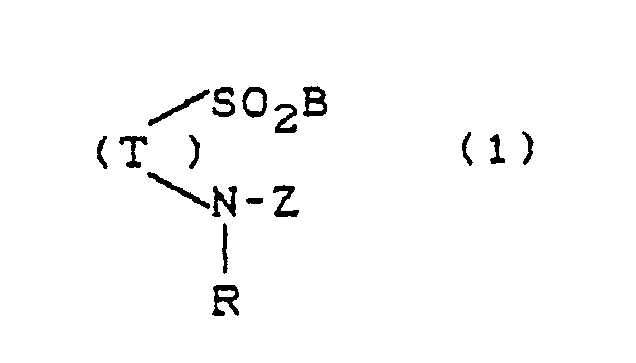
- the remainder SO2B is preferably bound directly to an aromatic-carbocyclic ring of T.
- the rest - -Z can be bonded directly or via a bridge member to an aromatic-carbocyclic ring of T.
- T1 and T2 represent H, Cl, Br, C1-C4-alkoxy, C1-C4-alkyl, optionally substituted phenyl or phenoxy, where T1 and T2 preferably have the same meaning, X and X1 for O, S or stands, R ⁇ represents hydrogen, or optionally substituted C1-C4-alkyl and in the event that Y represents an optionally substituted divalent aliphatic radical, together with R also represents alkylene, preferably -CH2-CH2-, and in the event that W denotes an aliphatic radical together with W can form a ring, optionally including a hetero atom, Y represents an optionally further substituted divalent aliphatic, araliphatic, cycloaliphatic or aromatic radical, W represents H or an optionally further substituted aliphatic, araliphatic, cycl
- radicals SO2B or R1 are each in the o-position to the substituent X1-W or XY- -Z.
- R optionally substituted C1-C4-alkyl are preferably: OH, OCH3, COOH, SO3H, OSO3H.
- R examples are: CH3, C2H5, n-C3H7, n-C4H9, which can be substituted by OH, OCH3, COOH, SO3H or OSO3H.
- Substituents of the optionally substituted phenyl and phenoxy radicals T1 and T2 are e.g. Cl, CH3, C2H5, OCH3 and OC2H5.
- a suitable rest -XY- - is in particular also
- Suitable radicals W-X1- are also particularly
- Suitable R4 radicals are, for example:
- Suitable fiber-reactive radicals are, in particular, those which contain at least one reactive substituent bonded to a 5- or 6-membered aromatic-heterocyclic ring, for example a monoazine, diazine or triazine ring, in particular a pyridine, pyrimidine, pyridazine, pyrazine, thiazine, oxazine or asymmetrical or symmetrical triazine ring, or to such a ring system, which a or has several fused aromatic-carbocyclic rings, for example a quinoline, phthalazine, cinnoline, quinazoline, quinoxaline, acridine, phenazine and phenanthridine ring system.
- a 5- or 6-membered aromatic-heterocyclic ring for example a monoazine, diazine or triazine ring, in particular a pyridine, pyrimidine, pyri
- reactive substituents on the heterocycle are, for example, halogen (Cl, Br or F), ammonium including hydrazinium, pyridinium, picolinium, carboxypyridinium, sulfonium, sulfonyl, azido (N3), rhodanido, thiol ether, oxyether, sulfinic acid and sulfonic acid.
- halogen Cl, Br or F
- ammonium including hydrazinium, pyridinium, picolinium, carboxypyridinium, sulfonium, sulfonyl, azido (N3), rhodanido, thiol ether, oxyether, sulfinic acid and sulfonic acid.
- halotriazinyl radicals can also be linked to a second halotriazinyl radical or a halodiazinyl radical or one or more vinylsulfonyl or sulfatoethylsulfonyl radicals, for example via a bridge member or in the case of the sulfatoethylsulfonyl or vinylsulfonyl group via a bridge member
- Mono-, di- or trihalopyrimidinyl residues such as 2,4-dichloropyrimidinyl-6, 2,4,5-trichloropyrimidinyl-6-, 2,4-dichloro-5-nitro- or -5-methyl- or -5-carboxymethyl - or -5-carboxy- or -5-cyano- or -5-vinyl- or -5-sulfo- or -5-mono-, -di or -trichloromethyl- or -5-carbalkoxypyrimidinyl-6-,
- R H
- R1 SO3H
- R2 and R3 H
- B CH2-CH2-OSO3H
- W C2-C4-alkyl which is substituted by OSO3H
- Z residue of a reactive component of the monofluor or monochlorotriazine series or 2,4-difluoro-5-chloropyrimidinyl-6-
- Y C2-C4 alkylene
- R7 hydrogen or optionally substituted C1-C6-alkyl, C5-C8-cycloalkyl or optionally substituted aryl or R6 and R7 optionally form a heterocyclic ring, including a further heteroatom.
- Substituents of the alkyl radicals R5, R6 and R7 are, for example, OH, OCH3, Cl, Cn, OSO3H, COOH, SO3H,
- Aryl radicals R5 and R7 are in particular phenyl or naphthyl radicals, which can be substituted, for example by C1-C4-alkyl, C1-C4-alkoxy, halogen such as F, Cl or Br, SO3H, COOH, NHCOCH3, NH2.
- the dyes of the formula (1) according to the invention cannot currently be prepared purely by chemical means, but they are with the symmetrical compounds of the general formulas (1a) and (1b) in which the individual formula members have the meanings given for formula (1).
- the dyes according to the invention are formed in the synthesis as a mixture with these symmetrical dyes of the formula (1a and 1b). However, these compounds of the formulas (1a and 1b) do not interfere with the good usability of the dyes of the formula (1) according to the invention, since they can likewise be fixed on the fiber as fiber-reactive dyes.
- the present invention thus also relates to mixtures consisting of the dyes of the formulas (1), (1a) and (1b), for example in a molar percentage ratio of (30 to 70): (35 to 15): (35 to 15), preferably in a molar ratio (40 to 60): (30 to 20): (30 to 20).
- the present invention further relates to processes for the preparation of the dyes of the formula (1).
- These are characterized in that an amino compound of the formula (5) and an amino compound of the formula (6) wherein W, X1, R3 have the meaning given in formula (1) and B2 is B or ß-hydroxyethyl, wherein R, R1, R2, X and Y have the meaning given, where substituted alkyl groups in these radicals are preferably hydroxy-substituted alkyl groups and the benzene nuclei (5) and (6) in one of the o-positions relative to the primary amino group must not be substituted, in a conventional manner and known for the synthesis of triphendioxazine compounds Manner with a benzoquinone compound of formula (7) in which T1 and T2 have the meanings given above and T3 and T4 are the same or different from each other and each for a hydrogen atom, an alkoxy group of 1 to 4 carbon atoms, such as in particular the methoxy group or for
- the two symmetrical chromophores also occur in this implementation.
- the two amino compounds (5) and (6) and the quinone (7) are preferably used in approximately equimolar amounts, the specification "about” means that the respective molar fraction can differ by 10%.
- 2,3,5,6-Tetrachloro-1,4-benzoquinone (chloranil) is preferably used as the quinone of the formula (7).
- the reaction according to the invention of two different amino compounds of the general formula (5) and (6) with a compound of the general formula (7) to give the anil corresponding to the general formula (8) can be carried out in aqueous, aqueous-organic or in a purely organic medium
- the organic solvents are preferably polar aprotic and protic solvents, such as lower alkanols, such as methanol and ethanol, or halogenated benzenes, such as o-dichlorobenzene.
- the reaction of the amines (5) and (6) with the quinones (7) according to the invention can be carried out at a temperature between 20 and 100 ° C., preferably between 50 and 70 ° C., in the presence of an acid-binding agent, for example an alkali metal or alkaline earth metal carbonate or acetates such as sodium acetate, sodium carbonate or sodium bicarbonate, or an alkali or alkaline earth metal hydroxide, such as sodium hydroxide or an oxide of an alkaline earth metal, such as magnesium oxide.
- an acid-binding agent for example an alkali metal or alkaline earth metal carbonate or acetates such as sodium acetate, sodium carbonate or sodium bicarbonate, or an alkali or alkaline earth metal hydroxide, such as sodium hydroxide or an oxide of an alkaline earth metal, such as magnesium oxide.
- an acid-binding agent for example an alkali metal or alkaline earth metal carbonate or acetates such as sodium acetate, sodium carbonate
- the anil of the formula (8) is then cyclized, preferably under oxidizing conditions and preferably after prior isolation, to the triphendioxazine compound in a per se customary and known procedure.
- This implementation can, for example, in Sulfuric acid or sulfur trioxide containing sulfuric acid are used as a medium, with sulfur trioxide, ammonium or alkali persulfates, sodium perborate, but preferably sodium or potassium peroxide sulfate (corresponding to the formulas Na2S2O8 or K2S2O8) being used as the oxidizing agent, or also with oleum in the presence of iodine or one inorganic iodine compound analogous to the information in European patent application publication No. 01 41 359 A.
- the reaction is preferably carried out in concentrated sulfuric acid, such as 96% to preferably 100% sulfuric acid, and in particular in sulfuric acid (oleum) containing sulfur trioxide, such as up to 30% by weight oleum.
- the reaction temperature is chosen between 5 and 40 ° C, optionally up to 80 ° C, but preferably between 15 and 25 ° C.
- hydroxyl groups which are bonded to an alkyl radical of the molecule such as, for example, the above-mentioned ⁇ -hydroxyethyl groups of the formula radical B2 or hydroxyalkyl groups of the formula radicals R4, W, Y and R are converted into the corresponding sulfatoalkyl groups.
- the reaction temperature should not exceed 30 ° C.
- sulfo groups according to the invention can also be incorporated into the aromatic rings of triphendioxazine (the corresponding aryl residues of T1, T2, W, Y, R3 and R4 included) introduce.
- the oleum used as the reaction medium and agent generally has a content of 5 to 30% by weight, preferably 10 to 20% by weight, of sulfur trioxide.
- Known procedures for the reaction of aromatic amines with 1,4-benzoquinones which lead to triphendioxazine compounds are described, for example, in K.
- the starting compounds corresponding to formula (5) are known, for example, from German Offenlegungsschriften 3 344 253, 3 404 855 and 3 439 756 and European Offenlegungsschriften 141 996 and 153 599.
- Compounds of the formula (5) are preferably used in which B2 is ⁇ -hydroxyethyl.
- the starting compounds corresponding to formula (6) are known, for example, from German Offenlegungsschriften 2 302 382 and 2 503 611.
- the triphendioxazine dyes of the formula (9) obtained in the cyclization are wherein R, R1, R2, R3, X, X1, T1, T2, W and Y have the meaning given, with a reactive component of the formula (10) A - Z (10) wherein Z has the meaning given and A represents a substituent which can be split off as an anion (preferably halogen), condenses with elimination of HA.
- This acylation is generally carried out in water at from 0 ° to 80 ° C., depending on the reactivity of (10), and in a weakly alkaline, neutral or weakly acidic medium.
- An acid-binding agent is preferably added during the condensation, such as LiOH, Li2CO3, Na2CO3, NaOH, K2CO3, KOH, MgCO3, CaCO3 and the like.
- the reactive components (10) are to be understood as the halides, in particular the chlorides or fluorides, of the reactive groups Z listed above.
- the new dyes give clear colors on cellulose and natural synthetic polyamide materials. They are characterized by high color strength.
- the new dyes are of particular interest for dyeing textile materials containing hydroxyl and amide groups, in particular materials made from native and regenerated cellulose and synthetic polyamide and polyurethane fibers, wool and silk.
- the materials mentioned are dyed or printed by the processes which are generally known and customary in industry for water-soluble reactive dyes. Light and wet fast brilliant dyeings and prints are then obtained.
- the temperature data in the examples are ° C.
- the formulas of the water-soluble reactive dyes in the description and in the examples are those of the free acids.
- the dyes are generally isolated and used in the form of their alkali metal salts, in particular the lithium, sodium or potassium salts.
- the color indicators given in the examples refer to the Color Index Hue Indication Chart (Indicator Numbers).
- the precipitated reaction product is filtered off at 60 ° C, washed with water and dried. After milling, a brown powder is obtained which consists of the mixture of the following three compounds, the asymmetric compound of the formula (A) predominating.
- 33.2 g of the product obtained according to a) are introduced into 250 g of 10% oleum at a temperature between 20 and 25 ° C. The mixture is stirred at this temperature for another hour. Then 26 g of sodium peroxodisulfate are added so that the temperature can be kept between 20 and 25 ° C. The mixture is stirred for 5 hours and then allowed to run on ice. Some of the condensation product has failed. The precipitation is completed by adding 10% by volume of potassium chloride. After suction and washing with KCl solution, the product is stirred in 1 l of ice water and adjusted to pH 5-5.5 by sprinkling in sodium bicarbonate.
- 0.05 mol of o-sulfanilic acid are dissolved in 200 ml of ice water with LiOH solution until neutral. At 0 ° C., 0.05 mol of trifluorotriazine is added dropwise and the pH is kept between 6 and 7 by adding LiOH solution.
- the resulting solution which is the condensation product of the formula contains, is added to the slurry of the cyclization product obtained according to b).
- the acylation is carried out at pH 8 and 0 ° C., the pH being kept at 8 by dropwise addition of LiOH solution.
- the dye goes into solution during acylation. After the condensation has ended, the solution is clarified and the dye is salted out by sprinkling in 20% by volume of NaCl. After vacuuming, drying and grinding, a blue dye powder is obtained, which dyes cotton in a brilliant, strong blue shade from a long liquor using one of the dyeing processes customary for reactive dyes (color code 13).
- the dye according to the invention obtained in the mixture corresponds to the likely formula
Landscapes
- Chemical & Material Sciences (AREA)
- Organic Chemistry (AREA)
- Chemical Kinetics & Catalysis (AREA)
- Coloring (AREA)
Abstract
Farbstoffe der Formel
Description
Die vorliegende Erfindung betrifft neue Triphendioxazin-Farbstoffe der Formel

T = Rest eines Triphendioxazinfarbstoffs, der frei von Resten -SO₂B und -
B = CH=CH₂ oder CH₂CH₂V,
worin
V = abspaltbare Gruppe wie OSO₃H, Cl, S₂O₃H, OCOCH₃, OPO₃H₂, -⊕N(CH₃)₃
R = H oder gegebenenfalls substituiertes C₁-C₄-Alkyl,
Z = faserreaktiver RestThe present invention relates to new triphendioxazine dyes of the formula
T = residue of a triphendioxazine dye which is free of residues -SO₂B and -
B = CH = CH₂ or CH₂CH₂V,
wherein
V = cleavable group such as OSO₃H, Cl, S₂O₃H, OCOCH₃, OPO₃H₂, - ⊕ N (CH₃) ₃
R = H or optionally substituted C₁-C₄ alkyl,
Z = fiber-reactive residue
Der Rest SO₂B ist vorzugsweise direkt an einen aromatisch-carbocyclischen Ring von T gebunden.The remainder SO₂B is preferably bound directly to an aromatic-carbocyclic ring of T.
Der Rest -
kann direkt oder über ein Brückenglied an einen aromatisch-carbocyclischen Ring von T gebunden sein.The rest -
can be bonded directly or via a bridge member to an aromatic-carbocyclic ring of T.
Insbesondere betrifft die Anmeldung neue Triphendioxazinfarbstoffe der Formel

B, R und Z die oben angegebene Bedeutung haben,
T₁ und T₂ für H, Cl, Br, C₁-C₄-Alkoxy, C₁-C₄-Alkyl, gegebenenfalls substituiertes Phenyl oder Phenoxy stehen, wobei T₁ und T₂ bevorzugt gleiche Bedeutung haben,
X und X₁ für O, S oder

R˝ für Wasserstoff, oder gegebenenfalls substituiertes C₁-C₄-Alkyl steht und für den Fall, daß Y einen gegebenenfalls substituierten zweiwertigen aliphatischen Rest bedeutet, zusammen mit R auch für Alkylen, vorzugsweise -CH₂-CH₂- steht, und für den Fall, daß W einen aliphatischen Rest bedeutet zusammen mit W gegebenenfalls unter Einschluß eines Heteroatoms einen Ring bilden kann,
Y für einen gegebenenfalls weitersubstituierten zweiwertigen aliphatischen, araliphatischen, cycloaliphatischen oder aromatischen Rest steht,
W für H oder einen gegebenenfalls weitersubstituierten aliphatischen, araliphatischen, cycloaliphatischen oder aromatischen Rest steht,
R¹ eine wasserlöslichmachende Gruppe wie eine Carboxy- oder Sulfogruppe oder eine Sulfamoylgruppe ist, die mono- oder disubstituiert sein kann, wobei die Substituenten vorzugsweise Alkylgruppen von 1 bis 4 C-Atomen, die durch einen Phenylrest substituiert sein können, und Phenylreste sind, wobei diese Reste wiederum bevorzugt wasserlöslichmachende Gruppen enthalten können, oder eine Disulfimidgruppe - SO₂NHSO₂R₄ ist, wobei R₄ für einen gegebenenfalls substituierten C₁-C₄-Alkylrest oder Phenylrest steht, oder eine Sulfongruppe -SO₂R₄ ist.
R₂ und R₃ stehen für H, C₁-C₄-Alkyl, C₁-C₄-Alkoxy, Carboxy, F, Cl oder Br.In particular, the application relates to new triphendioxazine dyes of the formula
B, R and Z have the meaning given above,
T₁ and T₂ represent H, Cl, Br, C₁-C₄-alkoxy, C₁-C₄-alkyl, optionally substituted phenyl or phenoxy, where T₁ and T₂ preferably have the same meaning,
X and X₁ for O, S or
R˝ represents hydrogen, or optionally substituted C₁-C₄-alkyl and in the event that Y represents an optionally substituted divalent aliphatic radical, together with R also represents alkylene, preferably -CH₂-CH₂-, and in the event that W denotes an aliphatic radical together with W can form a ring, optionally including a hetero atom,
Y represents an optionally further substituted divalent aliphatic, araliphatic, cycloaliphatic or aromatic radical,
W represents H or an optionally further substituted aliphatic, araliphatic, cycloaliphatic or aromatic radical,
R¹ is a water-solubilizing group such as a carboxy or sulfo group or a sulfamoyl group which may be mono- or disubstituted, the substituents preferably being alkyl groups of 1 to 4 carbon atoms which may be substituted by a phenyl radical and phenyl radicals, these being Leftovers in turn can preferably contain water-solubilizing groups, or is a disulfimide group - SO₂NHSO₂R₄, where R₄ is an optionally substituted C₁-C₄ alkyl radical or phenyl radical, or is a sulfone group -SO₂R₄.
R₂ and R₃ are H, C₁-C₄-alkyl, C₁-C₄-alkoxy, carboxy, F, Cl or Br.
Die Reste SO₂B bzw. R₁ stehen jeweils in o-Stellung zum Substituenten X₁-W bzw. X-Y-
The radicals SO₂B or R₁ are each in the o-position to the substituent X₁-W or XY-
Als Substituenten für R = gegebenenfalls substituiertes C₁-C₄-Alkyl kommen vorzugsweise in Frage: OH, OCH₃, COOH, SO₃H, OSO₃H.Possible substituents for R = optionally substituted C₁-C₄-alkyl are preferably: OH, OCH₃, COOH, SO₃H, OSO₃H.
Beispiele für R sind: CH₃, C₂H₅, n-C₃H₇, n-C₄H₉, die durch OH, OCH₃, COOH, SO₃H oder OSO₃H substituiert sein können. Substituenten der gegebenenfalls substituierten Phenyl- und Phenoxyreste T₁ bzw. T₂ sind z.B. Cl, CH₃, C₂H₅, OCH₃ und OC₂H₅.Examples of R are: CH₃, C₂H₅, n-C₃H₇, n-C₄H₉, which can be substituted by OH, OCH₃, COOH, SO₃H or OSO₃H. Substituents of the optionally substituted phenyl and phenoxy radicals T₁ and T₂ are e.g. Cl, CH₃, C₂H₅, OCH₃ and OC₂H₅.
Die Reste Y tragen, falls sie weitersubstituiert sind, vorzugsweise folgende weitere Substituenten: SO₃H, OSO₃H, COOH, CH₃, OCH₃, gegebenenfalls substituiertes Phenyl. Weiterhin können die araliphatischen, aliphatischen oder cycloaliphatischen Reste Y durch Heteroatome oder Heteroatomgruppen oder durch die Phenylgruppierung unterbrochen sein. Beispielhaft seien genannt: O, S, NH, N(COCH₃).
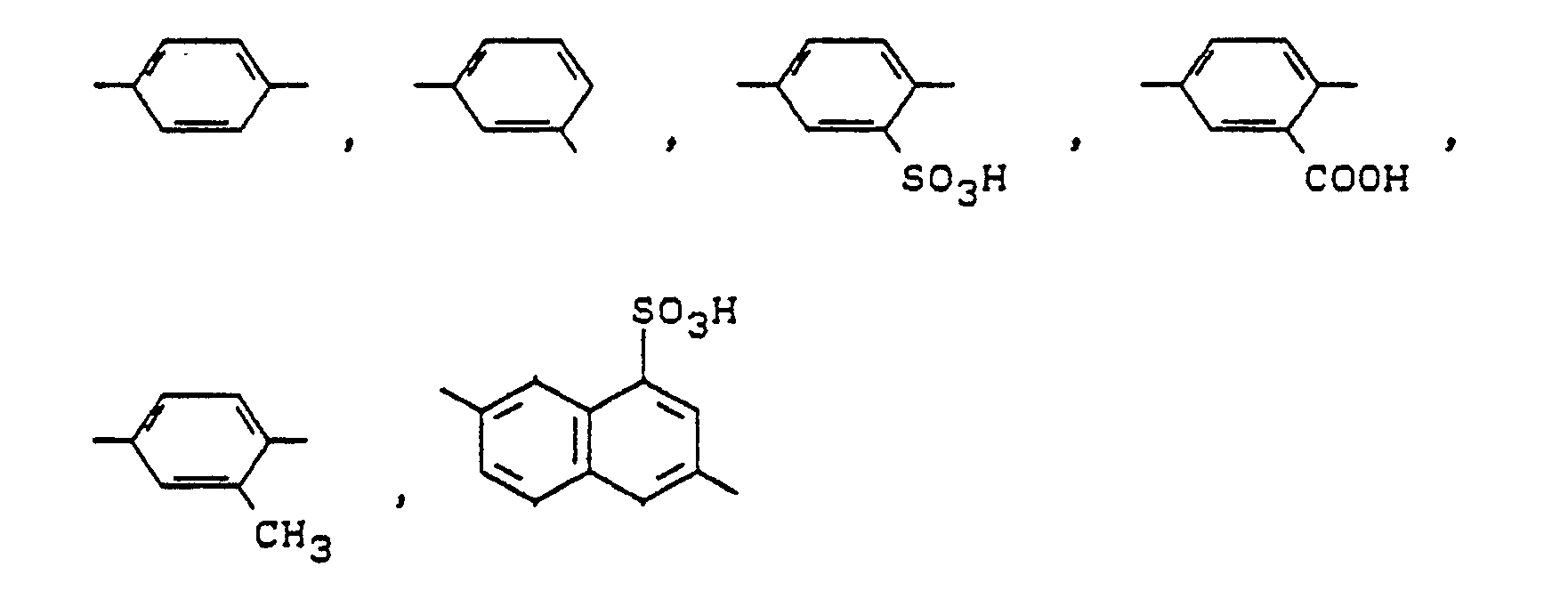
- a) Aromatische Reste Y sind beispielsweise folgende:
- b) Araliphatische Reste Y sind beispielsweise folgende:

- c) Aliphatische bzw. cycloaliphatische Reste Y sind beispielsweise folgende:

- a) Aromatic radicals Y are, for example, the following:
- b) Araliphatic radicals Y are, for example, the following:
- c) Aliphatic or cycloaliphatic radicals Y are, for example, the following:
Ein geeigneter Rest
-X-Y-

-XY-
Die Reste W tragen, falls sie weitersubstituiert sind, vorzugsweise folgende Substituenten: SO₃H, OSO₃H, COOH, CH₃, OCH₃, Cl. Weiterhin können die aliphatischen, araliphatischen oder cycloaliphatischen Reste W durch Heteroatome oder Heteroatomgruppen unterbrochen sein. Beispielhaft seien genannt: O, S, NH.
- a) Aromatische Reste W sind beispielsweise folgende:

- b) Araliphatische Reste W sind beispielsweise folgende:

- c) Aliphatische bzw. cycloaliphatische Reste W sind beispielsweise folgende:

- a) Aromatic radicals W are, for example, the following:
- b) Araliphatic radicals W are, for example, the following:
- c) Aliphatic or cycloaliphatic radicals W are, for example, the following:
Geeignete Reste W-X₁- sind insbesondere auch

Geeignete Reste R₄ sind beispielsweise:

Geeignete faserreaktive Reste, d.h. solche die mit den OH-oder NH-Gruppen der Faser unter Färbebedingungen unter Ausbildung kovalenter Bindungen reagieren, sind insbesondere solche, die mindestens einen reaktiven Substituenten an einen 5- oder 6-gliedrigen aromatischheterocyclischen Ring gebunden enthalten, bspw. an einen Monoazin-, Diazin- oder Triazinring, insbesondere einen Pyridin-, Pyrimidin-, Pyridazin-, Pyrazin-, Thiazin-, Oxazin- oder asymmetrischen oder symmetrischen Triazinring, oder an ein derartiges Ringsystem, welches einen oder mehrere ankondensierte aromatisch-carbocyclische Ringe aufweist, bspw. ein Chinolin-, Phthalazin-, Cinnolin-, Chinazolin-, Chinoxalin-, Acridin-, Phenazin- und Phenanthridin-Ring-System.Suitable fiber-reactive radicals, ie those which react with the OH or NH groups of the fiber under dyeing conditions to form covalent bonds, are, in particular, those which contain at least one reactive substituent bonded to a 5- or 6-membered aromatic-heterocyclic ring, for example a monoazine, diazine or triazine ring, in particular a pyridine, pyrimidine, pyridazine, pyrazine, thiazine, oxazine or asymmetrical or symmetrical triazine ring, or to such a ring system, which a or has several fused aromatic-carbocyclic rings, for example a quinoline, phthalazine, cinnoline, quinazoline, quinoxaline, acridine, phenazine and phenanthridine ring system.
Unter den reaktiven Substituenten am Heterocyclus sind beispielsweise zu erwähnen Halogen (Cl, Br oder F), Ammonium einschließlich Hydrazinium, Pyridinium, Picolinium, Carboxypyridinium, Sulfonium, Sulfonyl, Azido-(N₃), Rhodanido, Thiolether, Oxiether, Sulfinsäure und Sulfonsäure.Among the reactive substituents on the heterocycle are, for example, halogen (Cl, Br or F), ammonium including hydrazinium, pyridinium, picolinium, carboxypyridinium, sulfonium, sulfonyl, azido (N₃), rhodanido, thiol ether, oxyether, sulfinic acid and sulfonic acid.
Im einzelnen sind beispielsweise zu nennen:
2,4-Difluortriazinyl-6-, 2,4-Dichlortriazinyl-6-, Monohalogen-sym.-triazinylreste, insbesondere Monochlor- und Monofluortriazinylreste, die durch Alkyl, Aryl, Amino, Monoalkylamino, Dialkylamino, Aralkylamino, Arylamino, Morpholino, Piperidino, Pyrrolidino, Piperazino, Alkoxy, Aryloxy, Alkylthio, Arylthio substituiert sind, wobei Alkyl vorzugsweise gegebenenfalls substituiertes C₁-C₄-Alkyl, Aralkyl vorzugsweise gegebenenfalls substituiertes Phenyl-C₁-C₄-alkyl und Aryl vorzugsweise gegebenenfalls substituiertes Phenyl oder Naphthyl bedeutet und wobei bevorzugte Substituenten für Alkyl Halogen, Hydroxy, Cyan, Vinylsulfonyl, substituiertes Alkylsulfonyl, Dialkylamino, Morpholino, C₁-C₄-Alkoxy, Vinylsulfonyl-C₂-C₄-Alkoxy, substituierte Alkylsulfonyl-C₂-C₄-Alkoxy, Carboxy, Sulfo oder Sulfato sind und für Phenyl und Naphthyl, Sulfo, C₁-C₄-Alkyl, C₁-C₄-Alkoxy, Carboxy, Halogen, Acylamino, Vinylsulfonyl, substituiertes Alkylsulfonyl, Hydroxy, Amino.The following can be mentioned in detail, for example:
2,4-difluorotriazinyl-6, 2,4-dichlorotriazinyl-6, monohalogen-sym.-triazinyl residues, in particular monochloro- and monofluorotriazinyl residues, which are substituted by alkyl, aryl, amino, monoalkylamino, dialkylamino, aralkylamino, arylamino, morpholino, piperidino , Pyrrolidino, piperazino, alkoxy, aryloxy, alkylthio, arylthio are substituted, where alkyl is preferably optionally substituted C₁-C₄-alkyl, aralkyl preferably optionally substituted phenyl-C₁-C₄-alkyl and aryl is preferably optionally substituted phenyl or naphthyl and wherein preferred substituents for alkyl halogen, hydroxy, cyan, vinylsulfonyl, substituted alkylsulfonyl, dialkylamino, morpholino, C₁-C₄alkoxy, vinylsulfonyl-C₂-C₄alkoxy, substituted alkylsulfonyl-C₂-C₄alkoxy, carboxy, sulfo or sulfato and for phenyl and Naphthyl, sulfo, C₁-C₄-alkyl, C₁-C₄-alkoxy, Carboxy, halogen, acylamino, vinylsulfonyl, substituted alkylsulfonyl, hydroxy, amino.
Im einzelnen seien folgende Reste genannt:
2-Amino-4-fluor-triazinyl-6, 2-Methylamino-4-fluortriazinyl-6, 2-Ethylamino-4-fluortriazinyl-6, 2-Isopropylamino-4-fluor-triazinyl-6, 2-Dimethylamino-4-fluortriazinyl-6, 2-Diethylamino-4-fluor-triazinyl-6, 2-ß-Methoxy-ethylamino-4-fluor-triazinyl-6, 2-ß-Hydroxyethylamino-4-fluor-triazinyl-6, 2-Di-(ß-hydroxyethylamino)-4-fluor-triazinyl-6, 2-ß-Sulfoethylamino-4-fluor-triazinyl-6, 2-ß-Sulfoethyl-methylamino-4-fluortriazinyl-6, 2-Carboxymethylamino-4-fluor-triazinyl-6, 2-Di-(carboxymethylamino)-4-fluor-triazinyl-6, 2-Sulfomethyl-methylamino-4-fluor-triazinyl-6, 2-ß-Cyanethylamino-4-fluor-triazinyl-6, 2-Benzylamino-4-fluor-triazinyl-6, 2-ß-Phenylethylamino-4-fluor-triazinyl-6, 2-Benzyl-methylamino-4-fluor-triazinyl-6, 2-(4′-Sulfobenzyl)-amino-4-fluor-triazinyl-6, 2-Cyclohexylamino-4-fluor-triazinyl-6, 2-(o-, m-, p-Methylphenyl)-amino-4-fluor-triazinyl-6, 2-(o-, m-, p-Sulfophenyl)-amino-4-fluor-triazinyl-6, 2-(2′,5′-Disulfophenyl)-amino-4-fluor-triazinyl-6, 2-(o-, m-, p-Chlorphenyl)-amino-4-fluor-triazinyl-6, 2-(o-, m-, p-Methoxyphenyl)-amino-4-fluor-triazinyl-6, 2-(2′-Methyl-4′-sulfophenyl)-amino-4-fluor-triazinyl-6, 2-(2′-Methyl-5′-sulfophenyl)-amino-4-fluor-triazinyl-6, 2-(2′-Chlor-4′-sulfophenyl)-amino-4-fluor-triazinyl-6, 2-(2′-Chlor-5′-sulfophenyl)-amino-4-fluor-triazinyl-6, 2-(2′-Methoxy-4′-sulfophenyl)-amino-4-fluor-triazinyl-6, 2-(o-, m-, p-Carboxyphenyl)-amino- 4-fluor-triazinyl-6, 2-(2′,4′-Disulfophenyl)-amino-4-fluor-triazinyl-6, 2-(3′-5′-Disulfophenyl)-amino-4-fluor-triazinyl-6, 2-(2′-Carboxy-4′-sulfophenyl)-amino-4-fluor-triazinyl-6, 2-(2′-Carboxy-5′-sulfophenyl)-amino-4-fluor-triazinyl-6, 2-(6′-Sulfonaphthyl-(2′))-amino-4-fluor-triazinyl-6, 2-(4′,8′-Disulfonaphthyl-(2′))-amino-4-fluor-triazinyl-6, 2-(6′,8′-Disulfonaphthyl-(2′))-amino-4-fluor-triazinyl-6, 2-(N-methyl-N-phenyl)-amino-4-fluor-triazinyl-6, 2-(N-Ethyl-N-phenyl)-amino-4-fluor-triazinyl-6, 2-(N-ß-Hydroxyethyl-N-phenyl)-amino-4-fluor-triazinyl-6, 2-(N-iso-Propyl-N-phenyl)-amino-4-fluor-triazinyl-6, 2-Morpholino-4-fluortriazinyl-6, 2-Piperidino-4-fluor-triazinyl-6, 2-(4′,6′,8′-Trisulfonaphthyl-(2′))-amino-4-fluor-triazinyl-6, 2-(3′,6′,8′-Trisulfonaphthyl-(2′))-amino-4-fluor-triazinyl-6, 2-(3′,6′-Disulfonaphthyl-(1′))-amino-4-fluor-triazinyl-6, N-Methyl-N-(2,4-dichlortriazinyl-6)-carbamyl-, N-Methyl-N-(2-methylamino-4-chlortriazinyl-6)-carbamyl-, N-Methyl-N-(2-dimethylamino-4-chlortriazinyl-6)-carbamyl-, N-Methyl-bzw. N-Ethyl-N-(2,4-dichlortriazinyl-6)-aminoacetyl-, 2-Methoxy-4-fluor-triazinyl-6, 2-Ethoxy-4-fluor-triazinyl-6, 2-Phenoxy-4-fluor-triazinyl-6, 2-(o-, m-oder p-Sulfophenoxy)-4-fluor-triazinyl-6, 2-(o-, m-oder p-Methyl- oder -Methoxy-phenoxy)-4-fluor-triazinyl-6, 2-ß-Hydroxyethylmercapto-4-fluor-triazinyl-6, 2-Phenylmercapto-4-fluor-triazinyl-6, 2-(4′-Methylphenyl)-mercapto-4-fluortriazinyl, 2-(2′,4′-Dinitrophenyl)-mercapto-4-fluor-triazinyl-6, 2-Methyl-4-fluor-triazinyl-6, 2-Phenyl-4-fluor-triazinyl-6 sowie die entsprechenden 4-Chlor- bzw. 4-Brom-Triazinyl-Reste und die entsprechenden durch Halogenaustausch mit tertiären Basen wie Trimethylamin, Triethylamin, Dimethyl-ß-hydroxyethylamin, Triethanolamin, N,N-Dimethylhydrazin, Pyridin, α-, ß- oder γ-Picolin, Nicotinsäure oder Isonicotinsäure, Sulfinaten insbesondere Benzolsulfinsäure oder Hydrogensulfit erhältlichen Reste.The following residues are mentioned in detail:
2-amino-4-fluorotriazinyl-6, 2-methylamino-4-fluorotriazinyl-6, 2-ethylamino-4-fluorotriazinyl-6, 2-isopropylamino-4-fluorotriazinyl-6, 2-dimethylamino-4- fluorotriazinyl-6, 2-diethylamino-4-fluorotriazinyl-6, 2-ß-methoxy-ethylamino-4-fluorotriazinyl-6, 2-ß-hydroxyethylamino-4-fluorotriazinyl-6, 2-di- (ß-hydroxyethylamino) -4-fluoro-triazinyl-6, 2-ß-sulfoethylamino-4-fluoro-triazinyl-6, 2-ß-sulfoethyl-methylamino-4-fluorotriazinyl-6, 2-carboxymethylamino-4-fluoro triazinyl-6, 2-di- (carboxymethylamino) -4-fluoro-triazinyl-6, 2-sulfomethyl-methylamino-4-fluoro-triazinyl-6, 2-ß-cyanoethylamino-4-fluoro-triazinyl-6, 2- Benzylamino-4-fluoro-triazinyl-6, 2-ß-phenylethylamino-4-fluoro-triazinyl-6, 2-benzyl-methylamino-4-fluoro-triazinyl-6, 2- (4'-sulfobenzyl) amino-4 -fluoro-triazinyl-6, 2-cyclohexylamino-4-fluoro-triazinyl-6, 2- (o-, m-, p-methylphenyl) -amino-4-fluoro-triazinyl-6, 2- (o-, m -, p-Sulfophenyl) -amino-4-fluoro-triazinyl-6, 2- (2 ', 5'-disulfophenyl) -amino-4-fluoro-triazinyl-6, 2- (o-, m-, p- Chlorph enyl) -amino-4-fluoro-triazinyl-6, 2- (o-, m-, p-methoxyphenyl) -amino-4-fluoro-triazinyl-6, 2- (2'-methyl-4'-sulfophenyl) -amino-4-fluoro-triazinyl-6, 2- (2'-methyl-5'-sulfophenyl) -amino-4-fluoro-triazinyl-6, 2- (2'-chloro-4'-sulfophenyl) amino -4-fluoro-triazinyl-6, 2- (2'-chloro-5'-sulfophenyl) amino-4-fluoro-triazinyl-6, 2- (2'-methoxy-4'-sulfophenyl) amino-4 -fluorotriazinyl-6, 2- (o-, m-, p-carboxyphenyl) -amino- 4-fluorotriazinyl-6, 2- (2 ′, 4′-disulfophenyl) amino-4-fluorotriazinyl-6, 2- (3′-5′-disulfophenyl) amino-4-fluorotriazinyl- 6, 2- (2'-carboxy-4'-sulfophenyl) amino-4-fluoro-triazinyl-6, 2- (2'-carboxy-5'-sulfophenyl) amino-4-fluoro-triazinyl-6, 2- (6′-Sulfonaphthyl- (2 ′)) - amino-4-fluorotriazinyl-6, 2- (4 ′, 8′-disulfonaphthyl- (2 ′)) - amino-4-fluorotriazinyl-6 , 2- (6 ′, 8′-disulfonaphthyl- (2 ′)) - amino-4-fluorotriazinyl-6, 2- (N-methyl-N-phenyl) amino-4-fluorotriazinyl-6, 2- (N-ethyl-N-phenyl) amino-4-fluoro-triazinyl-6, 2- (N-ß-hydroxyethyl-N-phenyl) amino-4-fluoro-triazinyl-6, 2- (N -iso-propyl-N-phenyl) -amino-4-fluorotriazinyl-6, 2-morpholino-4-fluorotriazinyl-6, 2-piperidino-4-fluorotriazinyl-6, 2- (4 ′, 6 ′ , 8'-Trisulfonaphthyl- (2 ′)) - amino-4-fluorotriazinyl-6, 2- (3 ′, 6 ′, 8′-trisulfonaphthyl- (2 ′)) - amino-4-fluorotriazinyl- 6, 2- (3 ′, 6′-disulfonaphthyl- (1 ′)) - amino-4-fluoro-triazinyl-6, N-methyl-N- (2,4-dichlorotriazinyl-6) -carbamyl-, N- Methyl-N- (2-methylamino-4-chlorotri azinyl-6) -carbamyl-, N-methyl-N- (2-dimethylamino-4-chlorotriazinyl-6) -carbamyl-, N-methyl- or. N-ethyl-N- (2,4-dichlorotriazinyl-6) aminoacetyl, 2-methoxy-4-fluorotriazinyl-6, 2-ethoxy-4-fluorotriazinyl-6, 2-phenoxy-4-fluorine triazinyl-6, 2- (o-, m- or p-sulfophenoxy) -4-fluorotriazinyl-6, 2- (o-, m- or p-methyl- or methoxy-phenoxy) -4-fluorine -triazinyl-6, 2-ß-hydroxyethylmercapto-4-fluorotriazinyl-6, 2-phenylmercapto-4-fluorotriazinyl-6, 2- (4'-methylphenyl) -mercapto-4-fluorotriazinyl, 2- (2nd ', 4'-dinitrophenyl) -mercapto-4-fluoro-triazinyl-6, 2-methyl-4-fluoro-triazinyl-6, 2-phenyl-4-fluoro-triazinyl-6 and the corresponding 4-chloro or 4-bromo-triazinyl residues and the Corresponding radicals obtainable by halogen exchange with tertiary bases such as trimethylamine, triethylamine, dimethyl-β-hydroxyethylamine, triethanolamine, N, N-dimethylhydrazine, pyridine, α-, β- or γ-picoline, nicotinic acid or isonicotinic acid, sulfinates, in particular benzenesulfinic acid or hydrogen sulfite.
Die Halogentriazinylreste können auch mit einem zweiten Halogentriazinylrest oder einem Halogendiazinylrest oder einem oder mehreren Vinylsulfonyl- oder Sulfatoethylsulfonylresten verknüpft sein bspw. über ein Brückenglied


Desweiteren sind Reaktivgruppen der aliphatischen Reihe zu nennen, wie Acryloyl- Mono-, Di- oder Trichloracryloyl, wie -CO-CH=CH-Cl, -CO-CCl=CH₂, -CO-CCl=CH-CH₃, ferner -CO-CCl=CH-COOH, -CO-CH=CCl-COOH, ß-Chlorpropionyl-, 3-Phenylsulfonylpropionyl-, 3-Methylsulfonylpropionyl-, 2-Fluor-2-chlor-3,3-difluorcyclobutan-1-carbonyl-, 2,2,3,3-Tetrafluorcyclobutan-carbonyl-1- oder -sulfonyl-1-, ß-(2,2,3,3-Tetrafluorcyclobutyl-1-)-acryloyl-, α- oder ß-Bromacryloyl-, α- oder ß-Alkyl- oder -Arylsulfonylacryloyl-Gruppe, wie α- oder ß-Methylsulfonylacryloyl, Chloracetyl, Vinylsulfonyl, -SO₂CH₂CH₂Z worin Z = alkalisch abspaltbare Gruppe, insbesondere -OSO₃H, -OCOCH₃, Cl, Br, F, -SSO₃H, -OPO₃H₂, -OCOC₆H₅, Di-C₁-C₄-Alkylamino, quartäres Ammonium, insbesondere -N⊕(C₁-C₄-Alkyl)₃X⊖, -OSO₂CH₃, -SCN, -NH-SO₂CH₃, -OSO₂-C₆H₄-CH₃, -OSO₂-C₆H₅, -OCN,

In Formel (2) haben folgende Gruppierungen eine bevorzugte Bedeutung:
T₁ und T₂ = Cl
X und X₁ = NH
R = H
R₁ = SO₃H
R₂ und R₃ = H
B = CH₂-CH₂-OSO₃H
W = C₂-C₄-Alkyl, das durch OSO₃H substituiert ist
Z = Rest einer Reaktivkomponente der Monofluor- oder Monochlortriazinreihe oder 2,4-Difluor-5-chlorpyrimidinyl-6-
Y = C₂-C₄-AlkylenThe following groupings have a preferred meaning in formula (2):
T₁ and T₂ = Cl
X and X₁ = NH
R = H
R₁ = SO₃H
R₂ and R₃ = H
B = CH₂-CH₂-OSO₃H
W = C₂-C₄-alkyl which is substituted by OSO₃H
Z = residue of a reactive component of the monofluor or monochlorotriazine series or 2,4-difluoro-5-chloropyrimidinyl-6-
Y = C₂-C₄ alkylene
Im Rahmen der Formel (2) sind folgende Farbstoffe bevorzugt:

T₁, T₂, R, X und Z die angegebene Bedeutung haben und
B₁ = CH₂-CH₂OSO₃H
Y₁ = aliphatischer oder araliphatischer Rest
W₁ = aliphatischer oder araliphatischer RestThe following dyes are preferred in the context of the formula (2):
T₁, T₂, R, X and Z have the meaning given and
B₁ = CH₂-CH₂OSO₃H
Y₁ = aliphatic or araliphatic radical
W₁ = aliphatic or araliphatic radical
Weiterhin bevorzugt sind Farbstoffe der Formel

T₁, T₂, R, X, Z und B₁ die angegebene Bedeutung haben und
Y₂ = aliphatischer Rest
W₂ = aliphatischer RestDyes of the formula are also preferred
T₁, T₂, R, X, Z and B₁ have the meaning given and
Y₂ = aliphatic radical
W₂ = aliphatic residue
Besonders bevorzugt sind Farbstoffe der Formel (4), in denen

Weiterhin bevorzugt sind Farbstoffe der Formeln (3) und (4), in denen
T₁ und T₂ = Cl
X und X₁ = NH
R = H

G = F oder Cl und
E im Falle G = F eine gegebenenfalls substituierte Aminogruppe bedeutet und
im Falle G = Cl eine Ether- oder Thioethergruppe der Formeln
-OR₅ oder -SR₅
wobei
R₅ = gegebenenfalls substituiertes C₁-C₆-Alkyl oder gegebenenfalls substituiertes Aryl,
oder eine gegebenenfalls substituierte Aminogruppe.Dyes of the formulas (3) and (4) in which
T₁ and T₂ = Cl
X and X₁ = NH
R = H
G = F or Cl and
E if G = F is an optionally substituted amino group and
in the case of G = Cl an ether or thioether group of the formulas
-OR₅ or -SR₅
in which
R₅ = optionally substituted C₁-C₆ alkyl or optionally substituted aryl,
or an optionally substituted amino group.
Bevorzugte gegebenenfalls substituierte Aminogruppen sind dabei solche der Formel

R₆ = Wasserstoff oder gegebenenfalls substituiertes C₁-C₆-Alkyl
R₇ = Wasserstoff oder gegebenenfalls substituiertes C₁-C₆-Alkyl, C₅-C₈-Cycloalkyl oder gegebenenfalls substituiertes Aryl oder R₆ und R₇ bilden gegebenenfalls unter Einschluß eines weiteren Heteroatomes einen heterocyclischen Ring.Preferred optionally substituted amino groups are those of the formula
R₆ = hydrogen or optionally substituted C₁-C₆ alkyl
R₇ = hydrogen or optionally substituted C₁-C₆-alkyl, C₅-C₈-cycloalkyl or optionally substituted aryl or R₆ and R₇ optionally form a heterocyclic ring, including a further heteroatom.
Substituenten der Alkylreste R₅, R₆ und R₇ sind beispielsweise OH, OCH₃, Cl, Cn, OSO₃H, COOH, SO₃H,

Arylreste R₅ und R₇ sind insbesondere Phenyl- oder Naphthylreste, die substituiert sein können, beispielsweise durch C₁-C₄-Alkyl, C₁-C₄-Alkoxy, Halogen wie F, Cl oder Br, SO₃H, COOH, NHCOCH₃, NH₂.Aryl radicals R₅ and R₇ are in particular phenyl or naphthyl radicals, which can be substituted, for example by C₁-C₄-alkyl, C₁-C₄-alkoxy, halogen such as F, Cl or Br, SO₃H, COOH, NHCOCH₃, NH₂.
Beispiele für heterocyclische Gruppen, die durch


Die erfindungsgemäßen Farbstoffe der Formel (1) lassen sich derzeit auf chemischem Weg nicht rein darstellen, sondern sie sind mit den symmetrischen Verbindungen der allgemeinen Formel (1a) und (1b)

Die vorliegende Erfindung betrifft somit auch Gemische bestehend aus den Farbstoffen der Formeln (1), (1a) und (1b), beispielsweise im Molprozentverhältnis von (30 bis 70) : (35 bis 15) : (35 bis 15), bevorzugt im Molverhältnis (40 bis 60) : (30 bis 20) : (30 bis 20).The present invention thus also relates to mixtures consisting of the dyes of the formulas (1), (1a) and (1b), for example in a molar percentage ratio of (30 to 70): (35 to 15): (35 to 15), preferably in a molar ratio (40 to 60): (30 to 20): (30 to 20).
Die vorliegende Erfindung betrifft weiterhin Verfahren zur Herstellung der Farbstoffe der Formel (1). Diese sind dadurch gekennzeichnet, daß man eine Aminoverbindung der Formel (5) und eine Aminoverbindung der Formel (6)

W, X₁, R₃ die bei Formel (1) angegebene Bedeutung haben und B₂ für B oder Für ß-Hydroxyethyl steht,

R, R₁, R₂, X und Y die angegebene Bedeutung haben,
wobei substituierte Alkylgruppen in diesen Resten bevorzugt hydroxysubstituierte Alkylgruppen sind und wobei die Benzolkerne (5) und (6) in einer der o-Stellungen zur primären Aminogruppe zwingend nicht substituiert sein dürfen, in an und für sich üblicher und zur Synthese von Triphendioxazin-Verbindungen bekannten Weise mit einer Benzochinon-Verbindung der Formel (7)
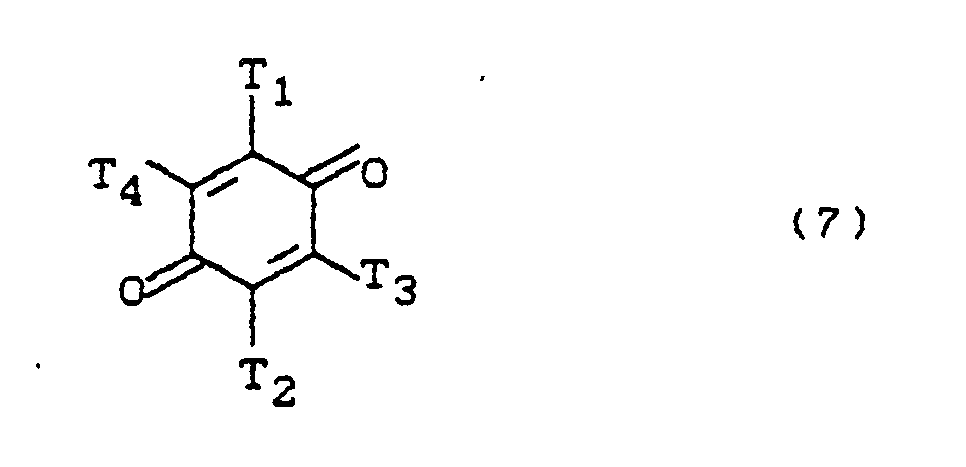
T₁ und T₂ die obengenannten Bedeutungen haben und
T₃ und T₄ zueinander gleich oder voneinander verschieden sind und jedes für ein Wasserstoffatom, eine Alkoxygruppe von 1 bis 4 C-Atomen, wie insbesondere die Methoxygruppe oder für eine Phenoxygruppe steht oder bevorzugt ein Halogenatom wie Bromatom und insbesondere Chloratom ist, wobei T₃ und T₄ auch gleiche Bedeutung wie T₁ und T₂ haben können,
zunächst zu einem Zwischenprodukt der angenommenen allgemeinen Formel (8)

B₂, R, R₁, R₂, R₃, X, X₁, T₁, T₂, W und Y die oben angegebene Bedeutung haben, umsetzt, und dieses nach Zwischenisolierung, vorzugsweise in Gegenwart eines Oxidationsmittels, zum Triphendioxazin cyclisiert, wobei man mit der cyclisierung gegebenenfalls vorhandene Hydroxyalkylgruppen, wie beispielsweise die ß-Hydroxyethylgruppe des Restes B₂ mittels eines Sulfatierungsmittels, wie Schwefeltrioxid enthaltender Schwefelsäure in die entsprechende ß-Sulfatoalkylgruppen überführt. Bei dieser Umsetzung treten natürlich auch die beiden symmetrischen Chromophore auf. Bevorzugt werden die beiden Aminoverbindungen (5) und (6) und das Chinon (7) in etwa äquimolaren Mengen eingesetzt, wobei die Angabe "etwa" bedeutet, daß der jeweilige molare Anteil zu 10 % differieren kann. Bevorzugt wird als Chinon der Formel (7) das 2,3,5,6-Tetrachlor-1,4-benzochinon (Chloranil) eingesetzt.The present invention further relates to processes for the preparation of the dyes of the formula (1). These are characterized in that an amino compound of the formula (5) and an amino compound of the formula (6)
W, X₁, R₃ have the meaning given in formula (1) and B₂ is B or ß-hydroxyethyl,
R, R₁, R₂, X and Y have the meaning given,
where substituted alkyl groups in these radicals are preferably hydroxy-substituted alkyl groups and the benzene nuclei (5) and (6) in one of the o-positions relative to the primary amino group must not be substituted, in a conventional manner and known for the synthesis of triphendioxazine compounds Manner with a benzoquinone compound of formula (7)
T₁ and T₂ have the meanings given above and
T₃ and T₄ are the same or different from each other and each for a hydrogen atom, an alkoxy group of 1 to 4 carbon atoms, such as in particular the methoxy group or for a Phenoxy group or is preferably a halogen atom such as bromine atom and in particular chlorine atom, where T₃ and T₄ can also have the same meaning as T₁ and T₂,
first of all to an intermediate of the assumed general formula (8)
B₂, R, R₁, R₂, R₃, X, X₁, T₁, T₂, W and Y have the meaning given above, and this, after intermediate isolation, preferably in the presence of an oxidizing agent, cyclizes to triphendioxazine, optionally with cyclization existing hydroxyalkyl groups, such as the β-hydroxyethyl group of the radical B₂, are converted into the corresponding β-sulfatoalkyl groups by means of a sulfating agent, such as sulfuric acid containing sulfur trioxide. Of course, the two symmetrical chromophores also occur in this implementation. The two amino compounds (5) and (6) and the quinone (7) are preferably used in approximately equimolar amounts, the specification "about" means that the respective molar fraction can differ by 10%. 2,3,5,6-Tetrachloro-1,4-benzoquinone (chloranil) is preferably used as the quinone of the formula (7).
Die erfindungsgemäße Umsetzung zweier verschiedener Aminoverbindungen der allgemeinen Formel (5) und (6) mit einer Verbindung der allgemeinen Formel (7) zum Anil entsprechend der allgemeinen Formel (8) kann in wäßrigem, wäßrig-organischem oder in rein organischem Medium erfolgen, wobei die organischen Lösemittel vorzugsweise polare aprotische und protische Lösungsmittel darstellen, wie beispielsweise niedere Alkanole, wie Methanol und Ethanol oder halogenierte Benzole, wie o-Dichlorbenzol. Die erfindungsgemäße Umsetzung der Amine (5) und (6) mit den Chinonen (7) kann bei einer Temperatur zwischen 20 und 100°C, vorzugsweise zwischen 50 und 70°C, in Gegenwart eines säurebindenden Mittels, beispielsweise eines Alkali- oder Erdalkalicarbonats oder -acetats wie Natriumacetat, Natrium-carbonat oder Natrium-bicarbonat, oder eines Alkali- oder Erdalkalihydroxids, wie Natriumhydroxid oder eines Oxids eines Erdalkalimetalls, wie Magnesiumoxid, durchgeführt werden. Sofern in einem wäßrigen oder wäßrig-organischen Medium gearbeitet wird, wird ein pH-Bereich zwischen 4 und 7, vorzugsweise zwischen 5,5 und 6,5 eingestellt. Das Anil der Formel (8) wird sodann, vorzugsweise unter oxidierenden Bedingungen und vorzugsweise nach vorheriger Isolierung, in an und für sich üblicher und bekannter Verfahrensweise zur Triphendioxazin-Verbindung cyclisiert. Diese Umsetzung kann beispielsweise in Schwefelsäure oder Schwefeltrioxid enthaltender Schwefelsäure als Medium erfolgen, wobei als Oxidationsmittel Schwefeltrioxid, Ammonium- oder Alkalipersulfate, Natriumperborat, vorzugsweise jedoch Natrium- oder Kaliumperoxidsulfat (entsprechend den Formeln Na₂S₂O₈ bzw. K₂S₂O₈), verwendet werden, oder auch mit Oleum in Gegenwart von Iod oder einer anorganischen Iodverbindung analog den Angaben der europäischen Patentanmeldungs-Veröffentlichung Nr. 01 41 359 A.The reaction according to the invention of two different amino compounds of the general formula (5) and (6) with a compound of the general formula (7) to give the anil corresponding to the general formula (8) can be carried out in aqueous, aqueous-organic or in a purely organic medium, the organic solvents are preferably polar aprotic and protic solvents, such as lower alkanols, such as methanol and ethanol, or halogenated benzenes, such as o-dichlorobenzene. The reaction of the amines (5) and (6) with the quinones (7) according to the invention can be carried out at a temperature between 20 and 100 ° C., preferably between 50 and 70 ° C., in the presence of an acid-binding agent, for example an alkali metal or alkaline earth metal carbonate or acetates such as sodium acetate, sodium carbonate or sodium bicarbonate, or an alkali or alkaline earth metal hydroxide, such as sodium hydroxide or an oxide of an alkaline earth metal, such as magnesium oxide. If working in an aqueous or aqueous-organic medium, a pH range between 4 and 7, preferably between 5.5 and 6.5 is set. The anil of the formula (8) is then cyclized, preferably under oxidizing conditions and preferably after prior isolation, to the triphendioxazine compound in a per se customary and known procedure. This implementation can, for example, in Sulfuric acid or sulfur trioxide containing sulfuric acid are used as a medium, with sulfur trioxide, ammonium or alkali persulfates, sodium perborate, but preferably sodium or potassium peroxide sulfate (corresponding to the formulas Na₂S₂O₈ or K₂S₂O₈) being used as the oxidizing agent, or also with oleum in the presence of iodine or one inorganic iodine compound analogous to the information in European patent application publication No. 01 41 359 A.
Vorzugsweise führt man die Umsetzung in konzentrierter Schwefelsäure, wie 96- bis bevorzugt 100 %iger Schwefelsäure und insbesondere in Schwefeltrioxid enthaltender Schwefelsäure (Oleum), wie bis zu 30 gew.-%igem Oleum, durch. Die Reaktionstemperatur wird zwischen 5 und 40°C, gegebenenfalls auch bis zu 80°C, bevorzugt jedoch zwischen 15 und 25°C, gewählt.The reaction is preferably carried out in concentrated sulfuric acid, such as 96% to preferably 100% sulfuric acid, and in particular in sulfuric acid (oleum) containing sulfur trioxide, such as up to 30% by weight oleum. The reaction temperature is chosen between 5 and 40 ° C, optionally up to 80 ° C, but preferably between 15 and 25 ° C.
Sofern der Ringschluß in Schwefelsäure oder Oleum als Reaktionsmedium ausgeführt wird, können Hydroxy-Gruppen, die an einem Alkylrest des Moleküls gebunden sind, wie beispielsweise die oben bereits erwähnten ß-Hydroxyethyl-Gruppen des Formelrestes B₂ oder Hydroxyalkyl-Gruppen der Formelreste R₄, W, Y und R in die entsprechenden Sulfatoalkylgruppen übergeführt werden. Bei Verwendung von Oleum soll die Reaktionstemperatur 30°C nicht überschreiten.If the ring closure is carried out in sulfuric acid or oleum as the reaction medium, hydroxyl groups which are bonded to an alkyl radical of the molecule, such as, for example, the above-mentioned β-hydroxyethyl groups of the formula radical B₂ or hydroxyalkyl groups of the formula radicals R₄, W, Y and R are converted into the corresponding sulfatoalkyl groups. When using oleum, the reaction temperature should not exceed 30 ° C.
Bei Temperaturen oberhalb von 25°C lassen sich erfindungsgemäß auch Sulfogruppen in die aromatischen Ringe des Triphendioxazins (die entsprechenden Arylreste von T₁, T₂, W, Y, R₃ und R₄ eingeschlossen) einführen. Das als Reaktionsmedium und Agenz verwendete Oleum besitzt in der Regel einen Gehalt von 5 bis 30 Gew.-%, bevorzugt 10 bis 20 Gew.-% an Schwefeltrioxid. Bekannte Verfahrensweisen zur Umsetzung von aromatischen Aminen mit 1,4-Benzochinonen, die zu Triphendioxazinverbindungen führen, sind beispielsweise in K. Venkataraman, "The Chemistry of Synthetic Dyes", Band V, Seite 419 bis 427 (1971), und in Ullmanns Encyclopädie der technischen Chemie, 4. Auflage, Band 8, Seite 240 und 241 (1974) sowie der deutschen Offenlegungsschrift Nr. 28 23 828 beschrieben.At temperatures above 25 ° C, sulfo groups according to the invention can also be incorporated into the aromatic rings of triphendioxazine (the corresponding aryl residues of T₁, T₂, W, Y, R₃ and R₄ included) introduce. The oleum used as the reaction medium and agent generally has a content of 5 to 30% by weight, preferably 10 to 20% by weight, of sulfur trioxide. Known procedures for the reaction of aromatic amines with 1,4-benzoquinones which lead to triphendioxazine compounds are described, for example, in K. Venkataraman, "The Chemistry of Synthetic Dyes", Volume V, pages 419 to 427 (1971), and in Ullmann's Encyclopedia of technical chemistry, 4th edition, volume 8, page 240 and 241 (1974) and the German Offenlegungsschrift No. 28 23 828.
Die Ausgangsverbindungen entsprechend der Formel (5) sind beispielsweise aus den deutschen Offenlegungsschriften 3 344 253, 3 404 855 und 3 439 756 und den europäischen Offenlegungsschriften 141 996 und 153 599 bekannt. Bevorzugt werden Verbindungen der Formel (5) eingesetzt, in denen B₂ für ß-Hydroxyethyl steht.The starting compounds corresponding to formula (5) are known, for example, from German Offenlegungsschriften 3 344 253, 3 404 855 and 3 439 756 and European Offenlegungsschriften 141 996 and 153 599. Compounds of the formula (5) are preferably used in which B₂ is β-hydroxyethyl.
Die Ausgangsverbindungen entsprechend der Formel (6) sind beispielsweise aus den deutschen Offenlegungsschriften 2 302 382 und 2 503 611 bekannt.The starting compounds corresponding to formula (6) are known, for example, from German Offenlegungsschriften 2 302 382 and 2 503 611.
Zur Herstellung von Farbstoffen der Formel (1) werden die bei der Cyclisierung anfallenden Triphendioxazinfarbstoffe der Formel (9)

R, R₁, R₂, R₃, X, X₁, T₁, T₂, W und Y die angegebene Bedeutung haben,
mit einer Reaktivkomponente der Formel (10)
A - Z (10)
worin
Z die angegebene Bedeutung hat und A einen als Anion abspaltbaren Substituenten (vorzugsweise Halogen) darstellt, unter Abspaltung von H-A kondensiert. Diese Acylierung wird im allgemeinen in Wasser bei Temperaturen von 0° bis 80°C - je nach Reaktivität von (10) - und im schwach alkalischen, neutralen oder schwach saurem Medium durchgeführt. Vorzugsweise wird während der Kondensation ein säurebindendes Mittel zugesetzt, wie beispielsweise LiOH, Li₂CO₃, Na₂CO₃, NaOH, K₂CO₃, KOH, MgCO₃, CaCO₃ u.ä.To produce dyes of the formula (1), the triphendioxazine dyes of the formula (9) obtained in the cyclization are
R, R₁, R₂, R₃, X, X₁, T₁, T₂, W and Y have the meaning given,
with a reactive component of the formula (10)
A - Z (10)
wherein
Z has the meaning given and A represents a substituent which can be split off as an anion (preferably halogen), condenses with elimination of HA. This acylation is generally carried out in water at from 0 ° to 80 ° C., depending on the reactivity of (10), and in a weakly alkaline, neutral or weakly acidic medium. An acid-binding agent is preferably added during the condensation, such as LiOH, Li₂CO₃, Na₂CO₃, NaOH, K₂CO₃, KOH, MgCO₃, CaCO₃ and the like.
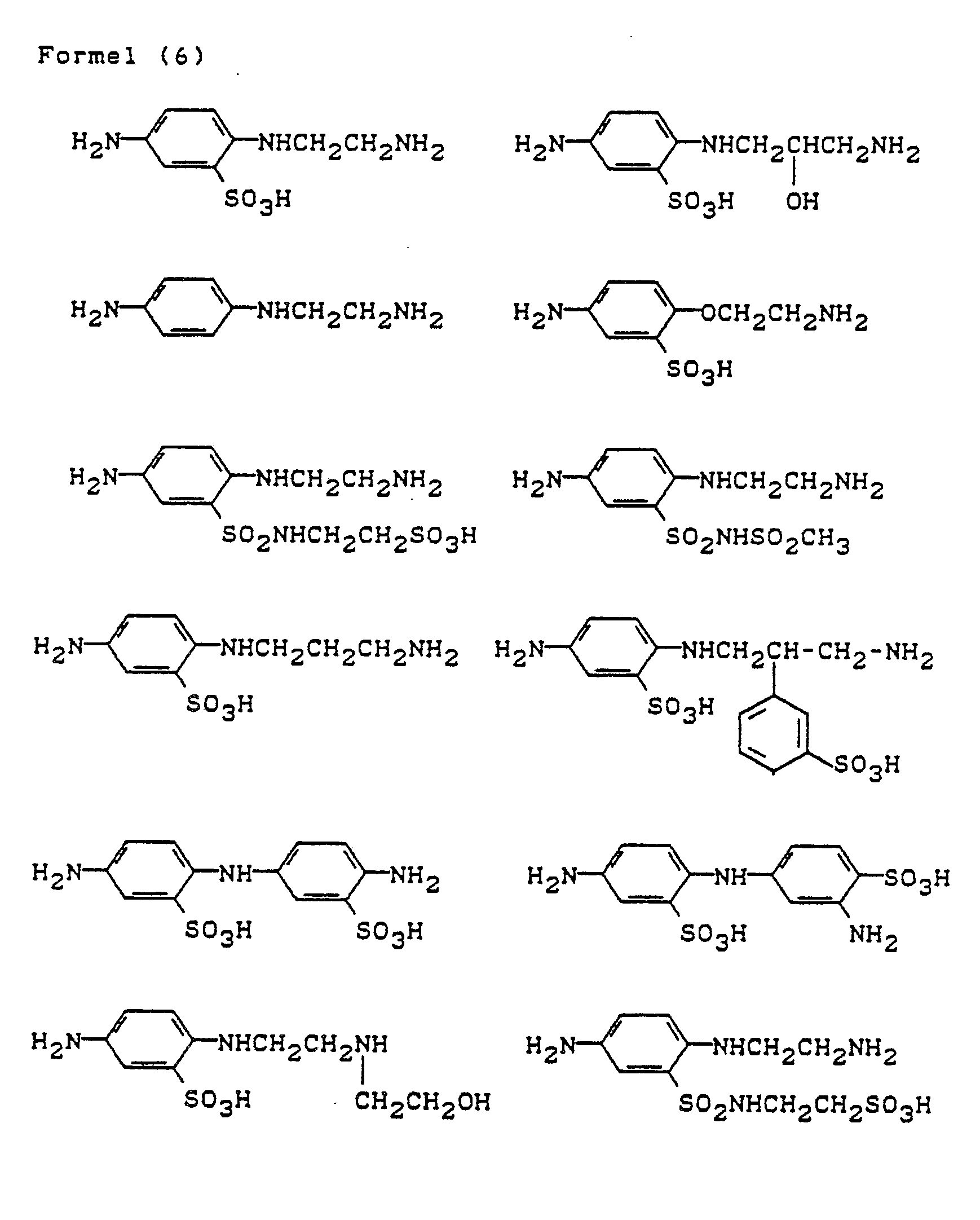
Beispiele für Verbindungen der Formel (5), (6), (7) und (10) sind folgende


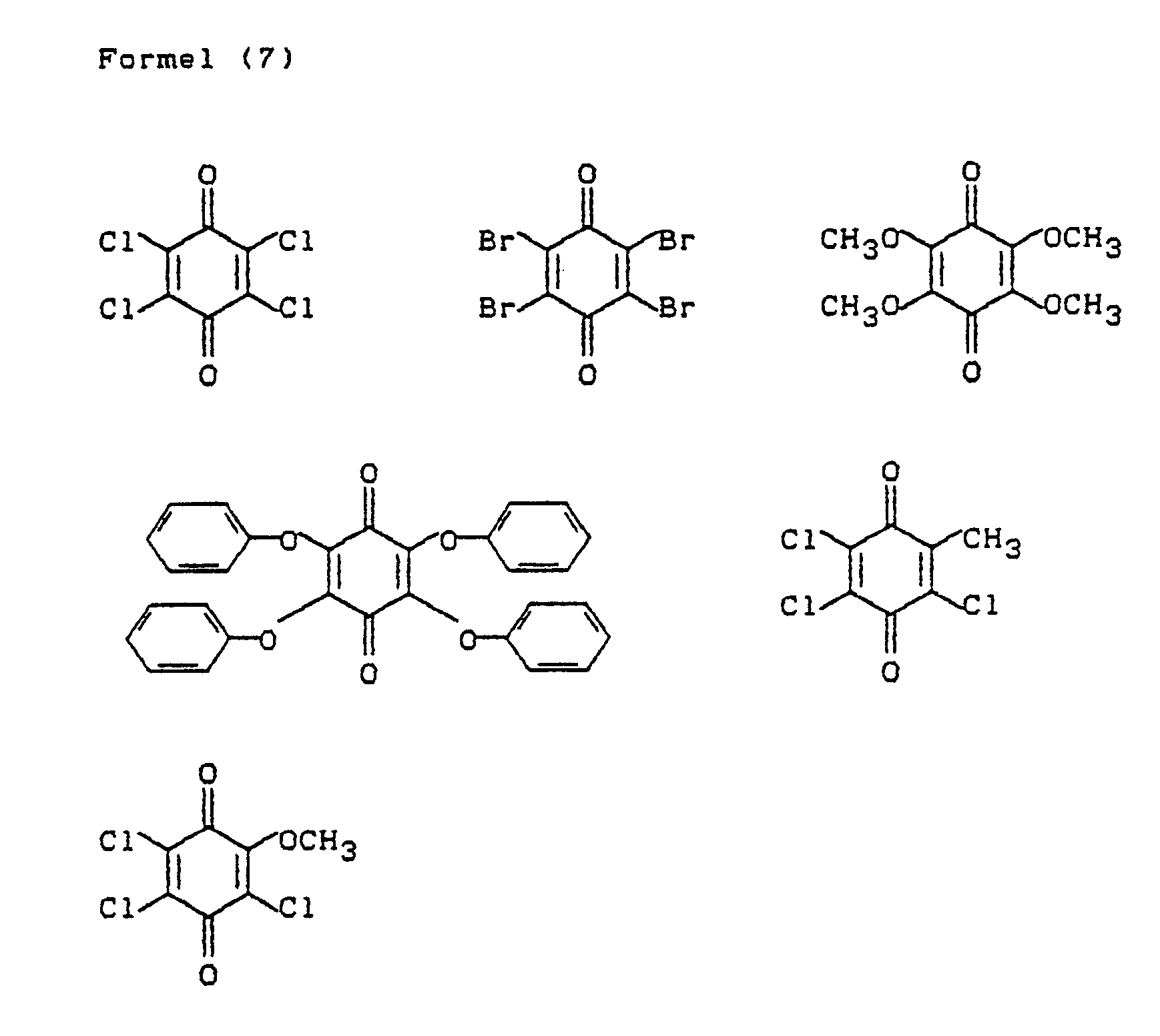
Als Reaktivkomponenten (10) sind die Halogenide, insbesondere die Chloride oder Fluoride der vorstehend aufgeführten Reaktivgruppen Z zu verstehen.The reactive components (10) are to be understood as the halides, in particular the chlorides or fluorides, of the reactive groups Z listed above.
Die neuen Farbstoffe geben auf Cellulose- sowie natürlichen synthetischen Polyamidmaterialien klare Färbungen. Sie zeichnen sich durch hohe Farbstärke aus.The new dyes give clear colors on cellulose and natural synthetic polyamide materials. They are characterized by high color strength.
Als wasserlösliche Reaktivfarbstoffe finden die neuen Farbstoffe bevorzugtes Interesse für das Färben von hydroxyl- und amidgruppenhaltigen Textilmaterialien, insbesondere von Materialien aus nativer und regenerierter Cellulose sowie synthetischen Polyamid- und Polyurethanfasern, Wolle und Seide.As water-soluble reactive dyes, the new dyes are of particular interest for dyeing textile materials containing hydroxyl and amide groups, in particular materials made from native and regenerated cellulose and synthetic polyamide and polyurethane fibers, wool and silk.
Die genannten Materialien werden nach den für wasserlösliche Reaktivfarbstoffe allgemein bekannten und in der Technik üblichen Verfahren gefärbt oder bedruckt. Man erhält dann licht- und naßechte brillante Färbungen und Drucke.The materials mentioned are dyed or printed by the processes which are generally known and customary in industry for water-soluble reactive dyes. Light and wet fast brilliant dyeings and prints are then obtained.
Bei den Temperaturangaben in den Beispielen handelt es sich um °C. Die Formeln der wasserlöslichen Reaktivfarbstoffe in der Beschreibung und in den Beispielen sind die der freien Säuren. Isoliert und angewandt werden die Farbstoffe im allgemeinen in Form ihrer Alkalisalze, insbesondere der Lithium-, Natrium- oder Kaliumsalze.The temperature data in the examples are ° C. The formulas of the water-soluble reactive dyes in the description and in the examples are those of the free acids. The dyes are generally isolated and used in the form of their alkali metal salts, in particular the lithium, sodium or potassium salts.
Die in den Beispielen angegebenen Farbkennzahlen beziehen sich auf Colour Index Hue Indication Chart (Indicator Numbers).The color indicators given in the examples refer to the Color Index Hue Indication Chart (Indicator Numbers).
Die in den folgenden Beispielen angegebenen Formeln beziehen sich auf jeweils eines der bei der Umsetzung entstehenden isomeren Reaktionsprodukte, wobei bezüglich der Substituenten in den beiden äußeren aromatischen Ringen des Triphendioxazin-Systems der isomeren Reaktionsprodukte auf das unter Formel (1) gesagte verwiesen wird.The formulas given in the following examples each relate to one of the isomeric reaction products formed during the reaction, reference being made to that stated under formula (1) with regard to the substituents in the two outer aromatic rings of the triphendioxazine system of the isomeric reaction products.
23,1 g 3-Sulfo-4-(ß-aminoethylamino)-anilin und 26 g 3-(ß-Hydroxyethylsulfonyl)-4-(ß-hydroxyethylamino)-anilin werden in 500 ml Wasser bei 60°C und einem pH von 5,5 verrührt. Anschließend gibt man 26 g Chloranil bei einer Reaktionstemperatur von etwa 65°C und unter Einhaltung eines pH von 5,0 bis 5,5 zu, den man durch Zutropfen einer verdünnten Sodalösung einhält. Man bringt die Reaktion bei gleicher Temperatur und dem angegebenen pH durch vierstündiges Rühren zu Ende.23.1 g of 3-sulfo-4- (ß-aminoethylamino) aniline and 26 g of 3- (ß-hydroxyethylsulfonyl) -4- (ß-hydroxyethylamino) aniline are in 500 ml of water at 60 ° C and a pH of 5.5 stirred. Then 26 g of chloranil are added at a reaction temperature of about 65 ° C. and while maintaining a pH of 5.0 to 5.5, which is maintained by adding a dilute sodium carbonate solution dropwise. The reaction is brought to an end at the same temperature and the specified pH by stirring for four hours.
Das ausgefallene Reaktionsprodukte wird bei 60°C abgesaugt, mit Wasser gewaschen und getrocknet. Man erhält nach dem Mahlen ein braunes Pulver, das aus dem Gemisch folgender drei Verbindungen besteht, wobei die assymmetrische Verbindung der Formel (A) überwiegt.

33,2 g des nach a) erhaltenen Produktes werden bei einer Temperatur zwischen 20 und 25°C in 250 g 10%iges Oleum eingetragen. Der Ansatz wird bei dieser Temperatur noch eine Stunde gerührt. Dann werden 26 g Natriumperoxodisulfat so eingetragen, daß die Temperatur zwischen 20 und 25°C gehalten werden kann. Man rührt 5 Stunden nach und läßt dann des Ansatz auf Eis laufen. Das Kondensationsprodukt ist zum Teil ausgefallen. Durch Zusatz von 10 Volumenprozent Kaliumchlorid wird der Niederschlag vervollständigt. Das Produkt wird nach dem Absaugen und Waschen mit KCl-Lösung in 1 l Eiswasser angerührt und durch Einstreuen von Natriumbicarbonat auf pH 5-5,5 gestellt.33.2 g of the product obtained according to a) are introduced into 250 g of 10% oleum at a temperature between 20 and 25 ° C. The mixture is stirred at this temperature for another hour. Then 26 g of sodium peroxodisulfate are added so that the temperature can be kept between 20 and 25 ° C. The mixture is stirred for 5 hours and then allowed to run on ice. Some of the condensation product has failed. The precipitation is completed by adding 10% by volume of potassium chloride. After suction and washing with KCl solution, the product is stirred in 1 l of ice water and adjusted to pH 5-5.5 by sprinkling in sodium bicarbonate.
0,05 Mol o-Sulfanilsäure werden mit LiOH-Lösung in 200 ml Eiswasser neutral gelöst. Bei 0°C tropft man 0,05 Mol Trifluortriazin ein und hält dabei den pH durch Zugabe von LiOH-Lösung zwischen 6 und 7. Die resultierende Lösung, die das Kondensationsprodukt der Formel

Der in dem Gemisch erhaltene erfindungsgemäße Farbstoff entspricht der wahrscheinlichen Formel

Ähnliche Farbstoffe, die Baumwolle in einem brillanten Blau mit der Farbkennzahl 13 färben, werden erhalten, wenn zur Acylierung der aliphatischen Aminogruppe des Chromophores in Beispiel 1 entsprechende Mengen der folgenden Acylierungsmittel verwendet werden.


Weitere wertvolle Farbstoffe werden erhalten, wenn man anstelle des in Beispiel 1 verwendeten erfindungsgemäßen Chromophors die nachfolgend aufgeführten einsetzt, wobei als Acylierungsmittel die in den Beispielen 1 bis 12 verwendeten Reaktivkomponenten eingesetzt werden.


Claims (12)

T = Rest eines Triphendioxazinfarbstoffs, der frei von
Resten -SO₂B und -

B = CH=CH₂ oder CH₂CH₂V,
worin
V = abspaltbare Gruppe wie OSO₃H, Cl, S₂O₃H, OCOCH₃, OPO₃H₂, -⊕N(CH₃)₃
R = H oder gegebenenfalls substituiertes C₁-C₄-Alkyl,
Z = faserreaktiver Rest.1. Triphendioxazin dyes of the formula
T = residue of a triphendioxazine dye free of
Residues -SO₂B and -
B = CH = CH₂ or CH₂CH₂V,
wherein
V = cleavable group such as OSO₃H, Cl, S₂O₃H, OCOCH₃, OPO₃H₂, - ⊕ N (CH₃) ₃
R = H or optionally substituted C₁-C₄ alkyl,
Z = fiber-reactive residue.

B, R und Z die in Anspruch 1 angegebene Bedeutung haben,
T₁ und T₂ für H, Cl, Br, C₁-C₄-Alkoxy, C₁-C₄-Alkyl, gegebenenfalls substituiertes Phenyl oder Phenoxy stehen, wobei T₁ und T₂ bevorzugt gleiche Bedeutung haben,
X und X₁ für O, S oder

R˝ für Wasserstoff, oder gegebenenfalls substituiertes C₁-C₄-Alkyl steht und für den Fall, daß Y einen gegebenenfalls substituierten zweiwertigen aliphatischen Rest bedeutet, zusammen mit R auch für Alkylen, vorzugsweise -CH₂CH₂-steht, und für den Fall, daß W einen aliphatischen Rest bedeutet zusammen mit W gegebenenfalls unter Einschluß eines Heteroatoms einen Ring bilden kann,
Y für einen gegebenenfalls weitersubstituierten zweiwertigen aliphatischen, araliphatischen, cycloaliphatischen oder aromatischen Rest steht,
W für H oder einen gegebenenfalls weitersubstituierten aliphatischen, araliphatischen, cycloaliphatischen oder aromatischen Rest steht,
R₁ eine wasserlöslichmachende Gruppe wie eine Carboxy- oder Sulfogruppe oder eine Sulfamoylgruppe ist, die mono- oder disubstituiert sein kann, wobei die Substituenten vorzugsweise Alkylgruppen von 1 bis 4 C-Atomen, die durch einen Phenylrest substituiert sein können, und Phenylreste sind, wobei diese Reste wiederum bevorzugt wasserlöslichmachende Gruppen enthalten können, oder eine Disulfimidgruppe SO₂NHSO₂R₄ ist, wobei R₄ für einen gegebenenfalls substituierten C₁-C₄-Alkylrest oder Phenylrest steht, oder eine Sulfongruppe -SO₂R₄ ist R₂ und R₃ für H, C₁-C₄-Alkyl, C₁-C₄-Alkoxy, Carboxy, F, Cl oder Br stehen und wobei
die Reste SO₂B bzw. R₁ jeweils in o-Stellung zum Substituenten X₁-W bzw. X-Y-

2. Dyes of claim 1 of the formula
B, R and Z have the meaning given in claim 1,
T₁ and T₂ represent H, Cl, Br, C₁-C₄-alkoxy, C₁-C₄-alkyl, optionally substituted phenyl or phenoxy, where T₁ and T₂ preferably have the same meaning,
X and X₁ for O, S or
R˝ represents hydrogen, or optionally substituted C₁-C₄ alkyl and in the event that Y represents an optionally substituted divalent aliphatic radical, together with R also represents alkylene, preferably -CH₂CH₂-, and for If W is an aliphatic radical together with W can form a ring, optionally including a hetero atom,
Y represents an optionally further substituted divalent aliphatic, araliphatic, cycloaliphatic or aromatic radical,
W represents H or an optionally further substituted aliphatic, araliphatic, cycloaliphatic or aromatic radical,
R₁ is a water-solubilizing group such as a carboxy or sulfo group or a sulfamoyl group, which may be mono- or disubstituted, the substituents preferably being alkyl groups of 1 to 4 carbon atoms, which may be substituted by a phenyl radical, and phenyl radicals, these being Residues in turn can preferably contain water-solubilizing groups, or is a disulfimide group SO₂NHSO₂R₄, where R₄ is an optionally substituted C₁-C₄ alkyl radical or phenyl radical, or is a sulfone group -SO₂R₄ R₂ and R₃ are H, C₁-C₄-alkyl, C₁-C₄-alkoxy, carboxy, F, Cl or Br and wherein
the radicals SO₂B or R₁ each in the o-position to the substituent X₁-W or XY-
T₁ und T₂ = Cl
X und X₁ = NH
R = H
R₁ = SO₃H
R₂ und R₃ = H
B = CH₂-CH₂-OSO₃H
W =C₂-C₄-Alkyl, das durch OSO₃H substituiert ist
Z =Rest einer Reaktivkomponente der Monofluor- oder Monochlortriazinreihe oder 2,4-Difluor-5-chlorpyrimidinyl-6-
Y = C₂-C₄-Alkylen.3. Dyes of claim 2 with
T₁ and T₂ = Cl
X and X₁ = NH
R = H
R₁ = SO₃H
R₂ and R₃ = H
B = CH₂-CH₂-OSO₃H
W = C₂-C₄-alkyl which is substituted by OSO₃H
Z = residue of a reactive component of the monofluor or monochlorotriazine series or 2,4-difluoro-5-chloropyrimidinyl-6-
Y = C₂-C₄ alkylene.
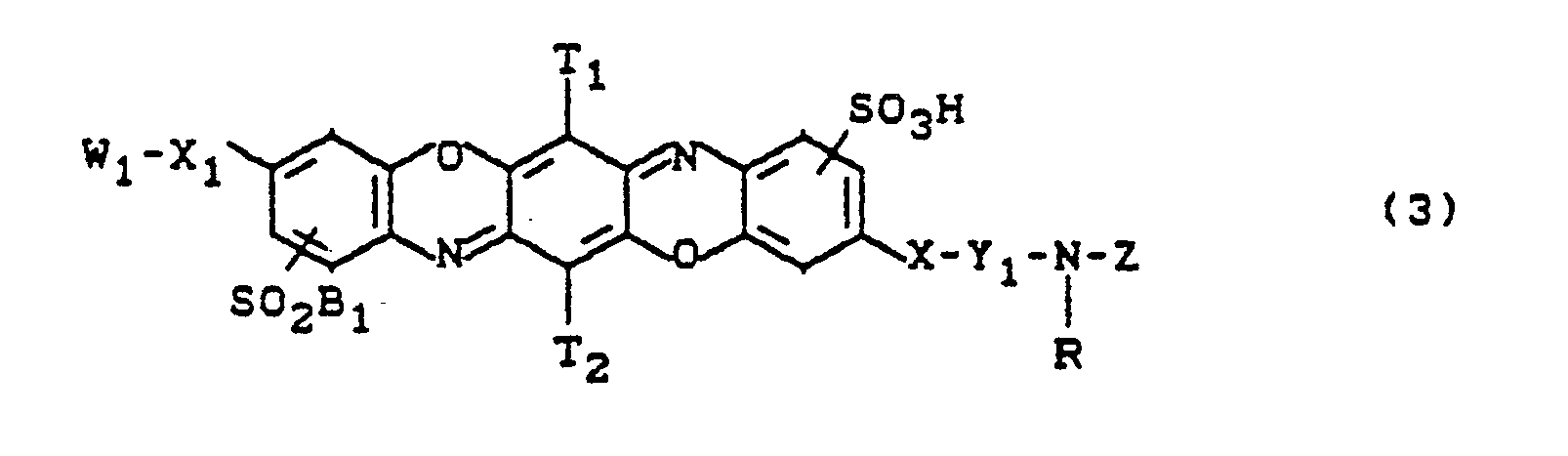
T₁, T₂, R, X und Z die in Anspruch 2 angegebene Bedeutung haben und
B₁ = CH₂-CH₂OSO₃H
Y₁ = aliphatischer oder araliphatischer Rest
W₁ = aliphatischer oder araliphatischer Rest.4. Dyes of claim 2 with the formula
T₁, T₂, R, X and Z have the meaning given in claim 2 and
B₁ = CH₂-CH₂OSO₃H
Y₁ = aliphatic or araliphatic radical
W₁ = aliphatic or araliphatic radical.

T₁, T₂, R, X, Z und B₁ die angegebene Bedeutung haben und
Y₂ = aliphatischer Rest
W₂ = aliphatischer Rest.5. Dyes of claim 2 of the formula
T₁, T₂, R, X, Z and B₁ have the meaning given and
Y₂ = aliphatic radical
W₂ = aliphatic residue.
Y₂ = -CH₂-CH₂-, -CH₂-CH₂-CH₂-CH₂-, -CH₂-CH₂-CH₂-, -CH₂-

W₂ = -CH₂-CH₂-OSO₃H,

Y₂ = -CH₂-CH₂-, -CH₂-CH₂-CH₂-CH₂-, -CH₂-CH₂-CH₂-, -CH₂-
W₂ = -CH₂-CH₂-OSO₃H,
T₁ und T₂ = Cl
X und X1 = NH
R = H

G = F oder Cl und
E im Falle G = F eine gegebenenfalls substituierte Aminogruppe bedeutet und im Falle G = Cl eine Ether- oder Thioethergruppe der Formeln
-OR₅ oder -SR₅
wobei
R₅ = gegebenenfalls substituiertes C₁-C₆-Alkyl oder gegebenenfalls substituiertes Aryl,
oder eine
gegebenenfalls substituierte Aminogruppe.7. dyes of claim 5 with
T₁ and T₂ = Cl
X and X1 = NH
R = H
G = F or Cl and
E in the case of G = F denotes an optionally substituted amino group and in the case of G = Cl an ether or thioether group of the formulas
-OR₅ or -SR₅
in which
R₅ = optionally substituted C₁-C₆ alkyl or optionally substituted aryl,
or one
optionally substituted amino group.

R₆ = Wasserstoff oder gegebenenfalls substituiertes C₁-C₆-Alkyl
R₇ = Wasserstoff oder gegebenenfalls substituiertes C₁-C₆-Alkyl, C₅-C₈-Cycloalkyl oder gegebenenfalls substituiertes Aryl oder R₆ und R₇ bilden gegebenenfalls unter Einschluß eines weiteren Heteroatomes einen heterocyclischen Ring.8. dyes of claim 7 with
R₆ = hydrogen or optionally substituted C₁-C₆ alkyl
R₇ = hydrogen or optionally substituted C₁-C₆-alkyl, C₅-C₈-cycloalkyl or optionally substituted aryl or R₆ and R₇ optionally form a heterocyclic ring, including a further heteroatom.

Applications Claiming Priority (2)
| Application Number | Priority Date | Filing Date | Title |
|---|---|---|---|
| DE3822850 | 1988-07-06 | ||
| DE3822850A DE3822850A1 (en) | 1988-07-06 | 1988-07-06 | TRIPHENDIOXAZINE DYES |
Publications (3)
| Publication Number | Publication Date |
|---|---|
| EP0349848A2 true EP0349848A2 (en) | 1990-01-10 |
| EP0349848A3 EP0349848A3 (en) | 1990-02-07 |
| EP0349848B1 EP0349848B1 (en) | 1993-04-21 |
Family
ID=6358075
Family Applications (1)
| Application Number | Title | Priority Date | Filing Date |
|---|---|---|---|
| EP89111418A Expired - Lifetime EP0349848B1 (en) | 1988-07-06 | 1989-06-23 | Triphene dioxazine dyes |
Country Status (4)
| Country | Link |
|---|---|
| US (1) | US5057609A (en) |
| EP (1) | EP0349848B1 (en) |
| JP (1) | JPH0247164A (en) |
| DE (2) | DE3822850A1 (en) |
Cited By (1)
| Publication number | Priority date | Publication date | Assignee | Title |
|---|---|---|---|---|
| US5498712A (en) * | 1992-05-26 | 1996-03-12 | Zeneca Limited | Triphenodioxazine dyes |
Families Citing this family (5)
| Publication number | Priority date | Publication date | Assignee | Title |
|---|---|---|---|---|
| GB8925900D0 (en) * | 1989-11-16 | 1990-01-04 | Ici Plc | Reactive dyes |
| JP3074796B2 (en) * | 1990-08-21 | 2000-08-07 | 住友化学工業株式会社 | Asymmetric dioxazine compound and method for dyeing or printing fiber material using the same |
| JP2570358Y2 (en) * | 1993-04-14 | 1998-05-06 | 矢崎総業株式会社 | Electrical junction box |
| TW506993B (en) | 1999-03-15 | 2002-10-21 | Ciba Sc Holding Ag | Reactive dyes, processes for their preparation and process for dyeing or printing a fibre material |
| JP2003104989A (en) * | 2001-09-28 | 2003-04-09 | Sumitomo Chem Co Ltd | Method for producing dioxazine compound |
Family Cites Families (3)
| Publication number | Priority date | Publication date | Assignee | Title |
|---|---|---|---|---|
| DE3439755A1 (en) * | 1984-04-05 | 1985-10-17 | Bayer Ag, 5090 Leverkusen | TRIPHENDIOXAZINE DYES |
| DE3530830A1 (en) * | 1985-08-29 | 1987-03-05 | Hoechst Ag | HYDRO-SOLUBLE TRIPHENEDIOXAZINE COMPOUNDS, PROCESS FOR THEIR PRODUCTION AND USE AS COLORING MATTER |
| DE3544982A1 (en) * | 1985-12-19 | 1987-06-25 | Hoechst Ag | WATER-SOLUBLE TRIPHENDIOXAZINE COMPOUNDS, METHOD FOR THE PRODUCTION THEREOF AND THEIR USE AS DYES |
-
1988
- 1988-07-06 DE DE3822850A patent/DE3822850A1/en not_active Withdrawn
-
1989
- 1989-06-20 US US07/369,441 patent/US5057609A/en not_active Expired - Fee Related
- 1989-06-23 EP EP89111418A patent/EP0349848B1/en not_active Expired - Lifetime
- 1989-06-23 DE DE8989111418T patent/DE58904119D1/en not_active Expired - Fee Related
- 1989-06-30 JP JP1167149A patent/JPH0247164A/en active Pending
Cited By (1)
| Publication number | Priority date | Publication date | Assignee | Title |
|---|---|---|---|---|
| US5498712A (en) * | 1992-05-26 | 1996-03-12 | Zeneca Limited | Triphenodioxazine dyes |
Also Published As
| Publication number | Publication date |
|---|---|
| US5057609A (en) | 1991-10-15 |
| JPH0247164A (en) | 1990-02-16 |
| EP0349848B1 (en) | 1993-04-21 |
| EP0349848A3 (en) | 1990-02-07 |
| DE58904119D1 (en) | 1993-05-27 |
| DE3822850A1 (en) | 1990-01-11 |
Similar Documents
| Publication | Publication Date | Title |
|---|---|---|
| EP0199036B1 (en) | Triphenedioxazine dyes | |
| EP0144580B1 (en) | Triphendioxazine dyes | |
| EP0349848B1 (en) | Triphene dioxazine dyes | |
| EP0158857A2 (en) | Reactive dichlorotriphenyldioxazin dyes | |
| EP0134033B1 (en) | Benzthiazinophenoxazine dyestuffs | |
| EP0043561B1 (en) | Water-soluble phthalocyanine compounds, process for their preparation and their use as dyestuffs | |
| EP0204245B1 (en) | Reactive dyes | |
| DE2455615A1 (en) | REACTIVE COLORS | |
| EP0272532B1 (en) | Dyestuffs | |
| EP0486423A1 (en) | Oligomer mixtures of triphenedioxazine compounds, process for their preparation, and their use | |
| EP0229339B1 (en) | Water soluble triphene dioxazine compounds, their starting compounds containing sulphonyl groups, process for their preparation and use of the triphene dioxazines as dyestuffs | |
| EP0414068B1 (en) | Reactive dyestuffs | |
| EP0432542B1 (en) | Azo dyestuffs and intermediates for their preparation | |
| DE4418992A1 (en) | New reactive dyes, their production and use | |
| EP0158110B1 (en) | Triphenedioxazine dyes | |
| EP0338310B1 (en) | Reactive dyes | |
| EP0043465A2 (en) | Reactive dyestuffs and their use in dyeing and printing fibre materials containing hydroxyle groups or nitrogen | |
| EP0240839B1 (en) | Complex metal dyes | |
| EP0205080B1 (en) | Triphenodioxazine-disulfimide reactive dyes | |
| DE2906442C2 (en) | ||
| EP0486429B1 (en) | Triphenedioxazine compounds, their preparation process and their use | |
| DE3902053A1 (en) | REACTIVE DYES |
Legal Events
| Date | Code | Title | Description |
|---|---|---|---|
| PUAI | Public reference made under article 153(3) epc to a published international application that has entered the european phase |
Free format text: ORIGINAL CODE: 0009012 |
|
| PUAL | Search report despatched |
Free format text: ORIGINAL CODE: 0009013 |
|
| 17P | Request for examination filed |
Effective date: 19890623 |
|
| AK | Designated contracting states |
Kind code of ref document: A2 Designated state(s): CH DE FR GB LI |
|
| AK | Designated contracting states |
Kind code of ref document: A3 Designated state(s): CH DE FR GB LI |
|
| 17Q | First examination report despatched |
Effective date: 19911023 |
|
| GRAA | (expected) grant |
Free format text: ORIGINAL CODE: 0009210 |
|
| AK | Designated contracting states |
Kind code of ref document: B1 Designated state(s): CH DE FR GB LI |
|
| REF | Corresponds to: |
Ref document number: 58904119 Country of ref document: DE Date of ref document: 19930527 |
|
| GBT | Gb: translation of ep patent filed (gb section 77(6)(a)/1977) |
Effective date: 19930405 |
|
| ET | Fr: translation filed | ||
| PLBE | No opposition filed within time limit |
Free format text: ORIGINAL CODE: 0009261 |
|
| STAA | Information on the status of an ep patent application or granted ep patent |
Free format text: STATUS: NO OPPOSITION FILED WITHIN TIME LIMIT |
|
| 26N | No opposition filed | ||
| PGFP | Annual fee paid to national office [announced via postgrant information from national office to epo] |
Ref country code: DE Payment date: 19950515 Year of fee payment: 7 |
|
| PGFP | Annual fee paid to national office [announced via postgrant information from national office to epo] |
Ref country code: GB Payment date: 19950612 Year of fee payment: 7 |
|
| PGFP | Annual fee paid to national office [announced via postgrant information from national office to epo] |
Ref country code: CH Payment date: 19950613 Year of fee payment: 7 |
|
| PGFP | Annual fee paid to national office [announced via postgrant information from national office to epo] |
Ref country code: FR Payment date: 19950616 Year of fee payment: 7 |
|
| PG25 | Lapsed in a contracting state [announced via postgrant information from national office to epo] |
Ref country code: GB Effective date: 19960623 |
|
| PG25 | Lapsed in a contracting state [announced via postgrant information from national office to epo] |
Ref country code: LI Effective date: 19960630 Ref country code: CH Effective date: 19960630 |
|
| GBPC | Gb: european patent ceased through non-payment of renewal fee |
Effective date: 19960623 |
|
| REG | Reference to a national code |
Ref country code: CH Ref legal event code: PL |
|
| PG25 | Lapsed in a contracting state [announced via postgrant information from national office to epo] |
Ref country code: FR Effective date: 19970228 |
|
| PG25 | Lapsed in a contracting state [announced via postgrant information from national office to epo] |
Ref country code: DE Effective date: 19970301 |
|
| REG | Reference to a national code |
Ref country code: FR Ref legal event code: ST |