EP0349269B1 - Flexible copper-clad substrates - Google Patents
Flexible copper-clad substrates Download PDFInfo
- Publication number
- EP0349269B1 EP0349269B1 EP89306514A EP89306514A EP0349269B1 EP 0349269 B1 EP0349269 B1 EP 0349269B1 EP 89306514 A EP89306514 A EP 89306514A EP 89306514 A EP89306514 A EP 89306514A EP 0349269 B1 EP0349269 B1 EP 0349269B1
- Authority
- EP
- European Patent Office
- Prior art keywords
- hydrocarbon group
- formula
- carbon atoms
- group
- polyamide acid
- Prior art date
- Legal status (The legal status is an assumption and is not a legal conclusion. Google has not performed a legal analysis and makes no representation as to the accuracy of the status listed.)
- Expired - Lifetime
Links
- 239000000758 substrate Substances 0.000 title claims description 33
- 239000004952 Polyamide Substances 0.000 claims description 34
- 239000002253 acid Substances 0.000 claims description 34
- 229920002647 polyamide Polymers 0.000 claims description 34
- 238000000034 method Methods 0.000 claims description 20
- 229920001721 polyimide Polymers 0.000 claims description 20
- RYGMFSIKBFXOCR-UHFFFAOYSA-N Copper Chemical compound [Cu] RYGMFSIKBFXOCR-UHFFFAOYSA-N 0.000 claims description 19
- 239000011889 copper foil Substances 0.000 claims description 18
- 125000004432 carbon atom Chemical group C* 0.000 claims description 16
- 239000004642 Polyimide Substances 0.000 claims description 12
- 125000002029 aromatic hydrocarbon group Chemical group 0.000 claims description 12
- 239000002131 composite material Substances 0.000 claims description 10
- 125000001931 aliphatic group Chemical group 0.000 claims description 8
- 238000000576 coating method Methods 0.000 claims description 6
- 125000003118 aryl group Chemical group 0.000 claims description 5
- 239000011248 coating agent Substances 0.000 claims description 5
- 239000011347 resin Substances 0.000 claims description 5
- 229920005989 resin Polymers 0.000 claims description 5
- 238000010438 heat treatment Methods 0.000 claims description 3
- 238000004519 manufacturing process Methods 0.000 claims description 3
- 125000002496 methyl group Chemical group [H]C([H])([H])* 0.000 claims description 3
- 238000002156 mixing Methods 0.000 claims description 3
- 125000001997 phenyl group Chemical group [H]C1=C([H])C([H])=C(*)C([H])=C1[H] 0.000 claims description 3
- -1 siloxane chain Chemical group 0.000 claims description 3
- 125000003668 acetyloxy group Chemical group [H]C([H])([H])C(=O)O[*] 0.000 claims description 2
- 125000003545 alkoxy group Chemical group 0.000 claims description 2
- 150000001343 alkyl silanes Chemical class 0.000 claims description 2
- 239000011888 foil Substances 0.000 claims description 2
- 229920001296 polysiloxane Polymers 0.000 claims description 2
- 229910052736 halogen Inorganic materials 0.000 claims 1
- 150000002367 halogens Chemical class 0.000 claims 1
- 238000006243 chemical reaction Methods 0.000 description 17
- SECXISVLQFMRJM-UHFFFAOYSA-N N-Methylpyrrolidone Chemical compound CN1CCCC1=O SECXISVLQFMRJM-UHFFFAOYSA-N 0.000 description 12
- 230000001070 adhesive effect Effects 0.000 description 12
- GTDPSWPPOUPBNX-UHFFFAOYSA-N ac1mqpva Chemical compound CC12C(=O)OC(=O)C1(C)C1(C)C2(C)C(=O)OC1=O GTDPSWPPOUPBNX-UHFFFAOYSA-N 0.000 description 11
- 239000000853 adhesive Substances 0.000 description 11
- 150000004985 diamines Chemical class 0.000 description 11
- 230000015572 biosynthetic process Effects 0.000 description 9
- 238000003786 synthesis reaction Methods 0.000 description 7
- CBCKQZAAMUWICA-UHFFFAOYSA-N 1,4-phenylenediamine Chemical compound NC1=CC=C(N)C=C1 CBCKQZAAMUWICA-UHFFFAOYSA-N 0.000 description 6
- 150000004984 aromatic diamines Chemical class 0.000 description 6
- 238000003756 stirring Methods 0.000 description 6
- 125000006158 tetracarboxylic acid group Chemical group 0.000 description 6
- IJGRMHOSHXDMSA-UHFFFAOYSA-N Atomic nitrogen Chemical compound N#N IJGRMHOSHXDMSA-UHFFFAOYSA-N 0.000 description 5
- FZHAPNGMFPVSLP-UHFFFAOYSA-N silanamine Chemical compound [SiH3]N FZHAPNGMFPVSLP-UHFFFAOYSA-N 0.000 description 5
- HLBLWEWZXPIGSM-UHFFFAOYSA-N 4-Aminophenyl ether Chemical compound C1=CC(N)=CC=C1OC1=CC=C(N)C=C1 HLBLWEWZXPIGSM-UHFFFAOYSA-N 0.000 description 4
- 0 CCCC(C)C(*(C(N*[*+])=O)(C(O)=O)C(O)=O)=O Chemical compound CCCC(C)C(*(C(N*[*+])=O)(C(O)=O)C(O)=O)=O 0.000 description 4
- 150000001875 compounds Chemical class 0.000 description 4
- 239000000203 mixture Substances 0.000 description 4
- 239000003960 organic solvent Substances 0.000 description 4
- 239000002904 solvent Substances 0.000 description 4
- GEYOCULIXLDCMW-UHFFFAOYSA-N 1,2-phenylenediamine Chemical compound NC1=CC=CC=C1N GEYOCULIXLDCMW-UHFFFAOYSA-N 0.000 description 3
- WZCQRUWWHSTZEM-UHFFFAOYSA-N 1,3-phenylenediamine Chemical compound NC1=CC=CC(N)=C1 WZCQRUWWHSTZEM-UHFFFAOYSA-N 0.000 description 3
- LXJLFVRAWOOQDR-UHFFFAOYSA-N 3-(3-aminophenoxy)aniline Chemical compound NC1=CC=CC(OC=2C=C(N)C=CC=2)=C1 LXJLFVRAWOOQDR-UHFFFAOYSA-N 0.000 description 3
- ZBMISJGHVWNWTE-UHFFFAOYSA-N 3-(4-aminophenoxy)aniline Chemical compound C1=CC(N)=CC=C1OC1=CC=CC(N)=C1 ZBMISJGHVWNWTE-UHFFFAOYSA-N 0.000 description 3
- FXHOOIRPVKKKFG-UHFFFAOYSA-N N,N-Dimethylacetamide Chemical compound CN(C)C(C)=O FXHOOIRPVKKKFG-UHFFFAOYSA-N 0.000 description 3
- ZMXDDKWLCZADIW-UHFFFAOYSA-N N,N-Dimethylformamide Chemical compound CN(C)C=O ZMXDDKWLCZADIW-UHFFFAOYSA-N 0.000 description 3
- YXFVVABEGXRONW-UHFFFAOYSA-N Toluene Chemical compound CC1=CC=CC=C1 YXFVVABEGXRONW-UHFFFAOYSA-N 0.000 description 3
- 150000007513 acids Chemical class 0.000 description 3
- WKDNYTOXBCRNPV-UHFFFAOYSA-N bpda Chemical compound C1=C2C(=O)OC(=O)C2=CC(C=2C=C3C(=O)OC(C3=CC=2)=O)=C1 WKDNYTOXBCRNPV-UHFFFAOYSA-N 0.000 description 3
- 230000000052 comparative effect Effects 0.000 description 3
- 229910001873 dinitrogen Inorganic materials 0.000 description 3
- 238000004090 dissolution Methods 0.000 description 3
- YBRVSVVVWCFQMG-UHFFFAOYSA-N 4,4'-diaminodiphenylmethane Chemical compound C1=CC(N)=CC=C1CC1=CC=C(N)C=C1 YBRVSVVVWCFQMG-UHFFFAOYSA-N 0.000 description 2
- MQJKPEGWNLWLTK-UHFFFAOYSA-N Dapsone Chemical compound C1=CC(N)=CC=C1S(=O)(=O)C1=CC=C(N)C=C1 MQJKPEGWNLWLTK-UHFFFAOYSA-N 0.000 description 2
- IAZDPXIOMUYVGZ-UHFFFAOYSA-N Dimethylsulphoxide Chemical compound CS(C)=O IAZDPXIOMUYVGZ-UHFFFAOYSA-N 0.000 description 2
- BGTOWKSIORTVQH-UHFFFAOYSA-N cyclopentanone Chemical compound O=C1CCCC1 BGTOWKSIORTVQH-UHFFFAOYSA-N 0.000 description 2
- 150000002576 ketones Chemical class 0.000 description 2
- 229910052757 nitrogen Inorganic materials 0.000 description 2
- QJGQUHMNIGDVPM-UHFFFAOYSA-N nitrogen group Chemical group [N] QJGQUHMNIGDVPM-UHFFFAOYSA-N 0.000 description 2
- 239000003495 polar organic solvent Substances 0.000 description 2
- 239000009719 polyimide resin Substances 0.000 description 2
- 230000002195 synergetic effect Effects 0.000 description 2
- ZNQVEEAIQZEUHB-UHFFFAOYSA-N 2-ethoxyethanol Chemical compound CCOCCO ZNQVEEAIQZEUHB-UHFFFAOYSA-N 0.000 description 1
- QTWJRLJHJPIABL-UHFFFAOYSA-N 2-methylphenol;3-methylphenol;4-methylphenol Chemical compound CC1=CC=C(O)C=C1.CC1=CC=CC(O)=C1.CC1=CC=CC=C1O QTWJRLJHJPIABL-UHFFFAOYSA-N 0.000 description 1
- QSPMTSAELLSLOQ-UHFFFAOYSA-N 3-(4-aminophenyl)aniline Chemical group C1=CC(N)=CC=C1C1=CC=CC(N)=C1 QSPMTSAELLSLOQ-UHFFFAOYSA-N 0.000 description 1
- ZMPZWXKBGSQATE-UHFFFAOYSA-N 3-(4-aminophenyl)sulfonylaniline Chemical compound C1=CC(N)=CC=C1S(=O)(=O)C1=CC=CC(N)=C1 ZMPZWXKBGSQATE-UHFFFAOYSA-N 0.000 description 1
- AVCOFPOLGHKJQB-UHFFFAOYSA-N 4-(3,4-dicarboxyphenyl)sulfonylphthalic acid Chemical compound C1=C(C(O)=O)C(C(=O)O)=CC=C1S(=O)(=O)C1=CC=C(C(O)=O)C(C(O)=O)=C1 AVCOFPOLGHKJQB-UHFFFAOYSA-N 0.000 description 1
- ZYEDGEXYGKWJPB-UHFFFAOYSA-N 4-[2-(4-aminophenyl)propan-2-yl]aniline Chemical compound C=1C=C(N)C=CC=1C(C)(C)C1=CC=C(N)C=C1 ZYEDGEXYGKWJPB-UHFFFAOYSA-N 0.000 description 1
- IREQBQVCBAKSIE-UHFFFAOYSA-N 4-[4-(4-aminophenyl)-4-[1,4-bis(4-aminophenyl)cyclohexa-2,4-dien-1-yl]oxycyclohexa-1,5-dien-1-yl]aniline Chemical compound C1=CC(N)=CC=C1C(C=C1)=CCC1(C=1C=CC(N)=CC=1)OC1(C=2C=CC(N)=CC=2)C=CC(C=2C=CC(N)=CC=2)=CC1 IREQBQVCBAKSIE-UHFFFAOYSA-N 0.000 description 1
- LTKVHLJLRBKGOM-UHFFFAOYSA-N 4-[5-(4-aminophenyl)-5-[1,5-bis(4-aminophenyl)cyclohexa-2,4-dien-1-yl]oxycyclohexa-1,3-dien-1-yl]aniline Chemical compound C1=CC(N)=CC=C1C1=CC=CC(C=2C=CC(N)=CC=2)(OC2(C=CC=C(C2)C=2C=CC(N)=CC=2)C=2C=CC(N)=CC=2)C1 LTKVHLJLRBKGOM-UHFFFAOYSA-N 0.000 description 1
- CNODSORTHKVDEM-UHFFFAOYSA-N 4-trimethoxysilylaniline Chemical compound CO[Si](OC)(OC)C1=CC=C(N)C=C1 CNODSORTHKVDEM-UHFFFAOYSA-N 0.000 description 1
- QQGYZOYWNCKGEK-UHFFFAOYSA-N 5-[(1,3-dioxo-2-benzofuran-5-yl)oxy]-2-benzofuran-1,3-dione Chemical compound C1=C2C(=O)OC(=O)C2=CC(OC=2C=C3C(=O)OC(C3=CC=2)=O)=C1 QQGYZOYWNCKGEK-UHFFFAOYSA-N 0.000 description 1
- JVERADGGGBYHNP-UHFFFAOYSA-N 5-phenylbenzene-1,2,3,4-tetracarboxylic acid Chemical compound OC(=O)C1=C(C(O)=O)C(C(=O)O)=CC(C=2C=CC=CC=2)=C1C(O)=O JVERADGGGBYHNP-UHFFFAOYSA-N 0.000 description 1
- IQXHVTCMSCXXCK-UHFFFAOYSA-N Cc(c(C)c1)ccc1-c1cc(N)c(C)cc1 Chemical compound Cc(c(C)c1)ccc1-c1cc(N)c(C)cc1 IQXHVTCMSCXXCK-UHFFFAOYSA-N 0.000 description 1
- CTQNGGLPUBDAKN-UHFFFAOYSA-N O-Xylene Chemical compound CC1=CC=CC=C1C CTQNGGLPUBDAKN-UHFFFAOYSA-N 0.000 description 1
- 150000008065 acid anhydrides Chemical class 0.000 description 1
- HFACYLZERDEVSX-UHFFFAOYSA-N benzidine Chemical group C1=CC(N)=CC=C1C1=CC=C(N)C=C1 HFACYLZERDEVSX-UHFFFAOYSA-N 0.000 description 1
- 239000007810 chemical reaction solvent Substances 0.000 description 1
- 229910052802 copper Inorganic materials 0.000 description 1
- 239000010949 copper Substances 0.000 description 1
- 229930003836 cresol Natural products 0.000 description 1
- 125000006159 dianhydride group Chemical group 0.000 description 1
- XXJWXESWEXIICW-UHFFFAOYSA-N diethylene glycol monoethyl ether Chemical compound CCOCCOCCO XXJWXESWEXIICW-UHFFFAOYSA-N 0.000 description 1
- 239000004205 dimethyl polysiloxane Substances 0.000 description 1
- 238000005530 etching Methods 0.000 description 1
- 238000001125 extrusion Methods 0.000 description 1
- ANSXAPJVJOKRDJ-UHFFFAOYSA-N furo[3,4-f][2]benzofuran-1,3,5,7-tetrone Chemical compound C1=C2C(=O)OC(=O)C2=CC2=C1C(=O)OC2=O ANSXAPJVJOKRDJ-UHFFFAOYSA-N 0.000 description 1
- 125000005843 halogen group Chemical group 0.000 description 1
- 239000002798 polar solvent Substances 0.000 description 1
- 229920000435 poly(dimethylsiloxane) Polymers 0.000 description 1
- 229920000642 polymer Polymers 0.000 description 1
- 239000002243 precursor Substances 0.000 description 1
- 238000005476 soldering Methods 0.000 description 1
- 239000000126 substance Substances 0.000 description 1
- 150000000000 tetracarboxylic acids Chemical class 0.000 description 1
- 238000007669 thermal treatment Methods 0.000 description 1
- 238000005406 washing Methods 0.000 description 1
- 239000008096 xylene Substances 0.000 description 1
Classifications
-
- H—ELECTRICITY
- H05—ELECTRIC TECHNIQUES NOT OTHERWISE PROVIDED FOR
- H05K—PRINTED CIRCUITS; CASINGS OR CONSTRUCTIONAL DETAILS OF ELECTRIC APPARATUS; MANUFACTURE OF ASSEMBLAGES OF ELECTRICAL COMPONENTS
- H05K1/00—Printed circuits
-
- H—ELECTRICITY
- H05—ELECTRIC TECHNIQUES NOT OTHERWISE PROVIDED FOR
- H05K—PRINTED CIRCUITS; CASINGS OR CONSTRUCTIONAL DETAILS OF ELECTRIC APPARATUS; MANUFACTURE OF ASSEMBLAGES OF ELECTRICAL COMPONENTS
- H05K1/00—Printed circuits
- H05K1/02—Details
- H05K1/03—Use of materials for the substrate
- H05K1/0313—Organic insulating material
- H05K1/032—Organic insulating material consisting of one material
- H05K1/0346—Organic insulating material consisting of one material containing N
Definitions
- the present invention relates to flexible copper-clad substrates having good dimensional stability and adhesive properties and to a process for making such substrates.
- conventional polyimide flexible printed substrates comprise polyimide films and copper foils clad thereon by means of an adhesive.
- adhesive With regard to this type of substrate, their heat resistance and electrical characteristics change inconveniently with time because of the adhesive, and for this reason, these substrates are not generally suitable for high-density circuits and automatic mounting systems.
- some techniques have been suggested including a method for thermally fusing polyimide films onto copper foils (Japanese Laid-Open patent No. 181857/1982) and a method which comprises coating copper foils with a polyimide precursor solution, and then heating to form a polyimide film thereon (Japanese Laid-Open patent No. 111359/1986).
- the first method since they use no adhesive, can provide substrates having good heat resistance and electrical characteristics, but the first method requires a thermal fusing step and other related steps, and thus the same or more treatment steps as in the conventional case are necessary. Furthermore, there is the problem that when the polyimide films which have undergone the thermal fusing treatment at a high temperature are cooled to room temperature, the substrates tend to curl owing to the difference between the thermal expansion coefficients of the resin and the copper foil.
- the second method has no step of preparing any film, and the steps of this method can be simplified. However, since a high temperature is required in the polyimide formation step, the substrates similarly tend to curl when cooled to room temperature. In addition, there is also the problem that the adhesive strength between the polyimide film and the copper foil may not be sufficient.
- the substrates tend to curl when the adhesive strength of the polyimide to the copper foil is increased, and the adhesive strength deteriorates when the thermal expansion coefficient is controlled.
- the known methods which have such problems are not sufficiently practical.
- a flexible copper-clad substrate which comprises a copper foil having formed directly on its surface a resin layer of a composite of (I) a polyimide having repeating units of the formula: [in which R1 is an aromatic hydrocarbon groupof the formula: in which Y is -O-, -CO-, -SO2- or -CH2-]; and (II) a silicone polyimide containing repeating units of the formula: (in which R2 is an aliphatic hydrocarbon group having 5 or less carbon atoms or an aromatic hydrocarbon group having 9 or less carbon atoms; R3 is a tetravalent aromatic hydrocarbonyl group; R4 is a divalent aromatic hydrocarbon group; R5 is divalent siloxane chain; R6 is a divalent aliphatic hydrocarbon group having 3 to 5 carbon atoms or a divalent aromatic hydrocarbon group having 6 to 9 carbon atoms; r is 2 or 3; the ratio x:y is 97-60: 3-40, and
- R1 is composed of 5 to 30 mole% of groups of the formula and 70 to 95 moles% of groups of the formula:
- R2 is a methyl or phenyl group; and
- R5 is a group of the formula: (in which R7 is a divalent aliphatic hydrocarbon group having 3 to 5 carbon atoms or a divalent aromatic hydrocarbon group having 6 to 9 carbon atoms; R8 is an aliphatic hydrocarbon group having 1 to 3 carbon atoms or an aromatic hydrocarbon group having 6 to 9 carbon atoms, and s is an integer of 3 to 150).
- the invention also provides a process for preparing a flexible copper-clad substrate as defined above which comprises the steps of coating a copper foil with a composite polyamide acid solution and then forming the resin layer by heating the coated foil, the composite solution being one prepared by mixing a solution of a polyamide acid having repeating units of the formula: (in which R1 has the meaning defined above), and a polyamide acid alkylsilane the formula: (in which R1, R2, R3, R4, R5, R6, r, x and y are as defined above; X is a hydrolyzable alkoxy group, an acetoxy group or a halogen group; and z is a value of 0 to 0.5).
- R1 is composed of 5 to 30 mole % of group and 70 to 95 mole % of groups
- R2 is a methyl or phenyl group
- R5 is a group of the formula: (in which R7, R8 and S have the meanings defined above).
- a flexible copper-applied substrate of the present invention not only has high adhesive strength between a polyimide and a copper foil but also prevents curling substantially, and therefore it is practically valuable. This is attributable to a synergistic effect obtained from the composite material in which a polyimide chain of a stiff structure having a controlled linear expansion coefficient is firmly combined with a crosslinked polyimide having a flexible structure.
- a polyamide acid (III) used in the present invention may be prepared by reacting 3,4,3′,4′-biphenyltetracarboxylic acid dianhydride represented by the formula (VI) with phenylenediamine represented by the general formula (VII) and an aromatic diamine represented by the general formula (VIII) in a polar organic solvent.
- phenylenediamine examples include paraphenylenediamine, metaphenylenediamine and orthophenylenediamine, but for the purpose of the present invention, paraphenylenediamine and a mixture of paraphenylenediamine and metaphenylenediamine can be suitably used.
- examples of the aromatic diamine represented by the formula (VIII) include 4,4′-diaminodiphenyl ether, 3,4′-diaminodiphenyl ether, 3,3′-diaminodiphenyl ether, 4,4′-diaminodiphenyl sulfone, 3,4′-diaminodiphenylsulfone, 4,4′-diaminodiphenyl ketone and 4,4′-diaminodiphenylmethane, but for the purpose of the present invcntion, 4,4′-diaminodiphenyl ether, 3,3′-diaminodiphenyl ether, 3,4′-diaminodiphenyl ether and mixtures thereof are suitable.
- the amounts of the above-mentioned diamines to be used are preferably such that a molar ratio of the diamine represented by the formula (VII) to the diamine represented by the formula (VIII)
- the polyamide acid represented by the general formula (IV) may be prepared by reacting an aromatic tetracarboxylic dianhydride represented by the following general formula (IX), an aromatic diamine represented by the following general formula (X), ⁇ , ⁇ -diaminosilicone represented by the general formula (XI) and an aminoalkylsilane represented by the following general formula (XII) in an organic solvent: H2N-R4-NH2 (X) H2N-R6-SiR2 3-r X r (XII)
- Typical examples of the aromatic tetracarboxylic acid dianhydride represented by the formula (IX) include pyromellitic acid dianhydride, 3,4,3′,4′-biphenyltetracarboxylic acid dianhydride, 3,4,3′,4′-benzophenonetetracarboxylic acid dianhydride, 2,3,3′,4′-benzophenonetetracarboxylic acid dianhydride,
- aromatic diamine represented by the formula (X) include paraphenylenediamine, metaphenylenediamine, 4,4′-diaminodiphenyl ether, 3,4′-diaminodiphenyl ether, 3,3′-diaminodiphenyl ether, 4,4′-diaminodiphenyl ketone, 3,4′-diaminodiphenyl ketone, 4,4′-diaminodiphenylsulfone, 4,4′-diaminobiphenyl, 3,4′-diaminobiphenyl, 4,4′-diaminodiphenylmethane, 2,2′-bis(4-aminophenyl)propane, 1,4-di(4-aminophenyl)phenyl ether and 1,3-di(4-aminophenyl)phenyl ether.
- examples of ⁇ , ⁇ -diaminosilicone represented by the general formula (XI) include the following compounds:
- the amount of ⁇ , ⁇ -diaminosilicone is preferably used in an amount of 3 to 40 mole% based on the total weight of all the diamines [the total of the aromatic diamine (X) and ⁇ , ⁇ -diaminosilicone (XI)].
- aminoalkylsilane represented by the formula (XII) include the following compounds: H2N-CH2CH2CH2-Si(OCH3)3, H2N-CH2CH2CH2-SiCl3 , H2N-CH2CH2CH2CH2CH2-Si(OCH3)3 , H2N-CH2CH2CH2CH2CH2-SiCl3 ,
- paraaminophenyltrimethoxysilane metaaminophenyltrimethoxysilane
- metaaminophenyltrimethoxysilane a mixture of paraminophenytrimethoxysilane and metaaminophenyltrimethoxysilane and paraaminophenyl-methyldimethoxysilane.
- the amount of the aminoalkylsilane to be used is from 0.5 to 20 mole%, preferably 1 to 10 mole%, based on the total weight of the diamines.
- organic solvent used in the synthetic reaction of the polyamide acids (III) and (IV) examples include polar organic solvents such as N-methyl-2-pyrrolidone, N,N-dimethylacetamide, N,N-dimethylformamide, dimethylsulfoxide, cresol, ethylcarbitol and cyclopentanone, and they can be used singly or in the form of a mixture of two or more thereof.
- polar organic solvents such as N-methyl-2-pyrrolidone, N,N-dimethylacetamide, N,N-dimethylformamide, dimethylsulfoxide, cresol, ethylcarbitol and cyclopentanone, and they can be used singly or in the form of a mixture of two or more thereof.
- xylene, toluene, ethylene glycol monoethyl ether or the like may be mixed with the above-mentioned solvent.
- the polyamide acid (III) is synthesized, the diamines are dissolved in the polar solvent, and the diamino compounds and the equimolar tetracarboxylic dianhydride are added thereto in sequence with stirring in a nitrogen gas flow. Temperature is maintained at a level of 0 to 80°C, and the reaction is performed for a period of 1 to 24 hours.
- the molecular weight of the resulting polyamide acid is preferably such that its inherent viscosity at 30°C at a concentration of 0.5 g/100 ml in N-methyl-2-pyrrolidone is from 0.7 to 2.
- the polyamide acid (IV) may be synthesized by a method in which the diamines (X), (XI) and the aminosilane (XII) are dissolved in an organic solvent, and a predetermined amount of tetracarboxylic dianhydride is further added thereto with stirring in a nitrogen gas flow, and in which the reaction temperature is maintained at a level of 0 to 80°C, and reaction is performed for a period of 1 to 24 hours.
- the diamines (X) and (XI) are dissolved in the organic solvent, and a predetermined amount of tetracarboxylic dianhydride is added thereto with stirring in a nitrogen gas flow so as to perform reaction.
- the aminoalkylsilane (XII) is further added thereto, and the reaction is carried out.
- the amounts of the respective components used in the reaction preferably satisfy the following relations: wherein A, B, C and D represent moles of the tetracarboxylic dianhydride, moles of the aromatic diamine, moles of ⁇ , ⁇ -diaminosilicone and moles of the aminoalkylsilane, respectively.
- the polyamide acid (IV) obtained by this reaction preferably has an inherent viscosity of 0.05 to 1 at 30°C at a concentration of 0.5 g/100 ml in N-methyl-2-pyrrolidone.
- the polyamide acids (III) and (IV) prepared by the above-mentioned reaction are mixed preferably in a ratio which satisfies the formula more preferably, wherein E and F represent weights of the polyamide acids (III) and (IV), respectively, and if desired, the above-mentioned reaction solvent is added thereto or removed therefrom, in order to form a polyamide acid composite solution, and a copper foil is then coated with the polyamide acid composite solution.
- a coating technique is not particularly limited, and a comma coating process, an extrusion cast process or the like can be employed.
- a thermal treatment is carried out to form a polyimide.
- the treatment is stepwise performed at a temperature of 100 to 200°C for a period of 10 to 90 minutes, and afterward at 200 to 350°C for 10 to 270 minutes.
- the flexible copper-applied substrate of the present invention is more excellent in adhesive strength and curl resistance as compared with a conventional substrate comprising a single polyimide resin layer and a copper foil. That is, in the present invcntion, the two kinds of polyimide resins are not simply mixed, and a synergistic effect due to the formation of the composite is exhibited. In consequence, according to the present invention, the substrates can be provided which have high adhesive strength and which prevent curling.
- a stirrer was set to a 500 milliliter three-necked flask, and the atmosphere in the flask was then replaced with nitrogen. Afterward, 250 ml of purified dimethylacetamide was poured into the flask. Additionally, 8.6 g of paraphenylenediamine and 4.0 g of 4,4′-diaminodiphenyl ether were then added thereto and dissolved therein. After the dissolution, while a reaction temperature was controlled so as not to exceed 10°C, 29.4 g of 3,4,3′,4′-biphenyltetracarboxylic acid dianhydride was added thereto little by little with stirring to perform reaction.
- the reaction was carried out at a reaction temperature of 15°C for 5 hours, so that a polyamide acid solution was obtained.
- the thus obtained polyamide acid had an inherent viscosity of 1.8 at 30°C at a concentration of 0.5 g/dl in N-methyl-2-pyrrolidone.
- This reaction was carried out with stirring at 15°C for 5 hours, thereby obtaining a polyamide acid, which had an inherent viscosity of 0.3 at 30°C at a concentration of 0.5 g/dl in N-methyl-2-pyrrolidone.
- the polyamide acid solutions (A) and (B) which had been synthesized in the above-mentioned steps (1) and (2) were mixed uniformly in a polmer weight ratio of 4:1. Afterward, the mixed polyamide acid solution was coated on an electrolytic copper foil by the use of an applicator so that the thickness of the solution layer thereon might be about 100 »m. This copper foil coated with the mixed polyamide acid solution was fixed on a frame and was then heated at 100°C, 150°C and 250°C, respectively, for 30 minutes and further at 350°C for 1 hour in an electric oven, thereby preparing a substrate. Adhesive strength between the polyimide film and the copper foil of the substrate was 1.9 kg/cm in terms of peeling strength at an angle of 180°. Moreover, the curling of the substrate was scarcely seen.
- Each substrate was prepared following the same procedure as in the step (3) of Example 1 with the exception that a mixing ratio of the polyamide acid (A) to the polyamide acid (B) was altered as shown in Table 1.
- Each of the polyamide acid solutions which had been synthesized in the above-mentioned step (1) was coated on a copper foil having a thickness of 35 »m by the use of an applicator, and the copper foil coated with the polyamide acid solution was then heated at 100°C, 150°C and 250°C, respectively, for 30 minutes, and further at 350°C for 1 hour in an electric oven, thereby preparing substrates.
Landscapes
- Engineering & Computer Science (AREA)
- Microelectronics & Electronic Packaging (AREA)
- Laminated Bodies (AREA)
- Macromolecular Compounds Obtained By Forming Nitrogen-Containing Linkages In General (AREA)
- Polymers With Sulfur, Phosphorus Or Metals In The Main Chain (AREA)
- Paints Or Removers (AREA)
Description
- The present invention relates to flexible copper-clad substrates having good dimensional stability and adhesive properties and to a process for making such substrates.
- Flexible copper-clad substrates are etched to form circuits, and various electronic parts are mounted on the circuits. Afterward, the circuits are incorporated in a system. In recent years, the mounting density of the parts on this type of circuit substrates has increased more and more, and the mounting procedure has tended to become automated. The mounting is effected under high-temperature conditions, e.g. by the use of automatic soldering, and therefore the substrates are required to have heat resistance. In addition, in the processes of forming the circuits, the substrates suffer chemical and thermal changes such as etching and washing, and so it is necessary that they maintain their original plane form without curling and without peeling of copper from films.
- In most cases, conventional polyimide flexible printed substrates comprise polyimide films and copper foils clad thereon by means of an adhesive. However, with regard to this type of substrate, their heat resistance and electrical characteristics change inconveniently with time because of the adhesive, and for this reason, these substrates are not generally suitable for high-density circuits and automatic mounting systems. In order to solve these problems, some techniques have been suggested including a method for thermally fusing polyimide films onto copper foils (Japanese Laid-Open patent No. 181857/1982) and a method which comprises coating copper foils with a polyimide precursor solution, and then heating to form a polyimide film thereon (Japanese Laid-Open patent No. 111359/1986).
- These improved methods, since they use no adhesive, can provide substrates having good heat resistance and electrical characteristics, but the first method requires a thermal fusing step and other related steps, and thus the same or more treatment steps as in the conventional case are necessary. Furthermore, there is the problem that when the polyimide films which have undergone the thermal fusing treatment at a high temperature are cooled to room temperature, the substrates tend to curl owing to the difference between the thermal expansion coefficients of the resin and the copper foil. On the other hand, the second method has no step of preparing any film, and the steps of this method can be simplified. However, since a high temperature is required in the polyimide formation step, the substrates similarly tend to curl when cooled to room temperature. In addition, there is also the problem that the adhesive strength between the polyimide film and the copper foil may not be sufficient.
- As discussed above, in the suggested methods, the substrates tend to curl when the adhesive strength of the polyimide to the copper foil is increased, and the adhesive strength deteriorates when the thermal expansion coefficient is controlled. In consequence, the known methods which have such problems are not sufficiently practical.
- It is an object of the present invention to provide substrates which have high adhesive strength and which scarcely curl. Another object of the present invention is to provide a process for preparing such substrates.
- According to one embodiment of the invention there is provided a flexible copper-clad substrate which comprises a copper foil having formed directly on its surface a resin layer of a composite of (I) a polyimide having repeating units of the formula:

[in which R¹ is an aromatic hydrocarbon groupof the formula:
in which Y is -O-, -CO-, -SO₂- or -CH₂-]; and (II) a silicone polyimide containing repeating units of the formula:

(in which R² is an aliphatic hydrocarbon group having 5 or less carbon atoms or an aromatic hydrocarbon group having 9 or less carbon atoms; R³ is a tetravalent aromatic hydrocarbonyl group; R⁴ is a divalent aromatic hydrocarbon group; R⁵ is divalent siloxane chain; R⁶ is a divalent aliphatic hydrocarbon group having 3 to 5 carbon atoms or a divalent aromatic hydrocarbon group having 6 to 9 carbon atoms; r is 2 or 3; the ratio x:y is 97-60: 3-40, and the ratio m:n is 50-100:50-0. - In accordance with a preferred embodiment of the invention, R¹ is composed of 5 to 30 mole% of groups of the formula

and 70 to 95 moles% of groups of the formula:
R² is a methyl or phenyl group; and R⁵ is a group of the formula:
(in which R⁷ is a divalent aliphatic hydrocarbon group having 3 to 5 carbon atoms or a divalent aromatic hydrocarbon group having 6 to 9 carbon atoms; R⁸ is an aliphatic hydrocarbon group having 1 to 3 carbon atoms or an aromatic hydrocarbon group having 6 to 9 carbon atoms, and s is an integer of 3 to 150). - The invention also provides a process for preparing a flexible copper-clad substrate as defined above which comprises the steps of coating a copper foil with a composite polyamide acid solution and then forming the resin layer by heating the coated foil, the composite solution being one prepared by mixing a solution of a polyamide acid having repeating units of the formula:

(in which R¹ has the meaning defined above), and a polyamide acid alkylsilane the formula:

(in which R¹, R², R³, R⁴, R⁵, R⁶, r, x and y are as defined above; X is a hydrolyzable alkoxy group, an acetoxy group or a halogen group; and z is a value of 0 to 0.5). - In a preferred embodiment of the process, R¹ is composed of 5 to 30 mole % of group

and 70 to 95 mole % of groups
R² is a methyl or phenyl group; and
R⁵ is a group of the formula:
(in which R⁷, R⁸ and S have the meanings defined above). - A flexible copper-applied substrate of the present invention not only has high adhesive strength between a polyimide and a copper foil but also prevents curling substantially, and therefore it is practically valuable. This is attributable to a synergistic effect obtained from the composite material in which a polyimide chain of a stiff structure having a controlled linear expansion coefficient is firmly combined with a crosslinked polyimide having a flexible structure.
- A polyamide acid (III) used in the present invention may be prepared by reacting 3,4,3′,4′-biphenyltetracarboxylic acid dianhydride represented by the formula (VI)

with phenylenediamine represented by the general formula (VII)
and an aromatic diamine represented by the general formula (VIII)
in a polar organic solvent. - Examples of the phenylenediamine used herein include paraphenylenediamine, metaphenylenediamine and orthophenylenediamine, but for the purpose of the present invention, paraphenylenediamine and a mixture of paraphenylenediamine and metaphenylenediamine can be suitably used. Furthermore, examples of the aromatic diamine represented by the formula (VIII) include 4,4′-diaminodiphenyl ether, 3,4′-diaminodiphenyl ether, 3,3′-diaminodiphenyl ether, 4,4′-diaminodiphenyl sulfone, 3,4′-diaminodiphenylsulfone, 4,4′-diaminodiphenyl ketone and 4,4′-diaminodiphenylmethane, but for the purpose of the present invcntion, 4,4′-diaminodiphenyl ether, 3,3′-diaminodiphenyl ether, 3,4′-diaminodiphenyl ether and mixtures thereof are suitable. The amounts of the above-mentioned diamines to be used are preferably such that a molar ratio of the diamine represented by the formula (VII) to the diamine represented by the formula (VIII) is in the range of 70-95:30-5.
- Furthermore, the polyamide acid represented by the general formula (IV) may be prepared by reacting an aromatic tetracarboxylic dianhydride represented by the following general formula (IX), an aromatic diamine represented by the following general formula (X), α,ω-diaminosilicone represented by the general formula (XI) and an aminoalkylsilane represented by the following general formula (XII) in an organic solvent:

H₂N-R⁴-NH₂ (X)

H₂N-R⁶-SiR²3-rXr (XII)
Typical examples of the aromatic tetracarboxylic acid dianhydride represented by the formula (IX) include pyromellitic acid dianhydride, 3,4,3′,4′-biphenyltetracarboxylic acid dianhydride, 3,4,3′,4′-benzophenonetetracarboxylic acid dianhydride, 2,3,3′,4′-benzophenonetetracarboxylic acid dianhydride, bis(3,4-dicarboxyphenyl)-ether dianhydride and bis(3,4-dicarboxyphenyl)-sulfone dianhydride. These carboxylic dianhydrides can be singly or in combination. - Moreover, typical examples of the aromatic diamine represented by the formula (X) include paraphenylenediamine, metaphenylenediamine, 4,4′-diaminodiphenyl ether, 3,4′-diaminodiphenyl ether, 3,3′-diaminodiphenyl ether, 4,4′-diaminodiphenyl ketone, 3,4′-diaminodiphenyl ketone, 4,4′-diaminodiphenylsulfone, 4,4′-diaminobiphenyl, 3,4′-diaminobiphenyl, 4,4′-diaminodiphenylmethane, 2,2′-bis(4-aminophenyl)propane, 1,4-di(4-aminophenyl)phenyl ether and 1,3-di(4-aminophenyl)phenyl ether. Furthermore, examples of α,ω-diaminosilicone represented by the general formula (XI) include the following compounds:

The amount of α,ω-diaminosilicone is preferably used in an amount of 3 to 40 mole% based on the total weight of all the diamines [the total of the aromatic diamine (X) and α,ω-diaminosilicone (XI)]. - Typical examples of the aminoalkylsilane represented by the formula (XII) include the following compounds:
H₂N-CH₂CH₂CH₂-Si(OCH₃)₃,
H₂N-CH₂CH₂CH₂-SiCℓ₃ ,
H₂N-CH₂CH₂CH₂CH₂CH₂-Si(OCH₃)₃ ,
H₂N-CH₂CH₂CH₂CH₂CH₂-SiCℓ₃ ,

- Of these compounds, what are particularly suitable for the purpose of the present invention are paraaminophenyltrimethoxysilane, metaaminophenyltrimethoxysilane, a mixture of paraminophenytrimethoxysilane and metaaminophenyltrimethoxysilane and paraaminophenyl-methyldimethoxysilane.
- The amount of the aminoalkylsilane to be used is from 0.5 to 20 mole%, preferably 1 to 10 mole%, based on the total weight of the diamines.
- Examples of the organic solvent used in the synthetic reaction of the polyamide acids (III) and (IV) include polar organic solvents such as N-methyl-2-pyrrolidone, N,N-dimethylacetamide, N,N-dimethylformamide, dimethylsulfoxide, cresol, ethylcarbitol and cyclopentanone, and they can be used singly or in the form of a mixture of two or more thereof. In addition, xylene, toluene, ethylene glycol monoethyl ether or the like may be mixed with the above-mentioned solvent.
- Next, reference to synthetic conditions will be made. In the case that the polyamide acid (III) is synthesized, the diamines are dissolved in the polar solvent, and the diamino compounds and the equimolar tetracarboxylic dianhydride are added thereto in sequence with stirring in a nitrogen gas flow. Temperature is maintained at a level of 0 to 80°C, and the reaction is performed for a period of 1 to 24 hours. The molecular weight of the resulting polyamide acid is preferably such that its inherent viscosity at 30°C at a concentration of 0.5 g/100 ml in N-methyl-2-pyrrolidone is from 0.7 to 2.
- The polyamide acid (IV) may be synthesized by a method in which the diamines (X), (XI) and the aminosilane (XII) are dissolved in an organic solvent, and a predetermined amount of tetracarboxylic dianhydride is further added thereto with stirring in a nitrogen gas flow, and in which the reaction temperature is maintained at a level of 0 to 80°C, and reaction is performed for a period of 1 to 24 hours. Alternatively, the diamines (X) and (XI) are dissolved in the organic solvent, and a predetermined amount of tetracarboxylic dianhydride is added thereto with stirring in a nitrogen gas flow so as to perform reaction. Afterward, the aminoalkylsilane (XII) is further added thereto, and the reaction is carried out. The amounts of the respective components used in the reaction preferably satisfy the following relations:

wherein A, B, C and D represent moles of the tetracarboxylic dianhydride, moles of the aromatic diamine, moles of α,ω-diaminosilicone and moles of the aminoalkylsilane, respectively. - The polyamide acid (IV) obtained by this reaction preferably has an inherent viscosity of 0.05 to 1 at 30°C at a concentration of 0.5 g/100 ml in N-methyl-2-pyrrolidone.
- The polyamide acids (III) and (IV) prepared by the above-mentioned reaction are mixed preferably in a ratio which satisfies the formula

more preferably,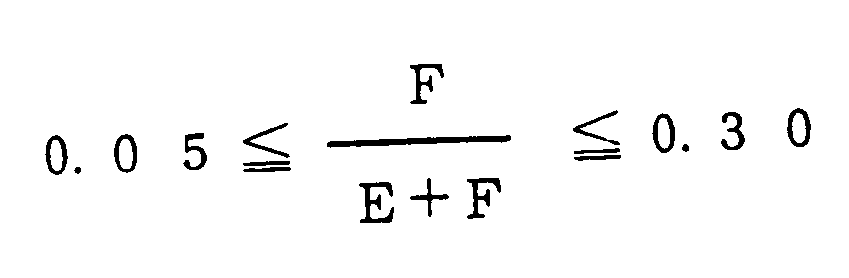
wherein E and F represent weights of the polyamide acids (III) and (IV), respectively,
and if desired, the above-mentioned reaction solvent is added thereto or removed therefrom, in order to form a polyamide acid composite solution, and a copper foil is then coated with the polyamide acid composite solution. A coating technique is not particularly limited, and a comma coating process, an extrusion cast process or the like can be employed. - After the coating step, a thermal treatment is carried out to form a polyimide. In this case, the treatment is stepwise performed at a temperature of 100 to 200°C for a period of 10 to 90 minutes, and afterward at 200 to 350°C for 10 to 270 minutes.
- The flexible copper-applied substrate of the present invention is more excellent in adhesive strength and curl resistance as compared with a conventional substrate comprising a single polyimide resin layer and a copper foil. That is, in the present invcntion, the two kinds of polyimide resins are not simply mixed, and a synergistic effect due to the formation of the composite is exhibited. In consequence, according to the present invention, the substrates can be provided which have high adhesive strength and which prevent curling.
- Now, the present invention will be described in detail in reference to examples and comparative examples, but the scope of the present case should not be limited to these examples.
- A stirrer was set to a 500 milliliter three-necked flask, and the atmosphere in the flask was then replaced with nitrogen. Afterward, 250 ml of purified dimethylacetamide was poured into the flask. Additionally, 8.6 g of paraphenylenediamine and 4.0 g of 4,4′-diaminodiphenyl ether were then added thereto and dissolved therein. After the dissolution, while a reaction temperature was controlled so as not to exceed 10°C, 29.4 g of 3,4,3′,4′-biphenyltetracarboxylic acid dianhydride was added thereto little by little with stirring to perform reaction. After completion of the addition, the reaction was carried out at a reaction temperature of 15°C for 5 hours, so that a polyamide acid solution was obtained. The thus obtained polyamide acid had an inherent viscosity of 1.8 at 30°C at a concentration of 0.5 g/dl in N-methyl-2-pyrrolidone.
- Into a 300 milliliter three-necked flask was poured purified 150 ml of N,N-dimethylacetamide, and 3.5 g of paraphenylenediamine and 10.3 g of α,ω-di-(3-aminopropyl)-polydimethylsiloxane were then dissolved therein. After the dissolution, 14.7 g of biphenyltetracarboxylic acid dianhydride was added thereto, and 0.6 g of aminophenyltrimethoxysilane was then added thereto in order to perform reaction. This reaction was carried out with stirring at 15°C for 5 hours, thereby obtaining a polyamide acid, which had an inherent viscosity of 0.3 at 30°C at a concentration of 0.5 g/dl in N-methyl-2-pyrrolidone.
- The polyamide acid solutions (A) and (B) which had been synthesized in the above-mentioned steps (1) and (2) were mixed uniformly in a polmer weight ratio of 4:1. Afterward, the mixed polyamide acid solution was coated on an electrolytic copper foil by the use of an applicator so that the thickness of the solution layer thereon might be about 100 »m. This copper foil coated with the mixed polyamide acid solution was fixed on a frame and was then heated at 100°C, 150°C and 250°C, respectively, for 30 minutes and further at 350°C for 1 hour in an electric oven, thereby preparing a substrate. Adhesive strength between the polyimide film and the copper foil of the substrate was 1.9 kg/cm in terms of peeling strength at an angle of 180°. Moreover, the curling of the substrate was scarcely seen.
- The synthesis of a polyamide acid (A) was carried out following the same procedure as in the step (1) of Example 1 with the exception that the kinds and amounts of diamine component and kind of solvent were altered as shown in Table 1.
- The synthesis of a polyamide acid (B) was carried out following the same procedure as in the step (2) of Example 1 with the exception that the kinds and amounts of acid anhydride component and diamine component, and kind of solvent were altered as shown in Table 1.
- Each substrate was prepared following the same procedure as in the step (3) of Example 1 with the exception that a mixing ratio of the polyamide acid (A) to the polyamide acid (B) was altered as shown in Table 1.
- The results of Examples 2 to 6 are set forth in Table 1.
- Into a 500 milliliter three-necked flask was poured 250 ml of purified solvent, and the atmosphere in the flask was then replaced with nitrogen. Afterward, a predetermined amount of diamine component was added thereto and was then dissolved therein with stirring. After the dissolution, a predetermined amount of an aromatic tetracarboxylic dianhydride was added thereto so as to perform reaction. This reaction was continued at a temperature of 10°C or less for 5 hours. The molecular weight of each of the thus obtained polymers was represented by an inherent viscosity at 30°C at a concentration of 0.5 g/100 ml in N-methyl-2-pyrrolidone.
- Each of the polyamide acid solutions which had been synthesized in the above-mentioned step (1) was coated on a copper foil having a thickness of 35 »m by the use of an applicator, and the copper foil coated with the polyamide acid solution was then heated at 100°C, 150°C and 250°C, respectively, for 30 minutes, and further at 350°C for 1 hour in an electric oven, thereby preparing substrates.
- The results in Comparative Examples 1 to 3 are set forth in Table 1.


Claims (4)
- A flexible copper-clad substrate which comprises a copper foil having formed directly on its surface a resin layer of a composite material of (I), a polyimide having repeating units of the formula:


(II) a silicone polyimide containing repeating units of the formula:

- A substrate according to claim 1 wherein R¹ is composed of 5 to 30 mole % of groups of the formula


- A process for preparing a substrate as claimed in claim 1 which comprises coating a copper foil with a polyamide acid composite solution and then forming the resin layer by heating the coated foil, the composite solution being one prepared by mixing a solution of a polyamide acid having repeating units of the formula:


- A process according to claim 3 in which R¹, R² and R⁵ have the meanings defined in claim 2.
Applications Claiming Priority (4)
| Application Number | Priority Date | Filing Date | Title |
|---|---|---|---|
| JP162982/88 | 1988-06-30 | ||
| JP16298288 | 1988-06-30 | ||
| JP63214185A JPH0710583B2 (en) | 1988-06-30 | 1988-08-29 | Flexible copper clad substrate |
| JP214185/88 | 1988-08-29 |
Publications (3)
| Publication Number | Publication Date |
|---|---|
| EP0349269A2 EP0349269A2 (en) | 1990-01-03 |
| EP0349269A3 EP0349269A3 (en) | 1991-05-15 |
| EP0349269B1 true EP0349269B1 (en) | 1994-06-15 |
Family
ID=26488584
Family Applications (1)
| Application Number | Title | Priority Date | Filing Date |
|---|---|---|---|
| EP89306514A Expired - Lifetime EP0349269B1 (en) | 1988-06-30 | 1989-06-27 | Flexible copper-clad substrates |
Country Status (5)
| Country | Link |
|---|---|
| EP (1) | EP0349269B1 (en) |
| JP (1) | JPH0710583B2 (en) |
| KR (1) | KR940010571B1 (en) |
| CA (1) | CA1324924C (en) |
| DE (1) | DE68916116T2 (en) |
Cited By (1)
| Publication number | Priority date | Publication date | Assignee | Title |
|---|---|---|---|---|
| CN101445602B (en) * | 2008-12-26 | 2010-12-01 | 上海工程技术大学 | A kind of soluble silicon-containing polyetherimide and its preparation method |
Families Citing this family (2)
| Publication number | Priority date | Publication date | Assignee | Title |
|---|---|---|---|---|
| JPH0362988A (en) * | 1989-07-31 | 1991-03-19 | Chisso Corp | Flexible printed circuit board and its manufacturing method |
| KR102952448B1 (en) * | 2023-02-03 | 2026-04-16 | 주식회사 넥스플렉스 | Polyimide composition, method for preparing the same, polyimide film and flexible copper clad laminate |
Family Cites Families (7)
| Publication number | Priority date | Publication date | Assignee | Title |
|---|---|---|---|---|
| JPS57181857A (en) * | 1981-05-06 | 1982-11-09 | Ube Industries | Polyimide laminated material and its manufacture |
| EP0089387A1 (en) * | 1982-03-19 | 1983-09-28 | Uop Inc. | Preparation of copper-clad laminates |
| DE3486131T2 (en) * | 1983-08-01 | 1993-10-28 | Hitachi Chemical Co Ltd | Low thermal expansion resin material for wiring insulation film. |
| JPS61111359A (en) * | 1984-11-06 | 1986-05-29 | Ube Ind Ltd | Polyamic acid solution composition and polyimide film |
| JPS61195832A (en) * | 1985-02-27 | 1986-08-30 | 日東電工株式会社 | Polyimide-metallic foil composite film |
| JPS61207438A (en) * | 1985-03-11 | 1986-09-13 | Chisso Corp | Soluble polyimidedisiloxane precursor and its production |
| AU599325B2 (en) * | 1986-06-30 | 1990-07-19 | Mitsui Toatsu Chemicals Inc. | Flexible copper-clad circuit substrate |
-
1988
- 1988-08-29 JP JP63214185A patent/JPH0710583B2/en not_active Expired - Fee Related
-
1989
- 1989-06-19 CA CA000603185A patent/CA1324924C/en not_active Expired - Lifetime
- 1989-06-27 DE DE68916116T patent/DE68916116T2/en not_active Expired - Lifetime
- 1989-06-27 EP EP89306514A patent/EP0349269B1/en not_active Expired - Lifetime
- 1989-06-29 KR KR1019890009020A patent/KR940010571B1/en not_active Expired - Fee Related
Cited By (1)
| Publication number | Priority date | Publication date | Assignee | Title |
|---|---|---|---|---|
| CN101445602B (en) * | 2008-12-26 | 2010-12-01 | 上海工程技术大学 | A kind of soluble silicon-containing polyetherimide and its preparation method |
Also Published As
| Publication number | Publication date |
|---|---|
| JPH0710583B2 (en) | 1995-02-08 |
| EP0349269A2 (en) | 1990-01-03 |
| JPH0270429A (en) | 1990-03-09 |
| DE68916116T2 (en) | 1994-12-01 |
| CA1324924C (en) | 1993-12-07 |
| EP0349269A3 (en) | 1991-05-15 |
| DE68916116D1 (en) | 1994-07-21 |
| KR910002311A (en) | 1991-01-31 |
| KR940010571B1 (en) | 1994-10-24 |
Similar Documents
| Publication | Publication Date | Title |
|---|---|---|
| EP0411772B1 (en) | Flexible printed-circuit base board and process for producing the same | |
| US5081229A (en) | Polyimide having excellent thermal dimensional stability | |
| US4818806A (en) | Process for producing highly adherent silicon-containing polyamic acid and corsslinked silicon-containing polyimide | |
| CN103524768A (en) | Novel electronic-grade polyimide film with low linear expansion coefficient and production method thereof | |
| CA1182693A (en) | Flexible base materials, their preparation and their use for printed circuits | |
| JPH0117455B2 (en) | ||
| KR20110035620A (en) | Polyimide film | |
| JPH02115265A (en) | Heat-resistant film and its laminate | |
| KR19980079256A (en) | Polyimide precursor solution, preparation method thereof, film or film obtained from such solution and preparation method of film | |
| EP0618269B1 (en) | Thermosetting resin compositions and their use for making resin articles and thin film wiring boards | |
| EP0316154B1 (en) | Silicon-containing polyimide precursor, cured product therefrom, and preparation thereof | |
| US5192619A (en) | Flexible copper-applied substrates | |
| JP3451128B2 (en) | Polyimide resin and heat-resistant adhesive | |
| EP0349269A2 (en) | Flexible copper-clad substrates | |
| JPH0457389B2 (en) | ||
| JPH08217877A (en) | Polyimide resin and polyimide film | |
| JP3456256B2 (en) | Polyimide copolymer and method for producing the same | |
| JPH07316294A (en) | Polyimide copolymer and method for producing the same | |
| JPH0848795A (en) | Novel polyimide film and manufacturing method thereof | |
| EP0317205B1 (en) | Imido group-containing silicon oligomers and cured product thereof, and their preparation | |
| JPH0670136B2 (en) | Method for producing modified polyimide composition | |
| JPH0518865B2 (en) | ||
| JPS62209136A (en) | Production of crosslinked polyimide containing silicon | |
| JPH09118807A (en) | Polyimidesiloxane composition | |
| KR100687387B1 (en) | Polyimide for Copper Clad Laminate Manufacturing and Manufacturing Method Thereof |
Legal Events
| Date | Code | Title | Description |
|---|---|---|---|
| PUAI | Public reference made under article 153(3) epc to a published international application that has entered the european phase |
Free format text: ORIGINAL CODE: 0009012 |
|
| AK | Designated contracting states |
Kind code of ref document: A2 Designated state(s): CH DE FR GB LI |
|
| PUAL | Search report despatched |
Free format text: ORIGINAL CODE: 0009013 |
|
| AK | Designated contracting states |
Kind code of ref document: A3 Designated state(s): CH DE FR GB LI |
|
| 17P | Request for examination filed |
Effective date: 19911021 |
|
| 17Q | First examination report despatched |
Effective date: 19930819 |
|
| GRAA | (expected) grant |
Free format text: ORIGINAL CODE: 0009210 |
|
| AK | Designated contracting states |
Kind code of ref document: B1 Designated state(s): CH DE FR GB LI |
|
| REF | Corresponds to: |
Ref document number: 68916116 Country of ref document: DE Date of ref document: 19940721 |
|
| ET | Fr: translation filed | ||
| PLBE | No opposition filed within time limit |
Free format text: ORIGINAL CODE: 0009261 |
|
| STAA | Information on the status of an ep patent application or granted ep patent |
Free format text: STATUS: NO OPPOSITION FILED WITHIN TIME LIMIT |
|
| 26N | No opposition filed | ||
| PGFP | Annual fee paid to national office [announced via postgrant information from national office to epo] |
Ref country code: FR Payment date: 19970610 Year of fee payment: 9 |
|
| PGFP | Annual fee paid to national office [announced via postgrant information from national office to epo] |
Ref country code: GB Payment date: 19970618 Year of fee payment: 9 |
|
| PGFP | Annual fee paid to national office [announced via postgrant information from national office to epo] |
Ref country code: CH Payment date: 19970630 Year of fee payment: 9 |
|
| PG25 | Lapsed in a contracting state [announced via postgrant information from national office to epo] |
Ref country code: GB Free format text: LAPSE BECAUSE OF NON-PAYMENT OF DUE FEES Effective date: 19980627 |
|
| PG25 | Lapsed in a contracting state [announced via postgrant information from national office to epo] |
Ref country code: CH Free format text: LAPSE BECAUSE OF NON-PAYMENT OF DUE FEES Effective date: 19980630 Ref country code: LI Free format text: LAPSE BECAUSE OF NON-PAYMENT OF DUE FEES Effective date: 19980630 |
|
| REG | Reference to a national code |
Ref country code: CH Ref legal event code: PL |
|
| GBPC | Gb: european patent ceased through non-payment of renewal fee |
Effective date: 19980627 |
|
| PG25 | Lapsed in a contracting state [announced via postgrant information from national office to epo] |
Ref country code: FR Free format text: LAPSE BECAUSE OF NON-PAYMENT OF DUE FEES Effective date: 19990226 |
|
| REG | Reference to a national code |
Ref country code: FR Ref legal event code: ST |
|
| PGFP | Annual fee paid to national office [announced via postgrant information from national office to epo] |
Ref country code: DE Payment date: 20080703 Year of fee payment: 20 |