EP0348827B1 - Procédé et appareil pour la culture de cellules - Google Patents
Procédé et appareil pour la culture de cellules Download PDFInfo
- Publication number
- EP0348827B1 EP0348827B1 EP89111419A EP89111419A EP0348827B1 EP 0348827 B1 EP0348827 B1 EP 0348827B1 EP 89111419 A EP89111419 A EP 89111419A EP 89111419 A EP89111419 A EP 89111419A EP 0348827 B1 EP0348827 B1 EP 0348827B1
- Authority
- EP
- European Patent Office
- Prior art keywords
- culture
- culture tank
- tank
- cell
- cells
- Prior art date
- Legal status (The legal status is an assumption and is not a legal conclusion. Google has not performed a legal analysis and makes no representation as to the accuracy of the status listed.)
- Expired - Lifetime
Links
- 238000000034 method Methods 0.000 title claims description 31
- 238000004113 cell culture Methods 0.000 title claims description 27
- 239000012531 culture fluid Substances 0.000 claims description 53
- 230000003100 immobilizing effect Effects 0.000 claims description 52
- 239000006285 cell suspension Substances 0.000 claims description 42
- 230000035755 proliferation Effects 0.000 claims description 19
- 230000004663 cell proliferation Effects 0.000 claims description 16
- 239000013543 active substance Substances 0.000 claims description 13
- 239000002609 medium Substances 0.000 claims description 10
- 239000000853 adhesive Substances 0.000 claims description 9
- 230000001070 adhesive effect Effects 0.000 claims description 9
- 235000015097 nutrients Nutrition 0.000 claims description 9
- 238000009827 uniform distribution Methods 0.000 claims description 9
- 239000001963 growth medium Substances 0.000 claims description 7
- 239000007788 liquid Substances 0.000 claims description 7
- 230000007246 mechanism Effects 0.000 claims description 7
- 229910010293 ceramic material Inorganic materials 0.000 claims description 6
- 239000012530 fluid Substances 0.000 claims description 5
- 238000000855 fermentation Methods 0.000 claims description 4
- 230000004151 fermentation Effects 0.000 claims description 4
- 239000000725 suspension Substances 0.000 claims description 4
- 238000009826 distribution Methods 0.000 claims description 2
- 210000004027 cell Anatomy 0.000 description 49
- 239000000969 carrier Substances 0.000 description 44
- 239000000919 ceramic Substances 0.000 description 18
- 238000004519 manufacturing process Methods 0.000 description 14
- 230000021164 cell adhesion Effects 0.000 description 7
- 239000012510 hollow fiber Substances 0.000 description 6
- 239000013076 target substance Substances 0.000 description 6
- 239000011324 bead Substances 0.000 description 5
- 230000000694 effects Effects 0.000 description 5
- 230000008569 process Effects 0.000 description 5
- 239000011521 glass Substances 0.000 description 4
- 102000029816 Collagenase Human genes 0.000 description 3
- 108060005980 Collagenase Proteins 0.000 description 3
- VYPSYNLAJGMNEJ-UHFFFAOYSA-N Silicium dioxide Chemical compound O=[Si]=O VYPSYNLAJGMNEJ-UHFFFAOYSA-N 0.000 description 3
- 102000004142 Trypsin Human genes 0.000 description 3
- 108090000631 Trypsin Proteins 0.000 description 3
- 229940122618 Trypsin inhibitor Drugs 0.000 description 3
- 101710162629 Trypsin inhibitor Proteins 0.000 description 3
- 229960002424 collagenase Drugs 0.000 description 3
- 239000004615 ingredient Substances 0.000 description 3
- 238000010008 shearing Methods 0.000 description 3
- 239000012588 trypsin Substances 0.000 description 3
- 239000002753 trypsin inhibitor Substances 0.000 description 3
- 238000005406 washing Methods 0.000 description 3
- PNEYBMLMFCGWSK-UHFFFAOYSA-N aluminium oxide Inorganic materials [O-2].[O-2].[O-2].[Al+3].[Al+3] PNEYBMLMFCGWSK-UHFFFAOYSA-N 0.000 description 2
- QVGXLLKOCUKJST-UHFFFAOYSA-N atomic oxygen Chemical compound [O] QVGXLLKOCUKJST-UHFFFAOYSA-N 0.000 description 2
- 230000005465 channeling Effects 0.000 description 2
- 238000010276 construction Methods 0.000 description 2
- 238000007667 floating Methods 0.000 description 2
- 229910052760 oxygen Inorganic materials 0.000 description 2
- 239000001301 oxygen Substances 0.000 description 2
- 239000002245 particle Substances 0.000 description 2
- 239000004033 plastic Substances 0.000 description 2
- 210000002966 serum Anatomy 0.000 description 2
- 238000003860 storage Methods 0.000 description 2
- OKTJSMMVPCPJKN-UHFFFAOYSA-N Carbon Chemical compound [C] OKTJSMMVPCPJKN-UHFFFAOYSA-N 0.000 description 1
- 239000005909 Kieselgur Substances 0.000 description 1
- FAPWRFPIFSIZLT-UHFFFAOYSA-M Sodium chloride Chemical compound [Na+].[Cl-] FAPWRFPIFSIZLT-UHFFFAOYSA-M 0.000 description 1
- RTAQQCXQSZGOHL-UHFFFAOYSA-N Titanium Chemical compound [Ti] RTAQQCXQSZGOHL-UHFFFAOYSA-N 0.000 description 1
- 230000009471 action Effects 0.000 description 1
- 238000013019 agitation Methods 0.000 description 1
- 238000010923 batch production Methods 0.000 description 1
- 229910052799 carbon Inorganic materials 0.000 description 1
- 230000008859 change Effects 0.000 description 1
- 230000005757 colony formation Effects 0.000 description 1
- 238000004891 communication Methods 0.000 description 1
- 238000007796 conventional method Methods 0.000 description 1
- 238000001816 cooling Methods 0.000 description 1
- 238000012136 culture method Methods 0.000 description 1
- 238000010586 diagram Methods 0.000 description 1
- 238000000502 dialysis Methods 0.000 description 1
- 238000010828 elution Methods 0.000 description 1
- 210000003527 eukaryotic cell Anatomy 0.000 description 1
- 239000000835 fiber Substances 0.000 description 1
- 239000007789 gas Substances 0.000 description 1
- 239000007792 gaseous phase Substances 0.000 description 1
- 230000005484 gravity Effects 0.000 description 1
- 210000003734 kidney Anatomy 0.000 description 1
- 239000000463 material Substances 0.000 description 1
- 239000011159 matrix material Substances 0.000 description 1
- 230000004060 metabolic process Effects 0.000 description 1
- 238000012986 modification Methods 0.000 description 1
- 230000004048 modification Effects 0.000 description 1
- 235000021049 nutrient content Nutrition 0.000 description 1
- 239000008363 phosphate buffer Substances 0.000 description 1
- 239000002985 plastic film Substances 0.000 description 1
- 229920006255 plastic film Polymers 0.000 description 1
- 230000002062 proliferating effect Effects 0.000 description 1
- 238000011084 recovery Methods 0.000 description 1
- 238000004904 shortening Methods 0.000 description 1
- 239000000377 silicon dioxide Substances 0.000 description 1
- 239000011780 sodium chloride Substances 0.000 description 1
- 239000000126 substance Substances 0.000 description 1
- 229910052719 titanium Inorganic materials 0.000 description 1
- 239000010936 titanium Substances 0.000 description 1
- 229910052845 zircon Inorganic materials 0.000 description 1
- GFQYVLUOOAAOGM-UHFFFAOYSA-N zirconium(iv) silicate Chemical compound [Zr+4].[O-][Si]([O-])([O-])[O-] GFQYVLUOOAAOGM-UHFFFAOYSA-N 0.000 description 1
Images


Classifications
-
- C—CHEMISTRY; METALLURGY
- C12—BIOCHEMISTRY; BEER; SPIRITS; WINE; VINEGAR; MICROBIOLOGY; ENZYMOLOGY; MUTATION OR GENETIC ENGINEERING
- C12M—APPARATUS FOR ENZYMOLOGY OR MICROBIOLOGY; APPARATUS FOR CULTURING MICROORGANISMS FOR PRODUCING BIOMASS, FOR GROWING CELLS OR FOR OBTAINING FERMENTATION OR METABOLIC PRODUCTS, i.e. BIOREACTORS OR FERMENTERS
- C12M27/00—Means for mixing, agitating or circulating fluids in the vessel
- C12M27/02—Stirrer or mobile mixing elements
-
- C—CHEMISTRY; METALLURGY
- C12—BIOCHEMISTRY; BEER; SPIRITS; WINE; VINEGAR; MICROBIOLOGY; ENZYMOLOGY; MUTATION OR GENETIC ENGINEERING
- C12M—APPARATUS FOR ENZYMOLOGY OR MICROBIOLOGY; APPARATUS FOR CULTURING MICROORGANISMS FOR PRODUCING BIOMASS, FOR GROWING CELLS OR FOR OBTAINING FERMENTATION OR METABOLIC PRODUCTS, i.e. BIOREACTORS OR FERMENTERS
- C12M25/00—Means for supporting, enclosing or fixing the microorganisms, e.g. immunocoatings
- C12M25/16—Particles; Beads; Granular material; Encapsulation
-
- C—CHEMISTRY; METALLURGY
- C12—BIOCHEMISTRY; BEER; SPIRITS; WINE; VINEGAR; MICROBIOLOGY; ENZYMOLOGY; MUTATION OR GENETIC ENGINEERING
- C12M—APPARATUS FOR ENZYMOLOGY OR MICROBIOLOGY; APPARATUS FOR CULTURING MICROORGANISMS FOR PRODUCING BIOMASS, FOR GROWING CELLS OR FOR OBTAINING FERMENTATION OR METABOLIC PRODUCTS, i.e. BIOREACTORS OR FERMENTERS
- C12M27/00—Means for mixing, agitating or circulating fluids in the vessel
- C12M27/18—Flow directing inserts
- C12M27/22—Perforated plates, discs or walls
-
- Y—GENERAL TAGGING OF NEW TECHNOLOGICAL DEVELOPMENTS; GENERAL TAGGING OF CROSS-SECTIONAL TECHNOLOGIES SPANNING OVER SEVERAL SECTIONS OF THE IPC; TECHNICAL SUBJECTS COVERED BY FORMER USPC CROSS-REFERENCE ART COLLECTIONS [XRACs] AND DIGESTS
- Y10—TECHNICAL SUBJECTS COVERED BY FORMER USPC
- Y10S—TECHNICAL SUBJECTS COVERED BY FORMER USPC CROSS-REFERENCE ART COLLECTIONS [XRACs] AND DIGESTS
- Y10S435/00—Chemistry: molecular biology and microbiology
- Y10S435/819—Fermentation vessels in series
Definitions
- the present invention relates to method and apparatus for efficient proliferation and fermentation of a cell culture according to the preamble of claims 1 and 3 respectively
- the systems (a) through (d) are exclusively for the batch production and the number of cells which can be cultivated for each process, namely, yield of a target substance is poor.
- the systems (e) through (f) of continuous culture medium circulation type are also restricted in the number of cells which can be cultivated there by and not suitable for mass culture.
- microcarrier system is disclosed in US-A-4,203,801. Proliferation of eukaryotic cells is performed in a main culture tank containing a liquid medium and an immobilizing carrier consisting of glass or diatomaceous earth.
- Japanese Disclosure Gazette No. 1985-259179 discloses a similar mass and high density cell culture tank of suspension type which is provided at the top with an inlet for fresh culture fluid, at the bottom with an outlet for used culture fluid, and adjacent the top with an impeller.
- the culture medium for cell proliferation has ingredients different from those for cell culture and the former becomes wasteful especially in the larger culture tank.
- the method according to the present invention intends to achieve an efficient cell culture by performing the initial cell proliferation and the subsequent cell culture for production of the physiologically active substance in different tanks.
- the method is preferable, by which the cells themselves are adhesively fixed onto particular material having a larger surface area in the stationary culture method and the culture medium is circulated, therethrough.
- the previously mentioned hollow fiber system is one embodiment of such method. Specifically, the culture medium is continuously circulated not only through the interior but also along the exterior surface of the hollow fiber on which the adhesive cells are to be prolifirated so that the nutrient and metabolism product are efficiently moved between the interior and the exterior of the fiber, enabling the cells to be cultivated at a high density.
- Japanese Disclosure Gazette No. 1984-154984 discloses a simplified hollow fiber system in which the cells are proliferated, cultivated on ceramic matrix and the culture fluid is continuously circulated.
- porous ceramic carrier which is a cylindrical monolithic carrier having at least about 20 through-holes extending in parallel to one another per square inch of cross-section.
- this system is inconvenient in that the carrier get readily clogged as it is continuously used.
- This solution is a method comprising steps of providing ceramic particles consisting for the most part of alumina suitable for all adhesion and having an approximately uniform size of 5 to 9 meshes, supplying culture fluid into a column filled with said ceramic particles, exchanging the quantity of culture fluid aged, after movement through the first half of the column, due to proliferation of cells with the quantity of fresh culture fluid at an intermediate level of column, and removing said aged culture are further continued through the second half of the column.
- This method is characterized by that the effort of culture fluid to the cells is relatively uniform, the cells are free from the damage due to a shearing force and the carrier facilitates the cell adhesion, and thus the method is suitable for mass culture of adhesive cells.
- the cell culture apparatus of the present invention intends to solve such problem.
- An object of this invention is to provide a method for efficient cell cultivating method adapted to perform initial cell proliferation and subsequent cell culture for production of target substance in different tanks.
- the method is effectively carried out by a cell culture apparatus comprising a preliminary culture tank of a smaller size, a main culture tank filled with immobilizing carriers containing ceramic material as a principal ingredient, and an intermediate reservoir interposed between said preliminary culture tank and said main culture tank.
- a quantity of cell suspension may be supplied to said main culture tank filled with immobilizing carriers containing ceramic material as the principal ingredient.
- Efficient cell adhesion onto the immobilizing carriers is accomplished by providing above-mentioned cell culture apparatus with a separate tank.
- the cells profilerated in the small size preliminary culture tank are stripped off from the immobilizing carriers to prepare cell suspension and the latter is transferred to the main culture tank filled with immobilizing carriers, said cell suspension is supplied to said main culture tank from top and bottom thereof so as to uniformalize cell adhesion onto said immobilizing carriers, on one hand, and serving to adjust nutrient and gas content in culture fluid in as well as to control circulation of said culture fluid within said main tank filled with the immobilizing carriers principally made of ceramic material, on the other hand.
- microcarrier type culture tank is most preferable as said small size preliminary culture tank, since as many cells as possible can be supplied to the subsequent mass culture tank.
- the method and the apparatus for cell culture according to the present invention provide a unique effect as will be described hereinafter.
- proliferation as well as culture can be efficiently achieved by proliferating cells to be used in next process of production in the preliminary culture tank while the target substance is produced, because the initial cell proliferation and said production of the target substance are performed in the different culture tanks.
- the proliferation medium can be effectively supplied for the minimum time. Further it is possible to change over from said proliferation medium to the culture fluid for production of the physiologically active substance, resulting in shortening of the cultivating time.
- the efficient cell culture as mentioned above has various merits in view of a fact that, in general, the life of cell is relatively short.
- supplying the cell suspension to the immobilizing carriers from top and bottom of the culture tank enables the cell adhesion onto said immobilizing carriers to be uniformly and effectively accomplished.
- Another object of the present invention is to provide a culture apparatus adapted to uniformly supply the cell suspension to the immobilizing carriers and to facilitate charging as well as removal of said immobilizing carriers.
- a culture apparatus filled with segmentary immobilizing carriers for adhesive cells and aiming at production of a target substance
- said culture apparatus comprising an inversed funnel-shaped inlet located above the immobilizing carriers filling the apparatus and having a perforated bottom plate for uniform distribution of a quantity of cell suspension supplied from above to said immobilizing carriers, a netty plate located under the immobilizing carriers to hold said immobilizing carriers, and another perforated plate also located under the immobilizing carriers for uniform distribution of a quantity of cell suspension supplied from bottom to said immobilizing carriers.
- the present invention provides an apparatus comprising a cover portion adapted for detachably carrying the inversed funnel-sharped fluid inlet having the perforated bottom plate for uniform distribution of the quantity of cell suspension supplied from above to the immobilizing carriers filling the apparatus, a drum portion fixed to a stand and a bottom portion adapted for detachably carrying the netty plate to hold the immobilizing carriers from underside and the perforated plate for uniform distribution of the quantity of cell suspension supplied from bottom portions.
- the culture apparatus of the present invention provides an effect as follows: Supply of cell suspension to the immobilizing carriers occurs from both top and bottom of the apparatus filled with said carriers so that the quantity of said cell suspension supplied from the top is uniformly supplied through the perforated plate as a part of the inversed funnel-shaped inlet and the quantity of cell suspension supplied from the bottom is uniformly distributed through the lower perforated plate and then the netty plate supporting the immobilizing carriers. Thus, cells uniformly adhere onto the immobilizing carriers.
- the bottom portion of the culture apparatus can be separated from and connected to the cover and drum portions of the culture apparatus by means of a linkage and a cylinder so as to facilitate charging and removal of the immobilizing carriers and thereby to shorten a time taken for such operation.
- dividable construction of the culture apparatus facilitates manual washing and checking.
- both washing and checking are easier than for the conventional culture tank of one-piece type.
- Reference numeral 1 designates a small sized culture tank used to perform the method of the present invention and, specifically, a microcarrier culture tank is used here as this small sized culture tank, within which proliferation of adhesive cells occurs according to the microcarrier culture process. It should be understood that, although said microcarrier culture tank used in the inventive method, the culture tanks of other types may be effectively employed.
- Reference numeral 2 designates a nutrient reservoir to supply said microcarrier culture tank 1 with nutrient.
- the cells initially proliferated within the microcarrier culture tank 1 are stripped off by the well known technique from the microcarriers to obtain suspension, which is then transferred via a conduit 13 into an intermediate reservoir 3.
- the cell suspension is temporarily stored in this intermediate reservoir 3 to uniformize the cell distribution.
- Reference numeral 4 designates a mass culture tank filled with ceramic carriers.
- a quantity of cell suspension is supplied by a pump 17 from said cell suspension reservoir 3 through a conduit 14 and then through an upper conduit 6 extending through the top of the culture tank 4 into a layered ceramic 5 while another quantity of cell suspension is supplied through a conduit 15A and 15B branched from the conduit 14 and then through a lower conduit 7 connected to the bottom of the culture tank 4 into said layered ceramic 5.
- Cell suspension is supplied in two-way fashion to the culture tank in the manner as has been mentioned above and thereby uniform adhesion of the cells onto the immobilizing ceramic carriers.
- the quantity of cell suspension to be supplied to the mash culture tank in the two-way fashion must be previously adjusted to the optimum quantity at a stage of culture medium adjustment within the intermediate reservoir, since it would be impossible to achieve uniform adhesion of cell onto the ceramic carriers if said quantity of cell suspension is excessively larger than the quantity of the ceramic carriers within the mass culture tank and effective utilization of whole the ceramic carriers would be impossible if said quantity of cell suspension is smaller thah the quarity of the ceramic carriers.
- Reference numeral 8 designates a culture fluid adjusting tank adapted to effect the culture fluid circulation within the culture tank 4 and to control nutrient and gaseous content of the culture fluid.
- the culture tank 4 is supplied from its top and bottom with the cell suspension from the intermediate reservoir 3 so that the cells uniformly adhere onto the individual ceramic carriers forming the layered ceramic 5 and then the culture tank 4 is supplied with culture fluid for cell proliferation under action of a pump 9 from the culture fluid adjusting tank 8.
- a pump 9 from the culture fluid adjusting tank 8.
- Downward circulation occurs in such a manner that said culture fluid is pumped by pump 9 from the culture fluid adjusting tank 8 into the culture tank 4 via conduits 18,48,15A, 14, 6 and the inverse funnel-like inlet 34, and returned to said tank 8 via conduits 7, 46, and 16B.
- Upward circulation occurs in such a manner that said culture fluid is pumped by pump 9 from the culture fluid adjusting tank 8 and into siad culture tank 4 via conducts 18, 7 and then though the inverse funnel-like inlet 34 , returned to said tank 8 via conduits 6,14, 16A, and 16B.
- the cell suspension is supplied again from the intermediate reservoir 3 into the culture tank 4 and the cell culture is repeated.
- the initial cell proliferation occurs within the microcarrier culture tank 1 while the final cell culture for production of the physiologically active substance occurs within the culture tank 4.
- the proliferation and the culture are carried out within the different culture tanks being in communication with each other via the intermediate reservoir.
- cell stripping in the small sized culture tank may be performed by any suitable conventional techniques.
- circulation of culture fluid is stopped, then the entire quantity of culture fluid is removed out from the small sized culture tank, and washed with phosphate buffer saline ( PBS ), followed by stripping of the cells effected by supplying a suitable quantity of trypsin or collagenase.
- PBS phosphate buffer saline
- a quantity of culture fluid containing trypsin inhibitor is supplied thereto in order to devitalize said trypsin or collagenase and thereby a quantity of cell suspension in which the cells float.
- said trypsin inhibitor may be substituted by serum containing culture fluid, because serum intrinsically contains therein said trypsin inhibitor.
- Said intermediate reservoir 3 has an additional important function as will be described below.
- the intermediate reservoir 3 serves for circulation and adjustment of the culture fluid and, upon completion of the cell proliferation and once the circulation has been stopped, the reservoir serves to adjust a quantity of culture fluid to be supplied to the mass culture tank 4 for the subsequent process.
- the quantity of culture fluid thus adjusted is now partially supplied to the small sized culture tank, in which removal of the culture fluid, washing and stripping of the cells have already been completed, to obtain a quantity of cell suspension which is, in turn, collected into the intermediate reservoir where a quantity of uniform and adjusted cell suspension is necessary to be supplied to the subsequent mass culture tank.
- the intermediated reservoir is essential for such process.
- the respective culture tanks as have been mentioned above require the associated adjusting tanks in order to adjust pH, temperature and nutrient properly during circulation of culture fluid, and nutrient is supplied from a reservoir not shown.
- the apparatus of the invention has been developed by overcoming the disadvantages of the microcarrier type cell cultivating apparatus and comprises a cell culture apparatus filled with carriers adapted to immobilize sedimentary adhesive cells.
- This cell culture apparatus is particularly suitable as the culture tank for production of physiologically active substance, which is provided separately from the small sized preliminary culture tank for the initial cell proliferation in the method for cell culture as has been mentioned above and accordingly the apparatus of the invention will be described in connection with a specific embodiment constructed as such culture tank.
- application of the inventive apparatus is not limited to such culture tank.
- Fig. 2 schematically illustrates an embodiment of the culture apparatus according to this invention.
- Reference numeral 4 designates a mass culture tank filled with ceramic carriers.
- a conduit 6 extends from a conduit 14 for supply of cell suspension. As shown by Fig. 3, The conduit 6 is detachably mounted in a cover 32 of the culture tank 4 for supply of cell suspension and its front end terminates in an inversed funnel-shaped inlet 34 and a bottom of the inversed funnel-shaped inlet 34 is defined by perforated plate 35 adapted for uniformly supplying cell suspension to the top of immobilizing carriers.
- the culture tank 4 is connected to a culture fluid adjusting tank 8 by conduits 16A, 16B, 18 so that a pump 9 disposed in the conduit 18 causes a quantity of culture fluid to circulate.
- the conduit 18 is connected to an inlet conduit 7 for the culture tank 4 while the conduits 16A and 16B is connected to the conduit 6 associated with the inversed funnel-shaped inlet 34 via a switchable value.
- a predetermined quantity of culture fluid is pumped into the culture tank 4 by said pump 9.
- culture fluid is returned from the inversed funnel-shaped inlet 34 to the culture fluid adjusting tank 8 through the conduits 6,14, 16A, 16B when the pump 9 is switched between ON and OFF by means of a fluid level control rod or when germ-free air is introduced through an inlet 11 into the culture tank 4 for pressurizing.
- the fluid level is always adjusted in the proximity of the inversed funnel-shaped inlet 34.
- This culture tank 4 consists of an upper flange-like portion 4a, an intermediate drum-like portion 4b and a lower portion 4c which are separable from one another.
- the flange-like portion 4a is covered by a lid 32.
- the supply conduit 6 extends downwardly to the inversed funnel-shaped inlet 34 having a bottom covered by the perforated plate 35.
- the culture tank 4 is further provided across the lower portion with a netty plate 36 adapted to the immobilizing carriers and a perforated plate 37 directly underlizing said netty plate 36. These netty plate 36 and perforated plate 37 are fixed by clamping bolts across the lower portion of the culture tank 4.
- the conduit 7 is connected to the lower end of the culture tank 4.
- Reference numerals 38, 39 designate cooling jackets for the lower portion 4c and the drum-like portion 4b, respectively, of the culture tank 4.
- ceramic carriers are filled in said culture tank 4 and sterilized therein. Then, a quantity of cell suspension containing adhesive cells floating therein is supplied to the culture tank 4 through the conduit 14 and then through the conduit 6 which opens into the top of the tank 4 while another quantity of cell suspension is supplied to the culture tank 4 through the conduit 15A, 15B branched from the conduit 14 and then the inlet conduit 7 which opens into the bottom of the tank 4.
- the conduit 6 terminates in the inversed funnel-shaped inlet 34 having its bottom defined by the perforated plate 35, so that the quantity of cell suspension is uniformly supplied from above into the culture tank 4 and the other quantity of cell suspension also is uniformly supplied from below into the culture tank 4 under the effect of the perforated plate 37 and the netty plate 36.
- a quantity of culture fluid for cell proliferation is circulated by the pump 9 from the culture fluid adjusting tank 9 through the conduits 18, 16B, 16A for the purpose of cell proliferation.
- culture fluid is changed over from that for cell proliferation to that for production of physiologically active substance coming from a reservoir not shown and thereby a target substance is produced.
- the culture fluid adjusting tank 8 functions to adjust various factors such as pH , temperature, gaseous content and nutrient content of culture fluid.
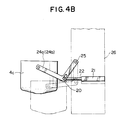
- the lower portion 4c of the culture tank 4 is separable from the intermediate drum-like portion 4b by means of a link mechanism and a cylinder, as will be described later more in details.
- the drum-like portion 4b is supported on stands 26 through links 24a, 24b mounted on the stands 26 at an intermediate level.
- Reference numeral 25 designates a supporting shaft by which the links 24a and 24b are pivotally supported by the stands 26 and the links 24a and 24b are interconnected by a tie rod 20 at respective angular portions of said links 24a, 24b.
- the lower portion 4c of the culture tank is pivotally lowered around the shaft 25 as said tie rod 20 is pulled by a piston rod 22 associated with a cylinder 21, and thereby the lower portion 4c is separated from the drum-like portion 4b of the culture tank 4.
- the links 24a, 24b are pivotally mounted at respective front ends to the lower portion 4c of the culture tank 4, so that the lower portion 4c can be maintained in a horizontal condition as shown by Fig. 4B, facilitating removal of the immobilizing carriers out from the culture tank 4.
- the cell culture apparatus is advantageous in that the lower portion thereof is separable and thereby removal of the immobilizing carriers out from the apparatus is facilitated.
Landscapes
- Health & Medical Sciences (AREA)
- Wood Science & Technology (AREA)
- Life Sciences & Earth Sciences (AREA)
- Engineering & Computer Science (AREA)
- Bioinformatics & Cheminformatics (AREA)
- Organic Chemistry (AREA)
- Chemical & Material Sciences (AREA)
- Zoology (AREA)
- Biomedical Technology (AREA)
- Sustainable Development (AREA)
- Microbiology (AREA)
- Biochemistry (AREA)
- General Engineering & Computer Science (AREA)
- General Health & Medical Sciences (AREA)
- Genetics & Genomics (AREA)
- Biotechnology (AREA)
- Immunology (AREA)
- Apparatus Associated With Microorganisms And Enzymes (AREA)
Claims (9)
- Procédé de fermentation d'une culture cellulaire, ladite fermentation comprenant une prolifération de cellules adhérentes dans un réservoir principal de culture (4) contenant un milieu liquide et un porteur immobilisant consistant principalement en une matière céramique, lesdites cellules adhérant audit porteur et produisant une substance physiologiquement active,
caractérisé en ce que
lesdites cellules adhérentes sont amenées, avant d'entrer dans le réservoir principal de culture, à proliférer dans un réservoir préliminaire de culture (1), d'une dimension petite en comparaison avec le réservoir principal de culture (4), ledit réservoir préliminaire de culture (1) contenant un milieu de culture ajusté dans un réservoir intermédiaire et un porteur immobilisant, en particulier un microporteur,
en ce que, après la prolifération dans le réservoir préliminaire de culture (1), les cellules sont ôtées dudit porteur puis recueillies et mises en suspension dans un milieu,
en ce que la répartition desdites cellules en suspension à l'intérieur dudit milieu est uniformisée et que la suspension est transférée au réservoir intermédiaire (3) et recueillie à l'intérieur de celui-ci,
et en ce que la suspension uniformisée de cellules, est transférée, selon les exigences et les besoins, dudit réservoir intermédiaire (3) vers ledit réservoir principal de culture (4) où leur culture est poursuivie. - Un procédé selon la revendication 1, caractérisé en ce que la suspension uniformisée de cellules est amenée au réservoir (4) de culture de façon simultanée à partir du haut et du bas dudit réservoir de culture (4) afin de permettre aux cellules d'adhérer de façon uniforme sur ledit porteur immobilisant.
- Appareil de culture cellulaire destiné à la mise en oeuvre du procédé selon la revendication 1, comprenant un réservoir principal de culture (4) contenant un milieu liquide et un porteur immobilisant consistant principalement en une matière céramique, des cellules à cultiver adhérant audit porteur et produisant une substance physiologiquement active,
caractérisé en ce qu'il est pourvu d'un réservoir préliminaire de culture (1) d'une dimension petite en comparaison du réservoir principal de culture (4), et en ce qu'un réservoir intermédiaire (3) est interposé entre ledit réservoir préliminaire de culture (1) et ledit réservoir principal de culture (4). - Appareil de culture cellulaire destiné à la mise en oeuvre du procédé selon les revendications 1 et 2 et selon la revendication 3, caractérisé en ce que ledit réservoir de culture (4) comprend une entrée (34) en forme d'entonnoir inversé, disposée au-dessus du porteur immobilisant remplissant l'appareil et comportant une plaque perforée (35) de fond en vue d'une répartition uniforme d'une quantité de suspension de cellules amenée depuis le haut vers ledit porteur immobilisant, une plaque maillée (36) située au-dessous du porteur immobilisant afin de supporter ledit porteur immobilisant, et une autre plaque perforée (37) située elle aussi au-dessous du porteur immobilisant en vue d'une répartition uniforme d'une autre quantité de suspension de cellules amenée depuis le bas vers ledit porteur immobilisant.
- Appareil selon la revendication 4 comprenant en outre un couvercle supérieur (32) apte à porter de façon détachable l'entrée de fluide (34) en forme d'entonnoir inversé comportant la plaque de fond perforée (35) en vue de la répartition uniforme de la quantité de suspension de cellules amenée depuis le haut vers le porteur immobilisant remplissant l'appareil, une partie intermédiaire en forme de tambour (4b) fixée à un montant (26) et une partie inférieure adaptée (4c) à porter de façon détachable la plaque maillée (36) afin de supporter le porteur immobilisant depuis le côté inférieur et la plaque perforée (37) en vue d'une répartition uniforme de la quantité de suspension de cellules amenée depuis le bas vers ledit porteur immobilisant, et dans lequel ladite partie inférieure (4c) est séparable dudit couvercle (32) et de la partie (4b) en forme de tambour.
- Appareil selon la revendication 5 dans lequel la partie inférieure séparable (4c) est entraînée, de façon à être tenue sur la partie restante ou à en être séparée, au moyen d'un mécanisme de liaison (24a, 24b) et d'un vérin (21).
- Appareil selon la revendication 6, dans lequel le mécanisme de liaison est relié à la partie en forme de tambour fixée au montant (26), sur un côté, et le vérin (21) est relié au mécanisme de liaison (24a, 24b) de façon que l'appareil puisse être abaissé.
- Appareil selon l'une quelconque des revendications 3 à 7 caractérisé en ce qu'un réservoir d'ajustement de milieu de culture (8) servant à ajuster la teneur en substance nutritive et en gaz dans le fluide de culture ainsi qu'à mettre en circulation ledit fluide de culture dans ledit réservoir principal rempli de porteur immobilisant principalement en matière céramique.
- Appareil selon l'une quelconque des revendications 3 à 8, caractérisé en ce que le réservoir intermédiaire (3) sert à la mise en circulation et à l'ajustement du milieu de liquide de culture dans le réservoir préliminaire (1) et sert, lorsque la prolifération de cellules est achevée et que la mise en circulation du milieu liquide a été arrêtée, à ajuster la quantité de milieu de liquide de culture à amener au réservoir principal de culture (4).
Applications Claiming Priority (4)
| Application Number | Priority Date | Filing Date | Title |
|---|---|---|---|
| JP158714/88 | 1988-06-27 | ||
| JP63158714A JPH025850A (ja) | 1988-06-27 | 1988-06-27 | 培養器 |
| JP158715/88 | 1988-06-27 | ||
| JP63158715A JPH025851A (ja) | 1988-06-27 | 1988-06-27 | 細胞培養方法とその装置 |
Publications (2)
| Publication Number | Publication Date |
|---|---|
| EP0348827A1 EP0348827A1 (fr) | 1990-01-03 |
| EP0348827B1 true EP0348827B1 (fr) | 1994-01-26 |
Family
ID=26485749
Family Applications (1)
| Application Number | Title | Priority Date | Filing Date |
|---|---|---|---|
| EP89111419A Expired - Lifetime EP0348827B1 (fr) | 1988-06-27 | 1989-06-23 | Procédé et appareil pour la culture de cellules |
Country Status (4)
| Country | Link |
|---|---|
| US (1) | US5079161A (fr) |
| EP (1) | EP0348827B1 (fr) |
| CA (1) | CA1306968C (fr) |
| DE (1) | DE68912661T2 (fr) |
Families Citing this family (16)
| Publication number | Priority date | Publication date | Assignee | Title |
|---|---|---|---|---|
| US5506117A (en) * | 1989-10-18 | 1996-04-09 | Cytokinetics, Inc. | Biochemical process for growing living cells by measuring the amount of nutrient added to the reaction medium |
| EP0513803A2 (fr) * | 1991-05-17 | 1992-11-19 | Japan Vilene Company, Ltd. | Support pour l'immobilisation de cellules animales et procédé pour la production de celui-ci et méthode de culture |
| JP3246664B2 (ja) * | 1993-01-29 | 2002-01-15 | ニュー ブルンズウイック サイエンティフィック カンパニー インコーポレイテッド | 足場および懸濁細胞の培養方法並びにその装置 |
| US5585266A (en) * | 1995-10-05 | 1996-12-17 | Plitt; Cheryl A. | Immobilized cell bioreactor |
| WO2003036265A2 (fr) * | 2001-10-26 | 2003-05-01 | Virtual Arrays, Inc. | Systemes de dosage a communication de fluides reglable |
| JP4176472B2 (ja) * | 2000-12-20 | 2008-11-05 | バイエル・フアーマシユーチカルズ・コーポレーシヨン | 哺乳動物細胞の種連続増殖(seed−trainexpansion)のための装置及び方法 |
| US20080187949A1 (en) * | 2001-10-26 | 2008-08-07 | Millipore Corporation | Multiplexed assays of cell migration |
| US20040126773A1 (en) * | 2002-05-23 | 2004-07-01 | Beske Oren E. | Assays with coded sensor particles to sense assay conditions |
| CN1300297C (zh) * | 2002-09-20 | 2007-02-14 | 华东理工大学 | 一种用于动物细胞扩大接种的消化反应器 |
| US20080207465A1 (en) * | 2002-10-28 | 2008-08-28 | Millipore Corporation | Assay systems with adjustable fluid communication |
| US20050287670A1 (en) * | 2004-06-29 | 2005-12-29 | Gulliver Eric A | Cell culturing systems, methods and apparatus |
| KR20130109000A (ko) * | 2010-05-11 | 2013-10-07 | 아르텔리스 에스에이 | 세포 배양 장치 및 방법 |
| JP6491670B2 (ja) * | 2014-09-19 | 2019-03-27 | 積水化学工業株式会社 | 微生物の培養方法及び培養装置 |
| WO2016061526A1 (fr) | 2014-10-17 | 2016-04-21 | Sani-Tech West, Inc. | Système et procédé de mélange et de filtration |
| JP6291429B2 (ja) * | 2015-01-20 | 2018-03-14 | 富士フイルム株式会社 | 細胞培養装置および細胞培養方法 |
| US20170218330A1 (en) * | 2016-02-01 | 2017-08-03 | Fenwal, Inc. | Systems and methods for the separation of cells from microcarriers using a spinning membrane |
Family Cites Families (3)
| Publication number | Priority date | Publication date | Assignee | Title |
|---|---|---|---|---|
| GB901673A (en) * | 1958-05-20 | 1962-07-25 | Nat Res Dev | Cell culture |
| US4203801A (en) * | 1972-04-26 | 1980-05-20 | Burroughs Wellcome Co. | Cell and virus culture systems |
| DE3639368A1 (de) * | 1986-11-18 | 1988-05-26 | Stephan Prof Dr Nees | Verfahren und vorrichtung zur kultivierung matrixgebundener, biologischer zellsysteme |
-
1989
- 1989-06-22 US US07/370,028 patent/US5079161A/en not_active Expired - Fee Related
- 1989-06-23 CA CA000603847A patent/CA1306968C/fr not_active Expired - Lifetime
- 1989-06-23 DE DE68912661T patent/DE68912661T2/de not_active Expired - Fee Related
- 1989-06-23 EP EP89111419A patent/EP0348827B1/fr not_active Expired - Lifetime
Also Published As
| Publication number | Publication date |
|---|---|
| US5079161A (en) | 1992-01-07 |
| CA1306968C (fr) | 1992-09-01 |
| EP0348827A1 (fr) | 1990-01-03 |
| DE68912661T2 (de) | 1994-05-19 |
| DE68912661D1 (de) | 1994-03-10 |
Similar Documents
| Publication | Publication Date | Title |
|---|---|---|
| US5079161A (en) | Method and apparatus for cell culture with immobilizing carriers | |
| US4789634A (en) | Carrier for the cultivation of human and/or animal cells in a fermenter | |
| JPH0728722B2 (ja) | バイオリアクター装置 | |
| US20260109929A1 (en) | Fixed bed cell culture and harvesting system and methods of using the same | |
| CA2244659C (fr) | Reacteur biologique pour la culture cellulaire | |
| JP2002112763A (ja) | 細胞培養容器 | |
| IL101792A (en) | Bioreactor and basket therefor | |
| US4725548A (en) | Method and fermenter for growing tissue cells | |
| US4203801A (en) | Cell and virus culture systems | |
| US5045201A (en) | Glass microbeads for biochemical separation of material from a fluid medium | |
| US5264359A (en) | Methods for large-scale cultivation of animal cells and for making supporting substrata for the cultivation | |
| JP3036032B2 (ja) | 細胞の培養方法及びその装置 | |
| WO1989006686A1 (fr) | Production augmentee de proteines cellulaires par l'utilisation de butyrate | |
| JPH025851A (ja) | 細胞培養方法とその装置 | |
| JP2002218967A (ja) | 細胞培養容器 | |
| JPH0634699B2 (ja) | 動物細胞培養方法及び装置 | |
| JP3060384B2 (ja) | 吸着カラムを連結させた細胞培養法およびそのための装置 | |
| JPS61108371A (ja) | 微小担体上またはカプセル内で細胞を培養するための容器 | |
| GB2180554A (en) | Biochemical reactor | |
| JPS5921388A (ja) | 細胞培養方法 | |
| JPS6265681A (ja) | 付着性細胞の連続大量培養法 | |
| US8080419B2 (en) | Process for recycling solid supports for cultivation of anchorage-dependent cells | |
| Yanagi et al. | A high-density culture of hepatocytes using porous substrate for use as a bioartificial liver | |
| JPS5959187A (ja) | 細胞培養方法及び装置 | |
| Lazar | Immobilization of animal cells in fixed bed bioreactors |
Legal Events
| Date | Code | Title | Description |
|---|---|---|---|
| PUAI | Public reference made under article 153(3) epc to a published international application that has entered the european phase |
Free format text: ORIGINAL CODE: 0009012 |
|
| AK | Designated contracting states |
Kind code of ref document: A1 Designated state(s): DE FR GB |
|
| 17P | Request for examination filed |
Effective date: 19900424 |
|
| 17Q | First examination report despatched |
Effective date: 19920611 |
|
| GRAA | (expected) grant |
Free format text: ORIGINAL CODE: 0009210 |
|
| AK | Designated contracting states |
Kind code of ref document: B1 Designated state(s): DE FR GB |
|
| REF | Corresponds to: |
Ref document number: 68912661 Country of ref document: DE Date of ref document: 19940310 |
|
| ET | Fr: translation filed | ||
| PLBE | No opposition filed within time limit |
Free format text: ORIGINAL CODE: 0009261 |
|
| STAA | Information on the status of an ep patent application or granted ep patent |
Free format text: STATUS: NO OPPOSITION FILED WITHIN TIME LIMIT |
|
| 26N | No opposition filed | ||
| PGFP | Annual fee paid to national office [announced via postgrant information from national office to epo] |
Ref country code: DE Payment date: 19950531 Year of fee payment: 7 |
|
| PGFP | Annual fee paid to national office [announced via postgrant information from national office to epo] |
Ref country code: GB Payment date: 19950612 Year of fee payment: 7 |
|
| PGFP | Annual fee paid to national office [announced via postgrant information from national office to epo] |
Ref country code: FR Payment date: 19950615 Year of fee payment: 7 |
|
| PG25 | Lapsed in a contracting state [announced via postgrant information from national office to epo] |
Ref country code: GB Effective date: 19960623 |
|
| GBPC | Gb: european patent ceased through non-payment of renewal fee |
Effective date: 19960623 |
|
| PG25 | Lapsed in a contracting state [announced via postgrant information from national office to epo] |
Ref country code: FR Effective date: 19970228 |
|
| PG25 | Lapsed in a contracting state [announced via postgrant information from national office to epo] |
Ref country code: DE Effective date: 19970301 |
|
| REG | Reference to a national code |
Ref country code: FR Ref legal event code: ST |